From Star Trek episode “Spectre of the Gun” (s3:ep6)
One Zen anecdote that I remember from my youth, was a story where a student declared to his master “all is illusion”. The master, listening to this whacked the student on the head (or pinched his nose, I forget) and said “was that an illusion?”.
I always liked this anecdote, but didn’t really appreciate until I got older and had more field-experience with Buddhism.
There’s a tendency to view Buddhism as a way to transcend one’s problems. People like to meditate in Buddhism, or do chanting, because they think it will “chill them out” or go into “Zen mode” as a way of facing life’s problems. Once you’re blissed out and calm, you’ll not be bothered by problems anymore, and all will be well. Right?
Sooner or later, you have to come down and still deal with problems in life: work, food, jerks, illness, boredom, bills, political crises, economic hardships, debt, injustice, broken cars, crying kids, angry spouses, dogs with “intestinal issues”, getting older, loneliness, house chores, the inevitable death of everyone you know, back problems, and so on. The list goes on and on. It does not go away, no matter how much you want it to.
Once you come to grips with this, which also happens to be the First Noble Truth of Buddhism, then the rest starts to fall into place. Until then, no chanting, meditation, prayer, seminars, self-help exercises, fancy gurus, or books will do any good. Not because you’re stupid, or unworthy, or not disciplined enough; it’s because you can’t put the cart before the horse. 🛒🐴
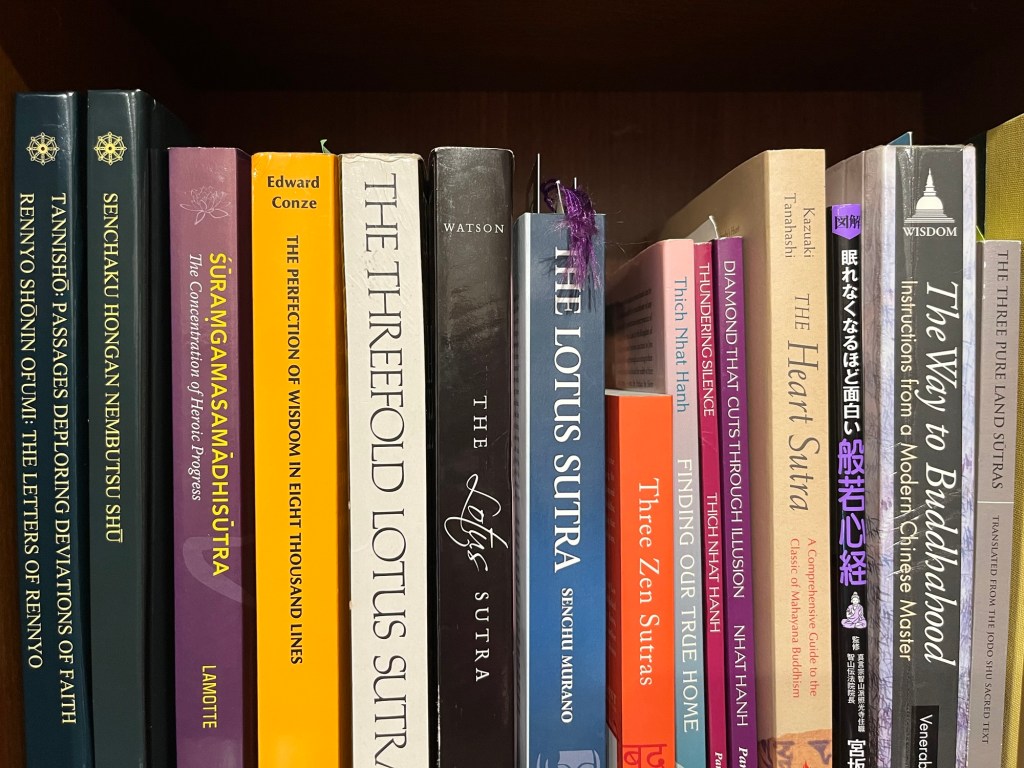
A photo of the Shurangama Sutra (the purple book on the left) from my personal collection. I purchased this years ago at Powell’s City of Books and haven’t found a copy since.
In my last post, I talked about Tetsugen Doko’s open-minded approach to Buddhist practice especially among his lay followers. But there was one thing that Tetsugen Doko did not compromise on.
In 1674 in the castle town of Mori (now Oita Prefecture), Tetsugen gave a controversial Buddhist lecture on the Shurangama Sutra, an influential Buddhist sutra in China not widely discussed in Japan. The lecture caused an uproar.
Tetsugen later summarized the lecture contents in an affadavit as follows (emphasis added):
I lectured first of all about the good and evil of the False Dharma and the True Dharma in the Final Age, which are referred to as the Three Absolutes in the Suramgama Sutra. Those who practice without keeping the precepts set out by the Buddha all represent the False Dharma. The reason for this [is as follows:]
Although practices such as chanting the Nembutsu, seated meditation, and reciting the sutras are each practiced differently depending on the abilities of the believer, the precepts against taking life, stealing, sexual misconduct, lying and the like are absolute, regardless of the sect. Not to keep them is unacceptable. Therefore these precepts are called “absolutes.”
This lecture earned him the ire of the local Jodo Shinshu community whose priests did not, by tradition, uphold any precepts. The local members rioted and multiple arrests were made by the authorities, who feared a return of the Ikko-Ikki riots, and Tetsugen quietly left town to avoid further trouble, especially for the feudal lord who had sponsored the lecture.
Nonetheless, more and more I believe that Tetsugen is correct: the basic lay precepts (a.k.a. the Five Precepts) should be front and center of one’s practice. Everything is grounded on that. Not the other way around, as I believed. What practices you choose to undertake are secondary to how you conduct your life the rest of the time.
I spent many years in my pursuit of the Buddhist path, fretting about doing the right practices, and chanting the right things, but these days I feel that the way to not be a dickhead is to simply stop acting like a dickhead. This is what the “training rules” of the precepts do: file away the sharper edges so that one’s Buddhist practice has a solid foundation.
Dr Helen J Baroni’s excellent book Iron Eyes covers the life and writings of Obaku Zen master Tetsugen Dōkō (鉄眼道光, 1630–1682). I’ve mentioned it in a fewolderposts, but I wanted to share a couple of Tetsugen’s poems really stood out to me:
41. MEETING AN OLD FRIEND
Separated east and west for twenty years.
You exclusively chant the Buddha’s [name, a.k.a. the nembutsu], while I practice meditation.
We meet together, why argue over high and low.
The wind and the moon originate in the same heaven.
Page 167
The “high and low” refers to the perception that the path of monastic self-discipline (as exemplified by the Zen tradition) is the “high road”, while the “low road” is instead relying Amida Buddha’s compassion to be reborn in the Pure Land. Here, Tetsugen argues that they both reach the same destination in the end, so the distinction doesn’t really matter.
Another poem he wrote is:
44. GIVEN TO THE FAITHFUL BELIEVER JONYU, WHO CHANTS THE BUDDHA’S NAME
The body is healthy, the years pour out; your ears and eyes are [still] clear.
Contented and unselfish, you reject personal glory.
Reflected light, in a single moment you penetrate the self.
For the first time you realize that practitioner and Dharma are complete in one body.1
Page 168
What really strikes me about these two poems is that Tetsugen openly acknowledges that his lay friends and followers recite the nembutsu and he’s totally fine with it.
It’s assumed in Japanese Buddhism that a sect practices meditation, or chanting, but not necessarily both. It’s also assumed that Zen people only hang out with Zen people, Pure Land Buddhists with Pure Land Buddhists, etc. There were exceptions: people like Ikkyu and Rennyo who were friends despite totally different practices and backgrounds, but you don’t hear about these often. Yet, in spite of this image, Tetsugen clearly was open to lay people practicing the Pure Land path and saw no conflict with this.
This makes more sense when you consider that Obaku Zen, a cousin of the Rinzai Zen sect, came to Japan from Ming-Dynasty China, when Zen and Pure Land thought had largely reconciled there. The excellent writings of Chinese monk Ouyi Zhixu (蕅益智旭, 1599–1655)2 and Yunqi Zhuhong (雲棲袾宏, 1535–1615)3 are typical of the thought at the time: both Zen and Pure Land Buddhism are different ways of approaching the same Dharma (e.g. Buddhism). One blends into the other.
Even modern Chan (Chinese Zen) teachers such as my favorite, Yin-shun (印順, 1906–2005), had no trouble recommending the nembutsu alongside other practices. In his book The Way to Buddhahood, he wrote:
If therefore, one is timid and finds it difficult to practice the bodhisattva-way, fearing that one will fall into the Two Vehicles or that following the karmic forces will cause one to drift apart from the Buddha Way, then chanting Amitabha Buddha is most secure! It is a wonderfully skillful means that can best embrace and protect those sentient beings who are beginners so that they do not lose their faith.
page 249
But I digress.
It should be noted that Tetsugen in particular was raised in the more native Jodo Shinshu-sect Buddhism and even went to Kyoto to train as a priest but eventually decided to pursue Obaku instead. So, perhaps he still had some connections toward his religious upbringing.
Nonetheless, all this is to say that Obaku Zen, having inherited such an outlook from Chinese Buddhism, takes Amida Buddha as its ideal, but sees Amida in more Zen terms. One is not required to see Amida that way upfront; it just comes in time with practice. Come as you are, and don’t worry if it doesn’t make sense. Someday, it will.
Namu Shakamuni Butsu Namu Amida Butsu
1 According to Dr Baroni’s footnotes: Kihō, can also be translated as “opportunity and Dharma,” in Pure Land thought, it means that while the sentient beings believe in the Buddha, the Buddha’s power saves sentient beings. Personally, I like to think this relates to Shoku’s comment about the Three Karmic Bonds, too.
2 Pronounced like “Oh-ee Jih-shoo” in English
3 Pronounced like “Yoon-chee Joo-hohng” in English
Recently, I found myself stuck in one of my usual nerd “rabbit holes” of trying to make sense of Zen lineages in Japanese Buddhism, but this led to a more complicated rabbit hole of making sense of the source “Chan” (Zen) lineages in China. This started after reading my new book on Rinzai Zen, which included a nice chart. At first, I tried to emulate and translate that chart in Canva, but then I realized it was missing some critical details, so I kept adding more. This is the result (click on the image for more detail):
Let’s go over this a bit so it makes more sense.
The premise behind all Zen sects regardless of country and lineage is that Zen started when the historical Buddha, Shakyamuni, supposedly held a flower up to his disciples and said nothing. Everyone was confused except his disciple Maha-Kashyapa who smiled in understanding. From here, according to tradition, the teachings were passed down from teacher to disciples for 28 generations in India, culminating in a monk named Bodhidharma who came to China.
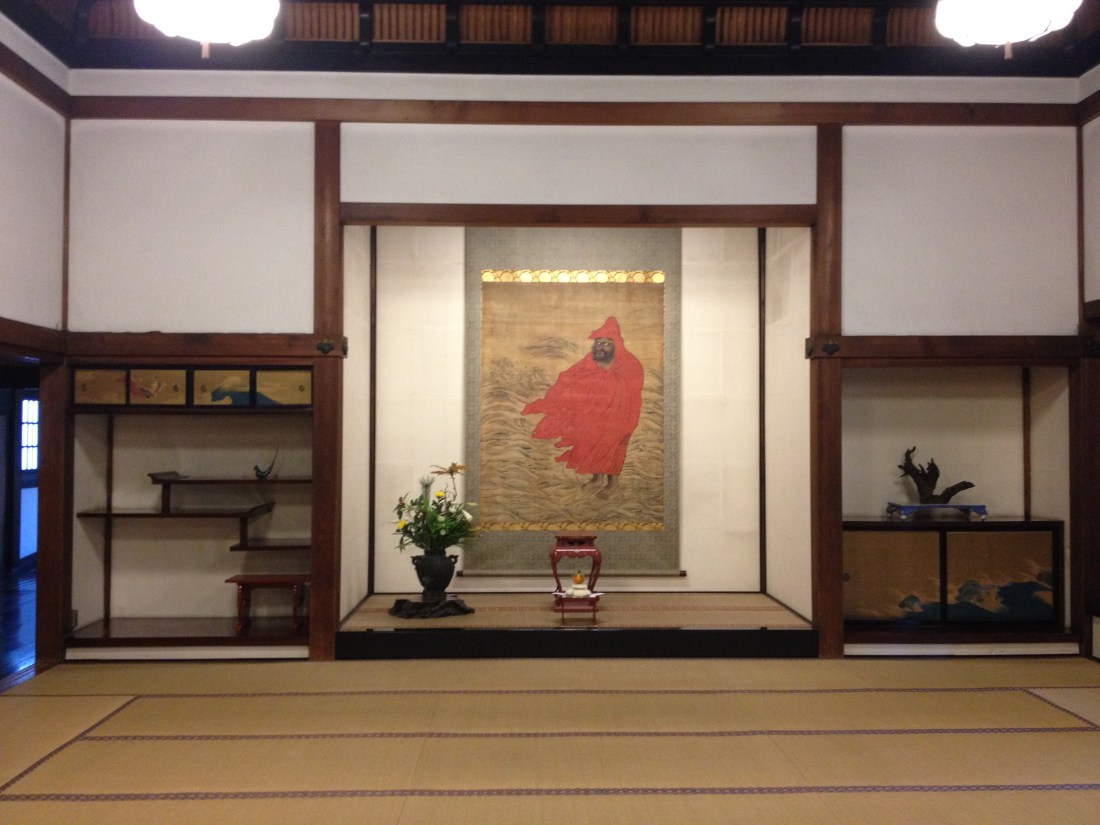
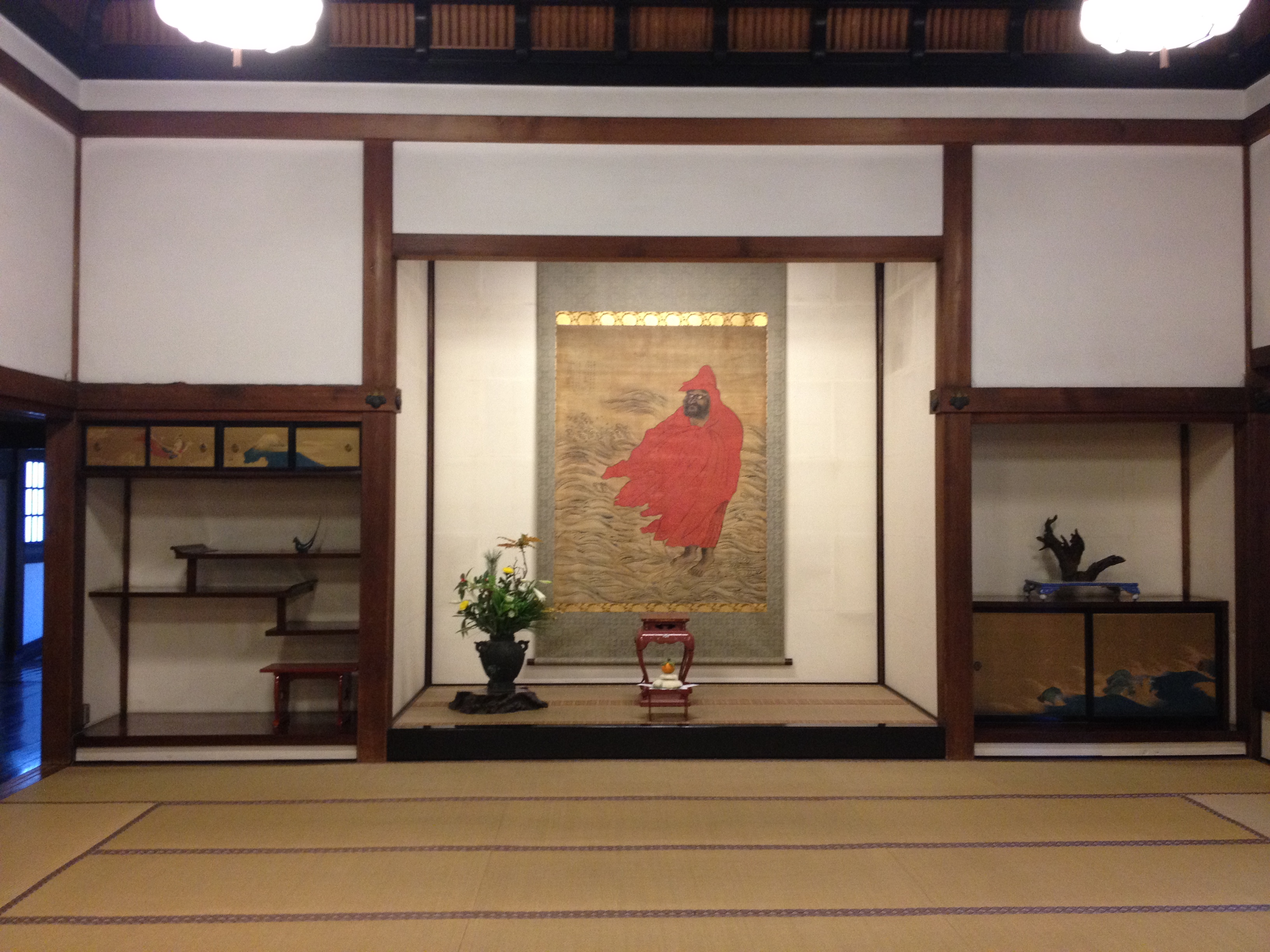
A painting of Bodhidharma at Sojiji temple (head of Soto Zen sect) in Kawasaki, Japan. Taken by me in 2010 (?).
The history up to this point is somewhat vague, and possibly apochryphal, but easy to follow.
This continues for a few more generations in China, until you get to a monk named Hui-Neng (Enō in Japanese)1 who is the supposed author of the Platform Sutra, a Chinese text. As the 6th “patriarch” of the lineage in China, he establishes what we know today as “Chan Buddhism” or Chinese Zen.
Things become more complicated a couple generations later as two descendants: Mazu Daoyi2 and Shitou Xiqian3 directly or indirectly found different schools of Chan Buddhism. This is known as the Five Houses of Chan period during the Tang Dynasty. Thus, the entire Chan/Zen tradition as we know it today is derived from Hui-neng and transmitted through these two men.
Out of the five houses, the Hongzhou,4Lin-ji and Cao-dong5 all survive in some form. The others are gradually absorbed into the Lin-ji school, which in the long-run is what becomes the most widespread form of Chan Buddhism in China. The Cao-dong school is the one exception, while the Hongzhou school’s success in Korea helps establish 8 out of 9 of the “Nine Schools of Seon (Chan)”6 in Korea. It through Bojo Jinul’s efforts in Korea that these nine schools are unified into the Jogye Order (homepage) which absorbed other Buddhist traditions in Korea into a single, cohesive one.
Meanwhile, in Japan, the Lin-ji and Cao-dong schools find their way to Japan where the names are preserved, but pronounced different: Rinzai and Soto respectively. Rinzai’s history is particularly complicated because they were multiple, unrelated transmissions to Japan often spurred by the Mongol conquest of China. Of these various Rinzai lineages, the two that survive are the “Otokan” Rinzai lineage through Hakuin, and the “Obaku” lineage through Ingen, but eventually the Otokan lineage absorbed the Obaku lineage. Today, Rinzai Zen is more formally called Rinzai-Obaku, or Rinnou (臨黄) for short. This is a bit confusing because Rinzai came to Japan under a monk named Eisai, and his lineage did continue for a while in Japan especially in Kyoto, but the lineage from the rival city of Kamakura ultimately prevailed and absorbed other Rinzai lineages. Obaku Zen arrived pretty late in Japanese-Buddhist history, and as you can see from the chart has some common ancestry with Rinzai, but also some differences due to cultural divergence and history.
Soto Zen’s history is quite a bit more streamlined as it had only one founder (Dogen), and although it did grow to have rival sects for a time, Keizan was credited for ultimately unifying these though not without some controversy even into the 19th century.
Anyhow, to summarize, the entire tradition started from a legendary sermon by the Buddha to Maha-Kashyapa, and was passed on over successive generations in India to a legendary figure who came to China and starting with Hui-neng became a tree with many branches. Yet, the roots are all the same. Speaking as someone who’s relatively new to the tradition, I realize while specific liturgy and practices differ, the general teachings and intent remain the surprisingly consistent regardless of culture or label.
Hope this information helps!
P.S. I had trouble deciding which term to use here: Zen or Chan or Seon since they all literally mean the same thing, but are oriented toward one culture or another. If this all seems confusing, the key to remember is that the entire tradition of Zen/Chan/Seon (and Thien in Vietnam) is all one and the same tree.
P.P.S. I realized that I never covered the Vietnamese (Thien, “tee-ehn”) tradition, but there’s so little information on it in English (and I cannot read Vietnamese), that I will have to differ that to another day.
1 Pronounced like “hwey-nung” in English.
2 Pronounced like “ma-tsoo dow-ee” in English.
3 Pronounced like “shih-tow shee-chee-yen” in English.
4 Pronounced like “hohng-joe” in English.
5 Pronounced like “tsow-dohng” in English.7
6 The Korean word “Seon” is pronounced like “sawn” in English. It is how the Chinese character for Chan/Zen () is pronounced in Korean Language.
7 If you made it this far in the post, congrats! I had to put so many footnotes in here because the Pinyin system of Romanizing Chinese words is a little less intuitive than the old Wade-Giles system. Pinyin is not hard to learn. In fact, I think Pinyin is better than the old Wade-Giles system (more “what you see is what you get”), but if you don’t learn Pinyin it can be confusing.better This is always a challenge with a writing system that strictly uses ideograms (e.g. Chinese characters). How do you write 慧能 into an alphabetic system that foreigners can intuitively understand. Also, which foreigners? (English-speaking, French-speaking, Spanish-speaking, etc). Anyhow, if you are interested in learning Chinese, I highly recommend learning Pinyin anyway because it’s quick and easy to pick up. BTW, since I posted about Hokkien recently it also has two different Rominzation systems: Pe̍h-ōe-jī (old, but widespread) and Tâi-lô (Taiwan’s official revised system).
Recently, I wrote about a Soto Zen sutra book I purchased some years ago, and it’s still one of the best books I own. Today, I wanted to highlight another Japanese-Buddhist sutra book that I had for years, but never really understood what it was about.
The book is available online here, among other places. The book was published by Nanzenji temple, a major Rinzai Zen temple, and I found it at a Kinokuniya bookstore here in the US in the Japanese-language section. It is titled 私の般若心経 (watashi no hannya shingyō, “My Heart Sutra [book]”)
The sutra book is really small, and easily fits in the palm of my hand. As the website description states, this is designed to that one can carry it on one’s person as a charm, but also use it for home liturgy. Pretty clever. I’ve seen such “sutra book charms” before but usually they are very small, and the print is lower-quality, since it’s meant to be carried, not read. This by contrast is very nice quality.
Inside, the contents are surprisingly dense for such a small book. Inside contains the texts necessary to do a home service according to Rinzai tradition, though it differs slightly from the one I posted previously.1
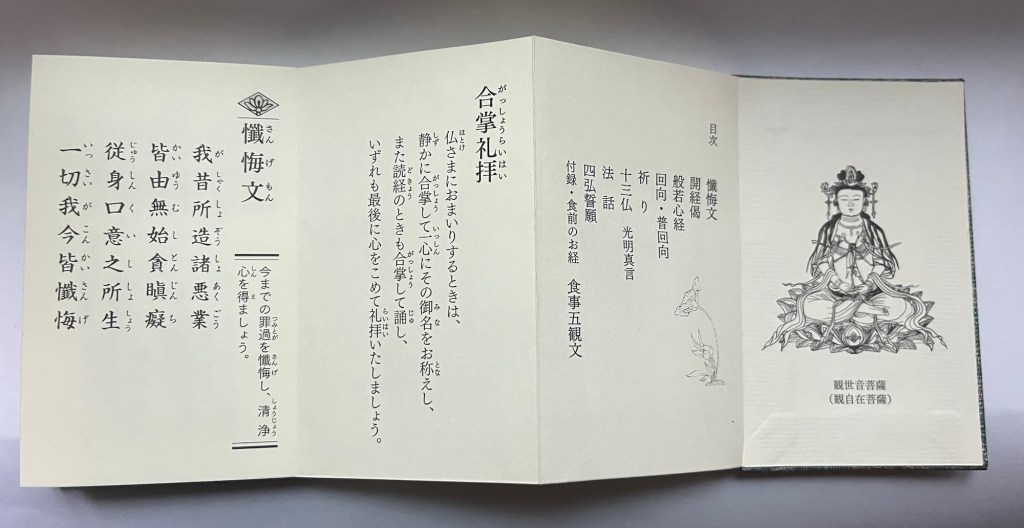
The contents, shown below include basic liturgy such as repentance verses, the opening of the sutra, a copy of the Heart Sutra, dedication of merit, four bodhisattva vows, and so on.
Above, we see the first four pages of the sutra book, from right to left: a picture of Kannon Bodhisattva, then the table of contents, an explanation about how to gassho, and finally the sangemon (verses on repentance).
Below, you can see the Heart Sutra from end to end (read right-to-left, vertically). If you can read Japanese hiragana script, you can recite this because each Chinese character is annotated with a pronunciation guide (a.k.a. furigana):
The furigana script is a bit small and hard to read, but that’s understandable given how small this book is.
Surprisingly, the sutra book contains other things I wasn’t expecting, such as mantras for the Thirteen Buddhas and Bodhisattvas, often recited during yearly memorials for the deceased. The book also the Mantra of Light, surprisingly. It also contains the five verses for contemplating food.
Finally, the book contains a sermon by the author, and has a handy blank section at the end for taking notes.
Weirdly, I’ve owned this book for almost 10 years, but back then I couldn’t read Japanese very well, so I didn’t fully appreciate what the contents of the book were, plus I had no familiarity with Rinzai Zen. Now that I have a bit more experience, I can appreciate this book a lot more, and have been using it for home liturgy lately.
For such a compact book, it’s really very nice, and only costs ¥550.
If you’re able to read basic hiragana script, and have an interest in Rinzai Zen, it’s definitely worth a purchase.
1 As noted in a previous post, Rinzai Zen in particular a number of lineages and factions, each one based around a different temple. This may help explain why the liturgy varies as much as it does.
As I write this post, I am in Dublin, Ireland on a short trip (business, not pleasure), helping my daughter get settled in for college. Thanks to timezone differences my daughter and I were awake at 11:30pm on a Friday and starving.
Taken near Trinity College and the main Bank of Ireland building (right).
Since a lot of pubs close their kitchens early, we went over to the local Supermac’s1 :
My daughter took this photo of her food. Mine is at the far end of the table (upper right corner).
It’s Friday night, so as we’re seated, people are stumbling in drunk looking for some cheap food, and there’s a steady stream of food delivery guys picking up orders. Still, even here, as I open my bag and eat my food, I try to still take a moment and appreciate the food, so I discreetly did gassho.
In Japanese culture, people will usually say itadakimasu before eating food, and gochisōsama deshita after finishing. The word itadakimasu is just the humble form of the verb “I receive”, and gochisōsama deshita means “It was a wonderful meal”.
But there’s also a set of verses that in the Zen tradition are recited before meals called the Shokuji Gokan (食事五観, “five observations at mealtime”). When I was watching a documentary recently, during mealtime, one of the Eiheiji monks walked the documentary host through the five verses. The five verses in Japanese for the Rinzaitradition are:
一つには、功の多少を計り、彼の来処を量る。 hitotsu ni wa, kō no tashō wo hakari, kano raisho wo hakaru
二つには、己が徳行の全闕を忖って供に応ず。 futatsu ni wa, onore ga tokugyō no zenketsu wo hakatte, ku ni ōzu
三つには、心を防ぎ、過貪等を離るるを宗とす。 mitsu ni wa, shin wo fusegi, togatontō wo hanaruru wo shū to su
四つには、正に良薬を事とするは形枯を療ぜんが為なり。 yotsu ni wa, masa ni ryōyaku wo koto to suru wa gyōko wo ryōzen ga tame nari
五つには、道業を成ぜんが為に、応にこの食を受くべし。 Itsutsu ni wa, dōgyō wo jōzen ga tame ni, ō ni kono jiki wo uku beshi.
The verses in Soto Zen appear to be slightly different. I am fairly certain, these are descended from Chinese Chan Buddhism, but I wasn’t able to find much information.
There are a lot of fine English translations available, though for now I am using the one from Sotozen.net:
We reflect on the effort that brought us this food and consider how it comes to us.
We reflect on our virtue and practice, and whether we are worthy of this offering.
We regard it as essential to free ourselves of excesses such as greed.
We regard this food as good medicine to sustain our life.
For the sake of enlightenment, we now receive this food.
In either case, the meaning is the same: before we take in the food, we should first reflect where it came from (and the countless people who made it possible),2 and whether we are living up to the practice or not. Finally, the verses remind us that food is essentially medicine (hence don’t be a pig), and that it helps us along the path toward Enlightenment. Even some chips (fries) at Supermac’s is something to be grateful for.
So, hello from Ireland, and will post more soon! 🇮🇪🖖🏼
1 The local version of McDonald’s, but ten times better.
2 The Jodo Shinshu tradition focuses on the concept of “gratitude“, so there’s a lot of overlaphere.
While reading my introduction book in Japanese about Rinzai Zen, I came across a famous set of paintings that I had totally forgotten about for thirty years.
Me at the age of 17 demonstrating the “Lion Roar Yoga” pose (?) at my world religions class in high school with my teacher. The Burger King crown was something I got from the nearby restaurant because my friends and I would race there during lunch break, eat for 5 minutes, and run back to class. Ah, teenage life….
Many, many moons ago, I was a cocky 17-year old first learning about Buddhism, and Mr Pierini was my World Religions teacher in high school. Mr Pierini was a charming, older Italian-American gentleman who had a lovely opera voice, and loved sharing cool ideas with us kids. This is how I first started to explore Buddhism beyond reading books at home.1
There were a number of things I learned about Zen then that seemed really cool and mystical. Looking back they made no sense to me, but they were fascinating. It sounded “cool” to be Zen, but admittedly, I was young, clueless, showing off, and knew nothing. Among the things I read about at the time were the Mumonkan and the Ten Oxen, texts that (I realize now) are both related to the Rinzai Zen tradition.
The Ten Oxen (shíniú 十牛 in Chinese) is a famous set of ten paintings, with poetic captions that were composed in the Southern Song Dynasty of China. The powerful Song Dynasty lost the northern half of China to the barbarian Jin Dynasty,2 and retreated to the south beyond the Yangtze River, where it held on for another 150 years. Despite having their back to a wall, the southern Song Dynasty oversaw a wonderful flowering of Chinese culture, including Buddhism, and especially Chinese “Chan” (Zen) Buddhism. This is also noteworthy, because historically this is the time when such monks as Eisai and Dogen both came to China from Japan to study Zen.3
The use of oxen as a symbol for taming the mind in Buddhism, according to Wikipedia, dates way back to early India including such texts in the Pali Canon as the Maha-gopalaka Sutta, but the Ten Oxen were a way to visually explain the Buddhist path (as described in the Chan/Zen tradition) to readers as a nice easy introduction. There were, evidentially several versions in circulation, but in Japan the version by one Kakuan (Chinese: Kuòān Shīyuǎn, 廓庵師遠) from the 12th century was all the rage during the Five Mountains Period of Japanese-Buddhist history. It is since known as the jūgyūzu (十牛図).
My book has a nice, down to earth explanation of the ten oxen and what they mean, so rather than posting the images with poetry, I wanted to share the simple explanations here. The illustrations are from Wikimedia Commons, and were originally painted by one Tenshō Shūbun (天章周文; died c. 1444–50).
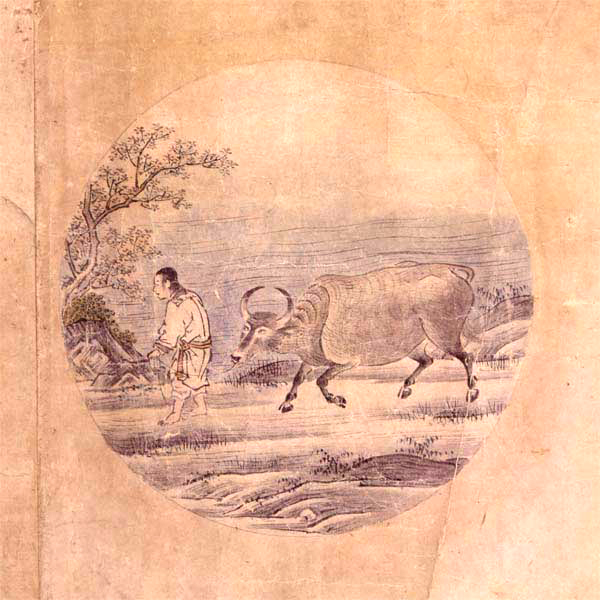
Searching for the ox
The cowherd is searching for his lost ox. The book explains that this is like someone looking for their lost Buddha-nature: that potential within us to awaken to full Buddha-hood (a.k.a. “Enlightenment”).
Footprints sighted
The cowherd now finds the footprints of his missing ox. This is like the Buddhist disciple who studies the Dharma (e.g. “Buddhism”), and gets the first hints at the true nature of things.
Ox sighted
Just as the cowherd sees his lost ox at last, the disciple of the Buddha grasps the point of the Dharma is (i.e. what’s it all about).
Grasping the Ox
One moment the cowherd has grasped the ox, another moment he is about to lose it. In the same way, my book explains that a person may perceived their true nature one moment, but lose sight of it again. The Buddhist disciple is still inexperienced and lacks certainty.
Taming the Ox
The wayward ox is now under control and lassoed, so the cowherd escorts it back home. For the Buddhist disciple, my book explains that through self-discipline such as the precepts, one’s delusions and conduct are brought to heel. This doesn’t mean they have resolved things, and one can still backslide, but at least they are under control now.
Riding the Ox
The cowherd is now confidently riding atop the ox, playing a flute. This means that one’s Buddha-nature is expressed through one’s form and behavior.
Forgetting the ox
Now that the cowherd is safely home with the ox, the ox is no longer a concern. My book explains that this symbolizes Enlightenment as one attains peace of mind.
Forgetting the distinction between self and ox
Here this empty circle expresses the Zen ideal that all is empty, and that there’s no distinction between oneself and the ox, or anything else for that matter; this is the Heart Sutra in a nutshell.
Back to basics
Having awakening to the nature of all things, things “return to the source” in a sense, or put another way, one sees mountains and mountains, trees as trees, etc. No more, no less.
Returning to society
My book explains that the cowherd now appears like Hotei (Chinese: Budai), the famous, jolly-looking figure in Chinese Buddhism and is in turn sharing the Dharma with another young cowherd. This cowherd will undergo the same quest, starting at picture one above.
In other words, everything comes full-circle.
In the same way, I don’t think teenage me imagined myself blogging about this 30 years later, and a bit more experienced, but life is funny that way.
Namu Shakamuni Butsu
1 Mr Pierini, thank you. 🙏🏼
2 Both would ultimately be destroyed by the Mongols especially under Kublai Khan who formed the Yuan Dynasty. This period of time is important to Japanese Zen history too because the influx of Chinese monks, especially Rinzai monks, to Kamakura-period Japan helped fuel a rise in Zen there. In the same way, the Fall of Constantinople in 1453 helped fuel the Renaissance in the West as refugees from the Eastern Roman Empire brought lost knowledge and know-how to the West. If there was any proof that we’re all connected in some way, look no further.
3 Earlier generations of Buddhist monks like Kukai (founder of Shingon) and Saicho (founder of Tendai) came to China during the Tang Dynasty, when connections to India were still flourishing. Hence, in Kukai’s case, he could study esoteric doctrine and Sanskrit directly from Indian-Buddhist monks. Centuries later, when Dogen and Eisai came to China, Buddhism had declined in India, and had gradually taken root in China in a more Chinese way. Of course, the Dharma is the Dharma, regardless of which culture and time it is taught, but it’s noteworthy that the Buddhism Dogen and Eisai was different: esoteric and scholarly Indian Buddhism had fallen out of favor, and a growing Zen (Chan in Chinese) community had largely replaced them.
I intentionally left this post in my blog draft folder for months, but now I am ready to post.
After a small revelation back in early May, I wanted to give it time and ensure that this change in Buddhist path wasn’t a spur of the moment decision.
After that little experience in May, I realized that I had misunderstood Zen Buddhism. Some of this is due to mixed experiences at local (Western) Zen communities,1 and in my opinion, systemic issues with Buddhist publications in English.3 Once I had better access to Japanese-language resources, and based on things I had sort of rediscovered, I decided to try to and go heads down for a few months and do my best to practice Zen as a lay person and parent.
My daily reminder list on my smartphone. A mix of mundane and Buddhist practice. 坐禅 means “zazen” and お勤め means “otsutome” (home service).
It took a lot of trial and error to get this right. At first, I had a tendency to succumb to self-doubt and start doing zazen meditation longer and longer, but then I would burn out, or have a busy day and skip. So, eventually I forced myself to keep it to five minutes, and I found I was able to sustain the practice more. Also, if I missee a day somehow, I would not punish myself over it.
Second, I struggled with how to do a Zen-style home service, so I had to do some research and this led to posts like this and this (these are for my own benefit as much to readers 😏 ). This home service underwent a few updates and changes over time, but I gradually settled on things over time, thanks to an old service I forgot I had.
Finally, I wanted to ensure I focused on Buddhist conduct as a foundational practice, and in particularly by upholding the Ten Bodhisattva Precepts. It’s also emphasized by such pastZenmonks as a foundation for other aspects of Zen, but compared to the basic Five Precepts, I found myself struggling both to remember what the Ten Precepts were, and also remembering to avoid things like not bring up the past faults of others, or harboring ill-will towards others. This is still a work in progress, but I assumed it would be. It took me many years of following the Five Precepts before it became second-nature.
Anyhow, since I started this little project four months ago, I am happy to say that I have mostly stuck with it. I can count the days I missed practice on my two hands, which over four months is pretty good. I realized that small, realistic, daily practice is much more effective than trying to focus on big retreats. So, in a sense, it’s been a big win and a learning lesson for myself.
But also I realized that I also really missed some aspects of the Pure Land practice that I had been doing up until this point. For me, I found that Pure Land Buddhism tends to appeal to the heart, while Zen appeals to the mind.
Dr. Janet Wallace: “The heart is not a logical organ.”
Star Trek, “The Deadly Years” (s2ep12), stardate 3479.4
So, my practice has continued to evolve to mostly Rinzai-Zen style practice, but also with a few Pure Land elements too. I suppose this is more inline with mainland Chinese Buddhism where such distinctions are less important than Japanese Buddhism, which tends to be sectarian. Also, if it works for Obaku Zen, it works for me.
So, that’s my update. Am I Zen Buddhist now? I don’t know. I am hesitant to use that label because I am hesitant to associate myself with that community. On the other hand, I’ve found it very beneficial so far, but I haven’t forgotten what I learned from Pure Land Buddhism either. So, I guess I am both, neither, whatever. At this point, taking inspiration from Chinese Buddhism: I uphold the precepts, meditate a bit each day, dedicate merit to loved ones and those suffering in the world, praise Amida Buddha, Shakyamuni Buddha, Kannon and the Lotus Sutra. Whatever label fits that is what I am these days. 🤷🏼♂️
Frankly, I stopped caring. I like how my practice has evolved these past months, and happy to continue.
P.S. Posting a little off-schedule, but oh well. Enjoy!
1 Not all experiences have been negative, but I have run into more than a few “Bushido Bros” and Japan nerds2 that soured my experience.
2 Yes, I am a Japan nerd too. I fully admit this, but nerds can be kind of intense and exhausting to talk to, so I don’t like to hang out too much with other Japan nerds.
3 It’s hard to quantify, but English books about Buddhism are either very dry, bland, and scholarly, or read like psychology self-help books, or just too mystical. When I read books in Japanese on similar subjects, I find them more down-to-earth and engaging. I know different people have different preferences, but I don’t like most English publications I find at the local bookstore. It is also why I try to share information (or translate if necessary) whenever I find it.
SPOCK: There are many who are uncomfortable with what we have created. It is almost a biological rebellion. A profound revulsion against the planned communities, the programming, the sterilised, artfully balanced atmospheres. They hunger for an Eden where spring comes.
Star Trek, “The Way to Eden” (s3e20), Stardate 5832.3
世の中よ道こそなけれ思ひ入る山の奥にも鹿ぞ鳴くなる。
Within this world there is, indeed, no path! Even deep in this mountains I have entered, heart set, I seem to hear the deer cry!
Recently, I came back from a camping trip, the last for our family before my daughter goes off to college. It was both good and bad. We stayed at Moran State Park on Orcas Island, Washington. I had been to Orcas Island a number of times over the years, but I had never really stayed there for personal reasons, so it was nice to explore at leisure for a change.
Cascade Lake near our campsite, which was very pristine and peaceful in the mornings. Our dog, Cherry, liked exploring here. The so-called “Indian Island” in Eastsound bay. This area was once a village belonging to a Salish people called the Lummi (official homepage), who grew camassia crops on that islet. A combination of disease from Westerners and raids by northern Salish tribes drove them to the mainland. That lone pine tree feels like a momument to the Lummi to me…A view from Mount Constitution, the highest peak on Orcas Island, facing eastward towards Washington State. I visited here many years ago as a kid on a school camping trip, but don’t remember much.
I posted the Star Trek quote above, not just because it sounds cool, but it does explore a side of us all: yearning for the simple country life. We all feel that revulsion toward modern life, and want to escape, yet even just after a couple days of camping in the woods, the smell of body-odor, noise from neighboring campers,1 and lack of food variety, Internet access, and electricity made us really eager to go back home. Even with modern amenities like gas stoves, freezer coolers and ready-made food (including instant ramen), it quickly gets old.
It wasn’t just me either. There was a lone woman camping just next to us. She brought her dog, and a stack of books to read, and seemed like an experienced camper, but it was clear that she wasn’t finding the solace she sought, and spent most of her time away from campsite to (presumably) find a quieter spot.
The fabled Eden sounds nice, but such a bucolic past probably never existed. Pre-modern life was in reality hard, exhausting, and safety was not always guaranteed.
Yet, modern life has its own challenges and dangers too. We might not die from dysentery anymore, but we often suffer obesity, isolation, and constant anxiety. We might not starve like our ancestors did, but we also eat some egregiously bad food thanks to mass-production and chemicals (including microplastics). Similarly, our fellow Man has replaced natural predators as the threat to our lives.
I don’t want to downplay the benefits of modern life, though.
The average2 lifespan of a human being in the 21st century is significantly longer than before. My little incident a couple years ago likely would have killed me before modern medicine. Dying in one’s forties was not uncommon in the pre-modern era. But the dangers of modern life are still there but now more subtle, yet catch up to us eventually.
In short, life is a struggle, no matter how long we live. Getting to old age without suffering any major health issues is something to be grateful for, but even more important is how you choose to live your life up to that point. As the Zen aphorism goes: every day is (sort of) a good day, so enjoy the moment, and try to live with some element of dignity and free of regrets.
Namu Shakamuni Butsu
1 There was a very rude family camped next to us. The mom kept yelling and swearing at her two toddler children, who in turn were constantly crying and talking back … at 4am in the morning. Ironically, the lady had a “Live Laugh Love” bumper sticker on her car.
2 The keyword here is “average”. A person in pre-modern times some people did live to their 80’s or 90’s, but the odds were against them. A single scratch leading to an infection, or a crippling injury, or a genetic precondition that we can treat now would often kill a younger person. So, if you did manage to live to a ripe old age, it was indeed a cause for celebration.
This is just another small, bonus post. A little while back, I was looking into the Obaku school of Zen, but even in Japanese information is pretty hard to find. However, I was able to find this sound clip from the NHK. This is a sound clip of a morning service at Manpuku-ji Temple, the head temple of the sect.
What distinguishes Obaku Zen (ōbaku-shū, 黄檗宗) from other Zen sects, and Japanese Buddhism in general is how late it was imported into Japan from China. Most sects imported during the Tang or Song dynasties, namely 8th or 11th centuries. But Obaku Zen came to Japan during the Ming Dynasty (14th century). It shares the same common lineage as Japanese Rinzai Zen, so they’re sibling sects. Yet, across centuries some things had diverged, and Obaku imports a lot more Ming-era Buddhist aspects, such as a fusion of Pure Land and Zen teachings (which came later in Chinese-Buddhist history), and changes to liturgy and pronunciation.1
So, if you ever see Obaku Zen liturgy (I’ve only seen a few screenshots), it sounds somewhat different even when it’s the same liturgy, because pronunciation changed over time in China.
Anyhow, just a minor nerd moment. Please enjoy!
1 Languages change and shift, including Chinese. Chinese-Buddhist liturgy imported to Japan from the Tang Dynasty would sound different than the same imported into Japan during the Ming. If that seems far-fetched, look at English language.















 Gleanings in Buddha-Fields
You must be logged in to post a comment.