All conditioned dharmas Are like dreams, illusions, bubbles, or shadows; Like drops of dew, or like flashes of lightning; Thusly should they be contemplated.
The Diamond Sutra, Translation courtesy of Lapis Lazuli Texts
It would be illogical to assume that all conditions remain stable.
Spock, “The Enterprise” Incident”, stardate 5027.3
The “Floating World”, or Ukiyo (浮世) is an old Buddhist term meaning the world of fleeting forms and temporary joys we live in as part of Samsara. It later became, in the 16th century onward, a term for the pleasure quarters of the city of Edo (later Tokyo) when it became the capital of the new Shogunate. The idea was simple: the pleasure quarters offered everything a person could want, if they could afford it, even if it was just part of the mundane, effervescent world.
Block print titled Taking the Evening Cool by Ryōgoku Bridge, c. 1745, by Okumura Masanobu, Public domain, via Wikimedia Commons
But it’s not hard to see that this kind of Floating World, with all its glamour and joys, can be found almost anywhere at any time. Even modern Pop Culture and entertainment, even social media, is just another form of the Floating World.
It’s not that the Floating World, modern Pop Culture, or social media inherently are evil, but they glosses over the pains and realities of life. For every successful actor or actress in Hollywood, it’s not hard to find many others who scrape by. Even those who succeed pay a very heavy price. For every person who greets you at the five-star restaurant with a smile, there are countless people in the back who are slaving away to wash the dishes, cut vegetables, and so on, to say nothing of the waiter’s own personal pains and dilemmas. For every pretty girl who smiles at you, she is glossing over her own pain and trauma. And so on.
Scratch the veneer and see a lot of people working hard to make customers, listeners or viewers happy, but themselves are stressed, exhausted, miserable, or unhappy with their lives.1Just like the rest of us.
In a sense, the whole thing is a golden sham.
And yet, why do we still gravitate toward such things, even when we know they are transient and don’t provide any lasting happiness? I am no different. When I’ve had a hard day at work, and after dinner with the family, I don’t meditate; I sit down and play a Fire Emblem game. Even Lady Izumi, a thousand years ago, lamented her inattentiveness.
Because we are human, and being human is hard sometimes.
Still, it’s worthwhile to see one’s own behavior and learn from it: the way we flit from something fun to something else fun. Even that can be illuminating. I learned a thing or two just writing this post. 🤔
But yes, life is hard, and it hurts, and it’s exhausting. The joys in life are fleeting, and yet we chase after them for even a temporary respite.
The joke here is a Japanese-Buddhist monk looking at a receipt from Muji (a Japanese home goods store), and commenting that this “sacred text” shows they purchased a lot.1 This happens to us too.
Anyhow, what is a sacret text in Buddhism?
Buddhist sacred texts are called sutras (sometimes suttas), from the old Indian Sanskrit word.2
Buddhism doesn’t have one sacred text like you would associate with the Bible, Q’uran, etc. Instead, it has layers and layers of sacred texts.3
I won’t get into why there are so many layers, but suffice to say that the Buddhist tradition holds the sutras as genuine sermons of the Buddha (a.k.a. Shakyamuni Buddha) which have been passed down generation after generation until today.
Sometimes sutras, or teachings contained therein, are repackaged into newer sutras, especially in the Mahayana Tradition, but the underlying teachings, the Dharma, are believed to be just as important. Think of Spiderman: every few years there’s another Spiderman movie, some more popular than others, but the underlying lore of Spiderman is always the same.4 The history of Buddhist sutras is awfully similar in this respect.
What’s important isn’t so much the specific text of a specific sutra, but the Dharma. In the same way, although Shakyamuni Buddha is very important, the Dharma he taught is even more so.
Because there are so many sutras, this also leads to many sects, schools, and traditions within Buddhism. Each sect or school strives to apply the Dharma as best they can, based on whatever sutra is considered most appropriate.
So how do we know if the Dharma is true? Because it can be applied in one’s own life, through good conduct, meditation, lifestyle choices and so on. If your doctor tells you to lose weight and exercise more, the results speak for themselves. Buddhism is a lot like this.
Should a Buddhist read all the sutras? No, there are simply too many. Some ate huge. It’s often best to start with one or two that are already part of the tradition you are interested in. From there, you can branch out as you see fit. Ask your local community if you need recommendations.
Also, an important tradition across all of Buddhism is reciting sutras. Some sutras are very short and can be recited as a whole. Other sutras are much too long, so people recite key passages only.
This tradition of reciting sutras not only helps internalize the teachings (make them a part of you), but also helps connect to the Buddhist tradition at large. People have been reciting the Buddha’s teachings from the very beginning, 2,500 years ago. When we recite and put the teachings into practice, we are another link in the chain.
Buddhism has no “holy” language, so you can recite them in your local translation, or use a liturgical format that fits your preferred tradition. Or switch between one and the other.
A booklet with the Heart Sutra used in Japanese Buddhism, which I posted about here.
What’s important is that followers make the teachings a part of their lives somehow. This helps them apply the Dharma and also generate good merit to help others. The Buddhist path is not a solitary path: we are all in this together.
Namu Shakamuni Butsu
Namu Amida Butsu
1 Muji is a great store, and there are a few oversea outside of Japan. You can find clothes, household items, stationary and so on. We shop at Muji in Japan whenever we visit there, but also have visited Muji stores along the West Coast as well.
2 Related distantly to the English word suture as in a thread. Old sutras were often palm leaves or tree bark threaded together to form a kind of book.
3 HInduism too, iirc.
4 Even when it’s Miles Morales vs. Peter Parker (or Gwen, or other Spider people), the lore is the basically the same.
When visiting famous Buddhist temples (o-tera, お寺) in Japan, it’s very common to see sutra books, or kyōten, (経典), sold in the gift shop. These are small booklets that contain popular Buddhist sutras of the Mahayana tradition, and are used for home services. Over the years, I’ve collected more sutra books than I care to admit, but I really liked the one I picked up from Kofukuji temple in Nara last year:
This is a boxed copy of the Heart Sutra, called the Hannya Shingyō (般若心経), with a blue brocade cover. Inside, you can see the Heart Sutra as it is usually printed: original Chinese characters with Japanese pronunciation guides. It is read from right to left, vertically:
However, if you look carefully, you will also see Buddhist deities embossed on the pages too:
They also appear on the backs of the pages too:
It took me a moment, but I finally recognized these as the Thirteen Buddhas and Bodhisattvas venerated in the Shingon-Buddhist tradition.1
I have read that many of the old Nara-Buddhist sects were gradually subsumed by Shingon Buddhism and adopted many of its practices. This includes sects such as the Kegon sect (Todaiji temple) and Hosso sect (Kofukuji temple) among others. So, this makes sense. You can learn more about Shingon Buddhism here.
Anyhow, of all the sutra books I own, I have to admit that this is my favorite one, and use it regularly for morning services (see old post).
P.S. If you’re ever curious what the Heart Sutra sounds like in Chinese (at least modern Chinese), this link has a nice example.
1 These Buddhas and Bodhisattvas are venerated in other sects in varying degrees, of course, but not as a set of thirteen like Shingon. Shingon even includes them in its ritual services.
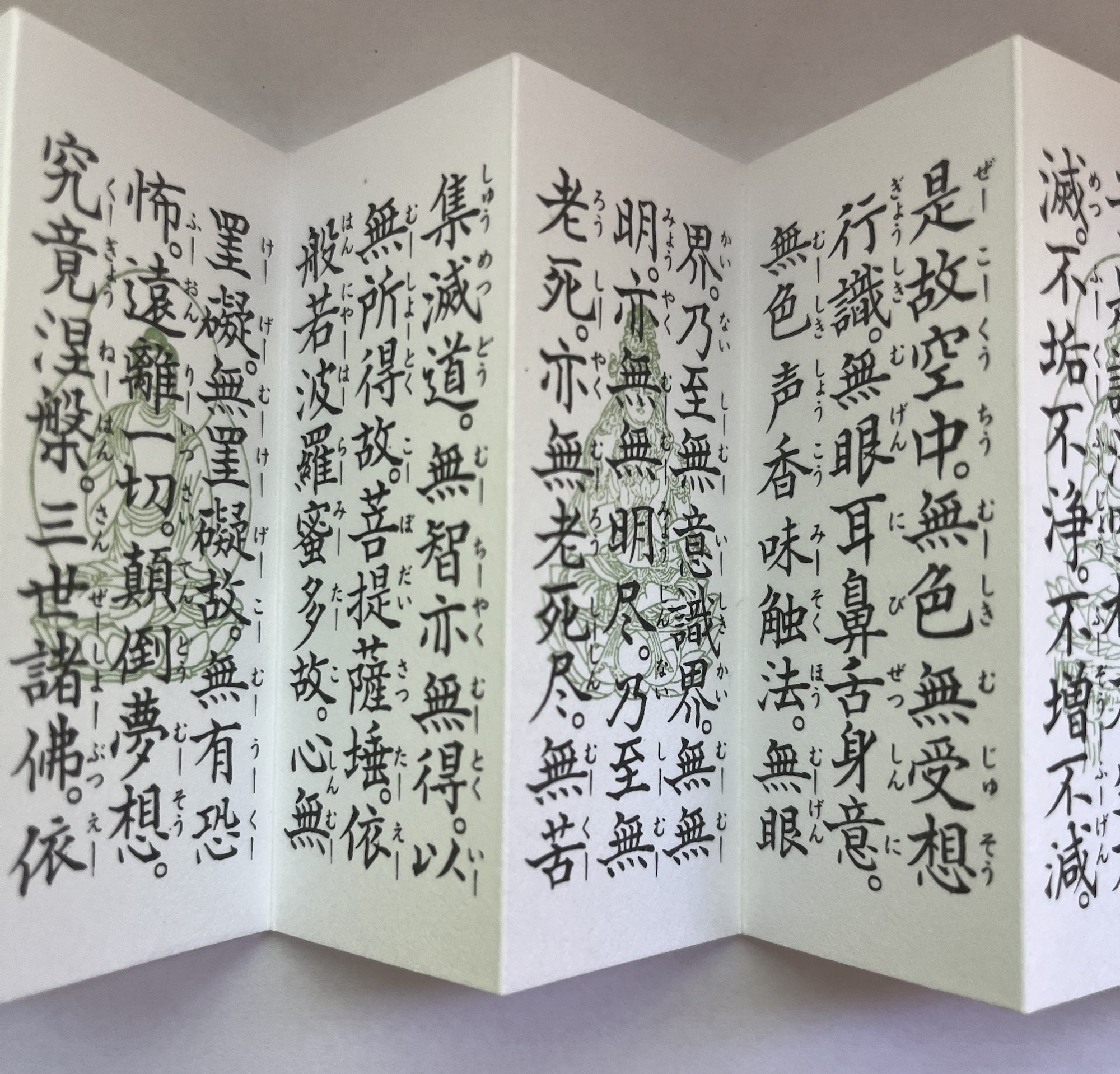
This is a photo from a sutra book I frequently use for daily services. I bought this book years ago from the temple of Sensoji (a.k.a. Asakusa Temple) in Tokyo, Japan, a place that I have visited many times over the years.
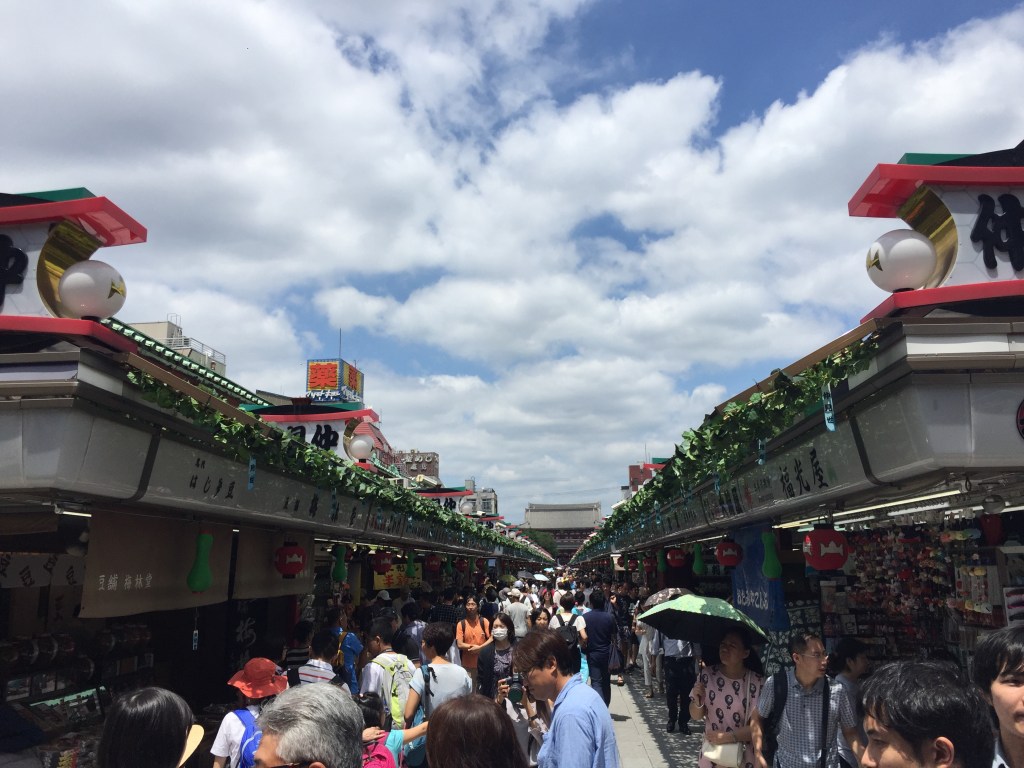
A photo I took in 2016 of the famous market of nakamise-dōri. The actual temple is way in the back.
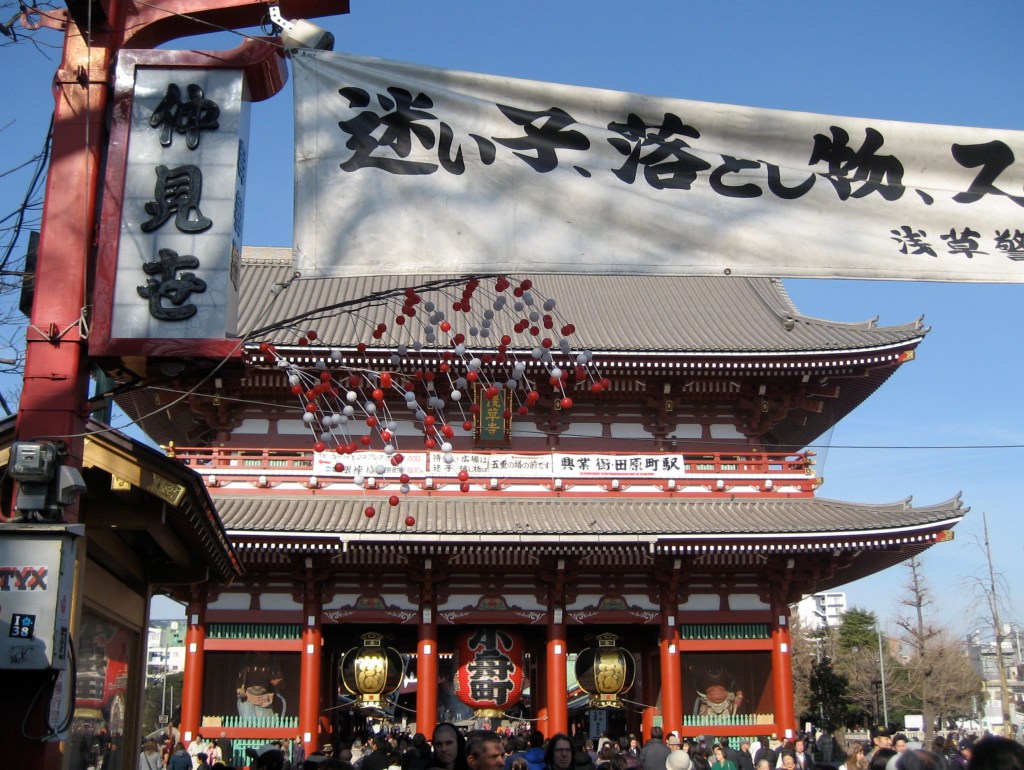
The temple just after New Year’s, taken in 2009.
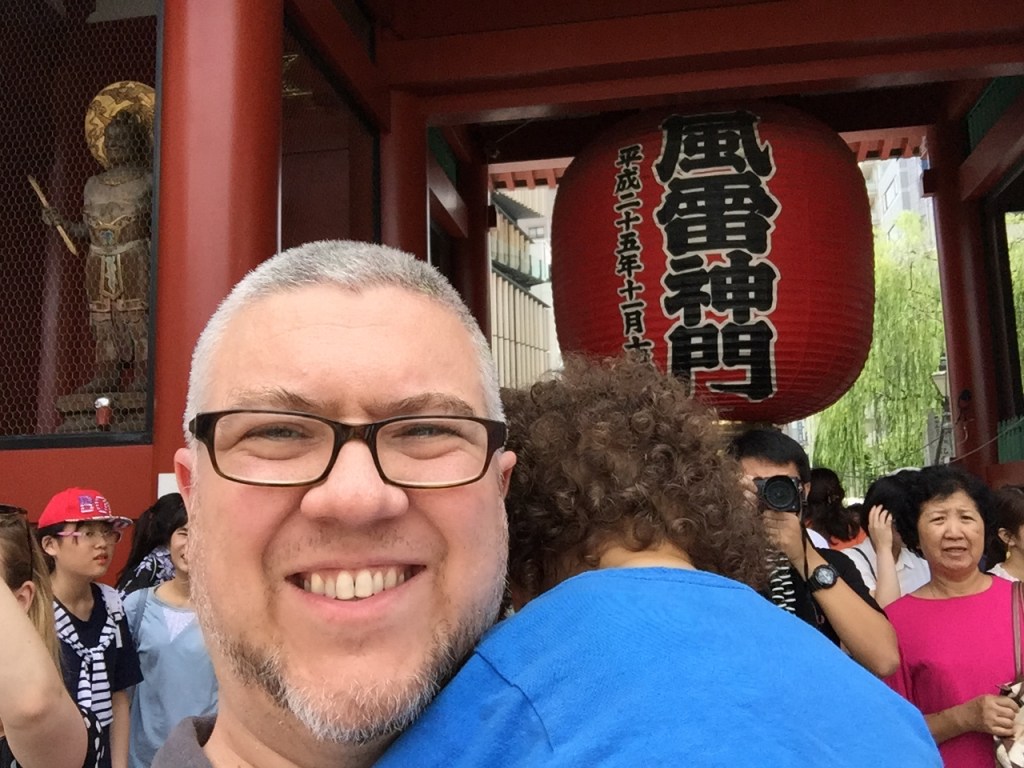
Me carrying one tired little boy at the iconic kaminari-mon gate in 2016. Note the giant red lantern in the back.
It is still one of my favorite temples, even if a bit touristy, and of the Buddhist sutra books I own this is still one of my favorite to use.1 This sutra book uses the traditional Classical Chinese with Japanese pronunciation guides (furigana), which is pretty typical of Japanese-Buddhist sutra books. As you can see, it’s not a long sutra to recite. It is probably the shortest sutra in the entire Buddhist canon.
Chanting the Heart Sutra is something many Buddhists in the Mahayana tradition (everything you see from Tibet to Japan, and overseas) do both in group services and in home services. People chant it in many languages and styles. Its simplicity, and general message about the nature of reality means that it tends to cut across sectarian lines and is popular in many sects and communities. Its cryptic and profound nature also means that for a one-page sutra it is the subject of intense study and research.
The sutra, for reference, is shown below. I used the standard Japanese liturgical form, recited in Zen temples, Tendai temples, Shingon temples, and so on, with only very minor differences per tradition. However, there are many ways and languages to recite the Heart Sutra.
kan ji zai bo satsu gyo jin han nya ha ra mi ta ji
When Avalokiteśvara Bodhisattva was practicing the profound Prajñāpāramitā,
照見五蘊皆空。
sho ken go un kai ku
he illuminated the Five Skandhas and saw that they were all empty,
度一切苦厄。
do is-sai ku yaku
and crossed over all suffering and affliction.
舎利子。色不異空。
sha ri shi shiki fu i ku
Śāriputra, form is not different from emptiness, and
空不異色。
ku fu i shiki
emptiness is not different from form.
色即是空。
shiki zoku ze ku
Form itself is emptiness, and
空即是色。
ku zoku ze shiki
emptiness itself is form.
受想行識亦復如是。
ju so gyo shiki yaku bu nyo ze
Sensation, conception, synthesis, and discrimination are also such as this.
舎利子。是諸法空相。
sha ri shi ze sho ho ku so
Śāriputra, all dharmas are empty:
不生不滅。
fu sho fu metsu
they are neither created nor destroyed,
不垢不浄。
fu ku fu jo
neither defiled nor pure,
不増不減。
fu zo fu gen
and they neither increase nor diminish.
是故空中。
ze ko ku chu
This is because in emptiness
無色無受想行識。
mu shiki mu ju so gyo shiki
there is no form, sensation, conception, synthesis, or discrimination.
無眼耳鼻舌身意。
mu gen-ni bi zes-shin i
There are no eyes, ears, nose, tongue, body, or thoughts.
無色声香味触法。
mu shiki sho ko mi soku ho
There are no forms, sounds, scents, tastes, sensations, or dharmas.
無眼界。
mu gen kai
There is no field of vision and
乃至無意識界。
nai shi mu i shiki kai
there is no realm of thoughts.
無無明。
mu mu myo
There is no ignorance
亦無無明尽。
yaku mu mu myo jin
nor elimination of ignorance,
乃至無老死。
nai shi mu ro shi
even up to and including no old age and death,
亦無老死尽。
yaku mu ro shi jin
nor elimination of old age and death.
無苦集滅道。
mu ku shu metsu do
There is no suffering, its accumulation, its elimination, or a path.
無智亦無得。
mu chi yaku mu toku
There is no understanding and no attaining.
以無所得故。
i mu sho tok-ko
Because there is no attainment,
菩提薩埵。依般若波羅蜜多故。
bo dai sat-ta e han nya ha ra mi ta ko
bodhisattvas rely on Prajñāpāramitā,
心無罜礙。
shin mu kei ge
and their minds have no obstructions.
無罜礙故。
mu kei ge ko
Since there are no obstructions,
無有恐怖。
mu u ku fu
they have no fears.
遠離一切顛倒夢想。
on ri is-sai ten do mu so
Because they are detached from backwards dream-thinking,
究竟涅槃。
ku gyo ne han
their final result is Nirvāṇa.
三世諸仏。
san ze sho butsu
Because all buddhas of the past, present, and future
依般若波羅蜜多故。
e han nya ha ra mi ta ko
rely on Prajñāpāramitā,
得阿耨多羅三藐三菩提。
toku a noku ta ra sam myaku san bo dai
they attain Anuttarā Samyaksaṃbodhi.
故知。般若波羅蜜多。
ko chi han nya ha ra mi ta
Therefore, know that Prajñāpāramitā
是大神呪。是大明呪。
ze dai jin shu ze dai myo shu
is a great spiritual mantra, a great brilliant mantra,
是無上呪。是無等等呪。
ze mu jo shu ze mu to do shu
an unsurpassed mantra, and an unequalled mantra.
能除一切苦。真実不虚故。説般若波羅蜜多呪。
no jo is-sai ku shin jitsu fu ko ko setsu han nya ha ra mi ta shu
The Prajñāpāramitā Mantra is spoken because it can truly remove all afflictions.
即説呪曰。
soku setsu shu watsu:
The mantra is spoken thusly:
羯諦羯諦波羅羯諦波羅僧羯諦菩提薩婆訶。
gya tei gya tei ha ra gya tei hara so gya tei bo ji so wa ka
gate gate pāragate pārasaṃgate bodhi svāhā3
般若心経
han nya shin gyo
The Heart Sutra
You can see a really nice example of this chanted here, courtesy of Koyasan Temple in Japan:
I have been reading Tanahashi’s book about the Heart Sutra and learning a lot about its various interpretations, how it’s conveyed in various languages, and various theories about its origin. I was fascinated to learn that there is a Mongolian version sometimes transcribed in Cyrillic. None of this is strictly necessary for the purposes of Buddhist practice, but it is fascinating. The example I showed above uses what’s called “Sino-Japanese”: Japanese pronunciation of the original Chinese characters it was composed with.2
As for chanting the sutra, I’ve been doing it for years, so I can more or less recite the Sino-Japanese version from memory, and am pretty comfortable doing it that way. I study the meaning of the sutra in English of course. I also have a PDF file for chanting in Sino-Japanese available for those interested.
I have also attended Zen centers on rare occasions (I tend to lean toward Pure Land Buddhism, to be honest) and seen the Heart Sutra recited using English. Learning the English meaning is very useful, but English chanting sounds a bit awkward to me. So, I prefer chanting in the original, and study the meaning separately.
But regardless of what language you use, the Heart Sutra, like all Buddhist sutras, has a funny tendency to gradually “sink in” over time. The meaning may not make much sense at first, but over the course of months and years, it takes on new meaning as you go through life, and see the sutra in a new light. I believe that’s the real value of Buddhist chanting: to internalize key Buddhist teachings in a way that you can carry with you throughout life.
As for me, these days, I tend to recite a Tendai-style home service,4 and as part of that I rotate between chanting this and a certain, small excerpt of the Immeasurable Life Sutra called the shiseige (四誓偈) or juseige (重誓偈) in Japanese Buddhism. When I finish one, I put it under the other sutra book, so I don’t forget which sutra to recite next time as I might go a week or two before reciting again. As a short, traditional liturgy, I am pretty content.
As with any Buddhist practice done over a long period of time, I believe that it gradually polishes the mind, and dispels one self-centered viewpoint. It’s super simple to do, but its benefits last a lifetime. To paraphrase Nichiren, when dying cloth in indigo, the more you do it, the deeper the color becomes.
Namu Amida Butsu Namu Kanzeon Bosatsu
Edit: I discovered in May 2025 some egregious mistakes in the formatting of the sutra above. This was not a problem with the translation, but with mistakes in how I copy-pasted into the blog post. I have since corrected these mistakes. Apologies to anyone who used the flawed copy of the sutra.
P.S. It’s tempting for some to look for an original “Sanskrit” version of the sutra, but alas, the best we know today is that the sutra was compiled originally in China, using excerpts from the much, much larger Prajña-paramita sutras. The story of how exactly that came to be is a much-discussed subject in Tanahashi’s book.
P.P.S. Fun fact: the version of the Heart Sutra used in Japan differs very slightly from the popular version attributed to Xuanzang. The Japanese version, popularized by the Shingon esoteric tradition, is called the rufubon (流布本) version. It has two extra Chinese characters (262 total) from Xuanzang’s 260, and uses slightly different characters for pronouncing the mantra at the end: 揭諦 instead of original 揭帝 for Sanskrit gaté.
1 Because it is devoted to Kannon Bodhisattva, this sutra book also includes (left in photo) a certain Japanese-Buddhist verse called the Jikku Kannon-gyō (十句観音経, “ten verse Kannon sutra”) popularized in the middle ages. I made a post here about it.
A nice explanation of the meaning and history of the ten-verse sutra can be found here.
2 It’s sometimes assumed that the sutra’s earliest composition was in a language like Sanskrit or something else from India, but research has long since proven that the Heart Sutra was a Chinese innovation, a summary of the much longer Perfection Wisdom Sutras, distilled into a very compact, chantable essence. The monk Xuan-zang later brought it back to India, where it later came to Tibet. Pretty clever actually.
3 I decided to leave the Sanskrit mantra untranslated, per esoteric-Buddhist tradition.
4 I like the Tendai approach to Buddhism because it encompasses all the things that are important to me, but avoiding a narrow, dogmatic approach that I found in the past and ultimately rejected.
Author’s note: this is a post from the old blog that I am reposting as a handy reference, with some extra updates and polish. Enjoy! 😄
One concept that often frustrated me in my early years as a Buddhist was the bodhisattva. Bodhisattvas are central to Mahayana Buddhism, that is all Buddhism from Tibet to Japan (and now overseas), and it seems like everyone had a different idea what a bodhisattva is.
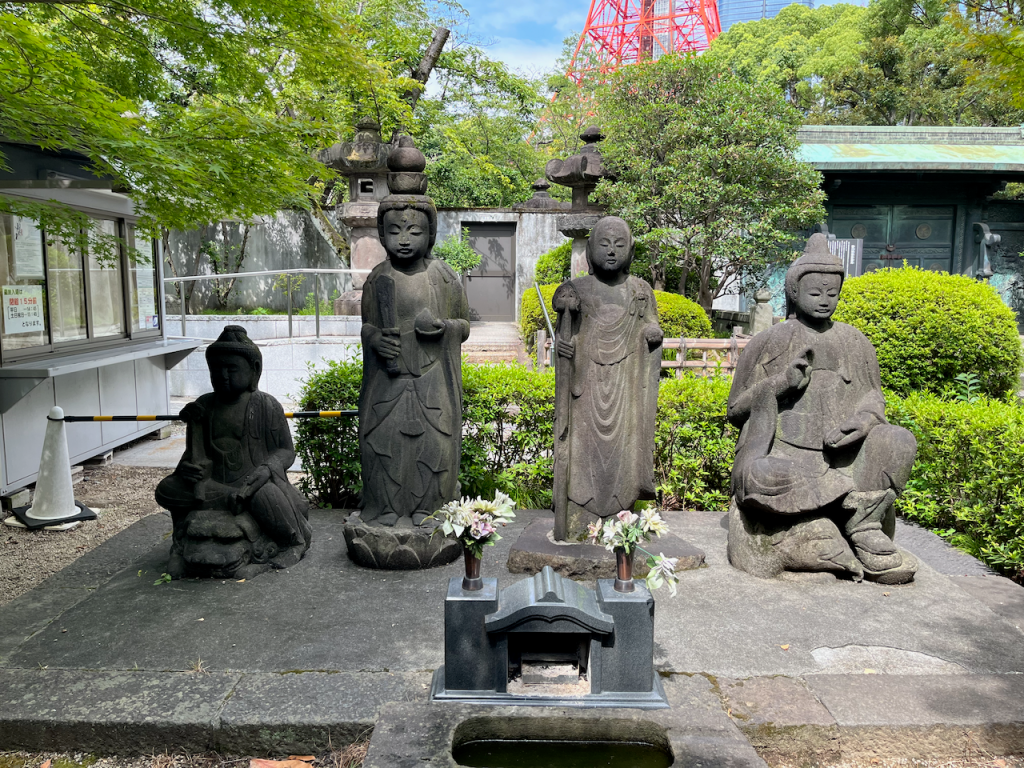
A series of statues at Zojoji Temple in Tokyo, Japan depicting four famous bodhisattvas in the Mahayana tradition. From left to right Manjushri (Monju), Avalokitesvara (Kannon), Ksitigarbha (Jizo), and Samanthabhadra (Fugen).
So, one time I decided to research this and hopefully provide a more comprehensive answer. This is still one man’s explanation, so take it with a grain of salt, but I did use the following sources:
Edward Conze – Buddhist Thought in India (ISBN 0472061291)
Robert E. Buswell Jr., Donald S. Lopez Jr. – Princeton Dictionary of Buddhism (ISBN: 0691157863)
Access to Insight – one of the best sources on Theravada Buddhism, and a great Buddhist resource in general.
Tagawa Shun’ei, translation by Charles Muller – Living Yogacara: An Introduction to Consciousness-Only Buddhism (ISBN: 0861715896)
Asvaghosha, translation by Yoshito S. Hakeda – The Awakening of Faith (In the Mahayana) (ISBN: 0231030258)
And the following sutras (or collections of sutras) were used:
In simplest terms a bodhisattva in Sanskrit, or bodhisatta in Pāli, means a “seeker of enlightnment”. In the earliest scriptures, the Buddha would talk to his disciples about his own past lives as a bodhisattva, such as this sutra in the Pali Canon:
“Bhikkhus [monks], before my enlightenment, when I was still only an unenlightened Bodhisatta, I too, being myself subject to birth, sought what was also subject to birth; being myself subject to aging, sickness, death, sorrow, and defilement, I sought what was also subject to aging, sickness, death, sorrow and defilement….”
In this context, the term bodhisattva mainly referred to the past lives of the historical Buddha, Shakyamuni. In his past lives, when he dwelt in the heavenly realm called Tuṣita (Tushita) and then was born as a prince in India, he was on the cusp of Enlightenment, and only needed that final push. Further, early texts, such as the Jatakas Tales, also imply that this Enlightenment was actually the culmination of many previous lifetimes of searching, effort, and noble deeds. Thus the path of the Bodhisatta who became the historical Buddha was thought to imply an extraordinary, lengthy journey across many lives culminating in final enlightenment.
Later Teachings
In later generations, the role of the Bodhisattva expanded beyond the historical Buddha, and appears more and more often in Buddhist literature. However, it is not the case though that Bodhisattvas are found in Mahayana Buddhism only though. For an excellent treatment of the subject, I highly recommend reading this article by Bhikkhu Bodhi.1 It was just that the path seemed too remote and arduous for most disciples, especially since the presence of a living Buddha allowed them to reach enlightenment much more quickly as Śrāvaka (shravaka) or “hearer-disciple”.
Anyway, in the classic Buddhist model, the historical Buddha was something like a “first among equals”, in that the quality of enlightenment experienced by Arhats (e.g. “noble ones”) was the same as the Buddha. However, Buddhas were distinguished from Arhats by additional qualities that made them almost suprahuman. A Buddha is one who, among other things, gains insight into the truth at a time when the Dharma is unknown (i.e. no other Buddha to teach them), which requires extraordinary spiritual insights and qualities, not to mention their capacity to teach others in such a way that they become enlightened too, and can carry the Dharma onward for generations. This was the contrast between a Buddha and an Arhat.
Over time, the Buddhist community began to explore more and more the notion of becoming a Buddha too (e.g. Buddhahood), and thus the role of the Bodhisattva became increasingly important. As a result, the status of a bodhisattva was elevated over arhats, such that arhats were considered noble, but somewhat inferior to Buddhas and Bodhisattvas.
How Do Arhats, Bodhisattvas and Buddhas relate?
A number of models to explain the relationship between buddhas, bodhisattvas and arhats developed over the course of Buddhist history. As we saw earlier, the original model really only included arhats and buddhas. However, the influential Yogacara school of Mahayana Buddhism (of which the Hossō school in Japan is one of the few independent remnants) taught that different beings had different, inherent natures that would incline them toward the Buddhist path of an arhat, bodhisattva (and thus a Buddha), indeterminate or even those whom enlightenment was impossible.
However, the most popular model in Mahayana Buddhism became the Ekayāna or “One-Vehicle” model. This was popularized by the Lotus Sutra which taught that all disciples would inevitably follow the same path, even if they appeared different at first. Each path (arhat, bodhisattva, etc) were part of the same natural progression and would ultimately converge. In the famous “Parable of the Burning House” in Chapter Three, the father says to his children in the burning house:
“Such a variety of goat carts, deer carts, and bullock carts is now outside the gate to play with. All of you must come quickly out of this burning house, and I will give you whatever you want.”
This parable, the Buddha explains, is meant to show that all followers seem to be following different trajectories, yet ultimately they all converge on the (Mahayana) Buddhist path and become bodhisattvas and then ultimately Buddhas.
Later, starting in the sixth chapter, the Buddha then predicts that his senior monks and nuns, all presumed to be arhats, will eventually become Buddhas. This again emphasizes that the arhat stage is not separate, but a kind of prepartory stage before the “real” Buddhist path begins. Again though, we see that arhat is considered a noble but somewhat inferior status to the bodhisattva, and that their enlightenment is somehow incomplete when compared to the enlightenment of a Buddha. Nevertheless, the arhat is still revered and respected in Mahayana Buddhism. For example, in the Amitabha Sutra, the historical Buddha describes the Pure Land of Amitabha Buddha like so:
Moreover, Śāriputra, he [the Buddha Amitabha] has an innumerable and unlimited number of śrāvaka disciples, all of them arhats, whose number cannot be reckoned by any means. His assembly of bodhisattvas is similarly vast …. Śāriputra, those sentient beings who hear of that land should aspire to be born there. Why? Because they will be able to meet such sages of supreme virtue.
Translation by Rev. Hisao Inagaki
Anyhow, we have talked quite a bit about the history of the bodhisattva, but in part two we’ll discuss how the sutras describe and define a bodhisattva, and how they relate to the buddhas. Stay tuned!
1 Please repeat after me: Bodhisattvas are not found in Mahayana Buddhism only. Many elements of the bodhisattva that we do see in Mahayana Buddhism have their roots in the earlier Mahāsāṃghika school of early Buddhism, which Mahayana drew many ideas and inspirations from. However, the Mahayana also drew from other schools such as Sarvastivada and Dharmagupta among others. The ideas were already there, the early Mahayana Buddhists simply synthesized them.
This matters because political disdain has begun to distort our perception of reality. Democrats now think Republicans are richer, older, crueler, and more unreasonable than they are in real life, according to multiple studies, including one by Douglas Ahler and Gaurav Sood published in TheJournal of Politics in April. Republicans, meanwhile, think Democrats are more godless, gay, and radical than they actually are. The more righteous we get, the more mistakes we make.
As is the case anywhere else in the world, demonization eventually bends toward violence. Already, nearly 20 percent of Democrats and Republicans say that many members of the other side “lack the traits to be considered fully human,” according to a 2017 survey by the political scientists Nathan Kalmoe and Lilliana Mason. Even more chilling: About 15 percent of Republicans and 20 percent of Democrats agree that the country would be “better off if large numbers of opposing partisans in the public today ‘just died.’”
The Buddha, Shakyamuni, had a few things to say about this subject. In the Metta Sutta is the famous quotation:
May all be well and secure, May all beings be happy!
And in the Aggi-Vacchagotta Sutta he talks about how he does not cling to self-centered views:
“A ‘position,’ Vaccha, is something that a Tathagata has done away with. What a Tathagata sees is this: ‘Such is form, such its origination, such its disappearance; such is feeling, such its origination, such its disappearance; such is perception…such are fabrications…such is consciousness, such its origination, such its disappearance.’ Because of this, I say, a Tathagata — with the ending, fading away, cessation, renunciation, & relinquishment of all construings, all excogitations, all I-making & mine-making & obsessions with conceit — is, through lack of clinging/sustenance, released.”
What the Buddha is saying is that it’s really all just inside our head. The more we build up these things in our mind, the more we cut ourselves off from reality. This is the opposite of liberation.






 Gleanings in Buddha-Fields

You must be logged in to post a comment.