Recently, I posted a train of thought, trying to reconcile some challenges in staying true to the Buddhist path while also making it simple and accessible too, plus reflecting on my own failings from time to time. I didn’t have much of a solution, just some ideas.
A photo in the old quarter of Kyoto city, near Kiyomizudera Temple. This pagoda (a Buddhist stupa) was reputedly built by the pious Prince Shotoku.
Anyhow, soon afterwards, it kind of hit me that much of what I suggested or valued was pretty consistent with my limited experiences with Tendai-sect Buddhism. In fact, one could easily argue that any Buddhist sect has grappled with this same challenge, and found novel ways to keep Buddhism fresh and accessible.
I have been off-and-on a follower of TendaiBuddhism for a few years now, particularly because it tends to be really broad and open to various practices and such. It’s perfectly to fine to venerate Amida Buddha, and recite the Heart Sutra, meditate zazen, and/or recite the Mantra of Light. This flexibility is a bit different from other sects in Japanese Buddhism which tend to specialize in one thing: nembutsu for Pure Land, zazen for Zen, etc.
The price for that openness and flexibility, is that it also tends to be more complicated, I have noticed. Tendai in Japanese tends to have a lot of technical jargon, and theories. These are fascinating on an intellectual level, but sometimes, as a working parent with barely enough sleep, you just need a more straightforward approach.
While reading my sole book in Japanese on Tendai Buddhism, I did find a nice quote on how to apply the Tendai concept of “Morning Daimoku, Evening Nembutsu” (previously discussed here) in daily practice though. Here is the quote with a rough translation:
Since Tendai touts the notion of “Four Schools Unified”1 (also known as One Vehicle Buddhism), you may recite whatever sutra you like. Each day, facing your Buddhist altar, reciting a sutra, repenting one’s own faults,2 expressing gratitude toward the Buddha and/or ancestors, wishing happiness to all, this is the daily practice of Tendai.
Much like the Shushogi in Soto Zen, composed in the late 19th century, this emphasizes for lay-followers a combination of daily cultivation (otsutomé, おつとめ) coupled with self-reflection. If you choose to specifically recite the basic Tendai daily liturgy, it takes about 5 minutes or so. Even if not, daily, long-term, sustainable practice is the recommended approach.
Anyhow, just something I wanted to share. 🙂
P.S. featured photo is a Buddhist stupa (pagoda) we saw in Kyoto in July 2023 near Kiyomizudera. If I recall correctly, this pagoda is attributed to the semi-legendary Prince Shotoku.
1 四宗融合 (shishū-yūgō) – the four schools meaning Zen, Pure Land, Esoteric Buddhism and Precepts, if I recall correctly.
2 Namely, how does one’s actions compare with the Buddhist precepts regarding conduct?
When people think of Zen, they think of meditation, and sand gardens. And with good reason. Zen uses the Buddhist teachings as a guide, but seeks to experience first-hand what Shakyamuni Buddha experienced.
However, that’s not to say that there isn’t a devotional side to Zen either. As a peerless teacher, Shakyamuni Buddha pointed the way, “turned the wheel of the Dharma” as they say, and so he is an inspiration to Buddhists everywhere. This is true for other Buddhist deities as well. Whether such deities actually exist or not is less important than you might think.1 Further, when you look at lay-oriented texts such as the Shushogi, it’s clear that Soto Zen evolved over time to accommodate people of all backgrounds, including those that don’t realistically have the time to devote themselves to meditation retreats, etc.
For this post, I reviewed a few Japanese-language sources on how to do home liturgy, or otsutomé (お勤め), for the Soto Zen tradition. I found that the Soto-sect of Japanese Zen has particularly good resources, both in English, and especially in Japanese, for home practice, and provides flexible approach to home devotional practices. We’ll talk about that more shortly.
Edit: This post has been rewritten and cleaned up in June 2025 now that I have access to more information, and a better understanding of how Soto Zen liturgy works.
According to Soto-Zen sources above, the home liturgy goes like so:
Ring the bell (if you have one) three times gently if you have one at your home altar.
What follows below is an example taken from Japanese sources. However, the same sources also state that you can add or remove as many of these you want.
Recently I found a great video by a Soto Zen priest (Japanese-language only, sorry), where he stated that if a practitioner simply recited the Heart Sutra each day, that would be great. But if even that was difficult, one can also simply recite na mu sha ka mu ni butsu three times (南無釈迦牟尼仏, “Praise to Shakyamuni Buddha”) before an altar image. The most important thing, the priest stated, is daily and sustainable practice. You can always adjust, add, or trim later.
Another option if you are short on time, is to just recite the Three Treasures, which is a nearly universal practice in Buddhism:
Japanese
Pronunciation
Meaningb
南無帰依仏
Namu ki-e butsu
I go to the Buddha [teacher] for refuge
南無帰依法
Namu ki-e ho
I go to the Dharma [the teaching] for refuge
南無帰依僧
Namu ki-e so
I go to the Sangha [the community] for refuge
a The ṃ (an m with a dot underneath) is pronounced more like “ng” than “m”. So, “Buddhaṃ” in this context sounds more like “Buddhang”. The regular “a” without an accent mark sounds “uh” as in “duh”, and ā is more like “ah” as in “father”.
Also, there seems to be an alternate, more stylized form of the Three Treasures found in Soto Zen liturgy called the ryakusanbō (略三宝), for which this a rough translation:
Japanese
Pronunciation
Meaning
十方三世一切仏
Ji Ho San Shi I Shi Fu
[Praise to] the Buddhas of the Ten Directions,1 and the Three Realms!2
諸尊菩薩摩訶薩
Shi Son Bu Sa Mo Ko Sa
[Praise to] past teachers, bodhisattvas, and all who follow the Buddhist path!
摩訶般若波羅蜜
Mo Ko Ha Ja Ho Ro Mi
[Praise to] the Dharma, whose wisdom leads to awakening!
1Ten Directions – the cosmos as a whole. In other words, all Buddhas everywhere. 2Three Realms – the realms of desire, form and formlessness. This is another fancy way of saying Samsara (existence) as a whole.
Now onto the example liturgy…
Example Soto Zen Liturgy
What follows is the example provided by the sutra book I got from Sojiji temple years ago, and the online version which only differs very slightly. This difference mainly is how some liturgies are written in Sino-Japanese (Chinese with Japanese pronunciation) or with more native, liturgical Japanese. To help readers choose, I will try to post both where pertinent. Also, where possible, I tried to provide Youtube links where I could find them.
Kaikyogé: Opening of the Sutra Verses
Sino-Japanese
Native Japanese
Mu jo jin jin mi myo ho
Mu jo jin jin mi myo ho wa
Hyaku sen man go nan so gu
Hyaku sen man go ni mo ai ou koto katashi
Ga kon ken mon toku ju ji
Ware ima ken mon shi ju ji suru ko wo etari
Gan ge nyo rai shin jitsu gi
Negawaku wa nyo rai shin jitsu no gi wo gesen
Translation: The supreme and profound teachings (Dharma) of the Buddha is truly rare to encounter, but now we are able to hear and receive it. It is our hope that the teachings become clear to us.
Sangémon: Renunciation of One’s Past Transgressions
Note: both my book and the website state that any sutra in the Buddhist canon (or excerpt of a sutra) is OK to recite. However, the most common choices are:
The Shushogi, one chapter per day in rotation (day one chapter one, day two chapter two, etc). I have provided links and translation to each one below:
For Japanese Buddhism, simply reciting the sutra without any other liturgy is a perfectly acceptable home practice, by the way. So, your home service could just be this part.
Fueko: The Dedication of Good Merit Towards Others
See this post for more details. This liturgy is somewhat unusual in that every sutra book I see consistently prints it as a mix of both native Japanese followed by Sino-Japanese (highlighted in bold). So I am posting as-is. Youtube link here.
Dedication of Merit, full version
Negawaku wa kono kudoku wo motte, amaneku issai ni oyoboshi,
Warera to shu jo to, mina tomo ni butsu do wo jozen koto wo
Ji ho san shi i shi fu
Shi son bu sa mo ko sa
Mo ko ho ja ho ro mi
Cadence
The sources state that doing the same liturgy in the morning when you wake up, and also before you go to bed is the ideal cadence. It is also customary to wash one’s face a bit before the liturgy as a respectful gesture, but this is optional too.
However, for people who are busy, it is perfectly fine to do morning or evening, not both. The sources also state that if one is truly busy, simply doing gassho in front of the altar is fine too.
Good luck and happy chanting!
1 As a Star Trek nerd, I like to imagine even Mr Spock as a Bodhisattva. 😉
This was a fun little book I received on Christmas. Definitely recommend.
2 Українською:
Я шукаю Притулку у Будді. Я шукаю Притулку в Дхармі. Я шукаю Притулок у Сангхе.
На русском:
Я ищу Прибежища в Будде. Я ищу Прибежища в Дхарме. Я ищу Прибежища в Сангхе.
While recently reading a certain Japanese-language introduction on the Soto school of Zen (the same book where I learned about the Shushōgi), I came across another teaching I wanted to share called the Four Bases of Community, also called the Four Grounds for Fellowship, and so on. This term is called shishōbō (四摂法) in Japanese Zen, but the term goes much further back, all the way to the Pāli Canon as cattāri saṅgahavatthūni,1 where it is the subject of a sutra called the Sangaha Sutta (AN 4.32).
But what are the Four Bases/Grounds for/of Community/Fellowship (of the Ring)?
The Soto Zen book lists them as (with my rough translations):
布施 (fuse) – offerings, generosity
愛護 (aigo) – kind words
利行 (rigyō) – empathy
同事 (dōji) – cooperation
A number of helpful articles in Japanese and English all point to the same thing: even small efforts toward kind words, empathy or generosity toward others have a knock-on effect that leads to both to own’s one happiness, but also happiness of others who are not directly involved. Six degrees of separation and all that.
Given how people are agitated and tense in the current climate, it may be a good opportunity to put the Four Grounds of Fellowship into practice as they may have effects that one can’t expect.
1 Sometimes seems to be abbreviated to saṅgaha-vatthu for you Pali nerds out there.
Since our trip to Japan is cancelled this year due to the pandemic, I have been posting old images of past temples I visited. Last time I posted about Zojoji temple and Tokyo Tower, this time I wanted to share some of photos of Sōjiji Temple (總持寺, homepage here) which happens to be fairly close to my wife’s hometown. Sojiji Temple is one of two head temples in the Soto Zen tradition, the other being the famous Eiheiji Temple where Dogen the founder established his community. Sojiji Temple existed since the 8th century though it belonged to a different sect, then eventually it changed hands in the 14th century. There, under the leadership of Keizan, the temple switched to Soto Zen, and over generations grew in increasing prominence as the main Zen temple in eastern Japan (Eiheiji is further west).
If Eiheiji is the spiritual heart of Soto Zen, Sojiji is the administrative heart. Much of what we see today with how Soto Zen looks and “feels” is due to Sojiji.
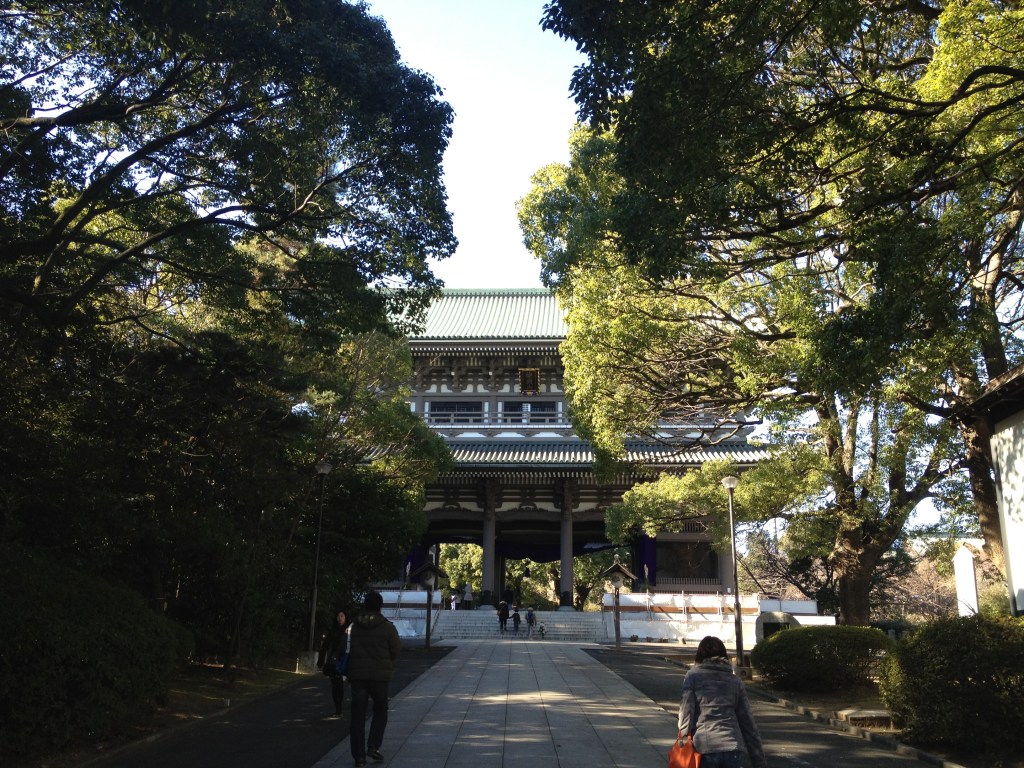
As a temple Sojiji is pretty large. It is located in the Tsurumi1 district of Yokohama comprises a large complex. My first visit there was in 2012, and I had a great time. The front gate is a lengthy ascent:
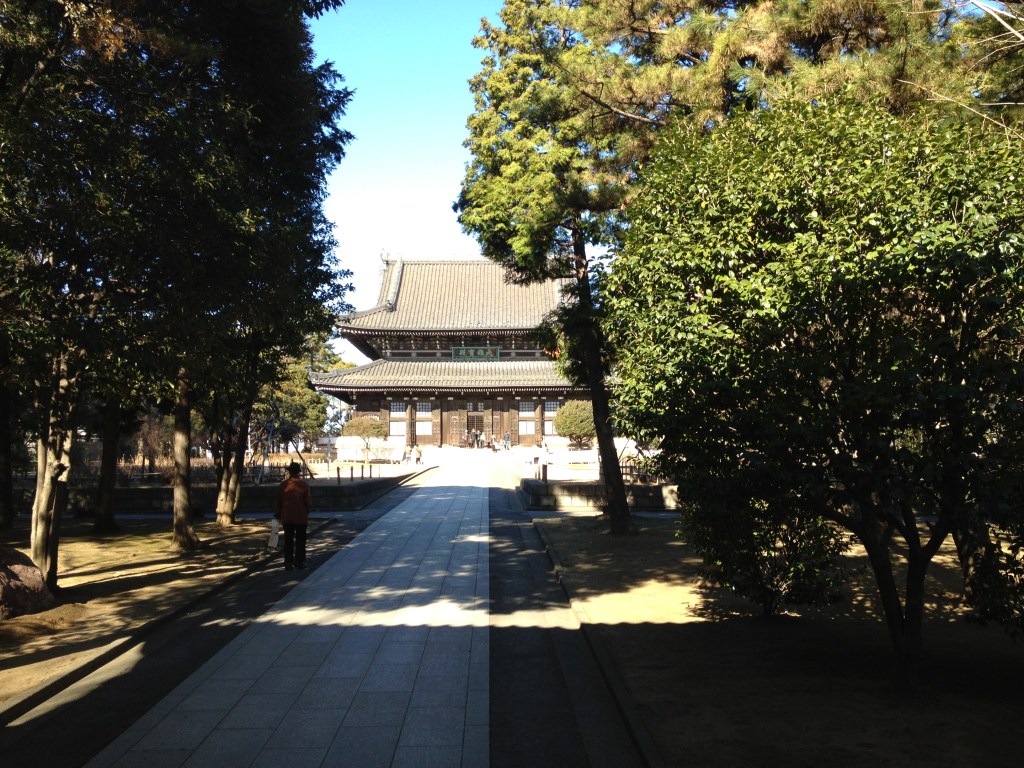
If you turn to the right, you’ll find the main office, which does offer English tours sometimes (check schedule for details), and the rest of the monastery. Way in the back is the main worship hall or butsuden.
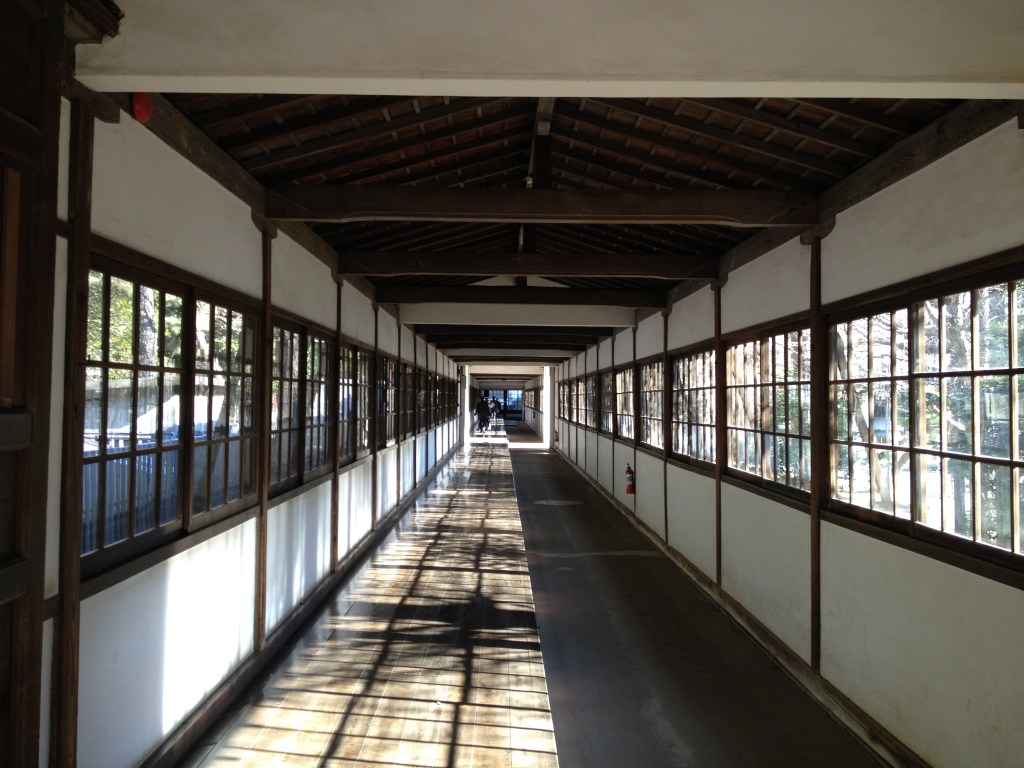
In my visit to Sojiji, we were able to get a tour which was very helpful in seeing the lesser known aspects of Sojiji. One of the more noteworthy sites is a kind of outdoor hallway connecting the east and west parts of the temple complex called the hyakken rōka (百間廊下):
I believe this translates to something like the “hundred-span hallway” or something. Monks clean this floor daily from one end to the other.
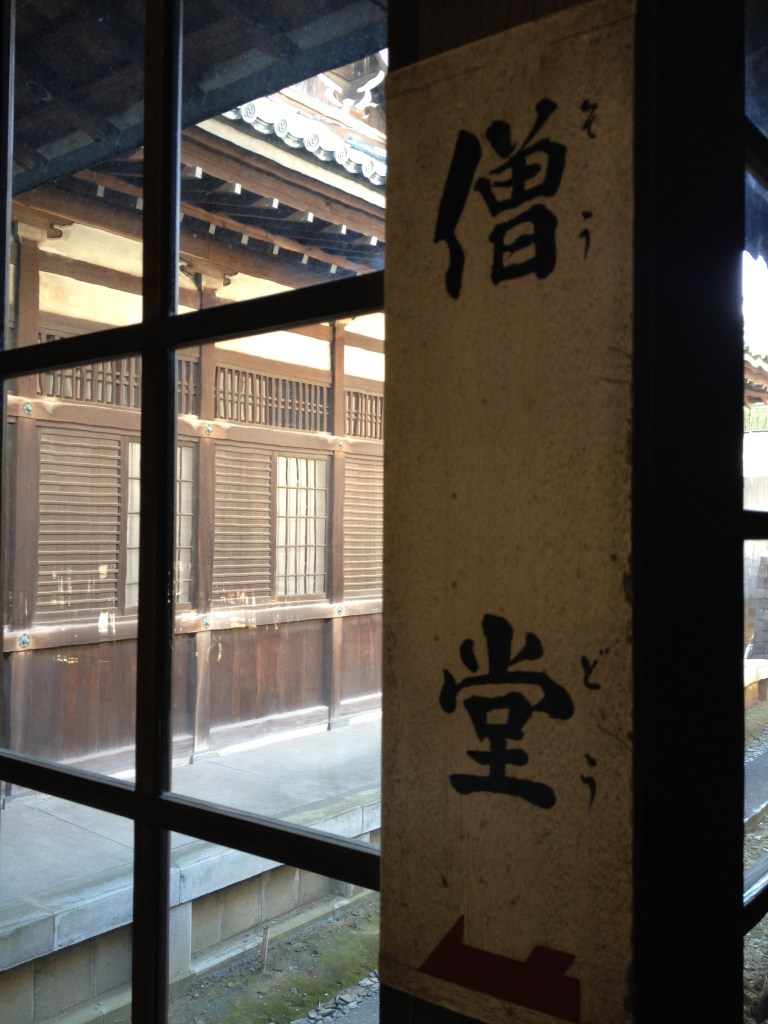
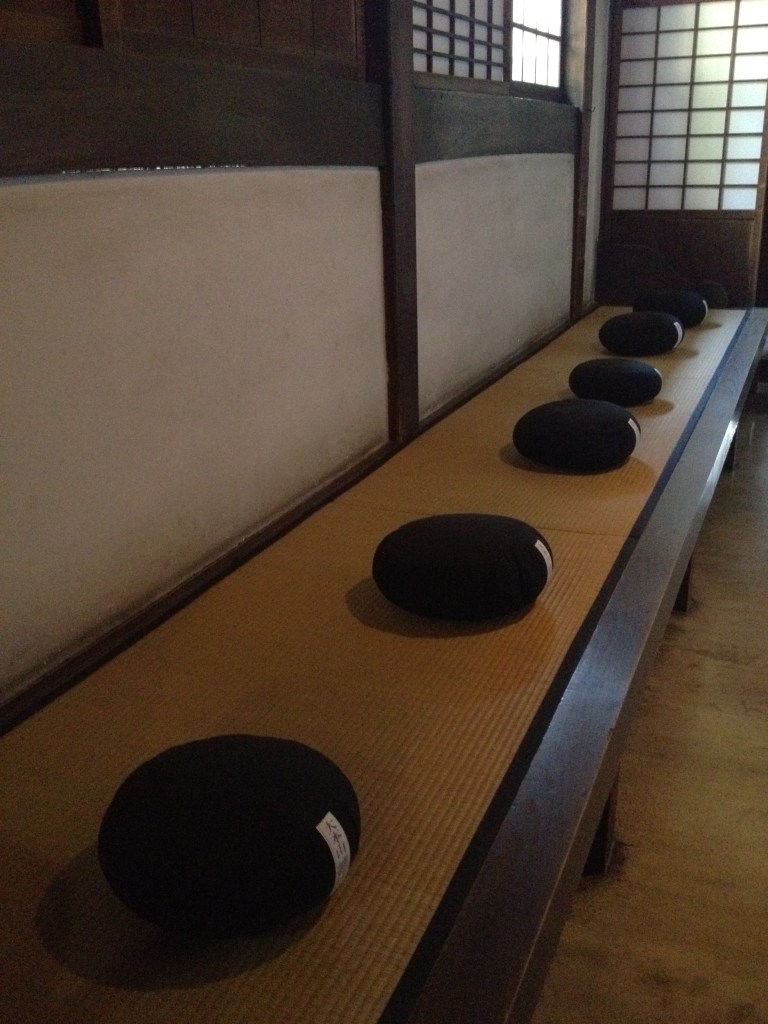
If you go on the tour, you might also get to see the monks’ hall (sōdō, 僧堂) where they practice meditation:
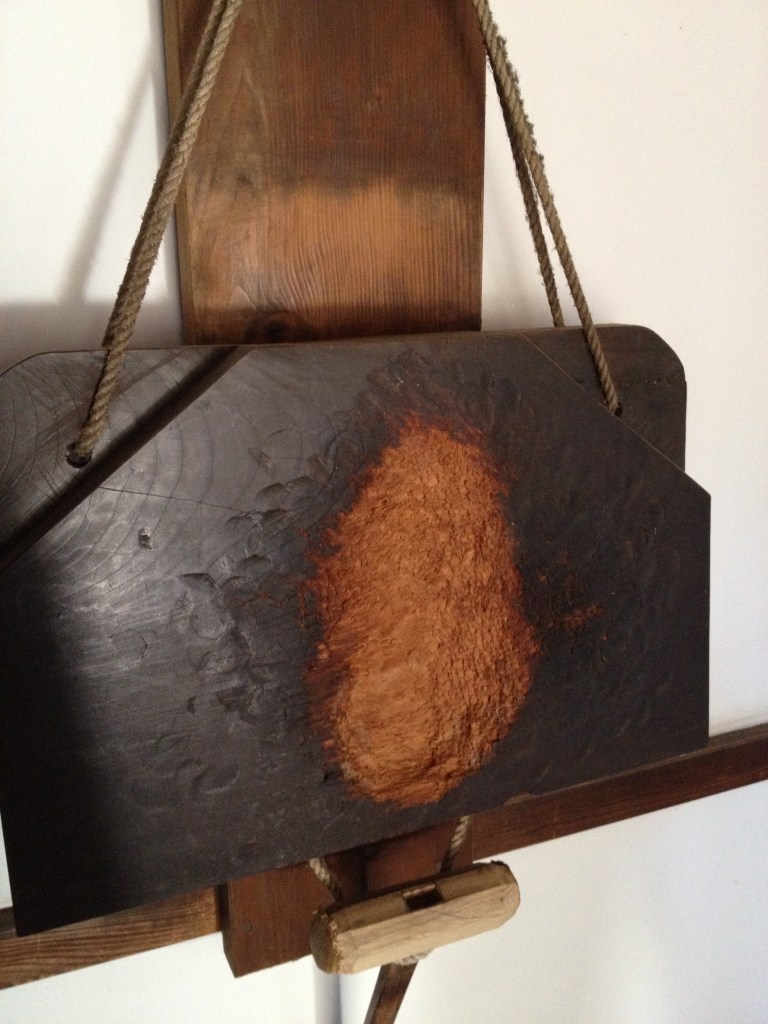
This wooden plank is used as a kind of “bell” to keep monks at Sojiji Temple on schedule while meditation. As you can see, it’s been well-worn.
One place on the tour that I didn’t get a photograph of (I can’t recall why, but maybe a fear of disrespecting the temple) was the memorial hall, where many daily services are held. You can see a video made in 1989 of service here done in the morning:2
It is a lovely hall and well worth seeing. Another, which I haven’t been able to visit is the main altar building, the butsuden.
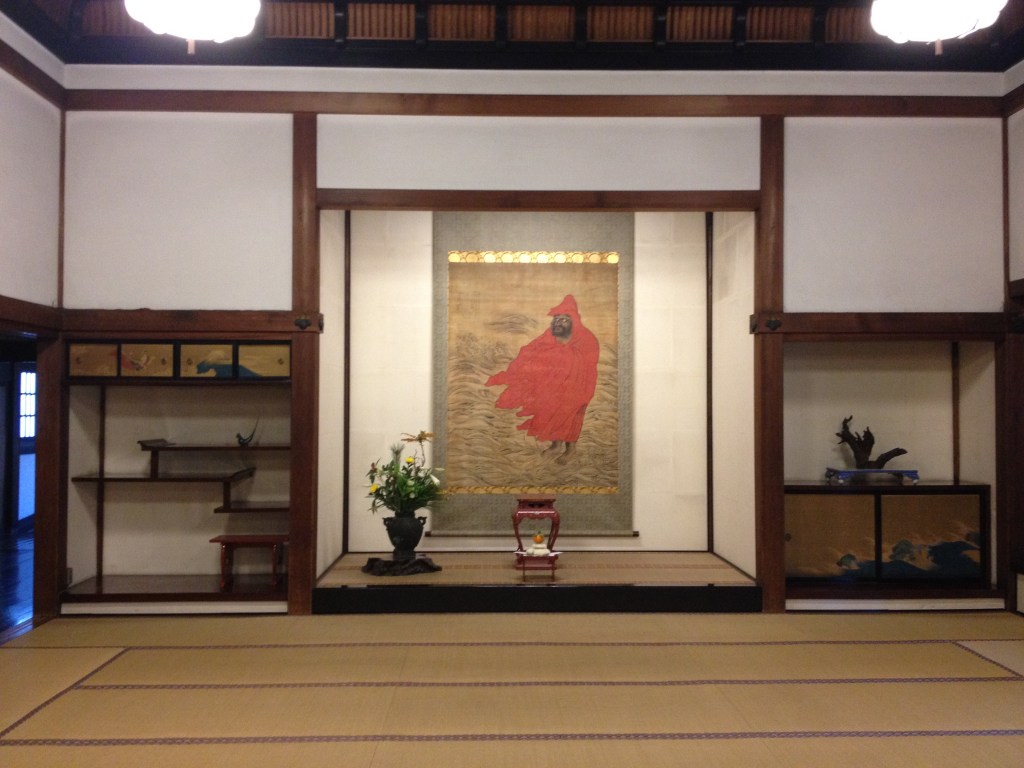
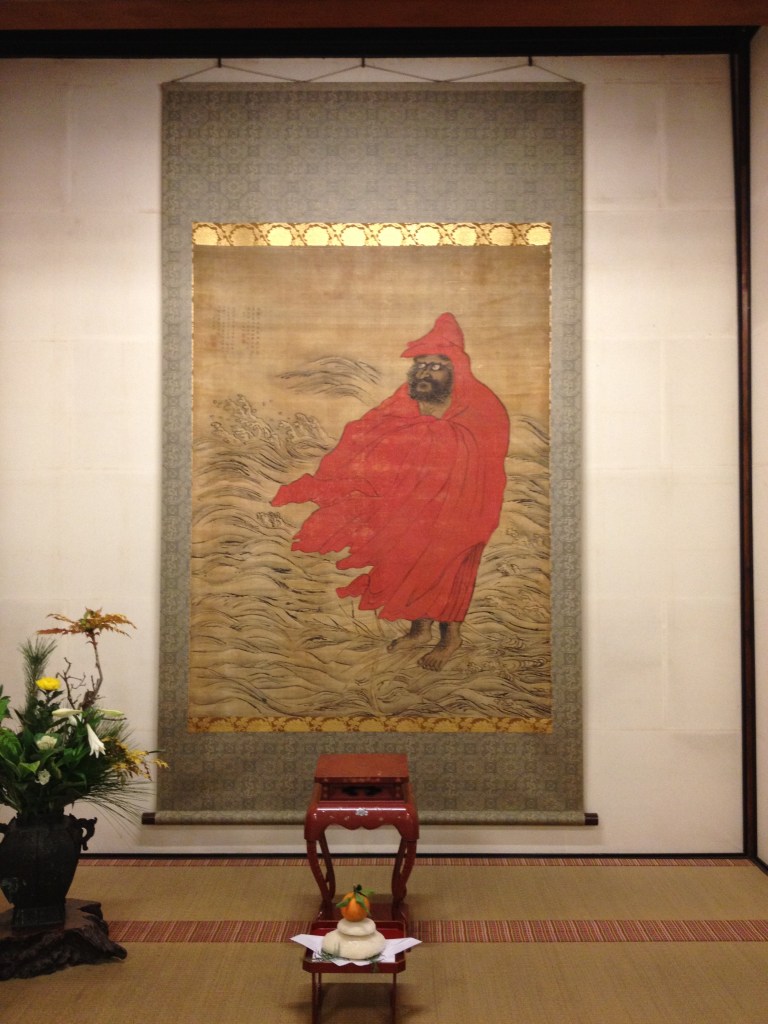
From the tour, we also learned that Sojiji also has a room for entertaining guests, which includes an amazing portrait of the legendary monk Bodhidharma who reputedly brought Zen to China from India.
Close up:
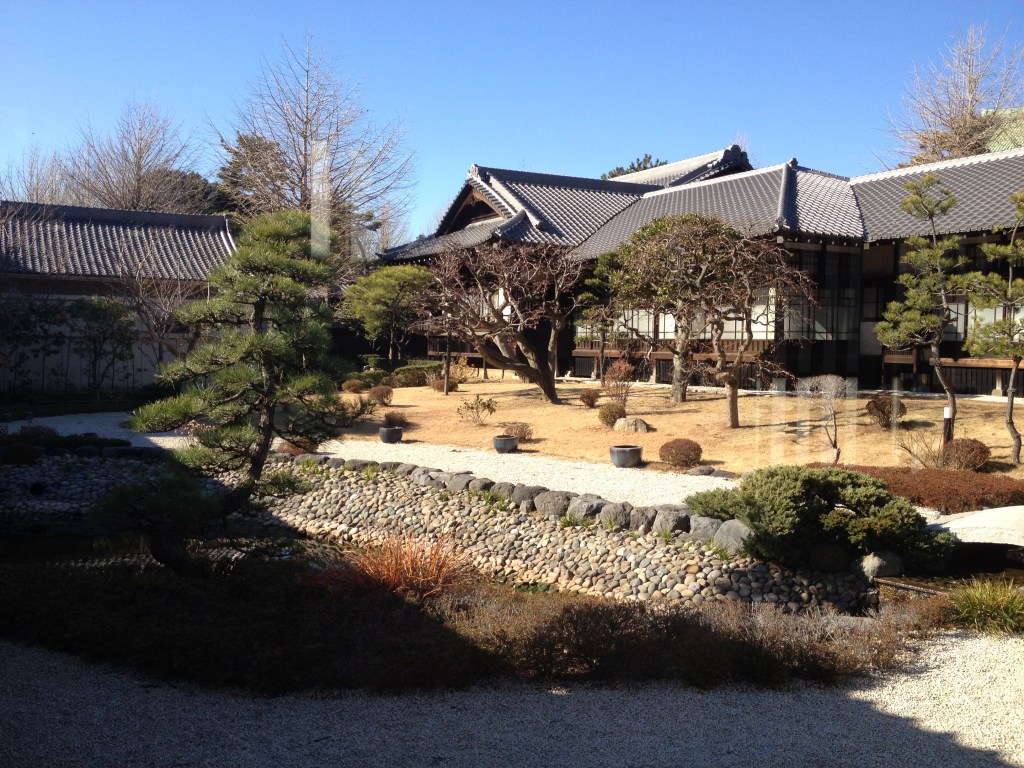
Nearby are gardens, too:
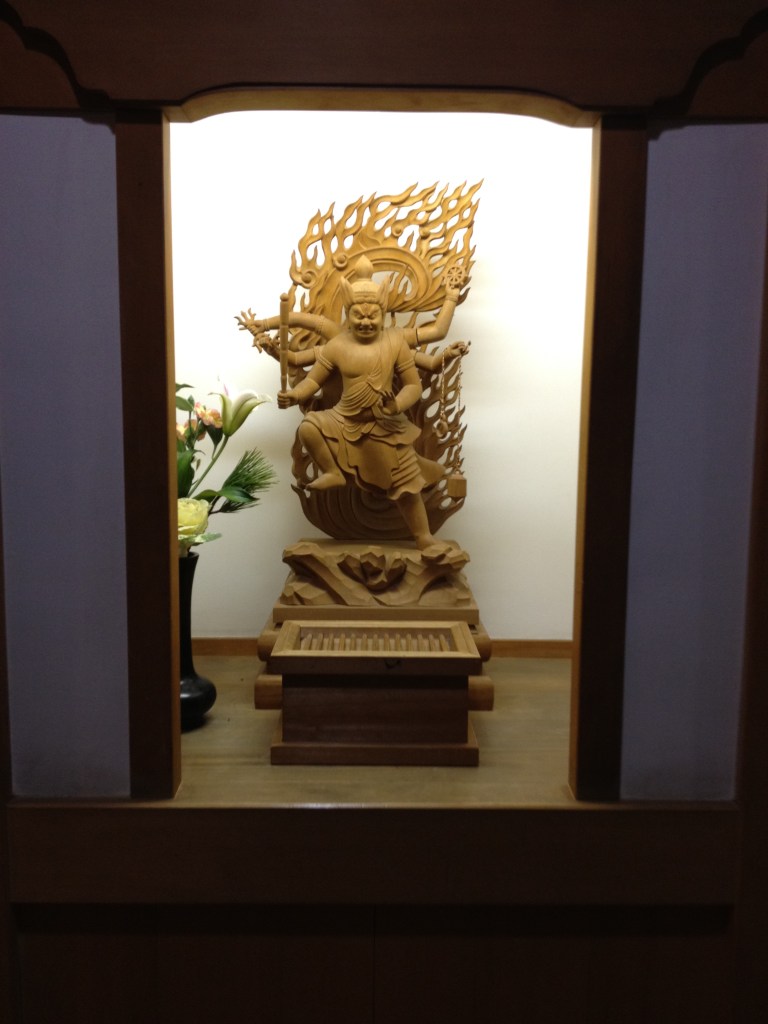
Sojiji had other interesting things too. For example, the main guest bathroom near the office had a great statue of an esoteric Buddhist deity:
If memory serves, this deity was associated with driving away impurities, but I can’t recall much.
Sojiji is not quite what I expected from a Soto Zen temple. It has a long monastic Zen tradition, a colorful history starting with Keizan and beyond, yet at the same time it was surprisingly open and friendly. The Soto Zen sutra book that I have was purchased here at the gift shop, along with some nice English language books. It still remains one of my favorite temples to go in Japan.
If you’re in Japan and interested in Zen Buddhism, don’t hesitate to check out this temple due to its accessibility and its amazing traditions.
1 If you plan to visit, look for Tsurumi train station, the closest. It is just a couple blocks away. From the larger Kawasaki station, it’s just a single stop away on certain train lines.
2 The part where monks fan through what looks like a stack of papers is a practice adapted from the parent Tendai sect, where monks would simulate reading through very long Buddhist sutras (in this case, the Perfection of Wisdom Sutra I think) as a way of accumulating positive merit, and share the teachings with others. Actually trying to recite the whole sutra, given its length, is no small undertaking.
A photo of my sutra book from Sōjijj temple, featuring the first fasicle of the Shushogi
Lately, I have been inspired to study certain aspects of the Soto school of Zen. In particular, I was reading in Japanese a nice explanation of the Shushōgi(修証義, “Meaning of Practice and Verification”).
The Shushōgi is a primer on Zen compiled for lay followers in 1890 by Ouchi Seiran (大内 青巒, 1845-1918) as part of a committee to bring Soto Zen teachings to a wider audience as a response to Christian proselytizing at the time. The Shushōgi is a popular text for Soto Zen followers in Japan, and appears prominently in Japanese sutra chanting books, yet it has never really caught on in the Western Zen community.1 Interestingly, the Shushogi has undergone a bit of a revival in Japanese-Zen circles in recent generations.
The Shushōgi is a relatively short text that attempts to distill the teachings of Soto Zen’s founder Dōgen (1200 – 1253), using excerpts from his voluminous Shobogenzo, into a smaller format that is accessible for lay followers.
This is significant if you have ever tried to read Dogen’s writings, which are profound, but also in true Zen fashion, really cryptic.
Full translations of the Shushogi can be found here, here and here. A Japanese-romaji version for chanting can be found here.
The text has five sections, with links to subsequent commentary I wrote:
General introduction to Buddhism (i.e. why practice?) – chapter one
Western Zen audience may be shocked to see that very little of the Shushōgi mentions meditation at all. One Zen priest even humorously points out in a great article that the Shushōgi was the result of some pretty creative editing, to say nothing about its content. How can this be treated as an authentic Zen text?
Having looked at it from a couple angles, not to mention my non-Zen background in Buddhism, I think the Shushōgi is actually an underrated text.
First, one of the things often overlooked in Western Buddhism is the Mahayana-Buddhist foundation that most schools are built upon. Here, I am not just talking about Zen, but most of the Buddhism people encounter here: Pure Land, Zen, Tibetan, Nichiren, etc. Each of these has a common foundation in Mahayana Buddhism, and Mahayana Buddhism does bring with it certain teachings that quietly permeate various schools: reflect and repentance, aspiration for Enlightenment, the desire to rescue all beings, etc. In cultures where Buddhism has existed for a long, long time, these are kind of a given, so the Shushōgi would fit in perfectly fine among Buddhist followers there. Western Buddhism, being relatively new and still developing, still suffers from a relatively incomplete picture of the whole Mahayana tradition and often thus does not see the forest for the trees.2 Schools like Zen, Pure Land and Nichiren all have their respective traditions, founders and practices, but do so within the background of the larger, common tradition.
Second, I think the writers of the Shushōgi were trying to cast as wide a net as possible, so they downplayed aspects of Zen that are intimidating to some (myself included), while promoting basic Buddhist practices that are accessible to all. If people do awaken the aspiration for Enlightenment, even briefly, or try to uphold the Ten Good Deeds (which is a very fundamental teaching in early Buddhism, btw), this puts them on a much more solid footing along the Buddhist path than they were before, and will probably lead them onward to more and more advanced teachings and practices, including zazen meditation (implied in the 5th section), anyway. It demands little, but inspires people to start somewhere in their Buddhist path. Basically it says “get off the dang couch!”
For people who are already “into Zen”, all this may seem unnecessary because the motivation and intention are already there, but for the rest of us, it is kind of a breath of fresh air compared to oppressive atmosphere Zen centers can sometimes have.3
Speaking as someone who is a working parent and lousy meditation-practitioner, the Shushogi is a gentle and welcoming approach to Zen that is at one familiar, and at the same time inspiring. If you’ve been turned off by Zen or meditation in the past, take a step back and read the Shushogi. It’s an odd-duck in the tradition of Zen, yet at the same time, I can see why Zen followers in Japan have so often embraced it.
1 Indeed, in the official English-language Japanese Soto Zen home page for liturgy, it appears near the bottom under “Other Texts”. Yet, in the Japanese-language official liturgy books, it’s given a more prominent place.
2 This also tends to lead to what one researcher described as “Protestant Buddhism”.
3 To say nothing of the one-upmanship that sometimes goes on. Don’t get me wrong, I’ve had some positive experiences at Zen centers in the West, but I often see the same over-eager characters over and over trying to somehow prove themselves. It tends to make Zen communities uptight, and intimidating, compared to other Buddhist communities I’ve been a part of, especially Asian-American Buddhist communities where the atmosphere is usually pretty laid back.



 Gleanings in Buddha-Fields
You must be logged in to post a comment.