Sometimes when you travel in Japan, especially outside of Tokyo, you may come across like this:
A large sacred tree at Kasuga shrine in Nara, Japan. Taken by me in July 2023.
This is a large tree that has been growing for centuries within the precincts of Kasuga Grand Shrine in Nara, Japan. The tree, as you can see, has a large rope tied around it with small paper streamers. If you ever saw the Studio Gibhli movie Totoro, you can see a big camphor tree with a similar rope around it.
Sometimes you also find rocks and other natural things with ropes around them too.
A “shimenawa” around an “iwakura” (sacred rock) at Meigetsuin, Buddhist temple in Kamakura, Japan, courtesy of Wikipedia.
This is a Shinto-religious custom using a special sacred, hempen rope called Shimenawa (注連縄). The little paper streamers called called Shidé (紙垂).
Shimenawa are sometimes used to section off a sacred space, but they’re also used to enshrine places thought to house a local kami, such as a tree or rock thought to be sacred. Sometimes you also see them hanging over home Shinto shrines (kamidana, 神棚). The idea is the same: the paper streamers help deliniate a sacred space (the inner sanctum of your home shrine in this case).
Interestingly, I discovered that a separate, but parallel tradition exists in Korea too. This blog shows that in Korean traditional culture, people would enshrine local guardian spirits by tying a rope (금줄, Geumjul) around them, and decorating with colored cloths (오색천, Osaekcheon) or white strips of paper. Such sacred trees (당산나무, Dangsan-namu) and sacred rocks (누석단, Nuseokdan), are collectively called Seonangdang. They are very similar in appearance to the ones in Japan, so it’s not hard to guess that there’s some common religious tradition between both cultures, though the Wikipedia article linked above also suggests a potential link to Mongol culture too.
Shinto as a religion exists only in Japan1 but it’s not hard to imagine that Shinto tradition drew from something much older that was shared across the Korean peninsula and Japan. Further, since it’s known that in early Japanese history that many Korean families migrated to Japan (the Imperial court sought their skills and technology), it’s quite possible the tradition was imported from Korea to Japan. Further, as this early Yamato court actively allied with the Korean kingdom of Baekche, it’s possible the cultural exchange went in that direction too.
Anyhow, it’s a fascinating example of how the two (or more) cultures have shared religious traditions for millenia, but few would notice.
1 Barring colonial efforts in the early 20th century to introduce it to other Asian countries, but these did not have a lasting impact culturally.
The Japanese concept of yakudoshi (厄年, inauspicious years based on age), is something I’ve written about a couple times over the years. During my last yakudoshi year, I had a particularly bad slip and fall on an icy deck, which took me months to recover.1 It was also around that time that I got laid off at work.
This time around, my daughter was undergoing a yakudoshi year recently. Yakudoshi doesn’t necessarily affect oneself, it’s thought to also affect those around you. My late mother-in-law’s fall which broke her hip happened supposedly during my sister-in-law’s yakudoshi year, and so on. In my daughter’s case, she had a generally good year overall, but at the beginning of yakudoshi, I was in the hospital for a week, and then again right at the very end, I had yet another slip and fall in the backyard. This time, wearing old sandals that had no traction left, I slipped on some moss and as I fell, the back of my head hit a rock.
Ouch.
A week has passed and the swollen lump in the back of my head is almost gone, and I don’t believe I suffered any effects from a concussion.2. Because I fell on my back first, and then hit my head, I think it helped cushion what could have been a much worse injury.
That said, we have been joking around the house that yakudoshi struck again. Maybe it did.
Of course, there are other ways to explain all this. The fact I was wearing old, worn sandals on a wet, cold day in early January in the PNW (with moss everywhere) was pretty stupid. I threw out the sandals since then. Also, I have a track record for being clumsy, so I have had plenty of accidents, yakudoshi or no.
The “inner Spock” in me would thus suggest that this is just a case of probability, weather and bad footwear, and in the case of the surgery, it was a known health risk identified many years ago that finally came to fruition. The probability was always there.
Finally, the Buddhist perspective might explain it as bad karma. Maybe I did something, or some things previously that lined up just right at that moment to compel me to walk outside in bad sandals at that particular day/time so that I would slip and fall.
Believing in the result means having deep faith that the Pure Land and all the forms of goodness (spiritually superior beings) that are assembled there are born from the Buddha Remembrance Samadhi, the meditative concentration that comes from reciting the Buddha-name. When you plant melon seeds you get melons, and when you plant beans you get beans. [Effect follows causes] like a shadow follows a physical shape, like an echo responds to a sound. Nothing is sown in vain. This is called “believing in the result”.
“Mind Seal of the Buddhas” by Ou-I, translation by J. C. Clearly
1 Acupuncture actually did help a lot, as I was getting tired of just relying on ibuprofen all the time.
2 I probably should have gone to see a doctor, but it was a Saturday, and after watching myself for an hour or two, I decided it wasn’t serious enough to warrant going to the emergency room. Time will tell if that was a bad idea, or not.
It’s 2025, and I am happy to be back. The break wasn’t as restful as hoped (too many holiday obligations), but I did accomplish most of my goals, and got to celebrate my firstborn’s 18th birthday which was an important milestone for us parents. I also played lots of Fire Emblem: Engage,1 and watched plenty of old Star Trek episodes.
Anyhow, for the first temple visit of the year, the priest stated that according to the traditional 60-year Chinese calendar 2025 was the sign ki-no-to-mi (乙巳), which can be roughly translated as “yin wood snake”, which implied change coming to fruition, like a tree growing its branches. For context, last year was “yang wood dragon” (ki-no-é-tatsu, 甲辰). Which implied much turmoil, like a baby dragon bursting from its shell.
While I might be speaking from confirmation bias, I cannot help but feel recent events in the last few years reflect this. But, I suppose it’s up to individual interpretation.2
Anyhow, I have some fun posts coming up that I finally finished while on break.
Hoping you all have a great year, or at least stay out of trouble. 😅
1 Engage doesn’t have the emotional depth of Fire Emblem: Three Houses (I doubt few games would), but it has grown on me, and I enjoy many aspects about it, and will likely play through it again.
2 I consulted the Yi Jing for the year, and my own personal fortune wasn’t great either. Warnings of not “stepping on a tiger’s tail” and such.
A long time ago, my wife and I watched this TED Talk in Japanese about religion and how Japanese culture approaches it:
The TED Talk is entirely in Japanese, with no subtitles, so unfortunately most folks here won’t be able to easily follow it. Which is a shame because it’s quite good. I had a saved in my personal playlist, and rewatched it recently. There a couple points in particular that I wanted to tease out:
The priest in question, Matsuyama Daiko, was raised in a “priest family” in Japan (e.g. Buddhist priest),1 but attended a Catholic school growing up. This is not unusual. My sister-in-law also attended a Catholic school in Japan, we have good friends who are a Buddhist priest family. Matsuyama makes the point that Japan approaches religion the way it approaches dinner: in the West we tend to feature a main dish, and maybe a few smaller side dishes (or none). In Japan, food is usually not served with a main dish, but several dishes that are more or less same quantity.
In the same way, while Matsuyama is an ordained Buddhist priest, he grew up with a wide exposure to other religions but sampled many dishes. It’s not unusual for a Japanese person to do Buddhist stuff, but also visit Shinto shrines during Hatsumode, get married in a Christian chapel, etc. Hence, like many dishes, Japanese tend to sample many traditions, and respect them all. People have their personal inclinations (or none at all), but they are not forced to choose following A versus following B. I don’t want to oversell this too much, but it is a practical approach to religion and one you’ll find not just in Japan, but other Asian cultures as well.
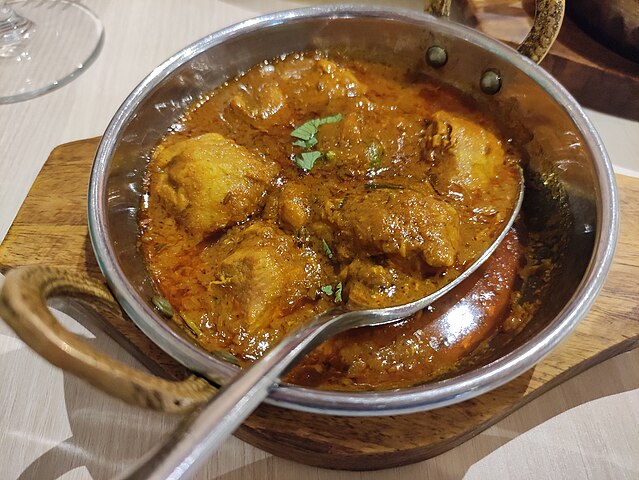
The second point that Matsuyama makes that I thought was interesting was the idea of variation even within the same religion. Matsuyama talked about how Buddhists in Theravada countries might look at Japanese Buddhism (Mahayana), and be confused by some of its practices, and vice-versa. So, he used the example of curry. Curry is a food that is found across all of Asia, but there’s an incredible amount of local variety. I LOVE curry. I eat any kind of curry, and love the sheer variety.
Different curry dishes arise from different environments and circumstances: availability of ingredients, cooking methods, climate, and so on. Matsuyama stated that Indian curry tends to be very spicy, which is handy in a hot, dry climate as some parts of India are, because it helps you sweat. Japanese curry, which tends to be very hearty and mild, works well in a climate that is colder. Thai curry uses a lot of coconut milk, something not available in Japan, and seafood. Curry as consumed in the UK has also been adjusted for local resources and taste.
Yet all of these are unquestionably curry. Anyone can taste any of these dishes and immediately recognize it as curry. In the same way, each tradition and sect with Buddhism is easily recognizable. It may not suit one’s personal taste, but the variety of cultures, historical precedents, people and geography have led to a variety of traditions, and there’s something for everyone. Of course, this is true of other world religions too, but I wanted to use Buddhism as the example.
So, when looking at the variety of ideas, teachings and practices, consider the example of curry. Different curries arise from different conditions, and each is suitable for different people, but also curry is delicious no matter how you try it. So, don’t be afraid to sample other versions.
1 Unlike most Buddhist countries where monks are celibate and usually live a cloistered life, Buddhist monks in Japan are (for complex historical reasons that are too long to go into here) parochial, live among communities and marry.
A little while ago, when talking about Japanese mythology, I alluded to the belief in the divine origins of the Japanese imperial family through their reputed ancestor Amaterasu Ōmikami (Amaterasu for short), kami of the sun. This lineage and how they came to rule Japan is recorded in two very old historical texts: the Kojiki and the Nihon Shoki.
Since I have been reading a fun book in Japanese about the Nihon Shoki, we will focus on that one. Just know that the origin story in Kojiki is mostly the same.
The Nihon Shoki begins as a series of myths about the creation of Japan, followed by stories of different generations of kami, culminating in Amaterasu’s grandson, Ninigi-no-Mikoto who descends to earth. Next, Ninigi had a great-grandson, named Kamu-yamato Iware-biko no Sumeramikoto (神日本磐余彦天皇),1 and in time “Iware-biko” became the first emperor of Japan, the legendary Emperor Jimmu (jimmu tennō, 神武天皇).2 We’ll explore later why this is more myth than history, but for now, let’s continue the story as recorded.
In his youth, the future emperor grew up in what later became the province of Hyuga in southern Japan, also called Himuka (日向) in olden times. By the age of 45, he had married, had children, and took care of his brothers. Then one day, he proclaimed to his family that due to his divine lineage, it is his destiny to rule the lands to the east (central Japan) which are rich and verdant, and to establish his capital there.
From here, Iware-biko sets out with his kin to the island of Honshu, the main island of Japan, and begins the invasion of the “Yamato” region, starting at the bay of Naniwa (later Osaka). It is here they come into conflict with the a local chieftain named Naga-sune-hiko. Sadly, Iware-biko’s older brother was killed, and the newcomers were forced to retreat. Iware-biko then reasoned that by fighting eastward, facing the rising sun, they lost the battle. Thus, he decides to sail south around the Kii Peninsula, and then attack from the east (i.e. westward). Upon reaching the region Kumano, they encountered a huge crow named the Yatagarasu (八咫烏) where “ata” 咫 means a hand-span from the thumb to the middle finger, about 18cm. So, the crow was 8 hand-spans long. The Yatagarasu was dispatched by the kami Amaterasu to help her descendant as a guide.
Once again, Iware-biko and his clan battled Nage-sune-hiko long and hard. Then, a golden-colored kite (as in bird), called the kinshi (金鵄), mounted on Iware-biko’s bow (hence the depiction above), and its blazing glare blinded their enemies. They were defeated at last.
From here, Iware-biko pacified the region, and assumed the throne as the first Emperor, Jimmu, and proclaimed that his line would “last 10,000 generations” (lit. mansei ikkei, 万世一系). Further, according to the Nihon Shoki, the first Emperor then proclaimed the phrase hakkō ichi-u (八紘一宇), or more elaborately “all under Heaven [lit. the eight corners of the world] under one roof”. The idea was basically one of universal brotherhood.
Allegedly, this unification of Japan, and its founding by Emperor Jimmu, all happened in the year 660 BCE.
Fast forward to the year 1940, as in 1940 CE.
This period was the height of Japanese militarism in the modern era, and the Youtube show Extra History has a brilliant miniseries on it:
I highly recommend viewing the miniseries if you are curious, but it helps explain a lot.
Anyhow, by 1940, this trend of nationalist fervor reached a crescendo, and it was coincidentally 2,600 years since the mythical founding of Japan. When the Greater East Asia Co-Prosperity Sphere was promulgated in 1940 by the Prime Minister at the time,3 Prince Konoe Fumimaro, he repeated an ancient phrase said to have been spoken by Emperror Jimmu: hakkō ichi-u (八紘一宇, “Eight corners of the world under one roof”). However, in Fumimaro’s modern interpretation, Asia would be united in a union of brotherhood, with Japan at the center (i.e. under one Japanese roof). This was repeated during war times as a rallying slogan as well, and questioning the historicity of the Nihon Shoki at that time was illegal.
There’s a small problem with the original historical narrative about Emperor Jimmu, though: it’s unlikely he ever existed, and it’s very doubtful that Japan was founded in 660 BC.
There is basically no archeological evidence that the early “Yamato” kingdom existed in Japan during this time. In fact, the earliest emperor that has any reliable archeological evidence is Sujin the 10th emperor, who is thought to have died around 30 BCE, 600 years later. Sovereigns weren’t even called “emperors” (tennō, 天皇) at the time, but “great kings” (dai-ō, 大王) instead. The term Emperor was reputedly used by Prince Shotoku centuries later.
So, why 660 BCE, and why the mythical lineage that probably didn’t exist?
Because the Nihon Shoki was not written for Japanese audiences. It was written for Chinese audiences in order to introduce Japan and its history. The Kojiki, conversely, was written for domestic audiences. Many of the early dates and lineages don’t line up properly, have insufficient historical evidence, or have imperial reigns that are unnaturally long. Yet as a narrative it seamlessly transitions between a divine kami ancestor and the current reigning family, and helped provide legitimacy in the eyes of the much larger and more powerful China. Even the date 660 BCE, 1260 years before the Nihon Shoki was completed, fit seamlessly with the Taoist 60-year calendar cycle to imply an auspicious beginning.
People did live in Japan back then, but we know from archaeological evidence that these were mostly hunter-gatherers, and rulers might be local chieftains at best.
What the Nihon Shoki does tell us though, through its legendary stories, heroes and such, is that pre-historical Japan was a place of many tribes, communities and confederations, and that over time the “Yamato” group came to increasingly dominate or incorporate them. For example, the ancestral kami, Ninigi, had a son in the Nihon Shoki named Yamasachi-hiko whose name includes “mountain”. Yamasachi-hiko married Toyotama-hime, who was a daughter of a sea deity. The fusion of mountains and sea ancestries is not lost on scholars.
Further, my book explaining the Nihon Shoki shows how some myths include subtle allusions to rival confederations who were defeated (or absorbed) by the early Yamato rulers. One noteworthy rival were the people of Izumo, for example. So, the Nihon Shoki can tell us a lot of interesting things about how Japan was founded, but not necessarily in the way we expect.
1 Many early figures in Japanese mythology had extremely long, grandiose names, by the way. My book on the Nihon Shoki likes to give amusing nicknames for ease of reading.
2 Thus, Emperor Jimmu was five generations removed from Amaterasu. The Nihon Shoki coveres stories and myths of each generation in between, but they are too numerous to list here. Needless to say, once Ninigi-no-Mikoto descends to the earth, things got wild.
3 Ostensibly to kick European Colonialism out of Asia, but it mostly ended up replacing European colonialism with Japanese colonialism. Not surprisingly, after WWII, many South East Asian countries fought for independence when the Europeans tried to reassert control. Enough was enough.
I’ve talked about the first shogun of Japan’s new Kamakura government, Minamoto no Yoritomo and his betrayal of his vassals here and here, but I also alluded to his execution of his younger half-brother, Minamoto no Yoshitsune. Yoshitsune’s downfall is indeed a sad tale. But as we’ll see, Yoritomo’s own downfall, while slower, wasn’t much better.
Minamoto no Yoshitsune was a military genius and the youngest of nine sons of Minamoto no Yoshitomo (Yoritomo was the oldest). When Yoshitomo was executed by his rival, Taira no Kiyomori, the half brothers were all scattered in exile, but gradually reunited under Yoritomo. Out of these brothers, Yoshitsune was the most talented in warfare. Yoshitsune led the led against the Heike clan and eventually destroyed it in the battle of Dan-no-ura.
Yoshitsune has been celebrated throughout Japanese history as the ultimate warrior, who along with his companion Benkei, went on many adventures and fought many battles. Yoshitsune’s bravery and unconventional strategies, coupled with Benkei’s stalwart strength and loyalty have been the subject of many Noh and Kabuki plays, as well as many works of art.
The famous battle between Benkei and Yoshitsune on the Gojobashi bridge in Kyoto. Photo courtesy of Wikimedia Commons.
But one thing Yoshitsune was not good at was politics. Once the Heike were destroyed, tensions rose between the new military commander (shogun 将軍), namely his older half-brother Yoritomo, and the conniving emperor Go-Shirakawa. The Imperial family had lost power due to the Heike clan, and were eager to get it back. The Genji clan defeated the Heike and weren’t keen to hand over their hard-fought power.
Yoshitsune was caught between these two men, and used as a proxy for their struggle for power. The Emperor, grateful for Yoshitsune’s efforts appointed him Kebiishi (検非違使): the Sheriff of Kyoto the capitol. Accepting this position, however, meant that Yoshitune was now working under the Emperor, not his half-brother the Shogun, and Yoritomo was evidentially furious by this. From here on out, he began to suspect his baby brother of plotting to overthrow him. The historical drama, Thirteen Lords of the Shogun, implies that certain retainers, perhaps jealous of Yoshitsune, may have been whispering in Yoritomo’s ear, fanning his paranoia further. When Yoshitsune tried to return to Kamakura to talk to his brother directly, he was refused entry and had to idle in the nearby town of Koshigoé.
While staying at Koshigoe, Yoshitsune wrote the following letter to his older brother:
So here I remain, vainly shedding crimson tears….I have not been permitted to refute the accusations of my slanderers or [even] to set foot in Kamakura, but have been obliged to languish idly these many days with no possibility of declaring the sincerity of my intentions. It is now so long since I have set eyes on His Lordship’s compassionate countenance that the bond of our blood brotherhood seems to have vanished.
Painting of Shizuka from 1825 by Hokusai, Public domain, via Wikimedia Commons
Yoshitsune was unable to ease his older brother’s concerns, nor did he want to be under control of the Emperor either, so he bowed out, and retreated to the province of Ōshū way up north, where he had previously been exiled. It was familiar land, and the ruler of Oshu promised to watch Yoshitsune on behalf of Yoritomo, while also protecting him from Yoritomo. With his mistress, Shizuka,2 they moved there and things were quiet for a time.
However, Yoritomo wasn’t satisfied. When Yoshitsune’s keeper passed away, the keeper’s son hatched a plan with Yoritomo to allow Yoritomo’s troops to attack his Yoshitsune’s house.
Legends hype up this last stand by Yoshitsune (with Benkei defending), but in any case, Yoshitsune the famed military commander was killed by his own half-brother, and his head was preserved in a box with sake. Yoshitsune was later enshrined as a kami at Shirahata Shrine in Fujisawa.3
Yoshitsune died in 1189, and by 1192 Yoritomo was in full control of Japan since the Emperor had died as well. As the shogun, the supreme commander of military forces, no one could oppose Yoritomo any longer, the country had been pacified at last, and he had avenged his father for his wrongful death.
……..but, this came at a steep, steep price. Yoritomo had to dodge other assassination attempts, and spent the remaining years of his life constantly watching his back. He had paid for his power in blood and betrayal, and even after taking tonsure as a Buddhist monk,4 he never really found any peace. When he died at age 51, more than a few probably sighed in relief. Yoritomo was powerful, and crafty, but he was brutal and paranoid, and everyone around him spent their lives in constant fear. One can not help but see the similarities to certain dictators today.
P.S. if you go to Tsurugaoka Hachimangu shrine in Kamakura, Japan, you can see a tiny museum, just to the left of the inner sanctum, which has relics from Yoritomo’s life. It’s easy to miss, but tickets are cheap, and it’s amazing to see. We saw it in December 2022, just after watching the historical drama, and it was pretty amazing. The new, larger museum near the front entrance is also great. A visitor can easily spend half a day at Tsurugaoka Hachimangu, especially if you are a history nerd.
P.P.S. Official website for Shirahata Shrine in Fujisawa. No English, sorry, but it’s close to Fujisawa station if you’re in the neighborhood.
1 I couldn’t find a good translation of Kebiishi in English, but based on the duties, and based on varied definitions of “Sheriff” in English-speaking countries, this seemed the closest equivalent. Needless to say, being the sheriff of the capital city was a prestigious honor, but also comes with plenty of political strings attached.
2 Another revered character in the plays and art about Yoshitsune. Yoshitsune had married another one for political reasons, and Shizuka was technically his concubine, but they seemed to have genuinely loved one another and so she alone stayed with Yoshitsune at Oshu. She is often revered for her sincere, loving devotion, and for their doomed fate.
3 When we visit family friends in Japan, we often go to Fujisawa. It’s a nice seaside town, but I never knew that Yoshitsune was enshrined here. I might try to stop by one of these days and get a stamp for my book.
4 A Buddhist monk, as in an bhikkhu or renunciant. More on the terminology here. The practice of retiring to the monastic life was a common practice among the nobility in pre-modern Japan. His wife, Hojo no Masako, not only retired to the monastic life, but still took the reins of power after Yoritomo’s death becoming the famous “warlord nun“. Go-Shirakawa, the scheming emperor, had technically retired to the monastic life as well, but only as a means of dodging certain constraints on his power by the Fujiwara clan. Politics were…. complicated in those days, and few who retired truly let go of power, despite the Buddhist prohibition for Buddhist monks to be involved in politics. Then again, even now some monks fail to heed this prohibition either. Once again, politics and religion should not mix.
Also, at the risk of being sanctimonious, I wonder if Yoritomo’s Buddhist devotion did him much good in the afterlife, given how many people he had murdered. This is not unlike the ancient king in India, Ajatashatru, who while devoted to the historical Buddha Shakyamuni, had also murdered his way to the top. Because of the weight of his crimes, Ajatashatru’s devotion and progress on the Buddhist path was greatly hindered for many lifetimes to come according to Shakyamuni. I can’t help but think Yoritomo suffered the same fate. In other words, we all pay our debts some time.
A few months ago, I touched on Japanese mythology and how it relates to the current Imperial family, but something I didn’t really cover were the three sacred treasures or Sanshu no Jingi (三種の神器).
These three treasures were said to be have been passed down to the first emperor of the Imperial family by their divine ancestor, Ninigi-no-mikoto. Some of these treasures are related to kami I mentioned in the mythology post and also represent ancient Japanese culture, even if their importance is more obscure now.
The three treasures are…
Kusanagi, the grass-cutting sword
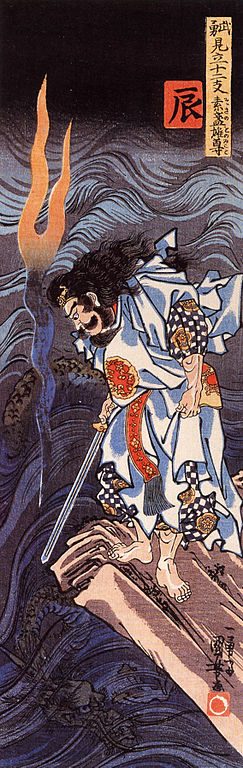
Woodblock print by Utagawa Kuniyoshi depicting Susano-o-no-Mikoto
The sword, kusanagi no tsurugi (草薙の剣), or “grass cutting sword”, was reputedly discovered by the kami Susano-o-no-Mikoto after he slew the massive serpent, Yamata-no-Orochi, embedded inside the monster’s tail. As I mentioned in the mythology post, Susano-o-no-Mikoto, the god of storms, was banished from the heavens, and while roaming the world he came upon a family that was preyed upon by the eight-headed serpent Yamata-no-Orochi. Susano-o-no-Mikoto battled the serpent and cut it into pieces. He found the tail too tough to cut up, and inside he discovered the sword, which he kept for his own.
The sword has a particularly checkered history as it was thought to have been lost at sea during the climatic battle between the Heike and Genji clans, but then is mentioned in accounts by people who have seen the sword centuries later. It’s not clear if the sword truly was lost, and a replica was made, or the sword was never actually lost at sea. In any case, the sword as it currently exists is stored in the Atsuta Shrine in Nagoya, Japan, and never revealed to the public.
Another thing to note is that swords from that era are pretty different than the Japanese katana we normally think of. Swords in early Japanese history were thicker, straighter, similar to a Chinese jiàn sword.
Yata no Kagami, the Bronze Mirror
An array of polished bronze mirrors from Antiquity, taken by author at the Louvre in February 2024.
Mirrors in general are a sacred item in Japanese Shinto religion, and are often used in central altars, both at home (kamidana) and in major shrines, to represent the kami‘s presence. Originally, mirrors in Japan, China and beyond were made from polished bronze, but since have become replaced with polished silver, and/or glass.
The sacred mirror though is the bronze kind, and was said to be part of the legend surrounding the sun goddess Amaterasu-Ōkami, when she isolated herself. After a series of nasty arguments with her brother, Susano-o-no-mikoto (which later got him hockey out of Heaven, see above), she was fed up and retreated to a cave called the Ama-no-Iwayato (天岩屋戸). The world was plunged into darkness and all the other kami were distraught about what to do. They eventually hatched a plan to lure her out by pretending to have a party outside her cave as if nothing was wrong by her absence.
They hung a bronze mirror, the yata-no-kagami (八咫鏡), while the other kami engaged in wild song and dance. When the curious Amaterasu emerged, she was entranced by the mirror long enough that they grabbed her and sealed the cave, thus preventing her from hiding again.
During the aforementioned battle at sea between the Heike and Genji clans, the mirror was safely recovered.
Yasakani no Magatama
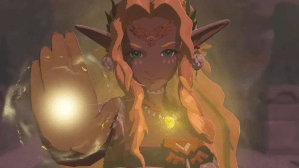
The final sacred treasure is an old magatama jewel called the yasakani no magatama (八尺瓊勾玉). Magatama jewels are something that were commonly used in very early Japanese history (later replaced by more Chinese style jewelry), so any such jewel tends to convey a sense of “primeval Japan”. Even in modern Japanese games, such as Zelda: Tears of the Kingdom, you see them prominently used to imply something of great power, but also great antiquity.
Queen Sonia wearing her magatama jewel around her neck. From Zelda: Tears of the Kingdom
Unlike the other two items, there is no particularly mythology associated with the jewel, instead it is a family heirloom, and is thought to have been passed down since the earliest days of the Imperial family. During the climactic battle between the Heike and Genji clans, the jewel and the sword were both thought lost, but later it is said the jewel was recovered.
P.S. featured photo shows the coronation of the previous emperor, the Heisei Emperor (Akihito), when the three sacred treasures were presented to him. The same ceremony was repeated by the current emperor. Photo by 首相官邸, CC BY 4.0, via Wikimedia Commons.
P.P.S. You probably noticed that kami names are quite long. These are often shortened for convenience in English, but this is somewhat inaccurate.
P.P.P.S. I started this post before my medical emergency, so it was nice to finally finish it. I have a few old drafts that are nearly done before I can move onto new content. 😏
Of the manytraditions in Japanese New Year (Jan 1st through 3rd, unlike Chinese New Year) is the first temple or shrine visit: hatsumōdé (初詣).
Japan essentially has two religions that have co-existed for many centuries: Shinto and Buddhism. Although they are very different on paper, on the ground, customs and traditions have blended as a result of this (mostly) peaceful coexistence and this includes New Year’s traditions.
People will try to go to their preferred Shinto shrine (jinja 神社) or Buddhist temple (otera お寺) within the first 3 days of the New Year, but most often on January 1st. You can visit any shrine or temple, there’s no pressure to “commit” to one or the other in Japanese culture. At times, we’ve visited Meiji Shrine in Tokyo, Kawasaki Daishi in Kawasaki city (a Shingon-sect Buddhist temple), Asakusa Temple in Tokyo, and Tsurugaoka-Hachimangu Shrine in Kamakura. The featured photo above is from Hatsumode at Asakusa Temple in 2009. We’ve also visited more local temples back home.1
Temples and shrines, especially famous ones, during this time are jammed packed with people trying to start off the new year with a blessing and maybe a few omamoricharms too. Old charms are often disposed of at this time too. Here’s an old photo from a past Hatsumode visit to Kawasaki Daishi in 2012:
This photo may not seem like much, but Kawasaki Daishi’s pagoda is visible way in the background, and the road leading up to the shrine is packed with people. It took maybe an hour to get through the procession to the temple itself.
For this year, 2024, we are at home, so I visited a small Shingon-sect Buddhist temple in the area. Shingon temples are pretty hard to find in the US, but somehow we have two temples in the area, and one of them offers a nice Hatsumode service. I don’t normally follow Shingon-sect Buddhism,2 but as I mentioned above, there’s no sense of commitment or obligation within Japanese religions: you can visit whatever service, and if you choose to follow more closely that’s up to you.
In our particular Hatsumode service, the priest led a series of Shingon-specific rituals to help cleanse any bad karma for the year, reciting the Heart Sutra (prominent in Shingon), and then a brief sermon based on the 60-year zodiac cycle. This year is apparently the year of kino-é-tatsu (甲辰), or wood-yang-dragon, which implies a lot of upheaval. After the last few years, that’s the sort of news I was not hoping to hear. 😒 Then again, shit happens.
I picked up a couple omamori charms for my daughter: a charm for success in studies since she is applying to college next year, and a charm for Yakudoshi since she is of the correct age (unlucky for her). I have learned the hard way not to laugh off Yakudoshi years.
Anyhow, like many Christians in the West during Christmas, Hatsumode might be the only time of the year when most Japanese visit a temple or shrine, but it’s an important time to reconnect and a break away from the usual bustle. I always enjoy this time, even with the crowds, freezing cold, and the hope that the next year will be better than the old one.
P.S. The history between Buddhism and Shinto in Japan is a great case study of two religions co-existing peacefully since they usually just operate at different levels. Shinto’s focus on there life now (and one’s connection to the kami) has little in common with Buddhism’s emphasis on the cycle of rebirth, and the eventual progress toward Buddhahood (e.g. Enlightenment). Chinese culture has a similar balance between Buddhism, and more native religions like Taoism. It’s only in Western religions that approach things with an “all or nothing” attitude that conflict tends to arise, but even then in traditional Christian cultures, native pagan beliefs tended to find a balance with Christian religion. They were not necessarily mutually exclusive, except on paper. Food for thought.
1 We used to visit Japan in the Winter so we could spend New Year’s in Japan with my wife’s family, but as our daughter grew up, and started going to school, we shifted the visits to Summer to avoid affecting attendance. We haven’t been back to Japan in Winter for almost a decade until 2022 and that was due in part to a funeral.
2 I am not against Shingon either, but I’ve found it difficult to commit to since it is an esoteric-only Buddhist sect, and I tend to be kind of an eclectic. It’s also why I frequently struggle with Zen and even Jodo Shu/Shinshu. Hence, my default “preferred sect” is Tendai due to its umbrella-approach to Buddhist practice. Still, due to available resources in my area, Shingon’s always been something I’ve considered.
A little while back, during my post on Fushimi Inari Shrine in Kyoto, Japan, I alluded to how the native Shinto religion often blended with Buddhism up until the early modern period (e.g. the Meiji Period) when they were more forcefully separated.
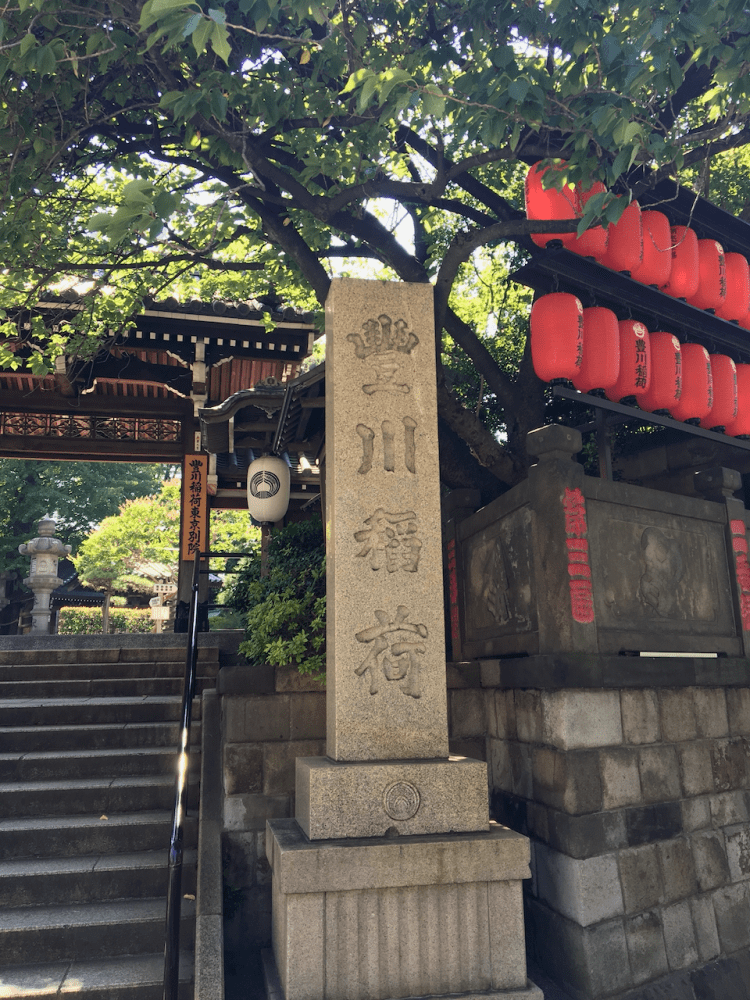
You can still see vestiges of this blending in some temples and shrines, but one great example is the Toyokawa Inari shrine right in the heart of Tokyo’s Minato Ward:
This Shinto shrine / Soto-Zen Buddhist temple venerates Dakini-ten (荼枳尼天), which is the Buddhist form of the Shinto kami Inari Ōkami.
Dakini-ten is based on the concept of Ḍākinī in esoteric (a.k.a. Vajrayana) Buddhism, but in Japan it blended with veneration of Shinto kami and thus took on a life of its own.
Inari Ōkami in his/her Buddhist form as Dakini-ten shining light upon a samurai warrior. Late medieval painting by Utagawa Kuniyoshi, source: Wikimedia
Anyhow, let’s talk about the temple itself. I visited the temple in 2018 and had little context back then, so I didn’t take as many good photos as I would have liked, but I will try to explain as best as I can.
Once you go past the main gate…
You come upon the main shrine to Inari Ōkami (colloquially known as “O-Inari-san”):
Another, small sub-shrine here:
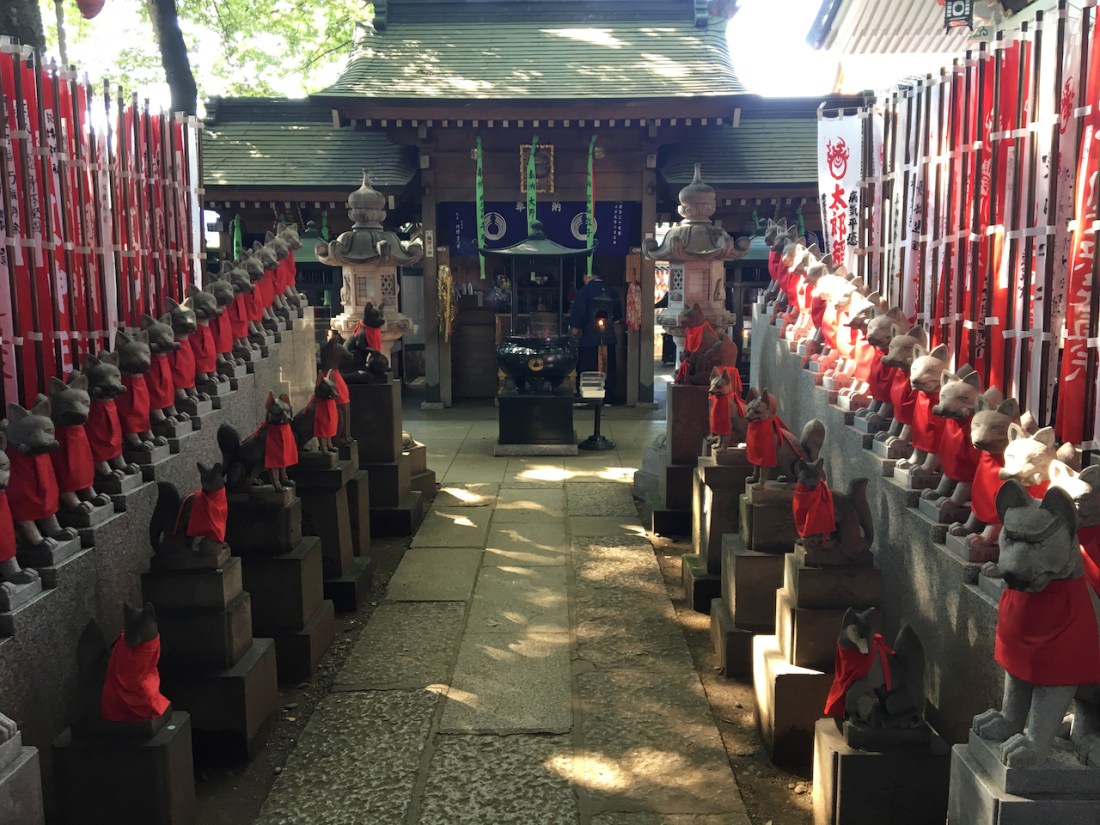
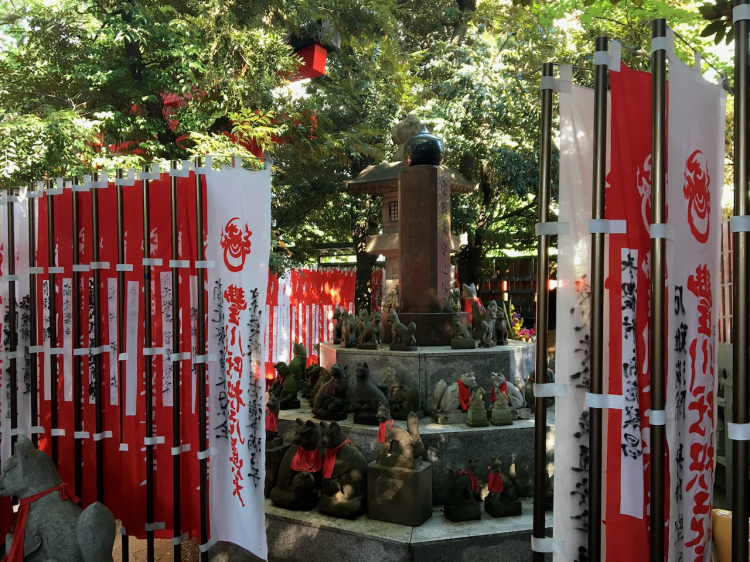
You can see fox statues all over the complex, due to their close association with Inari Ōkami.
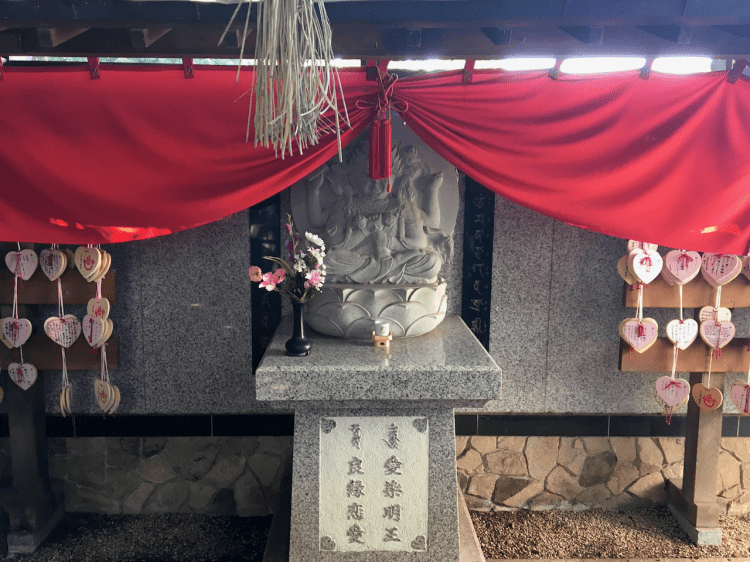
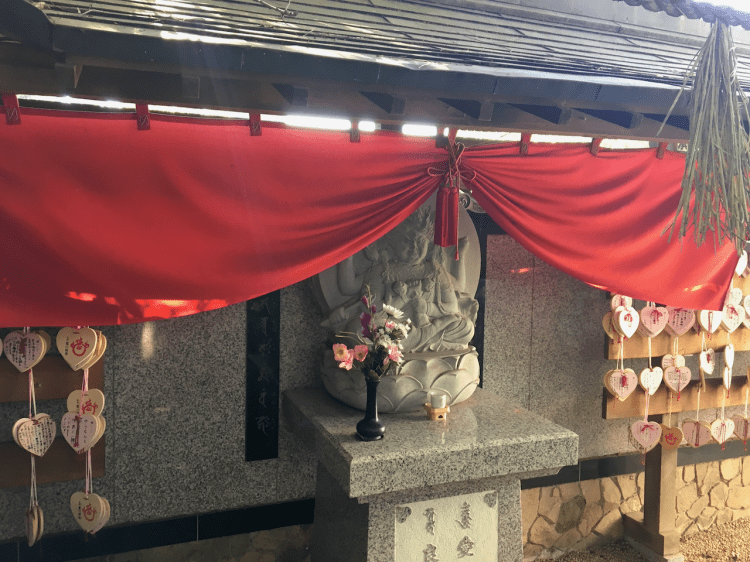
However, other deities, both Buddhist and Shinto are enshrined here too. For example, below is an esoteric-Buddhist (Vajrayana) deity named Aizen Myō-ō (愛染明王):
The fact that both Shinto deities like Benzaiten and Inari Ōkami reside in the same shrine as overtly Buddhist deities such as Kannon and Aizen Myō-ō is somewhat unusual, but really isn’t. This was normative for Japanese religion until the modern century. Japan has had two religions for a very long time, and they’ve co-existed for so long, that they often blended together.
If you look at American religion, pagan religion and Christianity co-existed for so long (even when paganism was officially repressed) that the two blended together. Things we take for granted such as Christmas trees, mistletoe, Easter eggs, and such are all examples where they have blended together to religion as we know it today. This might offend religious purists (to be fair everything annoys religious purists), but this is how societies absorb and adapt religions over generations. Japanese culture simply had different religions to work with.
Anyhow, fascinating stuff.
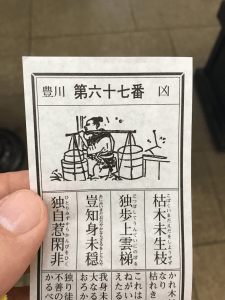
P.S. My omikuji fortune that visit was bad luck (kyō, 凶). I don’t remember having a particular bad year, especially compared to 2020 later, but it was surprising to get an overtly bad fortune for a change.
My son is in grade school and loves world mythology, especially Greek and Norse mythology (I did too at his age 🥰). But we’ve also been introducing him to Japanese mythology since it’s part of his heritage.
The trouble is is that Japanese mythology feels “scattered” and, due to cultural differences, hard to translate into English without a lot of explanation. Further, some of it just isn’t very kid-friendly.
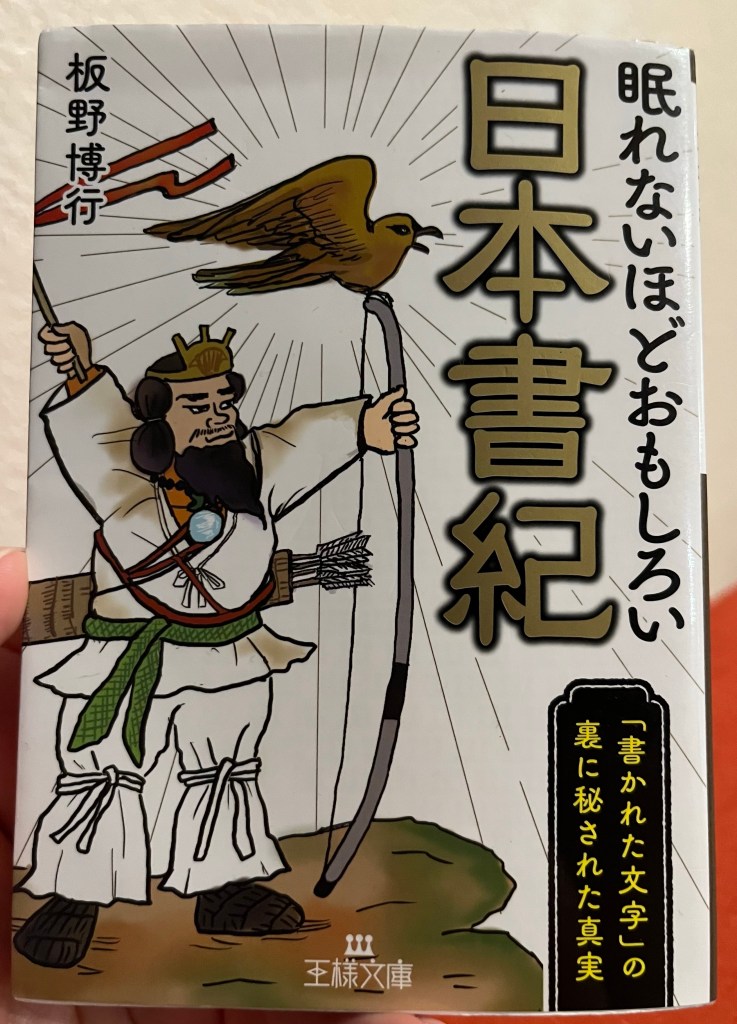
This post is meant to help make sense of Japanese mythology. I learned a lot about it after finding this book in Japanese about the Nihon Shoki (日本書紀), a legendary record of Japan’s foundation:
The Nihon Shoki is one of two records composed in the early 8th century about Japan’s history and origins. The other record is the Koijiki (古事記). Both were promulgated by Emperor Tenji, and both cover overlapping yet differing mythologies, so why are there two records?
The book above explains that the intended audiences were different.
The Nihon Shoki is a longer, more polished record of Japan’s foundation intended to impress Imperial China. It seamlessly transitions from mythology to the origins of the Japanese Imperial Family, legitimizing it in the eyes of their rivals in China, and even covers the life of Prince Shotoku. The Kojiki, by contrast, is shorter and includes more salacious details of some myths, and intended for domestic audiences only.
Even between the two records, some myths differ slightly, as we’ll see shortly.
In any case, much of what we know today about Japanese mythology derives from the Nihon Shoki and Kojiki, just as Greek mythology largely derives from only three sources: the Iliad and Odyssey attributed to Homer, and the Theogony by Hesiod.
The Founding Gods
The two gods credited with the founding of Japan are husband and wife Izanagi and Izanami. According to myth, they descended from the heaven realm, called Takama no Hara (高天原) and saw the primordial chaos of the world below. The Kojiki mentions 3 realms, by the way:
Takama no Hara (高天原) – the heaven realm
Ashihara no Nakatsukuni (葦原中国) – the earthly realm (e.g. Japan)
Yomi no Kuni (黄泉国) – the realm of the dead
According to my book above, the Nihon Shoki never mentions the second two, only the heaven realm. Also, if you’ve been playing Zelda: Tears of the Kingdom, you might notice some similarities….
Anyhow, Izanagi and Izanami stood over the primordial waters on a heavenly bridge called the Ama no Uki Hashi (天浮橋), dipped a spear or pike (literally hoko 矛 in Japanese, a kind of Chinese spear) into the water, and the salty water dripping from the spear tip encrusted and fell from the tip, forming the first island.
In the Nihon Shoki, they then fell in love with one another and wanted to have kids, but didn’t know how (being very new at this), and got advice from a Wagtail bird (lit. sekirei セキレイ in Japanese). Once they figured out how … the process works, they started giving birth to the “eight islands” of Japan (the Nihon Shoki and Kojiki differ slightly on what these islands are), as well as having many children, including some well-known kami :
Amaterasu Ōmikami (天照大神) – goddess (kami) of the sun, she was given dominion over the heavens. Her grandson, Ninigi-no-mikoto, is the progenitor of the Imperial family in Japan, according to the Nihon Shoki.
Susano-o-mikoto (須佐之男命) – god (kami) of storms, he was given dominion over the oceans. His son, Ōkuninushi, is a frequent figure in Japanese mythology especially relating to the founding of Japan.
Tsukuyomi-no-mikoto (月読命) – god or goddess (kami) of the moon, given dominion over the underworld. Their gender is unclear from the mythology.
However, in the Kojiki version, Izanami died when giving birth to the god of fire, and traveled to the underworld, leading to the myth shown below in the Youtube video.
The Nihon Shoki does not mention this myth, and simply states that they went on to create more gods and goddesses. In this Kojiki version, after Izanagi escaped the underworld, he purified himself under a waterfall, and from the droplets sprang more gods. In the Kojiki version, the three kami listed above were born from the water purifying Izanagi.
Sibling Rivalry
The rivalry between older sister Amaterasu Ōmikami (hereafter “Amaterasu”) and younger brother Susano-o-mikoto (hereafter “Susano-o”) drives a lot of the mythology found in the two records. Amaterasu did not like to lose, and Susano-o had a foul temper, so they often clashed.
In one story, they had a dare to see who had a pure heart (and who didn’t) by giving birth to more gods. In their minds, whoever gave birth to female goddesses had ulterior motives, while whomever gave birth to male gods did not.1 They sealed the agreement by exchanging items: Amaterasu gave her brother her jewels, and Susano-o exchanged his sword. Amaterasu gave birth to three female goddesses, and Susano-o gave birth to five male gods.
The Kojiki and Nihon Shoki differ on what happened next. In the Nihon Shoki, Susano-o cheered at first, but then Amaterasu pointed out that the male gods were born from her jewelry, thus she had the pure heart. In the Kojiki, Susano-o instead points out that the three goddesses were born from his sword, and being such sweet and kind goddesses, he obviously had the pure heart. Thus, depending on the source, different gods declared victory.
Side note: of the five male gods born, one of them, Ame-no-oshihomimi, is the reputed ancestor to the Imperial family. Of the female goddesses, they are still venerated a series of shrines in Fukuoka Prefecture (official homepage here).
In the Nihon Shoki version, Amaterasu won, but Susano-o had a huge tantrum and caused a ruckus, destroying many things, etc. Amaterasu was furious and hid herself in a cave, plunging the world into darkness. This famous myth is often depicted in Japanese artwork. The featured image above (source Wikipedia) depicts the efforts by the other kami to entice Amaterasu to leave her cave and thereby restore light to the world, including a risque dance by kamiAme-no-Uzume-no-Mikoto.
Descent to Earth
Fast-forwarding a bit for brevity, Susano-o, having been previously driven out of the heavens due to his behavior, undertakes some adventures, and rescues a maiden named Kushi-nada-himé from a massive serpent named Yamata-no-Orochi. From the serpents body came the mythical sword Kusanagi, one of the three sacred treasures (神器 jingi) of Japan by the way. The other two, the bronze mirror and jewel, were used in the aforementioned myth to draw Amaterasu out of her cave.
Susano-o and the maiden married, and their son, Ōkuninushi-no-kami (大国主神), who committed many great deeds that helped build and pacify Japan:
Interestingly, Ōkuninushi mostly only appears in the Kojiki.
Later, according to the Nihon Shoki, a kami named Takemikazuchi-no-kami (武甕槌神) was dispatched to inherit the country of Japan from Ōkuninushi who had been entrusted with its care. Interestingly, Takemikazuchi-no-kami is the patron god of the Fujiwara clan (originally the Nakatomi), and guess who helped compile the Nihon Shoki? Fujiwara no Fuhito.
Takemikazuchi demonstrated his power by sitting on a sword, point up, without losing his balance. Yes, that is as painful as that sounds. Needless to say Ōkuninushi was impressed. Ōkuninushi’s son, Takeminakata-no-kami (建御名方神) did not take this well and challenged Takemikazuchi-no-kami to a contest of strength, supposedly the first Sumo match ever, but Ōkuninushi’s son lost and fled elsewhere. Thus, Takemikazuchi-no-kami prevailed and inherited the country.
Later, Amaterasu’s grandson Ninigi2 descended from the heavens to the earthly realm with a retinue touching down at Mount Takachiho on the island of Kyushu.3 There are many versions of this myth. Sometimes Ninigi descends alone, in other versions he descends with various other kami who go on to found their own earthly clans. In some myths, he is obstructed by other kami, and in others he is bearing the aforementioned Three Sacred Treasures. In one myth, upon touching down, Ninigi jams a mythical spear, Ama-no-sakahoko (天の逆鉾) into the peak of the mountain, of which a replica exists today.
In any case, this is where the myths begin to transition to semi-legendary, semi-historical narrative, which is a tale for another day. It’s been fun to read about Japanese mythology in a more cohesive narrative, with humor and historical context thrown in, but I also read Japanese pretty slow, so it may take a little while to get to the next section.
Anyhow, I hope you enjoyed!
P.S. Thank you for your patience as I haven’t had much time to right articles lately. Outside of work and parenting, I have been working a lot on the other blog, plus enjoyingFire Emblem: Three Houses in what little spare time I have. I have more articles queued up and should hopefully get back on a regular cadence soon.
1 I wish I was making this up, but I am not. This kind of ritual to determine one’s heart was called Ukei (誓約) in Japanese, though in modern Japanese 誓約 is read as seiyaku and refers to oaths, vows or pledges in general.
2 More formally known as Amatsu-hikohikoho-no-ninigi-no-mikoto (天津彦彦火瓊瓊杵尊).
3 It’s interesting to note that many of the early myths, and older, more obscure kami in Shinto religion have some connection the island of Kyushu in particular, which is closest to mainland Asia.














 Gleanings in Buddha-Fields

.jpg)


You must be logged in to post a comment.