Star Trek and Space Lincoln!!

Season three of Star Trek has one of my most favorite, albeit silliest episodes in the entire series: The Savage Curtain. The episode starts off with a bang: Abraham Lincoln (played by Lee Bergere) floating in space on his trademark chair.

From there, the Enterprise crew and in particular Kirk and Spock are confronted by some of “histories worst villains” as well as an encounter with Spock’s idol, Surak (played by Barry Atwater), father of Vulcan philosophy.

A picture of Surak of Vulcan, his right hand in the Vulcan Salute.
Surak of Vulcan, founder of Vulcan Logic, in the Star Trek episode the “Savage Curtain” (season 3, episode 22)

The rock aliens who force the “good” historical figures to combat the “evil” historical figures want to compare and contrast their philosophical ideas against one another to see which is better.

Kahless the Unforgettable (played by Bob Herron) and Colonel Greene (played by Phillip Pine)

The premise might seem a bit silly, but it is a fascinating contrast of ideas:1

  • Surak – a pacifist, non-violent approach
  • Lincoln – fight if necessary, and “on their level”.
  • Col. Greene – power is all matters
  • Kahless – victory by any means
  • Kirk – do what it takes to save his crew
  • Spock – honor his commitments to Starfleet, and fight with Kirk, even if is compromises his personal morals

Although Surak loses his life in the combat, he has some really great quotes in this episode that I think are worth sharing:2

The face of war has never changed.  Surely it is more logical to heal than to kill.

Surak of Vulcan, “The Savage Curtain” (s3ep23), stardate 5906.5

and also:

I am pleased to see that we have differences.  May we together become greater than the sum of both of us.

Surak of Vulcan, “The Savage Curtain” (s3ep22), stardate 5906.4

Lincoln’s performance throughout the episode is great as he embodies the great American president as we want him to be: gentle, but tough when needed. One can’t help but compare this to Bill and Ted’s Excellent Adventure, even if they are completely different movies, because Abraham Lincoln is such a beloved figure.

At the very end of the episode, there is a subtle dialogue worth sharing:

KIRK: They seemed so real. And to me, especially Mister Lincoln. I feel I actually met Lincoln.

SPOCK: Yes, and Surak. Perhaps in a sense they were real, Captain. Since they were created out of our own thoughts, how could they be anything but what we expected them to be?

Source: http://www.chakoteya.net/StarTrek/77.htm

In fact, I think there’s something very Buddhist about this. The inhabitants of the planet didn’t necessarily create historically accurate versions of Lincoln, Surak, etc, but what we wanted them to be in our minds. In a sense, we create our own gods and idols through our hopes and aspirations (for good or for ill). This isn’t always bad, but it does show how unwittingly we bend the world around us to fit our beliefs and views.

Anyhow, The Savage Curtain is such a fun, surreal episode, and a fascinating contrast of ideas and people in history, and how they interact. These ideas and philosophies are timeless in many ways, and crop up over and over again in history, but by pitting a bunch of historical figures in space against once another, it takes on a whole new dimension of weird, silly, fun.

Also:

P.S. Many reviews point out that The Savage Curtain borrows elements from older, venerable episodes, and thus judge it an inferior episode. I can’t disagree that it borrows a lot of elements, but I like to think it is a capstone to several previous “moral tale” episodes. The action sequences aren’t quite as good, but I don’t think that was the point. It was battle of ideas, not sticks.

P.P.S. I bet you could take all 8 characters, including Kirk and Spock, in the battle and somehow arrange them into a classic D&D alignment chart. The rock aliens of Excalbia would probably be true-neutral.

1 I wish “Zorra” (Carol Daniels) and “Genghis Khan” (Nathan Jung) had dialogue, as it would have been interesting to have more contrasting goals and aspirations.

2 More on witnessing war.

Sutra Book from Kofukuji Temple

When visiting famous Buddhist temples (o-tera, お寺) in Japan, it’s very common to see sutra books, or kyōten, (経典), sold in the gift shop. These are small booklets that contain popular Buddhist sutras of the Mahayana tradition, and are used for home services. Over the years, I’ve collected more sutra books than I care to admit, but I really liked the one I picked up from Kofukuji temple in Nara last year:

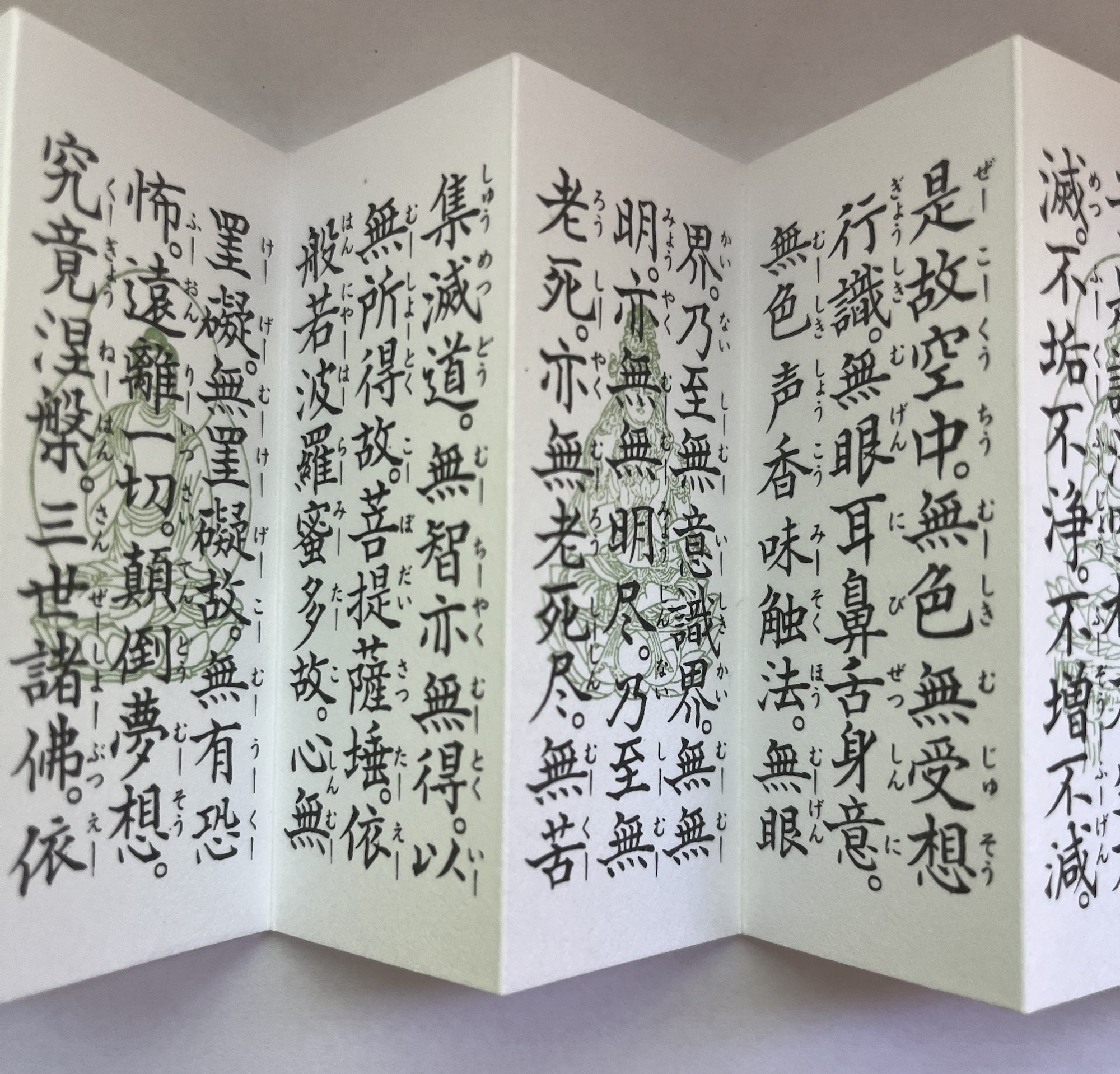
This is a boxed copy of the Heart Sutra, called the Hannya Shingyō (般若心経), with a blue brocade cover. Inside, you can see the Heart Sutra as it is usually printed: original Chinese characters with Japanese pronunciation guides. It is read from right to left, vertically:

However, if you look carefully, you will also see Buddhist deities embossed on the pages too:

They also appear on the backs of the pages too:

It took me a moment, but I finally recognized these as the Thirteen Buddhas and Bodhisattvas venerated in the Shingon-Buddhist tradition.1

I have read that many of the old Nara-Buddhist sects were gradually subsumed by Shingon Buddhism and adopted many of its practices. This includes sects such as the Kegon sect (Todaiji temple) and Hosso sect (Kofukuji temple) among others. So, this makes sense. You can learn more about Shingon Buddhism here.

Anyhow, of all the sutra books I own, I have to admit that this is my favorite one, and use it regularly for morning services (see old post).

P.S. If you’re ever curious what the Heart Sutra sounds like in Chinese (at least modern Chinese), this link has a nice example.

P.P.S. Older post about Kofukuji temple.

1 These Buddhas and Bodhisattvas are venerated in other sects in varying degrees, of course, but not as a set of thirteen like Shingon. Shingon even includes them in its ritual services.

Hosso Yogacara Buddhism and the Five Natures Doctrine

Throughout the history of the Hossō Buddhist sect in Japan, descended from the Yogacara school of thought from India, no one doctrine has caused more controversy or sparked debate with other schools than the Five-Natures Doctrine, or goshō kakubetsu (五姓各別). I don’t necessarily endorse nor criticize this doctrine myself, but I am a big believer that a little healthy competition is good for everyone, and the Japanese Buddhist discourse in the West is dominated by sects descended from Tendai Buddhism in particular (Zen, Pure Land, Nichiren), which tends to make things lop-sided. And so I think it’s good to provide alternate views to get people thinking. This post is one such effort. 🙂

This teaching, unique to Yogacara Buddhism and its offshoots only, states that there are in fact three “vehicles” of Buddhism (三乗, sanjō), not one as contended by the Lotus Sutra:

  1. The Bodhisattva vehicle
  2. The Pratyeka or “private Buddha” vehicle
  3. The Śrāvaka or “voice hearer/disciple” vehicle.

All three of these “vehicles” are defined in the earliest sutra scriptures, but not necessarily in a straightforward, textbook fashion. This page by Buddhanet provides an excellent summary if you’re not already familiar with the concept.

Now the Five Natures Doctrine in Hossō / Yogacara Buddhism states that due to innate natures of beings (lit. innate seeds), people will ultimately follow only one of these nature to fruition, or none at all. One does not feed into the other, so to speak. The Five Natures are:

  1. Beings with a predisposition toward the Bodhisattva Path
  2. Beings with a predisposition toward the Private Buddha Path
  3. Beings with a predisposition toward the Voice Hearer Path
  4. Beings with an indeterminate predisposition (they could go a few different ways)
  5. Beings lacking the predisposition at all for reaching Enlightenment (e.g. icchantikas)

The last class of beings is the one that draws the most fire. The notion of Icchantikas or beings who can never attain Enlightenment has some precedence in the Buddhist teachings, where it’s mentioned in the Mahayana Nirvana Sutra, and also mentioned at length in the Lankavatara Sutra. The Lankavatara also happens to be one of the two central texts in Hossō Buddhism.1 Anyway, the Sutra defines the Icchantikas as follows (explanations added by D.T. Suzuki):

Again, Mahamati, how is it that the Icchantika never awaken the desire for emancipation? Because they have abandoned all the stock of merit, and because they cherish certain vows for all beings since beginningless time. What is meant by abandoning all the stock of merit? It refers to [those Buddhists] who have abandoned the Bodhisattva collection [of the canonical texts], making the false accusation that they are not in conformity with the sutras, the codes of morality, and the emancipation. By this they have forsaken all the stock of merit and will not enter into Nirvana. Secondly again, Mahamati, there are Bodhisattva-Mahasattvas who, on account of their original vows made for all beings, saying, “So long as they do not attain Nirvana, I will not attain it myself,” keep themselves away from Nirvana. This, Mahamati, is the reason of their not entering into Nirvana, and because of this they go on the way of the Icchantika. (Section XXII)

So there are actually two types of icchantikas, or those who will never attain Enlightenment: those who have utterly abandoned merit and good works, and those Bodhisattvas who voluntarily stay and liberate all beings, rather than reach Enlightenment. But even in the case of those who have abandoned merit, the Buddha then states in the Sutra:

Those Icchantikas, Mahamati, who have forsaken all the stock of merit might some day be influenced by the power of the Tathagatas and be induced at any moment to foster the stock of merit. Why? Because, Mahamati, no beings are left aside by the Tathagatas. For this reason, Mahamati, it is [only] the Bodhisattva-Icchantika who never enters into Nirvana.

As Rev. Tagawa in his book, Living Yogacara, explains the doctrine like so:

When we consider the broad range of sentient beings, even without their variations in external form and appearance, we must acknowledge that they internally contain a wide variety of differences in terms of ability of character. In roughly defining a Buddhist lifestyle, I would like to think of it as the lifestyle of consistent application toward the elimination of of evil and cultivation of good, which the ultimate aim of liberating our mind, while simultaneous caring for others. But we certainly cannot say that all sentient beings are endowed with the same capacity for the elimination of evil and cultivation of good. Beyond these very general differences, the Yogācāras understood that all living beings do not uniformly become buddhas in the same way, and furthermore, that the state that they attain differs according to their predilection. (pg. 104)

This teaching drew intense criticism from the Tendai school of Buddhism in particular, which held the Lotus Sutra and its One Vehicle teaching as the ultimate. Indeed, Saichō, the founder of Tendai, traded harsh words with Tokuitsu, the leading Hossō scholar of his time. Later, debates such as the Ōwa Debate in 963, pitted both sides against each other with inconclusive results, followed by more and more debates until the time of Jōkei in the 13th century, who according to James L. Ford’s book, Jōkei and Buddhist Devotion in Early Medieval Japan, attempted to reconcile the differences with a “middle way” approach: reiterating the Lankavatara Sutra’s point that even Icchantikas will be saved by Buddhas and Bodhisattvas, rather than their own effort (or lack thereof). At the same time, he uses the Lotus Sutra, namely chapter five, and the parable of medicinal herbs, to assert the view that there are indeed different natures ultimately for all beings.

Rev. Tagawa writes regarding the whole debate and controversy:

This disparity in view between all sentient beings becoming Buddha and distinction in five natures is grounded in the differences between an idealistic point of view [the Tendai One Vehicle doctrine] and a realistic point of view [the Hossō Five-Natures doctrine]. To the extent that members of each side attach their own positions, they will accomplish nothing more than continuing to traverse along parallel lines, and we can never expect any satisfactory resolution of the controversy. However, those of us who are trying to follow the Buddhist path should, regardless of the standpoint, be willing to give serious consideration to the perspectives of the others. (pg. 108)

And lastly Rev. Tagawa provides one last warning with regard to the Five-Natures Doctrine:

…we should remember to never take the division into five-natures as either a standard by which others are measured in the Buddha-path, or as a teaching that coldly divides practitioners into classes. The theory of the distinction if five natures is something that should be taken up only in the context of one’s own self-examination regarding one’s own qualities. (pg. 109)

Rev. Tagawa’s point about realism vs. idealism is something for Buddhists to bear in mind, as Buddhism has an abundance of very poetic and beautiful imagery and concepts, but sometimes it’s important to take stock of what we have, compare it to reality, and try to understand where they agree and disagree. I do find myself sympathetic to the Five Natures Doctrine, but also willing to consider the Lotus Sutra view of universal Buddhahood if indeed it’s possible.

Definitely open to hear other thoughts, if you have them. 🙂

Namu Amida Butsu

P.S. this is a re-post from the old blog. It’s handy information to have on the Web. 😎

1 The other is the Samdhinirmocana Sutra, which I can’t find a copy of online anymore. 😦 A third critical text, at least for East Asian Yogacara/Hossō Buddhism is the Jō yuishiki ron, better known as the Chéng wéishì lùn (成唯識論) by Xuanzang.

Polishing the Mind

In Chinese-Buddhist literature, the influential treatise Cheng Wei Shi Lun (成唯識論) contains the following quote, translated in the book Living Yogacara:1

Polishing their minds, the courageous do not waver.

trans. Professor A. Charles Muller

This treatise was written by the famous Chinese monk, Xuanzang (玄奘), whom I talked about recently. From his journeys in India, Xuanzang brought back considerable information and texts to help the Yogacara Buddhism tradition flourish in China, along with many other important Buddhist texts and observations. Upon his return he wrote extensively and translated many works with Imperial support.

The Cheng Wei Shi Lun, is one of the foundational texts for East Asian Yogacara thought including the descendant Hossō school in Japan, and the treatise is quoted multiple times in Living Yogacara.

When I read this passage, I feel it is an encouragement for people who walk the Buddhist path. Life really can bring you down, and when you’re tired and exhausted, it is so easy to want to backslide and wallow in self-pity or take the low-road which is so much easier up front.

However, every action and thought committed “perfumes the mind” in Yogacara-speak, and its important to bear this in mind. There’s no such thing as a free lunch,2 so every deed or intention has its price, and the only way to break free from the constant up and down cycle, the constant upkeep, is to purify the mind once and for all, bit by bit. As the Yogacara school of thought teaches that Enlightenment takes 3 massive eons to complete (literally “three asaṃkhya kalpa”), it’s a gradual process. However, in Buddhism there is a lovely passage from the Immeasurable Life Sutra that I was also contemplating lately:

“At that time the Buddha Lokeshvararaja recognized the Bhiksu Dharmakara’s noble and high aspirations, and taught him as follows: ‘If, for example, one keeps on bailing water out of a great ocean with a pint-measure, one will be able to reach the bottom after many kalpas and then obtain rare treasures. Likewise, if one sincerely, diligently and unceasingly seeks the Way, one will be able to reach one’s destination. What vow is there which cannot be fulfilled?’

Nothing worthwhile in life comes easily, and hence Xuan-Zang’s statement that the courageous do not waver. They have everything to gain in the process.

Namu Amida Butsu

1 Compare to the ancient Dhammapada, verse 183:

The non-doing of any evil, the performance of what’s skillful, the cleansing of one’s own mind: this is the teaching of the Awakened.

2 See Heinlein’s novel The Moon is a Harsh Mistress. 🙂

Visiting Kofukuji Temple

Lately, I have been posting old nostalgia posts from visits made to Japan and its famous Buddhist temples, such as Kiyomizudera, Ryoanji and the two Pavilions. Today, I wanted to share one more famous temple that, in particular, is often overlooked by visitors, yet really worth a visit for its historical value and amazing cultural treasures. That is the temple of Kofukuji (homepage here), the head of the once-powerful Hosso or Yogacara sect.1

Anyone who’s dabbled in Japanese Buddhism has probably never heard of the Hosso/Yogacara, but in early-medieval Japan it was once the most powerful, if not the de facto state religion. The fortunes of the Hosso school were so great that they were closely allied with the powerful Fujiwara family, and fielded vast armies of sohei soldier-monks to combat their rivals, the upstart Tendai sect. Now, it is a very diminished school in Japan, mostly centered around Nara, Japan, and closely affiliated with Shingon Buddhism. For more on Hosso/Yogacara teachings, I highly recommend the book Living Yogacara: An Introduction to Consciousness-Only Buddhism by Rev. Tagawa Shun’ei.

Anyhow, I have been to Nara, Japan twice: once in 2005 during my very first trip to Japan, and again in 2010 when my duaghter was still a little girl.

Because of warfare, accidents and other reasons, Kofukuji has been greatly reduced, and not all buildings have been restored. Currently there are three main “halls”. I believe this is the Eastern Golden Hall (tōkondō 東金堂):

Inside the Eastern Golden Hall, I recall that there was a beautiful altar with man deities lined up, with the Medicine Buddha as the central figure.

From there, we saw the five-storied pagoda (gojū no tō 五重塔):

Side note: what is called a pagoda in English, is really just an East Asian form of a Buddhist stupa. Stupas are special reliquaries from India, that gradually evolved into the pagodas you see in Japan today.

Another place we visited was the Southern Round Hall (nan’endō 南円堂):

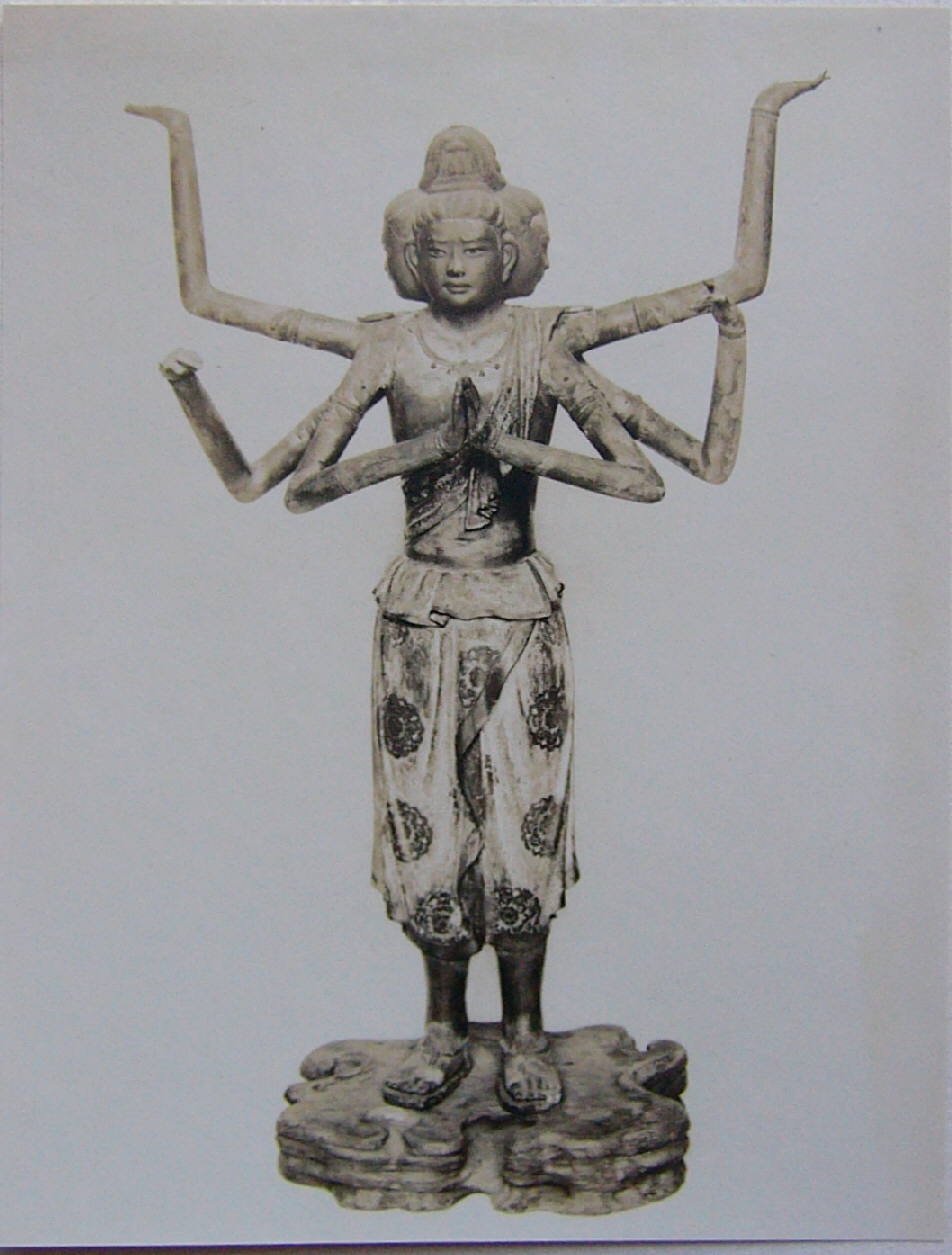
Finally, we visited the museum in the central hall. The museum is huge and contains many relics from Kofukuji’s history, including the famous Asura statue:

日本語: 小川晴暘English: OGAWA SEIYOU, Public domain, via Wikimedia Commons

Seeing the Asura statue in a picture is one thing, but seeing it in real life was simply amazing (though it was smaller than I expected 😋). Kofukuji has a long, rich history and the museum really shows it.

Nara is the early capital of Japan, and reflects a time when it was closely modeled after Chinese (specifically Tang-dynasty) culture and religion, with a blend of Indian influences as well. It’s a fascinating blend that is not found in later Japanese history. I highly recommend visiting Nara and Kofukuji in particular if you can.

1 The Japanese word hossō (法相) is a transliteration of the Chinese translation of the Sanskrit term yogācāra. Buddhist terminology has a long, fascinating history.

Buddhism, Conceit and The Nature of All Things

Lately, I’ve been playing the classic RPG game Chrono Trigger on my mobile phone, and it’s been a lot of fun to relive this game on a modern platform. I am amazed that this game even fits on a mobile phone, but that shows how much times has changed.

Anyhow, these screenshots are from my favorite part of the game where the players travel in time to an enlightened Ice Age / Atlantis-like civilization. One of the residents of this realm says to the players (as shown in the screenshots above):

The world you see with your eyes may well differ completely from the one I see with me. There are as many different worlds as there are observers. Never assume that only those things which you can see or touch are real.

This is a surprisingly Buddhist message (even if not intended that way). Allow me to explain.

Of the most fundamental Buddhist teachings (i.e. the Dharma) is the concept of no-self called anātman in Sanskrit. Sentient beings from the moment they’re born or conceived, they begin to experience senses, feelings and thoughts in a interdependent phenomena that Buddha calls the Five Skandhas (aggregates). The details aren’t super important, but what matters is that from all these sense experiences, feelings and thoughts, sentient beings reify this into a sense of self, even though it has no permanent substance (i.e. it “has no leg to stand on”).

Because we create this sense of self out of our past experiences, thoughts, etc, it also colors our future thoughts and impressions as well. The experiences and sense of self of a person born in a rural family will differ from a family born in the city, a person born in one country vs. another, a person raised in a large family vs. a small one, a religious family vs. a non-religious one, etc. In short, there are almost as many possible ways to look at the world as there are people because each person is coming with their own personal baggage, and each one assumes their perspective is reality because that’s all they’ve ever known. It’s like a fish who only knows the lake waters they have grown up in, unaware of a much larger ocean, let alone the air above, and space beyond that.

Further, in the end, these perspectives, views, etc are all just a bunch of hot air. They have no substance apart from what is in people’s minds. Hence no-self / anātman.

The Buddha really brings this home when he talked with a wandering ascetic named Vaccha:

“A ‘position,’ Vaccha, is something that a Tathagata [i.e. a Buddha] has “A ‘position,’ Vaccha, is something that a Tathāgata has done away with. What a Tathāgata sees is this: ‘Such is form, such its origination, such its disappearance; such is feeling, such its origination, such its disappearance; such is perception… such are fabrications… such is consciousness, such its origination, such its disappearance.’ Because of this, I say, a Tathāgata—with the ending, fading away, cessation, renunciation, & relinquishment of all suppositions, all excogitations, all I-making & mine-making & obsessions with conceit—is, through lack of clinging/sustenance, released.”

The Aggi-Vacchagotta Sutta (MN 72) translated by Thanissaro Bhikkhu

So, while we need to rely on our senses and thoughts for practical, day-to-day living, it’s important to take our own thoughts with a grain of salt, and not assume we have a pristine understanding of things. The results may surprise you.

P.S. The venerable Yogacara school of Buddhist philosophy really explored this in excruciating detail by mapping the mind, how it takes in new experiences, the many possible feelings one might experience, etc, and how these drive new thoughts based on past experience in a kind of feedback loop which they called “perfuming the seeds [of the mind]”. Reverend Tagawa’s excellent book, translated into English by Professor Charles Muller, Living Yogacara is an excellent overview of the Yogacara school of philosophy as it exists in Japan as the Hossō school. One of my favorite Buddhist books to read.