Mindfulness Meditation Isn’t What You Think

Spock : “… I have noted that the healthy release of emotion is frequently very unhealthy for those closest to you.”

Star Trek, “Plato’s Stepchildren” (s3ep10), Stardate 5784.2

Meditation, specifically mindfulness meditation, is touted as a stress-relief exercise. Busy people believe that if they can block out the time to meditate for X minutes a day, or when stressed, this will make more happy and productive. It has been all the rage in Silicon Valley too.

But it doesn’t work.

It will calm your mind while you are sitting, but as soon as you are back to work, your blood pressure will quickly rise again. Old habits will quickly resurface. Self-help, in short, does not help.

How do I know this?

I tried the same trick in my late 20’s. My first child was born, and I was working at Amazon (yes, that Amazon) for a few years in a technical support role. The environment was stressful, demanding, constantly on the move, the on-call rotation gave little time to decompress because something was always broken,1 and I had to drive into work at all hours of the night to try and fix it.

Since I had recently converted to Buddhism at the time, and listened to a lot of Ajahn Brahm dharma talks, I wanted to try meditation. We had a spare office that no one used, so I would go in there once or twice a day, turn off the lights, dutifully sit, chant certain Buddhist mantras, meditate for 20 minutes or more, and then return to work.

As soon as I was back at my desk, the stress would rise all over again. I kept at the meditation for months, almost a year, before I finally gave up.

The stress, constant sense of inadequacy measuring myself to hyper-competitive co-workers who graduated from Stanford, unrealistic work performance goals, fear of losing my job, and so on simply didn’t go away until I QUIT MY JOB AND TOOK A LESS DEMANDING ONE.2

It took me years as a Buddhist to finally realize that stress-relief is not what mindfulness meditation was intended for.

Mindfulness meditation is a tool to develop insight, not stress relief. It is necessary in the early stages of meditation to quiet the chatter in the mind, but that is just the first stage. It is to remove barriers to insight by develop a focused mind, and a quiet mind, a mind that can perceive things in a more balanced way. Consider this quote from the Buddha in a very early text, the Dhammapada:

  1. There is no meditative concentration for him who lacks insight, and no insight for him who lacks meditative concentration. He in whom are found both meditative concentration and insight, indeed, is close to Nibbana.
  2. The monk who has retired to a solitary abode and calmed his mind, who comprehends the Dhamma with insight, in him there arises a delight that transcends all human delights.
  3. Control of the senses, contentment, restraint according to the code of monastic discipline — these form the basis of holy life here for the wise monk.
Translation by Soma Thera from https://www.accesstoinsight.org/tipitaka/kn/dhp/dhp.25.budd.html

The emphasis is on focus, insight, and contemplation NOT relaxation or stress-relief. Mindfulness meditation has been repackaged and sold to naive Westerners with false promises. Meditation really does provide excellent benefits, but it has to be done as part of a much larger, holistic lifestyle change and with wholesome intentions. This is the “holy life” as described by the Buddha: a life of wholesome, guilt-free conduct, goodwill towards others, and a desire to pursue the Dharma (the teachings of the Buddha).

First, one should take up the Five Precepts of Buddhism. As we see in verse 374 above, the Buddha openly encourages that we curb our worst behaviors first as a foundation for other Buddhist practice. One will gain no lasting benefit from meditation until this is done. Full stop.

Second, one must approach meditation with the mindset of a monk. It is not necessary for lay-people to give up everything and go live in the woods. Buddhism accommodates both the “house-holder” lifestyle and that of a true renunciant (a.k.a. a monk or nun). But both the renunciant and the house-holder are expected to live a life of moderation and restraint.3 Easier said than done (speaking as a gamer and foodie), but it’s a goal to sincerely aspire to.

Speaking of restraint, one should always guard one’s speech. A long time ago, a Buddhist minister I admired once told me that speech was like toothpaste: once it was out of the tube, you couldn’t put it back. One has to learn to carefully monitor what one says both in person and online (and yes, at work). Again, easier said than done, but the alternative will only make your life miserable.

Finally, when such good foundations are established, meditation will help you learn more about yourself, and the world around you.4 It’s incredibly helpful, and life-changing when carried to fruition. I have my own little private insights that have stayed with me through the years, and I hope you will find yours too.

Namu Amida Butsu

Namu Shakamuni Butsu

P.S. if you feel the need to calm yourself right away, try something much simpler. You can recite the nembutsu, the Heart Sutra, a mantra, whatever. Try that for a minute, and see if that works. It is a band-aid fix though, and you still need to approach things from a holisitic standpoint, or you will gain no long-term benefit. Alternatively, just go for a walk.

1 Years later, the sound of a pager going off still triggers me a little bit. No joke.

2 Another ex-Amazonian who had joined the same company years earlier confided in me that after leaving Amazon, he drank himself stupid for months to decompress. I noticed that I was still on a hair-trigger for months after leaving Amazon, and it took me a while to unlearn those habits too. My wife noted that my posture improved after leaving, and that I grumbled about work less. Some jobs are simply not worth staying in.

3 The Buddha was pretty flexible about what exactly this meant, citing whatever cultural standards applied at the time as a benchmark. In short, a lot of it is rooted in common courtesy and good sense. If you cannot act toward others using common courtesy, meditation ain’t gonna fix your issue.

4 You may learn that your whole problem is that your job sucks, for example, and that the burn-out is not worth the money. Of course, if you’re a single mom caring for three kids, you have a lot fewer options available to you, and in such cases I recommend the nembutsu as a starting point.

Updates on my Buddhist Home Practice

Hello Dear Readers,

In June, I posted about the “day” and “night” concept used in Tendai Buddhist practice, using the example of the Jimon sect. I felt inspired to experiment a bit and try this out myself. My adjustments to home practice took a few twists and turns, but within a week or so I settled onto a consistent routine that I’ve been happy with.

Here’s what I’ve been doing for the past month, more or less.

For mornings, I focus on Kannon Bodhisattva:

For evenings, I focus on Amida Buddha:

I have found that splitting the practice like this has had some benefits. For me, this style of practice lets me cover both the here and now, through veneration of Kannon and reciting the Heart Sutra, while also looking to the future through venerating Amida Buddha through the evening practice. I feel pretty content covering both aspects.

I made both morning and evening routines intentionally short and lightweight so they are more sustainable, rather than doing something elaborate.

Still, to be honest, sometimes I am still too busy to even do this much. Or I just forget. 😅

I am not proud of that, but I felt I should be honest with readers and let them know that mistakes in Buddhist practice are perfectly OK. Life is unpredictable, and for us are “householders” (e.g. lay-Buddhists), life gets in the way. That’s why the monastic community was (presumably) created: to give people the option of practicing Buddhism full-time, not part-time.

That said, Buddhist practice is like exercise: the more you can do, the better. Even a little bit is a positive thing.

Anyhow, when I am simply busy, sometimes I will just recite either the Kannon mantra in the morning, or the nembutsu in the evening. Sometimes, I can only just bow at the altar for a moment.1 The Soto Zen resources I read previously often said much the same thing: adjust as needed, depending on how busy you are. Sometimes your home practice will be longer, sometimes shorter.

Just don’t give up.

Keep experimenting, keep trying, make it personal, and always be flexible.

Good luck and happy … er, “Buddhist-ing”.

P.S. I took a nice, relaxing weekend off to catch up on some things, avoid social media, and just unplug for a bit. I didn’t really have a plan, I just took a break. I may have also played some Fire Emblem games as well. The fun continues. 😀

1 To make this “split service” work, I have two altars now at home: the main one for Amida Buddha and tiny little “side altar” for Kannon on my bookshelf. It’s basic, but it’s something I can keep building on over time.

Buddhist Chanting for Difficult Times

Daily writing prompt
What strategies do you use to increase comfort in your daily life?

I have never tried using these WordPress writing prompts, but I thought I’d try as a fun exercise today.

Life is stressful. That’s the First Noble Truth of Buddhism. More precisely life is marked with stress, unease, discontent, and so on, collectively called dukkha in Sanskrit. Put more succinctly, shit happens sooner or later. It is impossible to avoid, but at the same time, a well-trained even-keel mind can weather the storm and thereby help ease one’s life, but also make life better for those around you too.

Buddhism as a 2,500 year old religion comes with a really large toolkit of methods, practices, and liturgy that can help bring peace of mind.

Most people think of meditation first, but this is simply not always practical, especially if you are a working parent, busy college student, and so on. There are other practices available that can more easily be fit into a busy lifestyle, and are not difficult to learn.

The first is to take up the Five Precepts as a baseline for one’s conduct. This is a passive practice, but helps provide some guideposts to life, gradually smooths out our rough edges, and builds self-confidence as well.

The second is Buddhist chanting.

There are many, many things one can chant in Buddhism: mantras, excerpts of Buddhist texts (sutras), full Buddhist texts, or devotional phrases as well.

Mantras are very short, but esoteric phrases often used for chanting, recited originally in Sanskrit language, but filtered over time in other languages. One of the best known is the Mantra of Light, but you can find many mantras. People often recite these 3 or 7 or even 21 times, but traditions vary. Consult your preferred tradition if you are unsure. Keep in mind that many traditions within Buddhism simply don’t use mantras, or use very sparingly.

Buddhist texts (sutras), or even excerpts of Buddhist texts, are an almost universal chanting practice. They are longer than mantras, but also more commonly practiced, and have a nice habit of reinforcing important teachings within yourself. You can recite them in the old, liturgical language, or recite in your own language. It does not really matter.

By far the most popular Buddhist text to recite is the Heart Sutra. The Heart Sutra is somewhat unusual because you can recite the entire text, from start to finish, in about 1-2 minutes. It is profound, but also really pithy. Another common chanting text you can do from start to finish is the Metta Sutta in the Theravada tradition. Most other Buddhist sutras are a challenge to recite in one sitting (some are extremely long), so instead people traditionally recite key excerpts only. The Lotus Sutra is particularly quote-worthy; it has many verses and quotations that are chanted by themselves without chanting the entire chapter. There are other good quote-worthy Buddhist sutras as well.

When chanting Buddhists sutras (or excerpts), you can either do it in a chanting voice, or simply recite the same way you might read a poem aloud, or something like reciting the “Litany of Fear” in Dune. Personally, I find chanting in English sounds silly, so I recite with an even voice instead.

Finally, we have devotional phrases. Because Buddhist deities are many and varied, each embodying some essential truth or concept in Buddhism, people tend to gravitate toward one or another. This is fine, and perfectly normal in Buddhism. One might gravitate toward the historical Buddha, Shakyamuni. One might gravitate toward Guan-yin (aka Avalokiteshvara, Chenrezig, Kannon, etc). One might gravitate toward the Buddha of Infinite Light (aka Amitabha, Amida, etc). Over time, you might shift as well. Again, perfectly normal.

In any case, many of these deities will have some simple devotional phrase: “Hail to X”, or “Praise to Y”, and so on. These might overlap with mantras, but aren’t necessarily mantras. They are often exoteric (no subtle, hidden meaning), not esoteric. Sometimes mantras are used as devotional phrases too. It’s also common in some traditions to praise the Lotus Sutra itself, not as a deity, but as the embodiment of the highest and best Buddhist teachings.

All of these devotional phrases are short, simple, and easy to recite. People often recite in groups of three, but you can recite as little or as much as you like. Consult your preferred tradition if you are unsure.

When should one do Buddhist chanting?

Whenever appropriate. If you get up first thing in the morning and recite your chosen sutra, mantra or devotional phrase, that’s great. If you do it before going to bed, that’s great. If you are stressed out at work, and need a moment, go in a quiet spot, and recite something Buddhist. If you are moved by something spiritual, you can also recite something in the form of gratitude. There are many times and places to do Buddhist chanting. Find what works, experiment if needed, see what sticks in your life.

One thing to keep in mind though: always do it respectfully, solemnly, and without showing off. Intention and sincerity are important.

Why should one do Buddhist chanting?

There are many reasons why one takes up the practice. For some, it helps settle the mind, especially when stressed or worried about something. It tends to reinforce positive habits too. Sometimes it can also bring a flash of insight because one’s mind is settled and they meaning of the texts finally makes sense. It also helps generate good karma for the future, like planting seeds for later harvest. By settling the mind, it also helps disengage negative habits and avoid negative consequences later.

Coupled with the Five Precepts I mentioned above, the long-term effects are both peace of mind for yourself, but also others around you as the wholesome effects “rub off”.

The Five Precepts and Buddhist chanting are two practices that almost anyone can do almost anywhere under any circumstances. You might have to tailor things to make it sustainable in your life, but there’s plenty of wiggle-room to make it work. Also, don’t be afraid to make adjustments.

Good luck!

Sutra Book from Kofukuji Temple

When visiting famous Buddhist temples (o-tera, お寺) in Japan, it’s very common to see sutra books, or kyōten, (経典), sold in the gift shop. These are small booklets that contain popular Buddhist sutras of the Mahayana tradition, and are used for home services. Over the years, I’ve collected more sutra books than I care to admit, but I really liked the one I picked up from Kofukuji temple in Nara last year:

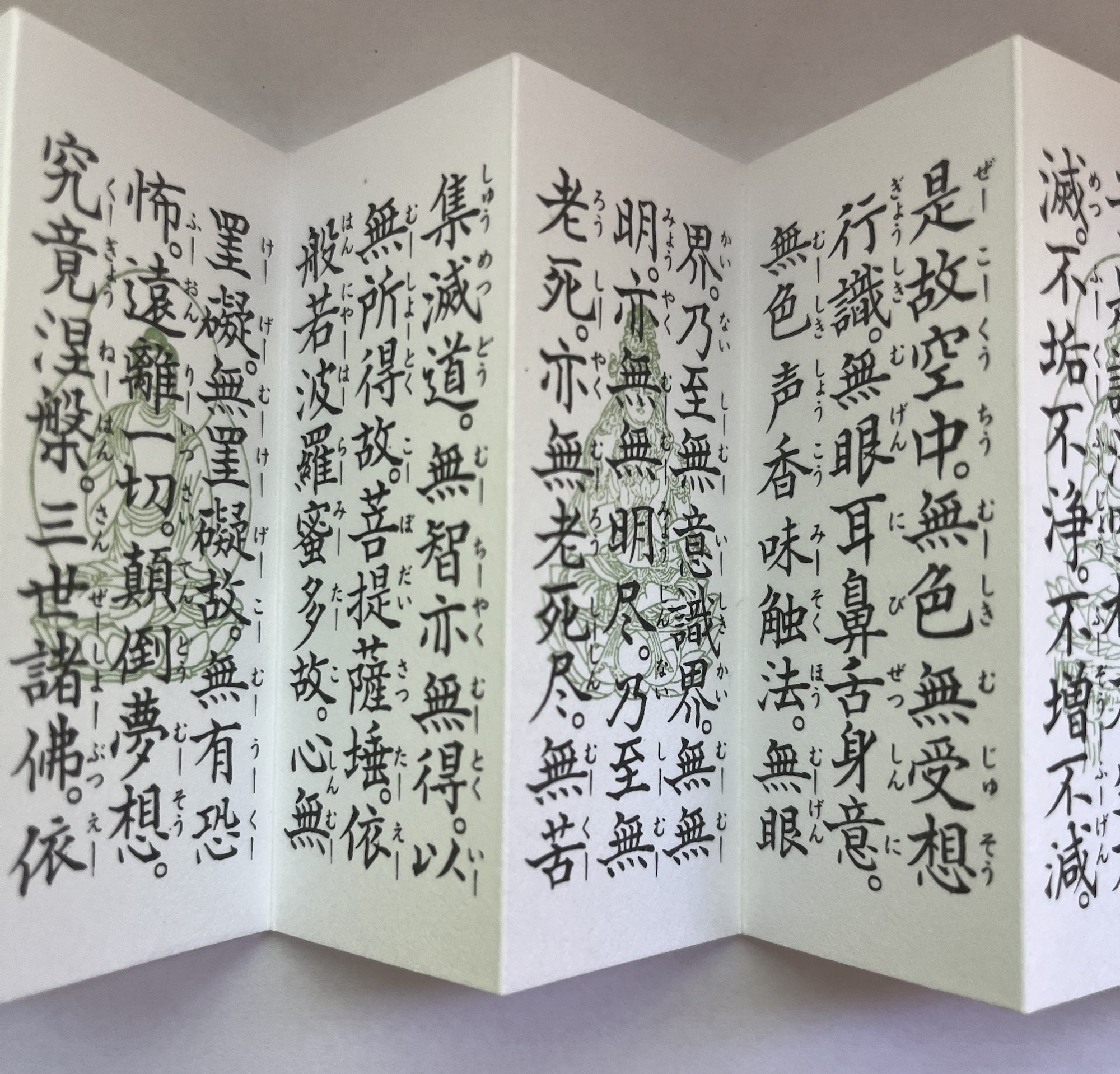
This is a boxed copy of the Heart Sutra, called the Hannya Shingyō (般若心経), with a blue brocade cover. Inside, you can see the Heart Sutra as it is usually printed: original Chinese characters with Japanese pronunciation guides. It is read from right to left, vertically:

However, if you look carefully, you will also see Buddhist deities embossed on the pages too:

They also appear on the backs of the pages too:

It took me a moment, but I finally recognized these as the Thirteen Buddhas and Bodhisattvas venerated in the Shingon-Buddhist tradition.1

I have read that many of the old Nara-Buddhist sects were gradually subsumed by Shingon Buddhism and adopted many of its practices. This includes sects such as the Kegon sect (Todaiji temple) and Hosso sect (Kofukuji temple) among others. So, this makes sense. You can learn more about Shingon Buddhism here.

Anyhow, of all the sutra books I own, I have to admit that this is my favorite one, and use it regularly for morning services (see old post).

P.S. If you’re ever curious what the Heart Sutra sounds like in Chinese (at least modern Chinese), this link has a nice example.

P.P.S. Older post about Kofukuji temple.

1 These Buddhas and Bodhisattvas are venerated in other sects in varying degrees, of course, but not as a set of thirteen like Shingon. Shingon even includes them in its ritual services.

Night and Day: Tendai Home Practice Redux

Home services in Japanese Buddhism, known as otsutomé (お勤め) or more formally gongyō (勤行), have many different approaches. It often depends on sect, particular communities, and personal preference. Trouble is, English sources are often confusing or insufficient. So, I try to look up information in Japanese, which is sometimes harder than you might think.

Anyhow, something I’ve learned recently about Tendai Buddhism, is that at least in some Tendai traditions, home practice might be divided between a morning service and a night service. This is in keeping with the two concepts in Tendai (more on that here):

Thus, in lay-Buddhist home services for Tendai Buddhism, some communities tend to divide the morning versus evening services to reflect these two concepts.

This page from the Jimon-branch of Tendai Buddhism, based in the famous Mii-dera Temple (as opposed to the Sanmon-branch based in Enryakuji atop Mount Hiei) shows example services for both morning and evening. I can’t translate everything word for word from the site, but let me try to summarize the basic format.

Morning Service

For the morning service, one pays homage to the Buddhas and Bodhisattvas “of the ten directions”1 and takes the Lotus Sutra as their basis. The morning service cited in the Jimon-sect page is based on a treatise by founder Saicho called the Hokke Sanmai Gyōhō (法華三昧行法), and for some reason is much shorter than the evening service.

The morning service is comparatively short, but includes liturgy such as:

  1. The Kannon Sutra – chapter 25 of the Lotus Sutra
  2. The Heart Sutra
  3. Dedication of Merit for all sentient beings’ welfare

I left out some of the liturgy from this list because I could not find details, or they were very specific to the Jimon sect (e.g. praises of Saicho’s disciple Enchin, who is the source of the Jimon branch), but hopefully you get the idea. This emphasizes the here and now, and seems rooted in the hokke senpo side of Tendai Buddhism to me.

Evening Service

The evening service by comparison uses the Amitabha Sutra as its basis and includes somewhat different liturgy.

  1. Verses of Repentance
  2. Verses of the Opening of the Sutra
  3. The Jigagé verses (chapter 16) of the Lotus Sutra
  4. Hymns to Amida Buddha
  5. Mantra of Light
  6. Reciting the Nembutsu
  7. Dedication of Merit for Rebirth in the Pure Land (this differs slightly from the morning service version).

It’s interesting to note that the evening service still includes verses from the Lotus Sutra, but also mixes the Nembutsu and Mantra of Light as well and definitely emphasizes the reiji saho side of Tendai.

Conclusion

As these are services associated with just one sub-sect of Tendai, and since people often add, subtract or adapt services to meet their needs, it’s perfectly fine to adjust this to whatever works in your situation. You could potentially reduce this all the way down to reciting the Heart Sutra in the morning, and the nembutsu at night. Or something similar. As long as it is sustainable, and captures the spirit of Hokke Senpo and Reiji Saho.

The themes of morning services expressing hokke senpo, and evening services expressing reiji saho, are a great way to apply Tendai teachings in one’s own life, or just Mahayana Buddhism in general.

P.S. features the gardens of Mii-dera temple, photo by E5894, CC BY-SA 3.0, via Wikimedia Commons

1 The eight cardinal directions, plus up and down.

Make Your Own Buddhist Sutra Book

Lately I’ve been talking a lot about home Buddhist practice, including home Buddhist services and such. These are things that devout lay-Buddhists often do (myself included), but then I realized I never talked about making one’s own sutra book.

There are a couple reasons why one might make their own.

First, Buddhist resources outside of Buddhist countries are hard to find. For someone like me who lives on a large city with a large Asian community this is not so hard. But if you lived in, say, rural Iowa, it might be a lot harder. So, sometimes you have to just DIY.

Second, it’s a nice way to personalize your Buddhist practice in a way that suits you.

I started making my own maybe about 9-10 years ago. I picked up a nice little Paperblanks notebook at the airport at the time, and I decided to collect Buddhist sutras and quotes that I liked. I started out small, just copying things now and then from sites like accesstoinsight.org, or copied from books.

This is a small quote from the Dhammapada :

And the Metta Sutta from the Pali Canon:

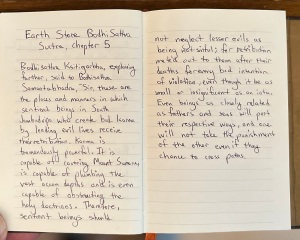
I also recorded Mahayana Buddhist sutras as well, such as this quote from chapter 5 of the Earth Store Bodhisattva Sutra:

I copied each of these by hand. I even tried to copy much longer texts, such as the 4th chapter of the Golden Light Sutra, which is a very beautiful prose about repentance and goodwill, but the text was much longer than I thought, and I eventually gave up halfway.

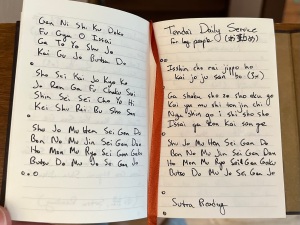
But eventually, around 2017-2018, when I left my old Jodo Shinshu-Buddhist community and started exploring other sects, I focused more on home practice and I started to add Japanese-style liturgies as well:

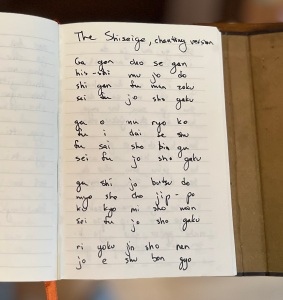
I also wrote specific sutra chants too, such as the Shiseige:

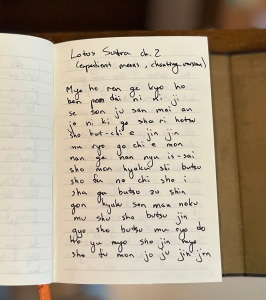
And chapter 2 of the Lotus Sutra:

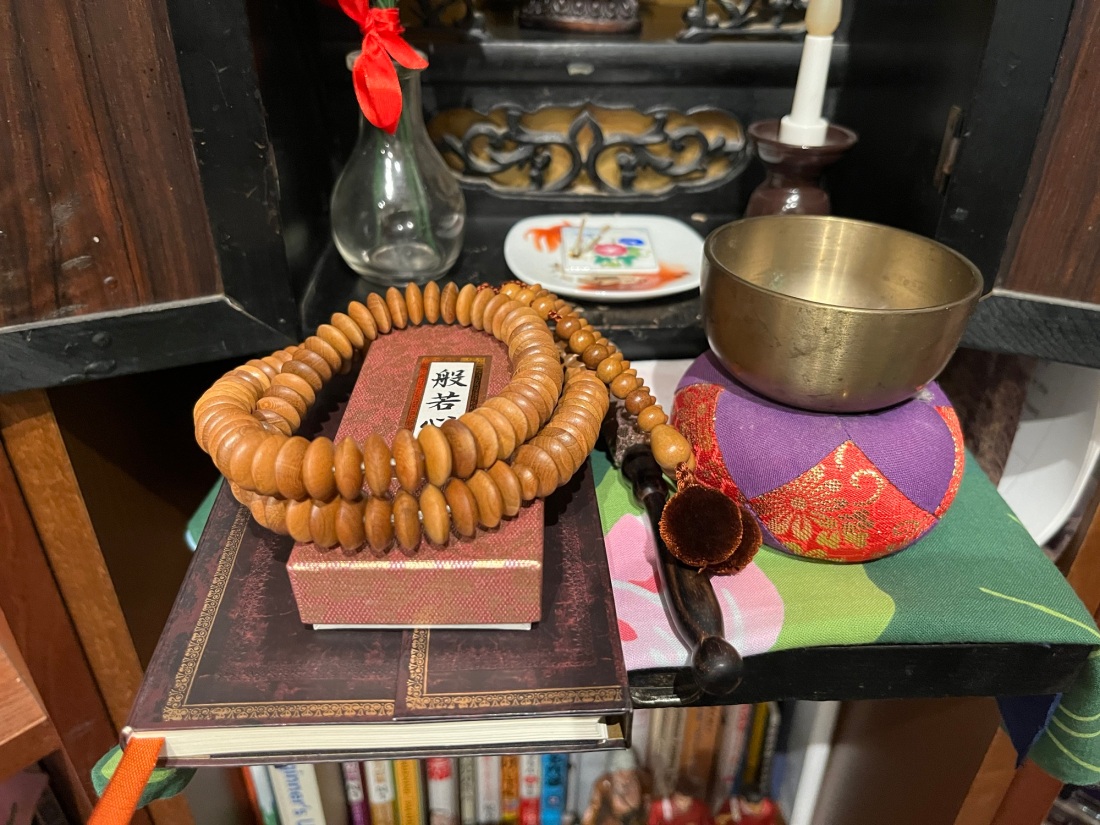
As you can see from the featured photo above,1 I keep this sutra book on my home altar (bottom left in photo), and use it almost daily. A personal sutra book works best when it’s meaningful, simple and useful for you, so the important thing is to not do what other people do, but make it useful for yourself. Find sutras or Buddhist quotes you like, collect them into a notebook, and copy them by hand (word of advice, use a gel pen, not a ballpoint pen, it’s easier to read), and make it your own. There’s no wrong way to do it.

Further, the sutra book I made has gradually progressed over time, just as my own path and practice have and I still have more room to write things in the future.

1 You can also see my Buddhist rosary, a Tendai-style rosary I ordered online, along with a boxed copy of the Heart Sutra, which I got in 2023 while visiting Nara‘s Kofukuji Temple, one of my personal favorite.

Life, Death, Life

Note: I started writing this post way back in December, but have been mulling over it for quite a while. The fact that I post this on the day before Nirvana Day (the death of the Buddha) is serendipity. 😏

The day of my mother-in-law’s 100th day memorial was a very somber day for us all in Japan. My wife had gone back to Japan shortly after her mother passed away, but the kids and I had not, so this was our first real chance to say goodbye. Per Japanese funerary customs, we dressed in somber blacks and dress suits (first time in many years for me), and we carried her ashes from her home to the nearby Buddhist temple where the memorial occurred.

It was a surreal morning: the weather was sunny and pleasant. Overhead, the sky was blue, and winter birds were singing in the trees, while we were quiet and carrying the ashes of our beloved relative, lost in thought. The contrast between life and death was impossible to ignore.

It made me realize that both life and death are all around us. They exist like two sides of the same coin.

Even in the original series, Star Trek, Mr Spock acknowledges this:

Season 2, episode 14, “Wolf in the Fold

Roger Zelazny in his novella, Creatures of Light and Darkness (1969), also explores the idea that the absolute, most fundamental powers in the Universe are life and death. The usurpers, Anubis (of the House of the Dead) and Osiris (of the House of Life) vie with one another, but also keep the Universe in balance:

Anubis: “Osiris and I are bookkeepers: We credit and we debit. We raise waves, or cause waves to sink back again into the ocean. Can life be counted upon to limit itself? No. It is the mindless striving of two to become infinity. Can death be counted upon to limit itself? Never. It is the equally mindless effort of zero to encompass infinity.…”

Creatures of Light and Darkness, by Roger Zelazny

Buddhism looks at this truth, and extends it one step further by pointing that life does not end with death, and the two blend together so much, and are so closely tied to one another that there really isn’t “death” as separate from “life”. Just one big fluid mess. Consider this verse from the Heart Sutra:

“Listen Sariputra, all phenomena bear the mark of Emptiness; their true nature is the nature of no Birth no Death, no Being no Non-being, no Defilement no Purity, no Increasing no Decreasing….”

Translation by Ven. Thich Nhat Hanh

If we see that life and death are two sides of the same coin, and that one cannot exist without the other, where do we draw the line? That’s the point of this verse, I think. That’s emptiness (shunyatā in Sanskrit) in Buddhism: all things exist in a provisional, contingent way that depends on other things. No separate thing called “life”, nor a separate thing called “death”. It just goes on and on…

In the Analects of Confucius, there is a famous quote that expresses this same sentiment:

子在川上曰。
逝者如斯夫
不舍晝夜。
[9:17] The Master, standing by a river, said, “It goes on like this, never ceasing day or night!”

Analects of Confucius, 9:17, translation by A. Charles Muller

In the same way, life and death dance around one another ad nauseum. In the Buddhist viewpoint, people are reborn again and again without end. Not one life or two, but countless, countless lives stretching back to some distant, unknowable eon, just as we are doomed to repeat this dance of birth, struggles of growing up, struggles of old age, illness and death over and over again into the future. A cosmic “rat race” without end.

In the immediate term, it’s a reminder that we cannot avoid death. We cannot live without it either. All existence is marked by death, and all existence must face it sooner or later.

During my mother-in-law’s memorial service, per tradition of the Jodo Shinshu sect, the famous Letter on White Ashes composed by Rennyo to a follower in the 15th century, was read aloud:

Who in this world today can maintain a human form for even a hundred years? There is no knowing whether I will die first or others, whether death will occur today or tomorrow. We depart one after another more quickly than the dewdrops on the roots or the tips of the blades of grasses. So it is said. Hence, we may have radiant faces in the morning, but by evening we may turn into white ashes.

Translated by Rev. Hisao Inagaki

Thus, only now matters. Enjoy the air you breathe, the life you live (even when work is miserable) and the health you have. Do not squander it.

Namu Amida Butsu

Freedom To Not Be A Dickhead

While reading Tanahashi’s book on the Heart Sutra, mentioned here, I found a great passage I wanted to share:

The word “freedom” often suggests that we can do anything we want, including being unethical and destructive. But there is also another kind of freedom, one that may prove to be more truly free. If we fully follow rules and ethics, we no longer need to think or worry about them. Thus, we are completely free from rules and ethics.

Banging on a piano keyboard without practicing is one kind of freedom that doesn’t get us anywhere. By diligently practicing the piano, however, we come to play beautifully and improvise freely. That is the kind of freedom the Heart Sutra calls for.

Pages 14 and 15

Being a dickhead is easy. We all do it to some degree or another. Most of us manage to suppress this tendency enough to function in society, but some people can’t even manage this. Further, as we get older our minds break down, and those restraints break down too. Thus, many elderly become mean, paranoid or say off-color things.

Taken at a storefront in Dublin, Ireland in 2025

The root of this dickheaded-ness is of course central to the Buddhist teachings. Previously, I talked about Japanese Buddhism and the concept of bonnō, but to summarize this dickheaded-ness extends from ignorance of how things are, anger when things don’t turn out our way, and greed by putting our needs first and foremost. Worse, like bucket with a small hole in it, if you try to satisfy and appease these urges, it only lasts for so long before you feel empty again.

This is where the training side of Buddhism comes into play. It’s tempting to want the more exotic mantras, thought-provoking teachings, or the faux-Zen quips that blow your mind. But if you really want to make some progress, you should consider getting your house in order by studying and applying basic Buddhist teachings include personal conduct, such as upholding the Five Precepts. As these basic teachings and practices sink in, and internalize, it opens up many other things. Time and patience are good foundations in religious practice.

P.S. Really had trouble coming up with theme picture for this post because there are plenty of example dickheads in the world, but also didn’t want to make an example of anyone, or any country’s flag.

Chanting the Heart Sutra

This is a photo from a sutra book I frequently use for daily services. I bought this book years ago from the temple of Sensoji (a.k.a. Asakusa Temple) in Tokyo, Japan, a place that I have visited many times over the years.

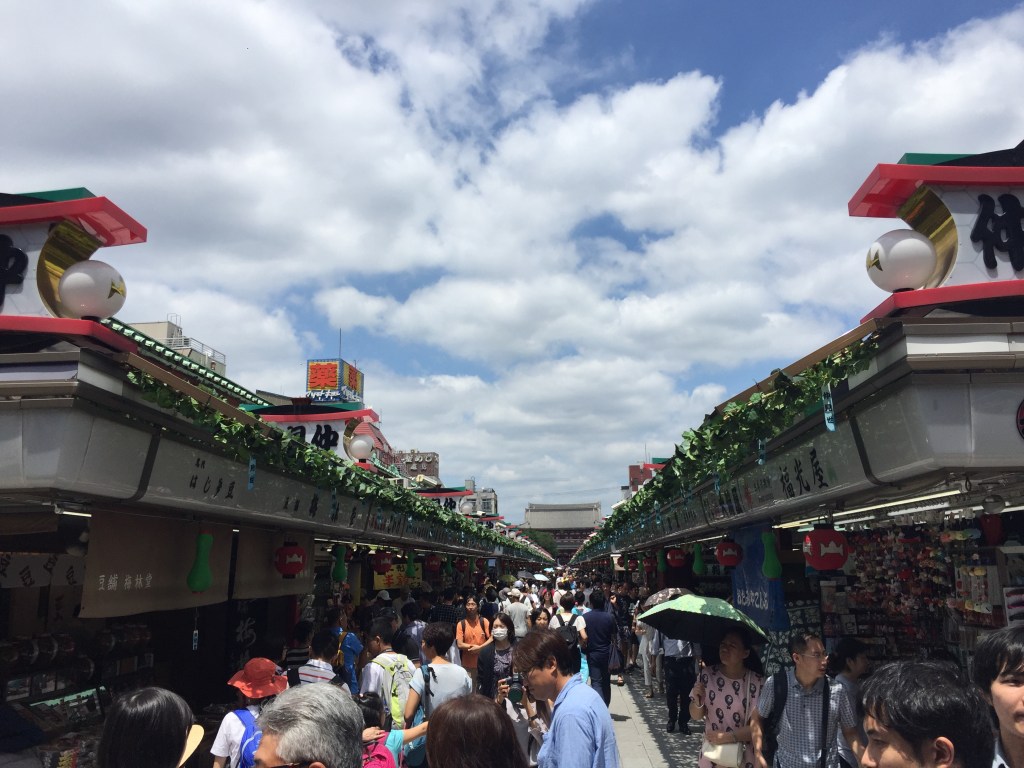
A photo I took in 2016 of the famous market of nakamise-dōri. The actual temple is way in the back.
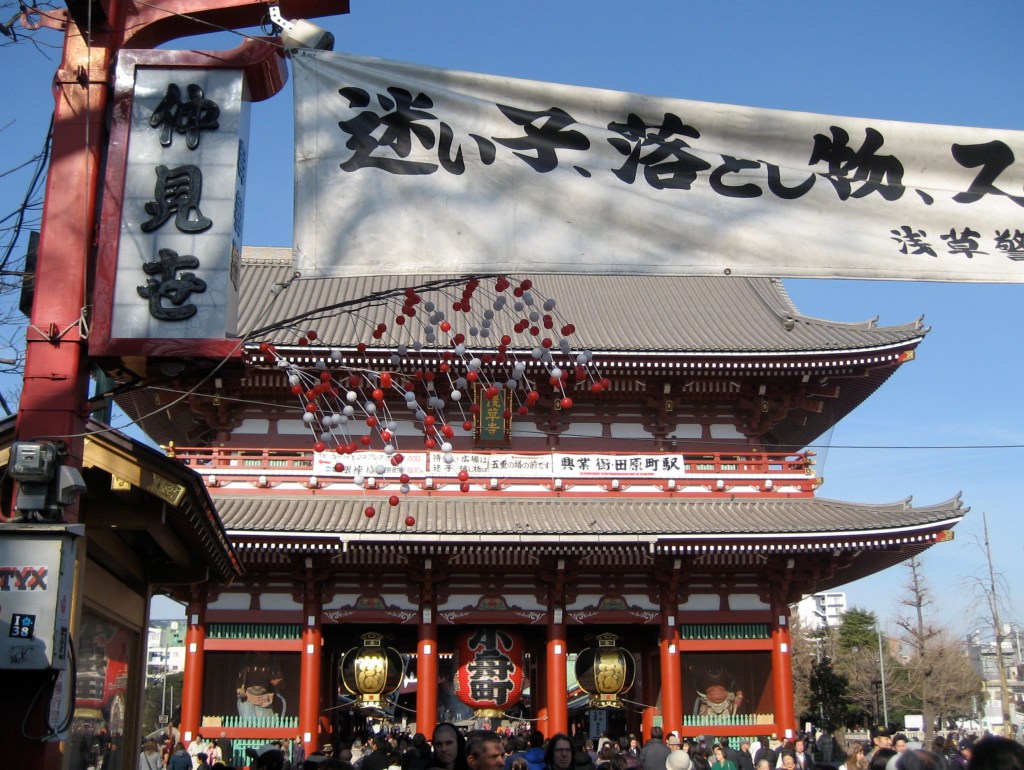
The temple just after New Year’s, taken in 2009.
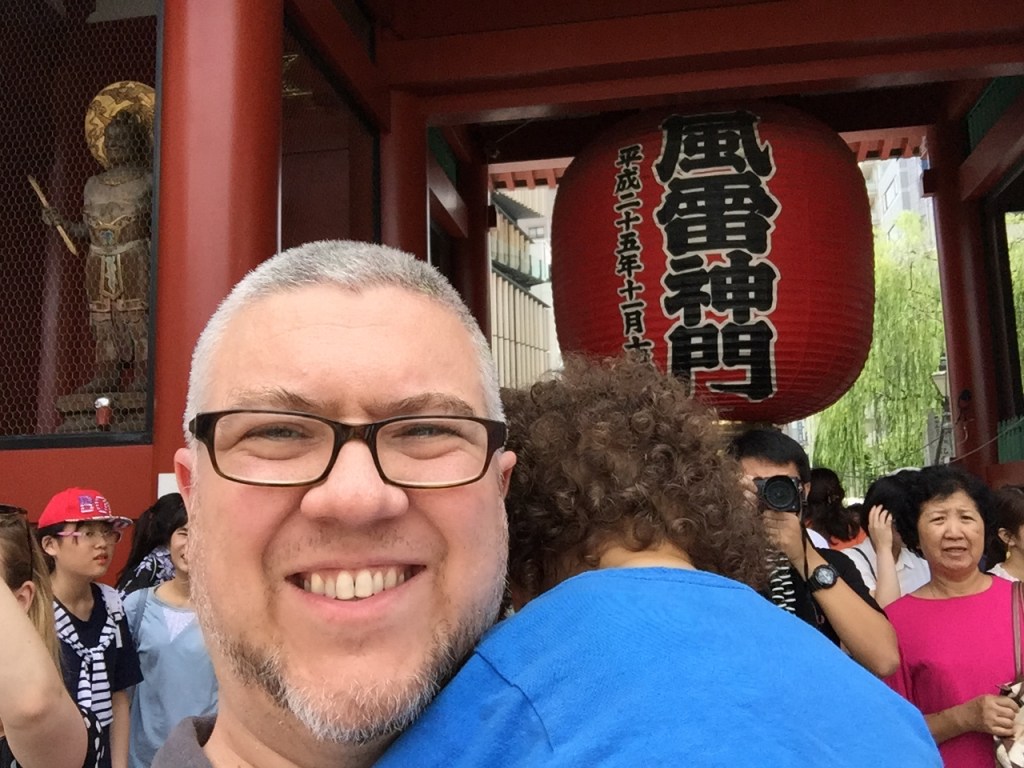
Me carrying one tired little boy at the iconic kaminari-mon gate in 2016. Note the giant red lantern in the back.

It is still one of my favorite temples, even if a bit touristy, and of the Buddhist sutra books I own this is still one of my favorite to use.1 This sutra book uses the traditional Classical Chinese with Japanese pronunciation guides (furigana), which is pretty typical of Japanese-Buddhist sutra books. As you can see, it’s not a long sutra to recite. It is probably the shortest sutra in the entire Buddhist canon.

Chanting the Heart Sutra is something many Buddhists in the Mahayana tradition (everything you see from Tibet to Japan, and overseas) do both in group services and in home services. People chant it in many languages and styles. Its simplicity, and general message about the nature of reality means that it tends to cut across sectarian lines and is popular in many sects and communities. Its cryptic and profound nature also means that for a one-page sutra it is the subject of intense study and research.

The sutra, for reference, is shown below. I used the standard Japanese liturgical form, recited in Zen temples, Tendai temples, Shingon temples, and so on, with only very minor differences per tradition. However, there are many ways and languages to recite the Heart Sutra.

Original ChineseRomanizationTranslation by
Lapis Lazuli Texts
摩訶般若波羅蜜多心経Ma ka han-nya ha ra mi ta shin gyoThe Heart of the Perfection of Wisdom Sutra
観自在菩薩行深般若波羅蜜多時。kan ji zai bo satsu gyo jin han nya ha ra mi ta ji When Avalokiteśvara Bodhisattva was practicing the profound Prajñāpāramitā,
照見五蘊皆空。sho ken go un kai ku he illuminated the Five Skandhas and saw that they were all empty,
度一切苦厄。do is-sai ku yakuand crossed over all suffering and affliction.
舎利子。色不異空。sha ri shi shiki fu i ku Śāriputra, form is not different from emptiness, and
空不異色。ku fu i shiki emptiness is not different from form.
色即是空。shiki zoku ze ku Form itself is emptiness, and
空即是色。ku zoku ze shiki emptiness itself is form.
受想行識亦復如是。ju so gyo shiki yaku bu nyo zeSensation, conception, synthesis, and discrimination are also such as this.
舎利子。是諸法空相。sha ri shi ze sho ho ku so Śāriputra, all dharmas are empty:
不生不滅。fu sho fu metsu they are neither created nor destroyed,
不垢不浄。fu ku fu jo neither defiled nor pure,
不増不減。fu zo fu genand they neither increase nor diminish.
是故空中。ze ko ku chu This is because in emptiness
無色無受想行識。mu shiki mu ju so gyo shiki there is no form, sensation, conception, synthesis, or discrimination.
無眼耳鼻舌身意。mu gen-ni bi zes-shin iThere are no eyes, ears, nose, tongue, body, or thoughts.
無色声香味触法。mu shiki sho ko mi soku ho There are no forms, sounds, scents, tastes, sensations, or dharmas.
無眼界。mu gen kai There is no field of vision and
乃至無意識界。nai shi mu i shiki kai there is no realm of thoughts.
無無明。mu mu myo There is no ignorance
亦無無明尽。yaku mu mu myo jinnor elimination of ignorance,
乃至無老死。nai shi mu ro shi even up to and including no old age and death,
亦無老死尽。yaku mu ro shi jin nor elimination of old age and death.
無苦集滅道。mu ku shu metsu do There is no suffering, its accumulation, its elimination, or a path.
無智亦無得。mu chi yaku mu tokuThere is no understanding and no attaining.
以無所得故。i mu sho tok-ko Because there is no attainment,
菩提薩埵。依般若波羅蜜多故。bo dai sat-ta e han nya ha ra mi ta ko bodhisattvas rely on Prajñāpāramitā,
心無罜礙。shin mu kei geand their minds have no obstructions.
無罜礙故。mu kei ge ko Since there are no obstructions,
無有恐怖。mu u ku fu they have no fears.
遠離一切顛倒夢想。on ri is-sai ten do mu so Because they are detached from backwards dream-thinking,
究竟涅槃。ku gyo ne hantheir final result is Nirvāṇa.
三世諸仏。san ze sho butsu Because all buddhas of the past, present, and future
依般若波羅蜜多故。e han nya ha ra mi ta ko rely on Prajñāpāramitā,
得阿耨多羅三藐三菩提。toku a noku ta ra sam myaku san bo daithey attain Anuttarā Samyaksaṃbodhi.
故知。般若波羅蜜多。ko chi han nya ha ra mi ta Therefore, know that Prajñāpāramitā
是大神呪。是大明呪。ze dai jin shu ze dai myo shu is a great spiritual mantra, a great brilliant mantra,
是無上呪。是無等等呪。ze mu jo shu ze mu to do shu an unsurpassed mantra, and an unequalled mantra.
能除一切苦。真実不虚故。説般若波羅蜜多呪。no jo is-sai ku shin jitsu fu ko ko setsu han nya ha ra mi ta shuThe Prajñāpāramitā Mantra is spoken because it can truly remove all afflictions.
即説呪曰。soku setsu shu watsu: The mantra is spoken thusly:
羯諦羯諦波羅羯諦波羅僧羯諦菩提薩婆訶。gya tei gya tei ha ra gya tei hara so gya tei bo ji so wa ka gate gate pāragate pārasaṃgate bodhi svāhā3
般若心経han nya shin gyoThe Heart Sutra

You can see a really nice example of this chanted here, courtesy of Koyasan Temple in Japan:

I have been reading Tanahashi’s book about the Heart Sutra and learning a lot about its various interpretations, how it’s conveyed in various languages, and various theories about its origin. I was fascinated to learn that there is a Mongolian version sometimes transcribed in Cyrillic. None of this is strictly necessary for the purposes of Buddhist practice, but it is fascinating. The example I showed above uses what’s called “Sino-Japanese”: Japanese pronunciation of the original Chinese characters it was composed with.2

As for chanting the sutra, I’ve been doing it for years, so I can more or less recite the Sino-Japanese version from memory, and am pretty comfortable doing it that way. I study the meaning of the sutra in English of course. I also have a PDF file for chanting in Sino-Japanese available for those interested.

I have also attended Zen centers on rare occasions (I tend to lean toward Pure Land Buddhism, to be honest) and seen the Heart Sutra recited using English. Learning the English meaning is very useful, but English chanting sounds a bit awkward to me. So, I prefer chanting in the original, and study the meaning separately.

But regardless of what language you use, the Heart Sutra, like all Buddhist sutras, has a funny tendency to gradually “sink in” over time. The meaning may not make much sense at first, but over the course of months and years, it takes on new meaning as you go through life, and see the sutra in a new light. I believe that’s the real value of Buddhist chanting: to internalize key Buddhist teachings in a way that you can carry with you throughout life.

As for me, these days, I tend to recite a Tendai-style home service,4 and as part of that I rotate between chanting this and a certain, small excerpt of the Immeasurable Life Sutra called the shiseige (四誓偈) or juseige (重誓偈) in Japanese Buddhism. When I finish one, I put it under the other sutra book, so I don’t forget which sutra to recite next time as I might go a week or two before reciting again. As a short, traditional liturgy, I am pretty content.

As with any Buddhist practice done over a long period of time, I believe that it gradually polishes the mind, and dispels one self-centered viewpoint. It’s super simple to do, but its benefits last a lifetime. To paraphrase Nichiren, when dying cloth in indigo, the more you do it, the deeper the color becomes.

Namu Amida Butsu
Namu Kanzeon Bosatsu

Edit: I discovered in May 2025 some egregious mistakes in the formatting of the sutra above. This was not a problem with the translation, but with mistakes in how I copy-pasted into the blog post. I have since corrected these mistakes. Apologies to anyone who used the flawed copy of the sutra.

P.S. It’s tempting for some to look for an original “Sanskrit” version of the sutra, but alas, the best we know today is that the sutra was compiled originally in China, using excerpts from the much, much larger Prajña-paramita sutras. The story of how exactly that came to be is a much-discussed subject in Tanahashi’s book.

P.P.S. Fun fact: the version of the Heart Sutra used in Japan differs very slightly from the popular version attributed to Xuanzang. The Japanese version, popularized by the Shingon esoteric tradition, is called the rufubon (流布本) version. It has two extra Chinese characters (262 total) from Xuanzang’s 260, and uses slightly different characters for pronouncing the mantra at the end: 揭諦 instead of original 揭帝 for Sanskrit gaté.

1 Because it is devoted to Kannon Bodhisattva, this sutra book also includes (left in photo) a certain Japanese-Buddhist verse called the Jikku Kannon-gyō (十句観音経, “ten verse Kannon sutra”) popularized in the middle ages. I made a post here about it.

A nice explanation of the meaning and history of the ten-verse sutra can be found here.

2 It’s sometimes assumed that the sutra’s earliest composition was in a language like Sanskrit or something else from India, but research has long since proven that the Heart Sutra was a Chinese innovation, a summary of the much longer Perfection Wisdom Sutras, distilled into a very compact, chantable essence. The monk Xuan-zang later brought it back to India, where it later came to Tibet. Pretty clever actually.

3 I decided to leave the Sanskrit mantra untranslated, per esoteric-Buddhist tradition.

4 I like the Tendai approach to Buddhism because it encompasses all the things that are important to me, but avoiding a narrow, dogmatic approach that I found in the past and ultimately rejected.

Tendai Buddhist Home Liturgy Example

Greetings readers! I have had a bit of extra time this week due to much-needed time off from work, and have been going through old projects, half-finished blog posts and such. One project I found today, which I decided to finish, was post a romaji (Romanized Japanese) version of the Tendai Buddhist home liturgy for anyone who needs it.

The Tendai sect in Japan has a nice homepage (Google Translated page), but almost nothing in English for doing the home service. Tendai information in English is pretty scattered (though there are some great websites),1 so I decided to go back to the source, and just translate it directly using romaji (romanized Japanese) for easy pronunciation.

Some quick notes:

  1. I chose the shortest, simplest elements of the service, based on Tendai’s recommendation in the link above, and also through the book うちのお寺は天台宗 (双葉文庫) which I picked up some years ago. There’s a more extended version of the home service, but both the book and website explain that the essentials are the following elements that I am posting below.
  2. Where possible, I chose to use the Sino-Japanese pronunciation. The website above lists both, and either option is fine (obviously English is fine too). The Sino-Japanese version, in my opinion, is the easiest to pronounce and chant, and ties back to the larger Buddhist tradition, so that’s my personal preference. The YouTube videos on the Tendai site sometimes provide an alternate native, liturgical Japanese version, and it’s perfectly fine to use this too.
  3. Finally, traditions and liturgical styles vary, so don’t be surprised if another Tendai community does it differently. If in doubt, just do it like your local community does.

The webpage also lists some tips (roughly translated below):

  • First, before you begin, double-check the offerings at your home altar make sure everything is in order: flowers, water, a candle,2 and any other offerings you wanted to make.
  • Before the service, take a moment to freshen up, rinse your mouth and hands with water, etc. That way, you can sit before the altar in a more purified state.
  • Drape any rosary you have over your left hand, and if you are holding a sutra book, lift it up gently and bow ever so slightly.3
  • When you do gassho, put your hands together in front of your chest at a natural angle (45 degrees is common based on personal experience).
  • When chanting, use a mild, even chanting voice, enunciating each word equally. (If you feel like you don’t chant as well as the video links, don’t feel bad: these are professional monks chanting.)
  • If you have a bell, there are certain times to ring it: twice at the beginning, once after reading each part, and three times at the end. (I’ve added prompts to the liturgy below.)
  • When done, close the Buddhist altar (if possible), and place the sutra book back on its stand.
  • Lastly, the book in particular mentions that any Buddhist sutra is OK to recite. The most common one is obviously the Heart Sutra, but any other Buddhist sutra, or an excerpt of a sutra, is fine too. Find what you like, and feel free to recite that.

Minimal Tendai Buddhist Home Liturgy

The service provided below is given as an example home service, but my book on Tendai Buddhism also states that among these different bits of liturgy, you can add or reduce as many as you see fit. Even if you only recite one bit of liturgy per day, that’s enough. The important thing is to make it sustainable. You can always adjust later if it’s too simple or too difficult.

Sanrai: Gratitude Toward the Three Treasures

(ring twice)

Ish-shin cho rai jip-po ho kai jo ju san bo

(repeat 3 times, ring once)

“I reverently praise the Buddha, Dharma and Sangha, which permeate the cosmos”

Youtube: https://youtu.be/JDZXXPFaQzg

Sangémon: Renunciation of One’s Past Transgressions

Ga shaku sho zo sho aku go-
Kai yu mu shi ton jin chi
Ju shin go i shi sho sho
Issai ga kon kai san ge

(ring once)

(See this post for more details)

Youtube (alternate version): https://youtu.be/WfNzd44EIZI

Shiguseigan: The Four Bodhisattva Vows

Shu jo mu hen sei gan do
Bon no mu hen sei gan dan
Ho mon mu ryo sei gan chi
Mu jo bo dai sei gan sho

(ring once)

(See this post for more details)

Youtube (alternate version): https://youtu.be/HbMQQs7GiW0

Sutra Chanting

Note: both my book and the website state that any sutra in the Buddhist canon (or excerpt of a sutra) is OK to recite. Popular choices include:

For Japanese Buddhism, simply reciting the sutra without any other liturgy is a perfectly acceptable home practice, by the way.

Daishi Hogo: Homage to the Founder of Tendai, Saicho

Namu shuso konpon dengyo daishi fukuju kongo

(repeat 3 times, ring once)

“Homage to the founder, Master Saicho”

Youtube (alternate version): https://youtu.be/0OoTMvXQpL8

Ekomon: Dedication of Merit to All Sentient Beings

Gan ni shi ku do ku
Fu gyu o is-sai
Ga to yo shu jo
Kai gu jo butsu do

(ring three times)

(See this post for more details)

Youtube: https://youtu.be/Z_j1cTE6JCQ

End of Service

Thanks everyone and I hope you find it useful. I will likely post updates and corrections as time goes on.

Namu amida butsu
Namu kanzeon bosatsu

1 There are, from what I can see from a cursory search, a number of Tendai communities in both the US and the UK. If you’d like to know more, I encourage you to contact such communities. I have no affiliation with any of these groups, however. I am just DIY.

2 Japan also sells LED Buddhist altar candles. Halloween goods also offer LED candles. Great for avoiding fire hazards.

3 This custom is also found in other Japanese-Buddhist sects as a gesture of humility.