Retiring my First Adventurer’s League Character

Or: “how not to build a wizard in Dungeons and Dragons, fifth edition.”

Update: I have brought Qisandoral back from retirement after the 2021 rules changes.

My first character in Dungeons and Dragons, Adventurers League, was a high-elf wizard (Abjuration school) named Qisandoral Ariesstanus. He was a side-kick I originally made for my kids in their home campaign, with his deadpan, humorous personality reminiscent of Mr Spock from Star Trek. Because of his stodgy, stoic nature, Abjuration as a school of magic seemed like a sensible move.

I kind of always pictured Qisandoral like the elf shown in this Magic the Gathering card. Source: Scryfall

Later, when I first “imported” this character to Adventurers League (i.e. made a new, AL-legal version of him), I didn’t really know how to do a proper build for wizards, so I prioritized sub-optimal stat choices such as Charisma, which didn’t actually make sense with his role-playing style. I probably could have role-played him different, but the group dynamics in Adventurers League helped influence my choices in role-playing.

The bigger problem though was learning how to manage spells for Qisandoral. Abjurers activate (or recharge) their primary ability, Arcane Ward, whenever they cast a spell from the Abjuration school. I thought this was great, so with my limited monetary resources, I spent everything I had to purchase and copy Abjuration school spells in my spellbook. The trouble was was that most Abjuration spells are pretty situational, particularly in the sort of one-shot adventures you often find in Adventurers League. Arcane Lock is a pretty neat utility spell in some situations, but I practically never used it in Adventurers League. Even mighty spells like Counterspell and Dispel Magic, staples of the Abjuration school, didn’t come up very often due to the nature of combat and adventures. Things would probably be different in a longer-term home campaign, but this version of Qisandoral was meant for Adventurers League only.

Further, I didn’t take advantage of Adventurers League rules for copying spells from another wizard player character enough, instead buying scrolls on my own. Thus, I spent too much money on spells that were often not worth it. Such spells are great in right situation, but rarely enough to be worth spending hundreds of gold pieces on for a scroll (nevermind the costs to copy).

Conversely, because I leaned so heavily in Abjuration, Qisandoral wasn’t very effective in most combat situations. Using Chromatic Orb helped to some degree because of its versatility, but by tier-3 (levels 10 through 15), a wizard usually is a pretty powerful class, and Qisandoral had excellent defenses, but not much else to offer. Even for an Abjuration wizard, I might have built him too conservatively.

In a recent article by the awesome James Haeck,1 he points out that wizards work best when they have a solution to every situation. They may have their fallback specialty, but the sheer diversity in spellcasting is what makes wizards stand apart from every other D&D spell class.

When I saw this article, I realized that for building an Abjuration wizard, the key to success is to have a certain number of core spells to trigger Arcane Ward, but also diversify to cover every other situation. For core Abjuration spells:

  • Mage Armor – cast it first thing in the day to bolster your armor class, and activate Arcane Ward in one shot. Yay.
  • Shield – in a pinch it will not only deflect potential damage but recharge your Arcane Ward a little bit, too. Double yay.
  • Alarm – since you can cast this as a ritual, a common trick by players is to cast over and over during a long break to recharge Arcane Ward. Kind of silly, but people do it. Plus, it’s handy for situations where you need to rest overnight in a hostile environment.
  • Counterspell – there are many situations where this isn’t useful, but when it is…
  • Dispel Magic – same as above… Abjuration wizards should always have these two prepared.
  • Banishment – personally one of my favorite Abjuration spells. Reduce the battlefield thread instantly by taking one or more creatures out of rotation, possibly for good! Sometimes you can send the big boss packing instantly.

Beyond these six core abjuration spells, you probably should diversify as much as you can.

Sadly, I didn’t do this, and after trying to belatedly fix Qisandoral’s build, it became too little too late in tier-3 adventures so I decided to retire him.

Retiring my first AL character wasn’t easy. Even though he wasn’t mechanically great, I still liked him as a role-playing character because he was a fun, distinctive, memorable character. What made me finally decide to retire him was that the original side-kick version still existed in my home campaign with my kids, and if I wanted to, I could probably make a new version from scratch in Adventurer’s League if I really wanted to. The “new” Qisandoral wouldn’t have the same character history, so no reliving the Liberation of Phlan again, nor any of the rewards from before, but it would be a chance to “make him right”.

On the other hand, I like to think that boring, old Qisandoral really did retire from adventuring and went back to his studies having learned all he needed to from the wider world, and having made his mark. With all that he accomplished in his adventuring life, he probably earned a long sabbatical anyway.

1 Mr Haeck also has a nice article on Abjuration wizards, but it was published after I made my character, so 🤷🏽‍♂️

No DnD Sometimes Is Better Than Bad DnD

Photo by Nathan Cowley on Pexels.com

I suppose it was going to happen sooner or later: a bad Dungeons and Dragons session in Adventurer’s League, and boy did it happen.

Adventurers League is a more portable format by its nature, which means that players can drop in to any game (as opposed to a more dedicated “campaign” with a set group of players who meet every so often to pick up the story). So, you never really know who you’re going to play with. Most players are easy to get along with (I’ve been playing over a year and have only had 1-2 bad experiences), since we all come to enjoy D&D anyway, but occasionally you’ll get an obnoxious player who rubs every on the wrong way and spoils the mood of the game.

We had such a player a couple Mondays ago. He was apparently new, and tried to dominate the game. He complained frequently because the game didn’t go his way (his character was fragile and had a random, bad encounter that nearly killed him), and kept trying to push the group into the direction he wanted. Finally, he lost his temper when our DM had mistakenly missed his turn, and he went into a rant about how everyone got a turn and left him with no monsters to fight. This made things very awkward for the rest of the game.

This really got under my skin for a few reasons:

  • He rolled bad initiative, which was no one’s fault but his own.
  • His character was a healer (according to him) and by design isn’t a powerful damage-dealer anyway. I am not sure what he was expecting to do.
  • DM’s make mistakes, and he shouldn’t have taken it personally.

Needless to say after 4 hours of listening to his whining and his rant, I was mentally exhausted after the game, and felt like taking a long, long break from communal D&D for a while.

Dungeons and Dragons as a game has its strengths and weaknesses. Coming together as a group to solve a challenge, whether it be a battle or a difficult puzzle, or some social dispute can be really fun and exciting. It’s why I play D&D, and dropped games like Magic: The Gathering: I prefer collaborating with a group more than constantly vying with one another for petty rewards (and then having to repeat the process over and over again ad nauseum).

But this also means that D&D requires a functional social-group.

Countless posts have been made online about dysfunctional D&D gaming groups, usually involving one or more toxic personalities. Some of them very toxic. Oftentimes, I feel these happen when:

  • People try to cobble a group together out of desperation. It usually starts out well, then peters out within a few sessions because people lose interest, the group doesn’t “click”, etc. I’ve been on, and DM’ed, groups like this. Or,
  • Open play (e.g. conventions, etc). People with serious social issues seek these out because the bar for entry is pretty low, and they can get what they want out of it, without consideration for the rest of the players.

The first one though is usually the most common, and most frustrating, because like so many things in life, people start out with good intentions, but the whole foundation is shaky.

I had a group I cobbled together at work to play the D&D adventure Waterdeep: Dragon Heist, but one by one the people dropped out due to work obligations, leaving only the socially-awkward players left, who were pretty frustrating to DM for. One of them insisted on an 18-page backstory which was definitely cringey in parts. The group fell apart fast, and left most of us kind of awkward thereafter at the workplace.

I think secret to making a successful, sustained D&D group is to already have an existing social group that willingly hangs out with or without D&D. Afterall, if people can’t get along in real life, why would they get along in a fantasy realm? Trying to force some strangers together for a group fantasy adventure is more often than not going to fail, but if a group already has a healthy social-dynamic, a well-run D&D campaign will certainly flourish. There are exceptions to this, but without an underlying, healthy social dynamic, usually the odds are not in your favor.

But what if you don’t have such a group? In my opinion, taking the risk of an unfamiliar group, and the potential emotional distress that this causes may not be worth it. It might be a good learning experience in general, but when people get sucked into an unhealthy group the situation can really go off the rails. So, I kind of think it’s better to just miss out and save yourself the unnecessary anguish. But, if you really want to play, caveat emp-friggin-tor.

So what about Adventurer’s League? After the bad game, I took a week off and then played again. The subsequent games were with players in my community whom I already played with and trusted, and we had a good time. My faith with AL was restored, and I’ve had a good time. Also, I haven’t seen that problem player again, which leads me to suspect that one of the community admins had a chat with them and showed them the door. The admins in my community are pretty sensitive to keeping the atmosphere healthy, and are willing to step up and protect players if need be. That’s very appreciated. But taking a break, even a short one, was worth it in order to “reset” things for me.

I suppose that’s another life lesson: there’s nothing wrong with taking a break. It might just be the best thing for yourself. 😉

P.S. yet another bad D&D session.

Buddhism and Bonnoh

Based on experience of being a Buddhist (with a few interruptions) since I was 16, I’ve learned that reading about Buddhism and living Buddhism, especially within a Buddhist culture, are two different things.

My wife, who is Japanese and whose father works in the funeral industry, has always had a good, intuitive understand of Buddhism even if she has seldom studied it. I, on the other hand, approached it for a long, long time from a more scholarly (read: “amateur scholarly”), analytical standpoint. It was only in recent years, that I started to realize the short-comings of “academic-only Buddhism” and kind of started over.

Case in point: in Japanese culture, you sometimes hear the Buddhist term bonnō (煩悩).1 I heard this term over the years, but lately I have heard it a lot while listening to a certain Japanese language Buddhist + comedy podcast.

The term bonnō in Japanese is derived from the Sanskrit term klesha, via Chinese, which in English is translated as “mental defilements”, “mental delusions”, etc. From a textbook perspective, these deluded mental states are the ones that cloud judgment, and cause people to do unwholesome conduct, further creating negative karma, and fostering conditions that keep one bound on the never-ending cycle of birth and rebirth (not to mention suffering in this life). Further, the most fundamental kleshas are defined as greed, anger, and ignorance, leading to other kleshas and so on.

I mean, that kind of makes sense. It might be interesting from an intellectual standpoint, but it’s not very practical. It doesn’t resonate with one’s life much.

But, while listening to the podcast, I realized that bonnō in everyday language just means all the stupid shit we do, think, or expect that causes us more grief.

  • That time I said something snarky to my wife and we got into a big fight? bonnō.
  • That time I (again) ate too much at the company holiday party and made myself sick? bonnō.
  • That time I played a Magic: The Gathering draft at my local game store without any practice or research, and got upset about a 0-4 ? bonnō.
  • That one session of Adventurer’s League I was super excited about, and waited all week for, and then it turned out to suck? bonnō.
  • That one girl that I really wanted to date in college, and when we finally did go out, it was super obvious we weren’t compatible? bonnō.

And so on. Bonnō is an interesting concept because we create grief for ourselves all the time, in small ways, in big ways, and so on. All of it derives from fundamental misunderstandings with other people, bad assumptions based on limited information, or unrealistic expectations that didn’t accord with reality.

Bonnō is not something limited to “trashy” people, though. People who are well-educated or come from affluent backgrounds are just as afflicted by bonnō as anyone else; the nature of their afflictions may be different, but you’d be fooling yourself into thinking that just because you went to college and had a class on European Colonialism in the 18th century that you’re somehow more enlightened than other people.

From the Japanese-Buddhist perspective, you are still bonpu (凡夫, sometimes pronounced “bonbu“): that is to say, a run-of-the-mill person subject to the same basic afflictions, same basic patterns of behavior, selfish ego, etc.

Nor is this some red pill vs. blue pill nonsense either.2 People who consider3 themselves smarter or more awakened like to think that it’s a matter of awakening to some higher truth, and suddenly BAM you’re a new, better man.

No, as far as Buddhism is concerned, it doesn’t work that way. In the end, you just need two things:

  1. Self-reflection. You can’t stop being a dick-head if you aren’t aware you’re acting like a dick-head.
  2. Cultivating wholesome qualities. Every defilement has a corresponding wholesome quality to counteract it: Anger is counteracted with good-will, greed with self-restraint, ignorance with wisdom, and so on.

Oh, and patience. A lot of patience. Even if you’re dead-set on the path to Enlightenment, you can not overcome old habits easily. A river does not change course overnight. Lots of mistakes are made, but remember to keep reflecting on your own behavior and determine what’s wholesome and what’s not.

As the Buddha said to his step-mother (who became a nun):

“As for the qualities of which you may know, ‘These qualities lead to dispassion, not to passion; to being unfettered, not to being fettered; to shedding, not to accumulating; to modesty, not to self-aggrandizement; to contentment, not to discontent; to seclusion, not to entanglement; to aroused persistence, not to laziness; to being unburdensome, not to being burdensome’: You may categorically hold, ‘This is the Dhamma [the Buddha’s teaching], this is the Vinaya [the Buddhist monastic community], this is the Teacher’s instruction.'”

translated from the Pali by Thanissaro Bhikkhu (with emphasis added by me)

The results of putting the Dharma into practice speak for themselves, if given time.

1 Pronounced “bohn-noh”.

2 Sorry, Neo, that was just a Dayquil you swallowed, lolz.

3 People consider themselves a lot of things. Welcome to the world of bonnō.

A Nerd Dad’s Review of Mythic Odysseys of Theros

Hi folks,

In addition to my recent adventures in adventure module writing, and gardening, I finally got a belated Father’s Day gift recently:

The Mythic Odysseys of Theros (MOoT) is a cross-over reference guide between Dungeons and Dragons and Magic: The Gathering, specifically the Greek-mythology inspired plane of Theros. Theros is a kind of idealized plane of what Greek mythology would be if taken out of historical context and allowed to run free. It is a world full of gods exerting a direct influence on the world, satyrs, minotaurs, city-states loosely modeled after ancient Greek city states, etc.

This leads to some interesting mechanics in MOoT that are worth sharing here:

  • Many of the typical “high-fantasy” character races that are found in D&D are not in Theros: elves, dwards, gnomes. They didn’t exist in classical Greek mythology (nor Magic the Gathering’s plane of Theros) and do not exist here. They are replaced by centaurs, satyrs, minotaurs, etc.
  • Unlike the usual, somewhat loose, mechanics between clerics and gods, the piety mechanics in MOoT provide clear benefits for characters who explicitly do things to advance their god’s agenda.
  • MOoT elevates the “hero” element1 of D&D by giving each character an extra starting ability totally outside of the standard Player’s Handbook. The ability is something that grows and develops as the hero accomplishes deeds.

All of these things mean that adventures on Theros aren’t always portable to other planes and campaigns (and definitely not Adventurers League legal), unless your DM allowed for such a transfer of abilities and deities. The fact that they even exist though makes a fun and interesting campaign in Theros, and likely one you’d play again with different characters, gods, etc.

Let me take a moment to talk about the book: it is gorgeous, even by the standards of D&D module books. The artwork is truly inspired, and I admit I enjoy thumbing through the book sometimes if nothing else than to just enjoy the art.

Also, the book is really well-organized in terms of getting started on building a character within Theros, and how they will relate to his/her deity of choice. There’s also an option for atheistic characters (some characters races are more inclined to this than others).

Theros as a module and as a plane lends itself more to “save the village, destroy monster” type adventures, than intrigue adventures (a la Eberron), but this also means that as a parent it’s probably easier to make stores for younger kids, which is part of the reason I got the book. I own the Eberron book, and it’s pretty interesting, but also poses some challenges which I’ll cover in a later post.

Also, in my case, as a promo I also received laminated map detailing several places on Theros, such as the Underworld, and so on. I don’t know easily available these are, but it may yet come in handy soon.

Anyhow, I am eager to try this out with the kids, especially my younger son who’s itching to battle monsters again.

1 Interestingly, the ancient Greek notion of a “hero” is not the same as the modern interpretation. Think of them more like obnoxious supermen with questionable moral judgment.

DMing People With Special Needs

Recently, I’ve moved from playing in Adventurers League games from Dungeons and Dragons, to hosting some with the local community as a Dungeon Master (a.k.a. “DM”). With lockdown, we’ve moved all our weekly games online to Warhorn and playing on the Roll20 service with shared accounts and resources, and the group has adapted pretty seamlessly, while still supporting our local game store where possible. For me, I’ve only DM’ed a few games for Adventurers League, but it’s been a fun, though eye-opening experience. DM’ing for kids at home, or my kid’s friends online, is easy but DM’ing for adults who come from many backgrounds is more challenging and helps you grow as a DM.

One recent example is that I was hosting a game where one player was self-described as visually impaired. I was very nervous about this as I don’t have much experience hosting AL games for adults, let alone online where the game is even more visual than before. However, one of the more senior DMs knew this person and had some simple advice which I wanted to share with other D&D players.

He suggested I reach out to this player and find out what his needs were. It turns out that it was much easier than expected: be sure to spend enough time describing the scene clearly, ask questions and move around his token on Roll20 if needs it to. I contacted the player, asked him a few questions about his character, preferences for token (for his token, I used a picture of the famous Binwin Bronzebottom since he was playing a dwarf fighter).

The session went much better than I expected. The player was an experience D&D player, and once we settled in, it felt pretty much like any other session, though I spent more time than normal carefully describing things. We all had a great time.

This experience taught me some things as a Dungeon Master:

  • Players come first. This doesn’t being a doormat in terms of rules, but it does mean ensuring your players have a wholesome, positive experience. Otherwise, you end up here.
  • Theater of the Mind is a time-honored, yet underrated practice in D&D. Someone pointed out that in earlier editions of Dungeons and Dragons (think: Stranger Things), “theater of the mind” was a necessary way of telling the story, but with improvements in technology

Good luck and happy role-playing!

P.S. For online D&D games, I highly, highly recommend battlemaps from 2-Minute Tabletop. They’re very affordable, and the maps are excellent.

Priorities

Hello Dear Readers,

The last couple weeks in lockdown (with at least 4 more ahead) have been interesting. After the initial panic, we’ve gradually settled into a routine where keep our kids “in school” during weekdays, take walks a lot in the neighborhood, only visit the grocery store as needed, and generally learn to keep ourselves entertained otherwise.

Being stuck at home a lot does tend to shift priorities. A lot of my personal projects have kind fallen further and further behind, because they just don’t really feel that important anymore.

I have caught up on a few books, movies, old episodes of Star Trek: the Next Generation,1 updated the blog (obviously 😏), and been playing Adventurer’s League online with the same community I played with before.2 Things like language study, Buddhist practice, Magic the Gathering and some writing projects have all died on the vine, leaving me with those things which I guess I valued enough to keep up.

All of this takes a backseat to my wife and kids though. Since I don’t work in the office anymore, I can enjoy dinners with them more consistently, and the (mostly) daily walks around the neighborhoods in the warm, spring weather and finally got some things done around the house. This is not to trivialize the danger of the novel Coronavirus, but it’s nice to be able to turn lemons into lemonade sometimes. 😊

In any case, as we’ve settled into a pretty good routine, it’s interesting how trivial some things seem now compared to life before COVID-19, and how others have bubbled to the surface.

It’s fair to say that those of who survive this (and one should never be too confident about one’s own mortality) are going to party like it’s 1999 when this has passed, but at the time, it is going to change our lives. It already has.

1 If you are a Star Trek TNG fan, I highly, highly recommend the new Star Trek: Picard series as well. Season one was terrific. Going back to watch Star Trek: Discovery as well.

2 Happy to see a couple of my more neglected characters in Adventurer’s League finally get some “flight time” and development. Also, it turns out that Eldritch Knights and Land Druids are pretty fun to play. Maybe I’ll post about that soon.

The Joys of D&D Figurine Painting

img_3993

I have been playing Dungeons and Dragons Adventurers League at my local game shop fairly regularly since last July, and as a result, I have started to accumulate a number of figurines.  These plastic figurines come in all shapes and sizes, but I’ve been hesitant to paint them because I was not confident in my art skills (translation: I suck at art¹).

Until now.

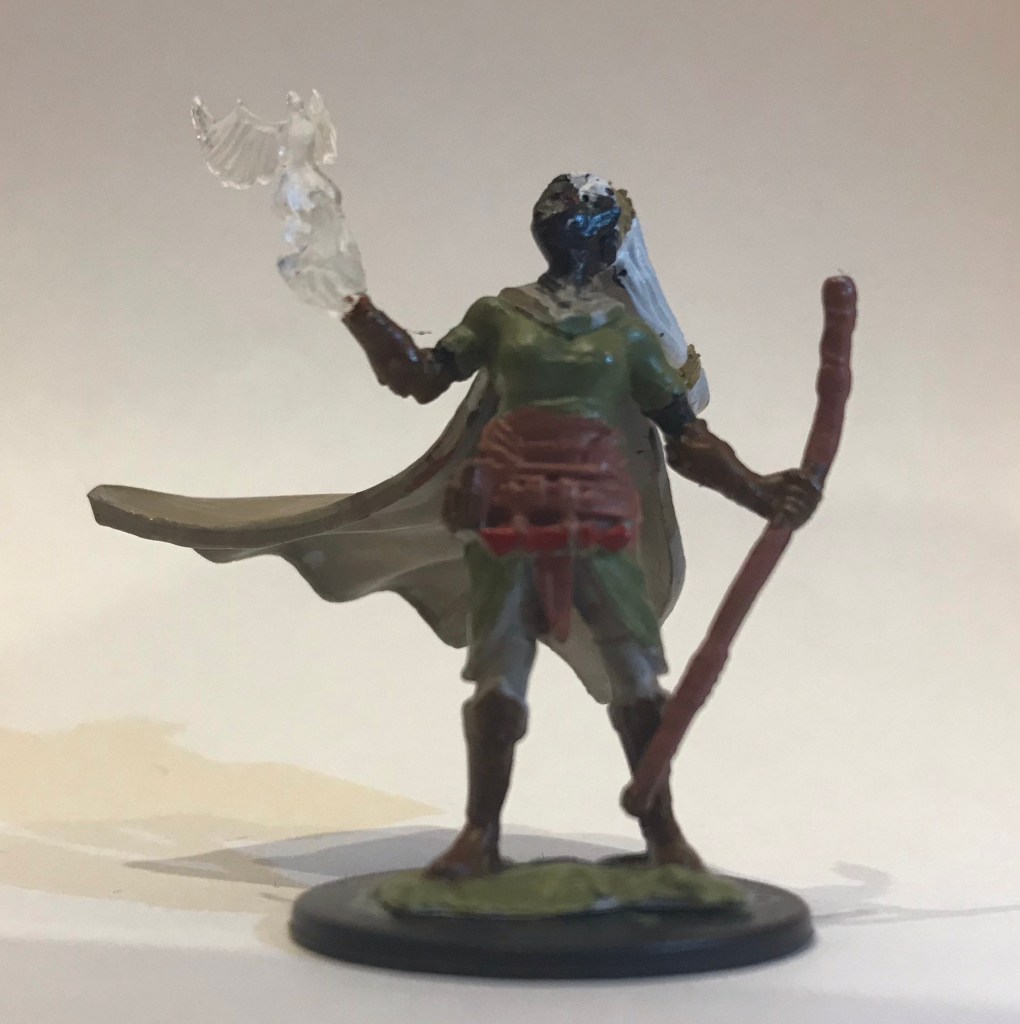
I couldn’t bear to look at those poor, grey figurines with their bland, grew tone anymore, so I finally bought a very minimal set of Citadel brand figurine paints and gave it a try.  My first few figures turned out OK, but not great.  However, by and by I’ve gotten somewhat better at painting and more importantly I really enjoy it.  The figurine above is one of my primary characters I play in Adventurers League.  Since she is a drow (dark elf), her skin is ebony-black and eyes red.  Painting two tiny red eyes took a lot of hand-eye coordination.  😅

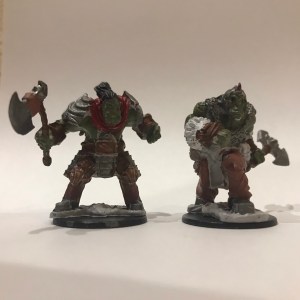
I’ve also painted a few monsters too, such as these orcs:

img_3981

Thanks to tips from friends, and helpful articles like this one, I’ve learned how to mix and match paints to get the color and consistency I wanted too.  That allowed me to make various shades of green, such as in this figurine:

img_3974

and:

img_3986

But, by far the best tip I’ve learned so far is to take a dollop of paint and put it on a “palette” which in my case is just a paper plate covered in plastic wrap.  From there, add enough water that the paint has the consistency of milk.  This really helps keep the tiny features of the figurine visible, and not “pasty” looking.  You can also mix two different colors on the same palette (after diluting both with water) to make interesting combinations.  It took me a few tries, but I was able to get a decent “skin” color for faces.

One of my friends who has more experience painting also suggested that “less is more” since you can always add more layers of paint if you need to, rather than taking away.

One thing that I do need to work on is shading.  I have a wash to provide shading, but somehow it doesn’t come out right.  As with normal paints, I’ve been told that it works better when watered down and then allowed to seep naturally into crevices and such.  I kind of got it to work on this Minotaur, particularly the shading on his muscles:

img_3997

Anyhow, as my painting skills (and photography skills) improve, I’ll try to post more.

The point though of this post is that despite having no real art skills, it was something fun worthwhile to delve into, and I am glad I did it. It’s good to break out of one’s comfort-zone from time to time.

¹ And photography, too.

Plane-Trotting in Dungeons and Dragons

flight landscape nature sky
Photo by Pixabay on Pexels.com

My kids have been playing campaign at home that has mostly taken them on a handful of interesting adventures across the Sword Coast of Faerun, but eventually the story kind of hit a plateau: how many more times would my kids want to pass through Baldur’s Gate?¹  With that, I decided it was time to mix things up a bit, and I contrived a little adventure where the kids would visit various Outer Planes instead.

As per the 5th-edition Dungeon Masters Guide, not to mention past editions, the world of Dungeons and Dragons is surrounded by 9-17 other dimensions or planes that each represent a moral alignment.²  The Nine Hells, being a primary example, are purely lawful-evil in that they’re tyrannical and extremely regimented, while the plane of Arborea is supposed to represent a wilderness paradise that is purely chaotic-good and happens to be the home of many Elf deities.

Further, there are plans that are wedged in between particular alignments, in that they’re halfway between, say, lawful-good and lawful-neutral.  These are the fun planes in my opinion since they better represent the moral ambiguities of life and what an idealized version might look like.  Some interesting examples include:

  • Arcadia – between lawful-good and lawful-neutral, this plane represents a kind of highly regimented paradise, where everything is in its perfect spot.
  • Pandemonium – between chaotic-neutral and chaotic-evil, Pandemonium represents madness, hence it is beset by constant howling winds that drive even the heartiest warrior crazy.
  • Tartarus (or Carceri) – between neutral-evil and chaotic-evil, this plane is a pure prison plane. Once you get in, it’s practically impossible to get out.

One optional, but important feature outlined in the Dungeon Masters Guide is the effect such planes have on visitors. Many planes include an optional rule where the planes exert a powerful, often mental influence, on players who fail a daily wisdom saving-throw.   For example, in Hades, one is afflicted with despair, while Pandemonium inflicts insanity, and Bytopia inspires charity and goodwill.  A secondary rule is that players who’s alignment is somehow in opposition to the plane experience further distress and fatigue.

For my kids adventure, they had to destroy an evil artifact called the Eye of Judgement (loosely based of the same artifact in Roger Zelazny’s Amber series) by taking it to Elysium, the neutral-good plane where the overwhelming sense of charity and good-will would simply fry the artifact.

That was all well and good, but the kids had forgotten to include a way to get back, and so they were trapped on a plane where everything is pleasant and peaceful. As adventurers, they quickly became bored of the place and sought a way out. Plus the pleasant effects of Elysium were definitely influencing some party members, so they opted to leave through another portal if they could find one.  Elysium had no dangerous encounters, so they easily went from town to town until they came to one large enough that they found three gateways: two with unknown destinations and one with a known, but unwanted destination.  When my kids opted to take one of the unknown portals, I secretly rolled to see which plane they would end up, and the result was Ysgard.

Heimdall an der Himmelsbrücke

Ysgard is a chaotic-good/chaotic-neutral plane that exemplifies personal glory and effort, loosely based on the same realm in Norse mythology.  My kids were excited because they knew they might meet characters like Loki and Thor, whom they knew from the Marvel comic universe.  Leaning into this, I have been leading the kids along toward the Bifrost with an extra party-member who not surprisingly is Loki (the Marvel movie version) in disguise.

In any case, the Dungeon Masters Guide, in its explanation of the planes, is somewhat vague on the contents of each plane, especially compared to past editions like 3.5.  I think this is somewhat intentional as it gives the DM room to expand and fill in the details as they see fit.  My vision of Elysium won’t necessarily match what another DM will imagine, but that’s fine.  The DMG even alludes to this in the following excerpt:

As with the Elemental Planes, one can imagine the perceptible part of the Outer Planes as a border region, while extensive spiritual regions lie beyond ordinary sensory experience. Even in perceptible regions, appearances can be deceptive. Initially, many of the Outer Planes appear hospitable and familiar….but the landscape can change at a whim of the powerful forces that dwell on these planes. (pg. 58)

So, the idea is that what the players see on the plane isn’t the true form of of the plane as seen by its own deities.  This means that each adventuring group will experience something slightly different anyway due to their predisposition, background, etc.

This means that the planes can be an almost infinite field of opportunities for adventure, especially for a party that’s looking to shake things up a bit. 😉

¹ While the Descent into Avernus campaign guide is still a week or so away, my children’s party has been to the city of Baldur’s Gate a number of times since they needed a city campaign other than Waterdeep which they fled at one point.  Before DiA, there aren’t much 5e resources to speak of, so I’ve been cobbling in details from older versions of D&D plus a bit of improv on my part.

² Why such odd numbers?  Don’t forget the purely neutral plane of the Concordant Opposition.  😉

Wacky Adventures at PAX with AcqInq

img_3253

PAX West came and went recently, and it was my first time going.  PAX is something that happens here every year, but I always miss it because either I can’t buy a ticket, or I have other plans that weekend.  This year though, I finally got a lucky break from a friend who had a one-day pass for Friday, which means that I could go to PAX, and still spend time with my kids on the weekend. ❤️

Since I only had one day to go, I decided to make the most of it at the tabletop gaming area since I am not an avid player of console/PC games.

PAX was hosting a special gaming table for the new Acquisitions Inc. module, and an introduction adventure. Since the timing of the Adventurers League adventures didn’t line up with other things I wanted to do, I opted to do the Acq Inc. adventure instead.  I was seated with some other people: a nice older couple, and a father/son combination.  We played a small, fun adventure using example characters from the book.  I played Lok, the dwarven cleric Obviator.

We all had a good time, and as the adventure wound down, one of the guys asked me what I thought about the book.  I replied that I liked it, but hadn’t had a chance to use it with my kids’ adventure at home, and it was then that they told me that they were the writers of that book!  It was so cool playing at the same table as the writers. I shook their hands and got autographs in my book (which was already signed by Mike Krahulik as his character Jim Darkmagic).

It was a great start to PAX, but after a lengthy afternoon lull spent people-watching, looking at expensive dice, and purchasing spellbook cards, I got to see my first live D&D game of Acquisitions Inc. at the Paramount Theater here in Seattle:

img_3265

We were stuck in the middle of the seats, which was not a great place to be when you have to go to the restroom, but it all worked out well.  It was great seeing Anna Prosser, Xavier Woods, Patrick Rothfuss, Jeremy Crawford and of course Jim Darkmagic and Omin Dran.  You can see the full episode here on Youtube.

It was a great day: I got to meet many good people in the D&D community, and got to finally see a live show.  I am already looking forward to next year.  😆

P.S.  PAX apparently has a thing with collecting “pins”, which I only realized much later in the day, so I got a total of 1 pin.  But, since I was trying to stay on a budget, one pin was probably enough.  🙂