More than any other year in recent history, it seems like 2025 is a year where we are suffering more than before. It is frustrating to watch all this unfold, frustrating to know that even when you try to help, it feels like it makes no difference, and frustrating to see no light at the end of the tunnel. I feel a combination of denial, passivity, frustration, anger, despair, and everything in between, over and over.
IVANOVA: Damn it, John, there’s always too many of them and not enough of us. What am I supposed to do?
SHERIDAN: Fight them without becoming them.
Babylon 5, “Dust to Dust”, s3:ep06
But I’ve also been thinking about this a lot, and I realized that the forces of History are always in motion, even if we don’t see them. It can take years, or in some cases decades to see the bigger picture.
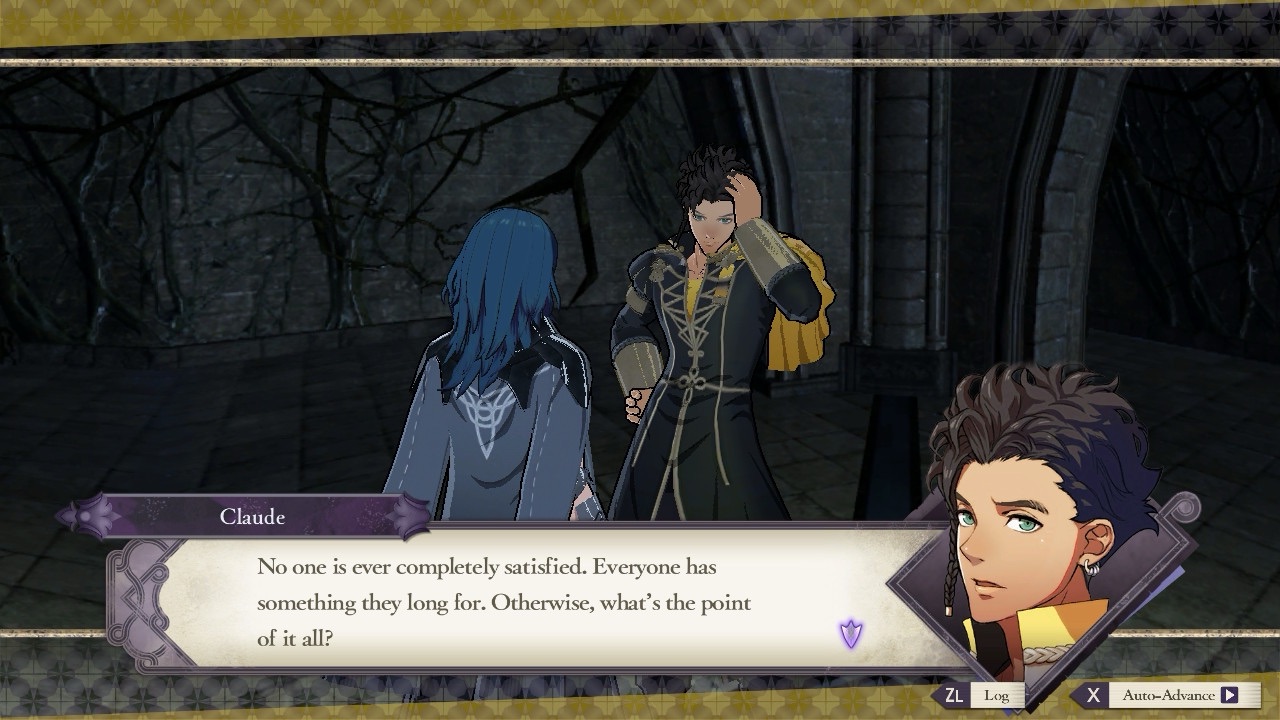
Claude from Fire Emblem: Three Houses saying “…but even while you’re standing still, the world keeps on moving. I always find that oddly comforting.”
But also, the little things we are doing here and now still matter. What happens to others who are suffering affects us, even if we are not consciously aware of it.
G’KAR: If we deny the other, we deny ourselves and we will cease to exist.
Babylon 5, “Point of No Return”, s3:ep9
Even those whom we oppose are suffering, even if we do not comprehend it:
If both sides are dead, no one will care which side deserves the blame. It no longer matters who started it, G’Kar. It only matters who is suffering.
Babylon 5, “Dust to Dust”, s3:ep6
So, simply standing back and letting history unfold isn’t enough. On the other hand it is just not possible to save the whole world. Even if I gave away everything I have here and now, it would be a drop in the bucket.
Instead, each one of us needs to find one small thing that we can dedicate ourselves to, for the good of others. In a Pure Land Buddhist text, The Larger Sutra of Immeasurable Life, the Buddha Amitabha started as a king, then a bodhisattva, and through tireless efforts over eons transformed his realm into the Pure Land through countless good acts, accumulated merit, and so on. This process was glacial, but it came to fruition nonetheless.
In the same way, each one of us when we dedicate ourselves to a cause, however small, it feels glacial. Nothing changes. But change does happen. As with the forces of History, things do unfold, but our actions help shift the currents of the “river of History” ever so little.
But even so, not every one will see this and understand. In the immense Buddhist tome, the Avatamsaka Sutra (a.k.a. the “Flower Garland Sutra”), is a famous quote:
On seeing a bodhisattva Perform various practices, Some give rise to a good mind and others a mind of evil, But the bodhisattva embraces them all.
Season three of the science series Babylon 5 marks a big change in the story and especially for G’kar (played by the late Andreas Katsulas, RIP) and his people. G’kar recognizes what is happening and realizes that there is no going back.
In a sense, every moment is a transition. Most are really small, subtle, trivial, with some big ones thrown in. Some of these big transitions are positive (getting married, having kids, etc), some are overtlynegative.
Some start negative and become positive: I was laid off, but the new job I got ended up being better. Some start positive and become negative: friends who started out great, but became problems later or responsibilities that get worse and worse.
In short, life is just a series of constant transitions, great and small, and they’re usually hard to spot in until they have already happened. For example, on my way to work, I pass by my old university. I graduated almost 25 years ago, and still visit for cherry blossoms, but year after year it has changed in small ways like the Ship of Theseus. The university I knew no longer exists.
A scene from Fire Emblem: Three Houses
That’s all well and good for gradual, transitions, but what if you are living through a very dramatic, negative transition? It is very hard to see the light at the end of the tunnel.
“I wish it need not have happened in my time,” said Frodo.
“So do I,” said Gandalf, “and so do all who live to see such times. But that is not for them to decide. All we have to decide is what to do with the time that is given us.”
J.R.R. Tolkien, The Fellowship of the Ring
But I like to think that given enough time, even dark and difficult times eventually fade…
“It’s like in the great stories, Mr. Frodo. The ones that really mattered. Full of darkness and danger they were. And sometimes you didn’t want to know the end. Because how could the end be happy? How could the world go back to the way it was when so much bad had happened? But in the end, it’s only a passing thing, this shadow. Even darkness must pass. A new day will come. And when the sun shines it will shine out the clearer. Those were the stories that stayed with you. That meant something, even if you were too small to understand why. But I think, Mr. Frodo, I do understand. I know now. Folk in those stories had lots of chances of turning back, only they didn’t. They kept going, because they were holding on to something. That there is some good in this world, and it’s worth fighting for.”
So, when times are difficult, I try to hold on to the idea that time marches on, and today’s kings will be tomorrow’s dust.
The Buddha taught the importance of equanimity, like a grass that bends in the wind, no matter how strong it blows, and this is a lot easier than it sounds when you’re dealing with the hassles of life. But knowing that time marches on does make it somewhat easier.
If you know what life and existence is, think of it this way: it’s just there.
MCCOY: What if you decide he is Kodos? What then? Do you play God, carry his head through the corridors in triumph? That won’t bring back the dead, Jim.
KIRK: No, but they may rest easier.
Star Trek, “The Conscience of the King” (s1ep13), Stardate 2817.6
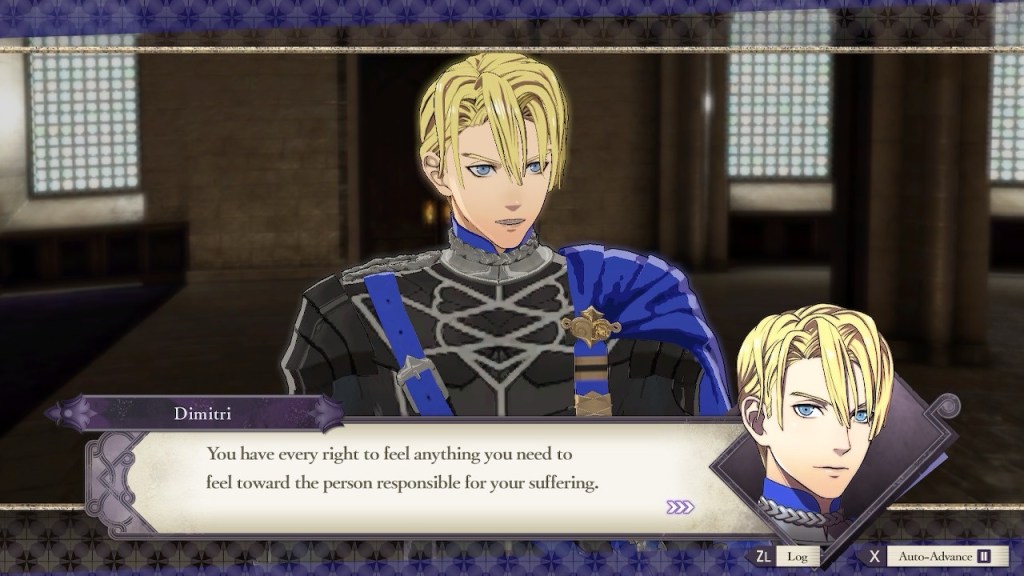
In the game Fire Emblem: Three Houses, one of the three main characters you interact with is the prince of Faerghus, Dimitri, who has suffered terrible tragedy in the youth. Behind his veneer of civility, he is gradually losing his mind.
He cannot get past the loss of his loved ones, and is determined to kill Edelgard personally, whom he blames for all his misery. Depending on which story path you choose in the game, Dimitri’s fate, and the fate of everyone he drags down with him, is very tragic indeed.
Dmittri in the “Azure Moon” route of Fire Emblem: Three Houses
The Buddha saw through this death-spiral of vengeance and hatred, and how utterly pointless it was:
“He abused me, he struck me, he overpowered me, he robbed me.” Those who harbor such thoughts do not still their hatred.
The Dhammapada, verse 3, translation by Acharya Buddharakkhita
Indeed, ill-will is one of the Five Hindrances, and can only be countered by goodwill. But what happens when someone has been genuinely hurt and abused by someone else?
Dimitri at an earlier point in the game.
Dimitri suffered terrible loss and hardship in his youth due to the political machinations outside his control, and the pain and grief are genuine, not something you can just wish away, or use platitudes to make it better. It’s not hard for readers to think back to moments of trauma in their own lives (I have my fair share), and feel raw anger, rage, or sadness (why did this happen to me? why do I have to live with these scars for the rest of my life?).
If you pick the story path that sides with Dimitri, there is a happier fate for him. I don’t want to spoil too much, but through his friends (including you, the main player), he learns to unravel his past and gradually learns to look forward toward the future his kingdom including a dramatic moment with Edelgard.
Thus, I think what the Buddha says in the Dhammapada is true: vengeance, anger and bitterness are indeed self-destructive, but if the trauma and pain are real, they can be very difficult to let go. It is too raw and painful to simply dismiss with logic and reason. But, in Dimitri’s case, support from loved ones helps him through the darkest moments, and helped him let go. He learned not to face it alone, and grew from it.
With whatever trauma you have to live through, I hope you dear readers find similar resolve and happiness.
In these times of uncertainty, I’ve been trying various ways to help causes I care about: donating more,1 making better environmental choices at home, and trying to be a better person, but even then, it feels like it’s never enough. Like Ashe from Fire Emblem: Three Houses, I feel like in spite of my efforts, I’ve accomplished nothing.
A conversation with “Ashe”, one of my favorite characters in FE3H.
Being able to start small and focus on helping someone is a great start. From there, you might branch out and help others too.
Yet in the big picture, this still doesn’t feel like it is enough sometimes.
Mahayana Buddhism, which is everything you see from Tibet to Japan and between, tends think very big picture. Thus, it often holds up the bodhisattva as the archtype for Buddhism: a being who lifetime after lifetime helps others, fulfilling very grandiose vows. The idea is that you can’t help everyone in one lifetime, but on the grand scale of time, it is possible to help everyone eventually. But of course, because time and space are so vast, it is a kind of never-ending story. The Buddha, Amitabha (aka Amida) completed his vows in 10 kalpas (aeons), roughly 160 million years.3
Meme from Return of the King 🤣
Anyhow, point being: if we look at it from a Mahayana-Buddhist endpoint, every little thing we do now does add up, but it happens on a scale of time that we can’t fully grasp. Nonetheless, it does add up in the long-run.
But maybe that’s small comfort here and now.
In truth, I don’t have a good answer here. I still try to help where I can while not burning myself out in the process, but I can only hope it makes a difference someday, even if I can’t see it.
1 I used to have a donations page on the blog pointing to various causes, but I’ve had to take it down temporarily to update some broken links, change some charities, and revise the content a little. The page is now back online!
2 I used to watch the original cartoon “He-Man and the Masters of the Universe” as a little kid, so this takes me back. I remember one Christmas I received the Castle Greyskull playset, which was really neat, but then fell apart later. Ah, the impermanence of all phenomena and kids’ toys.
3Kalpas are interpreted differently in different texts, so I am just using the more conservative estimate of 16 million years. Kalpas are meant to convey astronomical amounts of time, not literal ones.
SPOCK: There are many who are uncomfortable with what we have created. It is almost a biological rebellion. A profound revulsion against the planned communities, the programming, the sterilised, artfully balanced atmospheres. They hunger for an Eden where spring comes.
Star Trek, “The Way to Eden” (s3e20), Stardate 5832.3
As I write this, the family is in Japan (sadly, I was unable to go this year) visiting relatives, and I am home with the dog, Cherry.
Since I have a couple weeks to myself, I thought it would be a great time to put in a little extra Buddhist practice, catch up on some personal projects, go offline for a bit, etc. Basically, try to live like a monk for a few days. I carefully planned it out, decided what I would do and not do, took a three days off from work, and then got ready for the “mini home retreat”.
I lasted eight hours.
The first few hours were great. It was peaceful, quiet, and I did finish reading a couple books on my to-do list, meditated extra, recited more sutras than usual, and so on. But then, as the hours progressed, isolation and boredom set in. I started worrying if I was missing a text from my family (in case of emergencies), and I discovered that it’s hard to read Japanese books without a dictionary which I only have on my phone.
Embarrassingly by early afternoon I gave up and turned on my phone. Then I went and played Fire Emblem: Three Houses for a few hours,1 watched Star Trek V: The Final Frontier2 for some crazy reason, got bored and played more Fire Emblem until 11pm.
Day two, I didn’t even really bother to try again. I realized that I had hyped up this time off too much, and without any support or contact with others, I quickly started to get a little stir-crazy. That’s not to say the time wasn’t unproductive either. Even today (day two), I still got some extra stuff done around the house, and did a little more Buddhist stuff than usual. But I also played Fire Emblem: Three Houses for three hours.
τὸ μὲν πνεῦμα πρόθυμον, ἡ δὲ σὰρξ ἀσθενής. “Indeed the spirit is willing, but the flesh is weak.”
Indeed, in the Sutra on the Buddha of Immeasurable Life, one of the Three Pure Land sutras, the Buddha Shakyamuni laments that:
“People of the world, being weak in virtue, engage in strife over matters which are not urgent….Since they have not done any good in particular, nor followed the Way, nor acted virtuously, when they die, they will depart alone to an inferior world. Although they are destined to different states of existence, none of them understands the law of karma3 that sends them there.”
Translation by the late Hisao Inagaki, hosted here.
So, the problem of laziness and lack of follow-through in religious practices (or personal projects) is nothing new. Even in Japanese, there is a phrase: mikka bōzu (三日坊主) meaning “three day monk”. It’s a tongue-in-cheek phrase about how most endeavors last three days at most.
In my case, I think my failure was a combination of over-zealousness and perfectionism which set the bar too high for something I am not really used to doing day to day. The idea of a religious personal retreat is still worth it, but I should have set the bar lower the first time, and tried to be a bit more realistic.
The point isn’t to give up and just play more Fire Emblem (but then again, I might anyway), but reflect on what worked, and what didn’t and focus on something realistic and sustainable. As Dogen reminds us, it can be done, but expecting it to work overnight if I just push through hard enough is maybe a bit silly.
Namu Shakamuni Butsu Namu Amida Butsu
P.S. Bonus post. Apologies for any typos, I wrote this one quickly while it was still fresh in my mind, so probably more editing mistakes than usual.
P.P.S. On the plus side, I also had some time to practice vegetarian cooking and made a large batch of Mapo Tofu, Pasta Mama (in honor of Captain Pike in Star Trek: Strange New Worlds), and some Thai curry. This photo is the Mapo Tofu:
… I also harvested the scallions I’ve been growing since Spring:
1 I am on my eighth play-through I think. I am finally going back and replaying my first route, Crimson Flower route (i.e. with Edelgard) and doing things I missed on my first play-through. It’s been nearly two years, and I still enjoy this game very much. The story, dialogue, characters and world-building never cease to amaze me.
2 I think I watched it to remember why this movie is so unpopular. It has some good qualities to it, but yeah, it’s not very good. As a teenager, I watched it in the theaters and thought it a bit odd, but it’s not aged well for me.
3 For similar teaching, see the first chapter of the Soto Zen text, the Shushogi.
Ever since I stumbled upon the Nintendo game Fire Emblem: Three Houses, I’ve been completely hooked onto the Fire Emblem series. The series is quite popular in Japan, but until recently hasn’t been that well-known in the West outside a niche community. Many earlier titles were not even sold overseas. I have gone back and played a couple older titles1 and also last year I got a copy of the latest title: Fire Emblem: Engage for Christmas.
Since I played Engage after finishing Three Houses, I was comparing it with a very high bar, and thus it had a rocky start for me. However, after completing the game, and picking up the new Japanese-language manga (more on that later), I like Engage more and more. This post is meant to be a review to celebrate its 2nd release anniversary.
If you want the short summary of “is the game worth playing?”, then the quick answer is that I am halfway through my second play-through now and definitely enjoying it.
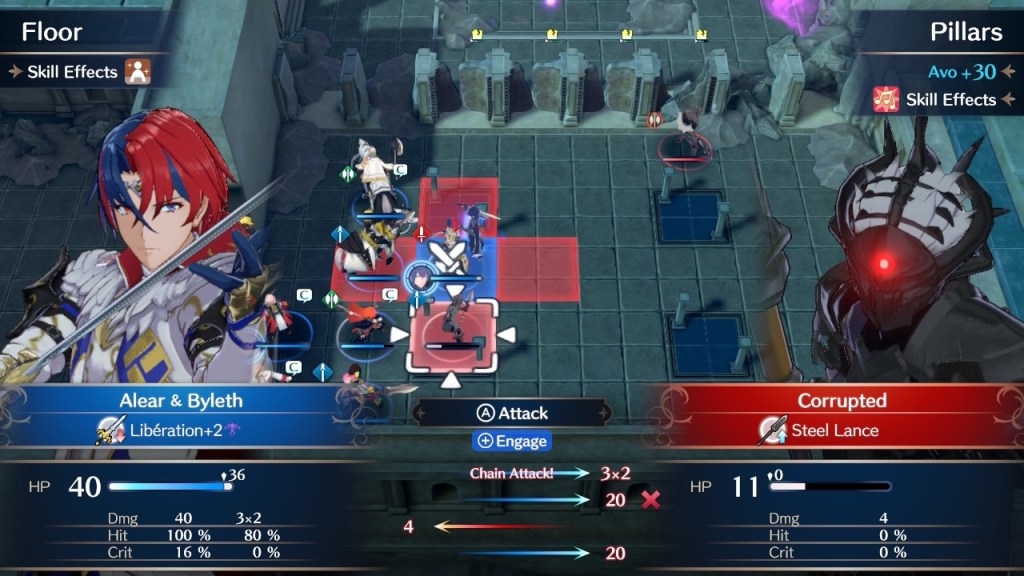
Like every Fire Emblem game, Engage is a turn-based battle game. I like to think of it as Chess, except that :
You get to pick the pieces you want to put on the board
You can build and train your pieces in various ways
There is a nice narrative to go with the entire adventure
Your pieces interact with each other, and might even get married. ❤️
An example screenshot I took of the main character, Alear, battling an enemy. Before the battle begins, the player can see what the results will be, allowing you to proceed, or take back the move.
Each Fire Emblem is somewhat unique, but they all follow a similar pattern. The Engage battle system doesn’t radically differ from earlier titles, but it is significantly smoother and more polished. It’s very well done. Engage leverages the weapon-advantage triangle of earlier titles (swords vs. axes, axes vs. spears, spears vs. swords) but also introduces a new “break” mechanic which causes the disadvantaged weapon holder to temporarily lose their weapon. This is a great way to overpower another opponent and avoid unnecessary damage yourself. Of course, this works both ways. There are also spells you can obtain that simply break an opponent from a distance. Very annoying if you are on the receiving end. The battles are hard, but they are genuinely fun to engage in …. uh? uh?
The big innovation to Engage is the use of Emblem Rings. Engage seems to be a kind of a homage to the entire series, and many of the heroes of past titles make a comeback as warrior spirits bound to specific rings. Characters who bear one of these rings gain increasing stat bonuses and abilities, and also unlock short conversations with the bound Emblem warriors. The more they use the ring, the more abilities and stat bonuses they unlock. There are twelve rings total, and since your groups is far larger, you have to carefully decide who gets to train with what rings, etc.
If you didn’t play earlier Fire Emblem titles, like myself, this a great way to get acquainted with past heroes you didn’t really know about. Ike from Fire Emblem: Dawn of Radiance, and Corrin from Fire Emblem: Fates are a particularly standout examples for me. It was also great to see Byleth from Three Houses as well.
Ike from Fire Emblem: Path of Radiance, featured here in Engage
These Emblem Rings both play a core part of the story, but also are an important aspect of many of the game mechanics. I didn’t understand until my second play-through how bond rings created from the Emblem Rings let other characters get some minor boosts to stats, minor abilities, and help charge SP points when not wearing an Emblem Ring proper. This is very helpful in ensuring none of your characters fall behind in progression too much, since there is only a limited number of rings to go around. Also, inheriting skills was something I didn’t do properly in my first play-through either, causing me to really miss some important enhancements. The Emblem Ring mechanics are both complex and highly customizable, but also take time to grasp. Engage might have done more to help clarify the benefits and features.
The other challenge with the game is the story.
Compared to the complex, Machiavellian story in Three Houses, with its adult themes of war, loss, politics and so on, along with its four possible story paths, Engage doesn’t really have any of this. The story is leaner, more linear hero story, harking back to older titles. That’s not to say the story isn’t interesting. In fact, once I finished the game, I found that I liked the story. The issue, I think is pacing: some dramatic parts of the story are introduced too early, so there’s no emotional connection, others introduced pretty late. Thus, there is a long awkward slog in the middle. The official manga2 actually does fix some of this so that the story aspects are smoothed out more, and long gaps in the plot are filled in.
The cast of characters too, lack some depth of Three Houses. The cuter, more cartoony style and one-dimensional personalities makes it a bit hard at times to take some of the characters seriously, as they feel like something from a mid-level anime. On the other hand, there are some great characters. The twins Clanne and Framme were simply adorable, Etie the bodybuilder lady was always a hoot (especially when she fights with Goldmary), Prince Alfred is always upbeat and positive even in the worst of times, and the brothers Prince Diamant and Alcryst had an interesting dynamic. In fact, there are actually quite a few fun or interesting characters, it’s just that others feel kind of superfluous or blatant fan-service characters.
This goes double for some of the villains. The Four Hounds were annoying to me, until the very end when their origin was revealed, but again due to the pacing, it was a bit too late. Similarly, the story between Hortensia and her big sister Ivy was actually pretty interesting, and helped flesh out the kingdom of Elusia more, but only if you progress far enough in their support conversations. By and large, the atmosphere of the game is lighter and more jovial than Three Houses, so it loses some gravity, but it does have some really nice support arcs nonetheless, and I do like the majority of the cast. The manga below really helps flesh things out and fixes some of the pacing issues, too.
The support conversations also differ from Three Houses a bit. The C and B supports tend to be shorter, but similarly follow a story arc. Some are actually quite good, some kind of bland. Then again, one can say the same in Three Houses: not every support conversation is compelling. I do really like that Engage seems to have more options for romantic supports, so if you’re a person who prefers same-sex relationships,3 you have more choices than Three Houses offered.
Yunaka is hilarious. 🤣
A few other things about Engage are worth noting.
First, the Somniel, the hub of Engage is really fun. It feels more like a vacation resort compared to the venerable Garreg Mach monastery of Three Houses. As with the Emblem Rings, there is a lot of features and quality-of-life improvements that are not found in earlier games, and easy to miss. I found myself frequently diverging from the game itself to mess around in the Somniel for lengthy periods of time.
Welcome to Club Med, er, the Somniel!
Second, as alluded to above, the game has a lot of replay value. That’s true with many Fire Emblem games as there is more than one way to win it, but Engage excels at this. You can go very in-depth of features and customizations. It’s overwhelming and easy to miss at times, but I have found myself enjoying the game a lot more during my second play-through once I grasped the basics.
Engage gets some flak for the thinner story and character development, but I have to admit that I enjoy it more than I expected, but it did take some patience to appreciate. There is a lot in this game, and while it is rough around the edges, it also really has a lot to offer new players and past fans of the series. Even with the rough patches, I definitely recommend the game for new fans and old.
P.S. bonus post, but also timely since Sakura-con starts today. My kids and I go yearly.
1 I was very lucky that someone at work was selling a slightly used 3DS for very cheap. Turns out there’s several good titles for the 3DS, but I picked Awakening because Chrom, Lucina and Robin all appear in Super Smash Brothers. It was nice to finally see who these people were, and appreciate the excellent storyline. Also, while writing this post, I also picked up Fire Emblem: Echoes, Shadow of Valentia for the 3DS as well. It’s a really beautiful story.
2 The official manga is only available in Japanese, but I obtained copies of it last year from Amazon Japan, and have been reading through (with a dictionary, of course). I hear there are unofficial translated versions available, but I don’t know anything about this. In any case, the manga is excellent and has done much to improve my opinion of Engage. Some aspects of the game story were rewritten in more sensible ways, while the art is just amazing.
The first four issues of the Fire Emblem: Engagemanga.
3 I am straight myself, but it’s important to acknowledge the sheer diversity of people in the world, rather than pretend it doesn’t exist.
Suffering is endemic to this world, whether it be a stripper hustling just to make $20, refugees who lose their homes, or soldiers fighting to defend their homeland, or children who are simply neglected and unloved.
If you stop to think about all this suffering, pain and misery, it’s completely overwhelming, heartbreaking.
Even if you had all the money in the world, and give it away, it provides only temporary relief. If you held all the power in the world, you could only affect so much change. Worse, you might fall into hubris.
From the game Fire Emblem: Three Houses
I think this is why the Buddha-Dharma is so helpful.
Photo courtesy of the Yomiuri Shimbun newspaper. This is the fumetsu no hōtō (不滅の法灯), the “Unextinguished Lamp of the Dharma” at Mount Hiei.
A candle flame doesn’t seem like much, but in a very dark place, that candle flame really stands out.
The majestic light of the Buddha Amitāyus is the most exalted….If, sentient beings encounter his light, their three defilements are removed; they feel tenderness, joy and pleasure; and good thoughts arise. If sentient beings in the three realms of suffering see his light, they will all be relieved and freed from affliction. At the end of their lives, they all reach emancipation.
The Immeasurable Life Sutra, translation by Rev. Hisao Inagaki
I often think about the old stories of Honen, the 12th century monk who spread the Pure Land teachings in Japan. It was a time of rampant disease, warfare, and income inequality. Honen couldn’t fix any of these things but he taught a simple message to any who wouldlisten. If nothing else, it gave hope and a sense of direction in a directionless world.
A multilingual sign posted at the front of Chion-in Temple in Kyoto, Japan.1
Sometimes, small, sincere gestures of kindness can be the best help of all.
This is a path toward closeness with Chion-in Temple. That is to say the path for encountering Master Honen. It is also a path for receiving the teachings of the nembutsu. One receives the compassion of the Buddha, regardless of age or gender, a path that leads to a bright, upright, affable life. A path that heals weariness, reveres life, leads to sincere joy; this is that path. A path of Compassion.
In Ukrainian via Google Translate:
Дорога до улюбленого храму Чіон-ін. Це шлях до зустрічі з Хонен-самою. І шлях до отримання вчення Нембуцу. Шлях, який веде до людей різного віку, чоловіків і жінок, які живуть яскраво, праведно та гармонійно завдяки мудрості Будди. Шлях, який дозволяє зцілити втому життя та насолоджуватися гідністю та радістю життя. Ось цей шлях. Шлях мудрості.
In Arabic via Google Translate:
الطريق إلى معبد تشيون إن المحبوب. هذا هو الطريق لمقابلة هونين-ساما. والطريق لتلقي تعاليم نيمبوتسو. طريق يؤدي إلى الناس من جميع الأعمار، رجالًا ونساءً، للعيش بشكل مشرق وصالح ومتناغم من خلال حكمة بوذا. طريق يسمح لك بالشفاء من تعب الحياة والاستمتاع بكرامة الحياة ومتعتها. هذا هو هذا الطريق. طريق الحكمة.
In Spanish via Google Translate:
El camino hacia el querido templo Chion-in. Ese es el camino para encontrar a Honen-sama. Y el camino para recibir las enseñanzas del Nembutsu. Un camino que lleva a personas de todas las edades, hombres y mujeres, a vivir de manera brillante, recta y armoniosa a través de la sabiduría de Buda. Un camino que permite sanar el cansancio de la vida y disfrutar de la dignidad y la alegría de vivir. Ese es este camino. El camino de la sabiduría.
“Mercedes” is one of the nicest, sweetest characters in the game Fire Emblem: Three Houses (and Three Hopes)
It’s been about 18 months since my mother-in-law passed away, and my wife still pays her respects regularly. We have her picture setup with some flowers and incense, and per custom my wife will burn incense in the morning. The kids, who miss their “baba”, offer incense sometimes too.
We also started enshrining an old photo of my maternal grandmother, who passed away 33 years ago, and burning incense for her too. Obviously, this is not an American custom, but I felt that it was a good one to adopt. I briefly touched on honoring one’s ancestors in a past post about day to day Tendai Buddhist practice, and remembering this I decided to take up the practice.
My grandmother was pretty ahead of her time. She was a computer nerd in the 80’s, and would dabble a lot with old Tandy Color Computers, dial up on local BBS’es, and hung around Star Trek forums online. And, she would share all this with me as a kid. I have a lot of fond memories of staying overnight at her house on weekends.
Thanks to her, I developed a love of computers, and that love of computers helped me build a career from which I can raise a family now. Just as we owe my mother-in-law for her many ways of supporting us in our early marriage, my grandmother also helped us by inspiring me to learn some good technical skills.
The reason why I posted this though was to not just reflect on the past.
Through Buddhist custom, we’ve been honoring past ancestors, and expressing gratitude, but also it’s important not to get stuck in the past either. Conduct here and now matter too. The quote above from Fire Emblem: Three Hopes (the sequel to Three Houses), really expresses this point nicely:
Living in the present is the best we can do. We owe it to those who can’t come back.
Fire Emblem: Three Hopes
My wife strives to be a good mom the way her mother was, and I try to be a good dad, including working an honest career. We both look forward to being the “nice grandma and grandpa” for our grandkids someday. 😊
Of course, this isn’t just limited to raising a family. A person can also just “pay it forward” in helping others. Just as our parents (warts and all) sacrificed much to raise us, we can selflessly help others around us, or help future generations by making the world a little bit of a better place. But, even more simply, taking time to enjoy one’s life, the breath one takes, their continued good health and so on, these too can honor our loved ones who aren’t around anymore.
One of the aspects of Buddhism that is hard to explain but central to its teachings is Samsara. Samsara is how Buddhism explains the world we live in, describes the kind of aimless wandering that all beings do lifetime after lifetime ad nauseum, and why Buddhist teachings are relevant.
But why do people continue on in Samsara?
Because we naturally crave continuity. We crave existence on our terms. Even someone who wishes to end their life still on some deep fundamental level wants to keep going, they simply find life unbearable nonetheless. On the other hand, the state of Nirvana described by the Buddha isn’t a wish for extinction either, because that’s still predicated on a sense of craving.
The issue in Buddhism isn’t so much life of death, it’s craving.
Craving is not something we consciously think about or do. It’s deep in our nature. We can suppress it, we can discipline ourselves, but we cannot make ourselves stop craving. Even striving to end craving is just another form of craving, isn’t it?
As long as one craves in any form, they create karma. By creating karma, they pave the way for future conditions, future rebriths, and so on:
[At Saavatthii the Blessed One said:] “Monks, what a man wills, what he plans, what he dwells on forms the basis for the continuation of consciousness. This basis being present, consciousness has a lodgment. Consciousness being lodged there and growing, rebirth of renewed existence takes place in the future, and from this renewed existence arise birth, decay-and-death, grief, lamentation, suffering, sorrow and despair. Such is the uprising of this entire mass of suffering.
The Cetanā Sutta (SN 12.38), translation by Maurice O’Connell Walshe
It’s a huge, tangled ball of karma, intention, volition, craving, etc. Untangling such a mess is extremely difficult, hence reaching the state of a bodhisattva, let alone a fully-awakened buddha, is nothing to sneeze at.
But what is the alternative then?
Aimless wandering across eons, lifetime after lifetime. Sometimes it’s a good life, sometimes it’s a terrible one, lots of middling lifetimes in between. But there’s no rest, no sense of direction.
Sooner or later, once a person comes to realize this, they face the realization that the only way to attain peace and liberation is to untangle the mind.
Namo Shakamuni Buddha
P.S. Featured image is from the game Fire Emblem: Three Houses. I play this game too much (speaking of craving), and love Claude’s insights on more thanoneoccasion.
In a couple recentposts, I touched upon the misdeeds of one 12th century warlord named Minamoto no Yoritomo in the excellent Japanese historical drama, the Thirteen Lords of the Shogun. Huge credit to Japanese actor Oizumi Yo (大泉洋) for his brilliant performance by the way.
There’s one particularly heart-breaking scene halfway thorugh the drama series: Yoritomo bullies his retainer, Hojo no Yoshitoki, to carry out a series of bloody purges (partly as a test of loyalty). Yoshitoki hesitates, seekingly ready to stand up to Yoritomo at last, but in the end he backs down. Later in the episode after the purges have taken place, Yoshitoki is at home holding his infant baby, but quietly cries to himself. He says to his child, “please forgive your dad” as the episode ends. 😭
While some of this is dramatic fiction, Yoritomo really was a ruthless man, just one of many in history who exerts power and does whatever is necessary to keep it. They exploit others and toss them aside when they are done. Such men are so hopelessly self-absorbed that they pull everyone in orbit down with them, and even then it’s not enough. Like a bucket with a big hole at the bottom, the more they try to fill it and appease their ego, the more they need to fill it again.
For you science types you can also compare them to a singularity (e.g. a black hole): something that has collapsed in on itself and now pulls everything in destroying them in the process.
Sagittarius A*, the black hole at the center of our galaxy.
For simplicity, we’ll call these people “super assholes”. It’s a pseudo-Buddhist term. 😉
Even in modern times, such powerful assholes still exist. They merely changed jobs. Some run major corporations, some rule dictatorships, others are just obnoxious politicians, lawyers, priests, media influencers and so on. Yet in spite of their obvious misdeeds and harm to others, they seem invulnerable, able to evade justice through wealth, power and just being enough of an asshole.
Worse, even if you manage to take down one asshole, another one inevitably arises.
All governments suffer a recurring problem: Power attracts pathological personalities. It is not that power corrupts but that it is magnetic to the corruptible.
When I think about this issue, I sometimes consider a passage from the Earth Store Bodhisattva Sutra, chapter five:
The power of karma is extremely great. It rivals Mount Sumeru in its heights. It surpasses the great oceans in its depths. It obstructs the path leading to sagehood. For that reason, beings should never think that minor bad deeds are unimportant or assume that they do not count as offenses. After death, there will be retributions to undergo that reflect all those details.
This is, admittedly, a pretty small comfort to the countless people whose lives have been destroyed, literally and figuratively, by such powerful men. Sure, they may self-destruct someday, and face some kind of karmic retribution in the future, but what about the people who are suffering or dead now?
Make no mistake, though, time does go on, awful people wither and die, and their legacies are forgotten. Remember the ancient Assyrian king, Ashurbanipal? His was a reign of terror. But soon after he died, the dreaded Assyrian Empire fell and its legacy is now just dust. Small comfort to people at the time, but still.
Screenshot from the game Fire Emblem: Three Houses.
If you compare these “super assholes” to black holes in space, I find the best thing to do is steer clear of their orbit. If you’re far away, you can still escape with minimal effort, but get too close and you may get sucked in further no matter what you do, just like Hojo no Yoshitoki. Sometimes it’s better to just lay low and let things pass.
Sometimes, though, it feels unavoidable, and that becomes the true test of one’s character.
Namu Amida Butsu
P.S. I coincidentally wrote most of this before a certain asshole was convicted (you know who). I fear he will somehow escape justice though, but he will be dead in time anyway.










 Gleanings in Buddha-Fields
You must be logged in to post a comment.