The day is finally upon us: my firstborn, my daughter, is now an adult and looking toward college. Ever since she was a tiny baby, we have celebrated the Japanese festival of Girls Day or Hinamatsuri (ひな祭り) yearly on March 3rd. Her grandparents (my in-laws) brought this doll set from Japan 18 years ago.1 I did my research and figured out how to assemble it, and have been doing it every year since.
My daughter is an adult this year, and so she isn’t really a little girl anymore. Thus, in a sense the tradition comes to and end. We discussed it, and we will probably keep celebrating anyway until she is married,2 but it still feels like a threshold has been crossed.
Of course, it all feels a little bittersweet. Our daughter is happy, healthy and looking forward to the next chapter in her life. We, her parents, of course will miss her. And we’re looking forward to grandkids someday.
Perhaps in time I will be assembling the dolls for a future granddaughter, and my wife will keep making chirashi-zushi. Time will tell.
As for all the other ladies out there, happy Girls Day!! 🎎
1 Normally, the doll set has up to 5 tiers, but as two elderly grandparents they could only bring the top tier and since they were only bringing one tier anyway, they splurged and got a nice set from Kyoto. Or, so I recall.
2 in those days girls married far younger than they do now, so people probably didn’t celebrate this far along.
Do you still play D&D Adventurers League, or did you take up new hobbies? How’s your figurine painting going?
Yes, though not as much as I did at the time.
As I write this, it is January 2020, and overall things are pretty darn good. Finances are better than before, and [trimmed for privacy].
I was laid off by my old company two months later, but then found a better job anyway.
Your health-habits are (somewhat) better than before, too.
Some improvements, but also some setbacks here too.
As this is not my first (and probably not my last) FutureMe letter, let me say that as you’ve reach the half-way point in your life, you still have much to look forward to. Never get complacent, always strive for better, and never forget Hierocles’s Circle when you regard other people.
This is something that really felt meaningful in 2025. I talked about Hierocles’s Circle here, and I still think it’s a nice blend Greek philosophy and Buddhist practice.
Happy 2024 (?) ol’ buddy!
Not sure why I said 2024, when I meant 2025. Oh well.
Anyhow, that’s what I wrote to myself 5 years ago. Clearly, I failed to predict some things, some things never changed, and it was also a nice reminder to myself of some things that are important.
Today is my dog’s 2nd birthday. “Cherry”, our beagle-pug, was adopted in early 2022, but her birthday is in January from what we can determine in her veterinary records. I wrote about her last year, but haven’t provided a lot of updates.
Our dog, Cherry, sitting on a local beach. Photo taken a few weeks ago, as of writing.
The truth is, adopting a puppy was quite difficult. Before we had children, we had adopted dogs, but much older, calmer dogs. A puppy is far different, and the first year was pretty chaotic, amidst other family and parenting challenges. There are times where, frankly, I regretted adopting a puppy.
And yet, we are now celebrating her second year. Cherry has calmed down significantly, her puppy habits, such as nipping and eating everything off the ground, are over, and more importantly, we’ve learned to communicate enough with her so that when she’s hungry or bored, we can easily determine what she wants. Thus, Cherry gets less frustrated, and so do we.
She has her moments: she is pretty clingey, and barks really loud at seemingly trivial things, but her behavior overall has markedly improved over the last year. We have also settled into a nice pattern together.
Most importantly, the kids really like her. My youngest was utterly terrified of the dog for the first few months, and would do his best to avoid her, but now he constantly plays with her, and is happy to have her in the house (sadly, he is slightly allergic, which we never anticipated). He is also comfortable meeting new dogs too, which was a surprising benefit. My eldest who was the most vocal about adopting a puppy, handles her very well, and can take care of her in our absence, so we have some freedom to run errands, and take a break if needed.
In short, Cherry has become an essential member of the family, as we originally hoped. It took longer than expected, but in the end it has had a pretty positive outcome.
Which brings me to my point.
A classic Peanuts comic strip, dated Janaury 12th, year unknown.
I found this Peanuts comic strip online,1 and wanted to share it here. It’s easy to think dogs are stupid and annoying, since they can be pretty obnoxious, obtuse, and demanding at times. And yet, we can learn a lot about ourselves caring for dogs (or anyone) and that can teach some important lessons. Cherry was pretty frustrating as a puppy, but I am glad we didn’t give up, and stuck with it. It taught me some important lessons about humility and forbearance (easy to conceive, hard to practice in real life), and the kids learned some valuable lessons about caring for others.
So, did Cherry make our lives better? Yes, I think so.
And so, today I wanted to celebrate her life as a 2-year old puppy and say thanks, and happy birthday!
Edit: birthday photo
1 to be honest, I am not 100% sure I have permission to use this, but I feel it makes an important point, so I’ll risk it anyway.
It’s 2025, and I am happy to be back. The break wasn’t as restful as hoped (too many holiday obligations), but I did accomplish most of my goals, and got to celebrate my firstborn’s 18th birthday which was an important milestone for us parents. I also played lots of Fire Emblem: Engage,1 and watched plenty of old Star Trek episodes.
Anyhow, for the first temple visit of the year, the priest stated that according to the traditional 60-year Chinese calendar 2025 was the sign ki-no-to-mi (乙巳), which can be roughly translated as “yin wood snake”, which implied change coming to fruition, like a tree growing its branches. For context, last year was “yang wood dragon” (ki-no-é-tatsu, 甲辰). Which implied much turmoil, like a baby dragon bursting from its shell.
While I might be speaking from confirmation bias, I cannot help but feel recent events in the last few years reflect this. But, I suppose it’s up to individual interpretation.2
Anyhow, I have some fun posts coming up that I finally finished while on break.
Hoping you all have a great year, or at least stay out of trouble. 😅
1 Engage doesn’t have the emotional depth of Fire Emblem: Three Houses (I doubt few games would), but it has grown on me, and I enjoy many aspects about it, and will likely play through it again.
2 I consulted the Yi Jing for the year, and my own personal fortune wasn’t great either. Warnings of not “stepping on a tiger’s tail” and such.
On my planet, to rest is to rest — to cease using energy. To me, it is quite illogical to run up and down on green grass, using energy, instead of saving it.
Spock, “Shore Leave”, stardate 3025.2
Dear Readers,
Wishing you all a restful end of year, and a happy 2025!
I am going to take the next couple of weeks off myself and recharge, spend time with the family and so on. But, I also have a personal to-do list I made for myself to capitalize on the downtime and get some things done, including:
Finishing a novel I’ve been reading
A bit more Buddhist practice
Finishing the next installment of the Journeys of Xuan-zang (part 5 is interesting, but taking way longer than expected to finish)
A couple bonus projects if I have time.
A bit of studying
So, unlike Spock, I’ll be probably busy, but also productive on a personal level. I mostly gave myself some really easy “softball” goals so I don’t burn out on my time off, but then again, maybe I should trim this list down and have more time to just space out.
I’ll let you all know in 2025. Until then, take care!
Way back in 2008, I wrote a blog post (now deleted) about my 1-year old daughter (codenamed “baby”) and teaching her about Buddhism, especially Jodo Shinshu Buddhism which we practiced at the time. I reposted excerpts of it here, with some updates in formatting and such, but also trimmed for brevity.
My 1 year-old daughter, “Baby”, likes to play with the Buddhist rosaries (o-nenju お念珠 in Japanese) we have around the house. Thankfully, most are well-made and can take a good beating from a one-year-old. She likes to chew on them as well, as it helps relieve the itching from teething. I am not sure if this is disrespectful to the rosary, but given that it makes Baby happy and helps with teething, I think it’s for the better.
We’ve been teaching Baby how to do gassho, which is a gesture of respect in Buddhism where we put the hands together close to the heart. We use the Japanese phrase namu namu (南無 南無) when teaching her how to do it. It literally means “hail, hail” or “praise, praise”, but is meant as a gesture of gratitude and respect. In Japanese Buddhism you see/hear phrases like:
Namu amida butsu – Praise to Amida Buddha
Namu myoho renge kyo – Praise to the Lotus Sutra
Namu kanzeon bosatsu – Praise to Kannon Bodhisattva
When I visited Japan in 2005, we visited my wife’s friend, whose family are practicing Shingon Buddhists. In Japan, before eating you are supposed to say itadakimasu (いただきます), which is a very humble form of the word “I am receiving”. In effect, you’re saying grace, Buddhist-style. So, my wife’s friend would tell her three-year old to “namu namu”, or to put her hands together and give thanks. The little girl promptly put her hands together and in her tiny voice said “itadakimasu”. It was really touching to see.
So, with that in mind, we teach the same wholesome habit to Baby as well. Baby is one year old, not three, so she still doesn’t really understand it yet. However, Sunday night she surprised me by draping the rosary over her arm, and waving it around, so I had to take a picture. She’s clearly learning good habits from us, and that’s what makes good parenting so important. Children need good influences or they will have a much harder time in life.
It’s hard for many Western Buddhists, especially those with kids, to know how to raise them as Buddhist. It’s hard too since a lot of people approach Buddhist from an intellectual/philosophical point of view. I am lucky because my wife comes from a Buddhist culture, so I learn a lot of this through her beyond the philosophical side. But for most people who don’t have Asian spouses, how do you develop a Buddhist-family lifestyle?
I think the key is to promote positive values to your kids:
Respect for others, your parents, teachers, etc.
Humility and gratitude knowing we depend on others for what we have. Who makes your food for example?
Kindness, kindness, kindness! In Buddhism, we toss around the word “compassion” a lot, but that’s too abstract for kids. Kindness on the other hand, is a lot easier to convey and just as good.
Plenty of research shows that kids like routine, so taking them to a Buddhist service regularly, or having a home routine is good. Meditation retreats on the other hand are a bad idea. Most are not suitable for children anyways.
Be a good example for your kids. My wife and I are pretty strict about not swearing or yelling in front of the kids. Sometimes we make mistakes, but we really try.
You get the idea. Most of this stuff is good parenting advice you can apply to any child, Buddhist or not, but the routine with “namu namu” and such is something that kids can understand, and helps convey difficult Buddhist concepts in simple terms. Raising kids is a lot of fun, especially watching them grow into adults who will carry happy memories of their childhood for the rest of their lives.
So, why did I repost this? Sixteen years have passed, and “baby” is now applying for college. It’s amazing to look back and realize how much one’s children have grown. As a teenager, my daughter has never shown any interest in Buddhism at all. We found a couple decent Buddhist books for teens, but I doubt she read them, and sometimes when I mentioned Buddhist teachings, she showed little or no interest.
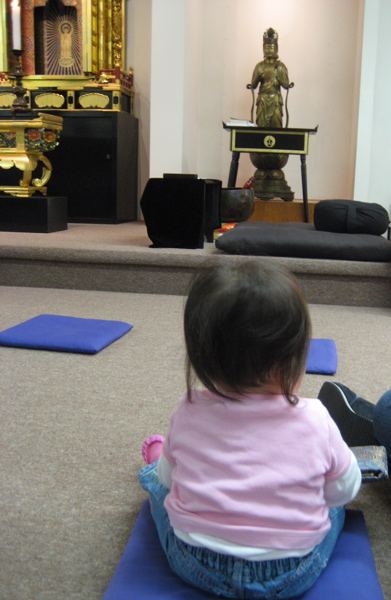
A really old photo of “Baby” at the local Buddhist temple , during a children’s service. The statue is Kannon Bodhisattva. “Baby” attended there for years, but as the kids grew up, we became less active, but this temple has been a part of the local Japanese-American community, and has excellent family-friendly services. This is something many “modern” Buddhist temples lack.
And yet, when she asked me to proofread her college application essay, I was surprised to see that she was quoting something I often say in Japanese: sho-gyō-mu-jō (諸行無常). This phrase is quoted from the famous 12th century war-epic the Tales of the Heike, and means something like the “impermanence of all phenomena”. The English translation is clunky, and since my kids were raised bi-lingual anyway, I just say sho-gyo-mu-jo.1
For example, when someone in the house broke a cup, or something breaks down, I usually just say “no big deal, sho-gyo-mu-jo“, and so on. The kids never really said anything about it, and yet when my daughter wrote her college essay, it’s clear that she really was listening and had processed this teaching as she grew up and matured. I was genuinely impressed, and a bit choked up.
The key, as my original post said, is to keep the teachings simple, set a good personal example, and let kids ease into it on their own. Hitting kids over the head with religious teachings just has the opposite effect. Kids need some kind of moral compass, but they aren’t always mature enough to understand the value of it. By setting a good example, and giving them space to figure things out, they will eventually internalize and process such teachings and figure out how to apply them to their own lives.
It’s also a reminder that good personal conduct really does have a positive impact on others, even if you can’t see the effect.
Namu Amida Butsu
1 Japanese four-character phrases (yojijukugo) are numerous, and only a small number are commonly used, but many educated Japanese have their favorite phrase or two that they will use in writing on conversation. Sometimes you see these in dramas too. It’s also a mark of education (e.g. which ones do you know?), as shown in an episode (season 1, episode 16) of the anime Chihayafuru where the characters quiz one other. Many are taken from Buddhist sources but popularized into common Japanese, others come from Chinese literature.
Finishing the last chapters of Roger Zelazny’s A Night in the Lonesome October, I wanted to post this quote:
Greymalk: “Damned if I know, Snuff. Does anybody really care about a hungry cat, except for a few friends?”
Snuff: “Maybe that’s all anybody ever has, no matter how the big show is run.”
Recently, someone at work told me a story. They took some time off and returned to their native home of Bosnia, and visited family and friends that they hadn’t seen in years. Every morning, they sat and enjoyed Turkish-style coffee with friends and family and just talked. When they came back to work, they told the rest of us that sometimes the best therapy is to just sit and talk with loved ones over coffee. Of course, this doesn’t cure everything, but even just getting into a routine of talking with loved ones face to face on a regular basis can do much to help one’s wellbeing.
My wife, kids and I try to sit for dinner every night when possible. My oldest is just about ready to leave for college, so this time will not last much longer, and we rarely ever talk about anything serious, but it’s nice to just share whatever interesting thing happened that day. Once our oldest leaves the nest, things will certainly change around the house.1
In any case, even in the most turbulent times, amidst all the chaos, sometimes all you can do is just foster relationships with the people around you. Just simply being around trusted people is a good start.
1 In the office too, those times when I could sit and chat with trusted co-workers were kind of nice even if corporate office life kind of sucked. Being laid off during the early Pandemic, and then working at a new place has cut me off from that experience because I still work from home (too many people hired during Pandemic, not enough office space). Working from home has its benefits too, but the isolation comes at a cost.
Spock: Change is the essential process of all existence.
Star Trek, “Let That Be Your Last Battlefield”, Stardate 5730.2
As I approach yet another birthday, and my kids are getting close to adulthood, I am definitely starting to see a change in my attitude toward life.
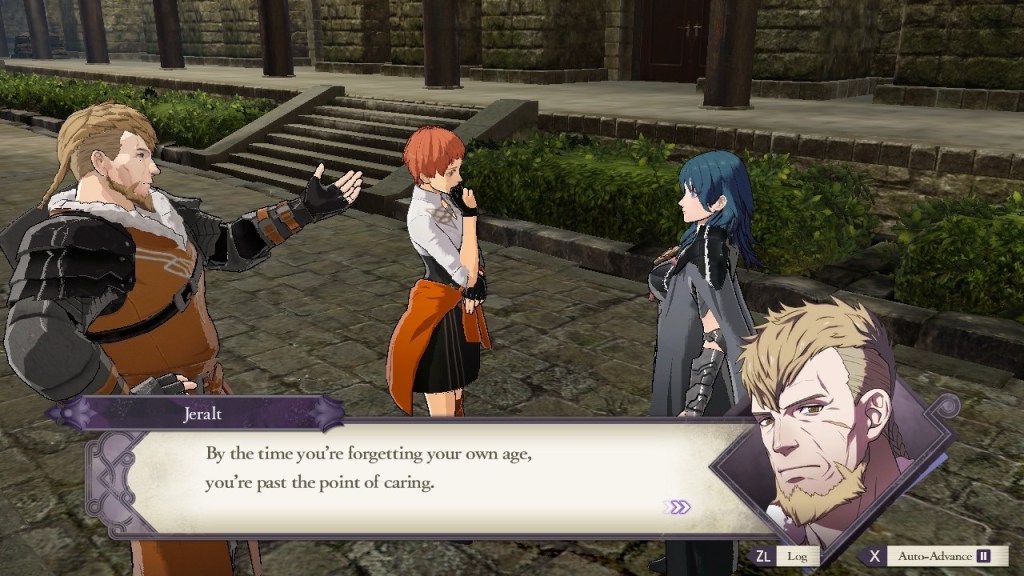
The character of Jeralt from Fire Emblem: Three Houses really sums it up nicely. My attitude has noticeably shifted this past year, especially after my time in the hospital in February, and I find I care a lot less about some things that were once important to me. I don’t mean this in a brooding or dismal sort of way. I am just so glad to be alive and well after that experience, and just being able to read my poetry from the Hyakunin Isshu, or playing Fire Emblem games1 makes me pretty happy lately. I keep my Buddhist routines small and sustainable as much as I can too.
My sense of ambition, something that really drove me in my twenties and thirties, has largely faded these days, and I am already looking forward to just being a nice grandad someday with my wife. Even certain recent goals I had don’t seem nearly as important as they were.
Is this part of the natural aging process? I am not sure. Maybe. Probably.
But it’s also nice being able to just let go and let life flow on, instead of constantly trying to wrestle with it, like punching a giant pile of dough into the shape you want, then getting frustrated when it loses its shape.
Of course, I still like to keep busy and still do self-improvement. I have just gradually narrowed my hobbies and personal goals to the ones I truly care about.
Namu Amida Butsu
1 I currently own five titles now. Three Houses is easily my favorite, but I also enjoy Awakening quite a bit, and Three Hopes. Fire Emblem: Engage is just disappointing. The crossover game, Tokyo Mirage Sessions #FE Encore, is also neat since you do get to tour parts of modern-day Tokyo, plus it’s pretty campy. I was lucky to get that game for less than half-price during my last trip to Japan.
In June, I posted about the “day” and “night” concept used in Tendai Buddhist practice, using the example of the Jimon sect. I felt inspired to experiment a bit and try this out myself. My adjustments to home practice took a few twists and turns, but within a week or so I settled onto a consistent routine that I’ve been happy with.
Here’s what I’ve been doing for the past month, more or less.
I have found that splitting the practice like this has had some benefits. For me, this style of practice lets me cover both the here and now, through veneration of Kannon and reciting the Heart Sutra, while also looking to the future through venerating Amida Buddha through the evening practice. I feel pretty content covering both aspects.
I made both morning and evening routines intentionally short and lightweight so they are more sustainable, rather than doing something elaborate.
Still, to be honest, sometimes I am still too busy to even do this much. Or I just forget. 😅
I am not proud of that, but I felt I should be honest with readers and let them know that mistakes in Buddhist practice are perfectly OK. Life is unpredictable, and for us are “householders” (e.g. lay-Buddhists), life gets in the way. That’s why the monastic community was (presumably) created: to give people the option of practicing Buddhism full-time, not part-time.
That said, Buddhist practice is like exercise: the more you can do, the better. Even a little bit is a positive thing.
Anyhow, when I am simply busy, sometimes I will just recite either the Kannon mantra in the morning, or the nembutsu in the evening. Sometimes, I can only just bow at the altar for a moment.1 The Soto Zen resources I read previously often said much the same thing: adjust as needed, depending on how busy you are. Sometimes your home practice will be longer, sometimes shorter.
Just don’t give up.
Keep experimenting, keep trying, make it personal, and always be flexible.
Good luck and happy … er, “Buddhist-ing”.
P.S. I took a nice, relaxing weekend off to catch up on some things, avoid social media, and just unplug for a bit. I didn’t really have a plan, I just took a break. I may have also played some Fire Emblem games as well. The fun continues. 😀
1 To make this “split service” work, I have two altars now at home: the main one for Amida Buddha and tiny little “side altar” for Kannon on my bookshelf. It’s basic, but it’s something I can keep building on over time.
“Mercedes” is one of the nicest, sweetest characters in the game Fire Emblem: Three Houses (and Three Hopes)
It’s been about 18 months since my mother-in-law passed away, and my wife still pays her respects regularly. We have her picture setup with some flowers and incense, and per custom my wife will burn incense in the morning. The kids, who miss their “baba”, offer incense sometimes too.
We also started enshrining an old photo of my maternal grandmother, who passed away 33 years ago, and burning incense for her too. Obviously, this is not an American custom, but I felt that it was a good one to adopt. I briefly touched on honoring one’s ancestors in a past post about day to day Tendai Buddhist practice, and remembering this I decided to take up the practice.
My grandmother was pretty ahead of her time. She was a computer nerd in the 80’s, and would dabble a lot with old Tandy Color Computers, dial up on local BBS’es, and hung around Star Trek forums online. And, she would share all this with me as a kid. I have a lot of fond memories of staying overnight at her house on weekends.
Thanks to her, I developed a love of computers, and that love of computers helped me build a career from which I can raise a family now. Just as we owe my mother-in-law for her many ways of supporting us in our early marriage, my grandmother also helped us by inspiring me to learn some good technical skills.
The reason why I posted this though was to not just reflect on the past.
Through Buddhist custom, we’ve been honoring past ancestors, and expressing gratitude, but also it’s important not to get stuck in the past either. Conduct here and now matter too. The quote above from Fire Emblem: Three Hopes (the sequel to Three Houses), really expresses this point nicely:
Living in the present is the best we can do. We owe it to those who can’t come back.
Fire Emblem: Three Hopes
My wife strives to be a good mom the way her mother was, and I try to be a good dad, including working an honest career. We both look forward to being the “nice grandma and grandpa” for our grandkids someday. 😊
Of course, this isn’t just limited to raising a family. A person can also just “pay it forward” in helping others. Just as our parents (warts and all) sacrificed much to raise us, we can selflessly help others around us, or help future generations by making the world a little bit of a better place. But, even more simply, taking time to enjoy one’s life, the breath one takes, their continued good health and so on, these too can honor our loved ones who aren’t around anymore.






 Gleanings in Buddha-Fields
You must be logged in to post a comment.