A Nerd Dad’s Review of Mythic Odysseys of Theros

Hi folks,

In addition to my recent adventures in adventure module writing, and gardening, I finally got a belated Father’s Day gift recently:

The Mythic Odysseys of Theros (MOoT) is a cross-over reference guide between Dungeons and Dragons and Magic: The Gathering, specifically the Greek-mythology inspired plane of Theros. Theros is a kind of idealized plane of what Greek mythology would be if taken out of historical context and allowed to run free. It is a world full of gods exerting a direct influence on the world, satyrs, minotaurs, city-states loosely modeled after ancient Greek city states, etc.

This leads to some interesting mechanics in MOoT that are worth sharing here:

  • Many of the typical “high-fantasy” character races that are found in D&D are not in Theros: elves, dwards, gnomes. They didn’t exist in classical Greek mythology (nor Magic the Gathering’s plane of Theros) and do not exist here. They are replaced by centaurs, satyrs, minotaurs, etc.
  • Unlike the usual, somewhat loose, mechanics between clerics and gods, the piety mechanics in MOoT provide clear benefits for characters who explicitly do things to advance their god’s agenda.
  • MOoT elevates the “hero” element1 of D&D by giving each character an extra starting ability totally outside of the standard Player’s Handbook. The ability is something that grows and develops as the hero accomplishes deeds.

All of these things mean that adventures on Theros aren’t always portable to other planes and campaigns (and definitely not Adventurers League legal), unless your DM allowed for such a transfer of abilities and deities. The fact that they even exist though makes a fun and interesting campaign in Theros, and likely one you’d play again with different characters, gods, etc.

Let me take a moment to talk about the book: it is gorgeous, even by the standards of D&D module books. The artwork is truly inspired, and I admit I enjoy thumbing through the book sometimes if nothing else than to just enjoy the art.

Also, the book is really well-organized in terms of getting started on building a character within Theros, and how they will relate to his/her deity of choice. There’s also an option for atheistic characters (some characters races are more inclined to this than others).

Theros as a module and as a plane lends itself more to “save the village, destroy monster” type adventures, than intrigue adventures (a la Eberron), but this also means that as a parent it’s probably easier to make stores for younger kids, which is part of the reason I got the book. I own the Eberron book, and it’s pretty interesting, but also poses some challenges which I’ll cover in a later post.

Also, in my case, as a promo I also received laminated map detailing several places on Theros, such as the Underworld, and so on. I don’t know easily available these are, but it may yet come in handy soon.

Anyhow, I am eager to try this out with the kids, especially my younger son who’s itching to battle monsters again.

1 Interestingly, the ancient Greek notion of a “hero” is not the same as the modern interpretation. Think of them more like obnoxious supermen with questionable moral judgment.


DMing People With Special Needs

Recently, I’ve moved from playing in Adventurers League games from Dungeons and Dragons, to hosting some with the local community as a Dungeon Master (a.k.a. “DM”). With lockdown, we’ve moved all our weekly games online to Warhorn and playing on the Roll20 service with shared accounts and resources, and the group has adapted pretty seamlessly, while still supporting our local game store where possible. For me, I’ve only DM’ed a few games for Adventurers League, but it’s been a fun, though eye-opening experience. DM’ing for kids at home, or my kid’s friends online, is easy but DM’ing for adults who come from many backgrounds is more challenging and helps you grow as a DM.

One recent example is that I was hosting a game where one player was self-described as visually impaired. I was very nervous about this as I don’t have much experience hosting AL games for adults, let alone online where the game is even more visual than before. However, one of the more senior DMs knew this person and had some simple advice which I wanted to share with other D&D players.

He suggested I reach out to this player and find out what his needs were. It turns out that it was much easier than expected: be sure to spend enough time describing the scene clearly, ask questions and move around his token on Roll20 if needs it to. I contacted the player, asked him a few questions about his character, preferences for token (for his token, I used a picture of the famous Binwin Bronzebottom since he was playing a dwarf fighter).

The session went much better than I expected. The player was an experience D&D player, and once we settled in, it felt pretty much like any other session, though I spent more time than normal carefully describing things. We all had a great time.

This experience taught me some things as a Dungeon Master:

  • Players come first. This doesn’t being a doormat in terms of rules, but it does mean ensuring your players have a wholesome, positive experience. Otherwise, you end up here.
  • Theater of the Mind is a time-honored, yet underrated practice in D&D. Someone pointed out that in earlier editions of Dungeons and Dragons (think: Stranger Things), “theater of the mind” was a necessary way of telling the story, but with improvements in technology

Good luck and happy role-playing!

P.S. For online D&D games, I highly, highly recommend battlemaps from 2-Minute Tabletop. They’re very affordable, and the maps are excellent.

Priorities

Hello Dear Readers,

The last couple weeks in lockdown (with at least 4 more ahead) have been interesting. After the initial panic, we’ve gradually settled into a routine where keep our kids “in school” during weekdays, take walks a lot in the neighborhood, only visit the grocery store as needed, and generally learn to keep ourselves entertained otherwise.

Being stuck at home a lot does tend to shift priorities. A lot of my personal projects have kind fallen further and further behind, because they just don’t really feel that important anymore.

I have caught up on a few books, movies, old episodes of Star Trek: the Next Generation,1 updated the blog (obviously 😏), and been playing Adventurer’s League online with the same community I played with before.2 Things like language study, Buddhist practice, Magic the Gathering and some writing projects have all died on the vine, leaving me with those things which I guess I valued enough to keep up.

All of this takes a backseat to my wife and kids though. Since I don’t work in the office anymore, I can enjoy dinners with them more consistently, and the (mostly) daily walks around the neighborhoods in the warm, spring weather and finally got some things done around the house. This is not to trivialize the danger of the novel Coronavirus, but it’s nice to be able to turn lemons into lemonade sometimes. 😊

In any case, as we’ve settled into a pretty good routine, it’s interesting how trivial some things seem now compared to life before COVID-19, and how others have bubbled to the surface.

It’s fair to say that those of who survive this (and one should never be too confident about one’s own mortality) are going to party like it’s 1999 when this has passed, but at the time, it is going to change our lives. It already has.

1 If you are a Star Trek TNG fan, I highly, highly recommend the new Star Trek: Picard series as well. Season one was terrific. Going back to watch Star Trek: Discovery as well.

2 Happy to see a couple of my more neglected characters in Adventurer’s League finally get some “flight time” and development. Also, it turns out that Eldritch Knights and Land Druids are pretty fun to play. Maybe I’ll post about that soon.

The Joys of D&D Figurine Painting

img_3993

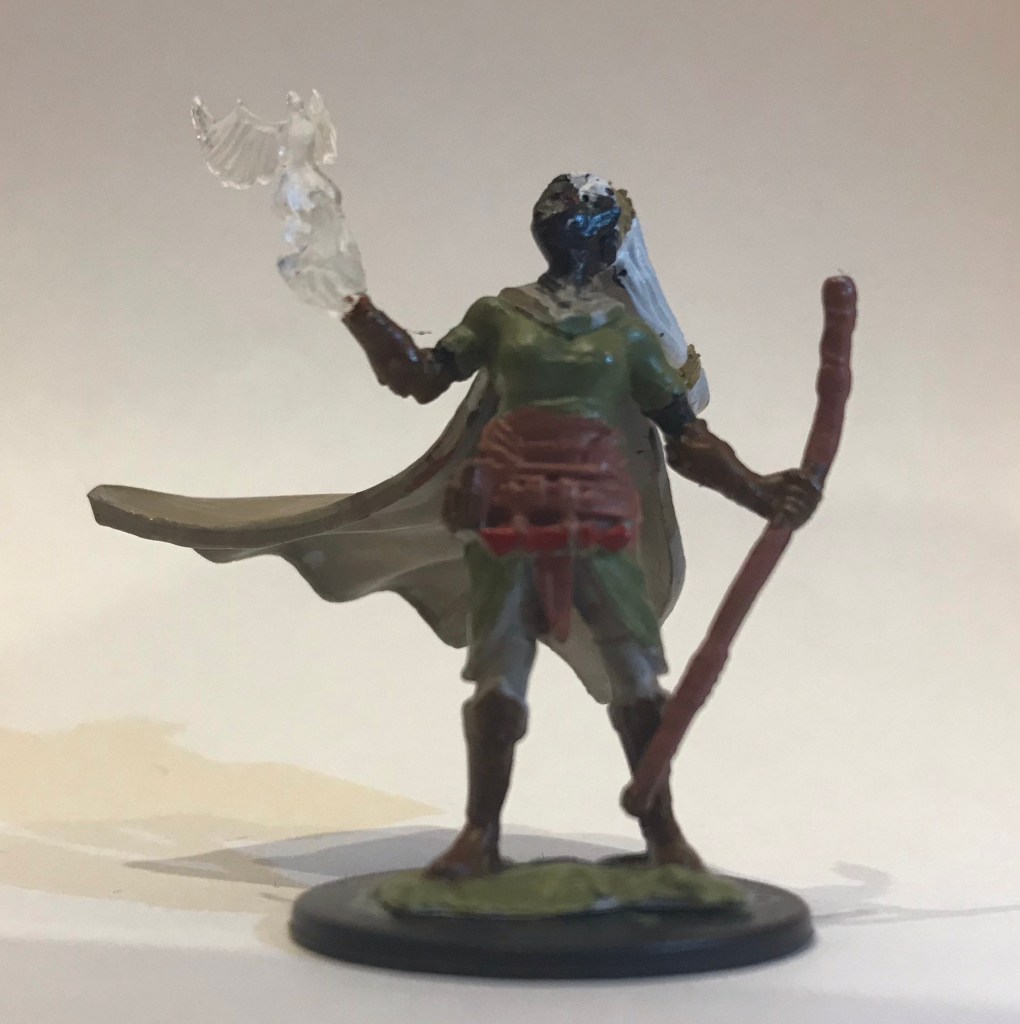
I have been playing Dungeons and Dragons Adventurers League at my local game shop fairly regularly since last July, and as a result, I have started to accumulate a number of figurines.  These plastic figurines come in all shapes and sizes, but I’ve been hesitant to paint them because I was not confident in my art skills (translation: I suck at art¹).

Until now.

I couldn’t bear to look at those poor, grey figurines with their bland, grew tone anymore, so I finally bought a very minimal set of Citadel brand figurine paints and gave it a try.  My first few figures turned out OK, but not great.  However, by and by I’ve gotten somewhat better at painting and more importantly I really enjoy it.  The figurine above is one of my primary characters I play in Adventurers League.  Since she is a drow (dark elf), her skin is ebony-black and eyes red.  Painting two tiny red eyes took a lot of hand-eye coordination.  😅

I’ve also painted a few monsters too, such as these orcs:

img_3981

Thanks to tips from friends, and helpful articles like this one, I’ve learned how to mix and match paints to get the color and consistency I wanted too.  That allowed me to make various shades of green, such as in this figurine:

img_3974

and:

img_3986

But, by far the best tip I’ve learned so far is to take a dollop of paint and put it on a “palette” which in my case is just a paper plate covered in plastic wrap.  From there, add enough water that the paint has the consistency of milk.  This really helps keep the tiny features of the figurine visible, and not “pasty” looking.  You can also mix two different colors on the same palette (after diluting both with water) to make interesting combinations.  It took me a few tries, but I was able to get a decent “skin” color for faces.

One of my friends who has more experience painting also suggested that “less is more” since you can always add more layers of paint if you need to, rather than taking away.

One thing that I do need to work on is shading.  I have a wash to provide shading, but somehow it doesn’t come out right.  As with normal paints, I’ve been told that it works better when watered down and then allowed to seep naturally into crevices and such.  I kind of got it to work on this Minotaur, particularly the shading on his muscles:

img_3997

Anyhow, as my painting skills (and photography skills) improve, I’ll try to post more.

The point though of this post is that despite having no real art skills, it was something fun worthwhile to delve into, and I am glad I did it. It’s good to break out of one’s comfort-zone from time to time.

¹ And photography, too.

Plane-Trotting in Dungeons and Dragons

flight landscape nature sky
Photo by Pixabay on Pexels.com

My kids have been playing campaign at home that has mostly taken them on a handful of interesting adventures across the Sword Coast of Faerun, but eventually the story kind of hit a plateau: how many more times would my kids want to pass through Baldur’s Gate?¹  With that, I decided it was time to mix things up a bit, and I contrived a little adventure where the kids would visit various Outer Planes instead.

As per the 5th-edition Dungeon Masters Guide, not to mention past editions, the world of Dungeons and Dragons is surrounded by 9-17 other dimensions or planes that each represent a moral alignment.²  The Nine Hells, being a primary example, are purely lawful-evil in that they’re tyrannical and extremely regimented, while the plane of Arborea is supposed to represent a wilderness paradise that is purely chaotic-good and happens to be the home of many Elf deities.

Further, there are plans that are wedged in between particular alignments, in that they’re halfway between, say, lawful-good and lawful-neutral.  These are the fun planes in my opinion since they better represent the moral ambiguities of life and what an idealized version might look like.  Some interesting examples include:

  • Arcadia – between lawful-good and lawful-neutral, this plane represents a kind of highly regimented paradise, where everything is in its perfect spot.
  • Pandemonium – between chaotic-neutral and chaotic-evil, Pandemonium represents madness, hence it is beset by constant howling winds that drive even the heartiest warrior crazy.
  • Tartarus (or Carceri) – between neutral-evil and chaotic-evil, this plane is a pure prison plane. Once you get in, it’s practically impossible to get out.

One optional, but important feature outlined in the Dungeon Masters Guide is the effect such planes have on visitors. Many planes include an optional rule where the planes exert a powerful, often mental influence, on players who fail a daily wisdom saving-throw.   For example, in Hades, one is afflicted with despair, while Pandemonium inflicts insanity, and Bytopia inspires charity and goodwill.  A secondary rule is that players who’s alignment is somehow in opposition to the plane experience further distress and fatigue.

For my kids adventure, they had to destroy an evil artifact called the Eye of Judgement (loosely based of the same artifact in Roger Zelazny’s Amber series) by taking it to Elysium, the neutral-good plane where the overwhelming sense of charity and good-will would simply fry the artifact.

That was all well and good, but the kids had forgotten to include a way to get back, and so they were trapped on a plane where everything is pleasant and peaceful. As adventurers, they quickly became bored of the place and sought a way out. Plus the pleasant effects of Elysium were definitely influencing some party members, so they opted to leave through another portal if they could find one.  Elysium had no dangerous encounters, so they easily went from town to town until they came to one large enough that they found three gateways: two with unknown destinations and one with a known, but unwanted destination.  When my kids opted to take one of the unknown portals, I secretly rolled to see which plane they would end up, and the result was Ysgard.

Heimdall an der Himmelsbrücke

Ysgard is a chaotic-good/chaotic-neutral plane that exemplifies personal glory and effort, loosely based on the same realm in Norse mythology.  My kids were excited because they knew they might meet characters like Loki and Thor, whom they knew from the Marvel comic universe.  Leaning into this, I have been leading the kids along toward the Bifrost with an extra party-member who not surprisingly is Loki (the Marvel movie version) in disguise.

In any case, the Dungeon Masters Guide, in its explanation of the planes, is somewhat vague on the contents of each plane, especially compared to past editions like 3.5.  I think this is somewhat intentional as it gives the DM room to expand and fill in the details as they see fit.  My vision of Elysium won’t necessarily match what another DM will imagine, but that’s fine.  The DMG even alludes to this in the following excerpt:

As with the Elemental Planes, one can imagine the perceptible part of the Outer Planes as a border region, while extensive spiritual regions lie beyond ordinary sensory experience. Even in perceptible regions, appearances can be deceptive. Initially, many of the Outer Planes appear hospitable and familiar….but the landscape can change at a whim of the powerful forces that dwell on these planes. (pg. 58)

So, the idea is that what the players see on the plane isn’t the true form of of the plane as seen by its own deities.  This means that each adventuring group will experience something slightly different anyway due to their predisposition, background, etc.

This means that the planes can be an almost infinite field of opportunities for adventure, especially for a party that’s looking to shake things up a bit. 😉

¹ While the Descent into Avernus campaign guide is still a week or so away, my children’s party has been to the city of Baldur’s Gate a number of times since they needed a city campaign other than Waterdeep which they fled at one point.  Before DiA, there aren’t much 5e resources to speak of, so I’ve been cobbling in details from older versions of D&D plus a bit of improv on my part.

² Why such odd numbers?  Don’t forget the purely neutral plane of the Concordant Opposition.  😉

Wacky Adventures at PAX with AcqInq

img_3253

PAX West came and went recently, and it was my first time going.  PAX is something that happens here every year, but I always miss it because either I can’t buy a ticket, or I have other plans that weekend.  This year though, I finally got a lucky break from a friend who had a one-day pass for Friday, which means that I could go to PAX, and still spend time with my kids on the weekend. ❤️

Since I only had one day to go, I decided to make the most of it at the tabletop gaming area since I am not an avid player of console/PC games.

PAX was hosting a special gaming table for the new Acquisitions Inc. module, and an introduction adventure. Since the timing of the Adventurers League adventures didn’t line up with other things I wanted to do, I opted to do the Acq Inc. adventure instead.  I was seated with some other people: a nice older couple, and a father/son combination.  We played a small, fun adventure using example characters from the book.  I played Lok, the dwarven cleric Obviator.

We all had a good time, and as the adventure wound down, one of the guys asked me what I thought about the book.  I replied that I liked it, but hadn’t had a chance to use it with my kids’ adventure at home, and it was then that they told me that they were the writers of that book!  It was so cool playing at the same table as the writers. I shook their hands and got autographs in my book (which was already signed by Mike Krahulik as his character Jim Darkmagic).

It was a great start to PAX, but after a lengthy afternoon lull spent people-watching, looking at expensive dice, and purchasing spellbook cards, I got to see my first live D&D game of Acquisitions Inc. at the Paramount Theater here in Seattle:

img_3265

We were stuck in the middle of the seats, which was not a great place to be when you have to go to the restroom, but it all worked out well.  It was great seeing Anna Prosser, Xavier Woods, Patrick Rothfuss, Jeremy Crawford and of course Jim Darkmagic and Omin Dran.  You can see the full episode here on Youtube.

It was a great day: I got to meet many good people in the D&D community, and got to finally see a live show.  I am already looking forward to next year.  😆

P.S.  PAX apparently has a thing with collecting “pins”, which I only realized much later in the day, so I got a total of 1 pin.  But, since I was trying to stay on a budget, one pin was probably enough.  🙂

Adventurer’s League: Moving On Up

close up of coins on table
Photo by Karol D on Pexels.com

Recently, I wrote about my new hobby playing Dungeons and Dragons’s Adventurers League at a local game shop.  My character Qisandoral Ariestannus, the Elvish answer to Mr Spock or Sam the Eagle, started as a level 1 character back in August, and “Qi” has now reached level 5 and is now considered a “tier 2” character.¹

For the jump from level 4 to level 5, I decided to leverage the “Catching Up” downtime rule which lets you spend 20 days worth of downtime to simply go up a level. This can only be triggered at specific experience levels, but is a nice, easy way to nudge your character to the next tier if you like.

The catch is that my daughter now plays with me, and since her character is much lower level than Qi, they can’t play in the same tiered-adventure as one another.

To work around this, I revived a different character I that played privately with my kids with a few minor tweaks: Gwynen Naïlo, an elf cleric of the Nature domain. He is one level lower than my daughter’s character, but at least we can adventure together at our local game shop on AL nights. Plus, I do enjoy playing clerics almost as much as wizards.

It seems that many seasoned AL players have a roster of different characters available so that they can always have something ready regardless of what adventure tier they play that day. Eventually as Qi and Gwynen move to higher tiers, I’ll probably have another character or two waiting in the wings.

In any case, it’s nice to see Qi (and Gwynen) rack up adventures, stories, and some loot, even as I get to know other people in the local AL community more and more. I am continuously pleased to see how supportive people are, and how much they’ve helped my daughter get up to speed. 🙂

P.S. With Season 9 just around the corner, I am excited to see Qi pick up some default items for tier 2 (in particular a Wand of the War Mage +1), and maybe also keep some of the magic items he finds in the adventures. I think the season 9 rules are a welcome improvement.

¹ A point of clarification: AL has 4 tiers, that map like so:

  • Tier 1 – Experience levels 1-4
  • Tier 2 – Experience levels 5-10
  • Tier 3 – Experience levels 11-16
  • Tier 4 – Experience levels 17-20

Ref: http://dndadventurersleaguedublin.org/adventurers-league-basics/

Contrary to what I originally thought, one tier isn’t always 4 levels. :p

Alignment and Toilet Humor

For those who still need guidance on D&D’s alignment system:

The Joys of Dungeons and Dragons Adventurer’s League

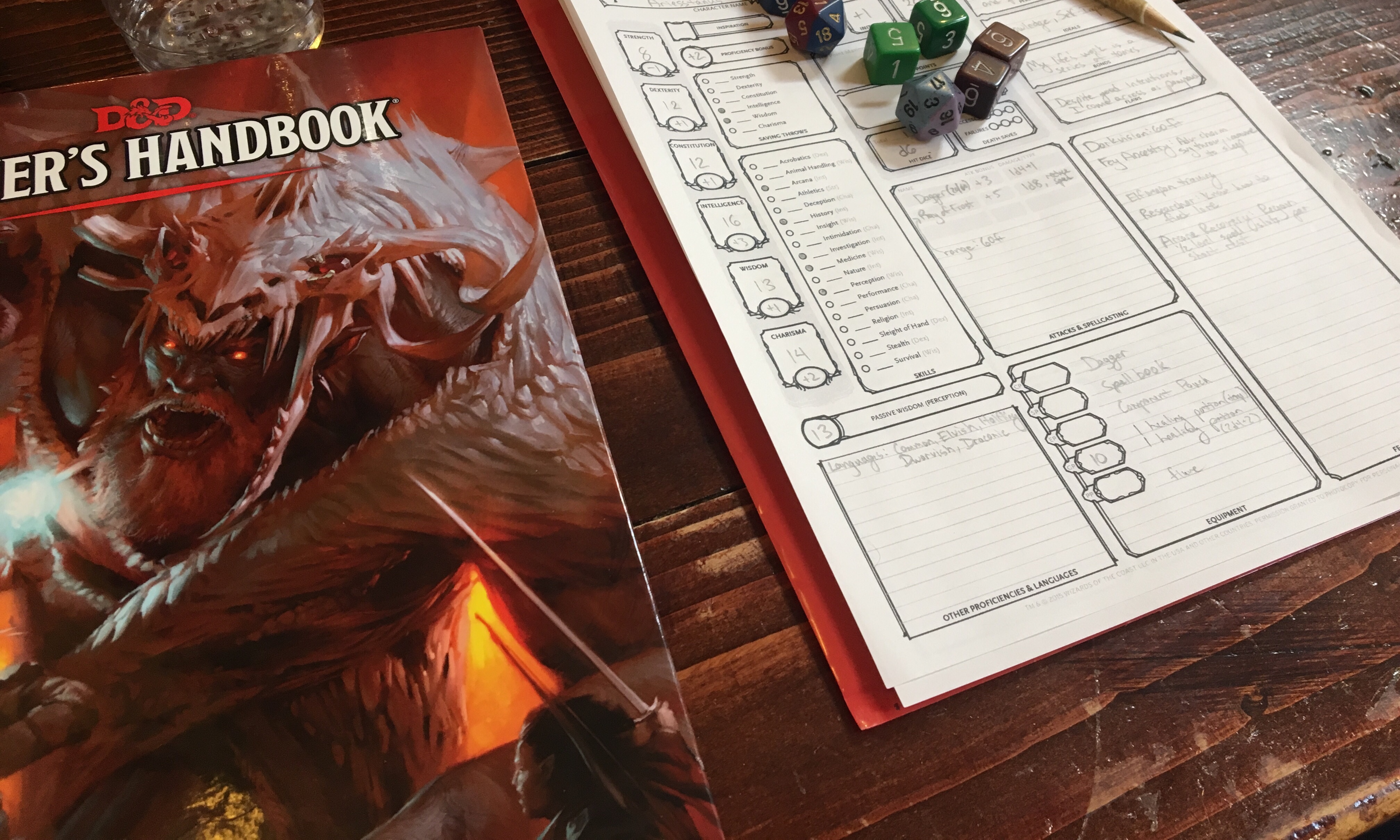
My PHB and character sheet from my first AL session

Recently, I alluded to a change in hobbies toward Dungeons and Dragons Adventurer’s League.  It all started one night at the local gaming store when I had yet another losing night drafting Magic the Gathering.  One of the store clerks, who is a fellow Dungeons and Dragons fan, told me about Adventurer’s League.  I had vaguely heard of it before, but he helped explain how it works and why it was worth a look.

Adventurer’s League exists to solve one of perennial issues with Dungeons and Dragons: finding a game.  It’s a program that provides drop-in games at any game store or event that offers them.  AL has stricter options for customizing your character,¹ but you gain portability in that you can bring it from one drop-in game to another, and can track progress between them using a standard logsheet and the baseline rules.  Larger conventions regularly host AL sessions too, if you’re part of the convention crowd.

Getting started with Adventurer’s League isn’t too difficult, especially if you’ve played D&D 5th Edition.  You need at minimum:

  • An Adventurer’s League logsheet (to track your character’s progress across sessions)
  • A character sheet
  • Dice
  • Pencil
  • Figurine

DMs can help you walk through the rest, or address questions you have.  However, it’s also really helpful to review the Player’s Guide first so you get familiar with some of the terms and how progress is tracked.  Having access to a player’s handbook for D&D helps too.  If you can’t afford one, there is a more limited, free version provided by Wizards of the Coast that you can download.

My first AL session ever was a large multi-party event that was also a charity fundraiser.  The DMs who volunteered to conduct the event were super-helpful in answering my questions, the people in my group were great, and the adventure was pretty darn fun, especially since it was part of a larger war campaign involving other groups at the same event and we all had to coordinate with one another to liberate the city of Phlan.

The subsequent sessions I played were much smaller in scope, and the players were different since it was a drop-in campaign, but it was still a lot of fun.  One session was a battle against local undead forces, while the next session was a role-playing adventure to help raise funds for a local orphanage.  D&D Adventurer’s League benefits from a large collection of quality-written adventures from DMS Guild, and these can be surprisingly fun and creative.  Often times, they’re one-off “mini adventures” from larger campaign settings such as Barovia or Waterdeep.

With AL, you don’t get to go as deep into role-playing as you would a home-campaign since your character drops into an adventure for maybe one session, but I found if you lighten up a bit and just go with the story, you can still have fun role-playing your character without heavy commitment either.  However, you’re 10-page backstory may need to be trimmed down to 3-4 sentences to make it fit into whatever campaign you wish to play.  😉

My current character, linked here in DnD Beyond, is a Sun Elf named Qisandoral Ariesstanus or “Qi” for short. He started as a throw-away NPC character in my home campaign with my kids but he soon grew on all of us and I decided to make an AL-version of him. He is the elf version of Mr Spock or Sam the Eagle from the Muppet Show: very stiff and deadpan in an amusing way.

Compared to a more competitive environment like Magic, AL is much more collaborative.  People are there to work together and have a good adventure, so they’re inclined to get along and solve the adventure rather than try to one-up one another.  That doesn’t eliminate the issue of problematic players (and I’ve met a few over the years), but I found those incidents pretty rare, and such players don’t last long.  The rest of the players are great people, and I always walk away from an AL session having had a good time.

Adventurer’s League is also very budget-friendly, which as a working father with kids is great. I can’t vouch for money spent on game-store food, but that’s another story. ;p

I can’t praise AL enough.  If you’d like to play D&D or looking for a gaming event that’s easy going, friendly and cost-efficient, definitely give Adventurer’s League a try.  You have nothing to lose, and many adventures and loot to win! 😀

P.S.  One thing I have noticed is that AL is still a relatively new program, so rules do change from season to season, especially with how progress is tracked. If in doubt, your DM can help you walk through any updates or rule changes if need be.

¹ For example, AL uses something called the “PHB+1 Rules” which means that when create and customize your character, you need to stick to the rules of the original Player’s Handbook plus one other book (e.g. Xanathar’s Guide to Everything).

Magic the Gathering and the Sunk Cost Fallacy

Recently, I got to enjoy a couple weeks as a pseudo-bachelor while my wife and kids were in Japan visiting relatives (I caught up with them later, but that’s another story), and decided to spend a bunch of time at my local game shop.  With the release of the M20 set for Magic the Gathering, I participated in a bunch of drafts that time, and lost most of my games.

Drafting with MtG has never been my strongest suit (I tend to play Pauper or other Constructed formats more often), but I can often get a 2-1 night when I draft.  However, each time I played I got at most 1-2, which at a draft price of $15 means I am in the red each time.

I felt like adding some more draft opportunities to try and re-coup my losses, but then I read about the economic concept of sunk-cost fallacy.  This means that after you’ve put money into something, even if it’s a loss, you’re inclination is to put more money into it.  For me, this meant that playing more draft would (in theory) help me win more games and start getting in the black (since you win more packs).

But, what if I still lost draft games?  Then I’d be even further in the red, and have more cards that I’d have to store somewhere and would like never use again?  The potential for waste kind of outweighed the potential wins I might get.  And honestly, I have too many cards from M20 at this point, and don’t really want to add to the collection at this point.

So, after having a small light-bulb moment, I realized that rather than trying harder to win at drafting, I needed a long break.

Drafting for Magic the Gathering can be fun, but if you’re going in with the intention of competing and getting a winning score, it requires a considerable investment of time, endurance and practice¹ to get good at it.  At this point in my life, I just don’t feel it’s worth it.  I like playing with my coworkers and friends from time to time, and use my Constructed decks when I can, but apart from that, I just don’t like competing in Magic.

So, rather than banging my head against the wall that is competitive drafting, and trying to save face, I decided to accept that fact that my M20 drafts were a sunk-cost and move on.  It kind of sucks that I spent dozens of dollars and have nothing to show for it besides a bunch of cards I don’t really want, but better to accept this and move on than to try to “recoup” my losses.

Also, I have decided to focus my energies on a different hobby now: D&D Adventurer’s League!  More on that in a future post.

¹ The thought of spending hours every night playing Magic online just to get more “reps”, or grinding away Friday night after Friday night just doesn’t appeal to me. Life is short, and this just isn’t worth it.