The Art of Dying

One thing that really annoys me as a long-time Buddhist is the tendency for self-help and spritual seminars to cost so much money. I saw this advertised locally in my area for weeks, and the starting price for a seat is $250 for a backrow seat, which to me is totally bonkers.

The Dharma, as taught by Shakyamuni Buddha was freely given, and required nothing.

Having said that, as a counter to pricey spiritual seminars, I wanted to promote a concept: the Art of Dying.

DYING?!

It is a simple concept: you are going to die. You cannot necessarily choose the hour or manner of your death. But it will occur inevitably occur.

You do not have to take my word for it. Here’s a Buddhist sutra (freely given I might add) from the words of the Buddha:

There is no bargaining with Mortality & his mighty horde.

Whoever lives thus ardently, relentlessly both day & night, has truly had an auspicious day:

So says the Peaceful Sage [Shakyamuni Buddha].

MN 131, translation by Ven. Thanissaro Bhikkhu

The Lotus Sutra, a later Buddhist text but in my opinion the capstone of the Buddhist canon, describes this using the famous Parable of the Burning House in the third chapter. You can find Dr Burton Watson’s translation here (again, for free!).

But, to summarize the Parable, the Buddha Shakyamuni asks us, the reader, to imagine a great, big mansion that’s old, rickey, and so on. Then, imagine the house is burning. Deep inside, some kids are playing in a room, unaware the house is on fire. The father, having just returned from a trip, sees his kids in danger and calls out to them to leave the house at once. The kids, engrossed in their games, fail to see their situation. Finally, the father offers them great rewards if they leave (specifically carts of goods), and the kids finally come out.

The father, Shakyamuni Buddha, has left the burning house and stands outside. He calls to those in danger, namely the “kids”, to see their peril and to come out too.

What about the burning house itself? That is the world we live in, with strife, conflict, disease, chaos, aging, and death.

The late Thich Nhat Hanh wrote about this too:

“Imagine two hens about to be slaughtered, but they do not know it. One hen says to the other, “The rice is much tastier than the corn. The corn is slightly off.” She is talking about relative joy. She does not realize that the real joy of this moment is the joy of not being slaughtered, the joy of being alive.”

Thich Nhat Hanh, The Heart of the Buddha’s Teaching

This gets to the heart of the Buddha’s teachings: do not squander the time you have on this Earth. It doesn’t mean you can’t enjoy life and your loved ones, but remember: Death will not wait for it to be convenient for you.

When you hear this, your instinct might be the “live, laugh, and love”, indulge in all the fun things in life before it’s too late. But that’s not what the Buddha intended. When you look back at the Parable of the Burning House, the father wasn’t asking the kids to play more, he was telling them to get out before it’s too late.

Further, in the Mahayana tradition, one can get themselves out of the burning house, but helping and guide others to get out of the burning house is even better. One can call such people bodhisattvas.

But you can’t help others (let alone yourself) until you :

  • Recognize the situation
  • Put down your own toys and find the way out before you can help others.

This is part of the progression of the Buddhist path: get your foundations in order, increasing confidence in the Dharma (which you can see in your own life), and turning outward to help other beings.

But starting at the beginning, how does one establish a foundation?

Everyone is different, but generally it starts with some simple things:

  1. Taking the Buddha, Dharma and Sangha as one’s chosen refuge (you can do this by yourself or in a community). You can setup a small shrine too.
  2. Taking up an ethical life, such as undertaking the Five Precepts
    • If all five are too hard, start with one, and work your way up over the months and years.
  3. Cultivate metta:
    • Say to yourself (yes, you): May I be well, may I be free from harm.
    • Now think of loved ones: may they be well, may they be free from harm.
    • Now think of all living beings (even the awful ones): may they be well, may they be free from harm.
  4. Setup a reasonable daily practice. Think of it like exercise or stretching: if you start too aggressively, you’ll injure yourself and set yourself back. So start small, and build up.
    • What does a daily practice look like? Some examples here.
    • A small meditation practice can be beneficial too, but intention matters.
    • Study the sutras. Not self-help books, but the sutras. Commentaries on the sutras, such as those provided by Thich Nhat Hanh are quite good and easy to find in used and independent bookstores such as Powell’s City of Books.
    • Find worthy teachers and communities, not slick, overpriced seminars or cults. Caveat emptor.
  5. Give yourself permission to screw up, then reflect on it, and move on.
  6. Repeat. Buddhism is a long-term practice. “Play the long game“, but also remember you are on the clock. Time is short.

So, that’s your free teaching for today. Thanks for attending this seminar. Want to support the blog? Pay it forward or something. This is “Buddhism on a Budget”, and I strongly feel this is how Buddhism should be.

Namu Shakyamuni Butsu
Namu Amida Butsu
Namu Kanzeon Bosatsu

P.S. apparently this also a band with this name. As fellow PNW residents, I salute them.

Reality Bites

From Star Trek episode “Spectre of the Gun” (s3:ep6)

One Zen anecdote that I remember from my youth, was a story where a student declared to his master “all is illusion”. The master, listening to this whacked the student on the head (or pinched his nose, I forget) and said “was that an illusion?”.

I always liked this anecdote, but didn’t really appreciate until I got older and had more field-experience with Buddhism.

There’s a tendency to view Buddhism as a way to transcend one’s problems. People like to meditate in Buddhism, or do chanting, because they think it will “chill them out” or go into “Zen mode” as a way of facing life’s problems. Once you’re blissed out and calm, you’ll not be bothered by problems anymore, and all will be well. Right?

….. well, Buddhism doesn’t work that way.

Sooner or later, you have to come down and still deal with problems in life: work, food, jerks, illness, boredom, bills, political crises, economic hardships, debt, injustice, broken cars, crying kids, angry spouses, dogs with “intestinal issues”, getting older, loneliness, house chores, the inevitable death of everyone you know, back problems, and so on. The list goes on and on. It does not go away, no matter how much you want it to.

In short, reality bites.

Once you come to grips with this, which also happens to be the First Noble Truth of Buddhism, then the rest starts to fall into place. Until then, no chanting, meditation, prayer, seminars, self-help exercises, fancy gurus, or books will do any good. Not because you’re stupid, or unworthy, or not disciplined enough; it’s because you can’t put the cart before the horse. 🛒🐴

Namu Shakamuni Butsu

Navigating Chaotic Times

VIR: I believe there are currents in the universe. Eddies and tides that pull us one way or the other. Some we have to fight, some we have to embrace.

Babylon 5, “The Geometry of Shadows”, s2:ep3

I really liked this quote from the science-fiction classic Babylon 5 (which I’ve been re-watching lately)1 because it speaks to the sense that many things happen outside our control. Instead, we’re constantly pulled along by other forces, and some of these can be beneficial, others can be harmful, and simply just pull us in unexpected directions. Some of these currents are very strong and difficult to resist, some are barely noticeable until we look back.

Further, we don’t always know where these currents will take us. So, there’s always danger in choosing one course or another.

DRAAL: What’s the third principle of sentient life? It is the capacity for self-sacrifice. The ability to override evolution and self-preservation…

Babylon 5, “A Voice in the Wilderness (part 1)”, s1:ep18

I think intuition is not enough to navigate this mess. One also needs a set of independent principles to help guide one, and that’s where things like the five precepts of Buddhism really come in handy. It’s not a list of “don’t do” things, it is a list of training rules to help strengthen the mind, and benefit others.

Also, clarity of mind.

Rather than giving in to self-doubt, stay cool, and take things one step at a time, navigate eddies and currents, but also don’t lose your goodwill towards others.

At least, that’s how I see it. 😏

Namu Shakamuni Butsu

1 Speaking of Shadows

Confronting Shadow

Recently, I talked at length about the role-playing game called The One Ring, and I wanted to explore one aspect of it, and its origins in Tolkien’s Lord of the Rings trilogy, namely “Shadow”.

Fan art of the Nazgûl, the dreaded Ringwraiths of Sauron

Because the Enemy, Sauron, is growing in strength in the Lord of the Rings setting, his dark influence can be felt (even if only a little) everywhere, even in happier, safer places like the Shire, the Grey Havens, Rivendell, etc. Sauron’s forces attack some places in Middle-Earth, in other places his spies infiltrate, and even in friendly places, the mere mention of his name fills others with dread. His “shadow” grew longer and longer across Middle Earth. There was no place in Middle Earth that doesn’t feel the influence of Shadow. Sound familiar?

In the role-playing game, when player characters experience negative events, despair, or trauma can accumulate “shadow points”. These points are long-term, hard to remove, and if too many accumulate, a character can become miserable (affecting many other aspects of the game), or worse can eventually have fits of madness, like when Boromir tried to take the One Ring from Frodo. Such player characters may be forced to leave the game, or a player may choose to retire the character before it is too late. The longer one uses a certain character in the game, the greater and greater risk for accumulating too many shadow points and thus meeting a bad end.

Further, when confronted with Shadow different player characters react differently. A treasure hunter may fall into “dragon sickness”, like Thorin in The Hobbit, a warden may fall into despair (“is anything I am doing making a difference?”), or a captain may crave power, etc.

Similarly, in the original Lord of the Rings trilogy, the different peoples of Middle-Earth reacted to the growing Shadow differently. Elves withdrew, longed for the past, or fled across the sea. Dwarves became insular and greedy. Men became desperate and power-hungry.

Boromir thought he was helping his home of Gondor by trying to take the One Ring from Frodo. That’s how Shadow made him go mad: playing into his anxieties, making him feel hopeless and thus taking desperate measures. The Rohirrim nearly gave up too, as Gríma Wormtongue kept feeding lies and despair to their king, Théoden. Gollum’s mind was shattered by the ring and he could barely remember who he had been, and believed he was too wretched to be redeemable.

This is what Shadow does to people: it breaks people down.

But the reason that Sauron was defeated in the Lord of the Rings trilogy was that some people didn’t give up.

Rather than fighting alone, those who resisted Sauron worked together. Individually they were too weak to resist (even Elrond), but when they worked together, they could draw on each other’s strength, and help each other when discouraged. In the books we see Samwise Gamgee doing this countless times for Frodo, or Legolas, Gimli and Aragorn racing through Rohan to save Pippin and Merry. Not everyone in the Lord of the Rings trilogy was a hero, but everyone did something, however small, to contribute to the effort.

Further, even in the darkest hour, people kept going. They didn’t quit, they took another step forward, and another, and another. The goal seemed miles away, literally, but each step brought them closer, even if only a little.

In The One Ring game, during a “fellowship phase” (downtime), you can spend part of your time healing the scars of shadow. According to the core rulebook, dwarves will spend time forging to “burn away frustration”, hobbits will engage in gardening or painting, humans and elves will play or recite songs and poetry. In the books, characters such as Sam and Frodo occasionally stop to enjoy lembas bread, or Pippin and Merry enjoy a good puff of pipeweed after a major battle. It may not seem like much, but taking those moments of downtime do much to lift the soul, especially when it is weighed down by Shadow.

There is much we can learn from this.

P.S. There’s a whole Reddit channel just for LoTR memes. It’s a treasure-trove of silliness.

Out of the Mud Springs the Lotus

Recently, I reread a famous autobiography of a former “bathhouse” geisha titled Autobiography of a Geisha. The geisha in question, Sayo Masuda (1926? – 2008), lived a pretty horrible life and her story as a geisha is far from the glamorous stories normally told in English publications.

The short summary is that Sayo Masuda was a child born from an impoverished mother who cycled through a few husbands, and unable to feed or raise her kids. So, she sold some of the children off to indentured servitude. Sayo was one of them (she didn’t even know her name until her teenage years). The landlord family who took her in was very abusive and did nothing to support or raise her: she was another mouth to feed, and they did the bare minimum to raise her. Sayo never received a formal education, and was thus totally illiterate for life. Later, she was sold again as an indentured servitude to a local geisha house in Nagano Prefecture. Her geisha “mother” similarly abused her for minor infractions and made her work chores all day to support the existing geisha, until she was trained to be one as well.

The term geisha (芸者) is tricky because it means different things to different people. Much of it has been romanticized by Western media, but also by autobiographies like Iwasaki Mineko’s “Geisha, A Life“, which was told from the perspective of a very high-class geisha working in Kyoto.1 Sayo Masuda, by contrast, was a geisha at a provincial red-light district, so there was every expectation that she would be available for sexual favors and would have a danna (“patron”) well before she was 18. What separated provincial geisha from prostitutes mostly was mostly a degree of refinement and artistic skills (song, dance, conversation, etc).

It was a very nasty and cutthroat world she survived in:

Geisha can do horrid, spiteful things: they’ll attack one another tooth and nail, each trying to force the other out of the way. To someone who doesn’t know this world and sees only the surface of it, I suppose we must appear quite carefree; but inwardly were eternally weeping tears of pain and sorrow.

Page 70

Much of the biography covers her struggles to survive in a cutthroat world, but also her increasing shame as she got older, and felt that was not worthy of some of the kind men she would meet. Her sense of despair, guilt, and hopelessness only increased as she got older, and she wondered if she’d ever be more than a nasty, cutthroat geisha.

Diverging a bit, this sense of crushing hopelessness tied with evil is a bit theme in J.R.R. Tolkien’s The Lord of the Rings, too. People who are corrupted and succumb to evil are those who are most often weighed down by guilt (Gollum), desperation (Boromir), or hopelessness (Denethor, steward of Gondor). Frodo the Ringbearer almost succumbs too, if not for the love and optimism of Samwise Gamgee. This is how evil works: not just through raw force, but also by breaking people down.

But I digress.

Sayo Masuda thankfully did have a happy (though bittersweet) ending where she finally found stable employment in spite of her literacy, and friends and family who supported her.

As I read this, I kept thinking over and over of a famous anecdote from the time of Honen, founder of the Pure Land sect (Jodo Shu) in Japan. Namely, when Honen was exiled to the provinces and encountered a woman of the night. She too lived a nasty, cruel life and wondered if she’d ever find salvation. Honen kindly told her:

“Your guilt in living such a life is surely great and the penalties seem incalculable. If you can find another means of livelihood, give this up at once. But if you can’t, or if you are not yet ready to sacrifice your very life for the true way, begin just as you are and call on the sacred name. It is for just such deluded folk as you that Amida Buddha made that wonderfully comprehensive Original Vow (hongan 本願). So put your full trust in it without the smallest reservation. If you rely upon the Original Vow and repeat the nenbutsu, your ojo is absolutely certain.”

Later, when Honen was pardoned and allowed to return to the capital, he found out that the woman had been inspired to take up the Buddhist path, and died as a nembutsu follower. He reportedly said:

“Yes, it is just as I had expected.”

This sense of redemption is one of the strongest aspects of Pure Land Buddhism to me. The transformation of “bits of rubble into gold” is something that appeals to myself and many others who struggle with teh Buddhist path, or just struggle in life. But the basic theme of Mahayana Buddhism is not just that all beings can be awakened as Buddhas, but given enough time they all will be awakened as Buddhas.

But even going allllll the way back to the earliest sermons (sutras) of the Buddha, we can see the symbolism of a lotus flower growing from the mud:

“Monks, just as a blue, red, or white lotus—born in the water, grown up in the water—stands having risen above the water, unsmeared by the water; in the same way, the Tathāgata—born in the world, grown up in the world—dwells having conquered the world, unsmeared by the world.”

The Puppha Sutta  (SN 22:94), translation by Ven. Thanissaro Bhikkhu

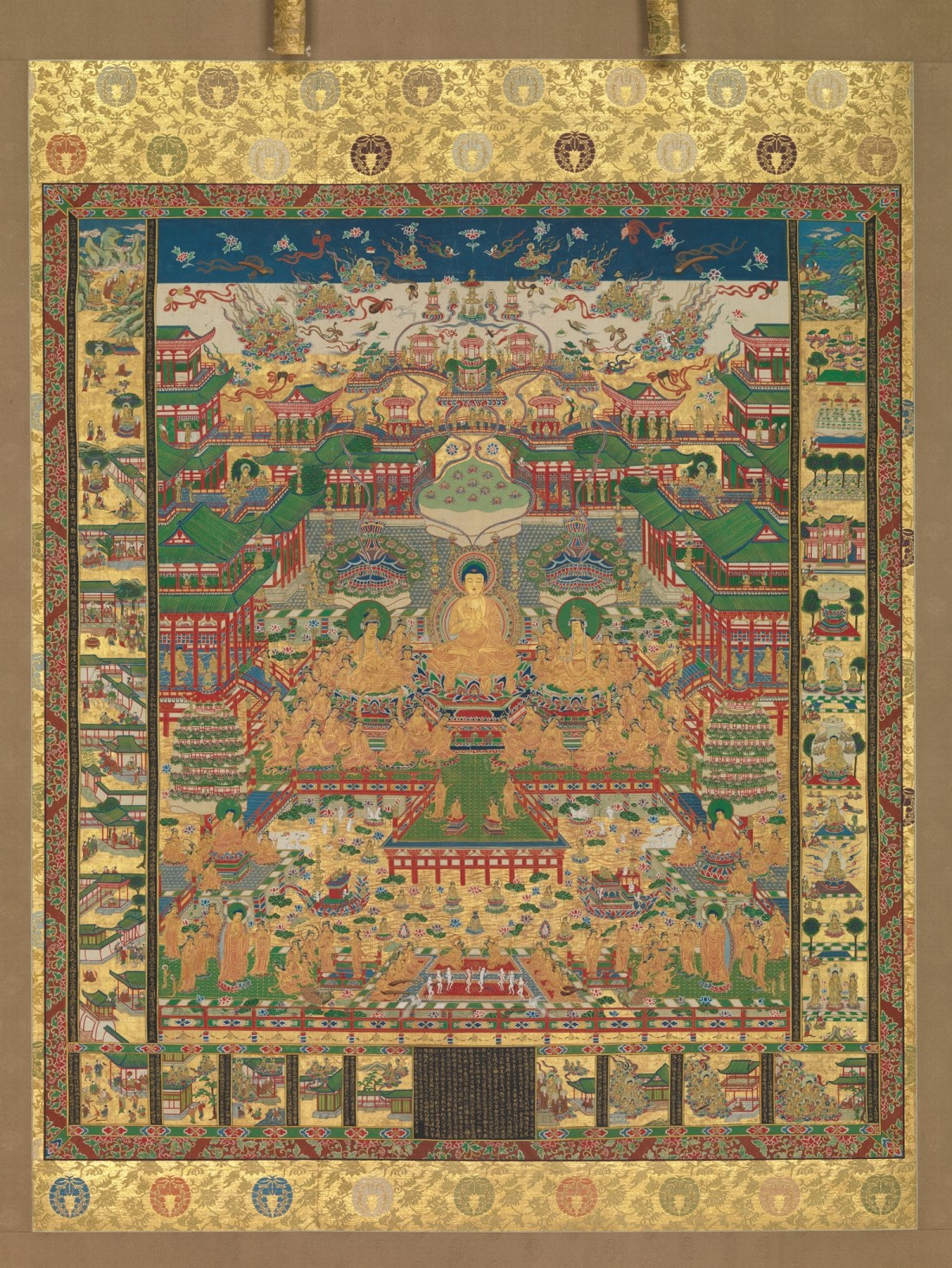
And again later in the Amitabha Sutra in the Mahayana tradition, the Pure Land of Amida Buddha is described in terms of its lotus ponds:

The lotus-flowers in the lakes, large as chariot wheels, are blue-colored
with blue splendor, yellow-colored with yellow splendor, red-colored with red splendor, whitecolored with white splendor, and (they are all) the most exquisite and purely fragrant.

English translation from the Chinese Version of Kumarajiva by Nishu Utsuki, The Educational Department of the West Hongwanji, Kyoto, Japan: 1924.

To reiterate, the idea of a lotus growing from the mud, unsullied by the mud was both intended to show the potential of all beings to awaken like the Buddha, but also the many colors of lotuses (in my opinion) show the diversity of followers from many walks of life.

Namu Shakamuni Butsu
Namu Amida Butsu

1 She also had a pretty high opinion of herself, which was grating to read at times. I seriously doubt her experience is representative of a lot of women in the industry.

Buddhism in a Nutshell

If you’re new to Buddhism, or curious about what it is, it’s tempting to compare with other world religions. However, it differs in some key ways.

One of my favorite books in my collection is an old translation of The Way to Buddhahood by the late Ven. Yin-Shun (“een-shoon”), a prominent Chinese monk who was an influential figure in Taiwan. His book is dense,1 and geared for Chinese audiences, but the translation is good, and Yin-Shun’s reputation as a scholar and respected monk is well-earned.

The opening pages of the book read as follows:

To study Buddhism means to learn from the Buddha. One takes the Buddha as one’s ideal and one’s mentor and learns from him incessantly. When one reaches the same level as the Buddha, then one has become a buddha.

The Buddha, founder of Buddhism, is a man we call “Shakyamuni”. Sometimes books call him by his birth name, Siddhartha Gautama, but Buddhists call him Shakyamuni or Shakyamuni Buddha.

The key to understand is that the Buddha is not a god. And, if we follow the Buddha’s teachings and apply them correctly, we too will rise to the same level as a buddha ourselves.

This is not a quick, “weekend-warrior” effort though.

….For an ordinary person with little good fortune and no wisdom, reaching this supreme and unsurpassed state of buddhahood through practice and study is difficult. But by practicing and studying the necessary methods and by following the right way to buddhahood, one can reach the goal of buddhahood. Only in this way, and without skipping any steps, can one advance to this distant and profound goal….

The goal is profound and difficult, but not impossible. One has to be realistic about the goal, and be willing to accept that it’s a long-term goal. Yet, if one does this, and stays the course, one will assuredly reach Buddha-hood. Yin-shun’s comment about “not skipping steps” is to counter promises by some teacher or cults that by “chanting this magic spell” or “praying to that” one just quickly jumps to Buddhahood. It is a gradual process, regardless of how one approaches it.

The good news is that within Buddhism there is a way array of practices, methods and traditions to help you along the way.

Because beings have different abilities, the Buddha Dharma has different ways: the way of blessedness and virtue, the way of wisdom, the difficult way, the easy way, the mundane way, the supramundane way, the way of the sravaka, the way of the bodhisattva, and so on. But ultimately, there is only one way. All of these ways are nothing but methods to become a buddha “in order to open up and make manifest the Buddhas knowledge and insight to sentient beings, so that they can also apprehend and attain the same.”

The specific ways that Ven. Yin-Shun cites are explained throughout the book, but needless to say, Buddhism is like the Colosseum in Rome, with many gates, all leading inward towards the middle. One only needs to step through one of them, and keep at it in a long-term sustainable way.

This is essentially what Buddhism is all about.

P.S. Happy spring Ohigan season!

1 I wouldn’t recommend the book as a first-pass introduction to Buddhism, but it covers a lot of subjects that are omitted in other books in a single volume.

Prejudice

M’BENGA: Prejudice has kept people from helping each other for centuries with no scientific justification. And after we met our neighbours in the galaxy, we found new bigotries….In any case, they’re meaningless to me. I am a physician. 

Star Trek: Strange New Worlds, “Ghost of Illyria” (s1ep3), Stardate 1224.3

Prejudice is something far more insidious than simple racism, and something we all face on some level. We discriminate based on all kinds of criteria: race, ethnicity, religion, gender, politics, sports teams, departments at work, etc. If someone is somehow different, we are inclined to see them as an outsider. It’s subtle and tough to resist without conscious effort.

My personal belief is that prejudice is born from some kind primitive instinct of self-preservation, by making discerning choices with only limited information. Sometimes this might keep us alive, other times, it causes hostility and animosity.

But I am not the only one who seems to think this way…

But I digress.

In the famous Star Trek episode “Arena”, Kirk is compelled to fight a Gorn to the death in single combat:

The episode emphasizes how repulsive and cruel the reptilian Gorn are, and yet at the end when Kirk finally defeats the Gorn, he spares its life. This earns him the respect of the Metrons, the highly-advanced aliens who instigated the duel.

METRON: By sparing your helpless enemy who surely would have destroyed you, you demonstrated the advanced trait of mercy, something we hardly expected…. There is hope for you. Perhaps in several thousand years, your people and mine shall meet to reach an agreement. You are still half savage, but there is hope. We will contact you when we are ready.

Star Trek, “Arena” (s1ep18), Stardate 3045.6

The Metrons knew that violence and hatred were primitive and hardly distinguish a species, but mercy and goodwill do. It requires thought and mental discipline to override one’s basic instincts, but it is almost always the right choice.

Namu Shakamuni Butsu

P.S. The Gorn play a much more prominent role in Strange New Worlds than original Star Trek … with mixed results.

Revisiting the Five Hindrances

SPOCK: If there are self-made purgatories, then we all have to live in them.

Star Trek, “This Side of Paradise”, stardate 3417.7

The Five Hindrances in Buddhism was something I briefly touched on in the past, and something I think about from time to time, but then I ran into this neat excerpt by the Chinese Tiantai (Tendai) founder, Zhi-yi:

The practitioner is like a person who has gained freedom from a debt or one who has been cured of a serious disease, like a starving man arriving in a prosperous country, or like one who has been rescued safe and unharmed from a band of villains. When he eliminates these five hindrances, his mind becomes calm and secure and he feels clear, cool, and blissful.

Just as with the sun and moon which may be obscured and prevented from shining brightly by the five phenomena of smoke, dust, clouds, fog and the hand of the asura known as Rāhu, so it is as well with the human mind and the five “covering” hindrances.

The Essentials for Practicing Calming-and-Insight & Dhyana Meditation by Zhiyi, translated by Kalavinka Press, page 75

I really like this quote for a few reasons.

First the benefits of self-discipline, and personal conduct are like getting out of debt. By not committing harmful actions towards others (and by extension yourself), you are no incurring further debt. Because you are no longer incurring debt any existing “karmic debt” run its course, your personal purgatory that much shorter. It bring a kind of freedom, even if it seems counterintuitive.

長からむん心も知らず黒髪の乱れてけさはものをこそ思え

I do not even know how long your feelings will last. My long black hair is all disheveled and, this morning, my thoughts too are in a tangle!

Poem 80 of the Hyakunin Isshu, translation by Joshua Mostow

Second, it reiterates that the Five Hindrances really do get in the way of clear thinking, and prevent one from being level-headed and in control. This leads to further harmful actions, incurring further “debt”, etc. So, it helps to know what the Five Hindrances are, and to observe them in your own life, and to know how best to counteract them.

Easier said than done, but every time you counteract ill-will, or laziness, you’ve lightened the burden in your own self-made purgatory.

Namu Shakamuni Butsu

P.S. Featured photo taken at Ryoanji temple in 2023.

Conduct, Then Practice

A photo of the Shurangama Sutra (the purple book on the left) from my personal collection. I purchased this years ago at Powell’s City of Books and haven’t found a copy since.

In my last post, I talked about Tetsugen Doko’s open-minded approach to Buddhist practice especially among his lay followers. But there was one thing that Tetsugen Doko did not compromise on.

In 1674 in the castle town of Mori (now Oita Prefecture), Tetsugen gave a controversial Buddhist lecture on the Shurangama Sutra, an influential Buddhist sutra in China not widely discussed in Japan. The lecture caused an uproar.

Tetsugen later summarized the lecture contents in an affadavit as follows (emphasis added):

I lectured first of all about the good and evil of the False Dharma and the True Dharma in the Final Age, which are referred to as the Three Absolutes in the Suramgama Sutra. Those who practice without keeping the precepts set out by the Buddha all represent the False Dharma. The reason for this [is as follows:]

Although practices such as chanting the Nembutsu, seated meditation, and reciting the sutras are each practiced differently depending on the abilities of the believer, the precepts against taking life, stealing, sexual misconduct, lying and the like are absolute, regardless of the sect. Not to keep them is unacceptable. Therefore these precepts are called “absolutes.”

This lecture earned him the ire of the local Jodo Shinshu community whose priests did not, by tradition, uphold any precepts. The local members rioted and multiple arrests were made by the authorities, who feared a return of the Ikko-Ikki riots, and Tetsugen quietly left town to avoid further trouble, especially for the feudal lord who had sponsored the lecture.

Nonetheless, more and more I believe that Tetsugen is correct: the basic lay precepts (a.k.a. the Five Precepts) should be front and center of one’s practice. Everything is grounded on that. Not the other way around, as I believed. What practices you choose to undertake are secondary to how you conduct your life the rest of the time.

I spent many years in my pursuit of the Buddhist path, fretting about doing the right practices, and chanting the right things, but these days I feel that the way to not be a dickhead is to simply stop acting like a dickhead. This is what the “training rules” of the precepts do: file away the sharper edges so that one’s Buddhist practice has a solid foundation.

Easier said than done? Oh yes.

Is it worth the effort anyway? Yes, definitely.

Namu Amida Butsu
Namu Shakamuni Butsu

Highs and Lows

Dr Helen J Baroni’s excellent book Iron Eyes covers the life and writings of Obaku Zen master Tetsugen Dōkō (鉄眼道光, 1630–1682). I’ve mentioned it in a few older posts, but I wanted to share a couple of Tetsugen’s poems really stood out to me:

41. MEETING AN OLD FRIEND

Separated east and west for twenty years.

You exclusively chant the Buddha’s [name, a.k.a. the nembutsu], while I practice meditation.

We meet together, why argue over high and low.

The wind and the moon originate in the same heaven.

Page 167

The “high and low” refers to the perception that the path of monastic self-discipline (as exemplified by the Zen tradition) is the “high road”, while the “low road” is instead relying Amida Buddha’s compassion to be reborn in the Pure Land. Here, Tetsugen argues that they both reach the same destination in the end, so the distinction doesn’t really matter.

Another poem he wrote is:

44. GIVEN TO THE FAITHFUL BELIEVER JONYU, WHO CHANTS THE BUDDHA’S NAME

The body is healthy, the years pour out; your ears and eyes are [still] clear.

Contented and unselfish, you reject personal glory.

Reflected light, in a single moment you penetrate the self.

For the first time you realize that practitioner and Dharma are complete in one body.1

Page 168

What really strikes me about these two poems is that Tetsugen openly acknowledges that his lay friends and followers recite the nembutsu and he’s totally fine with it.

It’s assumed in Japanese Buddhism that a sect practices meditation, or chanting, but not necessarily both. It’s also assumed that Zen people only hang out with Zen people, Pure Land Buddhists with Pure Land Buddhists, etc. There were exceptions: people like Ikkyu and Rennyo who were friends despite totally different practices and backgrounds, but you don’t hear about these often. Yet, in spite of this image, Tetsugen clearly was open to lay people practicing the Pure Land path and saw no conflict with this.

This makes more sense when you consider that Obaku Zen, a cousin of the Rinzai Zen sect, came to Japan from Ming-Dynasty China, when Zen and Pure Land thought had largely reconciled there. The excellent writings of Chinese monk Ouyi Zhixu (蕅益智旭, 1599–1655)2 and Yunqi Zhuhong (雲棲袾宏, 1535–1615)3 are typical of the thought at the time: both Zen and Pure Land Buddhism are different ways of approaching the same Dharma (e.g. Buddhism). One blends into the other.

Even modern Chan (Chinese Zen) teachers such as my favorite, Yin-shun (印順, 1906–2005), had no trouble recommending the nembutsu alongside other practices. In his book The Way to Buddhahood, he wrote:

If therefore, one is timid and finds it difficult to practice the bodhisattva-way, fearing that one will fall into the Two Vehicles or that following the karmic forces will cause one to drift apart from the Buddha Way, then chanting Amitabha Buddha is most secure! It is a wonderfully skillful means that can best embrace and protect those sentient beings who are beginners so that they do not lose their faith.

page 249

But I digress.

It should be noted that Tetsugen in particular was raised in the more native Jodo Shinshu-sect Buddhism and even went to Kyoto to train as a priest but eventually decided to pursue Obaku instead. So, perhaps he still had some connections toward his religious upbringing.

Nonetheless, all this is to say that Obaku Zen, having inherited such an outlook from Chinese Buddhism, takes Amida Buddha as its ideal, but sees Amida in more Zen terms. One is not required to see Amida that way upfront; it just comes in time with practice. Come as you are, and don’t worry if it doesn’t make sense. Someday, it will.

Namu Shakamuni Butsu
Namu Amida Butsu

1 According to Dr Baroni’s footnotes: Kihō, can also be translated as “opportunity and Dharma,” in Pure Land thought, it means that while the sentient beings believe in the Buddha, the Buddha’s power saves sentient beings. Personally, I like to think this relates to Shoku’s comment about the Three Karmic Bonds, too.

2 Pronounced like “Oh-ee Jih-shoo” in English

3 Pronounced like “Yoon-chee Joo-hohng” in English