Hanging Out With Kannon at Sanjusangendo

I alluded in recent posts about my visits to the temple of Sanjūsangendō (三十三間堂, San-ju-san-gen-do) in Kyoto, Japan, but I’ve never really talked about it.

My experiences with Sanjusangendo go all the way back to our first trip to Japan together in 2005. My wife (whose Japanese) and I had married the previous year,1 and we came to Japan to meet the extended family, but also take in many sites. That first trip through Kyoto was a whirlwind, and I have very fuzzy memories of most of it. I couldn’t remember much about Sanjusangendo, and since we couldn’t take photos, I had very little to remind me either.

And yet, something about Sanjusangendo drew us back in recent years. My late mother-in-law really liked Sanjusangendo, and my wife wanted visit again for her mother’s sake, and now with 20 years of experience in Buddhism, the temple made a lot more sense to me. The fact that it’s a Tendai temple (and I like Tendai Buddhism) was icing on the cake. My wife was really inspired by it too, so the following year we visited it again.

…. so, what is Sanjusangendo?

Sanjusangendo is a Buddhist temple, which venerates the bodhisattva Kannon, also known as Avalokiteshvara, Guan-yin, etc. It was founded in the 12th century by the infamous warlord Taira no Kiyomori as a way to impress Emperor Go-Shirakawa (tl;dr it didn’t work). What makes Sanjusangendo so famous is two things:

  1. It’s very long, narrow main hall (本堂, hondō). This is different than most temples which have a more square-shaped main hall. The hondō of Sanjusangendo is a very long rectangle, but there’s a reason for this. The featured photo above is something I took in 2023, and shows the scale of the building. The website also has a nice photo.
  2. The temple’s main attraction is the 1,000 statues of Kannon bodhisattva, centering around a much larger statue of Kannon. These statues are lined up in rows along the main hall, and in front of them are other statues featuring various gods and other divine beings protecting the temple. More on that below.

Since Sanjusangendo doesn’t allow photography inside the main hall,2 you should check out the official website instead. You can see the main hall, and the row upon row of Kannons here. The official website also has photos of each figure.

The main figure of devotion, as i said above, is the bodhisattva Kannon, but since Kannon has many forms, this form is the 1,000-armed Kannon called Senju Kannon (千手観音). This form of Kannon isn’t limited to Japanese Buddhism; I have seen this form expressed at Vietnamese Buddhist temples as well. The idea is that Kannon, according to the Lotus Sutra, uses many different means and methods to help people, and the 1,000 arms, each holding different objects, symbolizes the diverse ways that Kannon helps others.

You can see a photo of the 1,000-armed Kannon here.

Something you might also note is that the Kannon statue has 11 heads. Just as the 1,000 arms show Kannon’s efforts to help all beings in a variety of ways, the 11 heads show Kannon’s vigilance in watching out over people.

Not shown in the photos is a small display which teaches a particular mantra associated with the 1,000-armed Kannon:

LanguageMantra Pronunciation
SanskritOṃ     vajra-dharma     hrīḥ    svāhā
Japanese, katakana script3オン サラバ ダルマ キリ ソワカ
RomajiOn saraba daruma kiri sowaka

You can recite this mantra in Japanese or Sanskrit. I am unclear what the translation is, but I’ve been told before that translating mantras is kind of pointless, like giving answers to a Zen koan. So, I left out the translation.

Anyhow, flanking the great big statue of Kannon on either side are 10 rows of smaller, standing statues of Kannon, each with 1,000 arms, which you can see here. The website says that of the one-thousand statues, they were built over time: 124 were from the late Heian period (12th century) and the rest were constructed during the Kamakura period (13th-15th century). There are a total of 1,000 statues, each one slightly different, but generally the same form.

Finally, in front of these statues is a series of mythical figures. Some are originally from India, and traveled the Silk Road, gradually transforming into what we see today. Others are more native Japanese deities who’ve also become Buddhist guardians. You can see the full catalog here.

To give an example of the eclectic nature of these figures, one figure is a Buddhist guardian deity named Vajrapani (Naraenkengō 那羅延堅固 in Japanese), whose imagery was influenced by the Greek hero Herakles at a time when places like Bactria and Gandhara were still part of the Greek world.

On the other hand, you can also see the famous figures of Raijin and Fūjin who are Thunder and Wind gods respectively. As far as I know, these are native deities and did not originate from the Silk Road.

The quality of the artwork is really excellent. When you see any of these figures, Kannon, Vajrapani, Raijin, etc, the life-like quality is really impressive. And, like many examples of Buddhist art, they are full of symbolism and visual meaning beyond words. They impress and inspire those who see them. Since I have now seen Sanjusangendo three times, I found that it continues to impress me every time I see it.

Speaking from experience, Sanjusangendo is a place that requires some context to really appreciate. If you are unfamiliar with Kannon and why they have one-thousand arms, or with the strange but beautiful figures guarding the front row, then some of it will feel like a mystery. It’s a beautiful mystery, but still a mystery. But, hopefully after reading this, you will get a chance to see it someday and really get a feel for why this place is special.

As someone who has an affinity for Kannon since I first became a Buddhist, it is a special place for me. 😊

Edit: fixed a number of typos. Three-day weekend drowsiness. 😅

P.S. Again, apologies for the lack of photos. I know sometimes foreigners will take photos anyway (I have seen people do this), despite the signs clearly saying “photography prohibited”, but I don’t want to be one of those tourists. So, if you want to see more, check out the excellent website.

1 Twenty-year anniversary as of early 2024. 🎉

2 A lot of temples in Japan do this. I don’t fully understand why, and it is frankly a little frustrating.

3 Katakana script is often used to write foreign-imported words in Japanese, as opposed to hiragana script. Since mantras are originally derived from Sanskrit, using katakana makes sense in this context. Sometimes katakana is also used for visual impact (like in manga), so that might explain things too. NHK has a nice website explaining how to read katakana.

No Working Is True Working: the Tannisho

Writing my recent post about Ikkyu and Rennyo brought back a lot of old memories for me.1 I was also overjoyed when I was recently contacted by another member of my old Jodo Shinshu community. So, I started leafing through the old material I saved, much of it out of print now, and remembered this old quote from the Tannisho (歎異抄), a collection of sayings attributed to the founder, Shinran (1173 – 1263):

10) 念仏ねんぶつには無義むぎをもってとす。しょうせつのゆにとおおそうらき。

“In the nembutsu no selfworking is true-working; it is beyond description, explanation, and conception.”

translation by Dr Taitetsu Unno

This cryptic saying is probably the most emblematic of Shinran’s thinking, and what distinguishes Jodo Shinshu from the rest of the vast Pure Land Buddhist tradition.

Since the days of the early Chinese Buddhist Pure Land teachers such as Dao-chuo (道綽, 562–645) and Shan-dao (善導, 613–681), there has been this notion that Buddhism has two general paths:

  • The path of the Sages (i.e. the classic, monastic path), and
  • The path of the Pure Land

This morphed over time into the concepts of Self-Power and Other-Power. In other words, when following the Buddhist path does one rely on one’s own efforts, or fall back and rely on the grace of the Buddhist deities, primarily Amida Buddha? Every Pure Land Buddhist tradition and teacher that has arisen across history has wrestled with these competing approaches, how to find a balance, or where they might overlap. Charles B Jones’s book really explores this in far greater detail and well worth the read.

In any case, on the Self-Power vs. Other-Power spectrum, Jodo Shinshu Buddhism, as taught by Shinran and later Rennyo, really tipped the scales toward Other Power only. It’s not just 95% Other Power, 5% Self-Power; it’s entirely 100% Other Power. The idea arose through a combination of both Dharma Decline: that people were so far removed from the time of the historical Buddha Shakyamuni that any efforts towards one’s own emancipation were no longer possible, and the aforementioned tension between the Pure Land Path vs. Path of the Sages.

Thus, Shinran is saying that regardless of what one does or doesn’t do, the salvation provided by Amida Buddha is entirely due to Amida Buddha. One cannot add or detract from this grace. Once one experiences such grace, they spontaneously recite the nembutsu, rather than as a Buddhist practice.

Astute readers may find that this sounds an awful lot like Calvanism, and Charles B Jones points this out too. He also points out that the while this can provide great comfort to those who sincerely follow yet doubt their abilities, the challenge of Calvinist-type thinking is that it can leave the believer in doubt about whether they ever will be selected. It almost feels like a religious lottery. A person can be a genuine follower all their life, and yet grace might not come. Not every Jodo Shinshu follower experiences shinjin. And if they did, how would they know?

Back then, I wrestled with this issue quite a bit as a Jodo Shinshu follower. Shinshu teachings have a certain internal logic and beauty to them, but I always had this this nagging feeling that there was some “philosophical gymnastics” involved. And, to be frank, I am no longer convinced that this is what the Buddha taught. Even if you read the Larger Sutra of Immeasurable Life, the most important Pure Land Sutra and the source of the Juseige, it’s pretty clear that Shakyamuni intended for people to bend their efforts toward rebirth in the Pure Land, rather than let go and let Amida Buddha handle everything. The sutra is a bit long, and takes about 1-2 hours to finish reading, but if you’re learning about the Pure Land tradition, it’s worth the read.

I already critiqued Dharma Decline in another post so I won’t belabor that here. Suffice to say, it’s too formulaic to be a realistic assessment of human history.

But what about Other Power versus Self Power? In my humble opinion it’s a false dichotomy. You’re not actually forced in Buddhism to choose one or the other. It is possible, and very common, to find a balance of both in one’s practice. If a Buddhist deity inspires you to keep going, great! And since there many deities in Buddhism, it is possible to find someone who inspires you even if it is the historical Buddha himself. It doesn’t have to be a “cosmic” deity and will still be just as Buddhist.

I don’t want to trash on Shinran though, because a spiritual crisis like the one he had can be a very difficult to resolve even after years. Shinran was an accomplished and fascinating figure, and the Tannisho as a document is a valuable insight into his thinking process.

It’s just that I had my own “mini-crisis” in my younger years as a Buddhist and I came to a different conclusion even as a nembutsu devotee. These days I am pretty happy with my practice, small as it is, plus everything I’ve learned along the way.

Maybe I am totally wrong, but the way I figure it:

  • Slow and steady wins the race.
  • With the breadth of teachings and practices Buddhism has to offer there’s something for everyone and there’s nowhere to go but up.
  • Never be complacent. There’s always more to learn, more to try, and more to experience.

Good luck and happy practicing!

1 This is an old selfie I took of myself in 2015, wearing the robes of a minister’s assistant with the Buddhist Churches of America:

I was still in training (certified later in 2016), but I was very proud to wear it nonetheless. My chanting voice was terrible (still is), but I really tried to take my role seriously. I have a lot of happy memories from that time and am always grateful.

P.S. it’s hard to find a good translation of the Tannisho these days, but you find Dr Taitetsu Unno’s translation here on Web Archive.

Ikkyu and Rennyo: The Odd Couple

Years ago, when I was part of the local Jodo Shinshu Buddhist community, my minister told me a story about how Rennyo and Ikkyu, two famous Buddhist monks from 15th century Japan, were both good friends and would frequently test one another in their grasp of Buddhism. They were an unlikely pair of friends, given that they belonged to two very different Buddhist traditions, and yet they clearly had a rapport that you rarely find in Japanese-Buddhist history.

To be honest, I thought the story of them being friends was embellished, but I got curious recently poked around some Japanese sources on the Interwebs, and sure enough there were a number of famous anecdotes between Ikkyu and Rennyo. These anecdotes aren’t necessarily historically accurate, but they have been passed down through the generations and even show up in Japanese TV today.

But first, let’s introduce Ikkyu and Rennyo.

Ikkyu Sojun (一休宗純, 1394 – 1481) was a monk of the Rinzai Zen tradition,1 which was politically dominant at this time due to the Five Mountains System in Kyoto. He was disillusioned with the pomp and grandeur of the Zen community at that time, and left to live a more “authentic life” among the people. He is famous for his flashes of genius, and his artistic talents, but also his unorthodox behavior, including partying and sleeping with girls. Ikkyu left behind many excellent poems, paintings, and his genius image has made him a popular figure even in modern Japan.

Rennyo (蓮如, 1415–1499) was the eighth head of the ancestral Honganji Temple in Kyoto,2 which ostensibly was the head temple of the Jodo Shinshu sect. Trouble was, the movement was very fractured, with regional groups, rival powers, etc. And then there were the warrior-monks of Mount Hiei (head of Tendai sect) that wanted him dead. Rennyo had to flee Kyoto for a long while to the provinces, but used the time to unify the Jodo Shinshu groups into a more cohesive sect for the first time. His Letter on White Ashes, is a particularly inspired piece of writing.

Ikkyu was 20 years older than Rennyo, but in many anecdotes, they are making jokes with one another, or testing each other’s wisdom.

In one famous story (used in the “Ikkyu-san” cartoon), Ikkyu had put up a sign near a really crooked pine tree. The sign read whoever can see this pine straight, I will give them a kanmon of gold.

People were stumped, and brought this to Rennyo’s attention. Rennyo said, “pfft, more of Ikkyu’s mischief. I see this pine straight. I’ll get the cash.”

When Rennyo confronted Ikkyu about it, Ikkyu said, “Oh, it’s you. You don’t count. Look at the back of the sign.”

Sure enough, on the back of the sign was painted “EXCEPT RENNYO”.

When people ask Rennyo how he was able to see the crooked pine straight, Rennyo said that he saw it for what it was: a crooked pine. By seeing it for what it really was (a crooked pine), he saw it “straight”.

In another anecdote, for which I could find the original Japanese, Ikkyu had read the Amitabha Sutra and commented:

阿弥陀には まことの慈悲はなかりけり たのむ衆生のみぞ助ける

Amida Buddha has no true compassion; he only helps those who ask.

Source

To which Rennyo wrote back:

阿弥陀にはへだつる心なけれども 
蓋(ふた)ある水に月は宿らじ

Although my heart is not estranged from Amida Buddha,
the moonlight does not reside where water has a lid.

Source

Rennyo is invoking the imagery of Amida Buddha’s compassion as moonlight, which we’ve seen before, and how it shines everywhere. But if water is in a container (has a lid on it), the moonlight will not reflect back.

Ikkyu tested Rennyo again:

極楽は十万億土と説くなれば 足腰立たぬ婆は行けまじ

If the Pure Land of Amida Buddha is indeed 10,000,000,000,000 lands away [as described in the sutras], then an elderly woman who is unable to stand cannot go there.

Source

To which Rennyo replied:

極楽は 十万億土と説くなれど 近道すれば南無のひと声

It is taught that the Pure Land is indeed 10,000,000,000,000 lands away, but if you’re looking for a short-cut, recite the nembutsu.

Source

In another story, Ikkyu attended the 200th memorial of the founder of Jodo Shinshu (and Rennyo’s ancestor), Shinran. Of Shinran, Ikkyu wrote the following verse:

襟巻の あたたかそうな黒坊主 こやつが法は 天下一なり

That black[-robed] monk with the warm [as in “kind”] head and scarf,
his Dharma teachings are peerless.

Source

Ikkyu was referring to a famous portrait of Shinran depicts him as wearing his black clerical robes, and shaved head:

Nanbokucho-period artist, Public domain, via Wikimedia Commons

There are a lot of other stores too, and I’ll try to share more as I find them, but I thought these were neat. Zen and Pure Land Buddhism are often treated as separated teachings, and separate sects, but I suspect that as with any Buddhist path if you get far enough along, you’ll start to run into people of the same mind.

That, in my humble opinion, is the power of the Lotus Sutra and its many gates.

1 Zen in Japan is divided into 3 schools: Soto, Rinzai and Obaku, all imported from China at various points in history. Rinzai and Obaku both have the same “ancestral lineage” in China, but arrived in Japan at different points. Soto comes from a different lineage entirely in China.

2 A few generations after Rennyo, the Honganji split into two temples: Nishi (West) Honganji, and Higashi (East) Honganji after a family split, plus politics. They are effectively equal, but different sub-sects.

The Journeys of Xuanzang, part four: Southward

In our last episode (… a few months ago 😓) Xuan-zang met the Qaghan of the Western Turkic Khaganate, and made a good impression, allowing him to travel safely further south and westward toward the city of Samarkand.

Map of Xuan-zang’s journeys from Tashkent to Balkh. Inkarnate put out a new version of its software while I was on break, so some things may look different than past maps. As always, this is an amateur map, and may contain geographic mistakes.

If you need to brush up on earlier episodes, click below:

Samarkand

Samarkand is a fascinating place: a fabulously old city, and a major hub on the Silk Road. All the way back in the time of Alexander the Great’s conquests in 329 BCE, 1,000 years before Xuan-Zang, the city was called Marakanda (Μαράκανδα) in Greek and was part of the Achaemenid Persian Empire before that. By Xuan-zang’s time the city was part of the Sassanian Persian empire, and still a major trading hub, known even to the Chinese, but I was unable to find a reliable source on the Chinese name at the time. Modern term is 撒马尔干 (sǎ mǎ ěr gàn ?). The city at this time was almost entirely populated by Sogdian Iranian people, whom we’ve also seen in past episodes. This far west from China, Xuan-Zang probably saw very few if any Chinese people, and instead encountered many people from other cultures and parts of the world. He was very much a “stranger in a strange land”.1

However, because this city was part of the Sassanian Empire, the official religion was Zoroastrianism, not Buddhism, and as Xuan-zang came to the city, he noticed that the Buddhist monasteries there were abandoned and neglected. Some of Xuan-zang’s followers went to pay their respects at these monasteries, but they were chased off by a mob of Zoroastrian followers with flaming brands. Later, the king heard what happened and arrested the mob leaders and was going to pass sentence to mutilate them. Xuan-zang begged for leniency, and so they were flogged and expelled from the city.

The king of Samarkand wasn’t particularly friendly to Xuan-zang, but their relations did improve. Further, it seems that later the king of Samarkand made friendly, diplomatic overtures to Tang-Dynasty China as a foil to the Western Turkic Khaganate, but these did not go very far. Decades later, Great Tang’s expansion reached all the way to Samarkand and they briefly ruled for a few decades until the Battle of Talas later. All this happened decades after Xuan-zang visited the city though.

In any case, Xuan-zang wisely did not stay long in the city and turned at least to towards the south.

Heading South

Up until now, Xuan-zang’s journey from the Yumen Pass in China to Samarkand, over the Tian Shan mountains and across two deserts, has mostly been a westerly journey. But this was as far west as Xuan-zang would go. The road to India was now in a south-southeasterly direction passing through places like modern Afghanistan, Pakistan, and Uzbekistan. These areas were not part of Sassanian Empire, and instead were local princes and minor rulers with complicated relations with regional powers. These areas were more Buddhist-friendly as well due to the legacy of Bactrian Greeks,2 but more importantly due to the Kushans who came later. Much of these lands were former Kushan territory, and their good governance and patronage of Buddhism at the time allowed things to flourish on the Silk Road.

The first obstacle Xuan-Zang and his party ran into was the famous “Iron Gates“.

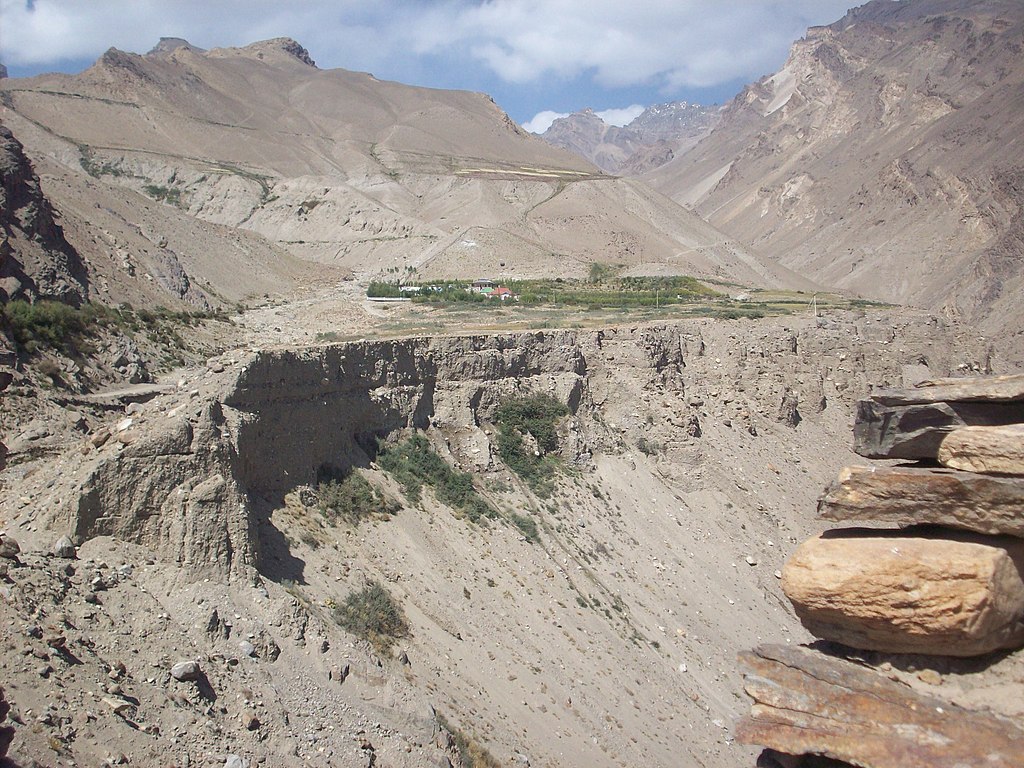
A valley in the Badakshan Province in Afghanistan, close to the where the Iron Gates would be. Photo by Zack Knowles, CC BY-SA 3.0, via Wikimedia Commons

Because this area was a choke-point for travel, it was often garrisoned, and he described “double wooden doors, strengthened with iron and furnished with bells”. In any case, Xuan-zang seemed able to pass through without much issue.

After crossing the Oxus River (now the Amu Darya), he returned to regions where Buddhism was still flourishing namely in the small city of Termez. Termez was once a major city of the Kushan Empire, but was much more diminished by the time Xuan-zang arrived. The Buddhist community here numbered about 1,000 monks. It was here that he saw the Ajina Tepe monastery and its excellent works of art.

In fact, from here Xuan-zang would behold some pretty amazing spectacles. Many people may not realize that the lands we now call Afghanistan were once bastions of Buddhism along the Silk Road, and boasted many treasures, monasteries, and a very eclectic culture.

But first, Xuan-zang had to deal with a series of problems in the city of Kunduz.

Intrigue and Murder at Kunduz

The Kunduz River valley today, Afghanistan Matters, CC BY 2.0, via Wikimedia Commons

Xuan-zang’s visit to the city of Kunduz was no accident. After meeting the king of Turfan way back in episode one, and the Qaghan of the Western Turks in episode three, he had many letters of introduction to the Prince of Kunduz named Tardu. As rulers on the Silk Road, they were all related by family or marriage, so Xuan-zang had little trouble getting an audience with Prince Tardu.

Except for one problem: the Prince’s wife had recently died, and he was in mourning. Later, Tardu abruptly married another daughter of the king of Turfan (episode one), and she in turn plotted with his son from the first marriage. This is starting to sound like the plot of a historical K-drama, doesn’t it?

Before long, Prince Tardu was poisoned and died. The new queen married the prince, and ruled Kunduz thereafter.

Xuan-zang did his best to lay low, and stay out of the issue. His delays at Kunduz meant that he had time to get to know another Buddhist monk named Dharmasimha. Dharmasimha and Xuan-zang debated Buddhist thought and treatises for some time, but Xuan-zang felt Dharmasimha didn’t know as much as he was hyped up to. Dharmasimha for his part, acknowledged his shortcomings, and tried to stay humble about it.

Moving On

Before Prince Tardu’s death, he had encouraged Xuan-zang to visit another city named Balkh, also in modern Afghanistan. Balkh had quite a few sites to see, and since some Buddhist monks were already planning to head back there, Xuan-zang accompanied them. After passing through a city named Tashkurghan (modern Kholm, not related to a similar city in China), they reached the verdant lands of Balkh.

The city of Balkh, known to the Greeks of Alexander the Great as Baktra (Βάκτρα) and Baítíguó (白題國) in Chinese to Tang-dynasty China, was important since very far back in antiquity. Balkh was the traditional birthplace of the Zoroastrian religion, and an important cultural center to Persian people since very ancient times, rivaling cities further to the west such as Babylon and Ecbatana in importance. According to Buddhist tradition, the first two of the Buddha’s disciples also hailed from Balkh, and made the first stupa. Centuries later, it was here that Alexander had married a bride named Roxana, seeking to unify western Greek culture with the eastern Persian culture. Later in the Hellenstic Age, it was an important center of the Greco-Bactrian kingdom.

Needless to say, while few people have heard of Balkh today, it was a very important city across many centuries.

During Xuan-zang’s time, the lands around Balkh were still very fertile (desertification happened gradually later). Even with the widespread destruction the Hephthalities (a.k.a. “white huns”), the lands were still prosperous, if somewhat depopulated. There were two major monasteries in the area collectively known as the Nava Vihara, that belonged to the Sarvastivadin tradition of “Hinayana” (early Indian) Buddhism.3 There were tens of thousands of monks in attendance, and Balkh was one fo the remaining places where teachers were regularly installed from India. Similar to Bamiyan, the Naha Vihara boasted massive statues of the Buddha as well. Interestingly, even as far as the 8th century, long after Xuan-zang was dead, an Arab historian named Umar ibn al-Azraq al-Kermani recorded a place of worship here similar to the Kabaa in Mecca. But instead a Buddhist stupa was enshrined inside, with a cloth draped over it, in accordance with Persian custom of showing veneration.

Xuan-zang stayed at the Nava Vihara for a month, and became good friends with a monk there named Prajnakara. Xuan-zang seemed to finally find a monk of high-caliber, who had a good depth of understanding of Buddhist doctrine, even if he was a “Hinayana”, not Mahayana Buddhist. The two journeyed together further south to Bamiyan.

In our next episode, we’ll explore Xuan-zang’s visit to the great Buddha status of Bamiyan, and Xuan-zang is reaching the borders of India. But first, he has to cross the Himalayas…

1 A nod to Robert Heinlein.

2 A few articles on the Gandharan culture, and the cultural connections between the Bactrian Greeks and Buddhism.

3 Although the Sarvastivada school was not Mahayana Buddhism, Mahayana Buddhism inherited a lot from it anyway: canon of texts, certain viewpoints, etc. Another important early school that influence Mahayana were the Dharmaguptaka, who mostly gave their monastic traditions and rules to the Mahayana.

A Look At The Awakening of Faith in the Mahayana

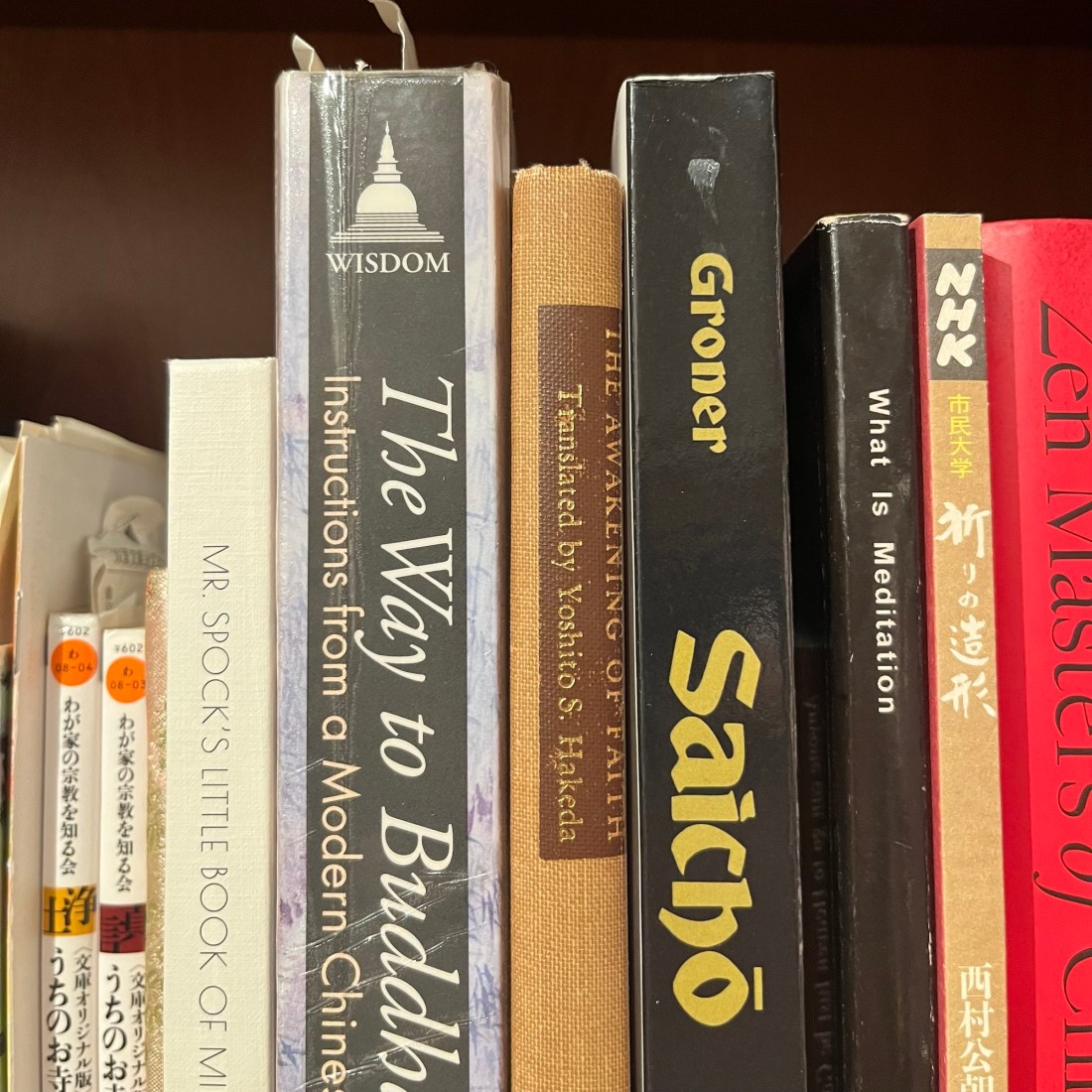
Not too long ago, I found an old book I had forgotten I had: a translation of the Awakening of Faith in the Mahayana. For simplicity, we’ll call it the “Awakening of Faith” in this blog post. The Awakening of Faith is a Buddhist treatise, a śastra,1 written probably in the 6th century, but attributed to a Buddhist master in India, Aśvaghoṣa from the 2nd century. It is thought to have been composed in China, but likely drew from Indian sources, or was composed by an Indian-Buddhist monk living in China. Since it is mainly found in China, it is called Dàshéng Qǐxìn Lùn (大乘起信論).

Wikipedia points out that researchers now think a more appropriate title would be Awakening of Mahayana Faith in the Suchness of the mind. The 信 here might also be interpreted as “trust” or “entrusting”, so maybe Awakening of Mahayana-style Entrusting [in the Suchness of the Mind]? That reads a bit awkward though, so readers will have to decide how to phrase it.

If readers are curious what Mahayana Buddhism is, please feel free to read here.

This might sound like I am splitting hairs, but it is kind of important to emphasize that English terms like “faith” aren’t a good analogue for what the book is about. This is not a book of Christian-style faith. Instead, the author of the treatise addresses why they wrote The Awakening of Faith, when the same teachings are found throughout existing Mahayana sutras:

Though this teaching is presented in the sutras, the capacity and deeds of men today are no longer the same, nor are the conditions of their acceptance and comprehension….

Translation by Yoshito S. Hakeda

The author lists eight reason such as helping all attain peace of mind, liberating from suffering, and correcting heretical views (my words, not the book). In other words, the author wanted to both assert an orthodox Mahayana viewpoint of Buddhism, but also to clarify any misunderstandings and inspire others to take up the path. It is in a sense, a textbook introduction of Mahayana Buddhism.

Mahayana Buddhism is actually a pretty broad tradition, with lots of sub-schools, diverging viewpoints and so on. So, it’s hard to explain the entire tradition in a single book. Still, the treatise does a good job of touching on some essentials that many Mahayana Buddhist traditions today are founded upon. Traditions such as Zen, Pure Land, Nichiren, Tendai, and Vajrayana (among others) all have certain common teachings that pervade them all. The Awakening of Faith helps to enumerate what these are, in a fairly short, readable format, which for a 6th century text is pretty impressive.

To give an example, here is a quote on Suchness : a fancy term for reality, totality of existence, the Whole Enchilada, the Whole Shebang, etc, etc.:

[The essence of Suchness] knows no increase or decrease in ordinary men, the Hinayanists [earlier Buddhist schools], the Bodhisattvas, or the Buddhas. It was not brought into existence in the beginning, nor will it cease to be at the end of time; it is eternal through and through.

Page 65, translation by Yoshito S. Hakeda

If this sounds strangely familiar to readers, you might find something very similar in the Heart Sutra:

“Hear, Shariputra, all dharmas [all things, stuff] are marked with emptiness; they are neither produced nor destroyed, neither defiled nor immaculate, neither increasing nor decreasing….”

Translation by Ven. Thich Nhat Hanh in “Heart of Understanding”

You can definitely see some common themes between The Awakening of Faith and early Mahayana-Buddhist sutras such as the Heart Sutra. Further, The Awakening of Faith explores the notion of Bodhisattvas quite a bit:

The Buddha-Tathāgatas [e.g. the many buddhas], while in the stages of Bodhisattva-hood [i.e. on the cusp of becoming fully enlightened buddhas], exercised great compassion, practiced pāramitās [perfecting certain virtues], and accepted and transformed sentient beings. They took great vows, desiring to liberate all sentient beings through countless aeons until the end of future time, for they regarded all sentient beings as they regarded themselves.

Page 67, translation by Yoshito S. Hakeda

… but it gradually moves from theoretical teachings into more practical ones too. I was surprised to see the treatise openly teach the importance of developing faith in the Western Pure Land of Amida Buddha:

Next, suppose there is a man who learns this teaching for the first time and wishes to seek the correct faith but lacks courage and strength….It is as the sutra says: “If a man meditates wholly on Amitābha Buddha in the world of the Western Paradise and wishes to be born in that world, directing all the goodness he has cultivated [toward that goal], then he will be reborn there.”

Page 103, translation by Yoshito S. Hakeda

The particular “sutra” that the author is talking about is unclear. Hakeda and other scholars seem really quick to dismiss this section as a later addition, or influenced by the Pure Land Buddhist community, since it’s not found in the Three Pure Land sutras, but I would argue that it is either quoted from, or related to an earlier Pure Land sutra called the Pratyutpanna Sutra. Note this quotation here:

In the same way, Bhadrapāla, bodhisattvas, whether they are ascetics or wearers of white (i.e., laypeople), having learned of the buddha field of Amitābha in the western quarter, should call to mind the buddha in that quarter. They should not break the precepts and call him to mind singlemindedly, either for one day and one night, or for seven days and seven nights. After seven days they will see Amitābha Buddha. If they do not see him while in the waking state, then they will see him in a dream.

Translation by Paul Harrison, courtesy of BDK America

But I digress.2

If you think of The Awakening of Faith as a kind of Mahayana training manual, you’d probably be right. It’s meant to distill the vast corpus of teachings into a more bite-sized treatise that covers all the important bases without getting bogged down in sectarian debates. It’s not difficult to read, but does get a little cerebral at times. Still, it was a pretty impressive effort for the day, when Buddhism was still being introduced in China, and people wanted sought to find a way to make the teachings accessible and easy to understand.

It’s influence on later East Asian Buddhism cannot be understated. It provided an important foundation for later schools such as Tian-tai (Tendai in Japan), and subsequent schools that arose from it: Zen, Pure Land, etc.

English translations are hard to find, but if you manage to find a copy of The Awakening of Faith, and are interested to understand what Mahayana Buddhism is all about, definitely pick it up.

1 Pronounced like “shastra”, see Buddhist Sanskrit Basics for more information.

2 It’s quite possible that Professor Hakeda is correct in that it’s a later addition. Ph.D’s aren’t for show: the dude has a lot of background and training in the subject, so he knows a lot. I just think that because the Pratyutpanna Sutra was already popular in China by the time that The Awakening of Faith was composed, it might not be a later addition. But as the kids say, that’s just my “head canon”. 😁

Also noteworthy is no mention of the verbal nembutsu in the above quote. The verbal nembutsu as a practice was popularized centuries later by Shan-dao. Therefore, if it was added to The Awakening of Faith as an afterthought, it was probably something very contemporary.

From Darkness Into Darkness: Lady Izumi’s Final Poem

Author’s note: I reposted this from the other blog. There’s a lot of overlap here, and it just made sense to post in both blogs (probably the first I’ve ever done that in 11+ years!). If you’ve already read the other post, apologies for posting again.

In a lesser-known Imperial poetry anthology called the Shui Wakashu (拾遺和歌集), poem 1342, is recorded what is believed to be Lady Izumi’s1 final poem:

JapaneseRomanizationTranslation
暗きよりKuraki yoriThe way I must enter
暗き道にぞKuraki michi ni zoleads through darkness to darkness —
入りぬべきIrinu bekiO moon above the mountains’ rim
はるかに照らせHaruka ni teraseplease shine a little further
山の端の月Yama no wa no tsukion my path.
Translation by Jane Hirshfield and Mariko Aratani in The Ink Dark Moon.

This poem was addressed to a Buddhist monk named “Shoku” and includes several Buddhist allusions. The most important is the phrase “darkness to darkness”, which comes from chapter seven of the Lotus Sutra:

….from darkness they [living beings] enter into darkness,
to the end never hearing the Buddha’s name [hear the Dharma].

translation by Burton Watson2

This refers to the Buddhist notion of Samsara, the near-infinite, aimless wandering that living beings undergo lifetime after lifetime, like a cosmic rat race. Such beings, who have yet to hear the Dharma [the teachings] of the Buddha, will continue to wander lifetime after lifetime without rest.

Thus, Lady Izumi is asking Shoku to help shine a light in the darkness for her, so that she may find the way [follow the Buddhist path].

I had trouble deciding which blog to put this in, since it covers both themes, but I decided to originally post in the other blog since the poem was introduced in the new historical drama about Lady Murasaki, Izumi’s contemporary.

Lady Izumi was, to put it mildly, a complex woman. She had incredible talent, and found herself in one scandal3 after another as powerful men fell at her feet, plus she earned scorn from other women such as Lady Murasaki. And yet, she was also very kind, devout and struggled to balance both the religious and worldly aspects of her life, while raising her orphaned granddaughter.

Hirshfield and Aratani note that if this poem is indeed her last, the final word she ever wrote was tsuki (月), “moon”.

1 poem 56 in the Hyakunin Isshu.

2 alternate translation by Murano reads: …they go from darkness to darkness, and do not hear of the names of the Buddhas.

3 this was a conservative, narrow, aristocratic society where men frequently had affairs, but it was much more scandalous if women did. The idea that women could want, and enjoy sex, was not something people really accepted at the time.

What is the Lotus Sutra?

One of the most influential sacred texts in Buddhism is the Lotus Sutra.

The Lotus Sutra has had a tremendous influence on Buddhism as we know it today. Much of Buddhist culture as we know it either came from the Lotus Sutra, or was influenced by its ideas and teachings. Not everything, of course. But the influence is hard to ignore. If you know the Lotus Sutra, a lot of things about Buddhist culture make more sense.

A copy of the Lotus Sutra enshrined at a Vietnamese Buddhist temple. Taken at Ksitigarbha Temple in Lynnwood, WA in 2013.

Because the Lotus Sutra has been translated to many different cultures at different times, it has had many names:

Original languageTitleRomanization
SanskritSaddharma Puṇḍarīka Sūtran/a
Chinese妙法蓮華經Miàofǎ Liánhuā Jīng
Vietnamese妙法蓮華經 (Han Nom)
Diệu Pháp Liên Hoa Kinh (modern)
n/a
Korean妙法蓮華經 (Hanja)
묘법연화경 (Hangeul)
Myobeop Yeonhwa gyeong
Japanese妙法蓮華経Myōhō Renge Kyō
Tibetanདམ་ཆོས་པད་མ་དཀར་པོའི་མདོDamchö Pema Karpo’i do

The full title in English is the Sutra on the White Lotus of the True Dharma, but usually we just call it the “Lotus Sutra”. Similarly, in other languages, the full title of the Lotus Sutra is shortened as well. For example, in Japanese, Myōhō Renge Kyō is shortened to Hokekyō.

But I digress.

The Lotus Sutra is not short, and for new Buddhists it is not easy to read. Composed in India in the first century CE, it is divided into 28 chapters, so it reads like a full book. Many of these chapters have a prose section, then repeats itself in one or more verse sections.1

Like all Buddhist texts, or sutras, it presents its teachings in the form of a sermon by the historical founder of Buddhism, Shakyamuni Buddha (“Shakyamuni” for short). Could the Buddha have given such a long, long sermon all in the span of one sitting? Probably not. But that’s how Buddhist sutras are usually presented.

A mural of the Buddha, attended by Bodhisattvas, at the Mogao Caves in Dunhuang, China. Photo taken by user scchoong123. Artwork is ancient and anonymous., Public domain, via Wikimedia Commons

Through the Buddha, the Lotus Sutra teaches many parables and similes to get its point across. Many of these parables took on a life of their own and frequently appear in Buddhist art or literature. Others are strange and obscure to modern readers. In fact, if you’re just reading the sutra for the first time, it really helps to have some kind of side-by-side guide to help make sense of it because if you tried to read it literally, you will get a headache. Thich Nhat Hanh’s book Opening the Heart of the Cosmos really helped me a lot.

For example, the chapter with the Sermon in the Sky, where a second Buddha named Prabhutaratna appears, and everyone flies up impossibly high to hear their sermon, and the Buddha projects himself across many worlds, is a difficult read. If you try to read at face-value, it reads like a fever dream.

A mural from the Yulin Grotto in China. See page for author, Public domain, via Wikimedia Commons
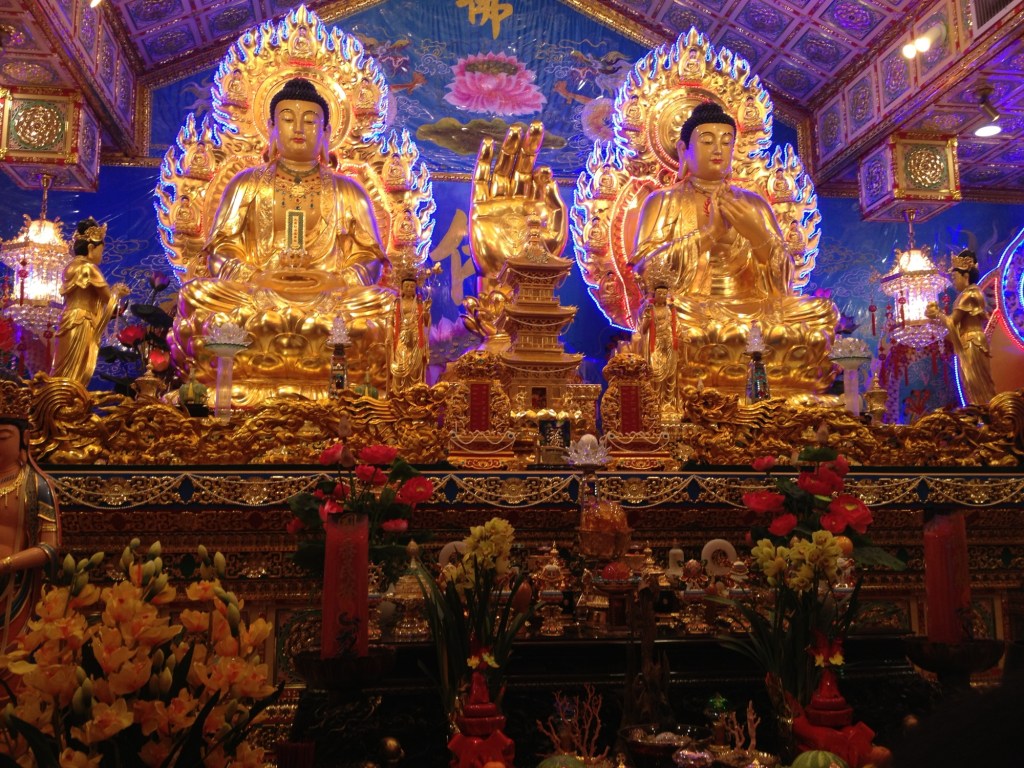
An altar revering the two buddhas, Shakyamuni and Prabhūtaratna, from the eleventh chapter of the Lotus Sutra, enshrined at a Vietnamese temple. Taken at Ksitigarbha Temple in Lynnwood, WA in 2013.

But the style of the Lotus Sutra isn’t to appeal to the head, it tries to appeal to the imagination. It is one thing to say that life is impermanent, it is another to describe the world as a great burning house, with people inside too distracted to notice. When the Buddha is shown projecting himself to countless worlds, it is just a colorful way of saying that the Dharma is everywhere, and there are countless buddhas across many worlds each preaching according to the environment. When the Buddha describes archetypal bodhisattvas in the later chapters, each one is meant to convey a different Buddhist virtue.

Deep stuff.

The Lotus Sutra was pretty radical for its time, and a core part of the larger Mayahana-Buddhist reform movement. The parable of the Dragon Princess, attaining enlightenment faster than any was obviously meant to blow the minds of the establishment, and challenge certain cultural prejudices about women, and so on.

A 12th century Japanese mural from the Heike Nokyo, depicting the Dragon Princess offering a jewel to the Buddha before transforming. Public domain, via Wikimedia Commons

Similarly, the chapter where countless streams of “bodhisattvas of the earth” emerge from the ground was meant to show how we didn’t need to rely on elite gurus, but that everyone had the capacity for being a bodhisattva too, if they just had the confidence.

I’ve talked about the main themes of the Lotus Sutra in an older post, but I wanted to cover two really important ones.

First, the most important teaching of the Lotus Sutra is probably the “One Vehicle” (Ekayāna) teaching. Previously, the reform Mahayana, or “great vehicle” Buddhists, bickered with the traditional Buddhist establishment (called Hinayana, or “small vehicle”), and traded barbs witih one another. You can see this is in some of the really early sutras composed by Mahayana Buddhists.

But then the Lotus Sutra took a step back and looked at the big picture, and taught that it was all just Buddhism (e.g. “one vehicle”) anyway. There were many places to start, and ways to move forward, but in time they would all converge, and the quality of one buddha was no different than another. What worked for one person didn’t necessarily work for another. There was no use bickering, any effort great or small was worth it.

Second, the other major teaching of the Lotus Sutra is that the Buddha was far, far older than history would tell us. The sutra implies that the Buddha would appear in some time and place, restart the Buddhist community, grow old and die, but that was just trick to keep people getting attached to the Buddha. This seems pretty disingenuous.

But what the sutra is trying to tell us is that the Buddha just personifies the Dharma (the teachings), and that the Dharma is the Buddha. Since the Dharma, the principle of existence, has always been around, in the same way one can see the Buddha also being around in one form or another, even in the darkest of times. Where does one begin, and the other end? I think the Mahayana Buddhists who composed it wanted people to stop getting hung up on the physical/historical Buddha, avoid a “cult of the Buddha”, and focus on the Dharma.

As a side note, the Lotus Sutra frequently promotes itself. It says that anyone who sincerely hears the Lotus Sutra, and praises it gets all kinds of benefits. But is not the Lotus Sutra as the written text from 1st century India. Like the “eternal Buddha”, this is the Lotus Sutra as the ultimate teaching (e.g. the Dharma) in its unvarnished form.

Thus, the Lotus Sutra is in some ways a very strange text because it is so dense with metaphor, simile and parables to get things across. But when you look at all the artwork and culture influenced by it, you can see that it gets something right. Rather than appealing to intellect, it conveys its messages through more impactful means. It is one of those texts that you keep referring back to over the years because it stands out so much.

Speaking from experience, it helps not to read it from cover to cover. Instead, focus on one chapter, try to suss out the meaning. Some chapters are, in my experience, a little bland, others are really moving. Sometimes a chapter won’t make any sense, then years later you will have an “ah ha” moment and you see it in a new light.

Speaking from experience. 😏

P.S. I probably own 3-4 translations of the Lotus Sutra, the Gene Reeves translation is probably the easiest for beginners in my opinion, but I like them all in their own way.

1 Researchers believe that the verses actually came first, and then the authors composed narrative around them.

Sutra Book from Kofukuji Temple

When visiting famous Buddhist temples (o-tera, お寺) in Japan, it’s very common to see sutra books, or kyōten, (経典), sold in the gift shop. These are small booklets that contain popular Buddhist sutras of the Mahayana tradition, and are used for home services. Over the years, I’ve collected more sutra books than I care to admit, but I really liked the one I picked up from Kofukuji temple in Nara last year:

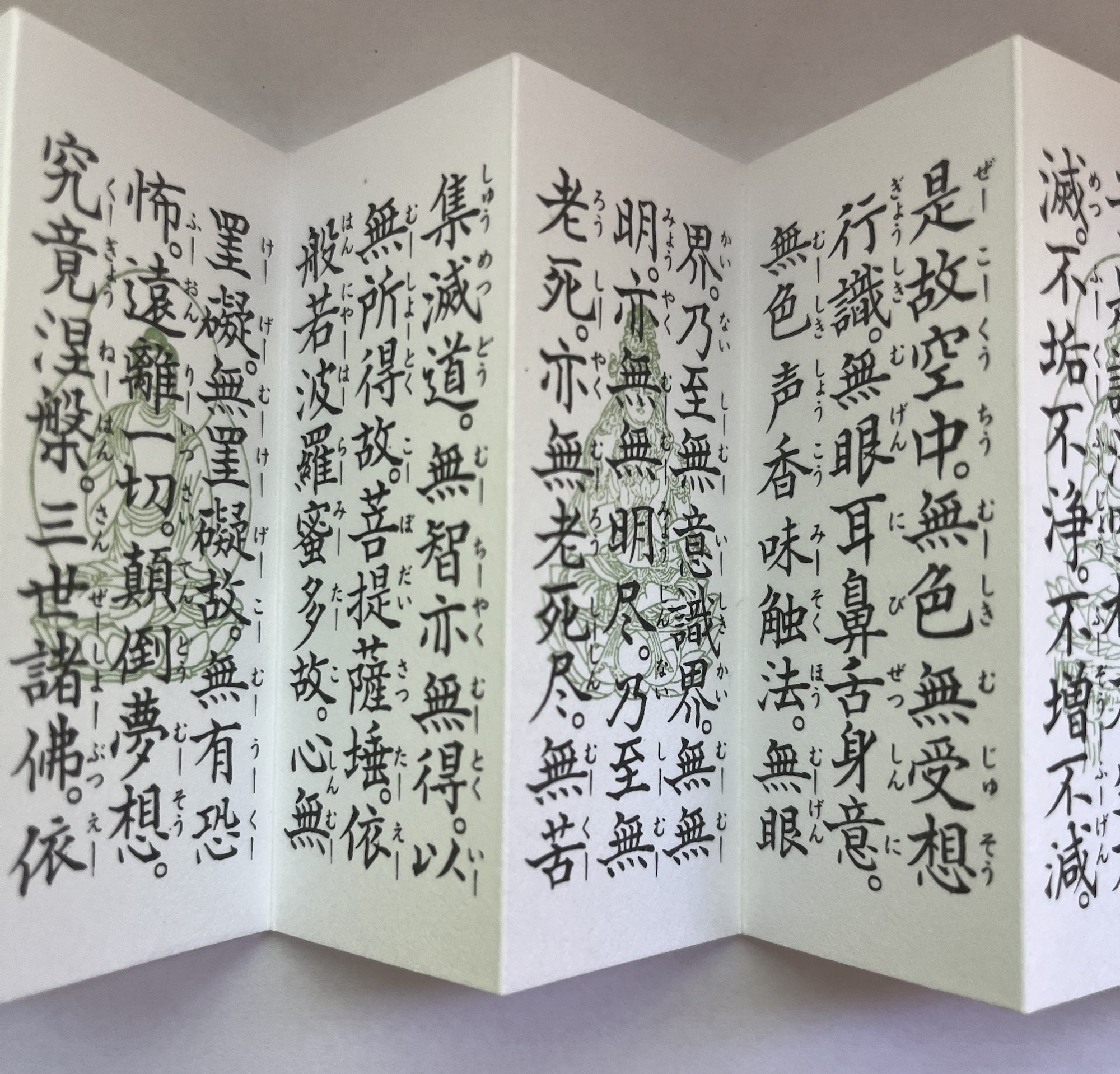
This is a boxed copy of the Heart Sutra, called the Hannya Shingyō (般若心経), with a blue brocade cover. Inside, you can see the Heart Sutra as it is usually printed: original Chinese characters with Japanese pronunciation guides. It is read from right to left, vertically:

However, if you look carefully, you will also see Buddhist deities embossed on the pages too:

They also appear on the backs of the pages too:

It took me a moment, but I finally recognized these as the Thirteen Buddhas and Bodhisattvas venerated in the Shingon-Buddhist tradition.1

I have read that many of the old Nara-Buddhist sects were gradually subsumed by Shingon Buddhism and adopted many of its practices. This includes sects such as the Kegon sect (Todaiji temple) and Hosso sect (Kofukuji temple) among others. So, this makes sense. You can learn more about Shingon Buddhism here.

Anyhow, of all the sutra books I own, I have to admit that this is my favorite one, and use it regularly for morning services (see old post).

P.S. If you’re ever curious what the Heart Sutra sounds like in Chinese (at least modern Chinese), this link has a nice example.

P.P.S. Older post about Kofukuji temple.

1 These Buddhas and Bodhisattvas are venerated in other sects in varying degrees, of course, but not as a set of thirteen like Shingon. Shingon even includes them in its ritual services.

Inequality

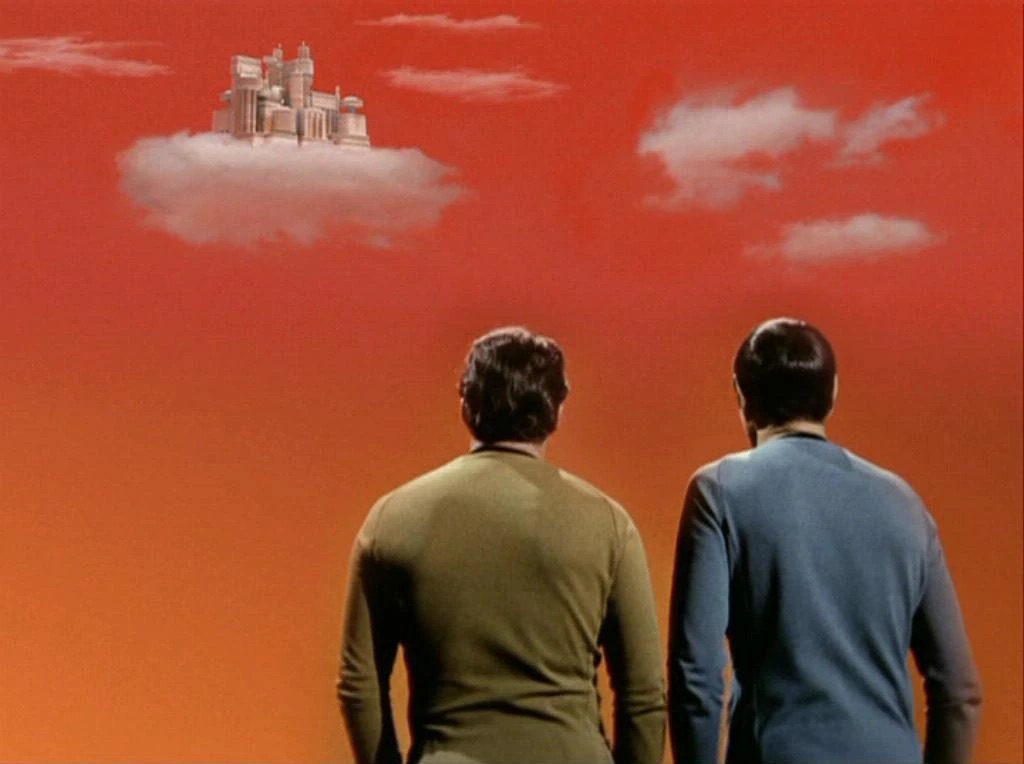
Spock sitting in an orange room, facing right, his fingers steepled as he meditates on a problem.

This troubled planet is a place of the most violent contrasts. Those who receive the rewards are totally separated from those who shoulder the burdens. It is not a wise leadership….

Star Trek: The Original Series, “The Cloud Minders” (s3ep21)

The classic Star Trek episode, “The Cloud Minders”, is a fun episode late in the third season that explores a society that is separated into two social classes: the intellectual class living in the clouds and a working-class that lives below in the mines.

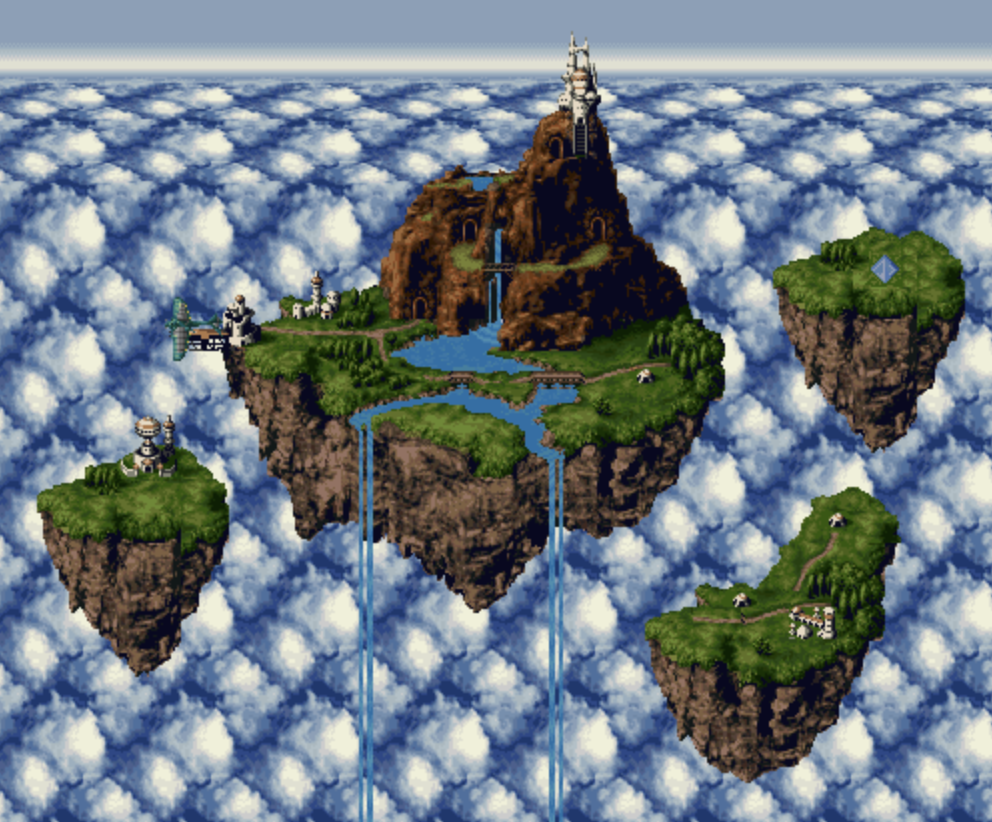
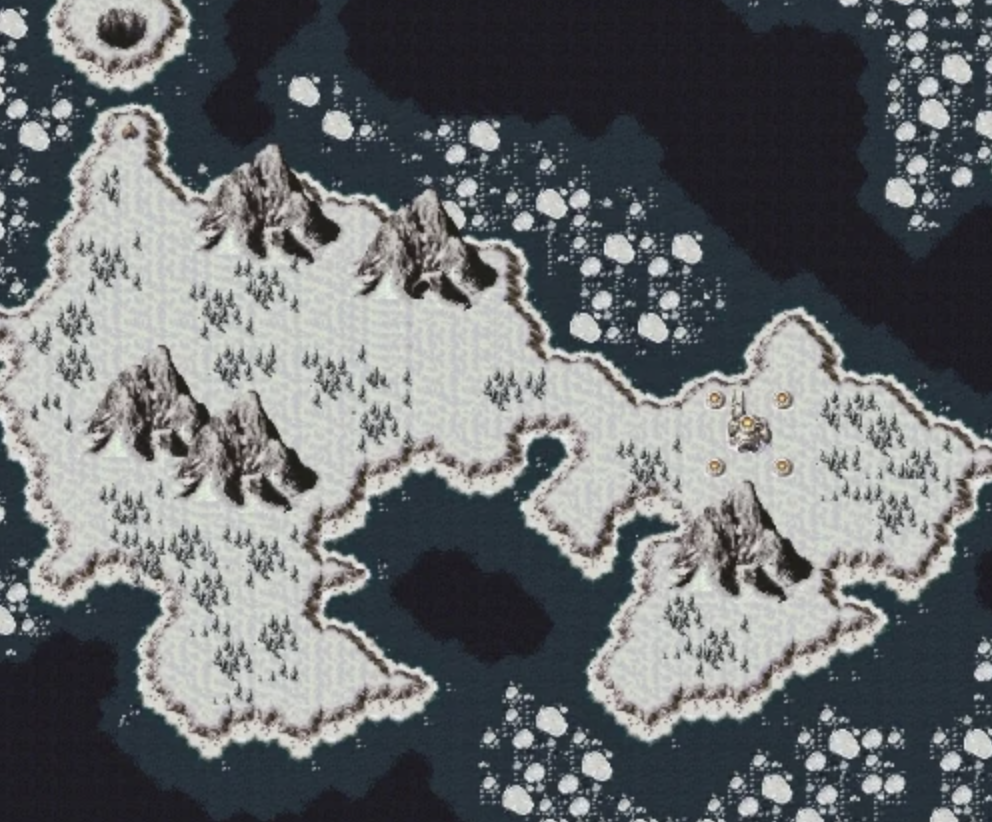
Years later, in the Japanese game Chrono Trigger, a similar theme was explored with a society that lived around 12,000 BC that had an elite intellectual class living in the clouds, and a worker class that lived in the icy wastes below.

It’s fascinating, if not somewhat disturbing to see real-life examples of this too. As much as I admire the Heian Period of Japanese culture, it’s not hard to see parallels: an elite literati that sits around and writes poetry all day, and a much larger illiterate peasant class that toils in the fields for their benefit. The inequality is disturbing.

Indeed, this pattern repeats over and over again in human history, regardless of time or place. There is even a political theory toward this end call the Iron Law of Oligarchy. Are we not also living under some form of oligarchy even today?

Further, the more that people “in the clouds” become cut off, the harder it is to develop empathy for those who toil, and easier to just blame them for their own predicament. This is the very antipathy of metta in Buddhism, the goodwill towards all beings, big or small, smart or foolish.

In some ways, the early Mahayana-Buddhist texts such as the Lotus Sutra or Three Pure Land Sutras1 were pretty revolutionary texts. The famous 12th chapter of the Lotus Sutra, and its story of the Dragon Princess deserves a look. In this story, the daughter of the Dragon King under the sea is introduced as a being of great wisdom despite only being 8 years old. The Buddha’s disciple Shariputra, representing the conservative faction of the Buddhist community scoffs at this:

At that time Shariputra said to the dragon girl, “You suppose that in this short time you have been able to attain the unsurpassed way. But this is difficult to believe. Why? Because a woman’s body is soiled and defiled, not a vessel for the Law [the Buddha-Dharma]. How could you attain the unsurpassed bodhi [awakening]? The road to Buddhahood is long and far-reaching. Only after one has spent immeasurable kalpas [eons] pursuing austerities, accumulating deeds, practicing all kinds of paramitas [self-perfections], can one finally achieve success. Moreover, a woman is subject to the five obstacles….”

Translation by Burton Watson: https://nichiren.info/buddhism/lotussutra/text/chap12.html

The Dragon King’s daughter rebuffs Shariputra’s criticism and wows them all:

At that time the members of the assembly all saw the dragon girl in the space of an instant change into a man and carry out all the practices of a bodhisattva, immediately proceeding to the Spotless World of the south, taking a seat on a jeweled lotus, and attaining impartial and correct enlightenment. With the thirty-two features and the eighty characteristics [signs of a Buddha], he expounded the wonderful Law for all living beings everywhere in the ten directions.

Translation by Burton Watson: https://nichiren.info/buddhism/lotussutra/text/chap12.html

The intended message here may seem a little strange to modern audiences. This was written for a patriarchal society in antiquity, but it’s clear the Lotus Sutra taught all beings, regardless of gender, age, or even human vs. non-human status, are equally capable of Buddhahood (full enlightenment) if given the chance. When they are not, society is stifled and suffers.

In the same way, when society maintains inequality for the sake of a few, or for the sake of tradition, it degrades society by robbing it of vitality and well-being for all.

Namo Amida Buddha

1 More on the Pure Land Buddhist path and its egalitarian approach.

Saicho: Founder of Tendai in Japan

June 4th is the yearly memorial service in Japan’s Tendai sect of Buddhism called Sangé-é (山家会) for its founder, Saichō (最澄, 767 – 822). I am writing this post a bit late this year, but I wanted to explore the life of Saicho a little bit and why he matters.

Saicho as depicted in a Heian-Period painting.

If you look at the history of Japanese Buddhism, Saicho doesn’t elicit much historical attention and discussion, even compared to contemporary rivals at the time like Kūkai, founder of Shingon-sect Buddhism. Yet, the sect he founded in Japan was overwhelmingly the largest and most influential for centuries (probably too much so), until it finally faded into the background in the late medieval period. This is why you rarely see mention of Saicho or Tendai these days: it’s far smaller now than it was in the past.

Also, to confuse matters further, Saicho is only the founder of the Japanese branch of Tendai. It was the Buddhist monk Zhi-yi (智顗, 538 – 597), who originally started the Tian-tai (天台) sect in China in the 7th century and it remains a very influential sect across many areas of mainland-Buddhist Asia (Korea, Vietnam, etc). Tian-tai in Japan (pronounced as Tendai) reveres Zhiyi as well.

Anyhow, Saicho was a monk at a time when Buddhism had already been established in Japan, primarily around the old capitol of Nara, yet was limited to a very tightly regulated number of schools and monks per school. Besides the Yogacara (Hossō) and Huayan (Kegon) schools, the rest are very obscure today. These schools had all been imported from Tang-Dynasty China, and represent “branch” schools to the mother temples there. The existing schools at that time were obligated to perform rituals on behalf of the Emperor to prevent calamities, cure diseases, bring prosperity to the nation and other political needs. In turn, the government allocated new acolyte monks every year, and allowed them to continue. However, beyond that, Buddhism had very little reach in the rest of Japanese society. This is very different than the bottom-up approach in China.

Mount Hiei today, photo courtesy of Wikimedia Commons.

Saicho was ordained as an official monk, but soon left and retreated to Mount Hiei where he underwent ascetic practices, rather than stay in the urban temple complexes. In time, he attracted other like-minded disciples, and a small, informal monastic community developed there on the mountain. Further, he carved an image of the Medicine Buddha, and later lit an oil lamp in reverence to the Buddha, praying that the light would never be extinguished. This lamp, the Fumetsu no Hōtō (不滅の法灯) was the subject of a previous post. By this point, the foundations of the temple of Enryakuji were laid.

Later, by a lucky coincidence, the capitol of Japan was moved away from Nara to Kyoto (back then Heian-kyō) in 795. Since Mount Hiei happened to be to the northeast of Kyoto, and since the northeast was considered an inauspicious direction in classic Chinese geomancy, the presence of a Buddhist temple there (namely Enryakuji) helped protect the new capital from negative influences. The Emperor, for his part, saw this new Buddhist sect has a counterbalance to the old guard sects in Nara. Thus, Saicho’s star quickly rose.

The Eastern Pagoda (Buddhist stupa), of Enryakuji Temple, 663highland, CC BY-SA 3.0, via Wikimedia Commons

Now with sponsorship from the new Imperial court, Saicho was dispatched to sail back to China in 804, gather more resources and help bring Buddhism to a wider audience. On the same diplomatic mission, another promising young monk named Kūkai was also dispatched. More on him later. Of the four ships that sailed out to sea, only 2 survived a storm at sea (Saicho and Kukai were each aboard one of the surviving ships).

Saicho’s had mixed success in China. He did not speak Chinese (he could only read it), but was able to get official permission from the Chinese government to travel to Mount Tiantai. There he stayed for 135 days. Saicho later received limited training in esoteric Buddhism, which was all the rage in Tang-Dynasty China (and Japan at this time). It wasn’t until the second generation of Tendai monks who went to China (Ennin for example) that esoteric training really developed in the Tendai sect in Japan. Saicho also copied many sutras and texts in order to provide fresh copies back in Japan (printing did not come until much later, despite flourishing in China).

Guoqing Temple (guó qīng sì, 国清寺) on Mount Tiantai, head of the Tiantai Order. Photo by Joshtinho, courtesy of Wikimedia Commons.

Nonetheless, when Saicho returned to Japan 8 months later, he was feted for his accomplishments. He got to work using his newfound training, and his collection of sutras brought back from China to petition the Emperor to start a new sect derived from the Chinese Tiantai Buddhism he trained under. Saicho’s vision was slightly different than Tiantai Buddhism, particularly because he envisioned a purely “Mahayana” sect, not just a sect with Mahayana Buddhism on top of earlier Buddhist tradition. This meant different ordination platforms, different training, etc. It was a big controversy at the time, and the powerful Yogacara (Hossō in Japanese) school based in Nara really gave him grief over it.2

In Dr Paul Groner’s book on Saicho, he explains Saicho’s vision further:

In his works directed against Tokuitsu and the Hossō [Yogacara] School, Saichō argued that all people had the Buddha-nature [capacity for Enlightenment] and could attain Buddhahood. Receiving the Fan wang [Bodhisattva precepts] ordination and adhering to the precepts were religious practices open to anyone. Anyone could receive a Fan wang ordination and anyone who had been correctly ordained could in turn confer the Fan wang precepts on others….

Saichō envisaged a system in which Tendai monks would be trained for twelve years on Mount Hiei and then go to live in the princes in order to perform good works, to preach, and to confer Fan wang ordinations.

Page 179

Further, Saicho really took the idea of unifying different Buddhist practices and traditions into an “umbrella tradition” to a new level. It wasn’t enough that the Lotus Sutra was the highest teaching (per Tiantai tradition), he wanted to really absorb other practices and traditions toward that end, and diffuse them across the country in a religious community that blurred the traditional lines between monks and laity.

Saicho’s zeal, his rising status in the new Imperial court at Kyoto, and his fresh training gave him a lot of leeway, and the Emperor granted his request. Thus, Tendai Buddhism (the Japanese branch of Tiantai) was born. It has a deep connection with the mother sect in China, but Saicho also added some innovations to it as well.

Saicho’s star was soon eclipsed after the other monk from the same diplomatic mission, Kūkai, who returned some time later and brought an extensive training program in esoteric Buddhism (something Saicho had only a partial training of). Because esoteric Buddhism was all the rage (until the Purge of 845), Kukai’s training and religious material he imported outshone Saicho. Kukai and Saicho tried to maintain a cordial relationship, but Saicho wasn’t willing to train under Kukai, and Kukai kept poaching disciples of Saicho’s so the two groups became somewhat acrimonious over time.

Saicho proved throughout his life that he was dedicated to the Lotus Sutra and the Buddhist path. He was a sincere ascetic in his youth, rather than a “career monk” like many others of his time, and held himself to high standards. The fact that attracted like-minded people around him, shows that he “walked the talk” too. In China, he underwent many trainings, copied many sutras, and didn’t stop learning and improving. It should be noted that Kukai and Saicho were both pioneers for journeying to China to bring back more Buddhist teachings, rather than past schools that relied on foreign monks to make the journey to remote Japan.

If Saicho had any virtue, it was zeal.

If Saicho had any fault, it was that he was perhaps stubborn.

Personally, I like Saicho, flaws and all. Like, I would have loved to sit with him on those early days on Mount Hiei, swap practice tips, get his advice, etc. I really like his enthusiasm and positivity. Much like Honen centuries later, Saicho was bold and motivated by sincere conviction. The Tendai sect morphed into something that I don’t think he anticipated but personally I blame politics more than the founder.

But anyway, this is all just my opinion.

As for me, I did an extra long home service for Saicho this week in his honor.

1 Devout Buddhists in early Japanese history, such as Prince Shotoku, were devotees of the Lotus Sutra as well, but I don’t think there was any effort in those days to elevate it to the highest teachings, let alone make a new sect out of it. It was just there as part of the larger tradition.

2 Acrimony between Tendai and Hosso schools of Buddhism continued for centuries, starting with Saicho’s disagreements with one Tokuitsu of Hossō. Both sects frequently faced off during official Buddhist debates at the Imperial court as well.