Star Trek, “Day of the Dove” (s3ep11), stardate unknown
Ever since … recent events, I’ve been thinking about this quote a lot.
This also reminded of a passage from the Analects of Confucius:
[8:13] The Master said: “Be of unwavering good faith and love learning. Be steadfast unto death in pursuit of the good Way.1 Do not enter a state which is in peril, nor reside in one which people have rebelled. When the Way prevails in the world, show yourself. When it does not, then hide. When the Way prevails in your own state, to be poor and obscure is a disgrace. But when the Way does not prevail in your own state, to be rich and honored is a disgrace.”
The Analects is a compilation of Confucius’s (a.k.a. “the Master”, or “Master Kong”, etc) teachings by his disciples, completed around the 1st or 2nd century BCE. This particular passage does a nice job of summarizes Confucius’s general teachings: at all times a “gentleman” (jūn zǐ, 君子) should always stick to their principles regardless of the conditions of the world.
There are times where one openly expresses their views and strives to do what’s right, where one can share their talents for public good. But there are also times when one should bide their time, avoid getting entangled, and focus inward. Whatever is necessary to maintain one’s integrity at all times. Better to be broke but maintain integrity, than to compromise personal values for the sake of gain.
In Confucius’s time the central state of the Zhou Dynasty kingship was breaking down, and the different nobles governing each fiefdom were either breaking away and declaring themselves kings, or being overthrown by their own ministers who would in turn assert authority. It was a cutthroat time in Chinese history, and Confucius wanted no part in it.
One cannot help but find parallels even today.
P.S. Featured photo is of Kang the Klingon from the Stat Trek episode “Day of the Dove”, played by the brilliant Michael Ansara.
1 When Confucius speaks of the “Way” (daò, 道) he is using a common Chinese religious term for things like righteousness, justice, stability, and so on. The Taoist usage of the term is similar, and draws from the same “cultural well” even if nuances differ.
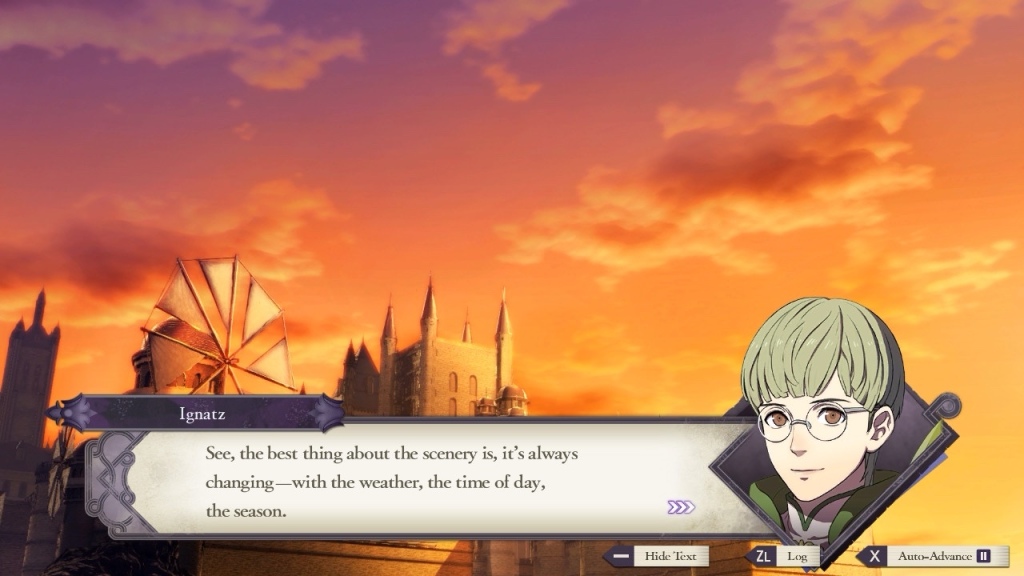
This was a neat dialogue between two of the characters in Fire Emblem: Three Houses that I wanted to post here.1 It’s very Buddhist in my opinion.
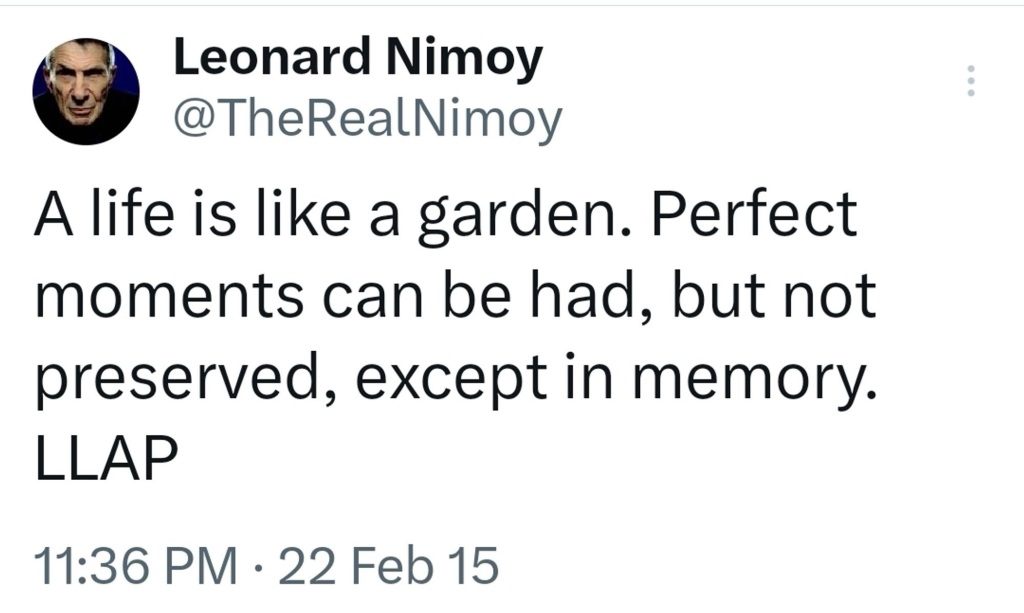
Or as Leonard Nimoy said before his passing…
I am one of those people who likes to take lots of photos of scenery on my phone, but I admit whenever I do this, the photos just aren’t the same as the original experience. I never could fully explain this to myself until I saw the dialogue above.
1 I haven’t talked about it as much lately, but I’ve been playing FE3H pretty much non-stop since last August, and am on my fifth play-through. I can confidently say this is one of my favorite all-time games.
I’ve been thinking about this conversation, shown above, from the game Fire Emblem: Three Houses. The game was made in 2019, just before the Pandemic, and other nonsense that went on in 2020 onward. How prophetic that statement was. Then again, I suppose this is something every generation has to live through in some ways. Sooner or later, things change, we lose something in the process and never get it back.
Wise words indeed…
It reminds me of a quote from the Analects of Confucius:
[9:17] The Master [Confucius], standing by a river, said, “It goes on like this, never ceasing day or night!”
Confucius said, The gentleman has three things to be aware of. When he is young and his energies are not fully controlled, he bewares of sexual attraction. When he is mature and his energies are at their height, he bewares of aggressiveness. When he is old and his energies have waned, he bewares of avariciousness.
The Analects of Confucius, 16:7, translation by Burton Watson
Although I don’t talk about the Analects of Confucius very often, this is a quote that I stumbled upon many years ago and often dwell on.
As I look back, I can definitely see the progression in my own life: I was a hopeless romantic in my teens and 20’s,1 bull-headed and arrogant in my 30’s while building up my career, and now as I approach my mid-40’s, I can see the greed and acquisitiveness cropping up now. My life is more stable than it was in my 20’s, and I have a bad habit of buying nostalgic things, or books I don’t need. In other words, a tendency or hoard now that I am able to do so.
After my grandfather passed away a few years ago, we had to sift through all his accumulated stuff, and it was a lot. He was not a hoarder by nature, and was comparatively organized, but it was still a lot of stuff. Similarly, my wife’s parents have accumulated some items as well.
My wife and I have both discussed that as we get older we do not want to be a burden on our kids, and that includes keeping things simple at home, so they don’t have a ton to throw out later. Easier said than done, but it’s an important thing to remember as you get older. People do naturally tend to hoard in their later years. Confucius knew it as far back as 5th century BCE, and the same pattern of human behavior is true even now in the 21st century.
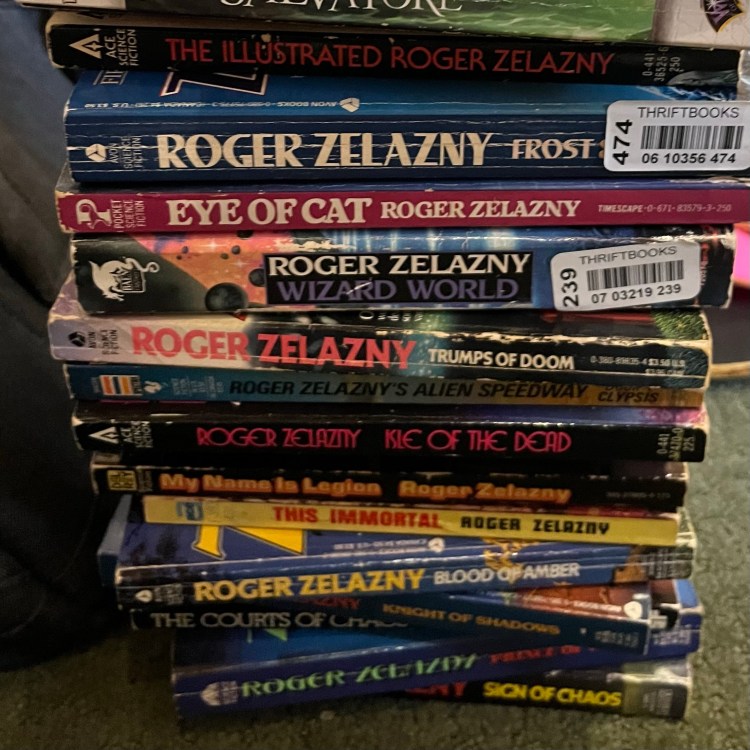
The den in our home has piled up a lot of things, and this weekend I finally looked around and found tons and tons of books I didn’t need, including some D&D books I just never used (and now don’t want), really old reference books that I might have used only once yet are taking up a lot of space, and a huge collection of old Roger Zelazny novels that I had been collecting:
In many cases, I had redundant copies, with different cover art, or they were just books I didn’t want anymore, such as the latter books in the Amber series,2 or the collaboration novels that don’t interest me.3
In any case, I spent most of a day sorting books and managed to pare down my book collection by one-third, and now have 4 stacks of books sitting on the floor waiting to be sold to Half Price Books, or tossed out for good. In some cases, I can simply recycle old books where possible by removing the covers and recycling the pages. Further, I found a bunch of old journals I kept when learning Greek and Sanskrit, and while it’s fun to see the progress, they’re also taking up space.
Further, I have a bunch of DVDs, KPop CDs,4 and games I hardly ever use, probably further paring things down. I don’t need to throw them all out, but it’s not hard to separate what I actually use and want to keep (e.g. Lord of the Rings trilogy on DVD because streaming sucks) vs. things I never watch such as Star Wars sequel movies.
It really is amazing how much I have accumulated in the last 15 years.
To be honest, it’s been a great feeling to clean all this out. When I see my bookshelf looking trim and well-organized with room to spare, less schwag from random toys and figures I had accumulated, it makes me feel lighter. I may remove even more to make room, but we’ll see.
This is hardly the level of cleaning that someone like Marie Kondo might have suggested, but it is worthwhile to clean out the house from time to time, while also guarding against future impulsive purchases. Taking a half-second to think before you do something impulsive can probably save you future headaches. I have started to do this more and more in recent months, reminding myself that I am pretty happy overall with what I have, even I am still paying for years of impulsive clutter.
As I wrote in my book, much of what we carry around is as much as mental burden as it is a physical one, so sometimes it’s perfectly fine to just put it down and leave it.
For example, I even threw out some really, really old sentimental items because they were just not needed anymore. I realized that nostalgia is all well and good in small doses, but you can’t cling to everything in your past, and once you’re dead, it won’t mean anything to whomever has to clean up that stuff anyway.
Leonard Nimoy was right:
Of course, I have a hunch that I’ll be having this conversation again in 5 years, but we’ll see. 😉
1 My mother told me that I was a hopeless romantic since I was probably 5 years old, but I definitely remember being girl-crazy in high school and college. I am pretty happy that I was able to find that special lady in my life a while back, though. 🥰
2 The first five books of the Amber series are awesome and I re-read them from time to time, but the last five aren’t worth re-reading. The convoluted plot and new generation of characters really turned me off.
3 Roger Zelazny collaborated with another of authors at the time, and some of those books definitely reflect the other author more than Zelazny. Frankly, some of them just aren’t very good. I do like Coils though.
4 I was hugely into KPop about 10-15 years ago, during the days of SNSD, 2NE1 and so on, but frankly most of it isn’t really worth holding on anymore. Plus, there are the smaller groups that just never really made it, and whose CD’s it’s time to let go of.
Note: I started writing this post way back in December, but have been mulling over it for quite a while. The fact that I post this on the day before Nirvana Day (the death of the Buddha) is serendipity. 😏
The day of my mother-in-law’s 100th day memorial was a very somber day for us all in Japan. My wife had gone back to Japan shortly after her mother passed away, but the kids and I had not, so this was our first real chance to say goodbye. Per Japanese funerary customs, we dressed in somber blacks and dress suits (first time in many years for me), and we carried her ashes from her home to the nearby Buddhist temple where the memorial occurred.
It was a surreal morning: the weather was sunny and pleasant. Overhead, the sky was blue, and winter birds were singing in the trees, while we were quiet and carrying the ashes of our beloved relative, lost in thought. The contrast between life and death was impossible to ignore.
It made me realize that both life and death are all around us. They exist like two sides of the same coin.
Even in the original series, Star Trek, Mr Spock acknowledges this:
Roger Zelazny in his novella, Creatures of Light and Darkness (1969), also explores the idea that the absolute, most fundamental powers in the Universe are life and death. The usurpers, Anubis (of the House of the Dead) and Osiris (of the House of Life) vie with one another, but also keep the Universe in balance:
Anubis: “Osiris and I are bookkeepers: We credit and we debit. We raise waves, or cause waves to sink back again into the ocean. Can life be counted upon to limit itself? No. It is the mindless striving of two to become infinity. Can death be counted upon to limit itself? Never. It is the equally mindless effort of zero to encompass infinity.…”
Creatures of Light and Darkness, by Roger Zelazny
Buddhism looks at this truth, and extends it one step further by pointing that life does not end with death, and the two blend together so much, and are so closely tied to one another that there really isn’t “death” as separate from “life”. Just one big fluid mess. Consider this verse from the Heart Sutra:
“Listen Sariputra, all phenomena bear the mark of Emptiness; their true nature is the nature of no Birth no Death, no Being no Non-being, no Defilement no Purity, no Increasing no Decreasing….”
If we see that life and death are two sides of the same coin, and that one cannot exist without the other, where do we draw the line? That’s the point of this verse, I think. That’s emptiness (shunyatā in Sanskrit) in Buddhism: all things exist in a provisional, contingent way that depends on other things. No separate thing called “life”, nor a separate thing called “death”. It just goes on and on…
In the Analects of Confucius, there is a famous quote that expresses this same sentiment:
子在川上曰。 逝者如斯夫 不舍晝夜。 [9:17] The Master, standing by a river, said, “It goes on like this, never ceasing day or night!”
Analects of Confucius, 9:17, translation by A. Charles Muller
In the same way, life and death dance around one another ad nauseum. In the Buddhist viewpoint, people are reborn again and again without end. Not one life or two, but countless, countless lives stretching back to some distant, unknowable eon, just as we are doomed to repeat this dance of birth, struggles of growing up, struggles of old age, illness and death over and over again into the future. A cosmic “rat race” without end.
In the immediate term, it’s a reminder that we cannot avoid death. We cannot live without it either. All existence is marked by death, and all existence must face it sooner or later.
During my mother-in-law’s memorial service, per tradition of the Jodo Shinshu sect, the famous Letter on White Ashes composed by Rennyo to a follower in the 15th century, was read aloud:
Who in this world today can maintain a human form for even a hundred years? There is no knowing whether I will die first or others, whether death will occur today or tomorrow. We depart one after another more quickly than the dewdrops on the roots or the tips of the blades of grasses. So it is said. Hence, we may have radiant faces in the morning, but by evening we may turn into white ashes.







 Gleanings in Buddha-Fields
You must be logged in to post a comment.