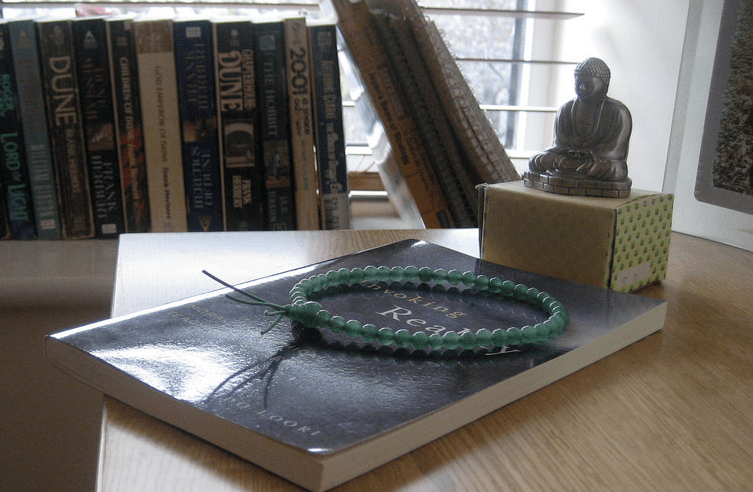
Jodo Shinshu Home Liturgy

For the sake of completeness,1 I wanted to cover home liturgy for the Jodo Shinshu sect of Buddhism as it is promoted in Japan. I spent years at a local Shinshu temple here in the US during the 2000’s and 2010’s, part of the Buddhist Churches of America (the American branch of Jodo Shinshu), whose liturgy is slightly different, but I’ll try to clarify the differences. There aren’t many, but it did surprise me when I first experienced Jodo Shinshu in Japan, and realized that it wasn’t what I was expecting.

Further, Jodo Shinshu’s liturgy is somewhat different than other ones we’ve covered so far. When we look at Rinzai, Soto, Tendai and Jodo Shu sect home liturgies, they tend to follow a certain flow:

They may have more or less content, and the particular verses may differ, but generally that’s the format.

Jodo Shinshu home liturgy differs from this pattern somewhat. I believe this is primarily because of the Jodo Shinshu sect emphasis on the Other Power of Amida Buddha, rather than one’s own good works. So, there’s nothing to cultivate in the traditional Buddhist sense, only to express gratitude for.

This lead to some changes, particularly through Rennyo the 8th monshu (head of the sect) who through his efforts to consolidate the various communities, promoted a liturgy format that centers around Shinran’s hymn, the Shoshinge. Thus, in Jodo Shinshu sect Buddhism, daily recitation of the Shoshinge is encouraged, including six wasan hymns at the end, followed by dedication of merit verse similar to other sects. This is the basic Jodo Shinshu home liturgy. If you recited the Shoshinge, and dedicated merit, that would be sufficient.

You can see an example of this here:

Alternatively, if you don’t want to recite the whole Shoshinge, as this site shows (another site) there are other things one can recite instead:

But many sources suggest the Shoshinge plus Wasan hymns when possible. Also, the same sources emphasize that Jodo Shinshu tradition does not recite the Heart Sutra (unlike other traditions).

Anyhow, going back to this site, the home liturgy is as follows:

  1. Light a candle and incense at your buddhist altar (if you have it).
  2. Put your hands together and recite the nembutsu
    • In Jodo Shinshu style, the nembutsu sounds more like na man da-, na man da-, na man da-
  3. Ring bell twice
  4. Recite the sutra (see above)
  5. Recite the dedication of merit hymn
  6. Optionally, recite a letter from Rennyo’s Gobunsho letters. My service handbook lists the following letters as recommendations to recite (English translation can be found here):
    • Fascicle V, letter 10 – “On Faith as Fundamental”
    • Fascicle V, letter 5 – “On Realizing Faith”
    • Fascicle V, letter 1 – “On Laymen and Laywomen Lacking Wisdom in the Last [Dharma] Age
    • Fascicle V, letter 2 – “On the Eighty Thousand Teachings
    • Fascicle V, letter 6 – “On the Great Benefit Bestowed with [the Awakening of] the One Thought-moment [of Faith]

From my experience with the Buddhist Churches of America, this format is similar to what we recited in Sunday services, though with a couple small differences. First, the Shoshinge was only recited at more formal ceremonies since it is so long. For normal weekly Sunday services, the Juseige was most often recited. Also, at least at the temple I went to, we also explicitly recited Taking Refuge in the Three Treasures (namu kie butsu, namu kie ho, namu kie so), which is something I don’t see in Jodo Shinshu services in Japan.

But in Japanese temples the Shoshinge is emphasized, and other aspects somewhat de-emphasized, hence it’s a bit unconventional.

Good luck and happy chanting!

Namu Amida Butsu

P.S. Photo was taken may years ago in 2008 when I lived in Ireland for a time. Back then, I had a lot fewer Buddhist resources (and there weren’t many in Ireland anyway), so I made this into a very impromptu altar.

1 I have not covered the Shingon and Nichiren sects, but I have too little information on them to speak with any certainty. Readers will have to do their own research for now.

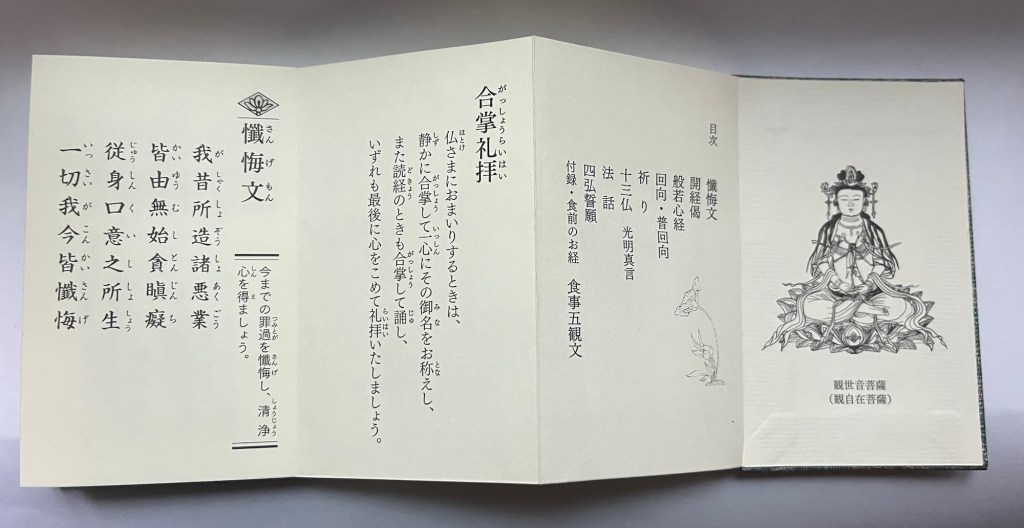
Rinzai Zen Sutra Book

Recently, I wrote about a Soto Zen sutra book I purchased some years ago, and it’s still one of the best books I own. Today, I wanted to highlight another Japanese-Buddhist sutra book that I had for years, but never really understood what it was about.

The book is available online here, among other places. The book was published by Nanzenji temple, a major Rinzai Zen temple, and I found it at a Kinokuniya bookstore here in the US in the Japanese-language section. It is titled 私の般若心経 (watashi no hannya shingyō, “My Heart Sutra [book]”)

The sutra book is really small, and easily fits in the palm of my hand. As the website description states, this is designed to that one can carry it on one’s person as a charm, but also use it for home liturgy. Pretty clever. I’ve seen such “sutra book charms” before but usually they are very small, and the print is lower-quality, since it’s meant to be carried, not read. This by contrast is very nice quality.

Inside, the contents are surprisingly dense for such a small book. Inside contains the texts necessary to do a home service according to Rinzai tradition, though it differs slightly from the one I posted previously.1

The contents, shown below include basic liturgy such as repentance verses, the opening of the sutra, a copy of the Heart Sutra, dedication of merit, four bodhisattva vows, and so on.

Above, we see the first four pages of the sutra book, from right to left: a picture of Kannon Bodhisattva, then the table of contents, an explanation about how to gassho, and finally the sangemon (verses on repentance).

Below, you can see the Heart Sutra from end to end (read right-to-left, vertically). If you can read Japanese hiragana script, you can recite this because each Chinese character is annotated with a pronunciation guide (a.k.a. furigana):

The furigana script is a bit small and hard to read, but that’s understandable given how small this book is.

Surprisingly, the sutra book contains other things I wasn’t expecting, such as mantras for the Thirteen Buddhas and Bodhisattvas, often recited during yearly memorials for the deceased. The book also the Mantra of Light, surprisingly. It also contains the five verses for contemplating food.

Finally, the book contains a sermon by the author, and has a handy blank section at the end for taking notes.

Weirdly, I’ve owned this book for almost 10 years, but back then I couldn’t read Japanese very well, so I didn’t fully appreciate what the contents of the book were, plus I had no familiarity with Rinzai Zen. Now that I have a bit more experience, I can appreciate this book a lot more, and have been using it for home liturgy lately.

For such a compact book, it’s really very nice, and only costs ¥550.

If you’re able to read basic hiragana script, and have an interest in Rinzai Zen, it’s definitely worth a purchase.

1 As noted in a previous post, Rinzai Zen in particular a number of lineages and factions, each one based around a different temple. This may help explain why the liturgy varies as much as it does.

Jodo Shu Home Liturgy

Hello dear readers, I realized recently that after posting I home liturgy examples for Soto Zen, Rinzai Zen, and Tendai sect Buddhism, I had never posted about Jodo Shu sect home liturgy despite being a follower for many years. There are a couple reasons for this.

Sutra book for Jodo Shu followers. I think this might be the first such book I have ever owned.

First, as someone who came to Jodo Shu Buddhism many years ago, I tended to rely on English sources only, and such sources tend follow Honen’s teachings, but nothing beyond that. Thus, through such books I followed Honen’s simple advice that focusing on the nembutsu is all that mattered. So, in my early efforts to learn Buddhist practice, I focused on reciting just the nembutsu. More on why the liturgy has expanded over time later in this post.

The second reason is that the Jodo Shu home liturgy is particularly long. My book on Jodo Shu explains that this usually takes about 20 minutes.

My limited experience confirms this. I have an old Jodo Shu sutra book from many years ago, which I received during one of our earliest family trips to Japan. That particular winter, we celebrated New Year in Japan, I got to participate in a local Joya-no-kané (“ringing of the temple bell”) ceremony, thanks to my father-in-law, and generally had a great time. It might even be the first sutra book I ever owned.

A photo of Honen, founder of Jodo Shu Buddhism, with his famous poem “Moonlight” below. A copy of his handwriting is to the right depicting the Nembutsu.

The book, needless to say, has some sentimental value for me.

But I digress.

You can find example Jodo Shu liturgy here on the official Jodo Shu homepage in Japanese. There is even a translated one on the Jodo Shu North American mission website. The format of the liturgy is:

  1. Kōgé – verse for offering incense
  2. Sanbōrai – taking refuge in the Buddha, Dharma and Sangha
  3. Shibujō or Sanbujō – both are verses of praise to the Buddhas
  4. Sangege – verses of repentance
  5. Junenreciting the nembutsu ten times.
  6. Kaikyōgé – verses for opening the sutra
  7. Shiseigé – an excerpt of the Sutra on the Buddha of Immeasurable Life, which I posted here.
  8. Honzeigé – dedicating the good merit to all beings
  9. Junenreciting the nembutsu ten times.
  10. Ichimai-kishōmon – Honen’s One-sheet Document, essentially his last will and testimony.
  11. (optional) Hotsuganmon – a verse attributed to Chinese Pure Land master Shan-dao, expressing a desire to be reborn in the Pure Land, become a bodhisattva and help others.1
  12. Shōyakumon – a verse for expressing the light of Amida Buddha.
  13. Nembutsu-ichi-éreciting the nembutsu as much as one likes.
  14. Sō-e-kō-gé – Another verse for transferring the good merit to all beings.
  15. Junenreciting the nembutsu ten times.
  16. Sōgangé – a variation of the Four Bodhisattva vows.
  17. Sanshōrai or Sanjinrai – three adorations or prostrations toward Amida Buddha
  18. Sōbutsu-gé – verses of praise to the Buddhas, but also a kind of warm sendoff too.
  19. Junenreciting the nembutsu ten times.

As you can see, it has many components, with the nembutsu sprinkled throughout. Many of these verses are very short too, so once you get used to the format, it is not that hard. It can feel a bit daunting upfront if you’re new to Pure Land Buddhism, though.

Thankfully, the Japanese site also has a couple example videos showing slightly different versions of the liturgy. Version one below with uses the Shibujo and Sanshorai:

and version two, which recites the Sanbujo and Sanshinrai instead:

The North America sites uses a little of both: the Sanbujo from version two, and the Sanshorai from version one. By contrast, my sutra book has all the verses, so you presumably pick which version you want to recite. It seems like they are basically interchangeable.

Since there is already an official English translation available online, I won’t repost here. Please refer to the links above for more details.

Instead, I wanted to address the question of liturgy versus just saying the nembutsu, and I found a good explanation in this article.

The author reiterates that Jodo Shu Buddhism begins and ends with the nembutsu and doesn’t need other verses to effect rebirth in the Pure Land. So, pretty consistent so far.

And yet, the author cites Honen who encouraged people to cultivate the “five right practices” (五種正行, goshushōgyō) which includes:

  • Recitation of verses
  • Observation
  • Paying homage
  • Reciting the nembutsu [lit. Amida Buddha’s sacred name]
  • Praise

Thus as a liturgy, it is meant to cultivate all five, with the nembutsu as the peak or the climax of a movie. From a general Mahayana-Buddhist standpoint, it covers all the important points: taking refuge, repentance, reciting a Buddhist sutra, sharing the good merit, and vows toward becoming a Bodhisattva.

My personal opinion is that if you’re new to Pure Land Buddhism, it’s perfectly fine to just recite the nembutsu, but as you become more comfortable with Buddhism, you can expand to include the whole liturgy. I have no doubt that it’s a wonderful experience once you do it from start-to-finish, but without context it can seem a bit difficult.

In any case, good luck and happy chanting!

1 My sutra book puts the Hotsuganmon at the very end, while the Jodo Shu site in Japanese puts it just after the One Sheet Document. The North America Jodo Shu site doens’t include it at all. I am not sure why there is a difference in format. I assume it is optional.

Rinzai Zen Home Liturgy

Recently, I finally got a hold of an introduction book on Rinzai Zen from Japan titled うちのお寺は臨済宗 (“My Temple is Rinzai Zen”). This book is part of a series for Japanese-Buddhists to learn more about the particular parish or sect they grow up in, and I have used it extensively covering other sects here. For some reason, I failed to find the Rinzai book in the past, but was finally able to order it.

Anyhow, most Western books on Rinzai Zen tend to focus on the mystical aspects of Zen without explaining the more practical side for lay followers. So, similar to my posts on Soto Zen and Tendai, I wanted to post the details of Rinzai Zen home liturgy based on what I learned from the book. Personally, I find the mundane side of Zen far more interesting than the more mystical aspects taught by the likes of Alan Watts and D.T. Suzuki.

As with Soto Zen, Rinzai Zen emphasizes the importance of zazen (meditation) practice, but it does have its fair share of chanting and devotionals as well as a support. How you, the layperson Zen student, balance these needs is something you will learn over time. I just wanted to share the information as presented in the book. If you are new to Buddhism, and maybe not comfortable with meditation, start with doing home devotional services first, and as you build confidence, you can expand to other practices in including meditation and precepts, etc.

In many ways, Rinzai Zen liturgy very closely resembles Soto Zen. Both are derived from Chinese tradition1 so this isn’t very surprising. Also, some chants will have a “Sinified” (Chinese) version and a native Japanese version, some only appear in Sinified form. I will try to post both when applicable.

A Quick Note on Liturgy

The book recommends consulting your local Rinzai temple for details. I believe this is because there are many subsects in Rinzai Zen (complicated history) and thus many lineages and home temples. Each temple lineague might do things a little differently, so the book cautiously suggests checking with your home temple first.

But if you are reading this, you probably don’t live in Japan, so the book also suggests commonly practiced liturgy format. That is what I am posting here. Again, it’s very similar to Soto Zen, so if you are unsure, you can consult Soto Zen sources too.

Example Rinzai Zen Home Liturgy

So far, based on research, I have seen that there are two versions use in Rinzai Zen. For simplicity, I will call them the “short version” and “long version”. People are welcome to chose which version they want to recite, or adapt as needed. These are examples. For both versions, I was lucky to find some nice video examples from the temple of Yogaku-ji in Tokyo. Thank you!

Short Version

The format of the “short” liturgy is as follows:

The video below shows a similar format, without reciting the Four Bodhisattva Vows, so it’s a very short and simple.

Kaikyogé: Opening of the Sutra Verses

I had trouble finding an example in native Japanese, but posting the Sinified form below. It is basically identical to other sects. I included rough translation as well.

Sino-JapaneseTranslation
Mu jo jin jin mi myo hoThe supreme and profound teachings (Dharma) of the Buddha
Hyaku sen man go nan so guis truly rare to encounter,
Ga kon ken mon toku ju jibut now we are able to hear and receive it.
Gan ge nyo rai shin jitsu giIt is our hope that the teachings become clear to us.

Sutra Chanting

As stated above, the Heart Sutra, Kannon Sutra, or Hakuin’s Hymn of Zazen are the most common choices. Feel free to choose one, or rotate them each day.

As noted above, my book mentioned that one can also recite the Dharani for the Prevention of Disaster, typically chanted three times after reciting the Heart Sutra. But this is entirely optional.

Shiguseigan: The Four Bodhisattva Vows

See this post for more details and translation. Youtube link here. It is the same as other sects in Japan.

Sino-JapaneseNative Japanese
Shu jo mu hen sei gan don/a
Bon no mu hen sei gan dan
Ho mon mu ryo sei gan chi
Mu jo bo dai sei gan sho

Fueko: The Dedication of Good Merit Towards Others

See this post for more details. This liturgy is somewhat unusual in that every sutra book I see consistently prints it as a mix of both native Japanese followed by Sino-Japanese (highlighted in bold). So I am posting as-is. Youtube link here.

Dedication of Merit, full version
Negawaku wa kono kudoku wo motte, amaneku issai ni oyoboshi,
Warera to shu jo to, mina tomo ni butsu do wo jozen koto wo
Ji ho san shi i shi fu
Shi son bu sa mo ko sa
Mo ko ho ja ho ro mi

There is also a second version that I found in a liturgy book from Nanzenji temple, another major Rinzai temple that uses a different format:

Sino-JapaneseTranslation
Gen ni su kun teMay this good merit that I have accumulated…
Fu gyu o i shiiBe distributed to all beings
Go ten ni shun sanSo that we may all walk this path
Kai kyu jin bu doAnd equally attain the Buddha Way.

What’s fascinating about this version is that the Chinese characters are exactly the same as found in other sects (for example Tendai liturgy), but the pronunciation is much more Sinified (Chinese-style), rather than Japanese style readings. Feel free to adapt either verse. I prefer the Chinese-style pronunciations as I find them shorter and easier to pronounce.

Long Version

The format of the “long” liturgy is as follows:

Many aspects of this liturgy are the same as the short version, or they are linked in other blog posts (The Great Compassion Dharani is too long to post here). Some of these “dedication of merit” verses are hard to find online, so I wasn’t able to post anything here.

In any case, the temple of Yogaku-ji in Tokyo has put another excellent video with this format, which I encourage you to take a look.

Conclusion

These are just a few examples (I found others) of how Rinzai Zen liturgy works. As with many aspects of Buddhism, find what works, and is sustainable, and feel free to adjust and modify over time. Consistency, preferably daily, is the most important thing.

Good luck, and happy chanting!

P.S. Featured photo from my visit to Kennin-ji Temple in 2024.

1 In truth, all Buddhism in Japan derives from Chinese Buddhism (often through the Korean peninsula), but for historical reasons, the two Zen sects (namely Rinzai and Soto) were founded by monks who journeyed to China during the Song Dynasty (10th – 13th century) which is much later than other traditions who imported Buddhism during the Tang Dynasty (7th – 10th c.). This means that they had the latest, freshest practices and monastic traditions compared to other sects, and this earned Zen an outsized cultural impact where other sects were either homegrown or seemingly antiquated. When Rinzai’s cousin Obaku came to Japan in the 16th century, it was even newer and briefly had a heyday in Japan.

Eight Hour Monk

SPOCK: There are many who are uncomfortable with what we have created. It is almost a biological rebellion. A profound revulsion against the planned communities, the programming, the sterilised, artfully balanced atmospheres. They hunger for an Eden where spring comes.

Star Trek, “The Way to Eden” (s3e20), Stardate 5832.3

As I write this, the family is in Japan (sadly, I was unable to go this year) visiting relatives, and I am home with the dog, Cherry.

Since I have a couple weeks to myself, I thought it would be a great time to put in a little extra Buddhist practice, catch up on some personal projects, go offline for a bit, etc. Basically, try to live like a monk for a few days. I carefully planned it out, decided what I would do and not do, took a three days off from work, and then got ready for the “mini home retreat”.

I lasted eight hours.

The first few hours were great. It was peaceful, quiet, and I did finish reading a couple books on my to-do list, meditated extra, recited more sutras than usual, and so on. But then, as the hours progressed, isolation and boredom set in. I started worrying if I was missing a text from my family (in case of emergencies), and I discovered that it’s hard to read Japanese books without a dictionary which I only have on my phone.

Embarrassingly by early afternoon I gave up and turned on my phone. Then I went and played Fire Emblem: Three Houses for a few hours,1 watched Star Trek V: The Final Frontier2 for some crazy reason, got bored and played more Fire Emblem until 11pm.

Day two, I didn’t even really bother to try again. I realized that I had hyped up this time off too much, and without any support or contact with others, I quickly started to get a little stir-crazy. That’s not to say the time wasn’t unproductive either. Even today (day two), I still got some extra stuff done around the house, and did a little more Buddhist stuff than usual. But I also played Fire Emblem: Three Houses for three hours.

τὸ μὲν πνεῦμα πρόθυμον, ἡ δὲ σὰρξ ἀσθενής.
“Indeed the spirit is willing, but the flesh is weak.”

Matthew 26:40-43 with original Koine Greek

Indeed, in the Sutra on the Buddha of Immeasurable Life, one of the Three Pure Land sutras, the Buddha Shakyamuni laments that:

“People of the world, being weak in virtue, engage in strife over matters which are not urgent….Since they have not done any good in particular, nor followed the Way, nor acted virtuously, when they die, they will depart alone to an inferior world. Although they are destined to different states of existence, none of them understands the law of karma3 that sends them there.”

Translation by the late Hisao Inagaki, hosted here.

So, the problem of laziness and lack of follow-through in religious practices (or personal projects) is nothing new. Even in Japanese, there is a phrase: mikka bōzu (三日坊主) meaning “three day monk”. It’s a tongue-in-cheek phrase about how most endeavors last three days at most.

In my case, I think my failure was a combination of over-zealousness and perfectionism which set the bar too high for something I am not really used to doing day to day. The idea of a religious personal retreat is still worth it, but I should have set the bar lower the first time, and tried to be a bit more realistic.

The point isn’t to give up and just play more Fire Emblem (but then again, I might anyway), but reflect on what worked, and what didn’t and focus on something realistic and sustainable. As Dogen reminds us, it can be done, but expecting it to work overnight if I just push through hard enough is maybe a bit silly.

Namu Shakamuni Butsu
Namu Amida Butsu

P.S. Bonus post. Apologies for any typos, I wrote this one quickly while it was still fresh in my mind, so probably more editing mistakes than usual.

P.P.S. On the plus side, I also had some time to practice vegetarian cooking and made a large batch of Mapo Tofu, Pasta Mama (in honor of Captain Pike in Star Trek: Strange New Worlds), and some Thai curry. This photo is the Mapo Tofu:

… I also harvested the scallions I’ve been growing since Spring:

1 I am on my eighth play-through I think. I am finally going back and replaying my first route, Crimson Flower route (i.e. with Edelgard) and doing things I missed on my first play-through. It’s been nearly two years, and I still enjoy this game very much. The story, dialogue, characters and world-building never cease to amaze me.

2 I think I watched it to remember why this movie is so unpopular. It has some good qualities to it, but yeah, it’s not very good. As a teenager, I watched it in the theaters and thought it a bit odd, but it’s not aged well for me.

3 For similar teaching, see the first chapter of the Soto Zen text, the Shushogi.

Soto Zen Service Book

Something I haven’t really covered before, but worth talking about lately is a Soto Zen service book I picked up some years ago at Sojiji Temple which is not too far from my wife’s home in Japan.

Back then, we’d visit Japan yearly to see relatives, and let the kids get much-needed language exposure. Also, I was in touch with an expat1 who lived there for 20 years and shared a passion for Buddhist temples. He and I would go “temple hopping” together around the Tokyo area whenever I was in town, and as my firstborn daughter got older, she would come with us.

In any case here is the cover of the service book for Soto Zen home liturgy:

Cover of Soto Zen service book, purchased at Sojiji temple. Title roughly translates as “Soto Zen scriptures for parishioners”.

Inside, you can see the table of contents on the right side. Japanese text is tradtionally written right to left, and vertically (not horizontal):

Table of contents of sutra service book for Soto Zen. Purchased at Sojiji temple.

On the left-hand side is the Kaikyoge, a verse recited traditionally when starting a service. The gist of the verse is that encountering the Dharma is quite rare, and yet we are privileged to read and recite it now. Thus, may we all attain the Buddha way. During my years with the Buddhist Churches of America, we read a very similar liturgy in English. The concept is almost universal in Buddhist services.

Also, notice that the text in the Kaikyoge is Chinese characters (kanji), but with hiragana text to the side as a pronunciation aid. This is because most liturgy in Japanese Buddhism was originally adopted from China, and thus requires pronunciation guides (same is true with Korean Buddhism too, iirc). At the very bottom-left is smaller text helping to explain the meaning of this verses.

The photo below is the first part of the verse section of the Kannon Sutra (a.k.a. chapter twenty-five of the Lotus Sutra). Again, we see vertical lines of Chinese characters since the original edition was recorded in old literary (not modern) Chinese, and phonetic hiragana script beside each character. The large circle mark indicates a ring of the bell if you have one. As with above, it is read from right to left, vertically.

A copy of the Kannon Sutra, version section, from a Soto Zen service book, from Sojiji temple.

What I really like about this particular sutra book is how clear and readable the hiragana text is. Some books use a font that’s hard to read if you are a foreigner (or even Japanese possibly). This makes reciting difficult. But here, if you can read hiragana script, it’s easy to follow along.

A close up of the Kannon Sutra as printed in a Soto Zen service book, purchased at Sojiji Temple.

By the way, below is an example of verses that are not recorded in Classical Chinese: an excerpt of the Shushogi, chapters three and four. Since the Shushogi was recorded natively in Japanese, there are fewer Chinese characters, and the style of language is more readable to a native speaker. To me, as a language student, it’s still pretty difficult since the source text by Dogen was composed in the 13th century. The grammar is quite different 800 years ago. This section also includes explanations at the bottom for modern native speakers.

Because of the popularity of the Shushogi among laity in the Soto Zen tradition, all five chapters are recorded in this sutra book.

The rest of the content is pretty typical, and I explained the full contents in an older post, but what I liked about this particular sutra book was the quality, readability, and thorough content.

Side note: it turns out that there is also an eBook version of the service book (originally linked here) available in both Apple Books and Google Play formats. The eBook version is a lot nicer than I expected, and closely follows the physical book (the subject of this post), with a few slight differences:

  • The kaikyōge (verses on opening of the sutra) uses Sino-Japanese, the service book uses a mixture of native Japanese and Sino-Japanese
  • Similarly, the Sankiraimon uses native Japanese in tbe eBook version, but Sino-Japanese in the physical book.
  • the eBook version has a really nice altar image (gohonzon). A person who can’t access Buddhist altar goods could print it out, and install in a Buddhist altar (obutsudan).

But I digress.

For some reason I find sutra books fascinating, and if readers enjoyed this post, please let me know. I might try to make more posts on the various books I’ve collected over the years. I have service books from practically every sect in Japan.

P.S. Happy 4th of July to readers in the US. Also, happy (belated) Canada Day to readers there. To my ancient roman readers happy … (checks notes) … Battle of Adrianople?

1 via online Buddhist circles, namely the long-dead E-Sangha forum. IYKYK.

April 2025 Updates

Hello Dear Readers, and Happy Earth Day! 🌎

Just a small update: Recently I was looking for some old Buddhist resources I used to rely upon a lot, and was shocked to discover that these resources have all but disappeared. Internet attrition has taken its toll, so many old websites I used can only be found on places like the Wayback Machine and such. This makes them pretty hard to find. Also, with modern web-technology, it is far easier now to post Japanese characters side by side with English text.

So, I’ve been working on a side project to “rescue” old information from obscurity and modernize it for easier study and (when possible) for other languages. So, the first one I have completed is Honen’s famous One Sheet Document or ichimai-kishōmon. I was able to use a good translation by the now-defunct JSRI (Jodo Shu Research Institute) and draw from Japanese-language sources too since I can now read such things, unlike 15 years ago. Please check out the link above. I also added Cyrillic text for Ukrainian/Russian Buddhists who might want to recite the document.

The other text I am trying to recover is larger, and taking more time: the Tannisho. The Tannisho is centrally important to the Jodo Shinshu tradition, but Taitetsu Unno’s fabulous translation is almost gone. I got a Japanese-language introduction at Tsukiji Honganji in 2023, and I’ve been using that, plus Dr Unno’s translation. It is only partially complete, but work is proceeding. I’ve also, thankfully been able to find more information in Japanese that helps explain the history, and so on.

That’s about it. I hope to rescue more resources soon, in particular some of Rennyo’s ofumi letters, but it’s slow and time-consuming, and my own resources are somewhat limited.

Mindfulness Meditation Isn’t What You Think

Spock : “… I have noted that the healthy release of emotion is frequently very unhealthy for those closest to you.”

Star Trek, “Plato’s Stepchildren” (s3ep10), Stardate 5784.2

Meditation, specifically mindfulness meditation, is touted as a stress-relief exercise. Busy people believe that if they can block out the time to meditate for X minutes a day, or when stressed, this will make more happy and productive. It has been all the rage in Silicon Valley too.

But it doesn’t work.

It will calm your mind while you are sitting, but as soon as you are back to work, your blood pressure will quickly rise again. Old habits will quickly resurface. Self-help, in short, does not help.

How do I know this?

I tried the same trick in my late 20’s. My first child was born, and I was working at Amazon (yes, that Amazon) for a few years in a technical support role. The environment was stressful, demanding, constantly on the move, the on-call rotation gave little time to decompress because something was always broken,1 and I had to drive into work at all hours of the night to try and fix it.

Since I had recently converted to Buddhism at the time, and listened to a lot of Ajahn Brahm dharma talks, I wanted to try meditation. We had a spare office that no one used, so I would go in there once or twice a day, turn off the lights, dutifully sit, chant certain Buddhist mantras, meditate for 20 minutes or more, and then return to work.

As soon as I was back at my desk, the stress would rise all over again. I kept at the meditation for months, almost a year, before I finally gave up.

The stress, constant sense of inadequacy measuring myself to hyper-competitive co-workers who graduated from Stanford, unrealistic work performance goals, fear of losing my job, and so on simply didn’t go away until I QUIT MY JOB AND TOOK A LESS DEMANDING ONE.2

It took me years as a Buddhist to finally realize that stress-relief is not what mindfulness meditation was intended for.

Mindfulness meditation is a tool to develop insight, not stress relief. It is necessary in the early stages of meditation to quiet the chatter in the mind, but that is just the first stage. It is to remove barriers to insight by develop a focused mind, and a quiet mind, a mind that can perceive things in a more balanced way. Consider this quote from the Buddha in a very early text, the Dhammapada:

  1. There is no meditative concentration for him who lacks insight, and no insight for him who lacks meditative concentration. He in whom are found both meditative concentration and insight, indeed, is close to Nibbana.
  2. The monk who has retired to a solitary abode and calmed his mind, who comprehends the Dhamma with insight, in him there arises a delight that transcends all human delights.
  3. Control of the senses, contentment, restraint according to the code of monastic discipline — these form the basis of holy life here for the wise monk.
Translation by Soma Thera from https://www.accesstoinsight.org/tipitaka/kn/dhp/dhp.25.budd.html

The emphasis is on focus, insight, and contemplation NOT relaxation or stress-relief. Mindfulness meditation has been repackaged and sold to naive Westerners with false promises. Meditation really does provide excellent benefits, but it has to be done as part of a much larger, holistic lifestyle change and with wholesome intentions. This is the “holy life” as described by the Buddha: a life of wholesome, guilt-free conduct, goodwill towards others, and a desire to pursue the Dharma (the teachings of the Buddha).

First, one should take up the Five Precepts of Buddhism. As we see in verse 374 above, the Buddha openly encourages that we curb our worst behaviors first as a foundation for other Buddhist practice. One will gain no lasting benefit from meditation until this is done. Full stop.

Second, one must approach meditation with the mindset of a monk. It is not necessary for lay-people to give up everything and go live in the woods. Buddhism accommodates both the “house-holder” lifestyle and that of a true renunciant (a.k.a. a monk or nun). But both the renunciant and the house-holder are expected to live a life of moderation and restraint.3 Easier said than done (speaking as a gamer and foodie), but it’s a goal to sincerely aspire to.

Speaking of restraint, one should always guard one’s speech. A long time ago, a Buddhist minister I admired once told me that speech was like toothpaste: once it was out of the tube, you couldn’t put it back. One has to learn to carefully monitor what one says both in person and online (and yes, at work). Again, easier said than done, but the alternative will only make your life miserable.

Finally, when such good foundations are established, meditation will help you learn more about yourself, and the world around you.4 It’s incredibly helpful, and life-changing when carried to fruition. I have my own little private insights that have stayed with me through the years, and I hope you will find yours too.

Namu Amida Butsu

Namu Shakamuni Butsu

P.S. if you feel the need to calm yourself right away, try something much simpler. You can recite the nembutsu, the Heart Sutra, a mantra, whatever. Try that for a minute, and see if that works. It is a band-aid fix though, and you still need to approach things from a holisitic standpoint, or you will gain no long-term benefit. Alternatively, just go for a walk.

1 Years later, the sound of a pager going off still triggers me a little bit. No joke.

2 Another ex-Amazonian who had joined the same company years earlier confided in me that after leaving Amazon, he drank himself stupid for months to decompress. I noticed that I was still on a hair-trigger for months after leaving Amazon, and it took me a while to unlearn those habits too. My wife noted that my posture improved after leaving, and that I grumbled about work less. Some jobs are simply not worth staying in.

3 The Buddha was pretty flexible about what exactly this meant, citing whatever cultural standards applied at the time as a benchmark. In short, a lot of it is rooted in common courtesy and good sense. If you cannot act toward others using common courtesy, meditation ain’t gonna fix your issue.

4 You may learn that your whole problem is that your job sucks, for example, and that the burn-out is not worth the money. Of course, if you’re a single mom caring for three kids, you have a lot fewer options available to you, and in such cases I recommend the nembutsu as a starting point.

Updates on my Buddhist Home Practice

Hello Dear Readers,

In June, I posted about the “day” and “night” concept used in Tendai Buddhist practice, using the example of the Jimon sect. I felt inspired to experiment a bit and try this out myself. My adjustments to home practice took a few twists and turns, but within a week or so I settled onto a consistent routine that I’ve been happy with.

Here’s what I’ve been doing for the past month, more or less.

For mornings, I focus on Kannon Bodhisattva:

For evenings, I focus on Amida Buddha:

I have found that splitting the practice like this has had some benefits. For me, this style of practice lets me cover both the here and now, through veneration of Kannon and reciting the Heart Sutra, while also looking to the future through venerating Amida Buddha through the evening practice. I feel pretty content covering both aspects.

I made both morning and evening routines intentionally short and lightweight so they are more sustainable, rather than doing something elaborate.

Still, to be honest, sometimes I am still too busy to even do this much. Or I just forget. 😅

I am not proud of that, but I felt I should be honest with readers and let them know that mistakes in Buddhist practice are perfectly OK. Life is unpredictable, and for us are “householders” (e.g. lay-Buddhists), life gets in the way. That’s why the monastic community was (presumably) created: to give people the option of practicing Buddhism full-time, not part-time.

That said, Buddhist practice is like exercise: the more you can do, the better. Even a little bit is a positive thing.

Anyhow, when I am simply busy, sometimes I will just recite either the Kannon mantra in the morning, or the nembutsu in the evening. Sometimes, I can only just bow at the altar for a moment.1 The Soto Zen resources I read previously often said much the same thing: adjust as needed, depending on how busy you are. Sometimes your home practice will be longer, sometimes shorter.

Just don’t give up.

Keep experimenting, keep trying, make it personal, and always be flexible.

Good luck and happy … er, “Buddhist-ing”.

P.S. I took a nice, relaxing weekend off to catch up on some things, avoid social media, and just unplug for a bit. I didn’t really have a plan, I just took a break. I may have also played some Fire Emblem games as well. The fun continues. 😀

1 To make this “split service” work, I have two altars now at home: the main one for Amida Buddha and tiny little “side altar” for Kannon on my bookshelf. It’s basic, but it’s something I can keep building on over time.

Make Your Own Buddhist Sutra Book

Lately I’ve been talking a lot about home Buddhist practice, including home Buddhist services and such. These are things that devout lay-Buddhists often do (myself included), but then I realized I never talked about making one’s own sutra book.

There are a couple reasons why one might make their own.

First, Buddhist resources outside of Buddhist countries are hard to find. For someone like me who lives on a large city with a large Asian community this is not so hard. But if you lived in, say, rural Iowa, it might be a lot harder. So, sometimes you have to just DIY.

Second, it’s a nice way to personalize your Buddhist practice in a way that suits you.

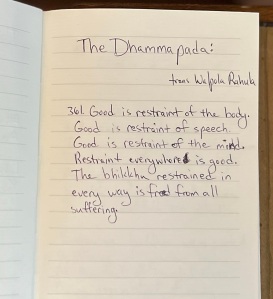
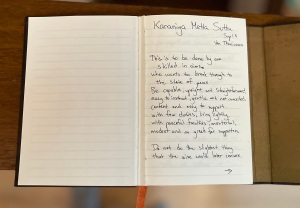
I started making my own maybe about 9-10 years ago. I picked up a nice little Paperblanks notebook at the airport at the time, and I decided to collect Buddhist sutras and quotes that I liked. I started out small, just copying things now and then from sites like accesstoinsight.org, or copied from books.

This is a small quote from the Dhammapada :

And the Metta Sutta from the Pali Canon:

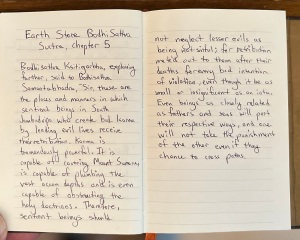
I also recorded Mahayana Buddhist sutras as well, such as this quote from chapter 5 of the Earth Store Bodhisattva Sutra:

I copied each of these by hand. I even tried to copy much longer texts, such as the 4th chapter of the Golden Light Sutra, which is a very beautiful prose about repentance and goodwill, but the text was much longer than I thought, and I eventually gave up halfway.

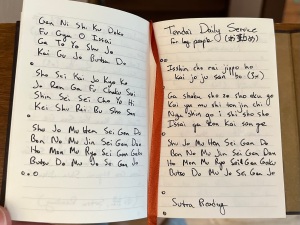
But eventually, around 2017-2018, when I left my old Jodo Shinshu-Buddhist community and started exploring other sects, I focused more on home practice and I started to add Japanese-style liturgies as well:

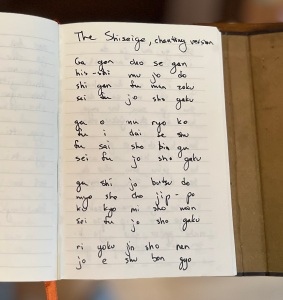
I also wrote specific sutra chants too, such as the Shiseige:

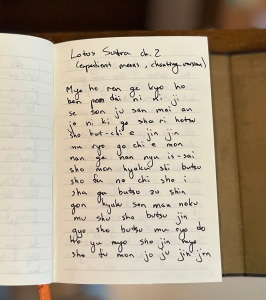
And chapter 2 of the Lotus Sutra:

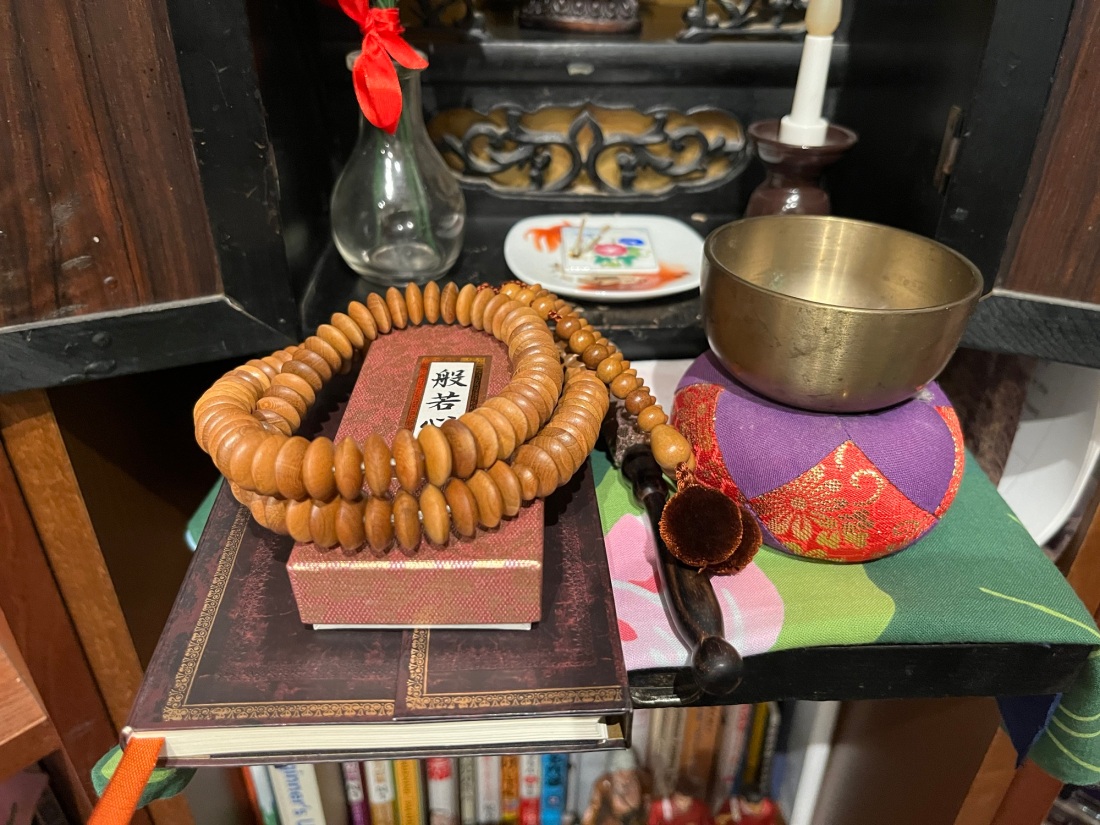
As you can see from the featured photo above,1 I keep this sutra book on my home altar (bottom left in photo), and use it almost daily. A personal sutra book works best when it’s meaningful, simple and useful for you, so the important thing is to not do what other people do, but make it useful for yourself. Find sutras or Buddhist quotes you like, collect them into a notebook, and copy them by hand (word of advice, use a gel pen, not a ballpoint pen, it’s easier to read), and make it your own. There’s no wrong way to do it.

Further, the sutra book I made has gradually progressed over time, just as my own path and practice have and I still have more room to write things in the future.

1 You can also see my Buddhist rosary, a Tendai-style rosary I ordered online, along with a boxed copy of the Heart Sutra, which I got in 2023 while visiting Nara‘s Kofukuji Temple, one of my personal favorite.