Gollum

‘I am sorry,’ said Frodo. ‘But I am frightened; and I do not feel any pity for Gollum.’

‘You have not seen him,’ Gandalf broke in.

The Fellowship of the Ring, J.R.R. Tolkien

One of the most iconic characters in J.R.R. Tolkien’s Lord of the Rings trilogy is Gollum.

Gollum a twisted and corrupted being who kept the Ring of Power for countless centuries deep within the mountains, living far beyond his natural lifespan, and his mind growing darker and more sinister in the isolation, plus his obsession with the Ring…

He will never be rid of his need for it. He hates and loves the Ring, as he hates and loves himself. Sméagol’s life is a sad story.

The Fellowship of the Ring

Unlike other villains in the story, Gollum does not crave power, destruction, and dominion over others. Gollum only seeks to survive at all costs, and to get back his “precious” ring. By sheer craving and spite, he endures the elements, eats raw flesh, and lies, cheats, and backstabs his way through life.

For Dungeons and Dragons players, Gollum is the embodiment of the neutral-evil alignment in my opinion.

But why do I mention this?

I feel like we’ve all encountered someone like Gollum in our lives: someone nasty, cruel and devoid of any empathy toward others. I remember as a kid there was a middle-aged man who lived in our apartment complex who hated us kids playing outside, and would glare at us when we were too loud.1 I had a very wealthy, but also petty old woman live next door a few years ago, who constantly belittled others (including me and my yard). Even her helpers clearly hated her. There are people on social media, who do nothing but lie, twist words, and badmouth others simply so they can stay on top.

Frodo’s reaction to Gollum is understandable. Gollum is a contemptible, wicked creature, and Sam is right not to trust him. And yet, Gandalf knows something that Frodo doesn’t, and still pities him, even if he doubts that Gollum will ever change his heart:

Deserves it! I daresay he does. Many that live deserve death. And some that die deserve life. Can you give it to them? Then do not be too eager to deal out death in judgement. For even the very wise cannot see all ends. I have not much hope that Gollum can be cured before he dies, but there is a chance of it.

The Fellowship of the Ring

Gandalf is realistic in that the Ring of Power has so badly corrupted Gollum, that it’s doubtful he would ever return to his former ways, or somehow redeem himself, and yet there is a glimmer of possibility. The second book, The Two Towers, hints at this too just before he betrays the hobbits at Shelob’s lair…

For a fleeting moment, could one of the sleepers have seen him, they would have thought that they beheld an old weary hobbit, shrunken by the years that had carried him far beyond his time, beyond friends and kin, and the fields and streams of youth, an old starved pitiable thing.

The Two Towers, J.R.R. Tolkien

Behind countless layers of spite, rage, craving, self-hate, and so on, Gollum is still a weary l, pathetic, old hobbit (a.k.a. Sméagol) who just wants to be happy. His understanding of happiness is twisted by the Ring of Power, but the basic need is there. Frodo understood this, and pities him, even as Sam berates him.

One can only imagine: if Sam had been more patient with Gollum, would Gollum have still betrayed them?

In any case, one can look at the Gollums in our life and see the same thing. One has to approach such people realistically, they will hurt you if they can, but they are still pitiable creatures. Redemption may not be possible, but it’s helpful to remember who they are deep down.

Namu Shakamuni Butsu

1 A family friend got fed up with his attitude and came over and chewed him out. After that, he never bothered us again. I am always grateful to her for standing up to that bully.

Change

Think of this as “part two” of yesterday’s post. Some other quotes I found that I felt expressed the same sentiment, both from Star Trek, and from Dune.


Spock: Change is the essential process of all existence.

Star Trek, “Let That Be Your Last Battlefield”, Stardate 5730.2

“Deep in the human unconscious is a pervasive need for a logical universe that makes sense. But the real universe is always one step beyond logic.”

Frank Herbert, Dune

“When things change, your absolute universe vanishes, no longer accessible to your self-limiting perceptions. The universe has moved beyond you.”

Frank Herbert, Heretics of Dune

Just posting as-is. Enjoy!

It’s Just There

I used to be an avid Dune reader in my younger years, and posted quotes from it all the time in earlier iterations of the blog. Anyhow, I found this quote from the third book:

The universe is just there; that’s the only way a Fedaykin can view it and remain the master of his senses. The universe neither threatens nor promises. It holds things beyond our sway: the fall of a meteor, the eruption of a spiceblow, growing old and dying. These are the realities of this universe and they must be faced regardless of how you feel about them. You cannot fend off such realities with words. They will come at you in their own wordless way and then, then you will understand what is meant by “life and death.” Understanding this, you will be filled with joy.

Muad’Dib to his Fedaykin, from Frank Herbert’s “Children of Dune”

I have probably said this a few times recently, but like it or not we are not the center of the Universe, no matter how much we like to think we are. The universe will carry on without or without us, and sometimes it’s capable of really wondrous moments, and sometimes it will unleash some really shitty realities on us. And there’s only so much we can do to control that. Like a raft navigating treacherous waters, we have to carefully row and pay attention to the currents.

In spite of all this, though, it doesn’t mean we have to sit and be passive either.

Speaking of old science-fiction quotes…I am an avid Roger Zelazny reader, and Isle of the Dead is among my favorite books ever. I always like this quote because of its cosmic feel, but also its unintentional Buddhist message which resembles Saicho’s famous quote about “lighting one corner of the world”:

“Earth-son, I greet you by the twenty-seven Names that still remain, praying the while that you have cast more jewels into the darkness and given them to glow with the colors of life.”

Roger Zelazny, “Isle of the Dead”

Also, consider the 16th chapter of the Lotus Sutra:

My pure land is not destroyed, yet the multitude see it as consumed in fire, with anxiety, fear and other sufferings filling it everywhere….But those who practice meritorious ways, who are gentle, peaceful, honest and upright, all of them will see me here in person, preaching the Law [a.k.a. The Dharma]

Translation by Burton Waton

Thus, even in the midst of crisis, or madness, or despair the light of the Dharma still shines even when it seems obfuscated. It is always there for those willing to look, and for those willing to cast a few jewels into the darkness.

The Quiet Life

When news of the capital happens to come my way, I learn of many people in high places who have met their end since I retired to this mountain, and other lesser folk besides, too many to be told. And how many houses too, have been lost in all those fires? In all this, my mere passing shelter has remained tranquil and safe from fears.

Small it may be, but there is a bed to on a night, and a place to sit in the daytime. As a simple place to house myself, it lacks nothing. The hermit crab prefers a little shell for his home. He knows what the world holds. The osprey chooses the wild shoreline, and this is because he fears mankind. And I too am the same….

The Hojoki “Record of a Ten Foot Square Hut”, Dr Meredith McKinney translation

More on the fleeting nature of power here, here and here. Injustice is a pervasive aspect of our world and yet life goes on. Just ask Epicurus.

The Value of Friendship

Finishing the last chapters of Roger Zelazny’s A Night in the Lonesome October, I wanted to post this quote:

Greymalk: “Damned if I know, Snuff. Does anybody really care about a hungry cat, except for a few friends?”

Snuff: “Maybe that’s all anybody ever has, no matter how the big show is run.”

Recently, someone at work told me a story. They took some time off and returned to their native home of Bosnia, and visited family and friends that they hadn’t seen in years. Every morning, they sat and enjoyed Turkish-style coffee with friends and family and just talked. When they came back to work, they told the rest of us that sometimes the best therapy is to just sit and talk with loved ones over coffee. Of course, this doesn’t cure everything, but even just getting into a routine of talking with loved ones face to face on a regular basis can do much to help one’s wellbeing.

My wife, kids and I try to sit for dinner every night when possible. My oldest is just about ready to leave for college, so this time will not last much longer, and we rarely ever talk about anything serious, but it’s nice to just share whatever interesting thing happened that day. Once our oldest leaves the nest, things will certainly change around the house.1

In any case, even in the most turbulent times, amidst all the chaos, sometimes all you can do is just foster relationships with the people around you. Just simply being around trusted people is a good start.

1 In the office too, those times when I could sit and chat with trusted co-workers were kind of nice even if corporate office life kind of sucked. Being laid off during the early Pandemic, and then working at a new place has cut me off from that experience because I still work from home (too many people hired during Pandemic, not enough office space). Working from home has its benefits too, but the isolation comes at a cost.

Who Needs Gods Anyway?

One of my personal tradition every Halloween season is to read Roger Zelazny’s book A Night In the Lonesome October, one chapter per day. The book, like all of Roger Zelazny’s writings, is a terrific book and I always find something new every time I read through it.

I felt like sharing this quote with readers:

We made our way cross-country through the colors of autumn browns, reds, yellows and the ground was damp, though not spongy. I inhaled the odors of forest and earth. Smoke curled from a single chimney in the distance, and I thought about the Elder Gods and wondered at how they might change things if the way were opened for their return. The world could be a good place or a nasty place without supernatural intervention; we had worked out our own ways of doing things, defined our own goods and evils. Some gods were great for individual ideals to be aimed at, rather than actual ends to be sought, here and now. As for the Elders, I could see no profit in intercourse with those who transcend utterly. I like to keep all such things in abstract, Platonic realms and not have to concern myself with physical presences…. I breathed the smells of woodsmoke, loam, and rotting windfall apples, still morning-rimed, perhaps, in orchard’s shade, and saw a high, calling flock V-ing its way to the south. I heard a mole, burrowing beneath my feet….

Even though I am a pretty devout (read: religious) Buddhist, I like this quotation a lot. It’s something I’ve felt for a long time: that religion works best when gods are kept at a distance, rather than an oppressive reality that must be feared and interpreted and re-interpreted over again. What’s front and center matters most. The world exists, it’s our job to learn how to live in it.

Further, I suspect everyone has a tendency to build God in their own image, hence the diversity of interpretations and approaches, but it’s all in our minds. The Buddha-Dharma is nice because it just works like the Laws of Physics or Gravity. Gravity doesn’t care whether you believe in it or not, it just works. In the same way, the Buddha-Dharma doesn’t demand fealty, respect or praise. Its teachings and goodwill are free for all. We do our best to work things out, and put the teachings into practice. How we interpret it isn’t so important. It’s just there.

Just like Fall weather, Halloween and nature.

Namu Amida Butsu

P.S. More on the virtues of knowing nothing, and just being humble.

A Trek Dad’s Review of Yesterday’s Son

As a big fan of the original Star Trek series (hereafter TOS), I recently picked up a trove of old Star Trek novels and have been reading them one by one.

I had heard about Yesterday’s Son from fellow TOS fans and started with this one first. The novel is based on the penultimate episode of TOS: All Our Yesterday’s, and continues the story further implying that during Spock’s brief tryst with Zarabeth resulted in a son, quarter Vulcan, quarter Human and half…Sarpeidon-ese?

Anyhow, the story involves Spock using time-travel to reunite with his son, bring him back to Spock’s time, and helping him integrate to life in the Federation. Further, Spock and his son develop a difficult, strained relationship over their differing backgrounds. Meanwhile, the Romulans are (as always) up to no good, and have their sites on the Guardian of Time from the season 1 episode City on the Edge of Forever. The end is a dramatic conflict with the Romulans, and a nice heroic moment for Spock’s son.

As a novel, it was a fun read with good pacing. I felt the novel deftly balanced key references to TOS without being a blatant fan-service, yet at the same time also provided innovations that didn’t go too far off the rails of Trek canon. In other words, it stayed faithful to Trek lore while also expanding it in a sensible way.

I really enjoyed this book, and would definitely recommend for classic Trek fans.

Making Your Own Book Cover, Japanese Style

When you buy books in Japan, you are often asked if you would like a book cover. If so, the staff will kindly fold some brown wrapping paper for your books, with just the proper fit. Because people often read on crowded trains where there is little privacy, it is a handy way to keep your reading habits private. It is also a nice way to prevent your book from being scuffed in a backpack or purse.1

Similarly, you find many nice premade book covers in Japanese stores, or online. But I think making your own is the best way to do it. If done correctly, it is guaranteed to fit the book properly, and you can personalize it with whatever paper or design you choose.

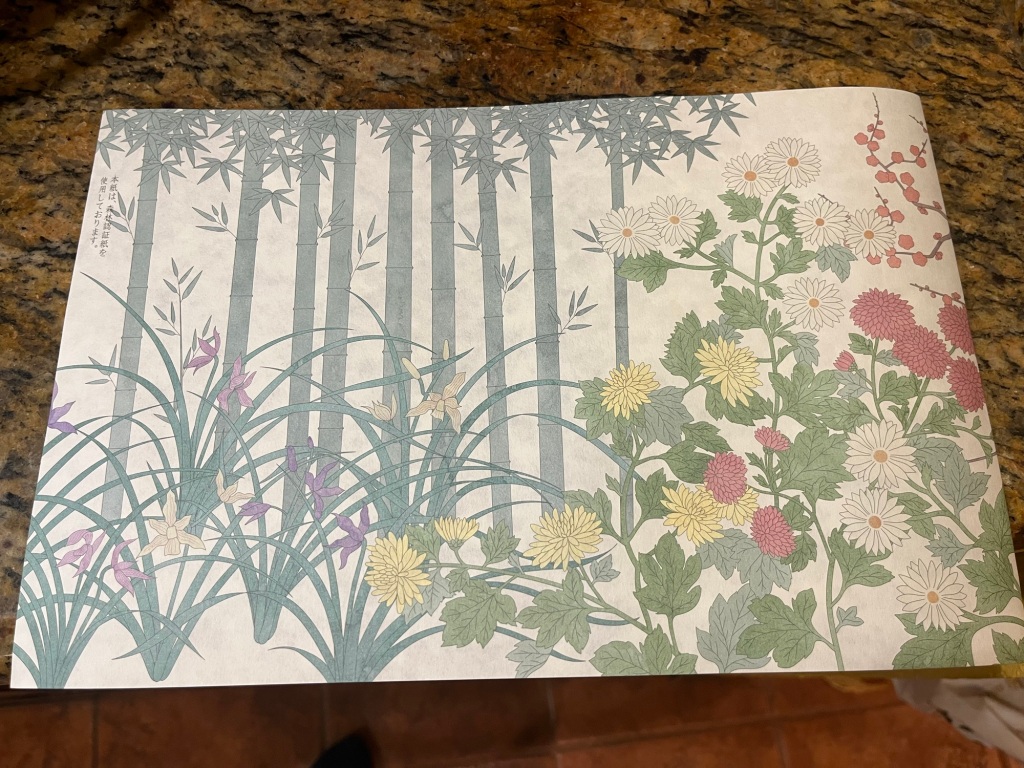
Recently, I purchased some Japanese book covers from a local antique store, but I was disappointed to find some of them didn’t fit any of my books. Coincidentally, I received some nice wrapping paper, so I decided to put it to good use.

Following these handy instructions, I was able to make a book cover out of it:

The instructions, essentially, require fitting the book to a corner of the paper or fabric, and leave a margin of 5cm on each side. When folding the paper, it’s important to make it flush with the top and bottom of the book. After that, it should fit like a glove.

My book cover above required a couple tries to get it right. I didn’t properly measure the first time, and it was a bit too small. So I had to fold a second time, this time reading the instructions more carefully, and got a satisfying fit. I’ve really enjoyed this book cover once it was complete. Once you learn the technique, I realized that it’s easy enough to make one using any sturdy, foldable paper, or soft fabric. Plus, if you are artistically inclined, you can probably make book-covers that are suitable for the books you are covering. I wish I had that talent. 😅

Anyhow, enjoy!

1 I have an old, used Star Trek novel whose corner broke off recently, so I can safely say that protecting books, especially legacy used books, is important.

Enma: King of the Dead

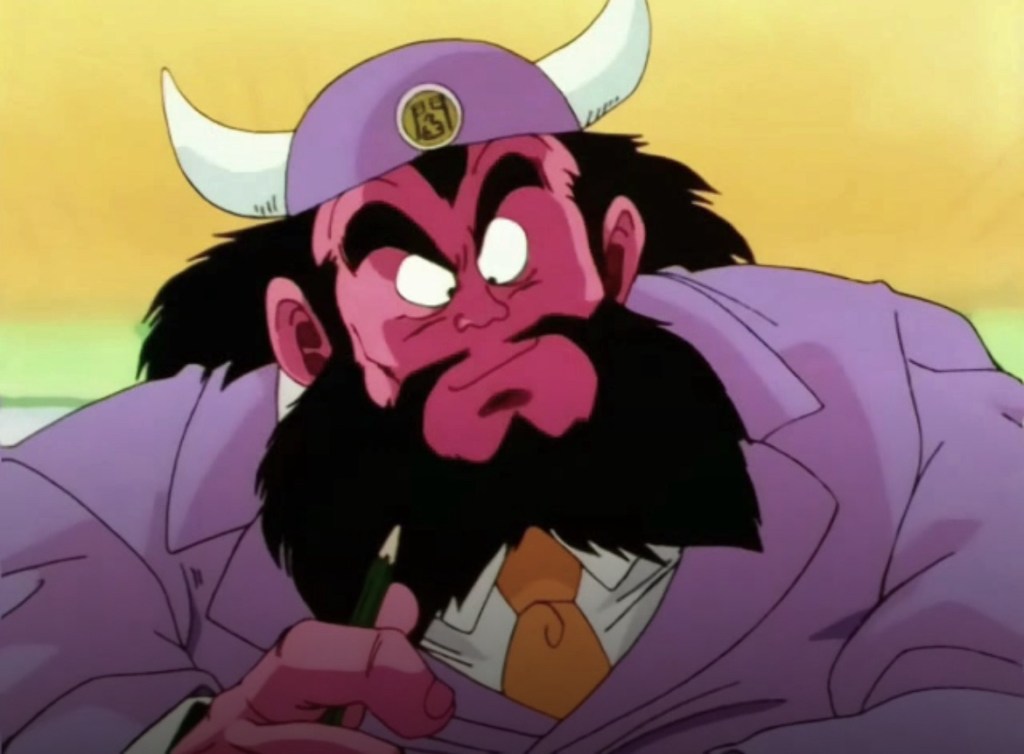
My son is at the age where is he is obsessed with Dragon Ball,1 so we watch some of the episodes together on Crunchyroll.

Source: https://dragonball.fandom.com/wiki/King_Yemma?file=KingYemmaNV01

Dragon Ball is a fun series because it blends a lot of Japanese-Chinese mythology, especially the early series, into a futuristic storyline. Goku is obviously based off of the famous legend of the Monkey King, Sun Wukong (Son Goku in Japanese). Another great example is the character Enma.

In Dragon Ball, Enma (sometimes spelled “Yemma” in English) presides the realm of spirits and behaves like a modern bureaucrat. In spite of the suit and tie, this Enma is definitely based on the original figure in Japanese mythology, named Enma Daiō (閻魔大王, “Great King Enma”).

The original Enma is a fascinating example of a “fusion” mythology, not a native Japanese one. Enma is originally based on the Hindu god Yama, lord of the dead.2 However, in China he was transformed into a Confucian-style bureaucrat and shoe-horned into Buddhist cosmology as a judge of the dead. Enma, along with other judges, determine the dead’s next destined rebirth within Buddhist cosmology. During certain Chinese funerary practices and festivals, you can see his visage on “ghost money” used to help the dearly departed coast through the trial process and ensure a smooth, lenient transition to their next life.

This Enma, a bureaucrat / judge of the dead, was how it was imported to Japanese culture in antiquity. He is even featured in classics such as the Tales of the Heike. When the warlord Taira no Kiyomori is dying from a terrible fever, he has a vision of Enma and his demonic attendants awaiting him. I’ve also heard of an old tradition where parents in Japan would scold their kids saying Enma would pull their tongue out if they told a lie. I have never heard this first-hand though, so I wonder if anyone ever says it anymore.

Anyhow, Dragon Ball’s spin on Enma, Goku and others is a fun look at Chinese-Japanese mythology, for a modern era.

RIP Toriyama Akira 🙏🏼

P.S. this post was also inspired after watching the Star Trek: Voyager episode “Barge of the Dead”. It’s a fun look at the Klingon afterlife.

1 growing up in the 1980’s my obsession at the time was Akira, which I still enjoy from time to time. 😄

2 if you ever pick up the book Lord of Light by Roger Zelazny, a wonderful blend of Hindu mythology and ultra-futuristic science-fiction with a lot of sass thrown in, the Yama depicted in that novel is quite an interesting character.

Ego Unfettered

This article from the Guardian is a poignant reminder of what happens when you have power and money, and no restraint. The symbolism of a moldy mansion, rampant infections, and miserable people is not lost on readers either.

In an old bilingual book about Rinzai Zen I picked up at the airport in Japan once, the author described the normal, run-of-the-mill mind as the “mind that leads the mind astray” (mayowasu kokoro, 迷わす心):

この「迷わす心」はいくら自分の意識で落ち着こう、ものごとを客感的に見よう、判断しようとしても、思う通りにはいかない。

No matter how you try to calm this “mind that leads the mind astray” through your own efforts, and no matter how you try to see and judge things objectively, you are likely to fail.

page, 30-31

Until one has fully broken through to the state of awakening (e.g. Buddhahood, enlightenment, etc), one cannot fully trust one’s own mind, no matter how certain one is. The mind operates from a basis of ignorance, insufficient information, a single point of view, etc. It is a slippery slope from a mistaken assumption, or a selfish thought to a line of thought that leads one further and further astray. One thinks they are working towards their own happiness and well-being, but in the end may drag others down with them.

This sort of ego is also self-reinforcing:

Your habits always come hunting after you. The self you construct will haunt you. A ghost wandering around in search of your body, eager to possess you. We are addicted to the self we construct.

Frank Herbert, Chapterhouse: Dune (Dune, #6), also posted here.

Thus, an unrestrained mind is ultimately a disaster for oneself, and those around them. It can happen to any of us, given the right circumstances. Or, as the old Tears for Fears song goes:

Thus as is written in the Dhammapada:

375. Control of the senses, contentment, restraint according to the code of monastic discipline — these form the basis of holy life here for the wise monk.

376. Let him associate with friends who are noble, energetic, and pure in life, let him be cordial and refined in conduct. Thus, full of joy, he will make an end of suffering.

translation by Ven. Acharya Buddharakkhita

Better to know one’s limit, stay vigilant, and savor the moments you have.

Namu Shakamuni Butsu
Namu Amida Butsu