Sacred Trees in Japan and Korea

Sometimes when you travel in Japan, especially outside of Tokyo, you may come across like this:

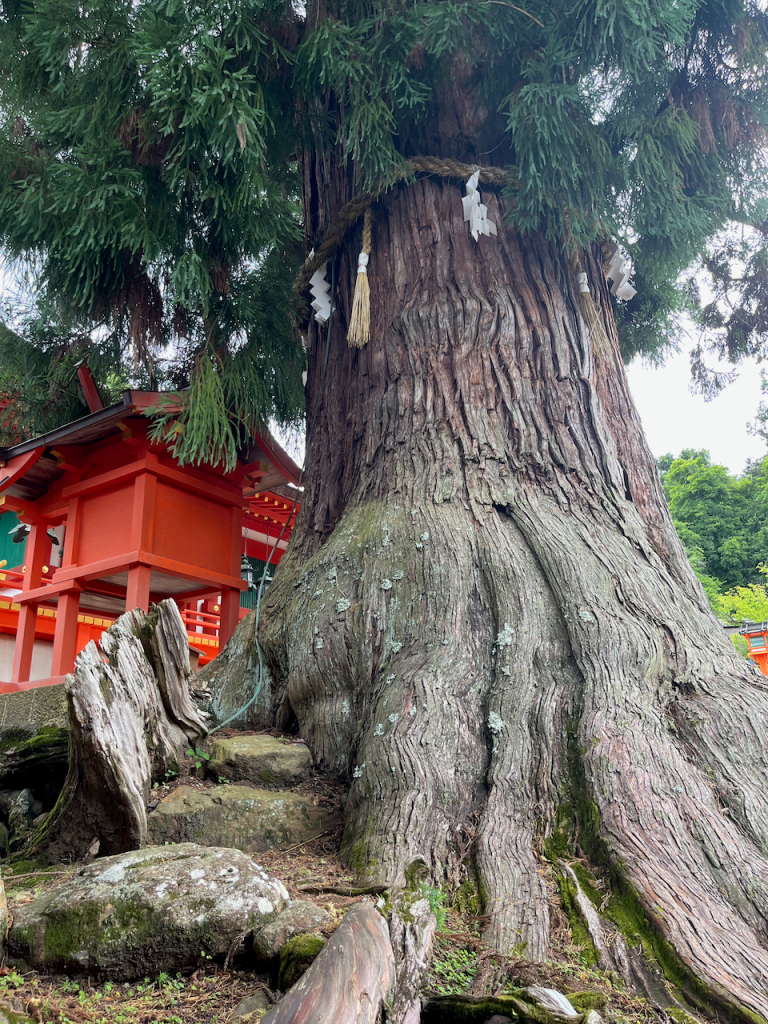
A large sacred tree at Kasuga shrine in Nara, Japan. Taken by me in July 2023.

This is a large tree that has been growing for centuries within the precincts of Kasuga Grand Shrine in Nara, Japan. The tree, as you can see, has a large rope tied around it with small paper streamers. If you ever saw the Studio Gibhli movie Totoro, you can see a big camphor tree with a similar rope around it.

Sometimes you also find rocks and other natural things with ropes around them too.

A “shimenawa” around an “iwakura” (sacred rock) at Meigetsuin, Buddhist temple in Kamakura, Japan, courtesy of Wikipedia.

This is a Shinto-religious custom using a special sacred, hempen rope called Shimenawa (注連縄). The little paper streamers called called Shidé (紙垂).

Shimenawa are sometimes used to section off a sacred space, but they’re also used to enshrine places thought to house a local kami, such as a tree or rock thought to be sacred. Sometimes you also see them hanging over home Shinto shrines (kamidana, 神棚). The idea is the same: the paper streamers help deliniate a sacred space (the inner sanctum of your home shrine in this case).

Interestingly, I discovered that a separate, but parallel tradition exists in Korea too. This blog shows that in Korean traditional culture, people would enshrine local guardian spirits by tying a rope (금줄, Geumjul) around them, and decorating with colored cloths (오색천, Osaekcheon) or white strips of paper. Such sacred trees (당산나무, Dangsan-namu) and sacred rocks (누석단, Nuseokdan), are collectively called Seonangdang. They are very similar in appearance to the ones in Japan, so it’s not hard to guess that there’s some common religious tradition between both cultures, though the Wikipedia article linked above also suggests a potential link to Mongol culture too.

Shinto as a religion exists only in Japan1 but it’s not hard to imagine that Shinto tradition drew from something much older that was shared across the Korean peninsula and Japan. Further, since it’s known that in early Japanese history that many Korean families migrated to Japan (the Imperial court sought their skills and technology), it’s quite possible the tradition was imported from Korea to Japan. Further, as this early Yamato court actively allied with the Korean kingdom of Baekche, it’s possible the cultural exchange went in that direction too.

Anyhow, it’s a fascinating example of how the two (or more) cultures have shared religious traditions for millenia, but few would notice.

1 Barring colonial efforts in the early 20th century to introduce it to other Asian countries, but these did not have a lasting impact culturally.

Yakudoshi Strikes Again

The Japanese concept of yakudoshi (厄年, inauspicious years based on age), is something I’ve written about a couple times over the years. During my last yakudoshi year, I had a particularly bad slip and fall on an icy deck, which took me months to recover.1 It was also around that time that I got laid off at work.

This time around, my daughter was undergoing a yakudoshi year recently. Yakudoshi doesn’t necessarily affect oneself, it’s thought to also affect those around you. My late mother-in-law’s fall which broke her hip happened supposedly during my sister-in-law’s yakudoshi year, and so on. In my daughter’s case, she had a generally good year overall, but at the beginning of yakudoshi, I was in the hospital for a week, and then again right at the very end, I had yet another slip and fall in the backyard. This time, wearing old sandals that had no traction left, I slipped on some moss and as I fell, the back of my head hit a rock.

Ouch.

A week has passed and the swollen lump in the back of my head is almost gone, and I don’t believe I suffered any effects from a concussion.2. Because I fell on my back first, and then hit my head, I think it helped cushion what could have been a much worse injury.

That said, we have been joking around the house that yakudoshi struck again. Maybe it did.

Of course, there are other ways to explain all this. The fact I was wearing old, worn sandals on a wet, cold day in early January in the PNW (with moss everywhere) was pretty stupid. I threw out the sandals since then. Also, I have a track record for being clumsy, so I have had plenty of accidents, yakudoshi or no.

The “inner Spock” in me would thus suggest that this is just a case of probability, weather and bad footwear, and in the case of the surgery, it was a known health risk identified many years ago that finally came to fruition. The probability was always there.

Finally, the Buddhist perspective might explain it as bad karma. Maybe I did something, or some things previously that lined up just right at that moment to compel me to walk outside in bad sandals at that particular day/time so that I would slip and fall.

Believing in the result means having deep faith that the Pure Land and all the forms of goodness (spiritually superior beings) that are assembled there are born from the Buddha Remembrance Samadhi, the meditative concentration that comes from reciting the Buddha-name. When you plant melon seeds you get melons, and when you plant beans you get beans. [Effect follows causes] like a shadow follows a physical shape, like an echo responds to a sound. Nothing is sown in vain. This is called “believing in the result”.

“Mind Seal of the Buddhas” by Ou-I, translation by J. C. Clearly

1 Acupuncture actually did help a lot, as I was getting tired of just relying on ibuprofen all the time.

2 I probably should have gone to see a doctor, but it was a Saturday, and after watching myself for an hour or two, I decided it wasn’t serious enough to warrant going to the emergency room. Time will tell if that was a bad idea, or not.

Happy New Year 2025

Hello Readers,

It’s 2025, and I am happy to be back. The break wasn’t as restful as hoped (too many holiday obligations), but I did accomplish most of my goals, and got to celebrate my firstborn’s 18th birthday which was an important milestone for us parents. I also played lots of Fire Emblem: Engage,1 and watched plenty of old Star Trek episodes.

Anyhow, for the first temple visit of the year, the priest stated that according to the traditional 60-year Chinese calendar 2025 was the sign ki-no-to-mi (乙巳), which can be roughly translated as “yin wood snake”, which implied change coming to fruition, like a tree growing its branches. For context, last year was “yang wood dragon” (ki-no-é-tatsu, 甲辰). Which implied much turmoil, like a baby dragon bursting from its shell.

While I might be speaking from confirmation bias, I cannot help but feel recent events in the last few years reflect this. But, I suppose it’s up to individual interpretation.2

Anyhow, I have some fun posts coming up that I finally finished while on break.

Hoping you all have a great year, or at least stay out of trouble. 😅

1 Engage doesn’t have the emotional depth of Fire Emblem: Three Houses (I doubt few games would), but it has grown on me, and I enjoy many aspects about it, and will likely play through it again.

2 I consulted the Yi Jing for the year, and my own personal fortune wasn’t great either. Warnings of not “stepping on a tiger’s tail” and such.

Hatsumodé: the First Visit of the New Year

Of the many traditions in Japanese New Year (Jan 1st through 3rd, unlike Chinese New Year) is the first temple or shrine visit: hatsumōdé (初詣).

Japan essentially has two religions that have co-existed for many centuries: Shinto and Buddhism. Although they are very different on paper, on the ground, customs and traditions have blended as a result of this (mostly) peaceful coexistence and this includes New Year’s traditions.

People will try to go to their preferred Shinto shrine (jinja 神社) or Buddhist temple (otera お寺) within the first 3 days of the New Year, but most often on January 1st. You can visit any shrine or temple, there’s no pressure to “commit” to one or the other in Japanese culture. At times, we’ve visited Meiji Shrine in Tokyo, Kawasaki Daishi in Kawasaki city (a Shingon-sect Buddhist temple), Asakusa Temple in Tokyo, and Tsurugaoka-Hachimangu Shrine in Kamakura. The featured photo above is from Hatsumode at Asakusa Temple in 2009. We’ve also visited more local temples back home.1

Temples and shrines, especially famous ones, during this time are jammed packed with people trying to start off the new year with a blessing and maybe a few omamori charms too. Old charms are often disposed of at this time too. Here’s an old photo from a past Hatsumode visit to Kawasaki Daishi in 2012:

This photo may not seem like much, but Kawasaki Daishi’s pagoda is visible way in the background, and the road leading up to the shrine is packed with people. It took maybe an hour to get through the procession to the temple itself.

For this year, 2024, we are at home, so I visited a small Shingon-sect Buddhist temple in the area. Shingon temples are pretty hard to find in the US, but somehow we have two temples in the area, and one of them offers a nice Hatsumode service. I don’t normally follow Shingon-sect Buddhism,2 but as I mentioned above, there’s no sense of commitment or obligation within Japanese religions: you can visit whatever service, and if you choose to follow more closely that’s up to you.

In our particular Hatsumode service, the priest led a series of Shingon-specific rituals to help cleanse any bad karma for the year, reciting the Heart Sutra (prominent in Shingon), and then a brief sermon based on the 60-year zodiac cycle. This year is apparently the year of kino-é-tatsu (甲辰), or wood-yang-dragon, which implies a lot of upheaval. After the last few years, that’s the sort of news I was not hoping to hear. 😒 Then again, shit happens.

I picked up a couple omamori charms for my daughter: a charm for success in studies since she is applying to college next year, and a charm for Yakudoshi since she is of the correct age (unlucky for her). I have learned the hard way not to laugh off Yakudoshi years. 

Anyhow, like many Christians in the West during Christmas, Hatsumode might be the only time of the year when most Japanese visit a temple or shrine, but it’s an important time to reconnect and a break away from the usual bustle. I always enjoy this time, even with the crowds, freezing cold, and the hope that the next year will be better than the old one.

P.S. The history between Buddhism and Shinto in Japan is a great case study of two religions co-existing peacefully since they usually just operate at different levels. Shinto’s focus on there life now (and one’s connection to the kami) has little in common with Buddhism’s emphasis on the cycle of rebirth, and the eventual progress toward Buddhahood (e.g. Enlightenment). Chinese culture has a similar balance between Buddhism, and more native religions like Taoism. It’s only in Western religions that approach things with an “all or nothing” attitude that conflict tends to arise, but even then in traditional Christian cultures, native pagan beliefs tended to find a balance with Christian religion. They were not necessarily mutually exclusive, except on paper. Food for thought.

1 We used to visit Japan in the Winter so we could spend New Year’s in Japan with my wife’s family, but as our daughter grew up, and started going to school, we shifted the visits to Summer to avoid affecting attendance. We haven’t been back to Japan in Winter for almost a decade until 2022 and that was due in part to a funeral.

2 I am not against Shingon either, but I’ve found it difficult to commit to since it is an esoteric-only Buddhist sect, and I tend to be kind of an eclectic. It’s also why I frequently struggle with Zen and even Jodo Shu/Shinshu. Hence, my default “preferred sect” is Tendai due to its umbrella-approach to Buddhist practice. Still, due to available resources in my area, Shingon’s always been something I’ve considered.

Toyokawa Inari Shrine: Syncretic Religion

A little while back, during my post on Fushimi Inari Shrine in Kyoto, Japan, I alluded to how the native Shinto religion often blended with Buddhism up until the early modern period (e.g. the Meiji Period) when they were more forcefully separated.

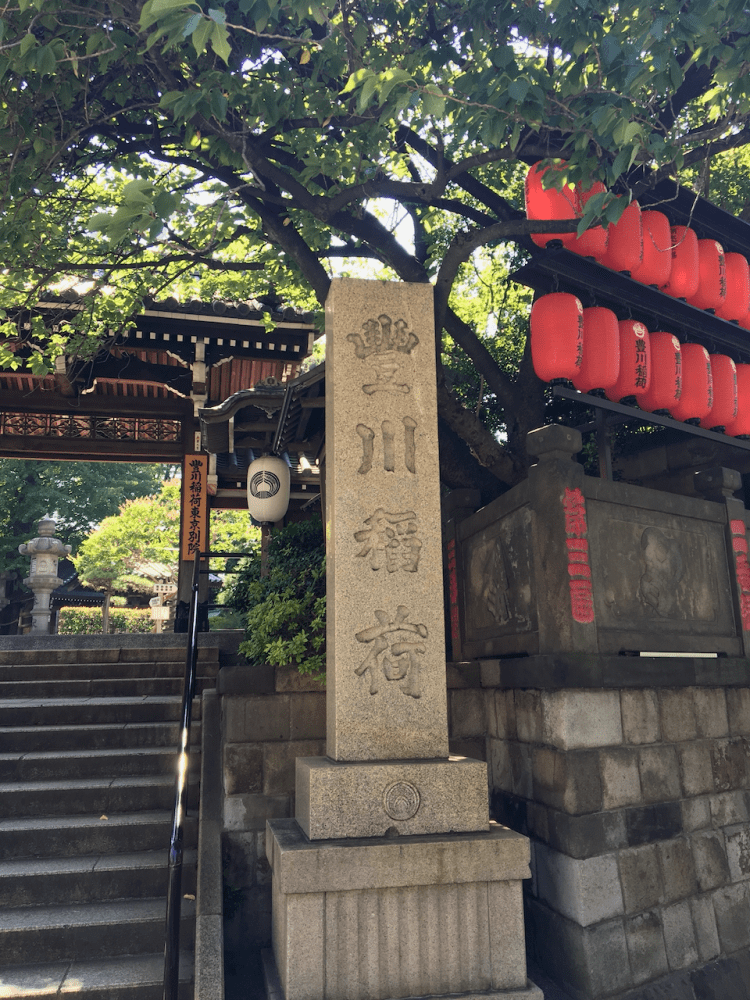
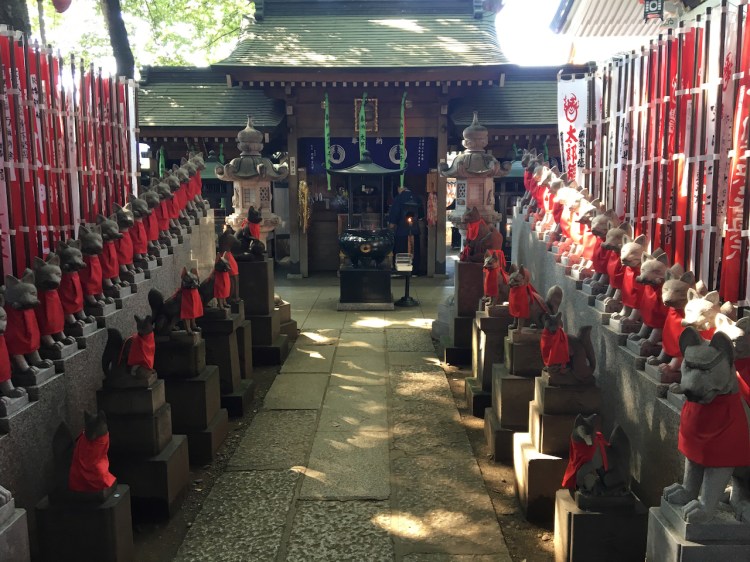
You can still see vestiges of this blending in some temples and shrines, but one great example is the Toyokawa Inari shrine right in the heart of Tokyo’s Minato Ward:

This Shinto shrine / Soto-Zen Buddhist temple venerates Dakini-ten (荼枳尼天), which is the Buddhist form of the Shinto kami Inari Ōkami.

Dakini-ten is based on the concept of Ḍākinī in esoteric (a.k.a. Vajrayana) Buddhism, but in Japan it blended with veneration of Shinto kami and thus took on a life of its own.

Inari Ōkami in his/her Buddhist form as Dakini-ten shining light upon a samurai warrior. Late medieval painting by Utagawa Kuniyoshi, source: Wikimedia

Anyhow, let’s talk about the temple itself. I visited the temple in 2018 and had little context back then, so I didn’t take as many good photos as I would have liked, but I will try to explain as best as I can.

Once you go past the main gate…

You come upon the main shrine to Inari Ōkami (colloquially known as “O-Inari-san”):

Another, small sub-shrine here:

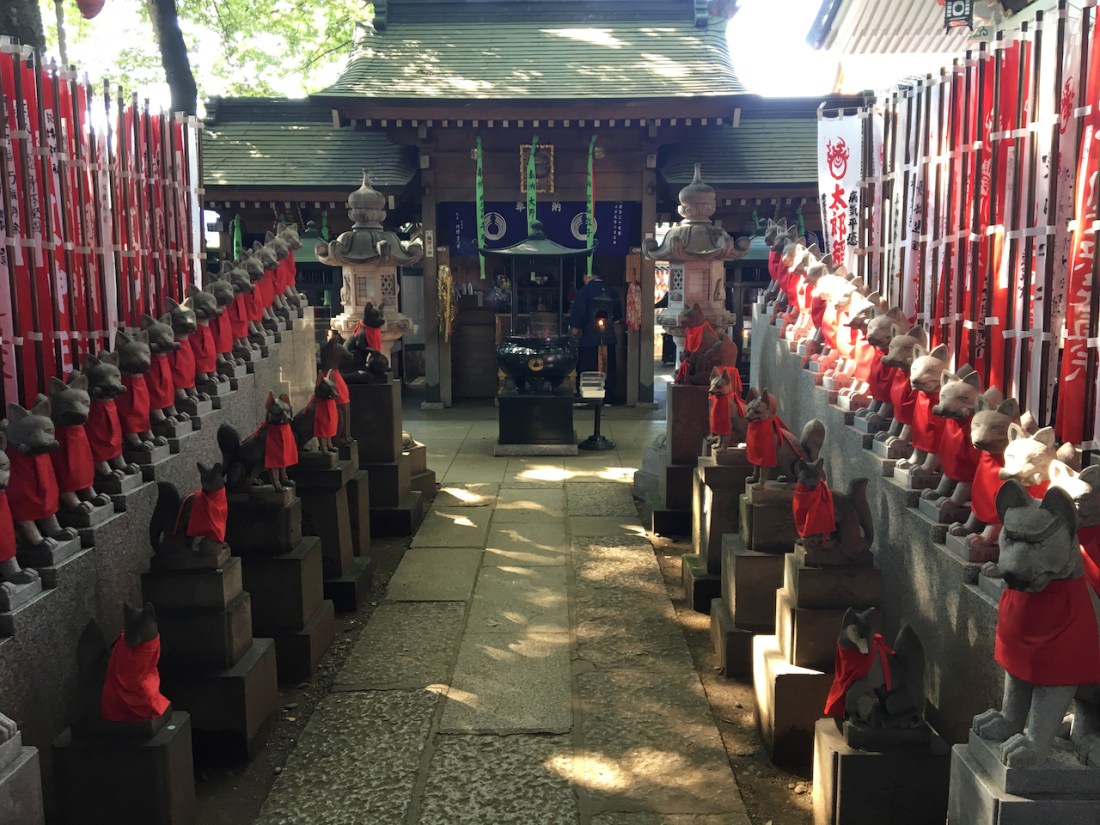
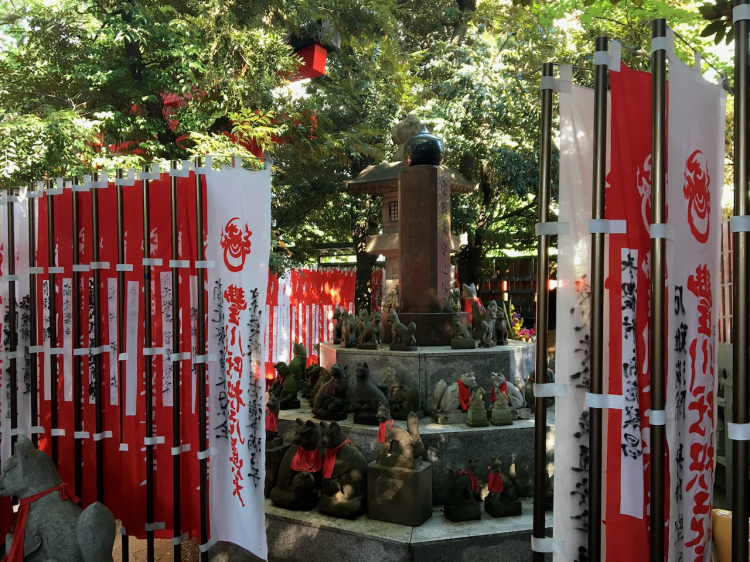
You can see fox statues all over the complex, due to their close association with Inari Ōkami.

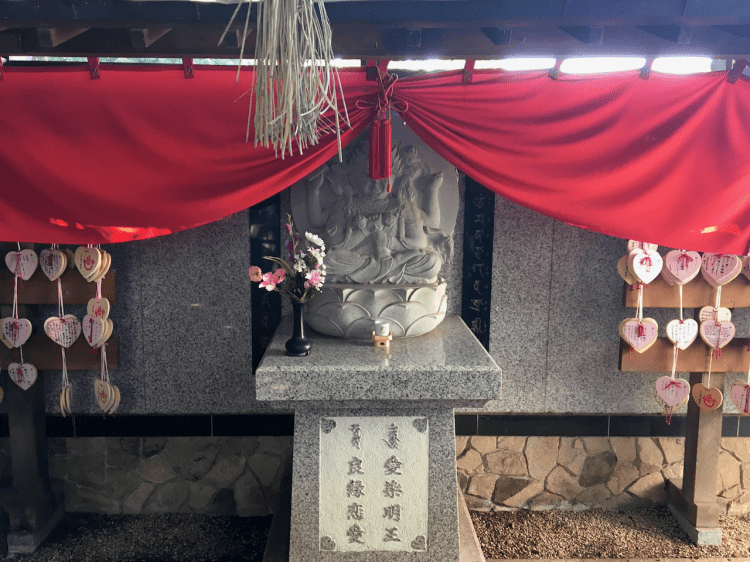
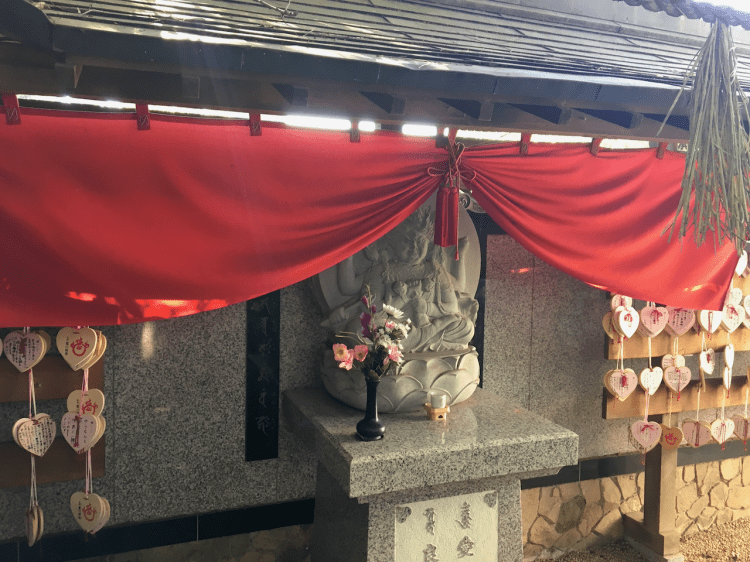
However, other deities, both Buddhist and Shinto are enshrined here too. For example, below is an esoteric-Buddhist (Vajrayana) deity named Aizen Myō-ō (愛染明王):

Also, Benzaiten, one of the Seven Luck Gods:

And Kannon Bodhisattva:

The fact that both Shinto deities like Benzaiten and Inari Ōkami reside in the same shrine as overtly Buddhist deities such as Kannon and Aizen Myō-ō is somewhat unusual, but really isn’t. This was normative for Japanese religion until the modern century. Japan has had two religions for a very long time, and they’ve co-existed for so long, that they often blended together.

If you look at American religion, pagan religion and Christianity co-existed for so long (even when paganism was officially repressed) that the two blended together. Things we take for granted such as Christmas trees, mistletoe, Easter eggs, and such are all examples where they have blended together to religion as we know it today. This might offend religious purists (to be fair everything annoys religious purists), but this is how societies absorb and adapt religions over generations. Japanese culture simply had different religions to work with.

Anyhow, fascinating stuff.

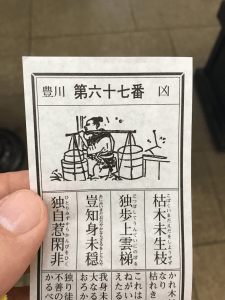
P.S. My omikuji fortune that visit was bad luck (kyō, 凶). I don’t remember having a particular bad year, especially compared to 2020 later, but it was surprising to get an overtly bad fortune for a change.

Making Sense of Early Japanese Mythology

My son is in grade school and loves world mythology, especially Greek and Norse mythology (I did too at his age 🥰). But we’ve also been introducing him to Japanese mythology since it’s part of his heritage.

The trouble is is that Japanese mythology feels “scattered” and, due to cultural differences, hard to translate into English without a lot of explanation. Further, some of it just isn’t very kid-friendly.

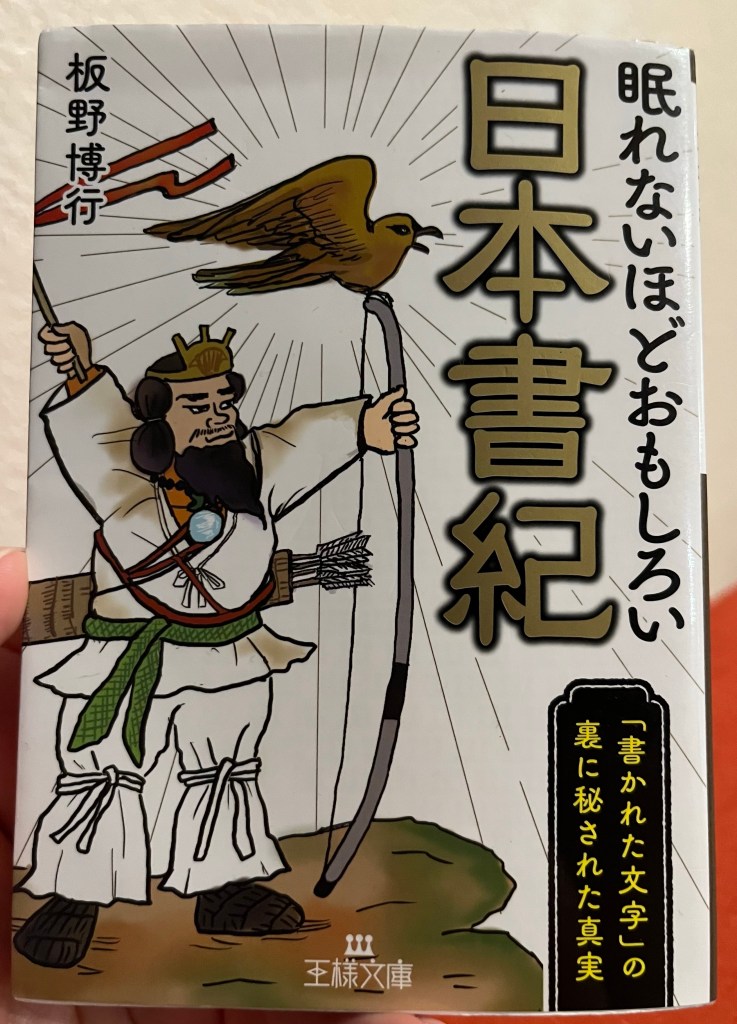
This post is meant to help make sense of Japanese mythology. I learned a lot about it after finding this book in Japanese about the Nihon Shoki (日本書紀), a legendary record of Japan’s foundation:

The Nihon Shoki is one of two records composed in the early 8th century about Japan’s history and origins. The other record is the Koijiki (古事記). Both were promulgated by Emperor Tenji, and both cover overlapping yet differing mythologies, so why are there two records?

The book above explains that the intended audiences were different.

The Nihon Shoki is a longer, more polished record of Japan’s foundation intended to impress Imperial China. It seamlessly transitions from mythology to the origins of the Japanese Imperial Family, legitimizing it in the eyes of their rivals in China, and even covers the life of Prince Shotoku. The Kojiki, by contrast, is shorter and includes more salacious details of some myths, and intended for domestic audiences only.

Even between the two records, some myths differ slightly, as we’ll see shortly.

In any case, much of what we know today about Japanese mythology derives from the Nihon Shoki and Kojiki, just as Greek mythology largely derives from only three sources: the Iliad and Odyssey attributed to Homer, and the Theogony by Hesiod.

The Founding Gods

The two gods credited with the founding of Japan are husband and wife Izanagi and Izanami. According to myth, they descended from the heaven realm, called Takama no Hara (高天原) and saw the primordial chaos of the world below. The Kojiki mentions 3 realms, by the way:

  • Takama no Hara (高天原) – the heaven realm
  • Ashihara no Nakatsukuni (葦原中国) – the earthly realm (e.g. Japan)
  • Yomi no Kuni (黄泉国) – the realm of the dead

According to my book above, the Nihon Shoki never mentions the second two, only the heaven realm. Also, if you’ve been playing Zelda: Tears of the Kingdom, you might notice some similarities….

Anyhow, Izanagi and Izanami stood over the primordial waters on a heavenly bridge called the Ama no Uki Hashi (天浮橋), dipped a spear or pike (literally hoko 矛 in Japanese, a kind of Chinese spear) into the water, and the salty water dripping from the spear tip encrusted and fell from the tip, forming the first island.

In the Nihon Shoki, they then fell in love with one another and wanted to have kids, but didn’t know how (being very new at this), and got advice from a Wagtail bird (lit. sekirei セキレイ in Japanese). Once they figured out how … the process works, they started giving birth to the “eight islands” of Japan (the Nihon Shoki and Kojiki differ slightly on what these islands are), as well as having many children, including some well-known kami :

  • Amaterasu Ōmikami (天照大神) – goddess (kami) of the sun, she was given dominion over the heavens. Her grandson, Ninigi-no-mikoto, is the progenitor of the Imperial family in Japan, according to the Nihon Shoki.
  • Susano-o-mikoto (須佐之男命) – god (kami) of storms, he was given dominion over the oceans. His son, Ōkuninushi, is a frequent figure in Japanese mythology especially relating to the founding of Japan.
  • Tsukuyomi-no-mikoto (月読命) – god or goddess (kami) of the moon, given dominion over the underworld. Their gender is unclear from the mythology.

However, in the Kojiki version, Izanami died when giving birth to the god of fire, and traveled to the underworld, leading to the myth shown below in the Youtube video.

The Nihon Shoki does not mention this myth, and simply states that they went on to create more gods and goddesses. In this Kojiki version, after Izanagi escaped the underworld, he purified himself under a waterfall, and from the droplets sprang more gods. In the Kojiki version, the three kami listed above were born from the water purifying Izanagi.

Sibling Rivalry

The rivalry between older sister Amaterasu Ōmikami (hereafter “Amaterasu”) and younger brother Susano-o-mikoto (hereafter “Susano-o”) drives a lot of the mythology found in the two records. Amaterasu did not like to lose, and Susano-o had a foul temper, so they often clashed.

In one story, they had a dare to see who had a pure heart (and who didn’t) by giving birth to more gods. In their minds, whoever gave birth to female goddesses had ulterior motives, while whomever gave birth to male gods did not.1 They sealed the agreement by exchanging items: Amaterasu gave her brother her jewels, and Susano-o exchanged his sword. Amaterasu gave birth to three female goddesses, and Susano-o gave birth to five male gods.

The Kojiki and Nihon Shoki differ on what happened next. In the Nihon Shoki, Susano-o cheered at first, but then Amaterasu pointed out that the male gods were born from her jewelry, thus she had the pure heart. In the Kojiki, Susano-o instead points out that the three goddesses were born from his sword, and being such sweet and kind goddesses, he obviously had the pure heart. Thus, depending on the source, different gods declared victory.

Side note: of the five male gods born, one of them, Ame-no-oshihomimi, is the reputed ancestor to the Imperial family. Of the female goddesses, they are still venerated a series of shrines in Fukuoka Prefecture (official homepage here).

In the Nihon Shoki version, Amaterasu won, but Susano-o had a huge tantrum and caused a ruckus, destroying many things, etc. Amaterasu was furious and hid herself in a cave, plunging the world into darkness. This famous myth is often depicted in Japanese artwork. The featured image above (source Wikipedia) depicts the efforts by the other kami to entice Amaterasu to leave her cave and thereby restore light to the world, including a risque dance by kami Ame-no-Uzume-no-Mikoto.

Descent to Earth

Fast-forwarding a bit for brevity, Susano-o, having been previously driven out of the heavens due to his behavior, undertakes some adventures, and rescues a maiden named Kushi-nada-himé from a massive serpent named Yamata-no-Orochi. From the serpents body came the mythical sword Kusanagi, one of the three sacred treasures (神器 jingi) of Japan by the way. The other two, the bronze mirror and jewel, were used in the aforementioned myth to draw Amaterasu out of her cave.

Susano-o and the maiden married, and their son, Ōkuninushi-no-kami (大国主神), who committed many great deeds that helped build and pacify Japan:

Interestingly, Ōkuninushi mostly only appears in the Kojiki.

Later, according to the Nihon Shoki, a kami named Takemikazuchi-no-kami (武甕槌神) was dispatched to inherit the country of Japan from Ōkuninushi who had been entrusted with its care. Interestingly, Takemikazuchi-no-kami is the patron god of the Fujiwara clan (originally the Nakatomi), and guess who helped compile the Nihon Shoki? Fujiwara no Fuhito.

Takemikazuchi demonstrated his power by sitting on a sword, point up, without losing his balance. Yes, that is as painful as that sounds. Needless to say Ōkuninushi was impressed. Ōkuninushi’s son, Takeminakata-no-kami (建御名方神) did not take this well and challenged Takemikazuchi-no-kami to a contest of strength, supposedly the first Sumo match ever, but Ōkuninushi’s son lost and fled elsewhere. Thus, Takemikazuchi-no-kami prevailed and inherited the country.

Later, Amaterasu’s grandson Ninigi2 descended from the heavens to the earthly realm with a retinue touching down at Mount Takachiho on the island of Kyushu.3 There are many versions of this myth. Sometimes Ninigi descends alone, in other versions he descends with various other kami who go on to found their own earthly clans. In some myths, he is obstructed by other kami, and in others he is bearing the aforementioned Three Sacred Treasures. In one myth, upon touching down, Ninigi jams a mythical spear, Ama-no-sakahoko (天の逆鉾) into the peak of the mountain, of which a replica exists today.

In any case, this is where the myths begin to transition to semi-legendary, semi-historical narrative, which is a tale for another day. It’s been fun to read about Japanese mythology in a more cohesive narrative, with humor and historical context thrown in, but I also read Japanese pretty slow, so it may take a little while to get to the next section.

Anyhow, I hope you enjoyed!

P.S. Thank you for your patience as I haven’t had much time to right articles lately. Outside of work and parenting, I have been working a lot on the other blog, plus enjoying Fire Emblem: Three Houses in what little spare time I have. I have more articles queued up and should hopefully get back on a regular cadence soon.

1 I wish I was making this up, but I am not. This kind of ritual to determine one’s heart was called Ukei (誓約) in Japanese, though in modern Japanese 誓約 is read as seiyaku and refers to oaths, vows or pledges in general.

2 More formally known as Amatsu-hikohikoho-no-ninigi-no-mikoto (天津彦彦火瓊瓊杵尊).

3 It’s interesting to note that many of the early myths, and older, more obscure kami in Shinto religion have some connection the island of Kyushu in particular, which is closest to mainland Asia.

Fushimi Inari Shrine and O-Inari-San

On the list of unexpected surprises during our recent trip to Kyoto/Nara was another place we visited: Fushimi Inari Grand Shrine (English / Japanese homepages) also called Inari Taisha (稲荷大神) in Japanese. The Fushimi Inari Grand Shrine, located in south-east Kyoto, is the head shrine devoted to a very popular Shinto kami named Inari Ōkami (稲荷大神). However, he also known more colloquially as O-Inari-san (お稲荷さん).

Shinto religion reveres and recognizes, many, many kami, and oftentimes these kami are often tied to a certain place, or even to just a single shrine. Many are quite obscure, too. For example, while Kasuga Grand Shrine is considered one of the most sacred, its deities are not well-known in popular culture. However, a few kami enjoy an almost universal popularity within Japan. This includes O-Inari-san and Tenjin, among others. You’ll find branch shrines throughout Japan, all descended from the main one, and in the case of O-Inari-san, the head shrine is at Fushimi.

Even to visitors to Japan, O-Inari-san is often recognizable because his shrines are often decorated bright red, and white foxes. Why foxes? Foxes were thought to be messengers of O-Inari-san, hence they adorn his shrines. Technically, O-Inari-san is not a god of foxes, however. They just happen to be his messengers. Instead, what makes O-Inari-san so popular is that he was a kami associated with commerce, travel, and the harvest of the year rice crop. For the latter, foxes, were often dispatched by O-Inari-san to report on the status of the harvest across Japan. Thus, foxes often have a “fey” image within Japanese folklore.

Even in modern businesses and shopping malls, if you look carefully, you’ll often find a small shrine to O-Inari-san tucked away somewhere.

Further, when Buddhism and Shinto blended in the middle ages, it was assumed that O-Inari-san was a divine protector of Buddhism, and sometimes conflated with certain obscure Buddhist figure named Dakini. In downtown Tokyo is a Shrine I’ve visited before called Toyokawa Inari devoted to O-Inari-san, and was a hybrid Zen temple and Shinto shrine:

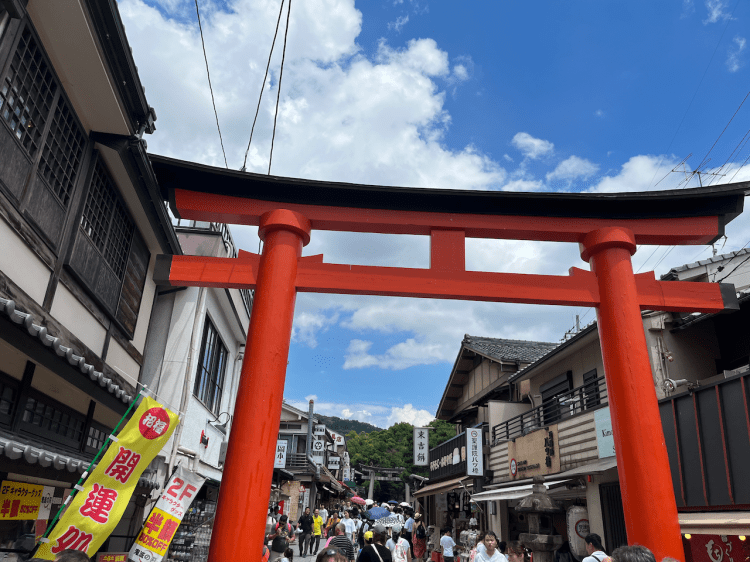
Anyhow, that’s the lengthy explanation of O-Inari-san; let’s look at the shrine. Chances are, you’ve probably seen photos of it, because the tunnel of red torii gates is so iconic, but there’s a lot more to the temple too.

From the Fushimi-Inari train station in Kyoto, you can find the shrine very easily (it’s a huge tourist draw):

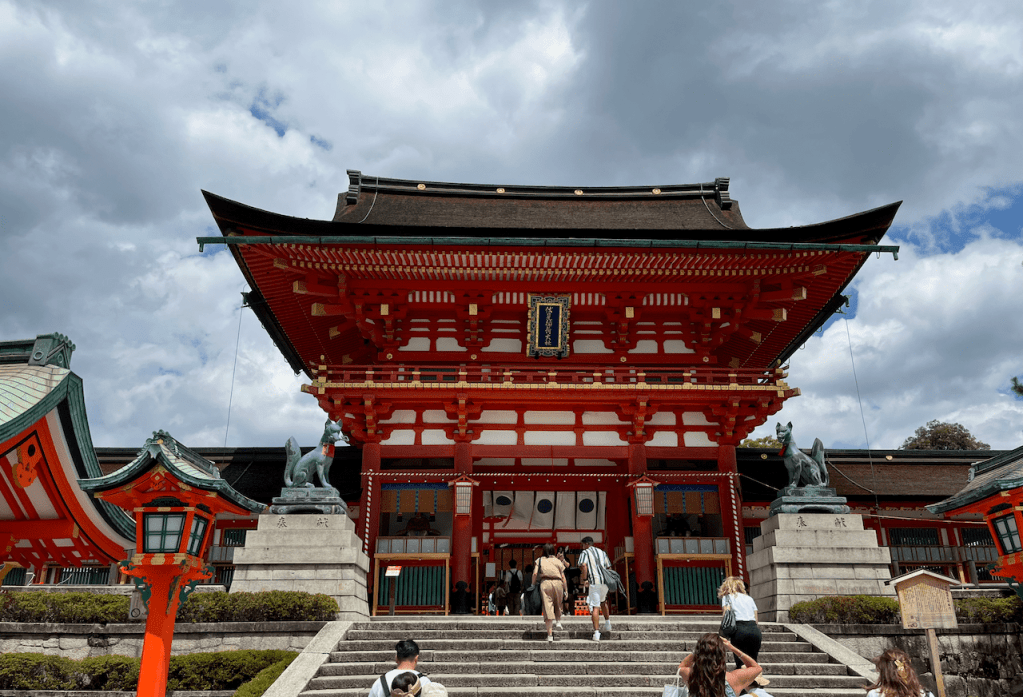
… until get to the front entrance:

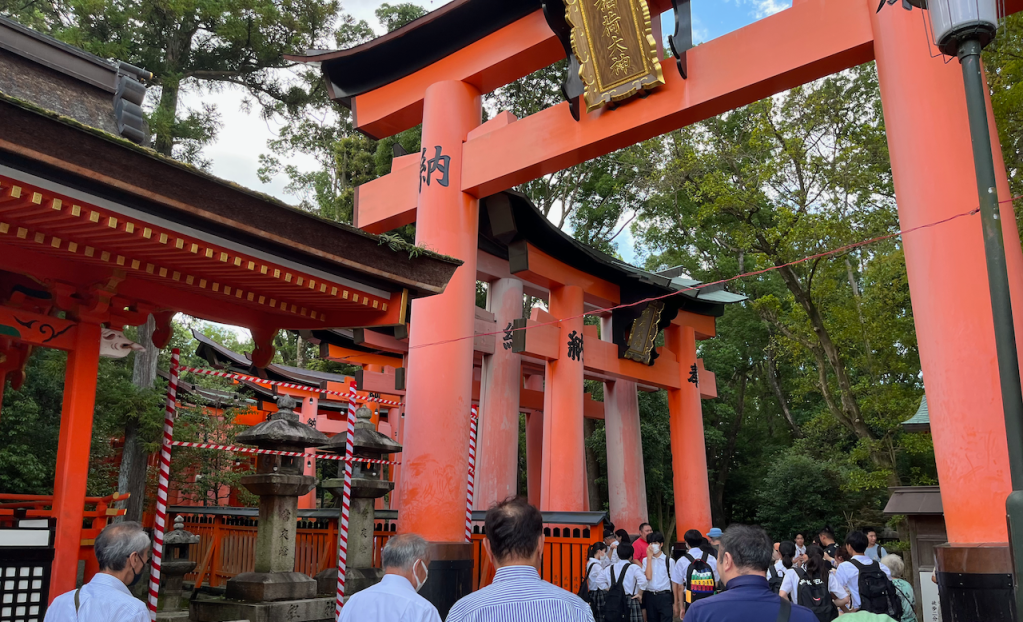
From here, the shrine splits into two places. Ahead, is the main, inner sanctum, however, the path also splits left and follows up the mountain:

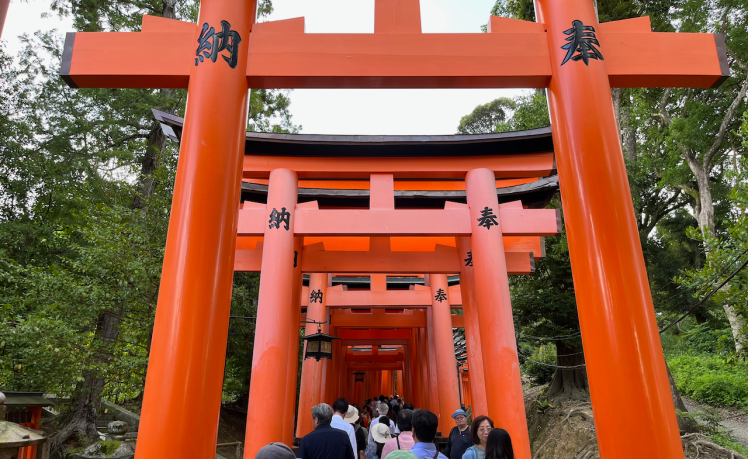
As you go up these stairs, the iconic tunnels begin to the right:

Each of these red torii gates is a donation by someone either praying for something, or an offering torii in gratitude for past blessings. This is a very common practice in Japanese Shinto (and Japanese religion in general): a cycle of supplication, and offerings of gratitude. This cycle is thought to deepen the connection (縁, en) between the particular kami and the supplicant over time.

Anyhow, the torii are pretty neat:

The tunnel branches off into a few side paths, but generally it loops up the mountain and back down again. There are other shrines at certain places up the mountain, and we visited a few, too many to post here (to be honest, I also got a bit lost without a map).

In any case, as you come down the mountain, there is a nice viewing spot here, to the right:

The veranda inside has a nice view, which I am told is especially lovely in Autumn:

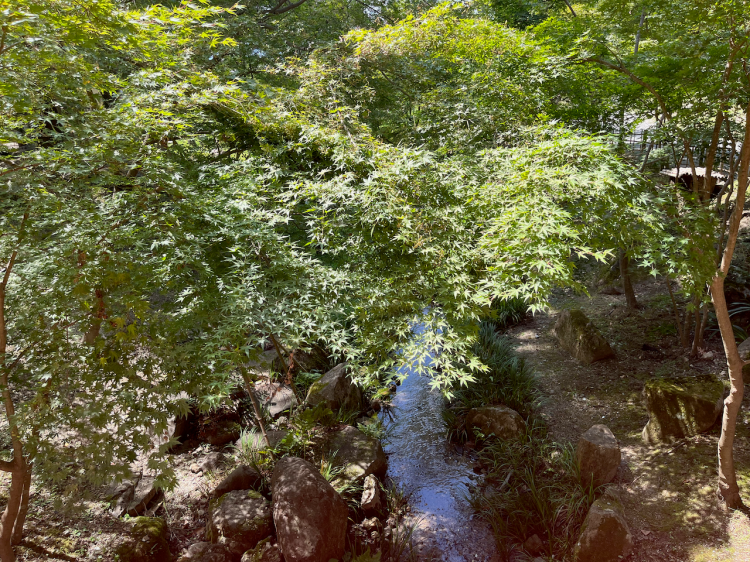
Finally, just before returning to the front gate, there is a nice little bridge with a small stream running under it:

I took a very brief video of the stream as well (apologies for the background noise):

Fushimi Inari Grand Shrine was quite a bit of fun, and a great place to spend half a day. It’s comparatively easy to get to in Kyoto, and there’s more than enough there to keep one busy. Further, my son, who loves foxes,1 really enjoyed himself. He even got a few fox (kitsune) toys. The photo at the top of this blog is his favorite, overlooking the famous Kamo River running through Kyoto.

P.S. the name o-inari-san is also used to describe those little fried tofu pockets with rice in them.

1 In our current Pathfinder 2nd ed campaign, my son is playing a Kitsune character.

Visiting Kasuga Shrine: Primeval Forests and Fujiwara Power

On our recent trip to Kyoto and Nara, we spent our last morning in Nara visiting the venerable Shinto shrine called Kasuga Taisha (春日大社), or Kasuga Grand Shrine (English / Japanese).

The English site doesn’t really explain the history or significance of the shrine though. Kasuga, along with neighboring the Buddhist temple of Kofukuji, were centers of power for the elite Fujiwara clan. Both the shrine and the temple were sponsored by members of the Fujiwara clan, and as the clans fortunes grew, so did the prestige of these sites.

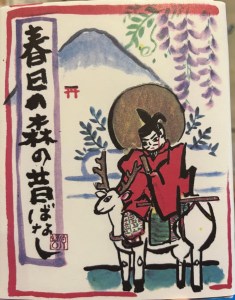
Anyhow, the legend of Kasuga Grand Shrine is said to begin when a Shinto kami named Takemikazuchi no mikoto was said to have ridden up Mount Mikasa on the back of a white deer. I picked up a children’s book of old stories about Kasuga Grand Shrine, and the cover depicts this legend:

In time, other kami had been added to the shrine, and venerated too (namely Ame no Koyané, Himegami, and Futsunushi no mikoto), but often are just revered as a single deity. Fun fact: Ame no Koyané is the patron deity of the Fujiwara clan itself.

One other note: Kasuga Grand Shrine is built along side a primeval forest, meaning a forest that has never been cut down in recorded history. You can see the forest from the shrine, but access is generally not allowed.

Anyhow, the main entrance to the Kasuga Grand Shrine is here, just to the right of Kofukiji temple:

From here, there is a long causeway leading to the shrine proper. You can see thousands of stone lanterns on either side. According to my Japanese sources, these lanterns are paid through donations by patrons extending all the way back to the Heian Period (8th – 12th century), and number up to 3,000 total.

You also run into some Nara Deer as well. Nara Deer are considered sacred, and thus roam freely throughout the larger Nara park area.

When you get to the torii gate, you are close to the Shrine:

Then follow the path to the left…

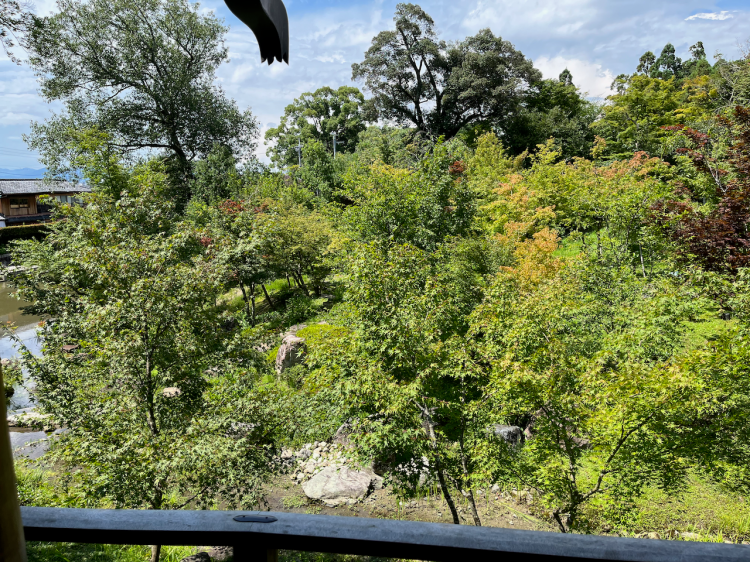
The courtyard of the Shrine is somewhat small, but contains several noteworthy things. For example, this wisteria tree is quite old:

This is the inner sanctum of the shrine, and requires an admission fee to go in, but it’s well worth it.

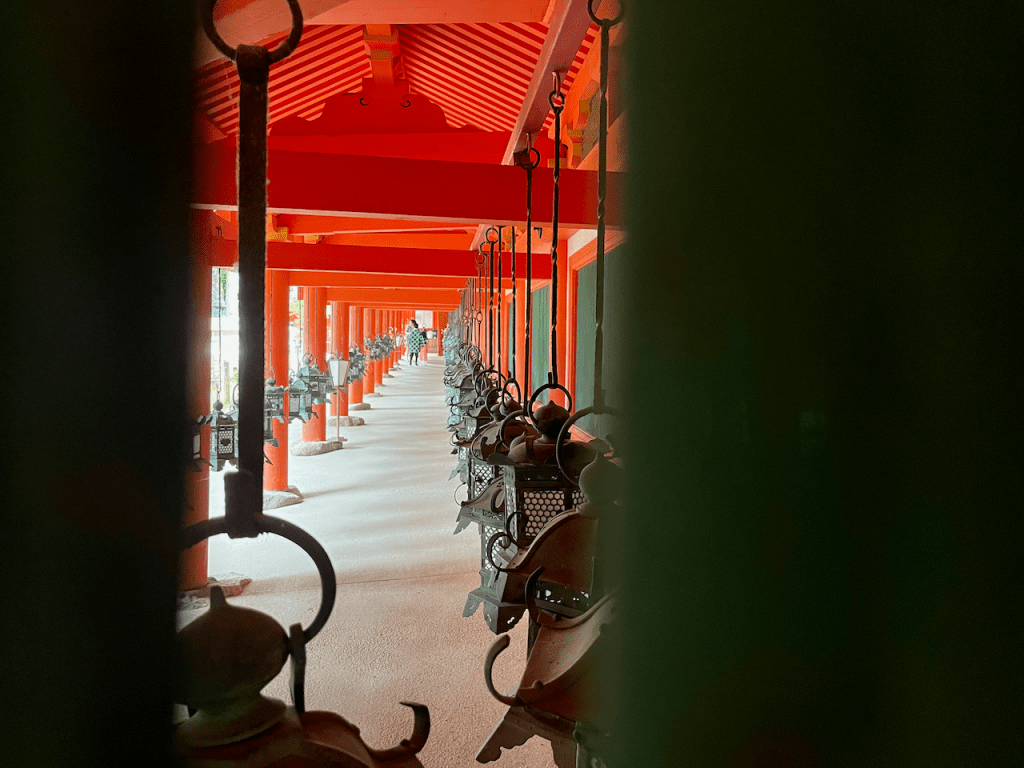
Inside the inner sanctum, visitors follow a set path, where you can see many hanging lanterns:

After walking this path, you come to an outdoor shrine altar that faces the primeval forest. I didn’t take a photo out of respect for the shrine, but it was neat to peer past the shrine into the forest, knowing that it’s been there for centuries.

Later, after leaving the altar, you enter a room that is very dark, where you find more lanterns:

After leaving the dark room, you see this tree. The rope tied around is a shimenawa, which implies that the tree is sacred too.

Part of the tree has over time branched out into this position, and the shrine has just built around it:

Kasuga Grand Shrine is a fascinating example of a Shinto shrine that’s deep with history, and sacred to the Shinto religion, while also carrying a mysterious air to visitors. It’s not necessarily the first place visitors to Japan would think to visit, since Shinto isn’t well understood, and Kasuga has many cultural aspects that aren’t readily obvious, but it’s well worth a visit and if you are visiting places like Todaiji it’s just a quick walk.

The Rise and Fall of the Fujiwara

In our recent visit to Kyoto, the ancient capitol of Japan, we also took a day to visit the city of Nara, which is an even earlier capitol. Downtown Nara has several highlights but two of them are the Buddhist temple of Kofukuji, and the Shinto shrine of Kasuga-Taisha (“Kasuga Grand Shrine”). Kofuku-ji Temple is one of the central temples of the once powerful Hosso sect, and Kasuga Grand Shrine is a famous shrine within Shinto religion,1 and hosts a primeval forest that has been untouched since antiquity. I might post more photos of each later.

The famous Sarasawa Pond with Kofukuji Temple on the left. Taken in July 2023.

What makes these two sites important is that they were both tied to the powerful Fujiwara Clan.

During the Nara Period of Japanese history, the Fujiwara were just one of several noble houses that supported the Imperial family. Back then they were called the Nakatomi (中臣) Clan. During a power-struggle between the Imperial family and the Soga clan, one Nakatomi no Kamatari (614 – 669) came to their rescue and helped defeat the Soga. Thereafter, the Imperial family relied on Kamatari to help reform and strengthen the government. The Nakatomi earned the clan name Fujiwara later under Emperor Tenji. So far so good.

However, starting with Kamatari’s son, Fujiwara no Fuhito (who also helped compile the Nihon Shoki), the clan gradually began to monopolize key positions, increasingly through inter-marriage with the Imperial family. By the 12th century, every member of the Imperial family married members of the Fujiwara clan, over and over, generation after generation. This allowed the head of the Fujiwara to assume the role of “regent” (sesshō, 摂政) to his offspring who were children on the Imperial throne, when switch to “chief advisor” (kanpaku, 関白) when they were old enough to rule on their own. That same advisor could also force the Emperor to abdicate to their son (whose mother was also from the Fujiwara clan) when necessary, allowing the same official to be regent to their grandson.

Further, by holding key government positions, the Fujiwara could also manipulate property laws on their private holdings in the provinces, increasing personal revenue. The Fujiwara were not the only noble houses to do this, even the Imperial family did it, but through their connections and influence, they profited immensely from the untaxed revenue of their lands.

With this increasing power and wealth, the Fujiwara sponsored a number of building projects. One of these was Kofukuji Temple, which was sponsored by the Fujiwara as far back as 669, but with its increasing connections to the Fujiwara, the building complex greatly increased in size and wealth.

Further, the family Shinto shrine of Kasuga Taisha prospered:

But the price of all this interconnectedness between the Fujiwara and religious establishments came at a cost. The religious institutions became extensions of Fujiwara power, with clan members given key positions locking other people out,2 and fielding armies of warrior monks against other rival temples.

By the time the system collapsed, the Fujiwara’s power began to diminish. Kofukuji Temple was largely burned down,3 and the original clan had become so large that it gradually broke up into five different clans, each one marrying with the Imperial family as needed:

JapaneseRomanizationFounded
近衛Konoe12th century
鷹司Takatsukasa1252
九条Kujō1191
一条Ichijō13th century
二条Nijō1242

Some of these new clans, especially the Kujō, even assumed positions of power with the new Kamakura shogunal family after the untimely death of Sanetomo, the 3rd shogun. Further, by the 19th century, with Westernization of Japan (e.g. the Meiji Period) the Five Regent Houses all became merged into the Western-style “peerage“, but by 1945, now hundreds of years since their founding, the five regent clans were finally abolished for good with the post-World War II reforms of the Imperial system.

In any case, after the 12th century, the centers of power had since moved. Kofukuji Temple, having been burned down in various conflicts, never quite rebuilt its power. Newer forms of Buddhism had taken root, and new centers of religious devotion had arisen. Kasuga Taisha grand shrine, being located in Nara, was now remote as the capitol had moved further and further east. When I visited Kofukuji Temple in 2010, and again this year (2023), some things had changed. The central Golden Hall (中金堂, Chū-kondō), had finished reconstruction for the first time in centuries. But even now, many of the original buildings have not been reconstructed.

Throughout Japanese history, the Fujiwara clan maintained prestige for centuries, but actual power continued to slip from their grasp bit by bit after the 12th century, and these historical relics in Nara are shadow of their former selves, and of Fujiwara power.

1 People are often surprised to learn that Japan has essentially two religions: Buddhism which came from India (via China), and Shinto which is the native religion. The two have been pretty intertwined culturally for centuries. It’s a long story.

2 Some of those who were excluded went on to found other Buddhist sects later partly out of disillusionment with the establishment.

3 Quite a few temples burned down in times of war, not just Kofukuji. Todaiji also burned down many times, as well as Enryakuji on Mt Hiei, among others.

Torii Gates in Japan

While making some maps on Inkarnate for a new Japanese-themed Ravenloft-domain I published on DMS Guild, I was reminded how these kind of Japanese gates often show up in unusual places in Western media, including fantasy media:

Torii gate for Tsurugaoka Hachimangu shrine in Kamakura, Japan. Taken in 2022.

But these gates aren’t just for decoration, they’re an important part of Japanese Shinto religion, called a torii (鳥居). They’re a feature only found at Shinto shrines, not Buddhist temples. Similar structures exist in other Asian cultures, but the torii in particular serves a religious function.

Shinto is a religion devoted to the kami, the native divinities of Japan, and in Shinto tradition ritual purity is important. The kami will not descend to ritually unclean places, nor hear the prayers of unclean people, so sacred places must be purified. A sacred space in this context can be as small as a tiny home shrine, a kamidana, or as large as the sanctum of a large shrine such as Meiji Shrine in Tokyo.

Torii gate for Meiji Shrine in Tokyo, taken in 2012 during Japanese New Year. The lines were amazingly long.

What matters is that there’s a sense of “boundary” between the mundane, outer world and the sacred, inner realm.

The torii thus acts as a gate between these two worlds. By passing through the gate you enter the sacred grounds of the shrine, or leave it. It’s also why taking away things from a shrine like pebbles or flowers is frowned upon.

Torii can be very small, or using the example of Meiji shrine, extremely large. There are many styles too. Some are bright red, others a more natural color. Sometimes a shrine will have a series of torii gates.

Torii gates at Hie Shrine in Tokyo, taken in 2017.

In the photo above, these gates were sponsored through donations by local businesses. As with many other aspects of Shinto, there’s a lot of local community involvement as well as give and take.

Anyhow, that’s a brief look at torii gates.