Misery

Suffering is endemic to this world, whether it be a stripper hustling just to make $20, refugees who lose their homes, or soldiers fighting to defend their homeland, or children who are simply neglected and unloved.

If you stop to think about all this suffering, pain and misery, it’s completely overwhelming, heartbreaking.

Even if you had all the money in the world, and give it away, it provides only temporary relief. If you held all the power in the world, you could only affect so much change. Worse, you might fall into hubris.

From the game Fire Emblem: Three Houses

I think this is why the Buddha-Dharma is so helpful.

Photo courtesy of the Yomiuri Shimbun newspaper. This is the fumetsu no hōtō (不滅の法灯), the “Unextinguished Lamp of the Dharma” at Mount Hiei.

A candle flame doesn’t seem like much, but in a very dark place, that candle flame really stands out.

The majestic light of the Buddha Amitāyus is the most exalted….If, sentient beings encounter his light, their three defilements are removed; they feel tenderness, joy and pleasure; and good thoughts arise. If sentient beings in the three realms of suffering see his light, they will all be relieved and freed from affliction. At the end of their lives, they all reach emancipation.

The Immeasurable Life Sutra, translation by Rev. Hisao Inagaki

I often think about the old stories of Honen, the 12th century monk who spread the Pure Land teachings in Japan. It was a time of rampant disease, warfare, and income inequality. Honen couldn’t fix any of these things but he taught a simple message to any who would listen. If nothing else, it gave hope and a sense of direction in a directionless world.

A multilingual sign posted at the front of Chion-in Temple in Kyoto, Japan. Reads in English: "This is the road of respectful affability toward Chionin temple. It is the road to encounter Master Honen. It is also the route to obtain the way of Buddhism. For the old, the weak, women, and children are lead to brightness, peaceful, and the meaning of life by collecting wisdom from the Buddha. To free tiresome beings, to let them gain dignity, and to accept the true happiness ingenuously. This is, Buddhism."
A multilingual sign posted at the front of Chion-in Temple in Kyoto, Japan.1

Sometimes, small, sincere gestures of kindness can be the best help of all.

Namu Amida Butsu

P.S. an older post on the same subject.

P.P.S. Two days and I am already violating my own blog schedule. 🤦🏼‍♂️ This was an impromptu post I wrote after yesterday’s political disaster.

1 the sign above reads in Japanese:

親しみ慕われる知恩院への道。それは法然さまに出会う道。そして、お念仏のみ教えをいただく道。仏さまの智慧をいただいて、老若男女すべての人が、明るく正しく仲よく生きることに通じる道。人生の疲れを癒し、生きる尊さ、喜びを素直にいただくことができる道。それがこの道。智慧の道。

In English I would roughly translate this as:

This is a path toward closeness with Chion-in Temple. That is to say the path for encountering Master Honen. It is also a path for receiving the teachings of the nembutsu. One receives the compassion of the Buddha, regardless of age or gender, a path that leads to a bright, upright, affable life. A path that heals weariness, reveres life, leads to sincere joy; this is that path. A path of Compassion.

In Ukrainian via Google Translate:

Дорога до улюбленого храму Чіон-ін. Це шлях до зустрічі з Хонен-самою. І шлях до отримання вчення Нембуцу. Шлях, який веде до людей різного віку, чоловіків і жінок, які живуть яскраво, праведно та гармонійно завдяки мудрості Будди. Шлях, який дозволяє зцілити втому життя та насолоджуватися гідністю та радістю життя. Ось цей шлях. Шлях мудрості.

In Arabic via Google Translate:

الطريق إلى معبد تشيون إن المحبوب. هذا هو الطريق لمقابلة هونين-ساما. والطريق لتلقي تعاليم نيمبوتسو. طريق يؤدي إلى الناس من جميع الأعمار، رجالًا ونساءً، للعيش بشكل مشرق وصالح ومتناغم من خلال حكمة بوذا. طريق يسمح لك بالشفاء من تعب الحياة والاستمتاع بكرامة الحياة ومتعتها. هذا هو هذا الطريق. طريق الحكمة.

In Spanish via Google Translate:

El camino hacia el querido templo Chion-in. Ese es el camino para encontrar a Honen-sama. Y el camino para recibir las enseñanzas del Nembutsu. Un camino que lleva a personas de todas las edades, hombres y mujeres, a vivir de manera brillante, recta y armoniosa a través de la sabiduría de Buda. Un camino que permite sanar el cansancio de la vida y disfrutar de la dignidad y la alegría de vivir. Ese es este camino. El camino de la sabiduría.

Self-Reflection

The moral, therefore, of my sermon on this small mount is this— even a mirror will not show you yourself, if you do not wish to see.

Roger Zelazny, Lord of Light

Self-reflection is one of the most important aspects of the Buddhist religion, and a critical component of emotional intelligence. And yet, self-reflection is surprisingly difficult to do. Peering into oneself, seeing the ugly sides of our personality, and not running away from it is a difficult thing to do.

But it can also be an illuminating experience if you are willing to face your darker self, and wind it backwards and figure out why it is there, why you feel or think the way you do.

As much as we like to think we are responsible, good people, the reality is is that our “shadow self” (to paraphrase Jung) is there, and it makes a mockery of many things we do. It doesn’t mean we are bad people or fake, just that we have to acknowledge that we are still motivated by basic needs, and that these are irrational and selfish. Hairless apes, in other words. 😉

Namu Shakamuni Butsu

Respect for Life

Recently, I was watching an iconic episode of Star Trek, “Arena” (s1ep19, a.k.a. the one with the Gorn), and I noticed this dialogue for the first time:

SPOCK: You mean to destroy the alien ship, Captain? 

KIRK: Of course.

SPOCK: I thought perhaps the hot pursuit alone might be sufficient. Destruction might be unnecessary.

KIRK: Colony Cestus Three has been obliterated, Mister Spock. 

SPOCK: The destruction of the alien vessel will not help that colony, Jim.

KIRK: If the aliens go unpunished, they’ll be back, attacking other Federation installations.

SPOCK: I merely suggested that a regard for sentient life —

KIRK: There’s no time for that.

I was impressed by how much Spock went out of his way to avoid destroying sentient life, as his duty allowed. This is not the only time he does this, see for example in Devil in the Dark (s1ep25):

SPOCK: Or it is the last of a race of creatures which made these tunnels. If so, if it is the only survivor of a dead race, to kill it would be a crime against science.

Of course, it’s also known that Leonard Nimoy helped develop the character’s iconic Vulcan Neck Pinch too: a non-violent way of subduing humanoids. He also didn’t hesitate to toss people from time to time…

Nonetheless, Spock’s respect for all life, and commitment to reason, science, and non-violence is really admirable. In Arena, Kirk is taking vengeance against the Gorn for the destruction of Cestus III, but Spock points out that destroying the Gorn vessel won’t bring back Cestus III. Later, as the episode shows, the destruction of Cestus III was due to a misunderstanding between the Federation and the Gorn. Spock was right: wanton destruction would have done no good. Kirk’s mercy toward the Gorn at the end is also praised by the Metrons who instigated the arena-style battle of the episode.

I suppose my point here is that science, reason, and respect for all life are worthy traits to uphold even today. 🖖🏼

P.S. Many years ago, when I visited the Star Trek museum exhibit at the Museum of Pop Culture in Seattle and I got to see the original Gorn costume:

Message From The Past

True story: this week I got the following email from myself from January 2020 from futureme.org. I’ve edited out a few things for privacy reasons:

Dear [me],

This is [me], 2020 edition! How has the last 5 years been? [trimmed for privacy]

Funny you should mention that. The Pandemic happened shortly after.

Have you found what you were looking for with regard to Greek philosophy, or have you found new appreciation for the Buddha-Dharma?

I didn’t study Greek philosophy much after I wrote this. It was a fun exercise, but I didn’t find it particularly practical.

Are you still studying Greek?

As a matter of fact

Did you keep up your Japanese studies?

Yes, despite some setbacks.

Do you still play D&D Adventurers League, or did you take up new hobbies? How’s your figurine painting going?

Yes, though not as much as I did at the time.

As I write this, it is January 2020, and overall things are pretty darn good. Finances are better than before, and [trimmed for privacy].

I was laid off by my old company two months later, but then found a better job anyway.

Your health-habits are (somewhat) better than before, too.

Some improvements, but also some setbacks here too.

As this is not my first (and probably not my last) FutureMe letter, let me say that as you’ve reach the half-way point in your life, you still have much to look forward to. Never get complacent, always strive for better, and never forget Hierocles’s Circle when you regard other people.

This is something that really felt meaningful in 2025. I talked about Hierocles’s Circle here, and I still think it’s a nice blend Greek philosophy and Buddhist practice.

Happy 2024 (?) ol’ buddy!

Not sure why I said 2024, when I meant 2025. Oh well.

Anyhow, that’s what I wrote to myself 5 years ago. Clearly, I failed to predict some things, some things never changed, and it was also a nice reminder to myself of some things that are important.

The Floating World

All conditioned dharmas
Are like dreams, illusions, bubbles, or shadows;
Like drops of dew, or like flashes of lightning;
Thusly should they be contemplated.

The Diamond Sutra, Translation courtesy of Lapis Lazuli Texts

It would be illogical to assume that all conditions remain stable.

Spock, “The Enterprise” Incident”, stardate 5027.3

The “Floating World”, or Ukiyo (浮世) is an old Buddhist term meaning the world of fleeting forms and temporary joys we live in as part of Samsara. It later became, in the 16th century onward, a term for the pleasure quarters of the city of Edo (later Tokyo) when it became the capital of the new Shogunate. The idea was simple: the pleasure quarters offered everything a person could want, if they could afford it, even if it was just part of the mundane, effervescent world.

Block print titled Taking the Evening Cool by Ryōgoku Bridge, c. 1745, by Okumura Masanobu, Public domain, via Wikimedia Commons

But it’s not hard to see that this kind of Floating World, with all its glamour and joys, can be found almost anywhere at any time. Even modern Pop Culture and entertainment, even social media, is just another form of the Floating World.

It’s not that the Floating World, modern Pop Culture, or social media inherently are evil, but they glosses over the pains and realities of life. For every successful actor or actress in Hollywood, it’s not hard to find many others who scrape by. Even those who succeed pay a very heavy price. For every person who greets you at the five-star restaurant with a smile, there are countless people in the back who are slaving away to wash the dishes, cut vegetables, and so on, to say nothing of the waiter’s own personal pains and dilemmas. For every pretty girl who smiles at you, she is glossing over her own pain and trauma. And so on.

Scratch the veneer and see a lot of people working hard to make customers, listeners or viewers happy, but themselves are stressed, exhausted, miserable, or unhappy with their lives.1 Just like the rest of us.

In a sense, the whole thing is a golden sham.

And yet, why do we still gravitate toward such things, even when we know they are transient and don’t provide any lasting happiness? I am no different. When I’ve had a hard day at work, and after dinner with the family, I don’t meditate; I sit down and play a Fire Emblem game. Even Lady Izumi, a thousand years ago, lamented her inattentiveness.

Because we are human, and being human is hard sometimes.

Still, it’s worthwhile to see one’s own behavior and learn from it: the way we flit from something fun to something else fun. Even that can be illuminating. I learned a thing or two just writing this post. 🤔

But yes, life is hard, and it hurts, and it’s exhausting. The joys in life are fleeting, and yet we chase after them for even a temporary respite.

Nonetheless, the house around us is still burning. Time is short.

1 Of course, if you’re thinking to yourself “better them than me”, do not be so sure.

Star Trek and Space Lincoln!!

Season three of Star Trek has one of my most favorite, albeit silliest episodes in the entire series: The Savage Curtain. The episode starts off with a bang: Abraham Lincoln (played by Lee Bergere) floating in space on his trademark chair.

From there, the Enterprise crew and in particular Kirk and Spock are confronted by some of “histories worst villains” as well as an encounter with Spock’s idol, Surak (played by Barry Atwater), father of Vulcan philosophy.

A picture of Surak of Vulcan, his right hand in the Vulcan Salute.
Surak of Vulcan, founder of Vulcan Logic, in the Star Trek episode the “Savage Curtain” (season 3, episode 22)

The rock aliens who force the “good” historical figures to combat the “evil” historical figures want to compare and contrast their philosophical ideas against one another to see which is better.

Kahless the Unforgettable (played by Bob Herron) and Colonel Greene (played by Phillip Pine)

The premise might seem a bit silly, but it is a fascinating contrast of ideas:1

  • Surak – a pacifist, non-violent approach
  • Lincoln – fight if necessary, and “on their level”.
  • Col. Greene – power is all matters
  • Kahless – victory by any means
  • Kirk – do what it takes to save his crew
  • Spock – honor his commitments to Starfleet, and fight with Kirk, even if is compromises his personal morals

Although Surak loses his life in the combat, he has some really great quotes in this episode that I think are worth sharing:2

The face of war has never changed.  Surely it is more logical to heal than to kill.

Surak of Vulcan, “The Savage Curtain” (s3ep23), stardate 5906.5

and also:

I am pleased to see that we have differences.  May we together become greater than the sum of both of us.

Surak of Vulcan, “The Savage Curtain” (s3ep22), stardate 5906.4

Lincoln’s performance throughout the episode is great as he embodies the great American president as we want him to be: gentle, but tough when needed. One can’t help but compare this to Bill and Ted’s Excellent Adventure, even if they are completely different movies, because Abraham Lincoln is such a beloved figure.

At the very end of the episode, there is a subtle dialogue worth sharing:

KIRK: They seemed so real. And to me, especially Mister Lincoln. I feel I actually met Lincoln.

SPOCK: Yes, and Surak. Perhaps in a sense they were real, Captain. Since they were created out of our own thoughts, how could they be anything but what we expected them to be?

Source: http://www.chakoteya.net/StarTrek/77.htm

In fact, I think there’s something very Buddhist about this. The inhabitants of the planet didn’t necessarily create historically accurate versions of Lincoln, Surak, etc, but what we wanted them to be in our minds. In a sense, we create our own gods and idols through our hopes and aspirations (for good or for ill). This isn’t always bad, but it does show how unwittingly we bend the world around us to fit our beliefs and views.

Anyhow, The Savage Curtain is such a fun, surreal episode, and a fascinating contrast of ideas and people in history, and how they interact. These ideas and philosophies are timeless in many ways, and crop up over and over again in history, but by pitting a bunch of historical figures in space against once another, it takes on a whole new dimension of weird, silly, fun.

Also:

P.S. Many reviews point out that The Savage Curtain borrows elements from older, venerable episodes, and thus judge it an inferior episode. I can’t disagree that it borrows a lot of elements, but I like to think it is a capstone to several previous “moral tale” episodes. The action sequences aren’t quite as good, but I don’t think that was the point. It was battle of ideas, not sticks.

P.P.S. I bet you could take all 8 characters, including Kirk and Spock, in the battle and somehow arrange them into a classic D&D alignment chart. The rock aliens of Excalbia would probably be true-neutral.

1 I wish “Zorra” (Carol Daniels) and “Genghis Khan” (Nathan Jung) had dialogue, as it would have been interesting to have more contrasting goals and aspirations.

2 More on witnessing war.

Culture, Religion, and Curry

A long time ago, my wife and I watched this TED Talk in Japanese about religion and how Japanese culture approaches it:

The TED Talk is entirely in Japanese, with no subtitles, so unfortunately most folks here won’t be able to easily follow it. Which is a shame because it’s quite good. I had a saved in my personal playlist, and rewatched it recently. There a couple points in particular that I wanted to tease out:

The priest in question, Matsuyama Daiko, was raised in a “priest family” in Japan (e.g. Buddhist priest),1 but attended a Catholic school growing up. This is not unusual. My sister-in-law also attended a Catholic school in Japan, we have good friends who are a Buddhist priest family. Matsuyama makes the point that Japan approaches religion the way it approaches dinner: in the West we tend to feature a main dish, and maybe a few smaller side dishes (or none). In Japan, food is usually not served with a main dish, but several dishes that are more or less same quantity.

An example of a traditional meal in Japanese cuisine. Photo by cyclonebill from Copenhagen, Denmark, CC BY-SA 2.0, via Wikimedia Commons

In the same way, while Matsuyama is an ordained Buddhist priest, he grew up with a wide exposure to other religions but sampled many dishes. It’s not unusual for a Japanese person to do Buddhist stuff, but also visit Shinto shrines during Hatsumode, get married in a Christian chapel, etc. Hence, like many dishes, Japanese tend to sample many traditions, and respect them all. People have their personal inclinations (or none at all), but they are not forced to choose following A versus following B. I don’t want to oversell this too much, but it is a practical approach to religion and one you’ll find not just in Japan, but other Asian cultures as well.

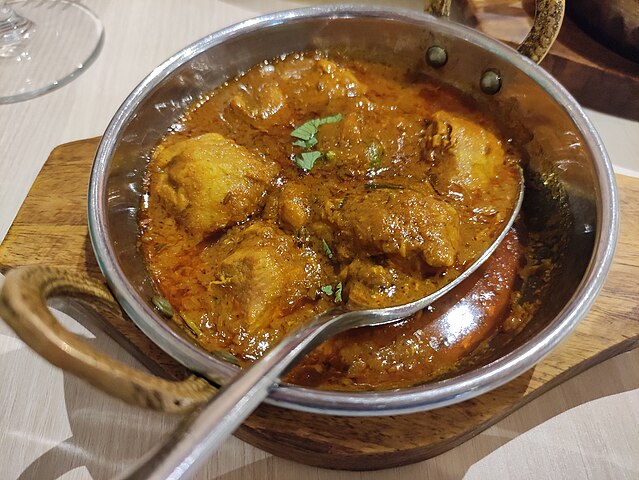
The second point that Matsuyama makes that I thought was interesting was the idea of variation even within the same religion. Matsuyama talked about how Buddhists in Theravada countries might look at Japanese Buddhism (Mahayana), and be confused by some of its practices, and vice-versa. So, he used the example of curry. Curry is a food that is found across all of Asia, but there’s an incredible amount of local variety. I LOVE curry. I eat any kind of curry, and love the sheer variety.

Different curry dishes arise from different environments and circumstances: availability of ingredients, cooking methods, climate, and so on. Matsuyama stated that Indian curry tends to be very spicy, which is handy in a hot, dry climate as some parts of India are, because it helps you sweat. Japanese curry, which tends to be very hearty and mild, works well in a climate that is colder. Thai curry uses a lot of coconut milk, something not available in Japan, and seafood. Curry as consumed in the UK has also been adjusted for local resources and taste.

Yet all of these are unquestionably curry. Anyone can taste any of these dishes and immediately recognize it as curry. In the same way, each tradition and sect with Buddhism is easily recognizable. It may not suit one’s personal taste, but the variety of cultures, historical precedents, people and geography have led to a variety of traditions, and there’s something for everyone. Of course, this is true of other world religions too, but I wanted to use Buddhism as the example.

So, when looking at the variety of ideas, teachings and practices, consider the example of curry. Different curries arise from different conditions, and each is suitable for different people, but also curry is delicious no matter how you try it. So, don’t be afraid to sample other versions.

1 Unlike most Buddhist countries where monks are celibate and usually live a cloistered life, Buddhist monks in Japan are (for complex historical reasons that are too long to go into here) parochial, live among communities and marry.

Live And Let Live

SPOCK: Insults are effective only where emotion is present.

Star Trek, “Who Mourns for Adonais?” (s2ep2), stardate 3468.1

SPOCK: Where there’s no emotion, there’s no motive for violence.

Star Trek, “Dagger of the Mind” (s1ep9), stardate 2715.1

I wrote about the Buddhist virtue of forbearance before, but I had an important reminder recently why this matters so much in Buddhist practice.

Our natural tendency is to hold a grudge when someone slights us, or when we have been wronged. This is normal human pattern of behavior. But, like self-doubt, this is a form of conceit, putting ourselves and our ego before others.

In the Dhammapada, a collection of sayings attributed to the Buddha and one of the very earliest Buddhist texts still preserved, the Buddha has much to say regarding the subject. For example:

133. Speak not harshly to anyone, for those thus spoken to might retort. Indeed, angry speech hurts, and retaliation may overtake you.

134. If, like a broken gong, you silence yourself, you have approached Nibbana [a.k.a. Nirvana, final Unbiding], for vindictiveness is no longer in you.

The Dhammapada, translation by Acharya Buddharakkhita

The Buddha was uncompromising on this: no vengeance, lest you bring even further misery upon yourself.

Indeed, the Buddha taught by freeing oneself of ill-will and other negative emotions, one is liberated:

197. Happy indeed we live, friendly amidst the hostile. Amidst hostile men we dwell free from hatred.

198. Happy indeed we live, friendly amidst the afflicted (by craving). Amidst afflicted men we dwell free from affliction.

199. Happy indeed we live, free from avarice amidst the avaricious. Amidst the avaricious men we dwell free from avarice.

200. Happy indeed we live, we who possess nothing. Feeders on joy we shall be, like the Radiant Gods.

The Dhammapada, translation by Acharya Buddharakkhita

Of course, this is easier said than done.

As with self-doubt or any negative emotion, stop and think like a Vulcan: assess the situation including your own feelings. Is this productive? Is it harmful? Is it based on conceit?

Spock in season 3 episode 21, the “Cloud Minders”, played by Leonard Nimoy

Many times, we are prone to act or lash out, but if we take a moment to assess our feelings, and the situation, we are more capable of handling it rationally. In so doing, we avoid further misery for ourselves and others.

When the ego is bruised, it demands attention and resolution. But that is short-sighted, and rarely fixes anything.

SEPTIMUS: Our way is peace.

Star Trek, the Son Worshiper, “Bread and Circuses” (s2ep25), stardate 4040.7.

A commitment toward peace and well-being towards others feels counter-intuitive at times, but peace toward others inevitably leads toward peace for oneself.

Namu Shakamuni Butsu

An Introduction to Buddhist Sutras

I was inspired to write this post after seeing this joke online on that one social-media site:

The joke here is a Japanese-Buddhist monk looking at a receipt from Muji (a Japanese home goods store), and commenting that this “sacred text” shows they purchased a lot.1 This happens to us too.

Anyhow, what is a sacret text in Buddhism?

Buddhist sacred texts are called sutras (sometimes suttas), from the old Indian Sanskrit word.2

Buddhism doesn’t have one sacred text like you would associate with the Bible, Q’uran, etc. Instead, it has layers and layers of sacred texts.3

I won’t get into why there are so many layers, but suffice to say that the Buddhist tradition holds the sutras as genuine sermons of the Buddha (a.k.a. Shakyamuni Buddha) which have been passed down generation after generation until today.

Sometimes sutras, or teachings contained therein, are repackaged into newer sutras, especially in the Mahayana Tradition, but the underlying teachings, the Dharma, are believed to be just as important. Think of Spiderman: every few years there’s another Spiderman movie, some more popular than others, but the underlying lore of Spiderman is always the same.4 The history of Buddhist sutras is awfully similar in this respect.

What’s important isn’t so much the specific text of a specific sutra, but the Dharma. In the same way, although Shakyamuni Buddha is very important, the Dharma he taught is even more so.

Because there are so many sutras, this also leads to many sects, schools, and traditions within Buddhism. Each sect or school strives to apply the Dharma as best they can, based on whatever sutra is considered most appropriate.

So how do we know if the Dharma is true? Because it can be applied in one’s own life, through good conduct, meditation, lifestyle choices and so on. If your doctor tells you to lose weight and exercise more, the results speak for themselves. Buddhism is a lot like this.

Should a Buddhist read all the sutras? No, there are simply too many. Some ate huge. It’s often best to start with one or two that are already part of the tradition you are interested in. From there, you can branch out as you see fit. Ask your local community if you need recommendations.

Also, an important tradition across all of Buddhism is reciting sutras. Some sutras are very short and can be recited as a whole. Other sutras are much too long, so people recite key passages only.

This tradition of reciting sutras not only helps internalize the teachings (make them a part of you), but also helps connect to the Buddhist tradition at large. People have been reciting the Buddha’s teachings from the very beginning, 2,500 years ago. When we recite and put the teachings into practice, we are another link in the chain.

Buddhism has no “holy” language, so you can recite them in your local translation, or use a liturgical format that fits your preferred tradition. Or switch between one and the other.

A booklet with the Heart Sutra used in Japanese Buddhism, which I posted about here.

What’s important is that followers make the teachings a part of their lives somehow. This helps them apply the Dharma and also generate good merit to help others. The Buddhist path is not a solitary path: we are all in this together.

Namu Shakamuni Butsu

Namu Amida Butsu

1 Muji is a great store, and there are a few oversea outside of Japan. You can find clothes, household items, stationary and so on. We shop at Muji in Japan whenever we visit there, but also have visited Muji stores along the West Coast as well.

2 Related distantly to the English word suture as in a thread. Old sutras were often palm leaves or tree bark threaded together to form a kind of book.

3 HInduism too, iirc.

4 Even when it’s Miles Morales vs. Peter Parker (or Gwen, or other Spider people), the lore is the basically the same.

Withdrawing

Kang a Klingon warrior leaning on a sword, point down, against an Enterprise console, staring bravely in the distance.

Kang: “Only a fool fights in a burning house.”

Star Trek, “Day of the Dove” (s3ep11), stardate unknown 

Ever since … recent events, I’ve been thinking about this quote a lot.

This also reminded of a passage from the Analects of Confucius:

[8:13] The Master said: “Be of unwavering good faith and love learning. Be steadfast unto death in pursuit of the good Way.1 Do not enter a state which is in peril, nor reside in one which people have rebelled. When the Way prevails in the world, show yourself. When it does not, then hide. When the Way prevails in your own state, to be poor and obscure is a disgrace. But when the Way does not prevail in your own state, to be rich and honored is a disgrace.”

Translation by Dr Charles Muller

The Analects is a compilation of Confucius’s (a.k.a. “the Master”, or “Master Kong”, etc) teachings by his disciples, completed around the 1st or 2nd century BCE. This particular passage does a nice job of summarizes Confucius’s general teachings: at all times a “gentleman” (jūn zǐ, 君子) should always stick to their principles regardless of the conditions of the world.

There are times where one openly expresses their views and strives to do what’s right, where one can share their talents for public good. But there are also times when one should bide their time, avoid getting entangled, and focus inward. Whatever is necessary to maintain one’s integrity at all times. Better to be broke but maintain integrity, than to compromise personal values for the sake of gain.

In Confucius’s time the central state of the Zhou Dynasty kingship was breaking down, and the different nobles governing each fiefdom were either breaking away and declaring themselves kings, or being overthrown by their own ministers who would in turn assert authority. It was a cutthroat time in Chinese history, and Confucius wanted no part in it.

One cannot help but find parallels even today.

P.S. Featured photo is of Kang the Klingon from the Stat Trek episode “Day of the Dove”, played by the brilliant Michael Ansara.

1 When Confucius speaks of the “Way” (daò, 道) he is using a common Chinese religious term for things like righteousness, justice, stability, and so on. The Taoist usage of the term is similar, and draws from the same “cultural well” even if nuances differ.