The Hero Of Our Own Story

A rich man thinks all other people are rich, and an intelligent man thinks all other people are similarly gifted. Both are always terribly shocked when they discover the truth of the world.

“I, Strahd” by P.N.Elrod

Another book I have been reading lately for Halloween is the novel I, Strahd, which is a fictional autobiography of the villain of the “Barovia” fantasy-gothic horror setting: Strahd von Zarovich. As an autobiography, Strahd talks about his origins and justifies why he’s such a monster, literally and figuratively. It was one of the most popular novels of the Ravenloft series that was published in the 1990’s to promote this venerable Dungeons and Dragons setting, and is a kind of “bible” for fans of the setting due to broad number of characters, helpful backstories, and compelling story.1

But I digress.

People naturally assume their values and beliefs are pristine because that’s all they ever know, and that others will naturally agree to them. They are then shocked to discover that other functional adults subscribe to very different beliefs. Their own world is briefly shattered or they feel threatened, and conclude that such adults are just stupid, insane or evil. What follows usually isn’t good.

Even when people claim they are open to discussion or free-thinkers, I am reminded of Dave Barry’s famous quote:

People who want to share their religious views with you almost never want you to share yours with them.

Of course this applies to me as well. But on the other hand, I have to remind myself that I am not the center of the Universe. Whether I am actually right or not is irrelevant; I have to accept that not everyone comes to the same conclusions that I do, and I have no right to judge them for their views:

Gandalf: “Do not be too eager to deal out death in judgment. Even the very wise can not see all ends. My heart tells me that Gollum has some part to play yet, for good or ill before this is over.”

“Fellowship of the Ring”, by J.R.R. Tolkien

Hence the Dhammapada has the famous line:

Hatred is never appeased by hatred in this world. By non-hatred alone is hatred appeased. This is a law eternal.

Translation by Ven. Acharya Buddharakkhita

It doesn’t mean you have to be best friends with other people, but you have to accept the sheer variety of people, ideas and beliefs no matter how stupid they seem.

Spock: Madness has no purpose.  Or reason.  But it may have a goal.

Star Trek, “The Alternative Factor”, stardate 3088.7

You don’t have to give them oxygen either. Some ideas are better left dead. It’s about tolerance of people, not tolerance of bad ideas. Ideas are, like all phenomena, contingent and impermanent (Buddhism par excellence).

As soon as you begin to harbor ill-will toward others who are different, you will quickly spiral into a dark path of your own doing.

Namu Amida Butsu

P.S. I have a huge backlog of drafted posts lately, so you may see a few more this week. I hope you enjoy.

1 It is a terrific read, but I admit I still like Vampire in the Mists featuring his rival, the elf-vampire Jander Sunstar, even more. Strahd is definitely *not* the hero in that tale. Heart of Midnight was also an excellent read and a close third for me. To be honest, all the novels I’ve read int he series so far, even the less compelling ones, are still good reads.

Who Needs Gods Anyway?

One of my personal tradition every Halloween season is to read Roger Zelazny’s book A Night In the Lonesome October, one chapter per day. The book, like all of Roger Zelazny’s writings, is a terrific book and I always find something new every time I read through it.

I felt like sharing this quote with readers:

We made our way cross-country through the colors of autumn browns, reds, yellows and the ground was damp, though not spongy. I inhaled the odors of forest and earth. Smoke curled from a single chimney in the distance, and I thought about the Elder Gods and wondered at how they might change things if the way were opened for their return. The world could be a good place or a nasty place without supernatural intervention; we had worked out our own ways of doing things, defined our own goods and evils. Some gods were great for individual ideals to be aimed at, rather than actual ends to be sought, here and now. As for the Elders, I could see no profit in intercourse with those who transcend utterly. I like to keep all such things in abstract, Platonic realms and not have to concern myself with physical presences…. I breathed the smells of woodsmoke, loam, and rotting windfall apples, still morning-rimed, perhaps, in orchard’s shade, and saw a high, calling flock V-ing its way to the south. I heard a mole, burrowing beneath my feet….

Even though I am a pretty devout (read: religious) Buddhist, I like this quotation a lot. It’s something I’ve felt for a long time: that religion works best when gods are kept at a distance, rather than an oppressive reality that must be feared and interpreted and re-interpreted over again. What’s front and center matters most. The world exists, it’s our job to learn how to live in it.

Further, I suspect everyone has a tendency to build God in their own image, hence the diversity of interpretations and approaches, but it’s all in our minds. The Buddha-Dharma is nice because it just works like the Laws of Physics or Gravity. Gravity doesn’t care whether you believe in it or not, it just works. In the same way, the Buddha-Dharma doesn’t demand fealty, respect or praise. Its teachings and goodwill are free for all. We do our best to work things out, and put the teachings into practice. How we interpret it isn’t so important. It’s just there.

Just like Fall weather, Halloween and nature.

Namu Amida Butsu

P.S. More on the virtues of knowing nothing, and just being humble.

A Trek Dad’s Review of Yesterday’s Son

As a big fan of the original Star Trek series (hereafter TOS), I recently picked up a trove of old Star Trek novels and have been reading them one by one.

I had heard about Yesterday’s Son from fellow TOS fans and started with this one first. The novel is based on the penultimate episode of TOS: All Our Yesterday’s, and continues the story further implying that during Spock’s brief tryst with Zarabeth resulted in a son, quarter Vulcan, quarter Human and half…Sarpeidon-ese?

Anyhow, the story involves Spock using time-travel to reunite with his son, bring him back to Spock’s time, and helping him integrate to life in the Federation. Further, Spock and his son develop a difficult, strained relationship over their differing backgrounds. Meanwhile, the Romulans are (as always) up to no good, and have their sites on the Guardian of Time from the season 1 episode City on the Edge of Forever. The end is a dramatic conflict with the Romulans, and a nice heroic moment for Spock’s son.

As a novel, it was a fun read with good pacing. I felt the novel deftly balanced key references to TOS without being a blatant fan-service, yet at the same time also provided innovations that didn’t go too far off the rails of Trek canon. In other words, it stayed faithful to Trek lore while also expanding it in a sensible way.

I really enjoyed this book, and would definitely recommend for classic Trek fans.

In Praise of the Castlevania Series

Every Halloween, including this recent one, I like to stop whatever else I am doing (including Fire Emblem), and play through the old, classic Castlevania the game series: namely Castlevania 1, 2 and 3 for the NES and Super Castlevania for the Super Nintendo. There’s something really fun about journeying to Dracula’s castle, fighting hordes of evil, and enjoying the medieval-gothic ambience. For various reasons, I never really got around to playing the newer Castlevania games because I was in college, and had other priorities, so I missed classics like Symphony of Night until it came out much later for mobile devices.

In any case, the first few are really near and dear to my heart. So, this post is a tribute to those early games.

Castlevania

Of all the games listed below, I think this is my favorite box art.

The original Castlevania game, like many early NES games, was short, simple, and brutal. The game did not teach you very much, but instead threw you right into the game, and the difficulty level rapidly progresses beyond level 1 and 2. By the time you get to the Grim Reaper, the levels are quite difficult. The final level is a genuine gauntlet.

I never beat this game as a kid, and I only beat as an adult through a combination of save states and dedication. It’s a classic of its era, and fun to playthrough. Even Terminal Montage did a nice tribute to it:

Castlevania II: Simon’s Quest

For some reason, early NES sequels often followed a pattern of providing overland adventures to expand the world of the first game. The Legend of Zelda had Zelda II: Link’s Quest, Castlevania had Castlevania II: Simon’s Quest and so on. Castlevania II was the least popular of the NES games, but it is in a weird way my personal favorite.

You had to be there, though.

I was a bit too young to play the original Castlevania when it first came out, but I knew about it, and so when Nintendo Power magazine put out the issue (with the controversial cover) with exclusive coverage of Castlevania II, I was hooked. The full color map was so fun to look at:

Source: Nintendo Power Magazine

I still play this game regularly. I enjoy the slower place than other Castlevania games, and that it requires less feats of acrobatics (less falling off of stairs, like Castlevania III). I like to both 100% the game, and beat it within the 8 hours. However sometimes, I just enjoy taking my time and exploring every corner of Transylvania.

Of course, one other thing should be mentioned: the soundtrack. 8-bit games weren’t known for powerful music technology, but every once in a while, someone would compose something inspired. The Bloody Tears song, found on the overload during daytime, would go on to be a classic of Castlevania franchise, and rightly so.

One other interesting bit of trivia. The Dungeons and Dragons module, Ravenloft (I6), came out in 1983:

The box art for Castlevania II came out in 1987. Notice any similarities?

Castlevania III: Dracula’s Curse

Castlevania III: Dracula’s Curse is arguably the hardest of the early Castlevania games. It used the novel idea of featuring a different, earlier Belmont, than Simon, so it has a grittier, more medieval feel. Coupled with the spirit helpers, and multiple routes to choose from, this games was exciting and fun to replay.

This is also the first game where Adrian Tepeš, also known as “Alucard”, is introduced, though mechanically he is a fairly weak helper.

In fact, fans of the Netflix Castlevania series (such as myself), will see many references to Castlevania III, including the same cast of characters. I was a bit surprised that Grant Danasty wasn’t included in the series, other than a brief mention:

“that one guy with the horse-drawn sailboat on wheels that called himself the Pirate of the Roads…”

Trevor Belmon, Castlevania Netflix Series, S3E01

As for the game, I truly do enjoy it, though the punishing difficulty and frequency of “stupid fall deaths” does get a bit frustrating at times. I often like to take the difficult routes just because it’s fun to go all the way up through the basement of Dracula’s castle, more so than the ghost ship. The soundtrack was excellent and many classics from this game appear in later franchises too. Culturally speaking, Castlevania III is the most influential of the early games, and with good reason.

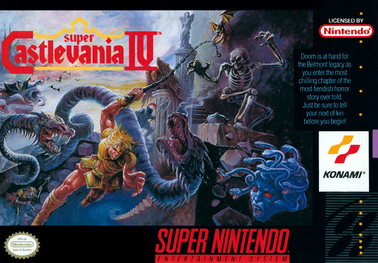
Super Castlevania IV

At last we come to the final game I played: Super Castlevania IV. This was the first game to be made for 16-bit Super Nintendo, versus older 8-bit Nintendo Entertain System. The improvement in graphics, sound and music reflect the improved hardware.

This game also finally allowed your character to whip in multiple directions, not just forward. I wish this feature had existed in earlier games, especially Castlevania II, since whipping the little slimes that were too short to hit was quite frustrating, as well as enemies on a lower platform.

The controls of this game are just so seamlessly smooth and the game levels are a good challenge without being excessive. The graphics of course were meant to show off new features of the 16-bit Super Nintendo, including rotating backgrounds, and other weirdness in Dracula’s castle. In fact, much of Dracula’s castle is just weird, but in a fun, gothic way. Fighting ballroom ghosts in one level, or gold skeletons in the treasure vault are all novel ideas, and lend to the old decadence of the villain.

Finally the music. The jazzier style music actually somehow enhances the mood of the game, rather than detracting from it. Composers definitely had some fun in this one, and I like to go back and listen to it occasionally on Youtube. Enhanced versions of classic Castlevania songs all sound great in this game.

One oddity is that this game is treated as non-canon in the Castlevania universe, since it is seen as a remake of the original Castlevania game.

Conclusion

I do regret not playing the later Castlevania games when they came out, especially Symphony of Night, so I missed out on a lot of the later lore until the Netflix series. However by this point, as an old school gamer, I had four classics under my belt, and was happy with what I had.

A New Dawn

I’ve been thinking about this conversation, shown above, from the game Fire Emblem: Three Houses. The game was made in 2019, just before the Pandemic, and other nonsense that went on in 2020 onward. How prophetic that statement was. Then again, I suppose this is something every generation has to live through in some ways. Sooner or later, things change, we lose something in the process and never get it back.

Wise words indeed…

It reminds me of a quote from the Analects of Confucius:

[9:17] The Master [Confucius], standing by a river, said, “It goes on like this, never ceasing day or night!”

Translation by A. Charles Muller

or Gandalf in the Fellowship of the Ring:

“Well, what can I tell you? Life in the wide world goes on much as it has these past age, full of its own comings and goings…”

J.R.R. Tolkien

Seen from another way though, this also means that new things come as well. Sometimes this can be scary, sometimes this can be a positive thing.

I suppose it’s all a matter of perspective.

Yuki-Onna: A Japanese a Scary Story (sort of)

In the 19th-century book Kwaidan, a collection of strange and scary Japanese stories, one of the most famous stories is called Yuki-Onna (雪女, lit. “Snow Woman”). Unlike other stories that Lafcadio Hearn collected, he claimed that this one was told to him directly by a local who somehow passed on the tale. I’ve posted it here verbatim from Project Gutenberg.1

Unlike other stories in Kwaidan, Yuki-Onna is less of a scary story than it is a weird story, but also if you play D&D/Pathfinder, I think the idea of a beautiful snow spirit wandering the woods and killing people by stealing their warmth, would make an interesting, albeit short, campaign setting too.2

Of the stories in Kwaidan, it is one of the most popular, and frequently shows up in Japanese media. One of my favorite comedy shows did a 3-minute summary of it in Japanese (sorry, no English, but the animation is great), joking how the identity of “O-Yuki” was painfully obvious:

As this is Obon Season in Japan, it’s a great time to enjoy another scary story or two…

In a village of Musashi Province (1), there lived two woodcutters: Mosaku and Minokichi. At the time of which I am speaking, Mosaku was an old man; and Minokichi, his apprentice, was a lad of eighteen years. Every day they went together to a forest situated about five miles from their village. On the way to that forest there is a wide river to cross; and there is a ferry-boat. Several times a bridge was built where the ferry is; but the bridge was each time carried away by a flood. No common bridge can resist the current there when the river rises.

Mosaku and Minokichi were on their way home, one very cold evening, when a great snowstorm overtook them. They reached the ferry; and they found that the boatman had gone away, leaving his boat on the other side of the river. It was no day for swimming; and the woodcutters took shelter in the ferryman’s hut,—thinking themselves lucky to find any shelter at all. There was no brazier in the hut, nor any place in which to make a fire: it was only a two-mat[1] hut, with a single door, but no window. Mosaku and Minokichi fastened the door, and lay down to rest, with their straw rain-coats over them. At first they did not feel very cold; and they thought that the storm would soon be over.

The old man almost immediately fell asleep; but the boy, Minokichi, lay awake a long time, listening to the awful wind, and the continual slashing of the snow against the door. The river was roaring; and the hut swayed and creaked like a junk at sea. It was a terrible storm; and the air was every moment becoming colder; and Minokichi shivered under his rain-coat. But at last, in spite of the cold, he too fell asleep.

He was awakened by a showering of snow in his face. The door of the hut had been forced open; and, by the snow-light (yuki-akari), he saw a woman in the room,—a woman all in white. She was bending above Mosaku, and blowing her breath upon him;—and her breath was like a bright white smoke. Almost in the same moment she turned to Minokichi, and stooped over him. He tried to cry out, but found that he could not utter any sound. The white woman bent down over him, lower and lower, until her face almost touched him; and he saw that she was very beautiful,—though her eyes made him afraid. For a little time she continued to look at him;—then she smiled, and she whispered:—“I intended to treat you like the other man. But I cannot help feeling some pity for you, because you are so young... You are a pretty boy, Minokichi; and I will not hurt you now. But, if you ever tell anybody even your own mother—about what you have seen this night, I shall know it; and then I will kill you... Remember what I say!”

With these words, she turned from him, and passed through the doorway. Then he found himself able to move; and he sprang up, and looked out. But the woman was nowhere to be seen; and the snow was driving furiously into the hut. Minokichi closed the door, and secured it by fixing several billets of wood against it. He wondered if the wind had blown it open;—he thought that he might have been only dreaming, and might have mistaken the gleam of the snow-light in the doorway for the figure of a white woman: but he could not be sure. He called to Mosaku, and was frightened because the old man did not answer. He put out his hand in the dark, and touched Mosaku’s face, and found that it was ice! Mosaku was stark and dead...

By dawn the storm was over; and when the ferryman returned to his station, a little after sunrise, he found Minokichi lying senseless beside the frozen body of Mosaku. Minokichi was promptly cared for, and soon came to himself; but he remained a long time ill from the effects of the cold of that terrible night. He had been greatly frightened also by the old man’s death; but he said nothing about the vision of the woman in white. As soon as he got well again, he returned to his calling,—going alone every morning to the forest, and coming back at nightfall with his bundles of wood, which his mother helped him to sell.

One evening, in the winter of the following year, as he was on his way home, he overtook a girl who happened to be traveling by the same road. She was a tall, slim girl, very good-looking; and she answered Minokichi’s greeting in a voice as pleasant to the ear as the voice of a song-bird. Then he walked beside her; and they began to talk. The girl said that her name was O-Yuki;[2] that she had lately lost both of her parents; and that she was going to Yedo (2), where she happened to have some poor relations, who might help her to find a situation as a servant. Minokichi soon felt charmed by this strange girl; and the more that he looked at her, the handsomer she appeared to be. He asked her whether she was yet betrothed; and she answered, laughingly, that she was free. Then, in her turn, she asked Minokichi whether he was married, or pledged to marry; and he told her that, although he had only a widowed mother to support, the question of an “honorable daughter-in-law” had not yet been considered, as he was very young... After these confidences, they walked on for a long while without speaking; but, as the proverb declares, Ki ga aréba, mé mo kuchi hodo ni mono wo iu: “When the wish is there, the eyes can say as much as the mouth.” By the time they reached the village, they had become very much pleased with each other; and then Minokichi asked O-Yuki to rest awhile at his house. After some shy hesitation, she went there with him; and his mother made her welcome, and prepared a warm meal for her. O-Yuki behaved so nicely that Minokichi’s mother took a sudden fancy to her, and persuaded her to delay her journey to Yedo. And the natural end of the matter was that Yuki never went to Yedo at all. She remained in the house, as an “honorable daughter-in law.”

O-Yuki proved a very good daughter-in-law. When Minokichi’s mother came to die,—some five years later,—her last words were words of affection and praise for the wife of her son. And O-Yuki bore Minokichi ten children, boys and girls, handsome children all of them, and very fair of skin.

The country-folk thought O-Yuki a wonderful person, by nature different from themselves. Most of the peasant-women age early; but O-Yuki, even after having become the mother of ten children, looked as young and fresh as on the day when she had first come to the village.

One night, after the children had gone to sleep, O-Yuki was sewing by the light of a paper lamp; and Minokichi, watching her, said:—

“To see you sewing there, with the light on your face, makes me think of a strange thing that happened when I was a lad of eighteen. I then saw somebody as beautiful and white as you are now—indeed, she was very like you.”...

Without lifting her eyes from her work, O-Yuki responded:—

“Tell me about her... Where did you see her?”

Then Minokichi told her about the terrible night in the ferryman’s hut,—and about the White Woman that had stooped above him, smiling and whispering,—and about the silent death of old Mosaku. And he said:—

“Asleep or awake, that was the only time that I saw a being as beautiful as you. Of course, she was not a human being; and I was afraid of her,—very much afraid,—but she was so white!... Indeed, I have never been sure whether it was a dream that I saw, or the Woman of the Snow.”...

O-Yuki flung down her sewing, and arose, and bowed above Minokichi where he sat, and shrieked into his face:—

“It was I—I—I! Yuki it was! And I told you then that I would kill you if you ever said one word about it!... But for those children asleep there, I would kill you this moment! And now you had better take very, very good care of them; for if ever they have reason to complain of you, I will treat you as you deserve!”...

Even as she screamed, her voice became thin, like a crying of wind;—then she melted into a bright white mist that spired to the roof-beams, and shuddered away through the smoke-hole.... Never again was she seen.

Enjoy!

1 Note: This eBook is for the use of anyone anywhere at no cost and with almost no restrictions whatsoever. You may copy it, give it away or re-use it under the terms of the Project Gutenberg License included with this eBook or online at http://www.gutenberg.net

2 At least, it would make a good one-shot adventure?

Kwaidan: Old-Timey Ghost Stories from Japan

Just as early American history is replete with strange or weird stories such as Rip Van Winkle, and the Legend of Sleepy Hollow and its headless horseman, all composed by Washington Irving, Japan has a collection of weird and strange stories compiled in a book called Kwaidan (怪談), which in modern Japanese is Kaidan.

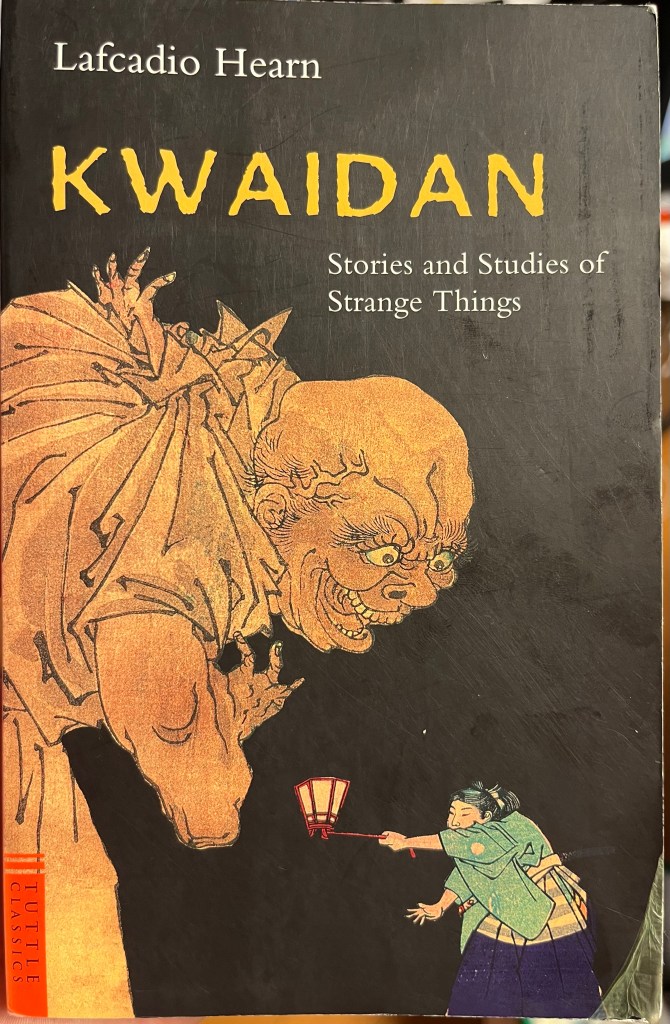
A used copy of the Tuttle Classics edition that I picked up a while back.

The full title is Kwaidan: Stories and Studies of Strange Things and was written by Greco-Irish author Lafcadio Hearn (1850-1904). Hearn had worked in journalism in the US for several years before moving to Japan, and settling down there, taking a Japanese wife and Japanese name, Koizumi Yakumo (小泉八雲), and writing many about early-modern, Imperial Japan.

Kaidan (using the modern spelling from here on out), Hearn admits in the foreword, is compiled from earlier Japanese sources, but it was the first of its kind published in English, and is even popular among Japanese audiences because it’s such a good compilation of disparate stories that have floated around Japanese culture for centuries. In the same way, the stories of Washington Irving drew on older European tales, but retold in an early American colonial setting.

By today’s standards, the stories in Kaidan, just like those of Irving, are pretty tame, more spooky or just plain weird. But they are full of vivid imagery that remains popular to this day. When Obon Season comes in Japan, usually starting around July 15th (not October like in the US), it is a popular time to relive these stories in TV and other media.

Because Kaidan is so old it is available for free on places like Project Gutenberg. If you like a physical copy though, you can easily find used ones online.

I have linked a few stories from Kaidan that I previously posted in the past.

One other aspect of the book not usually covered is the last section where Hearn shifts entirely to observations about insects in Japan, namely butterflies, ants, and mosquitoes. He then applies Japanese-Buddhist moral interpretations to them. Hearn, who was deeply fascinated by Buddhism, makes a few pointed comments about Christianity, while carefully any hint of criticism to his Western audience at the time. No doubt, at the time, this was probably a touch scandalous.

Hearn’s writings about Japan, and his understanding of Japanese culture and language (“honorable” this, and “honorable” that 🤦🏼‍♂️), don’t necessarily age well, but he was also one of the very first Westerners to be immersed and so I tend to give him a pass on many things (his publisher’s comments about Japanese women in the introduction are a bit cringey, though).

I tend to think of Hearn as something of a kindred spirit, separated by 120 years of time.

Maybe there’s something weird about that too. 😉

P.S. I learned from the Japanese Wikipedia article that the “Kw” in Kwaidan is probably a feature of the Izumo-dialect of Japanese that Hearn was immersed in the town of Matsue in Western Japan where he lived.

P.P.S. There was also apparently a film based on the book in 1965, though I have never seen it. I enjoy the written version more, perhaps.

A Nerd Dad’s Review: Empires Triology

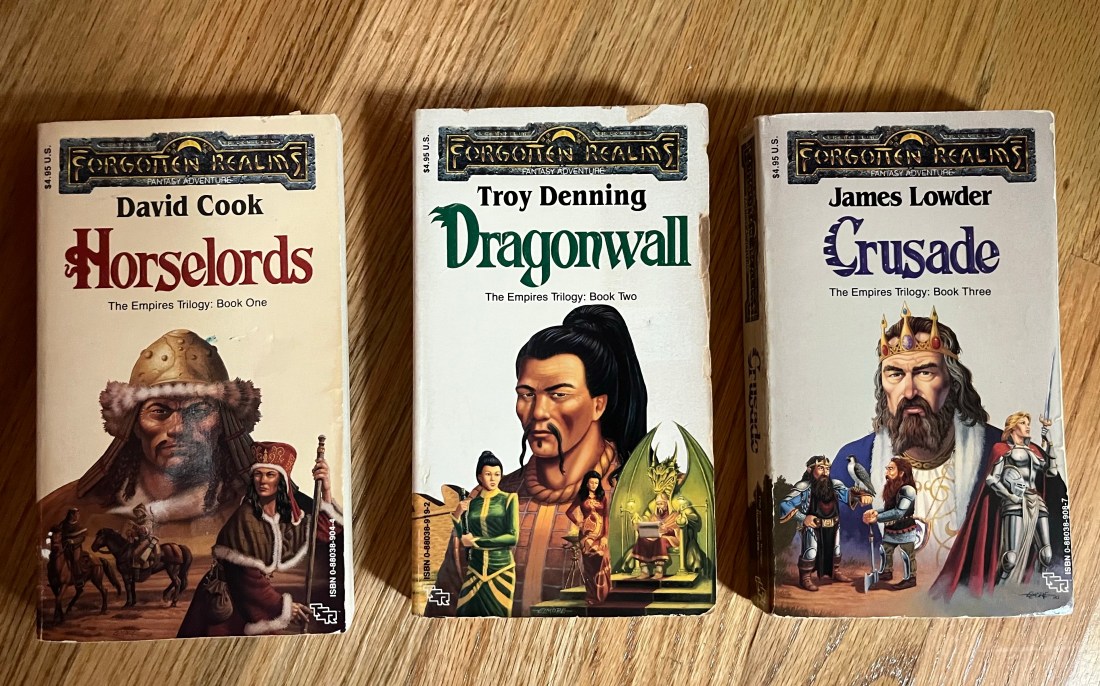
This post started with a surprise find at my local Half Price Books store. I often peruse the old fantasy paperback section, looking for Roger Zelazny novels that I haven’t picked up yet (see Spring Cleaning post), when I stumbled upon this old novel:

I suddenly remembered reading Horselords way back in the 1990’s in college, and although I didn’t remember the story much, I felt like re-reading it. It turned out to be a surprisingly good book. The story had surprisingly little to do with any Dungeons and Dragons lore apart from an odd mention here and there of magic, but instead was essentially a re-telling of the Mongol invasions of China, through a fantasy, fictional tribe called the Tuigan, headed by one Yamun Kahan. The book hints at some lore regarding the great Shou Empire, while the store is largely seen through the eyes of a foreign monk named Koja who is gradually brought into the inner-circle of Yamun Kahan. The story includes a lot of elements of the “noble savage” and “fish out of water” tropes, but overall it was a solid story as Koja gradually becomes more and more Tuigan in spite of himself. Even as his homeland is invaded by the Tuigan, Koja is a semi-willing participant in the invasion.

Having enjoyed the book, I decided to get the next two. I had never read them back in the day, not even sure if I knew they existed, but now, 30 years later, it was time to finish the series.

The second book, Dragonwall, was written by a different author, and was in many ways a different story entirely. The main character is a minor general named Batu Min Ho, who has Tuigan ancestry of his own, but was raised in Shou Lung. Through his tactical skill, he gradually rises through the ranks, earning the jealousy of some of the mandarins above him, culminating in a power struggle, and plenty of treachery that leaves his wife and children killed by the end.

Dragonwall overwhelmingly paints the Shou (fantasy Chinese) people of the Forgotten Realms in a negative light, as treacherous, back-biting, and decadent, which isn’t too surprising where court politics would be concerned but there’s little else to balance this contrast with the rest of Shou culture. This was probably meant to contrast the more brutal, yet honorable Tuigan culture, yet all the characters come off as one-dimensional and cartoonishly evil, especially the female antagonist. It plays into a lot of old, tired stereotypes about Chinese people.

Further, Batu Min Ho, having been discriminated and betrayed by the Shou, loses everything, goes rogue, literally using the Japanese term ronin (🤦🏻‍♂️)1 to describe himself, and joins Yamun Kahan’s horde.

The book ends with a lengthy divergence when the Tuigan under command of Batu Min Ho invade the fantasy realm of Thay briefly, which probably would’ve been interesting as a third story, rather than the end of this one.

In any case, this is where the third novel, Crusade, picks up, but once again, this book is written from the perspective of someone who is not Tuigan. This time the book is written through the perspective of the kingdom of Cormyr, a staple of the Forgotten Realms setting. This book, out of all three, has the most familiar fantasy setting since it is in a “Western” culture, so the author probably was on steadier ground and was able to afford fleshing out the characters more.

For me, Crusade, was a “slow burn” story: very slow start introducing an entirely new cast of characters with no interaction with the Tuigan. However, by the time of the climactic battle at the end, the book did an effective job of bringing everything together, including Batu Min Ho from the second book.

In spite of the rocky transition between settings across the series, shifting perspectives, and new characters each time, the final book did a rather admirable job wrapping up all the loose ends. The first book begins with a character named Koja and the third book essentially ends with him again. Coming full-circle was a nice conclusion.

The Empires Trilogy seems to have suffered from the same challenges that plagued the Star Wars sequels: No over-arching structure, and too many different “hands in the pot”, plus the stereotypical Asian characters, especially female characters, did not age well.

However, even with all the complaints, I still am glad to have finally finished the series. It was a bold attempt to make a semi-historical re-enactment of the Mongol invasions but through the lens of the Dungeons and Dragons Forgotten Realms setting. In spite of my complaints, I enjoyed the series and proudly keep it on my shelf now.

1 Western fascination of the lone warrior ronin is understandable, especially thanks to Kurosawa films, but it makes no sense for a Chinese character to use such a term, especially since it was not used for centuries later in the Edo period (17th century) when the story takes place in 12th century China.

Torii Gates in Japan

While making some maps on Inkarnate for a new Japanese-themed Ravenloft-domain I published on DMS Guild, I was reminded how these kind of Japanese gates often show up in unusual places in Western media, including fantasy media:

Torii gate for Tsurugaoka Hachimangu shrine in Kamakura, Japan. Taken in 2022.

But these gates aren’t just for decoration, they’re an important part of Japanese Shinto religion, called a torii (鳥居). They’re a feature only found at Shinto shrines, not Buddhist temples. Similar structures exist in other Asian cultures, but the torii in particular serves a religious function.

Shinto is a religion devoted to the kami, the native divinities of Japan, and in Shinto tradition ritual purity is important. The kami will not descend to ritually unclean places, nor hear the prayers of unclean people, so sacred places must be purified. A sacred space in this context can be as small as a tiny home shrine, a kamidana, or as large as the sanctum of a large shrine such as Meiji Shrine in Tokyo.

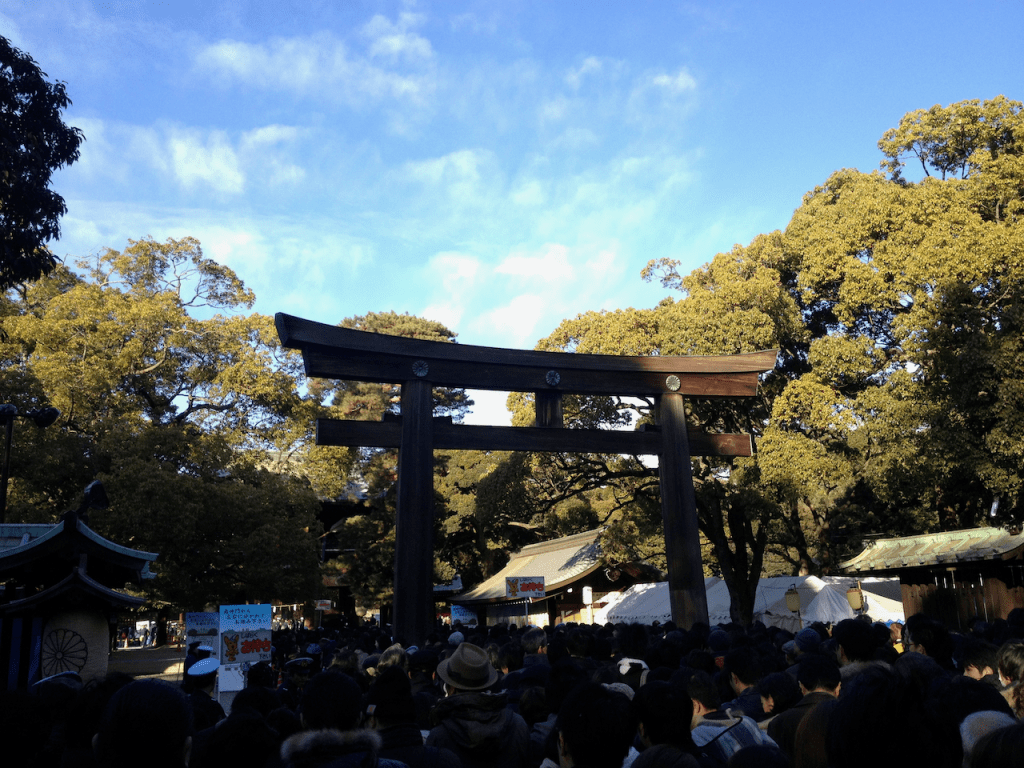
Torii gate for Meiji Shrine in Tokyo, taken in 2012 during Japanese New Year. The lines were amazingly long.

What matters is that there’s a sense of “boundary” between the mundane, outer world and the sacred, inner realm.

The torii thus acts as a gate between these two worlds. By passing through the gate you enter the sacred grounds of the shrine, or leave it. It’s also why taking away things from a shrine like pebbles or flowers is frowned upon.

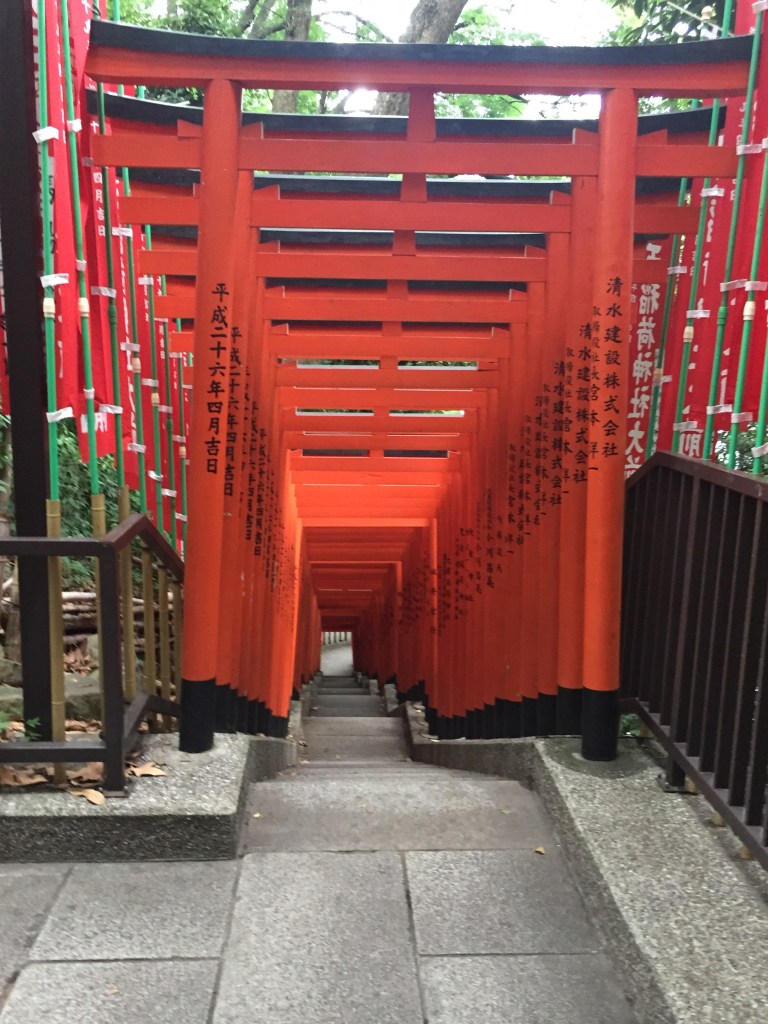
Torii can be very small, or using the example of Meiji shrine, extremely large. There are many styles too. Some are bright red, others a more natural color. Sometimes a shrine will have a series of torii gates.

Torii gates at Hie Shrine in Tokyo, taken in 2017.

In the photo above, these gates were sponsored through donations by local businesses. As with many other aspects of Shinto, there’s a lot of local community involvement as well as give and take.

Anyhow, that’s a brief look at torii gates.

Through the Ages

Been reading the Lord of the Rings with my son, and I stumbled upon this quote that I had never noticed before.

‘But it is not your own Shire,’ said Gildor. Others dwelt here before Hobbits were; and others will dwell here again when hobbits are no more. The wide world is all about you: you can fence yourselves in, but you cannot for ever fence it out.

J.R.R. Tolkien, “The Fellowship of the Ring”

Just some food for thought…