Frodo: ‘It’s a pity Bilbo didn’t kill Gollum when he had the chance.’
Gandalf: ‘Pity? It’s a pity that stayed Bilbo’s hand. Many that live deserve death. Some that die deserve life. Can you give it to them, Frodo? Do not be too eager to deal out death in judgment. Even the very wise cannot see all ends. My heart tells me that Gollum has some part to play in it, for good or evil, before this is over. The pity of Bilbo may rule the fate of many.’
J.R.R. Tolkien, The Fellowship of the Ring
We live around plenty of detestable people all the time, the Gollums of the world: in our neighborhood, workplace, etc, or in society at large. Some of us even have parents like this too.
It’s hard to put up with these people. Of course, we want to have goodwill toward them, but they just keep doing things that are annoying, rude, selfish, or directly harmful.
So, I like how Dogen in the Shobogenzo (recompiled as the Shushogi), suggests a realistic approach. Sometimes you simply can’t be friends with detestable people, or you can’t be around difficult family relatives. You can at least pity them, not hate them, though. They may never change, and that’s a tragedy, but it’s also important to avoid harboring ill-will. Easier said than done. But like Gandalf says, even terrible people have their part to play. So, at the very least, keep your distance for your own sanity, but also wish them well, even a little.
Confession: I starting writing this post before this one, and also before I had huge fight with my dad (again), and we are once again not on speaking terms, so I feel like a hypocrit for writing this post. but I still believe in those ideals. Because they are there, we can reflect, learn and grow. Myself included.
Long, long ago, I wrote about the struggles in the Late Roman Republic between its version of progressives versus conservatives. The Roman Republic did not have political parties as we would know them, but the factions and disagreements on how to solve changing political issues did exist in its Senate, much as happens in the modern world.
But that’s not something limited to ancient Rome.
In the late 6th century CE Japan was still limited to a small kingdom called Yamato (大和) which had conquered most of its rival kingdoms. At this time, the ruler of Yamato was still little more than a “chieftain” of the largest territory called an ō-kimi (大君) meaning “big king”, not even emperor (tennō, 天皇) as they are called now. Further, the authority of the king depended on powerful clans who had strong influence on the government.
For example, during Emperor Yōmei’s short and problematic reign there rose a power struggle between two opposing factions, the Soga (蘇我) clan, and the Mononobe (物部), and during the interregnum after he died. One one side of the struggle was a reform faaction that wanted to modernize the government based on the based on Sui-Dynasty Chinese government models, away from the older, clan-based kingship. This faction included:
Soga no Umako – head of the once powerful Soga clan, who had ties to the Korean peninsula
If the Soga were a progressive, reform faction wanting to modernize the country using the latest imported culture from China, the Mononobe were the exact opposite. The Mononobe Clan was a conservative, traditional clan that distrusted the new imported Chinese culture, and especially the foreign-imported religion of Buddhism. They supported the more native Shinto traditions, and were on the more xenophobic side of the political spectrum. Their current head, Mononobe no Moriya, actively skirmished with Soga no Umako during Yomei’s reign.
According to a historical text from the time, the Nihon Shoki (also discussed here and here), these conflicts came to a head in the year 587 after Emperor died, and a successor had to be chosen. In Japanese this is called the Teibi Conflict (teibi no ran, 丁未の乱) of 587. The Soga Clan and Prince Shotoku supported one successor, the Mononobe, the other. During the battle for succession, Mononobe no Moriya attacked Buddhist temples, and burned some of the images (often imported from the Korean kingdom of Baekje).
Finally, the battle came to a head at Mount Shigi (shigisan, 信貴山) in July of 587. The Soga lost multiple engagements at first and retreated. Then, according to tradition, Prince Shotoku, who was related to the Imperial family, fashioned a sacred branch of sumac, prayed to the Four Heavenly Kings (四天王) of Buddhism,1 promising to build a temple if they could help him trounce the Mononobe.
The subsequent battle was a complete rout for the Mononobe clan, and their leader Moriya was shot with an arrow. The rest was history: Shitenno-ji Temple, one of the oldest in Japan.
Under the reign of Empress Suiko, one of the few, powerful female monarchs in Japanese history,2 Japan further prospered under the triad of Suiko, Soga no Umako and Prince Shotoku, her advisors. Prince Shotoku in particular was said to have introduced:
Japan’s first ever Buddhist-influenced constitution: the Seventeen-article Constitution (jūshichijō kenpō, 十七条憲法 ). It’s not a modern, legal document, but it was meant to provide a spiritual framework for governing the country.3
Reorganized the bureaucracy into a meritocratic system based on the Chinese model, the Twelve Level Cap and Rank System (kan’i jūnikai, 冠位十二階).
The first use of the title “Emperor” (tennō, 天皇), when Prince Shotoku addressed the Emperor of China from the “Emperor” of Japan. This was a bit of a diplomatic coup by placing Japan as a co-equal to Imperial China.
What I always find interesting about this period of Japanese history was the overtly progressive nature and forward-thinking of the government at the time, not to mention a powerful female sovereign, and how it triumphed over conservative, xenophobic thinking. Of course, by today’s standards, it doesn’t seem that progressive, and some of these reforms eventually petered out,4 or were abandoned for various reasons, but some aspects persisted up until modern times. It is also the subject of various manga over the years.
But also, what I really like about this period is that the old order wasn’t totally destroyed either. The two sides eventually just learned to co-exist for many generations (e.g. the Nara and Heian periods of Japanese history). It wasn’t a smooth transition, but the forces of history marched on nonetheless.
P.S. Fun fact, one of the supporters of the conservative Mononobe faction was a small clan called the Nakatomi. Later, the Nakatomi would become the Fujiwara, and would eventually dominate political life in Japan. History is weird.
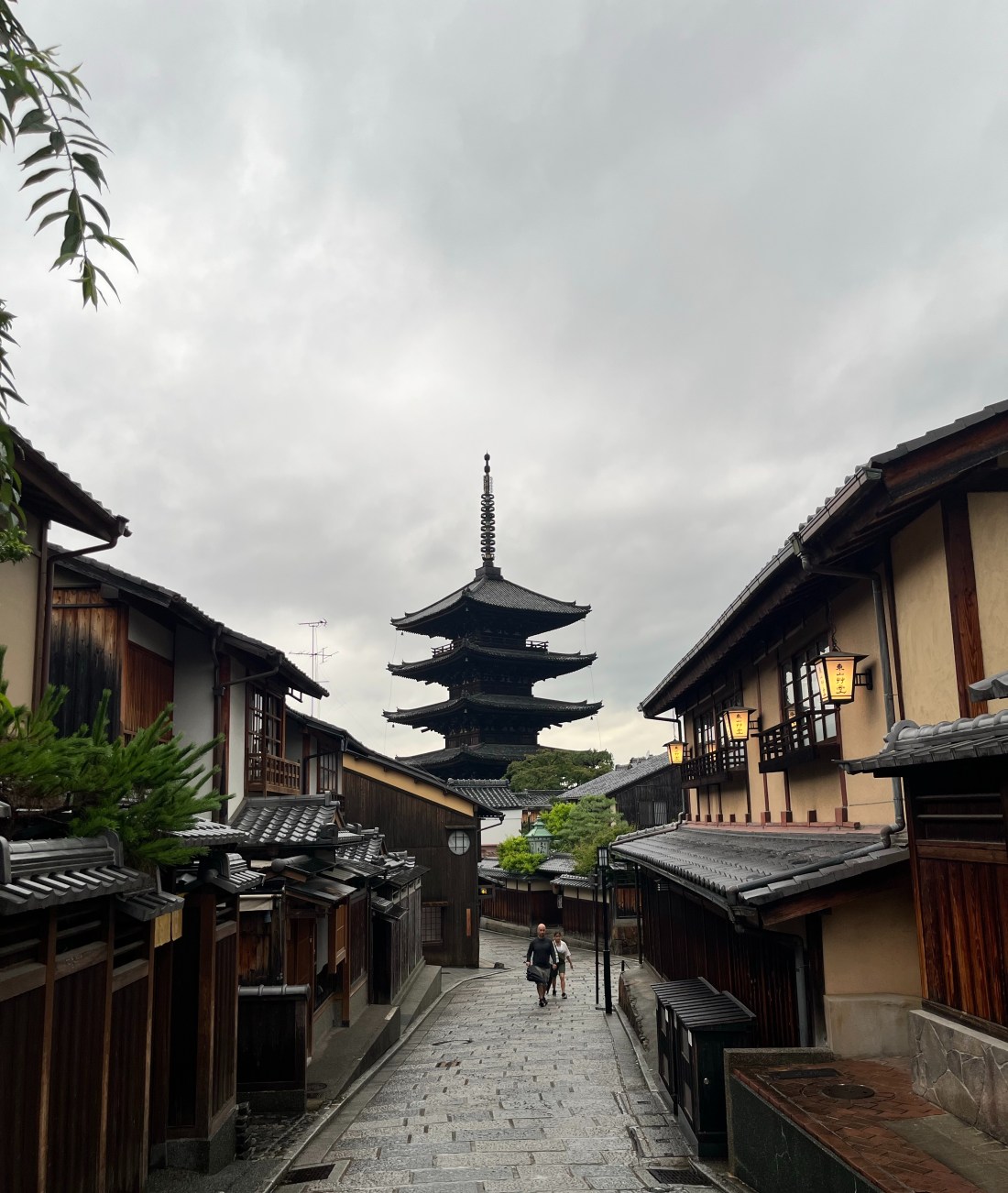
P.P.S. Featured photo is one of many pagodas (Buddhist stupa) promulgated by Shotoku, this one in Kyoto.
1 In Sanskrit, these were the Caturmahārājakayikas or Caturmahārāja. For example, if you visit Todaiji, you see some of the Four Guardian Kings around the giant statue of the Buddha, plus many other, older temples. I liked their adaptation in Roger Zelazny’s “Lord of Light” as well.
2 There were other Empresses who reigned as well, some powerful, but many remained as temporary regents until someone else could assume the throne.
3 The modern constitution of Japan adopted in 1947, at the instigation of US Occupation Forces, is ironically significantly more progressive and modern than the US Constitution. To be fair, they were written almost 200 years apart, but the Japanese Constitution explicitly grants suffrage to women and abolishes slavery. Even now, with its amendments, the US Constitution grants neither. In college, I met the lady (a US army secretary at the time) who helped write the clause on women’s suffrage. She was a very fascinating person, though she’s probably passed away by now.
4 Many generations later, this was still largely true: powerful clans ruled many parts of Japan outside the capital, gradually evolving into a feudal system over the centuries, until the Meiji Restoration of 1868,
All my deeds and past days were dark and full of evil. But a new day is come.
J.R.R. Tolkien, The Children of Húrin
Within the Silmarillion by J.R.R. Tolkien, is the tale (later edited and compiled as The Children of Húrin) of one human warrior named Túrin. The wicked father of dragons, Glaurung, has poisoned his mind and he goes mad with grief and (among other terrible crimes) mistakenly kills his elven friend.
Later, in a flash of awakening, through an encounter with another friend, he realizes what Glaurung has done to confuse him and lead him astray. He can’t change the past, but his mind is clear and he resolves to start over and focus on the task at hand: defeating the dragon and the dark forces of his land.
The Buddhist archetype for this is Angulimala: a ruthless madman that inflicted great harm, but in a moment of clarity changed his ways. This is how the Buddha-Dharma often works.
Anyway, the reason why I mention all this is that like the quote by Tolkien, each day is a new day. That doesn’t mean the karma you’ve created in the past will magically go away, but today is a chance to start over and try again.
KIRK: [War] is instinctive. But the instinct can be fought. We’re human beings with the blood of a million savage years on our hands! But we can stop it. We can admit that we’re killers… but we’re not going to kill today. That’s all it takes! Knowing that we’re not going to kill – today!
Star Trek, “A Taste of Armageddon” (s3:ep15), Stardate 3192.1
We still have our debts to pay off, but today we can choose to be a better person.
I stared for half a day once at an old man sitting on a bench in Arrakeen. He was a fifth-generation descendant of Stilgar the Naib and did not even know it. I studied the angle of his neck, the skin flaps below his chin, the cracked lips and moistness about his nostrils, the pores behind his ears, the wisps of gray hair which crept from beneath the hood of his antique stillsuit. Not once did he detect that he was being watched. Hah! Stilgar would have known it in a second or two. But this old man was just waiting for someone who never came. He got up finally and tottered off. He was very stiff after all of that sitting. I knew I would never see him in the flesh again. He was that near death and his water was sure to be wasted. Well, that no longer mattered.
Frank Herbert, “God Emperor of Dune”, chapter 5
It’s not uncommon to hear our grandparents1 talk about the “olden days”, and how we kids “have it easy!”. Chances are, you probably heard this too. As we get older, we start doing it too!
But sometimes I think about this quote from Herbert’s “God Emperor of Dune”. The planet Arrakis was once a harsh, forbidding desert planet where water was extremely scarce, and its Fremen people lived on the edge of survival. And yet, when Leto II Atreides the God Emperor ascended to power, he transformed the planet into a tropical paradise. Insodoing, the Fremen became softer generation after generation, forgetting their hard-learned survival skills.
Yet, I don’t mean this as a judgment. Instead, I think people are unwittingly products of their surroundings. At birth we don’t choose our parents, our native language, or which country, ethnicity, or “caste” we are born into. We are simply thrust into some circumstances outside our control, and even if we reject them, it still shapes who we are.
Further, as society moves from times of war (or pandemic), to times of peace, people change in response. Then, if war breaks out again, they change again. During times of prosperity, people behave one way, but in times of scarcity, they change again. It’s not that one generation is somehow better than another: they just respond to different conditions.
So, sometimes, I think about what forces have shaped myself up until now: my family’s political leanings, the socio-economic circumstances, and why these might have shaped my own personal biases. Even now, as I watch my kids grow up and leave the nest, I can already see generational differences with them, shaped by technology, world events, changes in social attitudes and so on. My grandchildren’s grandchildren will be even more different.
Season three of the science series Babylon 5 marks a big change in the story and especially for G’kar (played by the late Andreas Katsulas, RIP) and his people. G’kar recognizes what is happening and realizes that there is no going back.
In a sense, every moment is a transition. Most are really small, subtle, trivial, with some big ones thrown in. Some of these big transitions are positive (getting married, having kids, etc), some are overtlynegative.
Some start negative and become positive: I was laid off, but the new job I got ended up being better. Some start positive and become negative: friends who started out great, but became problems later or responsibilities that get worse and worse.
In short, life is just a series of constant transitions, great and small, and they’re usually hard to spot in until they have already happened. For example, on my way to work, I pass by my old university. I graduated almost 25 years ago, and still visit for cherry blossoms, but year after year it has changed in small ways like the Ship of Theseus. The university I knew no longer exists.
A scene from Fire Emblem: Three Houses
That’s all well and good for gradual, transitions, but what if you are living through a very dramatic, negative transition? It is very hard to see the light at the end of the tunnel.
“I wish it need not have happened in my time,” said Frodo.
“So do I,” said Gandalf, “and so do all who live to see such times. But that is not for them to decide. All we have to decide is what to do with the time that is given us.”
J.R.R. Tolkien, The Fellowship of the Ring
But I like to think that given enough time, even dark and difficult times eventually fade…
“It’s like in the great stories, Mr. Frodo. The ones that really mattered. Full of darkness and danger they were. And sometimes you didn’t want to know the end. Because how could the end be happy? How could the world go back to the way it was when so much bad had happened? But in the end, it’s only a passing thing, this shadow. Even darkness must pass. A new day will come. And when the sun shines it will shine out the clearer. Those were the stories that stayed with you. That meant something, even if you were too small to understand why. But I think, Mr. Frodo, I do understand. I know now. Folk in those stories had lots of chances of turning back, only they didn’t. They kept going, because they were holding on to something. That there is some good in this world, and it’s worth fighting for.”
So, when times are difficult, I try to hold on to the idea that time marches on, and today’s kings will be tomorrow’s dust.
The Buddha taught the importance of equanimity, like a grass that bends in the wind, no matter how strong it blows, and this is a lot easier than it sounds when you’re dealing with the hassles of life. But knowing that time marches on does make it somewhat easier.
If you know what life and existence is, think of it this way: it’s just there.
Recently, I talked at length about the role-playing game called The One Ring, and I wanted to explore one aspect of it, and its origins in Tolkien’s Lord of the Rings trilogy, namely “Shadow”.
Fan art of the Nazgûl, the dreaded Ringwraiths of Sauron
Because the Enemy, Sauron, is growing in strength in the Lord of the Rings setting, his dark influence can be felt (even if only a little) everywhere, even in happier, safer places like the Shire, the Grey Havens, Rivendell, etc. Sauron’s forces attack some places in Middle-Earth, in other places his spies infiltrate, and even in friendly places, the mere mention of his name fills others with dread. His “shadow” grew longer and longer across Middle Earth. There was no place in Middle Earth that doesn’t feel the influence of Shadow. Sound familiar?
In the role-playing game, when player characters experience negative events, despair, or trauma can accumulate “shadow points”. These points are long-term, hard to remove, and if too many accumulate, a character can become miserable (affecting many other aspects of the game), or worse can eventually have fits of madness, like when Boromir tried to take the One Ring from Frodo. Such player characters may be forced to leave the game, or a player may choose to retire the character before it is too late. The longer one uses a certain character in the game, the greater and greater risk for accumulating too many shadow points and thus meeting a bad end.
Further, when confronted with Shadow different player characters react differently. A treasure hunter may fall into “dragon sickness”, like Thorin in The Hobbit, a warden may fall into despair (“is anything I am doing making a difference?”), or a captain may crave power, etc.
Similarly, in the original Lord of the Rings trilogy, the different peoples of Middle-Earth reacted to the growing Shadow differently. Elves withdrew, longed for the past, or fled across the sea. Dwarves became insular and greedy. Men became desperate and power-hungry.
Boromir thought he was helping his home of Gondor by trying to take the One Ring from Frodo. That’s how Shadow made him go mad: playing into his anxieties, making him feel hopeless and thus taking desperate measures. The Rohirrim nearly gave up too, as Gríma Wormtongue kept feeding lies and despair to their king, Théoden. Gollum’s mind was shattered by the ring and he could barely remember who he had been, and believed he was too wretched to be redeemable.
This is what Shadow does to people: it breaks people down.
But the reason that Sauron was defeated in the Lord of the Rings trilogy was that some people didn’t give up.
Rather than fighting alone, those who resisted Sauron worked together. Individually they were too weak to resist (even Elrond), but when they worked together, they could draw on each other’s strength, and help each other when discouraged. In the books we see Samwise Gamgee doing this countless times for Frodo, or Legolas, Gimli and Aragorn racing through Rohan to save Pippin and Merry. Not everyone in the Lord of the Rings trilogy was a hero, but everyone did something, however small, to contribute to the effort.
Further, even in the darkest hour, people kept going. They didn’t quit, they took another step forward, and another, and another. The goal seemed miles away, literally, but each step brought them closer, even if only a little.
In The One Ring game, during a “fellowship phase” (downtime), you can spend part of your time healing the scars of shadow. According to the core rulebook, dwarves will spend time forging to “burn away frustration”, hobbits will engage in gardening or painting, humans and elves will play or recite songs and poetry. In the books, characters such as Sam and Frodo occasionally stop to enjoy lembas bread, or Pippin and Merry enjoy a good puff of pipeweed after a major battle. It may not seem like much, but taking those moments of downtime do much to lift the soul, especially when it is weighed down by Shadow.
There is much we can learn from this.
P.S. There’s a whole Reddit channel just for LoTR memes. It’s a treasure-trove of silliness.
Recently, I talked about the autobiography of Sayo Masuda, a former bath-house geisha who suffered a very difficult upbringing. Because she was born out of wedlock by a mother who rotated through one man after another, Sayo’s mother had too many kids and no financial support for them. Sayo was thus sold off as a child to indentured labor where she suffered greatly.
Reflecting back on this, she says in her autobiography:
Even now it fills me with anger: I want to rage against the miserable lives we lead, those of us who are born into this world as blots of sin because of a parent’s irresponsibility; I want to cry out that a life like mine must never be repeated. No matter how deep in disgrace, a human being is human, after all. The human spirit wanders ceaselessly in search of light; and if it finds a light of some sort, it strives somehow to get near it, struggling, writhing in anguish. Yet even as it writhes in anguish, it is drowned before it reaches the light. If you have the heart of a human being and you become the parent of a human being, then even if it exhausts every bit of your energy, until that child can walk alone I want you to do your duty as a parent.
Page 18
Speaking as a parent, I feel this too. Kids are born into your care (through your actions, obviously), so you owe it to them to provide the best possible life you can.
As I wrote a short while ago, I have grown tired of Dungeons and Dragons, and alluded to a different RPG system called The One Ring. The One Ring (TOR), produced by Swedish company Free League Publishing, is a role-playing game (RPG) designed entirely for The Lord of Rings fantasy setting by J.R.R. Tolkien. Whereas D&D and Pathfinder are more generic rule systems that can be applied toward many fantasy environments, TOR is designed exclusively for the Lord of the Rings “Middle Earth” setting.
The core rulebook for The One Ring costs $60 in the US, but with it you get all the basics you need: how to make a character, how to run an adventure as a Loremaster (a “DM” or “GM” in other systems), and even the basic monster compendium. Compare this to D&D 5th edition, which requires $150 for three books. The D&D core books have a lot of content, to be fair, but if you want to get started in The One Ring, having a single book for a reasonable price is an easier start. Also, it is available as a PDF file on DriveThruRPG, I believe, for even cheaper.
The core rulebook is very well done, and the artwork is really amazing (some of it is on the page linked above), and bring out the “feel” of the game. There are other supplements available as well which are also available through DriveThruPRG as PDF files, or hardcover on the website above.
Let’s discuss the basics of The One Ring system…
The Basics
The focus of TOR is thus much more immersive into the “look and feel” of the Lord of the Rings setting. The emphasis is much less on combat and magic powers, but more on day-to-day adventuring in the Middle-Earth setting. This means you have to take into account things like:
Planning where you are going in Middle Earth
Tracking day to day travel from point A to point B
This sounds tedious, but it isn’t. The rules are pretty straightforward.
Your stuff: things like encumbrance (load) matter. You have to consider how much you are carrying, including treasure.
Downtime, who you will spend Yule with, dealing with mental wellbeing, etc.
Healing from injuries (you cannot just magic away injuries).
Death, and any heirs for a player character.
What you get is a really mood-driven, realistic feel for life in Middle Earth. The adventuring (including combat and exploration) is still a core part of the game, but now you really get to slow down and immerse yourself in that world. That’s no small feat.
I emphasize this because many years ago I played a different LoTR-based RPG system produced by ICE using the “Rolemaster” rule system. This was a generic role-playing system used at the time, but modified for the Middle-Earth setting. I read through the book many times, and while it looked cool, even back then it felt like this wasn’t really an authentic Lord of the Rings game. Since that time, other systems have tried the same thing with mixed results.
Thus, what I like about TOR is that it conveys the Middle-Earth “feel” better than any system I’ve seen so far. It’s really fun to make a character, and imagine how they fit into the setting, and to also go to places that have historical significance in Middle-Earth, and somehow it really feels like you are there.
But how does the game play compared to Dungeons and Dragons and such?
Gameplay
First, TOR relies on a different dice system relying on a combination of d12 “fate dice” and d6 “success dice”. Certain numbers have significance on the dice: for example the 12 on a d12 is something akin to a “natural 20” in D&D, while an 11 is the opposite. The 6 on d6’s also provide extra bonus successes if you get them. There are specialty TOR dice you can get, which replace the 12 and 11 with the Gandalf rune ᚠ, and the 11 with the Eye of Sauron. These are not strictly necessary to play the game; a standard set of d12’s and d6’s will suffice.
The system for handling challenge roles is pretty straightforward, but the vocabulary takes a bit of getting used to (e.g. “favored” vs. “inspired”). After a couple of solo play sessions I got the hang of it.
In fact, the overall stats system in TOR is much simpler than D&D. You can easily fit your character onto a single sheet, and still have plenty to keep you busy. For testing purposes (namely “Strider Mode”, which I’ll cover later), I made a test character, a Dwarf named Frár son of Nár, using the core rulebook naming suggestions.
This is the example character sheet I made for myself. I wrote this in haste late night after my son had gone to sleep, so my handwriting is even worse than usual. Still, I like how it all fits in one sheet and is very easy to manage.
As you can see, the basic stats are three, not six like D&D / Pathfinder: strength, heart and wit. Frár had good scores in strength and wit, but pretty low in heart (he is not a bold person). The core rulebook gives you a preselected list of stats for each heroic culture, and you choose the combination you want. Having only three stats means some skills fall into buckets that might not entirely make sense (awareness for strength), but I am not troubled by this. The streamlined mechanics are nice.
I also like the fact that the challenge ratings for most things is based on your own stats. If you have high strength, the challenge rating for strength-based challenges is thus easier. Similarly for heart and wit. This hurt Frár though, because even with good travel skills, he frequently failed basic travel checks and ran into a few issues on his first journey. On the other hand, as a treasure hunter, his wit skills (and low challenge rating) will definitely come in handy. Frár just isn’t a bold traveller, I guess.
Speaking of streamlined: your stuff. Money isn’t meticulously tracked in TOR, and so when you make your character, you can pretty much equip it with any basic items you want (with a few restrictions based on cultural wealth). Further, during Fellowship phase (i.e. downtime), you automatically manage basic maintenance of consumables, travel rations, etc. Treasure is abstracted as “treasure points”, apart from rare or magic items, so you don’t have to carry around 5,000 copper coins to and from a dungeon. In other words, day to day maintenance of your character is assumed, and you don’t have to put much effort into it. You do have to consider the overall bulk of what you’re carrying (including looted treasure) because fatigue and endurance are really important in TOR. Fatigued characters definitely start to have problems, and it is not so easy to recover from. So travel wisely.
Side note, horses are really helpful, and fun. Frár has a horse that I named “Old Nob” for some reason. Horses will shoulder some of the burden, and help limit long-term fatigue. Plus, the game doesn’t allow harm to come to the horses (animal cruelty is not OK), so it’s nice to own a pony or horse.
Similarly, endurance is a more short-term form of fatigue and is used both in combat (instead of hit-points), and outside of combat. If your endurance falls below your load + fatigue numbers, you take penalties as well. If your endurance falls to 0, you are unconscious. In combat, this will knock you out, but a grievous wound can potentially kill you, or permanently scar you. Again, this simple, but realistic focus really gives combat more consequence than D&D.
Combat itself is somewhat complicated in some ways, but simpler in others. Strategic battle maps are not needed in TOR, and issues around initiative are simpler. The mechanics of who hits who are somewhat “number crunchy”, and it’s mostly based on your own ability to parry, rather than armor class. Getting a grievous wound is bad though, and there’s a significant chance it will outright kill your character. Stronger armor helps avoid this, but at the cost of lugging it around all the time (fatigue). So, choose carefully. Anyhow, positioning is a simple “three tier” setup where you’re either upfront, in the middle, or back. Being upfront lets you hit more, but enemies can hit you more too. Being in the back let’s you be more defensive, but you’re less likely to hit the enemy, and so on. There are also strategic things you can do to increase certain terrain advantages, but the enemy can also do the same to you.
Growth and experience are different than D&D and Pathfinder, in that you build up adventure points per session, which once you’ve you built up enough you can then redeem for increased skills and combat skills using a simple “point buy” system. As you build up points, you can get some better, special equipment or develop some additional features intrinsic to your heroic culture.
Game Phases and Downtime
The flow of time is important in TOR, and there are season and phases that are important. Your game campaign usually starts in the year 2965 in the Third Age,1 and as you complete “adventure phases”, you’ll also undertake “fellowship phases” (downtime) to not only recover, but it helps provide the passage of seasons too. During year’s end is a special fellowship phased called “Yule” which is meant to express wintertime, when people are home and hunkered down for winter. Yule season lets characters return to their homes. do extra-special downtime stuff, including recovering from Shadow, training an heir (if you want to) who will inherit your stuff if you die, and building fellowship with teammates.
Let’s talk about Shadow. The Shadow mechanic expresses the fear and hopelessness that pervades Middle Earth as the Enemy grows stronger and stronger. During certain traumatic events, or direct confrontation with certain monsters, you can accumulate Shadow, and this can eventually affect your character’s wellbeing. You can think of this as the character growing older and wider, but also perhaps a little more bitter, after years of adventuring.
Fellowship phases let you undo Shadow up to a point, but if Shadow grows too much, your character can meet an unhappy ending: non-Elf characters might go mad, while Elf characters will be compelled to immediate head West beyond the sea never to return. This is another form of character death in a sense. Elves are particularly prone to Shadow due to their long memories, and cannot shake it off as easily as other heroic races.
Solo Play
Finally, let’s explore “Strider Mode”. The One Ring community is smaller than more well known RPG games, so you can’t always find people to play with, but it comes with a nice feature called “Strider Mode” which is solo playing. I wrote more about it here. The rules for Strider Mode are available on DriveThruRPG, and are very inexpensive. Most aspects of the game remain the same, but a few rules must be tweaked. Further, to help with solo decision making, Strider Mode provides some extra decision tables you can role. I found that Strider Mode is actually pretty fun compared to typical solo play, and my character above has started playing Strider Mode as I learn to navigate both the player rules, but also with designing adventures. Frár has already started his first journey from The Shire to the Blue Mountains to do some treasure-hunting, accumulated 2 points of Shadow, but also had a friendly encounter with a dwarf from the Blue Mountains who taught him a handy shortcut, cutting down on travel time.
Conclusion
All in all, I am enjoying The One Ring a lot more than I expected. I was skeptical at first, but I’ve been pleasantly impressed both by the quality of the materials, and also the depth of the setting, and how well Middle Earth culture is translated into this RPG, but also how many distracting aspects like money are streamlined. This means the game is both simple to pick up and learn, but also has lots of role-playing and setting “depth”.
If you are curious about it, I recommend checking out play-through videos such as the wonderful Unsung Tales series, which I’ve found helpful:
Also, the official TOR discord channel has been helpful.
But for my money, I really found that the price-point versus the quality of materials has been worth it. I am also glad to support smaller gaming companies too. I truly enjoy this system, have read the core rulebook cover to cover already, and looking toward getting some of the expansion books.
P.S. Free League Publishing also has a D&D 5th edition port of The One Ring, which I also own. I will review this separately, because it differs from regular D&D, and from The One Ring, and is a fascinating topic by itself.
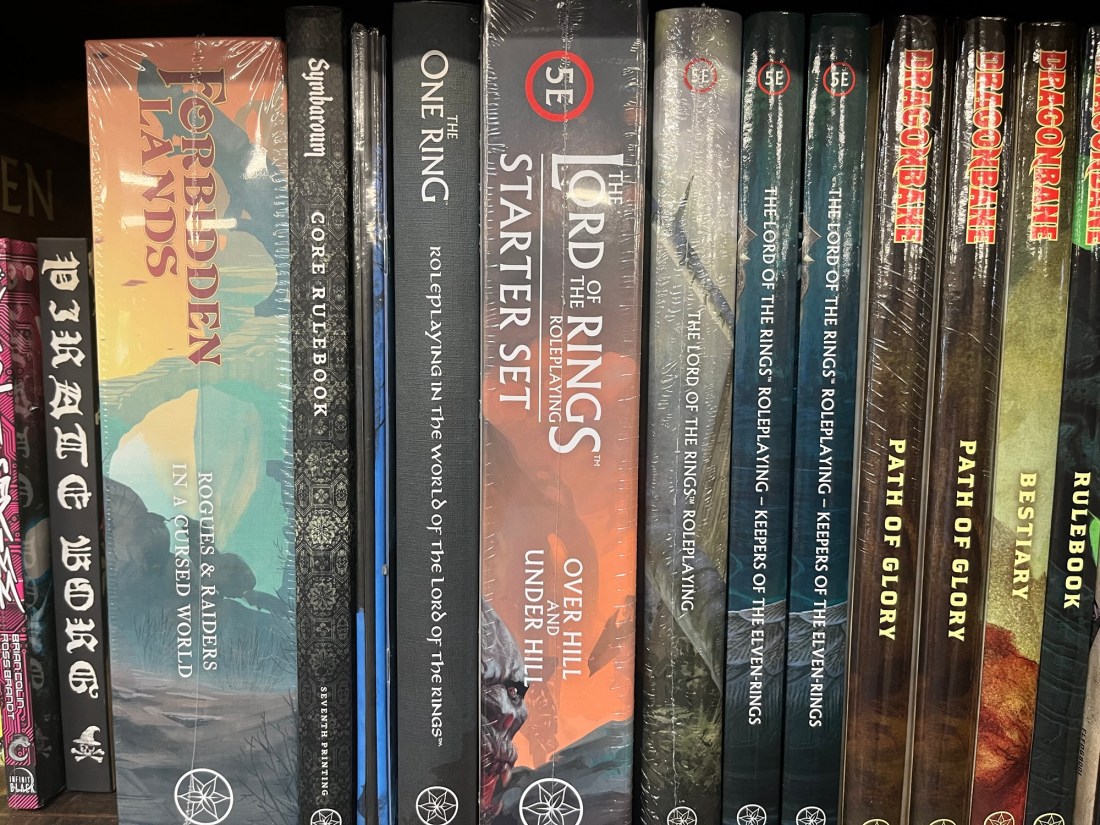
P.P.S. Featured photo is a shelf at my local gaming store, featuring some of The One Ring material.
1 This is meant to be a period of time between The Hobbit and The Fellowship of the Ring.
MCCOY: What he’s saying, Spock, is that a man who holds that much power, even with the best intentions, just can’t resist the urge to play God.
Star Trek, “Patterns of Force” (s2ep21), Stardate 2534.0
Since the beginning of time, powerful men have risen and then fallen. Doesn’t matter which culture, or which time period, sooner or later someone wants to be the Alpha, King of Kings, Pharoah, Shogun, President for Life, etc etc. It happens over and over again, and more often than not they self-destruct or their legacy crumbles after their death.
Take the case of Marcus Licinius Crassus, better known in history as simply “Crassus”. Crassus was absurdly rich. His wealth, and the political influence he bought with it, would make many hotshot-CEO’s today look like chumps.
We can look at examples and think to ourselves “what fools!”, but I think an even bigger lesson from this is that it can happen to any of us given the right circumstances. When we have power and authority, it is almost inevitable that we start to play god. In the Star Trek episode “Patterns of Force”, a historian tampered with an alien planet and (inadvertently) turned them into space Nazis.
The Ring of Power from J.R.R, Tolkien’s Lord of the Rings series illustrates this. Any person who gets a hold of the Ring, whether they be wizards, kings or elf-lords or even just hobbits, inevitably become corrupted.
Even Galadriel, one of the last of the mighty Noldor Elves on Middle-Earth and among the wisest of the elf-lords, was briefly tempted when Frodo offered her the ring, asking him if he wanted her to be a queen “terrible and fair”. Yet unlike her kin, she was able to resist and avoided a more terrible fate.
I feel I would be tempted too. This week I am filling in for my boss who’s on vacation, and even with this small dose of authority, I feel tempted to throw my weight around. How much more so if I was a world leader.
Why are we prone to this behavior?
I suspect it’s simply ego: our desire to mold the world in our own image. Even if we believe we are doing the right thing for others, our own ego blinds us to realities on the ground. If I had such power, I would probably fall into the same trap. People with strong egos are even more blind because they want so badly to project themselves onto the world while choosing to ignore the suffering it causes.
Of course someone has to be in charge. There has to be some form of authority for societies (or offices) to function. But it has to be treated as a radioactive, hot potato: something to be handled very carefully.
Anyhow, rambling thoughts here from the “Ozymandius” of my workplace.
Something fun to end this post though (direct link).
‘I am sorry,’ said Frodo. ‘But I am frightened; and I do not feel any pity for Gollum.’
‘You have not seen him,’ Gandalf broke in.
The Fellowship of the Ring, J.R.R. Tolkien
One of the most iconic characters in J.R.R. Tolkien’s Lord of the Rings trilogy is Gollum.
Gollum a twisted and corrupted being who kept the Ring of Power for countless centuries deep within the mountains, living far beyond his natural lifespan, and his mind growing darker and more sinister in the isolation, plus his obsession with the Ring…
He will never be rid of his need for it. He hates and loves the Ring, as he hates and loves himself. Sméagol’s life is a sad story.
The Fellowship of the Ring
Unlike other villains in the story, Gollum does not crave power, destruction, and dominion over others. Gollum only seeks to survive at all costs, and to get back his “precious” ring. By sheer craving and spite, he endures the elements, eats raw flesh, and lies, cheats, and backstabs his way through life.
For Dungeons and Dragons players, Gollum is the embodiment of the neutral-evil alignment in my opinion.
But why do I mention this?
I feel like we’ve all encountered someone like Gollum in our lives: someone nasty, cruel and devoid of any empathy toward others. I remember as a kid there was a middle-aged man who lived in our apartment complex who hated us kids playing outside, and would glare at us when we were too loud.1 I had a very wealthy, but also petty old woman live next door a few years ago, who constantly belittled others (including me and my yard). Even her helpers clearly hated her. There are people on social media, who do nothing but lie, twist words, and badmouth others simply so they can stay on top.
Frodo’s reaction to Gollum is understandable. Gollum is a contemptible, wicked creature, and Sam is right not to trust him. And yet, Gandalf knows something that Frodo doesn’t, and still pities him, even if he doubts that Gollum will ever change his heart:
Deserves it! I daresay he does. Many that live deserve death. And some that die deserve life. Can you give it to them? Then do not be too eager to deal out death in judgement. For even the very wise cannot see all ends. I have not much hope that Gollum can be cured before he dies, but there is a chance of it.
The Fellowship of the Ring
Gandalf is realistic in that the Ring of Power has so badly corrupted Gollum, that it’s doubtful he would ever return to his former ways, or somehow redeem himself, and yet there is a glimmer of possibility. The second book, The Two Towers, hints at this too just before he betrays the hobbits at Shelob’s lair…
For a fleeting moment, could one of the sleepers have seen him, they would have thought that they beheld an old weary hobbit, shrunken by the years that had carried him far beyond his time, beyond friends and kin, and the fields and streams of youth, an old starved pitiable thing.
The Two Towers, J.R.R. Tolkien
Behind countless layers of spite, rage, craving, self-hate, and so on, Gollum is still a weary l, pathetic, old hobbit (a.k.a. Sméagol) who just wants to be happy. His understanding of happiness is twisted by the Ring of Power, but the basic need is there. Frodo understood this, and pities him, even as Sam berates him.
One can only imagine: if Sam had been more patient with Gollum, would Gollum have still betrayed them?
In any case, one can look at the Gollums in our life and see the same thing. One has to approach such people realistically, they will hurt you if they can, but they are still pitiable creatures. Redemption may not be possible, but it’s helpful to remember who they are deep down.
Namu Shakamuni Butsu
1 A family friend got fed up with his attitude and came over and chewed him out. After that, he never bothered us again. I am always grateful to her for standing up to that bully.





 Gleanings in Buddha-Fields
You must be logged in to post a comment.