When visiting famous Buddhist temples (o-tera, お寺) in Japan, it’s very common to see sutra books, or kyōten, (経典), sold in the gift shop. These are small booklets that contain popular Buddhist sutras of the Mahayana tradition, and are used for home services. Over the years, I’ve collected more sutra books than I care to admit, but I really liked the one I picked up from Kofukuji temple in Nara last year:
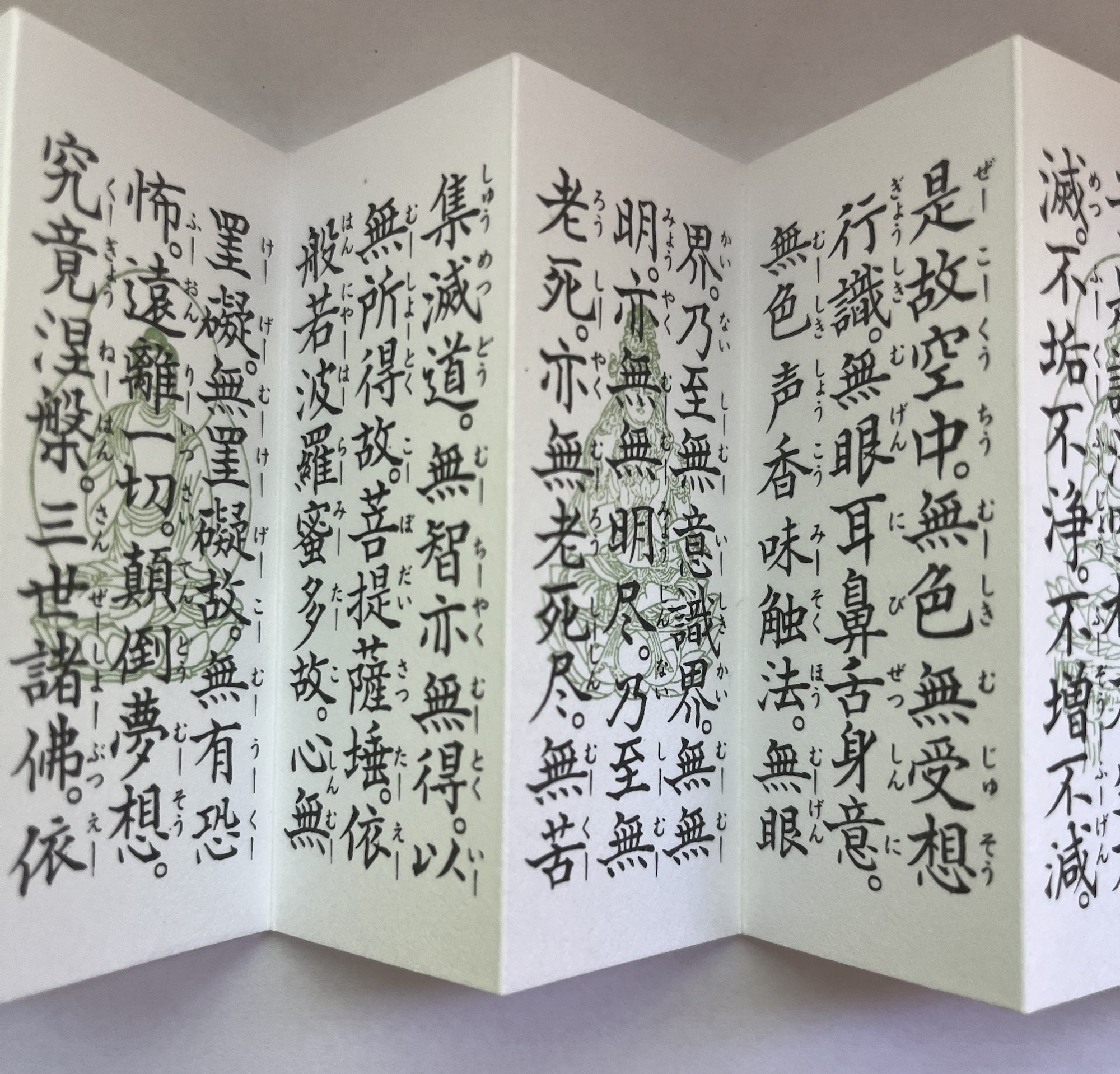
This is a boxed copy of the Heart Sutra, called the Hannya Shingyō (般若心経), with a blue brocade cover. Inside, you can see the Heart Sutra as it is usually printed: original Chinese characters with Japanese pronunciation guides. It is read from right to left, vertically:
However, if you look carefully, you will also see Buddhist deities embossed on the pages too:
They also appear on the backs of the pages too:
It took me a moment, but I finally recognized these as the Thirteen Buddhas and Bodhisattvas venerated in the Shingon-Buddhist tradition.1
I have read that many of the old Nara-Buddhist sects were gradually subsumed by Shingon Buddhism and adopted many of its practices. This includes sects such as the Kegon sect (Todaiji temple) and Hosso sect (Kofukuji temple) among others. So, this makes sense. You can learn more about Shingon Buddhism here.
Anyhow, of all the sutra books I own, I have to admit that this is my favorite one, and use it regularly for morning services (see old post).
P.S. If you’re ever curious what the Heart Sutra sounds like in Chinese (at least modern Chinese), this link has a nice example.
1 These Buddhas and Bodhisattvas are venerated in other sects in varying degrees, of course, but not as a set of thirteen like Shingon. Shingon even includes them in its ritual services.
June 4th is the yearly memorial service in Japan’s Tendai sect of Buddhism called Sangé-é (山家会) for its founder, Saichō (最澄, 767 – 822). I am writing this post a bit late this year, but I wanted to explore the life of Saicho a little bit and why he matters.
Saicho as depicted in a Heian-Period painting.
If you look at the history of Japanese Buddhism, Saicho doesn’t elicit much historical attention and discussion, even compared to contemporary rivals at the time like Kūkai, founder of Shingon-sect Buddhism. Yet, the sect he founded in Japan was overwhelmingly the largest and most influential for centuries (probably too much so), until it finally faded into the background in the late medieval period. This is why you rarely see mention of Saicho or Tendai these days: it’s far smaller now than it was in the past.
Also, to confuse matters further, Saicho is only the founder of the Japanese branch of Tendai. It was the Buddhist monk Zhi-yi (智顗, 538 – 597), who originally started the Tian-tai (天台) sect in China in the 7th century and it remains a very influential sect across many areas of mainland-Buddhist Asia (Korea, Vietnam, etc). Tian-tai in Japan (pronounced as Tendai) reveres Zhiyi as well.
Anyhow, Saicho was a monk at a time when Buddhism had already been established in Japan, primarily around the old capitol of Nara, yet was limited to a very tightly regulated number of schools and monks per school. Besides the Yogacara (Hossō) and Huayan (Kegon) schools, the rest are very obscure today. These schools had all been imported from Tang-Dynasty China, and represent “branch” schools to the mother temples there. The existing schools at that time were obligated to perform rituals on behalf of the Emperor to prevent calamities, cure diseases, bring prosperity to the nation and other political needs. In turn, the government allocated new acolyte monks every year, and allowed them to continue. However, beyond that, Buddhism had very little reach in the rest of Japanese society. This is very different than the bottom-up approach in China.
Saicho was ordained as an official monk, but soon left and retreated to Mount Hiei where he underwent ascetic practices, rather than stay in the urban temple complexes. In time, he attracted other like-minded disciples, and a small, informal monastic community developed there on the mountain. Further, he carved an image of the Medicine Buddha, and later lit an oil lamp in reverence to the Buddha, praying that the light would never be extinguished. This lamp, the Fumetsu no Hōtō (不滅の法灯) was the subject of a previous post. By this point, the foundations of the temple of Enryakuji were laid.
Later, by a lucky coincidence, the capitol of Japan was moved away from Nara to Kyoto (back then Heian-kyō) in 795. Since Mount Hiei happened to be to the northeast of Kyoto, and since the northeast was considered an inauspicious direction in classic Chinese geomancy, the presence of a Buddhist temple there (namely Enryakuji) helped protect the new capital from negative influences. The Emperor, for his part, saw this new Buddhist sect has a counterbalance to the old guard sects in Nara. Thus, Saicho’s star quickly rose.
The Eastern Pagoda (Buddhist stupa), of Enryakuji Temple, 663highland, CC BY-SA 3.0, via Wikimedia Commons
Now with sponsorship from the new Imperial court, Saicho was dispatched to sail back to China in 804, gather more resources and help bring Buddhism to a wider audience. On the same diplomatic mission, another promising young monk named Kūkai was also dispatched. More on him later. Of the four ships that sailed out to sea, only 2 survived a storm at sea (Saicho and Kukai were each aboard one of the surviving ships).
Saicho’s had mixed success in China. He did not speak Chinese (he could only read it), but was able to get official permission from the Chinese government to travel to Mount Tiantai. There he stayed for 135 days. Saicho later received limited training in esoteric Buddhism, which was all the rage in Tang-Dynasty China (and Japan at this time). It wasn’t until the second generation of Tendai monks who went to China (Ennin for example) that esoteric training really developed in the Tendai sect in Japan. Saicho also copied many sutras and texts in order to provide fresh copies back in Japan (printing did not come until much later, despite flourishing in China).
Guoqing Temple (guó qīng sì, 国清寺) on Mount Tiantai, head of the Tiantai Order. Photo by Joshtinho, courtesy of Wikimedia Commons.
Nonetheless, when Saicho returned to Japan 8 months later, he was feted for his accomplishments. He got to work using his newfound training, and his collection of sutras brought back from China to petition the Emperor to start a new sect derived from the Chinese Tiantai Buddhism he trained under. Saicho’s vision was slightly different than Tiantai Buddhism, particularly because he envisioned a purely “Mahayana” sect, not just a sect with Mahayana Buddhism on top of earlier Buddhist tradition. This meant different ordination platforms, different training, etc. It was a big controversy at the time, and the powerful Yogacara (Hossō in Japanese) school based in Nara really gave him grief over it.2
In Dr Paul Groner’s book on Saicho, he explains Saicho’s vision further:
In his works directed against Tokuitsu and the Hossō [Yogacara] School, Saichō argued that all people had the Buddha-nature [capacity for Enlightenment] and could attain Buddhahood. Receiving the Fan wang [Bodhisattva precepts] ordination and adhering to the precepts were religious practices open to anyone. Anyone could receive a Fan wang ordination and anyone who had been correctly ordained could in turn confer the Fan wang precepts on others….
Saichō envisaged a system in which Tendai monks would be trained for twelve years on Mount Hiei and then go to live in the princes in order to perform good works, to preach, and to confer Fan wang ordinations.
Page 179
Further, Saicho really took the idea of unifying different Buddhist practices and traditions into an “umbrella tradition” to a new level. It wasn’t enough that the Lotus Sutra was the highest teaching (per Tiantai tradition), he wanted to really absorb other practices and traditions toward that end, and diffuse them across the country in a religious community that blurred the traditional lines between monks and laity.
Saicho’s zeal, his rising status in the new Imperial court at Kyoto, and his fresh training gave him a lot of leeway, and the Emperor granted his request. Thus, Tendai Buddhism (the Japanese branch of Tiantai) was born. It has a deep connection with the mother sect in China, but Saicho also added some innovations to it as well.
Saicho’s star was soon eclipsed after the other monk from the same diplomatic mission, Kūkai, who returned some time later and brought an extensive training program in esoteric Buddhism (something Saicho had only a partial training of). Because esoteric Buddhism was all the rage (until the Purge of 845), Kukai’s training and religious material he imported outshone Saicho. Kukai and Saicho tried to maintain a cordial relationship, but Saicho wasn’t willing to train under Kukai, and Kukai kept poaching disciples of Saicho’s so the two groups became somewhat acrimonious over time.
Saicho proved throughout his life that he was dedicated to the Lotus Sutra and the Buddhist path. He was a sincere ascetic in his youth, rather than a “career monk” like many others of his time, and held himself to high standards. The fact that attracted like-minded people around him, shows that he “walked the talk” too. In China, he underwent many trainings, copied many sutras, and didn’t stop learning and improving. It should be noted that Kukai and Saicho were both pioneers for journeying to China to bring back more Buddhist teachings, rather than past schools that relied on foreign monks to make the journey to remote Japan.
If Saicho had any virtue, it was zeal.
If Saicho had any fault, it was that he was perhaps stubborn.
Personally, I like Saicho, flaws and all. Like, I would have loved to sit with him on those early days on Mount Hiei, swap practice tips, get his advice, etc. I really like his enthusiasm and positivity. Much like Honen centuries later, Saicho was bold and motivated by sincere conviction. The Tendai sect morphed into something that I don’t think he anticipated but personally I blame politics more than the founder.
But anyway, this is all just my opinion.
As for me, I did an extra long home service for Saicho this week in his honor.
1 Devout Buddhists in early Japanese history, such as Prince Shotoku, were devotees of the Lotus Sutra as well, but I don’t think there was any effort in those days to elevate it to the highest teachings, let alone make a new sect out of it. It was just there as part of the larger tradition.
2 Acrimony between Tendai and Hosso schools of Buddhism continued for centuries, starting with Saicho’s disagreements with one Tokuitsu of Hossō. Both sects frequently faced off during official Buddhist debates at the Imperial court as well.
This is another cool moment in Japanese history (previous post here) that I wanted to share while re-watching the drama Thirteen Lords of the Shogun. Shortly after the death of Kazusa Hirotsune, the head of the Genji (Minamoto) clan named Minamoto no Yoritomo, sought to finally take the fight to Heike (Taira) clan. The trouble was was that he had a rival within the Genji clan itself.
Yoshinaka as portrayed in woodblock print from 1866, source Wikimedia Commons.
The Genji clan was quite large by this time, going all the way back a few centuries to Emperor Saga in the early 9th century. By the time of the Genpei War (late 11th century), the clan had a number of sub-clans, domains and so on. One such branch was led by Yoritomo’s cousin, Kiso no Yoshinaka.1 Yoshinaka and Yoritomo initially worked together, and Yoshinaka even sent his son, Yoshitaka (木曽義高), in good faith as a hostage at Yoritomo’s court in the city of Kamakura. However, the relationship quickly became estranged, and they competed for who could get to the capitol of Kyoto first to rescue the Emperor under house-arrest from the Heike clan.
What Yoshinaka didn’t know was that the scheming Emperor, Go-Shirakawa, was already in league with Yoritomo. Go-Shirakawa expressed gratitude to Yoshinaka, and even bestowed the lofty title of Asahi Shogun, or “Asahi” Commander of the Armed Forces, and commanded him to take the fight to the Heike. And yet, Go-Shirakawa still threw in his lot with with Yoshinaka’s cousin Yoritomo. Things quickly went downhill as Yoshinaka, realizing that he was being double-crossed, seized the Emperor briefly, and battled his cousin’s forces. In the end, Yoshinaka and his army were wiped out. His son, Yoshitaka, did not survive much longer despite being wed to Yoritomo’s daughter O-hime. This part of the historical drama is really sad because it was clear that Yoshitaka did nothing wrong, but was simply a victim of politics.
In the historical drama, and in Japanese literature, Yoshinaka is portrayed as sincere and well-meaning, but out of his league compared to the scheming of the Emperor and of Yoritomo. He was a genuine warrior, loved by his vassals, but court politics were beyond his ability, and he was ultimately betrayed by the very forces he sought to help. Seeing a pattern with Yoritomo?
So, why bring this up?
Yoshinaka’s remains were interred at a small Buddhist temple named Gichū-ji2 in the city of Otsu, in Shiga Prefecture. Centuries later, the famous haiku poet, Matsuo Basho, visited the temple on one of this pilgrimages. Basho was evidentially an admirer of Yoshinaka and composed a haiku upon visiting the gravesite:
Japanese
Romanized
Rough Translation2
義仲の
Yoshinaka no
Is this not the mountain
寝覚めの山か
Mezame no yama ka
that Yoshinaka woke up on?
月悲し
Tsuki kanashi
The melancholy moon.
2 any faults in the translation are my own
According to tradition, it is thought that one night while sleeping on a mountainside, Yoshinaka woke up and gazed at the moon. Here, on that same mountainside, the moon shines melancholy, still reflecting over the demise of Yoshinaka.
Later, when Basho passed away he was, according to his wishes, also interred at Gichū-ji so that he may rest alongside the admired warlord.
There’s a travel blog entry in Japanese that shows the temple grounds and the grave sites, while this page shows the temple.
It’s interesting that such a talented poet was so infatuated by this legendary, though ill-fated warlord that he would be buried alongside him despite the passage of centuries.
P.S. If you thought Yoritomo was a scallywag now, wait until you get to the murder of Yoritomo’s own half-brother, the talented general Yoshitsune.
P.P.S. Yoritomo also punished another branch of the Genji clan, the Genji of Kai province, by executing that lord’s young heir on suspicion of treason as well.
P.P.P.S. Yoritomo was, suffice to say, a cold-blooded ruler. Not surprisingly, the Shogunal military government he founded got off to a rotten foundation and struggled after his death. Unlike the video game character Edelgard, Yoritomo seemed to have no moral conviction. He wanted power and vengeance.
1 Fun fact: the actor who played Kiso no Yoshinaka in the historical drama was also in Godzilla Minus One. He appears in the opening scene as a runway mechanic, Tachibana, talking to the ensign.
2 The kanji characters 義仲 can be read as either “Yoshinaka”, as in Kiso no Yoshinaka’s name, or as “Gichū”, the name of the temple. Clever.
When you buy books in Japan, you are often asked if you would like a book cover. If so, the staff will kindly fold some brown wrapping paper for your books, with just the proper fit. Because people often read on crowded trains where there is little privacy, it is a handy way to keep your reading habits private. It is also a nice way to prevent your book from being scuffed in a backpack or purse.1
Similarly, you find many nice premade book covers in Japanese stores, or online. But I think making your own is the best way to do it. If done correctly, it is guaranteed to fit the book properly, and you can personalize it with whatever paper or design you choose.
Recently, I purchased some Japanese book covers from a local antique store, but I was disappointed to find some of them didn’t fit any of my books. Coincidentally, I received some nice wrapping paper, so I decided to put it to good use.
Following these handy instructions, I was able to make a book cover out of it:
The instructions, essentially, require fitting the book to a corner of the paper or fabric, and leave a margin of 5cm on each side. When folding the paper, it’s important to make it flush with the top and bottom of the book. After that, it should fit like a glove.
My book cover above required a couple tries to get it right. I didn’t properly measure the first time, and it was a bit too small. So I had to fold a second time, this time reading the instructions more carefully, and got a satisfying fit. I’ve really enjoyed this book cover once it was complete. Once you learn the technique, I realized that it’s easy enough to make one using any sturdy, foldable paper, or soft fabric. Plus, if you are artistically inclined, you can probably make book-covers that are suitable for the books you are covering. I wish I had that talent. 😅
Anyhow, enjoy!
1 I have an old, used Star Trek novel whose corner broke off recently, so I can safely say that protecting books, especially legacy used books, is important.
The Buddhist religion has a very old tradition originally called Uposatha1 or Upavasatha,2 that is vaguely similar to the Jewish sabbath.
In traditional Theravada-Buddhist countries (e.g. Myanmar, Thailand, etc), monks and nuns recite the old monastic code on the full and new moons. Devout lay Buddhists will undertake the Eight Precepts (more detailed explanation here) and in essence live like a monk for a day.
In Mahayana-Buddhism much of the same traditions are observed depending on the country. In China, the tradition is called bù sà (布薩) for monastics, and liù zhāi rì (六齋日) for the lay community. The latter means “six days of fasting [or abstinence]”. These terms became fusatsu (布薩) and rokusainichi (六齋日) respectively in Japanese. I did some digging and I learned that these traditions are also upheld in Vietnamese and Korean Buddhism too. Much like the Theravada tradition, the 8th, 14th, 15th, 23rd, 29th, and 30th days of the lunar calendar are used to undertake the Eight Precepts, while monastic communities recite the monastic code.
However, I am unclear how many lay Buddhists in traditional countries actually uphold this tradition. It’s not something people really talk about it in daily conversation, and of course everyone’s situation is different.
Over the years, I have tried to observe the Uposatha tradition. I even put calendar reminders too:
A reminder on my phone. Also, trying to listen to the HyakuninIsshu as well in my spare time to improve my listening skills when playing karuta. Photo was taken at the Skagit Valley Tulip Festival in 2024. We go every year, and take lots of photos.
My reminder is set for the 8th, 14th, 15th days, etc. for each calendar month. I just substituted the Western calendar for the lunar calendar, and for the month of February I simply moved the 29th and 30th to March 1st and 2nd. It’s not perfect, but it is predictable and easy to manage.
However, reality tends to catch up with me. My ability to undertake, let alone uphold the Eight Precepts is very inconsistent, and most of the time I am so busy as a working parent that I forget Uposatha entirely. Alternatively, I have to pare it down to something very simple that I can fit into my schedule, such reading a sutra out loud, reciting the nembutsu, etc.
But even when I fail, I think there’s still value in setting aside certain dates like this for Uposatha. You could just pick a certain day every weekend, or a certain day of the week,3 or stick with the lunar calendar. You can choose to follow the “gold standard” and undertake the Eight Precepts, or find another sustainable practice, or some combination. Planning ahead like this also helps work it into your schedule.
You can also just start small, do something sustainable, and then intensify practice after a few weeks or months (or even years). Once it becomes habit you have established a good foundation.
1 This is the Pāli language term.
2 The Sanskrit language term. If you’re looking for pronunciation help, check out my other post. Also, for reasons that are unclear, there appear to be two different Sanskrit words: Uposadha or Upavasatha. I am unclear which one is correct, but what little I could find suggests that Upavasatha is the more commonly used term. 🤷🏼♂️
3 I used to set aside Tuesday nights every week to “live like a monk”. Like a “half-Uposatha” or something.
My wife of 20 years is from Japan, and we cook a mix of Japanese food and American food in the house.1 The key to Japanese cuisine is using good dashi (だし), or powdered fish stock. Most Japanese foods that you’ve probably tried use dashi as the base even if you don’t notice it.
Needless to say, we use dashi almost daily at home. However, getting good dashi can be tough. Sometimes, you will find dashi sold in supermarkets, but it is usually filled with MSG, and not always good quality.
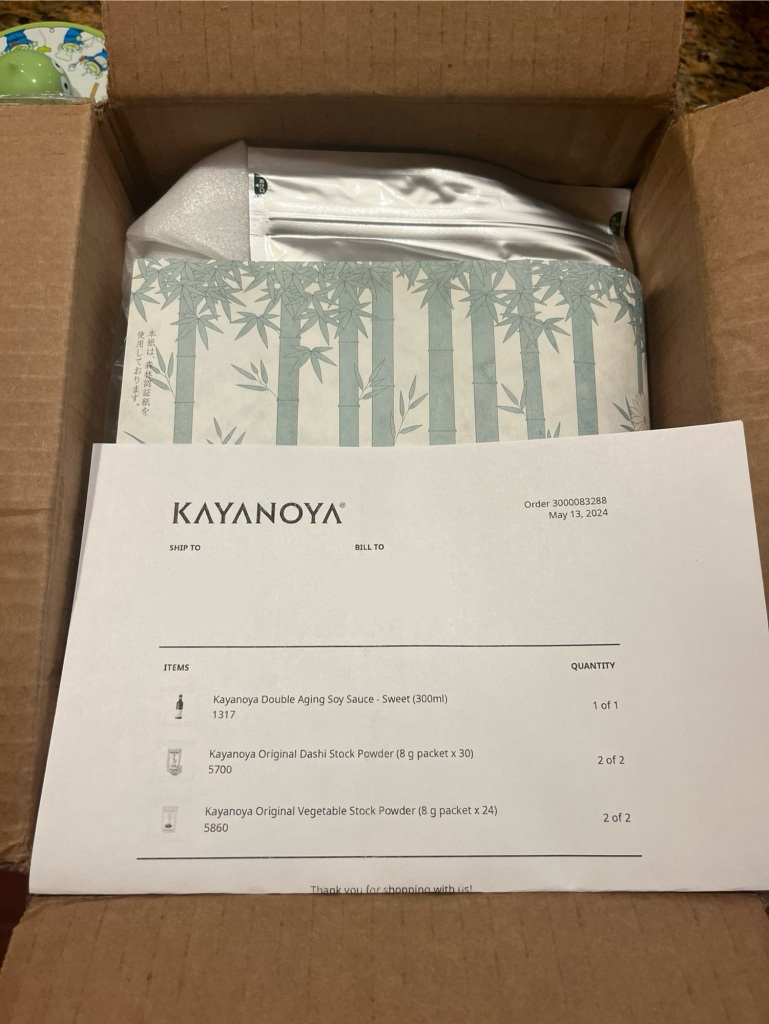
Thankfully, we discovered that the Japanese brand Kayanoya has a nice online store available in the US. From the web store, we ordered a batch of regular dashi, and a batch of vegetable stock. The packages arrived a week later:
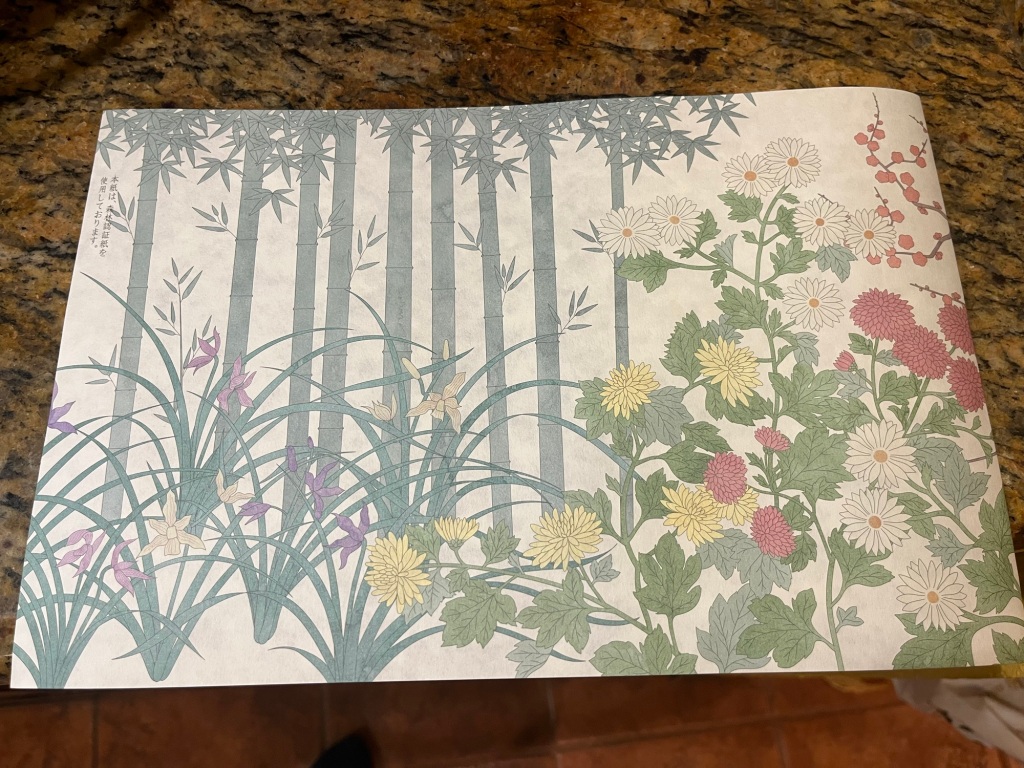
The package also comes with some nice Japanese-style wrapping paper. This sheet features several flowers: chrysanthemum (kiku), irishes (ayame), bamboo (také) and so on. I saved this paper and decided to use this as a makeshift bookcover (more on that in a later post). Anyhow, the paper is seasonal, so depending on what you order, you may receive different wrapping paper.
The dashi is terrific, and well worth the purchase, but the real surprise was the vegetable stock. It was delicious, more so than other domestic vegetable broth I’ve purchased before, and makes a really good lentil and vegetable soup.
If you are in the US, and cook Japanese food regularly, or want to make a nice vegetable soup, definitely consider ordering from the online store if you can.
1 My wife loves Korean food a lot (I do too), so we cook that too. We are lucky to have an H-Mart nearby, and a large number of Korean restaurants. I also experiment with making Indian-style curries, but I am still a long ways off from mastering it.
After finishing the Japanese historical drama, The Thirteen Lords of the Shogun,1 I managed to buy the Blu-ray from Amazon JP before it was taken off shelves due to controversy with one of the actors. Lately, as life has finally calmed down a little, I have been watching it again. With the benefit of rewatching, and Japanese subtitles, I have picked up a lot more from the show including this tragic bit of history.
One of the climatic turnings points early in the drama is Minamoto no Yoritomo’s execution of one of his vassals, Kazusa Hirotsune in front of everyone. Hirotsune was made the scapegoat for a failed rebellion among local retainers, while the rebellion was appeased, Yoritomo had him killed to teach a lesson. Hirotsune’s innocence was only confirmed after his death.
Apparently, some version of this really happened.
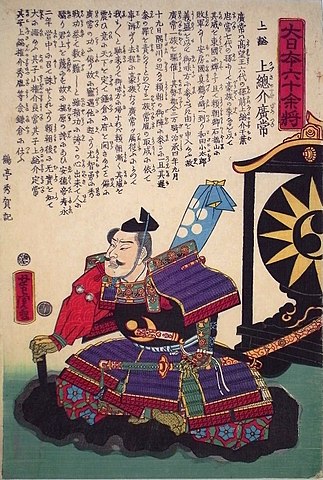
Woodblock print of Kazusa Hirotsune by Utagawa Yoshitora, Public domain, via Wikimedia Commons
According to the end of the episode, the incident was recorded in a historical record called the Gukanshō (愚管抄). In that document, it states that Hirotsune was a big player of a dice game called Sugoroku and while he was playing with some other vassals, he was suddenly attacked and slain by another vassal, Kajiwa Kagetoki, on Yoritomo’s orders. Later, Kagetoki, was said to have purified and washed the blood off his sword at the waters of a holy spring nearby. Hirotsune was evidentially abrasive and butted heads with Yoritomo at times, but nonetheless he was innocent of provoking the rebellion. Nonetheless, the damage was done: the clan property was broken up and given to other vassals for their loyalty, and the Kazusa clan disappeared from history.
Eight hundred years later the lands of the Kazusa family are now part of a local orchard in Kanagawa Prefecture, Japan called the Juniso Kajuen (十二所果樹園). You can see it on Instagram here. It’s a very nice looking orchard, but visitors walking through that orchard would probably never guess that long ago this was once the domain of a powerful and influential warlord.
I guess what I find fascinating and tragic about all this is how someone powerful and wealthy can be struck down, possibly through no fault of their own, and with the passage of centuries very little trace of their legacy remains.
1 not to be confused with the American series “Shogun”. The “Thirteen Lords” series was for Japanese TV only, and based on an entirely different historical event. Sadly, there is no English subtitles available which is a shame because I would argue that Thirteen Lords of the Shogun is a really fine drama and would be a huge hit overseas.
After a couple recent posts, I realized that I had never covered a very weird, disastrous war in Japanese history: the Ōnin War (応仁の乱, Ōnin no Ran) from 1467 to 1477.
The Onin War is something most Westerners would not be familiar with, but it had a devastating impact to Japan that can still be felt today in Kyoto. The war spanned 10 years, but was almost entirely fought within and around the old capitol of Kyoto, rather than across the countryside. The war practically flattened Kyoto, and with it centuries of culture and history.
The war began as a succession dispute. After the current shogun of Japan, Ashikaga Yoshimasa (also arguably the worst shogun in Japanese history) adopted this younger brother to be his heir. Yoshimasa had no male heirs, and so this was a common practice. Unfortunately, his wife then gave birth to a son, which put Yoshimasa in a very awkward spot.
Two of the most powerful samurai families supporting Yoshimasa were divided about which person to support: Yoshimasa’s younger brother, or his infant son. The Hosokawa and Yamana clans were already feuding with one another, so this just gave them another axe to grind. The two main generals under Yoshimasa were:
Hosokawa Katsumoto (細川勝元) – He supported Yoshimasa’s younger brother’s claim to be the heir.
Yamana Sōzen (山名宗全) – He supported Yoshimasa’s infant son, intentionally to further oppose the Hosokawa.
Eventually, both sides secretly built up armies within the city of Kyoto to attack the other. Neither side had a clear advantage, and neither side could score a decisive victory. The Hosokawa had the support of the Shogunate, but the Yamana clan had 6 out of 7 gates to the city. Each side had 100,000+ soldiers in the city. Confusingly, the two opposing sides later switched the heir they supported, and as the war became increasingly pointless, the two sides fought simply because they didn’t want to lose to their rival.
As the war dragged on, both armies pulled in more allies and reinforcements from the provinces, fighting over and over again in the neighborhoods of Kyoto, destroying homes, temples, etc. Battles were fought street-by-street, neighborhood by neighborhood. They even fought at Buddhist temples just to gain some advantage over their opponent.
But after 10 years, both sides were exhausted, weakened and finally withdrew.
Old Kyoto was completely destroyed. When people in Kyoto talk about “the war” destroying Kyoto, they are not referring to World War II, but the Onin War. So much was lost in the destruction that Kyoto has never been quite the same. Many of thefamoustemplesyou see in Kyoto today were burned down during the Onin War (possibly other times too, buildings in Japan frequently suffer from fire).
According to Professor Donald Keene, the famous Zen master Ikkyū Sōjun described the destruction in a poem titled “On the Warfare of the Bunmei Era”:1
One burst of flame and the capital—gilt palaces and how many mansions— Turns before one’s eyes into a wasteland. The ruins, more desolate by the day, are autumnal. Spring breezes, peach and plum blossoms, soon become dark.
Part of the reason for such destruction was that old Kyoto was a city made almost entirely out of wood. Further, houses were very close to one another. Even the Yamana and Hosokawa compounds were within walking distance from one another. Also, as I’ve alluded to before, the countless dead and displaced were horrendous to behold, especially compared to the aristocracy of Kyoto that mostly made it out unscathed.
But where was the Shogun in all this?
Ashikaga Yoshimasa was, by hereditary right, the Shogun (将軍): the supreme military commander of Japan, and had authority over both the Hosokawa and Yamana clans. And yet, even after his poor decision making caused the war to begin with, when the conflict erupted, Yoshimasa shrugged and basically did nothing.
Yoshimasa had no force of personality to compel both sides to stop fighting, and although he came from long line of warriors, he was much more inclined toward the arts. Through the entire conflict, Yoshimasa did not take sides, nor lead troops into combat, though some of his relatives briefly did. Yoshimasa simply withdrew and, like an aristocrat, remained aloof to the conflict. Yoshimasa held lavish drinking parties and poetry contests even while fighting raged in the city and Kyoto was burning.
As a Shogun, Yoshimasa was absolutely the wrong man for the job, and yet, when he retired as a Shogun, he devoted all his time, money and efforts to culture and arts, and this helped start a new culture in Kyoto: the Higashiyama culture. The Higashiyama Culture was short-lived, and war resumed in Japan soon after, but many of the traditional arts that exist in Japan today were from this small period of time, promoted and elevated by Yoshimasa.
One can easily argue that few, if any, wars have any realvalue, but the Onin War is a spectacular example of a war that accomplished almost nothing, could have been prevented by competent leadership, and came at tremendous cost. Even stranger, the result of this tremendous death and destruction was a new flourishing culture that is at the heart of Japan today.
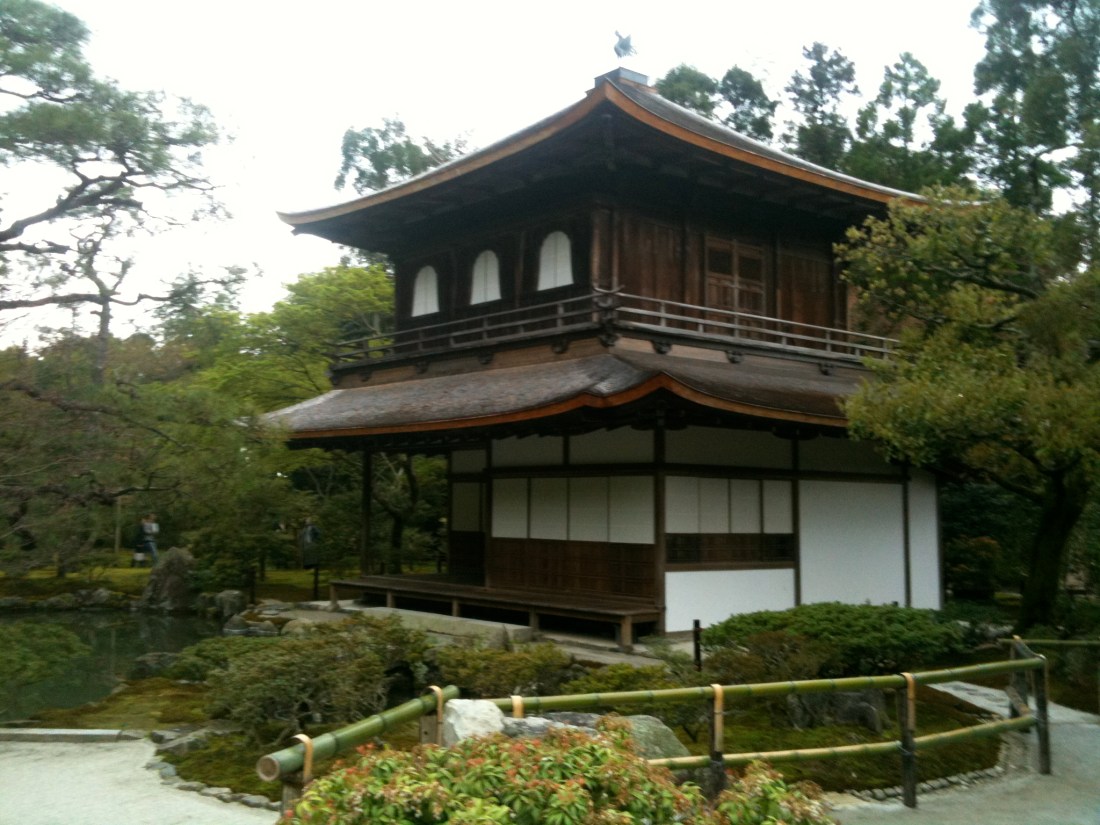
P.S. Featured photo is the Silver Pavilion of Ashikaga Yoshimasa, taken in 2010.
1 I tried finding this in Japanese, but I couldn’t. It was translated from a 1966 book called 五山文学集/江戸漢詩集 apparently.
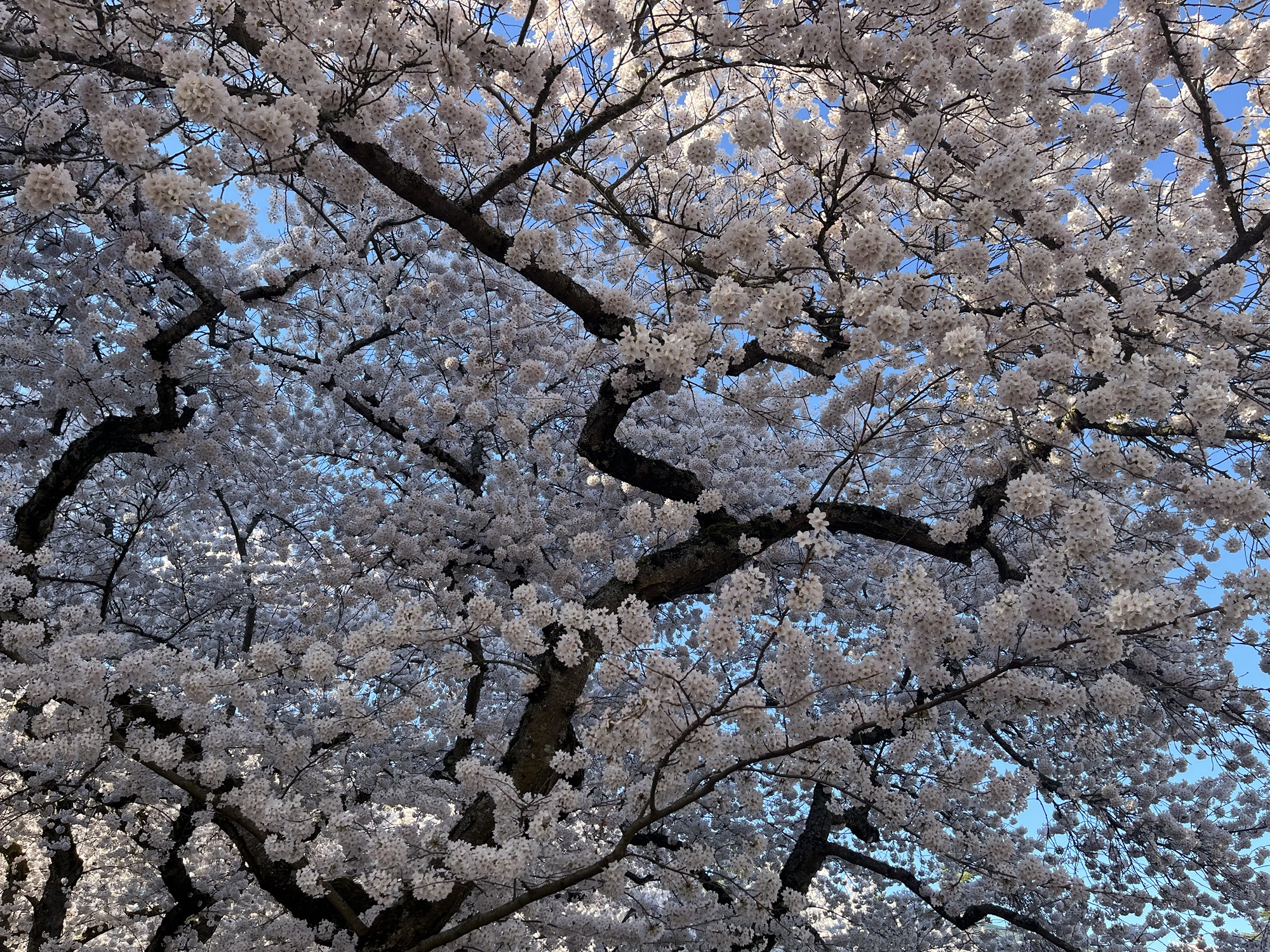
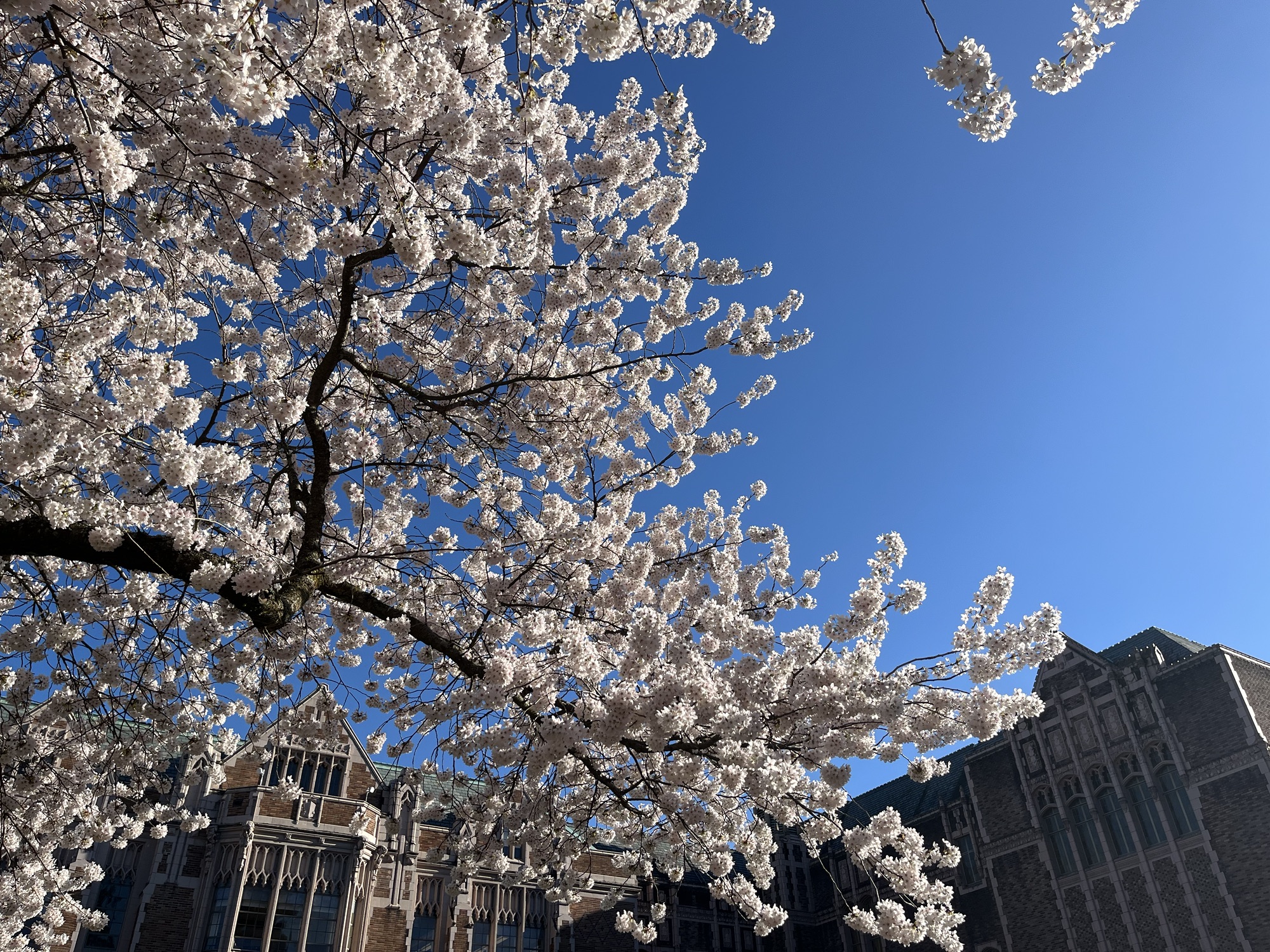
I’ve been talking a lot about heavy, often historical subjects lately, but today I just wanted to share something more local. Every year, my family and I go to see the cherry blossoms at the local University of Washington. This is part of a popular Japanese tradition called ohanami (お花見) or “flower viewing”. Ever since our children were little babies, my wife and I never fail to go to the University of Washington every year, and take lots of family photos and such. A lot of other people come too, and it is a fun community event. The UW has even created a dedicated website just for the occasion, plus social media accounts, and you can even watch a live-cam version of it:
A lot has changed in the last 15 years!
Depending on weather, timing of the bloom, etc, some times we arrive at full bloom (mankai, 満開, in Japanese) and at other times we come too late or a bit too early. This year we came on Tuesday and the timing and weather turned out perfect.
The UW actually has a few clusters of cherry trees, and different varieties, which you can see on the official map, so we tried to visit as many as I could. Also, on my other blog, I wrote a brief guide to Japanese cherry blossoms as well, so feel free to take a look.
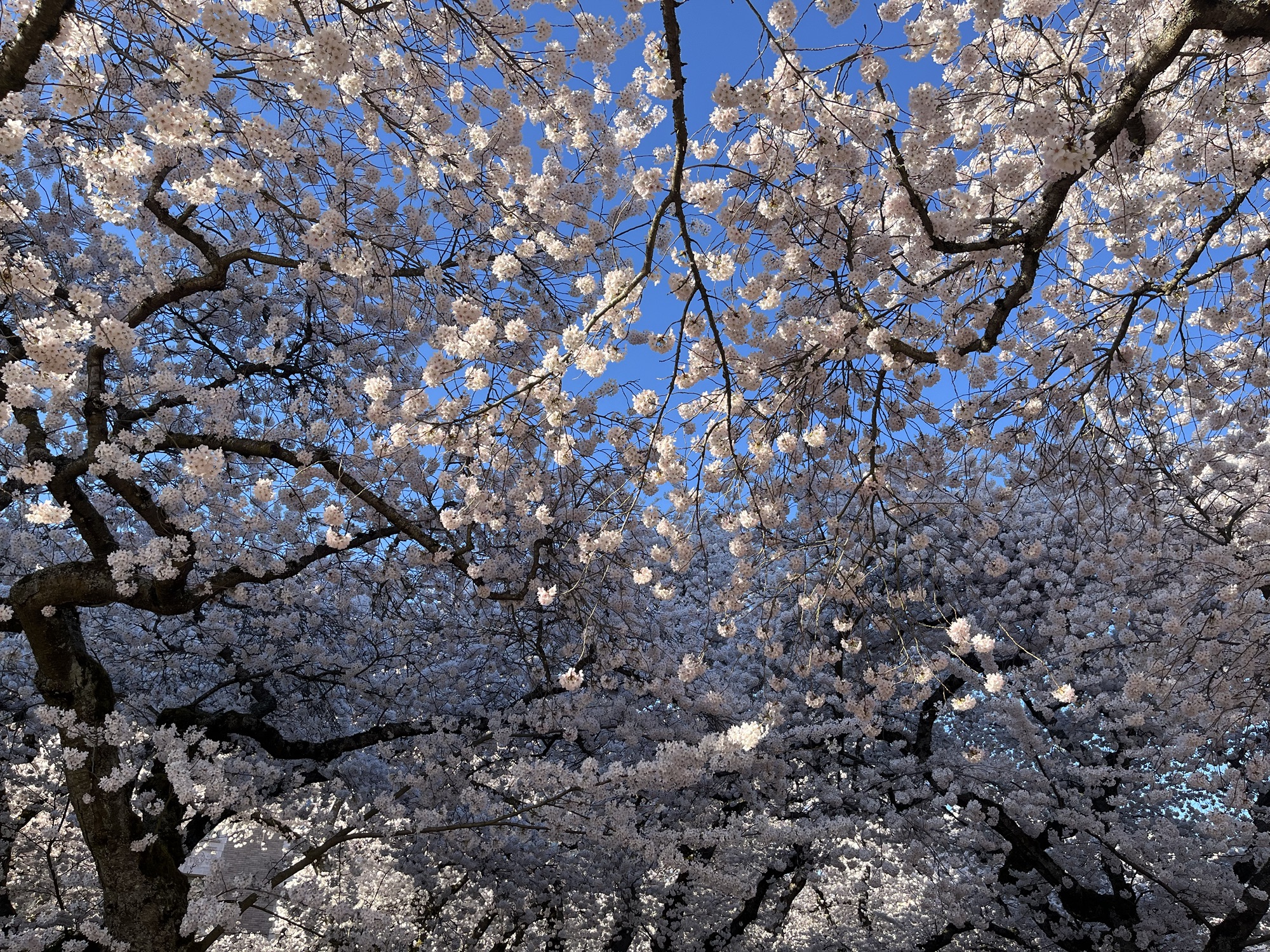
The main attraction of course is the Quad, and the Yoshino cherry trees there:
The “Yoshino” cherry tree is the most common and iconic cherry tree variety. In Japanese it is called the somei yoshino.
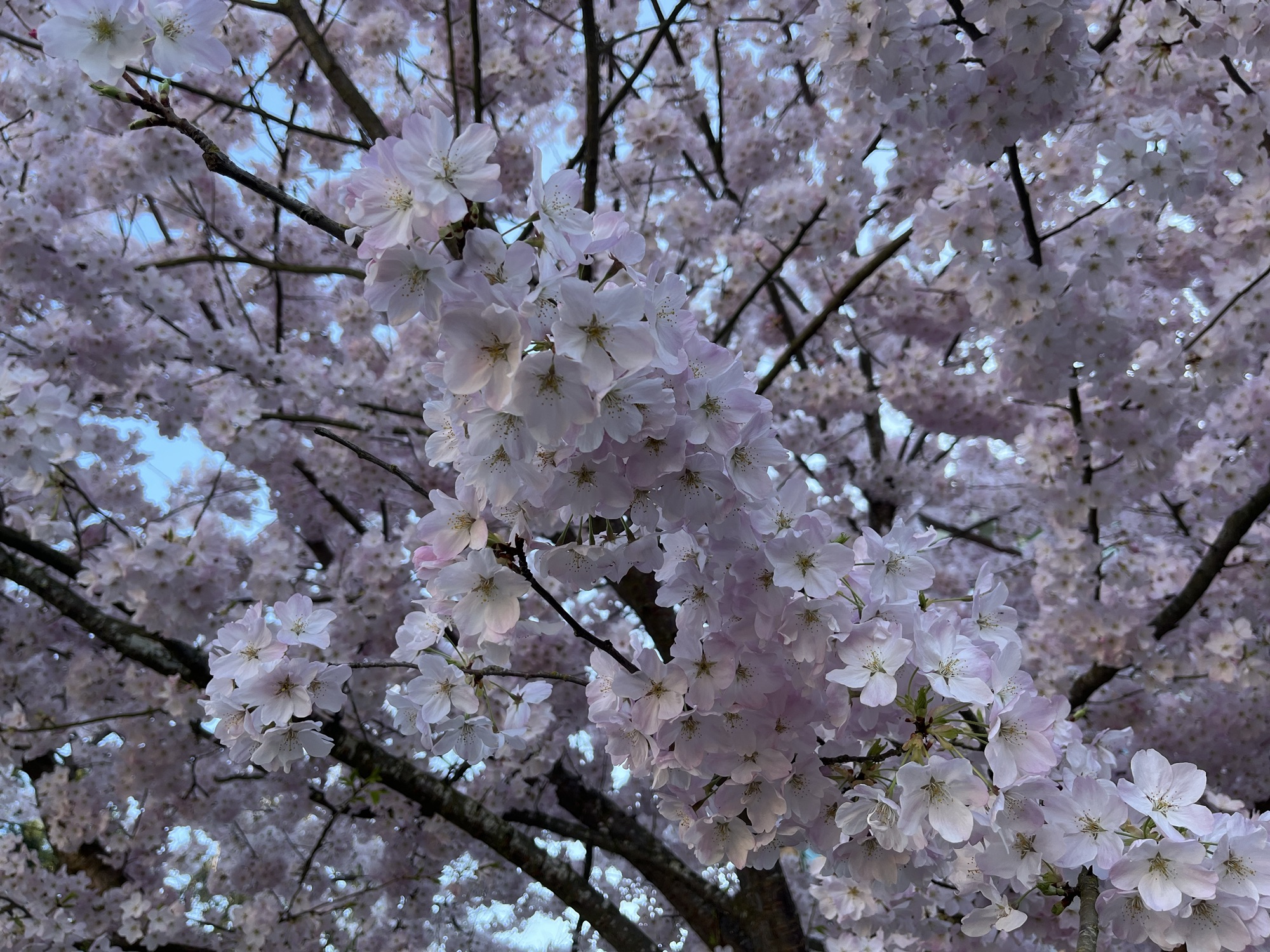
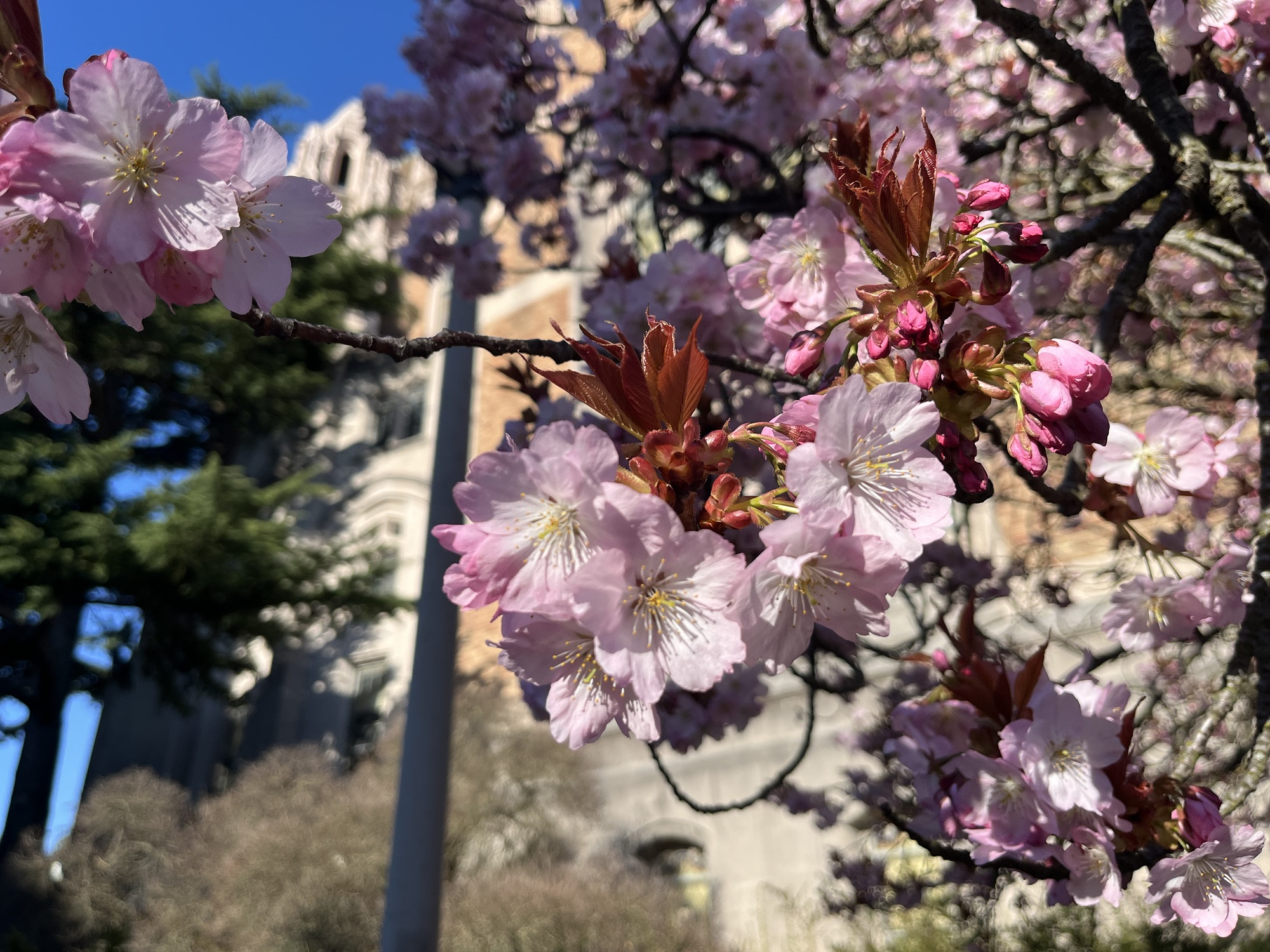
Next we moved south to see some of the varieties around Drumheller fountain. Not all varieties were in bloom yet, but we did see one called Kanzan,1 which I had never seen before. The blossoms were noticeably pinker, and had two layers of blossoms, not one.
I really liked this variety myself.
Later, we ran into some good friends who were also viewing the cherry blossoms. Since I hadn’t really been out much this past month, due to surgery recovery, it’s really nice to see some friends and socialize for a while. We later went and got some gyros at a place I used to frequent back in college.
One the way, we saw one other variety I had not seen before: a Mt Fuji Cherry tree:
I had not heard of this variety either, but it is apparently a variety of the Prunus Serrulata tree,2 and is known for it’s all white blossoms. This is probably why it got it’s name “Mount Fuji” since it matches the color of snow. In Japanese it is called the “Shirotae” variety, where shirotae is a well-known pillow word in Japanese poetry meaning something that is gleaming white.
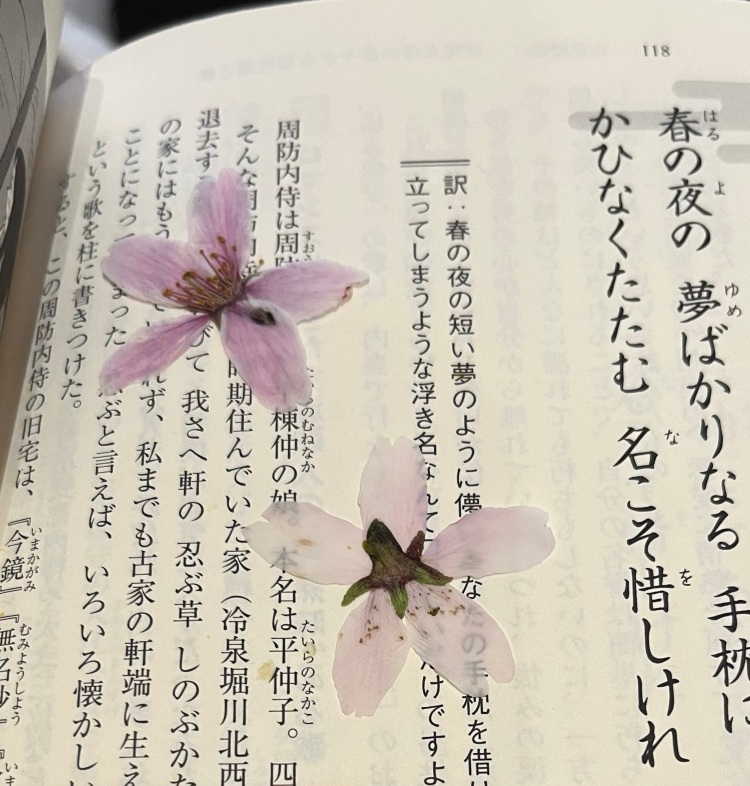
Anyhow, the weather worked out really well, and seeing old friends after a rough month really made the trip extra special. I had brought along one of my favorite books about the Hyakunin Isshu with me, and when a couple blossoms fell to the ground, I used it to press them within the pages. After a week, the pressed blossoms turned out pretty nice.
All in all, it was a memorable day, and really uplifting after a difficult month.
P.S. I know I’ve said it before, but a happy Spring Ohigan to all.
1 The UW website lists them as “Kwanzan”, but that is an older, archaic style of romanization of Japanese language. In Japanese it is definitely spelled “kanzan”. In the same way, the Bodhisattva Kannon was often spelled as “Kwannon” in older English literature.
2 The UW has another variety of Prunus Serrulata called the Shirofugen (a.k.a. Fugenzo in Japanese), but they were not in bloom when we came there.
In a recent post I talked about how Zen imported from Song-Dynasty China found patronage with the elite samurai families of the city of Kamakura. Sometimes this was due to the cultural prestige of Zen among “country bumpkin samurai”, but also the new Zen monastic community drew sincere students as well, helping it take root. Zen still had a very small presence, compared to other Buddhist institutions in medieval Japan, but it was definitely the “up and coming” sect.
By the 14th century, and with the destruction of the Hojo Family (ending the Kamakura Period of history), the seat of government shifted back to Kyoto under the new Ashikaga Shogunate (a.k.a. the Muromachi Period of Japanese history). The Ashikaga Shoguns, many of whom were avid Sinophiles, further cultivated the Rinzai Zen institutions from China, and created a new hierarchy of temples called the Five MountainsSystem. The same system existed in China, where “mountain” was synonymous with “Buddhist monasteries”, but the Chinese version was a looser organization and not strictly related to Zen Buddhism.
The Japanese version organized Rinzai Zen temples (and some Soto Zen temples) across the country into one of three administrative “ranks” with the “five mountains” (gozan, 五山) at the very top. These temples, as we’ll see later, functioned less as Buddhist temples and increasingly as bureaucratic hubs for the rest of the temples in Japan. They enjoyed much patronage and prestige, but the monastic life greatly suffered.
The three ranks were:
Gozan (五山) temples, the top-tier
Middle-tier jissatsu (十刹) temples, and
Shozan (諸山) temples at the bottom.
Confusingly, many Rinzai Zen temples existed outside this temple structure, either by choice, or just lacked prestige, and were derisively called rinka (林下, “the forest below”) to distinguish from more prestigious temples “up on the mountain”. I briefly mentioned rinka temples in this old post.
Anyhow, let’s look more closely at each.
The Gozan Temples
The list of gozan temples varied over time, usually whichever temples the current Shogun patronized. Further, there were actually two sets of gozan temples, one for Kyoto and one for the former capitol of Kamakura. Which one was more important depending on who was in power.
For example, in 1341, under guidance from Tadayoshi, the ranks were as follows (homepages linked where possible):
And by 1386, also under Yoshimitsu, the rankings switch in favor of the Kyoto temples, but also Nanzenji gets elevated to a “superior gozan temple”. Plus, a new temple built on Yoshimitsu’s orders, Shōkokuji, was slotted into the Gozan temple ranks.
The Gozan temples were the top of a large administrative bureaucracy that managed the many other Rinzai Zen temples, and as such enjoyed much patronage and influence. However, as we’ll see later, this came at a heavy cost.
Middle Rank Temples: Jissatsu
The ten temples of the middle rank, the jissatsu (十刹), were major temples in the provinces that served as middle-management. They managed other temples in the provinces and were subordinate to the gozan temples, but also held much influence too. Eventually, the jissatsu temples were also split up into 10 temples under the Kyoto gozan temples, and 10 more under the Kamakura gozan temples.
The list of temples moves around a lot, and sometimes temples were promoted to gozan temples, or downgraded.
Lower Rank Temples: Shozan
The shozan temples are the lowest-ranking, but also the largest group by far. At any time, up to 250 temples were ranked as shozan temples. As with the jissatsu temples, the shozan temples were usually provincial temples that simply didn’t have the prestige or political influence that the jissatsu had. However, they were still important in extending Shogunal control over the provinces, and thus still had ranking.
What Happened to the Gozan System?
As we saw in an old post, whenever the Buddhist establishment developed close ties with the ruling regime, this worked as long as the regime was powerful, but began to collapse easily when the regime was weak.
In the case of the Gozan system, the Zen temples never maintained huge standing armies that other, older temples such as Enryakuji (Tendai) or Kofukuji (Hossō sect) did, and so they relied on the Ashikaga shoguns for protection. As the Ashikaga shogunate started to weaken, local warlords in the provinces and the rival temple armies began to assert their power, and the Gozan temples suffered.
In fact, the disastrousŌnin War in the 15th century practically destroyed many of these monasteries along with most of Kyoto city. Some of these temples never to rebuilt, or became greatly diminished. By this point, the Ashikaga “shoguns” had no real power outside of the Kyoto area, and thus couldn’t protect or influence other temples anyway.
However, probably the biggest reason for their decline was that spiritual practices at these temples declined and atrophied as they became more and more important politically. In the book Five Mountains: The Rinzai Zen Monastic Institution in Medieval Japan by Professor Martin Collcutt, Collcutt shows how records and journals at these temples showed that they had a very active social scene: banquets, religious functions, public rituals, and so on, but very little actual Zen practice as we know it. Monastic discipline greatly declined, and while they flourished culturally, the religious practices suffered. The famous Zen monk, Ikkyu, at the time lamented the decline in monastic discipline. Then again, he was a bit of an eccentric curmudgeon anyway.
Ironically, Rinzai Zen temples that existed outside the Gozan system, gained lasting prominence instead. The modern lineages in Rinzai derive from two temples that were not in the Gozan system: Daitokuji and Myōshinji. Both had reputations for maintaining austere Zen practices, and enjoyed patronage from wealthy merchants, and the increasingly powerful provincial warlords. Under Hakuin (mentioned here), the two temples became the basis for Rinzai Zen today.
Admittedly, both Daitokuji and Myoshinji suffered from corruption as well, as they gained social prominence, but Hakuin’s reforms later fixed this.
So, repeat after me: religion and politics should not mix.













 Gleanings in Buddha-Fields

You must be logged in to post a comment.