Getting Older

Spock: Change is the essential process of all existence.

Star Trek, “Let That Be Your Last Battlefield”, Stardate 5730.2

As I approach yet another birthday, and my kids are getting close to adulthood, I am definitely starting to see a change in my attitude toward life.

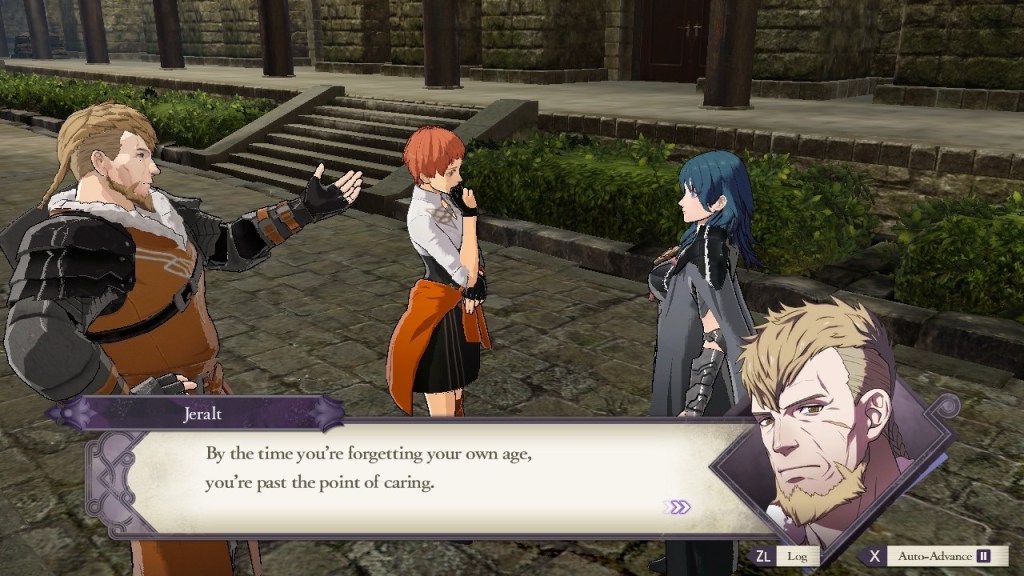
The character of Jeralt from Fire Emblem: Three Houses really sums it up nicely. My attitude has noticeably shifted this past year, especially after my time in the hospital in February, and I find I care a lot less about some things that were once important to me. I don’t mean this in a brooding or dismal sort of way. I am just so glad to be alive and well after that experience, and just being able to read my poetry from the Hyakunin Isshu, or playing Fire Emblem games1 makes me pretty happy lately. I keep my Buddhist routines small and sustainable as much as I can too.

My sense of ambition, something that really drove me in my twenties and thirties, has largely faded these days, and I am already looking forward to just being a nice grandad someday with my wife. Even certain recent goals I had don’t seem nearly as important as they were.

Is this part of the natural aging process? I am not sure. Maybe. Probably.

But it’s also nice being able to just let go and let life flow on, instead of constantly trying to wrestle with it, like punching a giant pile of dough into the shape you want, then getting frustrated when it loses its shape.

Of course, I still like to keep busy and still do self-improvement. I have just gradually narrowed my hobbies and personal goals to the ones I truly care about.

Namu Amida Butsu

1 I currently own five titles now. Three Houses is easily my favorite, but I also enjoy Awakening quite a bit, and Three Hopes. Fire Emblem: Engage is just disappointing. The crossover game, Tokyo Mirage Sessions #FE Encore, is also neat since you do get to tour parts of modern-day Tokyo, plus it’s pretty campy. I was lucky to get that game for less than half-price during my last trip to Japan.

Mindfulness Meditation Isn’t What You Think

Spock : “… I have noted that the healthy release of emotion is frequently very unhealthy for those closest to you.”

Star Trek, “Plato’s Stepchildren” (s3ep10), Stardate 5784.2

Meditation, specifically mindfulness meditation, is touted as a stress-relief exercise. Busy people believe that if they can block out the time to meditate for X minutes a day, or when stressed, this will make more happy and productive. It has been all the rage in Silicon Valley too.

But it doesn’t work.

It will calm your mind while you are sitting, but as soon as you are back to work, your blood pressure will quickly rise again. Old habits will quickly resurface. Self-help, in short, does not help.

How do I know this?

I tried the same trick in my late 20’s. My first child was born, and I was working at Amazon (yes, that Amazon) for a few years in a technical support role. The environment was stressful, demanding, constantly on the move, the on-call rotation gave little time to decompress because something was always broken,1 and I had to drive into work at all hours of the night to try and fix it.

Since I had recently converted to Buddhism at the time, and listened to a lot of Ajahn Brahm dharma talks, I wanted to try meditation. We had a spare office that no one used, so I would go in there once or twice a day, turn off the lights, dutifully sit, chant certain Buddhist mantras, meditate for 20 minutes or more, and then return to work.

As soon as I was back at my desk, the stress would rise all over again. I kept at the meditation for months, almost a year, before I finally gave up.

The stress, constant sense of inadequacy measuring myself to hyper-competitive co-workers who graduated from Stanford, unrealistic work performance goals, fear of losing my job, and so on simply didn’t go away until I QUIT MY JOB AND TOOK A LESS DEMANDING ONE.2

It took me years as a Buddhist to finally realize that stress-relief is not what mindfulness meditation was intended for.

Mindfulness meditation is a tool to develop insight, not stress relief. It is necessary in the early stages of meditation to quiet the chatter in the mind, but that is just the first stage. It is to remove barriers to insight by develop a focused mind, and a quiet mind, a mind that can perceive things in a more balanced way. Consider this quote from the Buddha in a very early text, the Dhammapada:

  1. There is no meditative concentration for him who lacks insight, and no insight for him who lacks meditative concentration. He in whom are found both meditative concentration and insight, indeed, is close to Nibbana.
  2. The monk who has retired to a solitary abode and calmed his mind, who comprehends the Dhamma with insight, in him there arises a delight that transcends all human delights.
  3. Control of the senses, contentment, restraint according to the code of monastic discipline — these form the basis of holy life here for the wise monk.
Translation by Soma Thera from https://www.accesstoinsight.org/tipitaka/kn/dhp/dhp.25.budd.html

The emphasis is on focus, insight, and contemplation NOT relaxation or stress-relief. Mindfulness meditation has been repackaged and sold to naive Westerners with false promises. Meditation really does provide excellent benefits, but it has to be done as part of a much larger, holistic lifestyle change and with wholesome intentions. This is the “holy life” as described by the Buddha: a life of wholesome, guilt-free conduct, goodwill towards others, and a desire to pursue the Dharma (the teachings of the Buddha).

First, one should take up the Five Precepts of Buddhism. As we see in verse 374 above, the Buddha openly encourages that we curb our worst behaviors first as a foundation for other Buddhist practice. One will gain no lasting benefit from meditation until this is done. Full stop.

Second, one must approach meditation with the mindset of a monk. It is not necessary for lay-people to give up everything and go live in the woods. Buddhism accommodates both the “house-holder” lifestyle and that of a true renunciant (a.k.a. a monk or nun). But both the renunciant and the house-holder are expected to live a life of moderation and restraint.3 Easier said than done (speaking as a gamer and foodie), but it’s a goal to sincerely aspire to.

Speaking of restraint, one should always guard one’s speech. A long time ago, a Buddhist minister I admired once told me that speech was like toothpaste: once it was out of the tube, you couldn’t put it back. One has to learn to carefully monitor what one says both in person and online (and yes, at work). Again, easier said than done, but the alternative will only make your life miserable.

Finally, when such good foundations are established, meditation will help you learn more about yourself, and the world around you.4 It’s incredibly helpful, and life-changing when carried to fruition. I have my own little private insights that have stayed with me through the years, and I hope you will find yours too.

Namu Amida Butsu

Namu Shakamuni Butsu

P.S. if you feel the need to calm yourself right away, try something much simpler. You can recite the nembutsu, the Heart Sutra, a mantra, whatever. Try that for a minute, and see if that works. It is a band-aid fix though, and you still need to approach things from a holisitic standpoint, or you will gain no long-term benefit. Alternatively, just go for a walk.

1 Years later, the sound of a pager going off still triggers me a little bit. No joke.

2 Another ex-Amazonian who had joined the same company years earlier confided in me that after leaving Amazon, he drank himself stupid for months to decompress. I noticed that I was still on a hair-trigger for months after leaving Amazon, and it took me a while to unlearn those habits too. My wife noted that my posture improved after leaving, and that I grumbled about work less. Some jobs are simply not worth staying in.

3 The Buddha was pretty flexible about what exactly this meant, citing whatever cultural standards applied at the time as a benchmark. In short, a lot of it is rooted in common courtesy and good sense. If you cannot act toward others using common courtesy, meditation ain’t gonna fix your issue.

4 You may learn that your whole problem is that your job sucks, for example, and that the burn-out is not worth the money. Of course, if you’re a single mom caring for three kids, you have a lot fewer options available to you, and in such cases I recommend the nembutsu as a starting point.

Ten Virtues of Incense

During our most recent trip to Japan, I picked up some nice incense from Zojoji Temple, and my wife separately picked up some from Sanjusangendō Temple in Kyoto.1 We also bought some incense last year at the Golden Pavilion and Ryoanji. It’s a thing in our house. We actually use incense a fair amount: I use it for Buddhist home services, my wife uses it to honor her deceased mother. Sometimes we also just light it for guests who come over.

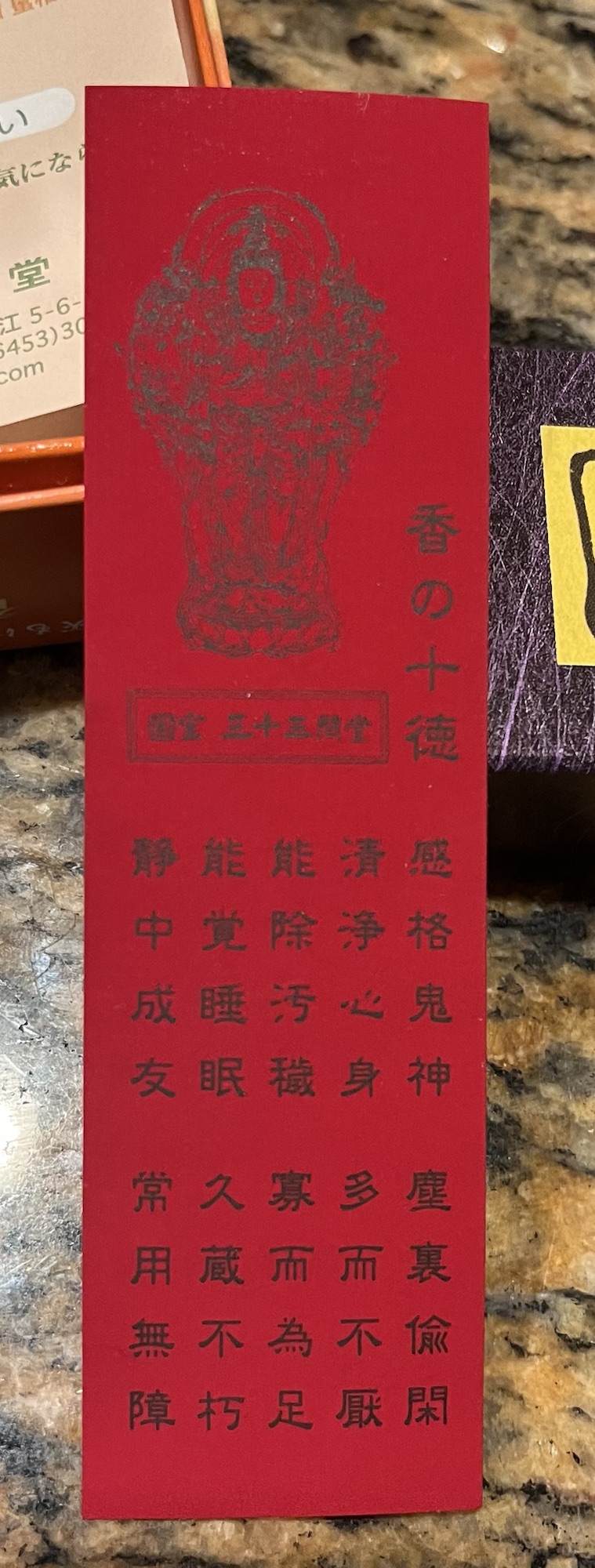
When we opened the incense box from Sanjusangendō, we were surprised to see this little red slip of paper. This is not bad photography: the paper is hard to read. At the top is a Buddhist image,2 but below that is something written on the slip of paper called the Ten Virtues of Incense, or kō no jittoku (香の十得). The Ten Virtues is a form of Chinese-style poetic verse, or kanshi (漢詩) originally composed by the 15th century eccentric Rinzai-Zen monk Ikkyu.

The Ten Virtues are ten aspects of incense that Ikkyu felt was beneficial for whomever uses it. Nippon Kodo has a really nice English-language page about it, including a translation. Feel free to stop and take a look. I’ll wait.

To summarize the benefits here (refer to other sources for proper translations), the ten virtues are:

  1. Spiritual awakening
  2. Purification of body and mind
  3. Removes impurity
  4. Brings alertness
  5. Brings comfort in solitude
  6. Brings moment of peace
  7. One doesn’t get tired of it
  8. Even a little is enough
  9. Stays fresh even in age.3
  10. You can use it every day.

Of course, it’s also important to use incense in a well-ventilated room. The smoke, while very pleasant, is probably not good for your lungs. I always open windows and doors before using it. Also, good quality incense tends to be less smoky. You can even find “reduce smoke” incense sometimes, which is probably healthier, though I would still keep good airflow just in case.

In any case, incense is pretty neat, and if you ever visit a Buddhist temple in Japan, you’re almost sure to find some really good quality stuff. But even if you can’t afford to travel, it’s not hard to find stuff online or in your area too.

Good luck and happy …….. inhaling?

1 We have visited this place a number of times over the years, including our “honeymoon” trip to meet the extended family in Japan way back when. And yet, I haven’t talked about it much. I actually really like this temple, but because they don’t allow much photography it’s hard to make a blog post about it. I might try one of these days, just haven’t figured out how to describe Sanjusangen-do without photos I can use.

2 The Buddhist image is the bodhisattva Kannon, in the form of 1000 arms, also known as senju kannon (千手観音). Since the temple venerates Kannon, this makes sense.

3 Speaking of our honeymoon trip way long ago, we went to a spa-resort place in Japan, and got these nice little incense envelopes. I put my envelope between two pages of a book at the time, shelved it, and forgot about it for years. I opened years later, and the oils of the incense had seeped through and stained the page, but it also left a really nice scent that still lasts. Even now 20 years later, the book still has a nice fragrance.

Perspective

Recently, I discovered that one of my coworkers, who is an immigrant to this country, had survived the Yugoslav wars of the 1990s. I am trying to protect their identity a bit, but they described life as a teenager being besieged in their home city for months in 1992 without running water, or reliable food supply. After the war was over, they came to the US with a mere $50, a college degree, and no idea what to do next. Thankfully, my coworker was able to get on their feet, establish their career here, and now have a growing family.

However, what’s interesting is that if my coworker had never confided their past, I would never have guessed. By all appearances they were just another career adult. I’ve had a coworker who grew up in Palestinian refugee camps in the Middle East, but again, it’s not obvious in a professional work setting and they only confided in me much later in our friendship.

It underscores how many people around you, who by all accounts seem like normal, functional adults, may be carrying terrible traumas in their lives. It is not always wars, natural disasters, and ethnic conflicts either; it can also be personal, domestic traumas, emotional scarring that fades with time, but never fully disappears. It is said that 1 out of 4 women in the US, possibly more, have been abused and that means that out of all the women I work with, correspond with, or hang out with, one out of four, maybe even one out of three of them may be carrying out terrible scars from their past.

And of course, it’s not limited to women, either. It’s not hard to scratch the surface and find men who have also suffered terrible traumas, abuse, etc., and carry this with them for the rest of their lives. I remember my best friend in grade school suffering terrible, physical abuse from his father. He grew into a pretty unhappy teen and eventually the family moved away. I didn’t comprehend any of this until too late, and lost touch with him before we could talk about it together. I’ve always regretted that.

Being an adult is hard enough as it is, but also carrying around terrible traumas makes it even harder because you can never fully erase them. You can move on, find happiness, and still grow as a human being, but the scar will always be there.

Photo by Mokhalad Musavi on Pexels.com

My coworker who survived the Yugoslav wars, for their part, told us that they decided not to focus on the past and instead focus on the here and now: kids, career, helping others in the same field, and so on. They joke among other survivors that they still get a bit twitchy sometimes due to their traumatic past. Yet at the same time, they don’t want to be weighed down by it either. They want to move on and look toward the future.

In learning to understand others, I think it’s important to consider painful past they may have had. It doesn’t always excuse the behavior, but it does provide some perspective.

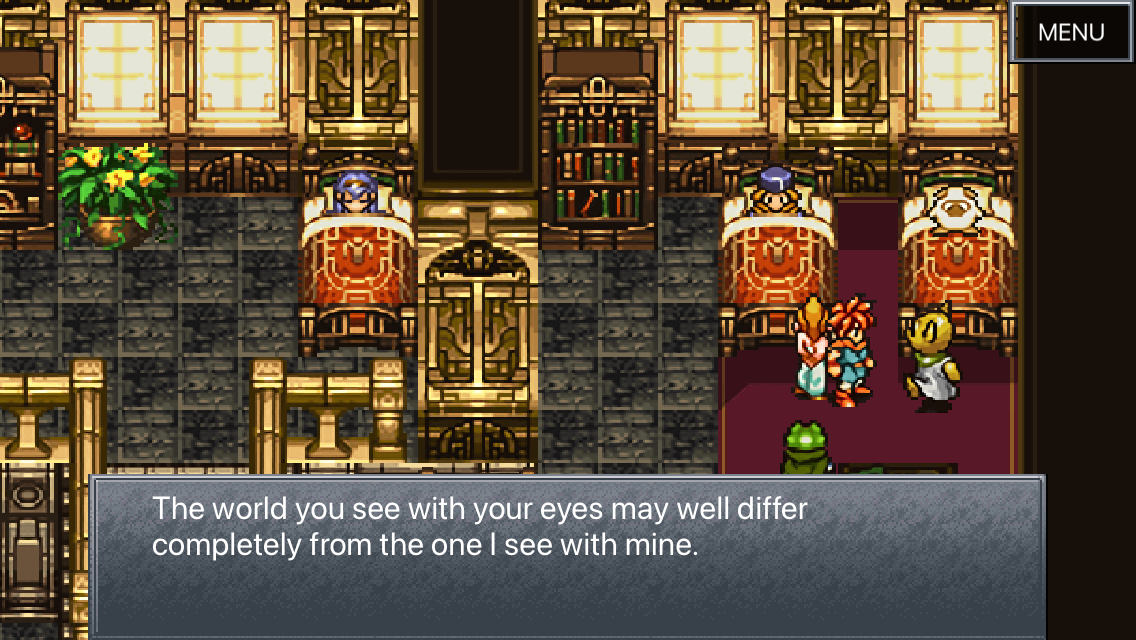
Screenshots from the game Chrono Trigger.

Updates Post-Surgery

Hi all,

Just some quick updates. It’s day 8 for me since getting out of the hospital, and it’s been a tough recovery. My body is healing well enough, but the healing process has taken a lot of my energy, and because I was in the hospital for so long eating a liquid diet, I’ve had to readjust to eating normal food again. I tend to sleep a lot more than before, and don’t have my old stamina yet. I’m told it will probably take the rest of the month to fully recover.

On the plus side, though, I feel like I am getting stronger every day. I can now walk around my neighborhood a bit, and don’t take as many naps as before. This also means I have more time to get back into my old routine more and more, which is nice. My kids are happy to have me home as well.

I can’t emphasize enough how nice it is to be home, in my own bed, eating home cooked food, and just seeing the family again. Walking outside and feeling sunlight or smelling trees is such a nice thing to do again. I’ve also been touched by friends who’ve come out and supported us, checked in on me, etc.

My emergency room visit was pretty serious, and while probably not fatal, it was no joke. The experience was a mental shock, especially considering I might not come back home, and has given me a lot to think about. I don’t know if I’ll blog much about that though, as it’s something I want to chew on for a while. That said, I’ve been dabbling again in Buddhist and Japanese subjects and hopefully will have some fun content for you all soon.

I know I originally said i’d take the month off, but I have a hunch I’ll be posting sooner than that. 😋

Namu Amida Butsu

Mending and Retreat

Hi all,

In addition to bout of COVID I was dealing with, I ended up in the emergency room due to pancreatitis, a problem related to my gall bladder. It has been a long, long week at the hospital, recovering and prepping to have my gall bladder removed. I am thankfully home now, minus a gall bladder, but my energy level is very low. Between the surgery, hospital stay and covid my body is shattered.

There’s not much else I wanted to say at the moment, but I am taking the rest of March off to rest and recover.

Mental Health and Fire Emblem

Since I started playing Fire Emblem: Three Houses, I have been continuously impressed with how well-written and relatable the cast of characters is. But there’s more to it.

Early in the story, when you first meet the other characters and students, many come off as quirky, annoying or just mean. However, as you progress in the game and get to know them through dialogues (e.g. “supports”), you learn more about why they are the way they are. Why is Dorothea such a good-digger? Why is Felix such a jerk? Why is Marianne so gloomy, Lysithea a workaholic, Sylvain a womanizer, and so on.

What you learn over time is that many of these characters, even the more stable ones, have some kind of personal trauma or persistent fear that’s driving their lives. Some characters have more crippling mental health issues, while some just hide their pain better than others.

After playing through a game like this, it’s not hard to see that many people around you are almost certainly suffering from some past traumas or persistent mental health problems. The degree or nature of that problem is different for each person, and some people hide it better than others, but I bet if you scratch the surface you will see it.

Of course, this applies to ourselves too. Past traumas, emotional pain and lingering, persistent mental habits color our behavior on a daily basis.

I grew up as the eldest son of a single mom in a conservative community in the 1980’s, and experienced plenty of bullying and ostracism as a result, while trying to grow up fast and help the family.1 I have no doubt this colors my behavior today. Seeing my grandmother dead from cancer at age 57 on the hospital bed two days after Thanksgiving in 1990 still comes back to me every November.

But there’s more to this.

As the game progresses, and through increased interaction, many of the characters open up about their pain and trauma to others and from this they find kindred spirits, or they gain new perspectives. It doesn’t erase the past, but oftentimes it helps them find closure, or get the support they needed.

In Buddhism, we revere the Sangha (the community) as one of the three treasures, along with the Buddha (teacher) and the Dharma (the teachings). The Sangha is essential in Buddhism because people can’t do it alone. The Buddha recognized from the beginning that people need one another, and can support one another.

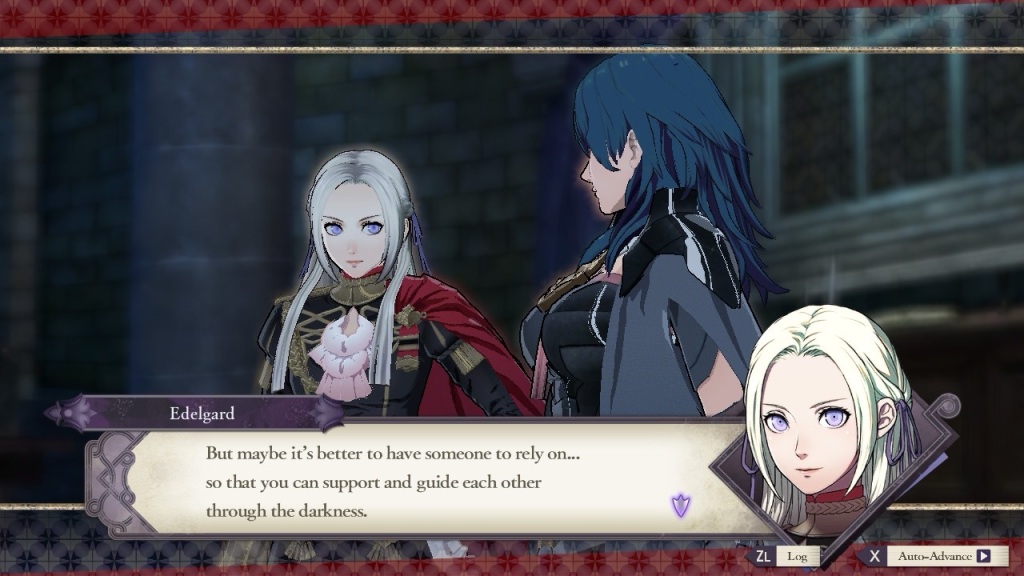
I love how Edelgard may appear as a villain at first glance, but then there are moments like these…

Even when the Sangha has its fair share of dickheads and scallywags, the mutual support people offer one another is part of the therapy that Buddhism offers. This isn’t limited to Buddhism, by the way; one can find solace in any religious community. My other grandmother was a devout Lutheran and would go to her local church every Sunday for many years.

It’s just that Buddhism overtly recognizes that everyone suffers from mental health problems on some level, which are given fancy terms like kleshas in Sanskrit, or bonnō in Japanese, but also that there aren’t easy solutions. It’s a long slow process, and it requires a mutual support network.

It’s scary to share one’s pain with others, or even with yourself,2 but it can really take a heavy load off you, and help provide new perspectives. You don’t have to force it either. As you spend time with others, people naturally start to open up over time. There’s no magic here, it’s just simply that people need one another, and this is how we find peace and wellbeing.

Namu Amida Butsu

1 a little bit like Jonathan Byers in Stranger Things, minus all the weird extra-dimensional stuff. Maybe. 😋

2 sometimes a personal journal or an anonymous blog can really work wonders.

Life Finds a Way

Here in the Pacific Northwest, there’s nothing more depressing each August and/September than seeing the summer sky filled with wildfire smoke, and constantly scanning air quality sites to see if I can safely walk the dog, or shut in for the day.

This is a view from my house one morning last week while walking the dog.

It’s very gloomy, and it’s hard not to get depressed knowing that in the years to come this will probably get worse, not better. On the other hand, I thought about it, and I was still thankful to be alive, able to breathe, and see the sunrise. I don’t mean this in a naïve “live laugh love” sort of way. It’s just like that Zen aphorism about every day being a good day: it’s not that every day is happy and blissful, especially if you have to deal with work, kids, and bills, it’s just that simply being alive one more day is still kind of remarkable in a way.

Also, each little thing you do, each decision you make, each word you say, does matter even if you can’t see the results right away.

Namu Amida Butsu

Updates For December 2022

A few updates for readers, some good, some bad. I’ll start with the bad news.

The bad news is that I have COVID. It is the first time I have ever had it (as far as I know), and despite being careful with masking such for the past 2½ years, I managed to somehow contract it. I am not entirely sure how, but I have my suspicions. In any case, all I can do now is isolate and try to recover as quickly as possible.

Given my age, and my weight, I am genuinely worried about the risk of severe symptoms, but so far it’s just a bad head cold. I can’t wait for it this to go away. Thankfully my family has tested negative so far, so perhaps we will get lucky.

The good news is that I’ve vaccinated 4 times so far (the two original + two boosters), so I remain positive that that will help blunt the worst effects of the illness.

For now, we are still on track with our plans to Japan in the second half of December. We are pretty excited to go, and the kids will finally get to see their grandpa and auntie after three years. The COVID infection may potentially change this, but we remain positive…. that the family will stay negative. 🤣

Life here is chilly and icy as the period of “small cold” begins (again, no pun intended), and Bodhi Day is only 6 days away. In our home, we started a tradition ages ago where we would surprise the kids with books as a present for Bodhi Day. It started out as a Santa Claus-type tradition but has gradually changed over time.

Since I am now isolated in the den for the next few days, I also have time to catch up on many things. Maybe more blog posts, we’ll see.

Eating Simple, Japanese Style

I had intended to write this post earlier when I first started my winter abstinence, but during recent events, this got pushed out a little. Anyhow, my wife and I have been together for more than half our life and her eating habits have rubbed off on me over time:

I’ve written about natto before. I enjoy eating it for breakfast a lot. It isn’t very filling, but it is light and healthy. I don’t cook miso soup every day for breakfast, but I do try to cook it regularly. With the tofu, it is warm and tasty, and just filling enough.

Per Buddhist teaching, food is something we need, like a medicine, but it’s always best to eat moderately if possible. Easier said than done,1 but it is essential to consider this.

But the lack of guilt from not overeating, nor the discomfort, is a reward in and of itself. Similarly, the eating enough to be satisfied will avoid the misery of excessive fasting.

In a small sutra in the Pali Canon, there is a conversation between the Buddha and King Pasenadi of the kingdom of Kosala. King Pasenadi had become obese from overeating, and could barely stand anymore. The Buddha told him in verse:

When a person is constantly mindful,
And knows when enough food has been taken,
All their afflictions become more slender
— They age more gradually, protecting their lives.

Donapaka Sutta (SN 3.13), translation by Andrew Olendzki

This moderation in food is not limited to Buddhist teachings however. You can find such advice in the words of Plato, Epicurus and Seneca, to say nothing of Taoism, Confucianism, etc.

P.S. the secret to cooking good miso soup is having good dashi (broth). It’s hard to find in the West, but avoid the cheap, artificial stuff if you can.

1 As someone who is pretty overweight, I wish I could that I say took care of my weight, but it is still a work in progress for me. Sometimes I like to write blog posts as much for myself as I for readers. 😏