Meditation and Back Pain

Since May when I started taking up Zen practice more actively, I’ve been meditating more or less pretty regularly since then. Not quite daily, but several times a week usually. This has highlighted something I didn’t expect: back pain.

Back pain is nothing new to me. I have worked a desk job for many years, so my back often hurts, and I don’t get enough exercise. My back problems are not severe, and don’t require surgery or anything, and I have tried a few things to solve them: new office chairs, Tiger Balm, Chinese medicine pads, yoga, acupuncture, ibuprofen, etc. Each of these helps a little bit, but the problem recurs over and over again. Simply bending down to take out something from the refrigerator can trigger it, but so did Zen meditation.

Meditation sometimes triggers lower back pain for me if I sat incorrectly. But also posture. I tried doing a half-lotus posture, but that quickly caused too much discomfort (full lotus posture is right out), so I usually sit in the “Burmese posture“. This is usually good enough, but even so, if I posture isn’t good, my back hurts more and more. If I already had back pain, it aggravates it. In such cases, I usually have to stop meditation for a few days while my back recovers.

I started to despair that I would never find relief.

Finally, I decided to try some physical-therapy exercises to strengthen my core muscles. I found this helpful website that provides a routine that a person should do once or twice a day (twice if possible). I started this about four weeks ago, sometimes once a day, sometimes twice a day. I also added 15 squats as part of this routine to make my knees stronger.1 After the first week, the pain in my back had noticeably diminished. By the end of the second week, my posture and back pain greatly improved. I felt much more sturdy when going up and down stairs.

Meditation too hurts a lot less. Sometimes I still get back pain, but both the severity and duration are much shorter now.

Again, to emphasize, my back problems are pretty minor and don’t require surgery or anything, but simply doing about 10 minutes daily of physical therapy type exercises to strengthen my core has had many little benefits, both for meditation and for general quality of life.

But don’t ask this old man to do half-lotus position… 😋

P.S. Taking a break next week on blogging. I need to catch up on some drafts, do some reading, etc. Plus it’s my birthday. 🥳 See you next time!

1 I have also been dieting more actively to help reduce physical weight of my body on my bones and back.

Back to Nature

SPOCK: There are many who are uncomfortable with what we have created. It is almost a biological rebellion. A profound revulsion against the planned communities, the programming, the sterilised, artfully balanced atmospheres. They hunger for an Eden where spring comes.

Star Trek, “The Way to Eden” (s3e20), Stardate 5832.3

世の中よ道こそなけれ思ひ入る山の奥にも鹿ぞ鳴くなる。

Within this world there is, indeed, no path! Even deep in this mountains I have entered, heart set, I seem to hear the deer cry!

Poem 83 of the Hyakunin Isshu, translation by Joshua Mostow

Recently, I came back from a camping trip, the last for our family before my daughter goes off to college. It was both good and bad. We stayed at Moran State Park on Orcas Island, Washington. I had been to Orcas Island a number of times over the years, but I had never really stayed there for personal reasons, so it was nice to explore at leisure for a change.

Cascade Lake near our campsite, which was very pristine and peaceful in the mornings. Our dog, Cherry, liked exploring here.
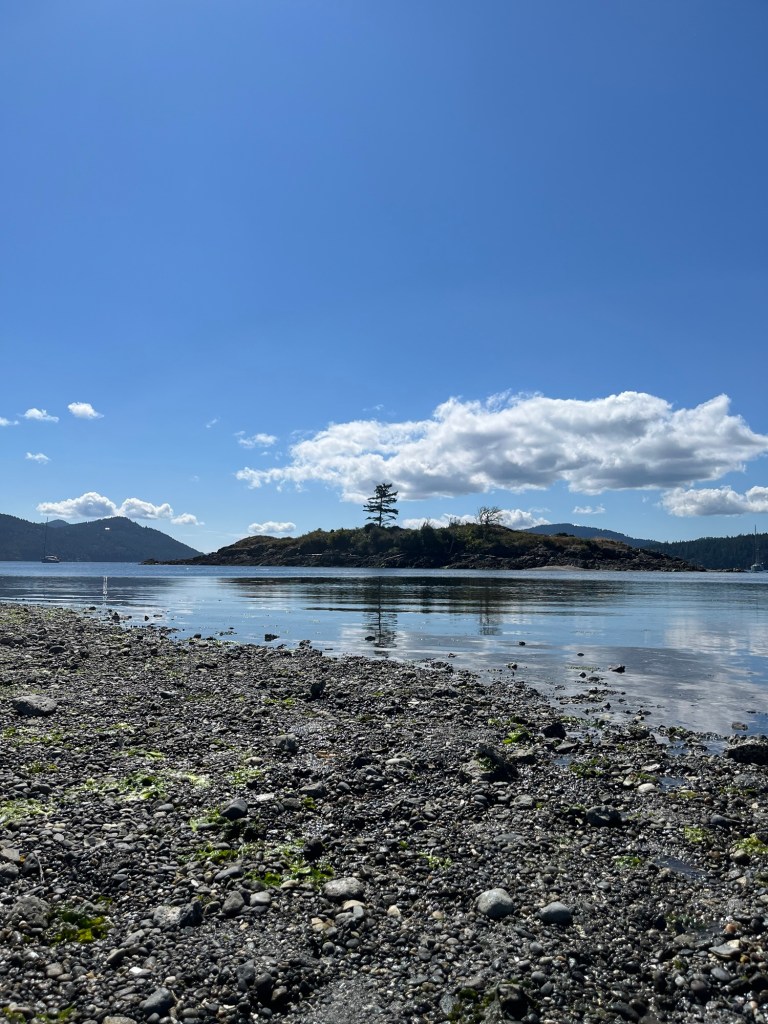
The so-called “Indian Island” in Eastsound bay. This area was once a village belonging to a Salish people called the Lummi (official homepage), who grew camassia crops on that islet. A combination of disease from Westerners and raids by northern Salish tribes drove them to the mainland. That lone pine tree feels like a momument to the Lummi to me…
A view from Mount Constitution, the highest peak on Orcas Island, facing eastward towards Washington State. I visited here many years ago as a kid on a school camping trip, but don’t remember much.

I posted the Star Trek quote above, not just because it sounds cool, but it does explore a side of us all: yearning for the simple country life. We all feel that revulsion toward modern life, and want to escape, yet even just after a couple days of camping in the woods, the smell of body-odor, noise from neighboring campers,1 and lack of food variety, Internet access, and electricity made us really eager to go back home. Even with modern amenities like gas stoves, freezer coolers and ready-made food (including instant ramen), it quickly gets old.

It wasn’t just me either. There was a lone woman camping just next to us. She brought her dog, and a stack of books to read, and seemed like an experienced camper, but it was clear that she wasn’t finding the solace she sought, and spent most of her time away from campsite to (presumably) find a quieter spot.

The fabled Eden sounds nice, but such a bucolic past probably never existed. Pre-modern life was in reality hard, exhausting, and safety was not always guaranteed.

Yet, modern life has its own challenges and dangers too. We might not die from dysentery anymore, but we often suffer obesity, isolation, and constant anxiety. We might not starve like our ancestors did, but we also eat some egregiously bad food thanks to mass-production and chemicals (including microplastics). Similarly, our fellow Man has replaced natural predators as the threat to our lives.

I don’t want to downplay the benefits of modern life, though.

The average2 lifespan of a human being in the 21st century is significantly longer than before. My little incident a couple years ago likely would have killed me before modern medicine. Dying in one’s forties was not uncommon in the pre-modern era. But the dangers of modern life are still there but now more subtle, yet catch up to us eventually.

In short, life is a struggle, no matter how long we live. Getting to old age without suffering any major health issues is something to be grateful for, but even more important is how you choose to live your life up to that point. As the Zen aphorism goes: every day is (sort of) a good day, so enjoy the moment, and try to live with some element of dignity and free of regrets.

Namu Shakamuni Butsu

1 There was a very rude family camped next to us. The mom kept yelling and swearing at her two toddler children, who in turn were constantly crying and talking back … at 4am in the morning. Ironically, the lady had a “Live Laugh Love” bumper sticker on her car.

2 The keyword here is “average”. A person in pre-modern times some people did live to their 80’s or 90’s, but the odds were against them. A single scratch leading to an infection, or a crippling injury, or a genetic precondition that we can treat now would often kill a younger person. So, if you did manage to live to a ripe old age, it was indeed a cause for celebration.

Vengeance

MCCOY: What if you decide he is Kodos? What then? Do you play God, carry his head through the corridors in triumph? That won’t bring back the dead, Jim.

KIRK: No, but they may rest easier.

Star Trek, “The Conscience of the King” (s1ep13), Stardate 2817.6

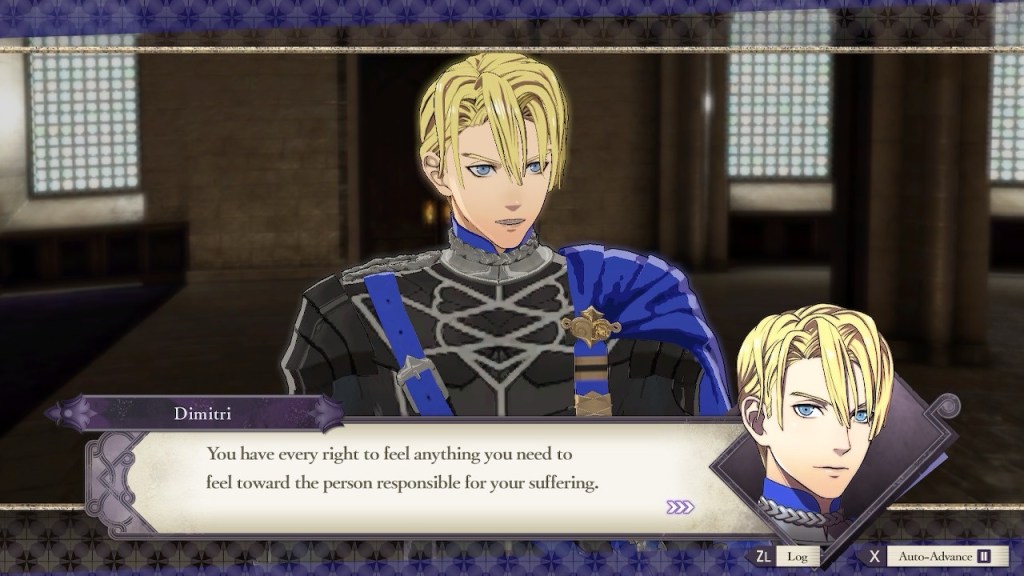
In the game Fire Emblem: Three Houses, one of the three main characters you interact with is the prince of Faerghus, Dimitri, who has suffered terrible tragedy in the youth. Behind his veneer of civility, he is gradually losing his mind.

He cannot get past the loss of his loved ones, and is determined to kill Edelgard personally, whom he blames for all his misery. Depending on which story path you choose in the game, Dimitri’s fate, and the fate of everyone he drags down with him, is very tragic indeed.

Dmittri in the “Azure Moon” route of Fire Emblem: Three Houses

The Buddha saw through this death-spiral of vengeance and hatred, and how utterly pointless it was:

“He abused me, he struck me, he overpowered me, he robbed me.” Those who harbor such thoughts do not still their hatred.

The Dhammapada, verse 3, translation by Acharya Buddharakkhita

Indeed, ill-will is one of the Five Hindrances, and can only be countered by goodwill. But what happens when someone has been genuinely hurt and abused by someone else?

Dimitri at an earlier point in the game.

Dimitri suffered terrible loss and hardship in his youth due to the political machinations outside his control, and the pain and grief are genuine, not something you can just wish away, or use platitudes to make it better. It’s not hard for readers to think back to moments of trauma in their own lives (I have my fair share), and feel raw anger, rage, or sadness (why did this happen to me? why do I have to live with these scars for the rest of my life?).

If you pick the story path that sides with Dimitri, there is a happier fate for him. I don’t want to spoil too much, but through his friends (including you, the main player), he learns to unravel his past and gradually learns to look forward toward the future his kingdom including a dramatic moment with Edelgard.

Thus, I think what the Buddha says in the Dhammapada is true: vengeance, anger and bitterness are indeed self-destructive, but if the trauma and pain are real, they can be very difficult to let go. It is too raw and painful to simply dismiss with logic and reason. But, in Dimitri’s case, support from loved ones helps him through the darkest moments, and helped him let go. He learned not to face it alone, and grew from it.

With whatever trauma you have to live through, I hope you dear readers find similar resolve and happiness.

Helping Others

In these times of uncertainty, I’ve been trying various ways to help causes I care about: donating more,1 making better environmental choices at home, and trying to be a better person, but even then, it feels like it’s never enough. Like Ashe from Fire Emblem: Three Houses, I feel like in spite of my efforts, I’ve accomplished nothing.

A conversation with “Ashe”, one of my favorite characters in FE3H.

Being able to start small and focus on helping someone is a great start. From there, you might branch out and help others too.

Photo courtesy of the hilarious “Skeletor is Love” Tumblr.2

Yet in the big picture, this still doesn’t feel like it is enough sometimes.

Mahayana Buddhism, which is everything you see from Tibet to Japan and between, tends think very big picture. Thus, it often holds up the bodhisattva as the archtype for Buddhism: a being who lifetime after lifetime helps others, fulfilling very grandiose vows. The idea is that you can’t help everyone in one lifetime, but on the grand scale of time, it is possible to help everyone eventually. But of course, because time and space are so vast, it is a kind of never-ending story. The Buddha, Amitabha (aka Amida) completed his vows in 10 kalpas (aeons), roughly 160 million years.3

Meme from Return of the King 🤣

Anyhow, point being: if we look at it from a Mahayana-Buddhist endpoint, every little thing we do now does add up, but it happens on a scale of time that we can’t fully grasp. Nonetheless, it does add up in the long-run.

But maybe that’s small comfort here and now.

In truth, I don’t have a good answer here. I still try to help where I can while not burning myself out in the process, but I can only hope it makes a difference someday, even if I can’t see it.

1 I used to have a donations page on the blog pointing to various causes, but I’ve had to take it down temporarily to update some broken links, change some charities, and revise the content a little. The page is now back online!

2 I used to watch the original cartoon “He-Man and the Masters of the Universe” as a little kid, so this takes me back. I remember one Christmas I received the Castle Greyskull playset, which was really neat, but then fell apart later. Ah, the impermanence of all phenomena and kids’ toys.

3 Kalpas are interpreted differently in different texts, so I am just using the more conservative estimate of 16 million years. Kalpas are meant to convey astronomical amounts of time, not literal ones.

Healthy Living: Eating Like A Monk

McCoy: “It might eventually cure the common cold, but lengthen lives? Poppycock. I can do more for you if you just eat right and exercise regularly”

Star Trek, “The Omega Glory” (s2ep23), Stardate unknown

Healthy eating is not difficult, at least in theory.

Of course if it were that easy, how come many of us are overweight? Myself included.

I talked about this recently, but I do not have very good self-control. I work a desk job, so I don’t move around much, and I snack a lot. I don’t eat particularly unhealthy: no alcohol, no soft drinks, etc., and I eat minimal red meat. But I tend to just eat too much junk food, or too many portions.

Recently, I dug out an old book of mine from many, many years ago,1 titled What Is Zen? 禅ってなんだろう. It’s a bilingual book I bought in Japan that explores Rinzai Zen life as a monk, but also includes some general thoughts about the tradition for lay followers. My copy has been covered in stickers when my daughter was a little girl, so I kept it both for nostalgia, and because such down-to-earth books on Zen are hard to find in the West.

This is what happens when little girls get a hold of daddy’s books… 😅

Anyhow, this book shows things like daily routines for monks, how they eat and so on. I wish I could repost the photographs because they’re really neat, but obviously that’s inappropriate. Instead, let me shiw you a different example:

An example of shōjin-ryōri (monastic food) at Tenryuji temple in Kyoto, Japan. Photo by 663highland, CC BY-SA 3.0, via Wikimedia Commons

This photo, shows a meal served at Tenryuji Temple, which I coincidentally visited last year. This kind of monastic food is called shōjin-ryōri (精進料理, “ascetic food”) in Japanese, but is a common part of Buddhist cuisine across East Asia. It’s not limited to monks and nuns only, devout lay followers can eat such a lifestyle if they wish. The photos from my book show that the monastic version of this meal is somewhat simpler in presentation (they are monks after all), but essentially the same.

Similarly, when we visited Ryoanji Temple (another Rinzai temple) waaay back in 2005, we enjoyed their version of tofu stew:

Taken by me in 2005, at Ryoanji Temple. This is a vegetarian tofu stew, with turnips artfully sculpted to look like lotus flowers.

This kind of diet is similar to a vegan diet in that it contains no animal products, even the dashi broth is vegetarian. Certain flavors like curry and onions are not used either.

But as with any diet changes, this is not something that should be done hastily or without consulting a physician. The key I wanted to convey here is that (partly as a reminder to myself when I read this six months later….) is that a healthy diet consists of the following:

  • More vegetables than protein
  • Minimal processed starches
  • Little or no animal protein
  • Small portions per meal2
  • Little or no snacking.

But I’ve been inspired by these examples of good Buddhist eating, and so I have been gradually trying to “eat like a monk” lately: smaller portions, avoiding or minimizing animal protein, limit starches, and eating more veggies.

Will it work for a Western desk-jockey like myself? We’ll see.

1 I mentioned this book on my old blog, that’s how long I’ve owned it.

2 My doctor had previous suggested intermittent fasting as a potential solution, or alternatively eating four small meals per day, instead of three big ones. Say, portions the size of two-three fists. The issue hasn’t been the diet, but my lack of diligence especially during the holidays. So, that may be the bigger issue.

The Healing Power of Nature

In the past, I talked about the four-character phrases, or yojijukugo, popular in Japanese culture. Recently, I learned about a new phrase that I hadn’t heard before: kachō-fūgetsu (花鳥風月). This phrase describes the beauty of nature, literally the Kanji characters for “flower”, “bird”, “wind” and “moon”.

The meaning here is various aspects of nature, but also in a positive healing sense.

Spock: Indeed, gentlemen. May I point out that I had an opportunity to observe your counterparts here quite closely. They were brutal, savage, unprincipled, uncivilized, treacherous; in every way, splendid examples of homo sapiens, the very flower of humanity. I found them quite refreshing. [he returns to the science station]

Kirk: I’m not sure, but I think we’ve just been insulted.

McCoy: I’m sure.

Star Trek, “Mirror Mirror” (s2ep4), stardate unknown

For all our veneer of civilization and advancement, we are still deep down biological creatures. We come from nature, and we need nature. Nature heals us and sustains us.

A small patch of grass in my yard, taken in April of 2025.

These days, it’s not hard to feel stressed by all the things that are going on, but I also found solace knowing that nature continues on regardless of what humans do or become. That doesn’t mean the future of humanity will necessarily be positive or negative, but it does remind me that life goes on nonetheless.

It also underscores how important protecting nature is.

P.S. More tips here for protecting the environment.

Madness

SPOCK: Jim, madness has no purpose or reason, but it may have a goal. 

Star Trek, “Alternative Factor” (s1ep25), Stardate: 3087.6

I was going to write something based on this excellent quote, but then the good folks at Extra History published this fascinating and hilarious video about Goodwin Wharton (1653 – 1704), and his autobiography describing his secret life as the King of the Faeries, unbeknownst to the rest of the world:

There is also a great blog post from 2015 that goes into more details.

It’s kind of baffling that someone like this could be a (more or less) functional individual yet also be completely consumed by their own fantasy, and so totally divorced from reality. Goodwin Wharton had goals, per Spock’s comment, though. However, Wharton was totally devoid of both reason and purpose. He was just quietly living out his fantasy life as “King of Faeries”.

It kind of makes one wonder how many more such people exist in a world like this. Would we even recognize them?

Thinking further on this, could any one of us be living in such fantasies? Could I, the writer of this blog, be similarly devoid of reality? I assume “no” of course, but then again, how would I even know? Are my personal goals just further extension of my own madness?

Looking at it form a Buddhist standpoint, our understanding of the world around us is obscured by ignorance, or misconceptions, which become the foundation of how we interact with the world. In a loose sense, this can be a form of madness, but most of us are functional adults with varying degrees of emotional maturity.

Further, we do have the capacity to ask ourselves, “is this the right thing to do?” or “does this even make sense?”. I think that ability to analyze ourselves is what helps counterbalance ignorance and madness. Further, the Dharma, that which is taught by the Buddhas, is meant to act as a kind of benchmark for one’s actions. It doesn’t what you think is right, if it aligns with the principles of the Dharma, than it is considered skillful, wise, and conducive to liberation and well-being. The Buddha doesn’t decide this, it is just how things work.

Conversely, those who never bother to analyze themselves, though, can go through life in a single trajectory and not realize their mistake. Just like Goodwin Wharton…

P.S. I felt like posting a bonus episode today since it is Spring Ohigan week. Please enjoy the weather and have a great weekend! 😊

Losing A Coworker

This wasn’t the post I was intending to publish today, but on Tuesday everyone at my company was notified that a well-known and well-liked member had unexpectedly died. I didn’t know him as well as some of my coworkers did, but I worked with him enough that I definitely feel the loss. Even more so for my teammates.

I am a little past middle-age, only a few years younger than my deceased co-worker, and I have to face the fact that my health will continue to decline. The emergency surgery I had last year was a close call, and it’s a reminder that this kind of thing may come up again. I can improve my diet and exercise (work in progress) and it is worthwhile, but decline will still happen inevitably. There is no avoiding this.

This really reminds me of is the famous Buddhist parable from the Lotus Sutra, chapter three: The Parable of the Burning House. You can read a good translation here (it’s the second half of chapter 3), or my other post here.

In summary,1 the Parable describes a large, but old and rotten mansion that has caught on fire. Inside are dozens of children, and they are so engrossed in their toys and play that they don’t notice that the house is engulfed in flames. Meanwhile, the father is outside calling out to the children begging them to get out where it is safe, but initially they refuse. The Buddha likens himself to the father, calling to his children (other sentient beings of the world),2 exhorting them to leave the burning world behind before it is too late.

A screenshot from Zelda: Tears of the Kingdom, where Link is on a floating island looking out over a sunset landscape.
A screenshot from the game Zelda: Tears of the Kingdom.

As one ages, that sense of “too late” looms more and more. What if, like my coworker, I drop dead next week? It’s unlikely now, but will get increasingly likely as time goes on. Thus, it is essential to settle your affairs, both temporal and spiritual, before it is too late.

And yet, as Lady Izumi wrote, this is easier said than done.

Namu Amida Butsu

1 There is more to this parable that what I am summarizing here, especially relating to the myriad Buddhist practices and such, but am focusing on the part that is pertinent for this post.

2 From the same chapter:

The Thus Come One [the Buddha] has already left the burning house of the threefold world [i.e. the Universe as a whole] and dwells in tranquil quietude in the safety of forest and plain. But now this threefold world is all my domain, and the living beings in it are all my children.

Yakudoshi Strikes Again

The Japanese concept of yakudoshi (厄年, inauspicious years based on age), is something I’ve written about a couple times over the years. During my last yakudoshi year, I had a particularly bad slip and fall on an icy deck, which took me months to recover.1 It was also around that time that I got laid off at work.

This time around, my daughter was undergoing a yakudoshi year recently. Yakudoshi doesn’t necessarily affect oneself, it’s thought to also affect those around you. My late mother-in-law’s fall which broke her hip happened supposedly during my sister-in-law’s yakudoshi year, and so on. In my daughter’s case, she had a generally good year overall, but at the beginning of yakudoshi, I was in the hospital for a week, and then again right at the very end, I had yet another slip and fall in the backyard. This time, wearing old sandals that had no traction left, I slipped on some moss and as I fell, the back of my head hit a rock.

Ouch.

A week has passed and the swollen lump in the back of my head is almost gone, and I don’t believe I suffered any effects from a concussion.2. Because I fell on my back first, and then hit my head, I think it helped cushion what could have been a much worse injury.

That said, we have been joking around the house that yakudoshi struck again. Maybe it did.

Of course, there are other ways to explain all this. The fact I was wearing old, worn sandals on a wet, cold day in early January in the PNW (with moss everywhere) was pretty stupid. I threw out the sandals since then. Also, I have a track record for being clumsy, so I have had plenty of accidents, yakudoshi or no.

The “inner Spock” in me would thus suggest that this is just a case of probability, weather and bad footwear, and in the case of the surgery, it was a known health risk identified many years ago that finally came to fruition. The probability was always there.

Finally, the Buddhist perspective might explain it as bad karma. Maybe I did something, or some things previously that lined up just right at that moment to compel me to walk outside in bad sandals at that particular day/time so that I would slip and fall.

Believing in the result means having deep faith that the Pure Land and all the forms of goodness (spiritually superior beings) that are assembled there are born from the Buddha Remembrance Samadhi, the meditative concentration that comes from reciting the Buddha-name. When you plant melon seeds you get melons, and when you plant beans you get beans. [Effect follows causes] like a shadow follows a physical shape, like an echo responds to a sound. Nothing is sown in vain. This is called “believing in the result”.

“Mind Seal of the Buddhas” by Ou-I, translation by J. C. Clearly

1 Acupuncture actually did help a lot, as I was getting tired of just relying on ibuprofen all the time.

2 I probably should have gone to see a doctor, but it was a Saturday, and after watching myself for an hour or two, I decided it wasn’t serious enough to warrant going to the emergency room. Time will tell if that was a bad idea, or not.

The Value of Friendship

Finishing the last chapters of Roger Zelazny’s A Night in the Lonesome October, I wanted to post this quote:

Greymalk: “Damned if I know, Snuff. Does anybody really care about a hungry cat, except for a few friends?”

Snuff: “Maybe that’s all anybody ever has, no matter how the big show is run.”

Recently, someone at work told me a story. They took some time off and returned to their native home of Bosnia, and visited family and friends that they hadn’t seen in years. Every morning, they sat and enjoyed Turkish-style coffee with friends and family and just talked. When they came back to work, they told the rest of us that sometimes the best therapy is to just sit and talk with loved ones over coffee. Of course, this doesn’t cure everything, but even just getting into a routine of talking with loved ones face to face on a regular basis can do much to help one’s wellbeing.

My wife, kids and I try to sit for dinner every night when possible. My oldest is just about ready to leave for college, so this time will not last much longer, and we rarely ever talk about anything serious, but it’s nice to just share whatever interesting thing happened that day. Once our oldest leaves the nest, things will certainly change around the house.1

In any case, even in the most turbulent times, amidst all the chaos, sometimes all you can do is just foster relationships with the people around you. Just simply being around trusted people is a good start.

1 In the office too, those times when I could sit and chat with trusted co-workers were kind of nice even if corporate office life kind of sucked. Being laid off during the early Pandemic, and then working at a new place has cut me off from that experience because I still work from home (too many people hired during Pandemic, not enough office space). Working from home has its benefits too, but the isolation comes at a cost.