SPOCK: On my planet, to rest is to rest — to cease using energy. To me, it is quite illogical to run up and down on green grass, using energy, instead of saving it.
Star Trek, “Shore Leave”, stardate 3025.2
Unlike my 2024 post, I intend to really take time off this time.
The truth is, is that I am deeply burned out. My wife and discussed this recently, and the chaos of preparing our firstborn for college, and our second-born ready for middle school, plus work demands have left us deeply exhausted. When we described it to one another, we quickly concluded that we were not depressed, just burned out. As parents, we had been running at full speed for almost two years, and now that things have quieted down, the fatigue finally caught up to us.
So, for the rest of 2025, I want to just sit around and do nothing: no personal projects, blogging, etc. I do plan to do some light reading (including some new books I picked up), play more soloThe One Ring RPG, watch more Star Trek,1 maybe finally finish painting some figurines that have sat half-completed for a year. I have one more blog post in the works, but otherwise, I’m taking some much needed personal downtime.
Just some of my unfinished painted figurines…
Thank you all for your understanding, and I wish you both a happy holidays and a wonderful new year!
1 I also recently picked up the Star Trek Adventures role-playing game from Modiphius as well, but I haven’t progressed very far in learning the game yet.
From the classic Star Trek episode, “Specter of the Gun” (s3:ep6), stardate 4385.3
Speaking of missed opportunities and the many rebirths of Buddhism, there’s another side to this discussion.
The Buddha really emphasized the importance of the life you live now. Yes, each sentient being lives a long endless stream of rebirths ad nauseum, but it’s not as if you just move to a new body, and pick up where you left off. Long story short, death is real, and not something to take lightly. Yes, your karma will propel another birth to take place, but this is a different person, and they have to start over to some degree.
I can’t really go into the theological questions,1 and I don’t know them very well myself, but in India there was much ink spilled over this distinction. For us 21st century readers, let me try to give an example.
Look at “Rogue-like” games such Hades, or Rogue Legacy 2. In such games, your character dies a lot, and each time you die, you have to start all the way from the beginning. Your character might inherit some rewards for past efforts (e.g. past lives), but this doesn’t doesn’t guarantee success, and your next run might be a total disaster and even set you back. In Rogue Legacy 2 in particular, each time you start over, you choose a new character, randomly generated from a few options.
So, each time you start over, you have to treat each life as something important and make the most of it. I think Buddhism works much the same way.
Namu Shakamuni Butsu
1 the crude summary is that in Hindu religion, the soul (atman) traverses from body to body. The Buddha taught anatman (“no soul”) instead. The Buddhist version implies cleaner “break” between lifetimes, but how it all works is beyond me.
A few months ago I wrote a review of a relatively new TTRPG (table-top role playing game) called The One Ring by Swedish company Free League Publishing.
Since that time, I’ve been having a fun time playing this game in “strider mode” or solo mode. This is named after the iconic character in The Lord of the Rings trilogy, Aragorn, who often went by the dubious nickname “Strider” despite his royal heritage.
Aragorn, played by Viggo Mortensen
I play a session of The One Ring, often at night when my son is asleep, for an hour or two, a couple times a week. I enjoy bookkeeping my own progress, deciding where to travel next in Middle-earth and so on.
This post is a guide on how to get started, tips for play, and so on.
How Does Strider Mode Work?
Strider Mode means that you are both the Loremaster and also the sole player. The idea is that your character has enough grit and resolve to go adventuring alone, and so for 95% of the game rules, everything stays the same. The other 5% is mostly slight alterations to character creation process to make a solo play more feasible:
The TN difficulty is 18 minus attribute (18 – Wits for example), instead of 20 minus attribute.
If you spend a hope point, it is automatically inspired, so you get two extra d6 dice, not just one.
Fellowship points are (iirc) fixed at 3.
Because you are your own Loremaster, the Strider Mode resources (listed below) give lots of really handy tables for helping set the scene, or deciding why something might turn out a certain way. These tables are your best friend in Strider mode. Once I realized what these tables did, I found my story-telling experience in Strider mode got a lot better.
How Do I Play Strider Mode?
Strider Mode only requires a two things:
The core rulebook for The One Ring, 2nd edition. There is a PDF version in DriveThruRPG, and also the physical book. Personally, the print quality of the book is really nice, so it is worth it if you can afford it. Also, if you order the physical books through Free League Publishing’s site, you get a voucher to get the PDF anyway.
The Strider Mode PDF available on DriveThruRPG. This is indispensible, but also very affordable.
D12s and D6 dice, or better yet, use the specially printed One Ring ones to make life easier.
Optional, but recommended:
The character sheet PDFs, downloadable from the publisher website.
Blank journey log sheets, also downloadable from the publisher. You will go through these fast, so print several, or keep a nice log book instead. I have an old engineering sketch book (the kind with grid paper), and it’s a great tool for recording travel.
Tips for Strider Mode Play
I have played a couple characters so far, a Dwarf (mentioned in my last review), and an Elf from Lindon, but so far I’ve noticed some play patterns that help your character succeed.
First, make sure you invest sufficient skill points in skills you’ll need for traveling. This includes Travel, but also Explore, Awareness, and Hunting. Since you are solely responsible for your own welfare in the wild lands, you need to know how to survive each challenge. I nearly lost Frar my dwarf after a nasty fall in the Blue Mountains. For my Elf, I spent too many points in Song and Lore, and not enough in Hunting.
Second, combat is extra difficult. My Elf, Belegon of Lindon, has had three combat encounters, and failed two of them. The first time he fell unconscious and was robbed by bandits. He also had to retreat from a battle with undead Marsh Dwellers. Since The One Ring doesn’t depend on combat like D&D, you should be more considerate about whether to engage in battle or not. Because one bad roll by one monster is enough to put you out. Just like real life, if you think about it. Also, make good use of the skirmish combat feature exclusive to Strider Mode, and make sure you have a ranged weapon.
Third, be frugal in how you travel. Without help from other party members, you have to be careful about how much load you carry, because fatigue can add up fast. This also means it’s a good idea, just in like in real life, to pace yourself in travel, travel smaller distances between towns if you can, etc.
Fourth, get to know the extra tables in the Strider Mode PDF. The Telling Table is a handy way of answering “yes or no” questions that the Loremaster would normally answer. The Oracle tables are a great way to answer “why” or “how” questions: how this elven cloak ended up in a hoard, why the bandits broke camp unexpectedly, and so on. These aren’t required, but they’re all handy narrating tools, so use them as you see fit.
Finally, treat your character the way you’d treat yourself: don’t hesitate to give them some much needed break during a Fellowship phase to research, socialize with characters, undo shadow points, etc.
Conclusion
Strider mode is a great way to experience The One Ring RPG at your own pace, play at as much or at little as you want. Having a fellowship with other players is a really great experience, and The One Ring emphasizes the importance of fellowship and kindred spirits (which is really nice), but even Strider mode lets you have a lot of fun too, especially in side quests or adventures where you get to explore, rather than hack and slash. The expansion books such as Realms of the Three Rings provide many nice, short, introduction adventures that are low-risk, but nicely suited for a lone adventurer.
Season three of the science series Babylon 5 marks a big change in the story and especially for G’kar (played by the late Andreas Katsulas, RIP) and his people. G’kar recognizes what is happening and realizes that there is no going back.
In a sense, every moment is a transition. Most are really small, subtle, trivial, with some big ones thrown in. Some of these big transitions are positive (getting married, having kids, etc), some are overtlynegative.
Some start negative and become positive: I was laid off, but the new job I got ended up being better. Some start positive and become negative: friends who started out great, but became problems later or responsibilities that get worse and worse.
In short, life is just a series of constant transitions, great and small, and they’re usually hard to spot in until they have already happened. For example, on my way to work, I pass by my old university. I graduated almost 25 years ago, and still visit for cherry blossoms, but year after year it has changed in small ways like the Ship of Theseus. The university I knew no longer exists.
A scene from Fire Emblem: Three Houses
That’s all well and good for gradual, transitions, but what if you are living through a very dramatic, negative transition? It is very hard to see the light at the end of the tunnel.
“I wish it need not have happened in my time,” said Frodo.
“So do I,” said Gandalf, “and so do all who live to see such times. But that is not for them to decide. All we have to decide is what to do with the time that is given us.”
J.R.R. Tolkien, The Fellowship of the Ring
But I like to think that given enough time, even dark and difficult times eventually fade…
“It’s like in the great stories, Mr. Frodo. The ones that really mattered. Full of darkness and danger they were. And sometimes you didn’t want to know the end. Because how could the end be happy? How could the world go back to the way it was when so much bad had happened? But in the end, it’s only a passing thing, this shadow. Even darkness must pass. A new day will come. And when the sun shines it will shine out the clearer. Those were the stories that stayed with you. That meant something, even if you were too small to understand why. But I think, Mr. Frodo, I do understand. I know now. Folk in those stories had lots of chances of turning back, only they didn’t. They kept going, because they were holding on to something. That there is some good in this world, and it’s worth fighting for.”
So, when times are difficult, I try to hold on to the idea that time marches on, and today’s kings will be tomorrow’s dust.
The Buddha taught the importance of equanimity, like a grass that bends in the wind, no matter how strong it blows, and this is a lot easier than it sounds when you’re dealing with the hassles of life. But knowing that time marches on does make it somewhat easier.
If you know what life and existence is, think of it this way: it’s just there.
Recently, I talked at length about the role-playing game called The One Ring, and I wanted to explore one aspect of it, and its origins in Tolkien’s Lord of the Rings trilogy, namely “Shadow”.
Fan art of the Nazgûl, the dreaded Ringwraiths of Sauron
Because the Enemy, Sauron, is growing in strength in the Lord of the Rings setting, his dark influence can be felt (even if only a little) everywhere, even in happier, safer places like the Shire, the Grey Havens, Rivendell, etc. Sauron’s forces attack some places in Middle-Earth, in other places his spies infiltrate, and even in friendly places, the mere mention of his name fills others with dread. His “shadow” grew longer and longer across Middle Earth. There was no place in Middle Earth that doesn’t feel the influence of Shadow. Sound familiar?
In the role-playing game, when player characters experience negative events, despair, or trauma can accumulate “shadow points”. These points are long-term, hard to remove, and if too many accumulate, a character can become miserable (affecting many other aspects of the game), or worse can eventually have fits of madness, like when Boromir tried to take the One Ring from Frodo. Such player characters may be forced to leave the game, or a player may choose to retire the character before it is too late. The longer one uses a certain character in the game, the greater and greater risk for accumulating too many shadow points and thus meeting a bad end.
Further, when confronted with Shadow different player characters react differently. A treasure hunter may fall into “dragon sickness”, like Thorin in The Hobbit, a warden may fall into despair (“is anything I am doing making a difference?”), or a captain may crave power, etc.
Similarly, in the original Lord of the Rings trilogy, the different peoples of Middle-Earth reacted to the growing Shadow differently. Elves withdrew, longed for the past, or fled across the sea. Dwarves became insular and greedy. Men became desperate and power-hungry.
Boromir thought he was helping his home of Gondor by trying to take the One Ring from Frodo. That’s how Shadow made him go mad: playing into his anxieties, making him feel hopeless and thus taking desperate measures. The Rohirrim nearly gave up too, as Gríma Wormtongue kept feeding lies and despair to their king, Théoden. Gollum’s mind was shattered by the ring and he could barely remember who he had been, and believed he was too wretched to be redeemable.
This is what Shadow does to people: it breaks people down.
But the reason that Sauron was defeated in the Lord of the Rings trilogy was that some people didn’t give up.
Rather than fighting alone, those who resisted Sauron worked together. Individually they were too weak to resist (even Elrond), but when they worked together, they could draw on each other’s strength, and help each other when discouraged. In the books we see Samwise Gamgee doing this countless times for Frodo, or Legolas, Gimli and Aragorn racing through Rohan to save Pippin and Merry. Not everyone in the Lord of the Rings trilogy was a hero, but everyone did something, however small, to contribute to the effort.
Further, even in the darkest hour, people kept going. They didn’t quit, they took another step forward, and another, and another. The goal seemed miles away, literally, but each step brought them closer, even if only a little.
In The One Ring game, during a “fellowship phase” (downtime), you can spend part of your time healing the scars of shadow. According to the core rulebook, dwarves will spend time forging to “burn away frustration”, hobbits will engage in gardening or painting, humans and elves will play or recite songs and poetry. In the books, characters such as Sam and Frodo occasionally stop to enjoy lembas bread, or Pippin and Merry enjoy a good puff of pipeweed after a major battle. It may not seem like much, but taking those moments of downtime do much to lift the soul, especially when it is weighed down by Shadow.
There is much we can learn from this.
P.S. There’s a whole Reddit channel just for LoTR memes. It’s a treasure-trove of silliness.
As I wrote a short while ago, I have grown tired of Dungeons and Dragons, and alluded to a different RPG system called The One Ring. The One Ring (TOR), produced by Swedish company Free League Publishing, is a role-playing game (RPG) designed entirely for The Lord of Rings fantasy setting by J.R.R. Tolkien. Whereas D&D and Pathfinder are more generic rule systems that can be applied toward many fantasy environments, TOR is designed exclusively for the Lord of the Rings “Middle Earth” setting.
The core rulebook for The One Ring costs $60 in the US, but with it you get all the basics you need: how to make a character, how to run an adventure as a Loremaster (a “DM” or “GM” in other systems), and even the basic monster compendium. Compare this to D&D 5th edition, which requires $150 for three books. The D&D core books have a lot of content, to be fair, but if you want to get started in The One Ring, having a single book for a reasonable price is an easier start. Also, it is available as a PDF file on DriveThruRPG, I believe, for even cheaper.
The core rulebook is very well done, and the artwork is really amazing (some of it is on the page linked above), and bring out the “feel” of the game. There are other supplements available as well which are also available through DriveThruPRG as PDF files, or hardcover on the website above.
Let’s discuss the basics of The One Ring system…
The Basics
The focus of TOR is thus much more immersive into the “look and feel” of the Lord of the Rings setting. The emphasis is much less on combat and magic powers, but more on day-to-day adventuring in the Middle-Earth setting. This means you have to take into account things like:
Planning where you are going in Middle Earth
Tracking day to day travel from point A to point B
This sounds tedious, but it isn’t. The rules are pretty straightforward.
Your stuff: things like encumbrance (load) matter. You have to consider how much you are carrying, including treasure.
Downtime, who you will spend Yule with, dealing with mental wellbeing, etc.
Healing from injuries (you cannot just magic away injuries).
Death, and any heirs for a player character.
What you get is a really mood-driven, realistic feel for life in Middle Earth. The adventuring (including combat and exploration) is still a core part of the game, but now you really get to slow down and immerse yourself in that world. That’s no small feat.
I emphasize this because many years ago I played a different LoTR-based RPG system produced by ICE using the “Rolemaster” rule system. This was a generic role-playing system used at the time, but modified for the Middle-Earth setting. I read through the book many times, and while it looked cool, even back then it felt like this wasn’t really an authentic Lord of the Rings game. Since that time, other systems have tried the same thing with mixed results.
Thus, what I like about TOR is that it conveys the Middle-Earth “feel” better than any system I’ve seen so far. It’s really fun to make a character, and imagine how they fit into the setting, and to also go to places that have historical significance in Middle-Earth, and somehow it really feels like you are there.
But how does the game play compared to Dungeons and Dragons and such?
Gameplay
First, TOR relies on a different dice system relying on a combination of d12 “fate dice” and d6 “success dice”. Certain numbers have significance on the dice: for example the 12 on a d12 is something akin to a “natural 20” in D&D, while an 11 is the opposite. The 6 on d6’s also provide extra bonus successes if you get them. There are specialty TOR dice you can get, which replace the 12 and 11 with the Gandalf rune ᚠ, and the 11 with the Eye of Sauron. These are not strictly necessary to play the game; a standard set of d12’s and d6’s will suffice.
The system for handling challenge roles is pretty straightforward, but the vocabulary takes a bit of getting used to (e.g. “favored” vs. “inspired”). After a couple of solo play sessions I got the hang of it.
In fact, the overall stats system in TOR is much simpler than D&D. You can easily fit your character onto a single sheet, and still have plenty to keep you busy. For testing purposes (namely “Strider Mode”, which I’ll cover later), I made a test character, a Dwarf named Frár son of Nár, using the core rulebook naming suggestions.
This is the example character sheet I made for myself. I wrote this in haste late night after my son had gone to sleep, so my handwriting is even worse than usual. Still, I like how it all fits in one sheet and is very easy to manage.
As you can see, the basic stats are three, not six like D&D / Pathfinder: strength, heart and wit. Frár had good scores in strength and wit, but pretty low in heart (he is not a bold person). The core rulebook gives you a preselected list of stats for each heroic culture, and you choose the combination you want. Having only three stats means some skills fall into buckets that might not entirely make sense (awareness for strength), but I am not troubled by this. The streamlined mechanics are nice.
I also like the fact that the challenge ratings for most things is based on your own stats. If you have high strength, the challenge rating for strength-based challenges is thus easier. Similarly for heart and wit. This hurt Frár though, because even with good travel skills, he frequently failed basic travel checks and ran into a few issues on his first journey. On the other hand, as a treasure hunter, his wit skills (and low challenge rating) will definitely come in handy. Frár just isn’t a bold traveller, I guess.
Speaking of streamlined: your stuff. Money isn’t meticulously tracked in TOR, and so when you make your character, you can pretty much equip it with any basic items you want (with a few restrictions based on cultural wealth). Further, during Fellowship phase (i.e. downtime), you automatically manage basic maintenance of consumables, travel rations, etc. Treasure is abstracted as “treasure points”, apart from rare or magic items, so you don’t have to carry around 5,000 copper coins to and from a dungeon. In other words, day to day maintenance of your character is assumed, and you don’t have to put much effort into it. You do have to consider the overall bulk of what you’re carrying (including looted treasure) because fatigue and endurance are really important in TOR. Fatigued characters definitely start to have problems, and it is not so easy to recover from. So travel wisely.
Side note, horses are really helpful, and fun. Frár has a horse that I named “Old Nob” for some reason. Horses will shoulder some of the burden, and help limit long-term fatigue. Plus, the game doesn’t allow harm to come to the horses (animal cruelty is not OK), so it’s nice to own a pony or horse.
Similarly, endurance is a more short-term form of fatigue and is used both in combat (instead of hit-points), and outside of combat. If your endurance falls below your load + fatigue numbers, you take penalties as well. If your endurance falls to 0, you are unconscious. In combat, this will knock you out, but a grievous wound can potentially kill you, or permanently scar you. Again, this simple, but realistic focus really gives combat more consequence than D&D.
Combat itself is somewhat complicated in some ways, but simpler in others. Strategic battle maps are not needed in TOR, and issues around initiative are simpler. The mechanics of who hits who are somewhat “number crunchy”, and it’s mostly based on your own ability to parry, rather than armor class. Getting a grievous wound is bad though, and there’s a significant chance it will outright kill your character. Stronger armor helps avoid this, but at the cost of lugging it around all the time (fatigue). So, choose carefully. Anyhow, positioning is a simple “three tier” setup where you’re either upfront, in the middle, or back. Being upfront lets you hit more, but enemies can hit you more too. Being in the back let’s you be more defensive, but you’re less likely to hit the enemy, and so on. There are also strategic things you can do to increase certain terrain advantages, but the enemy can also do the same to you.
Growth and experience are different than D&D and Pathfinder, in that you build up adventure points per session, which once you’ve you built up enough you can then redeem for increased skills and combat skills using a simple “point buy” system. As you build up points, you can get some better, special equipment or develop some additional features intrinsic to your heroic culture.
Game Phases and Downtime
The flow of time is important in TOR, and there are season and phases that are important. Your game campaign usually starts in the year 2965 in the Third Age,1 and as you complete “adventure phases”, you’ll also undertake “fellowship phases” (downtime) to not only recover, but it helps provide the passage of seasons too. During year’s end is a special fellowship phased called “Yule” which is meant to express wintertime, when people are home and hunkered down for winter. Yule season lets characters return to their homes. do extra-special downtime stuff, including recovering from Shadow, training an heir (if you want to) who will inherit your stuff if you die, and building fellowship with teammates.
Let’s talk about Shadow. The Shadow mechanic expresses the fear and hopelessness that pervades Middle Earth as the Enemy grows stronger and stronger. During certain traumatic events, or direct confrontation with certain monsters, you can accumulate Shadow, and this can eventually affect your character’s wellbeing. You can think of this as the character growing older and wider, but also perhaps a little more bitter, after years of adventuring.
Fellowship phases let you undo Shadow up to a point, but if Shadow grows too much, your character can meet an unhappy ending: non-Elf characters might go mad, while Elf characters will be compelled to immediate head West beyond the sea never to return. This is another form of character death in a sense. Elves are particularly prone to Shadow due to their long memories, and cannot shake it off as easily as other heroic races.
Solo Play
Finally, let’s explore “Strider Mode”. The One Ring community is smaller than more well known RPG games, so you can’t always find people to play with, but it comes with a nice feature called “Strider Mode” which is solo playing. I wrote more about it here. The rules for Strider Mode are available on DriveThruRPG, and are very inexpensive. Most aspects of the game remain the same, but a few rules must be tweaked. Further, to help with solo decision making, Strider Mode provides some extra decision tables you can role. I found that Strider Mode is actually pretty fun compared to typical solo play, and my character above has started playing Strider Mode as I learn to navigate both the player rules, but also with designing adventures. Frár has already started his first journey from The Shire to the Blue Mountains to do some treasure-hunting, accumulated 2 points of Shadow, but also had a friendly encounter with a dwarf from the Blue Mountains who taught him a handy shortcut, cutting down on travel time.
Conclusion
All in all, I am enjoying The One Ring a lot more than I expected. I was skeptical at first, but I’ve been pleasantly impressed both by the quality of the materials, and also the depth of the setting, and how well Middle Earth culture is translated into this RPG, but also how many distracting aspects like money are streamlined. This means the game is both simple to pick up and learn, but also has lots of role-playing and setting “depth”.
If you are curious about it, I recommend checking out play-through videos such as the wonderful Unsung Tales series, which I’ve found helpful:
Also, the official TOR discord channel has been helpful.
But for my money, I really found that the price-point versus the quality of materials has been worth it. I am also glad to support smaller gaming companies too. I truly enjoy this system, have read the core rulebook cover to cover already, and looking toward getting some of the expansion books.
P.S. Free League Publishing also has a D&D 5th edition port of The One Ring, which I also own. I will review this separately, because it differs from regular D&D, and from The One Ring, and is a fascinating topic by itself.
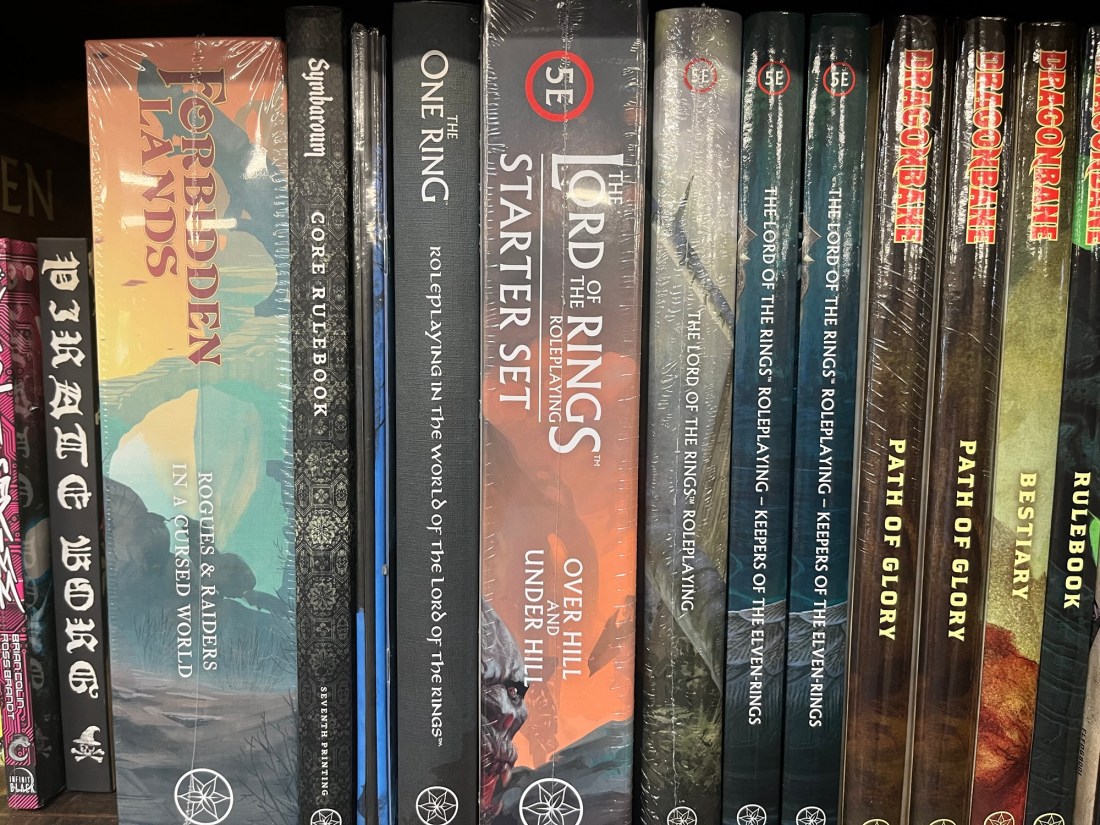
P.P.S. Featured photo is a shelf at my local gaming store, featuring some of The One Ring material.
1 This is meant to be a period of time between The Hobbit and The Fellowship of the Ring.
I’ve been playing 5th edition Dungeons and Dragons since 2016 off and on, first with co-workers, then with friends and family. Later, I branched out into Adventurer’s League, and wrote some modules online for fun.1
But now, I can confidently say that I am thoroughly tired of the game.
My kids and I played weekly during the Pandemic and had some greatadventures together, and when the Pandemic finally subsided I was eager to resume Adventurer’s League with the local community.
But then starting in 2024 something happened: the game just wasn’t as fun as it used to be. The 2024 revised rules made things briefly interesting again, but left me with a soulless, corporate aftertaste. But even the fun of revised and updated rules quickly lost its luster. The revised versions feel very polished, and fixed some issues, but also feel homogenized and bland, with no character left.2
PlayingD&D started feeling increasingly rote. My kids increasingly lost interest, especially my oldest who had one foot out the door towards college, and I didn’t have the drive to start up another group elsewhere. The final straw was returning to Adventurer’s League after a hiatus of 2-3 years. Adventurer’s League now feels hollowed out and running on fumes after WoTC stopped investing in it in favor of their new organized play setting. My local community is much smaller than before, with most of the old-timers having left, leaving only the die-hard players whom (speaking from experience) are hard to get along with.
Even the local gaming store I used to frequent has become so successful, that it is too crowded, too hard to find parking, and overpriced. Compared to five years ago, it is not fun to go there anymore.
I did briefly look into Pathfinder but quickly got tired of the rules-heavy and math-heavy gameplay. Plus, if you are an occasional player, you are forever chasing after new rules, classes and modules or will simply get left behind. The remaster didn’t help matters, because if you want to keep up you have to buy three new books at $60+ each, just to avoid some legal hassles with naming of spells and rules. In short, I did not find Pathfinder worth further investment.3
In spite of all this nay-saying, my son loves D&D, and reads the 2024 books avidly (I will probably give him the books at some point), and even enjoyed the new Dungeons and Dragons movie, Honor Among Thieves (it is a pretty fun movie, tbh). So, I won’t discourage him. I have personally grown sick of D&D and have no desire to play it (or Pathfinder) anytime in the near future. For me, the spark is totally gone.
And yet, I am also realizing that the TTRPG world is a lot more vast than I first thought. I stumbled recently upon an RPG system called The One Ring: a gaming system designed entirely for J.R.R. Tolkien’s Lord of the Rings series. I picked up a couple of the core rule books, including a Dungeons and Dragons-compatible version, and am reading through them now. The community, while not large as Dungeons and Dragons, is large enough that I can find the support I need to questions and people seem to be passionate without being obnoxious. As a lifelong Tolkien fan, the amount of love and attention put into the books is really impressive, and heart-warming. I probably will write a review of the core rules once I finish reading through the book.
There are many other RPG systems as well, by smaller publishers, who are passionate about their craft, and if you look enough, chances are you’ll find a system that’s right for you. My son loves D&D 2024 edition, so I am happy to let him continue reading, exploring, and designing adventures. For someone who enjoys Pathfinder, I hope they continue playing and exploring. I guess the point of all this is that if you are tired of the more corporate gaming systems, try exploring other smaller RPG systems, and see what’s there. You may find a hidden gem you didn’t know about.
For me, I am done with both D&D and Pathfinder systems, and instead enjoy exploring the rules of The One Ring. Whether I can find a local community to play with (the perennial challenge of TTRPG) is another matter entirely….
P.S. Featured photo is my bookshelf of TTRPG books: a mix of D&D 5th edition, 2nd edition (which I fondly remember from my teen years), and some The One Ring books. Most of the newer 5th edition books were sold off already, but I am keeping some older ones that I enjoyed.
1 Writing modules is fun, and I made a bit of money here and there, but nothing even remotely enough to raise a family with. I make enough per month to buy a cup of coffee or two. I gradually stopped as the effort per module exceeded what I felt I got out of it. I still have a few in draft I may finish someday, but in light of this post, I will likely keep them in draft for the foreseeable future. Also, the 50% cut that WoTC takes from my module sales is frankly kind of egregious.
2 The 2024 books have truly fantastic artwork, though.
3 I kept the remastered Player Core book (book 1, since now they’ve printed multiple versions) in case I ever join a group, but I admit it’s pretty unlikely at this point.
MCCOY: What if you decide he is Kodos? What then? Do you play God, carry his head through the corridors in triumph? That won’t bring back the dead, Jim.
KIRK: No, but they may rest easier.
Star Trek, “The Conscience of the King” (s1ep13), Stardate 2817.6
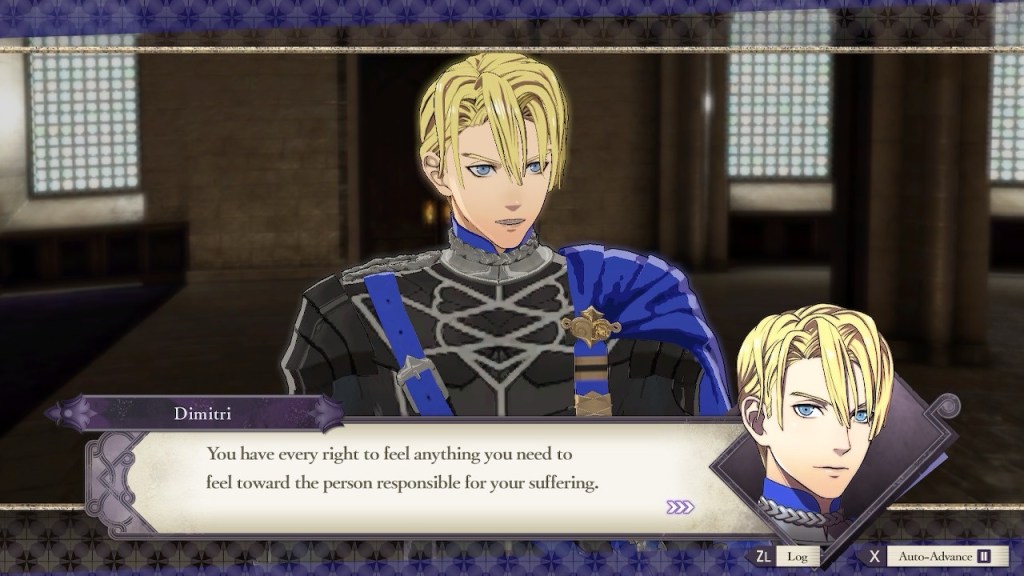
In the game Fire Emblem: Three Houses, one of the three main characters you interact with is the prince of Faerghus, Dimitri, who has suffered terrible tragedy in the youth. Behind his veneer of civility, he is gradually losing his mind.
He cannot get past the loss of his loved ones, and is determined to kill Edelgard personally, whom he blames for all his misery. Depending on which story path you choose in the game, Dimitri’s fate, and the fate of everyone he drags down with him, is very tragic indeed.
Dmittri in the “Azure Moon” route of Fire Emblem: Three Houses
The Buddha saw through this death-spiral of vengeance and hatred, and how utterly pointless it was:
“He abused me, he struck me, he overpowered me, he robbed me.” Those who harbor such thoughts do not still their hatred.
The Dhammapada, verse 3, translation by Acharya Buddharakkhita
Indeed, ill-will is one of the Five Hindrances, and can only be countered by goodwill. But what happens when someone has been genuinely hurt and abused by someone else?
Dimitri at an earlier point in the game.
Dimitri suffered terrible loss and hardship in his youth due to the political machinations outside his control, and the pain and grief are genuine, not something you can just wish away, or use platitudes to make it better. It’s not hard for readers to think back to moments of trauma in their own lives (I have my fair share), and feel raw anger, rage, or sadness (why did this happen to me? why do I have to live with these scars for the rest of my life?).
If you pick the story path that sides with Dimitri, there is a happier fate for him. I don’t want to spoil too much, but through his friends (including you, the main player), he learns to unravel his past and gradually learns to look forward toward the future his kingdom including a dramatic moment with Edelgard.
Thus, I think what the Buddha says in the Dhammapada is true: vengeance, anger and bitterness are indeed self-destructive, but if the trauma and pain are real, they can be very difficult to let go. It is too raw and painful to simply dismiss with logic and reason. But, in Dimitri’s case, support from loved ones helps him through the darkest moments, and helped him let go. He learned not to face it alone, and grew from it.
With whatever trauma you have to live through, I hope you dear readers find similar resolve and happiness.
SPOCK: There are many who are uncomfortable with what we have created. It is almost a biological rebellion. A profound revulsion against the planned communities, the programming, the sterilised, artfully balanced atmospheres. They hunger for an Eden where spring comes.
Star Trek, “The Way to Eden” (s3e20), Stardate 5832.3
As I write this, the family is in Japan (sadly, I was unable to go this year) visiting relatives, and I am home with the dog, Cherry.
Since I have a couple weeks to myself, I thought it would be a great time to put in a little extra Buddhist practice, catch up on some personal projects, go offline for a bit, etc. Basically, try to live like a monk for a few days. I carefully planned it out, decided what I would do and not do, took a three days off from work, and then got ready for the “mini home retreat”.
I lasted eight hours.
The first few hours were great. It was peaceful, quiet, and I did finish reading a couple books on my to-do list, meditated extra, recited more sutras than usual, and so on. But then, as the hours progressed, isolation and boredom set in. I started worrying if I was missing a text from my family (in case of emergencies), and I discovered that it’s hard to read Japanese books without a dictionary which I only have on my phone.
Embarrassingly by early afternoon I gave up and turned on my phone. Then I went and played Fire Emblem: Three Houses for a few hours,1 watched Star Trek V: The Final Frontier2 for some crazy reason, got bored and played more Fire Emblem until 11pm.
Day two, I didn’t even really bother to try again. I realized that I had hyped up this time off too much, and without any support or contact with others, I quickly started to get a little stir-crazy. That’s not to say the time wasn’t unproductive either. Even today (day two), I still got some extra stuff done around the house, and did a little more Buddhist stuff than usual. But I also played Fire Emblem: Three Houses for three hours.
τὸ μὲν πνεῦμα πρόθυμον, ἡ δὲ σὰρξ ἀσθενής. “Indeed the spirit is willing, but the flesh is weak.”
Indeed, in the Sutra on the Buddha of Immeasurable Life, one of the Three Pure Land sutras, the Buddha Shakyamuni laments that:
“People of the world, being weak in virtue, engage in strife over matters which are not urgent….Since they have not done any good in particular, nor followed the Way, nor acted virtuously, when they die, they will depart alone to an inferior world. Although they are destined to different states of existence, none of them understands the law of karma3 that sends them there.”
Translation by the late Hisao Inagaki, hosted here.
So, the problem of laziness and lack of follow-through in religious practices (or personal projects) is nothing new. Even in Japanese, there is a phrase: mikka bōzu (三日坊主) meaning “three day monk”. It’s a tongue-in-cheek phrase about how most endeavors last three days at most.
In my case, I think my failure was a combination of over-zealousness and perfectionism which set the bar too high for something I am not really used to doing day to day. The idea of a religious personal retreat is still worth it, but I should have set the bar lower the first time, and tried to be a bit more realistic.
The point isn’t to give up and just play more Fire Emblem (but then again, I might anyway), but reflect on what worked, and what didn’t and focus on something realistic and sustainable. As Dogen reminds us, it can be done, but expecting it to work overnight if I just push through hard enough is maybe a bit silly.
Namu Shakamuni Butsu Namu Amida Butsu
P.S. Bonus post. Apologies for any typos, I wrote this one quickly while it was still fresh in my mind, so probably more editing mistakes than usual.
P.P.S. On the plus side, I also had some time to practice vegetarian cooking and made a large batch of Mapo Tofu, Pasta Mama (in honor of Captain Pike in Star Trek: Strange New Worlds), and some Thai curry. This photo is the Mapo Tofu:
… I also harvested the scallions I’ve been growing since Spring:
1 I am on my eighth play-through I think. I am finally going back and replaying my first route, Crimson Flower route (i.e. with Edelgard) and doing things I missed on my first play-through. It’s been nearly two years, and I still enjoy this game very much. The story, dialogue, characters and world-building never cease to amaze me.
2 I think I watched it to remember why this movie is so unpopular. It has some good qualities to it, but yeah, it’s not very good. As a teenager, I watched it in the theaters and thought it a bit odd, but it’s not aged well for me.
3 For similar teaching, see the first chapter of the Soto Zen text, the Shushogi.
Ever since I stumbled upon the Nintendo game Fire Emblem: Three Houses, I’ve been completely hooked onto the Fire Emblem series. The series is quite popular in Japan, but until recently hasn’t been that well-known in the West outside a niche community. Many earlier titles were not even sold overseas. I have gone back and played a couple older titles1 and also last year I got a copy of the latest title: Fire Emblem: Engage for Christmas.
Since I played Engage after finishing Three Houses, I was comparing it with a very high bar, and thus it had a rocky start for me. However, after completing the game, and picking up the new Japanese-language manga (more on that later), I like Engage more and more. This post is meant to be a review to celebrate its 2nd release anniversary.
If you want the short summary of “is the game worth playing?”, then the quick answer is that I am halfway through my second play-through now and definitely enjoying it.
Like every Fire Emblem game, Engage is a turn-based battle game. I like to think of it as Chess, except that :
You get to pick the pieces you want to put on the board
You can build and train your pieces in various ways
There is a nice narrative to go with the entire adventure
Your pieces interact with each other, and might even get married. ❤️
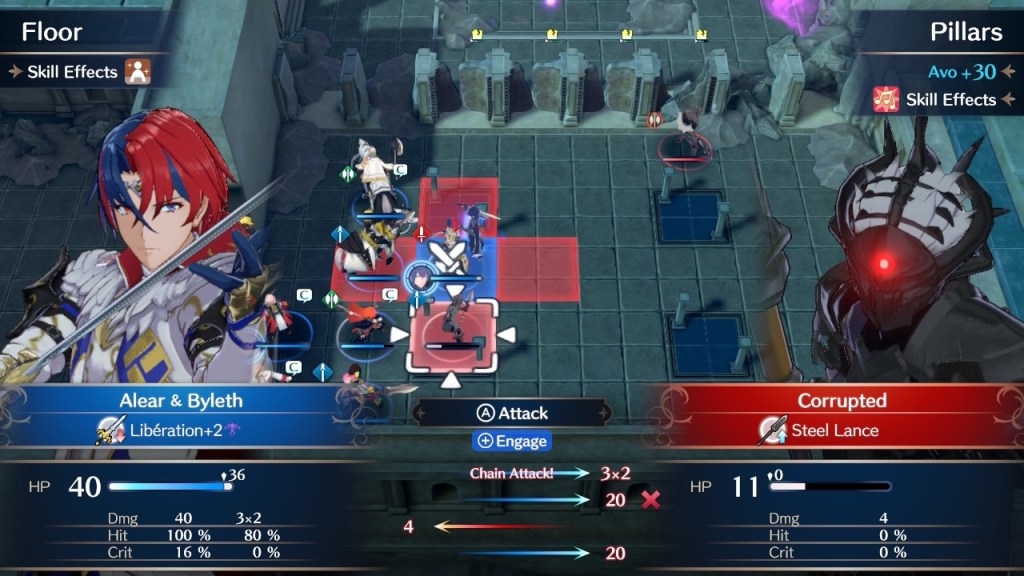
An example screenshot I took of the main character, Alear, battling an enemy. Before the battle begins, the player can see what the results will be, allowing you to proceed, or take back the move.
Each Fire Emblem is somewhat unique, but they all follow a similar pattern. The Engage battle system doesn’t radically differ from earlier titles, but it is significantly smoother and more polished. It’s very well done. Engage leverages the weapon-advantage triangle of earlier titles (swords vs. axes, axes vs. spears, spears vs. swords) but also introduces a new “break” mechanic which causes the disadvantaged weapon holder to temporarily lose their weapon. This is a great way to overpower another opponent and avoid unnecessary damage yourself. Of course, this works both ways. There are also spells you can obtain that simply break an opponent from a distance. Very annoying if you are on the receiving end. The battles are hard, but they are genuinely fun to engage in …. uh? uh?
The big innovation to Engage is the use of Emblem Rings. Engage seems to be a kind of a homage to the entire series, and many of the heroes of past titles make a comeback as warrior spirits bound to specific rings. Characters who bear one of these rings gain increasing stat bonuses and abilities, and also unlock short conversations with the bound Emblem warriors. The more they use the ring, the more abilities and stat bonuses they unlock. There are twelve rings total, and since your groups is far larger, you have to carefully decide who gets to train with what rings, etc.
If you didn’t play earlier Fire Emblem titles, like myself, this a great way to get acquainted with past heroes you didn’t really know about. Ike from Fire Emblem: Dawn of Radiance, and Corrin from Fire Emblem: Fates are a particularly standout examples for me. It was also great to see Byleth from Three Houses as well.
Ike from Fire Emblem: Path of Radiance, featured here in Engage
These Emblem Rings both play a core part of the story, but also are an important aspect of many of the game mechanics. I didn’t understand until my second play-through how bond rings created from the Emblem Rings let other characters get some minor boosts to stats, minor abilities, and help charge SP points when not wearing an Emblem Ring proper. This is very helpful in ensuring none of your characters fall behind in progression too much, since there is only a limited number of rings to go around. Also, inheriting skills was something I didn’t do properly in my first play-through either, causing me to really miss some important enhancements. The Emblem Ring mechanics are both complex and highly customizable, but also take time to grasp. Engage might have done more to help clarify the benefits and features.
The other challenge with the game is the story.
Compared to the complex, Machiavellian story in Three Houses, with its adult themes of war, loss, politics and so on, along with its four possible story paths, Engage doesn’t really have any of this. The story is leaner, more linear hero story, harking back to older titles. That’s not to say the story isn’t interesting. In fact, once I finished the game, I found that I liked the story. The issue, I think is pacing: some dramatic parts of the story are introduced too early, so there’s no emotional connection, others introduced pretty late. Thus, there is a long awkward slog in the middle. The official manga2 actually does fix some of this so that the story aspects are smoothed out more, and long gaps in the plot are filled in.
The cast of characters too, lack some depth of Three Houses. The cuter, more cartoony style and one-dimensional personalities makes it a bit hard at times to take some of the characters seriously, as they feel like something from a mid-level anime. On the other hand, there are some great characters. The twins Clanne and Framme were simply adorable, Etie the bodybuilder lady was always a hoot (especially when she fights with Goldmary), Prince Alfred is always upbeat and positive even in the worst of times, and the brothers Prince Diamant and Alcryst had an interesting dynamic. In fact, there are actually quite a few fun or interesting characters, it’s just that others feel kind of superfluous or blatant fan-service characters.
This goes double for some of the villains. The Four Hounds were annoying to me, until the very end when their origin was revealed, but again due to the pacing, it was a bit too late. Similarly, the story between Hortensia and her big sister Ivy was actually pretty interesting, and helped flesh out the kingdom of Elusia more, but only if you progress far enough in their support conversations. By and large, the atmosphere of the game is lighter and more jovial than Three Houses, so it loses some gravity, but it does have some really nice support arcs nonetheless, and I do like the majority of the cast. The manga below really helps flesh things out and fixes some of the pacing issues, too.
The support conversations also differ from Three Houses a bit. The C and B supports tend to be shorter, but similarly follow a story arc. Some are actually quite good, some kind of bland. Then again, one can say the same in Three Houses: not every support conversation is compelling. I do really like that Engage seems to have more options for romantic supports, so if you’re a person who prefers same-sex relationships,3 you have more choices than Three Houses offered.
Yunaka is hilarious. 🤣
A few other things about Engage are worth noting.
First, the Somniel, the hub of Engage is really fun. It feels more like a vacation resort compared to the venerable Garreg Mach monastery of Three Houses. As with the Emblem Rings, there is a lot of features and quality-of-life improvements that are not found in earlier games, and easy to miss. I found myself frequently diverging from the game itself to mess around in the Somniel for lengthy periods of time.
Welcome to Club Med, er, the Somniel!
Second, as alluded to above, the game has a lot of replay value. That’s true with many Fire Emblem games as there is more than one way to win it, but Engage excels at this. You can go very in-depth of features and customizations. It’s overwhelming and easy to miss at times, but I have found myself enjoying the game a lot more during my second play-through once I grasped the basics.
Engage gets some flak for the thinner story and character development, but I have to admit that I enjoy it more than I expected, but it did take some patience to appreciate. There is a lot in this game, and while it is rough around the edges, it also really has a lot to offer new players and past fans of the series. Even with the rough patches, I definitely recommend the game for new fans and old.
P.S. bonus post, but also timely since Sakura-con starts today. My kids and I go yearly.
1 I was very lucky that someone at work was selling a slightly used 3DS for very cheap. Turns out there’s several good titles for the 3DS, but I picked Awakening because Chrom, Lucina and Robin all appear in Super Smash Brothers. It was nice to finally see who these people were, and appreciate the excellent storyline. Also, while writing this post, I also picked up Fire Emblem: Echoes, Shadow of Valentia for the 3DS as well. It’s a really beautiful story.
2 The official manga is only available in Japanese, but I obtained copies of it last year from Amazon Japan, and have been reading through (with a dictionary, of course). I hear there are unofficial translated versions available, but I don’t know anything about this. In any case, the manga is excellent and has done much to improve my opinion of Engage. Some aspects of the game story were rewritten in more sensible ways, while the art is just amazing.
The first four issues of the Fire Emblem: Engagemanga.
3 I am straight myself, but it’s important to acknowledge the sheer diversity of people in the world, rather than pretend it doesn’t exist.








 Gleanings in Buddha-Fields
You must be logged in to post a comment.