Buddhism in a Nutshell

If you’re new to Buddhism, or curious about what it is, it’s tempting to compare with other world religions. However, it differs in some key ways.

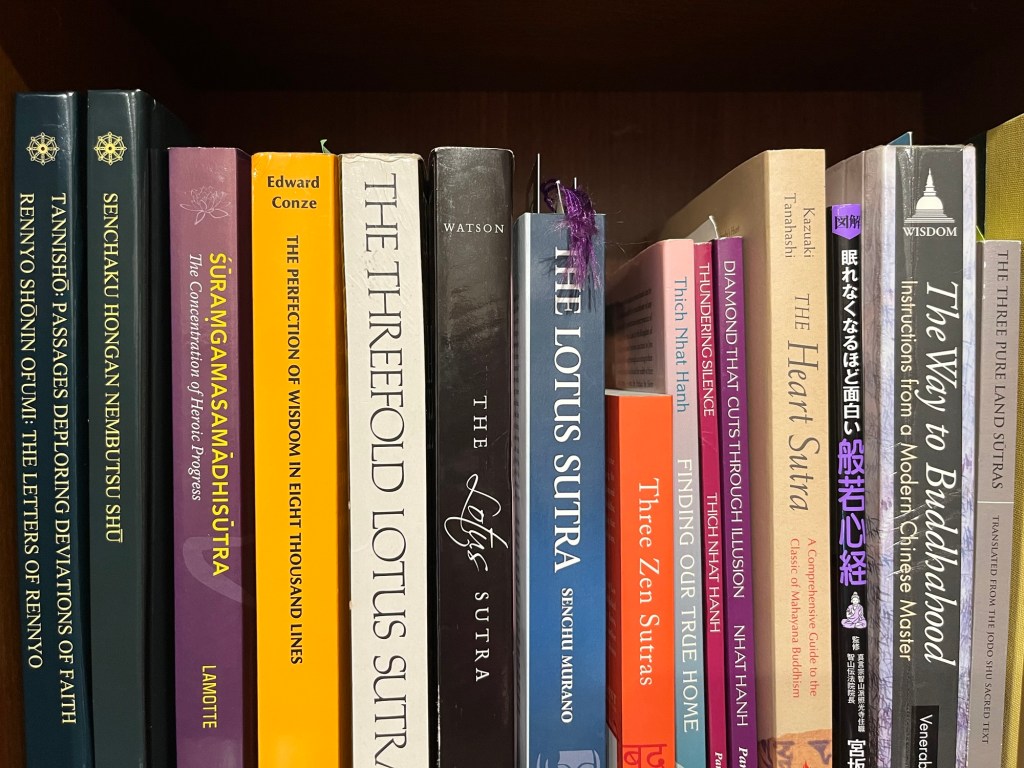
One of my favorite books in my collection is an old translation of The Way to Buddhahood by the late Ven. Yin-Shun (“een-shoon”), a prominent Chinese monk who was an influential figure in Taiwan. His book is dense,1 and geared for Chinese audiences, but the translation is good, and Yin-Shun’s reputation as a scholar and respected monk is well-earned.

The opening pages of the book read as follows:

To study Buddhism means to learn from the Buddha. One takes the Buddha as one’s ideal and one’s mentor and learns from him incessantly. When one reaches the same level as the Buddha, then one has become a buddha.

The Buddha, founder of Buddhism, is a man we call “Shakyamuni”. Sometimes books call him by his birth name, Siddhartha Gautama, but Buddhists call him Shakyamuni or Shakyamuni Buddha.

The key to understand is that the Buddha is not a god. And, if we follow the Buddha’s teachings and apply them correctly, we too will rise to the same level as a buddha ourselves.

This is not a quick, “weekend-warrior” effort though.

….For an ordinary person with little good fortune and no wisdom, reaching this supreme and unsurpassed state of buddhahood through practice and study is difficult. But by practicing and studying the necessary methods and by following the right way to buddhahood, one can reach the goal of buddhahood. Only in this way, and without skipping any steps, can one advance to this distant and profound goal….

The goal is profound and difficult, but not impossible. One has to be realistic about the goal, and be willing to accept that it’s a long-term goal. Yet, if one does this, and stays the course, one will assuredly reach Buddha-hood. Yin-shun’s comment about “not skipping steps” is to counter promises by some teacher or cults that by “chanting this magic spell” or “praying to that” one just quickly jumps to Buddhahood. It is a gradual process, regardless of how one approaches it.

The good news is that within Buddhism there is a way array of practices, methods and traditions to help you along the way.

Because beings have different abilities, the Buddha Dharma has different ways: the way of blessedness and virtue, the way of wisdom, the difficult way, the easy way, the mundane way, the supramundane way, the way of the sravaka, the way of the bodhisattva, and so on. But ultimately, there is only one way. All of these ways are nothing but methods to become a buddha “in order to open up and make manifest the Buddhas knowledge and insight to sentient beings, so that they can also apprehend and attain the same.”

The specific ways that Ven. Yin-Shun cites are explained throughout the book, but needless to say, Buddhism is like the Colosseum in Rome, with many gates, all leading inward towards the middle. One only needs to step through one of them, and keep at it in a long-term sustainable way.

This is essentially what Buddhism is all about.

P.S. Happy spring Ohigan season!

1 I wouldn’t recommend the book as a first-pass introduction to Buddhism, but it covers a lot of subjects that are omitted in other books in a single volume.

Prejudice

M’BENGA: Prejudice has kept people from helping each other for centuries with no scientific justification. And after we met our neighbours in the galaxy, we found new bigotries….In any case, they’re meaningless to me. I am a physician. 

Star Trek: Strange New Worlds, “Ghost of Illyria” (s1ep3), Stardate 1224.3

Prejudice is something far more insidious than simple racism, and something we all face on some level. We discriminate based on all kinds of criteria: race, ethnicity, religion, gender, politics, sports teams, departments at work, etc. If someone is somehow different, we are inclined to see them as an outsider. It’s subtle and tough to resist without conscious effort.

My personal belief is that prejudice is born from some kind primitive instinct of self-preservation, by making discerning choices with only limited information. Sometimes this might keep us alive, other times, it causes hostility and animosity.

But I am not the only one who seems to think this way…

But I digress.

In the famous Star Trek episode “Arena”, Kirk is compelled to fight a Gorn to the death in single combat:

The episode emphasizes how repulsive and cruel the reptilian Gorn are, and yet at the end when Kirk finally defeats the Gorn, he spares its life. This earns him the respect of the Metrons, the highly-advanced aliens who instigated the duel.

METRON: By sparing your helpless enemy who surely would have destroyed you, you demonstrated the advanced trait of mercy, something we hardly expected…. There is hope for you. Perhaps in several thousand years, your people and mine shall meet to reach an agreement. You are still half savage, but there is hope. We will contact you when we are ready.

Star Trek, “Arena” (s1ep18), Stardate 3045.6

The Metrons knew that violence and hatred were primitive and hardly distinguish a species, but mercy and goodwill do. It requires thought and mental discipline to override one’s basic instincts, but it is almost always the right choice.

Namu Shakamuni Butsu

P.S. The Gorn play a much more prominent role in Strange New Worlds than original Star Trek … with mixed results.

Jodo Shinshu Home Liturgy

For the sake of completeness,1 I wanted to cover home liturgy for the Jodo Shinshu sect of Buddhism as it is promoted in Japan. I spent years at a local Shinshu temple here in the US during the 2000’s and 2010’s, part of the Buddhist Churches of America (the American branch of Jodo Shinshu), whose liturgy is slightly different, but I’ll try to clarify the differences. There aren’t many, but it did surprise me when I first experienced Jodo Shinshu in Japan, and realized that it wasn’t what I was expecting.

Further, Jodo Shinshu’s liturgy is somewhat different than other ones we’ve covered so far. When we look at Rinzai, Soto, Tendai and Jodo Shu sect home liturgies, they tend to follow a certain flow:

They may have more or less content, and the particular verses may differ, but generally that’s the format.

Jodo Shinshu home liturgy differs from this pattern somewhat. I believe this is primarily because of the Jodo Shinshu sect emphasis on the Other Power of Amida Buddha, rather than one’s own good works. So, there’s nothing to cultivate in the traditional Buddhist sense, only to express gratitude for.

This lead to some changes, particularly through Rennyo the 8th monshu (head of the sect) who through his efforts to consolidate the various communities, promoted a liturgy format that centers around Shinran’s hymn, the Shoshinge. Thus, in Jodo Shinshu sect Buddhism, daily recitation of the Shoshinge is encouraged, including six wasan hymns at the end, followed by dedication of merit verse similar to other sects. This is the basic Jodo Shinshu home liturgy. If you recited the Shoshinge, and dedicated merit, that would be sufficient.

You can see an example of this here:

Alternatively, if you don’t want to recite the whole Shoshinge, as this site shows (another site) there are other things one can recite instead:

But many sources suggest the Shoshinge plus Wasan hymns when possible. Also, the same sources emphasize that Jodo Shinshu tradition does not recite the Heart Sutra (unlike other traditions).

Anyhow, going back to this site, the home liturgy is as follows:

  1. Light a candle and incense at your buddhist altar (if you have it).
  2. Put your hands together and recite the nembutsu
    • In Jodo Shinshu style, the nembutsu sounds more like na man da-, na man da-, na man da-
  3. Ring bell twice
  4. Recite the sutra (see above)
  5. Recite the dedication of merit hymn
  6. Optionally, recite a letter from Rennyo’s Gobunsho letters. My service handbook lists the following letters as recommendations to recite (English translation can be found here):
    • Fascicle V, letter 10 – “On Faith as Fundamental”
    • Fascicle V, letter 5 – “On Realizing Faith”
    • Fascicle V, letter 1 – “On Laymen and Laywomen Lacking Wisdom in the Last [Dharma] Age
    • Fascicle V, letter 2 – “On the Eighty Thousand Teachings
    • Fascicle V, letter 6 – “On the Great Benefit Bestowed with [the Awakening of] the One Thought-moment [of Faith]

From my experience with the Buddhist Churches of America, this format is similar to what we recited in Sunday services, though with a couple small differences. First, the Shoshinge was only recited at more formal ceremonies since it is so long. For normal weekly Sunday services, the Juseige was most often recited. Also, at least at the temple I went to, we also explicitly recited Taking Refuge in the Three Treasures (namu kie butsu, namu kie ho, namu kie so), which is something I don’t see in Jodo Shinshu services in Japan.

But in Japanese temples the Shoshinge is emphasized, and other aspects somewhat de-emphasized, hence it’s a bit unconventional.

Good luck and happy chanting!

Namu Amida Butsu

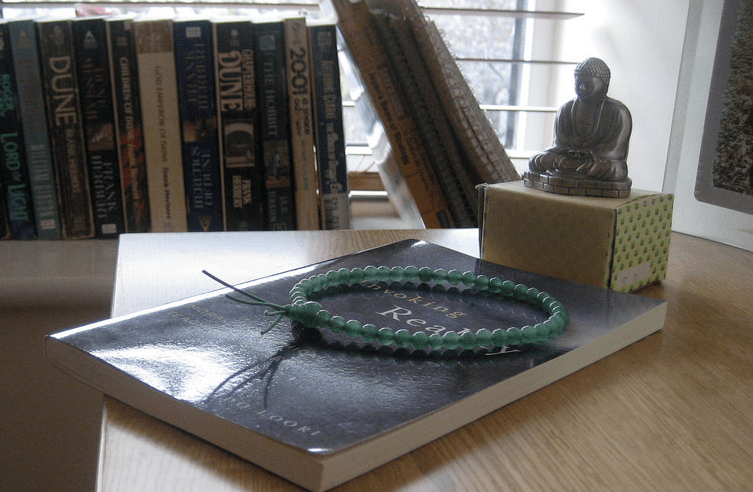
P.S. Photo was taken may years ago in 2008 when I lived in Ireland for a time. Back then, I had a lot fewer Buddhist resources (and there weren’t many in Ireland anyway), so I made this into a very impromptu altar.

1 I have not covered the Shingon and Nichiren sects, but I have too little information on them to speak with any certainty. Readers will have to do their own research for now.

Revisiting the Five Hindrances

SPOCK: If there are self-made purgatories, then we all have to live in them.

Star Trek, “This Side of Paradise”, stardate 3417.7

The Five Hindrances in Buddhism was something I briefly touched on in the past, and something I think about from time to time, but then I ran into this neat excerpt by the Chinese Tiantai (Tendai) founder, Zhi-yi:

The practitioner is like a person who has gained freedom from a debt or one who has been cured of a serious disease, like a starving man arriving in a prosperous country, or like one who has been rescued safe and unharmed from a band of villains. When he eliminates these five hindrances, his mind becomes calm and secure and he feels clear, cool, and blissful.

Just as with the sun and moon which may be obscured and prevented from shining brightly by the five phenomena of smoke, dust, clouds, fog and the hand of the asura known as Rāhu, so it is as well with the human mind and the five “covering” hindrances.

The Essentials for Practicing Calming-and-Insight & Dhyana Meditation by Zhiyi, translated by Kalavinka Press, page 75

I really like this quote for a few reasons.

First the benefits of self-discipline, and personal conduct are like getting out of debt. By not committing harmful actions towards others (and by extension yourself), you are no incurring further debt. Because you are no longer incurring debt any existing “karmic debt” run its course, your personal purgatory that much shorter. It bring a kind of freedom, even if it seems counterintuitive.

長からむん心も知らず黒髪の乱れてけさはものをこそ思え

I do not even know how long your feelings will last. My long black hair is all disheveled and, this morning, my thoughts too are in a tangle!

Poem 80 of the Hyakunin Isshu, translation by Joshua Mostow

Second, it reiterates that the Five Hindrances really do get in the way of clear thinking, and prevent one from being level-headed and in control. This leads to further harmful actions, incurring further “debt”, etc. So, it helps to know what the Five Hindrances are, and to observe them in your own life, and to know how best to counteract them.

Easier said than done, but every time you counteract ill-will, or laziness, you’ve lightened the burden in your own self-made purgatory.

Namu Shakamuni Butsu

P.S. Featured photo taken at Ryoanji temple in 2023.

Conduct, Then Practice

A photo of the Shurangama Sutra (the purple book on the left) from my personal collection. I purchased this years ago at Powell’s City of Books and haven’t found a copy since.

In my last post, I talked about Tetsugen Doko’s open-minded approach to Buddhist practice especially among his lay followers. But there was one thing that Tetsugen Doko did not compromise on.

In 1674 in the castle town of Mori (now Oita Prefecture), Tetsugen gave a controversial Buddhist lecture on the Shurangama Sutra, an influential Buddhist sutra in China not widely discussed in Japan. The lecture caused an uproar.

Tetsugen later summarized the lecture contents in an affadavit as follows (emphasis added):

I lectured first of all about the good and evil of the False Dharma and the True Dharma in the Final Age, which are referred to as the Three Absolutes in the Suramgama Sutra. Those who practice without keeping the precepts set out by the Buddha all represent the False Dharma. The reason for this [is as follows:]

Although practices such as chanting the Nembutsu, seated meditation, and reciting the sutras are each practiced differently depending on the abilities of the believer, the precepts against taking life, stealing, sexual misconduct, lying and the like are absolute, regardless of the sect. Not to keep them is unacceptable. Therefore these precepts are called “absolutes.”

This lecture earned him the ire of the local Jodo Shinshu community whose priests did not, by tradition, uphold any precepts. The local members rioted and multiple arrests were made by the authorities, who feared a return of the Ikko-Ikki riots, and Tetsugen quietly left town to avoid further trouble, especially for the feudal lord who had sponsored the lecture.

Nonetheless, more and more I believe that Tetsugen is correct: the basic lay precepts (a.k.a. the Five Precepts) should be front and center of one’s practice. Everything is grounded on that. Not the other way around, as I believed. What practices you choose to undertake are secondary to how you conduct your life the rest of the time.

I spent many years in my pursuit of the Buddhist path, fretting about doing the right practices, and chanting the right things, but these days I feel that the way to not be a dickhead is to simply stop acting like a dickhead. This is what the “training rules” of the precepts do: file away the sharper edges so that one’s Buddhist practice has a solid foundation.

Easier said than done? Oh yes.

Is it worth the effort anyway? Yes, definitely.

Namu Amida Butsu
Namu Shakamuni Butsu

Highs and Lows

Dr Helen J Baroni’s excellent book Iron Eyes covers the life and writings of Obaku Zen master Tetsugen Dōkō (鉄眼道光, 1630–1682). I’ve mentioned it in a few older posts, but I wanted to share a couple of Tetsugen’s poems really stood out to me:

41. MEETING AN OLD FRIEND

Separated east and west for twenty years.

You exclusively chant the Buddha’s [name, a.k.a. the nembutsu], while I practice meditation.

We meet together, why argue over high and low.

The wind and the moon originate in the same heaven.

Page 167

The “high and low” refers to the perception that the path of monastic self-discipline (as exemplified by the Zen tradition) is the “high road”, while the “low road” is instead relying Amida Buddha’s compassion to be reborn in the Pure Land. Here, Tetsugen argues that they both reach the same destination in the end, so the distinction doesn’t really matter.

Another poem he wrote is:

44. GIVEN TO THE FAITHFUL BELIEVER JONYU, WHO CHANTS THE BUDDHA’S NAME

The body is healthy, the years pour out; your ears and eyes are [still] clear.

Contented and unselfish, you reject personal glory.

Reflected light, in a single moment you penetrate the self.

For the first time you realize that practitioner and Dharma are complete in one body.1

Page 168

What really strikes me about these two poems is that Tetsugen openly acknowledges that his lay friends and followers recite the nembutsu and he’s totally fine with it.

It’s assumed in Japanese Buddhism that a sect practices meditation, or chanting, but not necessarily both. It’s also assumed that Zen people only hang out with Zen people, Pure Land Buddhists with Pure Land Buddhists, etc. There were exceptions: people like Ikkyu and Rennyo who were friends despite totally different practices and backgrounds, but you don’t hear about these often. Yet, in spite of this image, Tetsugen clearly was open to lay people practicing the Pure Land path and saw no conflict with this.

This makes more sense when you consider that Obaku Zen, a cousin of the Rinzai Zen sect, came to Japan from Ming-Dynasty China, when Zen and Pure Land thought had largely reconciled there. The excellent writings of Chinese monk Ouyi Zhixu (蕅益智旭, 1599–1655)2 and Yunqi Zhuhong (雲棲袾宏, 1535–1615)3 are typical of the thought at the time: both Zen and Pure Land Buddhism are different ways of approaching the same Dharma (e.g. Buddhism). One blends into the other.

Even modern Chan (Chinese Zen) teachers such as my favorite, Yin-shun (印順, 1906–2005), had no trouble recommending the nembutsu alongside other practices. In his book The Way to Buddhahood, he wrote:

If therefore, one is timid and finds it difficult to practice the bodhisattva-way, fearing that one will fall into the Two Vehicles or that following the karmic forces will cause one to drift apart from the Buddha Way, then chanting Amitabha Buddha is most secure! It is a wonderfully skillful means that can best embrace and protect those sentient beings who are beginners so that they do not lose their faith.

page 249

But I digress.

It should be noted that Tetsugen in particular was raised in the more native Jodo Shinshu-sect Buddhism and even went to Kyoto to train as a priest but eventually decided to pursue Obaku instead. So, perhaps he still had some connections toward his religious upbringing.

Nonetheless, all this is to say that Obaku Zen, having inherited such an outlook from Chinese Buddhism, takes Amida Buddha as its ideal, but sees Amida in more Zen terms. One is not required to see Amida that way upfront; it just comes in time with practice. Come as you are, and don’t worry if it doesn’t make sense. Someday, it will.

Namu Shakamuni Butsu
Namu Amida Butsu

1 According to Dr Baroni’s footnotes: Kihō, can also be translated as “opportunity and Dharma,” in Pure Land thought, it means that while the sentient beings believe in the Buddha, the Buddha’s power saves sentient beings. Personally, I like to think this relates to Shoku’s comment about the Three Karmic Bonds, too.

2 Pronounced like “Oh-ee Jih-shoo” in English

3 Pronounced like “Yoon-chee Joo-hohng” in English

Letting Go Of College-Age Children

Hello readers,

This past week, I have been in Dublin, Ireland. The purpose of this trip was (among other things) to help my daughter settle in to your her new life in Trinity College Dublin.

She graduated high school this year, and it’s been a slow-moving, emotional roller coaster as we come face to face to with the fact that our firstborn is leaving the nest. Of course, logically this was always going to happen, but actually facing it is harder than expected. As a father, she has been an important part of our life for the last 18 years, and the thought of letting her go especially in a place where I cannot protect her became increasingly stressful.

Dublin itself, is a great city: very walkable, safe in a way you don’t find in US cities,1 friendly people, and lots of awesome European food you can’t really find here in the West Coast.

A view of Dublin from my daughter’s accomadation

And yet, when my daughter and I arrived in Dublin, we had only five days to get setup with things like:

  • Apartment (student housing)
  • Bank account (since it’s a different country)
  • Mobile phone (same reason)
  • Figure out food sources
  • Figure out public transportation
  • Get some basic home goods since we couldn’t possibly bring it all from the States.
  • Meet some local friends we know to help my daughter establish a local support network, etc.

Out of those five days, I had to some work in Dublin as well (I couldn’t take five full days off), so it was more like three days.

The good news is that we quickly got many of these things sorted out. We found a good mobile service, found some groceries and good restaurants nearby, and her student accommodation is very close to the Luas tram, and the Luas runs often and is easy to get tickets for. If you visit Dublin, definitely learn to use the Luas.

However, during this time my stress and depression was very intense. As soon as my daughter was out of sight, I was full of fear of something bad happening to her (being a lone, young woman), and also really depressed to let her go. I remember a couple nights alone in the hotel where I hardly slept, partly due to jetlag, and partly due to sheer emotional stress.

But I thought about it, and I realized that beyond practical concerns, I was deeply clinging to my daughter. I like to think I was a pretty involved parent, and that I did my best to be both a good father and a friend, and suddenly 18 years of this was ripped away the moment that we set foot in Ireland, and my mind couldn’t handle the abrupt change. In short, I think part of my panic was grounded in ego as a parent. Once I realized my selfish ego was driving this panic, I paused.

Me having breakfast at a local Cafe Nerro in Temple Bar, while reading about the Heart Sutra.

Thinking about this further, the only way she would prosper was to let her get on her feet, help when she needs help, but otherwise, give her space to grown and learn. In short, I had to trust her.

This was hard at first, but I kept reminding myself “trust her, trust her” and by and by I learned to let go. Instead of constantly trying to protect her, I encouraged her, provided any advice I could, and let her explore the city herself. She got lost a couple times on the Luas (got off at the wrong stop), but soon she started finding shops she liked, and could get to and from Dublin city centre without issue.

So, by the end, things were looking up: my daughter was getting on her feet, and we had met a few friends who all happily wanted to help her, and we enjoyed some pub visits, and good European food.

The point of all this, I guess, is that if you are a parent, and you are dreading your children leaving the nest, ask yourself how much of this is concern for your kids, and how much of this is concern for yourself. My job, as a parent, is to provide a safe, loving environment as they grow, but I don’t own my kids. That’s just ego.

Namu Shakamuni Butsu

Update: After I wrote this post, my daughter texted us to let us know she had made some friends already. 🥰

P.S. Unrelated, but September 9th is the Day of the Chrysanthemum holiday in Japan. If you can, maybe decorate the house with a few chrysanthemums, or enjoy the weather with a friend. Happy Day of the Chrysanthemum to you all.

P.P.S. Happy Star Trek Day (September 8th)! Live long and prosper. 🖖🏼

1 It’s hard to explain: when I am in the US, there’s always a subtle feeling of tension. Not just recently, but even 15 years ago when I first came back to the US. When I am Ireland, everything feels more relaxed. The way people talk to one another, even when they tease each other, etc. Dublin city centre at night has plenty of drunks stumbling about, racial tension toward immigrants, and fist fights, but somehow everything feels less …. contentious. Since many Americans don’t travel, we don’t realize how wound up we are.

Making Sense of Zen Lineages

Recently, I found myself stuck in one of my usual nerd “rabbit holes” of trying to make sense of Zen lineages in Japanese Buddhism, but this led to a more complicated rabbit hole of making sense of the source “Chan” (Zen) lineages in China. This started after reading my new book on Rinzai Zen, which included a nice chart. At first, I tried to emulate and translate that chart in Canva, but then I realized it was missing some critical details, so I kept adding more. This is the result (click on the image for more detail):

Let’s go over this a bit so it makes more sense.

The premise behind all Zen sects regardless of country and lineage is that Zen started when the historical Buddha, Shakyamuni, supposedly held a flower up to his disciples and said nothing. Everyone was confused except his disciple Maha-Kashyapa who smiled in understanding. From here, according to tradition, the teachings were passed down from teacher to disciples for 28 generations in India, culminating in a monk named Bodhidharma who came to China.

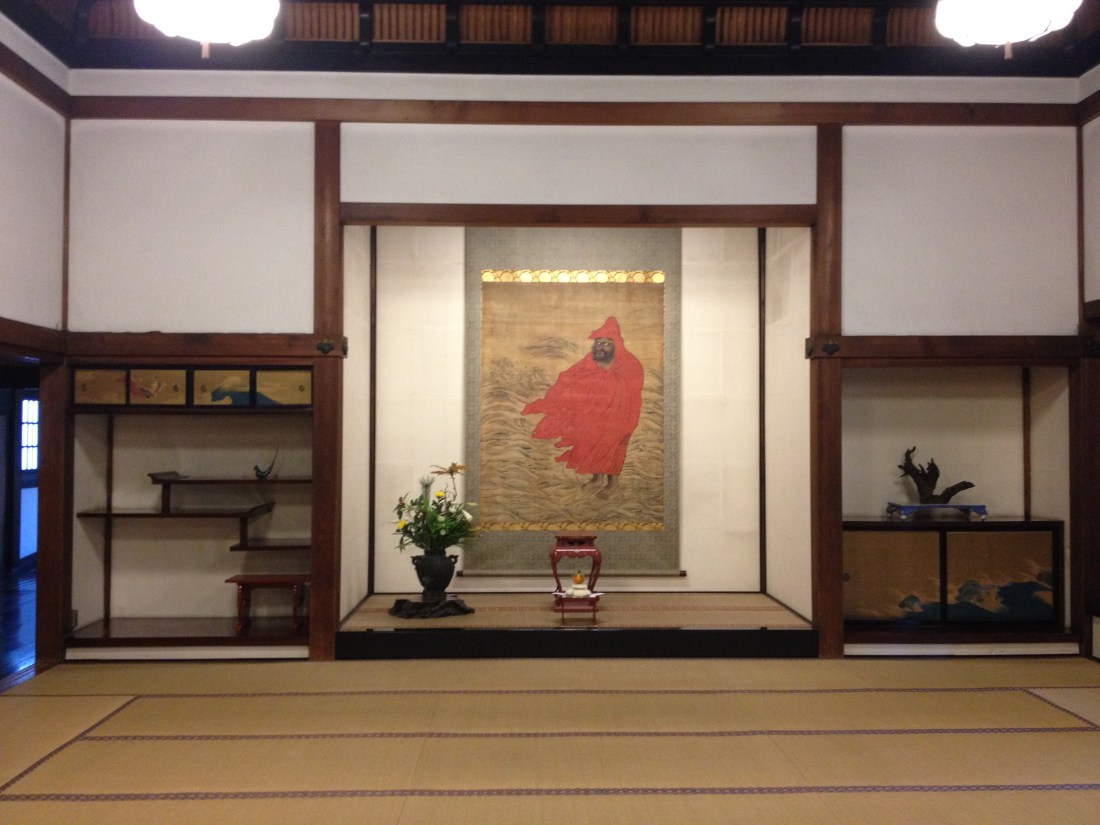
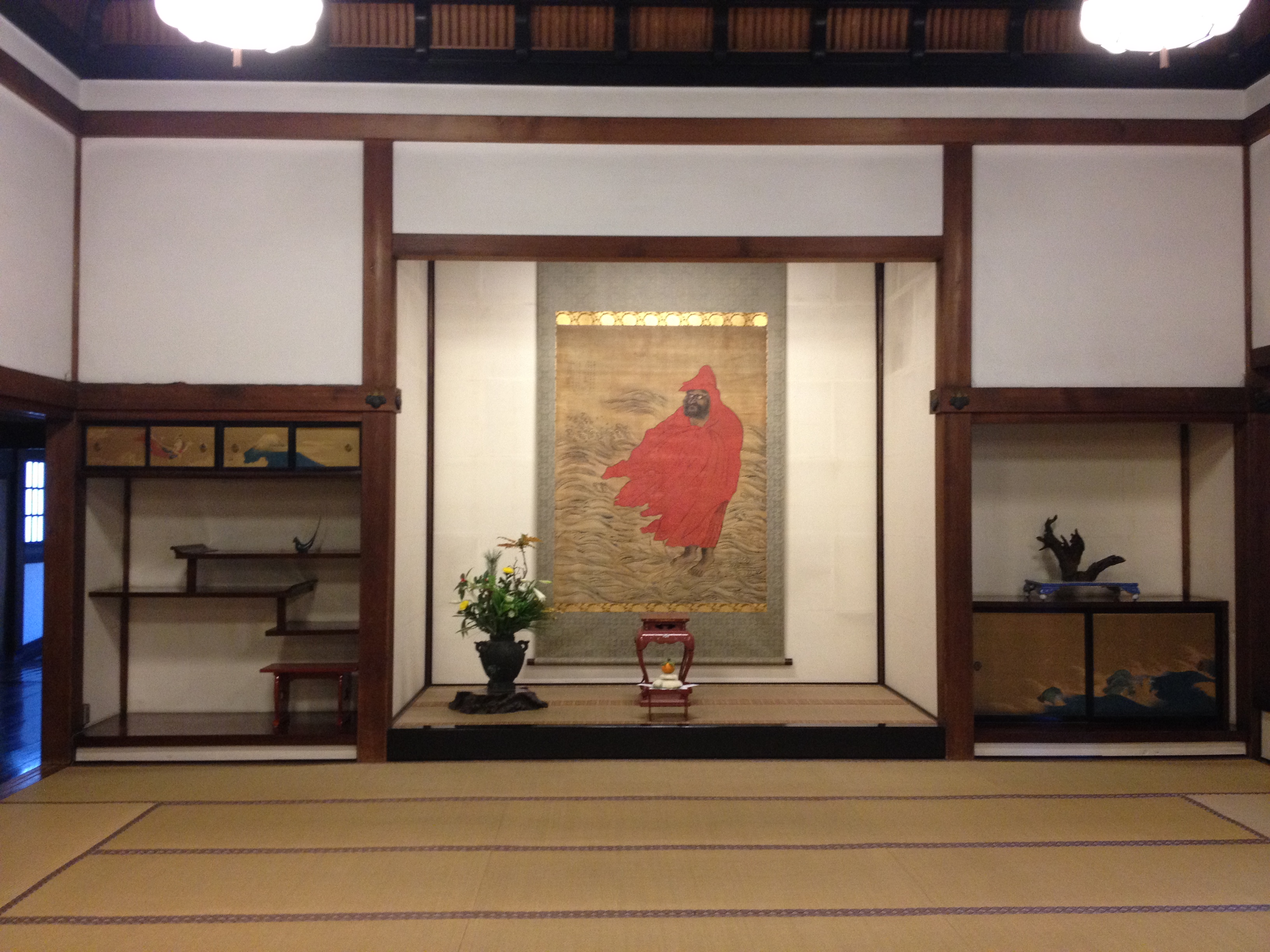
A painting of Bodhidharma at Sojiji temple (head of Soto Zen sect) in Kawasaki, Japan. Taken by me in 2010 (?).

The history up to this point is somewhat vague, and possibly apochryphal, but easy to follow.

This continues for a few more generations in China, until you get to a monk named Hui-Neng (Enō in Japanese)1 who is the supposed author of the Platform Sutra, a Chinese text. As the 6th “patriarch” of the lineage in China, he establishes what we know today as “Chan Buddhism” or Chinese Zen.

Things become more complicated a couple generations later as two descendants: Mazu Daoyi2 and Shitou Xiqian3 directly or indirectly found different schools of Chan Buddhism. This is known as the Five Houses of Chan period during the Tang Dynasty. Thus, the entire Chan/Zen tradition as we know it today is derived from Hui-neng and transmitted through these two men.

Out of the five houses, the Hongzhou,4 Lin-ji and Cao-dong5 all survive in some form. The others are gradually absorbed into the Lin-ji school, which in the long-run is what becomes the most widespread form of Chan Buddhism in China. The Cao-dong school is the one exception, while the Hongzhou school’s success in Korea helps establish 8 out of 9 of the “Nine Schools of Seon (Chan)”6 in Korea. It through Bojo Jinul’s efforts in Korea that these nine schools are unified into the Jogye Order (homepage) which absorbed other Buddhist traditions in Korea into a single, cohesive one.

Meanwhile, in Japan, the Lin-ji and Cao-dong schools find their way to Japan where the names are preserved, but pronounced different: Rinzai and Soto respectively. Rinzai’s history is particularly complicated because they were multiple, unrelated transmissions to Japan often spurred by the Mongol conquest of China. Of these various Rinzai lineages, the two that survive are the “Otokan” Rinzai lineage through Hakuin, and the “Obaku” lineage through Ingen, but eventually the Otokan lineage absorbed the Obaku lineage. Today, Rinzai Zen is more formally called Rinzai-Obaku, or Rinnou (臨黄) for short. This is a bit confusing because Rinzai came to Japan under a monk named Eisai, and his lineage did continue for a while in Japan especially in Kyoto, but the lineage from the rival city of Kamakura ultimately prevailed and absorbed other Rinzai lineages. Obaku Zen arrived pretty late in Japanese-Buddhist history, and as you can see from the chart has some common ancestry with Rinzai, but also some differences due to cultural divergence and history.

Soto Zen’s history is quite a bit more streamlined as it had only one founder (Dogen), and although it did grow to have rival sects for a time, Keizan was credited for ultimately unifying these though not without some controversy even into the 19th century.

Anyhow, to summarize, the entire tradition started from a legendary sermon by the Buddha to Maha-Kashyapa, and was passed on over successive generations in India to a legendary figure who came to China and starting with Hui-neng became a tree with many branches. Yet, the roots are all the same. Speaking as someone who’s relatively new to the tradition, I realize while specific liturgy and practices differ, the general teachings and intent remain the surprisingly consistent regardless of culture or label.

Hope this information helps!

P.S. I had trouble deciding which term to use here: Zen or Chan or Seon since they all literally mean the same thing, but are oriented toward one culture or another. If this all seems confusing, the key to remember is that the entire tradition of Zen/Chan/Seon (and Thien in Vietnam) is all one and the same tree.

P.P.S. I realized that I never covered the Vietnamese (Thien, “tee-ehn”) tradition, but there’s so little information on it in English (and I cannot read Vietnamese), that I will have to differ that to another day.

1 Pronounced like “hwey-nung” in English.

2 Pronounced like “ma-tsoo dow-ee” in English.

3 Pronounced like “shih-tow shee-chee-yen” in English.

4 Pronounced like “hohng-joe” in English.

5 Pronounced like “tsow-dohng” in English.7

6 The Korean word “Seon” is pronounced like “sawn” in English. It is how the Chinese character for Chan/Zen () is pronounced in Korean Language.

7 If you made it this far in the post, congrats! I had to put so many footnotes in here because the Pinyin system of Romanizing Chinese words is a little less intuitive than the old Wade-Giles system. Pinyin is not hard to learn. In fact, I think Pinyin is better than the old Wade-Giles system (more “what you see is what you get”), but if you don’t learn Pinyin it can be confusing.better This is always a challenge with a writing system that strictly uses ideograms (e.g. Chinese characters). How do you write 慧能 into an alphabetic system that foreigners can intuitively understand. Also, which foreigners? (English-speaking, French-speaking, Spanish-speaking, etc). Anyhow, if you are interested in learning Chinese, I highly recommend learning Pinyin anyway because it’s quick and easy to pick up. BTW, since I posted about Hokkien recently it also has two different Rominzation systems: Pe̍h-ōe-jī (old, but widespread) and Tâi-lô (Taiwan’s official revised system).

Rinzai Zen Sutra Book

Recently, I wrote about a Soto Zen sutra book I purchased some years ago, and it’s still one of the best books I own. Today, I wanted to highlight another Japanese-Buddhist sutra book that I had for years, but never really understood what it was about.

The book is available online here, among other places. The book was published by Nanzenji temple, a major Rinzai Zen temple, and I found it at a Kinokuniya bookstore here in the US in the Japanese-language section. It is titled 私の般若心経 (watashi no hannya shingyō, “My Heart Sutra [book]”)

The sutra book is really small, and easily fits in the palm of my hand. As the website description states, this is designed to that one can carry it on one’s person as a charm, but also use it for home liturgy. Pretty clever. I’ve seen such “sutra book charms” before but usually they are very small, and the print is lower-quality, since it’s meant to be carried, not read. This by contrast is very nice quality.

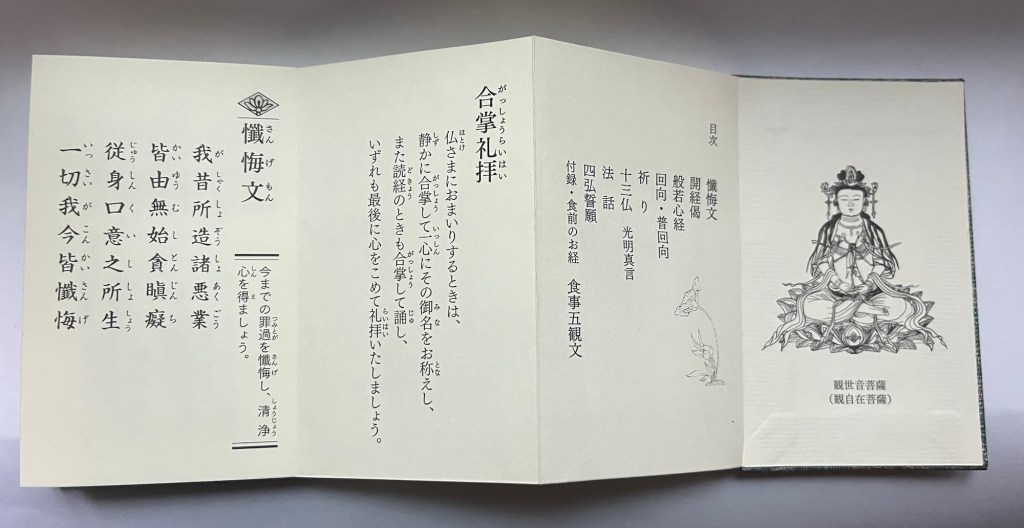
Inside, the contents are surprisingly dense for such a small book. Inside contains the texts necessary to do a home service according to Rinzai tradition, though it differs slightly from the one I posted previously.1

The contents, shown below include basic liturgy such as repentance verses, the opening of the sutra, a copy of the Heart Sutra, dedication of merit, four bodhisattva vows, and so on.

Above, we see the first four pages of the sutra book, from right to left: a picture of Kannon Bodhisattva, then the table of contents, an explanation about how to gassho, and finally the sangemon (verses on repentance).

Below, you can see the Heart Sutra from end to end (read right-to-left, vertically). If you can read Japanese hiragana script, you can recite this because each Chinese character is annotated with a pronunciation guide (a.k.a. furigana):

The furigana script is a bit small and hard to read, but that’s understandable given how small this book is.

Surprisingly, the sutra book contains other things I wasn’t expecting, such as mantras for the Thirteen Buddhas and Bodhisattvas, often recited during yearly memorials for the deceased. The book also the Mantra of Light, surprisingly. It also contains the five verses for contemplating food.

Finally, the book contains a sermon by the author, and has a handy blank section at the end for taking notes.

Weirdly, I’ve owned this book for almost 10 years, but back then I couldn’t read Japanese very well, so I didn’t fully appreciate what the contents of the book were, plus I had no familiarity with Rinzai Zen. Now that I have a bit more experience, I can appreciate this book a lot more, and have been using it for home liturgy lately.

For such a compact book, it’s really very nice, and only costs ¥550.

If you’re able to read basic hiragana script, and have an interest in Rinzai Zen, it’s definitely worth a purchase.

1 As noted in a previous post, Rinzai Zen in particular a number of lineages and factions, each one based around a different temple. This may help explain why the liturgy varies as much as it does.

Zen Verses for Mealtime

As I write this post, I am in Dublin, Ireland on a short trip (business, not pleasure), helping my daughter get settled in for college. Thanks to timezone differences my daughter and I were awake at 11:30pm on a Friday and starving.

Taken near Trinity College and the main Bank of Ireland building (right).

Since a lot of pubs close their kitchens early, we went over to the local Supermac’s1 :

My daughter took this photo of her food. Mine is at the far end of the table (upper right corner).

It’s Friday night, so as we’re seated, people are stumbling in drunk looking for some cheap food, and there’s a steady stream of food delivery guys picking up orders. Still, even here, as I open my bag and eat my food, I try to still take a moment and appreciate the food, so I discreetly did gassho.

In Japanese culture, people will usually say itadakimasu before eating food, and gochisōsama deshita after finishing. The word itadakimasu is just the humble form of the verb “I receive”, and gochisōsama deshita means “It was a wonderful meal”.

But there’s also a set of verses that in the Zen tradition are recited before meals called the Shokuji Gokan (食事五観, “five observations at mealtime”). When I was watching a documentary recently, during mealtime, one of the Eiheiji monks walked the documentary host through the five verses. The five verses in Japanese for the Rinzai tradition are:

  1. 一つには、功の多少を計り、彼の来処を量る。
    hitotsu ni wa, kō no tashō wo hakari, kano raisho wo hakaru
  2. 二つには、己が徳行の全闕を忖って供に応ず。
    futatsu ni wa, onore ga tokugyō no zenketsu wo hakatte, ku ni ōzu
  3. 三つには、心を防ぎ、過貪等を離るるを宗とす。
    mitsu ni wa, shin wo fusegi, togatontō wo hanaruru wo shū to su
  4. 四つには、正に良薬を事とするは形枯を療ぜんが為なり。
    yotsu ni wa, masa ni ryōyaku wo koto to suru wa gyōko wo ryōzen ga tame nari
  5. 五つには、道業を成ぜんが為に、応にこの食を受くべし。
    Itsutsu ni wa, dōgyō wo jōzen ga tame ni, ō ni kono jiki wo uku beshi.

The verses in Soto Zen appear to be slightly different. I am fairly certain, these are descended from Chinese Chan Buddhism, but I wasn’t able to find much information.

There are a lot of fine English translations available, though for now I am using the one from Sotozen.net:

  1. We reflect on the effort that brought us this food and consider how it comes to us.
  2. We reflect on our virtue and practice, and whether we are worthy of this offering.
  3. We regard it as essential to free ourselves of excesses such as greed.
  4. We regard this food as good medicine to sustain our life.
  5. For the sake of enlightenment, we now receive this food.

In either case, the meaning is the same: before we take in the food, we should first reflect where it came from (and the countless people who made it possible),2 and whether we are living up to the practice or not. Finally, the verses remind us that food is essentially medicine (hence don’t be a pig), and that it helps us along the path toward Enlightenment. Even some chips (fries) at Supermac’s is something to be grateful for.

So, hello from Ireland, and will post more soon! 🇮🇪🖖🏼

1 The local version of McDonald’s, but ten times better.

2 The Jodo Shinshu tradition focuses on the concept of “gratitude“, so there’s a lot of overlap here.