SPOCK: [being a Vulcan] means to adopt a philosophy, a way of life, which is logical and beneficial.
Star Trek, “Journey to Babel” (s2ep10), Stardate 3842.3
Recently, while I was doing some soul-searching, I found this very helpful article online by Dr. Jacqueline Stone. The article is an overview of how different Japanese-Buddhist monks of the Kamakura Period (12th-14th century), the same monks who founded important Buddhist sects we see today, addressed the concept of Dharma Decline. The site requires registration, but it’s free and easy. The article is worth a read if you are curious about the topic.
In any case, I found this great quote in Dr Stone’s article:
“The Zen sect regards the precepts as being of first priority,” he [Eisai] wrote. And, “By means of the precepts, meditation and wisdom are brought forth.”
Eisai (栄西, 1141 – 1215) also known as Myōan Eisai (明菴栄西) is the original founder of the Rinzai Zen-sect in Japan (more on its convoluted history here), and isn’t someone I really talk about much, but he was one of the founders of this “new” Kamakura-era Buddhism.
Anyhow, this quote really struck me.
In my limited experience, I rarely heard the importance of precepts from Western Zen sources, or that they are the basis for other Zen practice. That’s not to say it’s not there, but it often seemed to get lost in the message of Zen mysticism.
Bluntly speaking, precepts aren’t sexy like mindfulness, koan riddles, or meditation.
And yet, Eisai is taking a more traditional, conservative standpoint and reiterating that one should not put the cart before the horse. This is not limited to Eisai, by the way: the 19th century Soto-Zen text for lay-followers, the Shushogi, stressed the importance of the precepts, reflection on one’s actions, and practicing kindness, patience and generosity whenever possible.
But if you’re familiar with Zen, this might seem odd. Isn’t Zen all about meditation, being in the moment and so on?
Consider the Marvel movie Ant-Man (2015). In the movie the villain, a bald tech-CEO who bears more than a passing resemblance to a certain CEO and founder,1 brags to a coworker about some deep thoughts he had during “morning meditation”. This is not far from the mark: many ambitious people use meditation and mindfulness as a way to get what they want, not what it’s intended for. If a person can’t regulate their day to day conduct towards others, meditation will not avail them.
Put another way: a rotten person might meditate, but a person who follows the precepts is probably not a rotten person.2
Further, this focus on the precepts fosters mindfulness because one is monitoring their own actions, etc. It has concrete impact on one’s sense of self-worth, one’s relationships with others, and leads to greater peace of mind, even when not meditating. So, there’s a clear benefit, both short-term and also long-term to taking up the precepts first, and then letting other disciplines and practices extend from it.
Finally, upholding the precepts is something any Buddhist can do, regardless of background or circumstances. It is very accessible, beneficial (just like Spock says), and opens many doors to Buddhist practice.
Namu Shakamuni Butsu
P.S. I’ll cover this issue of precepts in more detail later, but TL;DR both Rinzai and Soto Zen both encourage people to take up the Ten Bodhisattva Precepts specifically.
SPOCK: There’s no further need to observe me, Doctor. As you can see, I’ve returned to the present in every sense.
Star Trek, “All Our Yesteryears” (s3ep23), Stardate 5943.7
I spent this past week volunteering as a chaperone for my son’s school camping trip, which was chaotic and busy, but also bought me some much-needed quiet time to read and reflect on some things. Exhausting, but nice.
Lately, while reviewing some old Buddhist material, I realized that I had conflicting thoughts about my own Buddhist path. I have spent much of my past 20 years as a Buddhist following the Pure Land path, especially Jodo-Shu/Jodo-Shinshu sect Buddhism, and this is reflected in many posts here, including recent posts like this one. This has been really formative to my understanding of Buddhist religion and teachings.
And yet, the reason why I left my old community nearly 10 years ago was that I felt there was more to Buddhism than just passively allowing the power of Amida Buddha to lead me (i.e. tariki 他力 in Japanese-Buddhist parlance). I wanted to pursue other facets, more active practices, and so on. This is reflected in my exploration of Buddhism in general, including recent posts like this one. But even then, I never could quite pin down what I should do for Buddhist practice, or what to prioritize. I had a general sense of things, but struggled to articulate what I think I should do.
So, for some time now, I have been plagued with self-doubt, and feeling conflicted about how best to be a “good Buddhist”. I was worried that I had lost my way. I read a few sources from different Buddhist traditions in my spare time, but it only made me feel more confused.
So, I decided to get back to basics. Using my spare time at camp, I started writing down what I genuinely believed in, and not what a particular tradition dictated to me. I didn’t have a lot of time, so I would just jot down notes on my phone, a sentence here or there. Over a few days, I had a list of items, and they had certain recurring themes. I was relieved to see that I came to the sameconclusionsasbefore, but now with a greater sense of conviction. What a relief.
I felt a bit like Captain Kirk in the season one Star Trek episode “This Side of Paradise” (s1ep24), after he has been affected by the mind-control spores. He is just about to leave the ship for good, but at the last minute, he comes to his senses and realizes that what he really valued was the ship, and his role as captain. It was as if he came out of a fever dream. This is how it felt for me.
But also with this new sense of conviction, I will probably be changing tack a little bit on the blog. Nothing dramatic, but I feel that it’s time to close the book on certain topics, and focus on other things that I want to explore more. Time will tell, but that’s what I want to do for some upcoming blog posts.
Thanks for reading!
Namu Shakamuni Butsu
P.S. Photos from camp.
P.P.S. Bonus episode this week. I felt like posting sooner than later. Enjoy!
I wrote about visiting a couple major Zen temples in Kyoto last summer: Tenryuji and Kenninji, but I realized that I totally forgot to post photos from Kenninji Temple. Of the two, we liked Kenninji more, and I am excited to share some of the history and art of this temple.
Both temples belonged to the Five Mountains temple network of the Muromachi Period of Japanese history, so they were very elite temples of the Rinzai Zen sect. However, Kenninji, like many famous Buddhist temples, has burned down a number of time over the centuries, including the disastrous Onin War, and reconstructed again. Many of the structures today are relatively new, or were granted from nearby temples to help consolidate.
While Tenryuji is on the western outskirts of Kyoto, near the iconic Arashiyama district, Kenninji is in eastern Higashiyama district of Kyoto. The official website of Kenninji is here, but I don’t think there is an English version. There is a nice overhead visual tour of the temple from the official tourism channel here (close captioning does work):
Another aerial tour here:
In terms of size, Kennin-ji feels smaller than Tenryuji which had a large park around it. Kennin-ji is firmly inside a busy neighborhood in Kyoto, and thus tends to feel a bit more cramped at first. There is a soba shop next to Kenninji I highly recommend by the way, to the right of the abbot’s quarters near the back exit.
If you go through the main entrance, you’ll see this gate, which is normally closed, so you are supposed to walk around it toward the main building.
The same gate, but as seen from its left as you walk around…
The pathway takes you to a scenic building called the Hojo Teien (方丈庭園, “10-foot garden”?) which is apparently the former Abbot’s quarters,1 but now includes many scenic sites. The website includes a nice gallery of the different rooms, including some I forgot to photograph here.
Within the abbot’s quarters are a series of rooms where you can find galleries of famous works stored at Kennin-ji. One of the most famous of all are the Raijin and Fujin screens shown below (gold screens on the left) painted by the famous Tawaraya Sōtatsu (c. 1570 – c. 1640):
As well as various ink paintings called shōheki-ga (障壁画):
I know I’ve seen these paintings before in college, when I was taking a course on Japanese art, but unfortunately, I don’t have any information about them now. From what I can figure out, this painting was called the Chikurin-shichiken-zu (竹林七賢図), or the “Seven Sages of the Bamboo Forest“. It was painted by Kaiho Yusho (海北友松, 1533–1615) in his 60’s. The painting depicts seven sages famous of the Western Jin Dynasty of China, who retreated to a bamboo forest and engaged in a mixture of refined conversation, heavy drinking, and lively music. These bohemian Seven Sages are apparently subjects of other works of art at the time.
Also, as I was writing this, I also realized that the calligraphy in the back (second image) is a another work of art: it’s a highly stylized calligraphy of the words 風神 (fūjin, the wind god), and 雷神 (raijin, the thunder god) by Kanazawa Shoko (金澤翔子, 1985 – present) an artist with Down’s Syndrome. Pretty amazing.
Facing out from the abbot’s quarters, you can see a nice sand garden called the Dai-on-en (大雄苑):
The abbot’s quarters also surrounds another sculpted garden called the Cho-on-tei (潮音庭):
We also saw lotus paintings like these:
Finally, the quarters connects to an altar room which contains a gorgeous ceiling mural of two dragons overlooking an altar:
The mural was painted in 2002 to commemorate the 800th anniversary of the temple, by one Koizumi Junsaku (1924–2012), and the altar itself (shown at the bottom) depicts Shakyamuni Buddha, the historical founder of Buddhism, flanked by his disciples.
We picked up a lot of goods at Kenninji: my son liked the twin dragons, and got a pilgrimage book with that image on the cover, and my wife got an incense holder with the image of Raijin and Fujin (based on the gold screen above). I picked up a miniature copy of the Kannon Sutra which I think was meant as an omamori charm.2
As temples go, Kenninji was something we knew nothing about, but it was quite a treat to visit. Foreigners who visit famous temples in Japan often remark that Buddhism feels like a museum piece, and while it is true that the Five Mountains temple system in Japan (including Kenninji and Tenryuji) is somewhat defunct now, it was clear that people really still cared about these temples, but it’s not always in ways obvious to Westerners.2 That said, Kenninji looks like a well-loved temple, and a credit to the Rinzai Zen tradition and it’s flowering culture of the era.
1 Apparently, 方丈庭園 was a common, poetic term used for major temples that had a scenic abbot’s quarters like the one showed above. Chion-in was another such example.
2 Language barrier is a big part of this, plus various unrealistic expectations that Western Buddhists have of what they expect temples to be like in Asia, compared to how people who grew up Buddhist practice. But that’s a story for another rant…
Recently, I wrote a brief introduction to the Buddhist canon, the sutras. Sutras come in many shapes and forms, but I want to focus on one of the most famous, and most popular to recite: The Heart Sutra.
A sutra book from Japan showing the Heart Sutra, preserved in old Chinese, but with Japanese pronunciation guides.
The full name of this sutra is the Heart of the Perfection of Wisdom Sutra (般若波羅蜜多心經), and was one in a series of “perfection of wisdom sutras” that were published starting around 2nd century BCE. Starting with the “Perfection of Wisdom in 8,000 Verses Sutra“, the authors made longer and longer versions, culminating to a 25,000 verse version of hte same sutra. Then, they started making shorter versions, getting down to the Diamond Sutra, and finally the Heart Sutra.
Or, so the theory goes.
The Heart Sutra is believed to distill the essence or “heart” of the Perfection of Wisdom teachings to its smallest, most essential version. More on that soon. This version is very short, can be read in 1-2 minutes, and is pretty cryptic. Because it is so short, it is easy to learn and memorize, and thus easy to recite. Its utility for everyday Buddhists is among the reasons it has such lasting popularity. I have a copy of a translation of the 8,000 verse sutra,1 and while it is interesting, it is a tome. It is not practical for most Buddhists to read such a tome, so you can imagine why the Heart Sutra was composed, and why it is so much more popular.
But that gets to an interesting question: who composed it? This is a surprisingly difficult question to answer.
The traditional assumption was that it was composed in India, using Sanskrit language, and then brought to China like most other Buddhist sutras. And yet, a scholar named Dr. Jan Nattier proposed an interesting theory that the Heart Sutra in particular was composed in China, not India, and that it was translated back to Sanskrit, not from it, by our favorite wandering monk Xuan-zang when he visited India. There is considerable debate about this, and valid arguments for one or the other, but it’s an interesting idea that some plucky Chinese monk found a clever way to distill the Perfection of Wisdom teachings into a more bite-sized form.
That said, one of the interesting features of the Heart Sutra is that it does contain a genuine Sanskrit mantra at the end (a trend that continues with later Buddhist texts) in the Siddham script:
𑖐𑖝𑖸 𑖐𑖝𑖸 𑖢𑖯𑖨𑖐𑖝𑖸 𑖢𑖯𑖨𑖭𑖽𑖐𑖝𑖸 𑖤𑖺𑖠𑖰𑖭𑖿𑖪𑖯𑖮𑖯 ga te ga te pā ra ga te pā ra saṃ ga te bo dhi svā hā
For various reasons, this mantra was written in Chinese characters that approximated the pronunciation of the Sanskrit:
As I eluded to earlier, the Heart Sutra is the most condensed version of the Perfection of Wisdom teachings, or prajñā-pāramitā in Sanskrit. This was a teaching that provided an important foundation for Mahayana Buddhism (everything from Tibet to Japan). “Perfection of Wisdom” is hard to explain. But, roughly speaking you can think of it as the fundamental understanding of existence, which is sitting right in front of your face, but not obvious until you see it. Like the first time you noticed a small crack in the wall. Once you see it, you don’t “unsee” it.
But instead, the Perfection of Wisdom is about undoing the filters in one’s own mind, so you can see the world unvarnished. That’s easy to say, but extremely tricky to sincerely accomplish. Hence the extraordinary accomplishments of the Buddhas and Bodhisattvas.
The Heart Sutra talks a lot about “not this”, and “not that”, and like other similar sutras (e.g. the Diamond Sutra, another of the series), this is to try and undo the filters of one’s own mind. But, on its surface, the Heart Sutra is cryptic and vague. Yet, because it is so pithy, and so over time bits of it start to sink in, or something that didn’t make sense in the past finally clicks.
So, if you do pick up a copy of the Heart Sutra, don’t worry if it doesn’t really make sense. Recite it from time to time,2 study it with help sutras guides (there are many) and make it a part of your Buddhist life, regardless of what tradition you follow.
For a such tiny, little composition, it’s a pretty neat contribution to Buddhism.
1 Purchased years ago at Powell’s City of Books in Portland, OR. One of the best bookstores, and well worth a visit if you go there.
2 Some people recite in their native language, others recite in one or more “liturgical” languages. It doesn’t really matter. Pick something you can stick with. You can change it later.
I saw this post recently on BlueSky, the hip new social media platform all the kids are talking about,1 and I had to share it with readers 🤣:
Speed-running is a fascinating sub-culture of gamers who finish games in impossibly short times through a combination of intense practice, manipulating errors in game code, and pre-planned strategy. My son and I like to watch speed-run world-records on YouTube for games I used to play as a kid. For example, this is a speed-run video where someone beats the classic NES game Mike Tyson’s Punch-Out in 22 minutes!
And this video shows someone attaining the world record for finishing the original Super Mario Brothers in 4:57. You can see multiple sneaky glitches and exploits here, plus lots of careful jump timing:
Finally, in this video, someone cleverly exploits an obscure glitch in Super Mario 3 to beat the game in 3:32!!!
But what does this have to do with Buddhism?
Buddhism is a 2,500-year old religion, adopted by many cultures and many times. The Buddha Shakyamuni (i.e. our historical founder), laid out the basic premise and trained his disciples on how to liberate themselves from the endless cycle of Samsara, and especially in the Mahayana-Buddhist tradition, to liberate others. We can see in early texts that this was a regimen of meditation training, self-restraint and living a humble, monastic lifestyle, as well as observation into one’s own mind. In video game terms, you can think of this as “grinding” level after level, building your skills, taking countless hours of gameplay.
The Buddhist path is a slow process, and requires a lifetime of dedication. Periodic visits to your favorite “meditation center” are fine, but Buddhism traditionally sees the path to awakening as a multi-lifetime endeavor for all but the truly talented (who may have already cultivated these qualities in previous lifetimes).
The actual length of time it normally took to accomplish awakening in Buddhism was hotly debated across Buddhist history. Early Buddhist texts implied that monks who were well-trained, or even lay-people who assiduously followed the basic code of conduct, could expect to reach awakening in one more lifetime, or may be a few lifetimes. But in Mahayana Buddhism, the length of time got longer and longer times as the bar of difficulty got higher and higher, well beyond what one could reasonably accomplish. A text called the Sutra of the Ten Stages in the Flower Garland Sutra describes the “Ten Stages of a Bodhisattva” over dozens of pages, and what’s required to complete each one before even getting to awakening. But each stage is a huge, huge endeavor by itself. Lifetimes of effort were not measured in eons of lifetimes.
As the road to awakening became longer and more remote, many Buddhist methods were developed to compensate for this and help people achieve the fruition of the Buddhist path much sooner, often through devotion to on Buddhist deity or another, or through specific samadhi methods, meditations and so on. The Pure Land path is by far the most popular and well-known due to its accessibility.
But in particular the Esoteric or Vajrayana traditions developed in the first centuries CE, hundreds of years after the Buddha. Historically speaking, the trend toward a longer and longer Buddhist path reversed and using this or that series of rituals, mantra chants, and mandala visual aids, one could “hack” the code of Buddhism and accomplish awakening in this very lifetime. Of course, the secrets behind such Buddhist speed-running techniques require a guru and a lineage.2 Vajrayana Buddhism is most prevalent in Tibet, but also in Japan through both Shingon and Tendai Buddhism.
But this does beg the question: is it really possible to speed-run the Buddhist path? Further, is the Buddhist path really eons and eons long as Mahayana Buddhism tends to assert, or is the length of time over-inflated?
Frankly, I don’t know.
Esoteric teachings and practices were definitely not part of the early Buddhist tradition (I definitely do not buy the idea of “secrets transmissions”, either). The Buddha’s advice in the early texts is generally pretty straightforward, one might say a little bland and anti-climactic, but also challenging because it gets to the root of who we are. It is definitely a lifetime effort.
But as much as I love the Mahayana tradition, it did have a tendency to out-do itself over and over. Waves and waves of Mahayana texts get increasingly dramatic, increasingly grandiose, and describe the Buddha path (namely through the Bodhisattva path) increasingly challenging terms. A backlash was inevitable, and so I can’t say I’m surprised that anti-intellectual movements such as Zen and Pure Land Buddhism, or “speed-run” methods such as Vajrayana arose in response.
Then there’s inevitable backlash from modern Buddhists who look at this convoluted history and complain, “none of this is real Buddhism anymore, it just cultural accretions”.
Every religion changes and evolves. Christianity as we know it didn’t have Christmas trees, and used Jewish-style liturgy in its early years. It adapted as it moved into new cultures. Islam grew into two different traditions, and as it became more urbanized some of the desert-nomadic traditions of the early community had to be adapted. Even obscure religions such as Zoroastrianism, whose early texts were composed amidst a steppe-nomadic culture, evolved to a more urbane and worldly culture until the Persian Empire.3
Zealous people love to go on a quest to find the “pristine” religious teachings, but you’ll never really find it. At best, you’re just reconstructing from pieces of the ancient past. At worst, you and your community just goes off the rails. It’s a fruitless quest.
So what to make of all this history and breadth of practice in Buddhism? Again, I just don’t know.
I do think that the old Kalama Sutta of the Pali Canon (AN 3.65) does provide some help though (slightly edited for readbility):
“It is proper for you, Kalamas, to doubt, to be uncertain; uncertainty has arisen in you about what is doubtful. Come, Kalamas. Do not go upon what has been acquired by repeated hearing; nor upon tradition; nor upon rumor; nor upon what is in a scripture; nor upon surmise; nor upon an axiom; nor upon specious reasoning; nor upon a bias toward a notion that has been pondered over; nor upon another’s seeming ability; nor upon the consideration, ‘The monk is our teacher.’
Kalamas, when you yourselves know: ‘These things are bad; these things are blamable; these things are censured by the wise; undertaken and observed, these things lead to harm and ill,’ abandon them.
Translation by Soma Thera
Followed by:4
…Kalamas, when you yourselves know: “These things are good; these things are not blamable; these things are praised by the wise; undertaken and observed, these things lead to benefit and happiness,” enter on and abide in them.’
Translation by Soma Thera
or the Buddha preaching to his stepmom in the Gotami Sutta of the Pali Canon (AN 8.53) :
“Gotamī, the qualities of which you may know, ‘These qualities lead to passion, not to dispassion; to being fettered, not to being unfettered; to accumulating, not to shedding; to self-aggrandizement, not to modesty; to discontent, not to contentment; to entanglement, not to reclusiveness; to laziness, not to aroused persistence; to being burdensome, not to being unburdensome’: You may categorically hold, ‘This is not the Dhamma, this is not the Vinaya, this is not the Teacher’s instruction.’
Translation by Thanissaro Bhikkhu
To summarize, if your Buddhist is leading to negative qualities described here, you should probably stop. If it is leading to wholesome qualities described here, keep going.
Namo Shakyamuni Buddha
Edit: I forgot to mention that the ultimate speed-runner in Buddhism is the Dragon Princess from the 12th chapter of the Lotus Sutra:
At that time the members of the assembly all saw the dragon girl in the space of an instant change into a man and carry out all the practices of a bodhisattva, immediately proceeding to the Spotless World of the south, taking a seat on a jeweled lotus, and attaining impartial and correct enlightenment. With the thirty-two features and the eighty characteristics, he expounded the wonderful Law for all living beings everywhere in the ten directions.
Translation by Burton Watson
1 I have a couple BlueSky feeds on there, but nothing related to the blog.
2 The Zen tradition is often compared to the Esoteric tradition since it also has ineffable teachings that can only be conveyed by a proper teacher.
3 I only know this because of the History of Persia podcast, by the way.
4 Because early Buddhist texts (sutras) were memorized and recited, they tended to be very repetitious. Later sutras, those in the Mahayana-Buddhist canon, used a more narrative style and thus longer and less repetitive, but also much more epic in tone.
During the past few weeks, I took up reading a 12th-century Japaense text, the Hojoki (discussed here) using Dr. Meredith McKinney’s excellent translation. It’s not a big text; you can probably read it in an hour or less. There’s a lot of stuff to unpack in this paragraph near the end.
I do not make claims for these [simple] pleasures to disparage the rich. I am simply comparing my past life with my present one. The Triple World is solely Mind. Without a peaceful mind, elephants, horses and the seven treasures are worthless things, palaces and fine towers mean nothing.
Kamo no Chomei, the author, used to be part of the aristocracy in the Capital, but was on the losing end of a family struggle for a prestigious position. Eventually he was pushed out and sidelined by his cousin, and later retreated as a hermit. So, Kamo no Chomei had a taste of the good life, but was obviously unhappy with the outcome. Compare this with the melancholy tone of Lady Murasaki’s diary a century earlier, or the Gossamer Years a generation earlier than that, and you can see that in spite of all the glamour, romance and beauty, there were plenty of people living among aristocracy who were all miserable in some way or another.
Kamo no Chomei gets to the heart of this: wealth and luxury might make day-to-day aspects of life easier, but that doesn’t equate to happiness or peace of mind.1
The phrase “The Triple World is solely Mind” requires some explanation. The term “Triple World” is an old Buddhist phrase to describe existence as a whole. The details are not important here.2 In modern American English, I suppose we could just call it the “Whole Enchilada”, existence as a whole. So, Kamo no Chomei is saying that the Whole Enchilada is just Mind with a capitol “M”. I explored this in an earlier post, but basically we perceive the world around us through the filter of our own mind. I am working on a lengthier post to explain this, but it’s a very Tendai-Buddhist concept (and Zen too) and too long to go into here, and I am still researching.
In any case, Kamo no Chomei even starts to question his attachments to his own humble lifestyle, seeing that he is getting complacent in that too:
The Buddha’s essential teaching is to relinquish all attachment. This fondness for my hut I now see must be error, and my attachment to a life of seclusion and peace is an impediment to rebirth. How could I waste my days like this, describing useless pleasures?
In the quiet dawn I ponder this, and question my own heart: you fled the world to live among forest and mountain in order to discipline the mind and practise the Buddhist Way. But though you have all the trappings of a holy man, your heart is corrupt. Your dwelling may aspire to be the hut of the holy Vimilakirti himself, but the practice you maintain in it cannot match even that of the fool Suddhipanthaka. Have you after all let the poverty ordained by past sins distract you? Or have your delusions tipped you over into madness?
Finally, exasperated, he writes at the end:
When I confront my heart thus, it cannot reply. At most, this mortal tongue can only end in three faltering invocations of the holy, unapproachable name of Amida.
It’s interesting to me that he starts with some pretty difficult, intellectual statement (the Triple World is Mind), moves into a lengthy discussion of self-doubt, and then finally ends with reciting the nembutsu.
I often feel this way too. As a nerd, I like going down “rabbit holes” sometimes, but in the end I get flustered and realize that I understand a lot less than I prefer. Maybe this is just self-doubt, but it makes one disheartened. So, sometimes, instead of re-hashing intellectual debates that are a thousand-years old (or more), better to just recite the dang nembutsu.
Namu Amida Butsu
1 Even if money can’t buy happiness, a healthy society needs robust social welfare to ensure basic human dignity and well-being. Sorry dudebros.
2 If you really want to know, the three worlds are the world of desire (the mundane world we live in), the world of form (similar to Plato’s world of form in the Allegory of the Cave), and the world of formlessness (i.e. pure though). But usually, this isn’t relevant and people just say “Triple World” as a stock phrase to mean “all of existence”.
Star Trek “For the World is Hollow and I have Touchedthe Sky” (s3ep8), Stardate 5476.4.
I started blogging way back in 2005 after visiting Japan for the first time, and discovering the Jodo Shu Buddhist path shortly thereafter from a now-defunct English-language site. Back then, I blogged on Blogger for a year or two, but soon moved to WordPress and have been here for almost 15 years. I have started, and then removed blogs a few times (Level 8 Buddhist, Japan: Life and Religion, etc), but I always come back and start again.
I am not sure why I have such a strong impulse to blog on such nerdy topic over and over again. In the beginning, it was my way of trying to reconcile my religious-cultural experiences in Japan, with the kind of stuff I learned about in Western textbooks. The two seemed pretty different, but over the years I learned a lot about Japanese religion and culture, and every time I learned something new, I’d put it on the blog so others could find it. I have often updated certain articles on Wikipedia as well.
Later, when I was part of a local Japanese-American temple (Jodo Shinshu sect), I learned even more from the experience. The Buddhism is often presented to Westerners is somewhat skewed by a combination of outmoded translations, native “Protestant” bias, and just lack of information. I had to relearn a lot of assumptions over the years myself, and I really miss that time with the temple community, even if I decided to follow a slightlydifferent path.
Over the years through blogging I have been lucky to meet disparate people in places like Europe, Africa and Asia who wanted to learn more, and were themselves struggling with finding the right information. Some of these areas do not have large Buddhist communities. But what matters is that anyone from any walk of life can find information they want, and put it into practice in a way that suits their life. A single mom in rural Arkansas, or a student in Sweden, or an elderly Asian-American all have the right to learn the Dharma, and shouldn’t be limited by time, place, background or cost.
I prefer this open approach. Instead of relying on gurus, special transmissions, seminars, meditation centers, retreats and so on, I want to present Buddhist teachings as-is from sources and sites I come across. I do not make money from this, and I don’t want people’s money (my current employment is enough). Instead, what I learn for myself, I also share with others. Truth must be truth for all with no strings attached.
The way I figure it: people can make their own informed decisions about how to put the Dharma into practice in their lives. They just need sufficient information to make informed choices.
During a recent trip to Japan, we visited the city of Kyoto. Since antiquity, it was a trendy of the nobility to build villas in the hilly suburbs of Kyoto (presumably cooler there in the summer), which in turn became Buddhist temples generations later. Some of these temples grew to be very powerful during Muromachi Period of Japanese history, namely the Zen temples of the Five Mountains System.
We were lucky enough to visit two of the five temples of the Five Mountains System: Tenryuji and Kenninji. Tenryuji is located in the western area of Kyoto, in Arashiyama district. By contrast, Kenninji is in east Kyoto at Higashiyama. Both of these were apex temples in the Five Mountains System, centers of Rinzai-sect Zen, and greatly benefited from patronage by the Ashikaga shogun rulers, before they lost prestige again and essentially became museum pieces.
Both temples are quite large, and very tourist-friendly, but they each have their own character, so I am making a separate post for each temple.1
Tenryuji Temple
Tenryuji Temple, official website here, is a temple that has seen a lot historically. It was number two or three in the Five Mountains hierarchy, and was thus a very prestigious temple. It contains many terrific works of art, and a gorgeous pond created by Muso Soseki back in the day. Because it is right next to the famous bamboo forests of Arashiyama in western Kyoto, we were able to view both on the same hike, as well as the iconic Togetsu-kyo Bridge:
I should add that the temperature was 37C (98F) in Kyoto and extremely humid that day. The walk through bamboo forests was incredibly enchanting, but also grueling due to heat.
It’s not clear from the photos, but because of the shade and the high humidity, there was a constant mist between the trees, and an oppressive air. It was really cool, and would make a great setting for any Asian-style D&D campaign (not unlike the ones that I made previously … 😏).
Once you emerge from the bamboo forest, you enter the back-entrance of Tenryuji Temple. The front entrance that’s very close to the Saga-Arashiyama train station as well, so you can also visit from that direction too. The signs are very obvious.
The main buildings were clustered together in the middle of the property, with a really nice garden walk surrounding it, including many lovely or rare plants. If I were a botanist, I’d probably have a field-day here. The signs are all multi-lingual too, which is really handy.
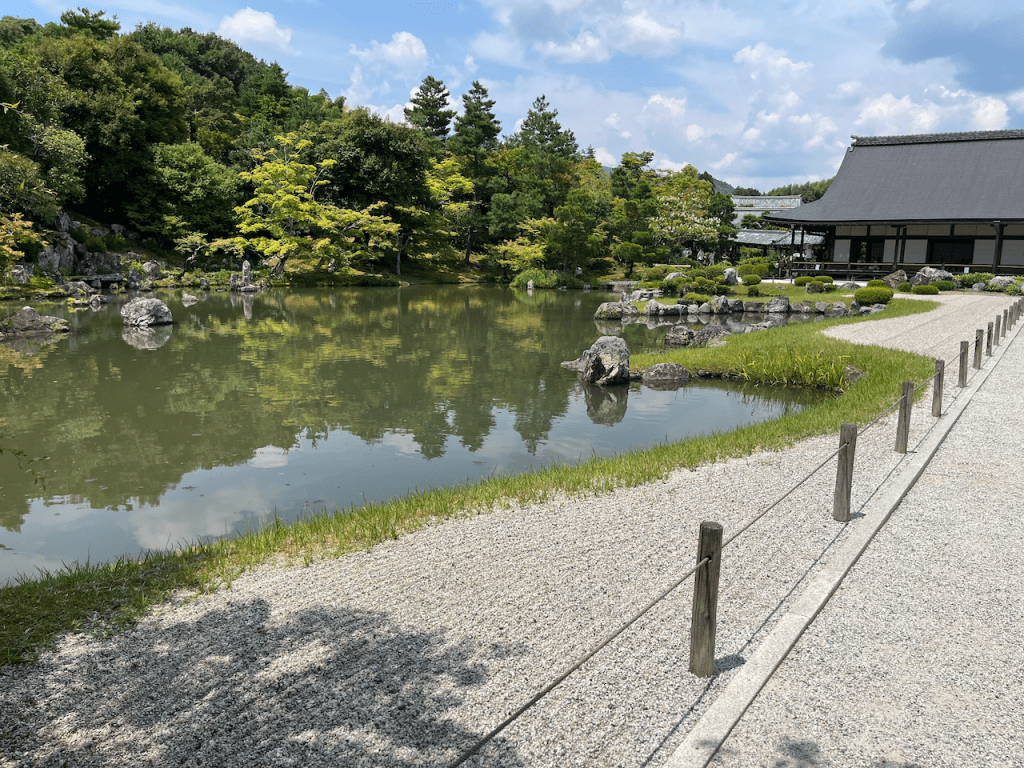
If you continue around the walk, you will come to the Sogenchi (曹源池) Pond, which according to the sign is modeled on Chinese architecture at the time (and a common feature of Japanese aesthetics during the Muromachi Period):
Similarly, you find a lovely sand garden (karesansui in Japanese, 枯山水 ) nearby too:
I wanted to take more photos of the interior of Tenryuji, but there were just too many tired, overheated tourists, and Instagram influencers. I chuckled as I saw a couple young ladies who were way over-dressed in fine, Chinese-style silk dresses and taking turns posing and photographing each other. The heat and humidity were so intense, I can’t imagine why they would do this to themselves. But I digress.
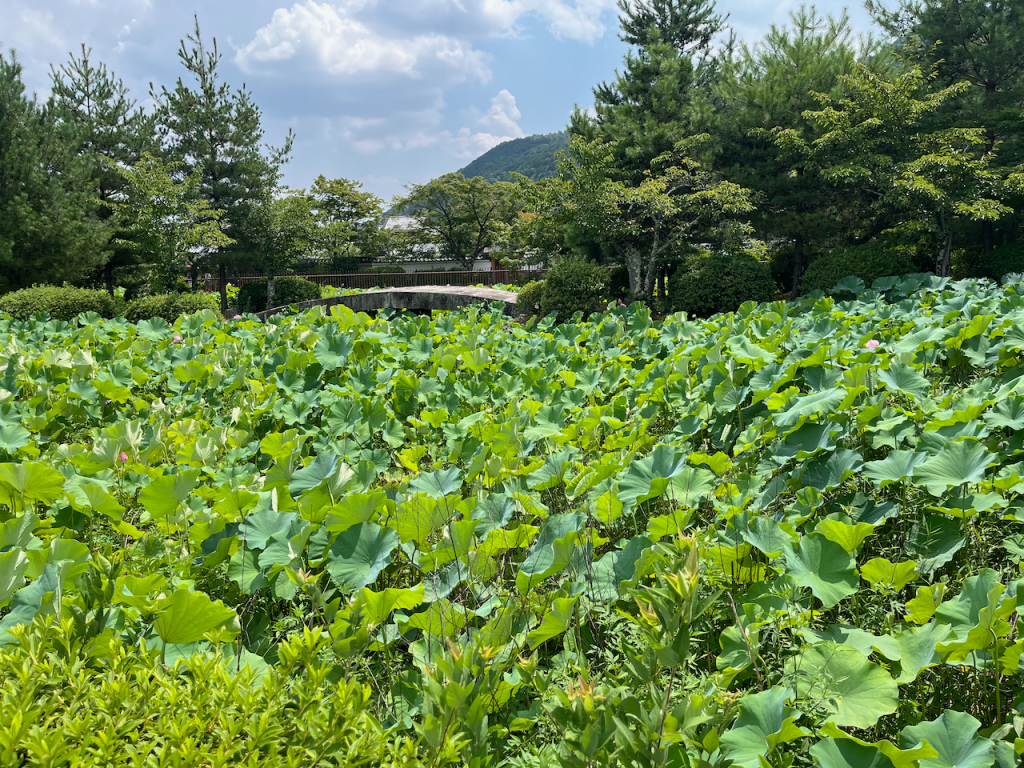
Finally, as exited Tenryuji toward the train station side we saw a very nice lotus pond:
Tenryuji Temple is, for historical reasons, a shadow of its former self, but even what remains is very scenic and embodies much of the beauty and prestige of Arashiyama. I didn’t enjoy it on the same level as another Zen temple, Ryoanji, but it is lovely. For poetry fans, the Arashiyama district is also the site where the Hyakunin Isshu anthology was compiled, which I covered on my other blog.
That said, Arashiyama is quite touristy and crowded. It’s pretty foreign friendly, and if you’re just passing through Kyoto for the first time, it’s a great place to stop. But, for me, if you have the time and want to really get to know Kyoto life and culture, there are other places I prefer.
Next time, we’ll talk about Kenninji, which was smaller than Tenryuji, but had some pretty mind-blowing artwork.
P.S. 欢迎中国游客,感谢您的阅读。
1 I tried to put both in a single post, but it quickly got too large. I am a victim of my own hubris…
During our most recent trip to Japan, I picked up some nice incense from Zojoji Temple, and my wife separately picked up some from Sanjusangendō Temple in Kyoto.1 We also bought some incense last year at the Golden Pavilion and Ryoanji. It’s a thing in our house. We actually use incense a fair amount: I use it for Buddhist home services, my wife uses it to honor her deceased mother. Sometimes we also just light it for guests who come over.
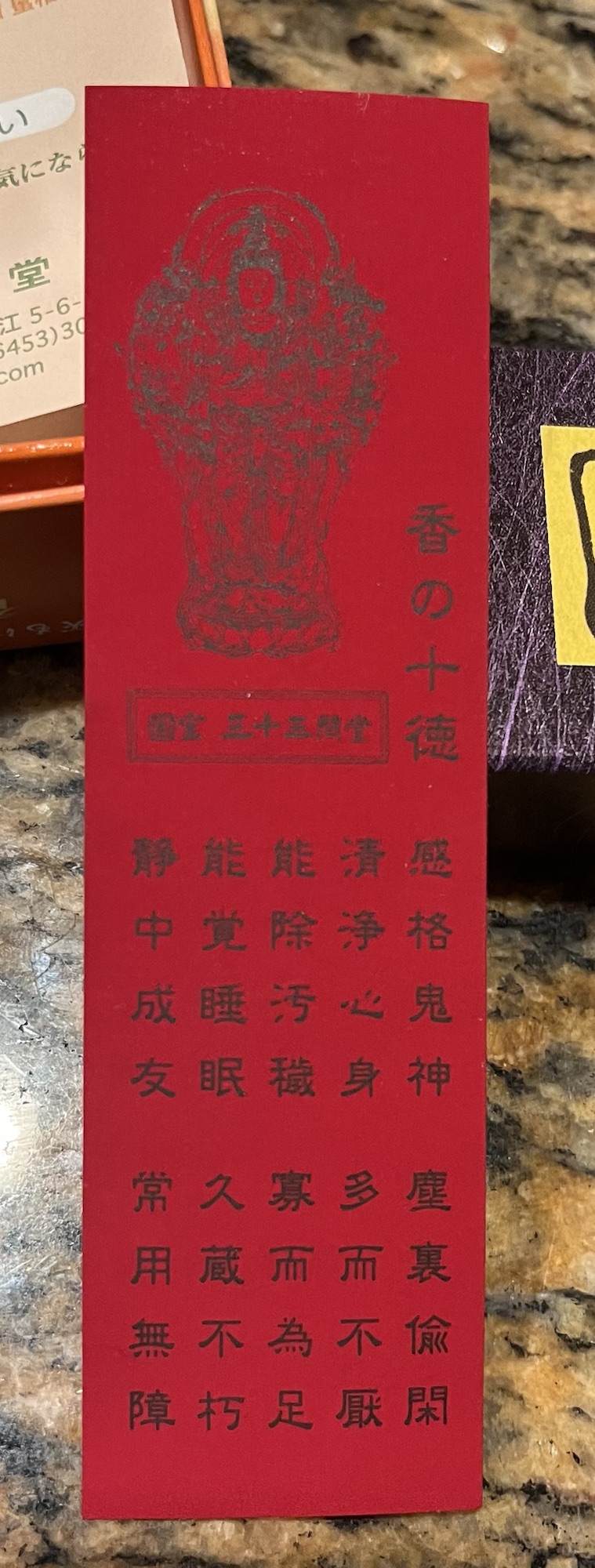
When we opened the incense box from Sanjusangendō, we were surprised to see this little red slip of paper. This is not bad photography: the paper is hard to read. At the top is a Buddhist image,2 but below that is something written on the slip of paper called the Ten Virtues of Incense, or kō no jittoku (香の十得). The Ten Virtues is a form of Chinese-style poetic verse, or kanshi (漢詩) originally composed by the 15th century eccentric Rinzai-Zen monk Ikkyu.
The Ten Virtues are ten aspects of incense that Ikkyu felt was beneficial for whomever uses it. Nippon Kodo has a really nice English-language page about it, including a translation. Feel free to stop and take a look. I’ll wait.
To summarize the benefits here (refer to other sources for proper translations), the ten virtues are:
Spiritual awakening
Purification of body and mind
Removes impurity
Brings alertness
Brings comfort in solitude
Brings moment of peace
One doesn’t get tired of it
Even a little is enough
Stays fresh even in age.3
You can use it every day.
Of course, it’s also important to use incense in a well-ventilated room. The smoke, while very pleasant, is probably not good for your lungs. I always open windows and doors before using it. Also, good quality incense tends to be less smoky. You can even find “reduce smoke” incense sometimes, which is probably healthier, though I would still keep good airflow just in case.
In any case, incense is pretty neat, and if you ever visit a Buddhist temple in Japan, you’re almost sure to find some really good quality stuff. But even if you can’t afford to travel, it’s not hard to find stuff online or in your area too.
Good luck and happy …….. inhaling?
1 We have visited this place a number of times over the years, including our “honeymoon” trip to meet the extended family in Japan way back when. And yet, I haven’t talked about it much. I actually really like this temple, but because they don’t allow much photography it’s hard to make a blog post about it. I might try one of these days, just haven’t figured out how to describe Sanjusangen-do without photos I can use.
2 The Buddhist image is the bodhisattva Kannon, in the form of 1000 arms, also known as senju kannon (千手観音). Since the temple venerates Kannon, this makes sense.
3 Speaking of our honeymoon trip way long ago, we went to a spa-resort place in Japan, and got these nice little incense envelopes. I put my envelope between two pages of a book at the time, shelved it, and forgot about it for years. I opened years later, and the oils of the incense had seeped through and stained the page, but it also left a really nice scent that still lasts. Even now 20 years later, the book still has a nice fragrance.
Not too long ago, I found an old book I had forgotten I had: a translation of the Awakening of Faith in the Mahayana. For simplicity, we’ll call it the “Awakening of Faith” in this blog post. The Awakening of Faith is a Buddhist treatise, a śastra,1 written probably in the 6th century, but attributed to a Buddhist master in India, Aśvaghoṣa from the 2nd century. It is thought to have been composed in China, but likely drew from Indian sources, or was composed by an Indian-Buddhist monk living in China. Since it is mainly found in China, it is called Dàshéng Qǐxìn Lùn (大乘起信論).
Wikipedia points out that researchers now think a more appropriate title would be Awakening of Mahayana Faith in the Suchness of the mind. The 信 here might also be interpreted as “trust” or “entrusting”, so maybe Awakening of Mahayana-style Entrusting [in the Suchness of the Mind]? That reads a bit awkward though, so readers will have to decide how to phrase it.
If readers are curious what Mahayana Buddhism is, please feel free to read here.
This might sound like I am splitting hairs, but it is kind of important to emphasize that English terms like “faith” aren’t a good analogue for what the book is about. This is not a book of Christian-style faith. Instead, the author of the treatise addresses why they wrote The Awakening of Faith, when the same teachings are found throughout existing Mahayana sutras:
Though this teaching is presented in the sutras, the capacity and deeds of men today are no longer the same, nor are the conditions of their acceptance and comprehension….
Translation by Yoshito S. Hakeda
The author lists eight reason such as helping all attain peace of mind, liberating from suffering, and correcting heretical views (my words, not the book). In other words, the author wanted to both assert an orthodox Mahayana viewpoint of Buddhism, but also to clarify any misunderstandings and inspire others to take up the path. It is in a sense, a textbook introduction of Mahayana Buddhism.
Mahayana Buddhism is actually a pretty broad tradition, with lots of sub-schools, diverging viewpoints and so on. So, it’s hard to explain the entire tradition in a single book. Still, the treatise does a good job of touching on some essentials that many Mahayana Buddhist traditions today are founded upon. Traditions such as Zen, Pure Land, Nichiren, Tendai, and Vajrayana (among others) all have certain common teachings that pervade them all. The Awakening of Faith helps to enumerate what these are, in a fairly short, readable format, which for a 6th century text is pretty impressive.
To give an example, here is a quote on Suchness : a fancy term for reality, totality of existence, the Whole Enchilada, the Whole Shebang, etc, etc.:
[The essence of Suchness] knows no increase or decrease in ordinary men, the Hinayanists [earlier Buddhist schools], the Bodhisattvas, or the Buddhas. It was not brought into existence in the beginning, nor will it cease to be at the end of time; it is eternal through and through.
Page 65, translation by Yoshito S. Hakeda
If this sounds strangely familiar to readers, you might find something very similar in the Heart Sutra:
“Hear, Shariputra, all dharmas [all things, stuff] are marked with emptiness; they are neither produced nor destroyed, neither defiled nor immaculate, neither increasing nor decreasing….”
Translation by Ven. Thich Nhat Hanh in “Heart of Understanding”
You can definitely see some common themes between The Awakening of Faith and early Mahayana-Buddhist sutras such as the Heart Sutra. Further, The Awakening of Faith explores the notion of Bodhisattvas quite a bit:
The Buddha-Tathāgatas [e.g. the many buddhas], while in the stages of Bodhisattva-hood [i.e. on the cusp of becoming fully enlightened buddhas], exercised great compassion, practiced pāramitās [perfecting certain virtues], and accepted and transformed sentient beings. They took great vows, desiring to liberate all sentient beings through countless aeons until the end of future time, for they regarded all sentient beings as they regarded themselves.
Page 67, translation by Yoshito S. Hakeda
… but it gradually moves from theoretical teachings into more practical ones too. I was surprised to see the treatise openly teach the importance of developing faith in the Western Pure Land of Amida Buddha:
Next, suppose there is a man who learns this teaching for the first time and wishes to seek the correct faith but lacks courage and strength….It is as the sutra says: “If a man meditates wholly on Amitābha Buddha in the world of the Western Paradise and wishes to be born in that world, directing all the goodness he has cultivated [toward that goal], then he will be reborn there.”
Page 103, translation by Yoshito S. Hakeda
The particular “sutra” that the author is talking about is unclear. Hakeda and other scholars seem really quick to dismiss this section as a later addition, or influenced by the Pure Land Buddhist community, since it’s not found in the Three Pure Land sutras, but I would argue that it is either quoted from, or related to an earlier Pure Land sutra called the Pratyutpanna Sutra. Note this quotation here:
In the same way, Bhadrapāla, bodhisattvas, whether they are ascetics or wearers of white (i.e., laypeople), having learned of the buddha field of Amitābha in the western quarter, should call to mind the buddha in that quarter. They should not break the precepts and call him to mind singlemindedly, either for one day and one night, or for seven days and seven nights. After seven days they will see Amitābha Buddha. If they do not see him while in the waking state, then they will see him in a dream.
Translation by Paul Harrison, courtesy of BDK America
But I digress.2
If you think of The Awakening of Faith as a kind of Mahayana training manual, you’d probably be right. It’s meant to distill the vast corpus of teachings into a more bite-sized treatise that covers all the important bases without getting bogged down in sectarian debates. It’s not difficult to read, but does get a little cerebral at times. Still, it was a pretty impressive effort for the day, when Buddhism was still being introduced in China, and people wanted sought to find a way to make the teachings accessible and easy to understand.
It’s influence on later East Asian Buddhism cannot be understated. It provided an important foundation for later schools such as Tian-tai (Tendai in Japan), and subsequent schools that arose from it: Zen, Pure Land, etc.
English translations are hard to find, but if you manage to find a copy of The Awakening of Faith, and are interested to understand what Mahayana Buddhism is all about, definitely pick it up.
2 It’s quite possible that Professor Hakeda is correct in that it’s a later addition. Ph.D’s aren’t for show: the dude has a lot of background and training in the subject, so he knows a lot. I just think that because the Pratyutpanna Sutra was already popular in China by the time that The Awakening of Faith was composed, it might not be a later addition. But as the kids say, that’s just my “head canon”. 😁
Also noteworthy is no mention of the verbal nembutsu in the above quote. The verbal nembutsu as a practice was popularized centuries later by Shan-dao. Therefore, if it was added to The Awakening of Faith as an afterthought, it was probably something very contemporary.












 Gleanings in Buddha-Fields
You must be logged in to post a comment.