Something cool I learned about while watching a Japanese documentary of Eiheiji temple, one of the two core temples in the Soto Zen tradition. Evidentially there is a small Buddhist altar there that features three Buddha statues. You can see photos of it here, the building (called the butsuden 仏殿) is here. This is posted on a separate blog too. You can see a photo of the three buddhas at the very bottom of this page here.
But who are these three Buddhas? In Japanese this is called the Sanzebutsu (三世仏), or “Buddhas of the Three Time Periods”.
In order these are:
Amida Buddha – the Buddha of the Past (he accomplished his vows eons ago), and thus the Pure Land was established.
Shakyamuni Buddha – the Buddha of the Present (the current eon of history), the historical founder of Buddhism. Also known as Siddhartha Gautama, Shakyamuni, etc.
Maitreya Buddha – Buddha of the Future (he has not accomplished his vows yet, but will eons later). For now he dwells in the heaven realm of Tushita.
This “trinity” of Buddhas is not limited to Eiheiji Temple. You can find similar works of art in other temples as well.
Anyhow, it’s an intriguing idea that the Dharma has always existed across space and time, but simply represented by different Buddhas as appropriate.
Recently, I finally got a hold of an introduction book on Rinzai Zen from Japan titled うちのお寺は臨済宗 (“My Temple is Rinzai Zen”). This book is part of a series for Japanese-Buddhists to learn more about the particular parish or sect they grow up in, and I have used it extensively covering other sects here. For some reason, I failed to find the Rinzai book in the past, but was finally able to order it.
Anyhow, most Western books on Rinzai Zen tend to focus on the mystical aspects of Zen without explaining the more practical side for lay followers. So, similar to my posts on Soto Zen and Tendai, I wanted to post the details of Rinzai Zen home liturgy based on what I learned from the book. Personally, I find the mundane side of Zen far more interesting than the more mystical aspects taught by the likes of Alan Watts and D.T. Suzuki.
As with Soto Zen, Rinzai Zen emphasizes the importance of zazen (meditation) practice, but it does have its fair share of chanting and devotionals as well as a support. How you, the layperson Zen student, balance these needs is something you will learn over time. I just wanted to share the information as presented in the book. If you are new to Buddhism, and maybe not comfortable with meditation, start with doing home devotional services first, and as you build confidence, you can expand to other practices in including meditation and precepts, etc.
In many ways, Rinzai Zen liturgy very closely resembles Soto Zen. Both are derived from Chinese tradition1 so this isn’t very surprising. Also, some chants will have a “Sinified” (Chinese) version and a native Japanese version, some only appear in Sinified form. I will try to post both when applicable.
A Quick Note on Liturgy
The book recommends consulting your local Rinzai temple for details. I believe this is because there are many subsects in Rinzai Zen (complicated history) and thus many lineages and home temples. Each temple lineague might do things a little differently, so the book cautiously suggests checking with your home temple first.
But if you are reading this, you probably don’t live in Japan, so the book also suggests commonly practiced liturgy format. That is what I am posting here. Again, it’s very similar to Soto Zen, so if you are unsure, you can consult Soto Zen sources too.
Example Rinzai Zen Home Liturgy
So far, based on research, I have seen that there are two versions use in Rinzai Zen. For simplicity, I will call them the “short version” and “long version”. People are welcome to chose which version they want to recite, or adapt as needed. These are examples. For both versions, I was lucky to find some nice video examples from the temple of Yogaku-ji in Tokyo. Thank you!
The video below shows a similar format, without reciting the Four Bodhisattva Vows, so it’s a very short and simple.
Kaikyogé: Opening of the Sutra Verses
I had trouble finding an example in native Japanese, but posting the Sinified form below. It is basically identical to other sects. I included rough translation as well.
Sino-Japanese
Translation
Mu jo jin jin mi myo ho
The supreme and profound teachings (Dharma) of the Buddha
Hyaku sen man go nan so gu
is truly rare to encounter,
Ga kon ken mon toku ju ji
but now we are able to hear and receive it.
Gan ge nyo rai shin jitsu gi
It is our hope that the teachings become clear to us.
As noted above, my book mentioned that one can also recite the Dharani for the Prevention of Disaster, typically chanted three times after reciting the Heart Sutra. But this is entirely optional.
Shiguseigan: The Four Bodhisattva Vows
See this post for more details and translation. Youtube link here. It is the same as other sects in Japan.
Sino-Japanese
Native Japanese
Shu jo mu hen sei gan do
n/a
Bon no mu hen sei gan dan
Ho mon mu ryo sei gan chi
Mu jo bo dai sei gan sho
Fueko: The Dedication of Good Merit Towards Others
See this post for more details. This liturgy is somewhat unusual in that every sutra book I see consistently prints it as a mix of both native Japanese followed by Sino-Japanese (highlighted in bold). So I am posting as-is. Youtube link here.
Dedication of Merit, full version
Negawaku wa kono kudoku wo motte, amaneku issai ni oyoboshi,
Warera to shu jo to, mina tomo ni butsu do wo jozen koto wo
Ji ho san shi i shi fu
Shi son bu sa mo ko sa
Mo ko ho ja ho ro mi
There is also a second version that I found in a liturgy book from Nanzenji temple, another major Rinzai temple that uses a different format:
Sino-Japanese
Translation
Gen ni su kun te
May this good merit that I have accumulated…
Fu gyu o i shii
Be distributed to all beings
Go ten ni shun san
So that we may all walk this path
Kai kyu jin bu do
And equally attain the Buddha Way.
What’s fascinating about this version is that the Chinese characters are exactly the same as found in other sects (for example Tendai liturgy), but the pronunciation is much more Sinified (Chinese-style), rather than Japanese style readings. Feel free to adapt either verse. I prefer the Chinese-style pronunciations as I find them shorter and easier to pronounce.
Another dedication of merit …. (I had trouble finding information about this one… will update later)
Many aspects of this liturgy are the same as the short version, or they are linked in other blog posts (The Great Compassion Dharani is too long to post here). Some of these “dedication of merit” verses are hard to find online, so I wasn’t able to post anything here.
In any case, the temple of Yogaku-ji in Tokyo has put another excellent video with this format, which I encourage you to take a look.
Conclusion
These are just a few examples (I found others) of how Rinzai Zen liturgy works. As with many aspects of Buddhism, find what works, and is sustainable, and feel free to adjust and modify over time. Consistency, preferably daily, is the most important thing.
1 In truth, all Buddhism in Japan derives from Chinese Buddhism (often through the Korean peninsula), but for historical reasons, the two Zen sects (namely Rinzai and Soto) were founded by monks who journeyed to China during the Song Dynasty (10th – 13th century) which is much later than other traditions who imported Buddhism during the Tang Dynasty (7th – 10th c.). This means that they had the latest, freshest practices and monastic traditions compared to other sects, and this earned Zen an outsized cultural impact where other sects were either homegrown or seemingly antiquated. When Rinzai’s cousin Obaku came to Japan in the 16th century, it was even newer and briefly had a heyday in Japan.
SPOCK: There are many who are uncomfortable with what we have created. It is almost a biological rebellion. A profound revulsion against the planned communities, the programming, the sterilised, artfully balanced atmospheres. They hunger for an Eden where spring comes.
Star Trek, “The Way to Eden” (s3e20), Stardate 5832.3
As I write this, the family is in Japan (sadly, I was unable to go this year) visiting relatives, and I am home with the dog, Cherry.
Since I have a couple weeks to myself, I thought it would be a great time to put in a little extra Buddhist practice, catch up on some personal projects, go offline for a bit, etc. Basically, try to live like a monk for a few days. I carefully planned it out, decided what I would do and not do, took a three days off from work, and then got ready for the “mini home retreat”.
I lasted eight hours.
The first few hours were great. It was peaceful, quiet, and I did finish reading a couple books on my to-do list, meditated extra, recited more sutras than usual, and so on. But then, as the hours progressed, isolation and boredom set in. I started worrying if I was missing a text from my family (in case of emergencies), and I discovered that it’s hard to read Japanese books without a dictionary which I only have on my phone.
Embarrassingly by early afternoon I gave up and turned on my phone. Then I went and played Fire Emblem: Three Houses for a few hours,1 watched Star Trek V: The Final Frontier2 for some crazy reason, got bored and played more Fire Emblem until 11pm.
Day two, I didn’t even really bother to try again. I realized that I had hyped up this time off too much, and without any support or contact with others, I quickly started to get a little stir-crazy. That’s not to say the time wasn’t unproductive either. Even today (day two), I still got some extra stuff done around the house, and did a little more Buddhist stuff than usual. But I also played Fire Emblem: Three Houses for three hours.
τὸ μὲν πνεῦμα πρόθυμον, ἡ δὲ σὰρξ ἀσθενής. “Indeed the spirit is willing, but the flesh is weak.”
Indeed, in the Sutra on the Buddha of Immeasurable Life, one of the Three Pure Land sutras, the Buddha Shakyamuni laments that:
“People of the world, being weak in virtue, engage in strife over matters which are not urgent….Since they have not done any good in particular, nor followed the Way, nor acted virtuously, when they die, they will depart alone to an inferior world. Although they are destined to different states of existence, none of them understands the law of karma3 that sends them there.”
Translation by the late Hisao Inagaki, hosted here.
So, the problem of laziness and lack of follow-through in religious practices (or personal projects) is nothing new. Even in Japanese, there is a phrase: mikka bōzu (三日坊主) meaning “three day monk”. It’s a tongue-in-cheek phrase about how most endeavors last three days at most.
In my case, I think my failure was a combination of over-zealousness and perfectionism which set the bar too high for something I am not really used to doing day to day. The idea of a religious personal retreat is still worth it, but I should have set the bar lower the first time, and tried to be a bit more realistic.
The point isn’t to give up and just play more Fire Emblem (but then again, I might anyway), but reflect on what worked, and what didn’t and focus on something realistic and sustainable. As Dogen reminds us, it can be done, but expecting it to work overnight if I just push through hard enough is maybe a bit silly.
Namu Shakamuni Butsu Namu Amida Butsu
P.S. Bonus post. Apologies for any typos, I wrote this one quickly while it was still fresh in my mind, so probably more editing mistakes than usual.
P.P.S. On the plus side, I also had some time to practice vegetarian cooking and made a large batch of Mapo Tofu, Pasta Mama (in honor of Captain Pike in Star Trek: Strange New Worlds), and some Thai curry. This photo is the Mapo Tofu:
… I also harvested the scallions I’ve been growing since Spring:
1 I am on my eighth play-through I think. I am finally going back and replaying my first route, Crimson Flower route (i.e. with Edelgard) and doing things I missed on my first play-through. It’s been nearly two years, and I still enjoy this game very much. The story, dialogue, characters and world-building never cease to amaze me.
2 I think I watched it to remember why this movie is so unpopular. It has some good qualities to it, but yeah, it’s not very good. As a teenager, I watched it in the theaters and thought it a bit odd, but it’s not aged well for me.
3 For similar teaching, see the first chapter of the Soto Zen text, the Shushogi.
Years ago, my wife and I bought a book from Japan titled 禅の言葉とジブリ meaning “Zen Words and Studio Ghibli” (publisher link here). This book was written by a Rinzai Zen monk named Hosokawa Shinsuke (細川晋輔) who was born into a priest family in Japan, and later ordained as a priest. Chapter by chapter, he relates life lessons to Studio Ghibli movies. To be honest, the book sat on our shelf for a long time, until recently, when I finally reached a level where I can follow along (with a good dictionary, of course).
Anyway, a quick divergence to talk about “priest families” in Japan. For historical reasons that are too complicated to go here, many Buddhist priests in Japan live not in monasteries, but in local parishes and raise families. Frequently, one of the kids inherits responsibility of that parish. If you think of a local Protestant pastor, it’s the same idea. Mr Hosokawa was born into such a family, and was expected to take on the family role, so after college he trained at a Rinzai Zen monastery for three years.
In his words, these first three years were a slog. He describes how he woke up every morning at 2 – 3am, meditate long stretches, followed by incessant chores around the temple all day. Day in and day out, this continued with no free time, and no privacy. Eventually, he adapted to monastic life, but he kept counting down the days when his three year term would end.
Then, abruptly, someone close to him died, and it changed his view. He was close to this person, but they often quarreled, yet now he would never see them again. Suddenly, the issue of life and death became very important to him, and he went from “having to practicing Zen” to “choosing to practice Zen”.
Thus he stayed at the monastery another several years (nine total). Yet in spite of all this training, he writes that he never really had any great awakening or sudden burst of insight. Instead, in his own words (roughly translated by me):
The more I struggled with ascetic practices in the Zen dojo, the more my firmly-held sense of values crumbled….simply put, the knowledge and experiences that I had built up so far I was allowed to let them go naturally. Having let go of such important things, having finally left it all behind, there was nothing left but the natural scenery that was right in front of my face.
Page 67
Later, he likens this experience to Totoro, the main character (monster, spirit, kami?) of the Ghibli movie My Neighbor Totoro. In the movie, many people in the village are totally oblivious that Totoro and his friends are there among them, because they are too caught up in their lives.
In the same way, the Dharma can be utterly hidden before your eyes, unless you take time to see it. In Mr Hosokawa’s case, it took nine years of intense monastic practice, the death of someone close to him, and gradually letting go of his ego. I can’t say whether this is the same for others (I haven’t learned to let go myself), but I think it’s an important lesson. I think the key word Mr Hosokawa uses is atarimae (当たり前), which in American English is like saying “duh, obviously”.
Chinese characters seem strange and mysterious until you learn them. Sex is strange and mysterious until you’ve experienced it. And so on and so forth. In the same way, for many the Dharma feels ethereal or mysterious until it finally clicks, and then its somewhat anti-climatic (“duh, obviously”).
Myoshinji Temple (English homepage) in Kyoto is one of the central temples of the Rinzai Zen tradition, especially after the reforms by Hakuin in the 18th century. Although I’ve never been there, it is a very scenic and seems like a worthwhile place to visit.
The website in Japanese lists a number of activities that one can partake in for experience Zen:
What struck me is that Myoshinji Temple provides a variety of activities to suit different people. Not everyone is ready for Zen training or meditation, yet they can still get something wholesome out of the experience. I like this kind of inclusive Zen Buddhism.
In my limited experiences with western Zen temples, the focus is solely on meditation and practicing as monks do. This approach only works for certain lifestyles and certain temperaments. It’s not wrong, but through my experiences in Pure Land Buddhism, especially through immigrant communities, I feel that a more inclusive, more approachable Buddhism is really beneficial.
Just sitting around enjoying donuts and coffee with congregants after service, and talk about stuff, is really nice. This only works when new people don’t feel intimidated, and people aren’t trying to one-up each other.
So to me, Buddhism works best when it accommodates people as they are now, with a variety of practices and options, rather than being written off as “cultural accretions“. Just let people be people, come as they are, and soak in the Dharma at their own pace.
Someone who only listens to sermons today, prays to Kannon, or copy a sutra, may be inspired to pick up deeper practices later at the right time. You never know.
1 Similar to Jodo Shinshu sect Buddhism, Rinzai Zen, at least at Myoshinji temple, has a lot of hymns. I don’t know much about these, and there is no information in English.
“Always keep the noble spirit of goodwill and mercy in your heart, and dedicate the limitless merits of meditation to all beings. Do not allow pride, conceit, or sanctimony to dwell, lest this becomes the Dharma of heretics and fools.”
Keizan’s Zazen Yojinki (坐禅用心記, “A Guide to Zazen”), amateur translation by me.
The Zazen Yojinki of Keizan (1268–1325) is a text I have never encountered before and I was unable to find any English translations or information on. Japanese sources say that it is similar to, and inherits from, Dogen’s Fukan Zazengi but tends to emphasize more practical matters by comparison.
Anyhow, I thought this was a great quote.
There are many reasons why one starts Buddhist practice, including meditation, but Keizan emphasizes that it’s not about personal benefit. In fact, chances are you’ll not feel any personal benefit at first, at least not in the way you’re expecting. In a sense, meditation is useless.
But that’s not the point.
You do not live in isolation with others. We depend on one another, even when we can’t stand each other. What we do affects others, what others do affects us. No matter how you try to come out ahead, you will always depend on others, and even when others come out ahead, they still need you.
So, like it or not, we’re all in this together. Thus, the only way to find peace and well-being is to stop being a dick. The only way to stop being a dick is to take up training rules such as the precepts, to quiet the mind through meditation, and finally to dedicate any good merit you accumulate for the sake of others even when you feel they don’t deserve it.
Something I haven’t really covered before, but worth talking about lately is a Soto Zen service book I picked up some years ago at Sojiji Temple which is not too far from my wife’s home in Japan.
Back then, we’d visit Japan yearly to see relatives, and let the kids get much-needed language exposure. Also, I was in touch with an expat1 who lived there for 20 years and shared a passion for Buddhist temples. He and I would go “temple hopping” together around the Tokyo area whenever I was in town, and as my firstborn daughter got older, she would come with us.
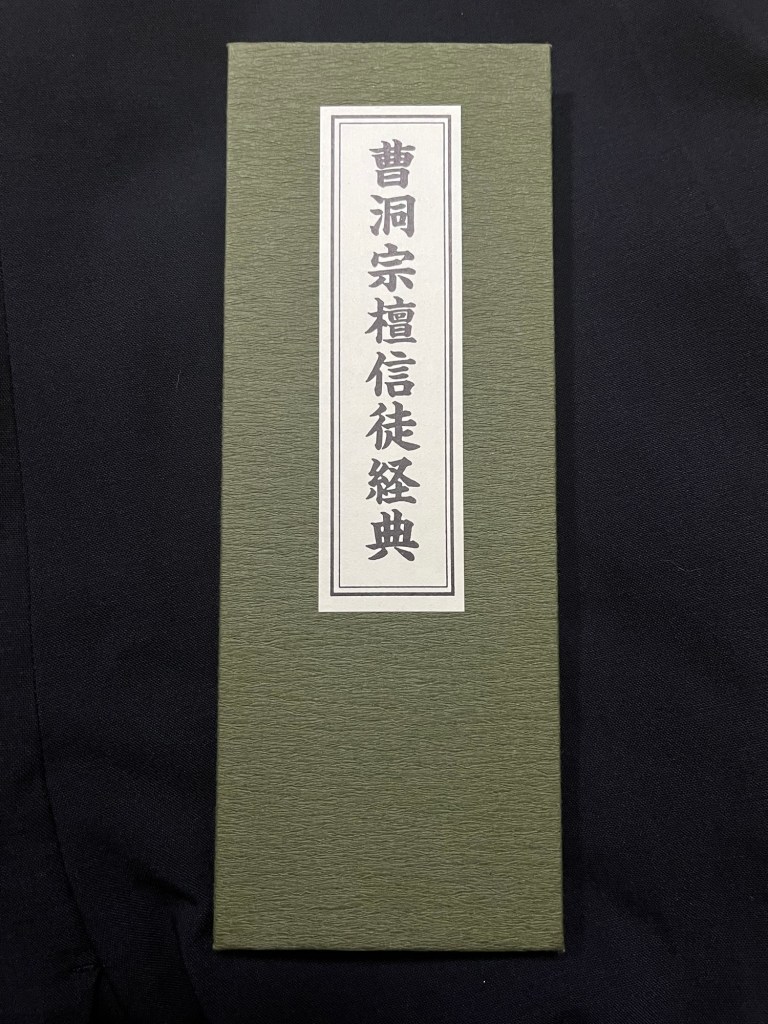
In any case here is the cover of the service book for Soto Zen home liturgy:
Cover of Soto Zen service book, purchased at Sojiji temple. Title roughly translates as “Soto Zen scriptures for parishioners”.
Inside, you can see the table of contents on the right side. Japanese text is tradtionally written right to left, and vertically (not horizontal):
Table of contents of sutra service book for Soto Zen. Purchased at Sojiji temple.
On the left-hand side is the Kaikyoge, a verse recited traditionally when starting a service. The gist of the verse is that encountering the Dharma is quite rare, and yet we are privileged to read and recite it now. Thus, may we all attain the Buddha way. During my years with the Buddhist Churches of America, we read a very similar liturgy in English. The concept is almost universal in Buddhist services.
Also, notice that the text in the Kaikyoge is Chinese characters (kanji), but with hiragana text to the side as a pronunciation aid. This is because most liturgy in Japanese Buddhism was originally adopted from China, and thus requires pronunciation guides (same is true with Korean Buddhism too, iirc). At the very bottom-left is smaller text helping to explain the meaning of this verses.
The photo below is the first part of the verse section of the Kannon Sutra (a.k.a. chapter twenty-five of the Lotus Sutra). Again, we see vertical lines of Chinese characters since the original edition was recorded in old literary (not modern) Chinese, and phonetic hiragana script beside each character. The large circle mark indicates a ring of the bell if you have one. As with above, it is read from right to left, vertically.
A copy of the Kannon Sutra, version section, from a Soto Zen service book, from Sojiji temple.
What I really like about this particular sutra book is how clear and readable the hiragana text is. Some books use a font that’s hard to read if you are a foreigner (or even Japanese possibly). This makes reciting difficult. But here, if you can read hiragana script, it’s easy to follow along.
A close up of the Kannon Sutra as printed in a Soto Zen service book, purchased at Sojiji Temple.
By the way, below is an example of verses that are not recorded in Classical Chinese: an excerpt of the Shushogi, chapters three and four. Since the Shushogi was recorded natively in Japanese, there are fewer Chinese characters, and the style of language is more readable to a native speaker. To me, as a language student, it’s still pretty difficult since the source text by Dogen was composed in the 13th century. The grammar is quite different 800 years ago. This section also includes explanations at the bottom for modern native speakers.
Because of the popularity of the Shushogi among laity in the Soto Zen tradition, all five chapters are recorded in this sutra book.
The rest of the content is pretty typical, and I explained the full contents in an older post, but what I liked about this particular sutra book was the quality, readability, and thorough content.
Side note: it turns out that there is also an eBook version of the service book (originally linked here) available in both Apple Books and Google Play formats. The eBook version is a lot nicer than I expected, and closely follows the physical book (the subject of this post), with a few slight differences:
The kaikyōge (verses on opening of the sutra) uses Sino-Japanese, the service book uses a mixture of native Japanese and Sino-Japanese
Similarly, the Sankiraimon uses native Japanese in tbe eBook version, but Sino-Japanese in the physical book.
the eBook version has a really nice altar image (gohonzon). A person who can’t access Buddhist altar goods could print it out, and install in a Buddhist altar (obutsudan).
But I digress.
For some reason I find sutra books fascinating, and if readers enjoyed this post, please let me know. I might try to make more posts on the various books I’ve collected over the years. I have service books from practically every sect in Japan.
P.S. Happy 4th of July to readers in the US. Also, happy (belated) Canada Day to readers there. To my ancient roman readers happy … (checks notes) … Battle of Adrianople?
1 via online Buddhist circles, namely the long-dead E-Sangha forum. IYKYK.
A while back, I talked about the history of Zen [particularly Rinzai Zen] and the samurai class in pre-modern Japan. Rinzai has a particularly convoluted history compared to other Buddhist sects in Japan due to its multiple waves of immigration from China, each unrelated to one another. Soto Zen’s history is notably different, but fairly convoluted in its own way, since it has two founders.
This concept of two founders started in the 19th century, after certain Soto Zen temples got into a spat about who was the actual founder of Soto Zen. If you’re reading this and know something about Japanese Buddhism, you might think that the answer is obvious: duh, it’s Dogen since he was the one who went to Song-dynasty China, and brought the tradition back. That was Eiheiji temple’s position at the time.
Conversely, Sojiji Temple took the position that it was Keizan’s influence a couple generations later that actually allowed it to flourish in Japan, establishing it as a proper sect, and not just an isolated temple. Further, until the 19th century, Dogen’s writings were kept secret, so very few Soto priests and students ever read it. So Dogen’s actual influence in the sect would be thus smaller than expected. Or so the argument goes.
Needless to say, eventually the two groups came to a compromise and agreed that both monks contributed to the growth of Soto Zen in Japan, each in their own way. Thus, in the Soto Zen tradition since, they are known as:
Dogen – “high founder” (高祖, kōsō)
Keizan – “great founder” (太祖, taisō)
Thus every 29th of September the Soto Zen liturgical calendar holds a memorial service for both founders known as Ryōsoki (両祖忌, lit. “dual founders memorial).
Even today, if you look at a Soto Zen obutsudan in Japan, you often see altar images like the ones linked here and here: namely an image of Shakyamuni Buddha in the middle, and Keizan on the left (facing right), and Dogen on the right (facing left). This is not an entirely unusual arrangement, by the way: in the Jodo Shinshu tradition, the Buddha Amida is in the middle, and often flanked by Shinran the founder, and Rennyo the restorer. Sometimes in Tendai Buddhism, you also see Shakyamuni Buddha flanked by Saicho the Japanese founder, and Zhi-yi the original Chinese founder.
The concept of “trinities” often appear in Buddhism, though not in the Western-Christian sense.
In any case, I am glad to see that Soto Zen was able to reconcile this dispute in a way that feels harmonious to me. I have visited Sojiji a couple times over the years (since it is thankfully pretty close to my wife’s house),1 and it is a pretty neat temple. I haven’t visited Eiheiji yet as it is in a remote prefecture in Japan, but I am sure it’s quite a nice place to visit. Just like Keizan and Dogen, each temple enriches the Soto Zen community in its own way, and this helps broaden the community and make it more inclusive.
It is tempting to look at Japanese-Buddhist history and assign one sect to one founder, etc, but both Soto Zen and Rinzai Zen have histories that tend to defy this mold, and it’s important to recognize that religious history is organic and complicated, but also quite fascinating.
Namu Shakamuni Butsu
P.S. Moving back to two posts a week, now that the backlog is caught up.
P.P.S. Posting late, sorry! Made a scheduling mistake. 😅
1 The present location of Sojiji is actually fairly recent. It was in Fukui Prefecture (same as Eiheiji) for many centuries, and was a branch temple of Keizan’s main temple of Yōkōji (永光寺). Ironically, as Yokoji declined, Sojiji gained in prominence. But, history is funny this way.
Another interesting quote from a 13th century Japanese Zen text, the Zuimonki (first described here), about the importance of not engaging in debates with others.
1-10) In a dharma talk, Dōgen said,
Even if you are speaking rationally and another person says something unreasonable, it is wrong to defeat him by arguing logically. On the other hand, it is not good to give up hastily saying that you are wrong, even though you think that your opinion is reasonable.
Neither defeats him, nor withdraw saying you are wrong. It is best to just leave the matter alone and stop arguing. If you act as if you have not heard and forget about the matter, he will forget too and will not get angry. This is a very important thing to bear in mind.
I think there’s only so much one can do to convince others, and if you meet someone who’s already made up their mind, it’s very unlikely you can change it because one’s beliefs are part of their core identity.
Spock: “Humans do have an amazing capacity for believing what they choose and excluding that which is painful.”
Star Trek, “And The Children Shall Lead” (s3ep4), stardate 5029.5
At that point, any effort to convince them is a sunk cost, a waste of energy.
So, like Dogen says, better to just drop the subject and let it go.
I found a neat quote recently from an old Soto Zen text called the Shōbōgenzō Zuimonki (正法眼蔵隨聞記), or “The Treasury of the True Dharma Eye: [A] Record of Things Heard”. We will call it the Zuimonki for short. Dōgen, who brought Soto Zen from China to Japan in the 13th century wrote a massive tome called the Shōbōgenzō, but his chief disciple Koun Ejō (孤雲懐奘, 1198–1280) also recorded the Zuimonki in the 13th. Ejo was actually a few years older than Dogen, yet outlived him by 20+ years or so. He would become the second abbot of Eiheiji temple, and its spiritual successor after Dogen’s passing.
The Zuimonki occupies a similar space as the Tannisho in the Jodo Shinshu tradition: a record of informal conversations between the founder and a trusted disciple. You can find a nice translation of it here on the Soto Zen homepage.1
Near the very end is the following conversation that I wanted to share (emphasis added):
[6-16]. Dōgen instructed,
All the buddhas and patriarchs were originally ordinary people.
While they were ordinary people, they certainly did bad deeds and had evil minds. Some of them were undoubtedly dull or even stupid. However, since they reformed their minds, followed their teachers, and practiced (the Way), they all became buddhas and patriarchs. People today should also be like this. Do not underestimate yourselves because you think you are dull or stupid.
If you do not arouse bodhi-mind in this present lifetime, when can you expect to be able to practice the Way? If you force yourselves to practice now, you will surely attain the Way.
There’s a lot to unpack in this quote, all of it good I think.
First, Dogen reiterates that the Buddhas and Bodhisattvas of the Buddhist tradition were all normal sentient beings at some point, with foibles, bad habits, etc. However, they resolved to change, and in time they became something much more. We saw this in the second chapter of the Shushogi as well, so we can definitely infer that Dogen sincerely believed that everyone could accomplish the Buddhist path if they only applied themselves.
I grew up in a broken home as a kid, with two younger sisters, and a chaotic family environment, and needlessly to say I did poorly in school. I remember year after year my teachers would tell my mom that if I just applied myself, I’d do really well. Finally, in the 10th grade, after reading a copy of J.R.R. Tolkien’s Fellowship of the Ring, I discovered that I really liked reading, and soon my grades improved enough that I could get into the local University and live the life I do now. So, I can attest that “believing in yourself, and applying yourself” really is true.
Second, Dogen is clearly not concerned about Dharma Decline, which was the milieu at the time in medieval Japanese Buddhism. Most sects in Japan had felt that because of the increasing chaos and declining Buddhist institutions, which roughly lined up with some aspects of Buddhist chronology,2 traditional Buddhist practice could no longer provide solutions to people’s suffering, hence alternative solutions arose. However, looking back from the 21st century, 8 centuries later, this may seem silly now. Yet, it was an intensely discussed subject at the time. Presumably, since Dogen had journeyed to China unlike other eminent monks at the time, he saw things from a different perspective and wasn’t convinced that the End Times were nigh.
Finally, Dogen is telling listeners not to lose faith in themselves. Self-doubt for anyone is crippling, but Dogen says even if you think you are slob, or an idiot, or whatever, don’t underestimate yourself.
From the original “Lego Movie”.
But if you’re unsure, start small, know your limits, but don’t give up either. Keep your eyes on the prize. 💪🏼
1 English resources on the Soto Zen website are actually quite good, and if you can read the Japanese pages, they are even better.
2 … using some pretty liberal interpretations of certain old Buddhist texts, and some calculations of the Buddha’s historical birth that no longer are accurate thanks to modern archaeology and research.





 Gleanings in Buddha-Fields
You must be logged in to post a comment.