Frodo: ‘It’s a pity Bilbo didn’t kill Gollum when he had the chance.’
Gandalf: ‘Pity? It’s a pity that stayed Bilbo’s hand. Many that live deserve death. Some that die deserve life. Can you give it to them, Frodo? Do not be too eager to deal out death in judgment. Even the very wise cannot see all ends. My heart tells me that Gollum has some part to play in it, for good or evil, before this is over. The pity of Bilbo may rule the fate of many.’
J.R.R. Tolkien, The Fellowship of the Ring
We live around plenty of detestable people all the time, the Gollums of the world: in our neighborhood, workplace, etc, or in society at large. Some of us even have parents like this too.
It’s hard to put up with these people. Of course, we want to have goodwill toward them, but they just keep doing things that are annoying, rude, selfish, or directly harmful.
So, I like how Dogen in the Shobogenzo (recompiled as the Shushogi), suggests a realistic approach. Sometimes you simply can’t be friends with detestable people, or you can’t be around difficult family relatives. You can at least pity them, not hate them, though. They may never change, and that’s a tragedy, but it’s also important to avoid harboring ill-will. Easier said than done. But like Gandalf says, even terrible people have their part to play. So, at the very least, keep your distance for your own sanity, but also wish them well, even a little.
Confession: I starting writing this post before this one, and also before I had huge fight with my dad (again), and we are once again not on speaking terms, so I feel like a hypocrit for writing this post. but I still believe in those ideals. Because they are there, we can reflect, learn and grow. Myself included.
This blog, and its blogger, have focused on the Pure Land tradition of Buddhism for many years. I didn’t really start practicing Buddhism seriously until I encountered the Jodo Shu-sect teachings of Honen way back in 2005. It really inspired something in me that’s never stopped even as my practice has taken many twists and turns.
But, strangely, I’ve never actually talked about what a “pure land” is. That’s the subject of today’s post.
The concept of a “Buddha land” or “Pure land” is actually a broad and rich tradition within Mahayana Buddhism, and well worth exploring. Here, I am not talking just about Amida Buddha and his Pure Land, but the general concept. It shows up a lot in Mahayana Buddhism and its many traditions, including the Zen tradition. It also shows up in contemporary Asian literature as well, including Akutagawa Ryunosuke’s famous short story “The Spider’s Thread” (蜘蛛の糸) as well as the Legend of Zelda series. Once you recognize it, references to Buddha lands show up in many unexpected places.
And yet, it all started long ago in India.
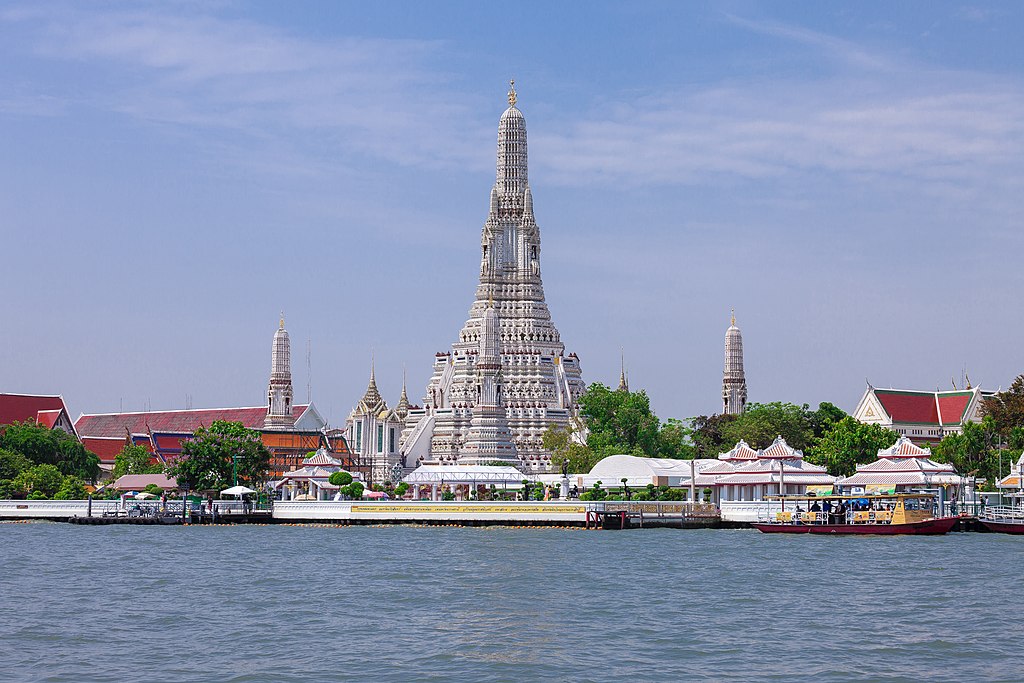
Traditional cosmology (i.e. “how the world is arranged”) in India tended to see a flat world with continents strung together in all directions, including above and below. Some of these continents would be anchored by a massive mountain in the middle, called Mount Sumeru (or Mount Meru). You can see this also in Buddhist architecture such as this famous temple in Bangkok, Thailand:
Incidentially, people in India thought that they lived in one of these continents called Jambudvipa, which was on the southern end of Mount Sumeru. For example, in the Earth Store Bodhisattva Sutra, you see text like so (chapter 4):
Thus, in this Saha world, on the continent of Jambudvipa, this Bodhisattva teaches and transforms beings by means of millions of billions of expedient devices.
Translation by City of Ten Thousand Buddhas
Anyhow, different continents were more peaceful and civilized than others. In some continents dwelt a living buddha, and by their sheer presence, the land would be purified, and all would be peaceful. Such lands are called buddhakṣetra in Sanskrit.
At that time the Buddha told the Elder Shāriputra, “Passing from here through hundreds of thousands of millions of Buddhalands to the West, there is a world called Ultimate Bliss. In this land a Buddha called Amitābha right now teaches the Dharma
Translation by City of Ten Thousand Buddhas
In this sutra, the Pure Land of Amitabha is just one of many such lands that exist to the west, but a particularly splendid Buddha land. Buddhas and Buddha lands were thought to exist in all cardinal directions, and the Amitabha Sutra above goes to great lengths to describe some of them, but highlights Amida Buddha’s Pure Land in particular.
Another example of a Buddha land is the realm of the Medicine Buddha, called Lapis Lazuli, which was thought as existing to the east (not west). The Medicine Buddha Sutra describes it at length. It even goes out of its way to say it’s easier to be reborn in the realm of Lapis Lazuli than the Pure Land of Amitabha:
“If their rebirth in the Pure Land is still uncertain, but they hear the name of the World-Honored Medicine Buddha, then, at the time of death, eight great Bodhisattvas, namely, [list of names] will traverse space and descend to show them the way. They will thereupon be reborn spontaneously in jeweled flowers of many hues. [i.e. be reborn in the Buddha land of the Medicine Buddha]
Translated and annotated under the guidance of Dharma Master Hsuan Jung by Minh Thanh & P.D. Leigh
If a person could be reborn in their next life in a Buddha land, any Buddha land, and thus be in the presence of a living Buddha, it is thought they would find refuge, but also they would advance much better along the Buddhist path. The idea of Pure Lands never supplanted or replaced more tradition Buddhism, but if your current circumstances prevented you from following the Buddhist path, you could opt to be reborn in a Buddha land and make up for it in the future.
… but then we come to another Buddha land worth noting: the Buddha land of Shakyamuni Buddha himself. The sixteenth chapter of the Lotus Sutra drops a plot twist wherein the Buddha never really died, and exists for all time on Vulture Peak in India (a real place where historically he and the Buddhist community often dwelt), and preaching the Dharma to any who see him (details added by me in parantheses):
I live on Mt. Sacred Eagle (another name for Vulture Peak) And also in the other abodes For asaṃkhya (countless) kalpas (eons).
…”This world is in a great fire. The end of the kalpa [of destruction] is coming.” In reality this world of mine is peaceful. It is filled with gods and men.
Translation by Rev. Senchu Murano
The Lotus Sutra version of the Pure Land is less about esoteric geography, and more about Shakyamuni Buddha always being here, whether we see them or not. It comes down to wisdom, clarity, and good conduct.
This viewpoint is found in Zen as well. When we look at the Hymn of Zazen by Japanese monk, Hakuin, who was a lifelong devotee of the Lotus Sutra, we can see the influence:
浄土即ち遠からず Jōdo sunawachi tōkarazu
“Indeed, the Pure Land is not far away”
Amateur translation by me
and:
当所即ち蓮華国此身即ち仏なり Tōsho sunawachi rengekoku, kono mi sunawachi hotoke nari
“This place is none other than the Land of Lotuses [the Pure Land], this body is none other than the Buddha.”
Amateur translation by me
But this isn’t just Hakuin talking. As we saw with the Obaku Zen tradition (a cousin of Hakuin’s Rinzai tradition), they felt the same way, only replacing Shakyamuni with Amida Buddha. But the sentiment was the same. You’ll find similar sentiments in esoteric traditions too, but I have little experience with those and cannot explain in much detail.
So, that brings us to the point: how does one interpret all these Pure Lands, these Buddha lands? My views have gradually changed over time, but I don’t pretend to have the answer. I think in a way that all viewpoints are correct. It is like the famous parable of the blind men describing an elephant: everyone has some idea, but the big picture is beyond our grasp. So, there’s no wrong way to interpret it. If one believes it’s a faraway refuge to be reborn into, that’s totally fine.1 If one believes it’s all in the mind, that’s fine too.
Even the Buddhist sutras, including some I linked above, state that simply “hearing” of the Buddha lands is a merit unto itself. So, if you’ve made it this far, you’re already doing just fine. Just apply the teachings in the way that best fits you.
Namu Shakamuni Butsu Namu Amida Butsu
1 Maybe this is my background as a scifi fan or something, but I do like to imagine that instead of physical continents, the various worlds and Buddha lands are just planets and worlds across the entire Universe. But that’s a personal view, more fantasy than firm belief, so please take it with a grain of salt.
In late 2025, by chance, I found an interesting book at the local Japanese bookstore titled 眠れなくなるほど面白い図解禅の話, “An explanation of Zen so interesting you can’t sleep”, which provides a nice overview for Japanese readers about Zen. It covers a lot of little details like different sects, founders, historical bits, cultural stuff, and so on, that are hard to find in English publications.
Anyhow, the book talks about something I’ve never heard before called the Shiseiku (四聖句) which can be translated as “The Four Holy Verses [of Zen]”. This is a set of verses, imported from Chinese Chan Buddhism and attributed to Bodhidharma, and distill what Zen is all about:
Chinese / Simplified1
Pinyin
Sino-Japanese
English2
不立文字 / 不立文字
bù lì wén zì
fu ryū mon ji
“Buddha-nature cannot be expressed in words.”
教外別傳 / 教外别传
jiào wài bié chuán
kyō ge betsu den
“The teachings of Buddha-nature exist outside scripture.”
直指人心 / 直指人心
zhí zhǐ rén xīn
jiki shi nin shin
“The heart of the Buddha’s teachings are transmitted directly, person to person.”
見性成佛 / 见性成佛
jiàn xìng chéng fó
ken shō jō butsu
“A person who sees their own true nature is a buddha.”
1 Rough translation by me, apologies for any mistakes
Let’s break these down.
The gist is that the deeper teachings of Buddhism cannot be expressed in words, but must be experienced first-hand. This is not an exclusive concept to Zen, by the way. Take a look at an early sutra of the Buddhist tradition:
“This Dhamma that I have attained is deep, hard to see, hard to realize, peaceful, refined, beyond the scope of conjecture, subtle, to-be-experienced by the wise.
The Ayacana Sutta (SN 6.1), translation by Ven. Thanissaro Bhikkhu
… among other places:
36. “When a monk’s mind is thus freed, O monks, neither the gods with Indra, nor the gods with Brahma, nor the gods with the Lord of Creatures (Pajaapati), when searching will find on what the consciousness of one thus gone (tathaagata) is based. Why is that? One who has thus gone is no longer traceable here and now, so I say.
Buddhism provides signposts, maps, or guides through the sutras, through Dharma talks (sermons), and such. However, sooner or later one has to apply the teachings themselves to fully grasp it. This includes one’s own “Buddha nature”: that capacity we have toward becoming buddhas ourselves.
Although Zen tends to have an anti-intellectual image, it’s important to understand that there is a genuine need for scriptural texts and references, especially as one starts out. The Buddha even warns us about making bad assumptions before fully grasping the Dharma, like trying to grasp a poisonous viper incorrectly.
But over the years, through practice this become less essential. Life is something to experience, to live, and to learn from. Even the really ugly shit. In the same way, imagine a pilot training to fly. Reading the manual isn’t enough; they must put in enough hours of “flight time” before they get a license.
But I digress.
The final verse (a buddha is one who sees their own nature) needs some extra explanation. What separates a buddha from a mundane human being is a degree of awakening, not supernatural powers. Or as Dogen Zenji explains in the Genjō Kōan:
To study the Buddha-Way is to study the Self. To study the Self is to forget the Self. To forget the Self is to be enlightened by all things. To be enlightened by all things is to drop off the body and mind of self and others.
In other words, through Buddhism, you see your own nature. By seeing your own nature, you drop the delusions and gain clear insight. By gaining clear insight, you awaken as a Buddha.
1 For those unfamiliar, Chinese characters come in the traditional form and simplified form. The traditional form is what you mainly see outside of the People’s Republic of China. The simplified form is mostly used within the PRC. Interestingly, Japanese uses halfway solution: some characters are simplified, some are not. Anyhow, in most cases, the characters are the same, but you can probably spot a few differences.
2 This is my own translation. Apologies in advance for any mistakes.
In terms of demographics, Zen in Japan never reached the mass appeal that the Pure Land and Shingon sects ever did,1 but it has had an unusually large influence on the culture. When people think of this, they usually think of things like sand gardens, tea ceremonies, or certaintemplesinKyoto, but the language includes many words originally borrowed from Chinese-Zen (a.k.a. Chan) terminology imported into Japan.
This is not unusual, as it happens in English and other languages too: religious terminology gradually become increasingly widespread and lose their original religious context. The English word “goodbye” evidentially derived from “god be with ye”, for example.
So, let’s look at a few examples in Japanese.
The word aisatsu (挨拶), meaning customary greetings, was originally from the back and forth questions a Zen teacher would ask a student to test their grasp of the Dharma. Back then it was called ichiai-issatsu (一挨一拶), so the word has shortened over time.
The verb ganbaru (頑張る), which you see all the time in Japanese and means to “hang in there” had a somewhat different meaning in the past. It’s original meaning was the tendency for people to cling to their egos and assert their viewpoint even in the face of reality. The word has changed to a more positive meaning over time.
The word shujinkō (主人公) meaning the main character of a story (or drama) originally comes from a famous collection of Zen koan called the Mumonkan, wherein a certain monk would talk to himself and say things like “hey you, stay awake [don’t be fooled]”. The “you” here is where shujinkō comes from.
The phrase ichi-go-ichi-é (一期一会) normally means a once-in-a-lifetime experience, but in a Zen or tea ceremony context it means that this moment is like no other, never to be repeated.
The word kanben (勘弁) which my wife sometimes yells at me (kanben shite yo! “use your head”, “be reasonable!”) originally described a teacher thoroughly investigating a student’s grasp of the Dharma.
Finally, the word genkan (玄関) is a very common word in Japanese, meaning the front entry way, where you take off your shoes, etc. Originally this was limited to the area near a temple’s gate, but during the Edo Period the usage became more popularized to mean the entryway of a home.
There are other, more obscure terms as well, often in the form of phrases and idioms.
The phrase nichi nichi kore kō nichi (日日是好日) means “every day is a good day”, and I talked about it in this older post. This is directly taken from Chinese, but pronounced in a Japanese way.
Similarly, another famous Chinese-Zen phrase is kyakka shōko (脚下照顧) which loosely translated means something like “watch your feet!”. More specifically, it means to observe one’s self carefully, using the example of your feet. If your shoelaces are untied, your walking gets sloppy, or your shoes get messy, or you trip and fall. So, if you notice this, and tie your shoelaces, then you are catching the problem early, and avoiding future issues.
So, that’s a look at Zen-Buddhist words in Japanese language. Thanks for reading!
1 According to one of my books, the Rinzai Zen sect has about 1.1 million registered followers, while the Jodo Shinshu sect has 11 million (10 times that number) and Shingon sect about 7 million. Soto Zen has about 3.5 registered followers, so somewhat larger, but not that much.
SPOCK: “Change is the essential process of all existence.”
Star Trek, “Let That Be Your Last Battlefield” (s3:ep15), Stardate 5730.2
It is that time once again as we celebrate a new year. It’s an exciting time: plenty to celebrate and look forward to, but some very difficult times too:
Mark Twain: “I come from a time when men achieve power and wealth by standing on the backs of the poor, where prejudice and intolerance are commonplace and power is an end unto itself.”
Star Trek: The Next Generation, “Time’s Arrow, part two” (s6:ep1), Stardate 46001.3
In my spare time, I have been avidly studying (re-studying) the Soto Zen text, the Shushogi. As I talked about before, this is streamlined collection of Dogen’s writings from the Shobogenzo, but with a focus on lay followers.
One of the themes repeated over and over is that time passes, and it only passes in one direction:
Time flies with more speed than an arrow; life moves on, more transient than dew. By what skillful means can you reinstate a day that has passed? To live one hundred years wastefully is to regret each day and month. Your body becomes filled with sorrow. Although you wander as the servant of the senses during the days and months of a hundred years — if you truly live one day, you not only live a life of a hundred years but save the hundred years of your future life…..true practice of the Law for one day is the seed of all the Buddha and their activities.
The Shushōgi, chapter five, fascicle thirty
A long life wasted in empty pursuits is nothing compared to a day spent in earnest practice. Even applying the Buddhist teachings a little bit, benefiting yourself and others, is still a great investment. Like exercise, a little bit goes a long way, and each day is an opportunity. Each one of us, just as we are now, is capable of doing something good and noble.
By the way, a quick blog update: I’ve been struggling in recent months to maintain a consistent schedule for posts (it was self-imposed anyway), so starting in 2026 I am going to try and be more flexible with posting. I am not sure how that will look, but you may see “bursts of inspiration” followed by some dry spells. We’ll see how things unfold. In the meantime, I’ve been adding more pages to the blog under the Buddhism section including the Letter on White Ashes, and the Shushogi above. Not the rest I intended,1 but something I enjoy doing. 🙂
Stay safe and happy 2026 to everyone!
1 I also played a lot of The One Ring RPG in my spare time, plus watching Star Trek: Enterprise for the first time ever. It is a terrific series, and I regret not watching it when it was on-air. So, I did have some downtime too. 😉
Some years ago, I received a tenugui (手ぬぐい), a kind of cotton cloth traditdionally used in Japan, with the following calligraphy on it:
我逢人 gahōjin
“self meets person”
I have briefly mentioned here this notion, but today I wanted to delve into it more. I have struggled to find a clear reference, but according to one story I found, these were the words uttered by founder of Soto Zen in Japan, Dogen, after first encountering his new teacher Rújìng (如淨, 1163–1228) in China.1 Dogen had studied under the Tendai sect in Japan for years, but he was dissatisfied with the lack of rigor, and journeyed with his mentor to Song-dynasty China to learn more there. At the Tiantong Temple (天童寺, Tiāntóngsì) he met Rujing, and after their first meeting, Dogen was said to have uttered these words meaning “At last, I have met someone”.
The sentiment here is that even though we might be physically in a room full of people, we may not really connect with them. We all go through this feeling. In modern society, that sense of isolation in a crowded room may feel even more acute. It is indeed a noisy yet lonely world we live in, and as the Buddha described it, a world of aimless wandering.
Only when you connect with someone does it really feel like you meet them. This could be someone romantic, or someone like a mentor, or just a really good friend. When you connect with that person, you can speak your mind 100%, and they will understand you. Such encounters are indeed rare (I can probably think of maybe 10-15 people in my own life), but it’s an example of how karma can work in mysterious ways, maybe across many lifetimes.
It is also why, in my opinion, when one encounters the light of Amida Buddha, or the Dharma in general, it subtly alters one’s aimless trajectory. Imagine an asteroid hurtling through the void of space for eons, then one day it’s finally caught within the gravity of a star. It’s still moving, but now its trajectory gradually bends more and more toward the star. I like to think of encountering the Dharma like that.
It’s also a great example of how Zen phrases and idioms proliferate Japanese language.
Namu Shakamuni Butsu
P.S. Please enjoy the Maha Santa Claus Sutra, an old classic I wrote 6 years old (!). Happy Holidays!
1 In Chinese, he is known better is Tiāntóng Rújìng (天童如净, “Rujing of Tiantong [temple]”).
Years ago, I used to write down sutra verses I’d find (in English) into my little sutra book, but after a while I often forget what I wrote down. Recently I found this really fascinating verse from the twenty-third chapter of the Lotus Sutra, which I had apparently written down:
The woman who hears and keeps this chapter of the Previous Life of Medicine-King Bodhisattva will not be a woman in her next life. The woman who hears this sutra and acts according to the teachings of it in the later five hundred years after my extinction, will be able to be reborn, after her life in this world, [as a man sitting] on the jeweled seat in the lotus flower blooming in the World of Happiness [the Pure Land] where Amitāyus Buddha lives surrounded by great Bodhisattvas. He [no more she] will not be troubled by greed, anger, ignorance, arrogance, jealousy, or any other impurity. He will be able to obtain the supernatural powers of a Bodhisattva and the truth of birthlessness. When he obtains this truth, his eyes will be purified. With his purified eyes, he will be able to see seven billion and two hundred thousand million nayuta Buddhas or Tathāgatas, that is, as many Buddhas as there are sands in the river Ganges.
Transalation by Rev. Sencho Murano
There is a lot to unpack here.
In Indian culture, it was felt that birth as a women was disadvantageous. This was probably due to the realities of the time: patriarchal society, extreme risks of childbirth in a pre-modern society with medical technology, dowry customs, etc.1 So, the idea was that rather than being reborn again as a woman in the next life, the sutra promises that such a woman could be reborn as a man by being reborn in the Pure Land of Amitāyus Buddha.
Amitāyus Buddha is one of the names of Amida Buddha. It is also used in the Immeasurable Life Sutra, where one of the vows of Amida Buddha is the following:
(35) If, when I attain Buddhahood, women in the immeasurable and inconceivable Buddha-lands of the ten quarters who, having heard my Name, rejoice in faith, awaken aspiration for Enlightenment and wish to renounce womanhood, should after death be reborn again as women, may I not attain perfect Enlightenment.
Translation by Rev. Hisao Inagaki
Here, we see essentially the same thing: if a woman is weary of the challenges of womanhood, she can choose to be reborn as a man in the Pure Land of Amida (Amitāyus) Buddha in accordance with his vow. Should his vow fail, the Pure Land would not be. Since it does exist, the vow is certain.
You can read this in two ways, I think:
This reaffirms a patriarchal attitude that woman are inferior, and therefore being a man is better on the Buddhist path, or
Buddhism was realistic about the challenges of woman in a patriarchal society of the time, and therefore offered something not found in other religious paths.
I think it is up to the reader to decide. To be honest, in light of other aspects of the Lotus Sutra, such as the Parable of the Dragon Princess, or Shakyamuni’s prophecy of Buddhahood to his nun disciples, I am inclined to think that the latter interpretation is what the authors of the Lotus Sutra intended. The Lotus Sutra reads as something (relatively) progressive for the time.
Separately, it’s interesting that the Pure Land of Amida Buddha is even referenced in the Lotus Sutra at all, and both sutras use the same name, Amitāyus, not the more common Amitābha. Typically, Buddhism tends to treat the Lotus Sutra and the Pure Land as separate traditions. They overlap because they are both Mahayana-Buddhist traditions, but often people focus on one or the other.
Further, the Pure Land of Amida Buddha is not prominent in the Lotus Sutra. Instead, the “pure land” of Shakyamuni Buddha in chapter sixteen is the big reveal. So, Amida Buddha’s Pure Land is more like a backup singer in the band, or a spinoff character.
But, having had some exposure to Tendai-Buddhist thought, and seeing overlapping texts like these, I feel it’s clear that they were meant to be one tradition, not two. From the Lotus Sutra perspective, the Pure Land path is part of the larger progression toward Buddhahood. From the Pure Land perspective, Buddhahood is all but assured if you are reborn there because of the radiance and magnetism of Amida Buddha. So, it feels like they are two sides of the same coin in a way. If you add the Zen perspective of the Pure Land, things get even more interesting.
How one approaches all this is up to you. If nothing else, the Lotus Sutra shows that there are many gates, and many ways to approach the Buddhist path, but they are like rivers all feeding into the same ocean.
Namu Shakamuni Butsu Namu Amida Butsu
P.S. Despite my “break” in December, I decided not to wait on this one. 😅
1 One could make the argument that even now in 21st century modern society, life as a woman is still not an easy one. But imagine life when you were expected to have many children, and the average childbirth had a 10% chance of killing you each time, so many women did not live past their 20s and 30s. Further, if your husband was a terrible person, you had little if any recourse.
A few months ago, I made this post about how the Obaku Zen sect interprets Amida Buddha and the Pure Land. To my surprise, I keep reflecting on this phrase from time to time, almost like a Zen koan:
This mind is the Pure Land, this body is Amida Buddha
This idea of merging Zen and Pure Land ideas is somewhat rare in Japanese Buddhism, but it’s surprisingly common in Chinese-Buddhist thought. Originally, I thought it was limited to later Ming-Dynasty Buddhism (which Obaku descends from), but similar strands of thought exist much further back.
A famous Chinese monk named Yongming Yanshou (永明延壽. 904 – 976) once wrote a poem titled the “Four Alternatives” (sì liào jiǎn 四料揀):1
Lacking both Chan and the Pure Land, it will be the iron beds and bronze pillars [of hell] for ten thousand kalpas [eons] and a thousand lives with no one to turn to.
Having Chan but lacking the Pure Land, nine out of ten will stray from the path; when the realm of the aggregates appears before them, they will instantly follow it.
Lacking Chan but having the Pure Land, ten thousand out of ten thousand who practice it will go [to rebirth]. Having seen Amitābha, why worry that one might not attain enlightenment?
Having both Chan and Pure Land, one is like a tiger with horns [i.e., doubly capable]. Such a person will be a teacher in the present life, and a buddha or patriarch in future lives.
translation by Charles B. Jones, “Chinese Pure Land Buddhism, Understanding a Tradition of Practice”, pg 210
Yongming is advocating a supportive model where both Zen practice and Pure Land practice work in concert. The Pure Land path is the “safer” path to follow, due to the vows of Amida Buddha, but if supported by Zen practice here and now, one is really making progress on the Buddhist path.
Further, a later writer named Yunqi Zhuhong2 (雲棲袾宏, 1535 – 1615) explained that these things were not mutually exclusive (Chinese added by me):3
To contemplate the Buddha (nianfo 念佛) is to contemplate the mind (nian-xin 念心). Birth there (in the Pure Land) does not entail birth away from here. Mind, Buddha, and sentient beings are all of one substance; the middle stream (non-duality) does not abide on the two banks (this world and the Pure Land).
Similarly, Ouyi Zhixu (蕅益智旭, 1599 – 1655) in his excellent work “Mind Seal of Buddhas” makes a similar argument: Zen and Pure Land practice are the same thing, just operating at different levels. You’re not forced to chose one or the other in your practice.
But such ideas aren’t limited to medieval Chinese-Buddhist monks. You can find such sentiments in Pure Land sutras themselves! In the Immeasurable Life Sutra is this passage (emphasis added):
“In this world, you should extensively plant roots of virtue, be benevolent, give generously, abstain from breaking the precepts, be patient and diligent, teach people with sincerity and wisdom, do virtuous deeds, and practice good. If you strictly observe the precepts of abstinence with upright thought and mindfulness even for a day and a night, the merit acquired will surpass that of practicing good in the land of Amitāyus [a.k.a. the Pure Land] for a hundred years. The reason is that in that buddha land of effortless spontaneity all the inhabitants do good without committing even a hair’s breadth of evil. If in this world you do good for ten days and nights, the merit acquired will surpass that of practicing good in the buddha lands of other directions for a thousand years.
Translation by Rev. Hisao Inagaki
In this passage, the Buddha is clearly advocating both bending your efforts toward rebirth in the Pure Land, but also making the most of the time you have here to undergo traditional Buddhist practices too because even a modest effort here is a great benefit in the future (both for yourself and others).
As I often tell my kids: “go nuts”!4
What I mean is: recite the nembutsu, meditate, uphold the precepts, or some combination thereof. You have nowhere to go but up.
But what if you can’t decide or don’t have the time?
In my opinion, start with the nembutsu. Begin just as you are, and recite it just 10 times daily. From there, add the Five Precepts when you are ready, and once you have that foundation, and are ready to branch out, then look into Zen practices. This make take months or even years. Take your time, go slow, and don’t be afraid to explore.
When I talk about the flexibility of Tendai Buddhism in Japan as well, this is what I am alluding to: start with something simple and small at first (such as a devotional practice), and gradually building upon it as you gain confidence and see the positive transformation in your life. Buddhism is kind of a SLOW, gradual religion, but like a glacier, once it starts moving, it has a wonderful momentum all its own even if you can’t see it.
Namu Shakumuni Butsu Namu Amida Butsu
P.S. Featured blog image is another famous “Dynamic Duo”: Batman and Robin from the 1960’s series.
P.P.S. Posting kind of off-schedule just because it is fun. 😊
1 I found this on Wikipedia actually and I thought to myself “wow, this person quoted exactly the same way that I would do!”, then I realized that I had put this on Wikipedia a few years ago. 🤦🏼♂️
2 Pronounced like “yoon-chee joo-hong”.
3 Again, I managed to pull a quote from Wikipedia that I had unwittingly added years ago and then promptly forgot.
4 My kids ask me if they can watch TV, play Switch or whatever, and my frequent answer is “go nuts” [go crazy, have fun].
My son and I visited our neighborhood bookstore recently (shop at local, independent bookstores!) and I found this neat book worth mentioning called The Blue Cliff Record, translated by David Hinton.
The Blue Cliff Record, known in Chinese as the Bìyán Lù (碧巖錄) is actually a pretty old text in the Chinese Chan (Zen) tradition, and is a collection of Koans compiled in the year 1125 by Yuanwu Keqin (圓悟克勤, 1063–1135).1 Obviously, the koans themselves were older and handed down over time, and appear in other collections, but the Blue Cliff Record is a kind of “selected wine list” of koans. The Blue Cliff Record was compiled during the Song Dynasty in China, which while politically unstable due to the Mongols, was a cultural high-water mark of Chinese Buddhism and especially the Chan tradition. Not surprisingly, Japan’s Zen traditionimported much from this time period as well.
This is not the first time I’ve studied koans, though.
In my youth, when I first explored Zen, I had a copy of the Gateless Gate by Mumonkan, and my religion studies teacher in high school assigned us each a koan to solve in class. Of course, none of us actually solved them, but it was a fun exercise. But as with my studies in Zen, I gradually forgot about it until recently, so it’s like coming back full circle after more than 30 years (!).
But what the heck are koans?
“Koans” are more properly called Gōng-àn (公案) in Chinese. The word “kōan” is how those Chinese characters are pronounced in Japanese, and this term is more widely known to Westerners.2 Koans are cryptic dialogues, often between a master and student, and widely used in the Lin-ji school of Chan Buddhism. As we saw in my recent post, Lin-ji is predominant in China, but also spread to neighboring countries, and in Japan’s case it became both the Rinzai and Obaku sects (albeit different centuries). Temples such as Kenninji and Ryoanji are examples of famous Rinzai temples in Japan. The Soto Zen tradition doesn’t rely on them as much, but inherits the same collections, as it is desecnded from the Cao-dong (not Lin-ji) school in China.
David Hinton in his foreword on the Blue Cliff Record explains that the key to understanding a Koan is to see it like a kind of public law case. When law students review famous court cases, they have to review the nature of the complaint, evidence presented, the judge’s decision, past precedence, etc. If you’re not a law student, this is hard. But if you’ve been practicing law for a long time, immersed yourself in it, then you see it with a different eye.
In the same way, Mr Hinton writes, a Koan is like a “public sangha case”. The “sangha” is one of the Three Treasures of Buddhism, and means the Buddhist community at large. So, these are public sangha cases for students to review, contemplate, and so on.
The truth is, when you read a Koan for the first time, it basically makes no sense whatsoever. You might think you get it, then you gradually realize that you really don’t. Then it gets under your skin, and bothers you enough that you might stick with it, until maybe one day, you look at it and you think “duh, of course!”
But also, some “public sangha cases” will resonate with you more than others, or at different times in your life.
Since I don’t participate in any Zen communities at present, I decided to do a little experiment. The Blue Cliff Record has exactly 100 cases in it, and being a giant nerd, I decided to pick one at random as my koan to contemplate. I took 2d10 dice from my Dungeons and Dragons set. Then, I briefly prayed to Kannon Bodhisattva and Shakyamuni Buddha and rolled the dice. I got koan #20 which David Hinton translates as “Dragon-Fang Meditation Clapper”:
When he was a monk traveling, Dragon-Fang Mountain asked Kingfisher Shadowed-Emergence: “What is the ch’i-weave mind [意] Bodhidharma brought from the West?”
“Pass me the clapper to announce meditation,” said Shadowed-Emergence.
Dragon-Fang passed the wooden clapper to Shadowed-Emergence, who swung it and struck Fang a blow.
“You can strike me all you want,” hissed Dragon-Fang, “But there’s still no ch’i-weave mind for Bodhidharma to bring from the West.”
Traveling years later, after his awakening under Fathom Mountain, Dragon-Fang asked Purport Dark-Enigma: “What is the ch’i-weave mind Bodhidharma brought from the West?”
“Pass me the meditation cushion,” replied Dark-Enigma, who swung it and struck Fang a blow.
“You can strike me all you want,” hissed Dragon-Fang, “But there’s still no ch’i-weave mind for Bodhidharma to bring from the West.”
Translation by David Hinton
Confusing? Yes. Mr Hinton takes the unusual approach of translating the monks’ names into English, hence “Dragon-Fang” and “Shadowed-Emergence”, etc. so it takes a bit of getting used to. The term “ch’i-weave mind” (意)3 takes 2 pages to explain at the end of the book, and I can’t do it justice, but for simplicity here I will crudely summarize it as the Big Mind, as opposed to one’s normal everyday mind.
Even so, this koan doesn’t make a whole lot of sense. I think I get it, but do I really get it?
I suppose time will tell…
Namu Shakamuni Buddha Namu Amida Buddha Namu Kanzeon Bosatsu
1 Pronounced like “yuen-wu kuh-cheen”
2 Many Buddhist terms in Japanese are just local pronunciations of Chinese-Buddhist words (often from Hokkien dialect, not Mandarin, due to its proximity to the Japan islands). This same trend happens with Korean-Buddhist words, Vietnamese-Buddhist words, and so on. If this sounds strange, consider religious words in English. They are often derived from Latin, for obvious reasons, but the pronunciation gets muddled over many generations, especially since they were often filtered through Middle-French (via conquering Normans). This is how religious ideas and words spread.
3 This Chinese-character is used in such Japanese words as:
意味 – imi or “meaning”
意識 – ishiki or “consciousness”
注意 – chūi or “caution”
用意 – yōi or “to prepare or provision something”
…. you get the idea. It’s used a lot, but kind of abstract too.
Garibaldi: This isn’t gonna be easy. G’kar: Nothing worthwhile ever is.
Babylon 5, “And the Rock Cried Out, No Hiding Place”, s3:ep20
Recently, I talked about the key to practicing Zen (or Buddhism in general) is training while incorporating other things in your life toward that same goal. Like Rocky Balboa training in Rocky, or Li Fong in the excellent movie Karate Kid: Legends, or someone working hard to learn a language by making other aspects of life conducive toward language learning.
In most cases, we go through a some stages when we take up a project like this.
New thing – “this is fun, I can see the benefits already!”
Steady practice – “gotta keep this up”
Boredom – “ugh, I gotta do this again”
Skipped days – “I’ll make up for it tomorrow”
More skipped days – “No, really, I’ll make up it up tomorrow.”
Guilt – “I suck”
Despair – “I’ll never succeed.”
Quitting.
My usual pattern with new projects, or dieting and exercise, is to eventually feel guilty, despair, and quit. It happens to me a lot over the years, admittedly.
But also, there are a few things that surprisingly I have managed to stick with for years, decades even. I’ve been actively studying Japanese since 2008, for example. I realized though that the way I’ve studied Japanese has changed and shifted many times. Some experiments succeeded, others failed immediately. But the goal was important enough to me, that even when I failed I just shifted tactics and tried again. I failed the N1 JLPT twice in the last five years, and to my surprise, I am still at it, but now trying a new tactic.
Put another way: when I hit a roadblock, instead of hitting my head on the wall harder and harder, I tried another route. I knew where I wanted to go (language fluency) and just kept trying methods until I found something that stuck.
I realized too that my pursuit of the Buddhist path has been much the same way. I started out in 2005 with very little understanding, but I really liked reciting the nembutsu, and I loved the simple, down-to-earth, and highly approachable Jodo Shu sect as taught by Honen (still do!). But while I’ve had the same basic goal, my understanding of Buddhism has grown over time, and like language learning, has gone through many false-starts, projects that soon ended, or things that just didn’t work. So, I just shifted, tried another route, backtracked, and so on. This what I think happened to me, and why I took up Zen practice since May.
My current Zen practice is, I suppose, just another track toward my goal.
So, I think the point of all this is that the goal is more important than the particular approach. If the goal is something you really care about you’ll find a way. In fact, you’ll probably bend other aspects of your life toward it. If not, then the goal maybe wasn’t that important to begin with. That’s OK. Better to acknowledge it, cut your losses, and move on.
But if the goal is worthwhile to you, then like G’Kar says, you’ll find a way.





 Gleanings in Buddha-Fields

You must be logged in to post a comment.