The Lost “Iranian” Buddhism: A Brief History of the Silk Road

Hello Everyone,

I recently finished two related books this week: the Xuan-zang book I wrote about before and a new book by Richard Foltz titled Religions of the Silk Road: Premodern Patterns of Globalization. The latter book was fairly short, but it was well-written and I finished it in about 4 days. I highly recommend it.

One of the reasons why I enjoyed these books so much is that they helped explain an important question about Buddhist history: how did Buddhism go from India to China?

Anyone who’s studied a little history about Buddhism knows it travelled the Silk Road from India to China, where it flourished and influenced other East Asian countries (Korea, Japan, Vietnam, etc). But this glosses over a lot. So these two books helped explain what exactly happened, and historical research was actually kind of surprising.

Bas relief nagsh-e-rostam couronnement.jpg

Different kingdoms and people “ruled” the Silk Road at different points of time, but many of them had a common “Iranian” origin. This is not the same as the modern country of Iran, but rather a common ancestry, which included such people as the Persians, the Sogdians, the Parthians and the Indo-Aryans such as Siddhartha Gautama. They had a common ancestry, spoke related Iranian-languages, and had common religious traditions that helped influence the new religions they encountered.1

What Is the Silk Road?

Silk route

The Silk Road was actually a network of trade routes that connected China with India, Persia and beyond Persia to the Near East. There were multiple routes, not a single road, and it was not common for a single merchant to travel the entire length. Instead, merchants would often use a “relay system” to bring goods to a major city along the road and trade there. The same goods might be carried by another merchant elsewhere, and so on.

For example, between Indian and China there were three major roads, two passing through Central Asia: the “north” road which was longer but somewhat safer and passed north of the Taklamakan Desert, and the shorter “southern” road which was quicker but was riskier due to mountains, flooding rivers and the Desert. Xuan-zang, in his famous journey, took the northern route from China to India, and was relatively safe, but on his return, he took the southern route and nearly drowned twice, lost his elephant and many important items he brought back from India. Meanwhile, in the ancient city of Palmyra in Syria, mummies have been found wrapped in Chinese silk.

Anyhow, the constant trade back and forth also brought other people who were not in business. Monks, priests and people seeking their fortune would sometimes accompany merchant caravans. Cities and kingdoms on the Road often welcomed such people because they helped connect them with important cultures like Persia, India and China, and would help improve their prestige. With greater prestige and culture, such a kingdom might prosper over rivals.

Why Did Buddhism Spread Along the Silk Road?

The original reason was probably trade. Rulers along the Silk Road would patronize traveling monks by building monasteries and establishing new Buddhist communities. This would help generate donations for the local economy, and enhance the culture and prestige of the city helping the economy further. For example, at the city of Balkh (now Afghanistan), Xuan-zang found 100 monasteries and a 3000 monks there in the 7th Century.

In reality, the local population probably didn’t convert to Buddhism en masse, but instead it may have blended with existing religious traditions. Further, as Buddhism declined, later religions such as Nestorian Christianity, Manichaeism and Islam spread the same way. It was a recurring pattern: whoever controlled the trade influenced the religious tendencies of the region.

What Kind of Buddhism Did They Spread

Three schools of Buddhism, out of the original 18, that spread along the Silk Road were:

  • Mahasangikas – Who tended to downplay the importance of the enlightened arhats, and emphasize intuition. They helped build the famous giant statues at Bamiyan, now destroyed.
  • Dharmaguptakas – Who elevated the importance of the Buddha, such that only he was worthy of offerings, and not the monks. They were the most important school early on, but gradually declined. The Agama Sutta in the Chinese Canon (equivalent to the Pali Canon in Theravada) is partly from Dharmaguptaka sources, as well as the Chinese monastic code of discipline.
  • Sarvastivadins – Who believed that past, present and future all existed simultaneously and were thus considered heretical according to the 3rd Council of Buddhism. Otherwise they were similar to other schools. Much of the Agama Sutta above derives from Sarvastivadin sources as well.

Finally of course was Mahayana Buddhism, which is what we see now in East Asian Buddhism. Mahayana Buddhism was not a distinct school at this time, but had members from each of the various Indian schools, interacted closely with them, and was thus influenced by them. Mahayana Buddhism and its “bodhisattva practices” was a kind of extra-curricular activity monks and nuns could participate in, on top of their usual monastic discipline.

Research shows that much of imagery and sutras used in Mahayana Buddhism may have been composed outside of India in Central Asia. Iranian culture already had a diverse pool of beliefs and imagery, including but not limited to Zoroastrianism, and this may have helped shape what we now know as East Asian Buddhism. More on that in another post.

Who Spread Buddhism?

There were four major peoples that help spread Buddhism along the Silk Road, three of whom were ethnically Iranian:

  • The Bactrians, who blended Indian Buddhism with Greek culture.
  • The Kushans, who learned form Bactrians and spread it further.
  • The Sogdians, master traders and translators
  • The Parthians, the last and most powerful group who brought many texts and translators to China.

Buddhism began to spread from India to the Greco-Iranian kingdom of Bactria first. It was close to Kashmir, which was a major center of Buddhist learning, and the Bactrian kings were tolerant of all religious traditions. The people and language were a mix of Greek setters, Indian and Bactrian (Iranian). The Bactrian language even used Greek letters. As an example of diversity and tolerance, King Menandros patronized Buddhism, though he was not a follower. His dialogues are preserved in a Buddhist text called the Questions of King Menander.

But the Bactrian kingdom didn’t last long, and was soon conquered by an Iranian people called the Sakas, then the Kushans. The Kushans are possibly a mixed-ethnic group (Iranian and Tocharian) who revived the Greco-Bactrian culture and helped spread Buddhism further than before. It was under the Kushan Empire that Buddhist statues, which resembled Greek statues in some ways, began to appear. This is the “Gandhara-style” of Buddhist art, named after a famous region of the Kushan Empire.

Gandhara Buddha (tnm).jpeg

King Kanishka of the Kushan Empire, was considered a great patron of Buddhism, though he wasn’t a follower (he patronized Greek gods and Hindu deities as well). He organized a new Buddhist council in Kashmir to rewrite old Buddhist texts from obscure local “Prakrit” dialects into more standard Sanskrit, for example. Kanishka also helped build monasteries and communities throughout his empire. He is often called the “Second King Ashoka” for this reason.

But the group that helped spread Buddhism the most wasn’t the Kushans, it was the Sogdians. The Sogdians were a small Iranian people who lived around modern Uzbekistan and Tajikistan, and were master translators and traders.

Sogdian artwork of Rostam

Their location along the Silk Road meant that they interacted with many different cultures, and thus they were able to carry ideas and goods to other major cultures easily. After Buddhism, the Sogdians helped spread other religions such as Nestorian Christianity and Manichaeism as well as Islam. The Sogdians frequently translated texts from one language to another: for example Prakrit to Bactrian, Aramaic to Turkish, Parthian to Chinese, etc. Ironically the Sogdians did not translate much Buddhist texts into their own language until much later (mainly from Chinese) and this may help explain why Buddhism didn’t take root in Sogdian culture. There were definitely examples of devout Sogdian monks and communities but not wide-scale devotion.

Finally, the last major group to bring Buddhism to China were the Parthians. The Parthians were another major Iranian group that eventually conquered the Kushans and establaished the Parthian Empire. it was during this time that Buddhism probably spread the furthest into Central Asia. For example in the famous city of Merv (now in Turkmenistan), researchers have found extensive Buddhist texts from the 1st-5th centuries and Buddhist communities in Shash (modern Tashkent) show that Buddhism had spread northwest of India before it turned east toward China.

The Parthians also contributed many famous translators into Chinese.2 The most famous was An Shigao (安世高) who translated a lot of basic Buddhists texts along with his student An Xuan (安玄). The surname ān (安) was frequently used for Parthians at the time. Some of these texts are still used in the East-Asian (and Western) Buddhist canon.

Why Did Buddhism Decline on the Silk Road?

As mentioned earlier, whoever controlled the trade of the Silk Road influenced religion there. After Buddhism was established, newer religions such as Nestorian Christianity and Manichaeism gradually dominated. The Persian merchants patronized both religions, as well as the state religion of Zoroastrianism and soon the Silk Road became very religiously diverse.

The final religion to appear was Islam. By the time that Islam reached Central Asia, Arab traders dominated the trade, and local kings and merchants found it advantageous to convert in order to build closer ties. In the countryside and the remote steppes, people tended to follow Nestorian Christianity and Buddhism for much longer, but in the cities, Islam and Arab culture were the new rising star and people tended to convert. Buddhism was already declining in India, so there wasn’t much incentive to maintain cultural ties with the Buddhist world. People simply lost interest.

Foltz’s book shows how the history of “Islamic conquest” at this time was often greatly exaggerated too. Writings at the time depicting local kings and warlords conquering other lands in the name of Islam were often a cover to simply expand control of trade, not religion. Research shows that the “convert or die” policies of these kings were often unsuccessful and limited in scope. What actually persuaded Central Asian people to convert to Islam were oftentimes charismatic Sufi preachers who helped fulfill the role of “shaman” that previous religions had done generations earlier. To this day, Islam in Central Asia is often syncretic and blends elements of earlier religions with canonical Islam. Meanwhile, the Nestorian Church ironically survived in the heart of the Islamic world in the form of the Syriac Church in northern Iraq and other places.

SyriacChurch-Mosul

Between the change in economy, decline of Buddhism in India and role Sufi preachers played in spreading the new dynamic faith, Buddhism naturally declined and faded entirely as did Nestorianism and Manichaeism.

Conclusion

The Iranian peoples of Central Asia were critical to bringing Buddhism out of India to Central Asia, China and now the modern world. We wouldn’t have things like Zen and Pure Land Buddhism if it weren’t for the Sogdians, Kushans and Parthians among others. Ironically many of these cultures no longer exist, yet their legacy lives on in many others.

The books mentioned at the beginning of this post were a lot of fun to read and I can’t recommend them enough for those interested in Buddhist history.

P.S. another blog repost, but with many fixed and updated links.

1 Even the modern Islamic Republic of Iran is just the latest in a very long series of dynasties and rulers that stretches back to the earliest civilizations of Man. See for example the Safavid Dynasty and Achaemenid Dynasty.

2 Other famous translators were not Parthian though: Lokaksema was Kushan while Kumarajiva had ancestry from both Kashmir and Kucha, another major Buddhist center at the time.


Polishing the Mind

In Chinese-Buddhist literature, the influential treatise Cheng Wei Shi Lun (成唯識論) contains the following quote, translated in the book Living Yogacara:1

Polishing their minds, the courageous do not waver.

trans. Professor A. Charles Muller

This treatise was written by the famous Chinese monk, Xuanzang (玄奘), whom I talked about recently. From his journeys in India, Xuanzang brought back considerable information and texts to help the Yogacara Buddhism tradition flourish in China, along with many other important Buddhist texts and observations. Upon his return he wrote extensively and translated many works with Imperial support.

The Cheng Wei Shi Lun, is one of the foundational texts for East Asian Yogacara thought including the descendant Hossō school in Japan, and the treatise is quoted multiple times in Living Yogacara.

When I read this passage, I feel it is an encouragement for people who walk the Buddhist path. Life really can bring you down, and when you’re tired and exhausted, it is so easy to want to backslide and wallow in self-pity or take the low-road which is so much easier up front.

However, every action and thought committed “perfumes the mind” in Yogacara-speak, and its important to bear this in mind. There’s no such thing as a free lunch,2 so every deed or intention has its price, and the only way to break free from the constant up and down cycle, the constant upkeep, is to purify the mind once and for all, bit by bit. As the Yogacara school of thought teaches that Enlightenment takes 3 massive eons to complete (literally “three asaṃkhya kalpa”), it’s a gradual process. However, in Buddhism there is a lovely passage from the Immeasurable Life Sutra that I was also contemplating lately:

“At that time the Buddha Lokeshvararaja recognized the Bhiksu Dharmakara’s noble and high aspirations, and taught him as follows: ‘If, for example, one keeps on bailing water out of a great ocean with a pint-measure, one will be able to reach the bottom after many kalpas and then obtain rare treasures. Likewise, if one sincerely, diligently and unceasingly seeks the Way, one will be able to reach one’s destination. What vow is there which cannot be fulfilled?’

Nothing worthwhile in life comes easily, and hence Xuan-Zang’s statement that the courageous do not waver. They have everything to gain in the process.

Namu Amida Butsu

1 Compare to the ancient Dhammapada, verse 183:

The non-doing of any evil, the performance of what’s skillful, the cleansing of one’s own mind: this is the teaching of the Awakened.

2 See Heinlein’s novel The Moon is a Harsh Mistress. 🙂

The Amazing Adventures of Xuanzang

One of the most important figures in Buddhism and East Asian history is, arguably, also one of the least known outside of some cultural circles. I am talking about a famous Chinese monk named Xuan-zang (玄奘, 602 – 664).1 Recently, I found an old, but fascinating book on my shelf I had forgotten about, titled The Silk Road Journey With Xuanzang by Sally Wriggins. This book tells the story of Xuanzang as a young monk, who decided to journey to India to see historical land of the Buddha.

The “Flaming Mountains” near the city of Turpan on the Silk Road. Photo by es:User:Colegota, CC BY-SA 2.5 ES, via Wikimedia Commons

He is also celebrated in this video from Extra History:

Why would he do this? In his own words:

The purpose of my journey is not to obtain personal offerings. It is because I regretted, in my country, the Buddhist doctrine was imperfect and the scriptures were incomplete. Having many doubts, I wish to go and find out the truth, and so I decided to travel to the West at the risk of my life in order to seek for the teachings of which I have not yet heard, so that the Dew of the Mahayana [Buddhist] sutras would have not only been sprinkled at Kapilavastu, but the sublime truth may also be known in the eastern country.

Translation by Li Yung-hsi in The Life of Hsuan Tsang by Huili (Translated). Chinese Buddhist Association, Beijing, 1959

But journeying from China to India can’t be all that hard, right?

In fact, it was extremely difficult and dangerous, and a big reason why even getting Buddhism to China was such a big deal in the first place. First, one has to…

A 14th century Japanese painting of Xuanzang journeying to India. Courtesy of the Tokyo National Museum, Public domain, via Wikimedia Commons
  • Cross the Taklamakan Desert, then
  • Journey through the Kingdom of the Western Turks, hopefully unscathed, then
  • Follow the Tian-Shan mountains for weeks, then
  • Cross over the Oxus River (modern-day Afghanistan), then
  • Pass over a small mountain range that you might have heard of: the Himalaya mountains, meanwhile
  • Avoid getting robbed by bandits (Xuan-zang did encounter a few)
  • Avoid thirst and starvation, and
  • Avoid exposure to the elements (extreme heat and cold), and finally once India
  • Follow the Ganges River for thousands of miles downstream to the city of Benares.

The so-called “silk road” between China and India was not a simple road that people could just traverse, but a series of inter-connected trade routes, and due to the harsh climate and difficult environments, also a very dangerous one. Powerful steppe warrior tribes of Uyghurs and Turks, not unlike the Scythians, dominated much of these no-mans-lands, and were fickle with whom they protected and supported.

The revered remains of the Buddha’s hut in the Jeta Grove, modern-day Shravasti, myself, CC BY-SA 2.5, via Wikimedia Commons

While in India, Xuanzang journeyed to many areas. Among other things, he beheld the giant Buddhist statues in Bamiyan, Afghanistan (now destroyed), visited the Jeta Grove where the Buddha frequently resided with his followers, and many of the great cities along the Ganges River before residing at Nalanda University for some time.

Xuanzang’s residence in China, photo by Gisling, CC BY-SA 3.0, via Wikimedia Commons

Technically Xuanzang wasn’t the first Chinese monk to accomplish this. Another monk named Faxian (法顯, 337 – 422)2 was the first of several. Faxian stayed only in the northern part of India, then took a ship back to China. Xuanzang journeyed all over India, studied at the famous Nalanda University (coincidentally mentioned in the BBC recently) and then walked all the way back too. The trip took a total of 11 years.

When Xuanzang returned to China, he was feted by the Emperor and was given a team of translators and scholars to help translate and compile all the texts he brought back. This led to an explosion of information for the Chinese Buddhist community and helped the Yogacara school gain deeper roots in East Asian Buddhism which we still benefit from today. Much of these records were gradually lost in India, but preserved in China thanks to people like Xuanzang.

One other historical note here, when Faxian came to India, Buddhism was still a prosperous religion, but when Xuanzang visited centuries later, it was clearly declining in some areas, and slowly being replaced with the Hindu religion we know today.3 Some Buddhist monasteries he encountered still maintained certain practices but no longer understood why. Other monasteries still survived as great centers of learning, with others were completely deserted. It’s not surprising then, centuries later, when Turko-Afghan warriors invaded India and established a Sultanate, Buddhist institutions were easily swept aside.

One thing that’s often overlooked is the language barrier. Chinese language and Sanskrit (as well as spoken Prakrits) are miles apart. They have no common linguistic ancestry. The effort to translate old Buddhist texts from Sanskrit to Chinese during the Tang Dynasty had been a major undertaking and required multiple efforts to properly refine the translation. But Chinese Buddhist monks who could actually speak Sanskrit or any Indian language would have been very rare indeed. Xuanzang must have relied on translators, or somehow learned to speak it well enough to survive so long in India. That invaluable ability to speak it fluently would have been very helpful on his return trip when he translated the volumes of texts he brought back to China.

Also, keep in mind that translating concepts such as the “phenomena of the mind” is much, much harder than translating, say, a shopping list. This was an extremely challenging undertaking.

Xuanzang’s adventure became the inspiration for a 16th-century Chinese novel called “Journey to the West” (西遊記). This Chinese novel was hugely popular, and you can often see movies and dramas about it both in China and Japan. In Japan, it’s called saiyūki. When my wife and I were first married, we enjoyed watching the 2006 drama with SMAP’s Kattori Shingo as the lead actor. We also have an kid’s manga version Japanese for our son. Even the image of Goku from Dragon Ball takes some influences from Journey to the West (a simian-like being riding a cloud, for example).

The book is a fantastic overview of many places along the Silk Road, Afghanistan, Pakistan, Kashmir, and India that Xuanzang saw and wrote about, and are only dimly understood by Westerners. In many places where the US has been involved in overseas conflicts, it’s simply amazing how much history has been there, and how many different feet have tread upon that ground, including monks like Xuanzang and earlier by the Bactrian Greeks of Alexandar the Great.

In any case, I’ve always been a big fan of Xuanzang, and I feel he deserves a lot more recognition in history. So, to help readers remember who he was, I made a song about him based on the original Spiderman theme song ( original lyrics):

♫ Xuanzang-man, Xuanzang-man.

Does whatever a Buddhist can

Goes around, anywhere,

Catches sutras just like flies.

Look out!

Here comes the Xuanzang-man.

Is he tough?

Listen bud—

He walked the entire way there.

Can he cross a de-sert?

Take a look over there.

Hey bro!

There goes the Xuanzang-man.

In the chill of the night,

At the Roof of the World,

He crossed a ravine,

With only a rope bridge!

Xuanzang-man, Xuanzang-man,

Friendly neighborhood Xuanzang-man.

Wealth and fame, he’s ignored— Wisdom is his reward.

To him, Life is a great illusion—

Wherever there’s a stupa,

You’ll find the Xuanzang-man!♫

Try it out a few times. A few parts of the wording are a bit awkward, so I probably need to work on it some more.

P.S. Featured image is a photo of the Taklamakan Desert, photo by Pravit, CC BY-SA 4.0, via Wikimedia Commons

1 Pronounced like “Shwan Tsahng”. In Japanese, the same name is pronounced as Genjō.

2 Pronounced like “Fa Shien”.

3 A common misconception is that Buddhism arose from Hinduism, but this is inaccurate. Buddhism and Hinduism both have a common cultural ancestor in the ancient religion of the Vedas. Buddhism ultimately rejected the deistic religion of the Vedas and its veneration of the early gods, relegating them to secondary status, but Hinduism embraced it and gave it much more philosophical weight. Hinduism as we know it simply didn’t exist, and the religion of the Vedas was more similar to, say, ancient Greek religion around the Olympian gods.

Waves and Water

Ryōhen (良遍, 1194-1252), was a prominent Yogacara-Buddhist scholar and faithful disciple of Jōkei, often credited as a reformer of Japan’s Hossō sect during the medieval period in Japanese Buddhist history. In James L. Ford’s book on Jokei and Medieval Japanese Buddhism, Professor Ford quotes this famous “restorer” when he describes the famous Buddhist metaphor of waves and water succinctly (Japanese terms added by Prof. Ford):

Although there seem to be a multitude of waves, it is not a real multitude, for the waves are causally produced (enshō), phantom-like (nyogen) dharmas that defy the comprehension of the unenlightened mind. If the waves were unchanging, real (kenjitsu) objects they would be completely different from water. But since the waves are nonsubstantial (koke), they are in harmony (sōwa) with the water and are neither completely identical to, nor completely different from, it (fusoku furi). From this analogy, you can understand the relationship between phenomena and their underlying substance. (pg. 60)

Photo by The Whale on Pexels.com

The key to understanding this is that phenomena (things, thoughts, feelings, ideas, everything) exists like the waves. It’s existence is contingent on external factors (like the wind and water), and therefore temporary, not permanent. They are causally produced, in other words. Once those external factors are no longer in harmony, the phenomena in question will change or fade.

The ‘underlying’ substance here is not meant to imply ‘pantheism’ or ‘oneness’ (in the New Age sense), but rather the causes and conditions that cause something to arise. All waves, like all phenomena, have a commonality of having a contingent, temporary existence. Such phenomena are not entirely separate in existence, but aren’t “one” either. The truth lies somewhere in between.

This is what Buddhism defines as “emptiness” (e.g. of a permanent, separate nature) or in the classic Sanskrit term “sunyata” (pronounced ‘shoon-yata’). In the Heart Sutra text, one of the most fundamental to East Asian Buddhism, this is all summed up very succinctly:

色 不 異 空

shiki fu i ku

空 不 異 色

ku fu i shiki

色 即 是 空

shiki soku ze ku

空 即 是 色

ku soku ze shiki

Which means something like: Form is not different than emptiness; Emptiness is not different from Form. Indeed, form is emptiness; Emptiness is form.

So when you have angry thoughts, or see something you don’t like, just remember the water and wave analogy. You can’t be angry if you don’t have angry thoughts. 😉 For the good things in life, remember that they too are waves and will only stay around if conditions allow them to do so. Reflection on such things I hope will lead people to a more balanced view of the world and self.

Namu Amida Butsu
Namu Kanzeon Bosatsu

Western Buddhism Is Not A Thing

Recently I picked up a book on the Thirty Verses on Yogacara (in Sanskrit, the Triṃśikā-vijñaptimātratā). This is a famous Buddhist poem by Indian monk Vasubandhu that has been the subject of many commentaries of the centuries in China, and now in the West. While it contains only 30 verses total, it is an effort to summarize the deeper meanings of the Yogacara school of Buddhism (discussed here and here among other places).

While the book looks promising, I was immediately struck by the forward by Rev. Norman Fischer a venerable Zen monk of the San Francisco Zen Center:

I think of original Buddhism, in all its many manifestations in the many countries where it arose, as Buddhism’s great “first wave.” It rose up out of the deep waters of our first great cultures, when monarchs rules the world in feudalistic agrarian societies, and writing was new. Developing in midst of such social arrangements, Buddhist teaching could not help but be influenced by them.

….Historically, the second wave began in the mid-nineteenth century, with the West’s “discovery” of Buddhism….

….And now we have a “third wave” [of Buddhism]….In this third wave, Buddhism is fairly well-established as a spiritual practice everywhere in the contemporary world….

[Later] …. While first-wave Buddhism was clearly an Asian religion, third-wave Buddhism erases the boundary between religion and spirituality, faith and praxis.

Inside Vasubandhu’s Yogacara, A Practitioner’s Guide, By Ben Connelly, foreward

I was really quite shocked at the cultural arrogance of this foreward, lumping all of existing Buddhism in Asian society, its generations of monks, innovations, schools and so on under a single “feudalistic, agrarian” umbrella, as compared to “contemporary” (e.g. Western Buddhism).

And the comments are not limited to Rev. Fischer. The author also write a bit later:

In America today we are creating new and distinct forms of Buddhism informed by the many strains of Asian Buddhist and yogic thought that have come to our shores….

Inside Vasubandhu’s Yogacara, A Practitioner’s Guide, By Ben Connelly, pg 17

This claptrap about “American Buddhism” as a distinct, new innovation shows up on a lot of Buddhist publications targeted toward educated whites, especially in IT. I feels part of a trend described by Professors Reader and Tanabe as “protestant Buddhism”:

From its beginnings in the nineteenth century, the Western study of Buddhism in India has had what Gregory Schopen calls a Protestant bias in having to find “true religion” located in scripture. So long as Buddhist studies scholars insist that “real Buddhism is textual Buddhism,” then what is written in the texts as ideals must be understood as having taken place in actual practice — and, conversely, any idea or practice that cannot be found in scripture must be rejected as a historical impossibility.

Practically Religious: Worldly Benefits and the Common Religion of Japan, pages 3-4

and further:

Strictly speaking, then, our contention here is not that sutra Buddhism is a folk religion but that it takes its place along with folk religion within the common religion, which is entirely comfortable with and embraces both Buddhist scriptures and the popular practices of this-worldly benefits. The conflict, as noted earlier, is between these popular practices and sectarian orthodox doctrines based on notions of true and false religions….What is remarkable about sectarian interpretations is their adamant refusal to accept what the sutras say about practical benefits.

Practically Religious: Worldly Benefits and the Common Religion of Japan, page 101

This trend toward creating a new, modern, rational Buddhism isn’t limited to just one book, but even so, the whole thing just feels like a solution no one really asked for, for a problem that doesn’t really exist.

Further, the process of Buddhism as a religion being adapted to new cultures is nothing new. When Buddhism was imported into China, it came in layers. Key sutras were translated multiple times, with translations gradually becoming more refined and readable and as new terminology flourished natively in Chinese. Further, adaptations were made over time to the monastic culture to better suit the culture, and to counter criticism from Confucian scholars (e.g. begging for alms fell out of trend, clothing styles changed, etc). Finally, Chinese Buddhism developed its own methods for categorizing and organizing Buddhist literature from India (cf. Tiantai sect), spurring new modes of thought.

Keep in mind that all this happened over centuries. At no point (as far as I am aware) did Chinese Buddhists tout their practice of Buddhism as “new”, “modern” and so on. They paid deference to the countless generations of Indian Buddhists who made it all possible, while developing local innovations in a continuous tradition. When Buddhism spread from China to Korea, Japan and Vietnam, the same trend continued.

Thus, as Buddhism takes hold in the US, primarily around Asian-American communities, the same trend is happening. Asian-American Buddhists are transitioning across generations from purely immigrant communities to fully American ones, just like every other immigrant community. It just takes time. Further, from personal experience, many non-Asian Buddhists are also taking part in such communities, and helping to carry to torch as well. In short, existing Buddhist communities are flourishing amidst Western culture without having to reinvent anything.

Thus, “American Buddhism” or “new Buddhism” or anything in this vein is just a pointless label for something no one asked for. It might appeal to people who are adverse to organized religion, but as Reader and Tanabe demonstrate, you can’t have one (orthodoxy) without the other (popular religion). They are two sides of the same coin. It’s just how people are, and its why the tradition has flourished as long as it has across as many countries as it has: countless people from countless backgrounds and from all walks of life find a way to put it into practice, however “imperfectly” it might look on paper.

We Westerners are just one of many who have done the same thing.

Namu Shakyamuni Buddha

Wisdom, And Freedom From Fear

Recently, my wife was talking with an extended relative she hadn’t talked to in a while. This relative also lives overseas, albeit in a different English-speaking country, and when we last spoke a year ago, she had been talking about mundane things like taking the kids out for picnics, etc.

This time around, the same relative was spouting incoherent ramblings about weather-control machines, forest fires caused by human agents, and all sorts of things she had found on Youtube and on the Internet. Since the last time we spoke with her, she had gone down some kind of rabbit hole of conspiracy theories, and it had changed her for the worse.

The number one reason why I hate conspiracy theories, and all they represent, is that they are inherently irrational, narcissistic, and antithetical to the Buddha-Dharma.

In the original Star Trek series, in the episode Journey to Babel (2×10), Spock speaks with his mother and says the following (emphasis added):

It [being a Vulcan] means to adopt a philosophy, a way of life, which is logical and beneficial. We cannot disregard that philosophy merely for personal gain, no matter how important that gain might be.

To me, this is the essence of the Buddhist way of life: a way of life that is meant to be logical, rational, and of benefit to all sentient beings. Consider such liturgy as the Four Bodhisattva Vows:

Sentient beings are innumerable, and yet I vow to save them all.
My mental defilements (lit. bonnō) are innumerable, I vow to extinguish them all.
The gates of the dharma are without measure, I vow to master them all.
The path to Buddhahood is peerless, I vow to fulfill it.

Similarly, in the famous liturgy, the Heart Sutra, there is the following verse (emphasis added):

Because there is no attainment, bodhisattvas rely on Prajñāpāramitā [the perfection, or culmination, of wisdom], and their minds have no obstructions. Since there are no obstructions, they have no fears.

translation by Lapis Lazuli texts

Wisdom leads to freedom from fear. This is not wisdom as in the sense of knowing more than other people, which is just empty narcissism, but rather seeing outside your self-centered viewpoint.

Take for example a famous Buddhist story about the monk and the snake. It is said that a long time ago there was a monk in India who, one night, had to step out into the woods to use the restroom. As a monk, he has no possessions, and thus has to walk out into the dark by himself. Since India has many poisonous snakes, this can be a risky business. In any case, as the monk was carefully treading through the grass, he steps on a snake and faints in terror. The following morning, he wakes up, and realizes that the “snake” he stepped on, was in fact an old piece of rope.

This is how the mind works, and why its important not to blindly rely on your own logic and viewpoint too much. People can be certain that X is true, and yet the facts say otherwise. The greater one’s faith, the more they cut themselves off from reality. The more rational approach is to look at the data, look at facts, make observations, and then make informed decisions, not what one feels or one is sure is the truth.

A ‘position,’ Vaccha, is something that a Tathagata [the Buddha] has done away with. What a Tathagata sees is this: ‘Such is form, such its origination, such its disappearance; such is feeling, such its origination, such its disappearance; such is perception…such are fabrications…such is consciousness, such its origination, such its disappearance.’ [e.g. the Twelvefold of Causation]

Aggi-Vacchagotta Sutta (MN 72), translated from the Pali by Ven. Thanissaro Bhikkhu

Or as Mr. Spock would say:

Insufficient facts always invites danger

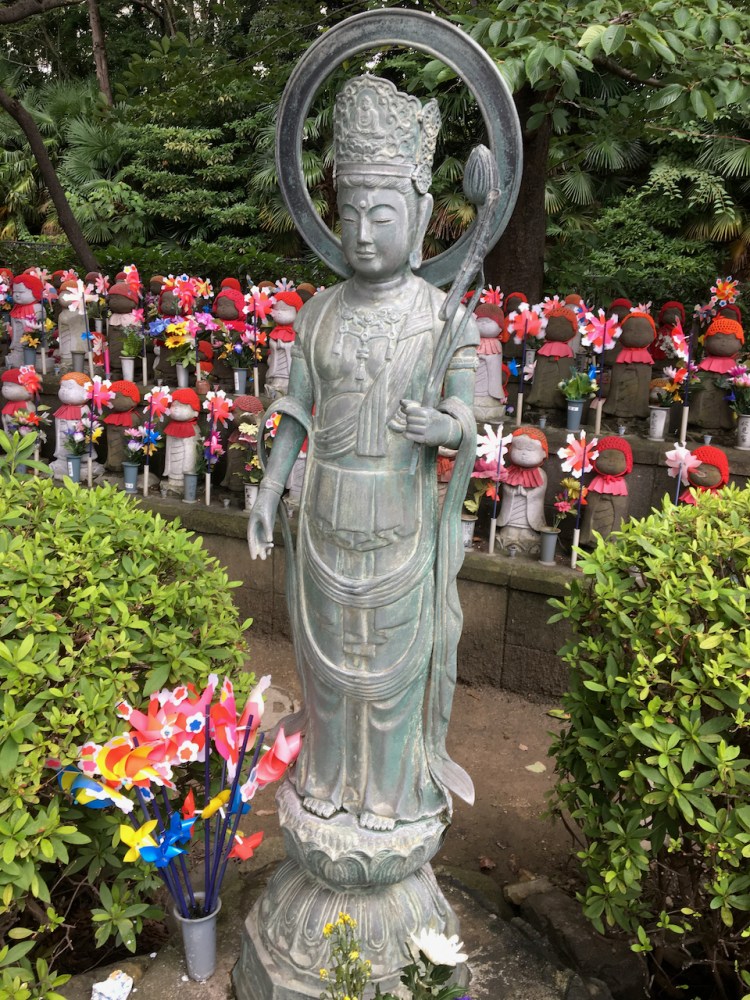
Thus, the Buddhist path is one that relies on rational thinking, not narcissistic beliefs. However, it is not limited to just rational thinking, and that’s why Mr Spock’s quote about “rational and beneficial” is so important. Consider the following Buddhist statue that I photographed in Japan in 2019 at Zojoji Temple (one of my favorites):

Here, the bodhisattva Kannon, is holding a lotus flower in one hand, while the other hand is down with two finger-tips touching. Buddhists statuary is replete with meanings and non-verbal symbols. The lotus symbolizes wisdom, and the potential for all beings to awaken, just as a lotus blooms from mud. The fingertips touching is another mudra meaning the “turning of the Wheel of the Dharma”, meaning to teach others and keep Buddhism going. The latter action, teaching the Dharma, helps sentient beings achieve awakening (i.e. the lotus), freedom from fear and wellbeing.

Hence, Kannon’s image here is a balance of both rational wisdom and compassion for all beings. Compassion not tempered by wisdom is irrational and can sometimes do more harm than good, while wisdom not compelled by concern for others is just dry scholasticism.

All of this is encapsulated in the 16th chapter of the Lotus Sutra where the Buddha says in verse:

My pure land is not destroyed,
yet the multitude see it as consumed in fire,
with anxiety, fear and other sufferings
filling it everywhere.
[…]
But those who practice meritorious ways,
who are gentle, peaceful, honest and upright,
all of them will see me
here in person, preaching the Law [the Dharma].

translation by Burton Watson

Part of the freedom from fear that comes from wisdom is the ability to see past the ups and downs of life, and see the bigger picture, to live a life that is gentle and peaceful towards others, and to maintain an upright life out of compassion for oneself.

None of this is easy, and requires years and years of practice, emotional growth, introspection, and willingness to take one’s own beliefs with a small grain of salt. It is a path that is not limited to Buddhists either, and there are plenty of Buddhists who don’t follow this path. What matters is not one’s affiliation to a religious org, but one’s willingness to live a life rooted in rationality and benefit for others. None of this can be accomplished by living in the paranoia and hostility, misinformation and sense of superiority that it brings from “not being a sheep” that comes with immersion in conspiracy theories

If you find yourself lost, scared, and confused with all the things going on in the world, take a moment and breathe. Turn off social media, go outside. Ground yourself in the world around you. If it helps, maybe recite the Heart Sutra a couple times (it is short enough you can chant it in about 1-minute) or the nembutsu. The life you live now, warts and all, is sustained by the goodwill of others around you, even if you don’t know who they are. Take a moment, and consider this, and maybe give something back to the world.

This is a long post, but I hope it helps others.

Namu Amida Butsu
Namu Kannon Bosatsu
Namu Shaka Nyorai

Yogacara Buddhism in Daily Life

Recently, I talked a little bit about an old, but highly influential stream of Mahayana Buddhist thought called Yogacara Buddhism (sounds like “Yogaachaara“) also known as “Conscious-ness Only Buddhism”. A lot of modern Buddhism that people practice now from Tibet to Japan is deeply influenced by Yogacara, even if not overtly aware of it.

Anyhow, in the previous post, I provided a very high-level overview of Yogacara Buddhism through an excellent book titled Living Yogacara: An Introduction to Consciousness-Only Buddhism, originally written in Japanese, but translated to English by A Charles Muller.

The book goes on to describe a more down to earth example of how Yogacara Buddhism describes the world:

We touch upon various things every day, meet various kinds of people, and are encountering various situations and events as we carry out our day-to-day living. At that time, it is quite natural for us to think that in regard to the objects of our mental functions of perceiving, thinking, and making judgments, that we are directly seeing, hearing, and making judgements in regard to this and that object. However, according to Yogācāra Buddhism, those cognized objects have already been colored and transformed by our minds in the process of their manifestation.

Page 10, translation by A Charles Muller

In the same chapter, the author uses the example of looking at a clock and recognizing that it is 7:30pm. The raw, digital output from the clock is internalized by our minds and interpreted as “7:30 in the evening” as the initial cognization, with follow up thoughts such as “oh, I am late” or “it’s time to get ready for bed”, and so on, as the followup stream of consciousness.

Elsewhere, Rev. Tagawa, also writes:

We lead our lives surrounded by all sorts of things. We annoyed, we may try to escape them by moving to the quiet and simple life in the middle of the mountains, but the fact of our being surrounded by many things does not change at all. As long as we are alive, there is no way that we can ever sever ourselves from our environment. In managing our daily lives, we have no recourse by to proceed while maintaining some kind of relationship with all those things that surround us. At such a time, there will always be things, people, and events. Rather than seeking to escape from them, what we need to do is examine the way we cognize these things, and the way we understand their content.

Page 11, trans. by A Charles Muller

This harks allllllllll the way back to one of the very earliest Buddhist texts, the Dhammapada, which is a collection of sayings attributed to the Buddha, wherein the opening lines are:

1. Mind precedes all mental states. Mind is their chief; they are all mind-wrought. If with an impure mind a person speaks or acts suffering follows him like the wheel that follows the foot of the ox.

2. Mind precedes all mental states. Mind is their chief; they are all mind-wrought. If with a pure mind a person speaks or acts happiness follows him like his never-departing shadow.

Translation by Acharya Buddharakkhita

Indeed, one cannot escape the mind or its mental states, regardless of whether one is in a mountain retreat, or stuck in the office. Buddhism is, first and foremost, a religion of the mind, not magical phenomena.

In the second Dune novel, there’s a quotation I think about sometimes think about at times like this:

The greatest palatinate earl and the lowliest stipendiary serf share the same problem. You cannot hire a mentat or any other intellect to solve it for you. There’s no writ of inquest or calling of witnesses to provide answers. No servant — or disciple — can dress the wound. You dress it yourself or continue bleeding for all to see.

Dune Messiah by Frank Herbert

In other words, we have to learn to live with ourselves and the environment around us somehow.

Namu Amida Butsu
Namu Shaka Nyorai

IDIC, Yo!

In the original Star Trek series (a.k.a. TOS), there’s an infamous episode1 in season 3 where Spock wears a new pin to symbolize the Vulcan philosophy of I.D.I.C., or “infinite diversity [in] infinite combinations”. Evidentially, it was Gene Roddenberry’s attempt at a cash grab by promoting a new product, but the catch phrase has taken on a life of its own in the Star Trek universe. You can see references to it in other Star Trek series, especially in the classic Star Trek: Deep Space Nine episode featuring a Vulcan baseball team.

To its credit, you get to see Spock sport a neat visor though…

The interesting thing about this philosophy, isn’t just the contribution it makes to the Star Trek universe, it has some interesting groundings in Buddhism as well.

Consider this phrase by the famous Indian Buddhist Nagarjuna (c. 150 – c. 250 CE):

sarvaṃ ca yujyate tasya śūnyatā yasya yujyate
sarvaṃ na yujyate tasya śūnyaṃ yasya na yujyate

All is possible when emptiness is possible.
Nothing is possible when emptiness is impossible.

Quoted from the book, Nagarjuna’s Middle Way, translated by Mark Siderits and Shoryu Katsura 

Much of Buddhism, especially Mahayana Buddhism, is grounded in the notion that all things, both concrete and abstract, arise through outside causes and conditions, and thus have a contingent existence. This is why all things are fluid, and constantly in flux. It’s also why, as Nagarjuna notes, that all things are possible.

Infinite diversity in infinite combinations, in other words.

1 Among the episode’s many other problems was the creepy way the male cast of the Enterprise are constantly talking about Diana Muldaur’s character’s beauty. TOS always had a problem with sexism, but this was over the top and creepy. It’s not a fault of the actors, just the terrible writing and direction that plagued season 3.

A Brief Introduction of Yogacara Buddhism

For this year’s fall Ohigan season, I wanted to provide a brief introduction to fascinating and highly influential school of thought within Mahayana Buddhism called Yogacara (as in “yoh-ga-cha-ra”), also known as “Conscious-Only Buddhism”.

I first encountered Yogacara Buddhism through a book that was translated from Japanese by Professor A. Charles Muller titled Living Yogacara: An Introduction to Consciousness-Only Buddhism. The book was written by head of the temple Kofukuji, Rev. Shun’ei Tagawa. Kofukuji Temple, a place I happened to visit in 2010, is one of the last temples in Japan of the once powerful Yogacara, or Hossō-shū (法相宗), sect in Japan. It once dominated political and religious thought in Japan until about 10th century, when it was increasingly eclipsed by the Tendai sect, while its political entanglements with the powerful aristocracy eventually led to its downfall.

However, the Yogacara tradition extends all the way back to when Buddhism flourished in India, starting with two half-brothers Vasubandhu and Asaṅga in the 4th century CE, who wrote the first treatises in the region of Gandhara (a place mentioned here, here, here), where modern Pakistan is now. It was one of the many innovations in Buddhism that happened in Gandhara that then traveled the Silk Road to China and beyond. The famous Chinese monk, Xuan-zang, who journeyed all the way back to India to collect more teachings was also a Yogacara monk. What we read and enjoy today is due to the efforts of all these monks and teachers.

But enough about history. What is Yogacara Buddhism?

Screenshots from Chrono Trigger, the iOS edition.

In the book, Rev. Shun’ei Tagawa bluntly summarizes the Yogacara teaching that reality is:

“nothing but that which has been transformed by consciousness.”

translation by A. Charles Muller

Further Rev. Shun’ei then quotes a famous poem that encapsulates the teachings:

JapaneseMeaning
手を打てばAt the clapping of hands,
鯉はえさと聞きThe carp come swimming for food;
鳥は逃げThe birds fly away in fright, and
女中は茶と聞くA maiden comes carrying tea —
猿沢の池Sarusawa Pond.
Translation by A Charles Muller
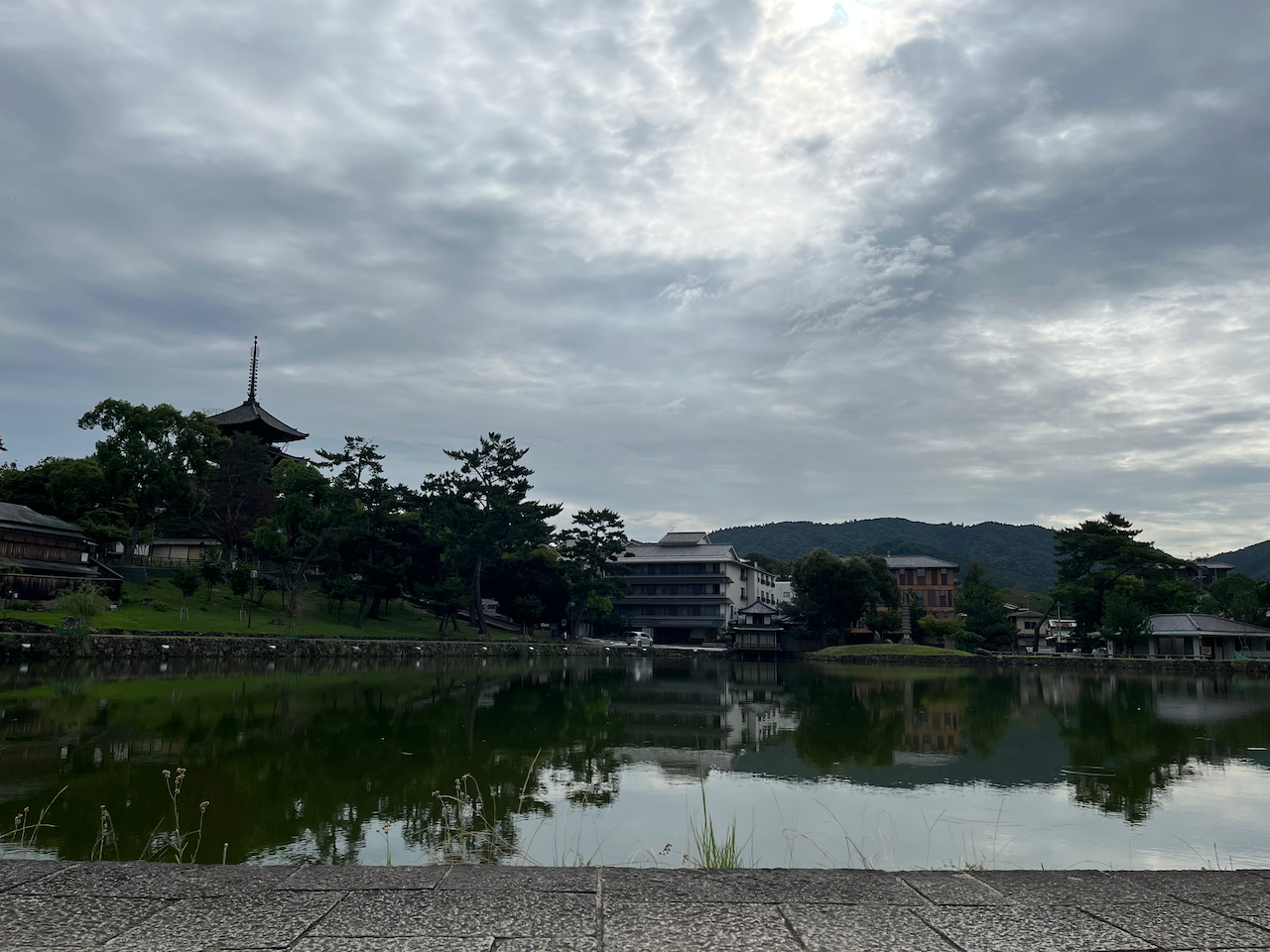
The famous Sarusawa Pond in Nara, Japan. Taken in July 2023. Kofukuji Temple can be seen to the left behind the trees.

The idea is that with a simple noise like the clapping of hands, each creature (or person) responds differently according to their background or how they view the world.

Using a more modern example from the book, imagine two people looking at a mountain together. One is a mountain climber, another is a painter. As a pile of rocks and magma formed by geological processes, a mountain is just a mountain. And yet, each person will perceive the mountain differently from one another. And such people will also interpret it differently than a goat on the mountain. It’s not a conscious effort either, it’s how our mind naturally works. Sort of a bubble of perception that we each live in, colored and reinforced by the constant feedback of our own thoughts, feelings and actions on the bubble’s inner surface.

Yet another example might be a fresh pair of jeans you bought and started wearing. Depending on what you do, or how you live your life, the jeans will absorb that. If you spend a lot of time in bars, your jeans start to smell like tobacco (or puke), if you work in a fast-food place your jeans smell like french fries, and if you visit Buddhist temples a lot, it will smell like incense. Your conduct, how you live your life and such, all play into a feedback loop that tends to reinforce itself, and in so doing “filter” your perception of the world. And this dynamic process is still ongoing every moment of your life.

Through this process, we also unknowingly isolate ourselves from the world around us, because, whether we are aware of it or not, we see ourselves as the center of the universe. This is why later Buddhist schools, such as the Zen Buddhists would use terms like the “mind as mirror” and such: what we perceive, we transform and filter in our conscious and project back out. We project ourselves back out onto the world around us all the time.

or, put another way…

What makes Yogacara Buddhist so fascinating is not just the concept, or its surface-similarity to Western philosophical ideas like Idealism, but how the early Yogacara Buddhists analyzed the “how” and “why” living beings do this, and further, how to apply this toward the Buddhist path toward liberation. Later Buddhist schools, I believe, applied Yogacara Buddhist teachings in their own ways, but the teaching remains more or less the same to this day even if couched in different language.

Anyhow, we’ve only scratched the surface here, but it’s a fascinating thing to look at, and hopefully I’ll be posting more content from Shun’ei Tagawa’s book.

Hope you’re all safe and well this Ohigan season, that the weather is pleasant, and you can take a moment to breathe easy and take it all in. Take care!

P.S. In the Chrono Trigger screenshots above, if you’re curious what the original Japanese text is (because you’re a big nerd like I am), it is:

あんたの目に見えてる世界とアタシの目に見えてる世界とはまったくちがうものなのかもね。

いい?宇宙の生命の数だけ存在するわ。見えるもの、さわれるものだけが本当と思っちゃダメよ。

The English translation is spot-on.

The Real Treasure Was Inside Us All Along

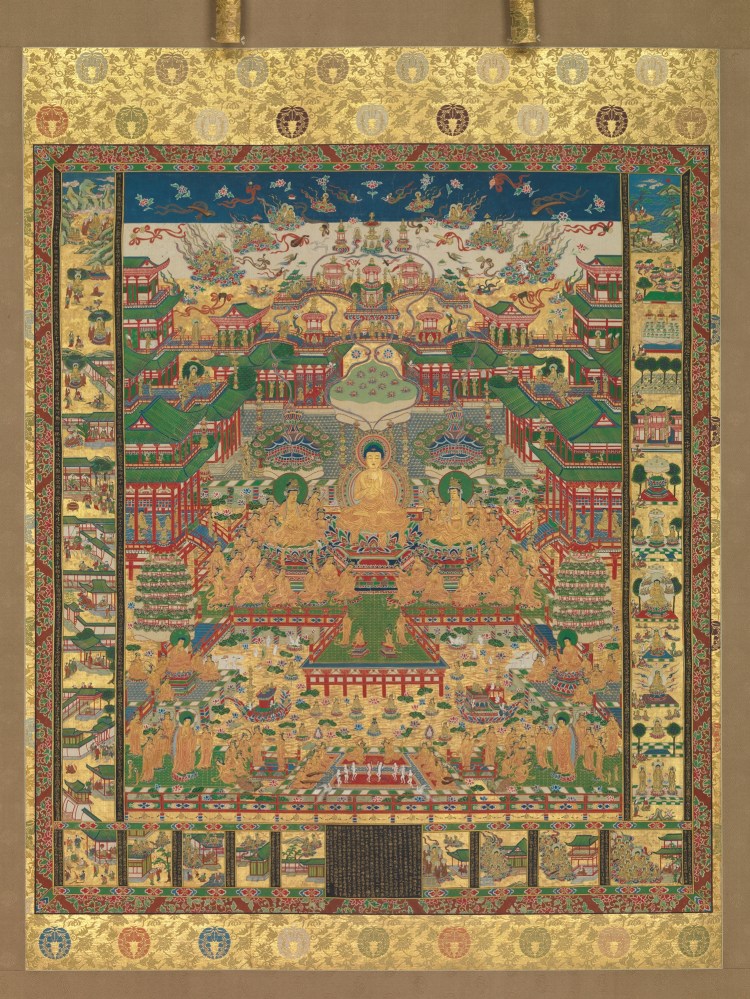
A reprint of the Taima Mandala, one of my favorite works of Buddhist art, with the Jodo Shinshu-sect crest at the top and bottom, Metropolitan Museum of Art, CC0, via Wikimedia Commons

Recently, I have been reading up on the Obaku sect (Ōbaku-shū, 黄檗宗) of Japanese Zen Buddhism: the same sect that Tetsugen was a disciple of. Obaku Zen is the third and last Zen sect to come to Japan to China, centuries after Rinzai and Soto were imported. Rinzai and Soto were both imported from China during the Song Dynasty. Obaku had the same lineage as Rinzai Zen, but was imported at the end of the Ming Dynasty, and had evolved over time to include some elements of Pure Land Buddhism, but with distinctly Chinese-Zen flavor.

In Japan, due to the Obaku sect’s common ancestry with the Rinzai sect, it was gradually absorbed administratively by the latter, but it’s arrival in Japan also reinvigorated Zen-monastic discipline. Soto and Rinzai sects frequently studied for a time at Obaku temple communities.

Obaku Zen, though small, still retains its more Sinified liturgy (sutra recitation is pronounced in a more more Chinese, less Japanese, style) and integration of Pure Land teachings.

For example their temple homepage lists an interesting excerpt from an earlier publication about the meaning of the Pure Land of Amitabha Buddha in a Zen context. What follows is the original excerpt, plus my rough translation:

この世で実在するのは心だけであり、総ての事物、現象は心の働きによって仮に現れたものであるとする「唯心」という考え方に基づけば、「浄土」も心の中にある。即ち自分自身の身こそが阿弥陀仏なのである。

If we take this world that exists as none other than Mind only, such that all of its affairs, its phenomenon, and such all depend on the movements of the Mind, and thus are “Conscious-only”, then the “Pure Land” is that which dwells in the heart. That is to say, Amitabha Buddha is this very self.

from「己身」の「弥陀」 (“Amitabha Buddha of the self”) from 黄檗宗青年僧の会発行「黄檗」(“Obaku Zen young monk’s periodical ‘Obaku'”)

To borrow that 1980’s cliché found in every Saturday morning cartoon: the real treasure was inside us all along.

The term “Conscious-only” or yuishin (唯心) is the Buddhist term for the Yogacara Buddhist school of philosophy, which taught that all things we perceive, think and feel are ultimately projections of the mind itself. It’s a subject that is super fascinating and far beyond the scope of this post, but important to understand that the Yogacara tradition of Buddhism has had a huge influence on Buddhism at large. I highly, highly recommend the book Living Yogacara: An Introduction to Consciousness-Only Buddhism if you’d like a general overview of Conscious-only Buddhism. It is a book that I come back to every now and then.

In any case, this concept of the Pure Land as the mind only might seem far-fetched given the overall trend, especially in Japanese Buddhist history, to focus on Amitabha Buddha and the Pure Land as separate, external entities. However if you’ll recall, the Chinese monk Ouyi who also lived in Ming Dynasty promoted a similar outlook:1 that in the end the real Pure Land was our Mind, and yet it’s perfectly fine to continue practicing Pure Land Buddhism as if it were external.

You might even say that the real bodhisattvas we encountered were the friends we made along the way. 🤪

Namu Amida Butsu

1 It’s tempting to argue that the Zen traditions of Soto and Rinzai that came to Japan earlier are more “pristine” than the later Obaku tradition, but I think that’s it’s a highly romanticized view of the past. Further, it’s important for religious traditions to “till the soil” from time to time, innovate and such. We can’t recreate the original 5th Century BCE community of the Buddha and his direct disciples, nor can we recreate the early Zen traditions in China and so on. We can learn from them, and keep innovating as time goes on. Later Zen tradition in China probably reflected continuous innovation as it vied with other schools of thought: Confucian, Taoist, other Buddhist schools, etc.