The Contradictions of Organized Religion

This post was inspired by a recent play-through of Fire Emblem: Three Houses and contains spoilers to the game.

In addition to the main plot, Three Houses contains a lot of subtle side-stories and hidden lore that players discover as they explore the monastery. For example, the game strongly hints that the official history of the Church of Seiros is a fabrication used to obfuscate the real history of Lady Rhea the archbishop.

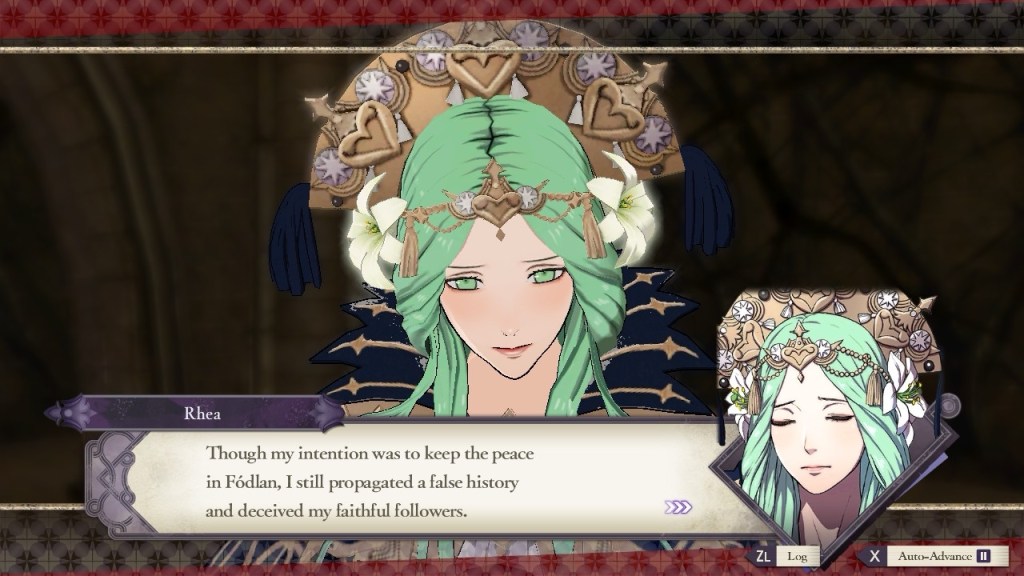
Lady Rhea doesn’t just venerate Saint Seiros (pictured above); she is Saint Seiros disguised for countless eons. The game, especially in the Silver Snow route, also reveals her divine dragon ancestry, the real source of the holy relics (remains of her siblings), and hints that other saints, namely Seteth (Saint Cichol) and Flayn (Saint Cethleann) are still alive after all these centuries, hiding their identities even as they manage the church.

Rhea/Seiros fears a repeat of a terrible massacre of her loved ones by humans centuries ago. Thus, she uses the Church to keep the peace, obfuscate the past with false narratives, suppress dissent, manipulate the governments of Fódlan, and (in a less cynical sense) gives the masses something positive to believe in: the goddess Sothis, her mother.

Rhea’s actions, like Lady Edelgard‘s, are morally grey in that they are driven by sincere desires to address the evils of society, but through questionable means.1 Good intentions lead to controversial decisions that nevertheless become church canon over the centuries.

It’s not hard to see the relevance of this toward real-world organized religions. 

Organized religion is not, of course, being manipulated by divine dragon beings (presumably). However, seeing as how church official history can obfuscate unpleasant aspects of the past, one can’t help but wonder how many such inconvenient truths that we’ll never know about have been smoothed over and polished for the sake of unity and peace.

Further, is an inconvenient truth better than a convenient lie? This answer isn’t so easy.

This is where the inherent contradictions of organized religion come into play: humans tend to manipulate and corrupt religious teachings in order to further an agenda, often with well-meaning (or at least benign) intentions. And yet, in spite of this cynical view, organized religion is necessary to preserve and carry on teachings across generations. Thus, followers often have to make the best of an awkward situation.

Everyone in their own personal religious path has to try to resolve these contradictions and try to put teachings into practice as best they can. Or, like Edelgard, throw them out completely and expose the hypocrisy. This latter choice entails conflict, and worse: the risk of simply replacing one convenient lie with another more suited to one’s preferences if they are not careful.

Anyone who says religion is easy is either wrong or trying to sell you something.

1 Further in Three Houses, Rhea and Edelgard’s intentions are irreconcilable, mutually exclusive, and in the end one of them must destroy the other, hence the tragedy of the whole story.

Self Doubt

Alternate title: What Would Tuvok Do?

Self doubt is something we may all face from time to time. For me, it hits hard when I have made a mistake, and it’s hard to shut off the negative thought process once it starts up.

The origins of this self-doubt are not that important, though. I have my theories, but it doesn’t really matter. What matters is what self-doubt does: it creates false assumptions, and cripples decision-making. One might say, it’s all in the mind.

Tuvok, as portrayed by Tim Russ.

During a recent rewatch of the Star Trek: Voyager,1 I really enjoyed Tim Russ’s character Tuvok, the Vulcan security officer. Tim Russ is a great actor, and I appreciate his portrayal of Tuvok, and especially Tuvok’s level-headed approach to situations. In the same way, Spock as played by Leonard Nimoy did the same thing in the original Star Trek series.

When Tuvok is faced with a difficult situation, and the rest of the crew (esp. Neelix) panics, he tends to remain calm, and analytical. He assesses the situation rationally.

Tuvok and Neelix (played by Ethan Phillips).

I think that’s the secret to overcoming self-doubt. Self-doubt, believe it or not, is rooted in a kind of conceit, or self-centeredness, even when it’s a negative form of conceit. Trying to counteract with self-love or self-affirmation just replaces one form of conceit with another. It’s not necessarily wrong, but kind of defeats the point.

In the same way, when I feel myself slipping into another death-spiral of self-doubt, lately I try to take a deep breath and do what Tuvok (or Spock) would do: calmly assess the situation and be rational. I am not the center of the Universe. The whole world is not judging me. If I’ve made a mistake, I need to analyze it, and correct it. If I am not at my best, I need to step back and reassess.

We can see a similar sentiment in an early sutra in Buddhism.

The Buddha “What do you think, Rāhula? What is a mirror for?”

Rāhula: “For reflection, sir.”

“In the same way, Rāhula, bodily actions, verbal actions, & mental actions are to be done with repeated reflection.

The Ambalaṭṭhikā Rāhulovāda Sutta (MN 61), translation by Thanissaro Bhikkhu

The trick is to be aware first and foremost that I am slipping into self-doubt again. This kind of mindfulness is the underpinning of Buddhism, and we can all learn to be a little self-aware. It never hurts to stop and “check in on yourself” from time to time, even during good moments. Further, the Buddhist practice of repentance is a time-honored for reflecting on your own actions in a scientific, analytical way, rather than flogging yourself.

So, in other words: CTFD.

Namu Shakamuni Butsu

P.S. More on the mind as a mirror.

P.P.S. As much as I love Leonard Nimoy as Spock, I am glad to see the Vulcan cast expanding over time: Tim Russ as Tuvok, Ethan Peck as Spock in Strange New World, Jolene Blalock as T’pol and so on.

1 Voyager was on when I was a college student so I watched from time to time, but I never loved the show the way I did Next Generation. Plus, the show has a number of inside references that are important, but if you only watched occasionally, you missed them. Rewatching again was great, though season 2 in particular was weak. Season 3 onward was amazing.

Tolerance

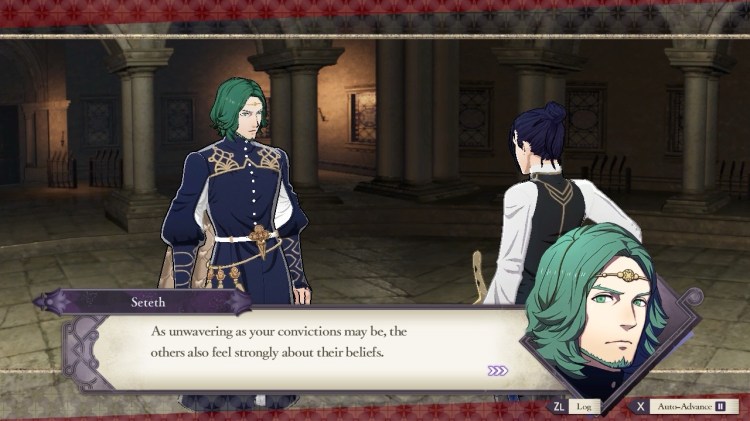
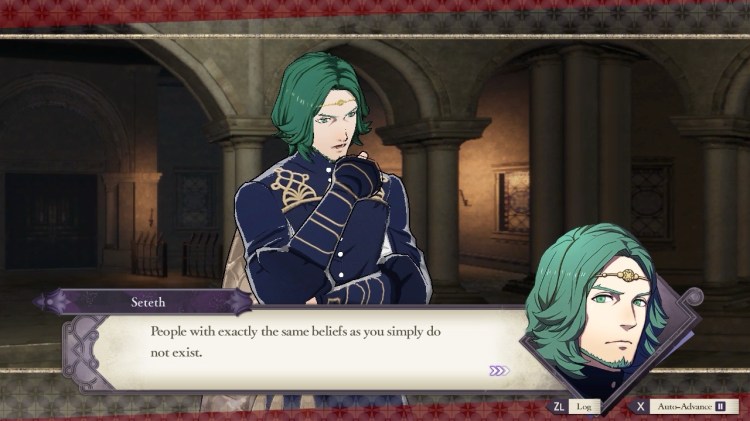
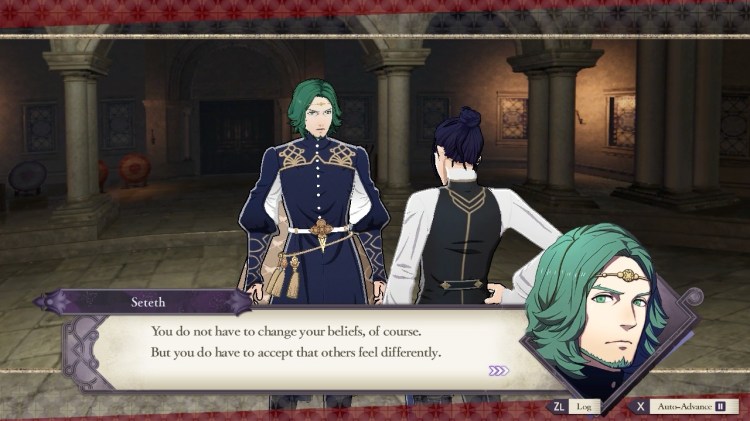
I thought this was a neat dialogue between two of the characters in the game Fire Emblem: Three Houses. The older Seteth (green hair) is offering some advice to the young and prickly Felix:

This might seem self-evident, but because we only see the world through our own viewpoint, our own thoughts and experiences, it’s easy to forget that other people have other viewpoints and other experiences, and come to their own conclusions, right or wrong.

Different game, but I hope the sentiment makes sense. 😆 It’s also why Buddhism emphasizes unconditional goodwill so much.

Namu Amida Butsu

Mental Health and Fire Emblem

Since I started playing Fire Emblem: Three Houses, I have been continuously impressed with how well-written and relatable the cast of characters is. But there’s more to it.

Early in the story, when you first meet the other characters and students, many come off as quirky, annoying or just mean. However, as you progress in the game and get to know them through dialogues (e.g. “supports”), you learn more about why they are the way they are. Why is Dorothea such a good-digger? Why is Felix such a jerk? Why is Marianne so gloomy, Lysithea a workaholic, Sylvain a womanizer, and so on.

What you learn over time is that many of these characters, even the more stable ones, have some kind of personal trauma or persistent fear that’s driving their lives. Some characters have more crippling mental health issues, while some just hide their pain better than others.

After playing through a game like this, it’s not hard to see that many people around you are almost certainly suffering from some past traumas or persistent mental health problems. The degree or nature of that problem is different for each person, and some people hide it better than others, but I bet if you scratch the surface you will see it.

Of course, this applies to ourselves too. Past traumas, emotional pain and lingering, persistent mental habits color our behavior on a daily basis.

I grew up as the eldest son of a single mom in a conservative community in the 1980’s, and experienced plenty of bullying and ostracism as a result, while trying to grow up fast and help the family.1 I have no doubt this colors my behavior today. Seeing my grandmother dead from cancer at age 57 on the hospital bed two days after Thanksgiving in 1990 still comes back to me every November.

But there’s more to this.

As the game progresses, and through increased interaction, many of the characters open up about their pain and trauma to others and from this they find kindred spirits, or they gain new perspectives. It doesn’t erase the past, but oftentimes it helps them find closure, or get the support they needed.

In Buddhism, we revere the Sangha (the community) as one of the three treasures, along with the Buddha (teacher) and the Dharma (the teachings). The Sangha is essential in Buddhism because people can’t do it alone. The Buddha recognized from the beginning that people need one another, and can support one another.

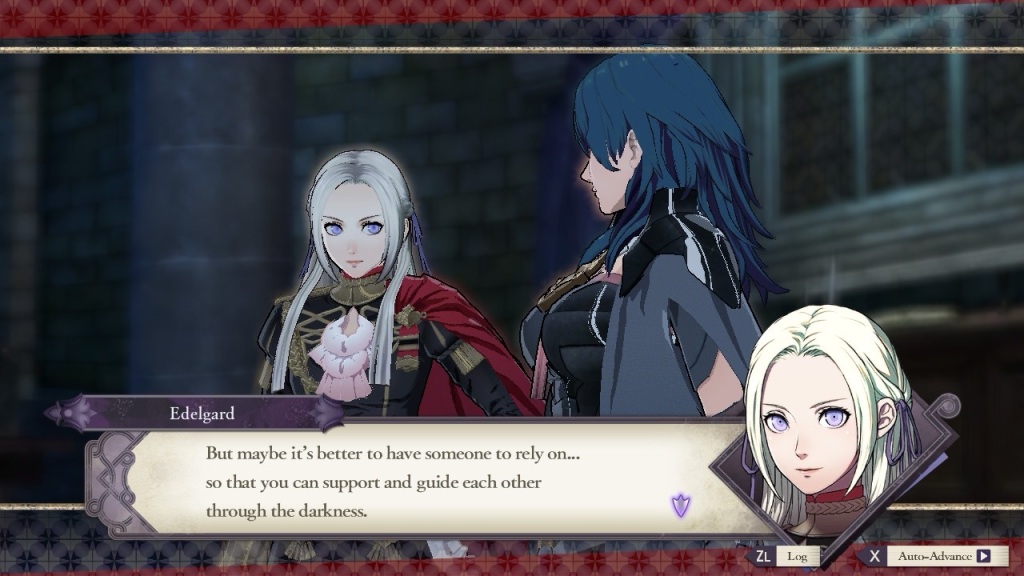
I love how Edelgard may appear as a villain at first glance, but then there are moments like these…

Even when the Sangha has its fair share of dickheads and scallywags, the mutual support people offer one another is part of the therapy that Buddhism offers. This isn’t limited to Buddhism, by the way; one can find solace in any religious community. My other grandmother was a devout Lutheran and would go to her local church every Sunday for many years.

It’s just that Buddhism overtly recognizes that everyone suffers from mental health problems on some level, which are given fancy terms like kleshas in Sanskrit, or bonnō in Japanese, but also that there aren’t easy solutions. It’s a long slow process, and it requires a mutual support network.

It’s scary to share one’s pain with others, or even with yourself,2 but it can really take a heavy load off you, and help provide new perspectives. You don’t have to force it either. As you spend time with others, people naturally start to open up over time. There’s no magic here, it’s just simply that people need one another, and this is how we find peace and wellbeing.

Namu Amida Butsu

1 a little bit like Jonathan Byers in Stranger Things, minus all the weird extra-dimensional stuff. Maybe. 😋

2 sometimes a personal journal or an anonymous blog can really work wonders.

Ignorance

More than faith, or doctrine, or anything, the notion of ignorance in Buddhism is of central importance. It is the root of all evil, so to speak. However, ignorance in Buddhism doesn’t mean stupidity. Very smart people can be ignorant. Ignorance has nothing to do with intelligence, it has everything to do with perception.

Each being born into this world is born under specific conditions and circumstances. Those circumstances color our world, from who our parents are, our culture, the language we speak by default, religious beliefs, and so on. Further, these circumstances influence how we react to new things, which develop into further lines of thoughts, choices, and so on. Rinse and repeat.

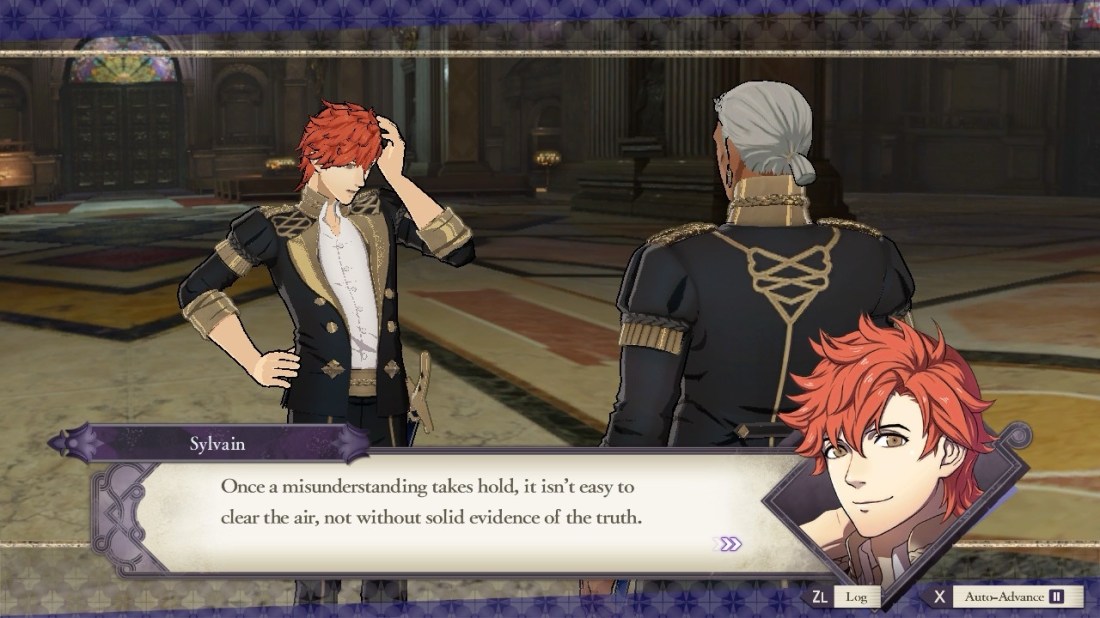
As the screenshot from Fire Emblem: Three Houses above shows: small misunderstandings take hold and are hard to undo.

There is a classic story in India, common to various religious traditions including Buddhism. In the story, a monk is wandering out late night through a grassy field to use the restroom, and steps on a snake. He panics, faints and then falls over unconscious. The next morning he wakes up, and realizes that he stepped on an old piece of rope, not a snake. He was certain at night, based on limited information, that he had stepped on a snake, but his perception was flawed and he drew an incorrect decision.1

Even if consider ourselves wise, and “know better” than others, we have to stay vigilant at all times. Little mistakes in understanding can lead to painful consequences.

I recently got mad at someone during an online game when I thought they were showing off. I was sure they were flaunting their victory in my face, and was pretty cranky all day until I reviewed the game and realized that I had misunderstood their last play. Once I realized that, I knew right away I was in the wrong, but I couldn’t undo the grumbling, anger, and ruined day. That quick half-second misunderstanding cost me a day. Fights with spouses or partners often start like this. Wars between two countries or two ethnic groups start like this.

Ignorance also comes in the form of overconfidence in one’s understanding of the world. A sense of self-satisfaction.

The first step in avoiding a trap, is knowing of its existence.

–Dune (1984)

There is no quick and easy solution in Buddhism for this. Knowing what ignorance is, and how insidious it is, and how easily we as functional adults can otherwise get duped by it is a step. Vigilance into one’s own thoughts, words, and actions is essential.

Namu Amida Butsu

1 Similarly, the Buddha described grasping Buddhist doctrines properly as similar to grasping a viper. If done improperly, it can cause much harm.

Not So Common Sense

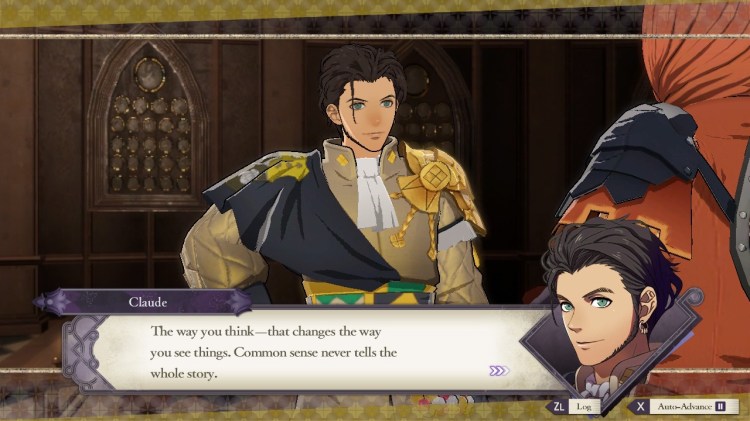
After finishing the game Fire Emblem: Three Houses, I am playing through again, but this time through the Golden Deer house,1 and I stumbled upon this amazing quote by one of the characters, Claude:

Claude is a particularly insightful character in the game (and probably one of the coolest), but this statement really sounds Buddhist to me, especially if you are familiar with Yogacara Buddhism, or the concept of mind as mirror.

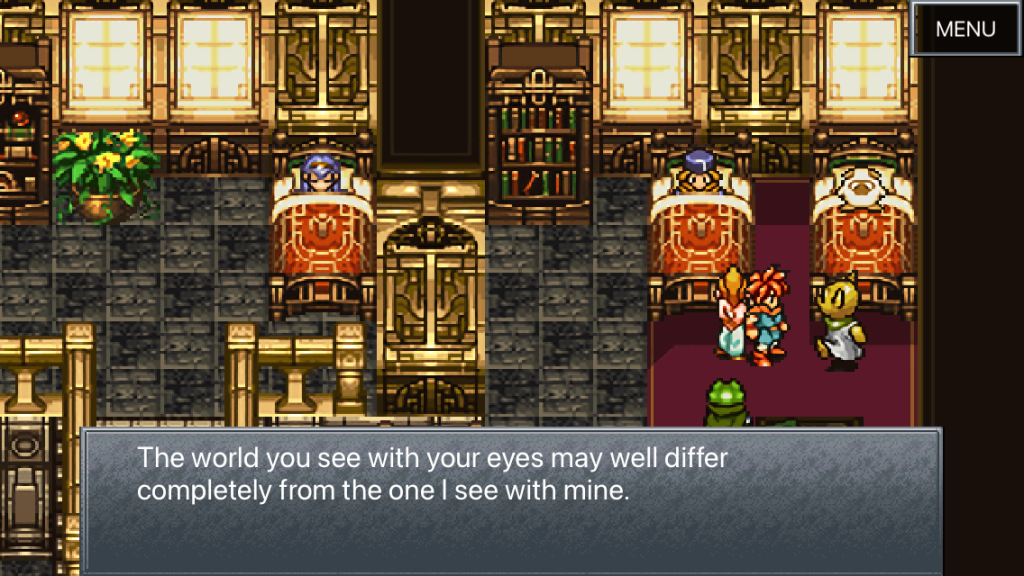
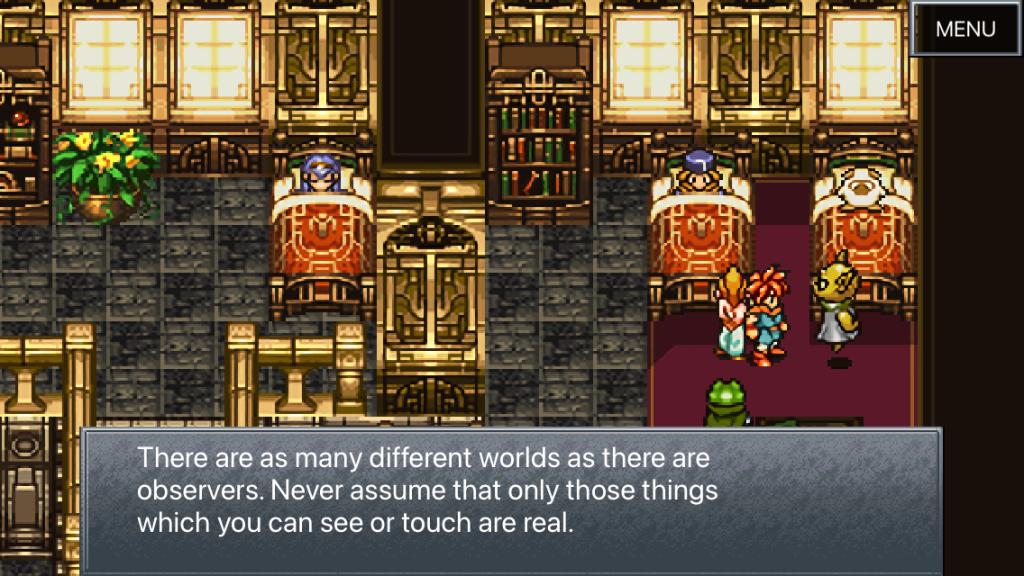
It also reminds me of that quote I posted previously from Chrono Trigger:

Speaking of Fire Emblem: Three Houses, I have really enjoyed how diverse and well-written the characters are. With each path, the characters start out pretty different, but in time they learn to understand one another as your teamwork builds up, and in spite of their different viewpoints, they learn to work more closely together, sometimes even romantically. They don’t necessarily agree with one another, but they learn to co-exist at the very least. That’s not an easy thing to do, but I believe it’s the emotionally mature thing to do.

In any case, I think what matters is learning to appreciate how one-sided your own viewpoint is, even when it feels like “common sense”.2

The choices you make, the lifestyle you choose then to create a feedback loop that reinforces your own view of the world, and this in turn skews your thinking more and more to one viewpoint. It’s an easy thing to say, but hard to notice in oneself. You don’t have to throw it all out, but never be afraid to question your own assumptions.

Since this is also the start of the Juya season in the Jodo Shu tradition, best wishes to you all!

Namu Amida Butsu

1 previously Black Eagle house. Edelgard is controversial, but that lady was amazing. I got a little choked up at the end.

2 even the Buddha called this out in the famous Kalama Sutta.

The Rise and Fall of the Fujiwara

In our recent visit to Kyoto, the ancient capitol of Japan, we also took a day to visit the city of Nara, which is an even earlier capitol. Downtown Nara has several highlights but two of them are the Buddhist temple of Kofukuji, and the Shinto shrine of Kasuga-Taisha (“Kasuga Grand Shrine”). Kofuku-ji Temple is one of the central temples of the once powerful Hosso sect, and Kasuga Grand Shrine is a famous shrine within Shinto religion,1 and hosts a primeval forest that has been untouched since antiquity. I might post more photos of each later.

The famous Sarasawa Pond with Kofukuji Temple on the left. Taken in July 2023.

What makes these two sites important is that they were both tied to the powerful Fujiwara Clan.

During the Nara Period of Japanese history, the Fujiwara were just one of several noble houses that supported the Imperial family. Back then they were called the Nakatomi (中臣) Clan. During a power-struggle between the Imperial family and the Soga clan, one Nakatomi no Kamatari (614 – 669) came to their rescue and helped defeat the Soga. Thereafter, the Imperial family relied on Kamatari to help reform and strengthen the government. The Nakatomi earned the clan name Fujiwara later under Emperor Tenji. So far so good.

However, starting with Kamatari’s son, Fujiwara no Fuhito (who also helped compile the Nihon Shoki), the clan gradually began to monopolize key positions, increasingly through inter-marriage with the Imperial family. By the 12th century, every member of the Imperial family married members of the Fujiwara clan, over and over, generation after generation. This allowed the head of the Fujiwara to assume the role of “regent” (sesshō, 摂政) to his offspring who were children on the Imperial throne, when switch to “chief advisor” (kanpaku, 関白) when they were old enough to rule on their own. That same advisor could also force the Emperor to abdicate to their son (whose mother was also from the Fujiwara clan) when necessary, allowing the same official to be regent to their grandson.

Further, by holding key government positions, the Fujiwara could also manipulate property laws on their private holdings in the provinces, increasing personal revenue. The Fujiwara were not the only noble houses to do this, even the Imperial family did it, but through their connections and influence, they profited immensely from the untaxed revenue of their lands.

With this increasing power and wealth, the Fujiwara sponsored a number of building projects. One of these was Kofukuji Temple, which was sponsored by the Fujiwara as far back as 669, but with its increasing connections to the Fujiwara, the building complex greatly increased in size and wealth.

Further, the family Shinto shrine of Kasuga Taisha prospered:

But the price of all this interconnectedness between the Fujiwara and religious establishments came at a cost. The religious institutions became extensions of Fujiwara power, with clan members given key positions locking other people out,2 and fielding armies of warrior monks against other rival temples.

By the time the system collapsed, the Fujiwara’s power began to diminish. Kofukuji Temple was largely burned down,3 and the original clan had become so large that it gradually broke up into five different clans, each one marrying with the Imperial family as needed:

JapaneseRomanizationFounded
近衛Konoe12th century
鷹司Takatsukasa1252
九条Kujō1191
一条Ichijō13th century
二条Nijō1242

Some of these new clans, especially the Kujō, even assumed positions of power with the new Kamakura shogunal family after the untimely death of Sanetomo, the 3rd shogun. Further, by the 19th century, with Westernization of Japan (e.g. the Meiji Period) the Five Regent Houses all became merged into the Western-style “peerage“, but by 1945, now hundreds of years since their founding, the five regent clans were finally abolished for good with the post-World War II reforms of the Imperial system.

In any case, after the 12th century, the centers of power had since moved. Kofukuji Temple, having been burned down in various conflicts, never quite rebuilt its power. Newer forms of Buddhism had taken root, and new centers of religious devotion had arisen. Kasuga Taisha grand shrine, being located in Nara, was now remote as the capitol had moved further and further east. When I visited Kofukuji Temple in 2010, and again this year (2023), some things had changed. The central Golden Hall (中金堂, Chū-kondō), had finished reconstruction for the first time in centuries. But even now, many of the original buildings have not been reconstructed.

Throughout Japanese history, the Fujiwara clan maintained prestige for centuries, but actual power continued to slip from their grasp bit by bit after the 12th century, and these historical relics in Nara are shadow of their former selves, and of Fujiwara power.

1 People are often surprised to learn that Japan has essentially two religions: Buddhism which came from India (via China), and Shinto which is the native religion. The two have been pretty intertwined culturally for centuries. It’s a long story.

2 Some of those who were excluded went on to found other Buddhist sects later partly out of disillusionment with the establishment.

3 Quite a few temples burned down in times of war, not just Kofukuji. Todaiji also burned down many times, as well as Enryakuji on Mt Hiei, among others.

Practical Buddhism

Recently, I’ve been reading some old books of mine about the life of Honen, a 12th century Japanese-Buddhist monk who started the Pure Land movement in Japan which includes Jodo Shu and Jodo Shinshu Buddhism. Honen had a pretty eclectic following: from nobility in the elite Fujiwara family, to prostitutes, ex-monks, etc.

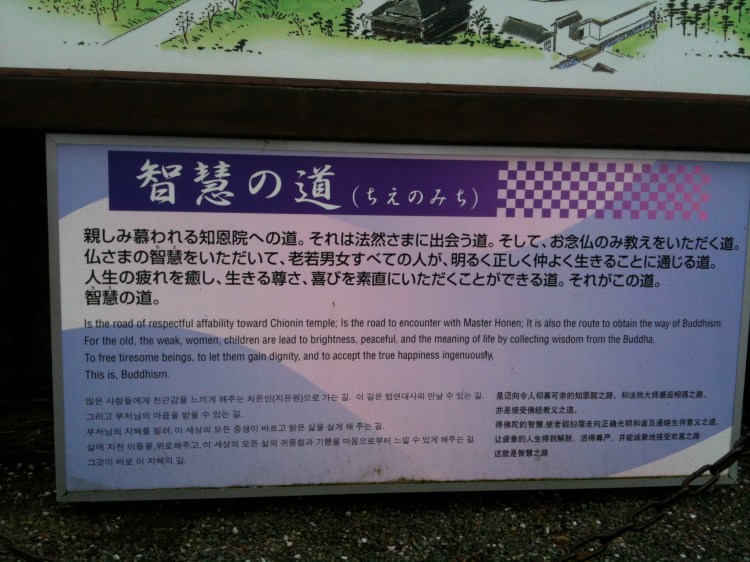
Taken in 2010 at Chion-in Temple in Kyoto, Japan, this is one of two head temples of Jodo Shu, and where Honen’s mausoleum is said to be. This was a sign posted near the main gate.

In one famous dialogue, Honen is talking with a former robber named Amano Shiro (天野四郎), who had previously been a leader of a gang in Kawachi Province and had reputedly killed some people as well. In his old age, he became inspired by Honen’s teachings and became a devout follower named Kyo Amidabutsu (教阿弥陀仏). One night, while staying with Honen, Kyo Amidabutsu had woken up in the middle of the night to hear Honen reciting the nembutsu by himself. When Honen realized he was no longer alone, he quietly went to bed.

A few days later, Kyo Amidabutsu went to talk to Honen. He had no family to care for him in his old age, and so he would be leaving soon to stay with a friend in a remote province in the east. Before he would leave though, he had some questions for Honen.

In the dialogue, as recorded in both Honen The Buddhist Saint and Traversing the Pure Land Path, is pretty long, Honen carefully explains what the nembutsu is all about, and patiently answers Kyo Amidabutsu’s questions. For example, Honen explains the significance of the nembutsu:

First of all, notice that there is nothing so extremely profound in the nembutsu at all. The only thing to now is that everyone who calls upon the sacred name [namu amida butsu] is certain to be Born into the Pure Land. No matter how educated a scholar may be, he has no right to assert that there are things in our school [e.g. Pure Land Buddhism] which really do not belong to it.

Page 61-62, “Traversing the Pure Land Path”

Here, Honen is trying to counter some of the other Buddhist schools at the time, which tended to emphasize a more esoteric, intellectual meaning, something that would require considerable time and effort for a monk to discover through practice, esoteric initiations, and meditation. Kyo Amidabutsu, as an elderly commoner in the 12th century, would probably had a minimal education, and thus would’ve found all that intimidating, assuming that he could even take tonsure and become a monk.

I really like the fact that Honen is not hitting Kyo Amidabutsu over the head with a bunch of doctrinal explanations about the Four Noble Truths, Karma, Rebirth, etc., either. Instead, he’s providing a simple, straightforward path with no hidden, mystical or esoteric meanings. It’s not that these aren’t important, but Buddhism is first and foremost a religion of practice, not belief, so these can be learned gradually.

Next, Kyo Amidabutsu asks a series of questions about when is it the right time to recite the nembutsu, whether to setup an altar, wear clerical robes, etc. Honen’s reply is similarly straightforward:

The nembutsu may be practiced whether you are walking, standing, sitting, or lying [down]. So it can be left to everyone according to their circumstances to do it either reclining or sitting or in any way they choose. And as to holding the rosary or putting on the robes, this also should be decided according to circumstances. The main point is not the outward manner at all but the fixing of the mind on the one thing — firmly determined to gain ojo [往生, rebirth in the Pure Land] and with all seriousness calling upon the sacred name [namu amida butsu].

Page 65-66, “Traversing the Pure Land Path”

This sense of sincerity is the key, as Honen teaches. For Kyo Amidabutsu’s sake, he uses an analogy of a thief who means to rob a house:

“Down deep in his heart [the thief] means to steal, but as far as his outward appearance is concerned, he gives not the slightest indication to others of his purpose by look or gesture. As others know absolutely nothing about the purpose to steal that is in his heart, we may say that the purpose is for him alone, without any reference to outward appearance. Such an undivided heart as this is necessary in the man who would make sure of birth into the Pure Land [of Amida Buddha].

Page 63, “Traversing the Pure Land Path”

In my limited experiences talking with people who are curious about Buddhism here in 21st Century America, I often notice that they are curious, but don’t know where to begin, and find it a bit overwhelming. Buddhism is hard to explain, and yet most of that information isn’t necessary upfront either. If people want to know more, they can (and will) ask. Instead of hitting people over the head with a bunch of esoteric, mystical or complicated psychological explanations, it’s probably better to just KISS: Keep It Simple, Stupid.

Buddhism isn’t meant to be an intellectual playground for the upper classes, it’s meant to help people from all walks of life. Everyone should feel free to begin the Buddhist path just as they are, and go at their own pace, using the tools they have.

Honen was sensitive to Kyo Amidabutsu’s situation and provided a straightforward, simple practice that provides both a sense of spiritual comfort, but also something very flexible and adaptable to his circumstances. Kyo Amidabutsu is old, has no kin, financially broke, and has no where to live. He probably doesn’t even know when he might eat next, or where he might sleep next. So, it has to be something that can be adapted to his existing lifestyle, and straightforward (not esoteric) enough that it is easy to understand yet provides a sense of refuge in a chaotic world. It may be looked down upon by more “elite” Buddhist followers, but for Kyo Amidabutsu, it’s just right.

Indeed, in founding the Jodo Shu sect, Honen reportedly once said:

The reason I founded the Jōdo [浄土, Pure Land] sect was that I might show the ordinary man how to be born into the Buddha’s real land of recompense [e.g. the Pure Land]. According to the Tendai sect, the ordinary man may be born into the so-called Pure Land, but that land is conceived of as a very inferior place. Although the Hossō [Yogacara] sect conceives of it as indeed a very fine superior place, they do not allow that the common man can be born there at all. And all the sects, though differing in many points, all agree in not allowing that the common man can be born into the Buddha’s land of real compensation….Unless I start a separate sect, the truth that the common man may be born into the Buddha’s land of compensation will be obscured, and it will be hard to realize the deep meaning Amida [Buddha]’s Original Vow [to provide a refuge for all beings].

Honen: The Buddhist Saint, page 23-24

For this reason, I come back again and again to Jodo Shu Buddhism over the years because even when I quibble about specific details, it’s accessibility, and simple message is pretty hard to beat within the Buddhist world. It meets the needs of all walks of life, and does not overwhelm people with philosophical details, yet it also provides plenty of flexibility to grow and learn as well. I feel this is an exemplary example of Buddhist metta if nothing else.

Namu Amida Butsu

Cutting Losses

Recently, I was reminded of this old sutra from the Pali Canon, the Gotami Sutta (AN 8.53):

“As for the qualities of which you may know, ‘These qualities lead to dispassion, not to passion; to being unfettered, not to being fettered; to shedding, not to accumulating; to modesty, not to self-aggrandizement; to contentment, not to discontent; to seclusion, not to entanglement; to aroused persistence, not to laziness; to being unburdensome, not to being burdensome’: You may categorically hold, ‘This is the Dhamma, this is the Vinaya, this is the Teacher’s instruction.'”

Translation by Ven. Thanissaro Bhikkhu

I’ve always liked this simple, straightforward benchmark of the Dharma. It reminds me of a quote by a Zen master many centuries later (quoted here originally):

This old man [himself] has spent more than thirty years in the rinka [monasteries], sitting in Zen meditation, quietly withering away my desires, without expectations for the morrow. When hunger comes, I eat. When the time comes, I sleep….The present does not persist. The past and future do not exist

Sōtō Zen in Medieval Japan by William M. Bodiford

One of the advantages of old age is perspective, and (ideally) not getting hung up on the ups and downs of life as much compared to our youth when everything is fresh and raw. Being able to approach life through equanimity and goodwill, not being tossed about by the Eight Winds is a great gift for oneself and others.

Of course, many older people are in fact the opposite: childish, petty, and irrational too. The older one gets, the more social filters break down and their true nature reveals itself. Similarly, I still have plenty of petty and mean days myself, but looking back, I do feel the Buddha-Dharma has helped smooth at least the roughest edges over time.

That’s why, as the Buddha and the Zen teacher both show, training in the Buddha-Dharma is so useful. Setting good habits and healthy perspectives sooner than later will gradually pay off over time, like a good investment.

The more you invest, and the sooner you invest, the better.

Namu Amida Butsu

P.S. I do have certain reservations about Thanissaro Bhikkhu’s rather conservative approach toward women’s ordination in Buddhism, but that’s not to deny his positive contributions as a translator. I’d call it a “professional disagreement”, except of course I am just a layperson and not a bhikkhu. 😅

P.P.S. Unlike the last two posts, this is a new one, not a re-post. 😎

Hosso Yogacara Buddhism and the Five Natures Doctrine

Throughout the history of the Hossō Buddhist sect in Japan, descended from the Yogacara school of thought from India, no one doctrine has caused more controversy or sparked debate with other schools than the Five-Natures Doctrine, or goshō kakubetsu (五姓各別). I don’t necessarily endorse nor criticize this doctrine myself, but I am a big believer that a little healthy competition is good for everyone, and the Japanese Buddhist discourse in the West is dominated by sects descended from Tendai Buddhism in particular (Zen, Pure Land, Nichiren), which tends to make things lop-sided. And so I think it’s good to provide alternate views to get people thinking. This post is one such effort. 🙂

This teaching, unique to Yogacara Buddhism and its offshoots only, states that there are in fact three “vehicles” of Buddhism (三乗, sanjō), not one as contended by the Lotus Sutra:

  1. The Bodhisattva vehicle
  2. The Pratyeka or “private Buddha” vehicle
  3. The Śrāvaka or “voice hearer/disciple” vehicle.

All three of these “vehicles” are defined in the earliest sutra scriptures, but not necessarily in a straightforward, textbook fashion. This page by Buddhanet provides an excellent summary if you’re not already familiar with the concept.

Now the Five Natures Doctrine in Hossō / Yogacara Buddhism states that due to innate natures of beings (lit. innate seeds), people will ultimately follow only one of these nature to fruition, or none at all. One does not feed into the other, so to speak. The Five Natures are:

  1. Beings with a predisposition toward the Bodhisattva Path
  2. Beings with a predisposition toward the Private Buddha Path
  3. Beings with a predisposition toward the Voice Hearer Path
  4. Beings with an indeterminate predisposition (they could go a few different ways)
  5. Beings lacking the predisposition at all for reaching Enlightenment (e.g. icchantikas)

The last class of beings is the one that draws the most fire. The notion of Icchantikas or beings who can never attain Enlightenment has some precedence in the Buddhist teachings, where it’s mentioned in the Mahayana Nirvana Sutra, and also mentioned at length in the Lankavatara Sutra. The Lankavatara also happens to be one of the two central texts in Hossō Buddhism.1 Anyway, the Sutra defines the Icchantikas as follows (explanations added by D.T. Suzuki):

Again, Mahamati, how is it that the Icchantika never awaken the desire for emancipation? Because they have abandoned all the stock of merit, and because they cherish certain vows for all beings since beginningless time. What is meant by abandoning all the stock of merit? It refers to [those Buddhists] who have abandoned the Bodhisattva collection [of the canonical texts], making the false accusation that they are not in conformity with the sutras, the codes of morality, and the emancipation. By this they have forsaken all the stock of merit and will not enter into Nirvana. Secondly again, Mahamati, there are Bodhisattva-Mahasattvas who, on account of their original vows made for all beings, saying, “So long as they do not attain Nirvana, I will not attain it myself,” keep themselves away from Nirvana. This, Mahamati, is the reason of their not entering into Nirvana, and because of this they go on the way of the Icchantika. (Section XXII)

So there are actually two types of icchantikas, or those who will never attain Enlightenment: those who have utterly abandoned merit and good works, and those Bodhisattvas who voluntarily stay and liberate all beings, rather than reach Enlightenment. But even in the case of those who have abandoned merit, the Buddha then states in the Sutra:

Those Icchantikas, Mahamati, who have forsaken all the stock of merit might some day be influenced by the power of the Tathagatas and be induced at any moment to foster the stock of merit. Why? Because, Mahamati, no beings are left aside by the Tathagatas. For this reason, Mahamati, it is [only] the Bodhisattva-Icchantika who never enters into Nirvana.

As Rev. Tagawa in his book, Living Yogacara, explains the doctrine like so:

When we consider the broad range of sentient beings, even without their variations in external form and appearance, we must acknowledge that they internally contain a wide variety of differences in terms of ability of character. In roughly defining a Buddhist lifestyle, I would like to think of it as the lifestyle of consistent application toward the elimination of of evil and cultivation of good, which the ultimate aim of liberating our mind, while simultaneous caring for others. But we certainly cannot say that all sentient beings are endowed with the same capacity for the elimination of evil and cultivation of good. Beyond these very general differences, the Yogācāras understood that all living beings do not uniformly become buddhas in the same way, and furthermore, that the state that they attain differs according to their predilection. (pg. 104)

This teaching drew intense criticism from the Tendai school of Buddhism in particular, which held the Lotus Sutra and its One Vehicle teaching as the ultimate. Indeed, Saichō, the founder of Tendai, traded harsh words with Tokuitsu, the leading Hossō scholar of his time. Later, debates such as the Ōwa Debate in 963, pitted both sides against each other with inconclusive results, followed by more and more debates until the time of Jōkei in the 13th century, who according to James L. Ford’s book, Jōkei and Buddhist Devotion in Early Medieval Japan, attempted to reconcile the differences with a “middle way” approach: reiterating the Lankavatara Sutra’s point that even Icchantikas will be saved by Buddhas and Bodhisattvas, rather than their own effort (or lack thereof). At the same time, he uses the Lotus Sutra, namely chapter five, and the parable of medicinal herbs, to assert the view that there are indeed different natures ultimately for all beings.

Rev. Tagawa writes regarding the whole debate and controversy:

This disparity in view between all sentient beings becoming Buddha and distinction in five natures is grounded in the differences between an idealistic point of view [the Tendai One Vehicle doctrine] and a realistic point of view [the Hossō Five-Natures doctrine]. To the extent that members of each side attach their own positions, they will accomplish nothing more than continuing to traverse along parallel lines, and we can never expect any satisfactory resolution of the controversy. However, those of us who are trying to follow the Buddhist path should, regardless of the standpoint, be willing to give serious consideration to the perspectives of the others. (pg. 108)

And lastly Rev. Tagawa provides one last warning with regard to the Five-Natures Doctrine:

…we should remember to never take the division into five-natures as either a standard by which others are measured in the Buddha-path, or as a teaching that coldly divides practitioners into classes. The theory of the distinction if five natures is something that should be taken up only in the context of one’s own self-examination regarding one’s own qualities. (pg. 109)

Rev. Tagawa’s point about realism vs. idealism is something for Buddhists to bear in mind, as Buddhism has an abundance of very poetic and beautiful imagery and concepts, but sometimes it’s important to take stock of what we have, compare it to reality, and try to understand where they agree and disagree. I do find myself sympathetic to the Five Natures Doctrine, but also willing to consider the Lotus Sutra view of universal Buddhahood if indeed it’s possible.

Definitely open to hear other thoughts, if you have them. 🙂

Namu Amida Butsu

P.S. this is a re-post from the old blog. It’s handy information to have on the Web. 😎

1 The other is the Samdhinirmocana Sutra, which I can’t find a copy of online anymore. 😦 A third critical text, at least for East Asian Yogacara/Hossō Buddhism is the Jō yuishiki ron, better known as the Chéng wéishì lùn (成唯識論) by Xuanzang.