While continuing my research into Buddhist home practice in Japanese Buddhism, I found this neat excerpt online from a Rinzai Zen booklet (I don’t have a copy, so I am just transcribing here).
The contents of home practice are zazen [zen meditation], veneration [of the buddha], and the reading of sutras, and yet only when these are seen as one can we truly call it “Home practice”. First, by freshening ourselves up, then warmly venerating the Buddha, and reading sutras solemnly, how can this be anything other than Zazen!
I think what the author is trying to say here is that when people think of Zen, they naturally think of meditation (e.g. zazen, 座禅), but it’s more than the physical act of sitting on a cushion, it’s also an attitude: a reverence toward the Buddha, the sutras (e.g. the Buddha’s teachings), and personal conduct both through sitting meditation, but also through life.
In an old post, I stated that expectations for lay followers to keep up a consistent meditation practice as monks and nuns do is a bit unrealistic for most people. Try doing this if you’re a working-class single mom, for example. On the other hand, Buddhism is a religion focused more on practice than faith, yet for lay-followers the practice has to be somehow reasonable and sustainable, while still retaining the essence of the Buddha’s teachings.
This is probably how the common practice of home services (otsutomé お勤め, or gongyō 勤行) evolved over time in Japan. Western Zen communities tend to emphasize zazen as in the physical act, which isn’t necessarily wrong (it is after all the central practice of Zen), but it’s a somewhat narrow interpretation.
Further, other Buddhist sects encourage their practices with a similar attitude too. One can follow this advice above in a Pure Land context, Vajrayana (Shingon) context, Nichiren context, or Tendai context with only minor adjustments. Whatever sect or practice one is inclined towards, and regardless of background, it is definitely possible maintain a healthy, sustainable Buddhist practice if one approaches it with reverence, and with sincerity.
This is another reference post. I noticed that one of my most popular posts is the entry on a Buddhist chant called the Mantra of Light, and there’s multiple ways to read and recite it depending on what language you choose. Anyhow, it made me realize that there’s a big knowledge gap about Sanskrit in a specifically Buddhist context. There’s plenty of Sanskrit language resources out there, but they’re focused on Hinduism, and Hindu-related literature. Even the writing system used in language textbooks, Devanagari, tends to assume certain things.
Sanskrit is a language that’s used in a variety of contexts, and religious traditions, including Buddhism, especially Mahayana Buddhism.
As a language, it is way too big to cover in this blog, and I am just a novice, but I wanted to provide some real, fundamental basics of how Sanskrit works, with an emphasis on Buddhism.
What is Sanskrit?
Sanskrit is a very old language still widely used in some contexts. It is related to Greek and Latin, among other things, but mostly as a distant cousin. The Arya people who come into northwest India spoke it natively, and then as they took over north India, they imposed their language on people there.
Just as Latin eventually morphed into languages like Spanish, French, and Italian (among others), or influenced languages such as English, German or Russian, Sanskrit followed a similar trajectory. Languages descended from Sanskrit are called Prakrits. Prakrits were the colloquial forms of Sanskrit, each with regional differences, while Sanskrit remained the “high” language, increasingly relegated to things like religious ceremonies or literature.
Why Sanskrit and Buddhism?
The historical Buddha, Shakyamuni, did not use Sanskrit when teaching his disciples. His native language was probably Magadhi (still spoken today), but he often used Pāli when speaking to others since it was so widely known. Both Magadhi and Pāli are prakrits, descended from Sanskrit.
Since Pāli was such a popular language, it was how most early Buddhist sermons were memorized and passed down to future generations. Some Buddhist traditions, especially Theravada Buddhism, preserve these sermons using Pāli.
However, as Buddhism spread northward along the Silk Road, it was recorded in yet more prakrits such as Gandhari (Pakistan area), and such, not Pāli. By this point, there were Buddhist texts preserved in all sorts of local prakrits, not necessarily Pāli, and it probably became unmanageable.
The early Mahayana Buddhists started converting texts and teachings to Sanskrit instead. While Sanskrit wasn’t a common, spoken language, it was something that everyone more or less knew, just as medieval writers in Europe all knew at least some Latin. Thus as the layers of literature built up over time, and especially outside the core areas of India, it made more and more sense to just use Sanskrit for everything. Their Sanskrit wasn’t always “pure” Sanskrit, but it was good enough.
The featured image above is of the temple of Sensoji, better known as Asakusa Temple, in Tokyo, Japan. The central altar has the Sanskrit letter “sa” for satyam (truth) prominently displayed using Siddham script. Thus, even in a place like Japan, Sanskrit is still being used.
What Writing System Does Sanskrit Use?
This is a surprisingly hard question to answer. Unlike some languages, like Greek or Chinese, it had no fixed writing system. Every knew at least some Sanskrit, but everyone wrote it down in their own way. The Pillars of Ashoka used the Brahmi script to convey Buddhist teachings to the masses, while Buddhist texts on the Silk Road were often recorded in Karoshthi, and Buddhist mantras were recorded in Siddham.
So, what writing system should Sanskrit be written in? Whatever conveys it best to the reader.
For the purposes of this blog article, we’ll stick with the Roman Alphabet, with extended diacritics. For Buddhists, there is no benefit to using modern Devanagari, since early Buddhists didn’t even use it, and it’s just an extra layer to learn. Just don’t bother. The Roman Alphabet is sufficient for Western audiences.
Sanskrit Alphabet
The Sanskrit alphabet (regardless of what script you use) is broader than English because each sound has its own letter (sometimes two), and thanks to the grammarian Pāṇini, it’s all carefully organized in a sensible system.
Many of these sounds exist in English, but do not have their own letter to distinguish them; we just pronounce them automatically. Some sounds definitely do not exist in English and require extra care.
We can’t cover all these letters in detail here, especially pronunciation. There are some excellent pronunciation guides like the video series below. While it’s a Hare Krishna channel, not a Buddhist one, the explanations are excellent and clear.
A notes worth calling out here though:
ḥ – this is like a “breathy” h-sound that shows up at the end of certain words.
ṃ – although it looks like an “m”, it sounds more like an “ng” sound as in running. In the Buddhist tradition of praising the three treasures, the phrase Buddhaṃ Saranaṃ Gacchāmi, it is pronounced like “boo-dang” not “boo-dam”.
Sanskrit distinguishes between letters like k and kh, g and gh, d and dh and so on. These are separate letters in Sanskrit. Letters with an “h” are pronounced with a puff of air. Think of the English word redhead. That’s a fairly close analogy to “dh”. Similarly, egghead, for “gh”, dickhead for “kh” and so on. Not very civilized, but it works. 😆. Thus, Buddha, can be broken down to letters bu-d-dh-a, where “dh” sounds like redhead.
Side note: the ph in Sanskrit is not an “f” sound. This confused me a lot when I looked at works like “phalam” (fruit). It’s a breathier “p” sound.
ś and ṣ are both like the English sound “sh”. A common example in Buddhism is the word Śastra, which is a kind of important treatise. This is pronounced like “shastra”, not “sastra”. I am not 100% sure how ś and ṣ differ, but for practical purposes they’re more or less the same.
ñ – Just like Spanish in words like El Niño.
The letters ṭ, ṭh, ḍ, ḍh and ṇ (the ones with a dot beneath them) are extra difficult to pronounce for English speakers since we don’t really have “retroflex” sounds (sounds where the tongue touches the roof of the mouth). Thankfully these don’t come up too often in Buddhist Sanskrit.
r – a nice rolled “r” sound like in Spanish, Latin, etc, not the American “r” sound.
v – This one is confusing, but the “v” is actually pronounced like a “w” sound. The aforementioned “Bodhisattva” is correctly pronounced like “Bodhisattwa”.
This not a complete summary, but will hopefully address some pitfalls. Let’s look at vowels too.
Vowels in Sanskrit are fairly straightforward, but with a few caveats worth noting:
Sanskrit vowels are distinguished by “short” and “long” sounds. As with the consonants, each one has its own letter to distinguish it, unlike English “o” which can be pronounced multiple ways. The video series I linked above shows vowel pronunciations as well. Just remembere that long and short vowels might look similar in the Roman alphabet, but they are distinct letters.
a is the default sound that’s used when there is no other vowel explicitly used. It sounds like “uh” as in “duh” not as in “father”; that’s the letter ā instead.
Sanskrit has a vowel ṛ that doesn’t really exist in English. Imagine the English word “rip”, remove the ending “p” and roll the “r”. That’s ṛ. Even the Sanskirt word for Sanskrit, saṃskṛta, uses ṛ instead of an i. Usually in English people transliterate this as “ri” instead of “ṛ”, but be aware that this is its own vowel. Also note that r is a consonant, and ṛ is a vowel. They are not the same.
The au sound is like English “ow”, not “aw”. Imagine hitting your head on the door-frame. That’s “au”.
The ai sound like the same as “yipe!”. Imagine touching a hot pan. That’s the “ai!” sound.
A Note on Pronunciation
The reality is is that, like Latin, there are few, if any native speakers today. Many people in India, and even abroad, learn Sanskrit (and for good reason), but each person colors their Sanskrit pronunciation with their own native language. That’s ok. It’s normal. So, nobody today pronounces it perfectly.
That said, even knowing a few basics rules, like the ones I highlighted above, will go a long way to really appreciating how beautiful Sanskrit is, and when reciting Buddhist mantras or prayers, it really brings them to life. Give it a try!
But also don’t worry: the Sanskrit Police will not arrest you if you make a mistake.
Sandhi Rules
Every language has at least some rules where sounds blend together or change sightly to make things smoother. Some languages have more rules than others. Sanskrit has a lot. These are called “Sandhi” rules (the grammatical term “sandhi” even comes from Sanskrit). While Sandhi rules for Sanskrit are a huge pain to learn, they are super important for making sense of Sanskrit, including Buddhist Sanskrit. Why? Let’s look at an example below.
buddhāya – Buddha, but with a dative-case ending: to the Buddha. We’ll get to conjugation soon.
Glomming words together like this is common in Sanskrit, and the Sandhi rules help “glue” them together. Of particular note is the final aḥ in the first word, followed by a vowel. According to Sandhi rules (very handy chart here), aḥ + vowel sound changes to o. So, namaḥ + amitābha becomes namo‘mitābha. The apostrophe is a visual tool to help with readability.
For Avalokiteśvara, the famous bodhisattva, if we were to praise them, the same Sandhi rule would apply: namo‘valokiteśvara.
On the other hand, if we were to praise Śariputra, the Buddha’s important monastic disciple, then according to Sandhi rules aḥ + ś would not actually change and simply be namaḥ śariputra written as two words.
Similarly, if a bunch of Buddhas (buddhāḥ) were going somewhere (gacchanti), the Sandhi rules would simply drop the ḥ: buddhāgacchanti
Anyhow, these are pretty basic examples, but Sandhi rules get complicated, and memorizing the entire Sandhi chart isn’t necessary for most people. The important thing to understand is that when two words abut one another, the final sound of the first word, and initial sound of the second often blend together to make pronunciation smoother. Further, Sanskrit often strings multiple words together in written form.
Conjugation
If you ever dealt with noun declensions in classic languages like Latin and Greek, guess what? Sanskrit has them too. Since they are distant cousins, this isn’t really all that surprising.
Modern languages have comparatively fewer conjugations because over the centuries languages become smoother and more streamlined. Modern Indian languages based off Sanskrit such as Hindi, Gujarati, and Bengali are relatively simple to learn, while Romance languages like Spanish, French and Italian are streamlined versions of Latin. In the same way, modern Greek is a simpler, more streamlined version of classic Koine Greek, which itself was a simpler, more standardized form of ancient dialects such as Homeric Greek.
Older Indo-European languages often had complicated conjugation and inflection systems, and since Sanskrit is among the oldest, it’s inflection system is quite complex.
Like every language, Sanskrit has to describe who does what to whom, and with what. Languages like English usually use prepositions like “to”, “from”, “with”, etc. Japanese and Korean uses particles. Sanskrit, Latin, and Greek use inflected endings. For example, let’s look at the word Buddha:
buddhaḥ , usually just written as buddha – this is the nominative form (e.g. “the Buddha”).
buddham, this is the accusative form (e.g. a verb does something to the Buddha)
buddhāya – this is the dative form meaning “to” or “for” someone. Or for indirect objects. (e.g. we give a direct object to the Buddha)
buddheṇa, this is the instrumental form (e.g. “with the Buddha”)
buddhe, this is the locative form (e.g. “on the Buddha”)
buddhāt, this is the ablative form (e.g. “away from the Buddha”)
And so on. You can convey a lot with inflection in just one word, but the drawback is that the rules are complicated to learn.
Further, Sanskrit divides nouns into the following declensions:
Masculine nouns with “a” endings – Buddhaḥ, bodhisattva, nṛpaḥ (king), etc.
Neuter nouns with “a” endings, satyam (truth), vanam (forest), śāstram (a Buddhist treatise)
Feminine nouns with “ā” endings – adityā (sun)
Feminine nouns with “ī” endings – bhikṣunī (a buddhist nun), nadī (river)
Masculine, neuter, and feminine “u” endings – bhikṣhu (a buddhist monk), Vasubandhu (the famous monk), dhenu (cow)
Nouns with “ṛ” endings – pitṛ (father), mātṛ (mother)
In short, it’s a lot. There are 12 different categories of noun declensions (Latin had 5, iirc, or slightly more if you count things like masculine first declension, etc).
Note that “grammatical gender” is not always the same as the actual gender of an object. It’s just how nouns are organized. The word for sun is “feminine”, but moon is “masculine”. There’s usually no logic to which gender a word fits, it is just what category it happens to fit.
Conclusion
Knowing Sanskrit is not required to be a devout Buddhist. Buddhism doesn’t really rely on the notion of a “holy language”, so Sanskrit is just as good as Pāli, which is just as good as Classical Chinese (a frequently underrated language), which is just as good as Korean, Japanese, English, French, Ukrainian, etc.
But Mahayana Buddhism does owe much to Sanskrit due to how the tradition grew and then consolidated along the Silk Road before coming to China. Thus, knowing even a little bit of Sanskrit is a really nice way to connect with the past, and appreciate what we’ve inherited thus far.
This page is pretty unpolished, and probably has a few errors, but I hope you find it useful.
Namo’mitābhabuddhāya
Edit: Somehow my blog app kept re-posting an old draft, making publishing difficult. This should all be cleaned up now, and other typos have been corrected as well.
A little while back, during my post on Fushimi Inari Shrine in Kyoto, Japan, I alluded to how the native Shinto religion often blended with Buddhism up until the early modern period (e.g. the Meiji Period) when they were more forcefully separated.
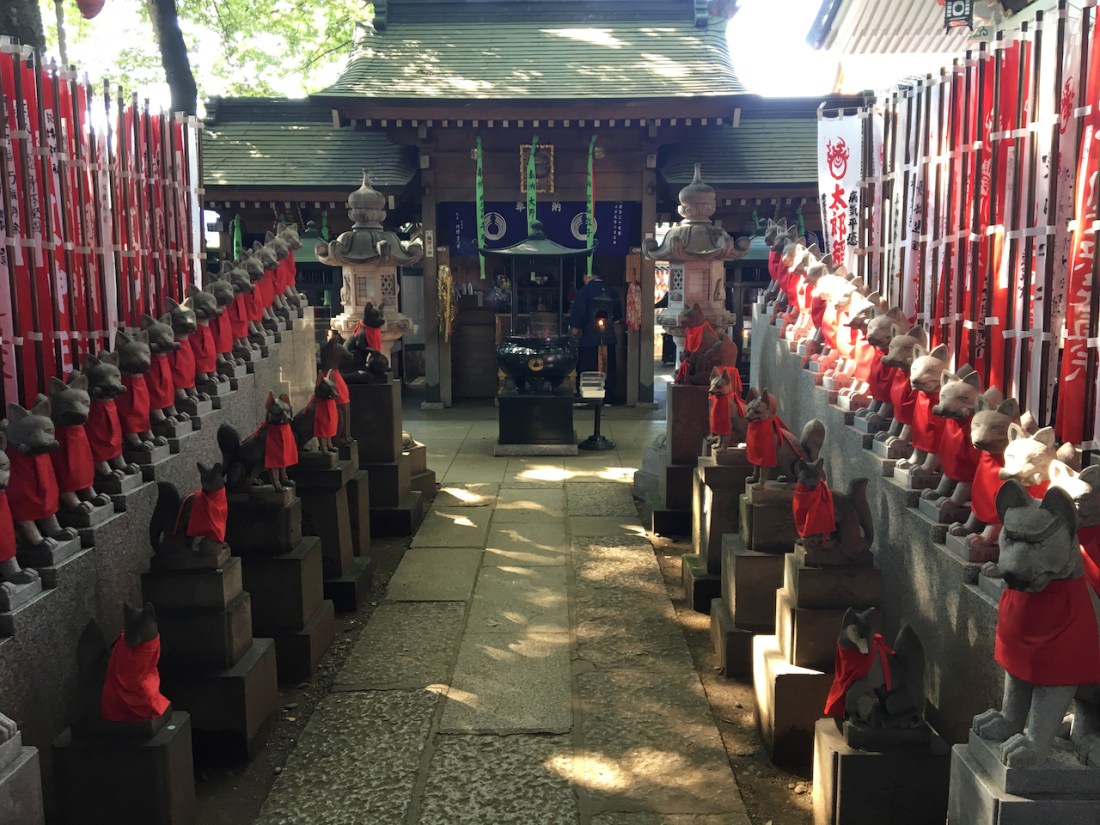
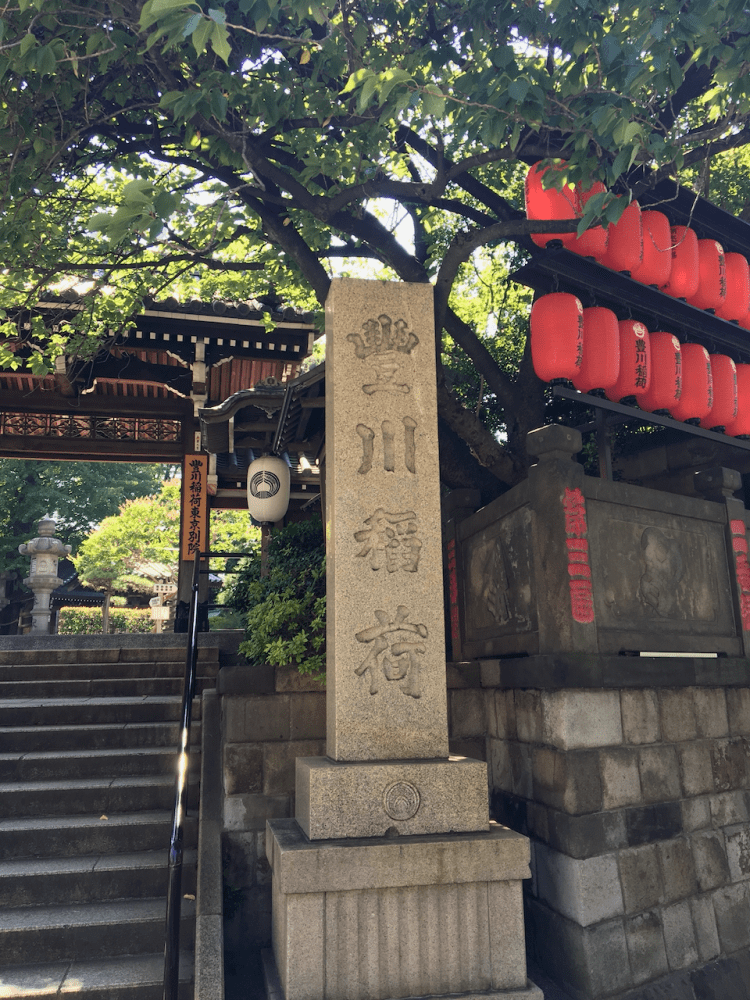
You can still see vestiges of this blending in some temples and shrines, but one great example is the Toyokawa Inari shrine right in the heart of Tokyo’s Minato Ward:
This Shinto shrine / Soto-Zen Buddhist temple venerates Dakini-ten (荼枳尼天), which is the Buddhist form of the Shinto kami Inari Ōkami.
Dakini-ten is based on the concept of Ḍākinī in esoteric (a.k.a. Vajrayana) Buddhism, but in Japan it blended with veneration of Shinto kami and thus took on a life of its own.
Inari Ōkami in his/her Buddhist form as Dakini-ten shining light upon a samurai warrior. Late medieval painting by Utagawa Kuniyoshi, source: Wikimedia
Anyhow, let’s talk about the temple itself. I visited the temple in 2018 and had little context back then, so I didn’t take as many good photos as I would have liked, but I will try to explain as best as I can.
Once you go past the main gate…
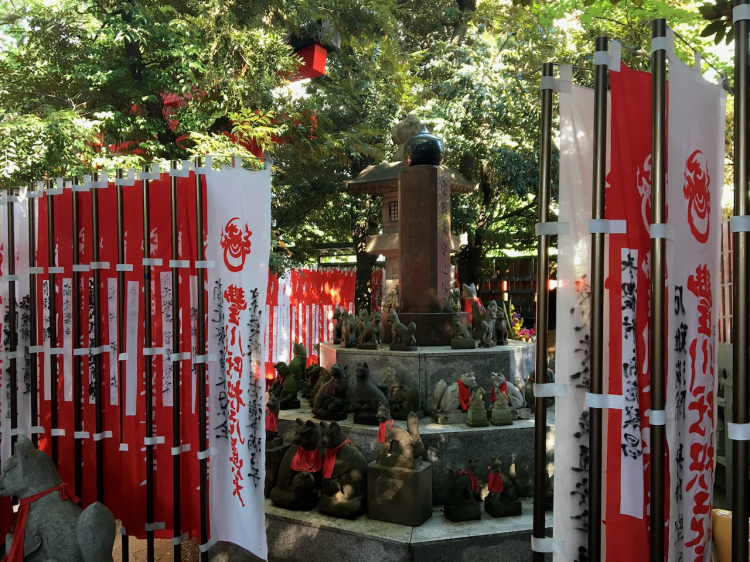
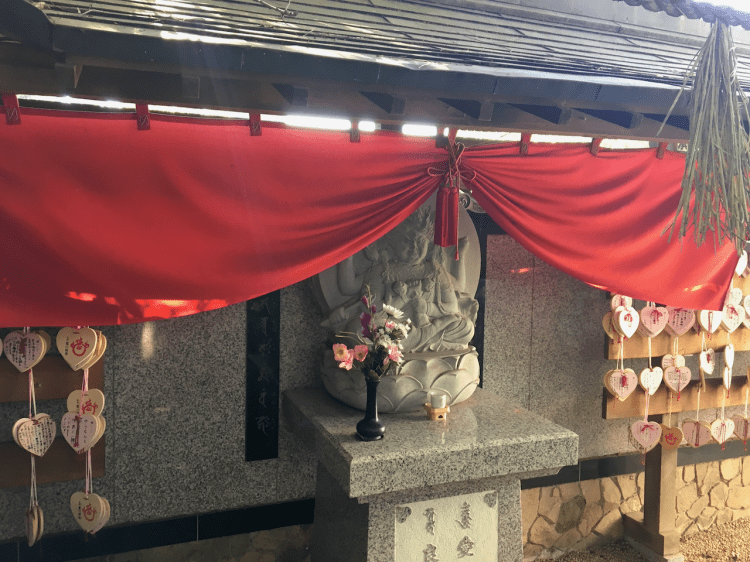
You come upon the main shrine to Inari Ōkami (colloquially known as “O-Inari-san”):
Another, small sub-shrine here:
You can see fox statues all over the complex, due to their close association with Inari Ōkami.
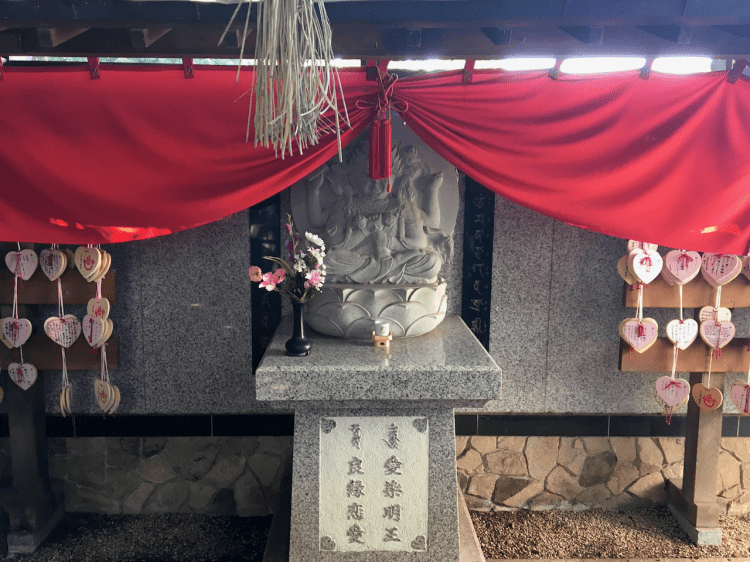
However, other deities, both Buddhist and Shinto are enshrined here too. For example, below is an esoteric-Buddhist (Vajrayana) deity named Aizen Myō-ō (愛染明王):
The fact that both Shinto deities like Benzaiten and Inari Ōkami reside in the same shrine as overtly Buddhist deities such as Kannon and Aizen Myō-ō is somewhat unusual, but really isn’t. This was normative for Japanese religion until the modern century. Japan has had two religions for a very long time, and they’ve co-existed for so long, that they often blended together.
If you look at American religion, pagan religion and Christianity co-existed for so long (even when paganism was officially repressed) that the two blended together. Things we take for granted such as Christmas trees, mistletoe, Easter eggs, and such are all examples where they have blended together to religion as we know it today. This might offend religious purists (to be fair everything annoys religious purists), but this is how societies absorb and adapt religions over generations. Japanese culture simply had different religions to work with.
Anyhow, fascinating stuff.
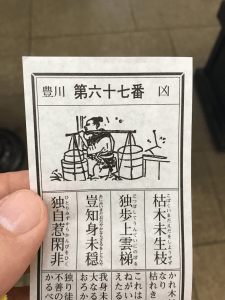
P.S. My omikuji fortune that visit was bad luck (kyō, 凶). I don’t remember having a particular bad year, especially compared to 2020 later, but it was surprising to get an overtly bad fortune for a change.
The hanging scroll in the Twitter image shows the so-called Thirteen Buddhas and Bodhisattvas, or jūsan-butsu (十三仏), of Japanese Buddhism. This is a collection of Buddhas and Bodhisattvas in the Mahayana tradition that often appear in things like funeral ceremonies, esoteric rites, and other things. Each one has an associated mantra (inherited from esoteric-Buddhist traditions, even in non-esoteric sects), and an associated memorial day.
This is an example I found in a Rinzai-Zen Buddhist service book. Rinzai Zen isn’t an esoteric sect, but does historically borrow certain liturgies and practices, hence you can find things like this.
You can find some details here, but I also listed them out in the table below:
This is knowledge that most Japanese-Buddhists would not pay attention to, unless they are particular devoted to esoteric practices,4 or have some ecclesiastical training. Further depending on which Buddhist sect we’re talking about, you might see them often, or rarely at all. But this list is almost universal in Japanese Buddhism, and it’s fascinating to see it come up now and then, even in social media.
P.S. I’ve spoken about Taima-dera temple (the Twitter feed above) in a previous post. These days, like many old temples in the Nara area, has been folded into the Shingon esoteric sect.
P.P.S. Mantras are usually not meant to be translated. There are English translations, but it kind of defeats the purpose of mantras in the esoteric tradition. The journey is more important.
1 These are usually written in katakana script since they’re technically foreign-imported words from Sanskrit.
2 If you see ō, it means that the word is pronounced like English “oh”, but two-beats long. Japanese distinguishes between “o” (one beat) and “ō” (two beats). Same pronunciation, different length.
3 That is, the historical Buddha and founder of the religion. ‘Nuff said.
4 Usually this means devotees of either Shingon or Tendai sects. Also, some of the mantras above are pronounced slightly differently depending on whether it’s the Shingon or Tendai lineage. This is an area I don’t know very well, so if you need further details, please consult other sources.
I did it, I finally finished it. For years I wanted to write a book about Buddhism, especially Mahayana Buddhism, and each time I struggled to get past a certain point and keep point.
Recently while cleaning out some files on the computer, I discovered that in early 2020, during the first months of the Pandemic, I had written a full draft of a book. I was surprised I had written a full draft, then subsequently forget, probably because the editing looked daunting at the time. Plus, I was starting a new hobby writing Dungeons and Dragons modules.
So, for the past month I have been fixing that draft, expanding some areas, adding photos and so on. The links below, available in PDF format and EPUB format, are the final result.
This book, The Mahayana Buddhism Field Manual, covers many aspects of Mahayana Buddhism, written for beginners in mind, including those who are rediscovering the religion of their birth. This book is dense, but covers as many aspects as possible, but also with a DIY (do it yourself) emphasis. Enjoy!
PDF Format
EPUB format
This book is free, so feel free to download it, distribute it, or share with someone interested in Buddhism, or maybe wants to learn more. If it helps others on the Buddhist path, great!
The Amida Nyorai Konpon Dharani (阿弥陀如来根本陀羅尼) or “Amitabha Root Dharani” is a dharani used in some Japanese Buddhist sects, typically only on the Segaki ritual used to feed the hungry ghosts in Buddhism, or possibly funerals and other similar services. It is typically only found in esoteric rituals in Shingon and Tendai Buddhism, but can be found in Jodo Shu and Zen as well. The dharani is typically of very, very limited use, and not part of normal liturgy.
This page is intended to post the dharani for reference purposes only. Esoteric practices such as mantras and dharani should only be used as recommended by one’s teacher, under a guided training program. I found reference material on this dharani to be almost non-existent in English, hence my decision to post it here.
This page will provide both the Sino-Japanese reading follow by the Sanskrit reading. There are multiple versions of the dharani in Japanese, so pronunciation may vary slightly between them, so for this reason the Sanskrit is provided as well. No translation will be provided as this is part of the esoteric training one should undergo when learning the dharani. Any translation you see online of this, or any mantra/dharani, should be treated as suspect.
Can’t read the characters?
If you’re having trouble reading the Kanji characters, you might have one or two problems with your computer:
Your computer may not have Asian fonts installed. In Windows you have to enable UTF8 and East Asian fonts under the Control Panel. Modern Mac computers are fully compatible already.
Your browser may be assuming the wrong character set. If you use a relatively modern browser and use UTF8 as character set, you should be able to read fine. IE, Firefox and Safari all read this fine as far as I can tell.
Even if not, then you can still use the romanized characters, and the (terrible) English translation.
Disclaimer and Legal Info
I hereby release this into the public domain. Please use it as you see fit, but if you attribute it to this site, greatly appreciated. Also, please bear in mind this is an amateur work, and should not be taken too seriously.
Dedication
I dedicate this effort to all sentient beings everywhere. May all beings be well, and may they all attain perfect peace.
P.S. This is an old post from my former blog that I thought I had lost, but recently recovered. Reposting here with better blog formatting. Otherwise, I haven’t changed the contents.
Mantras are a strange beast within Buddhism. The tradition of mantras predates Buddhism and goes all the way back to the early “Vedic religion”, that is the ancient devotional practices around the Vedas (precursors to Hinduism as we know it), and they continue to occupy an awkward spot.
The Mantra of Light as shown in a Rinzai-Zen service book.
“Recitation” in Buddhism usually comes in the form of recitingsutras, which makes sense, because the tradition of passing down the teachings from teacher to student has existed from the beginning. Mantras do not fit this role since they are essentially obscure (not to mention mispronounced) Sanskrit phrases, with esoteric meanings. The esoteric traditions such as Vajrayana in Tibet, Shingon and Taimitsu (Tendai school) traditions in Japan all embrace them as a central practice,1 but in other non-esoteric traditions mantras are relegated to a backup “support” role, protecting the Buddhist disciple.
For example, here’s a certain mantra as found in a Rinzai Zen liturgy book I own. This is the famous Mantra of Light (kōmyō shingon, 光明真言), which reads in various languages like so:
Ǎn ā mó jiā wěi lú zuǒ nǎng mó hē mǔ nà luō me nǐ bō nà me rù mó luó bō luō wà duō yě hōng
Japanese:2
オン アボキャ ベイロシャノウ マカボダラ マニ ハンドマ ジンバラ ハラバリタヤ ウン
Japanese romanization
On abokya beiroshano makabodara mani handoma jinbara harabaritaya un
Here’s an example of how it’s chanted in Japan (notice the Siddham letters, too):
What makes the Mantra of Light somewhat unusual within the world of mantras and esoteric traditions in Buddhism is how widely it’s been adopted. You will find it in many Buddhist traditions, even ones that are otherwise not interested in esoteric practices.
In fact, for a time in the late Heian Period of Japan, the Mantra of Light was propped up as a rival practice to the nembutsu in the Pure Land tradition particularly by a monk named Myoe (明恵, 1173 – 1232).
At that time, there was an existing funerary practice of scattering sand blessed by the Mantra of Light on the deceased, but Myoe tried to popularize it further by playing up its benefits in helping one to be reborn in the Pure Land of Amitabha Buddha. This interpretation is largely Myoe’s, however.
It never quite worked as Myoe hoped, and the popularity of the nembutsu prevailed, but even today it’s common for Buddhist practitioners to chant both. I do this in my home service for example. I happen to like the Tendai-sect approach of “umbrella Buddhism” where meditation practices, Pure Land practices and esoteric practices are given roughly equal weight, with the Lotus Sutra as a kind of capstone.
Thus, reciting the nembutsu (pure land Buddhism) and the Mantra of Light (esoteric Buddhism) are both perfectly fine.3 For me at least, I chant the nembutsu for the benefit of others, and the Mantra of Light to reinforce my commitment to being a help to others (and be less of a dickhead). That may not be the correct approach, but it’s a start.
Speaking of which what does the Mantra of Light actually mean? Like all mantras, they’re infused with meaning in esoteric traditions, so a simple translation doesn’t tell the whole story. Furthermore, in esoteric traditions, mantras are supposed to be recited while visualizing a specific image and holding your hands in a specific “mudra”. This combination is thought to jar something deep inside, not at an intellectual level, but on an experiential level. Thus, the meaning of the mantra is something shared between teacher and student. So, I don’t have a good answer for this. If you really want to know, consult a trusted teacher in good-standing!
But it’s not necessary to know the exact meaning either. The act of recitation is more important, or so I have been told. So, if you chose to recite the nembutsu, Mantra of Light, both, neither, that’s fine. Buddhism has a large toolbox, so try what works, and enjoy!
1 Interestingly enough, the Japanese word “shingon” as in the Shingon school, literally just means “mantra”.
2 Mantras are usually written in Japanese using katakana, given that they’re technically foreign words, but for ease of readibility, hiragana is also used.
3 Meditation has always been my Achilles Heel, but I still meditate from time to time.
Recently, I got into a debate online (that always ends well) about so-called “auxilliary” practices with some fellow Buddhists on an old, private discussion forum for Jodo Shu Buddhist teachings.
The debate started after someone on the forum asked about whether visualization of Amida Buddha was permitted in Jodo Shu, and I was not satisfied with the responses thus far which tended to strongly imply that it wasn’t worth doing, and that one should rely on the nembutsu only. I was somewhat annoyed by these replies, so I responded to the original poster like so (quoting almost verbatim here, minus some typographical editing):
In my experience, both Jodo Shu and the related Jodo Shinshu sects doctrinally focus on the spoken nembutsu only. I would argue though, that this “exclusive nembutsu teaching” is an idiosyncracy of Jodo Shu and does not always reflect the Pure Land tradition in general.
You are correct in that the Contemplation Sutra does teach an elaborate process for visualizing Amida Buddha, and this kind of visualization practice has been undertaken by monks, particularly in the Tiantai (Chinese) and Tendai (Japanese) sects among others. People tend to focus on a single passage toward the end of the sutra whereby reciting the name of Amida Buddha erases all karma, but in some monastic traditions, people have focused on visualization too.
It’s also true that there are parallel traditions for rebirth in the Pure Land that have nothing to do with the nembutsu, mostly in the esoteric tradition. Even today, Shingon Buddhism has visualization/chanting practices related to Amida Buddha that have little or anything to do with the nembutsu. Such parallel practices include such things as the Mantra of Light and various dharanis that sometimes appear in Zen traditions. Genshin, who was ironically a “patriarch” of the Jodo Shinshu tradition, listed many such methods in the Ojoyoshu, but in practice he recited the nembutsu like many other monks and nuns did during his time. Further, the 23rd chapter of the Lotus Sutra, clearly mentions rebirth in the Pure Land of Amitayus (Amida) Buddha through upholding the Lotus Sutra, not reciting the nembutsu.
I think most people would agree that the nembutsu tends to be the most simplest and straightforward, and thus people tend to treat it as the only viable solution in the so-called Latter Age of the Dharma. I think this is a bit of a leap, but if I were a priest and someone wanted to know more about the Pure Land, I would start by teaching the nembutsu too. It’s a great practice. On the other hand, I think it’s also important for people spiritually grow and if people want to branch out from the nembutsu, they should be able to do so without a sense of “guilt” caused by artificial, doctrinal orthodoxy. The reason, I think, is that the Pure Land tradition is more broad than the standard Jodo Shu/Shinshu narrative, and people who want to explore should feel free to do so.
Hope that makes sense,
Doug
Since my interest in Buddhism began in earnest in 2005, starting with Jodo Shu and Jodo Shinshu teachings, I have noticed a tendency for these two sects to dominate Pure Land Buddhist discussions among Western adherents. For a long time, I was also a fervent advocate, but I’ve since become wary of the exclusive approach taught by Jodo Shu/Jodo Shinshu Buddhism.
The heart of the issue, I believe, is the recitation of the nembutsu (念仏), the Buddha’s name, usually rendered as namu amida butsu (南無阿弥陀仏).
Jodo Shu and Jodo Shinshu sects treat this as the sole, exclusive practice and spend an inexhaustible amount of writing and research to assert this point. A cursory study of Jodo Shu/Shinshu literature will reveal that there isn’t much beyond this. The nembutsu is treated with an almost mystical reverence (which is especially amusing since such people are quick to reiterate that it’s not a mantra either). The “name” of Amida Buddha (myōgō 名号) is all-important and if you wish to reborn in the Pure Land of Amitabha Buddha, the only sure-fire method is to recite the nembutsu either as a practice (Jodo Shu) or as an expression of gratitude (Jodo Shinshu) for Amida Buddha’s grace already being extended to you. Beyond this, say adherents, nothing else really matters. Other practices in Buddhism may be conducive to you reciting the nembutsu, but have no merit or power beyond this. Even the Precepts aren’t particularly emphasized or important.
But, as I have learned from various sources, including my new book, this is a kind of revisionist history, and example of how prominent sects tend to dominate the conversation and cherry-pick only those things from the Buddhist sutras that bolster their view.
Further after some backlash, I explained further:
Within the context of Jodo Shu (and related sects), I agree that the position is that the nembutsu is the only essential practice. All other practices supplement it.
However, if you read the Three Pure Land sutras in their entirety, I believe that the authors suggested something slightly different. Take a look at this passage from the Larger Sutra (translation by Rev. Hisao Inagaki):
“For this reason, Ananda, sentient beings who wish to see Amitayus while in this world should awaken aspiration for the highest Enlightenment, do meritorious deeds, and aspire to be born in his land.”
and:
“Why do you not diligently practice good, reflect on the naturalness of the Way and realize that it is above all discriminations and is boundlessly pervasive? You should each make a great effort to attain it. Strive to escape from Samsara and be born in the Land of Peace and Provision. Then, the causes of the five evil realms having been destroyed, they will naturally cease to be, and so you will progress unhindered in your pursuit of the Way. The Pure Land is easy to reach, but very few actually go there. It rejects nobody, but naturally and unfailingly attracts beings. Why do you not abandon worldly matters and strive to enter the Way?”
I believe that the original authors of this sutra [were] advocating a more holistic approach toward rebirth in the Pure Land. It’s a similar message at the end of the Contemplation Sutra: spare no expense if you can.
The issue, I have observed, is that medieval Japanese monks had a tendency to read sutras literally and at face-value, because they were assumed to be the literal words of the Buddha (spoiler alert: they are not). It explains why they literally interpreted Dharma Decline as one of several 500-year periods, among other things. However, we’re living in the 21st century and have access to information they didn’t, so I believe it is beneficial to read the sutras critically, not literally.
Sure you can just recite the nembutsu, but why stop there? I believe that’s the message of both the Pure Land sutras and the Lotus Sutra ch. 2 when the Buddha says a person attains Buddhahood through a single nod to the Buddha or a single “hail Buddha”.
The intention of the Pure Land practices, I believe, isn’t just to get there; it’s part of the larger Mahayana-Buddhist theme of the potential of all beings to achieve Buddhahood and in turn help others still mired in Samsara. The Pure Land is one of many so-called “Dharma Gates” to accomplish this. The Pure Land “gate” just happens to be a particularly compelling one (full disclosure, I too recite the nembutsu).
But “the skies the limit” too, so don’t hesitate to adopt other practices if so inclined.
The danger of faithfully following a particular sect and its core beliefs is that you may well overlook obvious faults in logic, and may become complacent. You have to reassure yourself with “mental gymnastics” when faced by doubt or external criticism. My journey through Buddhism started as far back as 2005, and has taken plenty of twists and turns. At one point, I was even training for ordination as a lay priest in the Jodo Shinshu tradition. But in the end, I’ve become disillusioned by the narrow, sometimes dogmatic emphasis on the nembutsu to the exclusion of the larger Buddhist world and its array of practices and teachings. I can blame this doubt on my almost obsessive personal research at the time, but then again, changing your mind is the point of research. It’s OK to change your mind.
Looking back, I was kind of a fool in those days. I was so happy to have a Buddhist community around here like that, with a straightforward, accessible teaching, that I ignored the fact that it ran against the grain of my Buddhists beliefs. The desire to fit in was more important.
But it’s better to admit a sunk cost and move on, than to double-down. I left the community, somewhat abruptly, and floundered around for years (even deleted a blog or two at the time) until I eventually settled into the more holistic, Tendai-Buddhist practice I follow now, which includes the nembutsu, but a whole lot else too. I enjoy having a broader, not narrow, understanding of Mahayana Buddhism and its teachings, and the flexibility to practices various things in Buddhism without the guilt associated with “deviating” from the standard, orthodox teaching of the sect.
“Look, I already faced her once back when I believed in the throne, and it cost me everything. That’s what’s wrong with Asgard. The throne, the secrets, the whole golden sham.”
Valkyrie, “Thor: Ragnarok”
Much of the centuries of traditions, priesthoods, beautiful liturgy and the high quality books printed in English for budding Western communities are, if you scratch the surface and dig deeper, just a golden sham.1 That leaves any spiritual seeker with a dilemma: fall in line and find contentment, or learn what you can, apply what’s useful, and keep moving onward.
“Come, Kalamas. Do not go upon what has been acquired by repeated hearing; nor upon tradition; nor upon rumor; nor upon what is in a scripture; nor upon surmise; nor upon an axiom; nor upon specious reasoning; nor upon a bias towards a notion that has been pondered over; nor upon another’s seeming ability; nor upon the consideration, ‘The monk is our teacher.’ Kalamas, when you yourselves know: ‘These things are good; these things are not blamable; these things are praised by the wise; undertaken and observed, these things lead to benefit and happiness,’ enter on and abide in them.
trans by Soma Thera
The Kalama Sutta doesn’t mean you can just believe what you want, the Buddha is telling the Kalamas to think for themselves and weigh the teachings and traditions objectively against what they know to be good, right, beneficial and blameless. He is encouraging a kind of scientific observation.
So, if you ever feel pressure from your religious community to “toe the line” or that maybe you’re not a “good Buddhist (or whatever religion)”, stop and remember that the problem might not actually be you.
P. S. For the record, Jodo Shu Buddhism still holds a special place in my heart since it has been a long, and largely positive influence on my life. So I am grateful, but I’ve also moved on.
1 Of course, all of this could be just as easily said of many religious communities around the world.










 Gleanings in Buddha-Fields

You must be logged in to post a comment.