My family and I visit a certain Shingon-sect Buddhist temple in the area for New Years tradition, and also for Setsubun rituals (namely mamemaki bean-throwing, plus good luck). Neither my wife nor I follow the Shingon sect, but Japanese-buddhist temples for the Japanese community (not Westerners) are rare, so we are glad to visit despite the lengthy drive.
Shingon Buddhism, one of two “esoteric” (mikkyō, 密教) Buddhist traditions in Japan,1 relies on a complex array of ceremonies, rituals, symbolism, and mantra chants that help awaken one’s Buddha-nature not through words, but through a kind of non-verbal impact. This requires a trained teacher to guide one through it, hence it’s called “esoteric” Buddhism (a.k.a. Vajrayana Buddhism). Years ago, I attended a “moon meditation” sitting once where each one of us sat and meditated before a hanging scroll showing a full moon. It was an interesting experience.
Anyhow, one ceremony that’s very common in Shingon is called the Goma-taki (護摩炊き) ritual, or “fire ceremony”. This is often called Goma in English. This is a video provided by Koyasan Temple in Japan which shows a complete ceremony: a priest creates a pyre within a sacred space, often before a statue of Fudo-myo-o (不動明王). Throughout the ceremony, the priest recites certain chants and uses certain hand-gestures. The fire is thought to purify one’s mental defilements, burn away past karma too, and also certain sticks are added to the fire with people’s aspirations and wishes written on them.
At our temple here locally, the priest conducts the Goma ritual as well, and people receive blessings from the ceremony one by one, and we also receive small o-fuda talisman that we place next to our Buddhist altar at home for protection. These are larger than omamori charms, made of wood or cardboard, and usually enshrined, not carried on your person.
The origins of the Goma-taki ritual are taken from Indian religious practices of the past, but gradually underwent “Buddhification” (absorbing practices, and making them Buddhist) and this is why, I believe, that esoteric Buddhism arose in later generations of Buddhism in India.2 The deities portrayed in esoteric Buddhism also have origins in India, but transformed as they were brought through China to Japan.
Goma-taki rituals are frequently held for the public in larger Japanese temples, so you can easily drop and just observe, but be aware they can take up to an hour or more. But it is a pretty interesting experience and well worth observing.
Namu Daishi Henjo Kongo (Praise to the Great Teacher Vairocana Vajra, a.k.a. Kukai / Kobo Daishi)3
1 the other is Tendai Buddhism, which calls it taimitsu (台密), not mikkyo. What are the differences? Not sure. Both lineages come from the same Chinese-Buddhist tradition of the time, but beyond that, no idea.
2 Seen from one perspective, the earliest texts and traditions in Buddhism did not feature any esoteric practices and rituals, so if you’re looking for “pristine” Buddhism then esoteric practices don’t fit this. From another point of view, Buddhism continued to innovate across generations, first Mahayana Buddhism, then esoteric practices, so in that light esoteric Buddhism solves problems of practice and teaching that earlier Buddhism struggled with. I don’t know which viewpoint is the right one, personally. I am a big proponent of easy, accessible Buddhist teachings and practices (hence the nembutsu, precepts, etc), and esoteric Buddhism doesn’t make this easy. And yet, it is surprisingly popular in Japan (2nd only to Pure Land Buddhism), so maybe there’s something there that I’ve failed to notice all this time? 🤷🏼♂️
3 This is often recited in Shingon tradition the way namu amida butsu is recited in Pure Land traditions in Japan.
The Heian Period of Japanese history is a really fascinating period, both culturally and historically to me. I even made a whole side-blog devoted to it (15th anniversary this week!). When you read books like the Diary of Lady Murasaki or the Pillow Book, there are a lot of cultural allusions that are hard to translate into English, or even contemporary Japanese culture, and that includes the role of professional diviners called the Onmyōji (陰陽師).
The Onmyoji were not mere soothsayers, but were trained to read various signs and calculations, and compile calendars for the coming year to determine the movements of the gods, moon, stars, etc. This was then used by the aristocracy to make decisions, where to travel and so on.
Much of these calculations were based on practices imported from China: the Five Elements Theory, Yin-Yang philosophy, geomancy,1 and so on. When we think of elements: we think of earth, wind, fire and water,2 but in Chinese philosophy it was earth, wood, metal, fire and water. In the traditional calendar used today across Asia, these philosophies are still preserved. For example, this year (2026) is the yang-fire-horse: (丙午, hi-no-e-uma in Japanese)
The Crest of the famous Onmyoji, Abe no Seimei. The five points alluded to the Five Elements. Courtesy of Wikipedia.
But let’s look at a concrete example.
Onmyoji often calculated inauspicious directions of travel. The idea was that a certain Taoist god named Ten-ichi-ji (天一神) would wander in various cardinal directions. If you traveled in the direction that Ten-ichi-ji was dwelling on that particular day, you would suffer the wrath of that god and be cursed. Therefore, people had to avoid traveling certain directions on certain days. This would lead to convoluted efforts to reach your destination from another direction, a practice called katatagae (方違え). People would travel the night before (before it became inauspicious), or travel in a roundabout direction to get there.
In the Pillow Book, Sei Shonagon discusses the hassles of inauspicious directions:
[154] When Her Majesty [Empress Teishi] was in mourning for the previous Regent, she was required to leave the palace at the time of the Great Purification at the end of the sixth month. However, the Office of the Empress’s Household happened to be in a forbidden direction at the time, so she moved instead to the Aitadokoro [residence], which belonged to the Council of State.
Our first night there was hot and extraordinarily dark, and we spent it feeling cramped and rather anxious as we waited for the dawn.
Another example were abstinence days. Onmyoji calculated days that were highly inauspicious, called monoimi (物忌み), which required people to undergo a day of abstinence. People who were stuck at home on an abstinence days had to avoid anything impure: sex, travel, talking too loud, important work, certain foods, etc. They even had to wear special talisman in their hair or hat.
In the Pillow Book, Sei Shonagon recalls an incident with her lover Yukinari:3
[129] One evening, Secretary Controller Yukinari visited the Office of the Empress’s Household, and stayed talking far into the night. He finally left as dawn was approaching, remarking that he must return by the Hour of the Ox since he was obliged to stay at the palace all day owing to an Imperial abstinence.
Translation by Meredith McKinney
By the way, the passage above also contains Sei Shonagon’s famous poem which was later used in the Hyakunin Isshu (poem 62).
Further, she remarks how annoying abstinence days were:
[22] …. You’ve taken special care to send off a beautiful, carefully written letter, and you’re eagerly awaiting the reply — time passes, it seems awfully long in coming, and then finally your own elegantly folded or knotted letter is brought back, now horribly soiled and crumpled and with no signs reminaing of the brush stroke that sealed it. “There was no one in”, you’re told, or “They couldn’t accept it on account of an abstinence”. This is dreadfully dispiriting.
Onmyoji didn’t just make calendars, they also performed various purification rituals, and exorcisms that Buddhist or Shinto priests would not do. In the Diary of Lady Murasaki, the eponymous author4 writes about the commotion and rituals the Onmyoji would use to protect Empress Shoshi WHILE SHE WAS IN LABOR:
At the moment of birth what awful wails of anguish came from the evil spirits! Preceptor Shin’yo had been assigned to Gen no Kurõdo, a priest called Myoso to Hye no Kurõdo, and the Master of Discipline from the Hojüji to Ukon no Kurodo. Miya no Naishi’s enclosure was being overseen by Preceptor Chisan; he was thrown to the ground by the spirits and was in such distress that Preceptor Nengaku had to come to his aid with loud spells. Not that his powers were on the wane, it was just that the evil proved so very persistent. The priest Eiko, brought in to help Lady Saisho’s exorcist, became hoarse from shouting spells all night.
This mixture of Buddhist monks (trained in esoteric Buddhism) pairing with exorcists and mediums (Onmyoji) loud in yelling and chanting during a woman’s birth feels weird by today’s standards, but Shoshi’s father, the regent Fujiwara no Michinaga had everything riding on his daughter safely giving birth to a male who could inherit the Imperial Throne, so he spared no expense. Lucky for him, it worked.
Onmyoji gradually lost influence during later centuries of Japanese history, but never quite faded altogether. Technically, they were banned in the early-modern Meiji Period, but gradually reformed as a particular sect of Shinto to this day.
Title art for the anime Onmyoji on Netflix. I’ve watched a few episodes so far.
Next time, we’ll talk about a certain legendary Onmyoji named Abe no Seimei (shown above), who is a popular subject of Japanese movies, anime, manga, etc.
1 Geomancy (lit. “earth divination”) in Chinese culture today can be seen in practices like Feng Shui, the Ba Gua and so on. My wife is Japanese, not Chinese, but she does take an active interest in Feng Shui (called fūsui in Japanese). I am more ambivalent, but in spite of my “logical mind”, I am curious.
As I talked about in a recent post, the main core idea of the venerable Tendai (天台) sect in Japanese Buddhism, including its parent Tiantai sect in China, is that the Lotus Sutra is the most important text in the Buddhist canon, a kind of capstone (lit. “complete teaching”, engyō 円教) for the rest of Buddhist literature up to that point. Because the Lotus Sutra is pretty long (equivalent to a modern book), I tried to summarize its teachings here.
Anyhow, Tendai/Tiantai focuses on how to put the Lotus Sutra into practice. For Japanese Tendai in particular, this is encapsulated in a phrase called shishū yūgō (四宗融合) meaning “Four Integrated Practices”. According to my book, these are listed as follows:
Different people under the umbrella represent different Buddhist followers, with different practices and inclinations, but the umbrella itself represents the concept of upāya (“expedient means”) or hōben (方便) in Japanese. This is one the main themes of the Lotus Sutra, and expresses that all Buddhist teachings and practices lead toward the same end goal, and thus whatever works for a person at that time is perfectly fine for that person.
This is encapsulated in the 25th chapter of the Lotus Sutra, the so-called Kannon Sutra, because the Bodhisattva Kannon (a.k.a. Guan-Yin, Avalokiteshvara, Chenrezig, Quan Âm, etc) according to this chapter takes on whatever form is most beneficial for that person and teaches the Dharma to them. Thus, Kannon can appear as a man, woman, monk, rich person, etc. It’s also why statues of Kannon often depict them as having 1,000 arms, each holding a different object. Similarly, many of the early Buddhist monks who were Tendai followers practiced it differently from one another. On the one hand, you have monks like Eisai, who focused on meditation and precepts (and would later found the first Rinzai Zen temples), you also had monks like Genshin who focused a lot more on Pure Land practices, as well as esoteric experts such as Ennin.
Tendai as a sect in Japan was almost universal in the 9th through 12th centuries, but for a variety of historical (often self-inflicted) reasons, it has diminished in size and influence. Yet when you visit historical temples in Japan such as Asakusa Temple in Tokyo, Kiyomizudera Temple in Kyoto, and Sanjusangendo in Kyoto, these are all Tendai temples. Further, its influence lives on in newer sects that we know well: Zen, Pure Land, Nichiren and such, which all inherited practices and concepts even if they apply them in differing ways.
But while Tendai as an organized sect is somewhat diminished,3 its teachings of “umbrella” or “universal” Buddhism continue to live on. Rather than insisting there’s only one way to practice Buddhism, it gives a large, spacious framework for people to figure out their own path and use the vast toolkit available to work it out, all under the Lotus Sutra concept of expedient means. Use what works for you, and do not be afraid to adapt, change, or expand your practice as you go.
P.S. Publishing off-schedule just for fun. Happy Sunday!
1 Tendai/Tiantai has the same meditation tradition as Zen, but tends to call it shikan (止観) not zazen (座禅) meditation. The founder, Zhi-yi, in China wrote multiples treatises, the Mohe Zhiguan, that provides a comprehensive manual about meditation. I have a copy of the The Essentials for Practicing Calming-and-Insight & Dhyana Meditation, but have only read parts of it. It is a nice training manual for those interested, but it is a little dense since the intended audience was the monastic community.
2 In the time of Zhi-yi, the founder of Tiantai, Pure Land Buddhism was approach more as a meditation tradition than a separate set of practices that what we see today. By the time it came to Japan, this had changed somewhat, and we see through the writings of Genshin that there were a variety of approaches both devotional and meditation-focused.
3 According to my book, as of 2015, the number of registered followers in Japan was around 1.5 million give or take. This makes it the second smallest of the major sects in Japan, and one-eighth the size of Jodo Shinshu-sect Buddhism. Only Rinzai Zen is smaller (1.1 million).
Speaking of going off the rails, I once wrote about how politics had a pretty corrosive effect on the Tendai Buddhist monastic community on Mount Hiei during the late Heian Period of Japanese history, but there’s aspect to this increased corruption and declining monastic discipline: the esoteric Buddhist tradition itself. Scholar Paul Groner has done extensive research about Tendai Buddhism and history, and published an article in 1987 about an influential Tendai monk named Annen (安然, 841–889?) who’s innovations to esoterica and Buddhism had a detrimental impact to the community.
This is also covered in a book I’ve been reading recently about the “Original Enlightenment” teaching that medieval Tendai strongly advocated at the time. More on that book later (it’s a tough read, so it’s taking me a while).
A quick history of Tendai Buddhism in Japan and the Esoteric tradition.
Esoteric Buddhism (a.k.a. Vajrayana) was imported into Japan in early centuries of history, but mostly as an afterthought.1 It wasn’t until a monk named Kukai (空海; 774 – 835), founder of Shingon that Vajrayana Buddhism came to the fore. Kukai had studied it thoroughly under Indian and Chinese masters in the Chinese capital, and brought back a full program to Japan. It was the hot, new thing among the elite classes of Japan at time.
Saicho, founder of Tendai, had made the same journey to China, but was focused on learning Tian-tai (parent sect of Tendai) teachings, and only had a partial, incomplete training in Vajrayana. His disciples Ennin and Enchin also journeyed to China, and came back with a much more complete training, and helped establish a separate esoteric lineage from their rivals, the Shington sect under Kukai. The esoteric tradition within Tendai is called Taimitsu (台密).
Esoteric Buddhism was hugely popular among the affluent nobility in the capitol of Kyoto, who employed monks to officiate ceremonies, exorcise demons, cure illnesses, and bring prosperity. The Imperial Court also employed large numbers of monks regularly to pray for the safety of the nation from natural disasters, plagues and such. Over time, the Tendai sect in particular, due to its close proximity to the capitol, and extensive esoteric tradition developed a very close relationship with the government. Monks who were esoteric masters (阿闍梨, ajari) were especially popular among the elite. Further, because high-ranking monks in the Tendai order often came from noble families, there was increasing social relationships too. Popular monks were invited to parties, participated in poetry recitals and so on.
Back to Annen.
According to Dr Groner’s article, Annen was trained by two eminent monks at the time: Tankei (湛契, 817-880) and Henjo (遍昭, 817-890), the same Henjo who wrote poem 12 of the Hyakunin Isshu anthology. Both were part of the Tendai order on Mount Hiei, but found favor with the aristocracy and became “celebrity” priests.
Tankei was later defrocked after an affair with the Imperial prince’s wet nurse, but due to connections went on to serve in the Imperial bureaucracy and rose through the ranks until he reached junior fourth rank (equivalent to minor nobility). Strangely, while the Imperial government supported his defrocking over the affair, the Tendai sect establishment were angry about it, apparently not viewing the breaking of the vow of celibacy as a serious issue.
Similarly, Henjo was a nobleman for a long time, eventually who ordained in the Tendai order after the death of his liege Emperor Ninmyo in the year 850. By 868, after becoming an accomplished esoteric master, he mingled with the nobility again and was even granted a property by Ninmyo’s son for a new temple: the Unrin-in (雲林院). As Henjo established a monastic community there, in close proximity of the capitol, he started running the community his own way, shortening monastic training time, relaxing standards, etc.
Annen through training under Tankei and Henjo, developed into an accomplished master of the esoteric practices. He became a prolific writer and advocated a more urbane approach to monastic discipline where sincere intention was more important than actual discipline through the monastic precepts. For example, in his work, the futsu jubosatsukai koshaku (普通授菩薩戒広釈), Annen downplayed violating the precepts by explaining them away as an training expedient. It would be OK to violate the precepts in some situations, for example as an act of compassion for sentient beings.
Not everyone within the Tendai order agreed with this: The venerable Enchin complained in his generation that monks were already getting lax, wearing expensive robes, skipping the fortnight assembly, and so on. But Annen’s influence was too strong, and his interpretation of following the precepts loose enough for monks to bend the rules as this wished. This coupled with certain trendy theories at the time, such as the idea that “grasses and trees were enlightened”, led to a decline in monastic discipline that persisted all the way until the Edo Period (17th -19th century) when serious efforts to reintroduce monastic discipline were finally re-introduced. This was the Anraku Movement, by the way.
The issue is twofold: the vagueness of the Bodhisattva precepts employed by the Tendai sect exclusively allowed for individual interpretation. A monk with sincere intentions might still uphold proper behavior, but a monk with less sincere intentions might bend the interpretation to suit his conduct, rather than the other way around.
The second issue was the increasing intermixing of monks with the aristocracy. In the Buddha’s time ages ago in India, this was strictly forbidden. Monks were to withdraw from the contemporary world, and concentrate on strict monastic practice. Now, monks were fraternizing openly with the Imperial court instead of focusing on practice. This was done under the guise of “compassion for others”, but the results speak for themselves.
Anyhow, it easy to see how religious practice and teachings can fall under the sway of sophistry and go off the rails. Even in the Buddha’s time, he addressed this. In a conversation with the senior disciple Kashyapa in the Saddhammapaṭirūpaka Sutta (SN 16:13), the Buddha explains:
“These five downward-leading qualities tend to the confusion and disappearance of the true Dhamma. Which five? There is the case where the monks, nuns, male lay followers, & female lay followers live without respect, without deference, for the Teacher. They live without respect, without deference, for the Dhamma… for the Saṅgha… for the training… for concentration. These are the five downward-leading qualities that tend to the confusion and disappearance of the true Dhamma.
Translation by Thanissaro Bhikkhu
Once people started interpreting the Dharma their own way, the real Dharma got obfuscated, monastic disciples get confused, and things go off the rails.
Not surprisingly, this wasn’t the last time this happened in Japanese history.
P.S. Dr Groner’s article is a good read, so check it out.
1 Called Mikkyō (密教) in Japanese, “secret teaching”.
Now, I, Vairocana Buddha am sitting atop a lotus pedestal;
On a thousand flowers surrounding me are a thousand Sakyamuni Buddhas.
Each flower supports a hundred million worlds; in each world a Sakyamuni Buddha appears.
All are seated beneath a Bodhi-tree, all simultaneously attain Buddhahood.
All these innumerable Buddhas have Vairocana as their original body.
The Mahayana version of the “Brahma Net Sutra”, translation by Young Men’s Buddhist Association
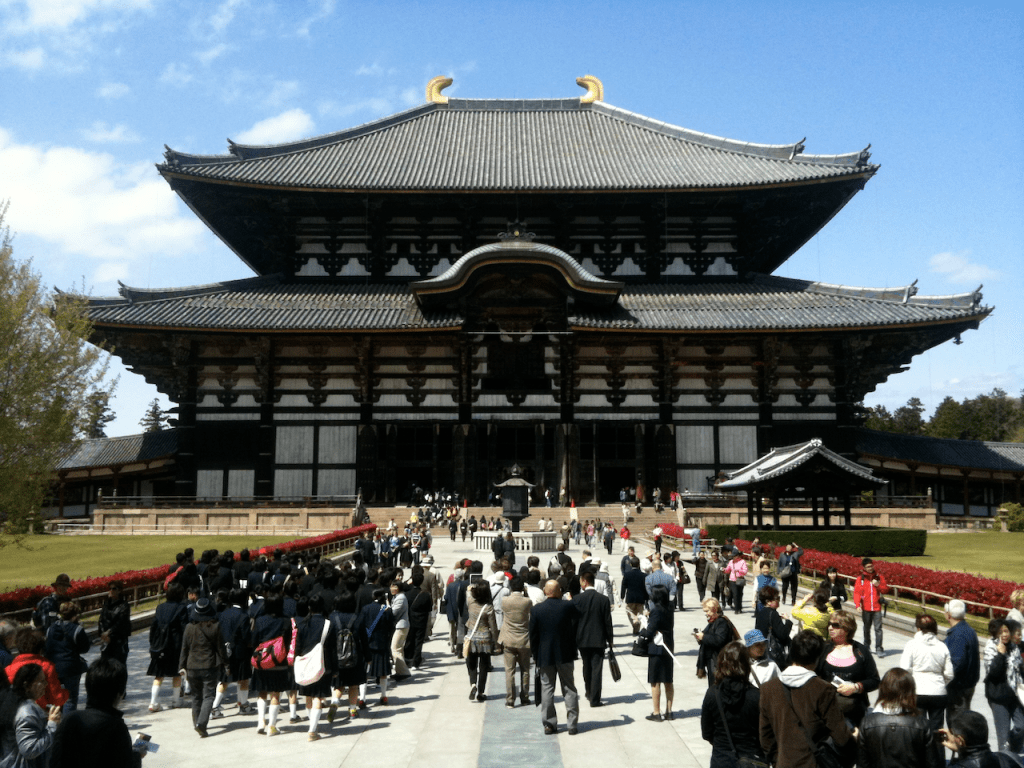
If you ever visit the famous Todaiji temple in Nara, Japan, you will see a truly colossal structure like so:
Taken by me on April 2010.
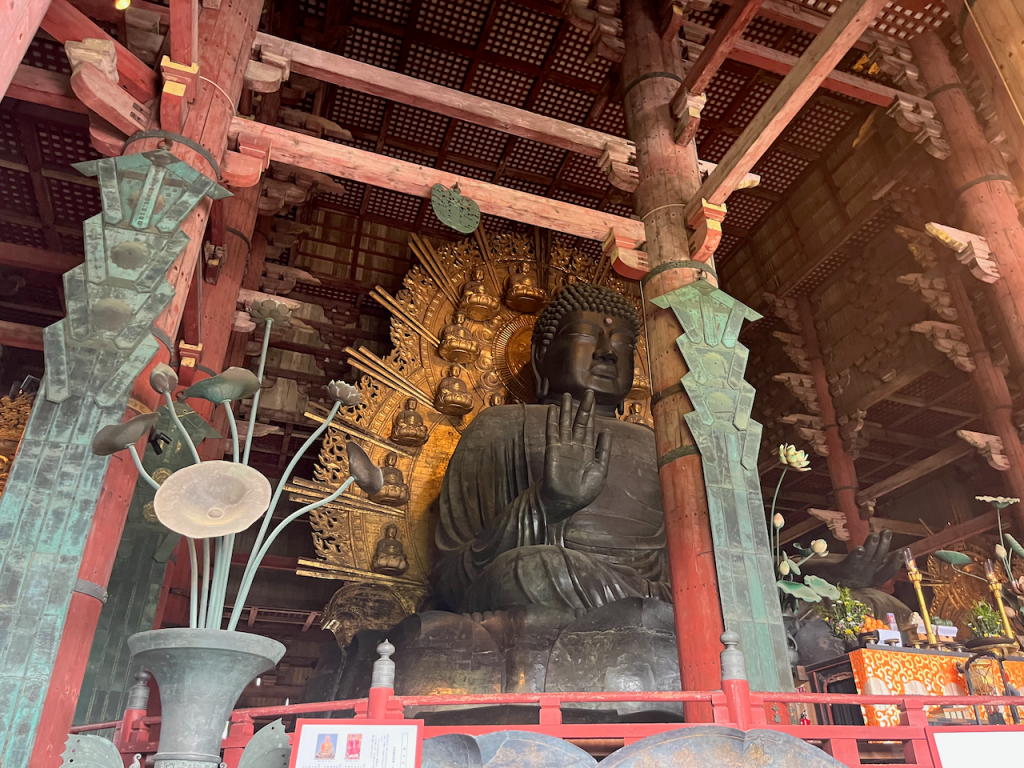
Inside as you approach is a colossal Buddha statue:
A side profile of the Great Buddha (daibutsu) of Todaiji Temple in Nara, Japan. This Buddha is Vairocana Buddha, the “Buddha of the Sun”. Taken in 2023.
This picture does not convey the size very well. It’s truly massive. But what is this Buddha?
This Buddha is a somewhat obscure figure named Vairocana (pronounced Wai-ro-chana) in Sanskrit, which means something like “of the Sun”. So, Vairocana is the Buddha of the Sun.
Vairocana features in a few Buddhist texts in the Mahayana canon: the Brahma Net Sutra quoted above and the voluminous Flower Garland Sutra, for example. It is also very prominent in esoteric traditions in Japan (Shingon and Tendai sects) as Maha-Vairocana (“Great Buddha of the Sun”).
The Brahma Net Sutra introduced Vairocana and explains that all Buddhas that appear in such-and-such time and place are embodiments of Vairocana. Thus Vairocana isn’t just another buddha, but is their source. Vairocana, in other words, embodies the Dharma.
That is why in the Great Buddha statue above at Todaiji Temple, you see rays of light emanating outward with “mini Buddhas” among them. Each of these Buddhas is thought to have the same basic origin story as the historical Shakyamuni Buddha. Hence in the text they are all just called “Shakymunis”. All these Buddhas have the same basic qualities ( Chapter Two of the Lotus Sutra teaches the same thing, by he way), one is the same as all the others.
This is primarily a Mahayana-Buddhist concept, but has precedence in pre-Mahayana sources. Consider the Vakkali Sutta from the Pali Canon:
“Enough, Vakkali! What is there to see in this vile body? He who sees Dhamma, Vakkali, sees me; he who sees me sees Dhamma. Truly seeing Dhamma, one sees me; seeing me one sees Dhamma.”
Translation by Maurice O’Connell Walshe
So the historical Buddha, founder of the Buddhist religion, Shakyamuni, is telling his disciples that his personage is less important than the Dharma. Mahayana Buddhism simply applies this same teaching towards all the Buddhas.
Also, some Buddhist texts assign different Buddhas to this role: the “cosmic” Shakyamuni Buddha of the Lotus Sutra or Amida Buddha in interpretations.
But it doesn’t really matter what you call this embodiment of the Dharma.
What matters, I think, is that the source of Buddhist wisdom is the Dharma, not a specific teacher, and that the Dharma pervades everywhere, regardless of the particular community, or lack thereof….
I saw this post recently on BlueSky, the hip new social media platform all the kids are talking about,1 and I had to share it with readers 🤣:
Speed-running is a fascinating sub-culture of gamers who finish games in impossibly short times through a combination of intense practice, manipulating errors in game code, and pre-planned strategy. My son and I like to watch speed-run world-records on YouTube for games I used to play as a kid. For example, this is a speed-run video where someone beats the classic NES game Mike Tyson’s Punch-Out in 22 minutes!
And this video shows someone attaining the world record for finishing the original Super Mario Brothers in 4:57. You can see multiple sneaky glitches and exploits here, plus lots of careful jump timing:
Finally, in this video, someone cleverly exploits an obscure glitch in Super Mario 3 to beat the game in 3:32!!!
But what does this have to do with Buddhism?
Buddhism is a 2,500-year old religion, adopted by many cultures and many times. The Buddha Shakyamuni (i.e. our historical founder), laid out the basic premise and trained his disciples on how to liberate themselves from the endless cycle of Samsara, and especially in the Mahayana-Buddhist tradition, to liberate others. We can see in early texts that this was a regimen of meditation training, self-restraint and living a humble, monastic lifestyle, as well as observation into one’s own mind. In video game terms, you can think of this as “grinding” level after level, building your skills, taking countless hours of gameplay.
The Buddhist path is a slow process, and requires a lifetime of dedication. Periodic visits to your favorite “meditation center” are fine, but Buddhism traditionally sees the path to awakening as a multi-lifetime endeavor for all but the truly talented (who may have already cultivated these qualities in previous lifetimes).
The actual length of time it normally took to accomplish awakening in Buddhism was hotly debated across Buddhist history. Early Buddhist texts implied that monks who were well-trained, or even lay-people who assiduously followed the basic code of conduct, could expect to reach awakening in one more lifetime, or may be a few lifetimes. But in Mahayana Buddhism, the length of time got longer and longer times as the bar of difficulty got higher and higher, well beyond what one could reasonably accomplish. A text called the Sutra of the Ten Stages in the Flower Garland Sutra describes the “Ten Stages of a Bodhisattva” over dozens of pages, and what’s required to complete each one before even getting to awakening. But each stage is a huge, huge endeavor by itself. Lifetimes of effort were not measured in eons of lifetimes.
As the road to awakening became longer and more remote, many Buddhist methods were developed to compensate for this and help people achieve the fruition of the Buddhist path much sooner, often through devotion to on Buddhist deity or another, or through specific samadhi methods, meditations and so on. The Pure Land path is by far the most popular and well-known due to its accessibility.
But in particular the Esoteric or Vajrayana traditions developed in the first centuries CE, hundreds of years after the Buddha. Historically speaking, the trend toward a longer and longer Buddhist path reversed and using this or that series of rituals, mantra chants, and mandala visual aids, one could “hack” the code of Buddhism and accomplish awakening in this very lifetime. Of course, the secrets behind such Buddhist speed-running techniques require a guru and a lineage.2 Vajrayana Buddhism is most prevalent in Tibet, but also in Japan through both Shingon and Tendai Buddhism.
But this does beg the question: is it really possible to speed-run the Buddhist path? Further, is the Buddhist path really eons and eons long as Mahayana Buddhism tends to assert, or is the length of time over-inflated?
Frankly, I don’t know.
Esoteric teachings and practices were definitely not part of the early Buddhist tradition (I definitely do not buy the idea of “secrets transmissions”, either). The Buddha’s advice in the early texts is generally pretty straightforward, one might say a little bland and anti-climactic, but also challenging because it gets to the root of who we are. It is definitely a lifetime effort.
But as much as I love the Mahayana tradition, it did have a tendency to out-do itself over and over. Waves and waves of Mahayana texts get increasingly dramatic, increasingly grandiose, and describe the Buddha path (namely through the Bodhisattva path) increasingly challenging terms. A backlash was inevitable, and so I can’t say I’m surprised that anti-intellectual movements such as Zen and Pure Land Buddhism, or “speed-run” methods such as Vajrayana arose in response.
Then there’s inevitable backlash from modern Buddhists who look at this convoluted history and complain, “none of this is real Buddhism anymore, it just cultural accretions”.
Every religion changes and evolves. Christianity as we know it didn’t have Christmas trees, and used Jewish-style liturgy in its early years. It adapted as it moved into new cultures. Islam grew into two different traditions, and as it became more urbanized some of the desert-nomadic traditions of the early community had to be adapted. Even obscure religions such as Zoroastrianism, whose early texts were composed amidst a steppe-nomadic culture, evolved to a more urbane and worldly culture until the Persian Empire.3
Zealous people love to go on a quest to find the “pristine” religious teachings, but you’ll never really find it. At best, you’re just reconstructing from pieces of the ancient past. At worst, you and your community just goes off the rails. It’s a fruitless quest.
So what to make of all this history and breadth of practice in Buddhism? Again, I just don’t know.
I do think that the old Kalama Sutta of the Pali Canon (AN 3.65) does provide some help though (slightly edited for readbility):
“It is proper for you, Kalamas, to doubt, to be uncertain; uncertainty has arisen in you about what is doubtful. Come, Kalamas. Do not go upon what has been acquired by repeated hearing; nor upon tradition; nor upon rumor; nor upon what is in a scripture; nor upon surmise; nor upon an axiom; nor upon specious reasoning; nor upon a bias toward a notion that has been pondered over; nor upon another’s seeming ability; nor upon the consideration, ‘The monk is our teacher.’
Kalamas, when you yourselves know: ‘These things are bad; these things are blamable; these things are censured by the wise; undertaken and observed, these things lead to harm and ill,’ abandon them.
Translation by Soma Thera
Followed by:4
…Kalamas, when you yourselves know: “These things are good; these things are not blamable; these things are praised by the wise; undertaken and observed, these things lead to benefit and happiness,” enter on and abide in them.’
Translation by Soma Thera
or the Buddha preaching to his stepmom in the Gotami Sutta of the Pali Canon (AN 8.53) :
“Gotamī, the qualities of which you may know, ‘These qualities lead to passion, not to dispassion; to being fettered, not to being unfettered; to accumulating, not to shedding; to self-aggrandizement, not to modesty; to discontent, not to contentment; to entanglement, not to reclusiveness; to laziness, not to aroused persistence; to being burdensome, not to being unburdensome’: You may categorically hold, ‘This is not the Dhamma, this is not the Vinaya, this is not the Teacher’s instruction.’
Translation by Thanissaro Bhikkhu
To summarize, if your Buddhist is leading to negative qualities described here, you should probably stop. If it is leading to wholesome qualities described here, keep going.
Namo Shakyamuni Buddha
Edit: I forgot to mention that the ultimate speed-runner in Buddhism is the Dragon Princess from the 12th chapter of the Lotus Sutra:
At that time the members of the assembly all saw the dragon girl in the space of an instant change into a man and carry out all the practices of a bodhisattva, immediately proceeding to the Spotless World of the south, taking a seat on a jeweled lotus, and attaining impartial and correct enlightenment. With the thirty-two features and the eighty characteristics, he expounded the wonderful Law for all living beings everywhere in the ten directions.
Translation by Burton Watson
1 I have a couple BlueSky feeds on there, but nothing related to the blog.
2 The Zen tradition is often compared to the Esoteric tradition since it also has ineffable teachings that can only be conveyed by a proper teacher.
3 I only know this because of the History of Persia podcast, by the way.
4 Because early Buddhist texts (sutras) were memorized and recited, they tended to be very repetitious. Later sutras, those in the Mahayana-Buddhist canon, used a more narrative style and thus longer and less repetitive, but also much more epic in tone.
Not too long ago, I found an old book I had forgotten I had: a translation of the Awakening of Faith in the Mahayana. For simplicity, we’ll call it the “Awakening of Faith” in this blog post. The Awakening of Faith is a Buddhist treatise, a śastra,1 written probably in the 6th century, but attributed to a Buddhist master in India, Aśvaghoṣa from the 2nd century. It is thought to have been composed in China, but likely drew from Indian sources, or was composed by an Indian-Buddhist monk living in China. Since it is mainly found in China, it is called Dàshéng Qǐxìn Lùn (大乘起信論).
Wikipedia points out that researchers now think a more appropriate title would be Awakening of Mahayana Faith in the Suchness of the mind. The 信 here might also be interpreted as “trust” or “entrusting”, so maybe Awakening of Mahayana-style Entrusting [in the Suchness of the Mind]? That reads a bit awkward though, so readers will have to decide how to phrase it.
If readers are curious what Mahayana Buddhism is, please feel free to read here.
This might sound like I am splitting hairs, but it is kind of important to emphasize that English terms like “faith” aren’t a good analogue for what the book is about. This is not a book of Christian-style faith. Instead, the author of the treatise addresses why they wrote The Awakening of Faith, when the same teachings are found throughout existing Mahayana sutras:
Though this teaching is presented in the sutras, the capacity and deeds of men today are no longer the same, nor are the conditions of their acceptance and comprehension….
Translation by Yoshito S. Hakeda
The author lists eight reason such as helping all attain peace of mind, liberating from suffering, and correcting heretical views (my words, not the book). In other words, the author wanted to both assert an orthodox Mahayana viewpoint of Buddhism, but also to clarify any misunderstandings and inspire others to take up the path. It is in a sense, a textbook introduction of Mahayana Buddhism.
Mahayana Buddhism is actually a pretty broad tradition, with lots of sub-schools, diverging viewpoints and so on. So, it’s hard to explain the entire tradition in a single book. Still, the treatise does a good job of touching on some essentials that many Mahayana Buddhist traditions today are founded upon. Traditions such as Zen, Pure Land, Nichiren, Tendai, and Vajrayana (among others) all have certain common teachings that pervade them all. The Awakening of Faith helps to enumerate what these are, in a fairly short, readable format, which for a 6th century text is pretty impressive.
To give an example, here is a quote on Suchness : a fancy term for reality, totality of existence, the Whole Enchilada, the Whole Shebang, etc, etc.:
[The essence of Suchness] knows no increase or decrease in ordinary men, the Hinayanists [earlier Buddhist schools], the Bodhisattvas, or the Buddhas. It was not brought into existence in the beginning, nor will it cease to be at the end of time; it is eternal through and through.
Page 65, translation by Yoshito S. Hakeda
If this sounds strangely familiar to readers, you might find something very similar in the Heart Sutra:
“Hear, Shariputra, all dharmas [all things, stuff] are marked with emptiness; they are neither produced nor destroyed, neither defiled nor immaculate, neither increasing nor decreasing….”
Translation by Ven. Thich Nhat Hanh in “Heart of Understanding”
You can definitely see some common themes between The Awakening of Faith and early Mahayana-Buddhist sutras such as the Heart Sutra. Further, The Awakening of Faith explores the notion of Bodhisattvas quite a bit:
The Buddha-Tathāgatas [e.g. the many buddhas], while in the stages of Bodhisattva-hood [i.e. on the cusp of becoming fully enlightened buddhas], exercised great compassion, practiced pāramitās [perfecting certain virtues], and accepted and transformed sentient beings. They took great vows, desiring to liberate all sentient beings through countless aeons until the end of future time, for they regarded all sentient beings as they regarded themselves.
Page 67, translation by Yoshito S. Hakeda
… but it gradually moves from theoretical teachings into more practical ones too. I was surprised to see the treatise openly teach the importance of developing faith in the Western Pure Land of Amida Buddha:
Next, suppose there is a man who learns this teaching for the first time and wishes to seek the correct faith but lacks courage and strength….It is as the sutra says: “If a man meditates wholly on Amitābha Buddha in the world of the Western Paradise and wishes to be born in that world, directing all the goodness he has cultivated [toward that goal], then he will be reborn there.”
Page 103, translation by Yoshito S. Hakeda
The particular “sutra” that the author is talking about is unclear. Hakeda and other scholars seem really quick to dismiss this section as a later addition, or influenced by the Pure Land Buddhist community, since it’s not found in the Three Pure Land sutras, but I would argue that it is either quoted from, or related to an earlier Pure Land sutra called the Pratyutpanna Sutra. Note this quotation here:
In the same way, Bhadrapāla, bodhisattvas, whether they are ascetics or wearers of white (i.e., laypeople), having learned of the buddha field of Amitābha in the western quarter, should call to mind the buddha in that quarter. They should not break the precepts and call him to mind singlemindedly, either for one day and one night, or for seven days and seven nights. After seven days they will see Amitābha Buddha. If they do not see him while in the waking state, then they will see him in a dream.
Translation by Paul Harrison, courtesy of BDK America
But I digress.2
If you think of The Awakening of Faith as a kind of Mahayana training manual, you’d probably be right. It’s meant to distill the vast corpus of teachings into a more bite-sized treatise that covers all the important bases without getting bogged down in sectarian debates. It’s not difficult to read, but does get a little cerebral at times. Still, it was a pretty impressive effort for the day, when Buddhism was still being introduced in China, and people wanted sought to find a way to make the teachings accessible and easy to understand.
It’s influence on later East Asian Buddhism cannot be understated. It provided an important foundation for later schools such as Tian-tai (Tendai in Japan), and subsequent schools that arose from it: Zen, Pure Land, etc.
English translations are hard to find, but if you manage to find a copy of The Awakening of Faith, and are interested to understand what Mahayana Buddhism is all about, definitely pick it up.
2 It’s quite possible that Professor Hakeda is correct in that it’s a later addition. Ph.D’s aren’t for show: the dude has a lot of background and training in the subject, so he knows a lot. I just think that because the Pratyutpanna Sutra was already popular in China by the time that The Awakening of Faith was composed, it might not be a later addition. But as the kids say, that’s just my “head canon”. 😁
Also noteworthy is no mention of the verbal nembutsu in the above quote. The verbal nembutsu as a practice was popularized centuries later by Shan-dao. Therefore, if it was added to The Awakening of Faith as an afterthought, it was probably something very contemporary.
When visiting famous Buddhist temples (o-tera, お寺) in Japan, it’s very common to see sutra books, or kyōten, (経典), sold in the gift shop. These are small booklets that contain popular Buddhist sutras of the Mahayana tradition, and are used for home services. Over the years, I’ve collected more sutra books than I care to admit, but I really liked the one I picked up from Kofukuji temple in Nara last year:
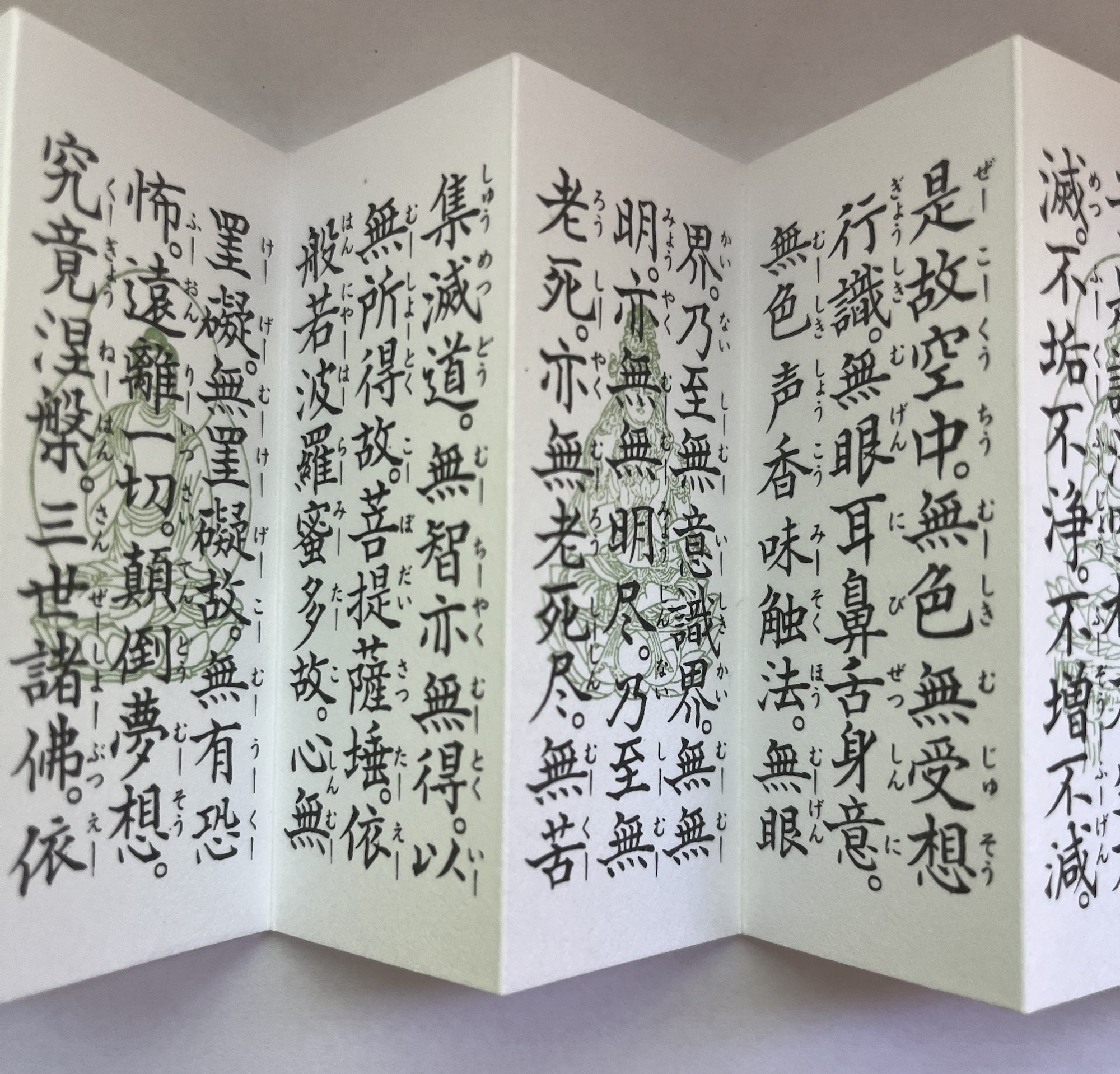
This is a boxed copy of the Heart Sutra, called the Hannya Shingyō (般若心経), with a blue brocade cover. Inside, you can see the Heart Sutra as it is usually printed: original Chinese characters with Japanese pronunciation guides. It is read from right to left, vertically:
However, if you look carefully, you will also see Buddhist deities embossed on the pages too:
They also appear on the backs of the pages too:
It took me a moment, but I finally recognized these as the Thirteen Buddhas and Bodhisattvas venerated in the Shingon-Buddhist tradition.1
I have read that many of the old Nara-Buddhist sects were gradually subsumed by Shingon Buddhism and adopted many of its practices. This includes sects such as the Kegon sect (Todaiji temple) and Hosso sect (Kofukuji temple) among others. So, this makes sense. You can learn more about Shingon Buddhism here.
Anyhow, of all the sutra books I own, I have to admit that this is my favorite one, and use it regularly for morning services (see old post).
P.S. If you’re ever curious what the Heart Sutra sounds like in Chinese (at least modern Chinese), this link has a nice example.
1 These Buddhas and Bodhisattvas are venerated in other sects in varying degrees, of course, but not as a set of thirteen like Shingon. Shingon even includes them in its ritual services.
Another dharani I was reading about lately is the Great Compassion Dharani, also known as the Nīlakaṇṭha Dhāraṇī, or in Japanese Buddhism the daihishin darani (大悲心陀羅尼), also known more simply as the daihishu (大悲咒), among other names.
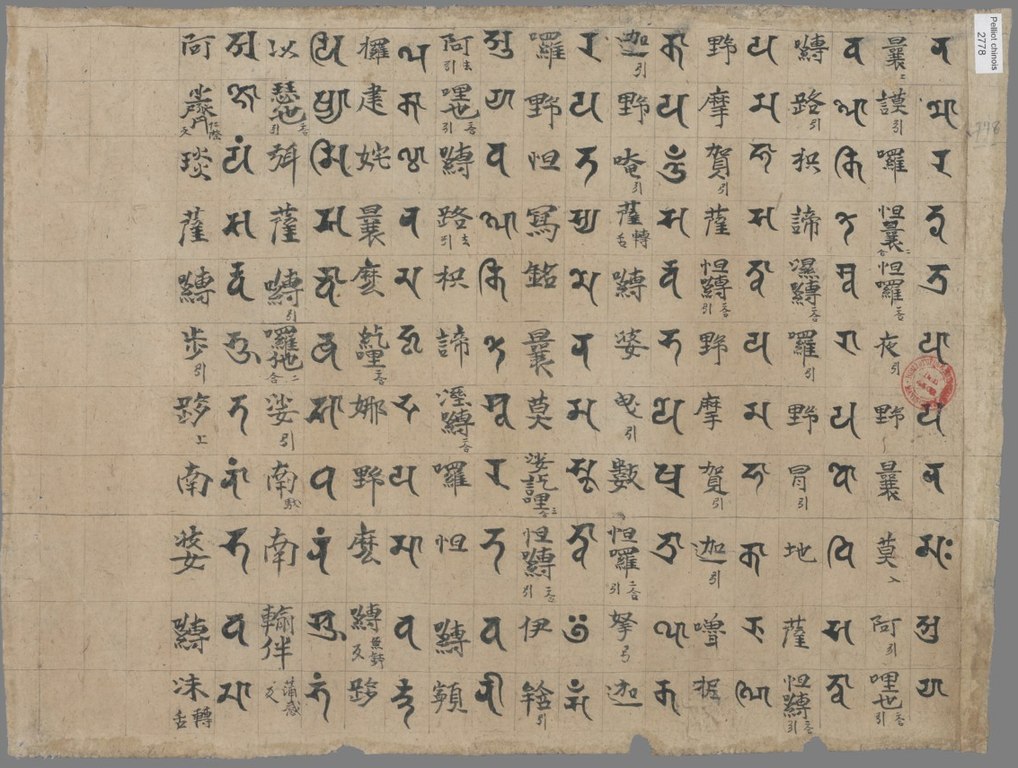
According to Wikipedia, this is one of widely recited dharani across the Buddhist tradition, and has undergone various changes over time, with a couple extant (though corrupted) versions. The featured photo above is an example found in the Dunhuang caves of China, showing the original text in Siddham script, with Chinese transliteration:
Fragment of the Nilaṇṭhanāmahṛdaya dhāraṇī both written in Siddhaṃ script and transliterated in Chinese characters. Bibliothèque nationale de France, Public domain, via Wikimedia Commons
You can see another example here, using both Siddham script, and the ancient Sogdian script:
Whereas the Dharani for the Prevention of Disaster (discussed in a previous post) is focused on practical matters, the Great Compassion Dharani is meant to be chanted in order to awaken goodwill towards others, using Kannon Bodhisattva as the archetype. It is taken from a longer Buddhist text, the Sutra on the Thousand-armed, Thousand-eyed Bodhisattva Avalokitesvara’s Sutra of Dharanis on the Vast, Perfect, and Unobstructed Mind of Great Compassion (千手千眼観世音菩薩広大円満無礙大悲心陀羅尼経).
This dharani is most closely associated the Zen traditions, but because it is pretty long, it’s probably not always practical for lay followers to recite in daily services. I have not seen it listed in service books for lay followers in either Soto Zen or Rinzai Zen. In any case, I am posting it here as a reference.
You can see an example of the Great Compassion Dharani being chanted in a formal Soto Zen service here:
There is a nice Chinese-language version here (starts at 1:07):
I have posted the dharani here in multiple languages, so that people can choose which version they prefer to recite. The main source was Wikipedia, but for the Chinese Pinyin, I had to check multiple websites as the pinyin varied slightly in some places, while for the Japanese version, I checked line by line in the video above.
Side note, there is a different version in the Japanese Shingon-Buddhist tradition, but I am too lazy to post here, since the dharani is so long. You can find it here on the Japanese Wikipedia article under “真言宗の読み方”.
June 2025: Major rewrite of this page to make the text side-by-side, but also fixed several typos.
1 Sources used to validate the pinyin: here and here, plus Wikipedia article. Each one slightly disagreed with one another, and my Chinese language skills are very limited, so I had to make a best guess in a few cases where things seemingly contradicted. It’s also possible that certain Chinese characters just have multiple pronunciations.
2 For some reason, the Soto Zen version doesn’t have the words 那摩婆薩哆 (nama vastya / ná mó pó sà duō).
3 Similarly, the Soto Zen version doesn’t have the final “om” (唵, ān) in it.
The dharani below is the Dharani for the Prevention of Calamity, or shōsaishu (消災呪), called more formally the shōsaimyōkichijō darani (消災妙吉祥陀羅尼). It is used in both Rinzai and Soto Zen traditions as a general-protection “spell”.1 I assume the intention is to protect the Zen disciple so that they can reduce obstructions on their path, similar to prayers to the Medicine Buddha in other traditions.
Before we share the dharani, let’s talk about mantras vs. dharani in Buddhism. Both belong to the esoteric traditions of “Vajrayana Buddhism”, (e.g. Tibetan Buddhism, and Shingon/Tendai Buddhism in Japan). My experience is limited, but I believe that mantras usually have layers of deeper and deeper meaning that a disciple explores in the esoteric path, while dharani do not. Instead, dharani are more like tools, simple “spells”1 or chants to provide a specific benefit. Mantras might provide also a benefit, but that’s not their sole purpose in the esoteric tradition.
Also, non-esoteric traditions in Buddhism will sometimes cherry-pick ones that they feel are useful, some more than others.2 Sometimes mantras and dharani are used for very specific liturgical purposes, others are chanted as part of normal service.
In any case, the Dharani for the Prevention of Calamity is regularly chanted three times in Rinzai Zen liturgies. I am less clear how it’s used in Soto Zen.
An example of the recitation is below from the Soto Zen tradition:
The dharani has a couple versions, one used in the Soto Zen sect, and another used by Rinzai. I’ve included both versions below.
NO MO SAN MAN DA MO TO NAN O HA RA CHI KO TO SHA SO NO NAN TO JI TO EN GYA GYA GYA KI GYA KI UN NUN SHI FU RA SHI FU RA HARA SHI FU RA HARA SHI FU RA CHI SHU SA CHI SHU SA CHI SHU RI CHI SHU RI SO WA JA SO WA JA SEN CHI GYA SHI RI EI SO MO KO
NA MU SAN MAN DA MO TO NAN O HA RA CHI KO TO SHA SO NO NAN TO JI TO EN GYA GYA GYA KI GYA KI UN NUN SHI FU RA SHI FU RA HA RA SHI FU RA HA RA SHI FU RA CHI SHU SA CHI SHU SA SHU SHI RI SHU SHI RI SO WA JA SO WA JA SE CHI GYA SHI RI EI SO MO KO
1 I am not sure what else to call it. Dharani use Sanskrit words that are chanted to provide a concrete benefit. If there was a meaning originally, it’s obscure now. I wish I could use a more suitable word for this, but there’s nothing in English I can use that doesn’t sound like a Harry Potter episode.
2 the Pure Land tradition usually doesn’t use mantras or dharani. One could argue the nembutsu is something similar, but that’s a story for another post.











 Gleanings in Buddha-Fields


You must be logged in to post a comment.