SPOCK: If there are self-made purgatories, then we all have to live in them.
Star Trek, “This Side of Paradise”, stardate 3417.7
The Five Hindrances in Buddhism was something I briefly touched on in the past, and something I think about from time to time, but then I ran into this neat excerpt by the Chinese Tiantai (Tendai) founder, Zhi-yi:
The practitioner is like a person who has gained freedom from a debt or one who has been cured of a serious disease, like a starving man arriving in a prosperous country, or like one who has been rescued safe and unharmed from a band of villains. When he eliminates these five hindrances, his mind becomes calm and secure and he feels clear, cool, and blissful.
Just as with the sun and moon which may be obscured and prevented from shining brightly by the five phenomena of smoke, dust, clouds, fog and the hand of the asura known as Rāhu, so it is as well with the human mind and the five “covering” hindrances.
The Essentials for Practicing Calming-and-Insight & Dhyana Meditation by Zhiyi, translated by Kalavinka Press, page 75
I really like this quote for a few reasons.
First the benefits of self-discipline, and personal conduct are like getting out of debt. By not committing harmful actions towards others (and by extension yourself), you are no incurring further debt. Because you are no longer incurring debt any existing “karmic debt” run its course, your personal purgatory that much shorter. It bring a kind of freedom, even if it seems counterintuitive.
長からむん心も知らず黒髪の乱れてけさはものをこそ思え
I do not even know how long your feelings will last. My long black hair is all disheveled and, this morning, my thoughts too are in a tangle!
Second, it reiterates that the Five Hindrances really do get in the way of clear thinking, and prevent one from being level-headed and in control. This leads to further harmful actions, incurring further “debt”, etc. So, it helps to know what the Five Hindrances are, and to observe them in your own life, and to know how best to counteract them.
Easier said than done, but every time you counteract ill-will, or laziness, you’ve lightened the burden in your own self-made purgatory.
Namu Shakamuni Butsu
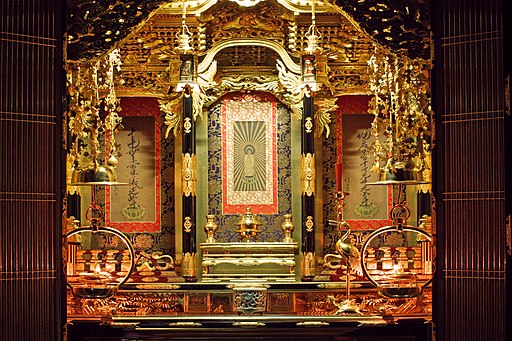
P.S. Featured photo taken at Ryoanji temple in 2023.
As I talked about in a recent post, the main core idea of the venerable Tendai (天台) sect in Japanese Buddhism, including its parent Tiantai sect in China, is that the Lotus Sutra is the most important text in the Buddhist canon, a kind of capstone (lit. “complete teaching”, engyō 円教) for the rest of Buddhist literature up to that point. Because the Lotus Sutra is pretty long (equivalent to a modern book), I tried to summarize its teachings here.
Anyhow, Tendai/Tiantai focuses on how to put the Lotus Sutra into practice. For Japanese Tendai in particular, this is encapsulated in a phrase called shishū yūgō (四宗融合) meaning “Four Integrated Practices”. According to my book, these are listed as follows:
Different people under the umbrella represent different Buddhist followers, with different practices and inclinations, but the umbrella itself represents the concept of upāya (“expedient means”) or hōben (方便) in Japanese. This is one the main themes of the Lotus Sutra, and expresses that all Buddhist teachings and practices lead toward the same end goal, and thus whatever works for a person at that time is perfectly fine for that person.
This is encapsulated in the 25th chapter of the Lotus Sutra, the so-called Kannon Sutra, because the Bodhisattva Kannon (a.k.a. Guan-Yin, Avalokiteshvara, Chenrezig, Quan Âm, etc) according to this chapter takes on whatever form is most beneficial for that person and teaches the Dharma to them. Thus, Kannon can appear as a man, woman, monk, rich person, etc. It’s also why statues of Kannon often depict them as having 1,000 arms, each holding a different object. Similarly, many of the early Buddhist monks who were Tendai followers practiced it differently from one another. On the one hand, you have monks like Eisai, who focused on meditation and precepts (and would later found the first Rinzai Zen temples), you also had monks like Genshin who focused a lot more on Pure Land practices, as well as esoteric experts such as Ennin.
Tendai as a sect in Japan was almost universal in the 9th through 12th centuries, but for a variety of historical (often self-inflicted) reasons, it has diminished in size and influence. Yet when you visit historical temples in Japan such as Asakusa Temple in Tokyo, Kiyomizudera Temple in Kyoto, and Sanjusangendo in Kyoto, these are all Tendai temples. Further, its influence lives on in newer sects that we know well: Zen, Pure Land, Nichiren and such, which all inherited practices and concepts even if they apply them in differing ways.
But while Tendai as an organized sect is somewhat diminished,3 its teachings of “umbrella” or “universal” Buddhism continue to live on. Rather than insisting there’s only one way to practice Buddhism, it gives a large, spacious framework for people to figure out their own path and use the vast toolkit available to work it out, all under the Lotus Sutra concept of expedient means. Use what works for you, and do not be afraid to adapt, change, or expand your practice as you go.
P.S. Publishing off-schedule just for fun. Happy Sunday!
1 Tendai/Tiantai has the same meditation tradition as Zen, but tends to call it shikan (止観) not zazen (座禅) meditation. The founder, Zhi-yi, in China wrote multiples treatises, the Mohe Zhiguan, that provides a comprehensive manual about meditation. I have a copy of the The Essentials for Practicing Calming-and-Insight & Dhyana Meditation, but have only read parts of it. It is a nice training manual for those interested, but it is a little dense since the intended audience was the monastic community.
2 In the time of Zhi-yi, the founder of Tiantai, Pure Land Buddhism was approach more as a meditation tradition than a separate set of practices that what we see today. By the time it came to Japan, this had changed somewhat, and we see through the writings of Genshin that there were a variety of approaches both devotional and meditation-focused.
3 According to my book, as of 2015, the number of registered followers in Japan was around 1.5 million give or take. This makes it the second smallest of the major sects in Japan, and one-eighth the size of Jodo Shinshu-sect Buddhism. Only Rinzai Zen is smaller (1.1 million).
It’s been a while since I discussed anything that relates to Tendai Buddhism, but I was doing a bit of nerd-reading with my free time, and thought this was interesting to share.
As Buddhism spread from India via the Silk Road, transmitted by such peoples as the Kushans, Sogdians, and Parthians (the same Parthians who contended with Rome from to time), the vast wealth of Buddhist texts, teachings and information flooded into China in waves.
This import of information was kind of haphazard at first, but as translations improved and information continued to come, China developed its own schools of thought to help make sense of it all.
One of the first successful efforts was by a Chinese monk named Zhi-yi (智顗, 538–597 CE)1 who founded the Tiantai school. He, or possibly by later patriarch Zhan-ran (湛然, c. 711-782 CE),2 analyzed the various teachings and Buddhist texts and developed a chronology called the Five Time Periods and Eight Teachings (五時八教, wǔshí bājiào).3 This chronology looks like so:
The Buddha (Shakyamuni) taught the Flower Garland Sutra first, but it was incomprehensible to disciples.
The Buddha stepped back and taught Agama sutras next. The Agamas are equivalent to the Pali Canon in the Theravada tradition, and nearly the same in terms of content. The Agama sutras were more grounded and practical and thus easier for his community to understand.
Next, the Buddha taught sutras such as the Vimalakirti Sutra as an introduction to Mahayana teachings, and thus higher than the Agamas.
Next, the Buddha taught the Perfection of Wisdom sutras, such as the Heart Sutra, as a more complete teachings.
Finally, the Buddha taughy his ultimate teachings: the Lotus Sutra and Nirvana Sutra because the disciples were now ready.
Thus, out of all the Buddhist texts, Zhi-yi argued that the Lotus Sutra was the complete and ultimate teaching (円教). In Japanese Tendai Buddhism, 円教 is pronounced as engyō, or is sometimes more formally called hokke engyō (法華円教, “the complete teaching that is the Lotus Sutra”). Much of Tendai Buddhism is thus about putting the Lotus Sutra teachings into practice. From the Tendai perspective, things like meditation, venerating Amida Buddha, esoteric practices like mantras, and upholding the precepts are all ways to put the Lotus Sutra into practice, and Zhi-yi wrote quite a bit about this subject.4 The idea, expressed through the phrase shi-shū-yū-gō (四宗融合) or “Four Integrated Schools”.
The historicity of Zhi-yi’s textual analysis is unfortunately pretty dubious. Modern archeology and Buddhology show that the very earliest texts, historically, were the Agamas / Pali Canon (the Dhammapada and Jataka Tales probably came even earlier), but even those were not recorded in writing until three to four centuries after the Buddha. So, even with the earliest texts, we have a gap from when the early disciples passed everything down orally before committing to writing generations later. Granted, Indian oral tradition was quite sophisticated and designed to minimize errors and corruptions in recitation, but the Agamas and Pali Canon do slightly diverge from one another, mostly in ways that are interesting to scholars only.
The Mahayana Sutras such as the Vimalakirti Sutra, Lotus Sutra and Perfection of Wisdom sutras were written down even later. One could argue that they were passed down orally5 and just recorded later for some reason, but textual analysis casts this into doubt. The Mahayana sutras are more like “reboots” or compilations of earlier teachings, more polished and such.
Which is where the Lotus Sutra comes in, I think.
This is personal bias, admittedly, but I do believe that the Lotus Sutra is a capstone of the Buddhist tradition, not because the Buddha saved it for last. Instead, the authors of the sutra did a really nice job of synthesizing earlier teachings into a single narrative, and devised clever parables to bring the teachings to readers in a fresh, new way. The Lotus Sutra doesn’t necessarily introduce a lot of new teachings so much as it brings it all together. Like a capstone or keystone. There’s something in there for everyone, in other words.
So, to me the Five Time Periods and Eight Teachings isn’t very useful in a literal, historical sense, but it is useful for showing how some sutras synthesize other sutras into increasing comprehensive narratives.
P.S. featured photo is the capstone of the main entrance of Giusti’s Palace, photo by Paolo Villa, CC BY-SA 4.0, via Wikimedia Commons
1 Pronounced like “Jer-yee” in English. The “zhi” in pinyin sounds like English “jerk” without the “k” at the end. His name in Japanese is read as Chigi, by the way.
2 Pronounced like “John-ron” in English. In Japanese, his name is read as Tannen.
3 This is read in Japanese language as gojihakkõ.
4 Pure Land practices as we recognize them do not seem to be prominent in Zhiyi’s time and were adopted into Tiantai later, and thus Japanese Tendai even later through such figures as Genshin.
5 The Lotus Sutra, for example is a mix of verse sections with narrative text around them. It’s argued that the verse sections came first, and then authors composed the narrative sections around them. When the verse sections were first composed is anyone’s guess.
I had an idea recently while flipping through my book on the journeys of the Buddhist monk Xuan-zang (pronounced like “Shwan-tsong”). Xuan-zang was the famous Buddhist monk who walked to India in order to bring back more information and texts in order to help develop Buddhism in his native China. In my old post, I covered some of the trials and tribulations of this amazing journey, and even made a fun song. However, looking back the post felt incomplete. I realized that many of these places that Xuan-zang traversed are obscure and forgotten now despite their central importance to Buddhist history, and the journey was so long that it’s too much to really explore in a single post.
So, this is the start of a series of posts meant to help retrace Xuan-zang’s journey, explore places of significance and how they tied into larger history. I don’t have a schedule yet (these posts take a while to write), but I am working on the next few drafts already.
Today’s post is the prologue episode, covering China at this time, and why Xuan-zang left.
Quick note: because this episode in particular uses a lot of Chinese names, for the sake of accuracy and modern readers, I am using the pinyin-style accent marks where relevant, and also using Simplified Chinese characters. I also put in lots of hyphens to help with pronunciation.
The Tang Dynasty
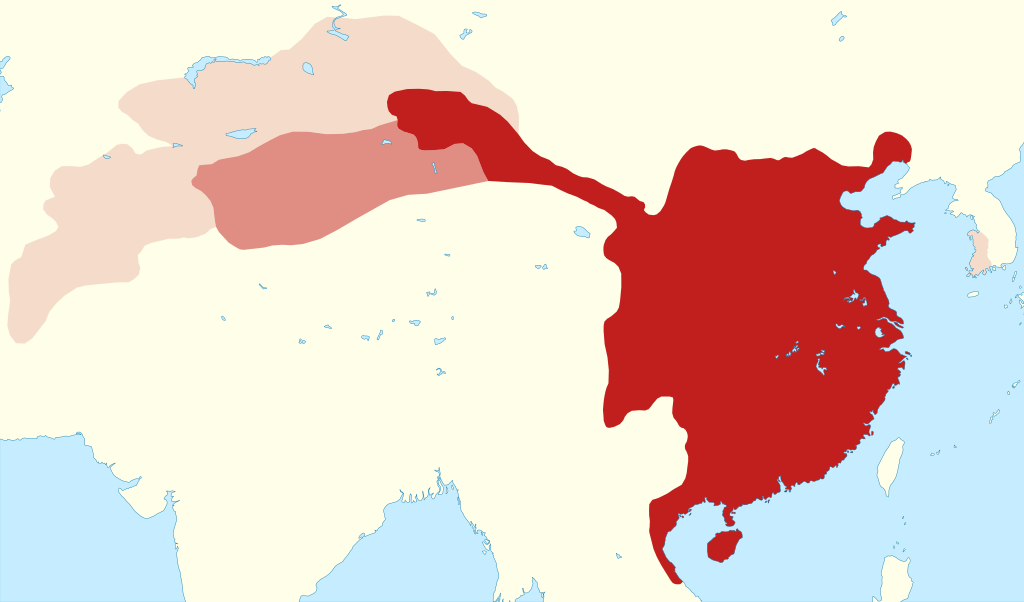
Great Tang at its largest extent in 661, map courtesy of Kanguole, CC BY-SA 4.0, via Wikimedia Commons
Chinese history, until the Republican era (1912 onward) had seen a series of kingships followed by imperial dynasties. Although, we usually call the country “China”, the name used by Chinese people in antiquity, and by their neighbors, was often taken from the current ruling dynasty.
Dynasties came and went. Some were fairly short-lived such as the Sui, others were incredibly powerful and long-lasting such as the Ming. Some were constantly fighting for their existence, such as the Song, others were fractured into a series of “mini-dynasties” that only exerted control over a region and were unable to unify China.
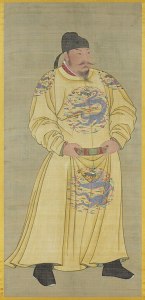
A portrait of Emperor Tai-zong, painted centuries later in the Ming Dynasty. National Palace Museum, Public domain, via Wikimedia Commons
Xuan-zang lived during the last days of the Suí Dynasty, and the early days of the Táng Dynasty (唐). “Great Tang” (大唐) as it called itself, lasted from 618 – 907, and was one of the high points of Chinese civilization. The empire expanded very far to the west, along the Silk Road (more on that in future posts) and actively imported all kinds of art, people, ideas, religions and material culture from Central Asia. Compared to earlier dynasties, Great Tang was much more cosmopolitan and less insular.
Xuan-zang lived primarily during the reign of the second Tang emperor Tài-zōng (太宗), who was an incredibly powerful, dynamic ruler. Chinese history still reveres him as of the greatest rulers. Tai-zong aided his father, the first emperor, in overthrowing the previous dynasty. Further, he was a powerful, expansionist ruler with a strong sense of administration, which helped provide stable foundations for Great Tang.
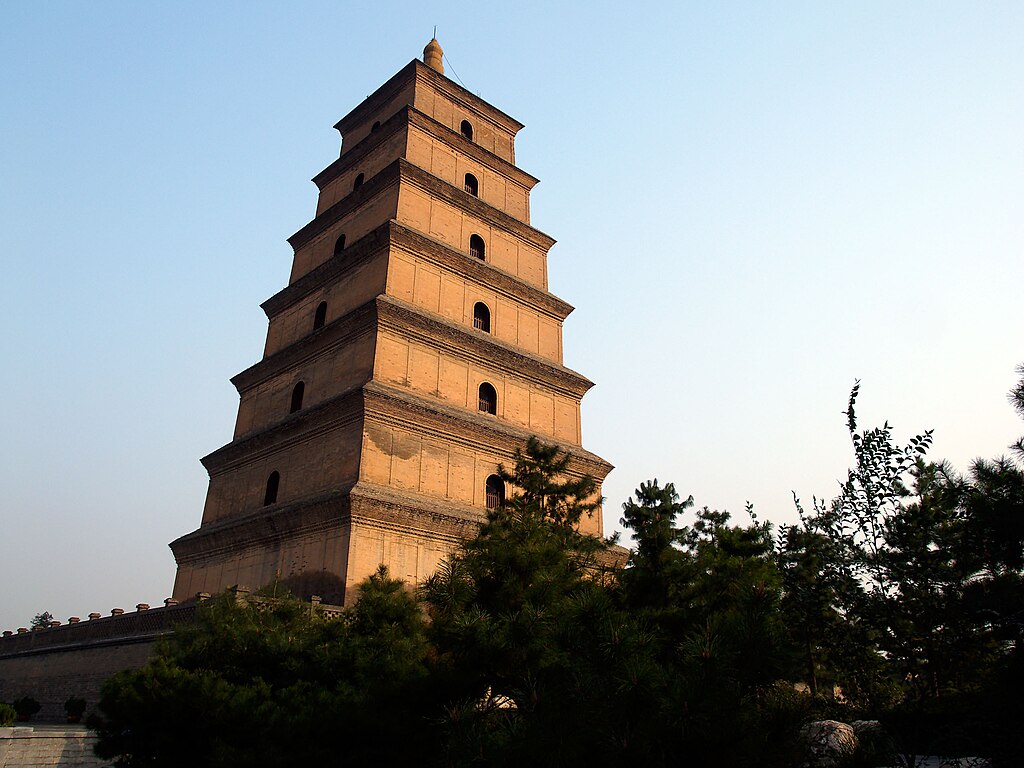
The capital of Great Tang was the city of Cháng-ān (长安) in the western part of China. The city was a massive, cosmopolitan center of administration, commerce and culture. Chang-an at its height grew to 30 square miles, which was massive compared to Rome which occupied only 5.2 square miles. The population by 742 was recorded as 2,000,000 residents and of these 5,000 foreigners.
Chang-an was easily one of the world’s greatest cities at the time, and it had a great influence on its neighbors as well: the layout for the capital of Japan, Kyoto, was intended to resemble Chang-an, and great Buddhist masters such as Saicho’s rival, Kukai, studied there extensively. It was here that many Buddhist texts that came from the Silk Road were translated here as well.
As the easternmost point of the Silk Road, it was here that many journeys began or ended…
Buddhism in Great Tang
The Tang Dynasty is often regarded as one of the high points of Chinese civilization, but also for Buddhism. Buddhism had emerged in China centuries earlier but its spread was slow at first. The native Confucian community particular resented the foreign Buddhist teachings as un-filial, unproductive (since monks did not work fields), and a drain on national resources.
In spite of the criticisms, it spread nonetheless. Wave and wave of teachings, newly translated texts, and schools of thought were imported from the Silk Road, allowing Buddhism to gradually take root, articulate its teachings better over successive generations, and develop natively Chinese schools of thought such as Tiān-tāi, Huá-yán, and Pure Land alongside imported schools of thought from India such as Fǎ-xiàng (Yogacara) and Sān-lùn (Madhyamika). By the time of the Tang Dynasty, massive temple complexes had arisen around Chang-an and other major cities.
This was a rare time when there was still a connection between Buddhist India and China, allowing a free flow of information. Later, when Buddhism fell in India, and the Silk Road was no longer safe to travel due to warfare, China was cut off.
Emperor Tai-zong himself had a distant relationship with Buddhism in his early reign. He kept it at arm’s length and strictly regulated. Further, travel in and out of China was tightly restricted, so that while there was commerce and trade, one could only do so with official permissions. More on this shortly.
Enter Xuan-Zang
Xuan-zang was the second son of his family. His older brother had ordained as a Buddhist monk, and Xuan-zang decided to follow in his footsteps at a young age. During the collapse of the Sui Dynasty, both brothers came to Chang-an where it was safe, and undertook further Buddhist studies. Since Xuan-zang proved to be a promising student, he was soon given access to advanced Buddhist texts and eventually ordained as a full monk in 622.
As to why Xuan-zang decided to journey all the way back to India, he is quoted as stating the following:
The purpose of my journey is not to obtain personal offerings. It is because I regretted, in my country, the Buddhist doctrine was imperfect and the scriptures were incomplete. Having many doubts, I wish to go and find out the truth, and so I decided to travel to the West at the risk of my life in order to seek for the teachings of which I have not yet heard, so that the Dew of the Mahayana sutras would have not only been sprinkled at Kapilavastu, but the sublime truth may also be known in the eastern country.
During his studies, Xuan-zang had noticed copyist errors, corruptions of texts, missing texts and other textual issues that prevented a thorough understanding. Thus, he resolved to journey to India, much like a monk named Fa-xian (法显) had done centuries earlier. He was particularly interested in the writings of Vasubandhu and his half-brother Asanga , who were crucial to the development of Mahayana Buddhism as we know it. Xuan-zang and some like-minded monks petitioned the Emperor Tai-zong to be allowed to journey to India, but never received an answer. He made his preparations, possibly learning some Tokharian language (commonly spoken along the Silk Road at that time) from the foreign quarters at Chang-an, then went west.
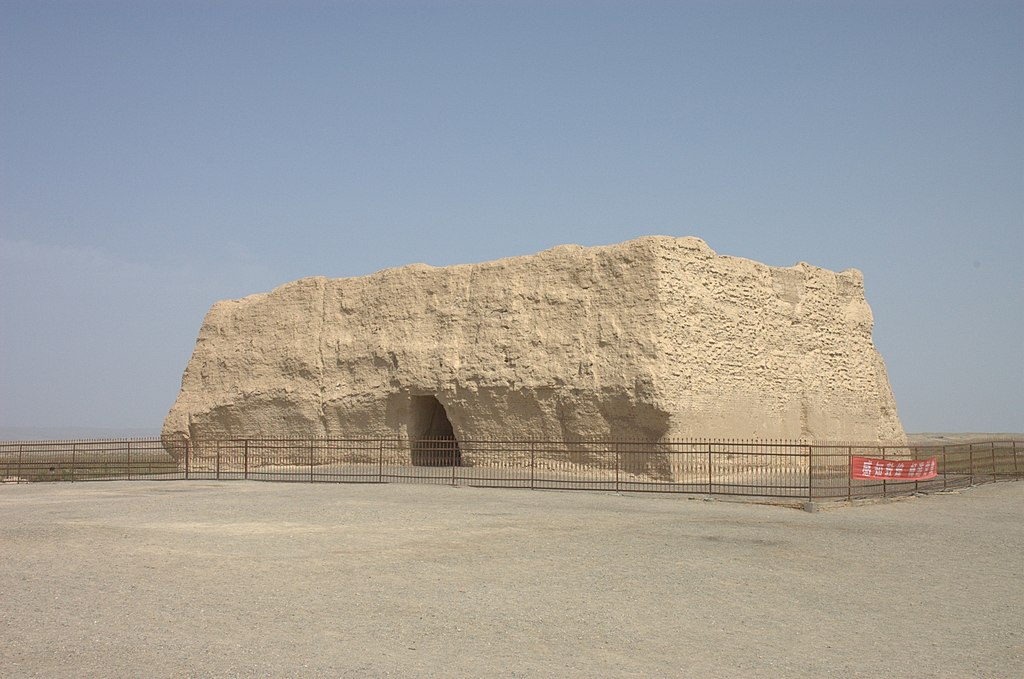
Ruins from the Yumen Pass, photo courtesy of 张骐, CC BY-SA 3.0, via Wikimedia Commons
By the time Xuan-zang reached the Yumen Pass (Yùmén Guān 玉门关) at the western end of Great Tang, he had attracted some unwanted scrutiny by authorities, and wasn’t permitted to leave. By this point, his companions had lost their nerve, but Xuan-zang was determined to continue. With some help from a sympathizer, Xuan-zang defied imperial orders and snuck around the Yumen Pass to leave China. He was now a criminal, and he was alone with a vast desert ahead of him.
June 4th is the yearly memorial service in Japan’s Tendai sect of Buddhism called Sangé-é (山家会) for its founder, Saichō (最澄, 767 – 822). I am writing this post a bit late this year, but I wanted to explore the life of Saicho a little bit and why he matters.
Saicho as depicted in a Heian-Period painting.
If you look at the history of Japanese Buddhism, Saicho doesn’t elicit much historical attention and discussion, even compared to contemporary rivals at the time like Kūkai, founder of Shingon-sect Buddhism. Yet, the sect he founded in Japan was overwhelmingly the largest and most influential for centuries (probably too much so), until it finally faded into the background in the late medieval period. This is why you rarely see mention of Saicho or Tendai these days: it’s far smaller now than it was in the past.
Also, to confuse matters further, Saicho is only the founder of the Japanese branch of Tendai. It was the Buddhist monk Zhi-yi (智顗, 538 – 597), who originally started the Tian-tai (天台) sect in China in the 7th century and it remains a very influential sect across many areas of mainland-Buddhist Asia (Korea, Vietnam, etc). Tian-tai in Japan (pronounced as Tendai) reveres Zhiyi as well.
Anyhow, Saicho was a monk at a time when Buddhism had already been established in Japan, primarily around the old capitol of Nara, yet was limited to a very tightly regulated number of schools and monks per school. Besides the Yogacara (Hossō) and Huayan (Kegon) schools, the rest are very obscure today. These schools had all been imported from Tang-Dynasty China, and represent “branch” schools to the mother temples there. The existing schools at that time were obligated to perform rituals on behalf of the Emperor to prevent calamities, cure diseases, bring prosperity to the nation and other political needs. In turn, the government allocated new acolyte monks every year, and allowed them to continue. However, beyond that, Buddhism had very little reach in the rest of Japanese society. This is very different than the bottom-up approach in China.
Saicho was ordained as an official monk, but soon left and retreated to Mount Hiei where he underwent ascetic practices, rather than stay in the urban temple complexes. In time, he attracted other like-minded disciples, and a small, informal monastic community developed there on the mountain. Further, he carved an image of the Medicine Buddha, and later lit an oil lamp in reverence to the Buddha, praying that the light would never be extinguished. This lamp, the Fumetsu no Hōtō (不滅の法灯) was the subject of a previous post. By this point, the foundations of the temple of Enryakuji were laid.
Later, by a lucky coincidence, the capitol of Japan was moved away from Nara to Kyoto (back then Heian-kyō) in 795. Since Mount Hiei happened to be to the northeast of Kyoto, and since the northeast was considered an inauspicious direction in classic Chinese geomancy, the presence of a Buddhist temple there (namely Enryakuji) helped protect the new capital from negative influences. The Emperor, for his part, saw this new Buddhist sect has a counterbalance to the old guard sects in Nara. Thus, Saicho’s star quickly rose.
The Eastern Pagoda (Buddhist stupa), of Enryakuji Temple, 663highland, CC BY-SA 3.0, via Wikimedia Commons
Now with sponsorship from the new Imperial court, Saicho was dispatched to sail back to China in 804, gather more resources and help bring Buddhism to a wider audience. On the same diplomatic mission, another promising young monk named Kūkai was also dispatched. More on him later. Of the four ships that sailed out to sea, only 2 survived a storm at sea (Saicho and Kukai were each aboard one of the surviving ships).
Saicho’s had mixed success in China. He did not speak Chinese (he could only read it), but was able to get official permission from the Chinese government to travel to Mount Tiantai. There he stayed for 135 days. Saicho later received limited training in esoteric Buddhism, which was all the rage in Tang-Dynasty China (and Japan at this time). It wasn’t until the second generation of Tendai monks who went to China (Ennin for example) that esoteric training really developed in the Tendai sect in Japan. Saicho also copied many sutras and texts in order to provide fresh copies back in Japan (printing did not come until much later, despite flourishing in China).
Guoqing Temple (guó qīng sì, 国清寺) on Mount Tiantai, head of the Tiantai Order. Photo by Joshtinho, courtesy of Wikimedia Commons.
Nonetheless, when Saicho returned to Japan 8 months later, he was feted for his accomplishments. He got to work using his newfound training, and his collection of sutras brought back from China to petition the Emperor to start a new sect derived from the Chinese Tiantai Buddhism he trained under. Saicho’s vision was slightly different than Tiantai Buddhism, particularly because he envisioned a purely “Mahayana” sect, not just a sect with Mahayana Buddhism on top of earlier Buddhist tradition. This meant different ordination platforms, different training, etc. It was a big controversy at the time, and the powerful Yogacara (Hossō in Japanese) school based in Nara really gave him grief over it.2
In Dr Paul Groner’s book on Saicho, he explains Saicho’s vision further:
In his works directed against Tokuitsu and the Hossō [Yogacara] School, Saichō argued that all people had the Buddha-nature [capacity for Enlightenment] and could attain Buddhahood. Receiving the Fan wang [Bodhisattva precepts] ordination and adhering to the precepts were religious practices open to anyone. Anyone could receive a Fan wang ordination and anyone who had been correctly ordained could in turn confer the Fan wang precepts on others….
Saichō envisaged a system in which Tendai monks would be trained for twelve years on Mount Hiei and then go to live in the princes in order to perform good works, to preach, and to confer Fan wang ordinations.
Page 179
Further, Saicho really took the idea of unifying different Buddhist practices and traditions into an “umbrella tradition” to a new level. It wasn’t enough that the Lotus Sutra was the highest teaching (per Tiantai tradition), he wanted to really absorb other practices and traditions toward that end, and diffuse them across the country in a religious community that blurred the traditional lines between monks and laity.
Saicho’s zeal, his rising status in the new Imperial court at Kyoto, and his fresh training gave him a lot of leeway, and the Emperor granted his request. Thus, Tendai Buddhism (the Japanese branch of Tiantai) was born. It has a deep connection with the mother sect in China, but Saicho also added some innovations to it as well.
Saicho’s star was soon eclipsed after the other monk from the same diplomatic mission, Kūkai, who returned some time later and brought an extensive training program in esoteric Buddhism (something Saicho had only a partial training of). Because esoteric Buddhism was all the rage (until the Purge of 845), Kukai’s training and religious material he imported outshone Saicho. Kukai and Saicho tried to maintain a cordial relationship, but Saicho wasn’t willing to train under Kukai, and Kukai kept poaching disciples of Saicho’s so the two groups became somewhat acrimonious over time.
Saicho proved throughout his life that he was dedicated to the Lotus Sutra and the Buddhist path. He was a sincere ascetic in his youth, rather than a “career monk” like many others of his time, and held himself to high standards. The fact that attracted like-minded people around him, shows that he “walked the talk” too. In China, he underwent many trainings, copied many sutras, and didn’t stop learning and improving. It should be noted that Kukai and Saicho were both pioneers for journeying to China to bring back more Buddhist teachings, rather than past schools that relied on foreign monks to make the journey to remote Japan.
If Saicho had any virtue, it was zeal.
If Saicho had any fault, it was that he was perhaps stubborn.
Personally, I like Saicho, flaws and all. Like, I would have loved to sit with him on those early days on Mount Hiei, swap practice tips, get his advice, etc. I really like his enthusiasm and positivity. Much like Honen centuries later, Saicho was bold and motivated by sincere conviction. The Tendai sect morphed into something that I don’t think he anticipated but personally I blame politics more than the founder.
But anyway, this is all just my opinion.
As for me, I did an extra long home service for Saicho this week in his honor.
1 Devout Buddhists in early Japanese history, such as Prince Shotoku, were devotees of the Lotus Sutra as well, but I don’t think there was any effort in those days to elevate it to the highest teachings, let alone make a new sect out of it. It was just there as part of the larger tradition.
2 Acrimony between Tendai and Hosso schools of Buddhism continued for centuries, starting with Saicho’s disagreements with one Tokuitsu of Hossō. Both sects frequently faced off during official Buddhist debates at the Imperial court as well.
Here is another wonderful poem (previous posts here and here) by the 11th century Japanese poetess, Lady Izumi (izumi shikibu 和泉式部 in Japanese), that I found in The Ink Dark Moon by Jane Hirshfield and Mariko Aratani:
Original Japanese
Romanization
Translation*
ものをのみ
Mono o nomi
Should I leave this burning house
思ひの家を
Omoi no ie o
of ceaseless thoughts
出でてふる
Idete furu
and taste the pure rain’s
一味の雨に
Ichimi no ame ni
single truth
ぬれやしなまし
Nure ya shina mashi
failing upon my skin?
* Translation by by Jane Hirshfield and Mariko Aratani
The headline for this poem reads:
On the night of the sixth, the sound of the night monk’s voice reciting the Sutras mingled with the sound of incessant rain, and truly this seemed to be a world of dreams…
Lady Izumi cleverly makes not one, not two, but THREE separate allusions to the famous Lotus Sutra, in this poem. I’ve talked about the Lotus Sutra before. It’s a very influential Buddhist text in the Mahayana tradition, and contains many parables and dramatic allusions, compared to some of the drier, more textbook style Buddhist sutras. Thus, allusions to the Lotus Sutra are found throughout literature in East Asia. In my opinion, understanding the Lotus Sutra is key to understanding Buddhism in East Asia: Zen, Pure Land, Tiantai, Nichiren and Vajrayana, etc.
The “burning house” here alludes to the Parable of the Burning House of third chapter of the Lotus Sutra. I’ve talked about it here, among otherplaces. This is pretty straightforward to understand in the poem: the Burning House here is symbolic of the world we live in, burning with passions, craving, anger, delusion, old age, disease, and so on. We can step out of the burning house if we choose to, but we are often distracted by things in the house, and thus unaware that the timbers all around us are on fire, putting us in mortal danger.
The second allusion is that of rain. In the fifth chapter of the Lotus Sutra, there is a parable describing rain on plants, the so-called The Parable of the Medicinal Herbs:
What falls from the cloud is water of a single flavor, but the plants and trees, thickets and groves, each accept the moisture that is appropriate to its portion. All the various trees, whether superior, middling or inferior, take that is fitting for large or small and each is enabled to sprout and grow. Root, stem, limb, leaf, the glow and hue of flower and fruit— one rain extends to them and all are able to become fresh and glossy, whether their allotment of substance, form and nature is large or small, the moistening they receive is one, but each grows and flourishes in its own way.
The Buddha is like this when he appears in the world, comparable to a great cloud that covers all things everywhere, Having appeared in the world, for the sake of living beings he makes distinctions in expounding the truth regarding phenomena.
This is, for me, one of my most favorite parts of the Lotus Sutra. As a sutra, it’s very inclusive (cf. the Parable of the Dragon Princess), but it also acknowledges that there is a huge variety of people in the world. Some people are just different than others, but they can all benefit from the Dharma in their own way, just like the various plants in world drinking from the rain.
Finally, the third allusion in Lady Izumi’s poem is that of a single “taste”. Both the Parable of the Burning House and the Parable of the Medicinal Herbs make a single point: the Dharma of the Buddha appears in a variety of ways, or “gates” for one to enter, but in the end the Dharma tastes the same equally, and is but one truth. So, whichever gate one enters, the rain will ultimately taste the same. For the Burning House, when the children come outside, their father offers, in the end, a single magnificent cart (not many) to offer them as an incentive.
Turning back to Lady Izumi, it’s obvious that she was very thoughtful of these things, even if she struggled to practice them amidst her life. Even when she was surrounded by scandal, and lost both her lovers and her daughter to illness, she could see past it and look at the greater picture.
Recently I picked up a book on the Thirty Verses on Yogacara (in Sanskrit, the Triṃśikā-vijñaptimātratā). This is a famous Buddhist poem by Indian monk Vasubandhu that has been the subject of many commentaries of the centuries in China, and now in the West. While it contains only 30 verses total, it is an effort to summarize the deeper meanings of the Yogacara school of Buddhism (discussed here and here among other places).
While the book looks promising, I was immediately struck by the forward by Rev. Norman Fischer a venerable Zen monk of the San Francisco Zen Center:
I think of original Buddhism, in all its many manifestations in the many countries where it arose, as Buddhism’s great “first wave.” It rose up out of the deep waters of our first great cultures, when monarchs rules the world in feudalistic agrarian societies, and writing was new. Developing in midst of such social arrangements, Buddhist teaching could not help but be influenced by them.
….Historically, the second wave began in the mid-nineteenth century, with the West’s “discovery” of Buddhism….
….And now we have a “third wave” [of Buddhism]….In this third wave, Buddhism is fairly well-established as a spiritual practice everywhere in the contemporary world….
[Later] …. While first-wave Buddhism was clearly an Asian religion, third-wave Buddhism erases the boundary between religion and spirituality, faith and praxis.
Inside Vasubandhu’s Yogacara, A Practitioner’s Guide, By Ben Connelly, foreward
I was really quite shocked at the cultural arrogance of this foreward, lumping all of existing Buddhism in Asian society, its generations of monks, innovations, schools and so on under a single “feudalistic, agrarian” umbrella, as compared to “contemporary” (e.g. Western Buddhism).
And the comments are not limited to Rev. Fischer. The author also write a bit later:
In America today we are creating new and distinct forms of Buddhism informed by the many strains of Asian Buddhist and yogic thought that have come to our shores….
Inside Vasubandhu’s Yogacara, A Practitioner’s Guide, By Ben Connelly, pg 17
This claptrap about “American Buddhism” as a distinct, new innovation shows up on a lot of Buddhistpublicationstargetedtoward educated whites, especially in IT. I feels part of a trend described by Professors Reader and Tanabe as “protestant Buddhism”:
From its beginnings in the nineteenth century, the Western study of Buddhism in India has had what Gregory Schopen calls a Protestant bias in having to find “true religion” located in scripture. So long as Buddhist studies scholars insist that “real Buddhism is textual Buddhism,” then what is written in the texts as ideals must be understood as having taken place in actual practice — and, conversely, any idea or practice that cannot be found in scripture must be rejected as a historical impossibility.
Practically Religious: Worldly Benefits and the Common Religion of Japan, pages 3-4
and further:
Strictly speaking, then, our contention here is not that sutra Buddhism is a folk religion but that it takes its place along with folk religion within the common religion, which is entirely comfortable with and embraces both Buddhist scriptures and the popular practices of this-worldly benefits. The conflict, as noted earlier, is between these popular practices and sectarian orthodox doctrines based on notions of true and false religions….What is remarkable about sectarian interpretations is their adamant refusal to accept what the sutras say about practical benefits.
Practically Religious: Worldly Benefits and the Common Religion of Japan, page 101
This trend toward creating a new, modern, rational Buddhism isn’t limited to just one book, but even so, the whole thing just feels like a solution no one really asked for, for a problem that doesn’t really exist.
Further, the process of Buddhism as a religion being adapted to new cultures is nothing new. When Buddhism was imported into China, it came in layers. Key sutras were translated multiple times, with translations gradually becoming more refined and readable and as new terminology flourished natively in Chinese. Further, adaptations were made over time to the monastic culture to better suit the culture, and to counter criticism from Confucian scholars (e.g. begging for alms fell out of trend, clothing styles changed, etc). Finally, Chinese Buddhism developed its own methods for categorizing and organizing Buddhist literature from India (cf. Tiantai sect), spurring new modes of thought.
Keep in mind that all this happened over centuries. At no point (as far as I am aware) did Chinese Buddhists tout their practice of Buddhism as “new”, “modern” and so on. They paid deference to the countless generations of Indian Buddhists who made it all possible, while developing local innovations in a continuous tradition. When Buddhism spread from China to Korea, Japan and Vietnam, the same trend continued.
Thus, as Buddhism takes hold in the US, primarily around Asian-American communities, the same trend is happening. Asian-American Buddhists are transitioning across generations from purely immigrant communities to fully American ones, just like every other immigrant community. It just takes time. Further, from personal experience, many non-Asian Buddhists are also taking part in such communities, and helping to carry to torch as well. In short, existing Buddhist communities are flourishing amidst Western culture without having to reinvent anything.
Thus, “American Buddhism” or “new Buddhism” or anything in this vein is just a pointless label for something no one asked for. It might appeal to people who are adverse to organized religion, but as Reader and Tanabe demonstrate, you can’t have one (orthodoxy) without the other (popular religion). They are two sides of the same coin. It’s just how people are, and its why the tradition has flourished as long as it has across as many countries as it has: countless people from countless backgrounds and from all walks of life find a way to put it into practice, however “imperfectly” it might look on paper.
We Westerners are just one of many who have done the same thing.
My daughter, now in high school,1 asked me last week about Buddhism since she is learning about world religions in her history class, and we got to have a great conversation about it. I haven’t actively raised her Buddhist, but she has been exposed to it through my wife and I (a story in of itself), and now she is old enough to start to appreciate some things and ask questions.
While talking with her, I realized that the “textbook” understanding of Buddhism as we know it, and how I originally learned it as a curious teenager myself, is often based on a Western-“orientalist” view that often borrowed from the Theravada Buddhist tradition. This isn’t necessarily wrong, and it still helps bridge the gap for people new to Buddhism, but there are considerable gaps about Mahayana Buddhism, the other tradition.
For example, the Four Noble Truths technically exist in both traditions, but are not prominent in the Mahayana tradition, whereas the Three (sometimes Four) Dharma Seals are. Bodhisattvas exist in both traditions (sorry purists), but the scope greatly increased in Mahayana Buddhism. The number of buddhas revered in Mahayana Buddhism is certainly larger than Theravada.
On the other hand, both traditions have the same basic set of monastic principles, even if they might quibble about particular rules. Both revere Shakyamuni Buddha as a revered teacher, who lived countless lives before culminating his last life as the historical founder of Buddhism. Both acknowledge, but don’t revere, the devas: deities of the ancient “Vedic religion”, precursor to Hinduism.2
Truth is, you’ve almost certainly seen Mahayana Buddhism or maybe even raised in it, but may not be aware. This is, in my opinion, due to its sheer complexity. Due to its development, and interaction with so many diverse cultures, it exploded into many different schools and sects, so that there isn’t a “Mahayana school” of Buddhism anymore. It kind of atomized into things like Zen, Pure Land tradition, Tiantai, esoteric Buddhism, Nichiren Buddhism, etc.
But all of these sects still have the same foundation in Mahayana Buddhism, and that’s what we’re looking at today.
A Brief History
First, let’s dispel one misconceptions: neither Mahayana nor Theravada Buddhism are considered “original” Buddhism: the kind of “pristine Buddhism” that people imagine today was practiced when Shakyamuni Buddha was still alive. Both arose from earlier schools of Buddhism in India, both arose from different geographic areas of India3 from one another and probably never really interacted with one another very much. They both inherited the same common pool of sutras: Buddhist texts orally taught from teacher to student since the time of the Buddha. Finally, they both inherited the same basic monastic code. Where Theravada developed primarily southern India and spread to places like Myanmar, Sri Lanka, etc., Mahayana spread to the northwest along the Silk Road to China and beyond, in part due to the Bactrian Greeks, Parthians, and among many other people.
In the case of Mahayana Buddhism, it also absorbed local deities as it spread, “Buddhified” them, and made them part of the tradition. These include deities that are well-known as Avalokitesvara (a.k.a. Guan-yin, Kannon) and Amitabha (a.k.a. Amida) Buddha.
You see, in addition to the original corpus of sutras that the early Mahayana Buddhists in north-west India inherited, they started writing new texts. Some texts took pot-shots at the older schools they felt were stodgy, or moribund, others tried to reboot the Buddhist teachings in a newer, more hip (relative to 1st century BC) format. Thus, many Mahayana sutras often have verse sections, probably adapted from older texts, but with lots of narrative texts wrapped around them as well for improved readability. Some of these new Mahayana sutras covered specific topics, others were meant to be pretty comprehensive. It was these early Mahayana Buddhists that also started carving new Buddhist images, partly due to influence from the Greeks living in Bactria as well.
Fragments of a Buddhist text made of birch-bark, from the Gandhara region (modern Afghanistan/ Pakistan), British Library, CC0, via Wikimedia Commons
All of this might sound like “cultural accretions” to purists, but as we’ll soon see, the Mahayana approach, particularly in the influential Lotus Sutra, emphasized the expediency of all teachings and all practices. This meant that revering one buddha is just as good as another. If it works, and keeps you on the path, that’s what mattered.
By the time that Mahayana Buddhism reached China, this vast amount of sutra literature from India, both the original sutras, and generations of newer Mahayana-only sutras, plus various deities had grown exponentially. Chinese Buddhists imported these as best as they could, with help from translators from Silk Road cultures, and from India. Further, some Chinese monks such as Xuan-zang even went back to India to bring back even more material. But the information was immense, and the task of translating not just the words, but concepts accurately was monumental.
Enter Zhi-Yi, the founder of Tiantai Buddhism, who was the first to try and systematize all these teachings into a cohesive structure. This school, based on Mount Tiantai, was very successful in this regard, and is still the basis for much of the Buddhism you see today in places like China, Vietnam, Korea and Japan.
From there, many other schools arose, either in opposition to Tiantai (such as Zen or Hua-yan), or branched off from it to focus on specific teachings or practices (e.g. Pure Land, Nichiren). All of these schools, regardless of whether they opposed Tiantai or derived from it, all drew from the same pool of Mahayana teachings such as those espoused in the aforementioned Lotus Sutra. This dynamic growth of Buddhist schools, all based in Mahayana teachings, is what we see today in east Asian Buddhism.
Mahayana and the Lotus Sutra
What makes Mahayana what it is is probably none other than a Buddhist text called the Lotus Sutra. You cannot have Mahayana without the Lotus Sutra. I won’t cover everything the Lotus Sutra teaches (more on that here), but among its influential ideas:
In spite of the various competing schools and sects, all of them ultimately converged into “One-Vehicle” Buddhism.
Women were just as capable of becoming fully-awakened buddhas as men.
No one has to settle for less, all beings have the capacity to become fully-awakened buddhas. This is also where terms like “buddha-nature” come into play.
All Buddhist practices, big and small, help one on the path. Similarly, all Buddhist deities help guide beings according to their background, capacity and inclination.
Buddhism isn’t tied to the past, the historical Buddha is always here with us so long as we see the Dharma (the teachings). This has some precedence in earlier Buddhist texts as well.
Thus, what the Lotus Sutra really did was provide an expanded, all-inclusive vision of Buddhism based on a solid foundation of goodwill toward all beings, and a faith in all sentient beings to eventually awaken. It even coined the term Mahayana, or “great vehicle”, to describe this in the second chapter.
So, What Is Mahayana Then?
With all this background information in mind, let’s get to brass tacks and talk about what makes a Buddhist sect Mahayana or not.
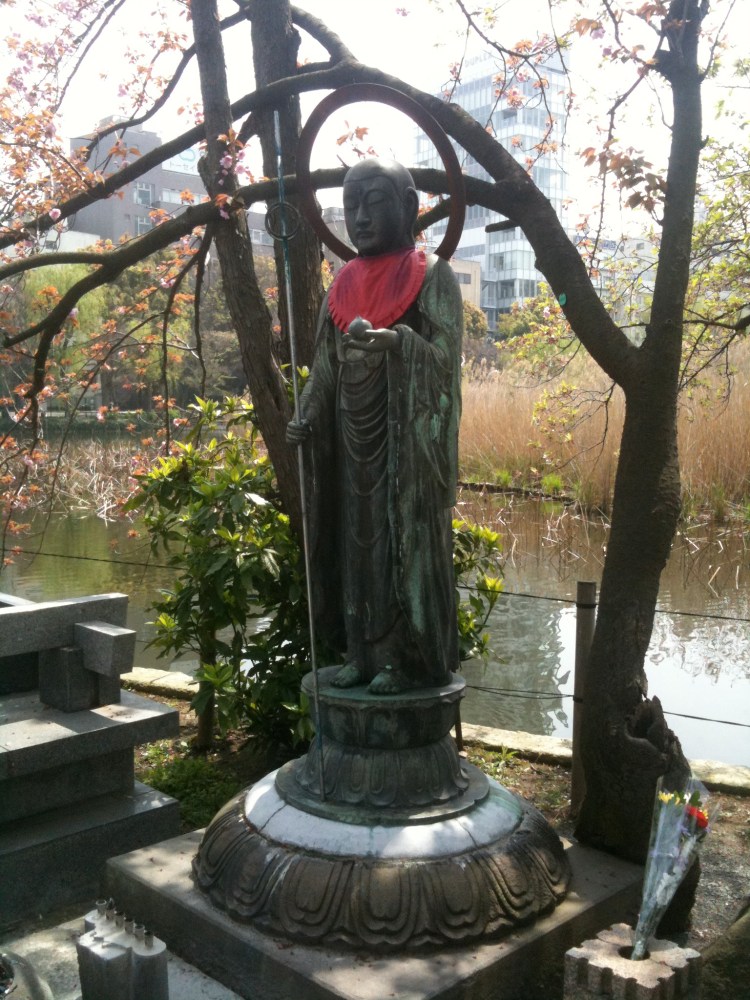
The Bodhisattva Jizō (Kshitigarbha in Sanskrit), taken near Ueno Park in Tokyo, Japan
There is a somewhat obscure text in China from the 6th century, known in English as the Awakening of Faith in the Mahayana attributed to Indian-Buddhist monk Ashvaghosa that was meant to kind of encapsulate Mahayana Buddhism. For example, the following verse:
After reflecting in this way [the suffering of all beings], he should pluck up his courage and make a great vow to this effect: may my mind be free from discriminations so that I may practice all of the various meritorious acts everywhere in the ten directions; may I, to the end of the future, by applying limitless expedient means, help all suffering sentient beings so that they may obtain the bliss of nirvana, the ultimate goal.
Every school that we call Mahayana Buddhism, Zen, Pure Land, Tiantai, Nichiren and so on has this basic principle in mind: one vows to develop one’s mind according to the Dharma, the teachings of the Buddha, not just to help liberate oneself, but also to help awaken and liberate others. We are all in this together, afterall. These different schools may quibble about how best to go about it, but they all agree with the basic principle. You also see these in Mahayana liturgy such as the Four Bodhisattva Vows.
Another is the importance of the mind, again encapsulated in the Awakening of Faith in the Mahayana:
The principle [of Mahayana] is “the Mind of the sentient being.” This Mind includes in itself all states of being of the phenomenal world and the transcendental world. (pg. 28, section 2)
The triple world [past, present, and future], therefore, is unreal and is of mind only. Apart from it there are no objects of the five senses and of the mind. (pg. 48, section 3)
This, like the previous quote, is nothing new to Buddhism, but Mahayana shifts the emphasis even more so, or expanded and deepened earlier teachings to a wider audience. One might call it Buddhism++ if you are a computer nerd. 😋
Conclusion
Mahayana Buddhism is a broad tradition that arose in northwest India that, from my perspective, tried to reboot earlier Indian Buddhism by synthesizing older teachings in new texts, absorbing and Buddhifying various deities, and broadening the vision of Buddhism to be as inclusive as possible and challenging some of the cultural assumptions at the time with respect to gender, livelihood, etc.
P.S. Featured image is from the ending credits of Final Fantasy I, Pixel Remaster. If you played the original like I did, I highly recommend. This is the best remake of the game I’ve played thus far.
1 When I first started blogging ages ago, several blogs ago, she was little a tiny baby. I even called her “baby”, then later “princess”. Amazing how much time has passed. 😭
2 Another correction I had to make with my daughter’s homework material: Buddhism did not come from Hinduism, but they both drew from the same cultural and religious well.
3 Imagine a country the size of Europe, but with maybe 3 times the linguistic and ethnic diversity of Europe, and an older history. That’s India.
Hell is an interesting subject in Buddhism, though not a particularly important one. It differs from the more Western notion of hell in a number of key ways.
First, the Buddhist “model of existence” is based on ancient Indian cosmology which viewed the universe not a single world, but many different worlds that intertwine, and with living beings trans-migrating between worlds: first one world, then another, all based on one’s karmawithout end. Buddhism differed from other Indian religions at the time due to its teaching of anātman (roughly “no self”, or “no soul”), but otherwise the basic model was still the same:
These realms collectively were things such as the realm of animals (i.e. pure survival and instinct), the deva realms (realms of heavenly bliss), the human realm, the hell realms and so on. Imagine Dante’s Inferno, in all its agony and dismal torment, but many more layers, and each one is a disparate “world” or “realm” rather than just one layer among several. That is the hell realms (plural) in Buddhism. Some more severe than others, various ironic punishments, etc.
The hell realms, as with the other realms, are all temporary states. One may suffer horrific torment for a long time until one’s karma related to it is exhausted, but eventually it does exhaust and one moves onto another rebirth in some other realm.
However, there’s even more to this story. Another way that Buddhists tend to look at these realms, hell, deva, animal, and so on, is that they are states of mind, just as they are potential destinations for rebirth. The Tiantai (Tendai in Japan) Buddhists first posited an idea that within a single moment of thought, one might dwell in any number of realms. This was called the 3,000 realms in a single thought, to cover all possibilities: past, present or future, and within them, the hell realms, deva realms, basic instinctive survival (animals), and so on. The mind jumps from one state to another, from time period to another, without end.
A person lives in terrible, abusive environment may be said to be living in the hell realms here and now, even if there are breaks of relief in between. A person suffering from a terrible addiction may be living like a hungry ghost.
This notion of the mental realms vs. actual realms of rebirth aren’t necessarily mutually exclusive either. What matters is that there are people around us living in various states, some blissful (even if only temporarily) and others are suffering terrible torment, and everything in between. The Buddhist learns to be aware of this migration from one state to another within their own mind, but also extend this awareness outward towards others around them who may need help or relief.
In my recent free time last month, I caught up on an old DVD video tour of Buddhist temples in Japan that my in-laws had given me years back. I also discovered that I could turn on the subtitles, which helped a ton as the Japanese is kind of difficult for me, but the content is very interesting. 😋
One interesting thing I noticed is that a surprising number of temples in Japan, especially older ones, could somehow tie themselves back to a certain Buddhist monk posthumously named Jikaku Daishi (慈覚大師). He is better known in English by his ordination name Ennin.
Ennin (円仁, 794?-864) was one of several, talented monks that were crucial to the early rise and foundation of Tendai Buddhist order in Japan. Tendai in Japan, a branch of the venerable Tiantai Buddhist school in China,1 was founded by the monk Saicho in the year 806 after spending some time training in China.
However, the early Tendai sect ran into some problems namely due to gaps in training and teachings, especially with esoteric Buddhism. Saicho had spent about one year in China, which was unusually short, and during that time had undergone training in disparate aspects of Tiantai Buddhism. On the other hand, the rival Shingon sect founded by Kukai (who also had stayed for one year) had been singularly focused on esoteric training, and brought back a complete set of training in the Womb Realm and Diamond Realm mandalas imported from India. Saicho unfortunately didn’t and this led to some tension between the sects. Kukai did not want to lend esoteric documents to Saicho and his disciples unless they formally trained under him, and Saicho became worried about losing disciples to the Shingon sect (some indeed were poached). While the two were still alive, this tension was not resolved.
After Saicho, early Tendai leaders decided the best way to solve this issue was to go back to China and gain deeper training themselves. This is not as easy as it sounds:
China had a strict policy of allowing only certain ships from Japan (the kentōshi 遣唐使), on a set schedule. Just getting on one of these voyages was no small matter.
Japanese ship technology was poor, and a storm could easily sink a fleet of ships. In Saicho/Kukai’s trip, they lost 2 out of 4 ships to a storm.
Once in China, the monk in question had to learn Chinese and communicate. The two languages are very different, so this is not an easy thing to accomplish.
Finally, such a monk required official permission from the Chinese-Imperial bureaucracy to train at such-and-such temple.
Once all that was complete, the monk in question would start the actual training which could take years.
Monks were then required to then leave China at a certain time, and hopefully the next diplomatic ship from Japan would arrive, and than safely return.
Finally, the monk, now safely in Japan, had to submit an official petition to the Japanese Imperial Court to return to the capitol, detailing his accomplishments, and cataloging anything he brought back. Until then, he’d be stuck in some rural port town waiting a response, which usually wasn’t very quick.
Needless to say, Ennin managed to accomplish all this, just as Kukai and Saicho had done previously by journeying to Tang-Dynasty China in 838. Unlike Saicho and Kukai, Ennin stayed in China much longer (as expected) and was only booted out of China in 847 due to a catastrophic anti-Buddhist purge at the time.
When Ennin came back to Japan, he brought back several noteworthy things:
Ennin brought back training in the five-tone nembutsu, a wide-spread practice in the Pure Land tradition in China.
Ennin completed the esoteric training Womb Realm and Diamond Realm mandalas, just as Kukai had done, but also brought back a third esoteric training regime in the Susiddhikara Sūtra tantra.2 This helped formalize the Tendai version of esoteric Buddhism called taimitsu (台密), along with efforts by rival disciple Enchin who also traveled to China.
Ennin also wrote a lengthy account of his travels from day one in China. This journal, the Nittō Guhō Junrei Kōki (入唐求法巡礼行記, “The Record of a Pilgrimage to China in Search of the [Buddhist] Law”) has been a fascinating and valuable source of life in the Tang-Dynasty from a foreigner’s point of view.
Once back in Japan, Ennin eventually succeeded in becoming the 3rd zasu (座主) or head of the Tendai Order. He proved to be an active administrator, both in expanding and improving the training on Mount Hiei, but also in founding other temples in the provinces such as Yamadera (which was featured on my dvd tour). However, tensions between him and Enchin simmered for generations and eventually erupted in to a full-blown violent schism between their descendant lineages.
Nevertheless, Ennin’s contributions to both esoteric and Pure Land buddhist practices in Japan helped pave the way for many other great thinkers later, and many of the things followers take for granted today. 🙏🏼
P.S. I finished a draft of this post before the war in Ukraine, so I felt it was time to publishing rather than leave it languishing. However, since the war started I haven’t had much motivation to work on personal projects and such, so the blog might be a little quiet for a bit. We’ll see.
1 same Chinese characters (天台), different pronunciation
2 there was no information at all in English wikipedia on this sutra, so the linked article above was written by me, warts and all. ;p









 Gleanings in Buddha-Fields
-testo_e_photo_Paolo_Villa-nA2-tesi_Accademia_Belle_Arti_Bologna-portone_di_Palazzo_Giusti.jpg)


,_part_31_-_BL_Or._14915.jpg)
You must be logged in to post a comment.