Tendai for Dummies

Hi all,

Recently, I posted a train of thought, trying to reconcile some challenges in staying true to the Buddhist path while also making it simple and accessible too, plus reflecting on my own failings from time to time. I didn’t have much of a solution, just some ideas.

A photo in the old quarter of Kyoto city, near Kiyomizudera Temple. This pagoda (a Buddhist stupa) was reputedly built by the pious Prince Shotoku.

Anyhow, soon afterwards, it kind of hit me that much of what I suggested or valued was pretty consistent with my limited experiences with Tendai-sect Buddhism. In fact, one could easily argue that any Buddhist sect has grappled with this same challenge, and found novel ways to keep Buddhism fresh and accessible.

I have been off-and-on a follower of Tendai Buddhism for a few years now, particularly because it tends to be really broad and open to various practices and such. It’s perfectly to fine to venerate Amida Buddha, and recite the Heart Sutra, meditate zazen, and/or recite the Mantra of Light. This flexibility is a bit different from other sects in Japanese Buddhism which tend to specialize in one thing: nembutsu for Pure Land, zazen for Zen, etc.

The price for that openness and flexibility, is that it also tends to be more complicated, I have noticed. Tendai in Japanese tends to have a lot of technical jargon, and theories. These are fascinating on an intellectual level, but sometimes, as a working parent with barely enough sleep, you just need a more straightforward approach.

While reading my sole book in Japanese on Tendai Buddhism, I did find a nice quote on how to apply the Tendai concept of “Morning Daimoku, Evening Nembutsu” (previously discussed here) in daily practice though. Here is the quote with a rough translation:

天台宗は四宗融合を掲げる「一乗仏教」好きなお経をとなえてかまいません。毎日、仏壇の前でお経をとなえ、自らの罪を悔い改め、仏さまや先祖に感謝し、皆の幸せを願うのは天台宗のおつとめです。

Since Tendai touts the notion of “Four Schools Unified”1 (also known as One Vehicle Buddhism), you may recite whatever sutra you like. Each day, facing your Buddhist altar, reciting a sutra, repenting one’s own faults,2 expressing gratitude toward the Buddha and/or ancestors, wishing happiness to all, this is the daily practice of Tendai.

Much like the Shushogi in Soto Zen, composed in the late 19th century, this emphasizes for lay-followers a combination of daily cultivation (otsutomé, おつとめ) coupled with self-reflection. If you choose to specifically recite the basic Tendai daily liturgy, it takes about 5 minutes or so. Even if not, daily, long-term, sustainable practice is the recommended approach.

Anyhow, just something I wanted to share. 🙂

P.S. featured photo is a Buddhist stupa (pagoda) we saw in Kyoto in July 2023 near Kiyomizudera. If I recall correctly, this pagoda is attributed to the semi-legendary Prince Shotoku.

1 四宗融合 (shishū-yūgō) – the four schools meaning Zen, Pure Land, Esoteric Buddhism and Precepts, if I recall correctly.

2 Namely, how does one’s actions compare with the Buddhist precepts regarding conduct?

Zen, the Pure Land, and Buddhism Lite

Warning: long, (mostly) unedited, stream of thought. Sometimes it’s just funner this way. 😄

Since my trip to Japan and back, I’ve been kind of debating something in the back of my head.

Much of my background in Buddhism since as far back as 2005 has been in the Pure Land tradition, especially Japanese “Jodo Shu” and to a lesser-extent “Jodo Shinshu” sects. The sure openness and simplicity are very appealing, especially when I am having a hard time in my life. At other times, I see my conduct as backsliding or lazy, or that I am not grounding myself enough in the here-and-now, and so I tend to shift toward Zen. At such times, the passivity of the Pure Land path seems out of place with what I feel Shakyamuni Buddha would have wanted to us as disciples to do.

Buddhism, as a world religion, is a religion of doing not believing.

But the reason why the Pure Land tradition is so popular across many Asian cultures, and increasingly in the West is that it realistically assesses the situation of lay followers and provides an accessible path for them to follow.

The monastic/lay-disciple relationship within Buddhism has always been a challenge throughout its history since it tends to relegate the lay disciples as passive followers. The doing of Buddhism tends to favor those who are willing to commit the time and energy into it (i.e. mendicants, renunciants, etc), leaving the laity to support them, or at least participate as time allows.

The Buddha was not insensitive to this, and sternly reminded his followers that without the lay community, they could not be a Sangha. Further, many of the original precepts in the monastic code were to avoid monks and nuns abusing their authority over the laity, including the Rains Retreat. Further, when the lay community and monastic community have a healthy relationship, everyone benefits.

The catch is that even with good intentions, the laity are often put in a more passive role. Many of the traditional sutras in the Buddhist canon are intended for fellow monks, not laity. Many of the practices require time and effort that laity simply can’t do.

While Pure Land Buddhism does help to address this, I realized that it can also lead to complacency. When dealing with my puppy, who while adorable is still behaving like a puppy, or dealing with constant pressures at work, such things tend to bring out the worst in me, and simply reciting the nembutsu over and over doesn’t seem like a particularly effective strategy.1 Further, I don’t want to forget about my experience last year, and some of the insights I gleaned from that.

On the other hand, I’ve never really liked the Zen tradition, especially in the West. Western Zen tends to feel weirdly divorced from the tradition it inherits from, sometimes flippantly so, and tends to feel sterile and lacking any sense of community. People seem come to Zen centers and practices because they need something, not because they are happy to be there.2 The Zen community in the West is comprised of he same sort of people who argue online about why such-and-such Star Wars series is good/bad, or try to out-do one another in their knowledge of Zen esoterica. In other words, it’s saturated with smarmy nerds.

In much of the current Asian-Buddhist tradition, both the Pure Land and Zen tradition stand at opposite poles between utter passivity (“it’s OK, I have faith in Amida Buddha”) or utter DIY (“I’m gonna meditate my way to Enlightenment!”). There are many efforts over the centuries, to somehow wed the two traditions, and these efforts usually gravitate toward one pole or the other. The famous Chinese monk, Yunqi Zhuhong,3 was a particularly effective example of this, but Yunqi isn’t well known in the West. Ven. Thich Nhat’s Hanh’s interpretation of Pure land through the lens of Zen, Finding Our True Home, was a pretty good modern attempt as well.

Still, these are somewhat intellectual exercises, and not always useful to lay people who may not always understand either tradition. So, going back to my main concern: how do you make Buddhism accessible (and easily understood) to a wide, non-Buddhist audience while still keeping faithful to the Buddha’s teachings on discipline, wisdom and cultivation. Further, how do you keep the “heart” of Buddhism so it doesn’t become a nerdy, sterile exercise?

I think this is where the Lotus Sutra really comes in handy. The Lotus Sutra by itself is hard to discern, and pretty tough to read, but if you’re already familiar with Buddhism, I think it helps provide the “heart” of Buddhism and helps address the question: what’s the point of it all? The parables in the Lotus Sutra are also a really great way to get around intellectual discussions and convey Buddhist teachings in a way people can adopt and carry with them, hence their popularity throughout antiquity.

However, as with Zen or the Pure Land, it’s important not to get a one-sided, literalist view of the Lotus Sutra either, or a person will go off the rails. It’s a historical text, written with a specific audience in mind, and has to be taken into context. Yup, I said it.

Anyhow, to that end, I have been thinking about this and I feel there are certain universal practices in buddhism that, regardless of sect you follow, are really beneficial to observe. By beneficial, I mean, you are aligning with teh intention of what the Buddha would have wanted us to follow either as a lay-person or as a monastic disciple. In previous blogs, I called this “Buddhism Lite”, since it distills the tradition to as simple and generic an approach as I can. You can re-name it something else.

Buddhism Lite

  • Uphold five precepts – In my opinion, this is the most fundamental practice for lay Buddhists, and really dove-tails nicely with the other practices below. If you have to prioritize the precepts versus meditation and such, prioritize the precepts. They are also the easiest to integrate in everyday life.
  • Recite “nembutsu” – in this context I am using nembutsu as simply recollecting the Buddha, and venerating him. The Buddha is our beacon in this world, and so it behooves us to give due gratitude. To me, the simplest way to venerate the historical Buddha is to recite the phrase Namo Shakamuni Buddha. If you prefer another Buddha or Bodhisattva, that’s totally fine. In the end, there is only one Dharma,4 and each figure simply embodies it. The Dharma is what maters most, not the particular Buddha.
  • Mindfulness meditation – as much as I tend to avoid mindfulness meditation, there’s no denying that it’s central to Buddhism. It is the practice the Buddha prescribed most to followers, and has a tangible value both in the near term and in the long term. I won’t prescribe how much a person meditate; just work it into your life in a way that’s sustainable (like physical exercise).
  • Optional: Uposatha – I haven’t really talked about this much, but Uposatha is traditionally when the Buddha would set aside time for devout laity and the monastic community to practice together. Think of the Uposatha as like the Sabbath, or Sunday services, etc. Uposatha is traditionally held on six days of the calendar month: the 8th, 14th, 15th, 23rd, 29th and 30th days.5 The example below is a Uposatha service you can observe at home on Uposatha days, based on existing traditions. As with meditation, make it sustainable for your life.
    • Praise to the 3 treasures:
      • “I go to the Buddha for refuge”
      • “I go to the Dharma for refuge”
      • “I go to the Sangha for refuge”
    • Confession of transgressions: All of the misdeeds I have committed in the past are the result of my greed, anger and delusion. I repent these misdeeds.
      • The key here is not to “flog yourself”, it’s about observing scientifically when your own conduct fell short and acknowledging this, wiping the slate clean, and resolving not to do them again.
    • Recite a sutra, or part of a sutra: your choice.
    • Recite the “Nembutsu” three times – see above.
    • Dedication of merit – you are not just practicing for yourself, but also for the benefit of others.

I think the key here is balancing devotion to the Buddha as a teacher, with putting things into practice in real life, and avoiding complacency.

Anyhow, this has been a somewhat rambling stream, but it was easier to just write it all out in one shot than try to explain in something more polished and shorter. If you made it this far and find it useful, thanks!

1 This is something I recall from a Jodo Shu called the ippyaku-shijūgo-kajō-mondō (百四十五箇条問答) or “One Hundred and Forty Five Questions and Answers” addressed to Honen:

Q: Is it better to recite Nembutsu abstaining from doing evil and doing only good, or to recite Nembutsu believing only in the true wish of Amida Buddha?

A [from Honen]: Abstaining from the evil while doing good things is the total admonition of Buddha. But for us, living in the real world, we disobey the admonition, so by believing from the bottom of our hearts in the real wish of Amida Buddha to save all kinds of people, we are able to say “Namu Amida Butsu”. Amida Buddha will lead all people into the Pure Land without any discrimination between people with or without wisdom, or between those who can or cannot keep the precepts. Please keep this in mind.” (Clause 145)

http://www.jodo.org/teachings/teachings01.html

2 From Brad Warner’s blog:

Plus those adoring audiences of sincere truth seekers that I imagined would hang on my trippy words of wisdom were nowhere to be found in his case. Instead, he was surrounded mainly by curiosity-seekers who never stayed around long, or by needy hangers-on who often became angry and belligerent when they weren’t satisfied with what he taught — which was always. He did have a handful of sincere students, but we were not much help when it came to supporting him.

http://hardcorezen.info/so-you-want-to-be-a-dharma-teacher/7843

Although I don’t really follow Mr Warner, this has been my limited experience as well.

3 I wrote much of this Wikipedia article, so I may be biased. 😏

4 Chapter two of the Lotus Sutra, by the way:

But stop, Shariputra, I will say no more. Why? Because what the Buddha has achieved is the rarest and most difficult-to-understand Law. The true entity of all phenomena can only be understood and shared between Buddhas. This reality consists of the appearance, nature, entity, power, influence, inherent cause, relation, latent effect, manifest effect, and their consistency from beginning to end.”

source: https://nichiren.info/buddhism/lotussutra/text/chap02.html

In other words, the Buddhas all awaken to the same Dharma, and have the same qualities and awareness. The Dharma is what matters. Also, the Vakkali Sutta in the Pali Canon.

5 How would Uposatha look in February? I would probably just bump the 29th and 30th to March 1st and 2nd respectively.

Commitment

The Lotus Sutra is one of the most important Buddhist texts in the entire Mahayana-Buddhist canon. Because of its length, its chapters, and its variety of figures, parables and such, there’s something for everyone, hence its influence on the subsequent tradition.

Lately, I have been thinking about the story of the Bodhisattva Medicine King,1 in the 23rd-chapter of the Lotus Sutra. The story is too long to quote verbatim here, but I will try to post the relevant parts. I am using the Senchu Murano translation, but the Burton Watson translation (available online) is excellent, too.2

In this chapter, the narrator, Shakyamuni Buddha, describes a land that existed countless eons ago, populated by a great Buddha:

Innumerable kalpas [“eons”, very long periods of time] ago, that is, as many kalpas as there are sands in the River Ganges, there lived a Buddha called Sun-Moon-Pure-Right-Virtue….He was accompanied by eight thousand million great Bodhisattva-mahāsattvas…The duration of his life was forty-two thousand kalpas…There was no calamity in his world. The ground of his world was as even as the palm of his hand….

Page 305, Chapter 23 of “The Lotus Sutra” by Senchu Morano

Then as this Buddha preaches the Lotus Sutra to his disciples (with emphasis added), one of them was particularly inspired. After having practiced many austeries, and offered countless kinds of incense and flowers to his teacher (Sun-Moon-Pure-Right-Virtue Buddha), he decided it was not enough :

Having made these offerings [of incense, flowers, etc. to the Buddha] he emerged from samādhi, and thought, ‘I have now made offerings to the Buddha by my supernatural powers. But these offerings are less valuable than the offering of my own body.’

Then he ate various kinds of incense….then he applied perfumed oil to his skin, put on a heavenly garment of treasures in the presence of Sun-Moon-Pure-Bright-Virtue Buddha, sprinkled various kinds of perfumed oil on the garment, and set fire to his body, making a vow by his supernatural powers. The light of the flame illumined the worlds numbering eight thousands of millions of times the number of the sands of the River Ganges….

The body of the Bodhisattva kept burning for twelve hundred years, and then was consumed. Having made this offering according to the Dharma, Gladly-Seen-By-All-Beings Bodhisattva passed away. In his next life, he appeared again in this world of Sun-Moon-Pure-Bright-Virtue Buddha.

Page 307-308, Chapter 23 of “The Lotus Sutra” by Senchu Morano

Later in the chapter, the narrator Shakyamuni Buddha, then explains that this pattern of Gladly-Seen-By-All-Beings Bodhisattva offering himself to his teacher was repeated countless times across many eons. The big reveal in this chapter was that this Bodhisattva, according to the Lotus Sutra, was now the Medicine King Bodhisattva attending Shakyamuni’s audience.

If, by this point, you’re wondering “what on earth is going on?” don’t worry. The Lotus Sutra isn’t a straightforward text. If you try to read at face-value, you will probably get really confused. Unlike the sutras of the Pali Canon, which are formulaic and dry, the Lotus Sutra is a narrative composition that relied on literary flourish and hyperbole.

Like other bodhisattvas features in the second half of the Lotus Sutra (including Avalokiteshvara in chapter 25), each one is held up as the epitome of some aspect of Buddhism. The Medicine King Bodhisattva, I think, is meant to epitomize commitment to the Dharma. The Sutra is not asking people to burn themselves to practice Buddhism. What matters isn’t the specific action, but that he kept coming back over and over, unconcerned about the trivialities of life.

If this seems odd, consider this passage from the Heart Sutra:

Because there is no attainment, bodhisattvas rely on Prajñāpāramitā [the perfection of wisdom], and their minds have no obstructions. Since there are no obstructions, they have no fears.

Translation by Lapis Lazuli Texts

Or the opening passage of the Immeasurable Life Sutra (e.g. the “Larger Sutra”) in the Pure Land tradition. I have again trimmed for brevity:

Having well learned the extensive wisdom of fearless and having realized the illusory nature of dharmas, he [a typical bodhisattva] destroys Mara’s nets and unties all the bonds of passion….

He is above all worldly affairs and his mind, always serene, dwells on the path of emancipation; this gives him complete control over all dharmas….

Having awakened great compassion for sentient beings, he kindly expounds the teaching, and endows them with the Dharma-eye. He blocks the paths to the three evil realms, opens the gate of virtue and, without waiting for their request, provides beings with the Dharma. He does this for the multitude of beings just as a dutiful son loves and respects his parents. He indeed looks upon sentient beings as his own self.

Translation by Rev. Hisao Inagaki

In each, there is a strong sense of fearlessness and long-term commitment.

But on the other hand, this is not something the bodhisattva thinks about. Consider this passage from the Diamond Sutra:

The Buddha said to Subhuti, “The Bodhisattva Mahasattvas master their mind by meditating as follows: ‘However many species of living beings there are—whether born from eggs, from the womb, from moisture, or spontaneously; whether they have form or do not have form; whether they have perceptions or do not have perceptions; or whether it cannot be said of them that they have perceptions or that they do not have perceptions, we must lead all these beings to nirvana so that they can be liberated. Yet when this innumerable, immeasurable, infinite number of beings has become liberated, we do not, in truth, think that a single being has been liberated.’

“Why is this so? If, Subhuti, a bodhisattva still has the notion of a self, a person, a living being, or a life span exists, that person is not a true bodhisattva.

Translation by Ven. Thich Nhat Hanh

So it’s not just a sense of great commitment, but also a way of living that’s not self-centered or conceited. The bodhisattvas do not keep score.

It’s like someone who is really committed to a certain hobby or sport, and they’re not even really thinking about it anymore. They just do it, and keep going, refining their craft more and more. Similarly, a good parent doesn’t count how many times they tell their kids “good job”, or how many diapers they changed. They are committed to raising their kids, and even when things are really rough, they keep at it. Mistakes are made, but they don’t quit right there. They keep going.

The Mahayana-Buddhist ideal is along these lines: someone who selflessly teaches the Dharma, helps others over and over, and polishes their minds, no matter how long it takes, and yet their total commitment means that they aren’t really consciously thinking about it. It’s just part of their being.

Anyhow, the imagery in Chapter 23 is powerful, and while this chapter isn’t usually cited by other teachers, I think it still has something to teach us.

P.S. Photo taken by me at Sanjusangendō Temple in July 2023.

1 Not to be confused with the Medicine Buddha. As far as I know, they are unrelated figures.

Source: XKCD

2 The Lotus Sutra has many, many translations in English, and honestly they’re all good. The really archaic translations from the 19th century are kind of hard to read (e.g. Soothill), but any modern translation is fine. The only time the differences matter is mostly for academic reasons, and then it just becomes hair-splitting for your average Buddhist:

Happy Birthday, Honen!

Today, April 7th in the Japanese-Buddhist calendar, is a holiday called Shūso Gōtan-e (宗祖降誕会) which celebrates the birthday of a monk named Honen (法然, April 7, 1133 – February 29, 1212). Ostensibly, Honen was a monk of the Tendai sect in Japan, but went on to be a founder of the Jodo-Shu or “Pure Land” Buddhist sect, as well as many other spin-offs. You can read more about his biography here.

Portrait of Honen by Shinkai (忍海), courtesy of Wikimedia Commons.

Honen didn’t invent Pure Land Buddhist as a practice and tradition. We can see earlier examples such as Genshin who were already practicing it avidly, and indeed, Pure Land Buddhism had been popular for centuries, especially when the social order was breaking down in the 12th century.

However, what Honen did and why he’s still revered today is his efforts to make the Pure Land practices as utterly accessible as possible through recitation of the nembutsu. Where many career monks were concerned with politics, or were seemingly aloof with the plight of people outside the Heian-period aristocracy, Honen really went out of his way to help others, and teach them a simple, straight-forward Buddhist practice, without discriminating by social class or gender.

Honen’s encounter with the woman of the night has always been one of my favorite stories about him, and underscores his easy-going manner, and his commitment to helping anyway he could. Even after his exile from the capitol, he maintained his monastic vows, and taught the Pure Land even to his dying breath.

Admittedly, I do have some quibbles about Honen’s approach to Pure Land Buddhism, and James L Ford’s book on Jokei, a critic of Honen, rightly points out how Honen cherry-picked teachings from earlier Pure Land masters to suit his own viewpoint. However, one thing is certain: Honen was very sincere in his efforts even if one might questions his methods. He did not get delusions of grandeur the way some contemporaries did, and he did not retreat to monasteries in pursuit of the truth. He was out among the masses all the time, teaching fellow monks, nuns, and lay people everything he knew.

So, happy birthday Honen! Thank you for teaching this American, 800 years later, about the nembutsu, and helping me get started on the Buddhist path when I needed it most.

P.S. another contemporary critic of Honen, Myōe, tried to do something similar by promoting the Mantra of Light, but for whatever reason it never quite caught on. Similarly, Nichiren promoted the odaimoku a couple generations later.

All of these monks, Jokei, Myoe, Honen and Nichiren were all talented teachers and sincerely sought to help others, but for whatever reason, perhaps because Honen was the first, or something dynamic in his teachings, achieved an impact on Japanese Buddhism not seen since.

My New Buddhism Book!

I did it, I finally finished it. For years I wanted to write a book about Buddhism, especially Mahayana Buddhism, and each time I struggled to get past a certain point and keep point.

Recently while cleaning out some files on the computer, I discovered that in early 2020, during the first months of the Pandemic, I had written a full draft of a book. I was surprised I had written a full draft, then subsequently forget, probably because the editing looked daunting at the time. Plus, I was starting a new hobby writing Dungeons and Dragons modules.

So, for the past month I have been fixing that draft, expanding some areas, adding photos and so on. The links below, available in PDF format and EPUB format, are the final result.

This book, The Mahayana Buddhism Field Manual, covers many aspects of Mahayana Buddhism, written for beginners in mind, including those who are rediscovering the religion of their birth. This book is dense, but covers as many aspects as possible, but also with a DIY (do it yourself) emphasis. Enjoy!

PDF Format
EPUB format

This book is free, so feel free to download it, distribute it, or share with someone interested in Buddhism, or maybe wants to learn more. If it helps others on the Buddhist path, great!

Thank you, and enjoy!

Asakusa Temple Over The Years

There’s a good chance that if you ever visited Tokyo, you’ve been to this place:

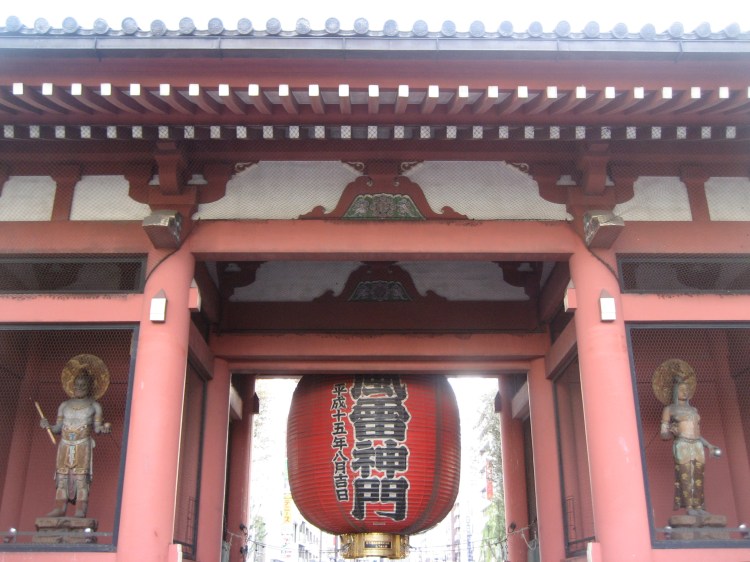
The kaminari-mon gate (雷門), taken in 2022
Same place, taken in 2009

This place is Asakusa Temple, or in Japanese Asakusa-dera, though more formally known as Sensōji. The Chinese characters 浅草寺 can be read either way. This is a temple formerly of the Tendai sect that has been a part of Tokyo since at least the 9th century and is centered around a statue of the Bodhisattva Kannon said to have washed up on the shore one day. The homepage (English available) is here.

Asakusa Temple is simultaneously a giant tourist-trap and a great experience. I have visited the temple 3-4 times since 2009 and it is always worth it. I have included photos from various trips below.

The first thing people will see is the famous Kaminari-mon Gate (雷門, “the lightning gate”) with its massive red lantern, flanked by two guardian Buddhist deities, the Niō. If you pass through the gate, or on your way out, you may notice the reverse:

Taken in 2009

The lantern on the back instead reads Fūraijinmon (風雷神門) or the Gate of the Wind and Thunder god.

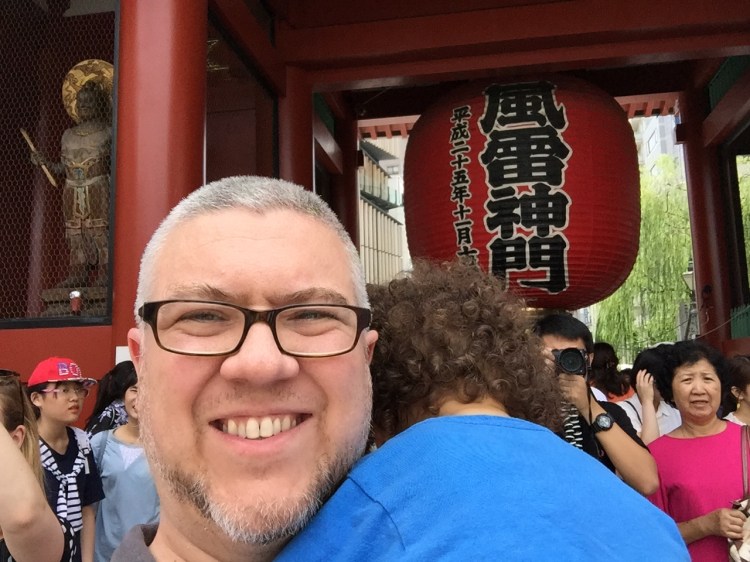
Me carrying a very tired little boy in the summer of 2014.

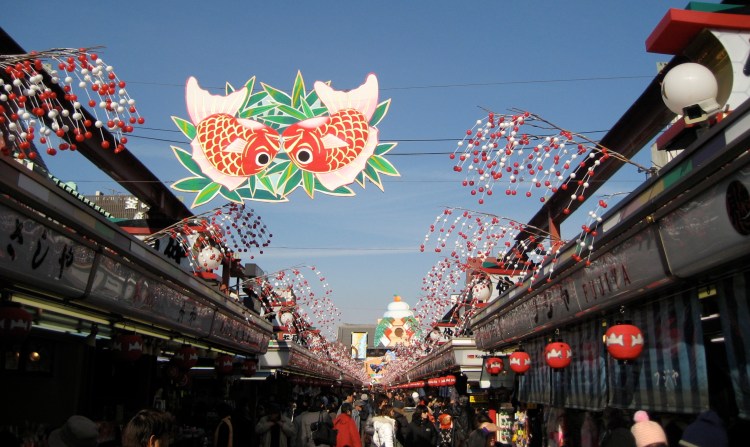
Once you pass through the gate, you will see a huge, long walkway: the Nakamise-dōri (中店通り):

December 2022
Summer of 2016
2009, just after New Year

This is not the temple proper. This is a large number of very crowded street stalls selling all kinds of wares: some focused on foreign tourists, and some focused more on native Japanese visitors. You can find all kinds of things here. In our most recent trip, we found some excellent shichimi spice with yuzu flavor added. Goes really well in soups. You can probably spend half a day here. Just beyond these shops, to the left and right, are various restaurants, against catered toward either native Japanese or foreign tourists. We ate at this place during our last trip:

In any case, once you go all the way past the shops, you can get to the temple proper:

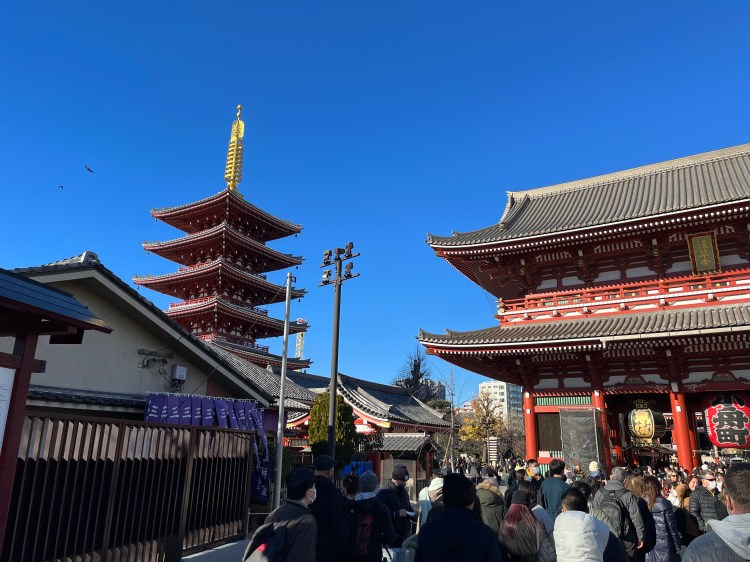
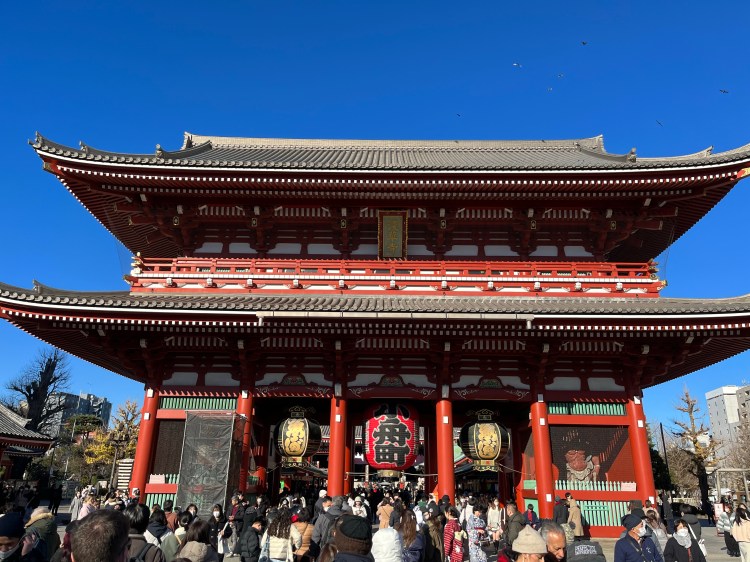
Pagoda and temple gate, December 2022
Temple gate, December 2022
Pagoda, 2009 New Year’s

This tall structure is a pagoda:

A pagoda, or gojū no tō (五重塔) in Japanese, is something adapted from Chinese culture and is meant to represent the ancient Buddhist stupas in India: storehouses for relics of the Buddha.

The temple gate itself, called the Hōzōmon (宝蔵門, “treasure [of the Dharma] storehouse gate”) sports a similarly large red lantern:

Me being a tourist in December 2022
Summer of 2016

Past this second gate you are now at the temple proper. There is a large, outdoor charcoal brazier with incense sticks burning here. Per Buddhist tradition, you can purify yourself (ablution) before seeing the Bodhisattva by waving some of the incense smoke over you. Once ready, you then proceed to the main hall (honden 本殿):

December 2022
January 2009

If you look up as you pass this lamp, you’ll also see the underside has a neat dragon pattern on it:

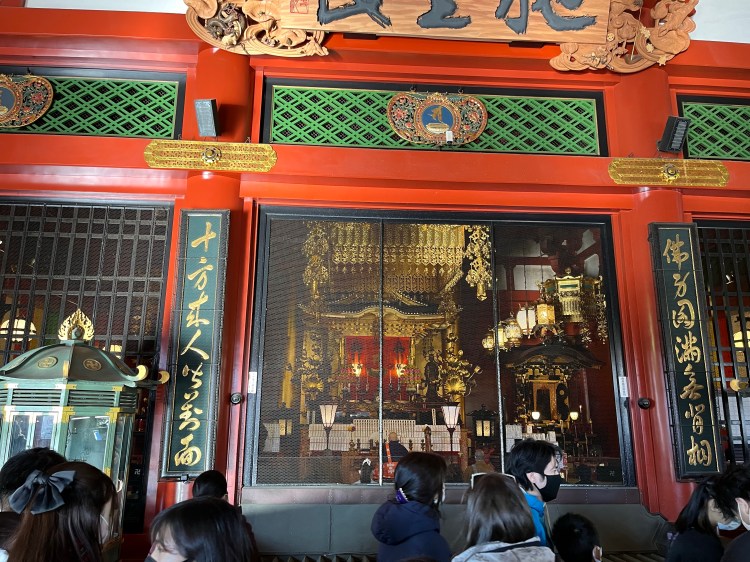
Since the temple itself is devoted to the Bodhisattva Kannon, you will see it enshrined at the central altar:

December 2022
January 2009

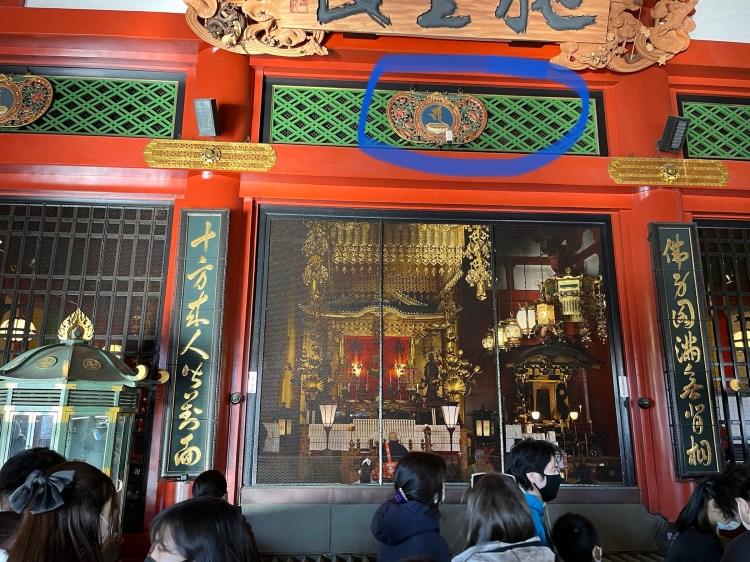
The statue itself is hidden behind the red screen, but is flanked by two other statues denoting the Indian gods Brahma and Indra as guardians. Also, if you pay attention, you’ll notice this mark both on the red screen and above:

This is the Sanskrit letter “sa” written in old Siddham script as 𑖭, and is used to represent Kannon. It also represents the Sanskrit word satya (“truth, virtue, etc”). There is also a really large grilled wooden box in front, and that is where you can put in a donation. Per tradition, people often put in a ¥5 yen coin (go-en-dama) due to word-play that implies fostering a karmic-bond with the bodhisattva.

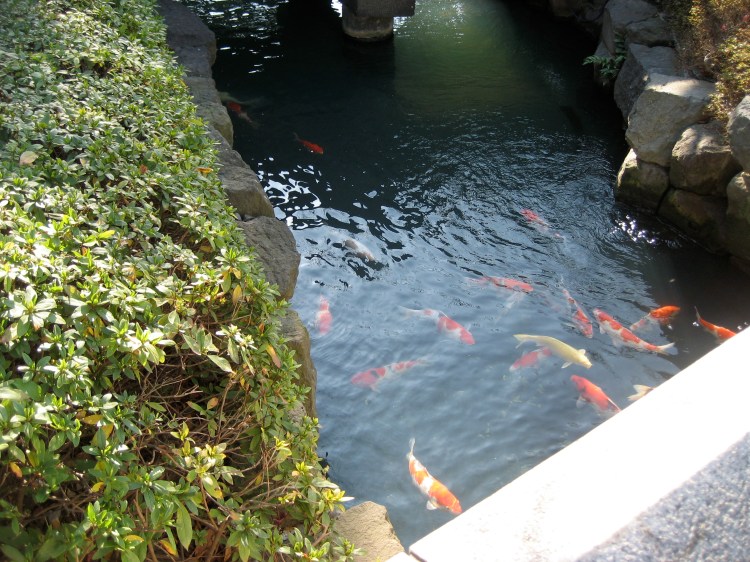
Note that if you go left of the main hall, there’s several other things to note. First is the koi pond and bridge:

January 2009
January 2009

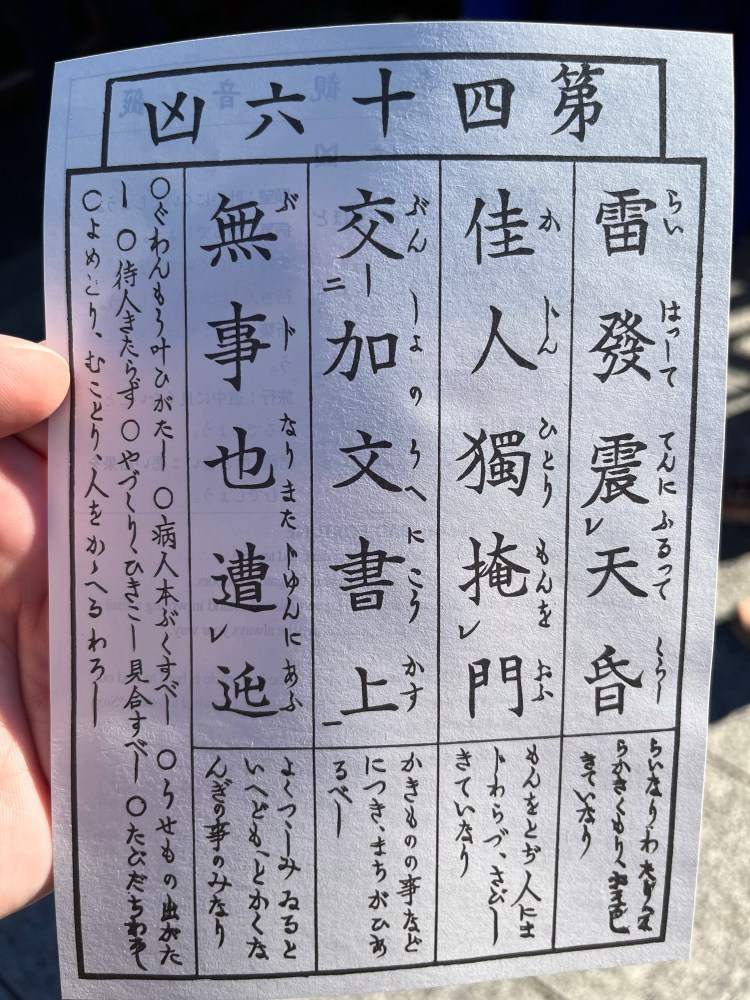
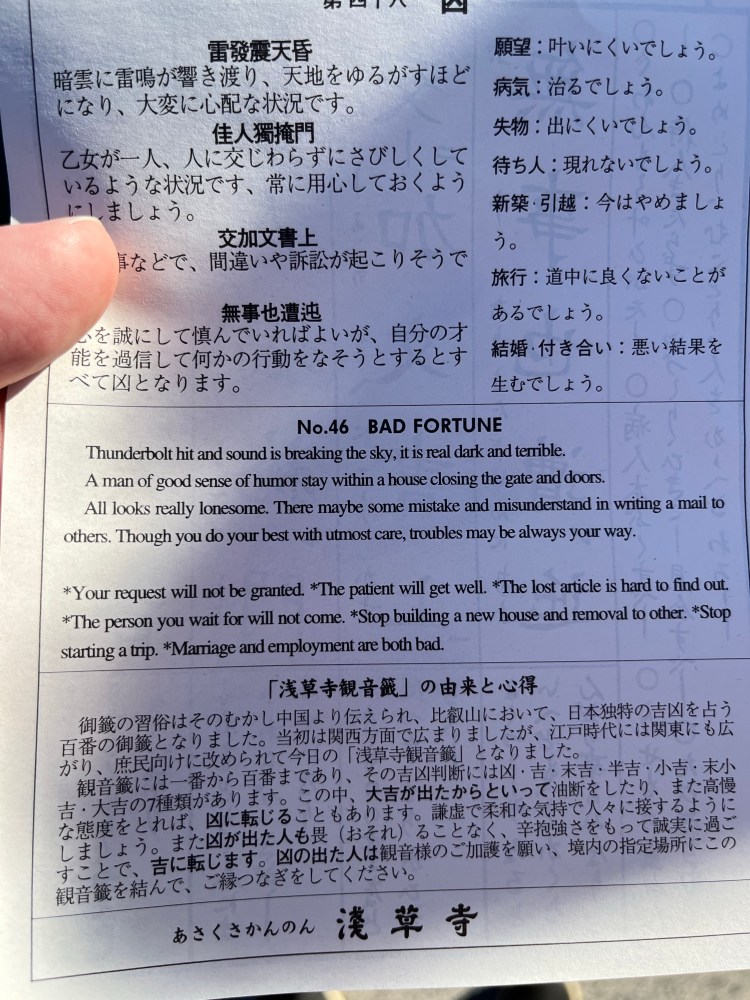
There’s also a place here where you can draw your fortune (omikuji). This year, I drew a bad fortune (凶 on the upper left):

Per tradition, if you get a bad fortune, you’re supposed to tie it up on a small wire fence nearby, so the bad luck “stays there”, and does not follow you.

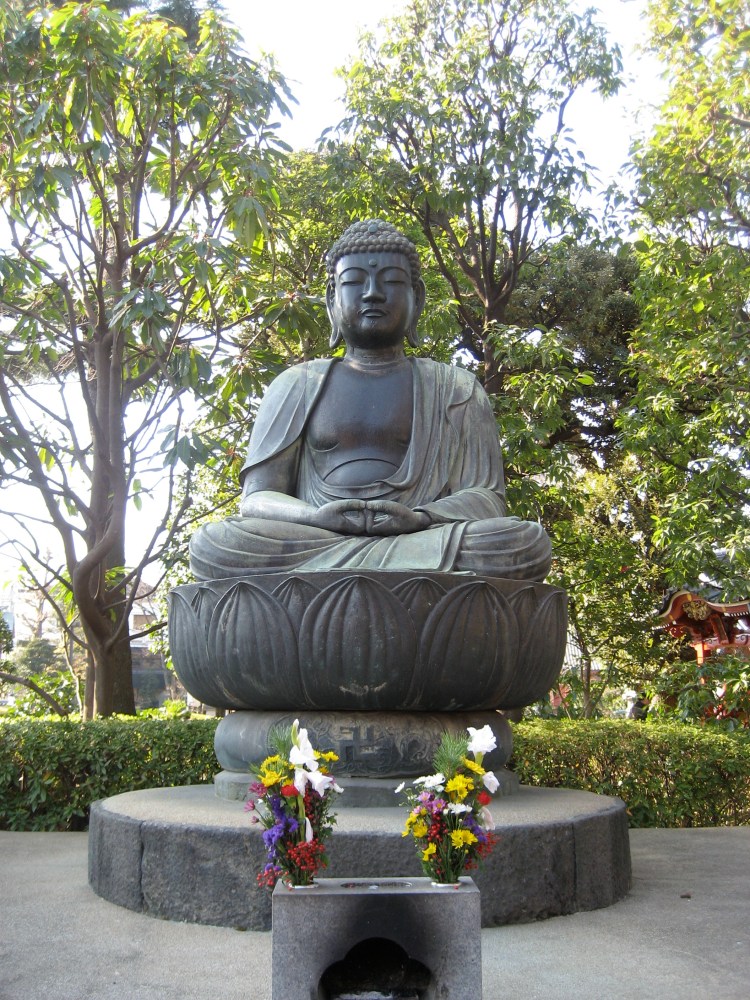
There is also a statue of Amitabha Buddha (阿弥陀如来, amida nyorai) nearby:

December 2022
Summer 2016

Finally, to the left of the main hall is one of several secondaries halls that compromise the temple complex. This hall is called the Yogodo Hall:

It is here that I got my pilgrimage book in 2022:

The Yogodo Hall is a commemorative hall to mark the 1,200th anniversary of the Tendai monk Ennin, who was a pivotal figure in the early Japanese Tendai tradition, and still crucial to the growth and development of the tradition. Side note, the term yōgō (影向) is a Buddhist term of the temporary manifestation of a Buddha or Bodhisattva or other divinity in the world for the benefit of beings. This is probably meant to be a form of praise to Ennin, implying that he had been a temporary manifestation of a Buddhist figure.

There are several other halls I’ve managed to overlook each time I visit, but a full map of the site in English can be found here.

In any case, it’s interesting to look back on my old photos and reflect on how much has changed (phone camera technology, for example 😉 ), and how much has remained the same at Sensoji…

Of Burning Houses and Rain

Here is another wonderful poem (previous posts here and here) by the 11th century Japanese poetess, Lady Izumi (izumi shikibu 和泉式部 in Japanese), that I found in The Ink Dark Moon by Jane Hirshfield and Mariko Aratani:

Original JapaneseRomanizationTranslation*
ものをのみMono o nomiShould I leave this burning house
思ひの家をOmoi no ie oof ceaseless thoughts
出でてふるIdete furuand taste the pure rain’s
一味の雨にIchimi no ame nisingle truth
ぬれやしなましNure ya shina mashifailing upon my skin?
* Translation by by Jane Hirshfield and Mariko Aratani

The headline for this poem reads:

On the night of the sixth, the sound of the night monk’s voice reciting the Sutras mingled with the sound of incessant rain, and truly this seemed to be a world of dreams…

Lady Izumi cleverly makes not one, not two, but THREE separate allusions to the famous Lotus Sutra, in this poem. I’ve talked about the Lotus Sutra before. It’s a very influential Buddhist text in the Mahayana tradition, and contains many parables and dramatic allusions, compared to some of the drier, more textbook style Buddhist sutras. Thus, allusions to the Lotus Sutra are found throughout literature in East Asia. In my opinion, understanding the Lotus Sutra is key to understanding Buddhism in East Asia: Zen, Pure Land, Tiantai, Nichiren and Vajrayana, etc.

The “burning house” here alludes to the Parable of the Burning House of third chapter of the Lotus Sutra. I’ve talked about it here, among other places. This is pretty straightforward to understand in the poem: the Burning House here is symbolic of the world we live in, burning with passions, craving, anger, delusion, old age, disease, and so on. We can step out of the burning house if we choose to, but we are often distracted by things in the house, and thus unaware that the timbers all around us are on fire, putting us in mortal danger.

The second allusion is that of rain. In the fifth chapter of the Lotus Sutra, there is a parable describing rain on plants, the so-called The Parable of the Medicinal Herbs:

What falls from the cloud is water of a single flavor, but the plants and trees, thickets and groves, each accept the moisture that is appropriate to its portion. All the various trees, whether superior, middling or inferior, take that is fitting for large or small and each is enabled to sprout and grow. Root, stem, limb, leaf, the glow and hue of flower and fruit— one rain extends to them and all are able to become fresh and glossy, whether their allotment of substance, form and nature is large or small, the moistening they receive is one, but each grows and flourishes in its own way.

The Buddha is like this when he appears in the world, comparable to a great cloud that covers all things everywhere, Having appeared in the world, for the sake of living beings he makes distinctions in expounding the truth regarding phenomena.

Translation by Burton Watson

This is, for me, one of my most favorite parts of the Lotus Sutra. As a sutra, it’s very inclusive (cf. the Parable of the Dragon Princess), but it also acknowledges that there is a huge variety of people in the world. Some people are just different than others, but they can all benefit from the Dharma in their own way, just like the various plants in world drinking from the rain.

Finally, the third allusion in Lady Izumi’s poem is that of a single “taste”. Both the Parable of the Burning House and the Parable of the Medicinal Herbs make a single point: the Dharma of the Buddha appears in a variety of ways, or “gates” for one to enter, but in the end the Dharma tastes the same equally, and is but one truth. So, whichever gate one enters, the rain will ultimately taste the same. For the Burning House, when the children come outside, their father offers, in the end, a single magnificent cart (not many) to offer them as an incentive.

Turning back to Lady Izumi, it’s obvious that she was very thoughtful of these things, even if she struggled to practice them amidst her life. Even when she was surrounded by scandal, and lost both her lovers and her daughter to illness, she could see past it and look at the greater picture.

Namu Amida Butsu

The Amitabha Root Dharani

The Amida Nyorai Konpon Dharani (阿弥陀如来根本陀羅尼) or “Amitabha Root Dharani” is a dharani used in some Japanese Buddhist sects, typically only on the Segaki ritual used to feed the hungry ghosts in Buddhism, or possibly funerals and other similar services. It is typically only found in esoteric rituals in Shingon and Tendai Buddhism, but can be found in Jodo Shu and Zen as well. The dharani is typically of very, very limited use, and not part of normal liturgy.

This page is intended to post the dharani for reference purposes only. Esoteric practices such as mantras and dharani should only be used as recommended by one’s teacher, under a guided training program. I found reference material on this dharani to be almost non-existent in English, hence my decision to post it here.

This page will provide both the Sino-Japanese reading follow by the Sanskrit reading. There are multiple versions of the dharani in Japanese, so pronunciation may vary slightly between them, so for this reason the Sanskrit is provided as well. No translation will be provided as this is part of the esoteric training one should undergo when learning the dharani. Any translation you see online of this, or any mantra/dharani, should be treated as suspect.

Can’t read the characters?

If you’re having trouble reading the Kanji characters, you might have one or two problems with your computer:

  • Your computer may not have Asian fonts installed. In Windows you have to enable UTF8 and East Asian fonts under the Control Panel. Modern Mac computers are fully compatible already.
  • Your browser may be assuming the wrong character set. If you use a relatively modern browser and use UTF8 as character set, you should be able to read fine. IE, Firefox and Safari all read this fine as far as I can tell.
Even if not, then you can still use the romanized characters, and the (terrible) English translation.

Disclaimer and Legal Info

I hereby release this into the public domain. Please use it as you see fit, but if you attribute it to this site, greatly appreciated. Also, please bear in mind this is an amateur work, and should not be taken too seriously.

Dedication

I dedicate this effort to all sentient beings everywhere. May all beings be well, and may they all attain perfect peace.

Namu Amida Butsu

The Amitabha Root Dharani

Japanese Kana

ノウボウ アラタンノウ タラヤ-ヤ-ノウマク アリヤ-ミタバ-ヤ- タタギャ タヤ-アラカテイ サンミャクサンボダヤ-タニャタ オン アミリテイ アミリトドバンベイ アミリタサンバンベイアミリタギャラベイ アミリタシッデイ アミリタテイゼイ アミリタビキランテイアミリタビキランタ ギャミネイ アミリタギャギャノウ キチキャレイアミリタドンドビソバレイ サラバアラタ サダネイサラバキャラマキレイシャ キャシャヨウキャレイソワカ

Japanese Romanization

nōbō aratannō tarayāyānōmaku ariyāmitabāyā tatagyatayāarakatei sanmyakusanbodayātanyata on amiritei amiritodobanbei amiritasanbanbeiamiritagyarabei amiritashiddei amiritateizei amiritabikiranteiamirita bikiranta gyaminei amirita gyagyasō kichikyareiamirita dondobi sobarei sarabārata sadaneisaraba kyarama kireisha kyashayō kyarei sowaka

Original Sanskrit

Namo ratna-trayāyanamaḥ āryāmitābhāya tathāgatāyārhatesamyak-saṃbuddhāya.Tadyathā oṃ amṛte amṛtodbhave amṛta-saṃbhaveamṛta-garbhe amṛta-siddhe amṛta-teje amṛta-vikrānteamṛta-vikrānta-gāmine amṛta-gagana kīrtikareamṛta-dundubhi-svare sarvārtha sādhanesarva-karma-kleśa-kṣayaṃ-kare svāhā!

Additional Links

All in Japanese, and used for reference.

Example Chant in a Japanese Buddhist Service

An example of this can be seen on Youtube:

P.S. This is an old post from my former blog that I thought I had lost, but recently recovered. Reposting here with better blog formatting. Otherwise, I haven’t changed the contents.

Samadhi, Schamadhi

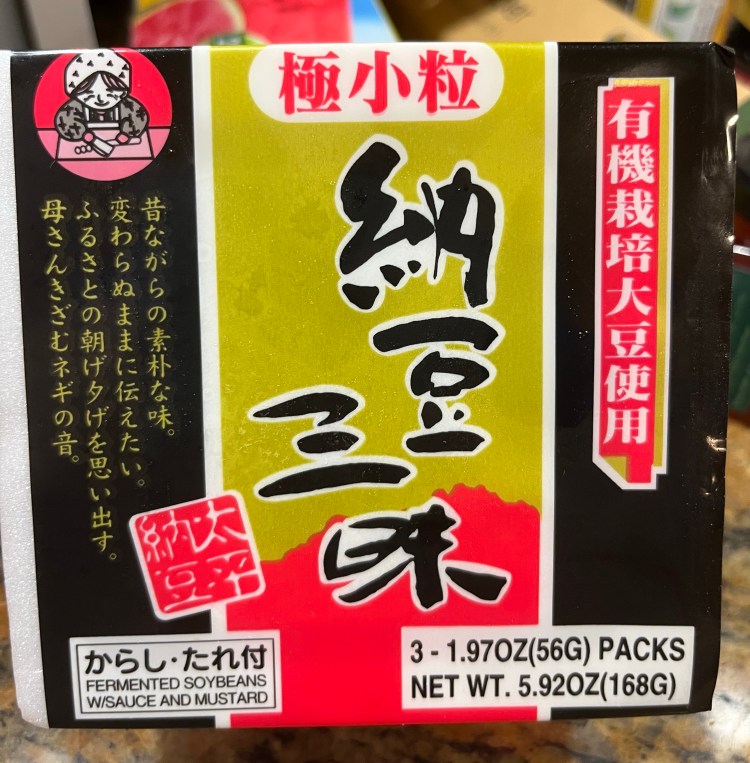
My family knows I love to eat rice and natto, or fermented soy beans, in the morning. Often with Korean kimchi. It’s a breakfast habit I started about 10-15 years ago, and never looked back. Thanks to the crunch of the pandemic, and inflation, shipments from Japan have become a trickle, and so our local Asian market will sometimes have no natto in stock, other times it will have a huge stock that quickly disappears. My wife found this new brand recently after the latest shipment came in, and the name of the product gave me a good chuckle.

The name of this product is nattō zanmai (納豆三昧), with “zanmai” being a Japanese transliteration of the Chinese-Buddhist term from the Sanskrit word samādhi. The word samadhi is something used in Indian religion in general, but refers to a state of intense concentration through meditation. It appears in a wide variety of contexts, but for now we’ll focus on the Buddhist ones. It helps to think of samādhi as being “in the zone”, but in a deeper, meditative sense.

Usually when people think of meditation, they think of the classic mindfulness meditation (a.k.a. vipassana meditation) and sometimes when one meditates here, they get into a deep, absorbed state. However, meditation is a broad subject in Buddhism, and with other kinds, including walking meditation, mantra-chanting, visualization of the Buddha, etc. In each such practice, some kind of samadhi is possible too. Even in the context of Pure Land Buddhism, chanting the nembutsu (the name of Amitabha Buddha) is said to bring about something called nembutsu samadhi if done as a long-term, dedicated practice. Honen was said to have seen the Pure Land around him during this intense state of recitation. Similarly, the intense practices of the Tendai sect were said to bring about powerful samadhi experiences as well if carried to fruition.

However, while all that is interesting for Buddhist-nerds like me, it is not the context being used for the brand of natto. The term “zanmai”, which still retains it Buddhist context, can also mean in a regular day to day context something that you’re just really into. You might even say “absorbed” by. 😎 Day to day Japanese has a lot of old Buddhist terms that have changed meaning over time and reflect cultural attitude even as their religion meaning is obscured. The term aisatsu (挨拶) refers generically to the formalities people use to greet one another, but originally derived from a Zen-Buddhist term for when a teacher would quiz his student on their grasp of Zen. Even the common phrase ganbaru (頑張る, “hang in there”) originally derived from a Zen context as well.

Of course, we do this in English too: many Christian-religious terms have gradually taken on a more pop-culture meaning as well. I have heard from an old Palestinian co-worker that this happens with Islamic terms in Arabic as well. It is a natural cultural phenomenon.

All this is to say that while natto over warm rice does not lead to meditate absorption, it is really darn good, and if like me, you eat it almost every day, you might say you’ve been pretty absorbed by it.

I’ll see myself out.

P.S. If you do like natto, this is a great brand. Definitely pick it up if you can.

The Real Treasure Was Inside Us All Along

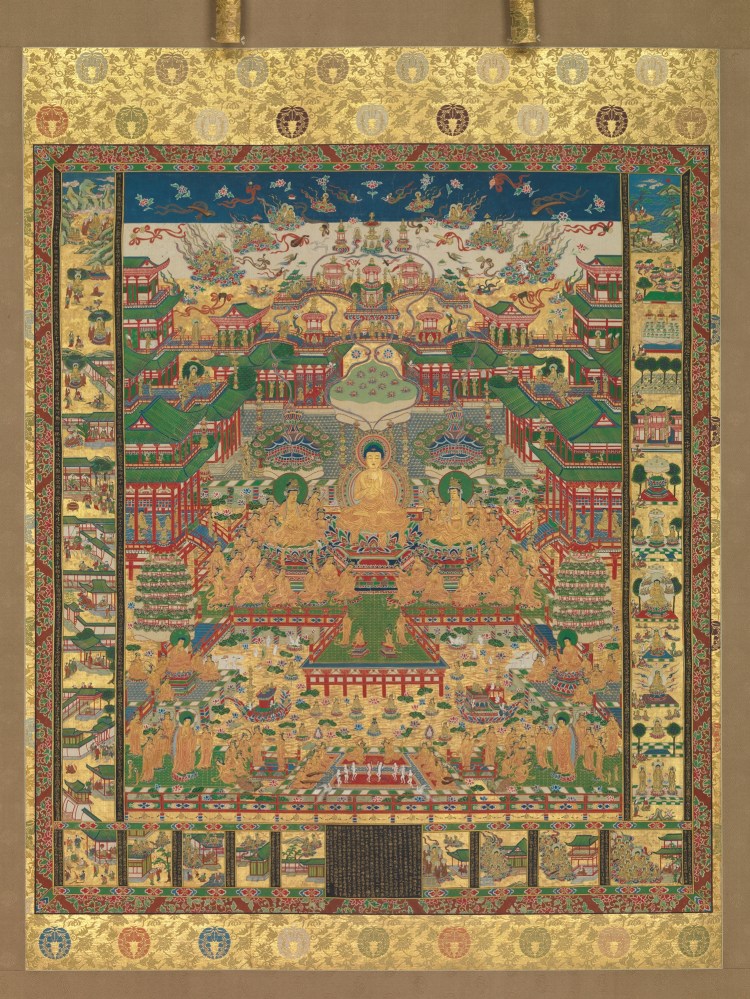
A reprint of the Taima Mandala, one of my favorite works of Buddhist art, with the Jodo Shinshu-sect crest at the top and bottom, Metropolitan Museum of Art, CC0, via Wikimedia Commons

Recently, I have been reading up on the Obaku sect (Ōbaku-shū, 黄檗宗) of Japanese Zen Buddhism: the same sect that Tetsugen was a disciple of. Obaku Zen is the third and last Zen sect to come to Japan to China, centuries after Rinzai and Soto were imported. Rinzai and Soto were both imported from China during the Song Dynasty. Obaku had the same lineage as Rinzai Zen, but was imported at the end of the Ming Dynasty, and had evolved over time to include some elements of Pure Land Buddhism, but with distinctly Chinese-Zen flavor.

In Japan, due to the Obaku sect’s common ancestry with the Rinzai sect, it was gradually absorbed administratively by the latter, but it’s arrival in Japan also reinvigorated Zen-monastic discipline. Soto and Rinzai sects frequently studied for a time at Obaku temple communities.

Obaku Zen, though small, still retains its more Sinified liturgy (sutra recitation is pronounced in a more more Chinese, less Japanese, style) and integration of Pure Land teachings.

For example their temple homepage lists an interesting excerpt from an earlier publication about the meaning of the Pure Land of Amitabha Buddha in a Zen context. What follows is the original excerpt, plus my rough translation:

この世で実在するのは心だけであり、総ての事物、現象は心の働きによって仮に現れたものであるとする「唯心」という考え方に基づけば、「浄土」も心の中にある。即ち自分自身の身こそが阿弥陀仏なのである。

If we take this world that exists as none other than Mind only, such that all of its affairs, its phenomenon, and such all depend on the movements of the Mind, and thus are “Conscious-only”, then the “Pure Land” is that which dwells in the heart. That is to say, Amitabha Buddha is this very self.

from「己身」の「弥陀」 (“Amitabha Buddha of the self”) from 黄檗宗青年僧の会発行「黄檗」(“Obaku Zen young monk’s periodical ‘Obaku'”)

To borrow that 1980’s cliché found in every Saturday morning cartoon: the real treasure was inside us all along.

The term “Conscious-only” or yuishin (唯心) is the Buddhist term for the Yogacara Buddhist school of philosophy, which taught that all things we perceive, think and feel are ultimately projections of the mind itself. It’s a subject that is super fascinating and far beyond the scope of this post, but important to understand that the Yogacara tradition of Buddhism has had a huge influence on Buddhism at large. I highly, highly recommend the book Living Yogacara: An Introduction to Consciousness-Only Buddhism if you’d like a general overview of Conscious-only Buddhism. It is a book that I come back to every now and then.

In any case, this concept of the Pure Land as the mind only might seem far-fetched given the overall trend, especially in Japanese Buddhist history, to focus on Amitabha Buddha and the Pure Land as separate, external entities. However if you’ll recall, the Chinese monk Ouyi who also lived in Ming Dynasty promoted a similar outlook:1 that in the end the real Pure Land was our Mind, and yet it’s perfectly fine to continue practicing Pure Land Buddhism as if it were external.

You might even say that the real bodhisattvas we encountered were the friends we made along the way. 🤪

Namu Amida Butsu

1 It’s tempting to argue that the Zen traditions of Soto and Rinzai that came to Japan earlier are more “pristine” than the later Obaku tradition, but I think that’s it’s a highly romanticized view of the past. Further, it’s important for religious traditions to “till the soil” from time to time, innovate and such. We can’t recreate the original 5th Century BCE community of the Buddha and his direct disciples, nor can we recreate the early Zen traditions in China and so on. We can learn from them, and keep innovating as time goes on. Later Zen tradition in China probably reflected continuous innovation as it vied with other schools of thought: Confucian, Taoist, other Buddhist schools, etc.