What is a Buddha Land?

This blog, and its blogger, have focused on the Pure Land tradition of Buddhism for many years. I didn’t really start practicing Buddhism seriously until I encountered the Jodo Shu-sect teachings of Honen way back in 2005. It really inspired something in me that’s never stopped even as my practice has taken many twists and turns.

But, strangely, I’ve never actually talked about what a “pure land” is. That’s the subject of today’s post.

The concept of a “Buddha land” or “Pure land” is actually a broad and rich tradition within Mahayana Buddhism, and well worth exploring. Here, I am not talking just about Amida Buddha and his Pure Land, but the general concept. It shows up a lot in Mahayana Buddhism and its many traditions, including the Zen tradition. It also shows up in contemporary Asian literature as well, including Akutagawa Ryunosuke’s famous short story “The Spider’s Thread” (蜘蛛の糸) as well as the Legend of Zelda series. Once you recognize it, references to Buddha lands show up in many unexpected places.

And yet, it all started long ago in India.

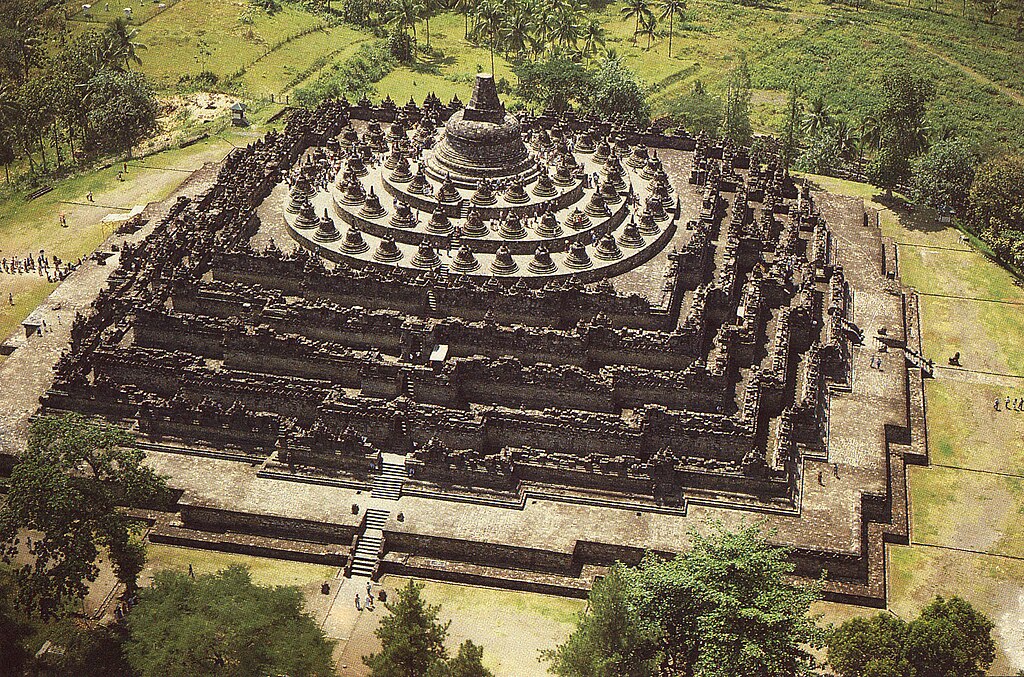
Traditional cosmology (i.e. “how the world is arranged”) in India tended to see a flat world with continents strung together in all directions, including above and below. Some of these continents would be anchored by a massive mountain in the middle, called Mount Sumeru (or Mount Meru). You can see this also in Buddhist architecture such as this famous temple in Bangkok, Thailand:
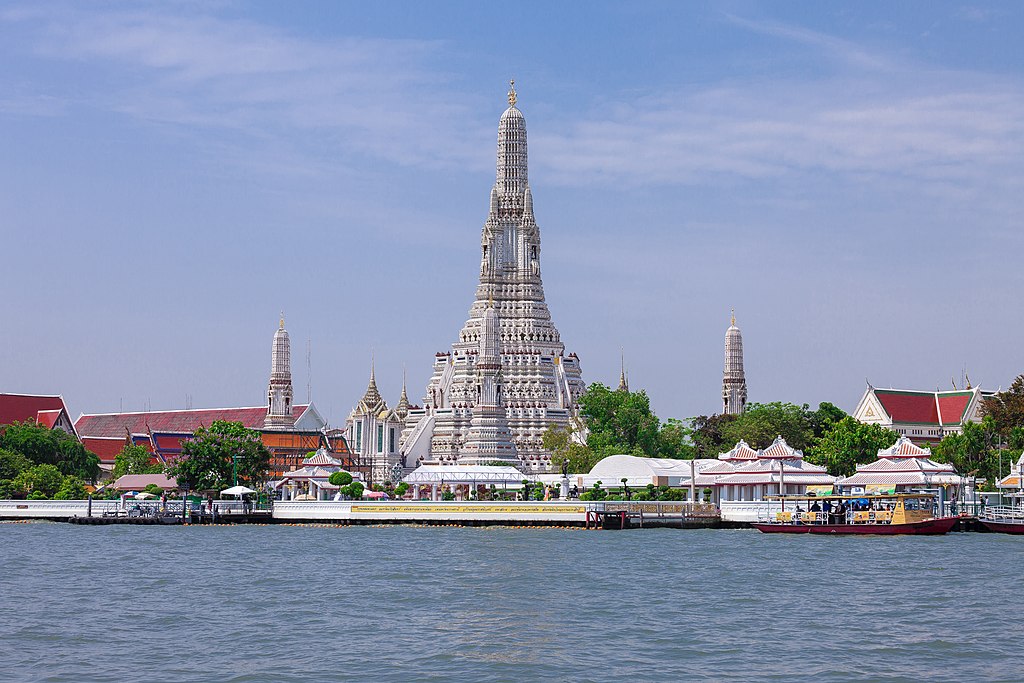
Phra Prang Wat Arun photo taken by Supanut Arunoprayote., CC BY 4.0, via Wikimedia Commons. The tall structure in the middle is meant to symbolize Mount Sumeru.

Or the famous Borobudur temple in Indonesia:
Incidentially, people in India thought that they lived in one of these continents called Jambudvipa, which was on the southern end of Mount Sumeru. For example, in the Earth Store Bodhisattva Sutra, you see text like so (chapter 4):

Thus, in this Saha world, on the continent of Jambudvipa, this Bodhisattva teaches and transforms beings by means of millions of billions of expedient devices.

Translation by City of Ten Thousand Buddhas

Anyhow, different continents were more peaceful and civilized than others. In some continents dwelt a living buddha, and by their sheer presence, the land would be purified, and all would be peaceful. Such lands are called buddhakṣetra in Sanskrit.

Let’s take a look this passage from the Amitabha Sutra:

At that time the Buddha told the Elder Shāriputra, “Passing from here through hundreds of thousands of millions of Buddhalands to the West, there is a world called Ultimate Bliss. In this land a Buddha called Amitābha right now teaches the Dharma

Translation by City of Ten Thousand Buddhas

In this sutra, the Pure Land of Amitabha is just one of many such lands that exist to the west, but a particularly splendid Buddha land. Buddhas and Buddha lands were thought to exist in all cardinal directions, and the Amitabha Sutra above goes to great lengths to describe some of them, but highlights Amida Buddha’s Pure Land in particular.

Another example of a Buddha land is the realm of the Medicine Buddha, called Lapis Lazuli, which was thought as existing to the east (not west). The Medicine Buddha Sutra describes it at length. It even goes out of its way to say it’s easier to be reborn in the realm of Lapis Lazuli than the Pure Land of Amitabha:

“If their rebirth in the Pure Land is still uncertain, but they hear the name of the World-Honored Medicine Buddha, then, at the time of death, eight great Bodhisattvas, namely, [list of names] will traverse space and descend to show them the way. They will thereupon be reborn spontaneously in jeweled flowers of many hues. [i.e. be reborn in the Buddha land of the Medicine Buddha]

Translated and annotated under the guidance of Dharma Master Hsuan Jung by Minh Thanh & P.D. Leigh

If a person could be reborn in their next life in a Buddha land, any Buddha land, and thus be in the presence of a living Buddha, it is thought they would find refuge, but also they would advance much better along the Buddhist path. The idea of Pure Lands never supplanted or replaced more tradition Buddhism, but if your current circumstances prevented you from following the Buddhist path, you could opt to be reborn in a Buddha land and make up for it in the future.

… but then we come to another Buddha land worth noting: the Buddha land of Shakyamuni Buddha himself. The sixteenth chapter of the Lotus Sutra drops a plot twist wherein the Buddha never really died, and exists for all time on Vulture Peak in India (a real place where historically he and the Buddhist community often dwelt), and preaching the Dharma to any who see him (details added by me in parantheses):

I live on Mt. Sacred Eagle (another name for Vulture Peak)
And also in the other abodes
For asaṃkhya (countless) kalpas (eons).

…”This world is in a great fire.
The end of the kalpa [of destruction] is coming.”
In reality this world of mine is peaceful.
It is filled with gods and men.

Translation by Rev. Senchu Murano

The Lotus Sutra version of the Pure Land is less about esoteric geography, and more about Shakyamuni Buddha always being here, whether we see them or not. It comes down to wisdom, clarity, and good conduct.

This viewpoint is found in Zen as well. When we look at the Hymn of Zazen by Japanese monk, Hakuin, who was a lifelong devotee of the Lotus Sutra, we can see the influence:

浄土即ち遠からず
Jōdo sunawachi tōkarazu

“Indeed, the Pure Land is not far away”

Amateur translation by me

and:

当所即ち蓮華国此身即ち仏なり
Tōsho sunawachi rengekoku, kono mi sunawachi hotoke nari

“This place is none other than the Land of Lotuses [the Pure Land],
this body is none other than the Buddha.”

Amateur translation by me

But this isn’t just Hakuin talking. As we saw with the Obaku Zen tradition (a cousin of Hakuin’s Rinzai tradition), they felt the same way, only replacing Shakyamuni with Amida Buddha. But the sentiment was the same. You’ll find similar sentiments in esoteric traditions too, but I have little experience with those and cannot explain in much detail.

So, that brings us to the point: how does one interpret all these Pure Lands, these Buddha lands? My views have gradually changed over time, but I don’t pretend to have the answer. I think in a way that all viewpoints are correct. It is like the famous parable of the blind men describing an elephant: everyone has some idea, but the big picture is beyond our grasp. So, there’s no wrong way to interpret it. If one believes it’s a faraway refuge to be reborn into, that’s totally fine.1 If one believes it’s all in the mind, that’s fine too.

Even the Buddhist sutras, including some I linked above, state that simply “hearing” of the Buddha lands is a merit unto itself. So, if you’ve made it this far, you’re already doing just fine. Just apply the teachings in the way that best fits you.

Namu Shakamuni Butsu
Namu Amida Butsu

1 Maybe this is my background as a scifi fan or something, but I do like to imagine that instead of physical continents, the various worlds and Buddha lands are just planets and worlds across the entire Universe. But that’s a personal view, more fantasy than firm belief, so please take it with a grain of salt.

Above Reproach

Recently, while cleaning out old notes from my mobile phone, I found this quote from the massive Buddhist text, the Avatamsaka Sutra (a.k.a. “The Flower Garland Sutra”) which I apparently saved in 2022 (!). I cannot remember where in the sutra this quote comes from, but I probably meant to post about it sooner than later. So… three years later I am finally posting this quote:

The peaceful nature of the buddhas cannot be known

By the covetous or the malevolent,

Or by those shrouded in the darkness of delusion,

Of those whose minds are defiled by hypocrisy and conceit.

Translation by J.C. Cleary

As we’ve seen with the Yogacara school of Buddhism, what we think and do helps “color” the world we also perceive, and thus becomes a feedback loop. Thus, someone who is prone to lying assumes others lie too. Someone who is aggressive or domineering fears others will dominate him, and so on. This is the world they perceive because their minds harbor such thoughts. In the Pali Canon is a sutra wherein the usurper king Ajātasattu visits the Buddha for some spiritual advice. Later, the Buddha laments that due to Ajātasattu’s prior patricide, his spiritual progress will be limited at best.

Thus, the Flower Garland Sutra says that evil men cannot “see” the Buddha because their minds are too clouded by greed, anger and arrogance. Of course, they can physically see a statue or image, but they may learn little or nothing from it. They may as well be living on another planet. It does not resonate with them, and so they miss out on learning the Dharma. They will fall into evil rebirths, and may not gain another opportunity for generations, centuries, possibly longer.

Conversely, one who lives a clean life, and avoids harboring greed, anger, and arrogance will see the Buddhas. I don’t necessarily mean in terms of visions and such,1 but they will see the Buddha-Dharma everywhere (even in awful places and situations), and learn from it. From there, their perception will only continue to grow and mature, leading to greater wisdom.

This idea isn’t limited to the Flower Garland Sutra. The famous sixteenth chapter of the Lotus Sutra basically says the same thing: those who live upright see the Buddha and his Pure Land here and now.

So, take heart. If you strive to keep your “house in order”, and avoid harboring ill-will and such, you will not fail to see the Buddha someday.

Namu Shakamuni Butsu
Namu Amida Butsu
Namu Kanzeon Bosatsu

1 True story: in my 20’s, when my oldest daughter was a baby, and I was first exploring Pure Land Buddhism, I once had a really vivid dream, where I was offering armfuls of incense sticks at the feet of a statue of Kannon Bodhisattva. It’s the one and only time I’ve had a “Buddhist dream”, but I suppose it can happen to anyone.

The Art of Dying

One thing that really annoys me as a long-time Buddhist is the tendency for self-help and spritual seminars to cost so much money. I saw this advertised locally in my area for weeks, and the starting price for a seat is $250 for a backrow seat, which to me is totally bonkers.

The Dharma, as taught by Shakyamuni Buddha was freely given, and required nothing.

Having said that, as a counter to pricey spiritual seminars, I wanted to promote a concept: the Art of Dying.

DYING?!

It is a simple concept: you are going to die. You cannot necessarily choose the hour or manner of your death. But it will occur inevitably occur.

You do not have to take my word for it. Here’s a Buddhist sutra (freely given I might add) from the words of the Buddha:

There is no bargaining with Mortality & his mighty horde.

Whoever lives thus ardently, relentlessly both day & night, has truly had an auspicious day:

So says the Peaceful Sage [Shakyamuni Buddha].

MN 131, translation by Ven. Thanissaro Bhikkhu

The Lotus Sutra, a later Buddhist text but in my opinion the capstone of the Buddhist canon, describes this using the famous Parable of the Burning House in the third chapter. You can find Dr Burton Watson’s translation here (again, for free!).

But, to summarize the Parable, the Buddha Shakyamuni asks us, the reader, to imagine a great, big mansion that’s old, rickey, and so on. Then, imagine the house is burning. Deep inside, some kids are playing in a room, unaware the house is on fire. The father, having just returned from a trip, sees his kids in danger and calls out to them to leave the house at once. The kids, engrossed in their games, fail to see their situation. Finally, the father offers them great rewards if they leave (specifically carts of goods), and the kids finally come out.

The father, Shakyamuni Buddha, has left the burning house and stands outside. He calls to those in danger, namely the “kids”, to see their peril and to come out too.

What about the burning house itself? That is the world we live in, with strife, conflict, disease, chaos, aging, and death.

The late Thich Nhat Hanh wrote about this too:

“Imagine two hens about to be slaughtered, but they do not know it. One hen says to the other, “The rice is much tastier than the corn. The corn is slightly off.” She is talking about relative joy. She does not realize that the real joy of this moment is the joy of not being slaughtered, the joy of being alive.”

Thich Nhat Hanh, The Heart of the Buddha’s Teaching

This gets to the heart of the Buddha’s teachings: do not squander the time you have on this Earth. It doesn’t mean you can’t enjoy life and your loved ones, but remember: Death will not wait for it to be convenient for you.

When you hear this, your instinct might be the “live, laugh, and love”, indulge in all the fun things in life before it’s too late. But that’s not what the Buddha intended. When you look back at the Parable of the Burning House, the father wasn’t asking the kids to play more, he was telling them to get out before it’s too late.

Further, in the Mahayana tradition, one can get themselves out of the burning house, but helping and guide others to get out of the burning house is even better. One can call such people bodhisattvas.

But you can’t help others (let alone yourself) until you :

  • Recognize the situation
  • Put down your own toys and find the way out before you can help others.

This is part of the progression of the Buddhist path: get your foundations in order, increasing confidence in the Dharma (which you can see in your own life), and turning outward to help other beings.

But starting at the beginning, how does one establish a foundation?

Everyone is different, but generally it starts with some simple things:

  1. Taking the Buddha, Dharma and Sangha as one’s chosen refuge (you can do this by yourself or in a community). You can setup a small shrine too.
  2. Taking up an ethical life, such as undertaking the Five Precepts
    • If all five are too hard, start with one, and work your way up over the months and years.
  3. Cultivate metta:
    • Say to yourself (yes, you): May I be well, may I be free from harm.
    • Now think of loved ones: may they be well, may they be free from harm.
    • Now think of all living beings (even the awful ones): may they be well, may they be free from harm.
  4. Setup a reasonable daily practice. Think of it like exercise or stretching: if you start too aggressively, you’ll injure yourself and set yourself back. So start small, and build up.
    • What does a daily practice look like? Some examples here.
    • A small meditation practice can be beneficial too, but intention matters.
    • Study the sutras. Not self-help books, but the sutras. Commentaries on the sutras, such as those provided by Thich Nhat Hanh are quite good and easy to find in used and independent bookstores such as Powell’s City of Books.
    • Find worthy teachers and communities, not slick, overpriced seminars or cults. Caveat emptor.
  5. Give yourself permission to screw up, then reflect on it, and move on.
  6. Repeat. Buddhism is a long-term practice. “Play the long game“, but also remember you are on the clock. Time is short.

So, that’s your free teaching for today. Thanks for attending this seminar. Want to support the blog? Pay it forward or something. This is “Buddhism on a Budget”, and I strongly feel this is how Buddhism should be.

Namu Shakyamuni Butsu
Namu Amida Butsu
Namu Kanzeon Bosatsu

P.S. apparently this also a band with this name. As fellow PNW residents, I salute them.

Rinzai Zen Sutra Book

Recently, I wrote about a Soto Zen sutra book I purchased some years ago, and it’s still one of the best books I own. Today, I wanted to highlight another Japanese-Buddhist sutra book that I had for years, but never really understood what it was about.

The book is available online here, among other places. The book was published by Nanzenji temple, a major Rinzai Zen temple, and I found it at a Kinokuniya bookstore here in the US in the Japanese-language section. It is titled 私の般若心経 (watashi no hannya shingyō, “My Heart Sutra [book]”)

The sutra book is really small, and easily fits in the palm of my hand. As the website description states, this is designed to that one can carry it on one’s person as a charm, but also use it for home liturgy. Pretty clever. I’ve seen such “sutra book charms” before but usually they are very small, and the print is lower-quality, since it’s meant to be carried, not read. This by contrast is very nice quality.

Inside, the contents are surprisingly dense for such a small book. Inside contains the texts necessary to do a home service according to Rinzai tradition, though it differs slightly from the one I posted previously.1

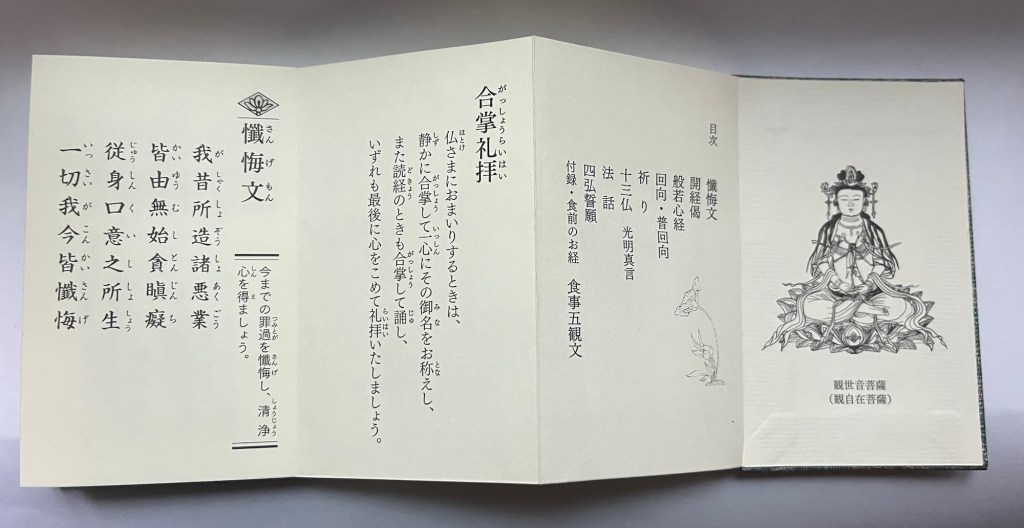
The contents, shown below include basic liturgy such as repentance verses, the opening of the sutra, a copy of the Heart Sutra, dedication of merit, four bodhisattva vows, and so on.

Above, we see the first four pages of the sutra book, from right to left: a picture of Kannon Bodhisattva, then the table of contents, an explanation about how to gassho, and finally the sangemon (verses on repentance).

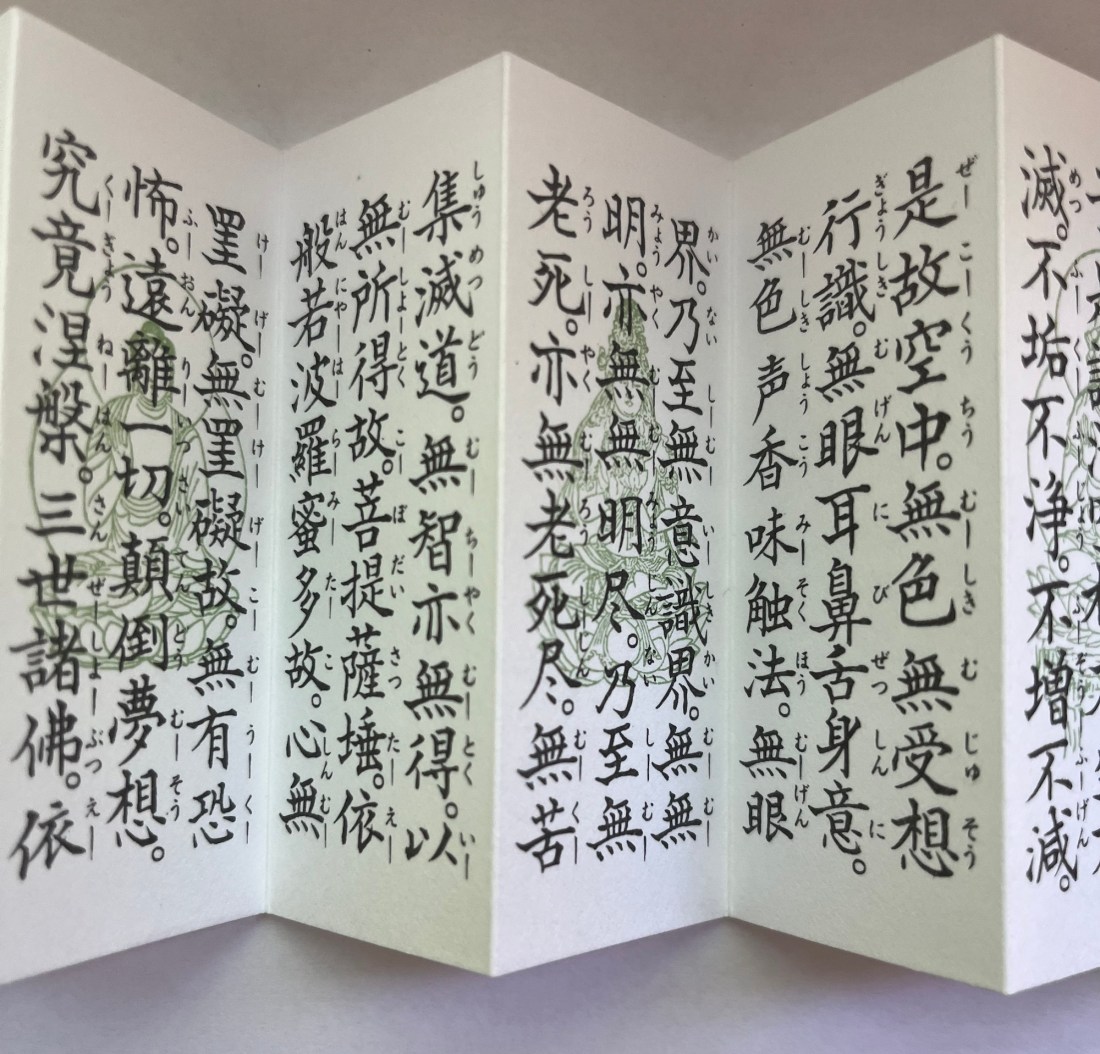
Below, you can see the Heart Sutra from end to end (read right-to-left, vertically). If you can read Japanese hiragana script, you can recite this because each Chinese character is annotated with a pronunciation guide (a.k.a. furigana):

The furigana script is a bit small and hard to read, but that’s understandable given how small this book is.

Surprisingly, the sutra book contains other things I wasn’t expecting, such as mantras for the Thirteen Buddhas and Bodhisattvas, often recited during yearly memorials for the deceased. The book also the Mantra of Light, surprisingly. It also contains the five verses for contemplating food.

Finally, the book contains a sermon by the author, and has a handy blank section at the end for taking notes.

Weirdly, I’ve owned this book for almost 10 years, but back then I couldn’t read Japanese very well, so I didn’t fully appreciate what the contents of the book were, plus I had no familiarity with Rinzai Zen. Now that I have a bit more experience, I can appreciate this book a lot more, and have been using it for home liturgy lately.

For such a compact book, it’s really very nice, and only costs ¥550.

If you’re able to read basic hiragana script, and have an interest in Rinzai Zen, it’s definitely worth a purchase.

1 As noted in a previous post, Rinzai Zen in particular a number of lineages and factions, each one based around a different temple. This may help explain why the liturgy varies as much as it does.

Rinzai Zen Home Liturgy

Recently, I finally got a hold of an introduction book on Rinzai Zen from Japan titled うちのお寺は臨済宗 (“My Temple is Rinzai Zen”). This book is part of a series for Japanese-Buddhists to learn more about the particular parish or sect they grow up in, and I have used it extensively covering other sects here. For some reason, I failed to find the Rinzai book in the past, but was finally able to order it.

Anyhow, most Western books on Rinzai Zen tend to focus on the mystical aspects of Zen without explaining the more practical side for lay followers. So, similar to my posts on Soto Zen and Tendai, I wanted to post the details of Rinzai Zen home liturgy based on what I learned from the book. Personally, I find the mundane side of Zen far more interesting than the more mystical aspects taught by the likes of Alan Watts and D.T. Suzuki.

As with Soto Zen, Rinzai Zen emphasizes the importance of zazen (meditation) practice, but it does have its fair share of chanting and devotionals as well as a support. How you, the layperson Zen student, balance these needs is something you will learn over time. I just wanted to share the information as presented in the book. If you are new to Buddhism, and maybe not comfortable with meditation, start with doing home devotional services first, and as you build confidence, you can expand to other practices in including meditation and precepts, etc.

In many ways, Rinzai Zen liturgy very closely resembles Soto Zen. Both are derived from Chinese tradition1 so this isn’t very surprising. Also, some chants will have a “Sinified” (Chinese) version and a native Japanese version, some only appear in Sinified form. I will try to post both when applicable.

A Quick Note on Liturgy

The book recommends consulting your local Rinzai temple for details. I believe this is because there are many subsects in Rinzai Zen (complicated history) and thus many lineages and home temples. Each temple lineague might do things a little differently, so the book cautiously suggests checking with your home temple first.

But if you are reading this, you probably don’t live in Japan, so the book also suggests commonly practiced liturgy format. That is what I am posting here. Again, it’s very similar to Soto Zen, so if you are unsure, you can consult Soto Zen sources too.

Example Rinzai Zen Home Liturgy

So far, based on research, I have seen that there are two versions use in Rinzai Zen. For simplicity, I will call them the “short version” and “long version”. People are welcome to chose which version they want to recite, or adapt as needed. These are examples. For both versions, I was lucky to find some nice video examples from the temple of Yogaku-ji in Tokyo. Thank you!

Short Version

The format of the “short” liturgy is as follows:

The video below shows a similar format, without reciting the Four Bodhisattva Vows, so it’s a very short and simple.

Kaikyogé: Opening of the Sutra Verses

I had trouble finding an example in native Japanese, but posting the Sinified form below. It is basically identical to other sects. I included rough translation as well.

Sino-JapaneseTranslation
Mu jo jin jin mi myo hoThe supreme and profound teachings (Dharma) of the Buddha
Hyaku sen man go nan so guis truly rare to encounter,
Ga kon ken mon toku ju jibut now we are able to hear and receive it.
Gan ge nyo rai shin jitsu giIt is our hope that the teachings become clear to us.

Sutra Chanting

As stated above, the Heart Sutra, Kannon Sutra, or Hakuin’s Hymn of Zazen are the most common choices. Feel free to choose one, or rotate them each day.

As noted above, my book mentioned that one can also recite the Dharani for the Prevention of Disaster, typically chanted three times after reciting the Heart Sutra. But this is entirely optional.

Shiguseigan: The Four Bodhisattva Vows

See this post for more details and translation. Youtube link here. It is the same as other sects in Japan.

Sino-JapaneseNative Japanese
Shu jo mu hen sei gan don/a
Bon no mu hen sei gan dan
Ho mon mu ryo sei gan chi
Mu jo bo dai sei gan sho

Fueko: The Dedication of Good Merit Towards Others

See this post for more details. This liturgy is somewhat unusual in that every sutra book I see consistently prints it as a mix of both native Japanese followed by Sino-Japanese (highlighted in bold). So I am posting as-is. Youtube link here.

Dedication of Merit, full version
Negawaku wa kono kudoku wo motte, amaneku issai ni oyoboshi,
Warera to shu jo to, mina tomo ni butsu do wo jozen koto wo
Ji ho san shi i shi fu
Shi son bu sa mo ko sa
Mo ko ho ja ho ro mi

There is also a second version that I found in a liturgy book from Nanzenji temple, another major Rinzai temple that uses a different format:

Sino-JapaneseTranslation
Gen ni su kun teMay this good merit that I have accumulated…
Fu gyu o i shiiBe distributed to all beings
Go ten ni shun sanSo that we may all walk this path
Kai kyu jin bu doAnd equally attain the Buddha Way.

What’s fascinating about this version is that the Chinese characters are exactly the same as found in other sects (for example Tendai liturgy), but the pronunciation is much more Sinified (Chinese-style), rather than Japanese style readings. Feel free to adapt either verse. I prefer the Chinese-style pronunciations as I find them shorter and easier to pronounce.

Long Version

The format of the “long” liturgy is as follows:

Many aspects of this liturgy are the same as the short version, or they are linked in other blog posts (The Great Compassion Dharani is too long to post here). Some of these “dedication of merit” verses are hard to find online, so I wasn’t able to post anything here.

In any case, the temple of Yogaku-ji in Tokyo has put another excellent video with this format, which I encourage you to take a look.

Conclusion

These are just a few examples (I found others) of how Rinzai Zen liturgy works. As with many aspects of Buddhism, find what works, and is sustainable, and feel free to adjust and modify over time. Consistency, preferably daily, is the most important thing.

Good luck, and happy chanting!

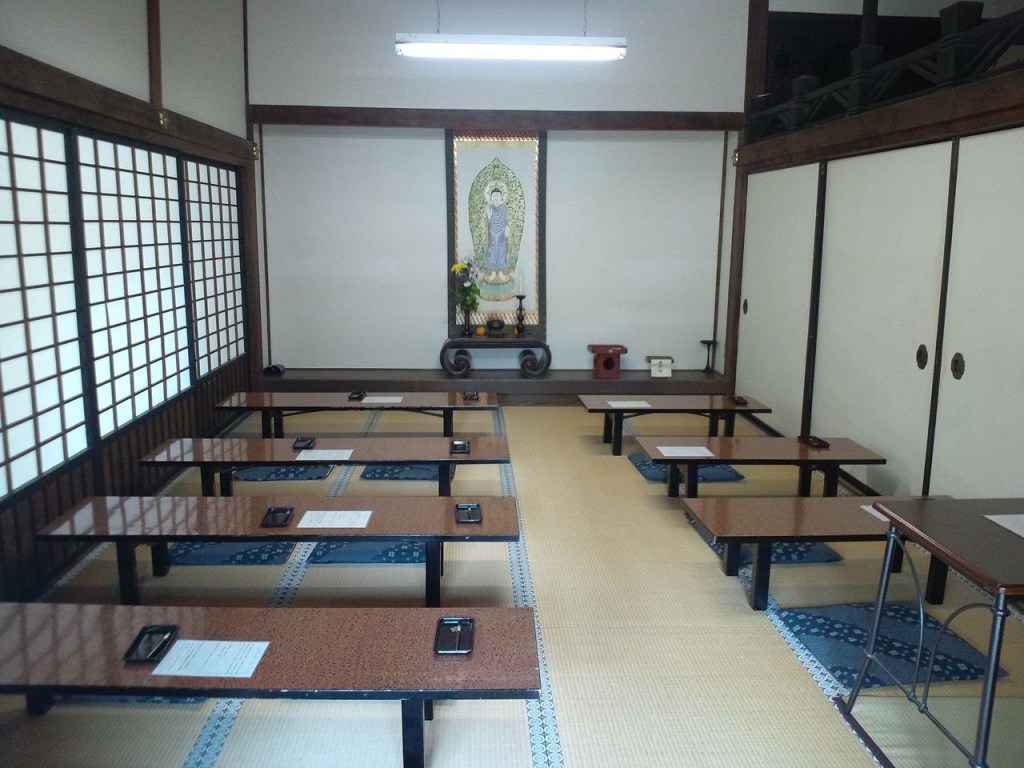
P.S. Featured photo from my visit to Kennin-ji Temple in 2024.

1 In truth, all Buddhism in Japan derives from Chinese Buddhism (often through the Korean peninsula), but for historical reasons, the two Zen sects (namely Rinzai and Soto) were founded by monks who journeyed to China during the Song Dynasty (10th – 13th century) which is much later than other traditions who imported Buddhism during the Tang Dynasty (7th – 10th c.). This means that they had the latest, freshest practices and monastic traditions compared to other sects, and this earned Zen an outsized cultural impact where other sects were either homegrown or seemingly antiquated. When Rinzai’s cousin Obaku came to Japan in the 16th century, it was even newer and briefly had a heyday in Japan.

The Lotus Sutra: the Capstone Teaching?

It’s been a while since I discussed anything that relates to Tendai Buddhism, but I was doing a bit of nerd-reading with my free time, and thought this was interesting to share.

As Buddhism spread from India via the Silk Road, transmitted by such peoples as the Kushans, Sogdians, and Parthians (the same Parthians who contended with Rome from to time), the vast wealth of Buddhist texts, teachings and information flooded into China in waves.

This import of information was kind of haphazard at first, but as translations improved and information continued to come, China developed its own schools of thought to help make sense of it all.

One of the first successful efforts was by a Chinese monk named Zhi-yi (智顗, 538–597 CE)1 who founded the Tiantai school. He, or possibly by later patriarch Zhan-ran (湛然, c. 711-782 CE),2 analyzed the various teachings and Buddhist texts and developed a chronology called the Five Time Periods and Eight Teachings (五時八教, wǔshí bājiào).3 This chronology looks like so:

  1. The Buddha (Shakyamuni) taught the Flower Garland Sutra first, but it was incomprehensible to disciples.
  2. The Buddha stepped back and taught Agama sutras next. The Agamas are equivalent to the Pali Canon in the Theravada tradition, and nearly the same in terms of content. The Agama sutras were more grounded and practical and thus easier for his community to understand.
  3. Next, the Buddha taught sutras such as the Vimalakirti Sutra as an introduction to Mahayana teachings, and thus higher than the Agamas.
  4. Next, the Buddha taught the Perfection of Wisdom sutras, such as the Heart Sutra, as a more complete teachings.
  5. Finally, the Buddha taughy his ultimate teachings: the Lotus Sutra and Nirvana Sutra because the disciples were now ready.

Thus, out of all the Buddhist texts, Zhi-yi argued that the Lotus Sutra was the complete and ultimate teaching (円教). In Japanese Tendai Buddhism, 円教 is pronounced as engyō, or is sometimes more formally called hokke engyō (法華円教, “the complete teaching that is the Lotus Sutra”). Much of Tendai Buddhism is thus about putting the Lotus Sutra teachings into practice. From the Tendai perspective, things like meditation, venerating Amida Buddha, esoteric practices like mantras, and upholding the precepts are all ways to put the Lotus Sutra into practice, and Zhi-yi wrote quite a bit about this subject.4 The idea, expressed through the phrase shi-shū-yū-gō (四宗融合) or “Four Integrated Schools”.

The historicity of Zhi-yi’s textual analysis is unfortunately pretty dubious. Modern archeology and Buddhology show that the very earliest texts, historically, were the Agamas / Pali Canon (the Dhammapada and Jataka Tales probably came even earlier), but even those were not recorded in writing until three to four centuries after the Buddha. So, even with the earliest texts, we have a gap from when the early disciples passed everything down orally before committing to writing generations later. Granted, Indian oral tradition was quite sophisticated and designed to minimize errors and corruptions in recitation, but the Agamas and Pali Canon do slightly diverge from one another, mostly in ways that are interesting to scholars only.

The Mahayana Sutras such as the Vimalakirti Sutra, Lotus Sutra and Perfection of Wisdom sutras were written down even later. One could argue that they were passed down orally5 and just recorded later for some reason, but textual analysis casts this into doubt. The Mahayana sutras are more like “reboots” or compilations of earlier teachings, more polished and such.

Which is where the Lotus Sutra comes in, I think.

This is personal bias, admittedly, but I do believe that the Lotus Sutra is a capstone of the Buddhist tradition, not because the Buddha saved it for last. Instead, the authors of the sutra did a really nice job of synthesizing earlier teachings into a single narrative, and devised clever parables to bring the teachings to readers in a fresh, new way. The Lotus Sutra doesn’t necessarily introduce a lot of new teachings so much as it brings it all together. Like a capstone or keystone. There’s something in there for everyone, in other words.

So, to me the Five Time Periods and Eight Teachings isn’t very useful in a literal, historical sense, but it is useful for showing how some sutras synthesize other sutras into increasing comprehensive narratives.

P.S. featured photo is the capstone of the main entrance of Giusti’s Palace, photo by Paolo Villa, CC BY-SA 4.0, via Wikimedia Commons

1 Pronounced like “Jer-yee” in English. The “zhi” in pinyin sounds like English “jerk” without the “k” at the end. His name in Japanese is read as Chigi, by the way.

2 Pronounced like “John-ron” in English. In Japanese, his name is read as Tannen.

3 This is read in Japanese language as gojihakkõ.

4 Pure Land practices as we recognize them do not seem to be prominent in Zhiyi’s time and were adopted into Tiantai later, and thus Japanese Tendai even later through such figures as Genshin.

5 The Lotus Sutra, for example is a mix of verse sections with narrative text around them. It’s argued that the verse sections came first, and then authors composed the narrative sections around them. When the verse sections were first composed is anyone’s guess.

Soto Zen Service Book

Something I haven’t really covered before, but worth talking about lately is a Soto Zen service book I picked up some years ago at Sojiji Temple which is not too far from my wife’s home in Japan.

Back then, we’d visit Japan yearly to see relatives, and let the kids get much-needed language exposure. Also, I was in touch with an expat1 who lived there for 20 years and shared a passion for Buddhist temples. He and I would go “temple hopping” together around the Tokyo area whenever I was in town, and as my firstborn daughter got older, she would come with us.

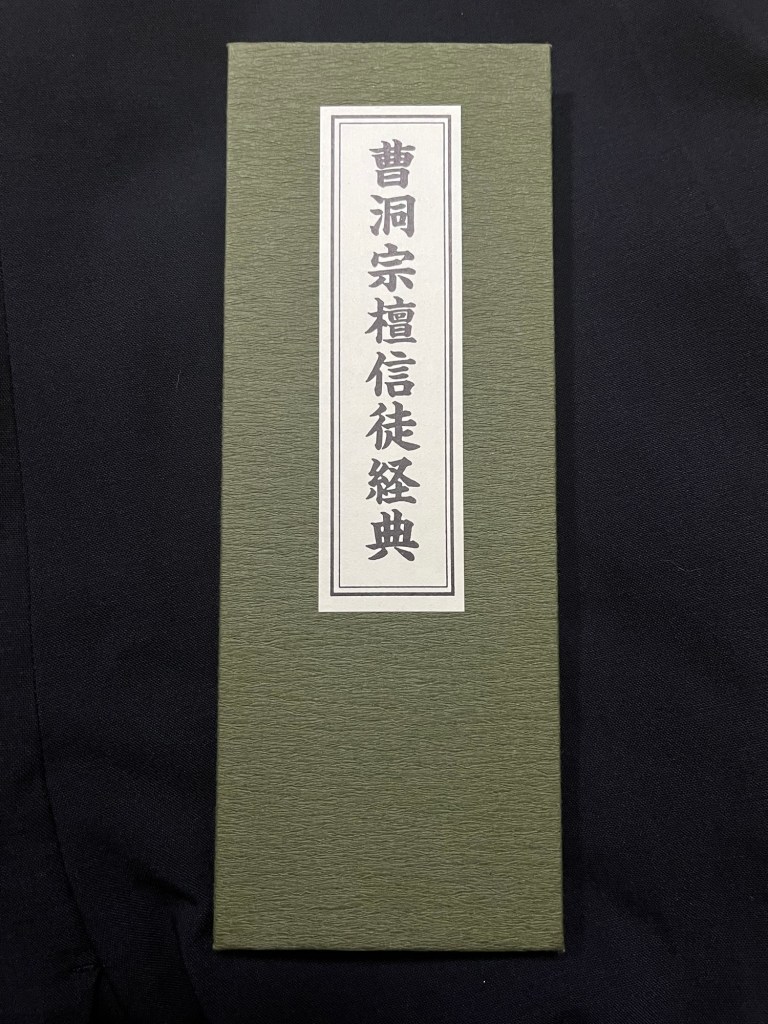
In any case here is the cover of the service book for Soto Zen home liturgy:

Cover of Soto Zen service book, purchased at Sojiji temple. Title roughly translates as “Soto Zen scriptures for parishioners”.

Inside, you can see the table of contents on the right side. Japanese text is tradtionally written right to left, and vertically (not horizontal):

Table of contents of sutra service book for Soto Zen. Purchased at Sojiji temple.

On the left-hand side is the Kaikyoge, a verse recited traditionally when starting a service. The gist of the verse is that encountering the Dharma is quite rare, and yet we are privileged to read and recite it now. Thus, may we all attain the Buddha way. During my years with the Buddhist Churches of America, we read a very similar liturgy in English. The concept is almost universal in Buddhist services.

Also, notice that the text in the Kaikyoge is Chinese characters (kanji), but with hiragana text to the side as a pronunciation aid. This is because most liturgy in Japanese Buddhism was originally adopted from China, and thus requires pronunciation guides (same is true with Korean Buddhism too, iirc). At the very bottom-left is smaller text helping to explain the meaning of this verses.

The photo below is the first part of the verse section of the Kannon Sutra (a.k.a. chapter twenty-five of the Lotus Sutra). Again, we see vertical lines of Chinese characters since the original edition was recorded in old literary (not modern) Chinese, and phonetic hiragana script beside each character. The large circle mark indicates a ring of the bell if you have one. As with above, it is read from right to left, vertically.

A copy of the Kannon Sutra, version section, from a Soto Zen service book, from Sojiji temple.

What I really like about this particular sutra book is how clear and readable the hiragana text is. Some books use a font that’s hard to read if you are a foreigner (or even Japanese possibly). This makes reciting difficult. But here, if you can read hiragana script, it’s easy to follow along.

A close up of the Kannon Sutra as printed in a Soto Zen service book, purchased at Sojiji Temple.

By the way, below is an example of verses that are not recorded in Classical Chinese: an excerpt of the Shushogi, chapters three and four. Since the Shushogi was recorded natively in Japanese, there are fewer Chinese characters, and the style of language is more readable to a native speaker. To me, as a language student, it’s still pretty difficult since the source text by Dogen was composed in the 13th century. The grammar is quite different 800 years ago. This section also includes explanations at the bottom for modern native speakers.

Because of the popularity of the Shushogi among laity in the Soto Zen tradition, all five chapters are recorded in this sutra book.

The rest of the content is pretty typical, and I explained the full contents in an older post, but what I liked about this particular sutra book was the quality, readability, and thorough content.

Side note: it turns out that there is also an eBook version of the service book (originally linked here) available in both Apple Books and Google Play formats. The eBook version is a lot nicer than I expected, and closely follows the physical book (the subject of this post), with a few slight differences:

  • The kaikyōge (verses on opening of the sutra) uses Sino-Japanese, the service book uses a mixture of native Japanese and Sino-Japanese
  • Similarly, the Sankiraimon uses native Japanese in tbe eBook version, but Sino-Japanese in the physical book.
  • the eBook version has a really nice altar image (gohonzon). A person who can’t access Buddhist altar goods could print it out, and install in a Buddhist altar (obutsudan).

But I digress.

For some reason I find sutra books fascinating, and if readers enjoyed this post, please let me know. I might try to make more posts on the various books I’ve collected over the years. I have service books from practically every sect in Japan.

P.S. Happy 4th of July to readers in the US. Also, happy (belated) Canada Day to readers there. To my ancient roman readers happy … (checks notes) … Battle of Adrianople?

1 via online Buddhist circles, namely the long-dead E-Sangha forum. IYKYK.

Why Study the Sutras

This is a great quote from the book River of Fire, River of Water:

One of the primary functions of Buddhist scriptures [the sutras], thus, is to bring to light the hidden aspects of the reader that is not readily recognized. The repeated reading of scripture, however, sooner or later opens up intimate truths about the reader that have been previously unknown. This sets the stage for knowing as becoming. When one begins to read scriptures in this way, one can also read everyday experiences as instructive and enlightening.

Page 156

The Buddhist sutras are a vast collection of scriptures across many generations, all purporting to be words of Shakyamuni Buddha, and cover a wide variety of topics. Some are very short and terse, others are volumes long. It is not possible to read all the sutras, and it’s not expected that one do so.

Instead, a particular Buddhist tradition will center its teachings around a particular sutra or set of sutras.

Some sutras are pretty straightforward and give practical advice about practice and such, while others can be pretty cryptic as they cover deeper subjects that would not be understood by newer students. It’s perfectly fine to read such sutras, but they may seem strange, and their meaning may not be clear. For such sutras, you may want to revisit them later, when you have more experience, and then the meaning will become clearer.

But what Dr Unno says is certainly true, based on personal experience: if you study the sutras, they become a part of you, then in time they reveal wonderful bits of wisdom. The Dharma is one flavor, like rain, but everyone approaches it a bit different according to their circumstances, and thus different sutras resonate at different times.

And of course, nothing beats real world experience.

Namu Shakamuni Butsu

Picture Sutras

Speaking of sutras, while reading about the Heart Sutra in Japanese, I learned about an interesting trend in the late-medieval “Edo Period” (17th through 19th century) called eshin-kyō (絵心経), or “picture Heart Sutra”).

An example of a “picture Heart Sutra” from 1795 (photo taken in 1922), composed by physician Tachibana Nankei in his travelogue Tōyūki (東遊記, “Journey to the East”), Public domain, via Wikimedia Commons

The idea was to make the Heart Sutra, a brief, but important and very popular Buddhist text, readable by illiterate peasants using a kind of rebus. The pictures above, to a native Japanese speaker of the time, would evoke certain words, which matched syllables of the sutra. For example, a few I can pick out:

  • The demon-looking character is a Hannya (mentioned here), hence hannya.
  • The pregnant woman with a baby is hara, as in a the torso.
  • The five vertical lines is go as in the number five.
  • The upright sword is ken.

This is just one example. It turns out that there’s many different versions, using slightly different pictures and styles. According to this blog, the origin of these picture sutras was a man named Zenpachi (善八). During the Genroku Period (mentioned here and on the other blog), a high-water mark of Japanese (especially Tokyo) culture, Zenpachi wanted to make Buddhist teachings easier for kids to understand and helped devise these pictures.

What’s interesting is that the tradition continues to this day, as seen in my Heart Sutra totebag my wife picked up.

This version is very cute, and of course has hiragana pronunciation guides just in case, but I think it’s a clever way to keep the Buddhist tradition alive.

P.S. moved this to Friday to make up for the accidental double-post on Tuesday and space the content out. We’ll be back to Monday-Thursday schedule starting next week.

Sutra Copying

The copying of Buddhist sutras is a time-honored devotional tradition in Buddhism. In the Olden Days, people did this not only as a form of devotion, but a necessary step in propagation before wood-block printing became widespread. But even with printing, sutra copying has been a popular personal practice.

A formal sutra-copying room at the temple of Seiryō-ji Buddhist Temple (homepage) in Japan. Photo by Yanajin33, courtesy of Wikipedia.

In Japan, this practice is called shakyō (写経), and is often available at major temples. You pay a small fee to cover material costs, and get a sheet of paper and an example sutra to copy from. From there, using an ink brush you copy the text in your own hand, and can either donate to the temple or take it home.

As for which sutras to copy the Heart Sutra is the most popular choice due to its size and popularity.1 However, in some sects, the preferred sutra varies. For example in the Jodo Shinshu tradition, some people copy the Shoshinge hymn (which is pretty long), or the Juseige. For Nichiren Buddhists, they copy excerpts of the Lotus Sutra such as chapter two and sixteen among others.

But I digress.

In a larger sense, a Buddhist follower can copy any sutra or excerpt of a sutra in whatever medium or language they want: Classical Chinese on a $2 notebook, Sanskrit Siddham script on fine washi Japanese paper, Ukrainian Cyrillic cursive, Latin, Koine Greek, or whatever. You can simply copy it by hand into your own sutra book, or make a PDF to share with others. You can copy it once, or a hundred times if you prefer.

There’s no restriction; the act of copying reverently is what matters.

I will also follow-up soon to show an example of more traditional sutra copying of the Heart Sutra, a project I’ve been working on on the side. Please stay tuned.

P.S. Bonus post today since it is the Buddha’s Birthday. 🎉

A Japanese copy of the Heart Sutra. This is the rufubon version (you can see the extra 一切 in the middle), compared to Xuan-zang’s version.

1 Fun fact: the version of the Heart Sutra used in Japan differs very slightly from the popular version attributed to my main man Xuanzang.

The Japanese version, popularized by the Shingon esoteric tradition, is called the rufubon (流布本) version. The rufubon version has two extra Chinese characters (262 total) from Xuanzang’s 260, namely the issai (一切) in the line on ri issai ten dō. It also uses slightly different characters for mantra at the end: 揭諦 instead of original 揭帝 for pronouncing Sanskrit gaté phonetically.