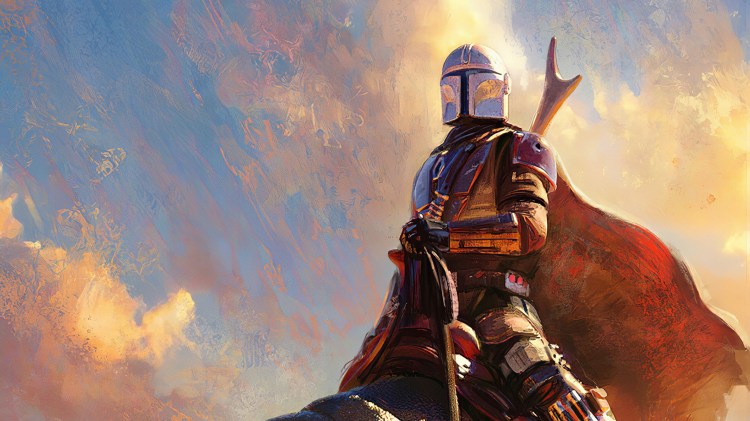
I have been a big fan of the Disney series, The Mandalorian, and have been re-watching the series in anticipation of season 3.
One of the aspects of the show I love is the Mandalorian code. As an orphan, adopted by an offshoot religious cult called the Children of the Watch, the main character Din Djarin is raised under a strict warrior’s code.
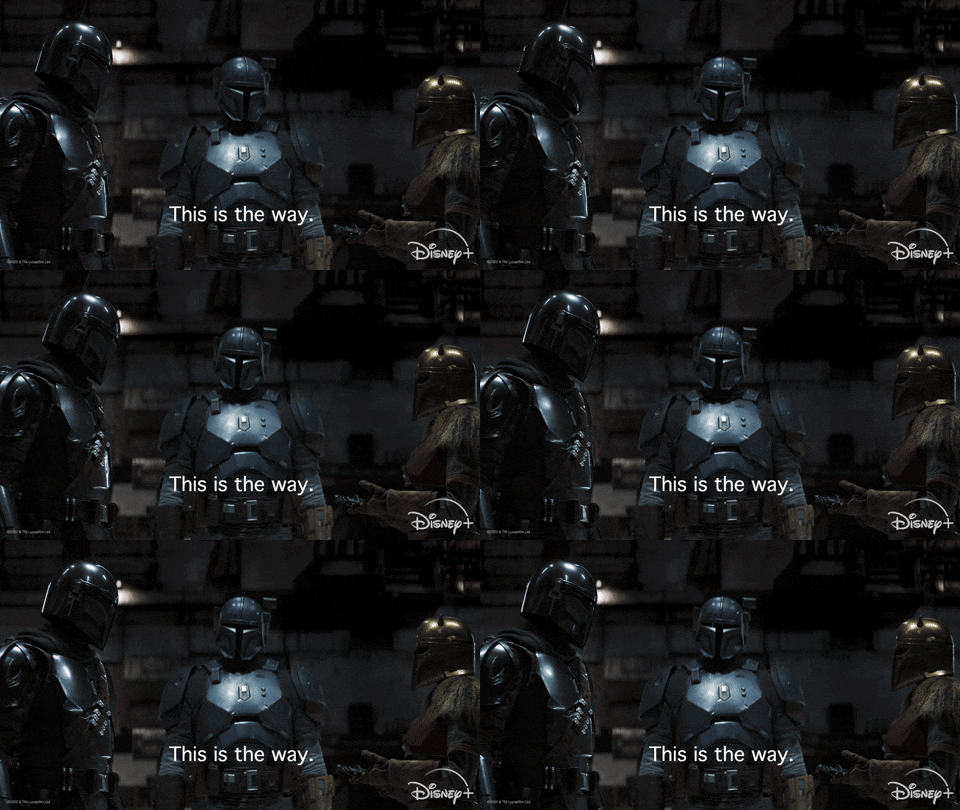
Mandalorians cannot remove their helmet in front of other beings, and as Din Djarin comments “weapons are part of my religion”. It is a strict, inflexible religion in many ways, but the Mandalorians believe it is also their source of survival. Even after as the season progresses, and Din Djarin’s character evolves, he still strives to keep this code as much as possible.
This idea of sticking to a moral code is very interesting to me.
Personally, I am not interested in being a warrior, and as a middle-aged dad working an office job, it probably isn’t realistic anyway. In any case, I have been a committed Buddhist for almost 20 years, and I suppose in a way that’s become my code. Things such as the Five Precepts, the Bodhisattva Precepts, and a commitment to help all beings, these are important to me.
I think it’s important to have some kind of moral code in one’s life. It’s important to be able to commit to something beyond oneself, and live a life beyond simple indulgence. The flip side of course is that one has to uphold that code too, even when one doesn’t feel like doing it.
But that tension between the realities of one’s life, one’s code and one’s nature is how a person grows. 😄
P.S. If you look at the progression of Mr Spock as a character too, you can see how he gradually changes from a staunchly Vulcan, driven by logic, to something more well-rounded in the movie series, and later in Star Trek: The Next Generation.
War has been a part of the history of Mankind since the beginning, but beyond the tales of glory, strategy, and raw statistics, it’s easy to forget the lives destroyed by it.
Spock: “I’ve noticed that about your people, doctor. You find it easier to understand the death of one than the death of a million.”
Star trek: the original series, “The immunity Syndrome”
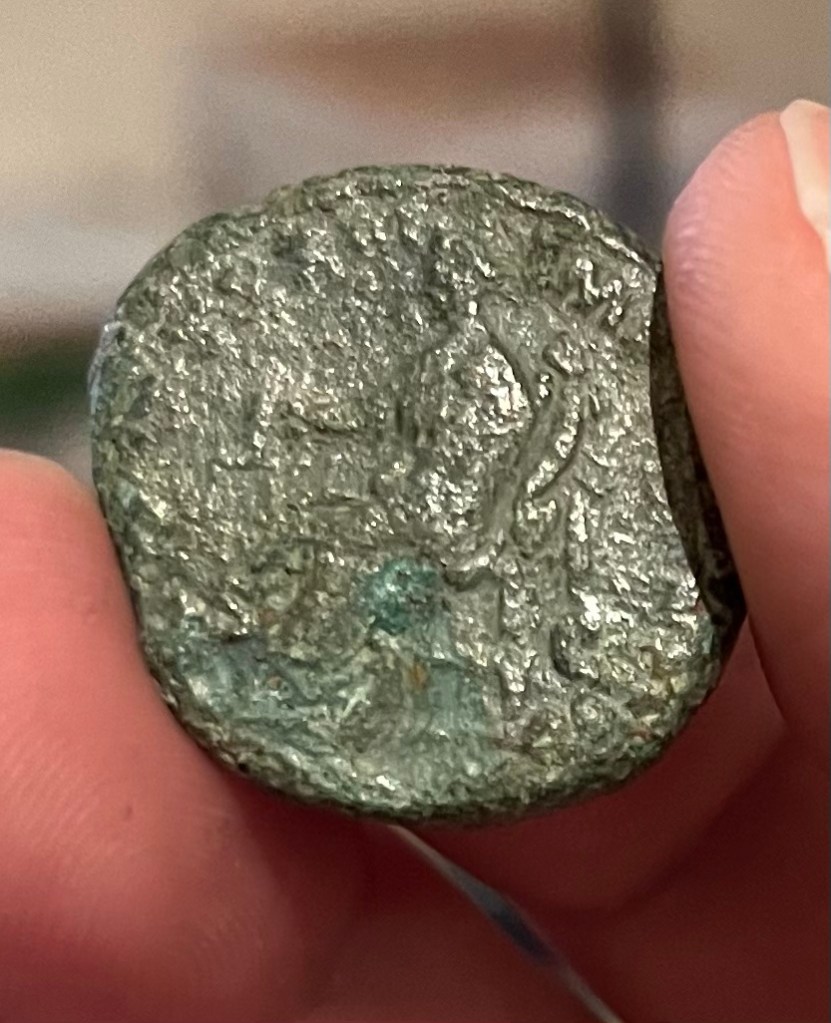
In my home coin collection, I have an old, faded copper coin supposedly found from some old Roman hoard. In those days, the Romans didn’t have banks to deposit money, and if they went off to war, they’d just bury their savings in the ground. If those soldiers died, the money would just sit there until found by modern archeologists.
So, this copper coin I have, worth almost nothing, belonged to someone 1800 years ago.
It’s the connection with others, and the way War destroys that connection that truly hurts us all. We are deprived of someone’s presence when they are killed, and we are usually worse for it.
So, what Spock says is true: it’s hard to fully grasp so many dead, but if we focus on the loss of any one of them, then the true impact of war becomes clear.
Recently, my wife was talking with an extended relative she hadn’t talked to in a while. This relative also lives overseas, albeit in a different English-speaking country, and when we last spoke a year ago, she had been talking about mundane things like taking the kids out for picnics, etc.
This time around, the same relative was spouting incoherent ramblings about weather-control machines, forest fires caused by human agents, and all sorts of things she had found on Youtube and on the Internet. Since the last time we spoke with her, she had gone down some kind of rabbit hole of conspiracy theories, and it had changed her for the worse.
The number one reason why I hate conspiracy theories, and all they represent, is that they are inherently irrational, narcissistic, and antithetical to the Buddha-Dharma.
In the original Star Trek series, in the episode Journey to Babel (2×10), Spock speaks with his mother and says the following (emphasis added):
It [being a Vulcan] means to adopt a philosophy, a way of life, which is logical and beneficial. We cannot disregard that philosophy merely for personal gain, no matter how important that gain might be.
To me, this is the essence of the Buddhist way of life: a way of life that is meant to be logical, rational, and of benefit to all sentient beings. Consider such liturgy as the Four Bodhisattva Vows:
Sentient beings are innumerable, and yet I vow to save them all. My mental defilements (lit. bonnō) are innumerable, I vow to extinguish them all. The gates of the dharma are without measure, I vow to master them all. The path to Buddhahood is peerless, I vow to fulfill it.
Similarly, in the famous liturgy, the Heart Sutra, there is the following verse (emphasis added):
Because there is no attainment, bodhisattvas rely on Prajñāpāramitā [the perfection, or culmination, of wisdom], and their minds have no obstructions. Since there are no obstructions, they have no fears.
translation by Lapis Lazuli texts
Wisdom leads to freedom from fear. This is not wisdom as in the sense of knowing more than other people, which is just empty narcissism, but rather seeing outside your self-centered viewpoint.
Take for example a famous Buddhist story about the monk and the snake. It is said that a long time ago there was a monk in India who, one night, had to step out into the woods to use the restroom. As a monk, he has no possessions, and thus has to walk out into the dark by himself. Since India has many poisonous snakes, this can be a risky business. In any case, as the monk was carefully treading through the grass, he steps on a snake and faints in terror. The following morning, he wakes up, and realizes that the “snake” he stepped on, was in fact an old piece of rope.
This is how the mind works, and why its important not to blindly rely on your own logic and viewpoint too much. People can be certain that X is true, and yet the facts say otherwise. The greater one’s faith, the more they cut themselves off from reality. The more rational approach is to look at the data, look at facts, make observations, and then make informed decisions, not what one feels or one is sure is the truth.
A ‘position,’ Vaccha, is something that a Tathagata [the Buddha] has done away with. What a Tathagata sees is this: ‘Such is form, such its origination, such its disappearance; such is feeling, such its origination, such its disappearance; such is perception…such are fabrications…such is consciousness, such its origination, such its disappearance.’ [e.g. the Twelvefold of Causation]
Aggi-Vacchagotta Sutta (MN 72), translated from the Pali by Ven. Thanissaro Bhikkhu
Or as Mr. Spock would say:
Insufficient facts always invites danger
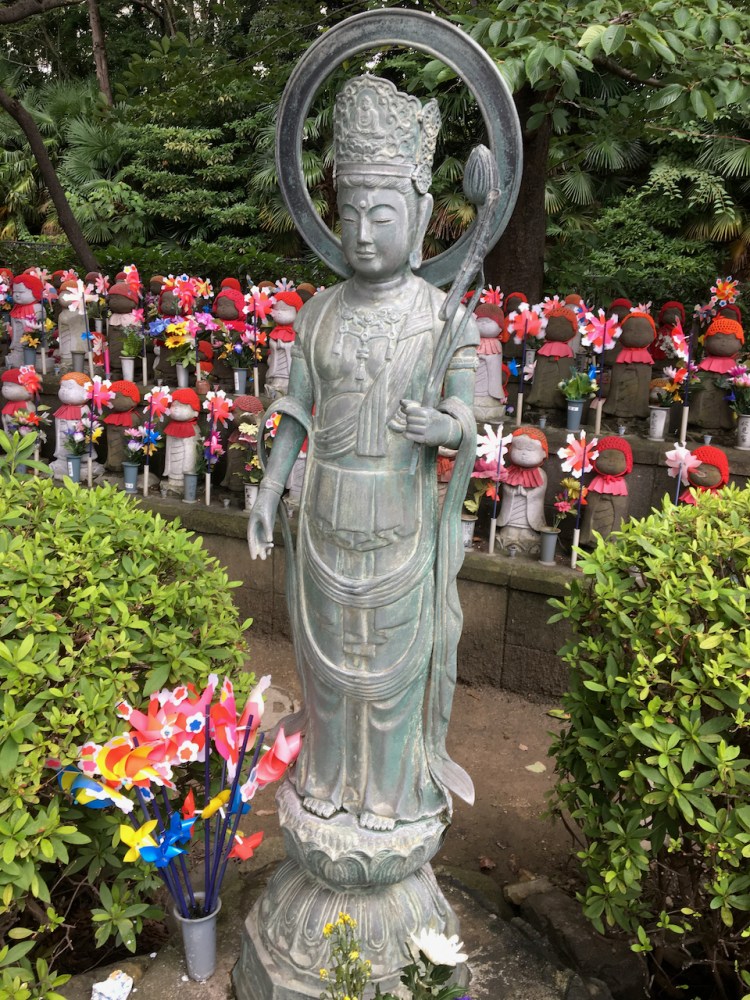
Thus, the Buddhist path is one that relies on rational thinking, not narcissistic beliefs. However, it is not limited to just rational thinking, and that’s why Mr Spock’s quote about “rational and beneficial” is so important. Consider the following Buddhist statue that I photographed in Japan in 2019 at Zojoji Temple (one of my favorites):
Here, the bodhisattva Kannon, is holding a lotus flower in one hand, while the other hand is down with two finger-tips touching. Buddhists statuary is replete with meanings and non-verbal symbols. The lotus symbolizes wisdom, and the potential for all beings to awaken, just as a lotus blooms from mud. The fingertips touching is another mudra meaning the “turning of the Wheel of the Dharma”, meaning to teach others and keep Buddhism going. The latter action, teaching the Dharma, helps sentient beings achieve awakening (i.e. the lotus), freedom from fear and wellbeing.
Hence, Kannon’s image here is a balance of both rational wisdom and compassion for all beings. Compassion not tempered by wisdom is irrational and can sometimes do more harm than good, while wisdom not compelled by concern for others is just dry scholasticism.
All of this is encapsulated in the 16th chapter of the Lotus Sutra where the Buddha says in verse:
My pure land is not destroyed, yet the multitude see it as consumed in fire, with anxiety, fear and other sufferings filling it everywhere. […] But those who practice meritorious ways, who are gentle, peaceful, honest and upright, all of them will see me here in person, preaching the Law [the Dharma].
translation by Burton Watson
Part of the freedom from fear that comes from wisdom is the ability to see past the ups and downs of life, and see the bigger picture, to live a life that is gentle and peaceful towards others, and to maintain an upright life out of compassion for oneself.
None of this is easy, and requires years and years of practice, emotional growth, introspection, and willingness to take one’s own beliefs with a small grain of salt. It is a path that is not limited to Buddhists either, and there are plenty of Buddhists who don’t follow this path. What matters is not one’s affiliation to a religious org, but one’s willingness to live a life rooted in rationality and benefit for others. None of this can be accomplished by living in the paranoia and hostility, misinformation and sense of superiority that it brings from “not being a sheep” that comes with immersion in conspiracy theories
If you find yourself lost, scared, and confused with all the things going on in the world, take a moment and breathe. Turn off social media, go outside. Ground yourself in the world around you. If it helps, maybe recite the Heart Sutra a couple times (it is short enough you can chant it in about 1-minute) or the nembutsu. The life you live now, warts and all, is sustained by the goodwill of others around you, even if you don’t know who they are. Take a moment, and consider this, and maybe give something back to the world.
In the original Star Trek series (a.k.a. TOS), there’s an infamous episode1 in season 3 where Spock wears a new pin to symbolize the Vulcan philosophy of I.D.I.C., or “infinite diversity [in] infinite combinations”. Evidentially, it was Gene Roddenberry’s attempt at a cash grab by promoting a new product, but the catch phrase has taken on a life of its own in the Star Trek universe. You can see references to it in other Star Trek series, especially in the classic Star Trek: Deep Space Nineepisode featuring a Vulcan baseball team.
To its credit, you get to see Spock sport a neat visor though…
The interesting thing about this philosophy, isn’t just the contribution it makes to the Star Trek universe, it has some interesting groundings in Buddhism as well.
Consider this phrase by the famous Indian Buddhist Nagarjuna (c. 150 – c. 250 CE):
sarvaṃ ca yujyate tasya śūnyatā yasya yujyate sarvaṃ na yujyate tasya śūnyaṃ yasya na yujyate
All is possible when emptiness is possible. Nothing is possible when emptiness is impossible.
Quoted from the book, Nagarjuna’s Middle Way, translated by Mark Siderits and Shoryu Katsura
Much of Buddhism, especially Mahayana Buddhism, is grounded in the notion that all things, both concrete and abstract, arise through outside causes and conditions, and thus have a contingent existence. This is why all things are fluid, and constantly in flux. It’s also why, as Nagarjuna notes, that all things are possible.
Infinite diversity in infinite combinations, in other words.
1 Among the episode’s many other problems was the creepy way the male cast of the Enterprise are constantly talking about Diana Muldaur’s character’s beauty. TOS always had a problem with sexism, but this was over the top and creepy. It’s not a fault of the actors, just the terrible writing and direction that plagued season 3.
When people think of Zen, they think of meditation, and sand gardens. And with good reason. Zen uses the Buddhist teachings as a guide, but seeks to experience first-hand what Shakyamuni Buddha experienced.
However, that’s not to say that there isn’t a devotional side to Zen either. As a peerless teacher, Shakyamuni Buddha pointed the way, “turned the wheel of the Dharma” as they say, and so he is an inspiration to Buddhists everywhere. This is true for other Buddhist deities as well. Whether such deities actually exist or not is less important than you might think.1 Further, when you look at lay-oriented texts such as the Shushogi, it’s clear that Soto Zen evolved over time to accommodate people of all backgrounds, including those that don’t realistically have the time to devote themselves to meditation retreats, etc.
For this post, I reviewed a few Japanese-language sources on how to do home liturgy, or otsutomé (お勤め), for the Soto Zen tradition. I found that the Soto-sect of Japanese Zen has particularly good resources, both in English, and especially in Japanese, for home practice, and provides flexible approach to home devotional practices. We’ll talk about that more shortly.
Edit: This post has been rewritten and cleaned up in June 2025 now that I have access to more information, and a better understanding of how Soto Zen liturgy works.
According to Soto-Zen sources above, the home liturgy goes like so:
Ring the bell (if you have one) three times gently if you have one at your home altar.
What follows below is an example taken from Japanese sources. However, the same sources also state that you can add or remove as many of these you want.
Recently I found a great video by a Soto Zen priest (Japanese-language only, sorry), where he stated that if a practitioner simply recited the Heart Sutra each day, that would be great. But if even that was difficult, one can also simply recite na mu sha ka mu ni butsu three times (南無釈迦牟尼仏, “Praise to Shakyamuni Buddha”) before an altar image. The most important thing, the priest stated, is daily and sustainable practice. You can always adjust, add, or trim later.
Another option if you are short on time, is to just recite the Three Treasures, which is a nearly universal practice in Buddhism:
Japanese
Pronunciation
Meaningb
南無帰依仏
Namu ki-e butsu
I go to the Buddha [teacher] for refuge
南無帰依法
Namu ki-e ho
I go to the Dharma [the teaching] for refuge
南無帰依僧
Namu ki-e so
I go to the Sangha [the community] for refuge
a The ṃ (an m with a dot underneath) is pronounced more like “ng” than “m”. So, “Buddhaṃ” in this context sounds more like “Buddhang”. The regular “a” without an accent mark sounds “uh” as in “duh”, and ā is more like “ah” as in “father”.
Also, there seems to be an alternate, more stylized form of the Three Treasures found in Soto Zen liturgy called the ryakusanbō (略三宝), for which this a rough translation:
Japanese
Pronunciation
Meaning
十方三世一切仏
Ji Ho San Shi I Shi Fu
[Praise to] the Buddhas of the Ten Directions,1 and the Three Realms!2
諸尊菩薩摩訶薩
Shi Son Bu Sa Mo Ko Sa
[Praise to] past teachers, bodhisattvas, and all who follow the Buddhist path!
摩訶般若波羅蜜
Mo Ko Ha Ja Ho Ro Mi
[Praise to] the Dharma, whose wisdom leads to awakening!
1Ten Directions – the cosmos as a whole. In other words, all Buddhas everywhere. 2Three Realms – the realms of desire, form and formlessness. This is another fancy way of saying Samsara (existence) as a whole.
Now onto the example liturgy…
Example Soto Zen Liturgy
What follows is the example provided by the sutra book I got from Sojiji temple years ago, and the online version which only differs very slightly. This difference mainly is how some liturgies are written in Sino-Japanese (Chinese with Japanese pronunciation) or with more native, liturgical Japanese. To help readers choose, I will try to post both where pertinent. Also, where possible, I tried to provide Youtube links where I could find them.
Kaikyogé: Opening of the Sutra Verses
Sino-Japanese
Native Japanese
Mu jo jin jin mi myo ho
Mu jo jin jin mi myo ho wa
Hyaku sen man go nan so gu
Hyaku sen man go ni mo ai ou koto katashi
Ga kon ken mon toku ju ji
Ware ima ken mon shi ju ji suru ko wo etari
Gan ge nyo rai shin jitsu gi
Negawaku wa nyo rai shin jitsu no gi wo gesen
Translation: The supreme and profound teachings (Dharma) of the Buddha is truly rare to encounter, but now we are able to hear and receive it. It is our hope that the teachings become clear to us.
Sangémon: Renunciation of One’s Past Transgressions
Note: both my book and the website state that any sutra in the Buddhist canon (or excerpt of a sutra) is OK to recite. However, the most common choices are:
The Shushogi, one chapter per day in rotation (day one chapter one, day two chapter two, etc). I have provided links and translation to each one below:
For Japanese Buddhism, simply reciting the sutra without any other liturgy is a perfectly acceptable home practice, by the way. So, your home service could just be this part.
Fueko: The Dedication of Good Merit Towards Others
See this post for more details. This liturgy is somewhat unusual in that every sutra book I see consistently prints it as a mix of both native Japanese followed by Sino-Japanese (highlighted in bold). So I am posting as-is. Youtube link here.
Dedication of Merit, full version
Negawaku wa kono kudoku wo motte, amaneku issai ni oyoboshi,
Warera to shu jo to, mina tomo ni butsu do wo jozen koto wo
Ji ho san shi i shi fu
Shi son bu sa mo ko sa
Mo ko ho ja ho ro mi
Cadence
The sources state that doing the same liturgy in the morning when you wake up, and also before you go to bed is the ideal cadence. It is also customary to wash one’s face a bit before the liturgy as a respectful gesture, but this is optional too.
However, for people who are busy, it is perfectly fine to do morning or evening, not both. The sources also state that if one is truly busy, simply doing gassho in front of the altar is fine too.
Good luck and happy chanting!
1 As a Star Trek nerd, I like to imagine even Mr Spock as a Bodhisattva. 😉
This was a fun little book I received on Christmas. Definitely recommend.
2 Українською:
Я шукаю Притулку у Будді. Я шукаю Притулку в Дхармі. Я шукаю Притулок у Сангхе.
На русском:
Я ищу Прибежища в Будде. Я ищу Прибежища в Дхарме. Я ищу Прибежища в Сангхе.
My kids and I have been playing a longer D&D campaign in the world of Eberron, a noir steam-punk magic setting for almost a year now, and the kids consistently seem to enjoy this setting more than other D&D campaigns we’ve run. Since we have only two players (my daughter and my son), the party consists of:
I run the sidekick characters myself, and some have come in and others rotated out.2 The hobgoblin and warforged sidekicks have been with the party since the beginning and have been a pretty integral part of the story.
Our hobgoblin cleric’s backstory is that he secretly wanted to be a wizard instead and only did the cleric role out of familial obligation. However, since Borsheg was rejected by the wizards guild, he has since gotten private tutorship on the side with a shady teacher named “Dak” who, currently unknown to the party, is a Rakshasa.
Our Warforged has become the most central character to the party though. Originally, Malbus 414’s backstory was that he had, like all Warforged, fought in the Last War, particularly as part of the 523rd Battalion in East Breland. However, it became clear that his entire platoon had been secretly conditioned by their gnomish creator, Dr Vilnius Volrani Vishkik, to attack any gnomes from a certain rival house on sight. Eventually, the kids were able to find an artificer who could remove Malbus’s conditioning, and scrape up enough money to pay for it, but at the cost of partial memory loss. The kids really got choked up when they realized that Malbus wasn’t going to be quite the same.
Out of all the stories that I’ve teased in front of kids, including demonic cults, Borsheg’s evil tutor, smuggling jobs, etc, the kids have really attached themselves to Malbus’s and have since pursued Dr Vishkik (who unknown to the kids, is now a glorified brain-in-a-jar) across continent only to discover that he has reconstituted most of the old 523rd platoon, and means to take on the Lord of Blades in Cyre in order to become a new ruler there, assert dominance over all Warforged at large. Malbus is torn between his loyalties to his old platoon, but also his new purpose in stopping Dr Vishkik, especially where violence is required.
Mechanically speaking, a Warforged is an interesting character race since it’s fully artificial, yet is also a living being. According to the 5e guide, if you play a Warforged, you (among other things):
Gain a +1 bonus to Armor Class.
Have advantage on saving throws against being poisoned, and you have resistance to poison damage, and are immune to disease
Do not require sleep, but when you take a long rest, you must spend at least six hours in an inactive, motionless state, rather than sleeping. In this state, you appear inert, but it doesn’t render you unconscious, and you can see and hear as normal. Further, you don’t need to sleep, and magic can’t put you to sleep.
These things all come from the Warforged’s artificial nature. However, as a living sentient being, you can still benefit from things like healing magic, potions, etc., so you are not a construct either. It’s not entirely clear to what degree a Warforged is a machine vs. a living being, but I’ve mostly leaned toward the artificial, and focused on the “power core” as a source of their sentience and humanity.
The mechanics of a Warforged are fun, but the role-playing side of the Warforged is what I find most compelling. Because the Last War is over, Warforged are kind of superfluous now. Society doesn’t need them anymore, and they are no longer manufactured (at least in mass-production), so they have been tossed out on the street with no clear picture of what to do with themselves. This leaves plenty of room to decide how you would want to play a Warforged. Malbus 414 initially took mercenary jobs because war was the only thing he knew, but once he met the party during the initial session, he gradually took his life in a new direction with them.
The official interview with creator Keith Baker helps clarify this and is worth a watch:
I tend to roleplay Malbus 414 similar to Commander Data from Star Trek: The Next Generation, in that he is searching for his humanity, and trying to forge a new identity for himself bit by bit as something more than just a war machine. One could conceivably do the opposite and play a Warforged who never really left the Last War. The noir, brooding atmosphere of Eberron really lends itself to this, because of the heavier emphasis on character backstory, personal challenges, etc, but if you play a Warforged within the larger universe, such as Planescape or even the Forgotten Realms somehow, the brooding war backstory can still come into play and create a good starting point for the character.
Or you could just make a character like this one:
Comment posted in linked video above
I wish Warforged were more available in other settings, not just for its useful mechanical reasons, especially in Adventurer’s League, but I am happy to play one when the opportunity comes up. Its nature lends itself to good role-playing, and its mechanics allow for all kinds of interesting character / class options.
1 My son is a huge Kirby fan.
2 Our half-orc rouge-scout sidekick died a few weeks back in a random encounter, and the elf fighter replaced him since the party was near Valenar anyway. I keep a pool of sidekicks in the backlog in case I need to replace one. Still, the half-orc scout was a good character in his own right, and the kid and I kind of miss him already, even as we enjoy the new character.
It’s been a while since I had a good D&D post, but after being sick in July and taking some time off, I honestly haven’t played in over a month. Even my play-by-post group had to take time off due to personal life interruptions affecting other players. So, this weekend, I finally got back into the kids’ Japan-themed “Hamato Islands” campaign, which I also publish adventures for on DMS Guild.
I was looking for a new bad guy to introduce, and prior to getting sick, I settled on Hobgoblins, pouring in from a rogue portal from the plane of Acheron. In terms of stats, I kept them more or less the same, but for this Japan-themed campaign, I decided that they had been on the Islands long enough to adapt samurai-style warfare, weapons, etc, and have carved out a small but growing fiefdom. Given the Hobgoblin tendency toward strict, hierarchical, martial societies, this wasn’t a difficult idea to implement.
That was a decent start, and then I forgot about for a while due to aforementioned issues. The idea sat on the mental shelf for a month.
Then, earlier this week, I started dusting off the campaign and updating notes, ideas, etc. The samurai-hobgoblin idea was pretty good, but I felt I still needed something more. Then, it hit me. The Klingons from Star Trek were also a brutal society with strict, martial codes, especially the early, more tyrannical Klingons from the original series. Further, it wouldn’t be hard to adapt the Klingon language as “Goblin”. So, why not make the hobgoblins more like klingons?
Kruge probably has the stats of a Hobgoblin Warlord. 😜
I updated the hobgoblins to use the Klingon style, red-and-black samurai armor, the Klingon symbol on their flag and even threw in a good “it is a good day to die” or two. I had used hobgoblins before, for example briefly in a separate planescape setting, but having that extra story-telling element and setting really took a functional D&D story into something more impactful. The hobgoblins as depicted in Volo’s Guide to Monsters is a good start, but borrowing from Klingon aesthetics made a big difference.
So, how did it go? My kids knew that Daddy was a big Star Trek fan, but they hardly know anything about Star Trek. In their first encounter with these “Hamato Island Hobgoblins”, I played Klingon background music from the first Star Trek movie:
My kids went nuts with anticipation as the hobgoblins in samurai battle armor and horseback approached, claimed the land the players were defending, and then got into a battle with the players, using their goblin ashigaru pikemen as backup. It was a tough battle for them, the lead up was worth it.
In the end, we had a great time. I learned, that as a DM, it doesn’t hurt to take time in your story to give your opponents more “character”. Visuals, sounds, etc, and really give a story extra “oomph” and help make an impact on players. Also, it’s perfectly fine to take the basic D&D settings, cultures and creatures, and either embellish or modify to fit the needs of your campaign. It’s easier to think of the official guides as starting points, than inflexible canon.
This whole experience gave me an excuse to finally brush up on the Klingon language. 😝 Qap’la!
P.S. When you think about this, it’s not so different than basing Elves of, say, Romulans.
Taken a couple days ago at Richmond Beach in north Seattle.
As my last post for 2020, I wanted to share a small feature of Japanese culture called the bōnenkai (忘年会) which are parties meant to say goodbye (lit. “to forget”) to the old year.
The last week or two may be filled with bōnenkai: work parties, parties with circles of friends, associates, etc. Such parties are really just drinking parties, a nice chance to get sloshed and get all the stresses of the last year out.
Obviously, this year was shittier than usual. Even before COVID, I had suffered a significant personal injury in January after slipping on some ice, had a major personal emergency in February and in March lost my job (not due to COVID, just crappy timing).
Thankfully, all these issues eventually got resolved and my family has been safe and sound since, and although I don’t drink at all,1 I understand the sentiment very much. Even if it’s just an arbitrary date on the Gregorian calendar, I would really like to put this year behind.
Our kagami-mochi this year (more explanation here) is a smaller version than what we normally get (the large one was sold out, unusually), but I am hoping that the Shinto kami, Toshigami-sama, might cut us a break this year. 😏
As for readers everywhere, happy 2021!!
1 I’ve chosen to undertake the Buddhist Five Precepts, and apart from a few fits and starts over the years, I’ve really tried to uphold them.
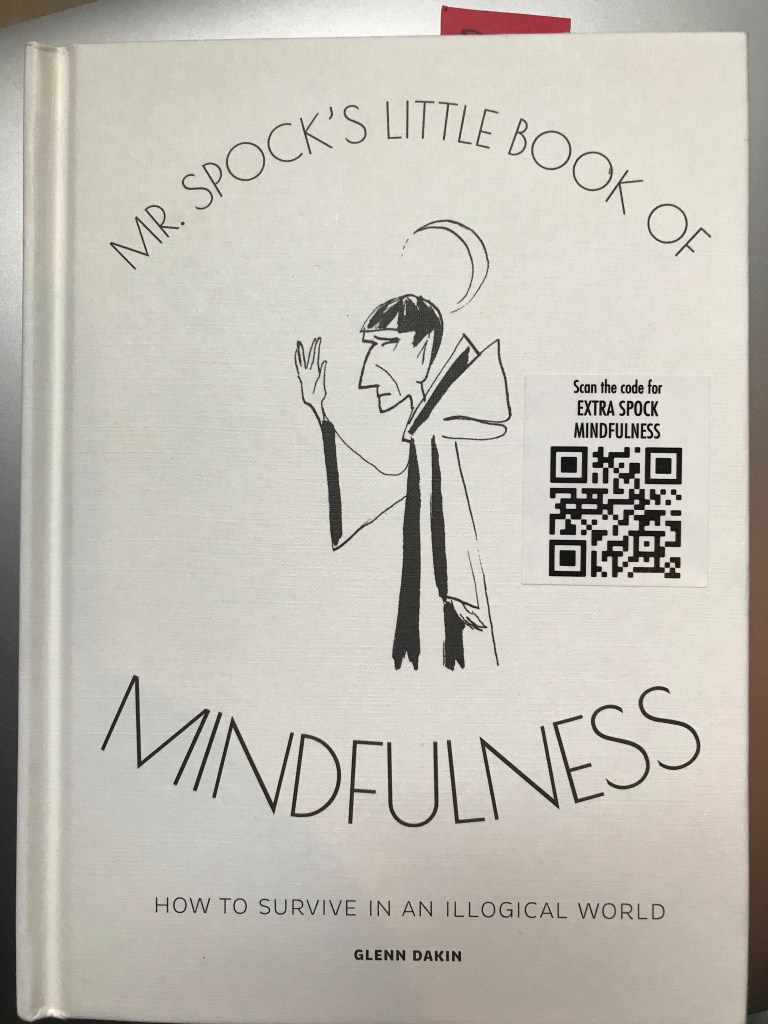
Recently, as a belated birthday gift, I got the following book, Mr Spock’s Little Book of Mindfulness: How to Survive in an Illogical World a fun, lighthearted book that explores Vulcan philosophy and Star Trek lore. In reality, the book draws upon a lot of spiritual guidance from more contemporary sources (particularly Taoist sources) and actual quotes from the original series, in the guise of Vulcan teachings. It’s fun to imagine a whole planet of Vulcans more or less living by this ethos though.
Mr Spock is among my favorite characters of all time in Star Trek, or any science-fiction series, and a source of inspiration since I was a kid. For me, the book did a pretty nice job balancing the Star Trek lore with some genuine, practical advice for life, while also keeping a good sense of humor. The artwork alone was terrific.
One quote I did want to share though was:
Look at yourself. Are you an Original Series Spock, or an evolved, Movie Spock? Do you deny the flawed side of your nature or have you come to terms with it, even learned to enjoy it?
WOULD YOU SAVE CHEKOV OR LEAVE HIM BEHIND?
page 91
This is a reference to Star Trek IV: The Voyage Home (the one with the whales). The movie is unusual in focusing on Spock’s efforts to explore his human side (“how do you feel?”) and when deciding whether to save Chekov from the 1980’s hospital, uncharacteristically suggests they should do it “because it’s the human thing to do”.
Anyhow, great book, lots of fun, and good food for thought.
Or: “how not to build a wizard in Dungeons and Dragons, fifth edition.”
Update: I have brought Qisandoral back from retirement after the 2021 rules changes.
My first character in Dungeons and Dragons, Adventurers League, was a high-elf wizard (Abjuration school) named Qisandoral Ariesstanus. He was a side-kick I originally made for my kids in their home campaign, with his deadpan, humorous personality reminiscent of Mr Spock from Star Trek. Because of his stodgy, stoic nature, Abjuration as a school of magic seemed like a sensible move.
I kind of always pictured Qisandoral like the elf shown in this Magic the Gathering card. Source: Scryfall
Later, when I first “imported” this character to Adventurers League (i.e. made a new, AL-legal version of him), I didn’t really know how to do a proper build for wizards, so I prioritized sub-optimal stat choices such as Charisma, which didn’t actually make sense with his role-playing style. I probably could have role-played him different, but the group dynamics in Adventurers League helped influence my choices in role-playing.
The bigger problem though was learning how to manage spells for Qisandoral. Abjurers activate (or recharge) their primary ability, Arcane Ward, whenever they cast a spell from the Abjuration school. I thought this was great, so with my limited monetary resources, I spent everything I had to purchase and copy Abjuration school spells in my spellbook. The trouble was was that most Abjuration spells are pretty situational, particularly in the sort of one-shot adventures you often find in Adventurers League. Arcane Lock is a pretty neat utility spell in some situations, but I practically never used it in Adventurers League. Even mighty spells like Counterspell and Dispel Magic, staples of the Abjuration school, didn’t come up very often due to the nature of combat and adventures. Things would probably be different in a longer-term home campaign, but this version of Qisandoral was meant for Adventurers League only.
Further, I didn’t take advantage of Adventurers League rules for copying spells from another wizard player character enough, instead buying scrolls on my own. Thus, I spent too much money on spells that were often not worth it. Such spells are great in right situation, but rarely enough to be worth spending hundreds of gold pieces on for a scroll (nevermind the costs to copy).
Conversely, because I leaned so heavily in Abjuration, Qisandoral wasn’t very effective in most combat situations. Using Chromatic Orb helped to some degree because of its versatility, but by tier-3 (levels 10 through 15), a wizard usually is a pretty powerful class, and Qisandoral had excellent defenses, but not much else to offer. Even for an Abjuration wizard, I might have built him too conservatively.
In a recent article by the awesome James Haeck,1 he points out that wizards work best when they have a solution to every situation. They may have their fallback specialty, but the sheer diversity in spellcasting is what makes wizards stand apart from every other D&D spell class.
When I saw this article, I realized that for building an Abjuration wizard, the key to success is to have a certain number of core spells to trigger Arcane Ward, but also diversify to cover every other situation. For core Abjuration spells:
Mage Armor – cast it first thing in the day to bolster your armor class, and activate Arcane Ward in one shot. Yay.
Shield – in a pinch it will not only deflect potential damage but recharge your Arcane Ward a little bit, too. Double yay.
Alarm – since you can cast this as a ritual, a common trick by players is to cast over and over during a long break to recharge Arcane Ward. Kind of silly, but people do it. Plus, it’s handy for situations where you need to rest overnight in a hostile environment.
Counterspell – there are many situations where this isn’t useful, but when it is…
Dispel Magic – same as above… Abjuration wizards should always have these two prepared.
Banishment – personally one of my favorite Abjuration spells. Reduce the battlefield thread instantly by taking one or more creatures out of rotation, possibly for good! Sometimes you can send the big boss packing instantly.
Beyond these six core abjuration spells, you probably should diversify as much as you can.
Sadly, I didn’t do this, and after trying to belatedly fix Qisandoral’s build, it became too little too late in tier-3 adventures so I decided to retire him.
Retiring my first AL character wasn’t easy. Even though he wasn’t mechanically great, I still liked him as a role-playing character because he was a fun, distinctive, memorable character. What made me finally decide to retire him was that the original side-kick version still existed in my home campaign with my kids, and if I wanted to, I could probably make a new version from scratch in Adventurer’s League if I really wanted to. The “new” Qisandoral wouldn’t have the same character history, so no reliving the Liberation of Phlan again, nor any of the rewards from before, but it would be a chance to “make him right”.
On the other hand, I like to think that boring, old Qisandoral really did retire from adventuring and went back to his studies having learned all he needed to from the wider world, and having made his mark. With all that he accomplished in his adventuring life, he probably earned a long sabbatical anyway.
1 Mr Haeck also has a nice article on Abjuration wizards, but it was published after I made my character, so 🤷🏽♂️











 Gleanings in Buddha-Fields
You must be logged in to post a comment.