Live And Let Live

SPOCK: Insults are effective only where emotion is present.

Star Trek, “Who Mourns for Adonais?” (s2ep2), stardate 3468.1

SPOCK: Where there’s no emotion, there’s no motive for violence.

Star Trek, “Dagger of the Mind” (s1ep9), stardate 2715.1

I wrote about the Buddhist virtue of forbearance before, but I had an important reminder recently why this matters so much in Buddhist practice.

Our natural tendency is to hold a grudge when someone slights us, or when we have been wronged. This is normal human pattern of behavior. But, like self-doubt, this is a form of conceit, putting ourselves and our ego before others.

In the Dhammapada, a collection of sayings attributed to the Buddha and one of the very earliest Buddhist texts still preserved, the Buddha has much to say regarding the subject. For example:

133. Speak not harshly to anyone, for those thus spoken to might retort. Indeed, angry speech hurts, and retaliation may overtake you.

134. If, like a broken gong, you silence yourself, you have approached Nibbana [a.k.a. Nirvana, final Unbiding], for vindictiveness is no longer in you.

The Dhammapada, translation by Acharya Buddharakkhita

The Buddha was uncompromising on this: no vengeance, lest you bring even further misery upon yourself.

Indeed, the Buddha taught by freeing oneself of ill-will and other negative emotions, one is liberated:

197. Happy indeed we live, friendly amidst the hostile. Amidst hostile men we dwell free from hatred.

198. Happy indeed we live, friendly amidst the afflicted (by craving). Amidst afflicted men we dwell free from affliction.

199. Happy indeed we live, free from avarice amidst the avaricious. Amidst the avaricious men we dwell free from avarice.

200. Happy indeed we live, we who possess nothing. Feeders on joy we shall be, like the Radiant Gods.

The Dhammapada, translation by Acharya Buddharakkhita

Of course, this is easier said than done.

As with self-doubt or any negative emotion, stop and think like a Vulcan: assess the situation including your own feelings. Is this productive? Is it harmful? Is it based on conceit?

Spock in season 3 episode 21, the “Cloud Minders”, played by Leonard Nimoy

Many times, we are prone to act or lash out, but if we take a moment to assess our feelings, and the situation, we are more capable of handling it rationally. In so doing, we avoid further misery for ourselves and others.

When the ego is bruised, it demands attention and resolution. But that is short-sighted, and rarely fixes anything.

SEPTIMUS: Our way is peace.

Star Trek, the Son Worshiper, “Bread and Circuses” (s2ep25), stardate 4040.7.

A commitment toward peace and well-being towards others feels counter-intuitive at times, but peace toward others inevitably leads toward peace for oneself.

Namu Shakamuni Butsu

Withdrawing

Kang a Klingon warrior leaning on a sword, point down, against an Enterprise console, staring bravely in the distance.

Kang: “Only a fool fights in a burning house.”

Star Trek, “Day of the Dove” (s3ep11), stardate unknown 

Ever since … recent events, I’ve been thinking about this quote a lot.

This also reminded of a passage from the Analects of Confucius:

[8:13] The Master said: “Be of unwavering good faith and love learning. Be steadfast unto death in pursuit of the good Way.1 Do not enter a state which is in peril, nor reside in one which people have rebelled. When the Way prevails in the world, show yourself. When it does not, then hide. When the Way prevails in your own state, to be poor and obscure is a disgrace. But when the Way does not prevail in your own state, to be rich and honored is a disgrace.”

Translation by Dr Charles Muller

The Analects is a compilation of Confucius’s (a.k.a. “the Master”, or “Master Kong”, etc) teachings by his disciples, completed around the 1st or 2nd century BCE. This particular passage does a nice job of summarizes Confucius’s general teachings: at all times a “gentleman” (jūn zǐ, 君子) should always stick to their principles regardless of the conditions of the world.

There are times where one openly expresses their views and strives to do what’s right, where one can share their talents for public good. But there are also times when one should bide their time, avoid getting entangled, and focus inward. Whatever is necessary to maintain one’s integrity at all times. Better to be broke but maintain integrity, than to compromise personal values for the sake of gain.

In Confucius’s time the central state of the Zhou Dynasty kingship was breaking down, and the different nobles governing each fiefdom were either breaking away and declaring themselves kings, or being overthrown by their own ministers who would in turn assert authority. It was a cutthroat time in Chinese history, and Confucius wanted no part in it.

One cannot help but find parallels even today.

P.S. Featured photo is of Kang the Klingon from the Stat Trek episode “Day of the Dove”, played by the brilliant Michael Ansara.

1 When Confucius speaks of the “Way” (daò, 道) he is using a common Chinese religious term for things like righteousness, justice, stability, and so on. The Taoist usage of the term is similar, and draws from the same “cultural well” even if nuances differ.

Change

Think of this as “part two” of yesterday’s post. Some other quotes I found that I felt expressed the same sentiment, both from Star Trek, and from Dune.


Spock: Change is the essential process of all existence.

Star Trek, “Let That Be Your Last Battlefield”, Stardate 5730.2

“Deep in the human unconscious is a pervasive need for a logical universe that makes sense. But the real universe is always one step beyond logic.”

Frank Herbert, Dune

“When things change, your absolute universe vanishes, no longer accessible to your self-limiting perceptions. The universe has moved beyond you.”

Frank Herbert, Heretics of Dune

Just posting as-is. Enjoy!

Battlefields

SPOCK: To expect sense from two mentalities of such extreme viewpoints is not logical.

Star Trek, “Let That Be Your Last Battlefield” (s3ep15), Stardate: 5730.2

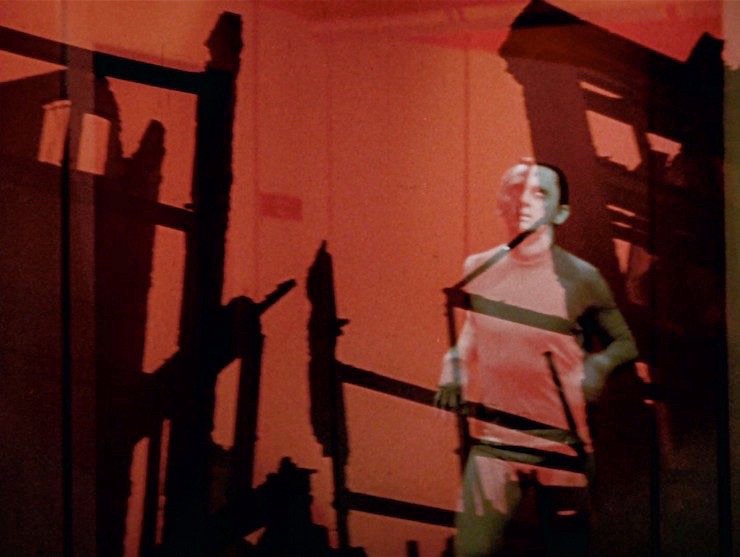
In the infamous episode of Star Trek, season three, Let That Be Your Last Battlefield, we see two aliens who have been chasing and attempting to defeat one another for “50,000 standard years” because the patterns on their faces are different.

“Bele” (L), played by Frank Gorshin, and “Lokai” (R), played by Lou Antonio

In the big climax at the end, they commandeer the Enterprise and return to their home world which is now a dead, lifeless world: their people have annihilated one another in Bele and Lokai’s absence. Rather than giving up, Bele and Lokai beam down to the surface (after an awkward running scene through the hallways) and continue their battle for all eternity.

This scene included stock footage from the Second World War, iirc. Because the war was only a generation earlier, the message was not lost on viewers.

The final dialogue of the episode between the crew is:

SULU: But their planet’s dead. Does it matter now which one’s right? 

SPOCK: Not to Lokai and Bele. All that matters to them is their hate. 

UHURA: Do you suppose that’s all they ever had, sir? 

KIRK: No, but that’s all they have left. 

While the episode exaggerates the topic, it does beg the question: how can people get into such a death spiral of conflict and hatred?

The single most important thing in Buddhism is the mind. Not a god or deity, but the mind. We see the world through our mind, we shape our view of the world through our mind, etc, etc. In a sense, even the gods are a product of the mind.1

The implications of this are really profound, but on a practical level it also helps explain why two seemingly rational adults can have such profoundly different views, to the point of being entirely hostile to one another.

When the Buddha spoke to a wandering ascetic named Vaccha, the Buddha called this need to assert a view-point “I-Making”. In the Aggi-Vacchagotta Sutta (MN 72 of the Pali Canon), Vaccha is trying to pin down the Buddha’s stance on this philosophical debate or that. But the Buddha is having none of that:

“A ‘position,’ Vaccha, is something that a Tathāgata [a Buddha] has done away with. What a Tathāgata sees is this: ‘Such is form, such its origination, such its disappearance….Because of this, I say, a Tathāgata—with the ending, fading away, cessation, renunciation, & relinquishment of all suppositions, all excogitations, all I-making & mine-making & obsessions with conceit—is, through lack of clinging/sustenance, released.”

Translation by Ven. Thanissaro Bhikkhu

In modern English, the Buddha is saying that holding onto views and beliefs just “feeds the ego”. By feeding the ego, it also imprisons us.

It’s hard to see this, because we naturally piece together the world around us through our experiences, but no matter who we are, the picture is incomplete and we fill in the rest based on conjecture, belief and hearsay. Nonetheless, if someone attacks our beliefs, it is an attack on our deepest sense of self too. This leads to the death spiral I alluded to earlier: the stronger we try to assert our beliefs (even if they are logical and sound), the more we stir conflict, forcing us to push even harder against perceived resistance.

But, like the honey badger, the Buddha don’t care. And because he has stopped clinging, he has no ego to bruise. Without an ego to bruise, he no longer suffers and is fully liberated.

This sounds far easier than it is, but that’s the gist. Sometimes it’s just better to shut up, don’t assume you know the answer, and just pay attention to the world around you. Imagine a blade of grass bending in the wind.

Afterall, what is the alternative?

P.S. as with the previous post, I started this months ago, and just now catching up.

1 put another way: we create our god by projecting our own ego.

Instinct and Restraint

Another post in my backlog that I wanted to share. I really didn’t intend this to relate to any recent events or anything, I just think it’s an evergreen quote by Captain Kirk.

KIRK: [War] is instinctive. But the instinct can be fought. We’re human beings with the blood of a million savage years on our hands! But we can stop it. We can admit that we’re killers… but we’re not going to kill today. That’s all it takes! Knowing that we’re not going to kill – today!

Star Trek, “A Taste of Armageddon”, stardate 3192.1

The Buddha was also very clear about the need for disciples to give up violence. This is not always easy, but the cost of war is rarely small.

Namu Amida Butsu

Spock Preaches the Four Noble Truths

Leonard Nimoy as Spock, and Arlene Martel as T’Pring

This is an iconic line from an iconic episode of the original series Star Trek:

After a time, you may find that “having” is not so pleasing a thing, after all, as “wanting.”  It is not logical, but it is often true.

Spock, “Amok Time” (s2ep1), stardate 3372.7

I like to think that this also encapsulates the Four Noble Truths of Buddhism very nice:

  1. Existence is marked by dukkha1 : dissatisfaction, unease, disappointment, etc.
  2. This dukkha arises from “wanting” or from unrealistic expectations.
  3. It doesn’t have to be this way.
  4. The way to avoid dukkha is to follow a lifestyle that is rational, “logical” and upright. In other words, the Noble Eightfold Path. 🖖

Buddhism historically uses a wide variety of parables, similes and other ways of expressing this, but they all say the same basic thing that Spock does: stop shooting yourself in the foot.

Namu Shaka Nyorai

Namu Amida Butsu

1 One of those fancy Buddhist Sanskrit terms that all the popular social-media influencers use… just kidding. 😉

Life Worth Living

I just stumbled upon this Tumblr feed yesterday, and felt like sharing as-is (special thanks to Ambromancy for reposting it).

https://www.tumblr.com/andremichaux/643573711612657664

This is originally from the Star Trek episode “City on the Edge of Forever”. The quote is:

Now I don’t pretend to tell you how to find happiness and love when every day is just a struggle to survive, but I do insist that you do survive because the days and the years ahead are worth living for.

Edith Keeler in Star Trek, “City on the Edge of Forever” (s1ep28), Stardate: 3134.0

Just posting as-is. Enjoy!

Saints Into Savages

Author’s note: I wrote this a couple months ago, but have been so backed up, I am finally posting it now. It was not intended to relate to current events. Just Star Trek nerdism, and me philosophizing.

The third-season episode of Star Trek titled Plato’s Children is often criticized as one of the worst episodes of the series. It actually has a really interesting premise, but suffers from poor execution.1

The Enterprise comes to planet populated by a self-styled republic,2 modeled after ancient Greek poleis, comprised of aliens who each have tremendous psychic powers. They live in great comfort, and spend their days pursuing whatever they want, but members of this republic have become so lazy, and have atrophied so much that they can’t manage even basic first-aid. When the leader suffers from a cut, he fails to do anything about it until it becomes seriously infected.

Further, one member of the community suffers from dwarfism, and no psychokinetic powers, and the other members of the republic bully him for entertainment and menial tasks. Michael Dunn’s performance as the “dwarf” character was excellent by the way. The same members also torment the Enterprise crew for an extended period of time to get what they want.3

By the end of the episode, it’s clear that the members of this republic are perpetually bored, and half-mad from having terrific power, but nothing constructive to use it for.

Without any struggle in life, or a way to stay grounded, I think the tendency is for one to gradually go mad. People’s minds, even when satisfied with basic needs, have a tendency to create more and more subtle problems for themselves. These problems nest fractally, there is no bottom.

Further, the other major point of the episode is said by the villain Patronius when he is defeated by Kirk:

Patronius: “Uncontrolled, power will turn even saints into savages. And we can all be counted on to live down to our lowest impulses.”

Star Trek, “Plato’s Stepchildren” (s3ep10), Stardate 5784.2

This is a very unintentionally Buddhist thing to say too. The mind is capable of the heights of sainthood (or bodhisattva-hood in Buddhism), as well as the depths of depravity, and everything in between. Under the right conditions any person can become a tyrant, or a saint bodhisattva. It’s not so much a question of personal will-power, environment matters more than one might think.

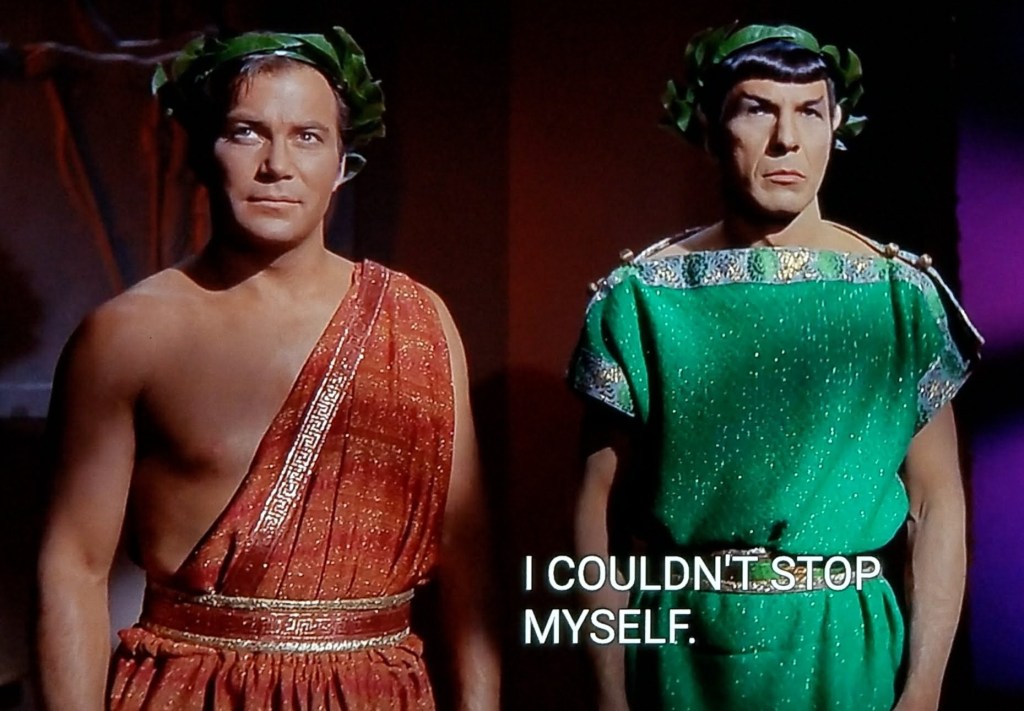
Under the right circumstances, you might even wear a toga….

It is always important to stay just a little vigilant toward one’s own mind. Perfectly rational people can easily go off the rails under the right circumstances. Further, you can’t control what others think and do (nor should you), but you can control how you react to them, or how you choose to conduct yourself. A mind unrestrained will inevitably run into disaster.

Namu Shaka Nyorai

1 Like many season 3 episodes.

2 The use of “republic” as modern people think it, is pretty different than the “res publica” as understood by Romans. It was more closer to a commonwealth, than a particular political structure, so even after Octavian took over as the princeps (the first “Emperor” in all but name), the res publica kept going well into the Easter Roman Byzantine era and beyond. By then, the Latin term was gradually replaced with the Greek equivalent: Politeia (πολιτεία).

3 This is why this episode is so unpopular. The script is pretty thin, so i guess the idea was to stretch out the time by adding more of these torment scenes.

Human Evolution

McCoy: Well, that’s the second time man’s been thrown out of paradise.

Kirk: No, no, Bones, this time we walked out on our own. Maybe we weren’t meant for paradise. Maybe we were meant to fight our way through, struggle, claw our way up, scratch for every inch of the way. Maybe we can’t stroll to the music of the lute. We must march to the sound of drums.

— Star Trek, “This Side of Paradise”, stardate 3417.7

Been thinking about this one all weekend. With all the upcoming chaos on Tuesday, and the continued struggles in society, I guess this one really hit home.

How often mankind has wished for a world as peaceful and secure as the one Landru provided.

Spock, “Return of the Archons” (s1ep21), stardate 3192.1

Of course, every generation everywhere faces its own crises, and somehow the Human race keeps going. We stumble, we fall back, but somehow we inevitably pick ourselves up, and move forward again.

The Hero Of Our Own Story

A rich man thinks all other people are rich, and an intelligent man thinks all other people are similarly gifted. Both are always terribly shocked when they discover the truth of the world.

“I, Strahd” by P.N.Elrod

Another book I have been reading lately for Halloween is the novel I, Strahd, which is a fictional autobiography of the villain of the “Barovia” fantasy-gothic horror setting: Strahd von Zarovich. As an autobiography, Strahd talks about his origins and justifies why he’s such a monster, literally and figuratively. It was one of the most popular novels of the Ravenloft series that was published in the 1990’s to promote this venerable Dungeons and Dragons setting, and is a kind of “bible” for fans of the setting due to broad number of characters, helpful backstories, and compelling story.1

But I digress.

People naturally assume their values and beliefs are pristine because that’s all they ever know, and that others will naturally agree to them. They are then shocked to discover that other functional adults subscribe to very different beliefs. Their own world is briefly shattered or they feel threatened, and conclude that such adults are just stupid, insane or evil. What follows usually isn’t good.

Even when people claim they are open to discussion or free-thinkers, I am reminded of Dave Barry’s famous quote:

People who want to share their religious views with you almost never want you to share yours with them.

Of course this applies to me as well. But on the other hand, I have to remind myself that I am not the center of the Universe. Whether I am actually right or not is irrelevant; I have to accept that not everyone comes to the same conclusions that I do, and I have no right to judge them for their views:

Gandalf: “Do not be too eager to deal out death in judgment. Even the very wise can not see all ends. My heart tells me that Gollum has some part to play yet, for good or ill before this is over.”

“Fellowship of the Ring”, by J.R.R. Tolkien

Hence the Dhammapada has the famous line:

Hatred is never appeased by hatred in this world. By non-hatred alone is hatred appeased. This is a law eternal.

Translation by Ven. Acharya Buddharakkhita

It doesn’t mean you have to be best friends with other people, but you have to accept the sheer variety of people, ideas and beliefs no matter how stupid they seem.

Spock: Madness has no purpose.  Or reason.  But it may have a goal.

Star Trek, “The Alternative Factor”, stardate 3088.7

You don’t have to give them oxygen either. Some ideas are better left dead. It’s about tolerance of people, not tolerance of bad ideas. Ideas are, like all phenomena, contingent and impermanent (Buddhism par excellence).

As soon as you begin to harbor ill-will toward others who are different, you will quickly spiral into a dark path of your own doing.

Namu Amida Butsu

P.S. I have a huge backlog of drafted posts lately, so you may see a few more this week. I hope you enjoy.

1 It is a terrific read, but I admit I still like Vampire in the Mists featuring his rival, the elf-vampire Jander Sunstar, even more. Strahd is definitely *not* the hero in that tale. Heart of Midnight was also an excellent read and a close third for me. To be honest, all the novels I’ve read int he series so far, even the less compelling ones, are still good reads.