Today is February 14th, Valentine’s Day. To celebrate in a classic Star Trek way, I’ve decided to watch these classic episodes involving Spock and his various romantic escapades:
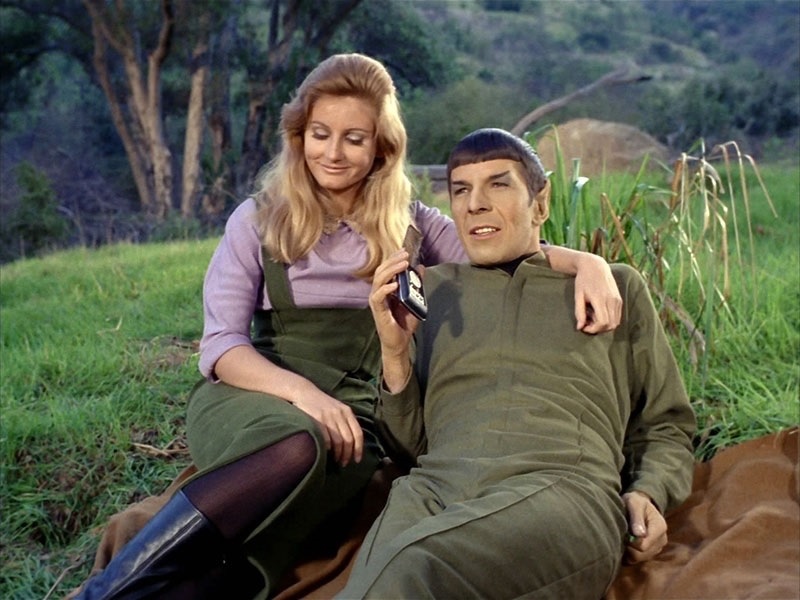
This Side of Paradise
This is one of my personal favorite episodes of Star Trek, but also features a particularly poignant chapter of Spock’s romantic life, and a great performance by Jill Ireland, the scientist who had a long-standing crush on Spock. The end where Spock expresses regret at the loss of happiness is particularly bittersweet, plus the premise of the entire episode is really good. Creepy, but good. We’re also reminded that Kirk’s true love (besides Spock) is his ship.
Amok Time
This classic episode is of course one of the most famous, and most popular episodes, and for good reason. It explores Spock’s Vulcan culture in-depth, and features a wedding ceremony gone haywire. Spock’s comment about “wanting” versus “having” is particularly powerful. Both Arlene Martel (T’Pring), and Celia Lovsky (T’Pau) gave amazing performances too.
I also really like Nurse Chapel’s (Majel Barrett) moments too between her and Spock, and the unrequited love. This episode ties in nicely with the excellent series Strange New Worlds too, I think, on many levels.
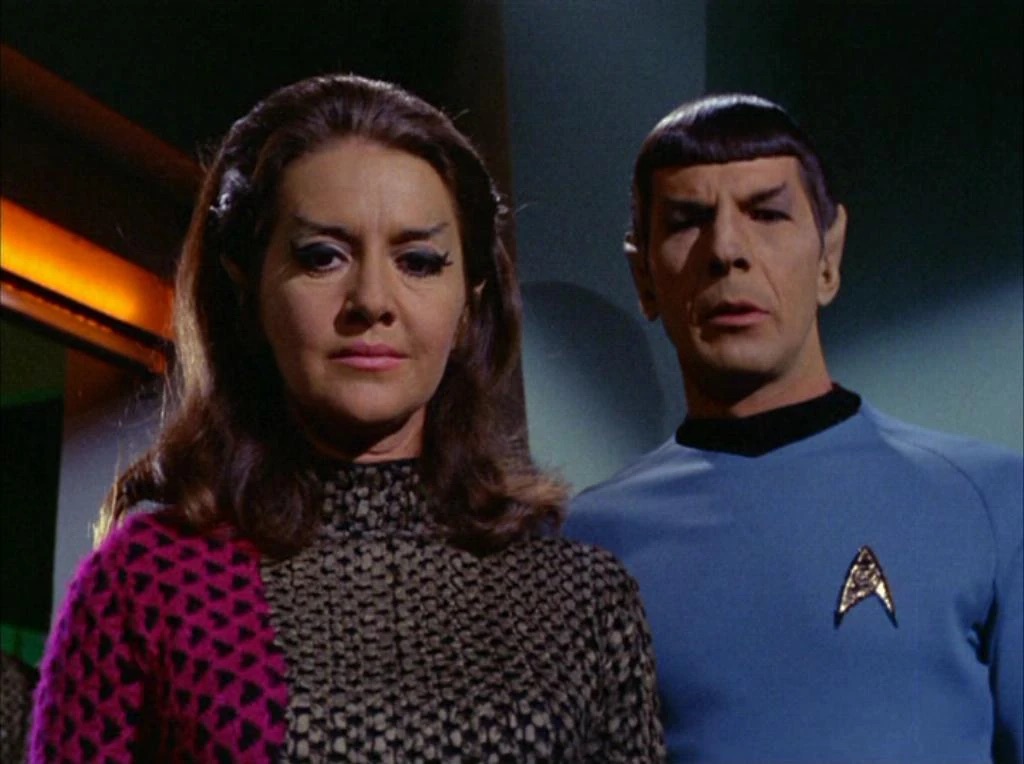
The Enterprise Incident
This is a great post-divorce episode, in which Spock has a rebound girlfriend. Overall, the episode plot seems a bit contrived, but it’s a much needed exploration of Romulan culture, apart from Balance of Terror in season one. Spock’s chemistry with Joanne Linville’s character is excellent.
The Cloud Minders
I’ve written about this episode afewtimes, and needless to say I love it. Both Charlene Polite and Diana Ewing provide romantic foils for Kirk and Spock respectively, but for once Spock out-charms Kirk.
All Our Yesterdays
The penultimate episode, and arguably what should have been the series finale, is a fantastic season three episode, and probably the most controversial romance Spock had. Zarabeth (played by the lovely Mariette Hartley) and Spock only share a brief time together, but it’s enough to spawn a great spinoff novel, and a compelling story across millennia.
Enjoy and Happy Vulcantines Day!! 🖖🏼
Edit: forgot to include The Cloud Minders… updated.
Recently, I was watching an iconic episode of Star Trek, “Arena” (s1ep19, a.k.a. the one with the Gorn), and I noticed this dialogue for the first time:
SPOCK: You mean to destroy the alien ship, Captain?
KIRK: Of course.
SPOCK: I thought perhaps the hot pursuit alone might be sufficient. Destruction might be unnecessary.
KIRK: Colony Cestus Three has been obliterated, Mister Spock.
SPOCK: The destruction of the alien vessel will not help that colony, Jim.
KIRK: If the aliens go unpunished, they’ll be back, attacking other Federation installations.
SPOCK: I merely suggested that a regard for sentient life —
KIRK: There’s no time for that.
I was impressed by how much Spock went out of his way to avoid destroying sentient life, as his duty allowed. This is not the only time he does this, see for example in Devil in the Dark (s1ep25):
SPOCK: Or it is the last of a race of creatures which made these tunnels. If so, if it is the only survivor of a dead race, to kill it would be a crime against science.
Of course, it’s also known that Leonard Nimoy helped develop the character’s iconic Vulcan Neck Pinch too: a non-violent way of subduing humanoids. He also didn’t hesitate to toss people from time to time…
Nonetheless, Spock’s respect for all life, and commitment to reason, science, and non-violence is really admirable. In Arena, Kirk is taking vengeance against the Gorn for the destruction of Cestus III, but Spock points out that destroying the Gorn vessel won’t bring back Cestus III. Later, as the episode shows, the destruction of Cestus III was due to a misunderstanding between the Federation and the Gorn. Spock was right: wanton destruction would have done no good. Kirk’s mercy toward the Gorn at the end is also praised by the Metrons who instigated the arena-style battle of the episode.
I suppose my point here is that science, reason, and respect for all life are worthy traits to uphold even today. 🖖🏼
P.S. Many years ago, when I visited the Star Trek museum exhibit at the Museum of Pop Culture in Seattle and I got to see the original Gorn costume:
Life’s incessant ceremonies leap everlasting, humans spring eternal on hope’s breast, and frying pans without fires are often far between…
Roger Zelazny, Sign of the Unicorn
This quote from the Chronicles of Amber series, a hugely underrated fantasy series these days, sums up many aspects of life nicely. Life is, in many ways, one damn thing after another, with only brief respites in between.
Of course, this is what the Buddha warned in the first of the Noble Truths. He described life is being marked with dukkha. It doesn’t mean we are always writhing in agony, it’s just that life is marked with dukkha, and it rears its head from time to time.
But what is dukkha?
The analogy frequently used back then was the example of a potter’s wheel:
A potter’s wheel that runs smoothly and easily was described using the term sukkha. But dukkha is more like a potter’s wheel that wobbles, grinds when it turns, and requires effort to keep it spinning. Similarly, life feels like a grind sometimes.
Of course, someone may point out that’s the point of life:
MCCOY: Well, that’s the second time man’s been thrown out of paradise.
KIRK: No, no, Bones. This time we walked out on our own. Maybe we weren’t meant for paradise. Maybe we were meant to fight our way through. Struggle, claw our way up, scratch for every inch of the way. Maybe we can’t stroll to the music of the lute. We must march to the sound of drums.
Star Trek, “This Side of Paradise” (s1ep25), Stardate 3417.3
The Buddha didn’t necessarily say life is “evil” or “awful”, but pointing out the obvious: there is no rest, no lasting refuge. Also, even though sometimes life really does feel awful, life still goes on.
It is this need for a lasting refuge, a way beyond the great Cosmic Rat Race, that leads people to the Dharma.
Namu Shakumuni Butsu
P.S. apparently I’ve written another post with the same title two years ago. 😏
Vanna: “It’s hard to believe that something which is neither seen nor felt can do so much harm.”
Kirk: “That’s true. But an idea can’t be seen or felt. And that’s what kept the Troglytes in the mines all these centuries. A mistaken idea.”
Star Trek, “The Cloud Minders” (s3ep21), stardate 5819.0
I’ve talked about this episode before, but I thought this quote was worthy of its own post.
Because all sentient beings who come into this world must struggle to piece together an understanding of things based on limited information, it’s easy to pick up ideas that are wrong or mistaken but make logical sense. Or, alternatively these ideas are foisted upon them by those they trust, such as parents or your society without the tools necessary to discern the truth.
Thus two rational people can have radically different views of things. One or both of these people can have very harmful negative views, and yet from their own perspective, they may sincerely believe they’re doing the right thing, and assume everyone else around them is stupid or insane..
But then how does one discern what is true or not?
The Buddha taught, on the one hand, that all viewpoints are just a form of conceit (lit. “I-making”) and diverge from reality. They’re based on limited information, logic and so on, and so none of them quite hit the mark. The Parable of the Blind Men and the Elephant is often cited as an example of how people form opinions based on limited facts and are willing to fight over this. In fact, the Buddha himself cited this story in an old, obscure sutra called the Tittha Sutta (Ud 6.4 of the Pali Canon):
…”Saying ‘An elephant is like this, an elephant is not like that! An elephant is not like this, an elephant is like that!’ they fought each other with their fists. And the king was delighted (with the spectacle).
“Even so, bhikkhus, are those wanderers of various sects blind, unseeing… saying, “Dhamma is like this!… Dhamma is like that!'”
Translation by John D. Ireland
The Buddha then recites a verse like so:
Some recluses and brahmans, so called, Are deeply attached to their own views; People who only see one side of things Engage in quarrels and disputes.
Translation by John D. Ireland
So, the Buddha warned against becoming attached to one’s own views because it just feeds the ego, and leads to conflict.
On the other hand, he taught the importance of using the Dharma as an objective benchmark (e.g. a “yardstick”) for how to judge one’s own conduct and views, and especially to see what the results are: do they lead to beneficial results, or harmful results? For example in the classic text, the Kalama Sutta (AN 3.65 in the Pali Canon), we see the Buddha explaining how to properly discern a teaching:
10. “Come, Kalamas. Do not go upon what has been acquired by repeated hearing; nor upon tradition; nor upon rumor; nor upon what is in a scripture; nor upon surmise; nor upon an axiom; nor upon specious reasoning; nor upon a bias toward a notion that has been pondered over; nor upon another’s seeming ability; nor upon the consideration, ‘The monk is our teacher.’ Kalamas, when you yourselves know: ‘These things are good; these things are not blamable; these things are praised by the wise; undertaken and observed, these things lead to benefit and happiness,’ enter on and abide in them.
Translation by Soma Thera
We can see that just because something seems logical doesn’t mean it necessary leads to wholesome results (praised by the wise, leading to wellbeing, etc). One’s intuition isn’t always a reliable guide. Teachings and ideas that lead to wholesome outcomes are in accord with the Dharma, and because they are in accord with the Dharma, they lead to wellbeing, peace of mind, liberation, etc.
Of course, in Buddhist history, there’s examples of eminent monks going off the rails, too. So, just. because one is a Buddhist, doesn’t mean one automatically does it right. It takes time, reflection, and a willingness to keep trying.
All conditioned dharmas Are like dreams, illusions, bubbles, or shadows; Like drops of dew, or like flashes of lightning; Thusly should they be contemplated.
The Diamond Sutra, Translation courtesy of Lapis Lazuli Texts
It would be illogical to assume that all conditions remain stable.
Spock, “The Enterprise” Incident”, stardate 5027.3
The “Floating World”, or Ukiyo (浮世) is an old Buddhist term meaning the world of fleeting forms and temporary joys we live in as part of Samsara. It later became, in the 16th century onward, a term for the pleasure quarters of the city of Edo (later Tokyo) when it became the capital of the new Shogunate. The idea was simple: the pleasure quarters offered everything a person could want, if they could afford it, even if it was just part of the mundane, effervescent world.
Block print titled Taking the Evening Cool by Ryōgoku Bridge, c. 1745, by Okumura Masanobu, Public domain, via Wikimedia Commons
But it’s not hard to see that this kind of Floating World, with all its glamour and joys, can be found almost anywhere at any time. Even modern Pop Culture and entertainment, even social media, is just another form of the Floating World.
It’s not that the Floating World, modern Pop Culture, or social media inherently are evil, but they glosses over the pains and realities of life. For every successful actor or actress in Hollywood, it’s not hard to find many others who scrape by. Even those who succeed pay a very heavy price. For every person who greets you at the five-star restaurant with a smile, there are countless people in the back who are slaving away to wash the dishes, cut vegetables, and so on, to say nothing of the waiter’s own personal pains and dilemmas. For every pretty girl who smiles at you, she is glossing over her own pain and trauma. And so on.
Scratch the veneer and see a lot of people working hard to make customers, listeners or viewers happy, but themselves are stressed, exhausted, miserable, or unhappy with their lives.1Just like the rest of us.
In a sense, the whole thing is a golden sham.
And yet, why do we still gravitate toward such things, even when we know they are transient and don’t provide any lasting happiness? I am no different. When I’ve had a hard day at work, and after dinner with the family, I don’t meditate; I sit down and play a Fire Emblem game. Even Lady Izumi, a thousand years ago, lamented her inattentiveness.
Because we are human, and being human is hard sometimes.
Still, it’s worthwhile to see one’s own behavior and learn from it: the way we flit from something fun to something else fun. Even that can be illuminating. I learned a thing or two just writing this post. 🤔
But yes, life is hard, and it hurts, and it’s exhausting. The joys in life are fleeting, and yet we chase after them for even a temporary respite.
Season three of Star Trek has one of my most favorite, albeit silliest episodes in the entire series: The Savage Curtain. The episode starts off with a bang: Abraham Lincoln (played by Lee Bergere) floating in space on his trademark chair.
From there, the Enterprise crew and in particular Kirk and Spock are confronted by some of “histories worst villains” as well as an encounter with Spock’s idol, Surak (played by Barry Atwater), father of Vulcan philosophy.
Surak of Vulcan, founder of Vulcan Logic, in the Star Trek episode the “Savage Curtain” (season 3, episode 22)
The rock aliens who force the “good” historical figures to combat the “evil” historical figures want to compare and contrast their philosophical ideas against one another to see which is better.
Kahless the Unforgettable (played by Bob Herron) and Colonel Greene (played by Phillip Pine)
The premise might seem a bit silly, but it is a fascinating contrast of ideas:1
Surak – a pacifist, non-violent approach
Lincoln – fight if necessary, and “on their level”.
Col. Greene – power is all matters
Kahless – victory by any means
Kirk – do what it takes to save his crew
Spock – honor his commitments to Starfleet, and fight with Kirk, even if is compromises his personal morals
Although Surak loses his life in the combat, he has some really great quotes in this episode that I think are worth sharing:2
The face of war has never changed. Surely it is more logical to heal than to kill.
Surak of Vulcan, “The Savage Curtain” (s3ep23), stardate 5906.5
and also:
I am pleased to see that we have differences. May we together become greater than the sum of both of us.
Surak of Vulcan, “The Savage Curtain” (s3ep22), stardate 5906.4
Lincoln’s performance throughout the episode is great as he embodies the great American president as we want him to be: gentle, but tough when needed. One can’t help but compare this to Bill and Ted’s Excellent Adventure, even if they are completely different movies, because Abraham Lincoln is such a beloved figure.
At the very end of the episode, there is a subtle dialogue worth sharing:
KIRK: They seemed so real. And to me, especially Mister Lincoln. I feel I actually met Lincoln.
SPOCK: Yes, and Surak. Perhaps in a sense they were real, Captain. Since they were created out of our own thoughts, how could they be anything but what we expected them to be?
In fact, I think there’s something very Buddhist about this. The inhabitants of the planet didn’t necessarily create historically accurate versions of Lincoln, Surak, etc, but what we wanted them to be in our minds. In a sense, we create our own gods and idols through our hopes and aspirations (for good or for ill). This isn’t always bad, but it does show how unwittingly we bend the world around us to fit our beliefs and views.
Anyhow, The Savage Curtain is such a fun, surreal episode, and a fascinating contrast of ideas and people in history, and how they interact. These ideas and philosophies are timeless in many ways, and crop up over and over again in history, but by pitting a bunch of historical figures in space against once another, it takes on a whole new dimension of weird, silly, fun.
Also:
Courtesy of “Swear Trek”
P.S. Many reviews point out that The Savage Curtain borrows elements from older, venerable episodes, and thus judge it an inferior episode. I can’t disagree that it borrows a lot of elements, but I like to think it is a capstone to several previous “moral tale” episodes. The action sequences aren’t quite as good, but I don’t think that was the point. It was battle of ideas, not sticks.
P.P.S. I bet you could take all 8 characters, including Kirk and Spock, in the battle and somehow arrange them into a classic D&D alignment chart. The rock aliens of Excalbia would probably be true-neutral.
1 I wish “Zorra” (Carol Daniels) and “Genghis Khan” (Nathan Jung) had dialogue, as it would have been interesting to have more contrasting goals and aspirations.
We Klingons believe as you do — the sick should die. Only the strong should live.
Kras, “Friday’s Child” (s2ep11), stardate 3497.2
Friday’s Child is an episode of Star Trek from the second season,1 which pits both the Federation and Klingons in political competition over mining rights to a planet of really tall people with funny hats.
Kras the Klingon (played by Tige Andrews) on the left, and Maab (played by Michael Dante) on the right.
Whether it was intentional or not, it is also an episode contrasting two modes of thinking: one is an individualist, darwinian view-point (e.g. only the strong survive) promoted by the Klingon Empire versus a community-oriented, social-democratic viewpoint (e.g. for the good of many). The United Federation of Planets obviously favors the latter.
It’s not hard to find people who favor one approach to society over the other. Some strongly so.
For the sake of transparency, I prefer the community-oriented, social-democratic approach. I grew up pretty poor and had to rely on free school lunches, tuition programs for college and such, and thanks to those, I was able to grow and ultimately succeed. So, if it works for me, I believe others should benefit too.
I think this is also a very Buddhist outlook – the suffering of others is ultimately our suffering too, and vice-versa.
That doesn’t mean we don’t have to care for our own needs though. Looking back to the philosophy of Epicurus,2 we can see that a perfectly reasonable approach is a quietest, isolated lifestyle, focused on just living a good life and not getting tangled in things.
But that’s not usually how it ends up.
For much of history, regardless of time or place, a privileged class rises to the top, whether it be ancient priesthoods, warrior classes, Party members, or corporate CEOs. Some rise to the top due to a mixture of time, place, money, and talent. And, for every one person that rises, many more are pushed down. Some are left behind to wither and die. “That’s the way things go”, some might say. The strong survive and the weak perish, so the thinking goes.
Kras the Klingon in this episode speaks much like the ancient Spartans did. They would not hesitate to leave sickly babies to die to exposure, and train the young constantly in rigid military training. People see this and admire the Spartans for their prowess, and revere them as an archetypal elite class of warriors.
And yet there are some glaring issues with this
First, even by the standards of slavery in the ancient world, Sparta as a city-state had an egregious system, where a large underclass (3-7 times larger than the Spartans) of helot slaves who did all the manual toil. The elite Sparta class thus used their time to focus on training. One can easily imagine plantations like those in the Antebellum South where workers toiled endlessly for nothing, while the landed gentry sat around and pursued the “gentlemanly arts”.
Second, for such a carefully engineered system, the Spartans actually lost a lot of battles. Setting aside the famous battle of Thermopylae which was immortalized as a film of naked, sweaty men in 300, the Spartan army lost frequently. A couple generations later, the Thebans under Epaminondas used clever strategy to smash the Spartans at the Battle of Leuctra in 371 BC despite being a smaller army. Rather than making the Spartans stronger, their system made them more brittle and inflexible.
Third, by creating such an elitist society, the Spartans couldn’t replenish their numbers. They couldn’t rely on helots as soldiers, since they hated the Spartans, and the Spartans couldn’t seriously stomach the idea of serving alongside former slaves. By their cruelty they had painted themselves into a corner.
Thus, each time Sparta lost a battle, its numbers got smaller and smaller until the Roman Republic just steamrolled them. The Roman Republic, by contrast, had a pretty open and flexible recruitment process so they could field huge armies quickly and furnish more if they lost (which admittedly they also did, but their long-term prospects were a lot better than the Spartans).
So, I suppose the moral of the story here (ethics notwithstanding) is that a society based on the premise that only the best and strongest survive ironically leads to an increasingly rigid and brittle society that cannot sustain itself. Diversity and mutual well-being strengthen society, not weaken it.
1 I think most classic Trek fans would agree that the second half of season one through the first half of season two was peak Trek. I still love season 3 for a variety of reasons, but admittedly the quality of writing was best during earlier seasons.
2 Epicurean philosophy gets a bad rap because “epicurean” means something different now. But Epicurus advocated a “quietist” approach, a life of solitude and non-involvement, surrounded by friends. Something vaguely akin to Chinese Taoism. He did not teach hedonism.
It’s 2025, and I am happy to be back. The break wasn’t as restful as hoped (too many holiday obligations), but I did accomplish most of my goals, and got to celebrate my firstborn’s 18th birthday which was an important milestone for us parents. I also played lots of Fire Emblem: Engage,1 and watched plenty of old Star Trek episodes.
Anyhow, for the first temple visit of the year, the priest stated that according to the traditional 60-year Chinese calendar 2025 was the sign ki-no-to-mi (乙巳), which can be roughly translated as “yin wood snake”, which implied change coming to fruition, like a tree growing its branches. For context, last year was “yang wood dragon” (ki-no-é-tatsu, 甲辰). Which implied much turmoil, like a baby dragon bursting from its shell.
While I might be speaking from confirmation bias, I cannot help but feel recent events in the last few years reflect this. But, I suppose it’s up to individual interpretation.2
Anyhow, I have some fun posts coming up that I finally finished while on break.
Hoping you all have a great year, or at least stay out of trouble. 😅
1 Engage doesn’t have the emotional depth of Fire Emblem: Three Houses (I doubt few games would), but it has grown on me, and I enjoy many aspects about it, and will likely play through it again.
2 I consulted the Yi Jing for the year, and my own personal fortune wasn’t great either. Warnings of not “stepping on a tiger’s tail” and such.
On my planet, to rest is to rest — to cease using energy. To me, it is quite illogical to run up and down on green grass, using energy, instead of saving it.
Spock, “Shore Leave”, stardate 3025.2
Dear Readers,
Wishing you all a restful end of year, and a happy 2025!
I am going to take the next couple of weeks off myself and recharge, spend time with the family and so on. But, I also have a personal to-do list I made for myself to capitalize on the downtime and get some things done, including:
Finishing a novel I’ve been reading
A bit more Buddhist practice
Finishing the next installment of the Journeys of Xuan-zang (part 5 is interesting, but taking way longer than expected to finish)
A couple bonus projects if I have time.
A bit of studying
So, unlike Spock, I’ll be probably busy, but also productive on a personal level. I mostly gave myself some really easy “softball” goals so I don’t burn out on my time off, but then again, maybe I should trim this list down and have more time to just space out.
I’ll let you all know in 2025. Until then, take care!




 Gleanings in Buddha-Fields

You must be logged in to post a comment.