SPOCK: If there are self-made purgatories, then we all have to live in them.
Star Trek, “This Side of Paradise”, stardate 3417.7
The Five Hindrances in Buddhism was something I briefly touched on in the past, and something I think about from time to time, but then I ran into this neat excerpt by the Chinese Tiantai (Tendai) founder, Zhi-yi:
The practitioner is like a person who has gained freedom from a debt or one who has been cured of a serious disease, like a starving man arriving in a prosperous country, or like one who has been rescued safe and unharmed from a band of villains. When he eliminates these five hindrances, his mind becomes calm and secure and he feels clear, cool, and blissful.
Just as with the sun and moon which may be obscured and prevented from shining brightly by the five phenomena of smoke, dust, clouds, fog and the hand of the asura known as Rāhu, so it is as well with the human mind and the five “covering” hindrances.
The Essentials for Practicing Calming-and-Insight & Dhyana Meditation by Zhiyi, translated by Kalavinka Press, page 75
I really like this quote for a few reasons.
First the benefits of self-discipline, and personal conduct are like getting out of debt. By not committing harmful actions towards others (and by extension yourself), you are no incurring further debt. Because you are no longer incurring debt any existing “karmic debt” run its course, your personal purgatory that much shorter. It bring a kind of freedom, even if it seems counterintuitive.
長からむん心も知らず黒髪の乱れてけさはものをこそ思え
I do not even know how long your feelings will last. My long black hair is all disheveled and, this morning, my thoughts too are in a tangle!
Second, it reiterates that the Five Hindrances really do get in the way of clear thinking, and prevent one from being level-headed and in control. This leads to further harmful actions, incurring further “debt”, etc. So, it helps to know what the Five Hindrances are, and to observe them in your own life, and to know how best to counteract them.
Easier said than done, but every time you counteract ill-will, or laziness, you’ve lightened the burden in your own self-made purgatory.
Namu Shakamuni Butsu
P.S. Featured photo taken at Ryoanji temple in 2023.
I intentionally left this post in my blog draft folder for months, but now I am ready to post.
After a small revelation back in early May, I wanted to give it time and ensure that this change in Buddhist path wasn’t a spur of the moment decision.
After that little experience in May, I realized that I had misunderstood Zen Buddhism. Some of this is due to mixed experiences at local (Western) Zen communities,1 and in my opinion, systemic issues with Buddhist publications in English.3 Once I had better access to Japanese-language resources, and based on things I had sort of rediscovered, I decided to try to and go heads down for a few months and do my best to practice Zen as a lay person and parent.
My daily reminder list on my smartphone. A mix of mundane and Buddhist practice. 坐禅 means “zazen” and お勤め means “otsutome” (home service).
It took a lot of trial and error to get this right. At first, I had a tendency to succumb to self-doubt and start doing zazen meditation longer and longer, but then I would burn out, or have a busy day and skip. So, eventually I forced myself to keep it to five minutes, and I found I was able to sustain the practice more. Also, if I missee a day somehow, I would not punish myself over it.
Second, I struggled with how to do a Zen-style home service, so I had to do some research and this led to posts like this and this (these are for my own benefit as much to readers 😏 ). This home service underwent a few updates and changes over time, but I gradually settled on things over time, thanks to an old service I forgot I had.
Finally, I wanted to ensure I focused on Buddhist conduct as a foundational practice, and in particularly by upholding the Ten Bodhisattva Precepts. It’s also emphasized by such pastZenmonks as a foundation for other aspects of Zen, but compared to the basic Five Precepts, I found myself struggling both to remember what the Ten Precepts were, and also remembering to avoid things like not bring up the past faults of others, or harboring ill-will towards others. This is still a work in progress, but I assumed it would be. It took me many years of following the Five Precepts before it became second-nature.
Anyhow, since I started this little project four months ago, I am happy to say that I have mostly stuck with it. I can count the days I missed practice on my two hands, which over four months is pretty good. I realized that small, realistic, daily practice is much more effective than trying to focus on big retreats. So, in a sense, it’s been a big win and a learning lesson for myself.
But also I realized that I also really missed some aspects of the Pure Land practice that I had been doing up until this point. For me, I found that Pure Land Buddhism tends to appeal to the heart, while Zen appeals to the mind.
Dr. Janet Wallace: “The heart is not a logical organ.”
Star Trek, “The Deadly Years” (s2ep12), stardate 3479.4
So, my practice has continued to evolve to mostly Rinzai-Zen style practice, but also with a few Pure Land elements too. I suppose this is more inline with mainland Chinese Buddhism where such distinctions are less important than Japanese Buddhism, which tends to be sectarian. Also, if it works for Obaku Zen, it works for me.
So, that’s my update. Am I Zen Buddhist now? I don’t know. I am hesitant to use that label because I am hesitant to associate myself with that community. On the other hand, I’ve found it very beneficial so far, but I haven’t forgotten what I learned from Pure Land Buddhism either. So, I guess I am both, neither, whatever. At this point, taking inspiration from Chinese Buddhism: I uphold the precepts, meditate a bit each day, dedicate merit to loved ones and those suffering in the world, praise Amida Buddha, Shakyamuni Buddha, Kannon and the Lotus Sutra. Whatever label fits that is what I am these days. 🤷🏼♂️
Frankly, I stopped caring. I like how my practice has evolved these past months, and happy to continue.
P.S. Posting a little off-schedule, but oh well. Enjoy!
1 Not all experiences have been negative, but I have run into more than a few “Bushido Bros” and Japan nerds2 that soured my experience.
2 Yes, I am a Japan nerd too. I fully admit this, but nerds can be kind of intense and exhausting to talk to, so I don’t like to hang out too much with other Japan nerds.
3 It’s hard to quantify, but English books about Buddhism are either very dry, bland, and scholarly, or read like psychology self-help books, or just too mystical. When I read books in Japanese on similar subjects, I find them more down-to-earth and engaging. I know different people have different preferences, but I don’t like most English publications I find at the local bookstore. It is also why I try to share information (or translate if necessary) whenever I find it.
SPOCK: There are many who are uncomfortable with what we have created. It is almost a biological rebellion. A profound revulsion against the planned communities, the programming, the sterilised, artfully balanced atmospheres. They hunger for an Eden where spring comes.
Star Trek, “The Way to Eden” (s3e20), Stardate 5832.3
世の中よ道こそなけれ思ひ入る山の奥にも鹿ぞ鳴くなる。
Within this world there is, indeed, no path! Even deep in this mountains I have entered, heart set, I seem to hear the deer cry!
Recently, I came back from a camping trip, the last for our family before my daughter goes off to college. It was both good and bad. We stayed at Moran State Park on Orcas Island, Washington. I had been to Orcas Island a number of times over the years, but I had never really stayed there for personal reasons, so it was nice to explore at leisure for a change.
Cascade Lake near our campsite, which was very pristine and peaceful in the mornings. Our dog, Cherry, liked exploring here. The so-called “Indian Island” in Eastsound bay. This area was once a village belonging to a Salish people called the Lummi (official homepage), who grew camassia crops on that islet. A combination of disease from Westerners and raids by northern Salish tribes drove them to the mainland. That lone pine tree feels like a momument to the Lummi to me…A view from Mount Constitution, the highest peak on Orcas Island, facing eastward towards Washington State. I visited here many years ago as a kid on a school camping trip, but don’t remember much.
I posted the Star Trek quote above, not just because it sounds cool, but it does explore a side of us all: yearning for the simple country life. We all feel that revulsion toward modern life, and want to escape, yet even just after a couple days of camping in the woods, the smell of body-odor, noise from neighboring campers,1 and lack of food variety, Internet access, and electricity made us really eager to go back home. Even with modern amenities like gas stoves, freezer coolers and ready-made food (including instant ramen), it quickly gets old.
It wasn’t just me either. There was a lone woman camping just next to us. She brought her dog, and a stack of books to read, and seemed like an experienced camper, but it was clear that she wasn’t finding the solace she sought, and spent most of her time away from campsite to (presumably) find a quieter spot.
The fabled Eden sounds nice, but such a bucolic past probably never existed. Pre-modern life was in reality hard, exhausting, and safety was not always guaranteed.
Yet, modern life has its own challenges and dangers too. We might not die from dysentery anymore, but we often suffer obesity, isolation, and constant anxiety. We might not starve like our ancestors did, but we also eat some egregiously bad food thanks to mass-production and chemicals (including microplastics). Similarly, our fellow Man has replaced natural predators as the threat to our lives.
I don’t want to downplay the benefits of modern life, though.
The average2 lifespan of a human being in the 21st century is significantly longer than before. My little incident a couple years ago likely would have killed me before modern medicine. Dying in one’s forties was not uncommon in the pre-modern era. But the dangers of modern life are still there but now more subtle, yet catch up to us eventually.
In short, life is a struggle, no matter how long we live. Getting to old age without suffering any major health issues is something to be grateful for, but even more important is how you choose to live your life up to that point. As the Zen aphorism goes: every day is (sort of) a good day, so enjoy the moment, and try to live with some element of dignity and free of regrets.
Namu Shakamuni Butsu
1 There was a very rude family camped next to us. The mom kept yelling and swearing at her two toddler children, who in turn were constantly crying and talking back … at 4am in the morning. Ironically, the lady had a “Live Laugh Love” bumper sticker on her car.
2 The keyword here is “average”. A person in pre-modern times some people did live to their 80’s or 90’s, but the odds were against them. A single scratch leading to an infection, or a crippling injury, or a genetic precondition that we can treat now would often kill a younger person. So, if you did manage to live to a ripe old age, it was indeed a cause for celebration.
MCCOY: What if you decide he is Kodos? What then? Do you play God, carry his head through the corridors in triumph? That won’t bring back the dead, Jim.
KIRK: No, but they may rest easier.
Star Trek, “The Conscience of the King” (s1ep13), Stardate 2817.6
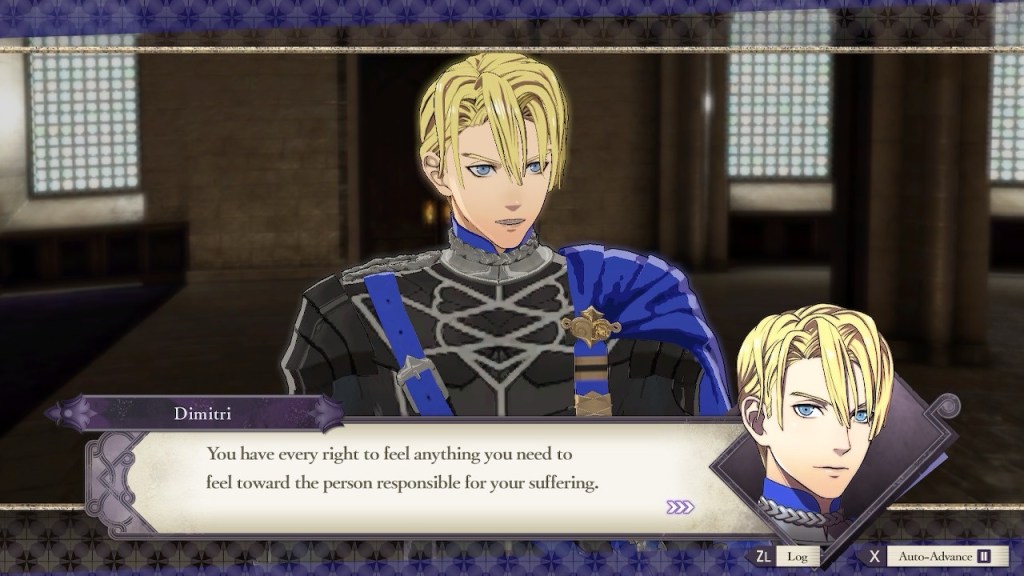
In the game Fire Emblem: Three Houses, one of the three main characters you interact with is the prince of Faerghus, Dimitri, who has suffered terrible tragedy in the youth. Behind his veneer of civility, he is gradually losing his mind.
He cannot get past the loss of his loved ones, and is determined to kill Edelgard personally, whom he blames for all his misery. Depending on which story path you choose in the game, Dimitri’s fate, and the fate of everyone he drags down with him, is very tragic indeed.
Dmittri in the “Azure Moon” route of Fire Emblem: Three Houses
The Buddha saw through this death-spiral of vengeance and hatred, and how utterly pointless it was:
“He abused me, he struck me, he overpowered me, he robbed me.” Those who harbor such thoughts do not still their hatred.
The Dhammapada, verse 3, translation by Acharya Buddharakkhita
Indeed, ill-will is one of the Five Hindrances, and can only be countered by goodwill. But what happens when someone has been genuinely hurt and abused by someone else?
Dimitri at an earlier point in the game.
Dimitri suffered terrible loss and hardship in his youth due to the political machinations outside his control, and the pain and grief are genuine, not something you can just wish away, or use platitudes to make it better. It’s not hard for readers to think back to moments of trauma in their own lives (I have my fair share), and feel raw anger, rage, or sadness (why did this happen to me? why do I have to live with these scars for the rest of my life?).
If you pick the story path that sides with Dimitri, there is a happier fate for him. I don’t want to spoil too much, but through his friends (including you, the main player), he learns to unravel his past and gradually learns to look forward toward the future his kingdom including a dramatic moment with Edelgard.
Thus, I think what the Buddha says in the Dhammapada is true: vengeance, anger and bitterness are indeed self-destructive, but if the trauma and pain are real, they can be very difficult to let go. It is too raw and painful to simply dismiss with logic and reason. But, in Dimitri’s case, support from loved ones helps him through the darkest moments, and helped him let go. He learned not to face it alone, and grew from it.
With whatever trauma you have to live through, I hope you dear readers find similar resolve and happiness.
HEMMER: … I will not fight for Starfleet, but I will defend its ideals. Pacifism is not passivity. It is the active protection of all living things in the natural universe.
Star Trek: Strange New Worlds, “Momento Mori” (s1ep4), Stardate 3177.3
I love Star Trek: Strange New Worlds, and I love this quote.
The first precept of Buddhism, regardless of whichlist you talk about, starts with a vow not to destroy life. Further, in such texts as the venerable Dhammapada (collected sayings of the Buddha), you can see quotations like so:
129. All tremble at violence; all fear death. Putting oneself in the place of another, one should not kill nor cause another to kill.
and:
142. Even though he be well-attired, yet if he is poised, calm, controlled and established in the holy life, having set aside violence towards all beings — he, truly, is a holy man, a renunciate, a monk
Per tradition, monks in the Buddhist tradition are often strictly vegetarian and why some devout lay Buddhists choose to be vegetarian, either full-time or on specific holidays.
But, I think Hemmer’s quote goes a step further, peace, goodwill, and pacifism are not simply refraining from violence; it is also respect for all life (even the Gollums in life). This requires empathy, putting yourself in their shoes. You see this expressed in such popular liturgy as the Four Bodhisattva Vows, dedication of merit, and so on.
But like many things in Buddhism, such a lofty goal is hard to uphold at first. So, the precepts more narrowly focus on simple training rules (not to do X, not to do Y), and overtime, as basic training rules become second-nature, and your understanding of the Buddha-Dharma deepens, one’s practice refines more and more over time. So, if you feel you can’t live up to such an ideal, don’t worry. It’s important to know that the ideal exists, and that every starts from somewhere.
Namu Shakamuni Butsu Namu Kanzeon Bosatsu
P.S. Double post today to celebrate Strange New Worlds, season three. I cancelled my subscription of Paramount Plus some months ago (no regrets), but I enjoy the first two seasons on BluRay, and waiting to get the subsequent seasons on BluRay as well.
SPOCK: War created an imbalance and nature counterbalanced it.
Star Trek, “The Omega Glory” (s2ep23), Stardate unknown
In some form or another, Climate Change has been with us since the beginning of Time. If you look at geologic time, gradual changes to climate happen, moving toward a hotter Earth or a colder one, and in the past once these changes lead to a tipping point, this leads to mass-extinction events. These changes in climate are often driven by natural forces: plate tectonics, accumulation of CO2 (carbon dioxide) in the atmosphere, shifts in the ocean currents and so on. Eventually, the pendulum swings back and the climate shifts toward the other direction. Meanwhile, life gradually recovers, diversifies again and so on.
But it’s important to understand that these changes happen very gradually over tens of thousands of years, or even hundreds of thousands of years.
Climate Change in the modern context refers to human-driven changes. The buildup of CO2 gas in the atmosphere is nothing new, but the output of that gas in the last 100 years is far higher than natural forces can account for. We know that this extra buildup is due to fossil fuels. Burning fossil fuels is literally like throwing gasoline on a fire.
Fossil fuels are not a sustainable energy source anyway, and they are condensing a process that should take a hundred thousand years into only tens of years. It’s small wonder we see such dramatic weather now: mass wildfires, mass rainfalls, mass drought and so on.
As Spock says, if we create an imbalance, nature will balance it out. But may not happen the way we want it to. The greater the imbalance, the greater the correction.
But just as 8-billion humans have, across generations, contributed to the problem, those same humans can contribute to fixing the imbalance (before Nature does it for us):
Reduce energy consumption at home. Even switching off lights at home helps.
Plant local, native plants in your neighborhood
Eat more vegetables (which I am trying to do anyway)
Cut back on fossil fuels: the less you use, the less accumulates in the atmosphere
and so on…
Find something you can reasonably do, and don’t hesitate to do some small good in the world.
“Always keep the noble spirit of goodwill and mercy in your heart, and dedicate the limitless merits of meditation to all beings. Do not allow pride, conceit, or sanctimony to dwell, lest this becomes the Dharma of heretics and fools.”
Keizan’s Zazen Yojinki (坐禅用心記, “A Guide to Zazen”), amateur translation by me.
The Zazen Yojinki of Keizan (1268–1325) is a text I have never encountered before and I was unable to find any English translations or information on. Japanese sources say that it is similar to, and inherits from, Dogen’s Fukan Zazengi but tends to emphasize more practical matters by comparison.
Anyhow, I thought this was a great quote.
There are many reasons why one starts Buddhist practice, including meditation, but Keizan emphasizes that it’s not about personal benefit. In fact, chances are you’ll not feel any personal benefit at first, at least not in the way you’re expecting. In a sense, meditation is useless.
But that’s not the point.
You do not live in isolation with others. We depend on one another, even when we can’t stand each other. What we do affects others, what others do affects us. No matter how you try to come out ahead, you will always depend on others, and even when others come out ahead, they still need you.
So, like it or not, we’re all in this together. Thus, the only way to find peace and well-being is to stop being a dick. The only way to stop being a dick is to take up training rules such as the precepts, to quiet the mind through meditation, and finally to dedicate any good merit you accumulate for the sake of others even when you feel they don’t deserve it.
Recently, my family and I attended a wedding in my hometown for a relative of mine, who is marrying for the third time. The wedding took place at a famous golf course, which is situated on the top of a hill with a commanding view of the area.
It was a surreal experience for me. My sisters and I grew up with our single mom in slummy apartments just ten minutes away, and we never went to that golf course in our youth. Now, we were there many years later, surrounded by wealthy men in tailored jackets, holding brandy glasses, bragging loudly about business, surrounded by women with fake boobs, and cocktail dresses. As a Marxist-Buddhist with an Asian wife, we felt out of place.
But it was fascinating too. Here’s a group of people who live a completely different lifestyle than me. It wasn’t a question of class differences either. It was just a choice of lifestyles and values. When my relative comes to our house in a couple weeks for my daughter’s graduation party, they will no doubt find my lifestyle strange too.
I keep thinking about this quote from Stephen King’s book The Gunslinger, which I posted above. People might physically exist in the same proximity, but they might as well be living in different worlds.
If you have ever played the game Dungeons and Dragons, you are probably familiar with planes of existence called the Feywild and the Shadowfell. The setting of Dungeons and Dragons usually takes place on a plane called the Prime Material Plane: the normal world of stuff, people, etc. But in the D&D setting there are other worlds that closely mirror it, yet are subtly different.
The Feywild (which I wrote about ages ago) represents a version of the Prime Material Plane that is overflowing with life, change, chaos, hence it has many “fey” creatures (fairies, goblins, elves, etc). By contrast, the Shadowfell (another old post) is a colder, more static and gloomy version of the Prime Material Plane. In Dungeons and Dragons, objects and places in one of these planes will appear in some form in the other: a small castle on the Prime Material Plane might be a grand fairy palace in the Feywild, or an abandoned, gloomy fortress in the Shadowfell, and so on. If you’ve watched the Netflix series Stranger Things, it’s the same concept.
So, as I stood there watching the golf course employees serving drinks to wealthy men, it was like they were in different worlds. Some people there are unhappy and stuck in a rut, and might see things through the lens of the Shadowfell, while others are flitting from one party to another, like the fey of the Feywild. And then everyone in between, too.
This isn’t limited to Dungeons and Dragons either: if you look at Buddhism, and its many realms of rebirth (heaven, humans, warrior titans, animals, hell, hungry ghosts, etc), you can think of it the same way: we might occupy the same space, but we might as well be living in different worlds.
Spock: Evil does seek to maintain power by suppressing the truth. McCoy: Or by misleading the innocent.
Star Trek, “And The Children Shall Lead” (s3ep4), stardate 5029.5.
The season three episode of Star Trek, “And The Children Shall Lead” is widely considered a bottom-tier episode. It had a lot of problems, including its casting. Even as a classic Star Trek fan, I kind of despise this episode.
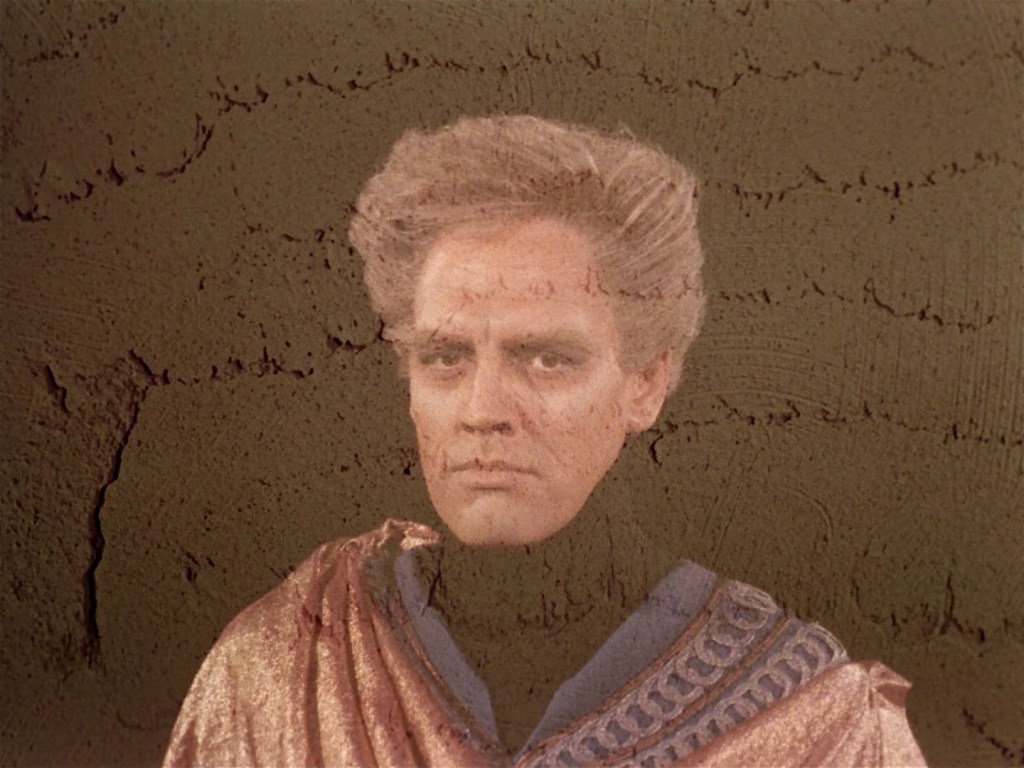
The evil entity “Gorgan”, played by infamous laywer Melvin Mouron Belli who had no prior acting experience. It was season three Trek at its worst.
But the premise of the episode did make a really important point: given the right persuasion, people (including children), can be made to do all kinds of terrible things. It just comes down to what someone asserts is “true” and if their argument is convincing enough. There’s plenty of examples in history, so I won’t belabor the point.
Or, like that old Simpsons gag:
Of course, ignorance as to what is actually true is the basis for our suffering, according to Buddhism. As thinking human beings, we have to piece together our understanding of the world as best we can, and hopefully we have good mentors along the way, but even a good mentor is not perfect. Simply put, subtle misperceptsions and misunderstandings can provide a foundation for a mountain of bad assumptions, stupid conduct, needless suffering. Thus, in Buddhism, this fundamental misunderstanding of things is one of the Three Poisons of the mind: the other two being anger and craving. But even anger and craving derive from misunderstanding too.
This is not something that can be fixed with some clever logic, or vaguely “zen-like” words. It’s a deeply seeded part of ourselves, something we cannot normally perceive in our daily lives, and even when you suppress it with willpower, it will surface again when you least expect it.
The Buddha described the awakening experience as “uprooting”:
….he [the renunciant monk] should develop the perception of inconstancy so as to uproot the conceit, ‘I am.’
Translation by Thanissaro Bhikkhu in the Meghiya Sutta of the Pali Canon (Ud 4:1 Meghiya)
Such a tree of ignorance isn’t cut down, leaving a stump; it is uprooted entirely.
Spock: “Humans do have an amazing capacity for believing what they choose and excluding that which is painful.”
Star Trek, “And The Children Shall Lead” (s3ep4), stardate 5029.5
But how can mundane people, who have yet to fully awaken, discern the truth?
The Buddha taught the Dharma. The Dharma is like a principle of existence (think: laws of physics), and it is something one can objectively measure their thoughts and actions against. In the words of the Buddha:
“Therefore, did we say, Kalamas, what was said thus, ‘Come Kalamas. Do not go upon what has been acquired by repeated hearing; nor upon tradition; nor upon rumor; nor upon what is in a scripture; nor upon surmise; nor upon an axiom; nor upon specious reasoning; nor upon a bias towards a notion that has been pondered over; nor upon another’s seeming ability; nor upon the consideration, “The monk is our teacher.”
Translation by Soma Thera of the Kalama Sutta of the Pali Canon (AN 3.65)
Intuition, logic, reasoning, or trust in a teacher or tradition is insufficient, because our own fundamental ignorance warps our understanding of such things. Instead, the Buddha encourages us to use simple benchmarks:
“What do you think, Kalamas? Does absence of greed [or hate, or delusion] appear in a man for his benefit or harm?” —
“For his benefit, venerable sir.” —
“Kalamas, being not given to greed [or hate, or delusion], and being not overwhelmed and not vanquished mentally by greed [or hate, or delusion], this man does not take life, does not steal, does not commit adultery, and does not tell lies; he prompts another too, to do likewise. Will that be long for his benefit and happiness?” —
“Yes, venerable sir.”
Translation by Soma Thera of the Kalama Sutta of the Pali Canon (AN 3.65)
Here, the Buddha is using the Five Precepts as a simple benchmark. Teachings and actions that lead to adherence of the Five Precepts (not taking life, stealing, adultery, etc) are proper teachings; choices that lead to breaking the Five Precepts are thus improper teachings. The monastic precepts are larger and have more rules, as are the Bodhisattva Precepts, but the essence is the same: a lifestyle that is honest, clean, and does not harm others in body, speech or mind.
The need for an objective benchmark such as the Dharma, is how we can know that words and teachings by others are for good or for ill. Evil can incite others to hate, or to lie and steal, but these clearly violate the benchmark that is the Five Precepts, and thus no matter what they say, we know they are false, conducive to harm, not good.
COGLEY: And I repeat, I speak of rights. A machine has none. A man must….you have brought us down to the level of the machine. Indeed, you have elevated that machine above us.”
Star Trek, “Court Martial” (s1ep20), Stardate 2950.1
SPOCK: Practical, Captain? Perhaps. But not desirable. Computers make excellent and efficient servants, but I have no wish to serve under them.
Star Trek, “The Ultimate Computer” (s2ep24), Stardate 4729.4
This is not a technology blog, but I was watching the episode “Court Martial” recently for Saturday Night Trek and the message was surprisingly relevant. It’s interesting that the concerns around AI have been around as far back as the 60’s. More than one episode of Trek explores the dangers of ceding too much control to AI.
The AI “Landru” from episode “Return of the Archons”.
The problem and ethical issues haven’t changed in over 60 years yet companies keep foisting AI on us. ChatGPT and other AI services scan this blog almost daily, probably misappropriating my content, and Google insists on providing flawed AI answers to search queries even when I don’t want them.
Yet another flawed reply from Google AI. Someone posted this online, I did not encounter this first-hand. But I have run into flagrantly wrong answers.
My phone’s auto-correct uses AI too, even after I’ve turned off Siri. Even my Fire Emblem Amiibo have AI builtin:
A few of my Fire Emblem amiibo. In front is Byleth from Fire Emblem: Three Houses, to the right is Robin from Fire Emblem: Awakening, and on the left is Chrom (the best dad) from the same game.
It’s almost impossible to avoid these days.
Still, I have tried my best to avoid using it whenever possible, though. I turn it off when I can, I never use ChatGPT, and limit use of Google or disable AI answers using “-ai” in the query. As with helping the environment, and other things, small efforts still help.
In fact, AI is known to harm the environment through its waste of resources, and datacenter output.
SPOCK: Fascinating. This atmosphere is remarkably similar to your twentieth century. Moderately industrialized pollution containing substantial amounts of carbon monoxide and partially consumed hydrocarbons. MCCOY: The word was smog. SPOCK: Yes, I believe that was the term.
Star Trek, “Bread and Circuses” (s2ep25), Stardate 4040.7
This blog, and its nerdy author, remain committed to free, open, and 100% human content.
Further, contrary to what proponents assert, AI is not inevitable. The spread of AI can be countered.
Simply put: help the environment, help promote human creativity, and don’t feed the machine.















 Gleanings in Buddha-Fields
You must be logged in to post a comment.