Frodo: ‘It’s a pity Bilbo didn’t kill Gollum when he had the chance.’
Gandalf: ‘Pity? It’s a pity that stayed Bilbo’s hand. Many that live deserve death. Some that die deserve life. Can you give it to them, Frodo? Do not be too eager to deal out death in judgment. Even the very wise cannot see all ends. My heart tells me that Gollum has some part to play in it, for good or evil, before this is over. The pity of Bilbo may rule the fate of many.’
J.R.R. Tolkien, The Fellowship of the Ring
We live around plenty of detestable people all the time, the Gollums of the world: in our neighborhood, workplace, etc, or in society at large. Some of us even have parents like this too.
It’s hard to put up with these people. Of course, we want to have goodwill toward them, but they just keep doing things that are annoying, rude, selfish, or directly harmful.
So, I like how Dogen in the Shobogenzo (recompiled as the Shushogi), suggests a realistic approach. Sometimes you simply can’t be friends with detestable people, or you can’t be around difficult family relatives. You can at least pity them, not hate them, though. They may never change, and that’s a tragedy, but it’s also important to avoid harboring ill-will. Easier said than done. But like Gandalf says, even terrible people have their part to play. So, at the very least, keep your distance for your own sanity, but also wish them well, even a little.
Confession: I starting writing this post before this one, and also before I had huge fight with my dad (again), and we are once again not on speaking terms, so I feel like a hypocrit for writing this post. but I still believe in those ideals. Because they are there, we can reflect, learn and grow. Myself included.
SPOCK: “Change is the essential process of all existence.”
Star Trek, “Let That Be Your Last Battlefield” (s3:ep15), Stardate 5730.2
It is that time once again as we celebrate a new year. It’s an exciting time: plenty to celebrate and look forward to, but some very difficult times too:
Mark Twain: “I come from a time when men achieve power and wealth by standing on the backs of the poor, where prejudice and intolerance are commonplace and power is an end unto itself.”
Star Trek: The Next Generation, “Time’s Arrow, part two” (s6:ep1), Stardate 46001.3
In my spare time, I have been avidly studying (re-studying) the Soto Zen text, the Shushogi. As I talked about before, this is streamlined collection of Dogen’s writings from the Shobogenzo, but with a focus on lay followers.
One of the themes repeated over and over is that time passes, and it only passes in one direction:
Time flies with more speed than an arrow; life moves on, more transient than dew. By what skillful means can you reinstate a day that has passed? To live one hundred years wastefully is to regret each day and month. Your body becomes filled with sorrow. Although you wander as the servant of the senses during the days and months of a hundred years — if you truly live one day, you not only live a life of a hundred years but save the hundred years of your future life…..true practice of the Law for one day is the seed of all the Buddha and their activities.
The Shushōgi, chapter five, fascicle thirty
A long life wasted in empty pursuits is nothing compared to a day spent in earnest practice. Even applying the Buddhist teachings a little bit, benefiting yourself and others, is still a great investment. Like exercise, a little bit goes a long way, and each day is an opportunity. Each one of us, just as we are now, is capable of doing something good and noble.
By the way, a quick blog update: I’ve been struggling in recent months to maintain a consistent schedule for posts (it was self-imposed anyway), so starting in 2026 I am going to try and be more flexible with posting. I am not sure how that will look, but you may see “bursts of inspiration” followed by some dry spells. We’ll see how things unfold. In the meantime, I’ve been adding more pages to the blog under the Buddhism section including the Letter on White Ashes, and the Shushogi above. Not the rest I intended,1 but something I enjoy doing. 🙂
Stay safe and happy 2026 to everyone!
1 I also played a lot of The One Ring RPG in my spare time, plus watching Star Trek: Enterprise for the first time ever. It is a terrific series, and I regret not watching it when it was on-air. So, I did have some downtime too. 😉
Something cool I learned about while watching a Japanese documentary of Eiheiji temple, one of the two core temples in the Soto Zen tradition. Evidentially there is a small Buddhist altar there that features three Buddha statues. You can see photos of it here, the building (called the butsuden 仏殿) is here. This is posted on a separate blog too. You can see a photo of the three buddhas at the very bottom of this page here.
But who are these three Buddhas? In Japanese this is called the Sanzebutsu (三世仏), or “Buddhas of the Three Time Periods”.
In order these are:
Amida Buddha – the Buddha of the Past (he accomplished his vows eons ago), and thus the Pure Land was established.
Shakyamuni Buddha – the Buddha of the Present (the current eon of history), the historical founder of Buddhism. Also known as Siddhartha Gautama, Shakyamuni, etc.
Maitreya Buddha – Buddha of the Future (he has not accomplished his vows yet, but will eons later). For now he dwells in the heaven realm of Tushita.
This “trinity” of Buddhas is not limited to Eiheiji Temple. You can find similar works of art in other temples as well.
Anyhow, it’s an intriguing idea that the Dharma has always existed across space and time, but simply represented by different Buddhas as appropriate.
SPOCK: There are many who are uncomfortable with what we have created. It is almost a biological rebellion. A profound revulsion against the planned communities, the programming, the sterilised, artfully balanced atmospheres. They hunger for an Eden where spring comes.
Star Trek, “The Way to Eden” (s3e20), Stardate 5832.3
As I write this, the family is in Japan (sadly, I was unable to go this year) visiting relatives, and I am home with the dog, Cherry.
Since I have a couple weeks to myself, I thought it would be a great time to put in a little extra Buddhist practice, catch up on some personal projects, go offline for a bit, etc. Basically, try to live like a monk for a few days. I carefully planned it out, decided what I would do and not do, took a three days off from work, and then got ready for the “mini home retreat”.
I lasted eight hours.
The first few hours were great. It was peaceful, quiet, and I did finish reading a couple books on my to-do list, meditated extra, recited more sutras than usual, and so on. But then, as the hours progressed, isolation and boredom set in. I started worrying if I was missing a text from my family (in case of emergencies), and I discovered that it’s hard to read Japanese books without a dictionary which I only have on my phone.
Embarrassingly by early afternoon I gave up and turned on my phone. Then I went and played Fire Emblem: Three Houses for a few hours,1 watched Star Trek V: The Final Frontier2 for some crazy reason, got bored and played more Fire Emblem until 11pm.
Day two, I didn’t even really bother to try again. I realized that I had hyped up this time off too much, and without any support or contact with others, I quickly started to get a little stir-crazy. That’s not to say the time wasn’t unproductive either. Even today (day two), I still got some extra stuff done around the house, and did a little more Buddhist stuff than usual. But I also played Fire Emblem: Three Houses for three hours.
τὸ μὲν πνεῦμα πρόθυμον, ἡ δὲ σὰρξ ἀσθενής. “Indeed the spirit is willing, but the flesh is weak.”
Indeed, in the Sutra on the Buddha of Immeasurable Life, one of the Three Pure Land sutras, the Buddha Shakyamuni laments that:
“People of the world, being weak in virtue, engage in strife over matters which are not urgent….Since they have not done any good in particular, nor followed the Way, nor acted virtuously, when they die, they will depart alone to an inferior world. Although they are destined to different states of existence, none of them understands the law of karma3 that sends them there.”
Translation by the late Hisao Inagaki, hosted here.
So, the problem of laziness and lack of follow-through in religious practices (or personal projects) is nothing new. Even in Japanese, there is a phrase: mikka bōzu (三日坊主) meaning “three day monk”. It’s a tongue-in-cheek phrase about how most endeavors last three days at most.
In my case, I think my failure was a combination of over-zealousness and perfectionism which set the bar too high for something I am not really used to doing day to day. The idea of a religious personal retreat is still worth it, but I should have set the bar lower the first time, and tried to be a bit more realistic.
The point isn’t to give up and just play more Fire Emblem (but then again, I might anyway), but reflect on what worked, and what didn’t and focus on something realistic and sustainable. As Dogen reminds us, it can be done, but expecting it to work overnight if I just push through hard enough is maybe a bit silly.
Namu Shakamuni Butsu Namu Amida Butsu
P.S. Bonus post. Apologies for any typos, I wrote this one quickly while it was still fresh in my mind, so probably more editing mistakes than usual.
P.P.S. On the plus side, I also had some time to practice vegetarian cooking and made a large batch of Mapo Tofu, Pasta Mama (in honor of Captain Pike in Star Trek: Strange New Worlds), and some Thai curry. This photo is the Mapo Tofu:
… I also harvested the scallions I’ve been growing since Spring:
1 I am on my eighth play-through I think. I am finally going back and replaying my first route, Crimson Flower route (i.e. with Edelgard) and doing things I missed on my first play-through. It’s been nearly two years, and I still enjoy this game very much. The story, dialogue, characters and world-building never cease to amaze me.
2 I think I watched it to remember why this movie is so unpopular. It has some good qualities to it, but yeah, it’s not very good. As a teenager, I watched it in the theaters and thought it a bit odd, but it’s not aged well for me.
3 For similar teaching, see the first chapter of the Soto Zen text, the Shushogi.
“Always keep the noble spirit of goodwill and mercy in your heart, and dedicate the limitless merits of meditation to all beings. Do not allow pride, conceit, or sanctimony to dwell, lest this becomes the Dharma of heretics and fools.”
Keizan’s Zazen Yojinki (坐禅用心記, “A Guide to Zazen”), amateur translation by me.
The Zazen Yojinki of Keizan (1268–1325) is a text I have never encountered before and I was unable to find any English translations or information on. Japanese sources say that it is similar to, and inherits from, Dogen’s Fukan Zazengi but tends to emphasize more practical matters by comparison.
Anyhow, I thought this was a great quote.
There are many reasons why one starts Buddhist practice, including meditation, but Keizan emphasizes that it’s not about personal benefit. In fact, chances are you’ll not feel any personal benefit at first, at least not in the way you’re expecting. In a sense, meditation is useless.
But that’s not the point.
You do not live in isolation with others. We depend on one another, even when we can’t stand each other. What we do affects others, what others do affects us. No matter how you try to come out ahead, you will always depend on others, and even when others come out ahead, they still need you.
So, like it or not, we’re all in this together. Thus, the only way to find peace and well-being is to stop being a dick. The only way to stop being a dick is to take up training rules such as the precepts, to quiet the mind through meditation, and finally to dedicate any good merit you accumulate for the sake of others even when you feel they don’t deserve it.
Something I haven’t really covered before, but worth talking about lately is a Soto Zen service book I picked up some years ago at Sojiji Temple which is not too far from my wife’s home in Japan.
Back then, we’d visit Japan yearly to see relatives, and let the kids get much-needed language exposure. Also, I was in touch with an expat1 who lived there for 20 years and shared a passion for Buddhist temples. He and I would go “temple hopping” together around the Tokyo area whenever I was in town, and as my firstborn daughter got older, she would come with us.
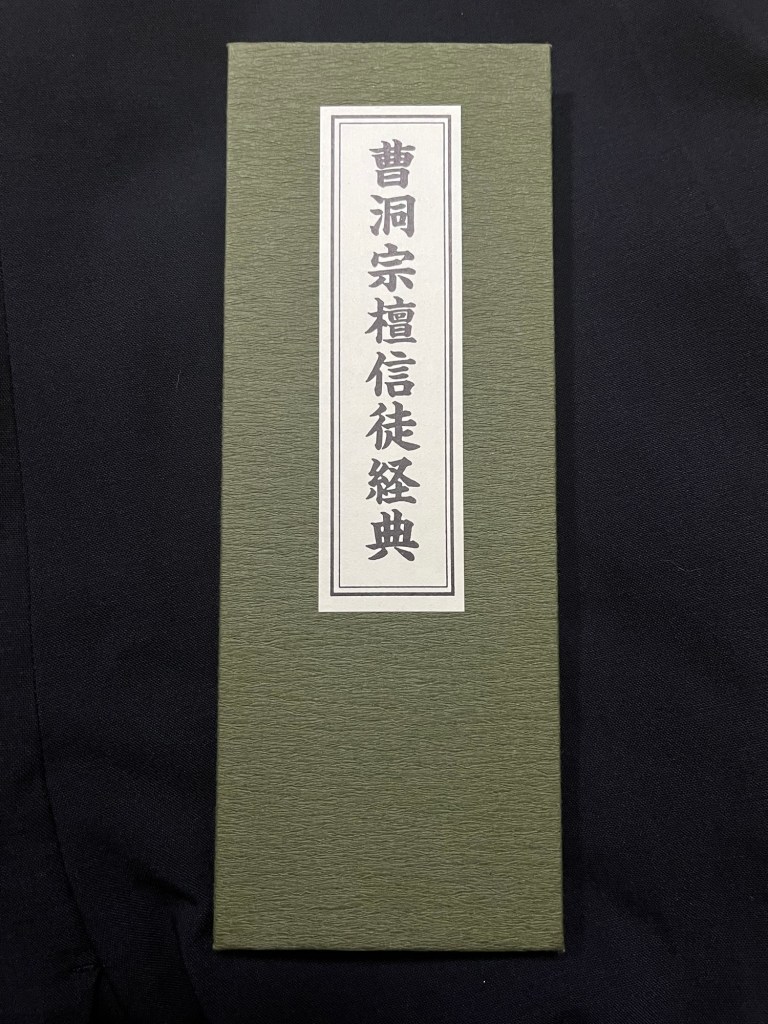
In any case here is the cover of the service book for Soto Zen home liturgy:
Cover of Soto Zen service book, purchased at Sojiji temple. Title roughly translates as “Soto Zen scriptures for parishioners”.
Inside, you can see the table of contents on the right side. Japanese text is tradtionally written right to left, and vertically (not horizontal):
Table of contents of sutra service book for Soto Zen. Purchased at Sojiji temple.
On the left-hand side is the Kaikyoge, a verse recited traditionally when starting a service. The gist of the verse is that encountering the Dharma is quite rare, and yet we are privileged to read and recite it now. Thus, may we all attain the Buddha way. During my years with the Buddhist Churches of America, we read a very similar liturgy in English. The concept is almost universal in Buddhist services.
Also, notice that the text in the Kaikyoge is Chinese characters (kanji), but with hiragana text to the side as a pronunciation aid. This is because most liturgy in Japanese Buddhism was originally adopted from China, and thus requires pronunciation guides (same is true with Korean Buddhism too, iirc). At the very bottom-left is smaller text helping to explain the meaning of this verses.
The photo below is the first part of the verse section of the Kannon Sutra (a.k.a. chapter twenty-five of the Lotus Sutra). Again, we see vertical lines of Chinese characters since the original edition was recorded in old literary (not modern) Chinese, and phonetic hiragana script beside each character. The large circle mark indicates a ring of the bell if you have one. As with above, it is read from right to left, vertically.
A copy of the Kannon Sutra, version section, from a Soto Zen service book, from Sojiji temple.
What I really like about this particular sutra book is how clear and readable the hiragana text is. Some books use a font that’s hard to read if you are a foreigner (or even Japanese possibly). This makes reciting difficult. But here, if you can read hiragana script, it’s easy to follow along.
A close up of the Kannon Sutra as printed in a Soto Zen service book, purchased at Sojiji Temple.
By the way, below is an example of verses that are not recorded in Classical Chinese: an excerpt of the Shushogi, chapters three and four. Since the Shushogi was recorded natively in Japanese, there are fewer Chinese characters, and the style of language is more readable to a native speaker. To me, as a language student, it’s still pretty difficult since the source text by Dogen was composed in the 13th century. The grammar is quite different 800 years ago. This section also includes explanations at the bottom for modern native speakers.
Because of the popularity of the Shushogi among laity in the Soto Zen tradition, all five chapters are recorded in this sutra book.
The rest of the content is pretty typical, and I explained the full contents in an older post, but what I liked about this particular sutra book was the quality, readability, and thorough content.
Side note: it turns out that there is also an eBook version of the service book (originally linked here) available in both Apple Books and Google Play formats. The eBook version is a lot nicer than I expected, and closely follows the physical book (the subject of this post), with a few slight differences:
The kaikyōge (verses on opening of the sutra) uses Sino-Japanese, the service book uses a mixture of native Japanese and Sino-Japanese
Similarly, the Sankiraimon uses native Japanese in tbe eBook version, but Sino-Japanese in the physical book.
the eBook version has a really nice altar image (gohonzon). A person who can’t access Buddhist altar goods could print it out, and install in a Buddhist altar (obutsudan).
But I digress.
For some reason I find sutra books fascinating, and if readers enjoyed this post, please let me know. I might try to make more posts on the various books I’ve collected over the years. I have service books from practically every sect in Japan.
P.S. Happy 4th of July to readers in the US. Also, happy (belated) Canada Day to readers there. To my ancient roman readers happy … (checks notes) … Battle of Adrianople?
1 via online Buddhist circles, namely the long-dead E-Sangha forum. IYKYK.
A while back, I talked about the history of Zen [particularly Rinzai Zen] and the samurai class in pre-modern Japan. Rinzai has a particularly convoluted history compared to other Buddhist sects in Japan due to its multiple waves of immigration from China, each unrelated to one another. Soto Zen’s history is notably different, but fairly convoluted in its own way, since it has two founders.
This concept of two founders started in the 19th century, after certain Soto Zen temples got into a spat about who was the actual founder of Soto Zen. If you’re reading this and know something about Japanese Buddhism, you might think that the answer is obvious: duh, it’s Dogen since he was the one who went to Song-dynasty China, and brought the tradition back. That was Eiheiji temple’s position at the time.
Conversely, Sojiji Temple took the position that it was Keizan’s influence a couple generations later that actually allowed it to flourish in Japan, establishing it as a proper sect, and not just an isolated temple. Further, until the 19th century, Dogen’s writings were kept secret, so very few Soto priests and students ever read it. So Dogen’s actual influence in the sect would be thus smaller than expected. Or so the argument goes.
Needless to say, eventually the two groups came to a compromise and agreed that both monks contributed to the growth of Soto Zen in Japan, each in their own way. Thus, in the Soto Zen tradition since, they are known as:
Dogen – “high founder” (高祖, kōsō)
Keizan – “great founder” (太祖, taisō)
Thus every 29th of September the Soto Zen liturgical calendar holds a memorial service for both founders known as Ryōsoki (両祖忌, lit. “dual founders memorial).
Even today, if you look at a Soto Zen obutsudan in Japan, you often see altar images like the ones linked here and here: namely an image of Shakyamuni Buddha in the middle, and Keizan on the left (facing right), and Dogen on the right (facing left). This is not an entirely unusual arrangement, by the way: in the Jodo Shinshu tradition, the Buddha Amida is in the middle, and often flanked by Shinran the founder, and Rennyo the restorer. Sometimes in Tendai Buddhism, you also see Shakyamuni Buddha flanked by Saicho the Japanese founder, and Zhi-yi the original Chinese founder.
The concept of “trinities” often appear in Buddhism, though not in the Western-Christian sense.
In any case, I am glad to see that Soto Zen was able to reconcile this dispute in a way that feels harmonious to me. I have visited Sojiji a couple times over the years (since it is thankfully pretty close to my wife’s house),1 and it is a pretty neat temple. I haven’t visited Eiheiji yet as it is in a remote prefecture in Japan, but I am sure it’s quite a nice place to visit. Just like Keizan and Dogen, each temple enriches the Soto Zen community in its own way, and this helps broaden the community and make it more inclusive.
It is tempting to look at Japanese-Buddhist history and assign one sect to one founder, etc, but both Soto Zen and Rinzai Zen have histories that tend to defy this mold, and it’s important to recognize that religious history is organic and complicated, but also quite fascinating.
Namu Shakamuni Butsu
P.S. Moving back to two posts a week, now that the backlog is caught up.
P.P.S. Posting late, sorry! Made a scheduling mistake. 😅
1 The present location of Sojiji is actually fairly recent. It was in Fukui Prefecture (same as Eiheiji) for many centuries, and was a branch temple of Keizan’s main temple of Yōkōji (永光寺). Ironically, as Yokoji declined, Sojiji gained in prominence. But, history is funny this way.
Another interesting quote from a 13th century Japanese Zen text, the Zuimonki (first described here), about the importance of not engaging in debates with others.
1-10) In a dharma talk, Dōgen said,
Even if you are speaking rationally and another person says something unreasonable, it is wrong to defeat him by arguing logically. On the other hand, it is not good to give up hastily saying that you are wrong, even though you think that your opinion is reasonable.
Neither defeats him, nor withdraw saying you are wrong. It is best to just leave the matter alone and stop arguing. If you act as if you have not heard and forget about the matter, he will forget too and will not get angry. This is a very important thing to bear in mind.
I think there’s only so much one can do to convince others, and if you meet someone who’s already made up their mind, it’s very unlikely you can change it because one’s beliefs are part of their core identity.
Spock: “Humans do have an amazing capacity for believing what they choose and excluding that which is painful.”
Star Trek, “And The Children Shall Lead” (s3ep4), stardate 5029.5
At that point, any effort to convince them is a sunk cost, a waste of energy.
So, like Dogen says, better to just drop the subject and let it go.
I found a neat quote recently from an old Soto Zen text called the Shōbōgenzō Zuimonki (正法眼蔵隨聞記), or “The Treasury of the True Dharma Eye: [A] Record of Things Heard”. We will call it the Zuimonki for short. Dōgen, who brought Soto Zen from China to Japan in the 13th century wrote a massive tome called the Shōbōgenzō, but his chief disciple Koun Ejō (孤雲懐奘, 1198–1280) also recorded the Zuimonki in the 13th. Ejo was actually a few years older than Dogen, yet outlived him by 20+ years or so. He would become the second abbot of Eiheiji temple, and its spiritual successor after Dogen’s passing.
The Zuimonki occupies a similar space as the Tannisho in the Jodo Shinshu tradition: a record of informal conversations between the founder and a trusted disciple. You can find a nice translation of it here on the Soto Zen homepage.1
Near the very end is the following conversation that I wanted to share (emphasis added):
[6-16]. Dōgen instructed,
All the buddhas and patriarchs were originally ordinary people.
While they were ordinary people, they certainly did bad deeds and had evil minds. Some of them were undoubtedly dull or even stupid. However, since they reformed their minds, followed their teachers, and practiced (the Way), they all became buddhas and patriarchs. People today should also be like this. Do not underestimate yourselves because you think you are dull or stupid.
If you do not arouse bodhi-mind in this present lifetime, when can you expect to be able to practice the Way? If you force yourselves to practice now, you will surely attain the Way.
There’s a lot to unpack in this quote, all of it good I think.
First, Dogen reiterates that the Buddhas and Bodhisattvas of the Buddhist tradition were all normal sentient beings at some point, with foibles, bad habits, etc. However, they resolved to change, and in time they became something much more. We saw this in the second chapter of the Shushogi as well, so we can definitely infer that Dogen sincerely believed that everyone could accomplish the Buddhist path if they only applied themselves.
I grew up in a broken home as a kid, with two younger sisters, and a chaotic family environment, and needlessly to say I did poorly in school. I remember year after year my teachers would tell my mom that if I just applied myself, I’d do really well. Finally, in the 10th grade, after reading a copy of J.R.R. Tolkien’s Fellowship of the Ring, I discovered that I really liked reading, and soon my grades improved enough that I could get into the local University and live the life I do now. So, I can attest that “believing in yourself, and applying yourself” really is true.
Second, Dogen is clearly not concerned about Dharma Decline, which was the milieu at the time in medieval Japanese Buddhism. Most sects in Japan had felt that because of the increasing chaos and declining Buddhist institutions, which roughly lined up with some aspects of Buddhist chronology,2 traditional Buddhist practice could no longer provide solutions to people’s suffering, hence alternative solutions arose. However, looking back from the 21st century, 8 centuries later, this may seem silly now. Yet, it was an intensely discussed subject at the time. Presumably, since Dogen had journeyed to China unlike other eminent monks at the time, he saw things from a different perspective and wasn’t convinced that the End Times were nigh.
Finally, Dogen is telling listeners not to lose faith in themselves. Self-doubt for anyone is crippling, but Dogen says even if you think you are slob, or an idiot, or whatever, don’t underestimate yourself.
From the original “Lego Movie”.
But if you’re unsure, start small, know your limits, but don’t give up either. Keep your eyes on the prize. 💪🏼
1 English resources on the Soto Zen website are actually quite good, and if you can read the Japanese pages, they are even better.
2 … using some pretty liberal interpretations of certain old Buddhist texts, and some calculations of the Buddha’s historical birth that no longer are accurate thanks to modern archaeology and research.
As I continue exploring obscure (and often untranslated) texts in the Japanese zen tradition, I discovered a text called the Shinjinmei nentei (信心銘拈提),1 originally composed in the 13th or 14th century. This text is composed by the so-called “second founder” of Soto Zen named Keizan Jōkin (瑩山紹瑾, 1268–1325). Keizan helped found the temple of Sojiji which I’ve visited before, and helped broaden the appeal and support of Soto Zen in medieval Japan.
I can’t find any information on this text in English, and with help from their modern translation (and a bit of Google Translate in some places, embarrassingly 🤦🏼♂️ ), I believe it translates as follows:
When it is cold we sit by a fire; when it is hot we wave a fan. We get dressed, we take a meal. We do such things as carry water and firewood, and work together to complete chores. We poop and pee, wake up in the day, sleep at night. We wash our hands and feet. In the midst of such daily life, we find thoughts of gratitude, and as we seek to repay such generosity [of the Buddhas], we do so by embodying the teachings of the Buddha by our actions. In this way, there is no difference between the Buddha and sentient beings, nor anything to attain, and there is no difference between the Zen path and daily life. This is called “no path no action” or “no name no practice” of a Shramana [a wandering monk].
This is a pretty amateur translation, but I hope it makes sense to readers. Keizan is encouraging disciples to not think of daily life and chores as separate from Zen practice. Rather, daily life and chores are Zen practice, and our conduct is how we express gratitude to the Buddhas for their guidance.
Namu Shakamuni Butsu
P.S. Bonus post today. Have a great weekend everyone!
1 My rough translation of the title is “Presentation of the ‘Faith-Mind Inscription‘”. The Shinjimei is a Chinese-Zen (Chan) text, while nentei (拈提) seems to mean a presentation, or to pose a problem. I presume this is Keizan’s commentaries on an older Chinese text.
Hopefully, someone with more skill will fix this title translation later.





 Gleanings in Buddha-Fields
You must be logged in to post a comment.