The hanging scroll in the Twitter image shows the so-called Thirteen Buddhas and Bodhisattvas, or jūsan-butsu (十三仏), of Japanese Buddhism. This is a collection of Buddhas and Bodhisattvas in the Mahayana tradition that often appear in things like funeral ceremonies, esoteric rites, and other things. Each one has an associated mantra (inherited from esoteric-Buddhist traditions, even in non-esoteric sects), and an associated memorial day.
This is an example I found in a Rinzai-Zen Buddhist service book. Rinzai Zen isn’t an esoteric sect, but does historically borrow certain liturgies and practices, hence you can find things like this.
You can find some details here, but I also listed them out in the table below:
This is knowledge that most Japanese-Buddhists would not pay attention to, unless they are particular devoted to esoteric practices,4 or have some ecclesiastical training. Further depending on which Buddhist sect we’re talking about, you might see them often, or rarely at all. But this list is almost universal in Japanese Buddhism, and it’s fascinating to see it come up now and then, even in social media.
P.S. I’ve spoken about Taima-dera temple (the Twitter feed above) in a previous post. These days, like many old temples in the Nara area, has been folded into the Shingon esoteric sect.
P.P.S. Mantras are usually not meant to be translated. There are English translations, but it kind of defeats the purpose of mantras in the esoteric tradition. The journey is more important.
1 These are usually written in katakana script since they’re technically foreign-imported words from Sanskrit.
2 If you see ō, it means that the word is pronounced like English “oh”, but two-beats long. Japanese distinguishes between “o” (one beat) and “ō” (two beats). Same pronunciation, different length.
3 That is, the historical Buddha and founder of the religion. ‘Nuff said.
4 Usually this means devotees of either Shingon or Tendai sects. Also, some of the mantras above are pronounced slightly differently depending on whether it’s the Shingon or Tendai lineage. This is an area I don’t know very well, so if you need further details, please consult other sources.
The Amida Nyorai Konpon Dharani (阿弥陀如来根本陀羅尼) or “Amitabha Root Dharani” is a dharani used in some Japanese Buddhist sects, typically only on the Segaki ritual used to feed the hungry ghosts in Buddhism, or possibly funerals and other similar services. It is typically only found in esoteric rituals in Shingon and Tendai Buddhism, but can be found in Jodo Shu and Zen as well. The dharani is typically of very, very limited use, and not part of normal liturgy.
This page is intended to post the dharani for reference purposes only. Esoteric practices such as mantras and dharani should only be used as recommended by one’s teacher, under a guided training program. I found reference material on this dharani to be almost non-existent in English, hence my decision to post it here.
This page will provide both the Sino-Japanese reading follow by the Sanskrit reading. There are multiple versions of the dharani in Japanese, so pronunciation may vary slightly between them, so for this reason the Sanskrit is provided as well. No translation will be provided as this is part of the esoteric training one should undergo when learning the dharani. Any translation you see online of this, or any mantra/dharani, should be treated as suspect.
Can’t read the characters?
If you’re having trouble reading the Kanji characters, you might have one or two problems with your computer:
Your computer may not have Asian fonts installed. In Windows you have to enable UTF8 and East Asian fonts under the Control Panel. Modern Mac computers are fully compatible already.
Your browser may be assuming the wrong character set. If you use a relatively modern browser and use UTF8 as character set, you should be able to read fine. IE, Firefox and Safari all read this fine as far as I can tell.
Even if not, then you can still use the romanized characters, and the (terrible) English translation.
Disclaimer and Legal Info
I hereby release this into the public domain. Please use it as you see fit, but if you attribute it to this site, greatly appreciated. Also, please bear in mind this is an amateur work, and should not be taken too seriously.
Dedication
I dedicate this effort to all sentient beings everywhere. May all beings be well, and may they all attain perfect peace.
P.S. This is an old post from my former blog that I thought I had lost, but recently recovered. Reposting here with better blog formatting. Otherwise, I haven’t changed the contents.
For this year’s fall Ohigan season, I wanted to provide a brief introduction to fascinating and highly influential school of thought within Mahayana Buddhism called Yogacara (as in “yoh-ga-cha-ra”), also known as “Conscious-Only Buddhism”.
I first encountered Yogacara Buddhism through a book that was translated from Japanese by Professor A. Charles Muller titled Living Yogacara: An Introduction to Consciousness-Only Buddhism. The book was written by head of the temple Kofukuji, Rev. Shun’ei Tagawa. Kofukuji Temple, a place I happened to visit in 2010, is one of the last temples in Japan of the once powerful Yogacara, or Hossō-shū (法相宗), sect in Japan. It once dominated political and religious thought in Japan until about 10th century, when it was increasingly eclipsed by the Tendai sect, while its political entanglements with the powerful aristocracy eventually led to its downfall.
However, the Yogacara tradition extends all the way back to when Buddhism flourished in India, starting with two half-brothers Vasubandhu and Asaṅga in the 4th century CE, who wrote the first treatises in the region of Gandhara (a place mentioned here, here, here), where modern Pakistan is now. It was one of the many innovations in Buddhism that happened in Gandhara that then traveled the Silk Road to China and beyond. The famous Chinese monk, Xuan-zang, who journeyed all the way back to India to collect more teachings was also a Yogacara monk. What we read and enjoy today is due to the efforts of all these monks and teachers.
But enough about history. What is Yogacara Buddhism?
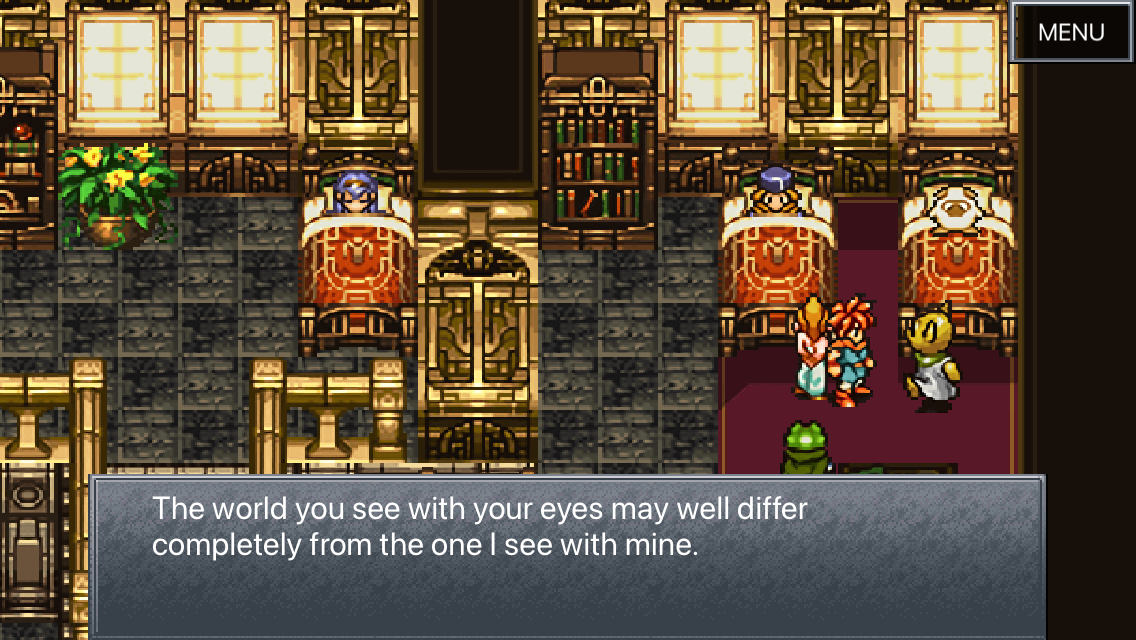
Screenshots from Chrono Trigger, the iOS edition.
In the book, Rev. Shun’ei Tagawa bluntly summarizes the Yogacara teaching that reality is:
“nothing but that which has been transformed by consciousness.”
Further Rev. Shun’ei then quotes a famous poem that encapsulates the teachings:
Japanese
Meaning
手を打てば
At the clapping of hands,
鯉はえさと聞き
The carp come swimming for food;
鳥は逃げ
The birds fly away in fright, and
女中は茶と聞く
A maiden comes carrying tea —
猿沢の池
Sarusawa Pond.
Translation by A Charles Muller
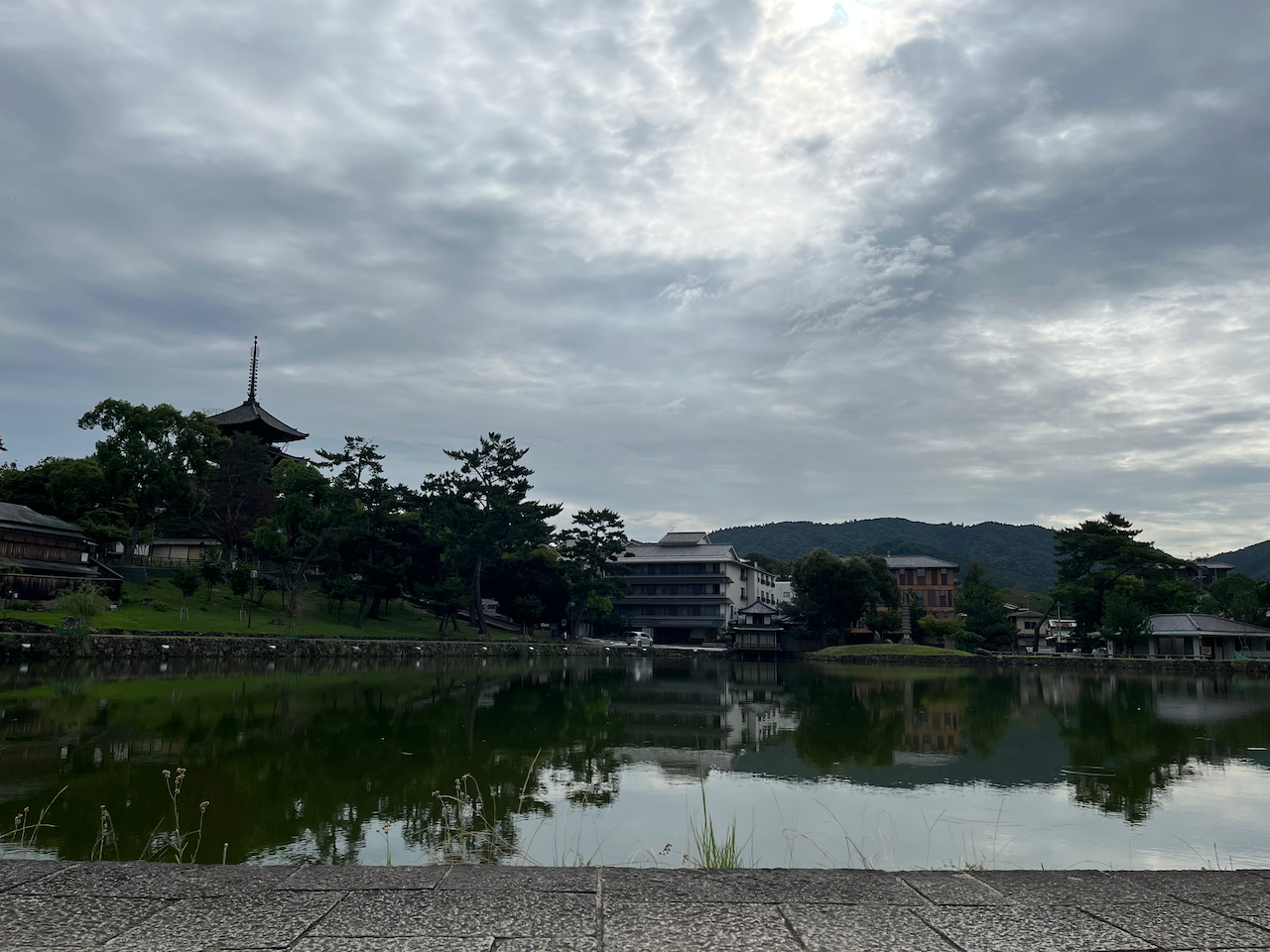
The famous Sarusawa Pond in Nara, Japan. Taken in July 2023. Kofukuji Temple can be seen to the left behind the trees.
The idea is that with a simple noise like the clapping of hands, each creature (or person) responds differently according to their background or how they view the world.
Using a more modern example from the book, imagine two people looking at a mountain together. One is a mountain climber, another is a painter. As a pile of rocks and magma formed by geological processes, a mountain is just a mountain. And yet, each person will perceive the mountain differently from one another. And such people will also interpret it differently than a goat on the mountain. It’s not a conscious effort either, it’s how our mind naturally works. Sort of a bubble of perception that we each live in, colored and reinforced by the constant feedback of our own thoughts, feelings and actions on the bubble’s inner surface.
Yet another example might be a fresh pair of jeans you bought and started wearing. Depending on what you do, or how you live your life, the jeans will absorb that. If you spend a lot of time in bars, your jeans start to smell like tobacco (or puke), if you work in a fast-food place your jeans smell like french fries, and if you visit Buddhist temples a lot, it will smell like incense. Your conduct, how you live your life and such, all play into a feedback loop that tends to reinforce itself, and in so doing “filter” your perception of the world. And this dynamic process is still ongoing every moment of your life.
Through this process, we also unknowingly isolate ourselves from the world around us, because, whether we are aware of it or not, we see ourselves as the center of the universe. This is why later Buddhist schools, such as the Zen Buddhists would use terms like the “mind as mirror” and such: what we perceive, we transform and filter in our conscious and project back out. We project ourselves back out onto the world around us all the time.
or, put another way…
What makes Yogacara Buddhist so fascinating is not just the concept, or its surface-similarity to Western philosophical ideas like Idealism, but how the early Yogacara Buddhists analyzed the “how” and “why” living beings do this, and further, how to apply this toward the Buddhist path toward liberation. Later Buddhist schools, I believe, applied Yogacara Buddhist teachings in their own ways, but the teaching remains more or less the same to this day even if couched in different language.
Anyhow, we’ve only scratched the surface here, but it’s a fascinating thing to look at, and hopefully I’ll be posting more content from Shun’ei Tagawa’s book.
Hope you’re all safe and well this Ohigan season, that the weather is pleasant, and you can take a moment to breathe easy and take it all in. Take care!
P.S. In the Chrono Trigger screenshots above, if you’re curious what the original Japanese text is (because you’re a big nerd like I am), it is:
Mantras are a strange beast within Buddhism. The tradition of mantras predates Buddhism and goes all the way back to the early “Vedic religion”, that is the ancient devotional practices around the Vedas (precursors to Hinduism as we know it), and they continue to occupy an awkward spot.
The Mantra of Light as shown in a Rinzai-Zen service book.
“Recitation” in Buddhism usually comes in the form of recitingsutras, which makes sense, because the tradition of passing down the teachings from teacher to student has existed from the beginning. Mantras do not fit this role since they are essentially obscure (not to mention mispronounced) Sanskrit phrases, with esoteric meanings. The esoteric traditions such as Vajrayana in Tibet, Shingon and Taimitsu (Tendai school) traditions in Japan all embrace them as a central practice,1 but in other non-esoteric traditions mantras are relegated to a backup “support” role, protecting the Buddhist disciple.
For example, here’s a certain mantra as found in a Rinzai Zen liturgy book I own. This is the famous Mantra of Light (kōmyō shingon, 光明真言), which reads in various languages like so:
Ǎn ā mó jiā wěi lú zuǒ nǎng mó hē mǔ nà luō me nǐ bō nà me rù mó luó bō luō wà duō yě hōng
Japanese:2
オン アボキャ ベイロシャノウ マカボダラ マニ ハンドマ ジンバラ ハラバリタヤ ウン
Japanese romanization
On abokya beiroshano makabodara mani handoma jinbara harabaritaya un
Here’s an example of how it’s chanted in Japan (notice the Siddham letters, too):
What makes the Mantra of Light somewhat unusual within the world of mantras and esoteric traditions in Buddhism is how widely it’s been adopted. You will find it in many Buddhist traditions, even ones that are otherwise not interested in esoteric practices.
In fact, for a time in the late Heian Period of Japan, the Mantra of Light was propped up as a rival practice to the nembutsu in the Pure Land tradition particularly by a monk named Myoe (明恵, 1173 – 1232).
At that time, there was an existing funerary practice of scattering sand blessed by the Mantra of Light on the deceased, but Myoe tried to popularize it further by playing up its benefits in helping one to be reborn in the Pure Land of Amitabha Buddha. This interpretation is largely Myoe’s, however.
It never quite worked as Myoe hoped, and the popularity of the nembutsu prevailed, but even today it’s common for Buddhist practitioners to chant both. I do this in my home service for example. I happen to like the Tendai-sect approach of “umbrella Buddhism” where meditation practices, Pure Land practices and esoteric practices are given roughly equal weight, with the Lotus Sutra as a kind of capstone.
Thus, reciting the nembutsu (pure land Buddhism) and the Mantra of Light (esoteric Buddhism) are both perfectly fine.3 For me at least, I chant the nembutsu for the benefit of others, and the Mantra of Light to reinforce my commitment to being a help to others (and be less of a dickhead). That may not be the correct approach, but it’s a start.
Speaking of which what does the Mantra of Light actually mean? Like all mantras, they’re infused with meaning in esoteric traditions, so a simple translation doesn’t tell the whole story. Furthermore, in esoteric traditions, mantras are supposed to be recited while visualizing a specific image and holding your hands in a specific “mudra”. This combination is thought to jar something deep inside, not at an intellectual level, but on an experiential level. Thus, the meaning of the mantra is something shared between teacher and student. So, I don’t have a good answer for this. If you really want to know, consult a trusted teacher in good-standing!
But it’s not necessary to know the exact meaning either. The act of recitation is more important, or so I have been told. So, if you chose to recite the nembutsu, Mantra of Light, both, neither, that’s fine. Buddhism has a large toolbox, so try what works, and enjoy!
1 Interestingly enough, the Japanese word “shingon” as in the Shingon school, literally just means “mantra”.
2 Mantras are usually written in Japanese using katakana, given that they’re technically foreign words, but for ease of readibility, hiragana is also used.
3 Meditation has always been my Achilles Heel, but I still meditate from time to time.
This is a photo from a sutra book I frequently use for daily services. I bought this book years ago from the temple of Sensoji (a.k.a. Asakusa Temple) in Tokyo, Japan, a place that I have visited many times over the years.
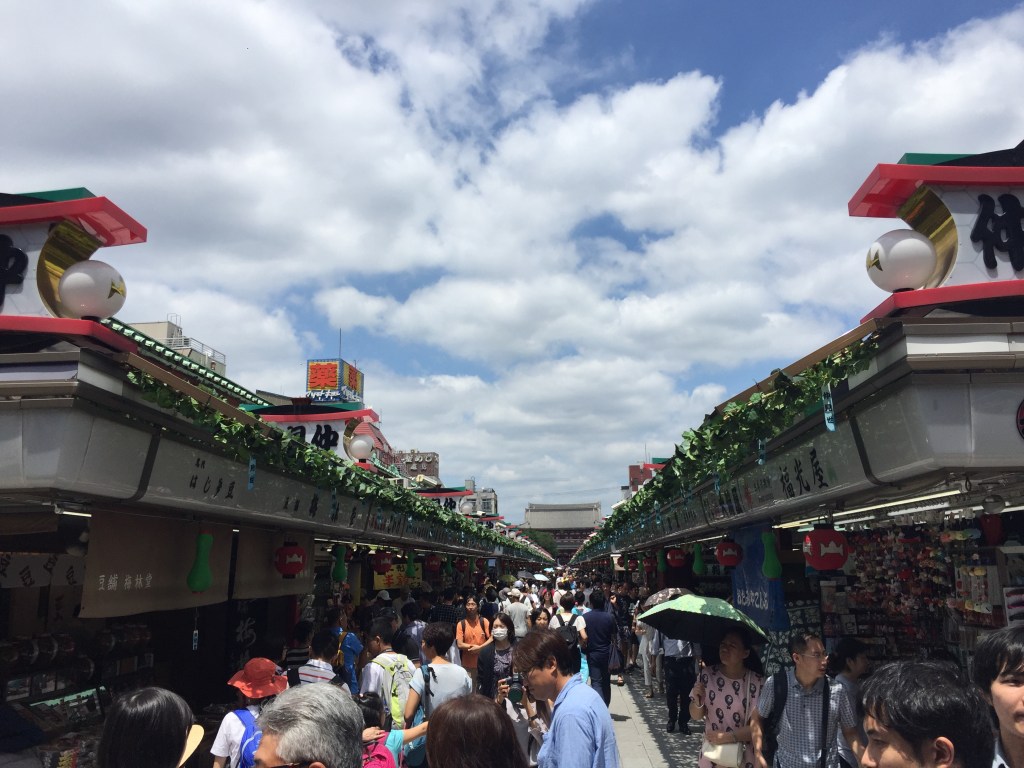
A photo I took in 2016 of the famous market of nakamise-dōri. The actual temple is way in the back.
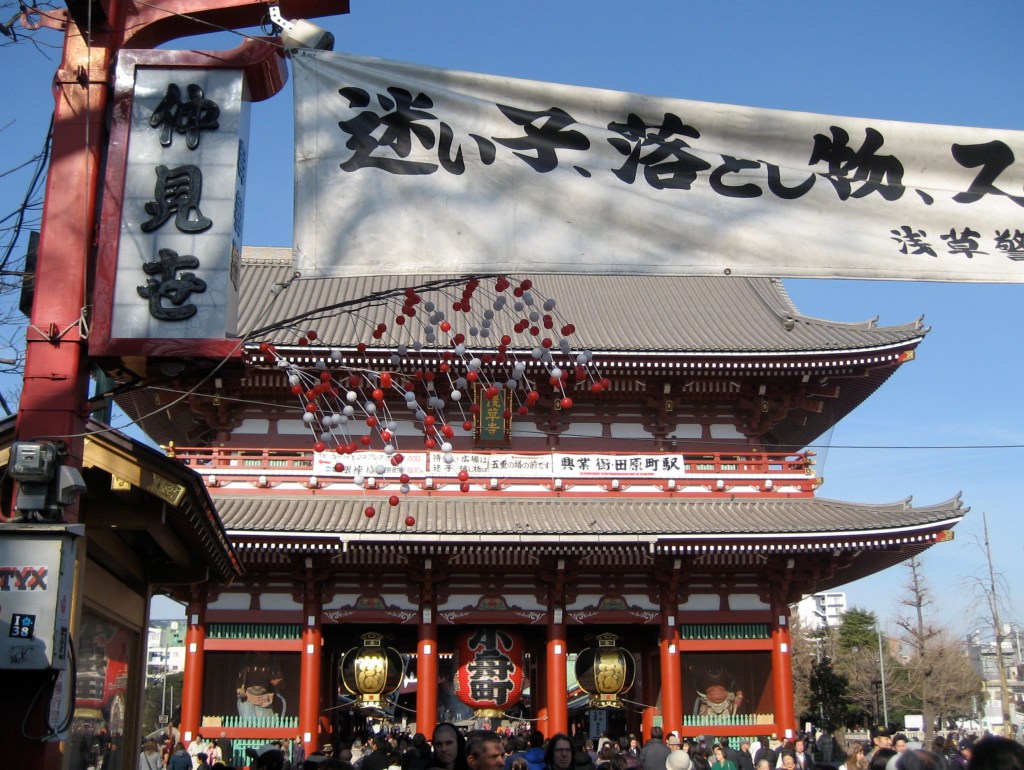
The temple just after New Year’s, taken in 2009.
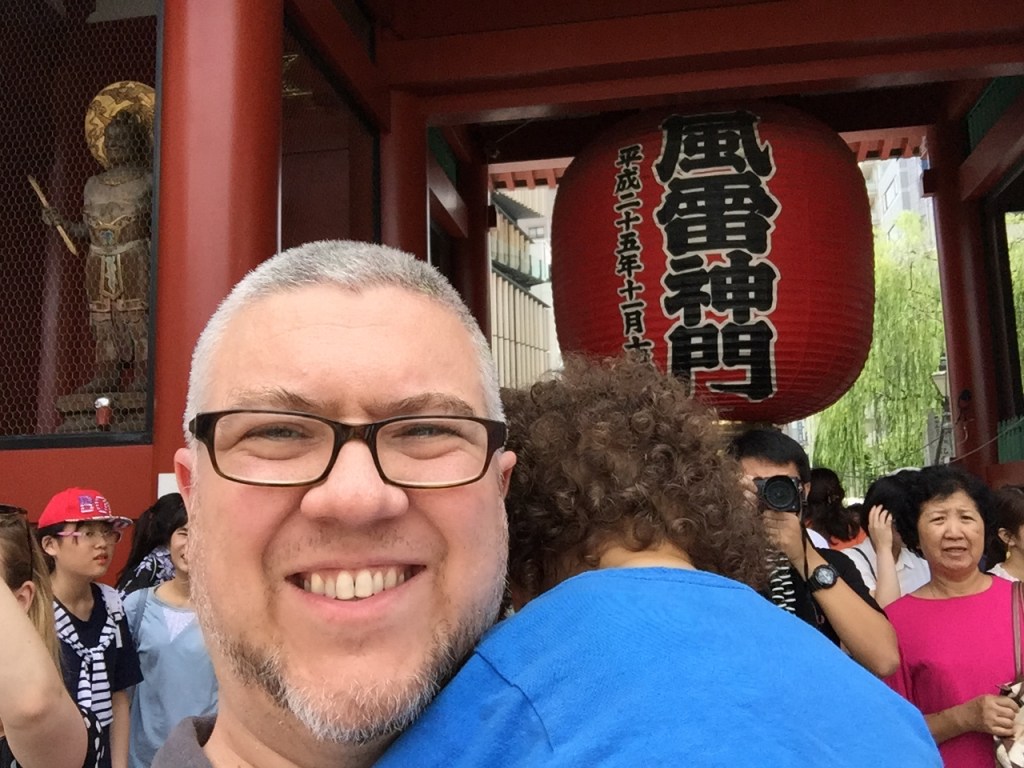
Me carrying one tired little boy at the iconic kaminari-mon gate in 2016. Note the giant red lantern in the back.
It is still one of my favorite temples, even if a bit touristy, and of the Buddhist sutra books I own this is still one of my favorite to use.1 This sutra book uses the traditional Classical Chinese with Japanese pronunciation guides (furigana), which is pretty typical of Japanese-Buddhist sutra books. As you can see, it’s not a long sutra to recite. It is probably the shortest sutra in the entire Buddhist canon.
Chanting the Heart Sutra is something many Buddhists in the Mahayana tradition (everything you see from Tibet to Japan, and overseas) do both in group services and in home services. People chant it in many languages and styles. Its simplicity, and general message about the nature of reality means that it tends to cut across sectarian lines and is popular in many sects and communities. Its cryptic and profound nature also means that for a one-page sutra it is the subject of intense study and research.
The sutra, for reference, is shown below. I used the standard Japanese liturgical form, recited in Zen temples, Tendai temples, Shingon temples, and so on, with only very minor differences per tradition. However, there are many ways and languages to recite the Heart Sutra.
kan ji zai bo satsu gyo jin han nya ha ra mi ta ji
When Avalokiteśvara Bodhisattva was practicing the profound Prajñāpāramitā,
照見五蘊皆空。
sho ken go un kai ku
he illuminated the Five Skandhas and saw that they were all empty,
度一切苦厄。
do is-sai ku yaku
and crossed over all suffering and affliction.
舎利子。色不異空。
sha ri shi shiki fu i ku
Śāriputra, form is not different from emptiness, and
空不異色。
ku fu i shiki
emptiness is not different from form.
色即是空。
shiki zoku ze ku
Form itself is emptiness, and
空即是色。
ku zoku ze shiki
emptiness itself is form.
受想行識亦復如是。
ju so gyo shiki yaku bu nyo ze
Sensation, conception, synthesis, and discrimination are also such as this.
舎利子。是諸法空相。
sha ri shi ze sho ho ku so
Śāriputra, all dharmas are empty:
不生不滅。
fu sho fu metsu
they are neither created nor destroyed,
不垢不浄。
fu ku fu jo
neither defiled nor pure,
不増不減。
fu zo fu gen
and they neither increase nor diminish.
是故空中。
ze ko ku chu
This is because in emptiness
無色無受想行識。
mu shiki mu ju so gyo shiki
there is no form, sensation, conception, synthesis, or discrimination.
無眼耳鼻舌身意。
mu gen-ni bi zes-shin i
There are no eyes, ears, nose, tongue, body, or thoughts.
無色声香味触法。
mu shiki sho ko mi soku ho
There are no forms, sounds, scents, tastes, sensations, or dharmas.
無眼界。
mu gen kai
There is no field of vision and
乃至無意識界。
nai shi mu i shiki kai
there is no realm of thoughts.
無無明。
mu mu myo
There is no ignorance
亦無無明尽。
yaku mu mu myo jin
nor elimination of ignorance,
乃至無老死。
nai shi mu ro shi
even up to and including no old age and death,
亦無老死尽。
yaku mu ro shi jin
nor elimination of old age and death.
無苦集滅道。
mu ku shu metsu do
There is no suffering, its accumulation, its elimination, or a path.
無智亦無得。
mu chi yaku mu toku
There is no understanding and no attaining.
以無所得故。
i mu sho tok-ko
Because there is no attainment,
菩提薩埵。依般若波羅蜜多故。
bo dai sat-ta e han nya ha ra mi ta ko
bodhisattvas rely on Prajñāpāramitā,
心無罜礙。
shin mu kei ge
and their minds have no obstructions.
無罜礙故。
mu kei ge ko
Since there are no obstructions,
無有恐怖。
mu u ku fu
they have no fears.
遠離一切顛倒夢想。
on ri is-sai ten do mu so
Because they are detached from backwards dream-thinking,
究竟涅槃。
ku gyo ne han
their final result is Nirvāṇa.
三世諸仏。
san ze sho butsu
Because all buddhas of the past, present, and future
依般若波羅蜜多故。
e han nya ha ra mi ta ko
rely on Prajñāpāramitā,
得阿耨多羅三藐三菩提。
toku a noku ta ra sam myaku san bo dai
they attain Anuttarā Samyaksaṃbodhi.
故知。般若波羅蜜多。
ko chi han nya ha ra mi ta
Therefore, know that Prajñāpāramitā
是大神呪。是大明呪。
ze dai jin shu ze dai myo shu
is a great spiritual mantra, a great brilliant mantra,
是無上呪。是無等等呪。
ze mu jo shu ze mu to do shu
an unsurpassed mantra, and an unequalled mantra.
能除一切苦。真実不虚故。説般若波羅蜜多呪。
no jo is-sai ku shin jitsu fu ko ko setsu han nya ha ra mi ta shu
The Prajñāpāramitā Mantra is spoken because it can truly remove all afflictions.
即説呪曰。
soku setsu shu watsu:
The mantra is spoken thusly:
羯諦羯諦波羅羯諦波羅僧羯諦菩提薩婆訶。
gya tei gya tei ha ra gya tei hara so gya tei bo ji so wa ka
gate gate pāragate pārasaṃgate bodhi svāhā3
般若心経
han nya shin gyo
The Heart Sutra
You can see a really nice example of this chanted here, courtesy of Koyasan Temple in Japan:
I have been reading Tanahashi’s book about the Heart Sutra and learning a lot about its various interpretations, how it’s conveyed in various languages, and various theories about its origin. I was fascinated to learn that there is a Mongolian version sometimes transcribed in Cyrillic. None of this is strictly necessary for the purposes of Buddhist practice, but it is fascinating. The example I showed above uses what’s called “Sino-Japanese”: Japanese pronunciation of the original Chinese characters it was composed with.2
As for chanting the sutra, I’ve been doing it for years, so I can more or less recite the Sino-Japanese version from memory, and am pretty comfortable doing it that way. I study the meaning of the sutra in English of course. I also have a PDF file for chanting in Sino-Japanese available for those interested.
I have also attended Zen centers on rare occasions (I tend to lean toward Pure Land Buddhism, to be honest) and seen the Heart Sutra recited using English. Learning the English meaning is very useful, but English chanting sounds a bit awkward to me. So, I prefer chanting in the original, and study the meaning separately.
But regardless of what language you use, the Heart Sutra, like all Buddhist sutras, has a funny tendency to gradually “sink in” over time. The meaning may not make much sense at first, but over the course of months and years, it takes on new meaning as you go through life, and see the sutra in a new light. I believe that’s the real value of Buddhist chanting: to internalize key Buddhist teachings in a way that you can carry with you throughout life.
As for me, these days, I tend to recite a Tendai-style home service,4 and as part of that I rotate between chanting this and a certain, small excerpt of the Immeasurable Life Sutra called the shiseige (四誓偈) or juseige (重誓偈) in Japanese Buddhism. When I finish one, I put it under the other sutra book, so I don’t forget which sutra to recite next time as I might go a week or two before reciting again. As a short, traditional liturgy, I am pretty content.
As with any Buddhist practice done over a long period of time, I believe that it gradually polishes the mind, and dispels one self-centered viewpoint. It’s super simple to do, but its benefits last a lifetime. To paraphrase Nichiren, when dying cloth in indigo, the more you do it, the deeper the color becomes.
Namu Amida Butsu Namu Kanzeon Bosatsu
Edit: I discovered in May 2025 some egregious mistakes in the formatting of the sutra above. This was not a problem with the translation, but with mistakes in how I copy-pasted into the blog post. I have since corrected these mistakes. Apologies to anyone who used the flawed copy of the sutra.
P.S. It’s tempting for some to look for an original “Sanskrit” version of the sutra, but alas, the best we know today is that the sutra was compiled originally in China, using excerpts from the much, much larger Prajña-paramita sutras. The story of how exactly that came to be is a much-discussed subject in Tanahashi’s book.
P.P.S. Fun fact: the version of the Heart Sutra used in Japan differs very slightly from the popular version attributed to Xuanzang. The Japanese version, popularized by the Shingon esoteric tradition, is called the rufubon (流布本) version. It has two extra Chinese characters (262 total) from Xuanzang’s 260, and uses slightly different characters for pronouncing the mantra at the end: 揭諦 instead of original 揭帝 for Sanskrit gaté.
1 Because it is devoted to Kannon Bodhisattva, this sutra book also includes (left in photo) a certain Japanese-Buddhist verse called the Jikku Kannon-gyō (十句観音経, “ten verse Kannon sutra”) popularized in the middle ages. I made a post here about it.
A nice explanation of the meaning and history of the ten-verse sutra can be found here.
2 It’s sometimes assumed that the sutra’s earliest composition was in a language like Sanskrit or something else from India, but research has long since proven that the Heart Sutra was a Chinese innovation, a summary of the much longer Perfection Wisdom Sutras, distilled into a very compact, chantable essence. The monk Xuan-zang later brought it back to India, where it later came to Tibet. Pretty clever actually.
3 I decided to leave the Sanskrit mantra untranslated, per esoteric-Buddhist tradition.
4 I like the Tendai approach to Buddhism because it encompasses all the things that are important to me, but avoiding a narrow, dogmatic approach that I found in the past and ultimately rejected.
Recently, I got into a debate online (that always ends well) about so-called “auxilliary” practices with some fellow Buddhists on an old, private discussion forum for Jodo Shu Buddhist teachings.
The debate started after someone on the forum asked about whether visualization of Amida Buddha was permitted in Jodo Shu, and I was not satisfied with the responses thus far which tended to strongly imply that it wasn’t worth doing, and that one should rely on the nembutsu only. I was somewhat annoyed by these replies, so I responded to the original poster like so (quoting almost verbatim here, minus some typographical editing):
In my experience, both Jodo Shu and the related Jodo Shinshu sects doctrinally focus on the spoken nembutsu only. I would argue though, that this “exclusive nembutsu teaching” is an idiosyncracy of Jodo Shu and does not always reflect the Pure Land tradition in general.
You are correct in that the Contemplation Sutra does teach an elaborate process for visualizing Amida Buddha, and this kind of visualization practice has been undertaken by monks, particularly in the Tiantai (Chinese) and Tendai (Japanese) sects among others. People tend to focus on a single passage toward the end of the sutra whereby reciting the name of Amida Buddha erases all karma, but in some monastic traditions, people have focused on visualization too.
It’s also true that there are parallel traditions for rebirth in the Pure Land that have nothing to do with the nembutsu, mostly in the esoteric tradition. Even today, Shingon Buddhism has visualization/chanting practices related to Amida Buddha that have little or anything to do with the nembutsu. Such parallel practices include such things as the Mantra of Light and various dharanis that sometimes appear in Zen traditions. Genshin, who was ironically a “patriarch” of the Jodo Shinshu tradition, listed many such methods in the Ojoyoshu, but in practice he recited the nembutsu like many other monks and nuns did during his time. Further, the 23rd chapter of the Lotus Sutra, clearly mentions rebirth in the Pure Land of Amitayus (Amida) Buddha through upholding the Lotus Sutra, not reciting the nembutsu.
I think most people would agree that the nembutsu tends to be the most simplest and straightforward, and thus people tend to treat it as the only viable solution in the so-called Latter Age of the Dharma. I think this is a bit of a leap, but if I were a priest and someone wanted to know more about the Pure Land, I would start by teaching the nembutsu too. It’s a great practice. On the other hand, I think it’s also important for people spiritually grow and if people want to branch out from the nembutsu, they should be able to do so without a sense of “guilt” caused by artificial, doctrinal orthodoxy. The reason, I think, is that the Pure Land tradition is more broad than the standard Jodo Shu/Shinshu narrative, and people who want to explore should feel free to do so.
Hope that makes sense,
Doug
Since my interest in Buddhism began in earnest in 2005, starting with Jodo Shu and Jodo Shinshu teachings, I have noticed a tendency for these two sects to dominate Pure Land Buddhist discussions among Western adherents. For a long time, I was also a fervent advocate, but I’ve since become wary of the exclusive approach taught by Jodo Shu/Jodo Shinshu Buddhism.
The heart of the issue, I believe, is the recitation of the nembutsu (念仏), the Buddha’s name, usually rendered as namu amida butsu (南無阿弥陀仏).
Jodo Shu and Jodo Shinshu sects treat this as the sole, exclusive practice and spend an inexhaustible amount of writing and research to assert this point. A cursory study of Jodo Shu/Shinshu literature will reveal that there isn’t much beyond this. The nembutsu is treated with an almost mystical reverence (which is especially amusing since such people are quick to reiterate that it’s not a mantra either). The “name” of Amida Buddha (myōgō 名号) is all-important and if you wish to reborn in the Pure Land of Amitabha Buddha, the only sure-fire method is to recite the nembutsu either as a practice (Jodo Shu) or as an expression of gratitude (Jodo Shinshu) for Amida Buddha’s grace already being extended to you. Beyond this, say adherents, nothing else really matters. Other practices in Buddhism may be conducive to you reciting the nembutsu, but have no merit or power beyond this. Even the Precepts aren’t particularly emphasized or important.
But, as I have learned from various sources, including my new book, this is a kind of revisionist history, and example of how prominent sects tend to dominate the conversation and cherry-pick only those things from the Buddhist sutras that bolster their view.
Further after some backlash, I explained further:
Within the context of Jodo Shu (and related sects), I agree that the position is that the nembutsu is the only essential practice. All other practices supplement it.
However, if you read the Three Pure Land sutras in their entirety, I believe that the authors suggested something slightly different. Take a look at this passage from the Larger Sutra (translation by Rev. Hisao Inagaki):
“For this reason, Ananda, sentient beings who wish to see Amitayus while in this world should awaken aspiration for the highest Enlightenment, do meritorious deeds, and aspire to be born in his land.”
and:
“Why do you not diligently practice good, reflect on the naturalness of the Way and realize that it is above all discriminations and is boundlessly pervasive? You should each make a great effort to attain it. Strive to escape from Samsara and be born in the Land of Peace and Provision. Then, the causes of the five evil realms having been destroyed, they will naturally cease to be, and so you will progress unhindered in your pursuit of the Way. The Pure Land is easy to reach, but very few actually go there. It rejects nobody, but naturally and unfailingly attracts beings. Why do you not abandon worldly matters and strive to enter the Way?”
I believe that the original authors of this sutra [were] advocating a more holistic approach toward rebirth in the Pure Land. It’s a similar message at the end of the Contemplation Sutra: spare no expense if you can.
The issue, I have observed, is that medieval Japanese monks had a tendency to read sutras literally and at face-value, because they were assumed to be the literal words of the Buddha (spoiler alert: they are not). It explains why they literally interpreted Dharma Decline as one of several 500-year periods, among other things. However, we’re living in the 21st century and have access to information they didn’t, so I believe it is beneficial to read the sutras critically, not literally.
Sure you can just recite the nembutsu, but why stop there? I believe that’s the message of both the Pure Land sutras and the Lotus Sutra ch. 2 when the Buddha says a person attains Buddhahood through a single nod to the Buddha or a single “hail Buddha”.
The intention of the Pure Land practices, I believe, isn’t just to get there; it’s part of the larger Mahayana-Buddhist theme of the potential of all beings to achieve Buddhahood and in turn help others still mired in Samsara. The Pure Land is one of many so-called “Dharma Gates” to accomplish this. The Pure Land “gate” just happens to be a particularly compelling one (full disclosure, I too recite the nembutsu).
But “the skies the limit” too, so don’t hesitate to adopt other practices if so inclined.
The danger of faithfully following a particular sect and its core beliefs is that you may well overlook obvious faults in logic, and may become complacent. You have to reassure yourself with “mental gymnastics” when faced by doubt or external criticism. My journey through Buddhism started as far back as 2005, and has taken plenty of twists and turns. At one point, I was even training for ordination as a lay priest in the Jodo Shinshu tradition. But in the end, I’ve become disillusioned by the narrow, sometimes dogmatic emphasis on the nembutsu to the exclusion of the larger Buddhist world and its array of practices and teachings. I can blame this doubt on my almost obsessive personal research at the time, but then again, changing your mind is the point of research. It’s OK to change your mind.
Looking back, I was kind of a fool in those days. I was so happy to have a Buddhist community around here like that, with a straightforward, accessible teaching, that I ignored the fact that it ran against the grain of my Buddhists beliefs. The desire to fit in was more important.
But it’s better to admit a sunk cost and move on, than to double-down. I left the community, somewhat abruptly, and floundered around for years (even deleted a blog or two at the time) until I eventually settled into the more holistic, Tendai-Buddhist practice I follow now, which includes the nembutsu, but a whole lot else too. I enjoy having a broader, not narrow, understanding of Mahayana Buddhism and its teachings, and the flexibility to practices various things in Buddhism without the guilt associated with “deviating” from the standard, orthodox teaching of the sect.
“Look, I already faced her once back when I believed in the throne, and it cost me everything. That’s what’s wrong with Asgard. The throne, the secrets, the whole golden sham.”
Valkyrie, “Thor: Ragnarok”
Much of the centuries of traditions, priesthoods, beautiful liturgy and the high quality books printed in English for budding Western communities are, if you scratch the surface and dig deeper, just a golden sham.1 That leaves any spiritual seeker with a dilemma: fall in line and find contentment, or learn what you can, apply what’s useful, and keep moving onward.
“Come, Kalamas. Do not go upon what has been acquired by repeated hearing; nor upon tradition; nor upon rumor; nor upon what is in a scripture; nor upon surmise; nor upon an axiom; nor upon specious reasoning; nor upon a bias towards a notion that has been pondered over; nor upon another’s seeming ability; nor upon the consideration, ‘The monk is our teacher.’ Kalamas, when you yourselves know: ‘These things are good; these things are not blamable; these things are praised by the wise; undertaken and observed, these things lead to benefit and happiness,’ enter on and abide in them.
trans by Soma Thera
The Kalama Sutta doesn’t mean you can just believe what you want, the Buddha is telling the Kalamas to think for themselves and weigh the teachings and traditions objectively against what they know to be good, right, beneficial and blameless. He is encouraging a kind of scientific observation.
So, if you ever feel pressure from your religious community to “toe the line” or that maybe you’re not a “good Buddhist (or whatever religion)”, stop and remember that the problem might not actually be you.
P. S. For the record, Jodo Shu Buddhism still holds a special place in my heart since it has been a long, and largely positive influence on my life. So I am grateful, but I’ve also moved on.
1 Of course, all of this could be just as easily said of many religious communities around the world.






 Gleanings in Buddha-Fields
You must be logged in to post a comment.