My family and I visit a certain Shingon-sect Buddhist temple in the area for New Years tradition, and also for Setsubun rituals (namely mamemaki bean-throwing, plus good luck). Neither my wife nor I follow the Shingon sect, but Japanese-buddhist temples for the Japanese community (not Westerners) are rare, so we are glad to visit despite the lengthy drive.
Shingon Buddhism, one of two “esoteric” (mikkyō, 密教) Buddhist traditions in Japan,1 relies on a complex array of ceremonies, rituals, symbolism, and mantra chants that help awaken one’s Buddha-nature not through words, but through a kind of non-verbal impact. This requires a trained teacher to guide one through it, hence it’s called “esoteric” Buddhism (a.k.a. Vajrayana Buddhism). Years ago, I attended a “moon meditation” sitting once where each one of us sat and meditated before a hanging scroll showing a full moon. It was an interesting experience.
Anyhow, one ceremony that’s very common in Shingon is called the Goma-taki (護摩炊き) ritual, or “fire ceremony”. This is often called Goma in English. This is a video provided by Koyasan Temple in Japan which shows a complete ceremony: a priest creates a pyre within a sacred space, often before a statue of Fudo-myo-o (不動明王). Throughout the ceremony, the priest recites certain chants and uses certain hand-gestures. The fire is thought to purify one’s mental defilements, burn away past karma too, and also certain sticks are added to the fire with people’s aspirations and wishes written on them.
At our temple here locally, the priest conducts the Goma ritual as well, and people receive blessings from the ceremony one by one, and we also receive small o-fuda talisman that we place next to our Buddhist altar at home for protection. These are larger than omamori charms, made of wood or cardboard, and usually enshrined, not carried on your person.
The origins of the Goma-taki ritual are taken from Indian religious practices of the past, but gradually underwent “Buddhification” (absorbing practices, and making them Buddhist) and this is why, I believe, that esoteric Buddhism arose in later generations of Buddhism in India.2 The deities portrayed in esoteric Buddhism also have origins in India, but transformed as they were brought through China to Japan.
Goma-taki rituals are frequently held for the public in larger Japanese temples, so you can easily drop and just observe, but be aware they can take up to an hour or more. But it is a pretty interesting experience and well worth observing.
Namu Daishi Henjo Kongo (Praise to the Great Teacher Vairocana Vajra, a.k.a. Kukai / Kobo Daishi)3
1 the other is Tendai Buddhism, which calls it taimitsu (台密), not mikkyo. What are the differences? Not sure. Both lineages come from the same Chinese-Buddhist tradition of the time, but beyond that, no idea.
2 Seen from one perspective, the earliest texts and traditions in Buddhism did not feature any esoteric practices and rituals, so if you’re looking for “pristine” Buddhism then esoteric practices don’t fit this. From another point of view, Buddhism continued to innovate across generations, first Mahayana Buddhism, then esoteric practices, so in that light esoteric Buddhism solves problems of practice and teaching that earlier Buddhism struggled with. I don’t know which viewpoint is the right one, personally. I am a big proponent of easy, accessible Buddhist teachings and practices (hence the nembutsu, precepts, etc), and esoteric Buddhism doesn’t make this easy. And yet, it is surprisingly popular in Japan (2nd only to Pure Land Buddhism), so maybe there’s something there that I’ve failed to notice all this time? 🤷🏼♂️
3 This is often recited in Shingon tradition the way namu amida butsu is recited in Pure Land traditions in Japan.
Speaking of going off the rails, I once wrote about how politics had a pretty corrosive effect on the Tendai Buddhist monastic community on Mount Hiei during the late Heian Period of Japanese history, but there’s aspect to this increased corruption and declining monastic discipline: the esoteric Buddhist tradition itself. Scholar Paul Groner has done extensive research about Tendai Buddhism and history, and published an article in 1987 about an influential Tendai monk named Annen (安然, 841–889?) who’s innovations to esoterica and Buddhism had a detrimental impact to the community.
This is also covered in a book I’ve been reading recently about the “Original Enlightenment” teaching that medieval Tendai strongly advocated at the time. More on that book later (it’s a tough read, so it’s taking me a while).
A quick history of Tendai Buddhism in Japan and the Esoteric tradition.
Esoteric Buddhism (a.k.a. Vajrayana) was imported into Japan in early centuries of history, but mostly as an afterthought.1 It wasn’t until a monk named Kukai (空海; 774 – 835), founder of Shingon that Vajrayana Buddhism came to the fore. Kukai had studied it thoroughly under Indian and Chinese masters in the Chinese capital, and brought back a full program to Japan. It was the hot, new thing among the elite classes of Japan at time.
Saicho, founder of Tendai, had made the same journey to China, but was focused on learning Tian-tai (parent sect of Tendai) teachings, and only had a partial, incomplete training in Vajrayana. His disciples Ennin and Enchin also journeyed to China, and came back with a much more complete training, and helped establish a separate esoteric lineage from their rivals, the Shington sect under Kukai. The esoteric tradition within Tendai is called Taimitsu (台密).
Esoteric Buddhism was hugely popular among the affluent nobility in the capitol of Kyoto, who employed monks to officiate ceremonies, exorcise demons, cure illnesses, and bring prosperity. The Imperial Court also employed large numbers of monks regularly to pray for the safety of the nation from natural disasters, plagues and such. Over time, the Tendai sect in particular, due to its close proximity to the capitol, and extensive esoteric tradition developed a very close relationship with the government. Monks who were esoteric masters (阿闍梨, ajari) were especially popular among the elite. Further, because high-ranking monks in the Tendai order often came from noble families, there was increasing social relationships too. Popular monks were invited to parties, participated in poetry recitals and so on.
Back to Annen.
According to Dr Groner’s article, Annen was trained by two eminent monks at the time: Tankei (湛契, 817-880) and Henjo (遍昭, 817-890), the same Henjo who wrote poem 12 of the Hyakunin Isshu anthology. Both were part of the Tendai order on Mount Hiei, but found favor with the aristocracy and became “celebrity” priests.
Tankei was later defrocked after an affair with the Imperial prince’s wet nurse, but due to connections went on to serve in the Imperial bureaucracy and rose through the ranks until he reached junior fourth rank (equivalent to minor nobility). Strangely, while the Imperial government supported his defrocking over the affair, the Tendai sect establishment were angry about it, apparently not viewing the breaking of the vow of celibacy as a serious issue.
Similarly, Henjo was a nobleman for a long time, eventually who ordained in the Tendai order after the death of his liege Emperor Ninmyo in the year 850. By 868, after becoming an accomplished esoteric master, he mingled with the nobility again and was even granted a property by Ninmyo’s son for a new temple: the Unrin-in (雲林院). As Henjo established a monastic community there, in close proximity of the capitol, he started running the community his own way, shortening monastic training time, relaxing standards, etc.
Annen through training under Tankei and Henjo, developed into an accomplished master of the esoteric practices. He became a prolific writer and advocated a more urbane approach to monastic discipline where sincere intention was more important than actual discipline through the monastic precepts. For example, in his work, the futsu jubosatsukai koshaku (普通授菩薩戒広釈), Annen downplayed violating the precepts by explaining them away as an training expedient. It would be OK to violate the precepts in some situations, for example as an act of compassion for sentient beings.
Not everyone within the Tendai order agreed with this: The venerable Enchin complained in his generation that monks were already getting lax, wearing expensive robes, skipping the fortnight assembly, and so on. But Annen’s influence was too strong, and his interpretation of following the precepts loose enough for monks to bend the rules as this wished. This coupled with certain trendy theories at the time, such as the idea that “grasses and trees were enlightened”, led to a decline in monastic discipline that persisted all the way until the Edo Period (17th -19th century) when serious efforts to reintroduce monastic discipline were finally re-introduced. This was the Anraku Movement, by the way.
The issue is twofold: the vagueness of the Bodhisattva precepts employed by the Tendai sect exclusively allowed for individual interpretation. A monk with sincere intentions might still uphold proper behavior, but a monk with less sincere intentions might bend the interpretation to suit his conduct, rather than the other way around.
The second issue was the increasing intermixing of monks with the aristocracy. In the Buddha’s time ages ago in India, this was strictly forbidden. Monks were to withdraw from the contemporary world, and concentrate on strict monastic practice. Now, monks were fraternizing openly with the Imperial court instead of focusing on practice. This was done under the guise of “compassion for others”, but the results speak for themselves.
Anyhow, it easy to see how religious practice and teachings can fall under the sway of sophistry and go off the rails. Even in the Buddha’s time, he addressed this. In a conversation with the senior disciple Kashyapa in the Saddhammapaṭirūpaka Sutta (SN 16:13), the Buddha explains:
“These five downward-leading qualities tend to the confusion and disappearance of the true Dhamma. Which five? There is the case where the monks, nuns, male lay followers, & female lay followers live without respect, without deference, for the Teacher. They live without respect, without deference, for the Dhamma… for the Saṅgha… for the training… for concentration. These are the five downward-leading qualities that tend to the confusion and disappearance of the true Dhamma.
Translation by Thanissaro Bhikkhu
Once people started interpreting the Dharma their own way, the real Dharma got obfuscated, monastic disciples get confused, and things go off the rails.
Not surprisingly, this wasn’t the last time this happened in Japanese history.
P.S. Dr Groner’s article is a good read, so check it out.
1 Called Mikkyō (密教) in Japanese, “secret teaching”.
Now, I, Vairocana Buddha am sitting atop a lotus pedestal;
On a thousand flowers surrounding me are a thousand Sakyamuni Buddhas.
Each flower supports a hundred million worlds; in each world a Sakyamuni Buddha appears.
All are seated beneath a Bodhi-tree, all simultaneously attain Buddhahood.
All these innumerable Buddhas have Vairocana as their original body.
The Mahayana version of the “Brahma Net Sutra”, translation by Young Men’s Buddhist Association
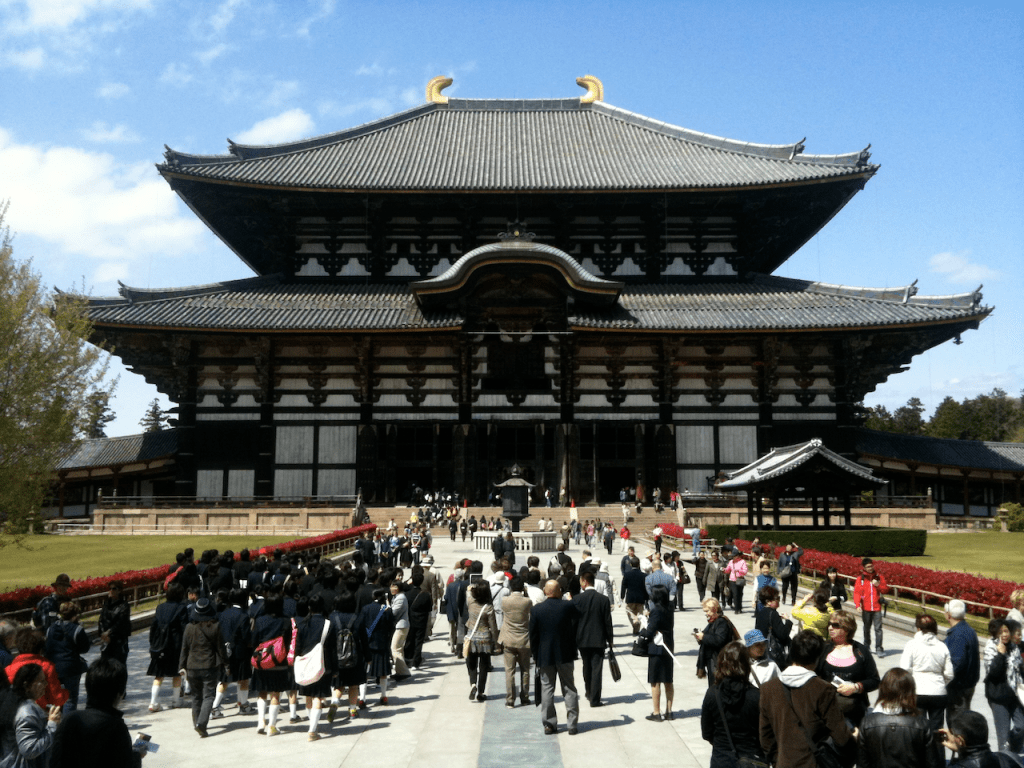
If you ever visit the famous Todaiji temple in Nara, Japan, you will see a truly colossal structure like so:
Taken by me on April 2010.
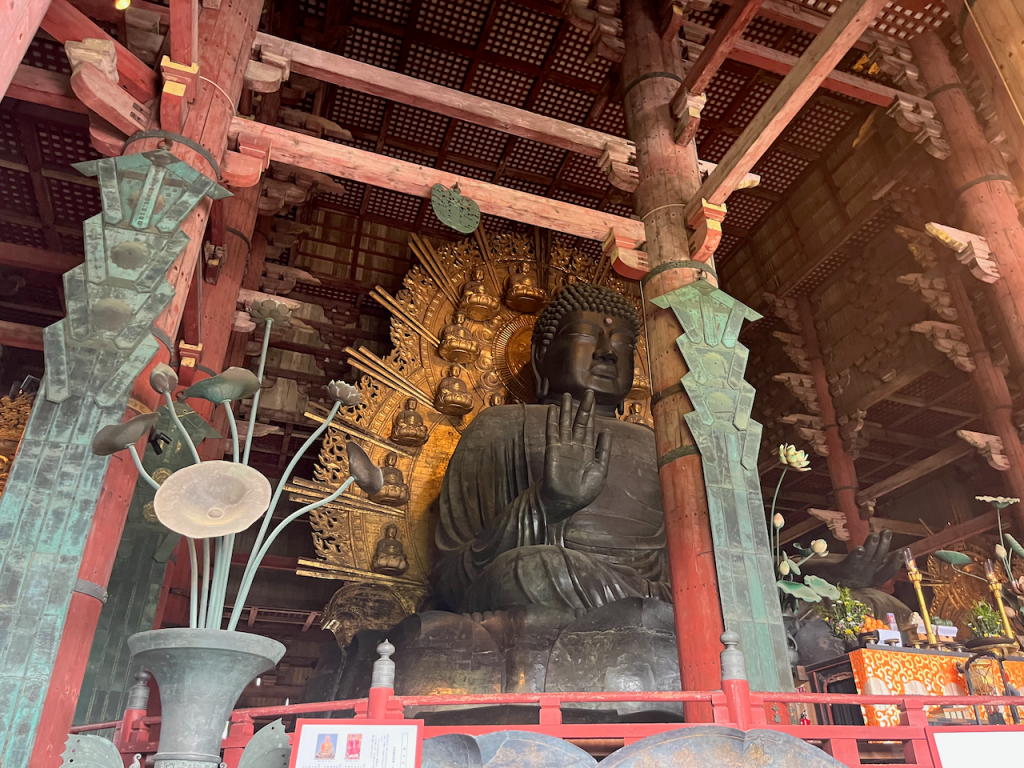
Inside as you approach is a colossal Buddha statue:
A side profile of the Great Buddha (daibutsu) of Todaiji Temple in Nara, Japan. This Buddha is Vairocana Buddha, the “Buddha of the Sun”. Taken in 2023.
This picture does not convey the size very well. It’s truly massive. But what is this Buddha?
This Buddha is a somewhat obscure figure named Vairocana (pronounced Wai-ro-chana) in Sanskrit, which means something like “of the Sun”. So, Vairocana is the Buddha of the Sun.
Vairocana features in a few Buddhist texts in the Mahayana canon: the Brahma Net Sutra quoted above and the voluminous Flower Garland Sutra, for example. It is also very prominent in esoteric traditions in Japan (Shingon and Tendai sects) as Maha-Vairocana (“Great Buddha of the Sun”).
The Brahma Net Sutra introduced Vairocana and explains that all Buddhas that appear in such-and-such time and place are embodiments of Vairocana. Thus Vairocana isn’t just another buddha, but is their source. Vairocana, in other words, embodies the Dharma.
That is why in the Great Buddha statue above at Todaiji Temple, you see rays of light emanating outward with “mini Buddhas” among them. Each of these Buddhas is thought to have the same basic origin story as the historical Shakyamuni Buddha. Hence in the text they are all just called “Shakymunis”. All these Buddhas have the same basic qualities ( Chapter Two of the Lotus Sutra teaches the same thing, by he way), one is the same as all the others.
This is primarily a Mahayana-Buddhist concept, but has precedence in pre-Mahayana sources. Consider the Vakkali Sutta from the Pali Canon:
“Enough, Vakkali! What is there to see in this vile body? He who sees Dhamma, Vakkali, sees me; he who sees me sees Dhamma. Truly seeing Dhamma, one sees me; seeing me one sees Dhamma.”
Translation by Maurice O’Connell Walshe
So the historical Buddha, founder of the Buddhist religion, Shakyamuni, is telling his disciples that his personage is less important than the Dharma. Mahayana Buddhism simply applies this same teaching towards all the Buddhas.
Also, some Buddhist texts assign different Buddhas to this role: the “cosmic” Shakyamuni Buddha of the Lotus Sutra or Amida Buddha in interpretations.
But it doesn’t really matter what you call this embodiment of the Dharma.
What matters, I think, is that the source of Buddhist wisdom is the Dharma, not a specific teacher, and that the Dharma pervades everywhere, regardless of the particular community, or lack thereof….
I saw this post recently on BlueSky, the hip new social media platform all the kids are talking about,1 and I had to share it with readers 🤣:
Speed-running is a fascinating sub-culture of gamers who finish games in impossibly short times through a combination of intense practice, manipulating errors in game code, and pre-planned strategy. My son and I like to watch speed-run world-records on YouTube for games I used to play as a kid. For example, this is a speed-run video where someone beats the classic NES game Mike Tyson’s Punch-Out in 22 minutes!
And this video shows someone attaining the world record for finishing the original Super Mario Brothers in 4:57. You can see multiple sneaky glitches and exploits here, plus lots of careful jump timing:
Finally, in this video, someone cleverly exploits an obscure glitch in Super Mario 3 to beat the game in 3:32!!!
But what does this have to do with Buddhism?
Buddhism is a 2,500-year old religion, adopted by many cultures and many times. The Buddha Shakyamuni (i.e. our historical founder), laid out the basic premise and trained his disciples on how to liberate themselves from the endless cycle of Samsara, and especially in the Mahayana-Buddhist tradition, to liberate others. We can see in early texts that this was a regimen of meditation training, self-restraint and living a humble, monastic lifestyle, as well as observation into one’s own mind. In video game terms, you can think of this as “grinding” level after level, building your skills, taking countless hours of gameplay.
The Buddhist path is a slow process, and requires a lifetime of dedication. Periodic visits to your favorite “meditation center” are fine, but Buddhism traditionally sees the path to awakening as a multi-lifetime endeavor for all but the truly talented (who may have already cultivated these qualities in previous lifetimes).
The actual length of time it normally took to accomplish awakening in Buddhism was hotly debated across Buddhist history. Early Buddhist texts implied that monks who were well-trained, or even lay-people who assiduously followed the basic code of conduct, could expect to reach awakening in one more lifetime, or may be a few lifetimes. But in Mahayana Buddhism, the length of time got longer and longer times as the bar of difficulty got higher and higher, well beyond what one could reasonably accomplish. A text called the Sutra of the Ten Stages in the Flower Garland Sutra describes the “Ten Stages of a Bodhisattva” over dozens of pages, and what’s required to complete each one before even getting to awakening. But each stage is a huge, huge endeavor by itself. Lifetimes of effort were not measured in eons of lifetimes.
As the road to awakening became longer and more remote, many Buddhist methods were developed to compensate for this and help people achieve the fruition of the Buddhist path much sooner, often through devotion to on Buddhist deity or another, or through specific samadhi methods, meditations and so on. The Pure Land path is by far the most popular and well-known due to its accessibility.
But in particular the Esoteric or Vajrayana traditions developed in the first centuries CE, hundreds of years after the Buddha. Historically speaking, the trend toward a longer and longer Buddhist path reversed and using this or that series of rituals, mantra chants, and mandala visual aids, one could “hack” the code of Buddhism and accomplish awakening in this very lifetime. Of course, the secrets behind such Buddhist speed-running techniques require a guru and a lineage.2 Vajrayana Buddhism is most prevalent in Tibet, but also in Japan through both Shingon and Tendai Buddhism.
But this does beg the question: is it really possible to speed-run the Buddhist path? Further, is the Buddhist path really eons and eons long as Mahayana Buddhism tends to assert, or is the length of time over-inflated?
Frankly, I don’t know.
Esoteric teachings and practices were definitely not part of the early Buddhist tradition (I definitely do not buy the idea of “secrets transmissions”, either). The Buddha’s advice in the early texts is generally pretty straightforward, one might say a little bland and anti-climactic, but also challenging because it gets to the root of who we are. It is definitely a lifetime effort.
But as much as I love the Mahayana tradition, it did have a tendency to out-do itself over and over. Waves and waves of Mahayana texts get increasingly dramatic, increasingly grandiose, and describe the Buddha path (namely through the Bodhisattva path) increasingly challenging terms. A backlash was inevitable, and so I can’t say I’m surprised that anti-intellectual movements such as Zen and Pure Land Buddhism, or “speed-run” methods such as Vajrayana arose in response.
Then there’s inevitable backlash from modern Buddhists who look at this convoluted history and complain, “none of this is real Buddhism anymore, it just cultural accretions”.
Every religion changes and evolves. Christianity as we know it didn’t have Christmas trees, and used Jewish-style liturgy in its early years. It adapted as it moved into new cultures. Islam grew into two different traditions, and as it became more urbanized some of the desert-nomadic traditions of the early community had to be adapted. Even obscure religions such as Zoroastrianism, whose early texts were composed amidst a steppe-nomadic culture, evolved to a more urbane and worldly culture until the Persian Empire.3
Zealous people love to go on a quest to find the “pristine” religious teachings, but you’ll never really find it. At best, you’re just reconstructing from pieces of the ancient past. At worst, you and your community just goes off the rails. It’s a fruitless quest.
So what to make of all this history and breadth of practice in Buddhism? Again, I just don’t know.
I do think that the old Kalama Sutta of the Pali Canon (AN 3.65) does provide some help though (slightly edited for readbility):
“It is proper for you, Kalamas, to doubt, to be uncertain; uncertainty has arisen in you about what is doubtful. Come, Kalamas. Do not go upon what has been acquired by repeated hearing; nor upon tradition; nor upon rumor; nor upon what is in a scripture; nor upon surmise; nor upon an axiom; nor upon specious reasoning; nor upon a bias toward a notion that has been pondered over; nor upon another’s seeming ability; nor upon the consideration, ‘The monk is our teacher.’
Kalamas, when you yourselves know: ‘These things are bad; these things are blamable; these things are censured by the wise; undertaken and observed, these things lead to harm and ill,’ abandon them.
Translation by Soma Thera
Followed by:4
…Kalamas, when you yourselves know: “These things are good; these things are not blamable; these things are praised by the wise; undertaken and observed, these things lead to benefit and happiness,” enter on and abide in them.’
Translation by Soma Thera
or the Buddha preaching to his stepmom in the Gotami Sutta of the Pali Canon (AN 8.53) :
“Gotamī, the qualities of which you may know, ‘These qualities lead to passion, not to dispassion; to being fettered, not to being unfettered; to accumulating, not to shedding; to self-aggrandizement, not to modesty; to discontent, not to contentment; to entanglement, not to reclusiveness; to laziness, not to aroused persistence; to being burdensome, not to being unburdensome’: You may categorically hold, ‘This is not the Dhamma, this is not the Vinaya, this is not the Teacher’s instruction.’
Translation by Thanissaro Bhikkhu
To summarize, if your Buddhist is leading to negative qualities described here, you should probably stop. If it is leading to wholesome qualities described here, keep going.
Namo Shakyamuni Buddha
Edit: I forgot to mention that the ultimate speed-runner in Buddhism is the Dragon Princess from the 12th chapter of the Lotus Sutra:
At that time the members of the assembly all saw the dragon girl in the space of an instant change into a man and carry out all the practices of a bodhisattva, immediately proceeding to the Spotless World of the south, taking a seat on a jeweled lotus, and attaining impartial and correct enlightenment. With the thirty-two features and the eighty characteristics, he expounded the wonderful Law for all living beings everywhere in the ten directions.
Translation by Burton Watson
1 I have a couple BlueSky feeds on there, but nothing related to the blog.
2 The Zen tradition is often compared to the Esoteric tradition since it also has ineffable teachings that can only be conveyed by a proper teacher.
3 I only know this because of the History of Persia podcast, by the way.
4 Because early Buddhist texts (sutras) were memorized and recited, they tended to be very repetitious. Later sutras, those in the Mahayana-Buddhist canon, used a more narrative style and thus longer and less repetitive, but also much more epic in tone.
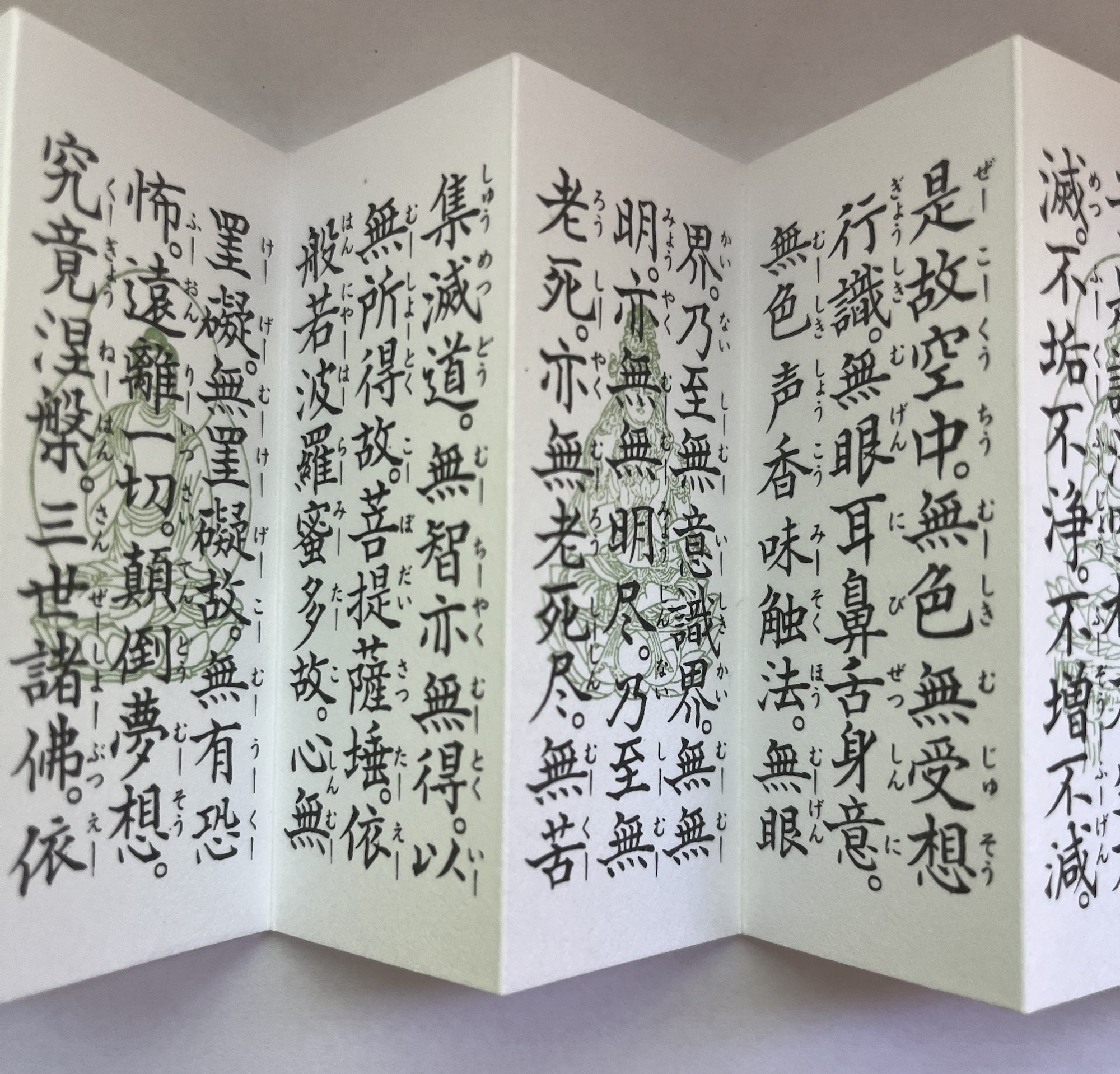
When visiting famous Buddhist temples (o-tera, お寺) in Japan, it’s very common to see sutra books, or kyōten, (経典), sold in the gift shop. These are small booklets that contain popular Buddhist sutras of the Mahayana tradition, and are used for home services. Over the years, I’ve collected more sutra books than I care to admit, but I really liked the one I picked up from Kofukuji temple in Nara last year:
This is a boxed copy of the Heart Sutra, called the Hannya Shingyō (般若心経), with a blue brocade cover. Inside, you can see the Heart Sutra as it is usually printed: original Chinese characters with Japanese pronunciation guides. It is read from right to left, vertically:
However, if you look carefully, you will also see Buddhist deities embossed on the pages too:
They also appear on the backs of the pages too:
It took me a moment, but I finally recognized these as the Thirteen Buddhas and Bodhisattvas venerated in the Shingon-Buddhist tradition.1
I have read that many of the old Nara-Buddhist sects were gradually subsumed by Shingon Buddhism and adopted many of its practices. This includes sects such as the Kegon sect (Todaiji temple) and Hosso sect (Kofukuji temple) among others. So, this makes sense. You can learn more about Shingon Buddhism here.
Anyhow, of all the sutra books I own, I have to admit that this is my favorite one, and use it regularly for morning services (see old post).
P.S. If you’re ever curious what the Heart Sutra sounds like in Chinese (at least modern Chinese), this link has a nice example.
1 These Buddhas and Bodhisattvas are venerated in other sects in varying degrees, of course, but not as a set of thirteen like Shingon. Shingon even includes them in its ritual services.
Another dharani I was reading about lately is the Great Compassion Dharani, also known as the Nīlakaṇṭha Dhāraṇī, or in Japanese Buddhism the daihishin darani (大悲心陀羅尼), also known more simply as the daihishu (大悲咒), among other names.
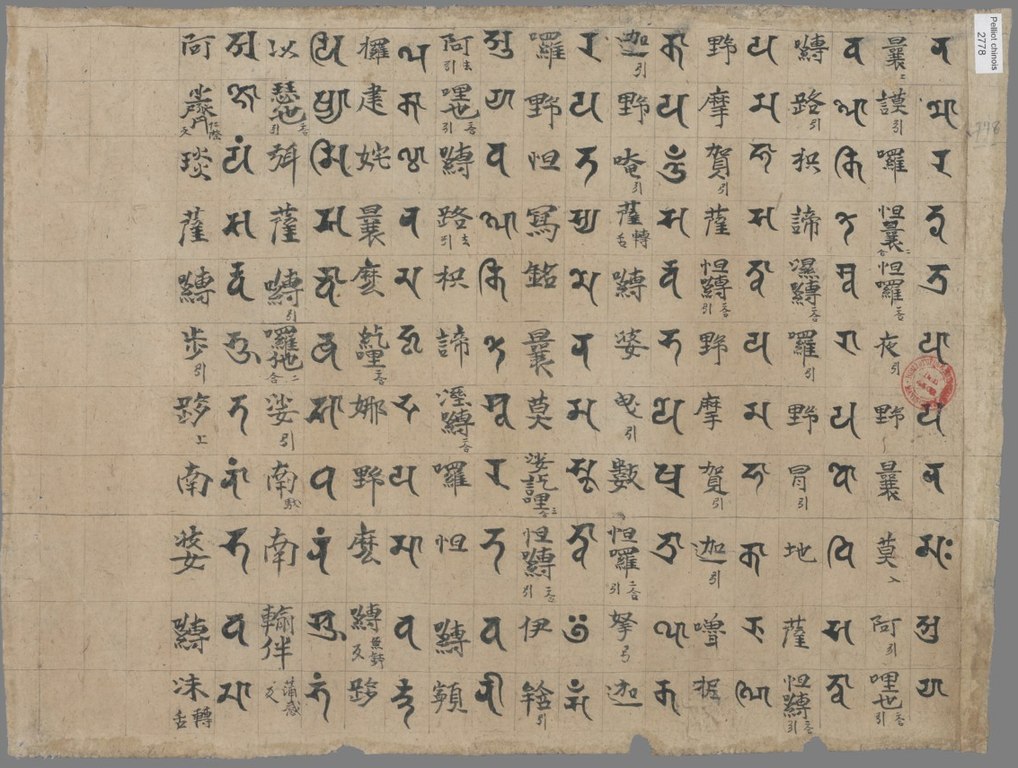
According to Wikipedia, this is one of widely recited dharani across the Buddhist tradition, and has undergone various changes over time, with a couple extant (though corrupted) versions. The featured photo above is an example found in the Dunhuang caves of China, showing the original text in Siddham script, with Chinese transliteration:
Fragment of the Nilaṇṭhanāmahṛdaya dhāraṇī both written in Siddhaṃ script and transliterated in Chinese characters. Bibliothèque nationale de France, Public domain, via Wikimedia Commons
You can see another example here, using both Siddham script, and the ancient Sogdian script:
Whereas the Dharani for the Prevention of Disaster (discussed in a previous post) is focused on practical matters, the Great Compassion Dharani is meant to be chanted in order to awaken goodwill towards others, using Kannon Bodhisattva as the archetype. It is taken from a longer Buddhist text, the Sutra on the Thousand-armed, Thousand-eyed Bodhisattva Avalokitesvara’s Sutra of Dharanis on the Vast, Perfect, and Unobstructed Mind of Great Compassion (千手千眼観世音菩薩広大円満無礙大悲心陀羅尼経).
This dharani is most closely associated the Zen traditions, but because it is pretty long, it’s probably not always practical for lay followers to recite in daily services. I have not seen it listed in service books for lay followers in either Soto Zen or Rinzai Zen. In any case, I am posting it here as a reference.
You can see an example of the Great Compassion Dharani being chanted in a formal Soto Zen service here:
There is a nice Chinese-language version here (starts at 1:07):
I have posted the dharani here in multiple languages, so that people can choose which version they prefer to recite. The main source was Wikipedia, but for the Chinese Pinyin, I had to check multiple websites as the pinyin varied slightly in some places, while for the Japanese version, I checked line by line in the video above.
Side note, there is a different version in the Japanese Shingon-Buddhist tradition, but I am too lazy to post here, since the dharani is so long. You can find it here on the Japanese Wikipedia article under “真言宗の読み方”.
June 2025: Major rewrite of this page to make the text side-by-side, but also fixed several typos.
1 Sources used to validate the pinyin: here and here, plus Wikipedia article. Each one slightly disagreed with one another, and my Chinese language skills are very limited, so I had to make a best guess in a few cases where things seemingly contradicted. It’s also possible that certain Chinese characters just have multiple pronunciations.
2 For some reason, the Soto Zen version doesn’t have the words 那摩婆薩哆 (nama vastya / ná mó pó sà duō).
3 Similarly, the Soto Zen version doesn’t have the final “om” (唵, ān) in it.
The dharani below is the Dharani for the Prevention of Calamity, or shōsaishu (消災呪), called more formally the shōsaimyōkichijō darani (消災妙吉祥陀羅尼). It is used in both Rinzai and Soto Zen traditions as a general-protection “spell”.1 I assume the intention is to protect the Zen disciple so that they can reduce obstructions on their path, similar to prayers to the Medicine Buddha in other traditions.
Before we share the dharani, let’s talk about mantras vs. dharani in Buddhism. Both belong to the esoteric traditions of “Vajrayana Buddhism”, (e.g. Tibetan Buddhism, and Shingon/Tendai Buddhism in Japan). My experience is limited, but I believe that mantras usually have layers of deeper and deeper meaning that a disciple explores in the esoteric path, while dharani do not. Instead, dharani are more like tools, simple “spells”1 or chants to provide a specific benefit. Mantras might provide also a benefit, but that’s not their sole purpose in the esoteric tradition.
Also, non-esoteric traditions in Buddhism will sometimes cherry-pick ones that they feel are useful, some more than others.2 Sometimes mantras and dharani are used for very specific liturgical purposes, others are chanted as part of normal service.
In any case, the Dharani for the Prevention of Calamity is regularly chanted three times in Rinzai Zen liturgies. I am less clear how it’s used in Soto Zen.
An example of the recitation is below from the Soto Zen tradition:
The dharani has a couple versions, one used in the Soto Zen sect, and another used by Rinzai. I’ve included both versions below.
NO MO SAN MAN DA MO TO NAN O HA RA CHI KO TO SHA SO NO NAN TO JI TO EN GYA GYA GYA KI GYA KI UN NUN SHI FU RA SHI FU RA HARA SHI FU RA HARA SHI FU RA CHI SHU SA CHI SHU SA CHI SHU RI CHI SHU RI SO WA JA SO WA JA SEN CHI GYA SHI RI EI SO MO KO
NA MU SAN MAN DA MO TO NAN O HA RA CHI KO TO SHA SO NO NAN TO JI TO EN GYA GYA GYA KI GYA KI UN NUN SHI FU RA SHI FU RA HA RA SHI FU RA HA RA SHI FU RA CHI SHU SA CHI SHU SA SHU SHI RI SHU SHI RI SO WA JA SO WA JA SE CHI GYA SHI RI EI SO MO KO
1 I am not sure what else to call it. Dharani use Sanskrit words that are chanted to provide a concrete benefit. If there was a meaning originally, it’s obscure now. I wish I could use a more suitable word for this, but there’s nothing in English I can use that doesn’t sound like a Harry Potter episode.
2 the Pure Land tradition usually doesn’t use mantras or dharani. One could argue the nembutsu is something similar, but that’s a story for another post.
While continuing my research into Buddhist home practice in Japanese Buddhism, I found this neat excerpt online from a Rinzai Zen booklet (I don’t have a copy, so I am just transcribing here).
The contents of home practice are zazen [zen meditation], veneration [of the buddha], and the reading of sutras, and yet only when these are seen as one can we truly call it “Home practice”. First, by freshening ourselves up, then warmly venerating the Buddha, and reading sutras solemnly, how can this be anything other than Zazen!
I think what the author is trying to say here is that when people think of Zen, they naturally think of meditation (e.g. zazen, 座禅), but it’s more than the physical act of sitting on a cushion, it’s also an attitude: a reverence toward the Buddha, the sutras (e.g. the Buddha’s teachings), and personal conduct both through sitting meditation, but also through life.
In an old post, I stated that expectations for lay followers to keep up a consistent meditation practice as monks and nuns do is a bit unrealistic for most people. Try doing this if you’re a working-class single mom, for example. On the other hand, Buddhism is a religion focused more on practice than faith, yet for lay-followers the practice has to be somehow reasonable and sustainable, while still retaining the essence of the Buddha’s teachings.
This is probably how the common practice of home services (otsutomé お勤め, or gongyō 勤行) evolved over time in Japan. Western Zen communities tend to emphasize zazen as in the physical act, which isn’t necessarily wrong (it is after all the central practice of Zen), but it’s a somewhat narrow interpretation.
Further, other Buddhist sects encourage their practices with a similar attitude too. One can follow this advice above in a Pure Land context, Vajrayana (Shingon) context, Nichiren context, or Tendai context with only minor adjustments. Whatever sect or practice one is inclined towards, and regardless of background, it is definitely possible maintain a healthy, sustainable Buddhist practice if one approaches it with reverence, and with sincerity.
Chapter 25 of the Lotus Sutra is a popular devotional text in East Asian Buddhism. It is often referred to as the “Avalokiteśvara Sutra”, or kannongyō (観音経) in Japanese, or more formally the kanzeon bosatsu fumonbongé (観世音普門品偈, “Chapter on the Universal Gate of Kanzeon Bodhisattva”).
Despite the name, it is not a stand-alone text, but simply a famous chapter in the larger Lotus Sutra. This particular chapter is the main introduction to one of the most popular Bodhisattvas in Buddhism: Avalokitesvara (Kannon in Japanese, Guanyin in Chinese, etc.). The chapter describes the attributes of Kannon that are familiar to Buddhists, such as their vows to help all beings who call on them, their ability to take on various forms to teach people, and their unwavering compassion to lead all beings to Enlightenment.
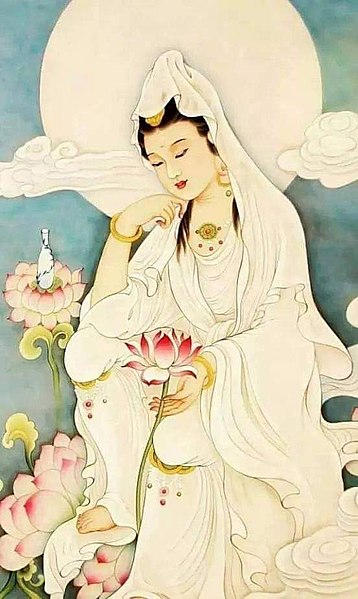
A more Chinese-style image of Kannon (a.k.a. Guan-yin) in her more motherly form, photo courtesy of Wikipedia.
The chapter as a whole is long and would be difficult to chant, so the verse section, not the narrative section, is frequently used for liturgical purposes. The Lotus Sutra often describes things in narrative form, then summarizes again in verse form. However, even the verse section alone is longer than the Heart Sutra, or the Shiseige, so just chanting the verse section is a bit challenging. In my experience it takes about 5-7 minutes.
For this reason, medieval Buddhists in Japan also devised an even shorter version called the Ten-Verse Kannon Sutra.
The sutra is frequently recited in both Zen and Tendai liturgies, among others, but it is not well known to Westerner lay-Buddhists. I had difficulty finding an online copy I could use as a reference here, even in Japanese, due to its length.
However, ages ago, I picked up a sutra book at the famous Sensōji temple in Tokyo, and once I figured out what the Kannon Sutra was, I copied it character by character to an old version of the blog, but then lost it later when I changed blogs. Recently, I was able to recover the text (not easily) from the original HTML I wrote, and posted it back on here with minor edits.
I have also provided a PDF version here if you want to print it out and use at home.
Also, special thanks to this website for providing much needed reference information on pronunciation and Chinese characters. My original, recovered text had a few errors, embarrassingly.
Examples
I found a few examples on Youtube that you can follow along if you are learning to chant the Kannon Sutra as shown below.
From Eiheiji temple (one of two home temples of Soto Zen). Note that they chant this at a pretty fast pace.
This example from Zenshoji Temple, a Shingon-sect temple, in Niigata Prefecture, has line by line annotation. The chanting pace is slower and easier to follow.
These examples are very similar, other than slight differences in pacing and pronunciation of certain Chinese characters. For people who are learning to recite the sutra, just pick what works until you get the hang of it.
Translation
I decided not to post the translation side-by-side with the text, the way I do with the Heart Sutra and such. This is due to formatting reasons on the blog, plus also length of the text makes this more difficult. I may revise this later.
For now, I highly recommend checking out a modern translation here by the excellent Dr Burton Watson. In that translation, the verse section starts after the phrase “At that time Bodhisattva Inexhaustible Intent posed this question in verse form“. The Buddhist Text Translation Society also has an excellent translation of the verse section here.
Disclaimer and Legal Info
I hereby release this into the public domain. Please use it as you see fit, but if you attribute it to this site, greatly appreciated. Also, please bear in mind this is an amateur work, and should not be taken too seriously.
Dedication
I dedicate this effort to all sentient beings everywhere. May all beings be well, and may they all attain perfect peace.
Namu Kanzeon Bosatsu
The Kannon Sutra, verse section
(2025 edition, with minor typo fixes)
Preamble
Original Chinese
Japanese Romanization
妙法蓮華經 観世音菩薩 普門品偈
Myo ho ren ge kyo kan ze on bo satsu fu mon bon ge
Verse Section
Original Chinese
Japanese Romanization
世尊妙相具 我今重問彼 佛子何因縁 名為観世音
Se son myo so gu ga kon ju mon pi bus-shi ga in nen myo i kan ze on
具足妙相尊 偈答無盡意 汝聴観音行 善応諸方所
gu soku myo so son ge to mu jin ni nyo cho kan on gyo zen no sho ho jo
弘誓深如海 歴劫不思議 侍多千億佛 発大清浄願
gu zei jin nyo kai ryak-ko fu shi gi ji ta sen noku butsu hotsu dai sho jo gan
我為汝略説 聞名及見身 心念不空過 能滅諸有苦
ga i nyo ryaku setsu mon myo gyu ken shin shin nen fu ku ka no metsu sho u ku
假使興害意 推落大火坑 念彼観音力 火坑変成池
ke shi ko gai i sui raku dai ka kyo nen pi kan on riki ka kyo hen jo ji
或漂流巨海 龍魚諸鬼難 念彼観音力 波浪不能没
waku hyo ru go kai ryu go sho ki nan nen pi kan on riki ha ro fu no motsu
或在須弥峰 為人所推堕 念彼観音力 如日虚空住
waku zai shu mi bu i nin sho sui da nen pi kan on riki nyo nichi ko ku ju
或被悪人逐 堕落金剛山 念彼観音力 不能損一毛
waku bi aku nin jiku da raku kon go sen nen pi kan on riki fu no son ichi mo
或値怨賊繞 各執刀加害 念彼観音力 咸即起慈心
waku ji on zoku nyo kaku shu to ka gai nen pi kan on riki gen soku ki ji shin
或遭王難苦 臨刑欲寿終 念彼観音力 刀尋段段壊
waku so o nan ku rin gyo yoku ju shu nen pi kan on riki to jin dan dan ne
或囚禁枷鎖 手足被杻械 念彼観音力 釈然得解脱
waku ju kin ka sa shu soku bi chu gai nen pi kan on riki shaku nen toku ge datsu
呪詛諸毒薬 所欲害身者 念彼観音力 還著於本人
shu so sho doku yaku sho yoku gai shin ja nen pi kan on riki gen jaku o hon nin
或遇悪羅刹 毒龍諸鬼等 念彼観音力 時悉不敢害
waku gu aku ra setsu doku ryu sho ki to nen pi kan on riki ji shitsu bu kan gai
若悪獣圍繞 利牙爪可怖 念彼観音力 疾走無邊方
nyaku aku shu i nyo ri ge so ka fu nen pi kan on riki jis-so mu hen bo
蚖蛇及蝮蠍 気毒煙火燃 念彼観音力 尋聲自回去
gan ja gyu fuku katsu ke doku en ka nen nen pi kan on riki jin sho ji e ko
雲雷鼓掣電 降雹澍大雨 念彼観音力 応時得消散
un rai ku sei den go baku ju dai u nen pi kan on riki o ji toku sho san
衆生被困厄 無量苦逼身 観音妙智力 能救世間苦
shu jo bi kon yaku mu ryo ku hitsu shin kan on myo chi riki no ku se ken ku
具足神通力 廣修智方便 十方諸国土 無刹不現身
gu soku jin zu riki ko shu chi ho ben jip-po sho koku do mu setsu fu gen shin
種種諸悪趣 地獄鬼畜生 生老病死苦 以漸悉令滅
shu ju sho aku shu ji goku ki chiku sho sho ro byo shi ku i zen shitsu ryo metsu
真観清浄観 廣大智慧観 悲観及慈観 常願常瞻仰
shin kan sho jo kan ko dai chi e kan hi kan gyu ji kan jo gan jo sen go
無垢清浄光 慧日破諸闇 能伏災風火 普明照世間
mu ku sho jo ko e nichi ha sho an no buku sai fu ka fu myo sho se ken
悲體戒雷震 慈意妙大雲 澍甘露法雨 滅除煩悩燄
hi tai kai rai shin ji i myo dai un ju kan ro ho u metsu jo bon no en
諍訟経官処 怖畏軍陣中 念彼観音力 衆怨悉退散
jo ju kyo kan jo fu i gun jin chu nen pi kan on riki shu on shitsu tai san
妙音観世音 梵音海潮音 勝彼世間音 是故須常念
myo on kan ze on bon on kai jo on sho hi se ken on ze ko shu jo nen
念念勿生疑 観世音浄聖 於苦悩死厄 能為作依怙
nen nen motsu sho gi kan ze on jo sho o ku no shi yaku no i sa e go
具一切功徳 慈眼視衆生 福聚海無量 是故応頂礼
gu is-sai ku doku ji gen ji shu jo fuku ju kai mu ryo ze ko o cho rai
Conclusion
Original Chinese
Romanization
爾時持地菩 薩即從座起 前白佛言世 尊若有衆生
ni ji ji ji bo sa soku ju za ki zen byaku butsu gon se son nyaku u shu jo
聞是観世音 菩薩品自在 之業普門示 現神通力者
mon ze kan ze on bo sa bon ji zai shi go fu mon ji gen jin zu riki sha
當知是人功 徳不少佛説 是普門品時 衆中八萬四
to chi ze nin ku doku fu sho bus-setsu ze fu mon bon ji shu ju hachi man shi
千衆生皆發 無等等阿耨 多羅三藐三 菩提心
sen shu jo kai hotsu mu to do a noku ta ra san myaku san bo dai shin
In the coming weeks, I hope to post a couple more such chants from the Lotus Sutra, as they are popular both in Tendai and Nichiren communities in particular, and I am learning to chant these too.
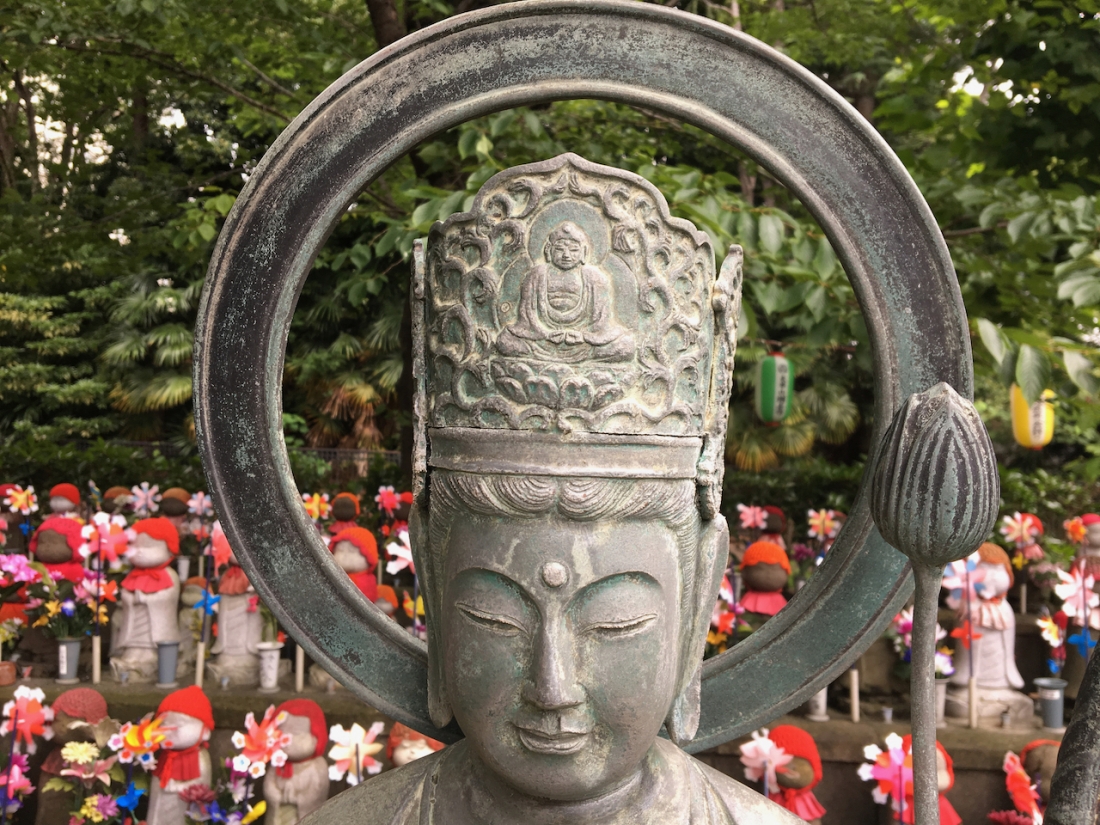
P.S. Featured photo was taken by me at Zojoji temple in Tokyo, Japan, with an image of Kannon Bodhisattva wearing a crown that features an image of Amitabha Buddha.
This is another reference post. I noticed that one of my most popular posts is the entry on a Buddhist chant called the Mantra of Light, and there’s multiple ways to read and recite it depending on what language you choose. Anyhow, it made me realize that there’s a big knowledge gap about Sanskrit in a specifically Buddhist context. There’s plenty of Sanskrit language resources out there, but they’re focused on Hinduism, and Hindu-related literature. Even the writing system used in language textbooks, Devanagari, tends to assume certain things.
Sanskrit is a language that’s used in a variety of contexts, and religious traditions, including Buddhism, especially Mahayana Buddhism.
As a language, it is way too big to cover in this blog, and I am just a novice, but I wanted to provide some real, fundamental basics of how Sanskrit works, with an emphasis on Buddhism.
What is Sanskrit?
Sanskrit is a very old language still widely used in some contexts. It is related to Greek and Latin, among other things, but mostly as a distant cousin. The Arya people who come into northwest India spoke it natively, and then as they took over north India, they imposed their language on people there.
Just as Latin eventually morphed into languages like Spanish, French, and Italian (among others), or influenced languages such as English, German or Russian, Sanskrit followed a similar trajectory. Languages descended from Sanskrit are called Prakrits. Prakrits were the colloquial forms of Sanskrit, each with regional differences, while Sanskrit remained the “high” language, increasingly relegated to things like religious ceremonies or literature.
Why Sanskrit and Buddhism?
The historical Buddha, Shakyamuni, did not use Sanskrit when teaching his disciples. His native language was probably Magadhi (still spoken today), but he often used Pāli when speaking to others since it was so widely known. Both Magadhi and Pāli are prakrits, descended from Sanskrit.
Since Pāli was such a popular language, it was how most early Buddhist sermons were memorized and passed down to future generations. Some Buddhist traditions, especially Theravada Buddhism, preserve these sermons using Pāli.
However, as Buddhism spread northward along the Silk Road, it was recorded in yet more prakrits such as Gandhari (Pakistan area), and such, not Pāli. By this point, there were Buddhist texts preserved in all sorts of local prakrits, not necessarily Pāli, and it probably became unmanageable.
The early Mahayana Buddhists started converting texts and teachings to Sanskrit instead. While Sanskrit wasn’t a common, spoken language, it was something that everyone more or less knew, just as medieval writers in Europe all knew at least some Latin. Thus as the layers of literature built up over time, and especially outside the core areas of India, it made more and more sense to just use Sanskrit for everything. Their Sanskrit wasn’t always “pure” Sanskrit, but it was good enough.
The featured image above is of the temple of Sensoji, better known as Asakusa Temple, in Tokyo, Japan. The central altar has the Sanskrit letter “sa” for satyam (truth) prominently displayed using Siddham script. Thus, even in a place like Japan, Sanskrit is still being used.
What Writing System Does Sanskrit Use?
This is a surprisingly hard question to answer. Unlike some languages, like Greek or Chinese, it had no fixed writing system. Every knew at least some Sanskrit, but everyone wrote it down in their own way. The Pillars of Ashoka used the Brahmi script to convey Buddhist teachings to the masses, while Buddhist texts on the Silk Road were often recorded in Karoshthi, and Buddhist mantras were recorded in Siddham.
So, what writing system should Sanskrit be written in? Whatever conveys it best to the reader.
For the purposes of this blog article, we’ll stick with the Roman Alphabet, with extended diacritics. For Buddhists, there is no benefit to using modern Devanagari, since early Buddhists didn’t even use it, and it’s just an extra layer to learn. Just don’t bother. The Roman Alphabet is sufficient for Western audiences.
Sanskrit Alphabet
The Sanskrit alphabet (regardless of what script you use) is broader than English because each sound has its own letter (sometimes two), and thanks to the grammarian Pāṇini, it’s all carefully organized in a sensible system.
Many of these sounds exist in English, but do not have their own letter to distinguish them; we just pronounce them automatically. Some sounds definitely do not exist in English and require extra care.
We can’t cover all these letters in detail here, especially pronunciation. There are some excellent pronunciation guides like the video series below. While it’s a Hare Krishna channel, not a Buddhist one, the explanations are excellent and clear.
A notes worth calling out here though:
ḥ – this is like a “breathy” h-sound that shows up at the end of certain words.
ṃ – although it looks like an “m”, it sounds more like an “ng” sound as in running. In the Buddhist tradition of praising the three treasures, the phrase Buddhaṃ Saranaṃ Gacchāmi, it is pronounced like “boo-dang” not “boo-dam”.
Sanskrit distinguishes between letters like k and kh, g and gh, d and dh and so on. These are separate letters in Sanskrit. Letters with an “h” are pronounced with a puff of air. Think of the English word redhead. That’s a fairly close analogy to “dh”. Similarly, egghead, for “gh”, dickhead for “kh” and so on. Not very civilized, but it works. 😆. Thus, Buddha, can be broken down to letters bu-d-dh-a, where “dh” sounds like redhead.
Side note: the ph in Sanskrit is not an “f” sound. This confused me a lot when I looked at works like “phalam” (fruit). It’s a breathier “p” sound.
ś and ṣ are both like the English sound “sh”. A common example in Buddhism is the word Śastra, which is a kind of important treatise. This is pronounced like “shastra”, not “sastra”. I am not 100% sure how ś and ṣ differ, but for practical purposes they’re more or less the same.
ñ – Just like Spanish in words like El Niño.
The letters ṭ, ṭh, ḍ, ḍh and ṇ (the ones with a dot beneath them) are extra difficult to pronounce for English speakers since we don’t really have “retroflex” sounds (sounds where the tongue touches the roof of the mouth). Thankfully these don’t come up too often in Buddhist Sanskrit.
r – a nice rolled “r” sound like in Spanish, Latin, etc, not the American “r” sound.
v – This one is confusing, but the “v” is actually pronounced like a “w” sound. The aforementioned “Bodhisattva” is correctly pronounced like “Bodhisattwa”.
This not a complete summary, but will hopefully address some pitfalls. Let’s look at vowels too.
Vowels in Sanskrit are fairly straightforward, but with a few caveats worth noting:
Sanskrit vowels are distinguished by “short” and “long” sounds. As with the consonants, each one has its own letter to distinguish it, unlike English “o” which can be pronounced multiple ways. The video series I linked above shows vowel pronunciations as well. Just remembere that long and short vowels might look similar in the Roman alphabet, but they are distinct letters.
a is the default sound that’s used when there is no other vowel explicitly used. It sounds like “uh” as in “duh” not as in “father”; that’s the letter ā instead.
Sanskrit has a vowel ṛ that doesn’t really exist in English. Imagine the English word “rip”, remove the ending “p” and roll the “r”. That’s ṛ. Even the Sanskirt word for Sanskrit, saṃskṛta, uses ṛ instead of an i. Usually in English people transliterate this as “ri” instead of “ṛ”, but be aware that this is its own vowel. Also note that r is a consonant, and ṛ is a vowel. They are not the same.
The au sound is like English “ow”, not “aw”. Imagine hitting your head on the door-frame. That’s “au”.
The ai sound like the same as “yipe!”. Imagine touching a hot pan. That’s the “ai!” sound.
A Note on Pronunciation
The reality is is that, like Latin, there are few, if any native speakers today. Many people in India, and even abroad, learn Sanskrit (and for good reason), but each person colors their Sanskrit pronunciation with their own native language. That’s ok. It’s normal. So, nobody today pronounces it perfectly.
That said, even knowing a few basics rules, like the ones I highlighted above, will go a long way to really appreciating how beautiful Sanskrit is, and when reciting Buddhist mantras or prayers, it really brings them to life. Give it a try!
But also don’t worry: the Sanskrit Police will not arrest you if you make a mistake.
Sandhi Rules
Every language has at least some rules where sounds blend together or change sightly to make things smoother. Some languages have more rules than others. Sanskrit has a lot. These are called “Sandhi” rules (the grammatical term “sandhi” even comes from Sanskrit). While Sandhi rules for Sanskrit are a huge pain to learn, they are super important for making sense of Sanskrit, including Buddhist Sanskrit. Why? Let’s look at an example below.
buddhāya – Buddha, but with a dative-case ending: to the Buddha. We’ll get to conjugation soon.
Glomming words together like this is common in Sanskrit, and the Sandhi rules help “glue” them together. Of particular note is the final aḥ in the first word, followed by a vowel. According to Sandhi rules (very handy chart here), aḥ + vowel sound changes to o. So, namaḥ + amitābha becomes namo‘mitābha. The apostrophe is a visual tool to help with readability.
For Avalokiteśvara, the famous bodhisattva, if we were to praise them, the same Sandhi rule would apply: namo‘valokiteśvara.
On the other hand, if we were to praise Śariputra, the Buddha’s important monastic disciple, then according to Sandhi rules aḥ + ś would not actually change and simply be namaḥ śariputra written as two words.
Similarly, if a bunch of Buddhas (buddhāḥ) were going somewhere (gacchanti), the Sandhi rules would simply drop the ḥ: buddhāgacchanti
Anyhow, these are pretty basic examples, but Sandhi rules get complicated, and memorizing the entire Sandhi chart isn’t necessary for most people. The important thing to understand is that when two words abut one another, the final sound of the first word, and initial sound of the second often blend together to make pronunciation smoother. Further, Sanskrit often strings multiple words together in written form.
Conjugation
If you ever dealt with noun declensions in classic languages like Latin and Greek, guess what? Sanskrit has them too. Since they are distant cousins, this isn’t really all that surprising.
Modern languages have comparatively fewer conjugations because over the centuries languages become smoother and more streamlined. Modern Indian languages based off Sanskrit such as Hindi, Gujarati, and Bengali are relatively simple to learn, while Romance languages like Spanish, French and Italian are streamlined versions of Latin. In the same way, modern Greek is a simpler, more streamlined version of classic Koine Greek, which itself was a simpler, more standardized form of ancient dialects such as Homeric Greek.
Older Indo-European languages often had complicated conjugation and inflection systems, and since Sanskrit is among the oldest, it’s inflection system is quite complex.
Like every language, Sanskrit has to describe who does what to whom, and with what. Languages like English usually use prepositions like “to”, “from”, “with”, etc. Japanese and Korean uses particles. Sanskrit, Latin, and Greek use inflected endings. For example, let’s look at the word Buddha:
buddhaḥ , usually just written as buddha – this is the nominative form (e.g. “the Buddha”).
buddham, this is the accusative form (e.g. a verb does something to the Buddha)
buddhāya – this is the dative form meaning “to” or “for” someone. Or for indirect objects. (e.g. we give a direct object to the Buddha)
buddheṇa, this is the instrumental form (e.g. “with the Buddha”)
buddhe, this is the locative form (e.g. “on the Buddha”)
buddhāt, this is the ablative form (e.g. “away from the Buddha”)
And so on. You can convey a lot with inflection in just one word, but the drawback is that the rules are complicated to learn.
Further, Sanskrit divides nouns into the following declensions:
Masculine nouns with “a” endings – Buddhaḥ, bodhisattva, nṛpaḥ (king), etc.
Neuter nouns with “a” endings, satyam (truth), vanam (forest), śāstram (a Buddhist treatise)
Feminine nouns with “ā” endings – adityā (sun)
Feminine nouns with “ī” endings – bhikṣunī (a buddhist nun), nadī (river)
Masculine, neuter, and feminine “u” endings – bhikṣhu (a buddhist monk), Vasubandhu (the famous monk), dhenu (cow)
Nouns with “ṛ” endings – pitṛ (father), mātṛ (mother)
In short, it’s a lot. There are 12 different categories of noun declensions (Latin had 5, iirc, or slightly more if you count things like masculine first declension, etc).
Note that “grammatical gender” is not always the same as the actual gender of an object. It’s just how nouns are organized. The word for sun is “feminine”, but moon is “masculine”. There’s usually no logic to which gender a word fits, it is just what category it happens to fit.
Conclusion
Knowing Sanskrit is not required to be a devout Buddhist. Buddhism doesn’t really rely on the notion of a “holy language”, so Sanskrit is just as good as Pāli, which is just as good as Classical Chinese (a frequently underrated language), which is just as good as Korean, Japanese, English, French, Ukrainian, etc.
But Mahayana Buddhism does owe much to Sanskrit due to how the tradition grew and then consolidated along the Silk Road before coming to China. Thus, knowing even a little bit of Sanskrit is a really nice way to connect with the past, and appreciate what we’ve inherited thus far.
This page is pretty unpolished, and probably has a few errors, but I hope you find it useful.
Namo’mitābhabuddhāya
Edit: Somehow my blog app kept re-posting an old draft, making publishing difficult. This should all be cleaned up now, and other typos have been corrected as well.








 Gleanings in Buddha-Fields

.jpeg?uselang=en)
You must be logged in to post a comment.