Chanting the “Jigage”: Chapter Sixteen of the Lotus Sutra

The Lotus Sutra, one of the most important sutras of Mahayana Buddhism, is the size of an epic novel, and thus much too large to recite cover to cover. Even reciting a single chapter can be daunting because each chapter contains a large narrative section, and one or more verse sections that recap the narrative.

For this reason, certain verse sections have become popular for chanting because they get to the heart of the Lotus Sutra and convey its essential teachings, in a manageable size.

Popular examples (among others) include the Kannon Sutra, the verse section of chapter 16, and the opening section of chapter 2. Both are actively recited in Nichiren and Tendai sect home services. Today we will focus on the big verse section at the end of chapter 16, called the jigagé (自我偈) in Japanese.

Chapter 16 of the Lotus Sutra is the big reveal of the sutra: Shakyamuni Buddha is not just a historical figure that lived in 5th century India, and member of the warrior-caste Shakya clan, but is also, on another level, a timeless Buddha that has pretty much existed since a remote, incalculable past:

Since I attained Buddhahood the number of kalpas [aeons] that have passed is an immeasurable hundreds, thousands, ten thousands, millions, trillions, asamkhyas [in other words, a mind-boggling amount of time]. Constantly I have preached the Law [a.k.a. the Dharma], teaching, converting countless millions of living beings, causing them to enter the Buddha way, all this for immeasurable kalpas.

Translation by Burton Watson

I believe this part of an important theme not just in the Lotus Sutra but Mahayana Buddhism in general: the Dharma is a timeless, eternal law of reality and the various Buddhas simply embody it. The Dharma is what matters, not one particular Buddha or another. You can see hints of this in older Buddhist sutras such as the Vakkali Sutta (SN 22.87) in the Pali Canon, but I believe that Mahayana Buddhism took it to its logical conclusion.

Later in the same verse section is the famous lines:

My pure land is not destroyed, yet the multitude see it as consumed in fire, with anxiety, fear and other sufferings filling it everywhere….But those who practice meritorious ways, who are gentle, peaceful, honest and upright, all of them will see me here in person, preaching the Law [a.k.a. The Dharma]

Translation by Burton Watson

To me, this reinforces that even in the worst, most desolate times, the Dharma is always there, and anyone who seeks it sincerely will find it even when others cannot see it. I’ve talked about this passage often in the Nirvana Day posts I’ve made in the past, among other places.

Anyhow, let’s move on now to the liturgy itself.

Liturgical Language

Because this is a chant used in Japanese Nichiren and Tendai traditions, among others, I am posting it as-is in Japanese, more specifically Sino-Japanese: the original Classical Chinese that it was recorded in, but with historical Japanese pronunciation. You are welcome to recite in English, or any other language, there is no restriction.

For this liturgical text, I relied on a few sources, plus I double-checked the spellings using physical sutra books I have at home. I am fairly certain it’s accurate.

Also, I formatted the text similar to how it is formatted in real service books.

Translation

I decided not to post the translation side-by-side with the text, the way I do with the Heart Sutra and such. This is due to formatting reasons on the blog, plus also length of the text makes this more difficult. I may revise this later.

For now, I highly recommend checking out a modern translation here by the excellent Dr Burton Watson. The Buddhist Text Translation Society also has an excellent translation here. The chant below is the first narrative section that goes all the way to the first verse section.

Disclaimer and Legal Info

I hereby release this into the public domain. Please use it as you see fit, but if you attribute it to this site, greatly appreciated. Also, please bear in mind this is an amateur work, and should not be taken too seriously.

Dedication

I dedicate this effort to all sentient beings everywhere. May all beings be well, and may they all attain perfect peace.

Namu Shakamuni Buddha

The Lotus Sutra sixteenth chapter, verse section

Preamble

Classical ChineseJapanese Romanization
妙法蓮華経
如来寿量品
第十六
Myo ho ren ge kyo
nyo rai ju ryo hon
dai ju roku

Verse Section

Classical ChineseJapanese Romanization
自我得仏来
所経諸劫数
無量百千万
億載阿僧祇
Ji ga toku butsu rai
sho kyo sho kos-shu
mu ryo hyaku sen man
oku sai a so gi
常説法教化
無数億衆生
令入於仏道
爾来無量劫
jo sep-po kyo ke
mu shu oku shu jo
ryo nyu o butsu do
ni rai mu ryo ko
為度衆生故
方便現涅槃
而実不滅度
常住此説法
i do shu jo ko
ho ben gen ne han
ni jitsu fu metsu do
jo ju shi sep-po
我常住於此
以諸神通力
令顛倒衆生
雖近而不見
ga jo ju o shi
i sho jin zu riki
ryo ten do shu jo
sui gon ni fu ken
衆見我滅度
広供養舎利
咸皆懐恋慕
而生渇仰心
shu ken ga metsu do
ko ku yo sha ri
gen kai e ren bo
ni sho katsu go shin
衆生既信伏
質直意柔軟
一心欲見仏
不自惜身命
shu jo ki shin buku
shichi jiki i nyu nan
is-shin yoku ken butsu
fu ji shaku shin myo
時我及衆僧
倶出霊鷲山
我時語衆生
常在此不滅
ji ga gyu shu so
ku shutsu ryo ju sen
ga ji go shu jo
jo zai shi fu metsu
以方便力故
現有滅不滅
余国有衆生
恭敬信楽者
i ho ben riki ko
gen u metsu fu metsu
yo koku u shu jo
ku gyo shin gyo sha
我復於彼中
為説無上法
汝等不聞此
但謂我滅度
ga bu o hi chu
i setsu mu jo ho
nyo to fu mon shi
tan ni ga metsu do
我見諸衆生
没在於苦海
故不為現身
令其生渇仰
ga ken sho shu jo
motsu zai o ku kai
ko fu i gen shin
ryo go sho katsu go
因其心恋慕
乃出為説法
神通力如是
於阿僧祇劫
in go shin ren bo
nai shitsu i sep-po
jin zu riki nyo ze
o a so gi ko
常在霊鷲山
及余諸住処
衆生見劫尽
大火所焼時
jo zai ryo ju sen
gyu yo sho ju sho
shu jo ken ko jin
dai ka sho sho ji
我此土安穏
天人常充満
園林諸堂閣
種種宝荘厳
ga shi do an non
ten nin jo ju man
on rin sho do kaku
shu ju ho sho gon
宝樹多花果
衆生所遊楽
諸天撃天鼓
常作衆伎楽
ho ju ta ke ka
shu jo sho yu raku
sho ten kyaku ten ku
jo sa shu gi gaku
雨曼陀羅華
散仏及大衆
我浄土不毀
而衆見焼尽
u man da ra ke
san butsu gyu dai shu
ga jo do fu ki
ni shu ken sho jin
憂怖諸苦悩
如是悉充満
是諸罪衆生
以悪業因縁
u fu sho ku no
nyo ze shitsu ju man
ze sho zai shu jo
i aku go in nen
過阿僧祇劫
不聞三宝名
諸有修功徳
柔和質直者
ka a so gi ko
fu mon san bo myo
sho u shu ku doku
nyu wa shichi jiki sha
則皆見我身
在此而説法
或時為此衆
説仏寿無量
sok-kai ken ga shin
zai shi ni sep-po
waku ji i shi shu
setsu butsu ju mu ryo
久乃見仏者
為説仏難値
我智力如是
慧光照無量
ku nai ken bus-sha
i setsu butsu nan chi
ga chi riki nyo ze
e ko sho mu ryo
寿命無数劫
久修業所得
汝等有智者
勿於此生疑
ju myo mu shu ko
ku shu go sho toku
nyo to u chi sha
mot-to shi sho gi
当断令永尽
仏語実不虚
如医善方便
為治狂子故
to dan ryo yo jin
butsu go jip-pu ko
nyo i zen ho ben
i ji o shi ko
実在而言死
無能説虚妄
我亦為世父
救諸苦患者
jitsu zai ni gon shi
mu no sek-ko mo
ga yaku i se bu
ku sho ku gen sha
為凡夫顛倒
実在而言滅
以常見我故
而生憍恣心
i bon bu ten do
jitsu zai ni gon metsu
i jo ken ga ko
ni sho kyo shi shin
放逸著五欲
墮於悪道中
我常知衆生
行道不行道
ho itsu jaku go yoku
da o aku do chu
ga jo chi shu jo
gyo do fu gyo do
随応所可度
為説種種法
毎自作是念
以何令衆生
zui o sho ka do
i ses-shu ju ho
mai ji sa ze nen
i ga ryo shu jo
得入無上道
速成就仏身
toku nyu mu jo do
soku jo ju bus-shin

P.S. I’ve been posting a lot of Japanese-Buddhist liturgy from various sources, and this is the last one I will post for a while. The ones I have posted so far on the blog cover the most common sutra chants, so anyone curious to get started in a tradition (or rediscover a tradition) should hopefully find what they need. Good luck!

Happy Bodhi Day 2023

To all those who celebrate, and to all beings everywhere, a peaceful and joyous Bodhi Day to you all.

Namu Amida Butsu

Pain

When you read a textbook definition of Buddhism, usually it will state the First Noble Truth as something like “existence is suffering”, “existence is dukkha”, or “there is suffering”, etc, etc.

Recently, after stubbing my toe (again), I realized that these explanations don’t do it justice.

When the Buddha taught that life is (in the old Pāli language) dukkha, what he was saying was that Life entails pain. “Suffering” is vague and abstract, but pain is something we live with on a daily basis.

There is the obvious pain: pain from injury, pain from a stomachache, pain from medical issues, pain from heat, cold, homelessness, etc.

There’s also emotional pain: a break-up, loss of a loved one, the pain of romantic rejection, pain from being humiliated or abused, etc.

Then there are subtle pains: having to tear yourself from your favorite video game to go to work, the pain of eating the last French fry (and no more left), the pain of getting something and being disappointed, the pain from boredom, the pain from responsibility, the pain knowing someday you and your significant other will be parted for good, etc.

In short, pain is unavoidable. Sometimes it’s very raw and horrific, and at other times it’s subtle and bittersweet.

The Buddha did not teach that life is always suffering, or that life is not worth living. It’s just that pain is unavoidable. If you dream of a future of luxury or joy, you will still encounter pain. If you hope to live a long, happy life, pain still crops up sooner or later.

Even if you live as long as someone like Galadriel from the Lord of the Rings, with all her beauty, longevity and power, you still cannot avoid pain, regret, etc. If anything, it only piles up over time.

Most people who come to this realization decide to grin and bear it since life is still worth living. This is understandable. This is how many of us choose to live. The little joys in life, good friends, nature, etc, make life sweeter. The support we get from others keeps us going.

But there also comes a time in one’s life when we feel weary. A deep weariness.

At such times, the Third Noble Truth, that there is a way out of this, becomes important. Like Galadriel who eventually sailed to the West at the end of Lord of the Rings, there is an alternative for us too. Whether we choose to take that path is entirely our choice, but it is there when we wish to take it up.

Namo Shakyamuni Buddha

The Hidden Treasure of Horyuji

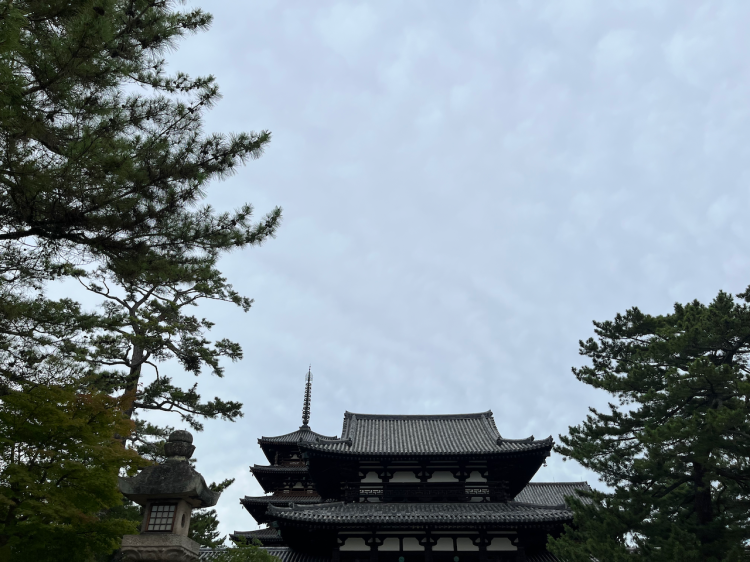
Much of our recent trip to the cities of Kyoto and Nara was planned ahead of time, however, we did have a couple unplanned visits we did that both worked out very well. One of them was the ancient Buddhist temple Horyuji. Horyuji is ancient, even by the standards of Buddhist temples in Japan. It was founded in 607, at a time when the early Japanese Imperial court was first establishing relations with China, and the Korean peninsula.

This is important because Horyuji shows a lot of elements imported from “Kudara” (百済), which was the Japanese word for the Korean kingdom of Baekje,1 and the wider Korean peninsula as a whole. This was a time when the Korean peninsula was not one country, but three major kingdoms, all ethnically Korean, along with several minor fiefdoms, each fighting for survival. Baekje was a particularly rich and developed country with close contacts with Tang-dynasty China, and also with the fledgling Japanese “Yamato” court. It was through Baekje that Buddhism first came to Japan, along with a lot of cultural and technical know-how from the continent. Japan, for its part, often sent military aid and such to help defend Baekje from its rivals.

In any case, Horyuji as a very old temple represents a snapshot in time when Chinese and Korean influences were very strong. The architecture, statues and such all show a combination of local, and imported influences. Further, because the temple was one of several founded by the semi-legendary Prince Shotoku, the temple is a testament to his forward-thinking efforts to reform Japan, in contrast to the reactionary Mononobé Clan whom he defeated in battle.

However, travel warning: Horyuji is kind of out of the way from modern Nara. We had just finished our trip to Todaiji, and with some time to spare, my wife remember a haiku she had learned in school that featured Horyuji. However, it turns out that Horyuji was in a pretty isolated area outside of modern Nara, so getting there from downtown took a 30 minute taxi ride at a cost of ¥7000. We decided to go late in the afternoon, and the taxi driver was noticeably concerned about us heading there so late in the day, but was our only chance to go, so we risked it.2

Horyuji contains several treasure houses, and a museum, with countless artifacts from early Japanese-Buddhist history. Unfortunately, like many temples in Japan cameras are often not allowed, however, the website has many excellent photographs, so I highly recommend perusing the English website.

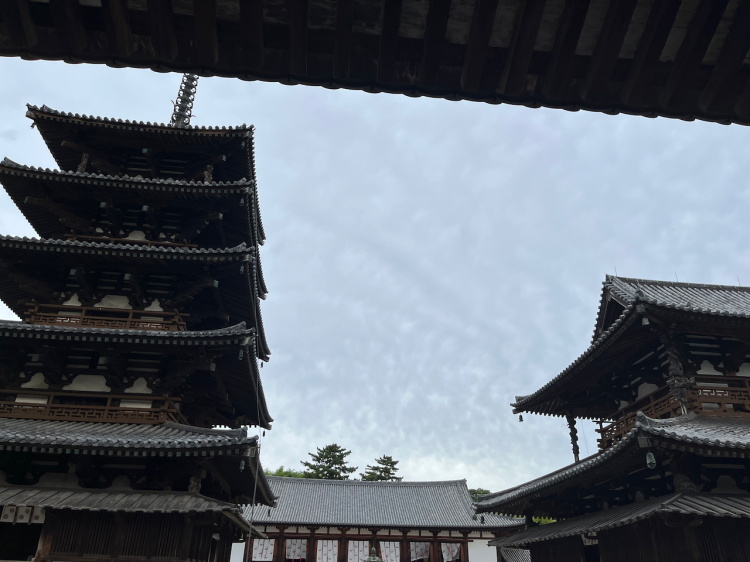
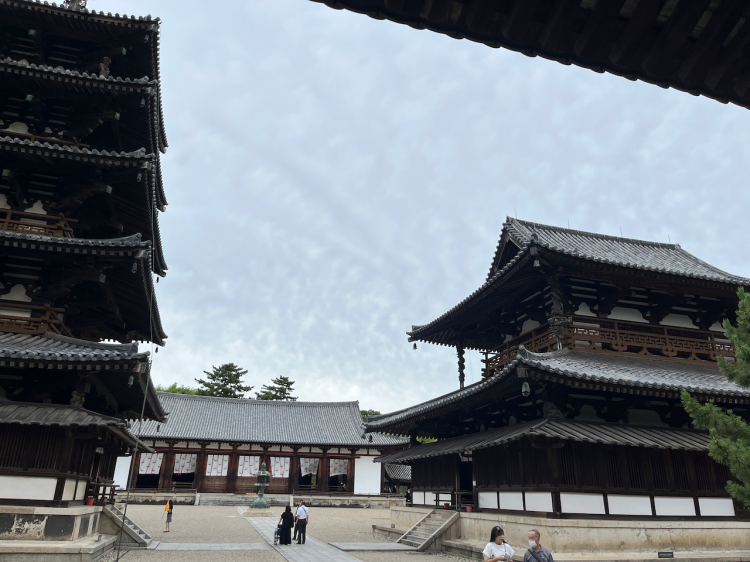
The temple complex of Horyuji was considerably larger than I first expected:

Steps leading up to the front gate…
Temple courtyard

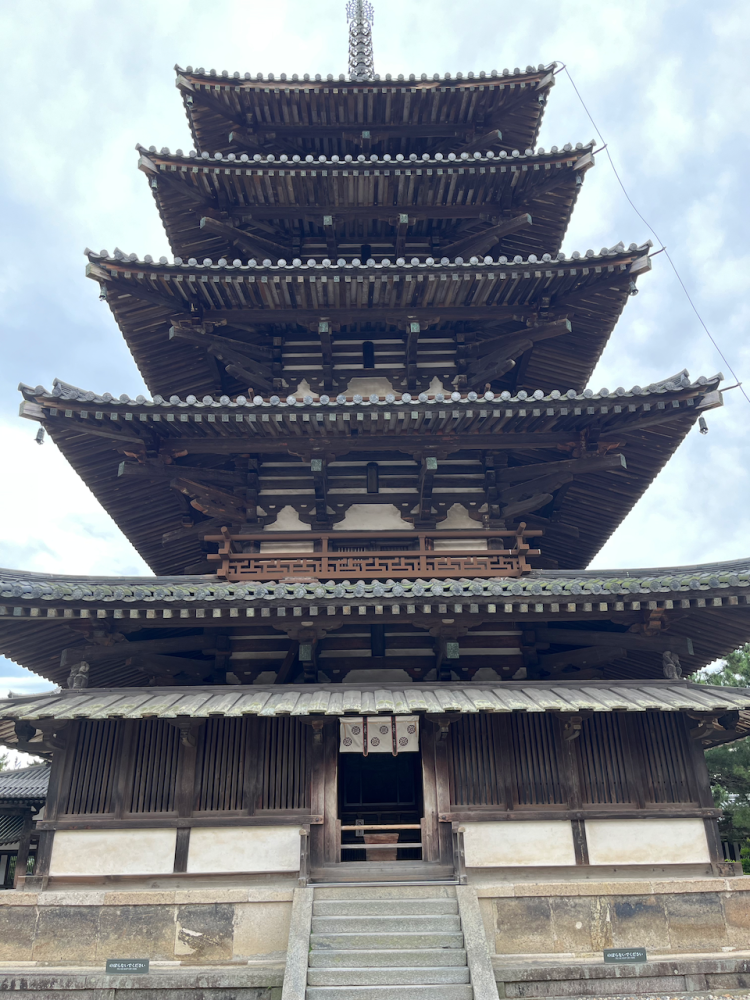
Because it was so hot, and so late on a weekday, there were very few people there, primarily a school field trip (in the photo above, you can see the teacher carrying an orange flag). To the left you can see a tall pagoda, which in Japanese is called a go-ju-no-tō (五重塔, lit. “five-storied tower”):3

The pagoda above (English description here) is said to be one of the oldest still standing, and buried underneath may be some ashes or bones of the historical Buddha, Shakyamuni, himself.

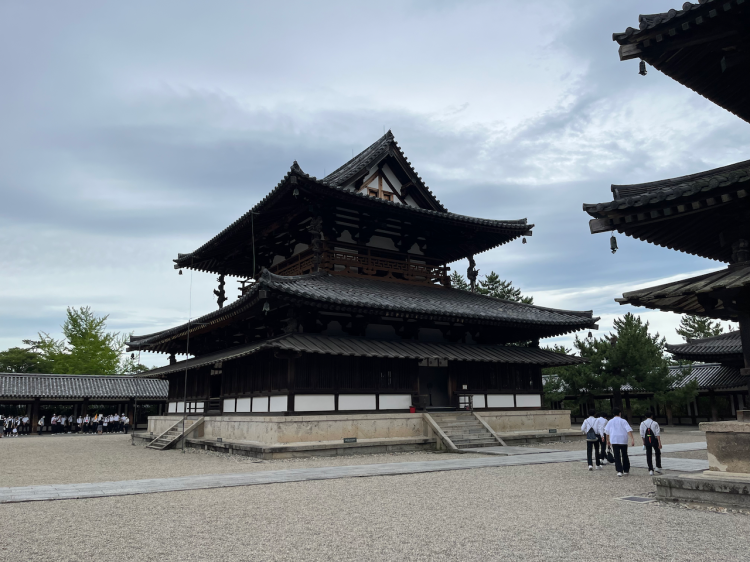
To the right, the Golden Hall (kondō, 金堂):

As the English description explains, this is one of the oldest, extant wooden buildings in Japan. Seeing the “triad” or “trinity” of Shakyamuni Buddha (photos here) enshrined there was amazing. I had often seen photos of it as an example of artwork of the period, but I honestly never imagined I’d see it face to face. I was definitely in awe.

Speaking of which, when people normally think of a trinity, they either think of The Matrix, or of the Holy Trinity in the Christian religion. However, Mahayana Buddhism often paired a particular Buddha with a pair of attendant Bodhisattvas into trinities of its own. Horyuji was unusual in having several such works of art, where most temples might have only one.

For example, in the photos above, you can see a building with white curtains over the entrance. That was the great lecture hall (daikōdō, 大講堂), where a trinity of the Medicine Buddha (photo here) and his two attendant Bodhisattvas was enshrined. I paid obeisance there to help with my gout, which was quite painful that day. I also took home special paper talisman (ofuda) the temple provided against Covid19.

Another statue that really stood out to me was the famous “Kudara Kannon”, a statue of the Bodhisattva Kannon either made in Baekje in the 6th century, or made by artisans imported from Baekje. You can see a photo of it here (scroll down a bit), but it was much taller than I expected. The Kudara Kannon was quite tall and slender, looking down over us, yet serenely beautiful too. It looked fragile, and yet had endured for countless centuries.

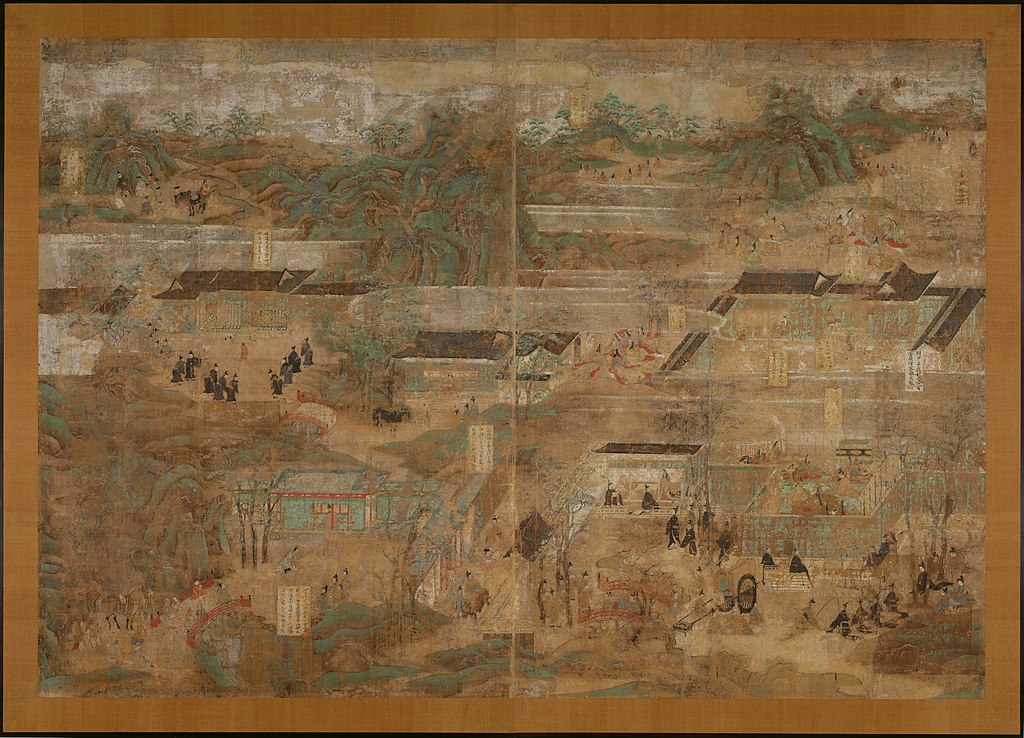
In the museum, I also saw an illustrated history of Prince Shotoku, the patron of Horyuji (and of Japanese Buddhism in general) from the 12th century:

Tokyo National Museum, Public domain, via Wikimedia Commons

Someday I will write more about Prince Shotoku, because as a religious figure he is well-known in Japan, but not outside the country. He’s a fascinating figure, but also the his origin story is pretty fascinating too, and shows further fusion of Korean immigrant culture in Japan.

Anyhow, I really wish I could have done more justice to this visit, but the temple website in English is excellent, and the experience was very fascinating as an amateur historian, and Buddhist-nerd.

1 Baekje ultimately fell to Silla, unfortunately. There are plenty of excellent K-Dramas about this historical period in time, by the way. There are plenty of excellent K-Dramas in general, I would argue.

2 Because we were in the middle of nowhere after the temple closed, and no taxis around, getting back to our hotel required some help from locals, who showed us some local buses to use, plus a few transfers. In short: be mindful of the time, and how you get back to Nara if you go to Horyuji. That said, it was definitely worth the visit.

3 The term “pagoda” is something many Westerners are vaguely familiar with, but are unaware of the significance. Many Buddhist temples in antiquity (and sometimes even modern ones), keep a Buddhist “storehouse” of relics, sutras, etc. This is based on the ancient Indian stupa, where relics of Shakyamuni Buddha and his followers were housed, and served as pilgrimage spots. The term pagoda is possibly based on Chinese language, but definitely shows misunderstanding by early European visitors.

“The Buddha”, not “Buddha”

Recently, I was watching an excellent video by Extra History on the history of Buddhism, and I was happy to see that they used the term “the Buddha”, not just “Buddha”. This might not seem like a big deal, but it helps to know the difference.

The word Buddha comes from Sanskrit, and means “an Awakened One”, someone who has accomplished Enlightenment and is fully unbound (e.g. Nirvana).

In any case, “Buddha” is a title, not a name. A person who accomplishes Enlightenment is a Buddha.

Further, in Buddhism, it is thought there is not just one Buddha, but many Buddhas.

Buddhism thinks in terms of very long time, as in countless eons that span a near infinite flow of time. Within that time, when ignorance prevails, a Buddha arises. It works like a cycle.

Think of the teachings (a.k.a. the Dharma) of Buddhism, as something like the laws of physics. The laws of physics pervade the Universe, whether anyone notices or not. Along comes someone like Newton who observes them, articulates them, and teachers others. In the same way, a Buddha is one who discovers the Dharma, articulates it and teachers others. After that Buddha passes away, eventually the Dharma is forgotten again, and in time a new Buddha arises to repeat the cycle.

Thus, the historical Buddha, the one who founded Buddhism as an organized religion around 5th century BCE, is thought to one of a long line of Buddhas that span those countless eons. He is one Buddha of many. And since he was born from the ancient Shakya clan in northern India, he is called Shakyamuni Buddha, or “the Buddha from the Shakya clan”. His birth name was Siddhartha Gautama (sometimes Gotama), but his title in Buddhism is Shakyamuni Buddha.

And now you know….

P.S. More on buddhas, buddhas and buddhas.

Hamamatsuri 2023: Of Puppies and Parental Stress

Hello readers and happy Hanamatsuri to those who celebrate the birthday of the Buddha, Shakyamuni (a.k.a. Siddhartha Gautama).

This past week has been crazy, mainly because we have a new addition to the family:

Her name is Cherry, and she is a 12-week old pug/beagle mix that we adopted. She was abandoned by her original owner in a garbage bag, and later rescued. Since she was staying with a foster family in our area, the adoption process was very quick. Overnight (literally), we had a new puppy in our life and have been scrambling to adjust since.

She is not the first dog we have adopted, but by far the youngest, and we’ve been in for a shock. She hasn’t been house-broken yet, and still has many of the classic puppy habits: biting, lots of energy, teething. and a small bladder.

She is a very sweet dog, but the past week has been very disruptive. We have little time to sit and relax, and she may suddenly decide to start biting our toes or hands when she’s bored or wanting to play rough. Also, our carpet is a mess as we are still training her to toilet outside, and don’t always get it right.

Needless to say, it has been both a fun and miserable experience. When she is taking another nap on my lap, it is very pleasant, when she is destroying the house, not so much.

Which brings us back to Hanamatsuri.

The Buddha taught the importance of self-reflection over and over again. It’s easy to be at peace and a good Buddhist when life is going your way. But, when life is difficult, you are tried, or stressed, then your true nature will emerge, and it is often ugly to look at.

I see it in myself. Apparently this is known as the “Puppy Blues”, too. There are times I wish someone would just take her off our hands. There are also times when I am frustrated, and just don’t want to deal with her. In this respect, Cherry is a mirror to myself. Through her, just as through raising kids, I see my true nature.

But it’s good to be aware of these things. Not just intellectually, but to experience and see it firsthand. It’s unpleasant to confront, but it’s important to recognize those feelings exist too. I love little Cherry and don’t want her to suffer anymore, so I have no desire to send her back. Further, I know it will get easier with time, just as it was with little kids, and just like little kids, it gets more rewarding over time.

However, it does require constant vigilance toward my own mind. One should not kid oneself and get complacent. Just as training a puppy takes considerable patience and persistence, so does training one’s own mind.

Easier said than done, but there is no alternative if one does not wish to break through to a state of peace, and also benefit those around you.

Happy Hanamatsuri!!

Namo tassa bhagavato arahato sammu-sam-buddhasa

P.S. this is apparently 500th post. 🥳

Buddhism and the Parable of the Two Rivers

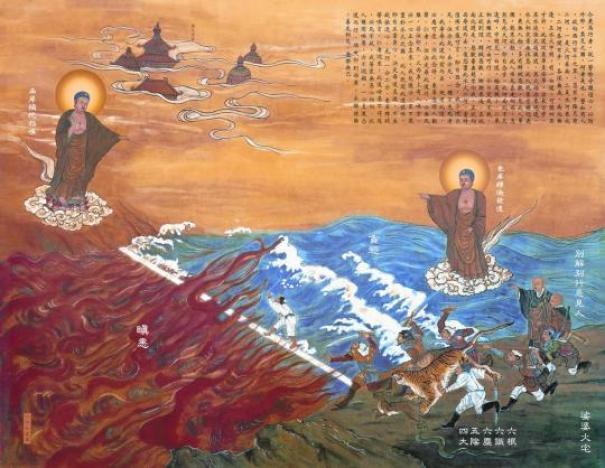
shandao-two-rivers

Since this week is the Japanese-Buddhist holiday of Ohigan (lit. “other shore” お彼岸), I wanted to share a famous parable in the “Pure Land” Buddhist tradition, written by a 7th century Chinese monk named Shan-dao (善導 613-681).  This is usually called the Parable of the Two Rivers and the White Path.  You can find translations of it here and here among other places.  This is a translation by the late Rev. Hisao Inagaki:

Suppose a man is traveling a hundred thousand li [approx. 500 feet] toward the west. On the way, he suddenly comes upon two rivers: one is a river of fire that extends southward, and the other is a river of water that extends northward. The two rivers are each a hundred paces wide and unfathomably deep, extending endlessly to the north and south. Where they meet, there is a white path, four or five inches wide. This path is a hundred paces long from the east bank to the west. The waves of the water splash and the flames of the fire burn the path. The waves and flames alternate without ceasing.

This traveler has already journeyed far into the open plain where there is no one to be found. Suddenly, there appear many bandits and vicious beasts. Seeing him alone, they approach competing with each other to kill him. Afraid of death, he at once runs to the west. When he suddenly sees this great river, he says to himself, “This river extends endlessly to the south and to the north. I see a white path in the middle, but it is extremely narrow. Although the two banks are close to each other, how can I get across? Undoubtedly, I shall die this day. When I turn round to return, I see bandits and vicious beasts coming closer and closer. If I try to run toward the south or north, I see vicious beasts and poisonous insects vie with each other to attack me. If I seek the path to the west, I will certainly fall into one of the two rivers of water and fire.

His horror at this moment is beyond expression. So he thinks to himself, “If I turn back now, I shall die; if I stay, I shall die; if I go forward, I shall die, too. Since I cannot escape death in any way, I would rather follow this path. Because there is a path, it must be possible to cross the rivers.”

When this thought occurs to him, he suddenly hears a voice from the eastern bank urging him, “Take this path with firm resolution. There is no danger of death. If you stay there, you will die.” Again, he hears another voice from the western bank calling to him, “Come at once single-heartedly with right mindfulness. I will protect you. Do not fear that you may fall into the calamities of water or fire.” Since the traveler hears this voice urging him from the bank and the calling from the other, he resolutely, body and soul, takes the path and proceeds at once without doubt or apprehension.

As he takes a step or two, he hears the voices of the bandits on the eastern bank, “Come back! That path is treacherous. You cannot cross it. Undoubtedly, you are sure to die. We have no evil intentions in pursuing you.” Though hearing the calling voices, this person does not even look back. As he proceeds straight on this path with singleness of heart, he, in no time, reaches the western bank and is now free from all danger. There he meets his good friend, and his joy knows no end. This is the parable.

Commentaries on this parable are pretty consistent in that the historical Buddha, Shakyamuni, represents the voice on this shore urging the man to cross via the white path, while the voice on the other side is Amitabha Buddha inviting the man to cross to safety.  The monsters, bandits and such are the hassles of life, while the river of fire represents rage, anger, aversion, and the turbulent waters represent desire, craving, or some variations thereof.

But for me, there’s even more to this parable.  Buddhism, across all sects, frequently uses the analogy, originally from an ancient sutra called the Sutta of the Simile of the Water Snake, of a raft crossing one short to another.  The Dharma (the teachings of the Buddha) are the raft, this shore represents our mundane existence and all the strife, frustrations and calamities that come with it.  The other shore represents the peace of mind and contentment that come with Enlightenment (or even just following the Buddhist path in a lesser sense).

Further, the Parable of the Two Rivers seems to conflate the Other Shore with the Pure Land of Amitabha Buddha.  Is the Pure Land just a metaphor for awakening, and if so, does Amitabha Buddha represent the Dharma itself?  Or, is being reborn in the Pure Land essentially the same as reaching Enlightenment (by virtue of the Pure Land being so conducive to the path)?  Or maybe both?

This and many more thoughts during the Ohigan season… 🙂

Namo Shakyamuni Buddha

Namo Amitabha Buddha