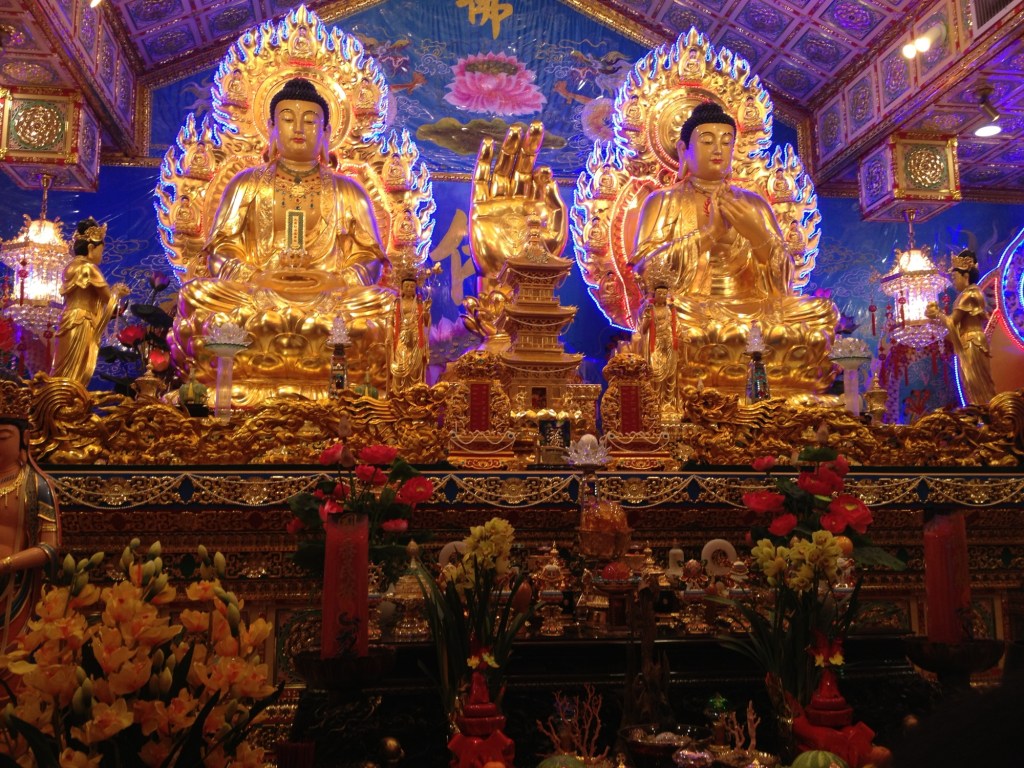
What is a Buddha Land?

This blog, and its blogger, have focused on the Pure Land tradition of Buddhism for many years. I didn’t really start practicing Buddhism seriously until I encountered the Jodo Shu-sect teachings of Honen way back in 2005. It really inspired something in me that’s never stopped even as my practice has taken many twists and turns.

But, strangely, I’ve never actually talked about what a “pure land” is. That’s the subject of today’s post.

The concept of a “Buddha land” or “Pure land” is actually a broad and rich tradition within Mahayana Buddhism, and well worth exploring. Here, I am not talking just about Amida Buddha and his Pure Land, but the general concept. It shows up a lot in Mahayana Buddhism and its many traditions, including the Zen tradition. It also shows up in contemporary Asian literature as well, including Akutagawa Ryunosuke’s famous short story “The Spider’s Thread” (蜘蛛の糸) as well as the Legend of Zelda series. Once you recognize it, references to Buddha lands show up in many unexpected places.

And yet, it all started long ago in India.

Traditional cosmology (i.e. “how the world is arranged”) in India tended to see a flat world with continents strung together in all directions, including above and below. Some of these continents would be anchored by a massive mountain in the middle, called Mount Sumeru (or Mount Meru). You can see this also in Buddhist architecture such as this famous temple in Bangkok, Thailand:
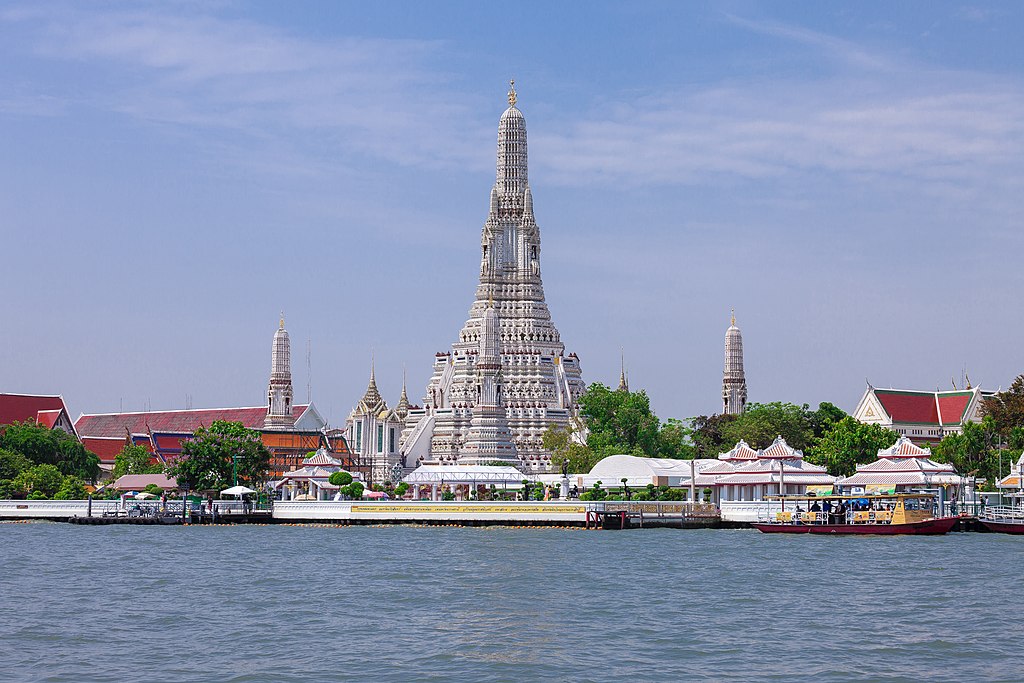
Phra Prang Wat Arun photo taken by Supanut Arunoprayote., CC BY 4.0, via Wikimedia Commons. The tall structure in the middle is meant to symbolize Mount Sumeru.

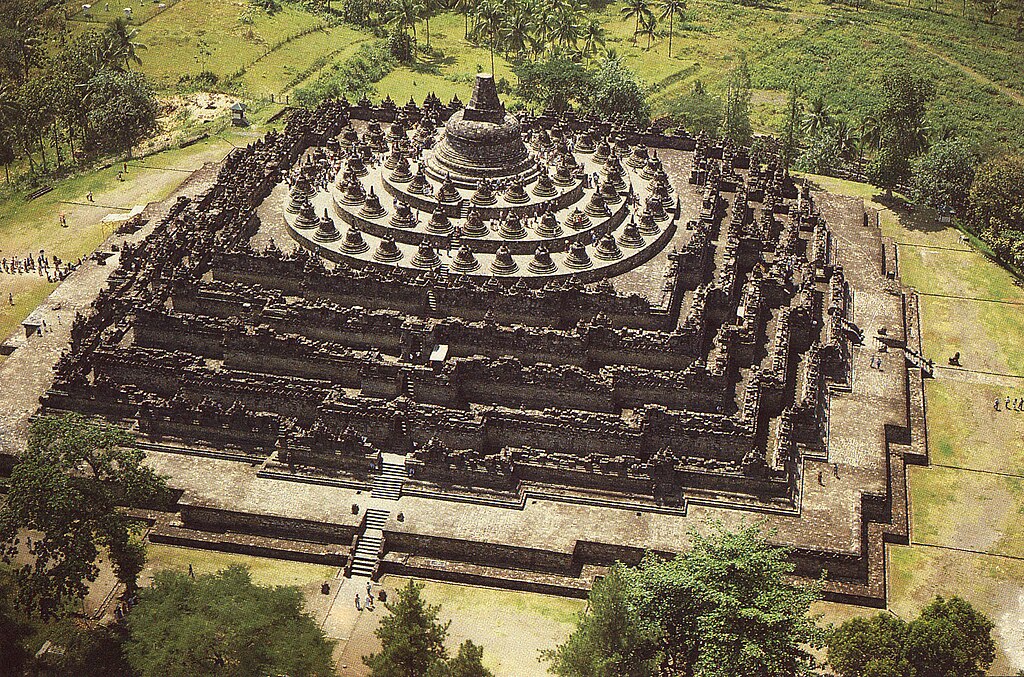
Or the famous Borobudur temple in Indonesia:
Incidentially, people in India thought that they lived in one of these continents called Jambudvipa, which was on the southern end of Mount Sumeru. For example, in the Earth Store Bodhisattva Sutra, you see text like so (chapter 4):

Thus, in this Saha world, on the continent of Jambudvipa, this Bodhisattva teaches and transforms beings by means of millions of billions of expedient devices.

Translation by City of Ten Thousand Buddhas

Anyhow, different continents were more peaceful and civilized than others. In some continents dwelt a living buddha, and by their sheer presence, the land would be purified, and all would be peaceful. Such lands are called buddhakṣetra in Sanskrit.

Let’s take a look this passage from the Amitabha Sutra:

At that time the Buddha told the Elder Shāriputra, “Passing from here through hundreds of thousands of millions of Buddhalands to the West, there is a world called Ultimate Bliss. In this land a Buddha called Amitābha right now teaches the Dharma

Translation by City of Ten Thousand Buddhas

In this sutra, the Pure Land of Amitabha is just one of many such lands that exist to the west, but a particularly splendid Buddha land. Buddhas and Buddha lands were thought to exist in all cardinal directions, and the Amitabha Sutra above goes to great lengths to describe some of them, but highlights Amida Buddha’s Pure Land in particular.

Another example of a Buddha land is the realm of the Medicine Buddha, called Lapis Lazuli, which was thought as existing to the east (not west). The Medicine Buddha Sutra describes it at length. It even goes out of its way to say it’s easier to be reborn in the realm of Lapis Lazuli than the Pure Land of Amitabha:

“If their rebirth in the Pure Land is still uncertain, but they hear the name of the World-Honored Medicine Buddha, then, at the time of death, eight great Bodhisattvas, namely, [list of names] will traverse space and descend to show them the way. They will thereupon be reborn spontaneously in jeweled flowers of many hues. [i.e. be reborn in the Buddha land of the Medicine Buddha]

Translated and annotated under the guidance of Dharma Master Hsuan Jung by Minh Thanh & P.D. Leigh

If a person could be reborn in their next life in a Buddha land, any Buddha land, and thus be in the presence of a living Buddha, it is thought they would find refuge, but also they would advance much better along the Buddhist path. The idea of Pure Lands never supplanted or replaced more tradition Buddhism, but if your current circumstances prevented you from following the Buddhist path, you could opt to be reborn in a Buddha land and make up for it in the future.

… but then we come to another Buddha land worth noting: the Buddha land of Shakyamuni Buddha himself. The sixteenth chapter of the Lotus Sutra drops a plot twist wherein the Buddha never really died, and exists for all time on Vulture Peak in India (a real place where historically he and the Buddhist community often dwelt), and preaching the Dharma to any who see him (details added by me in parantheses):

I live on Mt. Sacred Eagle (another name for Vulture Peak)
And also in the other abodes
For asaṃkhya (countless) kalpas (eons).

…”This world is in a great fire.
The end of the kalpa [of destruction] is coming.”
In reality this world of mine is peaceful.
It is filled with gods and men.

Translation by Rev. Senchu Murano

The Lotus Sutra version of the Pure Land is less about esoteric geography, and more about Shakyamuni Buddha always being here, whether we see them or not. It comes down to wisdom, clarity, and good conduct.

This viewpoint is found in Zen as well. When we look at the Hymn of Zazen by Japanese monk, Hakuin, who was a lifelong devotee of the Lotus Sutra, we can see the influence:

浄土即ち遠からず
Jōdo sunawachi tōkarazu

“Indeed, the Pure Land is not far away”

Amateur translation by me

and:

当所即ち蓮華国此身即ち仏なり
Tōsho sunawachi rengekoku, kono mi sunawachi hotoke nari

“This place is none other than the Land of Lotuses [the Pure Land],
this body is none other than the Buddha.”

Amateur translation by me

But this isn’t just Hakuin talking. As we saw with the Obaku Zen tradition (a cousin of Hakuin’s Rinzai tradition), they felt the same way, only replacing Shakyamuni with Amida Buddha. But the sentiment was the same. You’ll find similar sentiments in esoteric traditions too, but I have little experience with those and cannot explain in much detail.

So, that brings us to the point: how does one interpret all these Pure Lands, these Buddha lands? My views have gradually changed over time, but I don’t pretend to have the answer. I think in a way that all viewpoints are correct. It is like the famous parable of the blind men describing an elephant: everyone has some idea, but the big picture is beyond our grasp. So, there’s no wrong way to interpret it. If one believes it’s a faraway refuge to be reborn into, that’s totally fine.1 If one believes it’s all in the mind, that’s fine too.

Even the Buddhist sutras, including some I linked above, state that simply “hearing” of the Buddha lands is a merit unto itself. So, if you’ve made it this far, you’re already doing just fine. Just apply the teachings in the way that best fits you.

Namu Shakamuni Butsu
Namu Amida Butsu

1 Maybe this is my background as a scifi fan or something, but I do like to imagine that instead of physical continents, the various worlds and Buddha lands are just planets and worlds across the entire Universe. But that’s a personal view, more fantasy than firm belief, so please take it with a grain of salt.

Self-Mastery

A screenshot from Fire Emblem: Engage. I enjoy the game, though I am still a Three Houses kind of guy.

Out of all things the things one can accomplish in their lives, self-mastery is probably one of the most difficult.

As the Buddha said in the Dhammpada:

185. Not despising, not harming, restraint according to the code of monastic discipline, moderation in food, dwelling in solitude, devotion to meditation — this is the teaching of the Buddhas.

Translation by Acharya Buddharakkhita

Plain and simple, Buddhism is about restraint, non-violence, and devotion to the training. This can come in many forms, but if it leads to moderation, dignity, self-mastery, and goodwill towards others, this is in accord with the Buddha’s teachings.

Recently, we had a holiday work party at a local Brazilian steakhouse. I have never been to one before but it had many finely cuts meats, and they were served in large quantities over and over.

I am not vegetarian yet (work in progress), but I have been gradually reducing my meat consumption since early 2025. I definitely do not eat steaks and sausages very much. But everyone else was consuming in large quantities. I had a few samples and soon quit because I knew I couldn’t digest so much meat (it was kind of gross). I am really glad I did because although I missed out on some good food, I saved myself from indigestion, nausea and “meat sweats”.

Indeed the Buddha famous said:

186-187. There is no satisfying sensual desires, even with the rain of gold coins. For sensual pleasures give little satisfaction and much pain. Having understood this, the wise man finds no delight even in heavenly pleasures. The disciple of the Supreme Buddha delights in the destruction of craving.

Translation by Acharya Buddharakkhita

Indulging in a ton of food seems like a refuge for us, it makes us happy, but it is not a reliable one. Overindulgence leads to future health problems and misery.

As the Buddha warns through the sutras, there is no safe, reliable refuge. We still dwell in the “burning house” of the Lotus Sutra: death, old age, and disease are things we have to face, amusing ourselves with our toys, but the house burns around us nonetheless.

If you are a high-rolling CEO or a pleb, it is the same problem, just a different scale.

But the Buddha by his accomplishments and his awakening, and thus letting go, has reached safety:

I have already left the
burning house of the triple world.1
I am tranquil and peaceful
In a bower in a forest.

translation by Rev. Senchu Murano, chapter three of the Lotus Sutra

Hence, the Buddha (like all buddhas) seeks to lead people out of the burning house too, to the safety of the forest.

The first step in the Buddhist path (i.e. leaving the burning house) is, in my opinion (among others), taking the small steps toward moderation and self-restraint. Such things pay dividends in the short-term through having fewer hassles, a balanced personal budget, and provide mental well-being both through increased self-confidence and also fewer regrets.

In the long-term it provides far more.

Namu Shakamuni Butsu

1 This is a Buddhist term that shows up in the sutras a lot. It just means the cosmos, the Universe, the “Whole Enchilada“, etc.

Countdown to Bodhi Day

Buddhist holidays are few and far between, especially in overseas (non-Buddhist cultures), but since we raise our kids both through Japanese and American culture, I try to give them a unique, memorable tradition for the holidays. So, when the kids were young, I borrowed the Japanese-Buddhist holiday of Jodo-é (成道会) and adapted it for American Christmas culture. This holiday is better known in English as Bodhi Day and is observed on December 8th every year.1

Bodhi Day, sometimes incorrectly called Rōhatsu (臘八) in Zen-specific contexts,2 celebrates the awakening of Shakyamuni Buddha, the historical founder of Buddhism. It is the day where the Buddha is said to have meditated under the Bodhi Tree, saw his past lives laid out before him, resisted the temptations of Mara, and in the early morning broke through the wall of ignorance to see things as they were. By awakening thus, he is called a buddha (lit. “an awakened one”).

So, at the time, I took inspiration from our local Japanese-American temple (which had a great kid’s program), and made a “Bodhi Tree”: a miniature Christmas tree that a statue of the Buddha sits under. After that, I setup a small Buddhist-style shrine with an offering plate, water, bell, LED candle, etc. You can see an example above from years ago.

Also, to make it fun for the kids, I always give a gift on Bodhi Day, usually books they like. Such gifts don’t have to be Buddhist books, just something they would enjoy reading.3 Also, we usually have a fun family dinner together, and I usually read the story of the Buddha from an old Japanese-manga I found years ago. These celebrations are not strictly “Buddhist”, but it’s something festive and wholesome with the family, while celebrating the enlightenment of Shakyamuni Buddha,4 in a way that blends American traditions with Japanese ones.

Anyhow, Bodhi Day is 8 days away, so until then, hoping you all have a great week!

Namu Shakamuni Butsu

1 Many other Buddhist traditions still use the lunar calendar, so the dates will vary. I like using the Japanese version with the solar calendar because it’s easier to predict and blends into holiday season more easily.

2 The problem with the term Rohatsu 臘八 is that is refers only to the Zen practice of sesshin or dedicated meditation practice (i.e. a kind of austere retreat). This is obviously unsuitable for kids, and even in Japanese Zen, the holiday is called generally called Jōdō-é (成道会) among lay followers. So, calling it Rohatsu is misleading, and too narrow to be useful anyway.

3 When you are a kid, the last thing you want is religious books. So, I give fun books, comic books, etc.

4 The enlightenment story of Shakyamuni Buddha also serves as a template for other Buddhas and their enlightenment stories in Buddhist literature, too. See the preamble for the Larger Sutra of the Buddha of Immeasurable Life as an example.

Divine Intervention, Or Lack Thereof

Scotty: Thank heaven!

Spock: Mr Scott, there was no deity involved. It was my cross-circuiting to B that recovered them.

McCoy: Then thank pitchforks and pointed ears.

Star Trek, “Obsession” (s2:ep13), stardate 3620.7

In the host of world religions, Buddhism occupies a strange place. In one sense, it is a world religion because it is followed by many different peoples, cultures, and languages throughout its 2,500 year history.

But unlike other world religions there is no central deity, no creator.

Hold on, you might be thinking, what about the Buddha?

The Buddha is the central figure of Buddhism. He is the teacher, but in the Buddhist tradition he was once a person, just like you and me, who through countless lifetimes as a bodhisattva fully accomplished the path and awakened to the Dharma: the principles of existence. He taught the Dharma to his disciples, and they became the first generation of the Sangha, the community.

Thus, these comprise the Three Treasures of Buddhism.

But why do people pray to the Buddha?

Because the Buddha and all other such figures in Buddhism are not passive. The Buddha taught the Dharma out of compassion and goodwill for all beings, and the countless Bodhisattvas such as Kannon guide any sentient beings who take up the Buddhist path. Amida Buddha provides a refuge for all beings who wish to be reborn there.

Kannon (観音) Bodhisattva in her more motherly form.

The underlying theme isn’t Enlightenment for Enlightenment’s sake. It is to help beings who suffer so that eventually they too may reach Buddhahood (a.k.a. Enlightenment).

One does not have to pray to the Buddhas and Bodhisattvas. The most important thing is to put the Buddhist teachings into practice as one can. But in times of unease, uncertainty or crisis it’s perfectly fine to pray to a Buddha or Bodhisattva that you revere. I do it from time to time myself when I am worried about my kids, on plane flights, before surgery, etc.

But also, in the end, I am responsible for my choices, my words, and my thoughts.

When you plant melon seeds you get melons, and when you plant beans you get beans. [Effect follows causes] like a shadow follows a physical shape, like an echo responds to a sound. Nothing is sown in vain. This is called “believing in the result”.

Ou-yi’s Mind Seal of the Buddhas, translation by J. C. Clearly

I alone bear the fruits of my choices, words and thoughts.

Namu Shakamuni Butsu

Namu Amida Butsu

Namu Kanzeon Bosatsu

Buddhas of the Three Time Periods

Something cool I learned about while watching a Japanese documentary of Eiheiji temple, one of the two core temples in the Soto Zen tradition. Evidentially there is a small Buddhist altar there that features three Buddha statues. You can see photos of it here, the building (called the butsuden 仏殿) is here. This is posted on a separate blog too. You can see a photo of the three buddhas at the very bottom of this page here.

But who are these three Buddhas? In Japanese this is called the Sanzebutsu (三世仏), or “Buddhas of the Three Time Periods”.

In order these are:

  • Amida Buddha – the Buddha of the Past (he accomplished his vows eons ago), and thus the Pure Land was established.
  • Shakyamuni Buddha – the Buddha of the Present (the current eon of history), the historical founder of Buddhism. Also known as Siddhartha Gautama, Shakyamuni, etc.
  • Maitreya Buddha – Buddha of the Future (he has not accomplished his vows yet, but will eons later). For now he dwells in the heaven realm of Tushita.

This “trinity” of Buddhas is not limited to Eiheiji Temple. You can find similar works of art in other temples as well.

Anyhow, it’s an intriguing idea that the Dharma has always existed across space and time, but simply represented by different Buddhas as appropriate.

Namu Amida Butsu
Namu Shakamuni Butsu
Namu Miroku Bosatsu

Happy Birthday, Shakyamuni Buddha 2025

April 8th in the Japanese-Buddhist tradition is the birthday of Shakyamuni Buddha, also known as “the Buddha”, “Siddhartha Gautama”, and so on. Many other countries celebrate on the 8th day of the 4th lunar month, so traditions vary.1

But I digress.

In Buddhism, a Buddha is a being who, across many lifetimes of hard work, religious discipline, and great compassion towards others fulfills the quest for Enlightenment. Not only that, a Buddha then teaches and awakens others rather than hoarding the joys all to themselves.

This altar, which is in the basement of Zojoji Temple in Tokyo, Japan, contains a tiny relic of the historical Buddha, Shakyamuni. It was donated in the 1950’s by India as a goodwill gesture after being discovered in an archeological site after countless centuries. Pretty neat story, actually, though not available in English.

So, within our tradition Shakyamuni Buddha (i.e. “the Buddha of the Shakya clan”) is what we call the historical Buddha who around 500 BCE fulfilled his path and taught others the Dharma: the principle of existence (think: “Law of Gravity” kind of stuff).

Thus, today is his 🙏🏼 birthday. Was he really born on the 8th day of the 4th month? Who knows.

The message of the story is more important than historical details: any sentient being, given enough time and dedication can fully liberate themselves, and then through awakened compassion, liberate others as well. Even someone who is totally rotten now can, given enough time and the right circumstances, accomplish great good.

The Dharma taught by the Buddha is for all. The Dharma is free, beneficial, and illuminating.

A joyous Buddha’s Birthday to you all! 🙏🏼

Namu Shakamuni Butsu
(南無釈迦牟尼仏)

P.S. April 7th is the birthday of my favorite Japanese-Buddhist monk, Honen.

1 The Theravada tradition of South East Asia celebrates Buddhist holidays according to an entirely different calendar than the Mahayana tradition described here. As far as I am concerned, none of these holidays have reliable historicity, so just like Jesus’s birthday not actually taking place in December (taxes were not collected that time of year), the date is kind of artificial, and frankly doesn’t really matter. One date is as good as another.

Madness

SPOCK: Jim, madness has no purpose or reason, but it may have a goal. 

Star Trek, “Alternative Factor” (s1ep25), Stardate: 3087.6

I was going to write something based on this excellent quote, but then the good folks at Extra History published this fascinating and hilarious video about Goodwin Wharton (1653 – 1704), and his autobiography describing his secret life as the King of the Faeries, unbeknownst to the rest of the world:

There is also a great blog post from 2015 that goes into more details.

It’s kind of baffling that someone like this could be a (more or less) functional individual yet also be completely consumed by their own fantasy, and so totally divorced from reality. Goodwin Wharton had goals, per Spock’s comment, though. However, Wharton was totally devoid of both reason and purpose. He was just quietly living out his fantasy life as “King of Faeries”.

It kind of makes one wonder how many more such people exist in a world like this. Would we even recognize them?

Thinking further on this, could any one of us be living in such fantasies? Could I, the writer of this blog, be similarly devoid of reality? I assume “no” of course, but then again, how would I even know? Are my personal goals just further extension of my own madness?

Looking at it form a Buddhist standpoint, our understanding of the world around us is obscured by ignorance, or misconceptions, which become the foundation of how we interact with the world. In a loose sense, this can be a form of madness, but most of us are functional adults with varying degrees of emotional maturity.

Further, we do have the capacity to ask ourselves, “is this the right thing to do?” or “does this even make sense?”. I think that ability to analyze ourselves is what helps counterbalance ignorance and madness. Further, the Dharma, that which is taught by the Buddhas, is meant to act as a kind of benchmark for one’s actions. It doesn’t what you think is right, if it aligns with the principles of the Dharma, than it is considered skillful, wise, and conducive to liberation and well-being. The Buddha doesn’t decide this, it is just how things work.

Conversely, those who never bother to analyze themselves, though, can go through life in a single trajectory and not realize their mistake. Just like Goodwin Wharton…

P.S. I felt like posting a bonus episode today since it is Spring Ohigan week. Please enjoy the weather and have a great weekend! 😊

Who Dwells In This House?

I’ve been mulling over a certain quotation of Honen (法然, 1133–1212), the 12th century Buddhist monk credited with spreading the Pure Land tradition in Japan, and thus founder of movements such as Jodo-Shu and Jodo-Shinshu:

“All of our deeds in the realms of saṃsāra result from ties with the three worldly passions of greed, anger, and ignorance. Understand that when the worldly passions of greed, anger, and ignorance surface, an illusion arises that causes one to fall into the lower realms. Do your best to prevent such an occurrence.

If these worldly passions arise, merely think of them as a guest of the heart, and think of nembutsu as the host of the heart. In this way, birth in the Pure Land will be possible. Contrarily, if you think of the worldly passions as the host and nembutsu as the guest, nembutsu becomes virtue mixed with worldly passions and falsity, making birth in the Pure Land impossible.

In essence, even if worldly passions surface in the moments before and after nembutsu is recited, do not allow these passions to intermingle with the recitation of the six characters, Na mu A mi da Butsu.”

Translation from The Promise of Amida Buddha (Digital Edition, pg 105) Joji Atone & Yoko Hayashi, originally posted here.

What Honen says here is quite profound, and shows a good grasp of the challenges of the spiritual life. Saying your are spiritual, or calling yourself a spiritual person frankly isn’t enough. It’s just words and labels. The real question is is who or what lives in the house of your heart?

I’ve been thinking about this a lot, and with some shame, I think the Buddha tends to be more of a guest at times than the host. I’ve been Buddhist at least 2005, but I am also a working parent, and, live with a lot of distractions. So, of course my practice and conduct suffer at times.

And yet, I think it’s more than that.

As members of the homo sapiens species, our natural inclinations are, crudely speaking, to feed, fight, and fuck.

In one sense, this is perfectly normal as a biological species. We are hairless apes after all. Our ancestors were doing this for 300,000 years or more. But deep down it’s just instinct baked into the fiber of our being. What seems perfectly good and normal to us humans may differ from another species. What seems tasty to a jackal might be revolting to us humans.

Further, the Buddha Shakyamuni didn’t necessarily call this “evil”, but he did describe people who lived by such instincts as “run-of-the-mill”, nothing extraordinary. There was nothing praiseworthy about choosing this default lifestyle driven by one’s passions and instincts. Such people are born, grow, struggle, procreate, and die. End of story.

Instead, the Buddha praised those who lived a life of self-control and mental discipline such as this quote from the Dhammapada:

280. The idler who does not exert himself when he should, who though young and strong is full of sloth, with a mind full of vain thoughts — such an indolent man does not find the path to wisdom.

281. Let a man be watchful of speech, well controlled in mind, and not commit evil in bodily action. Let him purify these three courses of action, and win the path made known by the Great Sage.

Translation by Acharya Buddharakkhita, sourced from here: https://www.accesstoinsight.org/tipitaka/kn/dhp/dhp.20.budd.html

But this all comes back to the point that Honen made earlier. Honen spoke about it in the context of Pure Land Buddhism, and the desire to be reborn in the Pure Land, but it’s not hard to broaden this to the entire Buddhist tradition. Whoever we choose to let dwell in our house, that is what will drive our actions. Other aspects of our lives drop in as guests, come and go.

Later in the Dhammapada, the Buddha warns that this ins’t just a mental exercise: the clock is ticking:

287. As a great flood carries away a sleeping village, so death seizes and carries away the man with a clinging mind, doting on his children and cattle.

288. For him who is assailed by death there is no protection by kinsmen. None there are to save him — no sons, nor father, nor relatives.

289. Realizing this fact, let the wise man, restrained by morality, hasten to clear the path leading to Nibbana [a.k.a. Nirvana, “final unbinding”].

Translation by Acharya Buddharakkhita, sourced from here: https://www.accesstoinsight.org/tipitaka/kn/dhp/dhp.20.budd.html

In the Lotus Sutra, the Parable of the Burning House also reminds us that we are “on the clock”, and the Buddha calls us to get out before it is too late.

Namo Shakyamuni Buddha
Namu Amida Butsu

P.S. even a pinch of austerity is a good start. 😏

What is the Lotus Sutra?

One of the most influential sacred texts in Buddhism is the Lotus Sutra.

The Lotus Sutra has had a tremendous influence on Buddhism as we know it today. Much of Buddhist culture as we know it either came from the Lotus Sutra, or was influenced by its ideas and teachings. Not everything, of course. But the influence is hard to ignore. If you know the Lotus Sutra, a lot of things about Buddhist culture make more sense.

A copy of the Lotus Sutra enshrined at a Vietnamese Buddhist temple. Taken at Ksitigarbha Temple in Lynnwood, WA in 2013.

Because the Lotus Sutra has been translated to many different cultures at different times, it has had many names:

Original languageTitleRomanization
SanskritSaddharma Puṇḍarīka Sūtran/a
Chinese妙法蓮華經Miàofǎ Liánhuā Jīng
Vietnamese妙法蓮華經 (Han Nom)
Diệu Pháp Liên Hoa Kinh (modern)
n/a
Korean妙法蓮華經 (Hanja)
묘법연화경 (Hangeul)
Myobeop Yeonhwa gyeong
Japanese妙法蓮華経Myōhō Renge Kyō
Tibetanདམ་ཆོས་པད་མ་དཀར་པོའི་མདོDamchö Pema Karpo’i do

The full title in English is the Sutra on the White Lotus of the True Dharma, but usually we just call it the “Lotus Sutra”. Similarly, in other languages, the full title of the Lotus Sutra is shortened as well. For example, in Japanese, Myōhō Renge Kyō is shortened to Hokekyō.

But I digress.

The Lotus Sutra is not short, and for new Buddhists it is not easy to read. Composed in India in the first century CE, it is divided into 28 chapters, so it reads like a full book. Many of these chapters have a prose section, then repeats itself in one or more verse sections.1

Like all Buddhist texts, or sutras, it presents its teachings in the form of a sermon by the historical founder of Buddhism, Shakyamuni Buddha (“Shakyamuni” for short). Could the Buddha have given such a long, long sermon all in the span of one sitting? Probably not. But that’s how Buddhist sutras are usually presented.

A mural of the Buddha, attended by Bodhisattvas, at the Mogao Caves in Dunhuang, China. Photo taken by user scchoong123. Artwork is ancient and anonymous., Public domain, via Wikimedia Commons

Through the Buddha, the Lotus Sutra teaches many parables and similes to get its point across. Many of these parables took on a life of their own and frequently appear in Buddhist art or literature. Others are strange and obscure to modern readers. In fact, if you’re just reading the sutra for the first time, it really helps to have some kind of side-by-side guide to help make sense of it because if you tried to read it literally, you will get a headache. Thich Nhat Hanh’s book Opening the Heart of the Cosmos really helped me a lot.

For example, the chapter with the Sermon in the Sky, where a second Buddha named Prabhutaratna appears, and everyone flies up impossibly high to hear their sermon, and the Buddha projects himself across many worlds, is a difficult read. If you try to read at face-value, it reads like a fever dream.

A mural from the Yulin Grotto in China. See page for author, Public domain, via Wikimedia Commons
An altar revering the two buddhas, Shakyamuni and Prabhūtaratna, from the eleventh chapter of the Lotus Sutra, enshrined at a Vietnamese temple. Taken at Ksitigarbha Temple in Lynnwood, WA in 2013.

But the style of the Lotus Sutra isn’t to appeal to the head, it tries to appeal to the imagination. It is one thing to say that life is impermanent, it is another to describe the world as a great burning house, with people inside too distracted to notice. When the Buddha is shown projecting himself to countless worlds, it is just a colorful way of saying that the Dharma is everywhere, and there are countless buddhas across many worlds each preaching according to the environment. When the Buddha describes archetypal bodhisattvas in the later chapters, each one is meant to convey a different Buddhist virtue.

Deep stuff.

The Lotus Sutra was pretty radical for its time, and a core part of the larger Mayahana-Buddhist reform movement. The parable of the Dragon Princess, attaining enlightenment faster than any was obviously meant to blow the minds of the establishment, and challenge certain cultural prejudices about women, and so on.

A 12th century Japanese mural from the Heike Nokyo, depicting the Dragon Princess offering a jewel to the Buddha before transforming. Public domain, via Wikimedia Commons

Similarly, the chapter where countless streams of “bodhisattvas of the earth” emerge from the ground was meant to show how we didn’t need to rely on elite gurus, but that everyone had the capacity for being a bodhisattva too, if they just had the confidence.

I’ve talked about the main themes of the Lotus Sutra in an older post, but I wanted to cover two really important ones.

First, the most important teaching of the Lotus Sutra is probably the “One Vehicle” (Ekayāna) teaching. Previously, the reform Mahayana, or “great vehicle” Buddhists, bickered with the traditional Buddhist establishment (called Hinayana, or “small vehicle”), and traded barbs witih one another. You can see this is in some of the really early sutras composed by Mahayana Buddhists.

But then the Lotus Sutra took a step back and looked at the big picture, and taught that it was all just Buddhism (e.g. “one vehicle”) anyway. There were many places to start, and ways to move forward, but in time they would all converge, and the quality of one buddha was no different than another. What worked for one person didn’t necessarily work for another. There was no use bickering, any effort great or small was worth it.

Second, the other major teaching of the Lotus Sutra is that the Buddha was far, far older than history would tell us. The sutra implies that the Buddha would appear in some time and place, restart the Buddhist community, grow old and die, but that was just trick to keep people getting attached to the Buddha. This seems pretty disingenuous.

But what the sutra is trying to tell us is that the Buddha just personifies the Dharma (the teachings), and that the Dharma is the Buddha. Since the Dharma, the principle of existence, has always been around, in the same way one can see the Buddha also being around in one form or another, even in the darkest of times. Where does one begin, and the other end? I think the Mahayana Buddhists who composed it wanted people to stop getting hung up on the physical/historical Buddha, avoid a “cult of the Buddha”, and focus on the Dharma.

As a side note, the Lotus Sutra frequently promotes itself. It says that anyone who sincerely hears the Lotus Sutra, and praises it gets all kinds of benefits. But is not the Lotus Sutra as the written text from 1st century India. Like the “eternal Buddha”, this is the Lotus Sutra as the ultimate teaching (e.g. the Dharma) in its unvarnished form.

Thus, the Lotus Sutra is in some ways a very strange text because it is so dense with metaphor, simile and parables to get things across. But when you look at all the artwork and culture influenced by it, you can see that it gets something right. Rather than appealing to intellect, it conveys its messages through more impactful means. It is one of those texts that you keep referring back to over the years because it stands out so much.

Speaking from experience, it helps not to read it from cover to cover. Instead, focus on one chapter, try to suss out the meaning. Some chapters are, in my experience, a little bland, others are really moving. Sometimes a chapter won’t make any sense, then years later you will have an “ah ha” moment and you see it in a new light.

Speaking from experience. 😏

P.S. I probably own 3-4 translations of the Lotus Sutra, the Gene Reeves translation is probably the easiest for beginners in my opinion, but I like them all in their own way.

1 Researchers believe that the verses actually came first, and then the authors composed narrative around them.

Celebrating the Buddha’s Birthday

Next week, according to the solar calendar, is the Buddha’s birthday. Many communities observe this holiday using the lunar calendar, and different communities use different lunar calendars, so the dates will vary quite a bit. I use the Japanese-Buddhist calendar which in turn uses the Western calendar since the 19th century, thus April 8th.1

But I digress.

How does one celebrate the Buddha’s birthday?

Based on my limited experience in Japan and such, Buddhist holidays tend to be pretty laid back affairs. Buddhist temples usually do not hit you over the head with religious teachings, but often do hold local festivals maybe with a sermon or two. There’s no pressure for holiday shopping or even attending a temple. The reality is that Buddhism is not an evangelical religion; people are welcome to come as they are, and approach at their own pace.

Instead, the Buddha’s birthday is a time of joy and reflection.

The appearance of a buddha is, according to tradition, exceedingly rare and even if one is not alive during the time of a buddha, the buddha’s teachings and influence on the world last for many generations. If one lived in an age where the Dharma, the teachings of the Buddha, did not exist or were obscured, then one could not benefit from them.

Thus, even for us living 2,500 years2 after the Buddha Shakyamuni (e.g. Siddhartha Gautama), we can still learn from the Buddha, apply the teachings as best we can, and thereby break the cycle of rebirth. The Buddha-Dharma is good medicine that one can take as one needs, and apply to their life as they see fit.

So, on April 8th, or whatever day you celebrate, take a moment to reflect on the historical Buddha, enjoy the warm weather, and don’t hesitate to do something good and noble that day.

Namo Shakyamuni Buddha

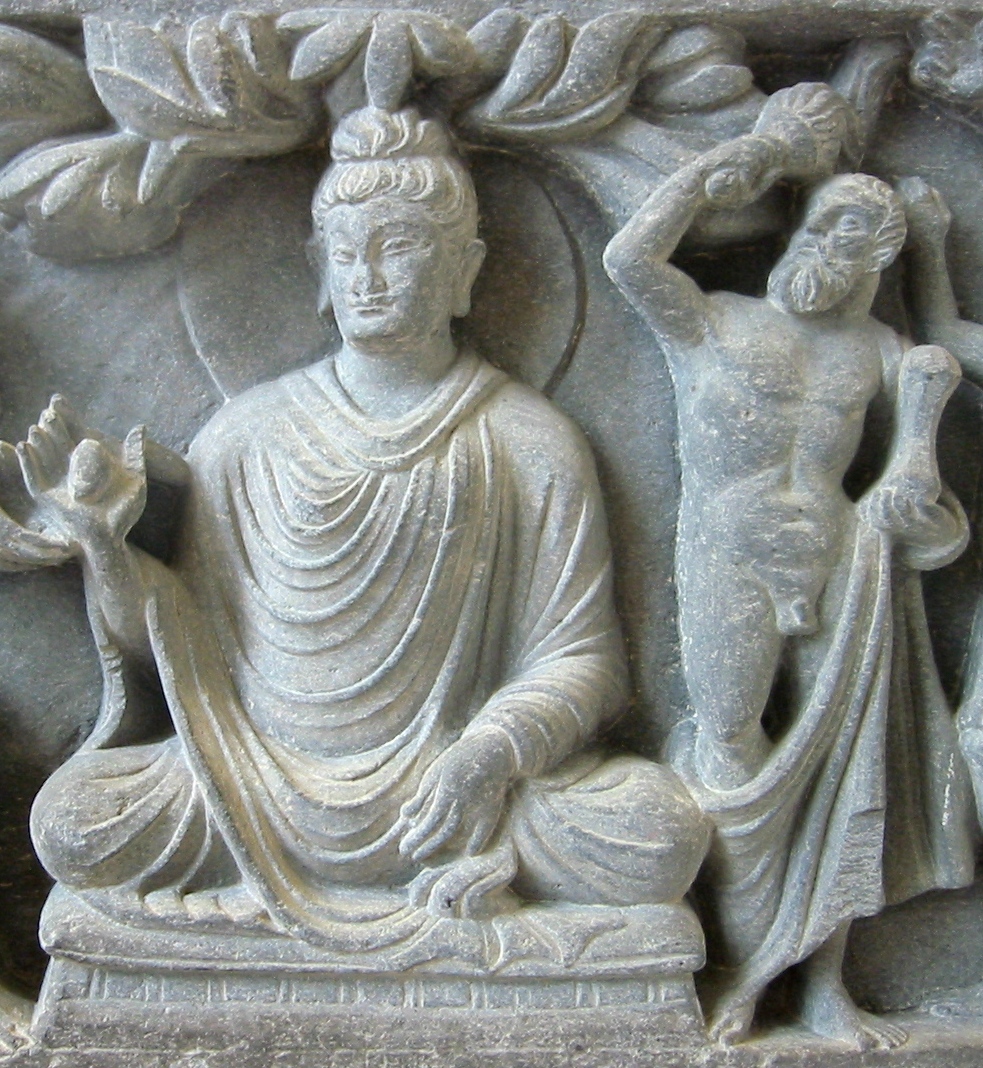
P.S. Featured image is Shakyamuni Buddha flanked by a guardian named Vajrapani. Notice the strongly Greek artistic style, including Vajrapani who looks similar to Hercules. This was made in Gandhara almost 2,000 years ago. Countless cultures and people have paid homage to Shakyamuni Buddha just as we do now. 🥳

1 Rant: Given that Christmas is observed on December 25th, despite Jesus’s birth very obviously not taking place in December (the Romans did not collect taxes in winter), the specific date for celebrating an event really isn’t that important. One date is as good as another, as long as the tradition is meaningful for people. I do prefer observing holidays using the solar calendar since it’s just so much easier to observe and plan out, though. Lunar calendars are fascinating in their own way, but they’re opaque and confusing to anyone who doesn’t fully understand them.

2 random history fact: by the time the Romans had subjugated places like Egypt and Mesopotamia, these places already had 2,000 years of culture and tradition. The Akkadian language was still in use for religious ceremonies and documents, despite the Akkadian empire of Sargon being gone for more than a thousand years. And all of this is but a drop in the bucket compared to geologic time of the Earth.