A Product Of One’s Era

I stared for half a day once at an old man sitting on a bench in Arrakeen. He was a fifth-generation descendant of Stilgar the Naib and did not even know it. I studied the angle of his neck, the skin flaps below his chin, the cracked lips and moistness about his nostrils, the pores behind his ears, the wisps of gray hair which crept from beneath the hood of his antique stillsuit. Not once did he detect that he was being watched. Hah! Stilgar would have known it in a second or two. But this old man was just waiting for someone who never came. He got up finally and tottered off. He was very stiff after all of that sitting. I knew I would never see him in the flesh again. He was that near death and his water was sure to be wasted. Well, that no longer mattered.

Frank Herbert, “God Emperor of Dune”, chapter 5

It’s not uncommon to hear our grandparents1 talk about the “olden days”, and how we kids “have it easy!”. Chances are, you probably heard this too. As we get older, we start doing it too!

But sometimes I think about this quote from Herbert’s “God Emperor of Dune”. The planet Arrakis was once a harsh, forbidding desert planet where water was extremely scarce, and its Fremen people lived on the edge of survival. And yet, when Leto II Atreides the God Emperor ascended to power, he transformed the planet into a tropical paradise. Insodoing, the Fremen became softer generation after generation, forgetting their hard-learned survival skills.

Yet, I don’t mean this as a judgment. Instead, I think people are unwittingly products of their surroundings. At birth we don’t choose our parents, our native language, or which country, ethnicity, or “caste” we are born into. We are simply thrust into some circumstances outside our control, and even if we reject them, it still shapes who we are.

Further, as society moves from times of war (or pandemic), to times of peace, people change in response. Then, if war breaks out again, they change again. During times of prosperity, people behave one way, but in times of scarcity, they change again. It’s not that one generation is somehow better than another: they just respond to different conditions.

So, sometimes, I think about what forces have shaped myself up until now: my family’s political leanings, the socio-economic circumstances, and why these might have shaped my own personal biases. Even now, as I watch my kids grow up and leave the nest, I can already see generational differences with them, shaped by technology, world events, changes in social attitudes and so on. My grandchildren’s grandchildren will be even more different.

This is neither bad nor good, it’s just how things work.

P.S. Double-post today!

1 Including the dinner table … happy Thanksgiving!
Time Travel and the Guardian of Forever

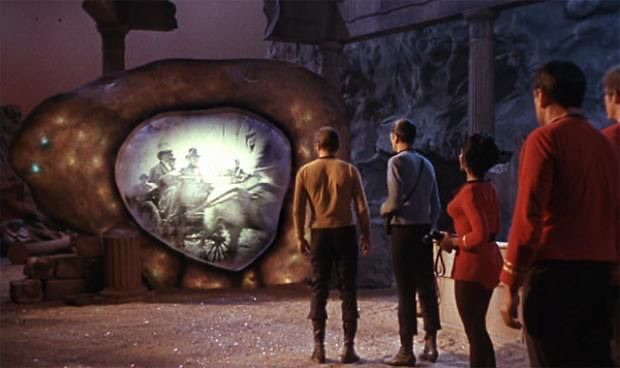
One of the most iconic episodes of the original Star Trek series is the episode “City on the Edge of Forever” (season 1, episode 28), where Kirk and Spock have to travel back in time through the Guardian of Forever, in order to correct a change in the timeline that drastically affects their future. The climatic ending involves a tragic moment where Kirk has to let someone they love die in order to correct the timeline.

During my last watch-through of this episode with the Saturday Night Star Trek team, I started thinking about the time-travel implications of this episode. If you haven’t seen the episode, please stop here and watch the episode (or save this post for another time). I think this episode is even trippier than you night believe at first.

Warning: spoilers.

Canonical Story

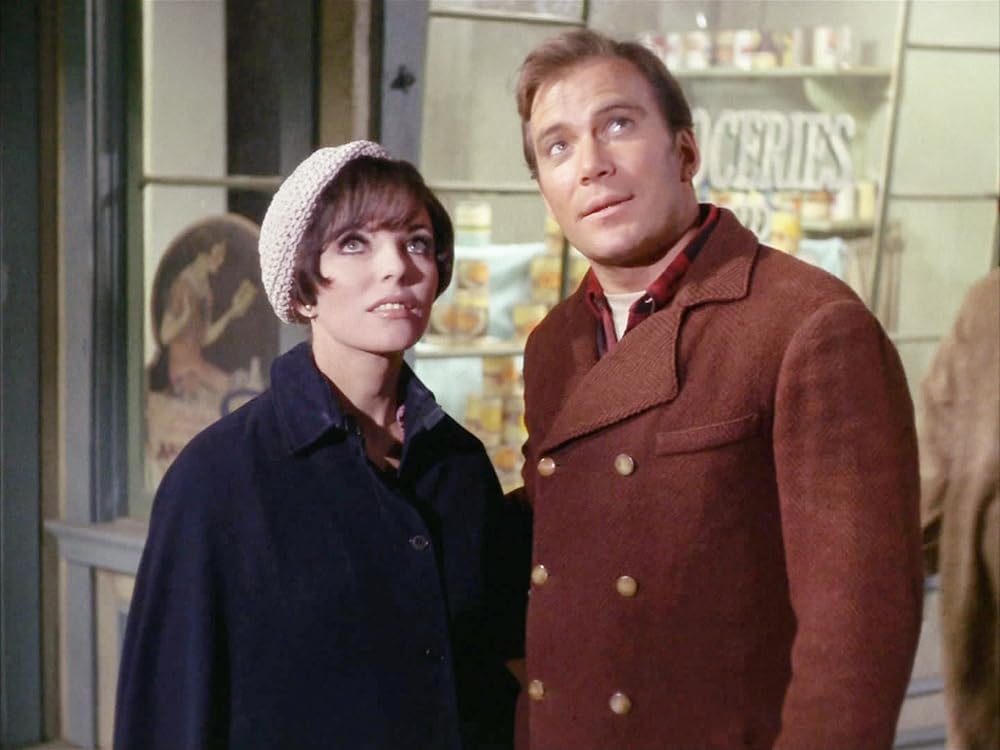
Edith Keeler (played by Joan Collins), and James Kirk (played by William Shatner)

This episode treats time travel in the following order:

  1. McCoy (deluded by overdose of medication) travels back in time to 1930’s and somehow saves Edith Keeler.
  2. Edith Keeler’s existence helps trigger a pacifist movement that delays US entry into World War II (Spock: “the right idea, but the wrong time”) leading to catastrophic consequences. The alternate (correct) history is that she dies in a car accident.
  3. Kirk and McCoy travel back in time to stop this.
  4. Kirk saves Edith Keeler from a fall down the stairs that might have killed her.
  5. After being admonished by Spock, Kirk chooses not to save Edith Keeler when she is struck by a car, ending her life. This restores the timeline to the way it was.
  6. Kirk, Spock, and McCoy return to the 23rd century, all is well (minus Kirk’s poor heart).

This is the canonical story.

My Fan Theory: Kirk is the Source of the Timeline not Restorer

My personal theory is that James Kirk didn’t restore the timeline as such; he caused it. The future we see now in Star Trek universe was a direct result of, not saved by, James T Kirk.

If you think about it for a moment, the canonical history is that Edith Keeler dies by a car accident before the start of World War II, but in the story, the reason why she gets into a car accident in the first place is because she crosses the street to see Jim Kirk. If both Jim and McCoy hadn’t travelled back, would Edith Keller still die by a car accident?

This is where causality in time travel gets weird. Assuming Jim Kirk is the cause of the canonical timeline, then presumably he was predestined at some point to find the Guardian of Forever, go back in time, interact with Edith Keeler in such a way that she dies by car accident.

The implication is that Jim Kirk was always going to travel back in time at the set date (barring further time travel shenanigans), which implies predestiny.

But what if Kirk and the Enterprise somehow never found the Guardian of Forever? Then Edith’s particular death shouldn’t happen, causing a paradox.

Or, if as Spock implies, time flows like river with “currents and eddies” and thus Edith Keeler would have still died by a traffic accident, but not this particular one, thus the timeline stays more or less unchanged.

Which one is true? Who knows.

The Weight of the Decision

The other aspect of this episode is that the timeline of Earth drastically changes due to the death (or life) of Edith Keeler. This means that following these events in the 1930’s countless people are drastically affected. Depending on the timeline, Person A might be killed in WWII, or they might live. If they live, Person A might have kids that otherwise might not exist.

Thus when Kirk restores (or causes) the timeline, his action causes the life or death of countless humans he will never know about. Similarly, McCoy’s initial interference.

So, regardless of which timeline is correct, Kirk and/or McCoy will be responsible for the countless deaths and lives that come after. A weighty decision indeed.

Another Timeline Change: Death by Phaser

Another aspect that’s often missed is McCoy’s first arrival in the 1930’s. He is robbed by a local homeless guy (the same guy who makes lewd comments about Edith Keeler earlier in the episode), who takes his hand-phaser and accidentally vaporizes himself. This seems to prevent any Federation technology from leaking back to the past (good), but the death of the homeless guy may have additional timeline consequences that we don’t know about, and never see the results of.

Granted, as Spock said in his “currents and eddies” comment, the timeline may resist change, and so the death of the man may not change all that much. But it’s also possible that his absence triggers events that the subtly alter the future in ways we don’t know about, even if they are not as dramatic as Edith Keeler’s.

So, when the Enterprise crew return to the ship, I wonder if they noticed any subtle oddities…

Conclusion

Time travel is weird, and the causality of time travel is even weirder. Since no one has actually travelled in time (as far as we know), the implications of changing the past are entirely theoretical, but it’s fun to imagine.

And, not surprisingly, “City on the Edge of Forever” remains one of the most iconic episodes in Star Trek. 🖖🏼

P.S. The Star Trek novel Yesterday’s Son by A.C. Crispin explores the Guardian of Time, and a certain other Star Trek episode involving Spock and a woman, and the implications of both. Quite a fun read if you find it.

P.P.S. An accidental double-post today. I made a scheduling error. 😅

Respect for Life

Recently, I was watching an iconic episode of Star Trek, “Arena” (s1ep19, a.k.a. the one with the Gorn), and I noticed this dialogue for the first time:

SPOCK: You mean to destroy the alien ship, Captain? 

KIRK: Of course.

SPOCK: I thought perhaps the hot pursuit alone might be sufficient. Destruction might be unnecessary.

KIRK: Colony Cestus Three has been obliterated, Mister Spock. 

SPOCK: The destruction of the alien vessel will not help that colony, Jim.

KIRK: If the aliens go unpunished, they’ll be back, attacking other Federation installations.

SPOCK: I merely suggested that a regard for sentient life —

KIRK: There’s no time for that.

I was impressed by how much Spock went out of his way to avoid destroying sentient life, as his duty allowed. This is not the only time he does this, see for example in Devil in the Dark (s1ep25):

SPOCK: Or it is the last of a race of creatures which made these tunnels. If so, if it is the only survivor of a dead race, to kill it would be a crime against science.

Of course, it’s also known that Leonard Nimoy helped develop the character’s iconic Vulcan Neck Pinch too: a non-violent way of subduing humanoids. He also didn’t hesitate to toss people from time to time…

Nonetheless, Spock’s respect for all life, and commitment to reason, science, and non-violence is really admirable. In Arena, Kirk is taking vengeance against the Gorn for the destruction of Cestus III, but Spock points out that destroying the Gorn vessel won’t bring back Cestus III. Later, as the episode shows, the destruction of Cestus III was due to a misunderstanding between the Federation and the Gorn. Spock was right: wanton destruction would have done no good. Kirk’s mercy toward the Gorn at the end is also praised by the Metrons who instigated the arena-style battle of the episode.

I suppose my point here is that science, reason, and respect for all life are worthy traits to uphold even today. 🖖🏼

P.S. Many years ago, when I visited the Star Trek museum exhibit at the Museum of Pop Culture in Seattle and I got to see the original Gorn costume:

Star Trek and Space Lincoln!!

Season three of Star Trek has one of my most favorite, albeit silliest episodes in the entire series: The Savage Curtain. The episode starts off with a bang: Abraham Lincoln (played by Lee Bergere) floating in space on his trademark chair.

From there, the Enterprise crew and in particular Kirk and Spock are confronted by some of “histories worst villains” as well as an encounter with Spock’s idol, Surak (played by Barry Atwater), father of Vulcan philosophy.

A picture of Surak of Vulcan, his right hand in the Vulcan Salute.
Surak of Vulcan, founder of Vulcan Logic, in the Star Trek episode the “Savage Curtain” (season 3, episode 22)

The rock aliens who force the “good” historical figures to combat the “evil” historical figures want to compare and contrast their philosophical ideas against one another to see which is better.

Kahless the Unforgettable (played by Bob Herron) and Colonel Greene (played by Phillip Pine)

The premise might seem a bit silly, but it is a fascinating contrast of ideas:1

  • Surak – a pacifist, non-violent approach
  • Lincoln – fight if necessary, and “on their level”.
  • Col. Greene – power is all matters
  • Kahless – victory by any means
  • Kirk – do what it takes to save his crew
  • Spock – honor his commitments to Starfleet, and fight with Kirk, even if is compromises his personal morals

Although Surak loses his life in the combat, he has some really great quotes in this episode that I think are worth sharing:2

The face of war has never changed.  Surely it is more logical to heal than to kill.

Surak of Vulcan, “The Savage Curtain” (s3ep23), stardate 5906.5

and also:

I am pleased to see that we have differences.  May we together become greater than the sum of both of us.

Surak of Vulcan, “The Savage Curtain” (s3ep22), stardate 5906.4

Lincoln’s performance throughout the episode is great as he embodies the great American president as we want him to be: gentle, but tough when needed. One can’t help but compare this to Bill and Ted’s Excellent Adventure, even if they are completely different movies, because Abraham Lincoln is such a beloved figure.

At the very end of the episode, there is a subtle dialogue worth sharing:

KIRK: They seemed so real. And to me, especially Mister Lincoln. I feel I actually met Lincoln.

SPOCK: Yes, and Surak. Perhaps in a sense they were real, Captain. Since they were created out of our own thoughts, how could they be anything but what we expected them to be?

Source: http://www.chakoteya.net/StarTrek/77.htm

In fact, I think there’s something very Buddhist about this. The inhabitants of the planet didn’t necessarily create historically accurate versions of Lincoln, Surak, etc, but what we wanted them to be in our minds. In a sense, we create our own gods and idols through our hopes and aspirations (for good or for ill). This isn’t always bad, but it does show how unwittingly we bend the world around us to fit our beliefs and views.

Anyhow, The Savage Curtain is such a fun, surreal episode, and a fascinating contrast of ideas and people in history, and how they interact. These ideas and philosophies are timeless in many ways, and crop up over and over again in history, but by pitting a bunch of historical figures in space against once another, it takes on a whole new dimension of weird, silly, fun.

Also:

P.S. Many reviews point out that The Savage Curtain borrows elements from older, venerable episodes, and thus judge it an inferior episode. I can’t disagree that it borrows a lot of elements, but I like to think it is a capstone to several previous “moral tale” episodes. The action sequences aren’t quite as good, but I don’t think that was the point. It was battle of ideas, not sticks.

P.P.S. I bet you could take all 8 characters, including Kirk and Spock, in the battle and somehow arrange them into a classic D&D alignment chart. The rock aliens of Excalbia would probably be true-neutral.

1 I wish “Zorra” (Carol Daniels) and “Genghis Khan” (Nathan Jung) had dialogue, as it would have been interesting to have more contrasting goals and aspirations.

2 More on witnessing war.

Happy Holidays 2024

Spock sitting in an orange room, facing right, his fingers steepled as he meditates on a problem.

On my planet, to rest is to rest — to cease using energy.  To me, it is quite illogical to run up and down on green grass, using energy, instead of saving it.

Spock, “Shore Leave”, stardate 3025.2

Dear Readers,

Wishing you all a restful end of year, and a happy 2025!

I am going to take the next couple of weeks off myself and recharge, spend time with the family and so on. But, I also have a personal to-do list I made for myself to capitalize on the downtime and get some things done, including:

  • Finishing a novel I’ve been reading
  • A bit more Buddhist practice
  • Finishing the next installment of the Journeys of Xuan-zang (part 5 is interesting, but taking way longer than expected to finish)
  • A couple bonus projects if I have time.
  • A bit of studying

So, unlike Spock, I’ll be probably busy, but also productive on a personal level. I mostly gave myself some really easy “softball” goals so I don’t burn out on my time off, but then again, maybe I should trim this list down and have more time to just space out.

I’ll let you all know in 2025. Until then, take care!

P.S. Related post from a few years earlier.

It’s Just There

I used to be an avid Dune reader in my younger years, and posted quotes from it all the time in earlier iterations of the blog. Anyhow, I found this quote from the third book:

The universe is just there; that’s the only way a Fedaykin can view it and remain the master of his senses. The universe neither threatens nor promises. It holds things beyond our sway: the fall of a meteor, the eruption of a spiceblow, growing old and dying. These are the realities of this universe and they must be faced regardless of how you feel about them. You cannot fend off such realities with words. They will come at you in their own wordless way and then, then you will understand what is meant by “life and death.” Understanding this, you will be filled with joy.

Muad’Dib to his Fedaykin, from Frank Herbert’s “Children of Dune”

I have probably said this a few times recently, but like it or not we are not the center of the Universe, no matter how much we like to think we are. The universe will carry on without or without us, and sometimes it’s capable of really wondrous moments, and sometimes it will unleash some really shitty realities on us. And there’s only so much we can do to control that. Like a raft navigating treacherous waters, we have to carefully row and pay attention to the currents.

In spite of all this, though, it doesn’t mean we have to sit and be passive either.

Speaking of old science-fiction quotes…I am an avid Roger Zelazny reader, and Isle of the Dead is among my favorite books ever. I always like this quote because of its cosmic feel, but also its unintentional Buddhist message which resembles Saicho’s famous quote about “lighting one corner of the world”:

“Earth-son, I greet you by the twenty-seven Names that still remain, praying the while that you have cast more jewels into the darkness and given them to glow with the colors of life.”

Roger Zelazny, “Isle of the Dead”

Also, consider the 16th chapter of the Lotus Sutra:

My pure land is not destroyed, yet the multitude see it as consumed in fire, with anxiety, fear and other sufferings filling it everywhere….But those who practice meritorious ways, who are gentle, peaceful, honest and upright, all of them will see me here in person, preaching the Law [a.k.a. The Dharma]

Translation by Burton Waton

Thus, even in the midst of crisis, or madness, or despair the light of the Dharma still shines even when it seems obfuscated. It is always there for those willing to look, and for those willing to cast a few jewels into the darkness.

Spock Preaches the Four Noble Truths

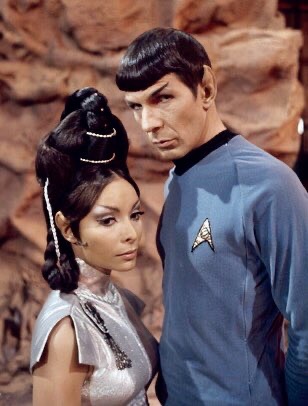
Leonard Nimoy as Spock, and Arlene Martel as T’Pring

This is an iconic line from an iconic episode of the original series Star Trek:

After a time, you may find that “having” is not so pleasing a thing, after all, as “wanting.”  It is not logical, but it is often true.

Spock, “Amok Time” (s2ep1), stardate 3372.7

I like to think that this also encapsulates the Four Noble Truths of Buddhism very nice:

  1. Existence is marked by dukkha1 : dissatisfaction, unease, disappointment, etc.
  2. This dukkha arises from “wanting” or from unrealistic expectations.
  3. It doesn’t have to be this way.
  4. The way to avoid dukkha is to follow a lifestyle that is rational, “logical” and upright. In other words, the Noble Eightfold Path. 🖖

Buddhism historically uses a wide variety of parables, similes and other ways of expressing this, but they all say the same basic thing that Spock does: stop shooting yourself in the foot.

Namu Shaka Nyorai

Namu Amida Butsu

1 One of those fancy Buddhist Sanskrit terms that all the popular social-media influencers use… just kidding. 😉

Saints Into Savages

Author’s note: I wrote this a couple months ago, but have been so backed up, I am finally posting it now. It was not intended to relate to current events. Just Star Trek nerdism, and me philosophizing.

The third-season episode of Star Trek titled Plato’s Children is often criticized as one of the worst episodes of the series. It actually has a really interesting premise, but suffers from poor execution.1

The Enterprise comes to planet populated by a self-styled republic,2 modeled after ancient Greek poleis, comprised of aliens who each have tremendous psychic powers. They live in great comfort, and spend their days pursuing whatever they want, but members of this republic have become so lazy, and have atrophied so much that they can’t manage even basic first-aid. When the leader suffers from a cut, he fails to do anything about it until it becomes seriously infected.

Further, one member of the community suffers from dwarfism, and no psychokinetic powers, and the other members of the republic bully him for entertainment and menial tasks. Michael Dunn’s performance as the “dwarf” character was excellent by the way. The same members also torment the Enterprise crew for an extended period of time to get what they want.3

By the end of the episode, it’s clear that the members of this republic are perpetually bored, and half-mad from having terrific power, but nothing constructive to use it for.

Without any struggle in life, or a way to stay grounded, I think the tendency is for one to gradually go mad. People’s minds, even when satisfied with basic needs, have a tendency to create more and more subtle problems for themselves. These problems nest fractally, there is no bottom.

Further, the other major point of the episode is said by the villain Patronius when he is defeated by Kirk:

Patronius: “Uncontrolled, power will turn even saints into savages. And we can all be counted on to live down to our lowest impulses.”

Star Trek, “Plato’s Stepchildren” (s3ep10), Stardate 5784.2

This is a very unintentionally Buddhist thing to say too. The mind is capable of the heights of sainthood (or bodhisattva-hood in Buddhism), as well as the depths of depravity, and everything in between. Under the right conditions any person can become a tyrant, or a saint bodhisattva. It’s not so much a question of personal will-power, environment matters more than one might think.

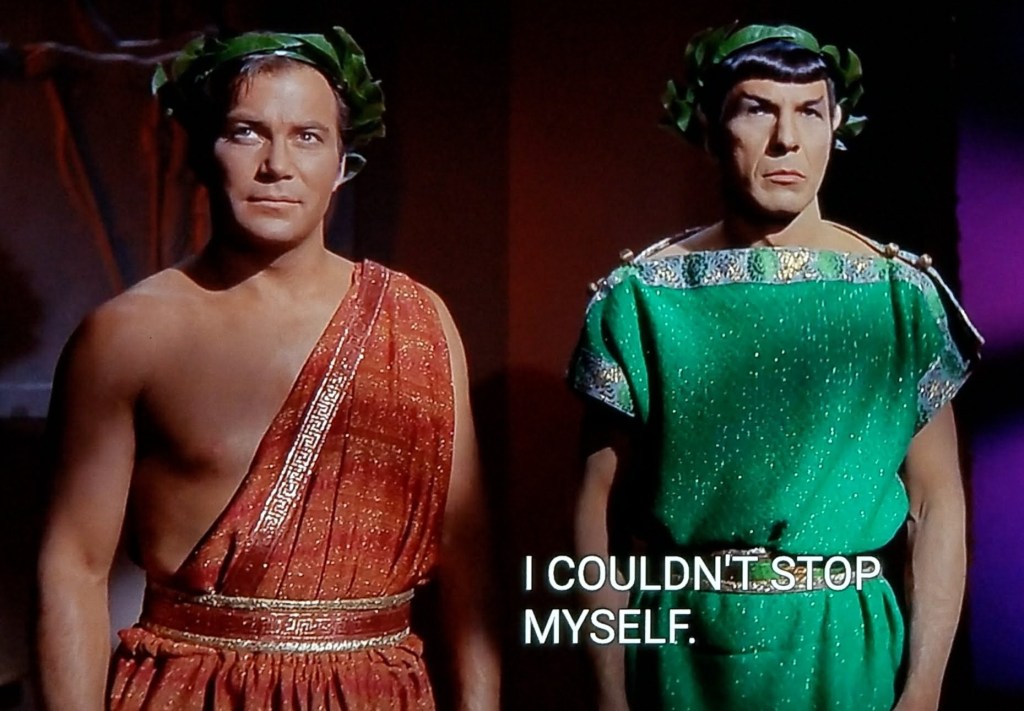
Under the right circumstances, you might even wear a toga….

It is always important to stay just a little vigilant toward one’s own mind. Perfectly rational people can easily go off the rails under the right circumstances. Further, you can’t control what others think and do (nor should you), but you can control how you react to them, or how you choose to conduct yourself. A mind unrestrained will inevitably run into disaster.

Namu Shaka Nyorai

1 Like many season 3 episodes.

2 The use of “republic” as modern people think it, is pretty different than the “res publica” as understood by Romans. It was more closer to a commonwealth, than a particular political structure, so even after Octavian took over as the princeps (the first “Emperor” in all but name), the res publica kept going well into the Easter Roman Byzantine era and beyond. By then, the Latin term was gradually replaced with the Greek equivalent: Politeia (πολιτεία).

3 This is why this episode is so unpopular. The script is pretty thin, so i guess the idea was to stretch out the time by adding more of these torment scenes.

Letting Go of Expectations of Others

Spock: No one can guarantee the actions of another.

Star Trek, “Day of the Dove” (s3ep7), stardate unknown

The third season of the classic TV series, Star Trek, gets a lot of flak for being lower in quality, but some of the best episodes of the series can be found there. One of my personal favorites is “Day of the Dove”.

The premise is strange at first glance: the Enterprise crew and a group of Klingon prisoners are trapped on the Enterprise by a phantasmal alien that feeds on anger and conflict, which keeps manipulating both sides in order to instigate them into hopeless, unending cycle of conflict. The alien furnishes weapons, seals corridors, plants false memories, and heals fatal injuries all so that the Enterprise crew and Klingons fight can ad infinitum, even as the ship is hurling out of control beyond the edge of the galaxy.

There’s a lot to unpack in this episode, and much of it still relates to circumstances today. But I’ll let you the reader decide for yourself.

In any case, Spock’s quote above illustrates something very Buddhist in my opinion: people expect other people to think and feel the way they do. When they don’t, we get frustrated. We naturally tend to see our own viewpoint as “pristine” and the more other’s deviate from this, the weirder or aberrant they are. We get frustrated when we they don’t do what we expect them to do. This can also happen between spouses, co-workers, and so on.

But as Spock rightly implies, this is arrogant, irrational, and dare I say “illogical”. We are not the center of the Universe, why should other people think and do as we do?

In the classic Buddhist text, the Dhammapada, are the following verses:

  1. One who, while himself seeking happiness, oppresses with violence other beings who also desire happiness, will not attain happiness hereafter.
  2. One who, while himself seeking happiness, does not oppress with violence other beings who also desire happiness, will find happiness hereafter.
  3. Speak not harshly to anyone, for those thus spoken to might retort. Indeed, angry speech hurts, and retaliation may overtake you.
  4. If, like a broken gong, you silence yourself, you have approached Nibbana,1 for vindictiveness is no longer in you.

[skipping for brevity…]

142. Even though he be well-attired [instead of dressed like a humble monk], yet if he is poised, calm, controlled and established in the holy life, having set aside violence towards all beings — he, truly, is a holy man, a renunciate, a monk.

translation by Acharya Buddharakkhita

Oftentimes, it is simply better to let go, let people be who they are, even if they are wrong or short-sighted, and wish them no harm.

Namu Shakamuni Butsu
Namu Amida Butsu

1 Nibbana is the Pali-style pronunciation of Nirvana. Both mean the same thing in a Buddhist context: liberation, unbinding, freedom. A Buddha’s awakening to the truth (e.g. enlightenment) leads to a state of letting go, unbinding. The Buddha Shakyamuni described it as a flame extinguished.