IDIC, Redux

Imagine a star in the sky, any star. It is a great big ball of hydrogen gas (some helium too). Its own mass is so great that it compresses its core with tremendous heat and pressure until it ignites a nuclear fusion reaction.

Photo by Pixabay on Pexels.com

Through nuclear fusion (not fission as we use), hydrogen molecules fuse into helium, releasing energy each time. If the star is heavy enough it will eventually also fuse helium into things like carbon and oxygen. If the star is exceptionally big, it will fuse even heavier elements.

Such stars, when they reach the end of their lives, billions of years later, explode in dramatic fashion scattering all their fused elements into space. In a few more billion years, this material coalesces into another star, some planets, etc.

DELENN: We are all born as molecules in the hearts of a billion stars molecules that do not understand politics or policies or differences.

Over a billion years we foolish molecules forget who we are and where we came from.

In desperate acts of ego we give ourselves names, fight over lines on maps and pretend that our light is better than everyone else’s.

Babylon 5, “And All My Dreams, Torn Asunder” (s5:ep16)

Thus when you look at your own hands, or the cup of coffee you are drinking it is literally, and scientifically speaking, made from material that was fused in a nuclear reaction by stars that were destroyed many billions of years ago. This generation of stars is all but gone (the Universe is quite old), but we are their legacy. From ancient chemical processes, a near-infinite number of things have arisen. As the Vulcans in Star Trek would say: infinite diversity in infinite combinations (IDIC).

And yet, it’s easy to forget this.

We take our bodies for granted, as well as the things around us. We also assume they are permanent. A coffee cup is a coffee cup. Always will be. This gives rise to thoughts of “me” and “my things”. Survival becomes our primary motive. We are homo sapiens after all.

Evolution teaches us that we must fight that which is different in order to secure land, food, and mates for ourselves. But we must reach a point where the nobility of intellect asserts itself and says no. We need not be afraid of those who are different. We can embrace that difference and learn from it.

G’Kar, Babylon 5, “The Ragged Edge” (s5:e12)

But none of this is permanent. As the Buddha taught, we do not own anything. We don’t even truly own ourselves:

Rahula, any form whatsoever that is past, future, or present; internal or external; blatant or subtle; common or sublime; far or near: every form is to be seen as it actually is with right discernment as: ‘This is not mine. This is not my self. This is not what I am.'”

Mahā Rāhulovāda Sutta (MN 62) of the Pali Canon, translation by Thanissaro Bhikkhu

Thus, that cup of coffee isn’t really your cup of coffee. Your body isn’t really yours either. At most, you are borrowing that body (a gift from your parents, the universe, etc). That cup is in your care, but it will fall apart or go in the bin someday. Your children are in your care; you do not own them.

In time, like the stars that once forged the elements in your body, such things will be long, long gone. Dust in grand scheme of time.

P.S. Original IDIC post.
Time Travel and the Guardian of Forever

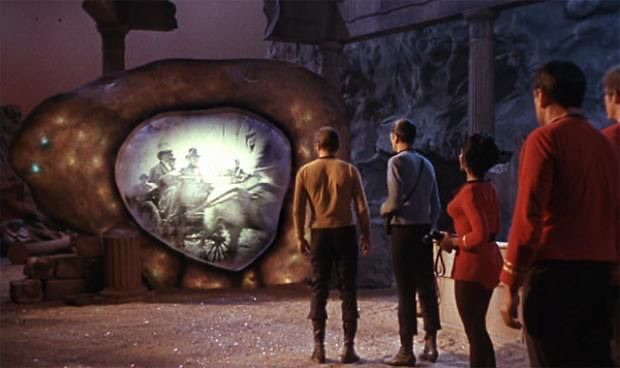
One of the most iconic episodes of the original Star Trek series is the episode “City on the Edge of Forever” (season 1, episode 28), where Kirk and Spock have to travel back in time through the Guardian of Forever, in order to correct a change in the timeline that drastically affects their future. The climatic ending involves a tragic moment where Kirk has to let someone they love die in order to correct the timeline.

During my last watch-through of this episode with the Saturday Night Star Trek team, I started thinking about the time-travel implications of this episode. If you haven’t seen the episode, please stop here and watch the episode (or save this post for another time). I think this episode is even trippier than you night believe at first.

Warning: spoilers.

Canonical Story

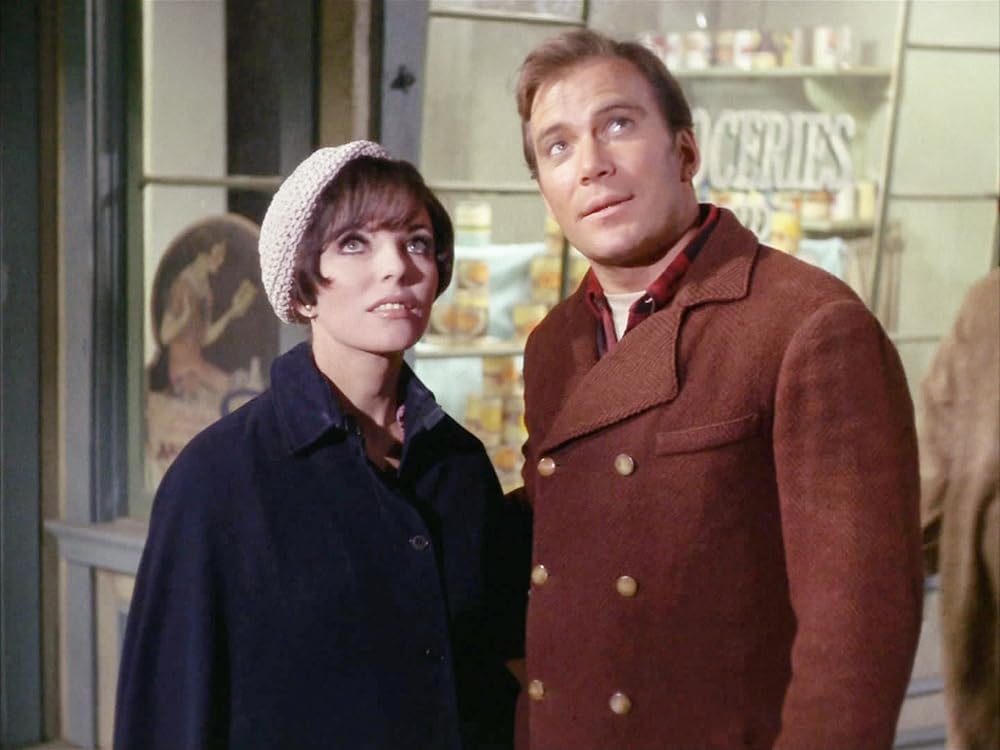
Edith Keeler (played by Joan Collins), and James Kirk (played by William Shatner)

This episode treats time travel in the following order:

  1. McCoy (deluded by overdose of medication) travels back in time to 1930’s and somehow saves Edith Keeler.
  2. Edith Keeler’s existence helps trigger a pacifist movement that delays US entry into World War II (Spock: “the right idea, but the wrong time”) leading to catastrophic consequences. The alternate (correct) history is that she dies in a car accident.
  3. Kirk and McCoy travel back in time to stop this.
  4. Kirk saves Edith Keeler from a fall down the stairs that might have killed her.
  5. After being admonished by Spock, Kirk chooses not to save Edith Keeler when she is struck by a car, ending her life. This restores the timeline to the way it was.
  6. Kirk, Spock, and McCoy return to the 23rd century, all is well (minus Kirk’s poor heart).

This is the canonical story.

My Fan Theory: Kirk is the Source of the Timeline not Restorer

My personal theory is that James Kirk didn’t restore the timeline as such; he caused it. The future we see now in Star Trek universe was a direct result of, not saved by, James T Kirk.

If you think about it for a moment, the canonical history is that Edith Keeler dies by a car accident before the start of World War II, but in the story, the reason why she gets into a car accident in the first place is because she crosses the street to see Jim Kirk. If both Jim and McCoy hadn’t travelled back, would Edith Keller still die by a car accident?

This is where causality in time travel gets weird. Assuming Jim Kirk is the cause of the canonical timeline, then presumably he was predestined at some point to find the Guardian of Forever, go back in time, interact with Edith Keeler in such a way that she dies by car accident.

The implication is that Jim Kirk was always going to travel back in time at the set date (barring further time travel shenanigans), which implies predestiny.

But what if Kirk and the Enterprise somehow never found the Guardian of Forever? Then Edith’s particular death shouldn’t happen, causing a paradox.

Or, if as Spock implies, time flows like river with “currents and eddies” and thus Edith Keeler would have still died by a traffic accident, but not this particular one, thus the timeline stays more or less unchanged.

Which one is true? Who knows.

The Weight of the Decision

The other aspect of this episode is that the timeline of Earth drastically changes due to the death (or life) of Edith Keeler. This means that following these events in the 1930’s countless people are drastically affected. Depending on the timeline, Person A might be killed in WWII, or they might live. If they live, Person A might have kids that otherwise might not exist.

Thus when Kirk restores (or causes) the timeline, his action causes the life or death of countless humans he will never know about. Similarly, McCoy’s initial interference.

So, regardless of which timeline is correct, Kirk and/or McCoy will be responsible for the countless deaths and lives that come after. A weighty decision indeed.

Another Timeline Change: Death by Phaser

Another aspect that’s often missed is McCoy’s first arrival in the 1930’s. He is robbed by a local homeless guy (the same guy who makes lewd comments about Edith Keeler earlier in the episode), who takes his hand-phaser and accidentally vaporizes himself. This seems to prevent any Federation technology from leaking back to the past (good), but the death of the homeless guy may have additional timeline consequences that we don’t know about, and never see the results of.

Granted, as Spock said in his “currents and eddies” comment, the timeline may resist change, and so the death of the man may not change all that much. But it’s also possible that his absence triggers events that the subtly alter the future in ways we don’t know about, even if they are not as dramatic as Edith Keeler’s.

So, when the Enterprise crew return to the ship, I wonder if they noticed any subtle oddities…

Conclusion

Time travel is weird, and the causality of time travel is even weirder. Since no one has actually travelled in time (as far as we know), the implications of changing the past are entirely theoretical, but it’s fun to imagine.

And, not surprisingly, “City on the Edge of Forever” remains one of the most iconic episodes in Star Trek. 🖖🏼

P.S. The Star Trek novel Yesterday’s Son by A.C. Crispin explores the Guardian of Time, and a certain other Star Trek episode involving Spock and a woman, and the implications of both. Quite a fun read if you find it.

P.P.S. An accidental double-post today. I made a scheduling error. 😅

Back to Nature

SPOCK: There are many who are uncomfortable with what we have created. It is almost a biological rebellion. A profound revulsion against the planned communities, the programming, the sterilised, artfully balanced atmospheres. They hunger for an Eden where spring comes.

Star Trek, “The Way to Eden” (s3e20), Stardate 5832.3

世の中よ道こそなけれ思ひ入る山の奥にも鹿ぞ鳴くなる。

Within this world there is, indeed, no path! Even deep in this mountains I have entered, heart set, I seem to hear the deer cry!

Poem 83 of the Hyakunin Isshu, translation by Joshua Mostow

Recently, I came back from a camping trip, the last for our family before my daughter goes off to college. It was both good and bad. We stayed at Moran State Park on Orcas Island, Washington. I had been to Orcas Island a number of times over the years, but I had never really stayed there for personal reasons, so it was nice to explore at leisure for a change.

Cascade Lake near our campsite, which was very pristine and peaceful in the mornings. Our dog, Cherry, liked exploring here.
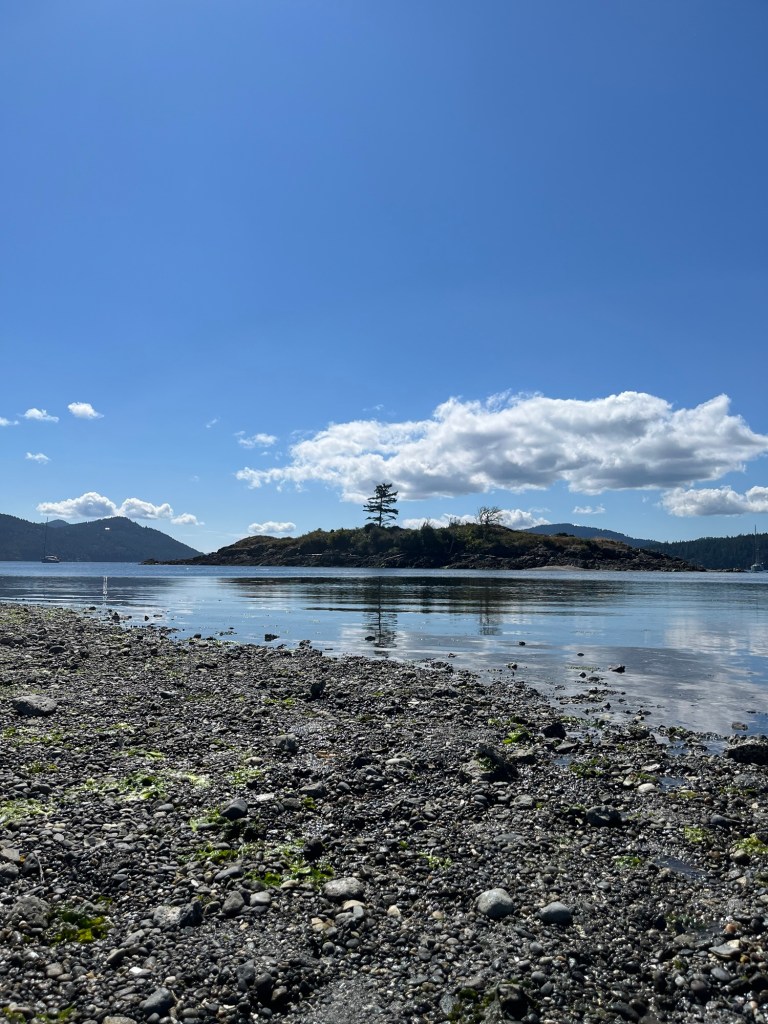
The so-called “Indian Island” in Eastsound bay. This area was once a village belonging to a Salish people called the Lummi (official homepage), who grew camassia crops on that islet. A combination of disease from Westerners and raids by northern Salish tribes drove them to the mainland. That lone pine tree feels like a momument to the Lummi to me…
A view from Mount Constitution, the highest peak on Orcas Island, facing eastward towards Washington State. I visited here many years ago as a kid on a school camping trip, but don’t remember much.

I posted the Star Trek quote above, not just because it sounds cool, but it does explore a side of us all: yearning for the simple country life. We all feel that revulsion toward modern life, and want to escape, yet even just after a couple days of camping in the woods, the smell of body-odor, noise from neighboring campers,1 and lack of food variety, Internet access, and electricity made us really eager to go back home. Even with modern amenities like gas stoves, freezer coolers and ready-made food (including instant ramen), it quickly gets old.

It wasn’t just me either. There was a lone woman camping just next to us. She brought her dog, and a stack of books to read, and seemed like an experienced camper, but it was clear that she wasn’t finding the solace she sought, and spent most of her time away from campsite to (presumably) find a quieter spot.

The fabled Eden sounds nice, but such a bucolic past probably never existed. Pre-modern life was in reality hard, exhausting, and safety was not always guaranteed.

Yet, modern life has its own challenges and dangers too. We might not die from dysentery anymore, but we often suffer obesity, isolation, and constant anxiety. We might not starve like our ancestors did, but we also eat some egregiously bad food thanks to mass-production and chemicals (including microplastics). Similarly, our fellow Man has replaced natural predators as the threat to our lives.

I don’t want to downplay the benefits of modern life, though.

The average2 lifespan of a human being in the 21st century is significantly longer than before. My little incident a couple years ago likely would have killed me before modern medicine. Dying in one’s forties was not uncommon in the pre-modern era. But the dangers of modern life are still there but now more subtle, yet catch up to us eventually.

In short, life is a struggle, no matter how long we live. Getting to old age without suffering any major health issues is something to be grateful for, but even more important is how you choose to live your life up to that point. As the Zen aphorism goes: every day is (sort of) a good day, so enjoy the moment, and try to live with some element of dignity and free of regrets.

Namu Shakamuni Butsu

1 There was a very rude family camped next to us. The mom kept yelling and swearing at her two toddler children, who in turn were constantly crying and talking back … at 4am in the morning. Ironically, the lady had a “Live Laugh Love” bumper sticker on her car.

2 The keyword here is “average”. A person in pre-modern times some people did live to their 80’s or 90’s, but the odds were against them. A single scratch leading to an infection, or a crippling injury, or a genetic precondition that we can treat now would often kill a younger person. So, if you did manage to live to a ripe old age, it was indeed a cause for celebration.

The Healing Power of Nature

In the past, I talked about the four-character phrases, or yojijukugo, popular in Japanese culture. Recently, I learned about a new phrase that I hadn’t heard before: kachō-fūgetsu (花鳥風月). This phrase describes the beauty of nature, literally the Kanji characters for “flower”, “bird”, “wind” and “moon”.

The meaning here is various aspects of nature, but also in a positive healing sense.

Spock: Indeed, gentlemen. May I point out that I had an opportunity to observe your counterparts here quite closely. They were brutal, savage, unprincipled, uncivilized, treacherous; in every way, splendid examples of homo sapiens, the very flower of humanity. I found them quite refreshing. [he returns to the science station]

Kirk: I’m not sure, but I think we’ve just been insulted.

McCoy: I’m sure.

Star Trek, “Mirror Mirror” (s2ep4), stardate unknown

For all our veneer of civilization and advancement, we are still deep down biological creatures. We come from nature, and we need nature. Nature heals us and sustains us.

A small patch of grass in my yard, taken in April of 2025.

These days, it’s not hard to feel stressed by all the things that are going on, but I also found solace knowing that nature continues on regardless of what humans do or become. That doesn’t mean the future of humanity will necessarily be positive or negative, but it does remind me that life goes on nonetheless.

It also underscores how important protecting nature is.

P.S. More tips here for protecting the environment.

The Death of Gods

“I hope that your Engels and your Lenins never replace the religion that I hate, or the superstitions I have battened upon. You Babakov, have more blood on your hands than I have ever drunk. In destroying the gods of light you are also destroying the Dark Ones. We shall be avenged!”

Roger Zelazny, “On the Road to Splenoba”

I found this quote recently in an old, obscure Roger Zelazny short story titled On the Road to Splenoba, in which a vampire comes into contact with a Communist official with a surprise ending. No spoilers, sorry.

Anyhow, I just thought this quote was really neat because it speaks to the way the modern world has kind of destroyed the worldview where higher powers manage everything. We can’t attribute the motions of the planets, or the weather to deities the way we used to, because we know “under the hood” how these things work. People are no longer at the mercy of diseases thanks to medical technology.1 Of course, with the benefit of science, we also have a much better picture of the origins of the Earth, life, etc.

However, as the quote alludes to, it also feels like a bit of the magic of the world is gone too.

This reminds me of the Star Trek episode “Who Mourns for Adonais?“, when the Enterprise encounters the ancient Greek deity, Apollo, on a remote planet, and ultimately kill him in order to escape his grasp.

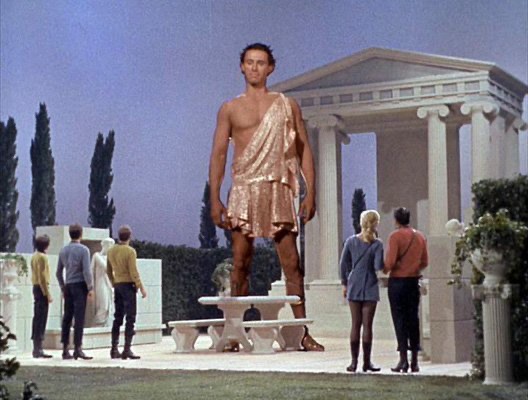
The “god” Apollo, played by Michael Forest.

The ending is melancholy:

KIRK: Would it have hurt us, I wonder, just to have gathered a few laurel leaves?

Star Trek, “Who Mourns for Adonais?” (s2ep2), stardate: 3468.1

The human race had outgrown Apollo, and gone on to accomplish many great things, yet it also cost something in the process. Maybe this is like growing up, trading a child’s imagination and wonderment for an adult’s self-mastery and freedom to choose one’s life…

1 Skepticism toward medical science is a modern issue though… 🙄. I doubt few who lived in the era of measles would object to taking a vaccine, but people have the luxury of choice now, even if those choices are reckless ones.

Religion and the Scale of the Universe

The Whirlpool Galaxy, photo courtesy of Wikimedia Commons

As a kid, I was always fascinated by Astronomy, and I remember often watching the stars at night, when I would visit my dad’s house on the weekends. Back then, I didn’t really understand astronomy well, but I learned what I could about constellations, I visited the planetarium at the Pacific Science Center, and of course I became a big fan of classic Star Trek through my uncle. In college, I even majored in Astronomy for a time until I realized that Physics wasn’t my forté.

Space and the universe have always fascinated me, and for a long time, I’ve felt that in light of space, science, etc, Buddhism has been particularly suited for this worldview. 

The Buddha-Dharma functions in a lot of ways like the laws of physics or other natural laws. It’s less something to believe in, and something more to understand or at least acknowledge. It can fit into any time or place.

The various Buddhas and Bodhisattvas, primarily found in the Mahayana tradition, might seem superstitious, but embody important Buddhist truths and can be just as weird and cosmic as anything the universe has to offer. Further, belief is such beings is neither required nor expected. It is up to each person to adopt what they want. They are quite literally a form of expedient means.

Finally, when you look at the sheer vastness of space, it’s hard not feel small. But that is alright too. Buddhism thinks big, but also because everything is interconnected in some way, it assures that the choices we make, wholesome or unwholesome, do affect all other things. We can light one corner of the world (and universe) through our actions and our thoughts.

Namu Kanzeon Bosatsu
Namu Amida Butsu

P.S. Featured photo is Whirlpool Galaxy (NASA and European Space Agency, Public domain, via Wikimedia Commons)

P.P.S. I’ve often wondered if the Buddhas and Bodhisattvas really do exist, would they be humanoids like us, or would they be strange aliens like in Star Trek? Would Amida Buddha’s original from be a green alien with four arms? 😋