A Look At the Hellenistic Age Dynasties

The Hellenistic Age in history is the period after Alexander the Great died in 323 BCE, when his soldiers scrambled for power over the vast conquered empire, and ruling the known world for three centuries until they were toppled one by one by the Roman Republic.

These dynasties, descended from Alexander’s generals and philoi (trusted companions), were all Greco-Macedonian in culture and language, yet because each dynasty ruled over a different culture: Egyptian, Persian, Babylonian, and so on, they took on their own unique characteristics. These Hellenistic kings exemplified masculine warrior king ideology as they competed for legitimacy through warfare and conquest, with no overarching political ideology.

Let’s look at a couple examples.

The Seleucid Empire

The Seleucid Empire, descended from former general Seleukos I Nikator (“the victor”). The Seleucid Dynasty had by far the largest chunk of Alexander’s conquests, but also the most difficult to maintain. The diversity of people of people from the Levant, including the Hebrews, the Babylonians, the Parthians, and peoples in northwest India required constant vigilance to rule by a tiny Greco-Macedonian minority.

To assist with their rule, the Seleucids wisely adopted Babylonian customs and religious ceremonies, while their patron god Apollo synthesized with eastern Persian (and Parthian) cultures who venerated archery. The Seleucid kings had to go on campaign constantly to maintain control over such a large empire, while maintaining religious functions in Babylon. The satraps (local kings ruling each province in Persian tradition) required constant discipline because they were prone to set themselves up as rivals. The early Seleucid rulers also established or augmented Greek colonies across the empire to help maintain rule.

The powerful Antiochus III Megas, (a.k.a. Antiochus the Great) made a famous Anabasis campaign that took him all the way to Kabul, Afghanistan to crush rebel satrap Euthydemus I, in Bactria, before swinging back around and crushing then re-subjugating Persia, and Coele Syria (the lands around modern Israel). Antiochus III Megas, the most successful of the Seleucid rulers, only keep it all together through sheer force of will and constant warfare, and many later rulers were simply not as capable or successful.

After Antiochus III, the empire began to unravel as his sons Seleucus IV Philopator and Antiochus IV Epiphanes, and their progeny gradually split the ruling family, as one side would usurp the throne, while the other would eventually reclaim it. All this happened, as enemies gradually increased on their borders, and the territory they ruled over got smaller and smaller.

Antiochus IV Epiphanes is particularly infamous in the biblical tradition, namely in the Old Testament, for his Abomination of Desolation (defiling the Temple of Jerusalem and replacing worship of G*d with pagan idols) and became the archetypal antichrist figure later. The Hellenistic Age podcast has a really nice series of episodes about this period:

Definitely check them out if interested. By the way, the Jewish holiday of Hanukkah dates from the time of Antiochus IV, and his (failed) efforts to crush the Maccabean revolt, though according to the Hellenistic Age Podcast, the tradition of the Menorah seems to date some time later. (Happy Hanukah to Jewish readers, btw!)

Ptolemaic Egypt

The Ptolemies, by contrast, ruled a somewhat smaller empire, but it was more culturally unified, and incredibly rich. By the time Alexander the Great came to Egypt, Egypt as a nation-state had already existed for 2500-3000 years. So, Egyptian culture was OLD even by the standards of the ancient Greeks.

To rule such a state, the Ptolemies adopted rulership as another Pharonic dynasty, technically the 33rd such dynasty if you are counting. Unlike the traditional dynasts of Egypt, who ruled from either Memphis (Old Kingdom) or Thebes (New Kingdom), the Ptolemies settled in the northwest city of Alexandria, and ruled over a small but powerful Greek aristocracy. Much like the Seleucids, this ethnically Greek minority had certain privileges and rights that the rest of the population did not, and frequently filled key positions of the powerful bureaucracy. Their phalanx armies were, until relatively late, ethnically Greek in composition, while the Egyptian mostly fielded armies of archers and sailors. The Ptolemies were filthy rich, because the bureaucratic system they inherited from Egyptian society was so effective at regulating taxation and exploiting the farm labor for maximum profit.

Alexandria itself grew to a powerful center of learning and culture in the Mediterranean (rivaled only by Antioch in the Seleucid Empire) under Ptolemy II Philadelphus, and Greek religion synthesized with Egyptian leading to gods such as Sarapis with Greek deities, leading to an explosion of popularity in Egyptian deities (particularly Isis) outside of Egypt. These “refurbished” Egyptian deities didn’t always resemble their original Egyptian form, but represented a fascinating synthesis of Greek thought and Egyptian religion.

Edit: Extra History happened to put out a nice video about the Ptolemies in Egypt here:

Confusingly, every single king from Ptolemy I Soter to Ptolemy XIV Philopator was named Ptolemy. Every one of them. Further, brother-sister marriages were practiced with each generation per Egyptian custom, so after so many generations, you can guess what happened. The truth is, Hellenistic kings frequently married their sisters, not just the Ptolemies, since the available pool of “eligible” women of sufficient pedigree (ethnically Macedonian-Greek, from one of the elite families) were pretty small. So, after a few generations, every Hellenistic monarch was marrying a relative in some form of another, much like the Hapsburgs many centuries later.

Corruption was a chronic problem in the Ptolemy court, especially after Ptolemy IV Philopator, who lived a reckless and decadent life, then died, leaving the kingdom a mess for sycophants and corrupt officials to run into the ground. Things unravelled and got so bad that at one point, there were two Ptolemy kings (VI and VIII) who were rivals, one of them married to his sister Cleopatra III at some point, each fighting over Egypt as the Seleucid rule Antiochus IV above nearly overran Egypt until the Romans stepped into tell him to go home.

Out of all Hellenistic kingdoms, Egypt under the Ptolemies lasted the longest, but by the time that Cleopatra (yes that famous Cleopatra, the VII) died with her lover Marcus Antonius (Marc Antony) after the Battle of Actium, Egypt was a flailing, second-rate power that had greatly diminished through the centuries.

Problems with the Hellenistic Kingdoms

Although each kingdom, including the Ptolemies and Seleucids, was diverse in how Greek culture interacted with local cultures, there were some functional problems that affected each one until the Romans eventually crushed them one by one.

First, as you might have guessed, they fought each other a lot. The Hellenistic dynasts were constantly warring with one another. This required tremendeous funds to raise armies, but Hellenistic warfare relied upon Greco-Macedonian phalanxes, which were difficult to raise and train. So, with their vast wealth, they would often just buy their way out of the problem and hire huge mercenary armies. However, once you lost your army in battle, it was hard to raise another one quickly. By contrast, the Romans raised large citizen armies quickly and cheaply, so when an army was lost, they’d just raise more of them and replace their numbers. When Antiochus III lost to the Romans at the Battle of Magnesia, the empire never quite recovered.

Second, each royal family was constantly fighting with itself. The Antigonids who ruled Macedon proper were the exception, in that they faithfully supported one another until near the end, but the Seleucids and especially the Ptolemies were constantly murdering other family members. The strong central power of the king, with little or no shared power, meant that absolute power was very attractive and “there could only be one”.

Third, because monarchs often died relatively young, eunuchs and powerful ministers often filled in as regents (again the Antigonids were a happy exception), and many of them did not rule justly or honestly, leading to further conflicts and revolts.

Finally, because they were ethnic minorities ruling over much larger territories, mismanagement led to revolts that required even more resources to suppress. Very few Ptolemies, for example, learned the Egyptian language fluently, preferring to use Greek. Some monarchs tried to “Hellenize” subject cultures through organizing Greek-style poleis cities, gymnasiums and other features. Further, subject people often found it handy to take on Greek-style names, and style in order to find work in the government. Many famous Jewish people at the time spoke and wrote in fluent Greek while still maintaining traditions handed down from their Hebrew forefathers.

Across the Hellenistic world, the once powerful kingdoms, descendents of Alexander the Great and his famed army, collectively faded in power through squabbles, unstable regimes, and failure to adapt to new threats, and some whims of Fate, until they either were crushed by other, newer powers (Rome in the West, Parthians in the East). That being the case, the cultural legacy of the Hellenistic kingdoms, and the (often bumpy) synthesis of cultures is super fascinating, and its echoes still lives on with us today in such things as Hanukkah, Buddhist statuary, famous philosophers, the Library of Alexandria, and many more.

P.S. featured photo is a reconstruction of the Pergamon Temple in Berlin, Germany, a famous Hellenistic Age monument. Photo by Lestat (Jan Mehlich), CC BY-SA 3.0, via Wikimedia Commons.

The Wars of the Diadochoi

Recently I talked about the human tendency to grab power, and the tendency to self-destruct as a result. I wanted to look at a very fascinating, but often forgotten, period of Western history: the Wars of the Diadochoi, probably one of the most clear expressions of this tendency.

The Greek term diadochos (διάδοχος) means “successor”, or in plural diadochoi (διάδοχοι). These were the troops of Alexander the Great, who had marched with him all the way to India, battle after battle, and were present when he died in the city of Babylon on June 10th, in 323 BC.

Alexander’s premature death left the small Greek kingdom of Macedon ruling a vast empire stretching all the way from Macedon and Greece, down to Egypt, and east to central Asia and northwestern India. Much of this territory had been administered under the Achaemenid Persians as “Satrapies” each with their own king. The Achaemenid emperor ruled these local kings as the “king of kings”.

But as soon as Alexander the Great died, this empire unravelled.

Alexander, in true fashion, had rushed headlong in one invasion after another, with no clear plan how to rule the newly acquired territory. Alexander was a military genius who never lost a battle, and was genuinely convinced he was the son of a god. Yet, he was also extremely impetuous and didn’t really have a long-term plan other than a vague notion of Greco-Persian empire.

Upon his sudden death, his close confidants (philoi, φίλοι), generals, and various troops quickly divided into factions who rallied behind one successor of Alexander or another, while also scrambling for territory (satraps).

Update: Extra History put out a really nice video summarizing these early years of conflict:

Anyhow, to put it mildly, this scramble for power, territory, and regency of the heirs unleashed one war after another, from Greece to Central Asia, from Egypt to Asia Minor:

  • First War of the Diadochoi (321–319 BCE) – an alliance against general Perdiccas who sought to expand his regency by marrying Alexander’s daughter, resulted in the death of Perdiccas who was betrayed by his men who worked out a deal with the opposing faction. During this time, Ptolemy stole Alexander’s body and escaped to Egypt. Seleucus (one of Perdiccas’s murderers) made a deal with Ptolemy. Remember these two men.
  • Second War of the Diadochoi (318–316 BCE) – the new preeminent power, Antigonus, went to war against a faction challenging his authority in Mesopotamia. By the end of this long, complex war of shifting alliances, Ptolemy was now firmly in control of Egypt as Ptolemy I Soter (“savior”), and Antigonus was still the strongest power who reigned as Antigonus I Monopthalmus (“the one-eyed”). Macedon was ruled by Cassander who also instrumented the death of Alexander the Great’s primary heir, Alexander the IV. By this point the empire had broken up into massive dynasties, with no more pretense of ruling in Alexander’s stead.
  • Third War of the Diadochoi (315–311 BCE) – continued wars by Antigonus against an increasingly powerful Seleucus who built a power-base from the eastern Satraps, and also with Ptolemy I in Egypt. Antigonus was unable to decisively defeat either, and things devolved into a detente.
  • Babylonian War (311–309 BCE) – the war between Antigonus and Seleucus resumes, and ultimately Antigonus is later defeated by Seleucus and a coalition of other Diadochoi at the Battle of Ipsus in 301 BCE. Seleucus now rules the remnants of the Persian empire as Seleucus I Nicator (“the victorious”).
  • Fourth War of the Diadochi (307–301 BCE) – This was a prolonged four-way battle between Antigonus I, who now ruled Macedon with his son Demetrius I Poliorcetes (“besieger of cities”), Ptomley I in Egypt, Seleucus I in Mesopotamia, and Lysimachus (another successor) who ruled Asia Minor. By this point, the various dynasties were mostly stable now, but further battles continued:
    • A prolonged three-way war from 298–285 BCE between Demetrius I Polircetes, Phyrrus of Epirus, and Cassander’s sons, resulting ultimately in Demetrius’s death, but succession by his son Antigonus II Gonatas and thus establishment of the Antigonid Dynasty.
    • Meanwhile, Seleucus I and Lysimachus battled for a long time (285–281 BCE) until Lysimachus was killed in battle in 281 BCE. It should be noted that Seleucus’s victory was as close to reunification of Alexander’s empire as the Diadochoi ever came. However, Seleucus I was murdered while marching to Europe by his ally, Ptolemy Ceraunus, an ousted son of Ptolemy I, for reasons unknown. Seleucus’s son, Antiochus I Soter, established the Seleucid Empire in Mesopotamia, Persia, and the east.
    • The last struggle was Ptolemy Ceraunus’s brief seizure of power in 281 BCE in Macedon, but his reign was unexpectedly cut short due to a massive invasion of Celtic tribes into Macedon, Greece, and even Asian minor. These Celts later came to rule a territory known as Galatia for centuries. With Ceraunus dead, the Antogonid’s reclaimed power in Macedon and ruled for centuries.

Thus, by 280 or so, the various successors and powers had finally settled into three great dynasties:

  • the Antigonid Dynasty (Greece/Macedon),
  • the Ptolemaic Dynasty (Egypt, eastern Mediterranean), and
  • the Seleucid Empire (Mesopotamia, Persia, etc).
A map depicting the kingdoms of the Diadochi c. 301 BC, after the Battle of Ipsus. Courtesy of Diadochen1.png: Captain_BloodDiadochi IT.svg: Luigi Chiesa (talk) This vector image includes elements that have been taken or adapted from this file: Battle icon gladii.svg.derivative work: Homo lupustranslator: Manlleus (ca), CC BY-SA 3.0, and Wikimedia Commons

A fourth Hellenstic dynasty, the Attalids, came to rule a small, but powerful state in western Asia Minor, and were a close ally of Rome for generations, while a fifth dynasty (a hybrid Greco-Persian one), ruled the Black Sea as the Mithridatic or Pontic Dynasty until they too were annexed by Rome. And then we have the Bactrian-Greeks far to the east as well.

Aside from the Bactrian Greeks, each of these dynasties ruled their respective lands for the next three centuries, a period known in history as the Hellenistic Period, until the rise of the Roman Republic who destroyed them one at a time.

The four wars of the Diadochoi make Game of Thrones look mild. There was so much switching of sides, backstabbings, intritrigue, scandals, and of course constant warfare. The excellent Hellenistic Age Podcast spends the first twenty episodes alone covering this conflict. And even after the wars had settled down, the constant struggles between the Antigonids, Ptolemies and Seleucids never really ended. They fought dynastic battles within their own families, but also constant battles with one another. The Ptolemies and Seleucids in particular fought six wars over a territory called Coele-Syria (modern Lebanon and Syria, sometimes included modern Israel and Palestine) until the Ptolemies finally lost it for good. The Book of Daniel in the Old Testament even alludes to this war between the “king of the north” and “king of the south”.

Next time, we’ll look more into how these different dynasties thrived and survived (until the Romans came), and how each took on different personalities.

Everybody Wants to Rule the World

MCCOY: What he’s saying, Spock, is that a man who holds that much power, even with the best intentions, just can’t resist the urge to play God.

Star Trek, “Patterns of Force” (s2ep21), Stardate 2534.0

Since the beginning of time, powerful men have risen and then fallen. Doesn’t matter which culture, or which time period, sooner or later someone wants to be the Alpha, King of Kings, Pharoah, Shogun, President for Life, etc etc. It happens over and over again, and more often than not they self-destruct or their legacy crumbles after their death.

Take the case of Marcus Licinius Crassus, better known in history as simply “Crassus”. Crassus was absurdly rich. His wealth, and the political influence he bought with it, would make many hotshot-CEO’s today look like chumps.

And yet, Crassus died in 53 BCE with molten gold poured down his throat by Parthian warriors. His hated rival, Gnaeus Pompeius Magnus (“Pompey”) was murdered on the beaches of Egypt a few years later. And of course the final member of this “gang of three”, Julius Caesar, didn’t last much longer.

We can look at examples and think to ourselves “what fools!”, but I think an even bigger lesson from this is that it can happen to any of us given the right circumstances. When we have power and authority, it is almost inevitable that we start to play god. In the Star Trek episode “Patterns of Force”, a historian tampered with an alien planet and (inadvertently) turned them into space Nazis.

The Ring of Power from J.R.R, Tolkien’s Lord of the Rings series illustrates this. Any person who gets a hold of the Ring, whether they be wizards, kings or elf-lords or even just hobbits, inevitably become corrupted.

Even Galadriel, one of the last of the mighty Noldor Elves on Middle-Earth and among the wisest of the elf-lords, was briefly tempted when Frodo offered her the ring, asking him if he wanted her to be a queen “terrible and fair”. Yet unlike her kin, she was able to resist and avoided a more terrible fate.

I feel I would be tempted too. This week I am filling in for my boss who’s on vacation, and even with this small dose of authority, I feel tempted to throw my weight around. How much more so if I was a world leader.

Why are we prone to this behavior?

I suspect it’s simply ego: our desire to mold the world in our own image. Even if we believe we are doing the right thing for others, our own ego blinds us to realities on the ground. If I had such power, I would probably fall into the same trap. People with strong egos are even more blind because they want so badly to project themselves onto the world while choosing to ignore the suffering it causes.

Of course someone has to be in charge. There has to be some form of authority for societies (or offices) to function. But it has to be treated as a radioactive, hot potato: something to be handled very carefully.

Anyhow, rambling thoughts here from the “Ozymandius” of my workplace.

Something fun to end this post though (direct link).

Enjoy!

Power

Another Roman history nerd moment, if you will indulge me….

By 45 BCE, Gaius Julius Caesar (aka Julius Caesar) had defeated his rival Gnaeus Pompeius Magnus (aka Pompey the Great) in a lengthy civil war and returned to Rome.

From here, Julius Caesar kept pushing the limits of power, with no one pushing back, inching closer and closer to a king. Special thanks to Historia Civilis for these fun, awesome history videos:

His power grab was crass and violated centuries of tradition and laws, yet the Senate was packed with loyalists who just went along with it for personal gain, while opposition was uncoordinated and ineffective (special nod to Tribune of the Plebs, Pontius Aquila, though).

Even after Caesar’s demise, nothing really got better.

Instead, the facade of government was no longer there and lacked any real legitimacy, so men just grabbed power.

In time the Second Triumvirate (aka “rule by three men”) formed under:

Through a combination of purges, rivals were eliminated until eventually the Triumvirate turned on one another with only Octavian left standing.

Contrary to popular belief, the Roman Senate and other functions of state continued to exist. The res publica that is Rome never stopped being the res publica until 1453 CE with the Fall of Constantinople. Octavian didn’t even declare himself Emperor. He adopted the title princeps (“first among many”) as the leader of the Senate.

However, real power rested with Octavian and his descendants, the Julio-Claudian dynasty, and the Senate just kept getting weaker and weaker over the generations until by the time of the Eastern Romans (aka the Byzantines), it was pretty much ceremonial: honorific titles to confer on allied and friends. Even the title princeps kept going until Diocletian in the third century dropped the act and just called himself Emperor.

Speaking of the Eastern Romans, the line of Emperors continuing all the way to Konstatinos (“Constatine”) XI Palailogos in 1453 had its ups and downs. During a time of succession crisis, someone would once again fill the power vacuum and rule with blatant power, rather than legitimate rule. Emperor Konstatinos VII Porphyrogenitus in the 10th century had legitimacy, but he practically did nothing because his father-in-law Romanos Lekapenos held real power, and just propped his son-in-law up for legitimacy. Centuries later, when Constantinople was on the brink, Ioannes (“John VI”) Kantakouzenos in the late 13th launched a civil, and hired tons of Turkish mercenaries to fight for him. Needless say these, these Ottoman Turks didn’t leave, and, the Eastern Romans lasted only another 100 years.

This, by the way, is not limited to Western political history. In fact, centuries before the Roman Republic, if you look the famous Spring and Autumn Period in Chinese history, you see many examples of this too. Local nobility gradually morphed into warlords as the central Zhou (pronounced “Joe”) Dynasty lost its central grip on power. Kǒngzǐ (aka “Confucius”), living generations later when the system has practically collapsed, laments how local warlords perform religious rites that used to be accorded to the Emperor, and not someone of their station. These were gross power grabs, and Confucius criticized their lack of propriety and respect for the traditions and rites of the times.

Why do I mention all this?

It seems there is a pattern in history and politics than when governments are weak, someone with ambition fills the vacuum and just pushes things over. Such strongmen rule with power, not laws. As Frank Herbert wrote in the Dune series:

“All governments suffer a recurring problem: Power attracts pathological personalities. It is not that power corrupts but that it is magnetic to the corruptible.”

Frank Herbert, Chapterhouse: Dune

Going all the way back to Pompey the Great, there is a famous quote attributed to him by Plutarch which in Greek said:1

‘οὐ παύσεσθε,’ εἶπεν, ‘ἡμῖν ὑπεζωσμένοις ξίφη νόμους ἀναγινώσκοντες;’
“…at which Pompey said: “Cease quoting laws to us that have swords girt about us!””

Source for English here

This quote has been on my mind a lot lately, and is what spurred this lengthy diatribe, I suppose.

Laws and rules are only effective when people respect them. When people stop respecting them, they cease to be effective. In such times, political principles and theory hardly matter anymore. Power becomes the only true constant.

And of course, as we all know, power is a fickle thing, and easily lost.

Roman Buddhas

I have been following the excellent Hellenistic Age Podcast as far back as the beginning of the Pandemic, and I always enjoy when Buddhist history overlaps with the Hellenistic Age of history.

Recently, the podcast featured a fascinating episode that covers the interaction between Buddhist India and the Roman Empire, particularly Roman Egypt.

Dr William Dalrymple shows how Roman and Indian cultural interaction was much more broad and influenced Buddhist art and culture, and vice-versa. It covers a lot of details that I definitely was unaware.

The podcast in general is great, but for readers here, definitely recommend.

Enjoy!

P.S. Double-post today. Enjoy!

What’s Done Is Done

ゆく河の流れは絶えずして、しかももとの水にあらず
Yuku kawa no nagare wa taezu shite, shikamo moto no mizu ni arazu.

“The river flows without end, but it is never the same waters.”

Hojoki, 12th c. Japan

I’ve been sitting on this post for a little while, trying to decide how best to put things into words. I don’t like delving into contemporary issues, or politics. But it’s hard to ignore the many problems going on right now.

In particular, I keep thinking about the above quote, and the related Ship of Theseus for us Westerners. Even in peaceful times, it’s hard not to look back and see how things have changed, and won’t go back to the way things were before. Even more so in dramatic times.

But this year, I feel we’ve definitely crossed some kind of threshold, not just in a nostalgic sense.

Portrait of Sulla on a denarius minted in 54 BC, photo by Classical Numismatic Group, Inc. http://www.cngcoins.com, CC BY-SA 2.5, via Wikimedia Commons

Even after the Roman general Sulla retired in 78 BCE as dictator, the Roman Republic didn’t carry on as it did before. Instead, rapid decline continued as other men such as Cicero, Pompey, Caesar, and Augustus seized on the precedent to push their own vision of rulership. If one powerful man can break precedent, then what’s to stop others from doing the same?

Of course, this decline of the Republic1 had other precedents too. Bit by bit, across generations, things changed and the effects weren’t always clear until too late. Sulla opposed the populist, reformist Gracchi brothers, and the Gracchi Brothers in turn were opposed to increased centralization of land-wealth, which in turn had been caused by Rome’s increasing power and influence across the Italian Peninsula, etc, etc. Where one issue begins and another ends is hard to fathom. Instead, bit by bit, like the wooden planks on the Ship of Theseus, small changes gradually add up until something is no longer recognizable.

If we look at other societies, such as the fall of Heian Period aristocracy in 12th century Japan, it is the same thing: small changes built up, followed by a dramatic shift in power, and then the aristocracy was then permanently diminished in power, replaced by military governments. Once the threshold was crossed, it was never the same, and that’s why the author of the Hojoki wrote what he did.

“How did you go bankrupt?” 
“Two ways. Gradually, then suddenly.”

Ernest Hemingway, The Sun Also Rises

Thus, here I sit, an armchair philosopher watching everything I took for granted in my youth change around me, often abruptly, until it’s no longer recognizable. I don’t know how things will resolve, though somehow they will. Yet, countless changes that will only make sense in hindsight have led to this moment in history that I am forced to live in, and I have to accept that in a sense it’s already over.

1 Technically speaking, the Republic (a.k.a. res publica in Latin, or politeia in Greek) never ended until 1453 with the fall of Constantinople. The way that modern historians define a republic is different than how Romans thought of it. The imperial era from Augustus onward was still seen as the res publica/politeia, it just gradually changed and evolved … like the Ship of Theseus … from one system of administration or another. But Romans never really viewed a “break” between the senatorial style of government and the later imperial one as a change in historical period.

Welfare

We Klingons believe as you do — the sick should die.  Only the strong should live.

Kras, “Friday’s Child” (s2ep11), stardate 3497.2

Friday’s Child is an episode of Star Trek from the second season,1 which pits both the Federation and Klingons in political competition over mining rights to a planet of really tall people with funny hats.

Kras the Klingon (played by Tige Andrews) on the left, and Maab (played by Michael Dante) on the right.

Whether it was intentional or not, it is also an episode contrasting two modes of thinking: one is an individualist, darwinian view-point (e.g. only the strong survive) promoted by the Klingon Empire versus a community-oriented, social-democratic viewpoint (e.g. for the good of many). The United Federation of Planets obviously favors the latter.

It’s not hard to find people who favor one approach to society over the other. Some strongly so.

For the sake of transparency, I prefer the community-oriented, social-democratic approach. I grew up pretty poor and had to rely on free school lunches, tuition programs for college and such, and thanks to those, I was able to grow and ultimately succeed. So, if it works for me, I believe others should benefit too.

I think this is also a very Buddhist outlook – the suffering of others is ultimately our suffering too, and vice-versa.

That doesn’t mean we don’t have to care for our own needs though. Looking back to the philosophy of Epicurus,2 we can see that a perfectly reasonable approach is a quietest, isolated lifestyle, focused on just living a good life and not getting tangled in things.

But that’s not usually how it ends up.

For much of history, regardless of time or place, a privileged class rises to the top, whether it be ancient priesthoods, warrior classes, Party members, or corporate CEOs. Some rise to the top due to a mixture of time, place, money, and talent. And, for every one person that rises, many more are pushed down. Some are left behind to wither and die. “That’s the way things go”, some might say. The strong survive and the weak perish, so the thinking goes.

Kras the Klingon in this episode speaks much like the ancient Spartans did. They would not hesitate to leave sickly babies to die to exposure, and train the young constantly in rigid military training. People see this and admire the Spartans for their prowess, and revere them as an archetypal elite class of warriors.

And yet there are some glaring issues with this

First, even by the standards of slavery in the ancient world, Sparta as a city-state had an egregious system, where a large underclass (3-7 times larger than the Spartans) of helot slaves who did all the manual toil. The elite Sparta class thus used their time to focus on training. One can easily imagine plantations like those in the Antebellum South where workers toiled endlessly for nothing, while the landed gentry sat around and pursued the “gentlemanly arts”.

Second, for such a carefully engineered system, the Spartans actually lost a lot of battles. Setting aside the famous battle of Thermopylae which was immortalized as a film of naked, sweaty men in 300, the Spartan army lost frequently. A couple generations later, the Thebans under Epaminondas used clever strategy to smash the Spartans at the Battle of Leuctra in 371 BC despite being a smaller army. Rather than making the Spartans stronger, their system made them more brittle and inflexible.

Third, by creating such an elitist society, the Spartans couldn’t replenish their numbers. They couldn’t rely on helots as soldiers, since they hated the Spartans, and the Spartans couldn’t seriously stomach the idea of serving alongside former slaves. By their cruelty they had painted themselves into a corner.

Thus, each time Sparta lost a battle, its numbers got smaller and smaller until the Roman Republic just steamrolled them. The Roman Republic, by contrast, had a pretty open and flexible recruitment process so they could field huge armies quickly and furnish more if they lost (which admittedly they also did, but their long-term prospects were a lot better than the Spartans).

So, I suppose the moral of the story here (ethics notwithstanding) is that a society based on the premise that only the best and strongest survive ironically leads to an increasingly rigid and brittle society that cannot sustain itself. Diversity and mutual well-being strengthen society, not weaken it.

1 I think most classic Trek fans would agree that the second half of season one through the first half of season two was peak Trek. I still love season 3 for a variety of reasons, but admittedly the quality of writing was best during earlier seasons.

2 Epicurean philosophy gets a bad rap because “epicurean” means something different now. But Epicurus advocated a “quietist” approach, a life of solitude and non-involvement, surrounded by friends. Something vaguely akin to Chinese Taoism. He did not teach hedonism.

Isis and the Buddha: an Egyptian discovery

Recently, archaeologists have uncovered a statue of the Buddha, not in India or Asia, but in ancient Egypt! The statue, according to the Egyptian government, was uncovered as part of a temple dedicated to Isis, and crafted by a local Indian Buddhist community during the early Roman Imperial age, the Principate.

The cult of Isis was a fascinating example of religion in the Hellenistic Period, and inherited later when the Romans took over the eastern Mediterranean. During the Hellenistic Period, a period of constant political rivalries, and large movements of Greek people, and expansion of Greek culture through colonies, the old Olympian religion had increasingly proved unable to help people through difficult times. The old Olympian religion was focused on public cults in a kind of “contractual” religion where people of a city-state publicly worship a particular god, and get something out of it. For more personal needs, there just wasn’t much substance.

Thus, mystery religions such as the Cult of Demeter and others arose. These provided more personal relationships with the gods, and clearer undersetanding of the afterlife, and how one might secure a better fate than just being an empty shade wandering in Hades (cf. Homer’s Odyssey).

When the Macedonian Ptolemy family took over Egypt, they had to reform Greco-Egyptian society into something they could rule legitimately, so certain gods were reinvented or elevated. Egyptians had done this too, but the Ptolemies tapped into this and elevated two gods in particular:

  • Serapis – a kind of hybrid god based loosely on Osiris, but also Zeus.
  • Isis – Osiris’s consort.

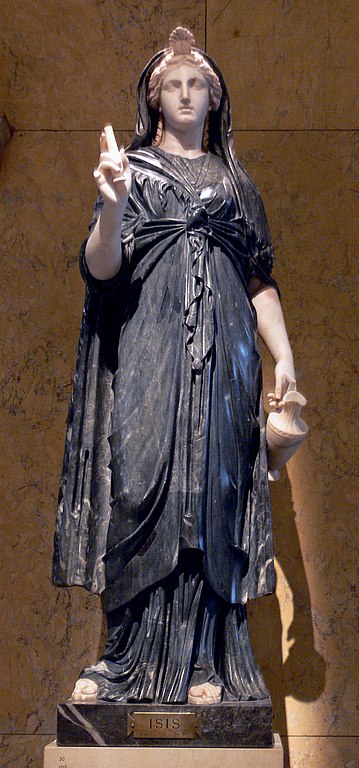
Isis’s role in particular grew far beyond the original Egyptian religion and her cults spread across the Roman world. Her status also grew in that she wasn’t just a mother goddess, but the mother goddess: embodying wisdom, magic, maternal love and so on. Other goddess figures from disparate cults were sometimes viewed as just more manifestations of Isis. There are even

A statue of Isis, from the 2nd century CE. Photo: Andreas Praefcke, Public domain, via Wikimedia Commons

Isis’s religion wasn’t organized according to the kind of doctrine or dogma we associate with modern religions, it was still very much a form of personal, devotional worship,1 rather than an “one-size fits all” religion to explain everything. Roman society at large was still a marketplace of religions, but the religions had changed from mostly public ritual (e.g. the Olympian gods) to more internal, personal religion.

So, how does the Buddha fit into all this? That part is still being researched, but given Isis’s status as a goddess of wisdom, putting a statue of the Buddha, a figure also associated with wisdom, in her temple was probably a useful cultural prop. Indian merchants, had a trade colony in Egypt at the time, and the Buddhist religion in India reached a high-water mark at the time, so at least some of the Indian people living in Egypt would know of it, or might even be devotees.

Does that mean that there were Buddhist communities in Roman Egypt? Evidence is very scant. Even if there were, their presence was likely limited to the Indian expat community.

Still, the cultural cross-over is pretty fascinating.

P.S. This is the last post before the family and I head to Japan. When next we meet, I’ll post updates from

1 Similarly, worship of Mithra, a Zoroastrian deity imported into Roman culture, enjoyed widespread devotion among soldiers and other figures. People worshipped the god or goddess they tended to feel most affinity with.

Gauls in the Roman Senate: A Cautionary Tale

gaulsinrome

Recently, I was reminded of an anecdotal tale from the early Roman Empire about the introduction of Gauls to the Roman Senate.  The anecdote is also frequently alluded to in Professor Mary Beard’s excellent overview of Roman History titled SPQR: A History of Ancient Rome.

In 48 CE, Emperor Claudius was trying to convince the Roman Senate in his capacity as princeps (first among equals in the Senate) to allow Gauls as members of the Senate.  According to Professor Beard, Claudius played up Rome’s ancient history during the time of Romulus and the fact that it had been founded on foreigners being integrated into Rome (sometimes forcibly), so why should Gauls, who had been part of Rome for generations since Julius Caesar’s conquest, be any different?

But this didn’t go down well, for some Romans. There were plenty of Roman stereotypes about Gauls, not the least of which was their different appearance. According to Greek historian Diodorus Siculus he described them in the first century BCE like so (source):

Some of them shave their beards, but others let it grow a little; and the nobles shave their cheeks, but they let the mustache grow until it covers the mouth.

Romans often used the term “hairy Gaul” (Gallia Comata) to describe the province of Transalpine Gaul which included territory that Julius Caesar had conquered in the Gallic Wars. In the video series Historia Civilis, the narrator explains in one video that when Caesar in his role as dictator, appointed some Gauls to the Senate in order to fulfill some of his post-conquest promises, the people in Rome had an uproar. There were jokes about Gauls invading Rome (just as they did centuries before), asking for directions to the Senate house. Professor Beard confirms these jokes were making the rounds among the people in Rome.

However, despite these persistent stereotypes as hairy barbarians, the Gauls, especially among the nobility, were adopting Roman lifestyle habits, dress, using Latin language and even teaching their children Latin. They were just about as Roman as anyone else was, but Roman “natives” kept looking down at them.

A century later, when Emperor Claudius gave his speech, he still had to justify the idea to the Senate:

If anyone concentrates on the fact that the Gauls gave Julius Caesar, now a god, such trouble in war for ten years, he should consider that they have also been loyal and trustworthy for a hundred years since then.

Mary Beard, “SPQR”, chapter 12

It’s interesting that many Romans, despite being founded on a tradition of integration with foreigners, still couldn’t stomach the idea of Gauls in the Senate both in Julius Caesar’s time and later with Emperor Claudius. Despite Roman citizenship being granted to people in the provinces, some people simply felt they were more “Roman” than others, regardless of legal status.

Interesting parallels for our times.

P.S. For a fascinating look at the real Gauls, including Celtic culture at large, I highly recommend this podcast. Needless to say, there is a lot about ancient Celts that people don’t know.