McCoy: “It might eventually cure the common cold, but lengthen lives? Poppycock. I can do more for you if you just eat right and exercise regularly”
Star Trek, “The Omega Glory” (s2ep23), Stardate unknown
Healthy eating is not difficult, at least in theory.
Of course if it were that easy, how come many of us are overweight? Myself included.
I talked about this recently, but I do not have very good self-control. I work a desk job, so I don’t move around much, and I snack a lot. I don’t eat particularly unhealthy: no alcohol, no soft drinks, etc., and I eat minimal red meat. But I tend to just eat too much junk food, or too many portions.
Recently, I dug out an old book of mine from many, many years ago,1 titled What Is Zen? 禅ってなんだろう. It’s a bilingual book I bought in Japan that explores Rinzai Zen life as a monk, but also includes some general thoughts about the tradition for lay followers. My copy has been covered in stickers when my daughter was a little girl, so I kept it both for nostalgia, and because such down-to-earth books on Zen are hard to find in the West.
This is what happens when little girls get a hold of daddy’s books… 😅
Anyhow, this book shows things like daily routines for monks, how they eat and so on. I wish I could repost the photographs because they’re really neat, but obviously that’s inappropriate. Instead, let me shiw you a different example:
An example of shōjin-ryōri (monastic food) at Tenryuji temple in Kyoto, Japan. Photo by 663highland, CC BY-SA 3.0, via Wikimedia Commons
This photo, shows a meal served at Tenryuji Temple, which I coincidentally visited last year. This kind of monastic food is called shōjin-ryōri (精進料理, “ascetic food”) in Japanese, but is a common part of Buddhist cuisine across East Asia. It’s not limited to monks and nuns only, devout lay followers can eat such a lifestyle if they wish. The photos from my book show that the monastic version of this meal is somewhat simpler in presentation (they are monks after all), but essentially the same.
Similarly, when we visited Ryoanji Temple (another Rinzai temple) waaay back in 2005, we enjoyed their version of tofu stew:
Taken by me in 2005, at Ryoanji Temple. This is a vegetarian tofu stew, with turnips artfully sculpted to look like lotus flowers.
This kind of diet is similar to a vegan diet in that it contains no animal products, even the dashi broth is vegetarian. Certain flavors like curry and onions are not used either.
But as with any diet changes, this is not something that should be done hastily or without consulting a physician. The key I wanted to convey here is that (partly as a reminder to myself when I read this six months later….) is that a healthy diet consists of the following:
More vegetables than protein
Minimal processed starches
Little or no animal protein
Small portions per meal2
Little or no snacking.
But I’ve been inspired by these examples of good Buddhist eating, and so I have been gradually trying to “eat like a monk” lately: smaller portions, avoiding or minimizing animal protein, limit starches, and eating more veggies.
Will it work for a Western desk-jockey like myself? We’ll see.
1 I mentioned this book on my old blog, that’s how long I’ve owned it.
2 My doctor had previous suggested intermittent fasting as a potential solution, or alternatively eating four small meals per day, instead of three big ones. Say, portions the size of two-three fists. The issue hasn’t been the diet, but my lack of diligence especially during the holidays. So, that may be the bigger issue.
While reading the excellent book, River of Fire, River of Water by Dr Taitetsu Unno last week, there was a nice chapter about Buddhism being about not one, but series of small awakenings.
Many people experience this type of [radical, spiritual] awakening, but normally it touches only one aspect of life and rarely involves the total person. Furthermore, a single experience may not effect any real transformation. The awakening must be repeated and deepened for as long as we are living and breathing.
page 65
Here, Dr Unno was talking about it in the context of the experience of Shinjin (信心, the sincere entrusting of Amida Buddha that Shinran taught), but he cites a few sources, including the Rinzai Zen master Hakuin (白隠 1686 – 1769), who evidentially taught that there was the initial awakening (in a Zen context), and then subsequent awakenings.
True kenshō [見性, “seeing your nature”] is a very difficult practice. That being the case, only a select few individuals who are gifted with special religious capabilities will ever achieve kenshō.
One shouldn’t give up on attaining kenshō, but there is another state prior to it called sei [省]. Of course Zen disdains practice for the sake of personal attainments, but when one sits in zazen and properly regulates one’s posture and breathing, the mind gradually grows calm. In that state, the honshō [本性, “one’s original nature?”] and original self become active, if not completely.
pages 39-41
Here, the author is describing the process of reaching final enlightenment, using the alternative Zen-specific term kensho.1 But, in keeping with mainstream Buddhism, this state of mind is pretty difficult to attain, and yet one has any number of smaller awakenings (sei) along the way. One may not necessarily fully become awakened, but even those brief glimpses can be transformative. The point is of course that it’s a journey, not just an abstract goal.
In Star Trek terms (because I am a giant nerd), think of the movie Star Trek VI: The Undiscovered Country. Spock talks to his protegé, Valeris, about the importance of logic, even for a Vulcan:
VALERIS: But is this logical? Surely we must… SPOCK: Logic? …Logic is the beginning of wisdom, Valeris, not the end.
I think Buddhism is less about “what have I accomplished” and more about “what can I do next” or “where do I go from here?”.
Namu Shakamuni Butsu
P.S. Next week I am changing up the schedule a bit. I hope you enjoy.
1 The generic Japanese-Buddhist term is satori (悟り), and they mean more or less the same thing. As someone who accomplished neither, I can’t really speak to either one. 😅
SPOCK: [being a Vulcan] means to adopt a philosophy, a way of life, which is logical and beneficial.
Star Trek, “Journey to Babel” (s2ep10), Stardate 3842.3
Recently, while I was doing some soul-searching, I found this very helpful article online by Dr. Jacqueline Stone. The article is an overview of how different Japanese-Buddhist monks of the Kamakura Period (12th-14th century), the same monks who founded important Buddhist sects we see today, addressed the concept of Dharma Decline. The site requires registration, but it’s free and easy. The article is worth a read if you are curious about the topic.
In any case, I found this great quote in Dr Stone’s article:
“The Zen sect regards the precepts as being of first priority,” he [Eisai] wrote. And, “By means of the precepts, meditation and wisdom are brought forth.”
Eisai (栄西, 1141 – 1215) also known as Myōan Eisai (明菴栄西) is the original founder of the Rinzai Zen-sect in Japan (more on its convoluted history here), and isn’t someone I really talk about much, but he was one of the founders of this “new” Kamakura-era Buddhism.
Anyhow, this quote really struck me.
In my limited experience, I rarely heard the importance of precepts from Western Zen sources, or that they are the basis for other Zen practice. That’s not to say it’s not there, but it often seemed to get lost in the message of Zen mysticism.
Bluntly speaking, precepts aren’t sexy like mindfulness, koan riddles, or meditation.
And yet, Eisai is taking a more traditional, conservative standpoint and reiterating that one should not put the cart before the horse. This is not limited to Eisai, by the way: the 19th century Soto-Zen text for lay-followers, the Shushogi, stressed the importance of the precepts, reflection on one’s actions, and practicing kindness, patience and generosity whenever possible.
But if you’re familiar with Zen, this might seem odd. Isn’t Zen all about meditation, being in the moment and so on?
Consider the Marvel movie Ant-Man (2015). In the movie the villain, a bald tech-CEO who bears more than a passing resemblance to a certain CEO and founder,1 brags to a coworker about some deep thoughts he had during “morning meditation”. This is not far from the mark: many ambitious people use meditation and mindfulness as a way to get what they want, not what it’s intended for. If a person can’t regulate their day to day conduct towards others, meditation will not avail them.
Put another way: a rotten person might meditate, but a person who follows the precepts is probably not a rotten person.2
Further, this focus on the precepts fosters mindfulness because one is monitoring their own actions, etc. It has concrete impact on one’s sense of self-worth, one’s relationships with others, and leads to greater peace of mind, even when not meditating. So, there’s a clear benefit, both short-term and also long-term to taking up the precepts first, and then letting other disciplines and practices extend from it.
Finally, upholding the precepts is something any Buddhist can do, regardless of background or circumstances. It is very accessible, beneficial (just like Spock says), and opens many doors to Buddhist practice.
Namu Shakamuni Butsu
P.S. I’ll cover this issue of precepts in more detail later, but TL;DR both Rinzai and Soto Zen both encourage people to take up the Ten Bodhisattva Precepts specifically.
I wrote about visiting a couple major Zen temples in Kyoto last summer: Tenryuji and Kenninji, but I realized that I totally forgot to post photos from Kenninji Temple. Of the two, we liked Kenninji more, and I am excited to share some of the history and art of this temple.
Both temples belonged to the Five Mountains temple network of the Muromachi Period of Japanese history, so they were very elite temples of the Rinzai Zen sect. However, Kenninji, like many famous Buddhist temples, has burned down a number of time over the centuries, including the disastrous Onin War, and reconstructed again. Many of the structures today are relatively new, or were granted from nearby temples to help consolidate.
While Tenryuji is on the western outskirts of Kyoto, near the iconic Arashiyama district, Kenninji is in eastern Higashiyama district of Kyoto. The official website of Kenninji is here, but I don’t think there is an English version. There is a nice overhead visual tour of the temple from the official tourism channel here (close captioning does work):
Another aerial tour here:
In terms of size, Kennin-ji feels smaller than Tenryuji which had a large park around it. Kennin-ji is firmly inside a busy neighborhood in Kyoto, and thus tends to feel a bit more cramped at first. There is a soba shop next to Kenninji I highly recommend by the way, to the right of the abbot’s quarters near the back exit.
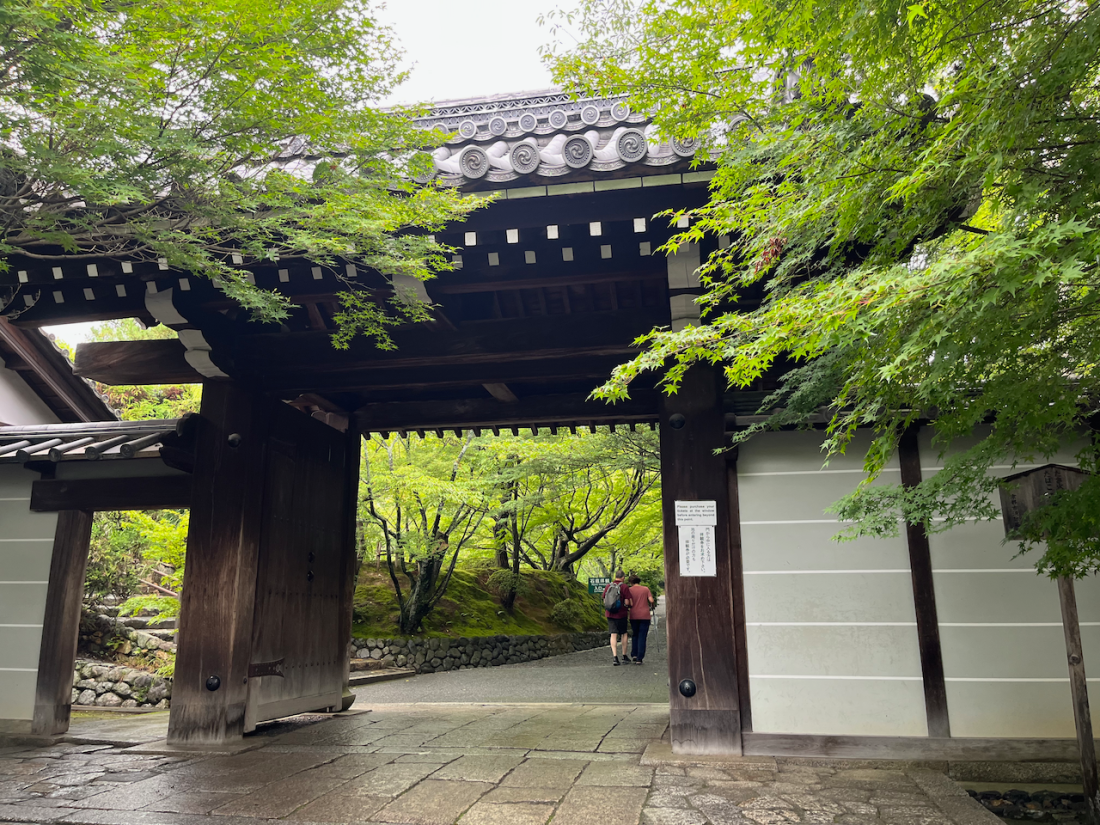
If you go through the main entrance, you’ll see this gate, which is normally closed, so you are supposed to walk around it toward the main building.
The same gate, but as seen from its left as you walk around…
The pathway takes you to a scenic building called the Hojo Teien (方丈庭園, “10-foot garden”?) which is apparently the former Abbot’s quarters,1 but now includes many scenic sites. The website includes a nice gallery of the different rooms, including some I forgot to photograph here.
Within the abbot’s quarters are a series of rooms where you can find galleries of famous works stored at Kennin-ji. One of the most famous of all are the Raijin and Fujin screens shown below (gold screens on the left) painted by the famous Tawaraya Sōtatsu (c. 1570 – c. 1640):
As well as various ink paintings called shōheki-ga (障壁画):
I know I’ve seen these paintings before in college, when I was taking a course on Japanese art, but unfortunately, I don’t have any information about them now. From what I can figure out, this painting was called the Chikurin-shichiken-zu (竹林七賢図), or the “Seven Sages of the Bamboo Forest“. It was painted by Kaiho Yusho (海北友松, 1533–1615) in his 60’s. The painting depicts seven sages famous of the Western Jin Dynasty of China, who retreated to a bamboo forest and engaged in a mixture of refined conversation, heavy drinking, and lively music. These bohemian Seven Sages are apparently subjects of other works of art at the time.
Also, as I was writing this, I also realized that the calligraphy in the back (second image) is a another work of art: it’s a highly stylized calligraphy of the words 風神 (fūjin, the wind god), and 雷神 (raijin, the thunder god) by Kanazawa Shoko (金澤翔子, 1985 – present) an artist with Down’s Syndrome. Pretty amazing.
Facing out from the abbot’s quarters, you can see a nice sand garden called the Dai-on-en (大雄苑):
The abbot’s quarters also surrounds another sculpted garden called the Cho-on-tei (潮音庭):
We also saw lotus paintings like these:
Finally, the quarters connects to an altar room which contains a gorgeous ceiling mural of two dragons overlooking an altar:
The mural was painted in 2002 to commemorate the 800th anniversary of the temple, by one Koizumi Junsaku (1924–2012), and the altar itself (shown at the bottom) depicts Shakyamuni Buddha, the historical founder of Buddhism, flanked by his disciples.
We picked up a lot of goods at Kenninji: my son liked the twin dragons, and got a pilgrimage book with that image on the cover, and my wife got an incense holder with the image of Raijin and Fujin (based on the gold screen above). I picked up a miniature copy of the Kannon Sutra which I think was meant as an omamori charm.2
As temples go, Kenninji was something we knew nothing about, but it was quite a treat to visit. Foreigners who visit famous temples in Japan often remark that Buddhism feels like a museum piece, and while it is true that the Five Mountains temple system in Japan (including Kenninji and Tenryuji) is somewhat defunct now, it was clear that people really still cared about these temples, but it’s not always in ways obvious to Westerners.2 That said, Kenninji looks like a well-loved temple, and a credit to the Rinzai Zen tradition and it’s flowering culture of the era.
1 Apparently, 方丈庭園 was a common, poetic term used for major temples that had a scenic abbot’s quarters like the one showed above. Chion-in was another such example.
2 Language barrier is a big part of this, plus various unrealistic expectations that Western Buddhists have of what they expect temples to be like in Asia, compared to how people who grew up Buddhist practice. But that’s a story for another rant…
During a recent trip to Japan, we visited the city of Kyoto. Since antiquity, it was a trendy of the nobility to build villas in the hilly suburbs of Kyoto (presumably cooler there in the summer), which in turn became Buddhist temples generations later. Some of these temples grew to be very powerful during Muromachi Period of Japanese history, namely the Zen temples of the Five Mountains System.
We were lucky enough to visit two of the five temples of the Five Mountains System: Tenryuji and Kenninji. Tenryuji is located in the western area of Kyoto, in Arashiyama district. By contrast, Kenninji is in east Kyoto at Higashiyama. Both of these were apex temples in the Five Mountains System, centers of Rinzai-sect Zen, and greatly benefited from patronage by the Ashikaga shogun rulers, before they lost prestige again and essentially became museum pieces.
Both temples are quite large, and very tourist-friendly, but they each have their own character, so I am making a separate post for each temple.1
Tenryuji Temple
Tenryuji Temple, official website here, is a temple that has seen a lot historically. It was number two or three in the Five Mountains hierarchy, and was thus a very prestigious temple. It contains many terrific works of art, and a gorgeous pond created by Muso Soseki back in the day. Because it is right next to the famous bamboo forests of Arashiyama in western Kyoto, we were able to view both on the same hike, as well as the iconic Togetsu-kyo Bridge:
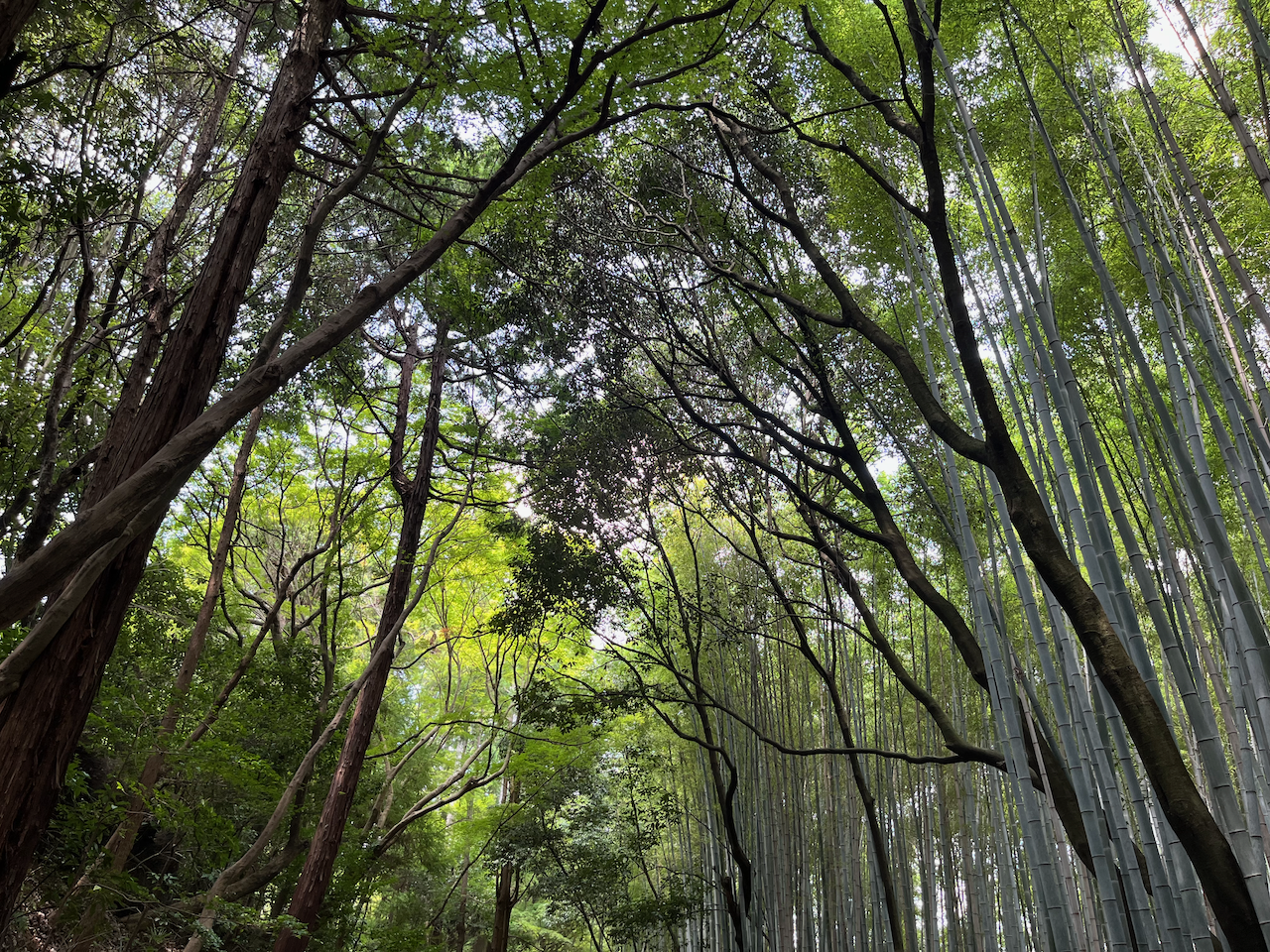
I should add that the temperature was 37C (98F) in Kyoto and extremely humid that day. The walk through bamboo forests was incredibly enchanting, but also grueling due to heat.
It’s not clear from the photos, but because of the shade and the high humidity, there was a constant mist between the trees, and an oppressive air. It was really cool, and would make a great setting for any Asian-style D&D campaign (not unlike the ones that I made previously … 😏).
Once you emerge from the bamboo forest, you enter the back-entrance of Tenryuji Temple. The front entrance that’s very close to the Saga-Arashiyama train station as well, so you can also visit from that direction too. The signs are very obvious.
The main buildings were clustered together in the middle of the property, with a really nice garden walk surrounding it, including many lovely or rare plants. If I were a botanist, I’d probably have a field-day here. The signs are all multi-lingual too, which is really handy.
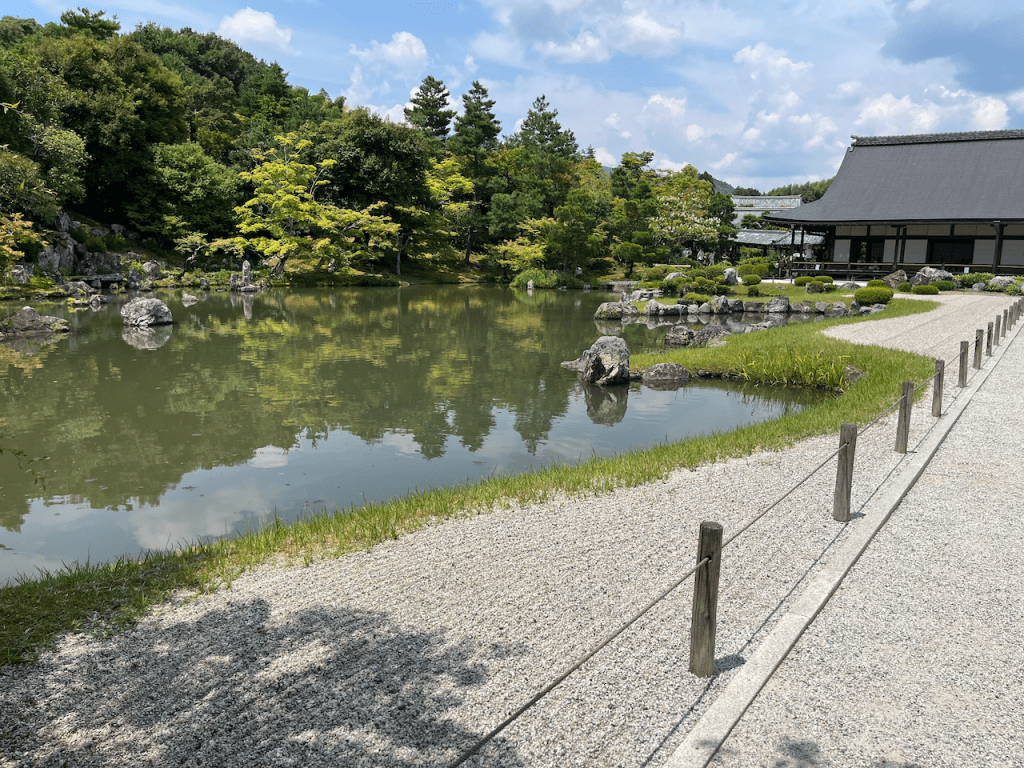
If you continue around the walk, you will come to the Sogenchi (曹源池) Pond, which according to the sign is modeled on Chinese architecture at the time (and a common feature of Japanese aesthetics during the Muromachi Period):
Similarly, you find a lovely sand garden (karesansui in Japanese, 枯山水 ) nearby too:
I wanted to take more photos of the interior of Tenryuji, but there were just too many tired, overheated tourists, and Instagram influencers. I chuckled as I saw a couple young ladies who were way over-dressed in fine, Chinese-style silk dresses and taking turns posing and photographing each other. The heat and humidity were so intense, I can’t imagine why they would do this to themselves. But I digress.
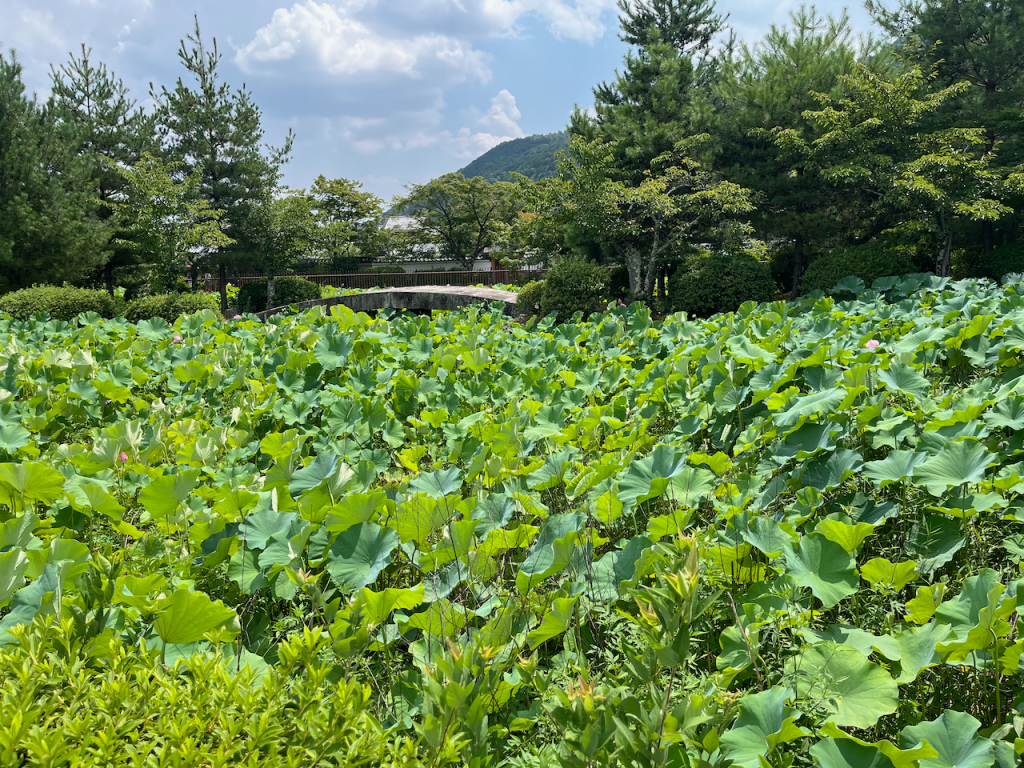
Finally, as exited Tenryuji toward the train station side we saw a very nice lotus pond:
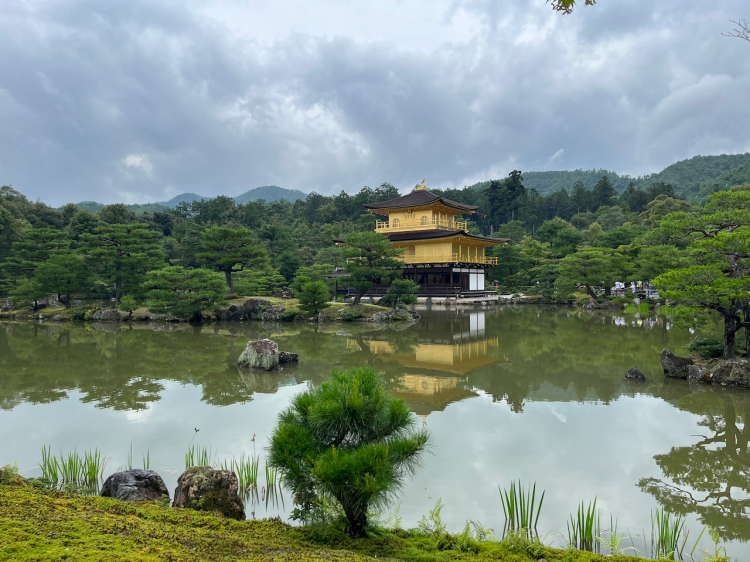
Tenryuji Temple is, for historical reasons, a shadow of its former self, but even what remains is very scenic and embodies much of the beauty and prestige of Arashiyama. I didn’t enjoy it on the same level as another Zen temple, Ryoanji, but it is lovely. For poetry fans, the Arashiyama district is also the site where the Hyakunin Isshu anthology was compiled, which I covered on my other blog.
That said, Arashiyama is quite touristy and crowded. It’s pretty foreign friendly, and if you’re just passing through Kyoto for the first time, it’s a great place to stop. But, for me, if you have the time and want to really get to know Kyoto life and culture, there are other places I prefer.
Next time, we’ll talk about Kenninji, which was smaller than Tenryuji, but had some pretty mind-blowing artwork.
P.S. 欢迎中国游客,感谢您的阅读。
1 I tried to put both in a single post, but it quickly got too large. I am a victim of my own hubris…
Years ago, when I was part of the local Jodo Shinshu Buddhist community, my minister told me a story about how Rennyo and Ikkyu, two famous Buddhist monks from 15th century Japan, were both good friends and would frequently test one another in their grasp of Buddhism. They were an unlikely pair of friends, given that they belonged to two very different Buddhist traditions, and yet they clearly had a rapport that you rarely find in Japanese-Buddhist history.
To be honest, I thought the story of them being friends was embellished, but I got curious recently poked around some Japanese sources on the Interwebs, and sure enough there were a number of famous anecdotes between Ikkyu and Rennyo. These anecdotes aren’t necessarily historically accurate, but they have been passed down through the generations and even show up in Japanese TV today.
But first, let’s introduce Ikkyu and Rennyo.
Ikkyu Sojun (一休宗純, 1394 – 1481) was a monk of the Rinzai Zen tradition,1 which was politically dominant at this time due to the Five Mountains System in Kyoto. He was disillusioned with the pomp and grandeur of the Zen community at that time, and left to live a more “authentic life” among the people. He is famous for his flashes of genius, and his artistic talents, but also his unorthodox behavior, including partying and sleeping with girls. Ikkyu left behind many excellent poems, paintings, and his genius image has made him a popular figure even in modern Japan.
Rennyo (蓮如, 1415–1499) was the eighth head of the ancestral Honganji Temple in Kyoto,2 which ostensibly was the head temple of the Jodo Shinshu sect. Trouble was, the movement was very fractured, with regional groups, rival powers, etc. And then there were the warrior-monks of Mount Hiei (head of Tendai sect) that wanted him dead. Rennyo had to flee Kyoto for a long while to the provinces, but used the time to unify the Jodo Shinshu groups into a more cohesive sect for the first time. His Letter on White Ashes, is a particularly inspired piece of writing.
Ikkyu was 20 years older than Rennyo, but in many anecdotes, they are making jokes with one another, or testing each other’s wisdom.
In one famous story (used in the “Ikkyu-san” cartoon), Ikkyu had put up a sign near a really crooked pine tree. The sign read whoever can see this pine straight, I will give them a kanmon of gold.
People were stumped, and brought this to Rennyo’s attention. Rennyo said, “pfft, more of Ikkyu’s mischief. I see this pine straight. I’ll get the cash.”
When Rennyo confronted Ikkyu about it, Ikkyu said, “Oh, it’s you. You don’t count. Look at the back of the sign.”
Sure enough, on the back of the sign was painted “EXCEPT RENNYO”.
When people ask Rennyo how he was able to see the crooked pine straight, Rennyo said that he saw it for what it was: a crooked pine. By seeing it for what it really was (a crooked pine), he saw it “straight”.
In another anecdote, for which I could find the original Japanese, Ikkyu had read the Amitabha Sutra and commented:
阿弥陀には まことの慈悲はなかりけり たのむ衆生のみぞ助ける
Amida Buddha has no true compassion; he only helps those who ask.
Rennyo is invoking the imagery of Amida Buddha’s compassion as moonlight, which we’ve seen before, and how it shines everywhere. But if water is in a container (has a lid on it), the moonlight will not reflect back.
Ikkyu tested Rennyo again:
極楽は十万億土と説くなれば 足腰立たぬ婆は行けまじ
If the Pure Land of Amida Buddha is indeed 10,000,000,000,000 lands away [as described in the sutras], then an elderly woman who is unable to stand cannot go there.
In another story, Ikkyu attended the 200th memorial of the founder of Jodo Shinshu (and Rennyo’s ancestor), Shinran. Of Shinran, Ikkyu wrote the following verse:
襟巻の あたたかそうな黒坊主 こやつが法は 天下一なり That black[-robed] monk with the warm [as in “kind”] head and scarf, his Dharma teachings are peerless.
There are a lot of other stores too, and I’ll try to share more as I find them, but I thought these were neat. Zen and Pure Land Buddhism are often treated as separated teachings, and separate sects, but I suspect that as with any Buddhist path if you get far enough along, you’ll start to run into people of the same mind.
That, in my humble opinion, is the power of the Lotus Sutra and its many gates.
1 Zen in Japan is divided into 3 schools: Soto, Rinzai and Obaku, all imported from China at various points in history. Rinzai and Obaku both have the same “ancestral lineage” in China, but arrived in Japan at different points. Soto comes from a different lineage entirely in China.
2 A few generations after Rennyo, the Honganji split into two temples: Nishi (West) Honganji, and Higashi (East) Honganji after a family split, plus politics. They are effectively equal, but different sub-sects.
During our most recent trip to Japan, I picked up some nice incense from Zojoji Temple, and my wife separately picked up some from Sanjusangendō Temple in Kyoto.1 We also bought some incense last year at the Golden Pavilion and Ryoanji. It’s a thing in our house. We actually use incense a fair amount: I use it for Buddhist home services, my wife uses it to honor her deceased mother. Sometimes we also just light it for guests who come over.
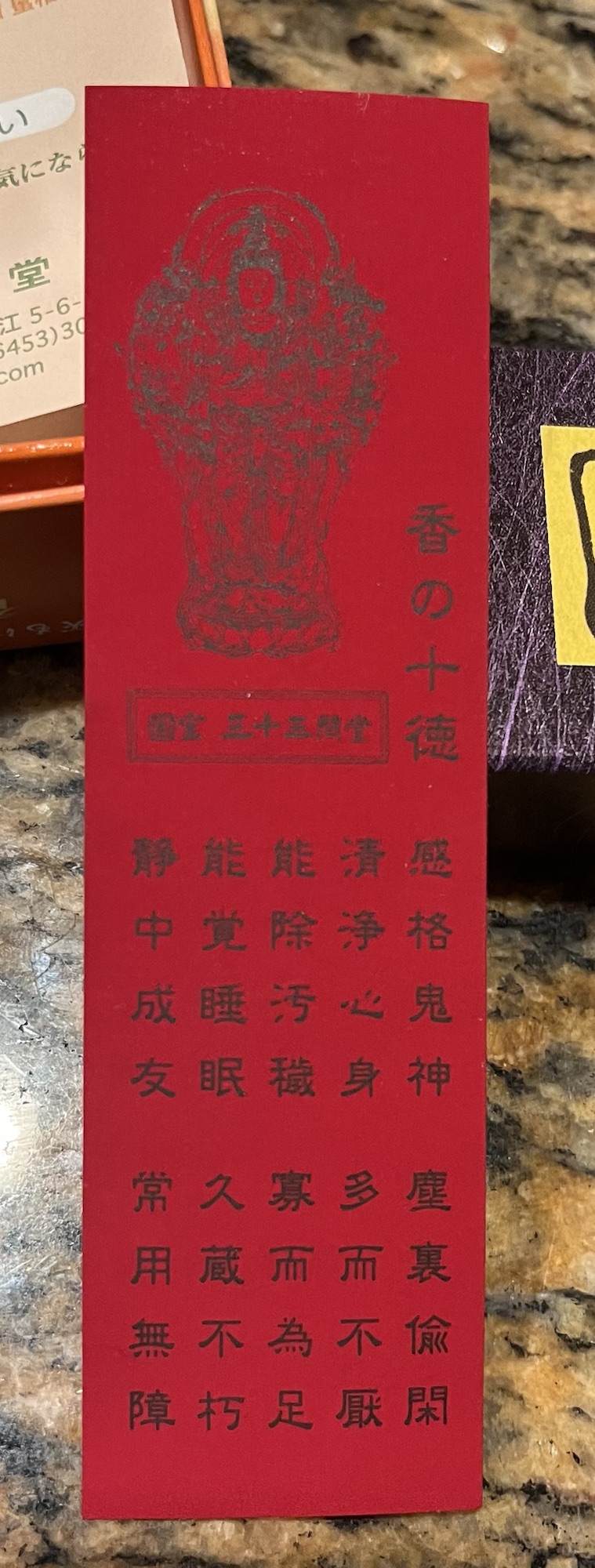
When we opened the incense box from Sanjusangendō, we were surprised to see this little red slip of paper. This is not bad photography: the paper is hard to read. At the top is a Buddhist image,2 but below that is something written on the slip of paper called the Ten Virtues of Incense, or kō no jittoku (香の十得). The Ten Virtues is a form of Chinese-style poetic verse, or kanshi (漢詩) originally composed by the 15th century eccentric Rinzai-Zen monk Ikkyu.
The Ten Virtues are ten aspects of incense that Ikkyu felt was beneficial for whomever uses it. Nippon Kodo has a really nice English-language page about it, including a translation. Feel free to stop and take a look. I’ll wait.
To summarize the benefits here (refer to other sources for proper translations), the ten virtues are:
Spiritual awakening
Purification of body and mind
Removes impurity
Brings alertness
Brings comfort in solitude
Brings moment of peace
One doesn’t get tired of it
Even a little is enough
Stays fresh even in age.3
You can use it every day.
Of course, it’s also important to use incense in a well-ventilated room. The smoke, while very pleasant, is probably not good for your lungs. I always open windows and doors before using it. Also, good quality incense tends to be less smoky. You can even find “reduce smoke” incense sometimes, which is probably healthier, though I would still keep good airflow just in case.
In any case, incense is pretty neat, and if you ever visit a Buddhist temple in Japan, you’re almost sure to find some really good quality stuff. But even if you can’t afford to travel, it’s not hard to find stuff online or in your area too.
Good luck and happy …….. inhaling?
1 We have visited this place a number of times over the years, including our “honeymoon” trip to meet the extended family in Japan way back when. And yet, I haven’t talked about it much. I actually really like this temple, but because they don’t allow much photography it’s hard to make a blog post about it. I might try one of these days, just haven’t figured out how to describe Sanjusangen-do without photos I can use.
2 The Buddhist image is the bodhisattva Kannon, in the form of 1000 arms, also known as senju kannon (千手観音). Since the temple venerates Kannon, this makes sense.
3 Speaking of our honeymoon trip way long ago, we went to a spa-resort place in Japan, and got these nice little incense envelopes. I put my envelope between two pages of a book at the time, shelved it, and forgot about it for years. I opened years later, and the oils of the incense had seeped through and stained the page, but it also left a really nice scent that still lasts. Even now 20 years later, the book still has a nice fragrance.
In a recent post I talked about how Zen imported from Song-Dynasty China found patronage with the elite samurai families of the city of Kamakura. Sometimes this was due to the cultural prestige of Zen among “country bumpkin samurai”, but also the new Zen monastic community drew sincere students as well, helping it take root. Zen still had a very small presence, compared to other Buddhist institutions in medieval Japan, but it was definitely the “up and coming” sect.
By the 14th century, and with the destruction of the Hojo Family (ending the Kamakura Period of history), the seat of government shifted back to Kyoto under the new Ashikaga Shogunate (a.k.a. the Muromachi Period of Japanese history). The Ashikaga Shoguns, many of whom were avid Sinophiles, further cultivated the Rinzai Zen institutions from China, and created a new hierarchy of temples called the Five MountainsSystem. The same system existed in China, where “mountain” was synonymous with “Buddhist monasteries”, but the Chinese version was a looser organization and not strictly related to Zen Buddhism.
The Japanese version organized Rinzai Zen temples (and some Soto Zen temples) across the country into one of three administrative “ranks” with the “five mountains” (gozan, 五山) at the very top. These temples, as we’ll see later, functioned less as Buddhist temples and increasingly as bureaucratic hubs for the rest of the temples in Japan. They enjoyed much patronage and prestige, but the monastic life greatly suffered.
The three ranks were:
Gozan (五山) temples, the top-tier
Middle-tier jissatsu (十刹) temples, and
Shozan (諸山) temples at the bottom.
Confusingly, many Rinzai Zen temples existed outside this temple structure, either by choice, or just lacked prestige, and were derisively called rinka (林下, “the forest below”) to distinguish from more prestigious temples “up on the mountain”. I briefly mentioned rinka temples in this old post.
Anyhow, let’s look more closely at each.
The Gozan Temples
The list of gozan temples varied over time, usually whichever temples the current Shogun patronized. Further, there were actually two sets of gozan temples, one for Kyoto and one for the former capitol of Kamakura. Which one was more important depending on who was in power.
For example, in 1341, under guidance from Tadayoshi, the ranks were as follows (homepages linked where possible):
And by 1386, also under Yoshimitsu, the rankings switch in favor of the Kyoto temples, but also Nanzenji gets elevated to a “superior gozan temple”. Plus, a new temple built on Yoshimitsu’s orders, Shōkokuji, was slotted into the Gozan temple ranks.
The Gozan temples were the top of a large administrative bureaucracy that managed the many other Rinzai Zen temples, and as such enjoyed much patronage and influence. However, as we’ll see later, this came at a heavy cost.
Middle Rank Temples: Jissatsu
The ten temples of the middle rank, the jissatsu (十刹), were major temples in the provinces that served as middle-management. They managed other temples in the provinces and were subordinate to the gozan temples, but also held much influence too. Eventually, the jissatsu temples were also split up into 10 temples under the Kyoto gozan temples, and 10 more under the Kamakura gozan temples.
The list of temples moves around a lot, and sometimes temples were promoted to gozan temples, or downgraded.
Lower Rank Temples: Shozan
The shozan temples are the lowest-ranking, but also the largest group by far. At any time, up to 250 temples were ranked as shozan temples. As with the jissatsu temples, the shozan temples were usually provincial temples that simply didn’t have the prestige or political influence that the jissatsu had. However, they were still important in extending Shogunal control over the provinces, and thus still had ranking.
What Happened to the Gozan System?
As we saw in an old post, whenever the Buddhist establishment developed close ties with the ruling regime, this worked as long as the regime was powerful, but began to collapse easily when the regime was weak.
In the case of the Gozan system, the Zen temples never maintained huge standing armies that other, older temples such as Enryakuji (Tendai) or Kofukuji (Hossō sect) did, and so they relied on the Ashikaga shoguns for protection. As the Ashikaga shogunate started to weaken, local warlords in the provinces and the rival temple armies began to assert their power, and the Gozan temples suffered.
In fact, the disastrousŌnin War in the 15th century practically destroyed many of these monasteries along with most of Kyoto city. Some of these temples never to rebuilt, or became greatly diminished. By this point, the Ashikaga “shoguns” had no real power outside of the Kyoto area, and thus couldn’t protect or influence other temples anyway.
However, probably the biggest reason for their decline was that spiritual practices at these temples declined and atrophied as they became more and more important politically. In the book Five Mountains: The Rinzai Zen Monastic Institution in Medieval Japan by Professor Martin Collcutt, Collcutt shows how records and journals at these temples showed that they had a very active social scene: banquets, religious functions, public rituals, and so on, but very little actual Zen practice as we know it. Monastic discipline greatly declined, and while they flourished culturally, the religious practices suffered. The famous Zen monk, Ikkyu, at the time lamented the decline in monastic discipline. Then again, he was a bit of an eccentric curmudgeon anyway.
Ironically, Rinzai Zen temples that existed outside the Gozan system, gained lasting prominence instead. The modern lineages in Rinzai derive from two temples that were not in the Gozan system: Daitokuji and Myōshinji. Both had reputations for maintaining austere Zen practices, and enjoyed patronage from wealthy merchants, and the increasingly powerful provincial warlords. Under Hakuin (mentioned here), the two temples became the basis for Rinzai Zen today.
Admittedly, both Daitokuji and Myoshinji suffered from corruption as well, as they gained social prominence, but Hakuin’s reforms later fixed this.
So, repeat after me: religion and politics should not mix.
There is a persistent image in the West of samurai being adherents of Zen, that the “way of the warrior” (bushido)1 and Zen are somehow one and the same. One can imagine a samurai who has practiced swordsmanship to a finely honed skill, meditating under a waterfall, and writing Zen-like deathbed poetry before preparing to throw away their life in battle. In my first visit to Ryoanji temple (featured photo shown above), 28-year old me had a similar image in mind persisting all the way back when I was a naïve 16-year old white kid just reading about Zen for the first time. Looking back after almost 20 years of Buddhist-study and practice, I facepalm at myself a little, but it’s a very persistent image in media. (side note: Last Samurai is not my favorite movie)
So, did samurai really embrace Zen, and was Zen essentially a “samurai religion”? Turns out, it’s complicated, and most of the imagery was romanticized.
Even at the height of its influence in the last fourteenth century, Zen–including the more widely diffused Sōtō Zen–probably had still not replaced devotion to Kannon, Jizō [Bodhisattva], the Lotus Sutra [e.g. Nichiren Buddhism], or the Pure Land of Amida in the hearts of most ordinary, and many high-ranking, Japanese samurai.
page 80
Further:
Zen in the Kamakura and Muromachi periods can be called “the religion of the samurai” only in the sense that most patrons of Zen were samurai, not in the sense that it was practiced assiduously or exclusive by all, or even perhaps the majority, of those who would be described as warriors.
page 80
So where did the image come from? Let’s take a brief look at the history of Zen, especially Rinzai Zen, in Japan.
The Two Lineages of Zen in Japan
Japan has historically two sects of Buddhism, both descended from Chinese lineages: Soto and Rinzai Zen. The differences between the two are too big to cover here, and there’s plenty of information on the web that explore the two. Suffice to say, the two lineages came to Japan in the 12th century, but took pretty different trajectories.
Soto Zen, founded by Dogen after journeying to China, did not sit well with existing powerful Buddhist sects in Japan, because of Dogen’s unwavering commitment to his ideal of ideal Zen practice, and was pushed out to the countryside. For centuries it was obscure, and enjoyed little patronage beyond certain local samurai families, primarily for the sake of prestige. Its popularity grew later through the efforts of a monk named Keizan, who developed increasing patronage from (mostly) provincial samurai rulers, and cultivated more community support. Professor Bodiford’s book, Sōtō Zen in Medieval Japan, is an excellent overview of its history. In any case, all Soto Zen traditions in Japan (and beyond) trace back to Dogen.
Rinzai Zen, founded by Eisai, has a much more complicated history. Eisai was willing to compromise more when he returned from China with the Buddhist establishment, so early Rinzai Zen was more like a hybrid Zen-Tendai Buddhist institution with a lot of esoteric practices. It enjoyed further popularity under Enni Ben’en (圓爾辯圓, 1202 – 1280) in the capitol of Kyoto, but remained a relatively small sect, often conflated with existing Buddhist institutions at the time.
Zen really didn’t take off until the second-half of the Kamakura Period under the Hojo Clan regency. After the death of Sanetomo, the 3rd shogun, the subsequent shoguns, distant offshoots of the family, were installed but increasingly powerless against their own regents, the Hojo Clan. Under talented Hojo leaders such as Hojo Tokiyori and Tokimune, power was consolidated, and they became the effective rulers of Japan.
But there was a persistent issue: the Hojo Clan, while militarily powerful and based in Kamakura was seen as inferior to the old aristocracy (e.g. the Fujiwara) in Kyoto who had centuries of refinement to rely upon compared to the upstarts. The old Buddhist establishment was still closely allied to the aristocracy, and thus hostile to the Hojo Clan.
Enter the Mongols
When the Mongols finally destroyed the Song Dynasty in China, establishing the new “Yuan” Dynasty, the upheaval affected many monastic institutions. Some monks, including ardent Song-loyalists, decided to leave China and make the journey to Japan either to get away from Mongol authority, or possibly in some cases, to work as spies for the Mongols who later tried to invade Japan.
Starting with a monk named Lanxi Daolong (蘭溪道隆, 1213-1278), who came to Japan in 1246 for reasons not entirely clear, followed by Wuan Puning (兀庵普寧, 1197 – 1276) in 1260, a steady stream of Rinzai-lineage monks came to Japan. For the Hojo leadership, this new source of Chinese education, culture and religious teachings practically fell into their lap, and they quickly adopted these new monks, establishing a series of monasteries in the new capital of Kamakura starting with Kenchōji (website here) in 1253, and expanding to other temples such as Engaku-ji in 1282. These new temples in Kamakura Zen temples were different than the ones that Eisai and Enni Ben’en’s temples had established in Kyoto, designed to match Song Dynasty practices, with Chinese monks frequently serving as abbots.
Thus, Rinzai Zen in Japan was essentially established as two separate lineages2 albeit with a common ancestry: the first lineage established by Eisai and popularized in Kyoto by Enni Ben’en that incorporated more native Japanese-Buddhist practices, and the second lineage which came later driven by Chinese Zen monks during the end of the Song Dynasty who established a more “pure” form of Zen based on the Chinese model. It should be noted that the Chinese monks mentioned above did journey to Kyoto as well to update existing monasteries of the older lineage to modern (e.g. Song Dynasty) standards as well, but the temple of Kenchōji was the premiere Zen temple for centuries in Japan. Further, by the 14th century, and especially later, much of Rinzai Zen was more homogenized than the early communities.
The arrival of the Chinese-Buddhist teachers to Japan in the 13th century is important to note, though, because this is the point in time where the samurai class really start to interact with Zen communities.
The Hojo Clan had finally found a way to one-up their rivals in Kyoto by raising their own cultural credentials with the new immigrants from China, but also some Hojo family members really did embrace Rinzai Zen teachings. Hojo Tokiyori (北条 時頼, 1227 – 1263) and his son, Tokimune (北条 時宗, 1251 – 1284) both became avid students under Chinese teachers, patronized the new monastic communities in Kamakura, and encouraged its practice among their samurai vassals. Other regents of the Hojo Clan never took much interest. But now, Zen finally had the patronage it needed to expand and grow in Japan, yet as Collcut’s book shows, it was still largely adopted for cultural prestige, and also oftentimes due to obligation towards Hojo Clan. Many of these vassal clans later rose to be major powers centuries later (cf. Hosokawa, Takeda, Uesugi, Tokugawa, etc) with their own patronage to Zen temples in their provinces.
Later, as the Hojo Clan finally declined in power, and gradually replaced by the Ashikaga Clan (e.g the Muromachi Period), the pattern continued. Both the emperors of the time such as Go-Daigo and Hanazono, and the Ashikaga Shoguns patronized Rinzai Zen temples, but often times for political expediency. The “Five Mountains” monastic system developed at this time, borrowed from Chinese cultural, is a big topic, and worthy of its own post.
The high-point of “Zen-Samurai” culture as we know it can probably be traced to the 8th shogun of the Ashikaga Clan, Yoshimasa (足利 義政, 1436 – 1490) who while being a dismal military commander, was a brilliantinnovator of Zen aesthetics. Yoshimasa had a taste of artistic genius, and patronized Zen-influenced architecture, painting, poetry, and gardening, and so on, but also directly added his own spin. The “zen aesthetic” we all recognize is largely due to Yoshimasa who synthesized earlier Song-Dynasty culture through establishment of institutions by the Hojo Clan.
However, on a personal level, Yoshimasa recited the nembutsu and seldom meditated.
Conclusion
All this is not meant to detract from Zen teachings, or the contributions of Zen monks to Japanese culture, or to imply that there were no Zen-devotees among the samurai class, but as I alluded to in the beginning, the romanticized Zen-Samurai image mostly exists on paper or in the writings of its sincere devotees. It was the ideal at the time among enthusiasts, and this ideal has persisted into Western culture, including teachers and self-help gurus.
How samurai in Japan, or Japanese in general, interacted with Buddhism (including Zen) was complicated and very individual, and not always related to piety. When you look at other pre-modern cultures, you see similar patterns. The emperors of the Eastern Romans had a complex relationship with the Church, and usually were not interested in the deeper teachings, or various doctrinal conflicts of the Byzantine Orthodox church except when it interfered with political goals (cf. iconoclasm, schisms, etc), or were varying degrees of sincerity. Further, how they practiced religion would have been noticeably different than your typical Eastern Roman in the provinces or the streets of Byzantium.
Now, imagine the same in any other culture: Western medieval communities, people in the Islamic caliphate, Chinese Buddhists, etc.
In short, how people interact with religion, and how its romanticized, are two different things. The dynamic interaction of people, culture and religion is fascinating, but not very marketable. The romanticized form of religion is marketable, but is like a bag of potato chips: tastes good, but rarely provides anything meaningful.
1 Please, please, please: if you ever go visit Japan, do not wear a “bushido” shirt. It really pegs you as a tourist.
2 The third “Obaku” sect of Zen in Japan is in fact yet another Rinzai Zen lineage that came from China, this time from the Ming Dynasty. By this point, Pure Land Buddhism and Zen in China had largely reconciled, and Obaku Zen includes more elements of Pure Land than is found in other Rinzai lineages, while still retaining its core Zen element.
The dharani below is the Dharani for the Prevention of Calamity, or shōsaishu (消災呪), called more formally the shōsaimyōkichijō darani (消災妙吉祥陀羅尼). It is used in both Rinzai and Soto Zen traditions as a general-protection “spell”.1 I assume the intention is to protect the Zen disciple so that they can reduce obstructions on their path, similar to prayers to the Medicine Buddha in other traditions.
Before we share the dharani, let’s talk about mantras vs. dharani in Buddhism. Both belong to the esoteric traditions of “Vajrayana Buddhism”, (e.g. Tibetan Buddhism, and Shingon/Tendai Buddhism in Japan). My experience is limited, but I believe that mantras usually have layers of deeper and deeper meaning that a disciple explores in the esoteric path, while dharani do not. Instead, dharani are more like tools, simple “spells”1 or chants to provide a specific benefit. Mantras might provide also a benefit, but that’s not their sole purpose in the esoteric tradition.
Also, non-esoteric traditions in Buddhism will sometimes cherry-pick ones that they feel are useful, some more than others.2 Sometimes mantras and dharani are used for very specific liturgical purposes, others are chanted as part of normal service.
In any case, the Dharani for the Prevention of Calamity is regularly chanted three times in Rinzai Zen liturgies. I am less clear how it’s used in Soto Zen.
An example of the recitation is below from the Soto Zen tradition:
The dharani has a couple versions, one used in the Soto Zen sect, and another used by Rinzai. I’ve included both versions below.
NO MO SAN MAN DA MO TO NAN O HA RA CHI KO TO SHA SO NO NAN TO JI TO EN GYA GYA GYA KI GYA KI UN NUN SHI FU RA SHI FU RA HARA SHI FU RA HARA SHI FU RA CHI SHU SA CHI SHU SA CHI SHU RI CHI SHU RI SO WA JA SO WA JA SEN CHI GYA SHI RI EI SO MO KO
NA MU SAN MAN DA MO TO NAN O HA RA CHI KO TO SHA SO NO NAN TO JI TO EN GYA GYA GYA KI GYA KI UN NUN SHI FU RA SHI FU RA HA RA SHI FU RA HA RA SHI FU RA CHI SHU SA CHI SHU SA SHU SHI RI SHU SHI RI SO WA JA SO WA JA SE CHI GYA SHI RI EI SO MO KO
1 I am not sure what else to call it. Dharani use Sanskrit words that are chanted to provide a concrete benefit. If there was a meaning originally, it’s obscure now. I wish I could use a more suitable word for this, but there’s nothing in English I can use that doesn’t sound like a Harry Potter episode.
2 the Pure Land tradition usually doesn’t use mantras or dharani. One could argue the nembutsu is something similar, but that’s a story for another post.













 Gleanings in Buddha-Fields

.jpg)
You must be logged in to post a comment.