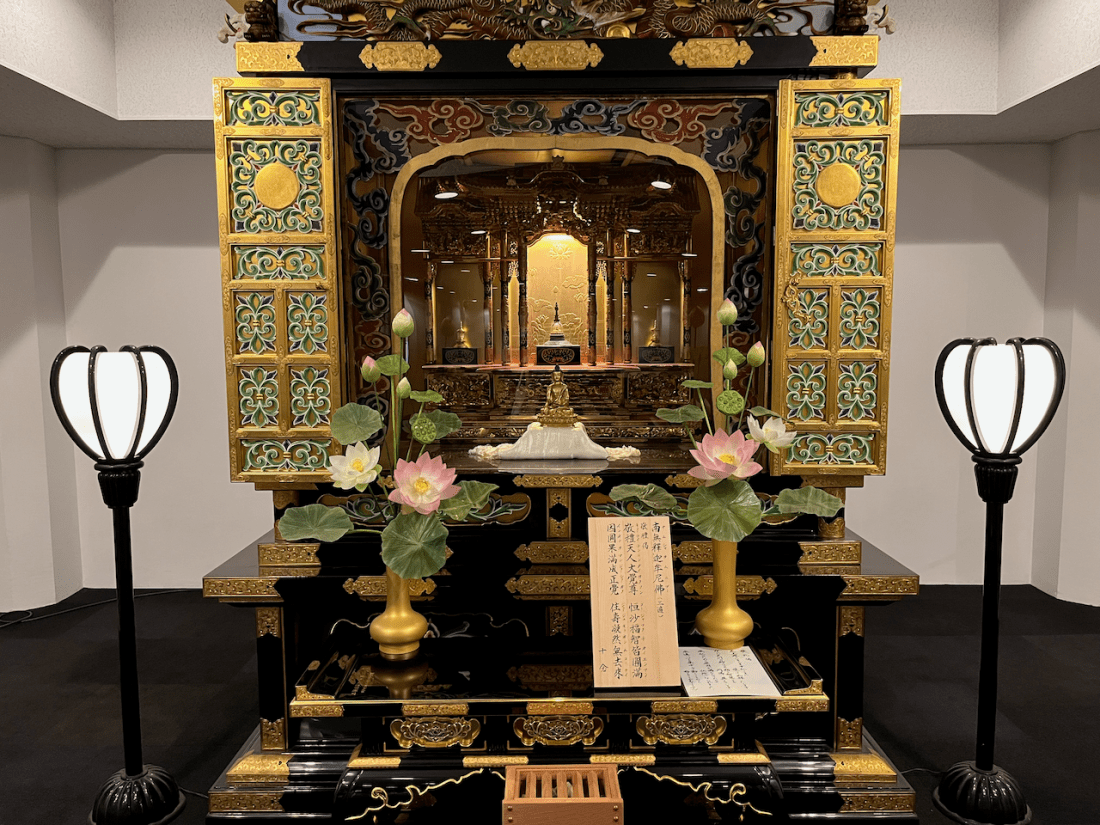
The Pure Land and the Lotus Sutra

Years ago, I used to write down sutra verses I’d find (in English) into my little sutra book, but after a while I often forget what I wrote down. Recently I found this really fascinating verse from the twenty-third chapter of the Lotus Sutra, which I had apparently written down:

The woman who hears and keeps this chapter of the Previous Life of Medicine-King Bodhisattva will not be a woman in her next life. The woman who hears this sutra and acts according to the teachings of it in the later five hundred years after my extinction, will be able to be reborn, after her life in this world, [as a man sitting] on the jeweled seat in the lotus flower blooming in the World of Happiness [the Pure Land] where Amitāyus Buddha lives surrounded by great Bodhisattvas. He [no more she] will not be troubled by greed, anger, ignorance, arrogance, jealousy, or any other impurity. He will be able to obtain the supernatural powers of a Bodhisattva and the truth of birthlessness. When he obtains this truth, his eyes will be purified. With his purified eyes, he will be able to see seven billion and two hundred thousand million nayuta Buddhas or Tathāgatas, that is, as many Buddhas as there are sands in the river Ganges.

Transalation by Rev. Sencho Murano

There is a lot to unpack here.

In Indian culture, it was felt that birth as a women was disadvantageous. This was probably due to the realities of the time: patriarchal society, extreme risks of childbirth in a pre-modern society with medical technology, dowry customs, etc.1 So, the idea was that rather than being reborn again as a woman in the next life, the sutra promises that such a woman could be reborn as a man by being reborn in the Pure Land of Amitāyus Buddha.

Amitāyus Buddha is one of the names of Amida Buddha. It is also used in the Immeasurable Life Sutra, where one of the vows of Amida Buddha is the following:

(35) If, when I attain Buddhahood, women in the immeasurable and inconceivable Buddha-lands of the ten quarters who, having heard my Name, rejoice in faith, awaken aspiration for Enlightenment and wish to renounce womanhood, should after death be reborn again as women, may I not attain perfect Enlightenment.

Translation by Rev. Hisao Inagaki

Here, we see essentially the same thing: if a woman is weary of the challenges of womanhood, she can choose to be reborn as a man in the Pure Land of Amida (Amitāyus) Buddha in accordance with his vow. Should his vow fail, the Pure Land would not be. Since it does exist, the vow is certain.

You can read this in two ways, I think:

  1. This reaffirms a patriarchal attitude that woman are inferior, and therefore being a man is better on the Buddhist path, or
  2. Buddhism was realistic about the challenges of woman in a patriarchal society of the time, and therefore offered something not found in other religious paths.

I think it is up to the reader to decide. To be honest, in light of other aspects of the Lotus Sutra, such as the Parable of the Dragon Princess, or Shakyamuni’s prophecy of Buddhahood to his nun disciples, I am inclined to think that the latter interpretation is what the authors of the Lotus Sutra intended. The Lotus Sutra reads as something (relatively) progressive for the time.

Separately, it’s interesting that the Pure Land of Amida Buddha is even referenced in the Lotus Sutra at all, and both sutras use the same name, Amitāyus, not the more common Amitābha. Typically, Buddhism tends to treat the Lotus Sutra and the Pure Land as separate traditions. They overlap because they are both Mahayana-Buddhist traditions, but often people focus on one or the other.

Further, the Pure Land of Amida Buddha is not prominent in the Lotus Sutra. Instead, the “pure land” of Shakyamuni Buddha in chapter sixteen is the big reveal. So, Amida Buddha’s Pure Land is more like a backup singer in the band, or a spinoff character.

But, having had some exposure to Tendai-Buddhist thought, and seeing overlapping texts like these, I feel it’s clear that they were meant to be one tradition, not two. From the Lotus Sutra perspective, the Pure Land path is part of the larger progression toward Buddhahood. From the Pure Land perspective, Buddhahood is all but assured if you are reborn there because of the radiance and magnetism of Amida Buddha. So, it feels like they are two sides of the same coin in a way. If you add the Zen perspective of the Pure Land, things get even more interesting.

How one approaches all this is up to you. If nothing else, the Lotus Sutra shows that there are many gates, and many ways to approach the Buddhist path, but they are like rivers all feeding into the same ocean.

Namu Shakamuni Butsu
Namu Amida Butsu

P.S. Despite my “break” in December, I decided not to wait on this one. 😅

1 One could make the argument that even now in 21st century modern society, life as a woman is still not an easy one. But imagine life when you were expected to have many children, and the average childbirth had a 10% chance of killing you each time, so many women did not live past their 20s and 30s. Further, if your husband was a terrible person, you had little if any recourse.

Confronting a Suffering World

More than any other year in recent history, it seems like 2025 is a year where we are suffering more than before. It is frustrating to watch all this unfold, frustrating to know that even when you try to help, it feels like it makes no difference, and frustrating to see no light at the end of the tunnel. I feel a combination of denial, passivity, frustration, anger, despair, and everything in between, over and over.

IVANOVA: Damn it, John, there’s always too many of them and not enough of us. What am I supposed to do?

SHERIDAN: Fight them without becoming them.

Babylon 5, “Dust to Dust”, s3:ep06

But I’ve also been thinking about this a lot, and I realized that the forces of History are always in motion, even if we don’t see them. It can take years, or in some cases decades to see the bigger picture.

Claude from Fire Emblem: Three Houses saying “…but even while you’re standing still, the world keeps on moving. I always find that oddly comforting.”

But also, the little things we are doing here and now still matter. What happens to others who are suffering affects us, even if we are not consciously aware of it.

G’KAR: If we deny the other, we deny ourselves and we will cease to exist.

Babylon 5, “Point of No Return”, s3:ep9

Even those whom we oppose are suffering, even if we do not comprehend it:

If both sides are dead, no one will care which side deserves the blame. It no longer matters who started it, G’Kar. It only matters who is suffering.

Babylon 5, “Dust to Dust”, s3:ep6

So, simply standing back and letting history unfold isn’t enough. On the other hand it is just not possible to save the whole world. Even if I gave away everything I have here and now, it would be a drop in the bucket.

Instead, each one of us needs to find one small thing that we can dedicate ourselves to, for the good of others. In a Pure Land Buddhist text, The Larger Sutra of Immeasurable Life, the Buddha Amitabha started as a king, then a bodhisattva, and through tireless efforts over eons transformed his realm into the Pure Land through countless good acts, accumulated merit, and so on. This process was glacial, but it came to fruition nonetheless.

In the same way, each one of us when we dedicate ourselves to a cause, however small, it feels glacial. Nothing changes. But change does happen. As with the forces of History, things do unfold, but our actions help shift the currents of the “river of History” ever so little.

But even so, not every one will see this and understand. In the immense Buddhist tome, the Avatamsaka Sutra (a.k.a. the “Flower Garland Sutra”), is a famous quote:

On seeing a bodhisattva
Perform various practices,
Some give rise to a good mind and others a mind of evil,
But the bodhisattva embraces them all.

Original translation from the Collected Works of Shinran, courtesy of the Jōdo Shinshū Hongwanji-ha

This is the Mahayana Buddhist in a nutshell.

Namu Shakamuni Butsu

Namu Amida Butsu

P.S. Thanks to a bug in my blogging app I posted two posts at the same time last week. Apologies for any confusion.

Also, I am still resting a little from burnout, so no blog schedule for now. I wanted to at least finish some mostly-complete drafts for now.

Amitabha: The Welcoming Buddha

During my wife’s latest trip to Japan (I stayed home this year for various reasons), she found this delightful patch/sticker:

This is an image of Amida Buddha, welcoming the deceased to the Pure Land. This is called raigō amida (来迎阿弥陀, “Amida welcoming the dead”). I talked about this before a little while ago, becuase it was a common artistic motif in medieval Japanese Buddhism, especially at a time where disease, warfare and death would often cut people’s lives short.

The imagery of Amida Buddha coming to greet the dead is found primarily in the Contemplation of Amitabha Sutra (a.k.a. “the Contemplation Sutra”). The last section of the sutra lists the nine grades of people who are reborn in the Pure Land, and the fourth grade (“highest level of the middle grade”) gives the following description, for example:

“When such a person is about to die, Amitayus [Amida] appears before him, surrounded by a host of monks and radiating a golden light. He then expounds the truth of suffering, emptiness, impermanence and no-self, and praises renunciation of the world as the way to escape from suffering.

“Seeing this, the aspirant greatly rejoices and finds himself seated upon a lotus-flower. He kneels down, joins his palms and worships the Buddha. Before he raises his head, he attains birth in the Land of Utmost Bliss, where his lotus-bud soon opens.

Translation by Rev. Hisao Inagaki

Depending on the grade of the aspirant, this welcome may be more or less elaborate, but all of them are reborn in the Pure Land somehow.

So, I like this patch because it’s a reminder of the goodwill Amida Buddha extends to all beings, and how everyone can be born in the Pure Land if they want to.

Namu Amida Butsu

P.S. I kept the patch in its wrapper for a long time, but finally decided to put it in a sutra book I’ve been making.

P.P.S. Accidental double-post. 🤦🏼‍♂️

The Dynamic Duo of Zen and Pure Land

A few months ago, I made this post about how the Obaku Zen sect interprets Amida Buddha and the Pure Land. To my surprise, I keep reflecting on this phrase from time to time, almost like a Zen koan:

This mind is the Pure Land,
this body is Amida Buddha

This idea of merging Zen and Pure Land ideas is somewhat rare in Japanese Buddhism, but it’s surprisingly common in Chinese-Buddhist thought. Originally, I thought it was limited to later Ming-Dynasty Buddhism (which Obaku descends from), but similar strands of thought exist much further back.

A famous Chinese monk named Yongming Yanshou (永明延壽. 904 – 976) once wrote a poem titled the “Four Alternatives” (sì liào jiǎn 四料揀):1

Lacking both Chan and the Pure Land, it will be the iron beds and bronze pillars [of hell] for ten thousand kalpas [eons] and a thousand lives with no one to turn to.

Having Chan but lacking the Pure Land, nine out of ten will stray from the path; when the realm of the aggregates appears before them, they will instantly follow it.

Lacking Chan but having the Pure Land, ten thousand out of ten thousand who practice it will go [to rebirth]. Having seen Amitābha, why worry that one might not attain enlightenment?

Having both Chan and Pure Land, one is like a tiger with horns [i.e., doubly capable]. Such a person will be a teacher in the present life, and a buddha or patriarch in future lives.

translation by Charles B. Jones, “Chinese Pure Land Buddhism, Understanding a Tradition of Practice”, pg 210

Yongming is advocating a supportive model where both Zen practice and Pure Land practice work in concert. The Pure Land path is the “safer” path to follow, due to the vows of Amida Buddha, but if supported by Zen practice here and now, one is really making progress on the Buddhist path.

Further, a later writer named Yunqi Zhuhong2 (雲棲袾宏, 1535 – 1615) explained that these things were not mutually exclusive (Chinese added by me):3

To contemplate the Buddha (nianfo 念佛) is to contemplate the mind (nian-xin 念心). Birth there (in the Pure Land) does not entail birth away from here. Mind, Buddha, and sentient beings are all of one substance; the middle stream (non-duality) does not abide on the two banks (this world and the Pure Land).

Similarly, Ouyi Zhixu (蕅益智旭, 1599 – 1655) in his excellent work “Mind Seal of Buddhas” makes a similar argument: Zen and Pure Land practice are the same thing, just operating at different levels. You’re not forced to chose one or the other in your practice.

But such ideas aren’t limited to medieval Chinese-Buddhist monks. You can find such sentiments in Pure Land sutras themselves! In the Immeasurable Life Sutra is this passage (emphasis added):

“In this world, you should extensively plant roots of virtue, be benevolent, give generously, abstain from breaking the precepts, be patient and diligent, teach people with sincerity and wisdom, do virtuous deeds, and practice good. If you strictly observe the precepts of abstinence with upright thought and mindfulness even for a day and a night, the merit acquired will surpass that of practicing good in the land of Amitāyus [a.k.a. the Pure Land] for a hundred years. The reason is that in that buddha land of effortless spontaneity all the inhabitants do good without committing even a hair’s breadth of evil. If in this world you do good for ten days and nights, the merit acquired will surpass that of practicing good in the buddha lands of other directions for a thousand years.

Translation by Rev. Hisao Inagaki

In this passage, the Buddha is clearly advocating both bending your efforts toward rebirth in the Pure Land, but also making the most of the time you have here to undergo traditional Buddhist practices too because even a modest effort here is a great benefit in the future (both for yourself and others).

As I often tell my kids: “go nuts”!4

What I mean is: recite the nembutsu, meditate, uphold the precepts, or some combination thereof. You have nowhere to go but up.

But what if you can’t decide or don’t have the time?

In my opinion, start with the nembutsu. Begin just as you are, and recite it just 10 times daily. From there, add the Five Precepts when you are ready, and once you have that foundation, and are ready to branch out, then look into Zen practices. This make take months or even years. Take your time, go slow, and don’t be afraid to explore.

When I talk about the flexibility of Tendai Buddhism in Japan as well, this is what I am alluding to: start with something simple and small at first (such as a devotional practice), and gradually building upon it as you gain confidence and see the positive transformation in your life. Buddhism is kind of a SLOW, gradual religion, but like a glacier, once it starts moving, it has a wonderful momentum all its own even if you can’t see it.

Namu Shakumuni Butsu
Namu Amida Butsu

P.S. Featured blog image is another famous “Dynamic Duo”: Batman and Robin from the 1960’s series.

P.P.S. Posting kind of off-schedule just because it is fun. 😊

1 I found this on Wikipedia actually and I thought to myself “wow, this person quoted exactly the same way that I would do!”, then I realized that I had put this on Wikipedia a few years ago. 🤦🏼‍♂️

2 Pronounced like “yoon-chee joo-hong”.

3 Again, I managed to pull a quote from Wikipedia that I had unwittingly added years ago and then promptly forgot.

4 My kids ask me if they can watch TV, play Switch or whatever, and my frequent answer is “go nuts” [go crazy, have fun].

Four Months Practicing Zen

I intentionally left this post in my blog draft folder for months, but now I am ready to post.

After a small revelation back in early May, I wanted to give it time and ensure that this change in Buddhist path wasn’t a spur of the moment decision.

After that little experience in May, I realized that I had misunderstood Zen Buddhism. Some of this is due to mixed experiences at local (Western) Zen communities,1 and in my opinion, systemic issues with Buddhist publications in English.3 Once I had better access to Japanese-language resources, and based on things I had sort of rediscovered, I decided to try to and go heads down for a few months and do my best to practice Zen as a lay person and parent.

My daily reminder list on my smartphone. A mix of mundane and Buddhist practice. 坐禅 means “zazen” and お勤め means “otsutome” (home service).

It took a lot of trial and error to get this right. At first, I had a tendency to succumb to self-doubt and start doing zazen meditation longer and longer, but then I would burn out, or have a busy day and skip. So, eventually I forced myself to keep it to five minutes, and I found I was able to sustain the practice more. Also, if I missee a day somehow, I would not punish myself over it.

Second, I struggled with how to do a Zen-style home service, so I had to do some research and this led to posts like this and this (these are for my own benefit as much to readers 😏 ). This home service underwent a few updates and changes over time, but I gradually settled on things over time, thanks to an old service I forgot I had.

Finally, I wanted to ensure I focused on Buddhist conduct as a foundational practice, and in particularly by upholding the Ten Bodhisattva Precepts. It’s also emphasized by such past Zen monks as a foundation for other aspects of Zen, but compared to the basic Five Precepts, I found myself struggling both to remember what the Ten Precepts were, and also remembering to avoid things like not bring up the past faults of others, or harboring ill-will towards others. This is still a work in progress, but I assumed it would be. It took me many years of following the Five Precepts before it became second-nature.

Anyhow, since I started this little project four months ago, I am happy to say that I have mostly stuck with it. I can count the days I missed practice on my two hands, which over four months is pretty good. I realized that small, realistic, daily practice is much more effective than trying to focus on big retreats. So, in a sense, it’s been a big win and a learning lesson for myself.

But also I realized that I also really missed some aspects of the Pure Land practice that I had been doing up until this point. For me, I found that Pure Land Buddhism tends to appeal to the heart, while Zen appeals to the mind.

Dr. Janet Wallace: “The heart is not a logical organ.”

Star Trek, “The Deadly Years” (s2ep12), stardate 3479.4

So, my practice has continued to evolve to mostly Rinzai-Zen style practice, but also with a few Pure Land elements too. I suppose this is more inline with mainland Chinese Buddhism where such distinctions are less important than Japanese Buddhism, which tends to be sectarian. Also, if it works for Obaku Zen, it works for me.

So, that’s my update. Am I Zen Buddhist now? I don’t know. I am hesitant to use that label because I am hesitant to associate myself with that community. On the other hand, I’ve found it very beneficial so far, but I haven’t forgotten what I learned from Pure Land Buddhism either. So, I guess I am both, neither, whatever. At this point, taking inspiration from Chinese Buddhism: I uphold the precepts, meditate a bit each day, dedicate merit to loved ones and those suffering in the world, praise Amida Buddha, Shakyamuni Buddha, Kannon and the Lotus Sutra. Whatever label fits that is what I am these days. 🤷🏼‍♂️

Frankly, I stopped caring. I like how my practice has evolved these past months, and happy to continue.

Namu Shakamuni Butsu
Namu Amida Butsu
Namu Kanzeon Bosatsu

P.S. Posting a little off-schedule, but oh well. Enjoy!

1 Not all experiences have been negative, but I have run into more than a few “Bushido Bros” and Japan nerds2 that soured my experience.

2 Yes, I am a Japan nerd too. I fully admit this, but nerds can be kind of intense and exhausting to talk to, so I don’t like to hang out too much with other Japan nerds.

3 It’s hard to quantify, but English books about Buddhism are either very dry, bland, and scholarly, or read like psychology self-help books, or just too mystical. When I read books in Japanese on similar subjects, I find them more down-to-earth and engaging. I know different people have different preferences, but I don’t like most English publications I find at the local bookstore. It is also why I try to share information (or translate if necessary) whenever I find it.

Obaku Zen Morning Service

This is just another small, bonus post. A little while back, I was looking into the Obaku school of Zen, but even in Japanese information is pretty hard to find. However, I was able to find this sound clip from the NHK. This is a sound clip of a morning service at Manpuku-ji Temple, the head temple of the sect.

What distinguishes Obaku Zen (ōbaku-shū, 黄檗宗) from other Zen sects, and Japanese Buddhism in general is how late it was imported into Japan from China. Most sects imported during the Tang or Song dynasties, namely 8th or 11th centuries. But Obaku Zen came to Japan during the Ming Dynasty (14th century). It shares the same common lineage as Japanese Rinzai Zen, so they’re sibling sects. Yet, across centuries some things had diverged, and Obaku imports a lot more Ming-era Buddhist aspects, such as a fusion of Pure Land and Zen teachings (which came later in Chinese-Buddhist history), and changes to liturgy and pronunciation.1

So, if you ever see Obaku Zen liturgy (I’ve only seen a few screenshots), it sounds somewhat different even when it’s the same liturgy, because pronunciation changed over time in China.

Anyhow, just a minor nerd moment. Please enjoy!

1 Languages change and shift, including Chinese. Chinese-Buddhist liturgy imported to Japan from the Tang Dynasty would sound different than the same imported into Japan during the Ming. If that seems far-fetched, look at English language.

The Flexibility of Tendai

As I talked about in a recent post, the main core idea of the venerable Tendai (天台) sect in Japanese Buddhism, including its parent Tiantai sect in China, is that the Lotus Sutra is the most important text in the Buddhist canon, a kind of capstone (lit. “complete teaching”, engyō 円教) for the rest of Buddhist literature up to that point. Because the Lotus Sutra is pretty long (equivalent to a modern book), I tried to summarize its teachings here.

Anyhow, Tendai/Tiantai focuses on how to put the Lotus Sutra into practice. For Japanese Tendai in particular, this is encapsulated in a phrase called shishū yūgō (四宗融合) meaning “Four Integrated Practices”. According to my book, these are listed as follows:

  • Meditation1
  • Esoteric Practices (mantras, dharani, mandala, etc)
  • Precepts
  • Pure Land2

This a lot. It helps to think of Tendai as a big umbrella or parasol with a bunch of people standing under it.

Photo by Ryutaro Tsukata on Pexels.com

Different people under the umbrella represent different Buddhist followers, with different practices and inclinations, but the umbrella itself represents the concept of upāya (“expedient means”) or hōben (方便) in Japanese. This is one the main themes of the Lotus Sutra, and expresses that all Buddhist teachings and practices lead toward the same end goal, and thus whatever works for a person at that time is perfectly fine for that person.

This is encapsulated in the 25th chapter of the Lotus Sutra, the so-called Kannon Sutra, because the Bodhisattva Kannon (a.k.a. Guan-Yin, Avalokiteshvara, Chenrezig, Quan Âm, etc) according to this chapter takes on whatever form is most beneficial for that person and teaches the Dharma to them. Thus, Kannon can appear as a man, woman, monk, rich person, etc. It’s also why statues of Kannon often depict them as having 1,000 arms, each holding a different object. Similarly, many of the early Buddhist monks who were Tendai followers practiced it differently from one another. On the one hand, you have monks like Eisai, who focused on meditation and precepts (and would later found the first Rinzai Zen temples), you also had monks like Genshin who focused a lot more on Pure Land practices, as well as esoteric experts such as Ennin.

Tendai as a sect in Japan was almost universal in the 9th through 12th centuries, but for a variety of historical (often self-inflicted) reasons, it has diminished in size and influence. Yet when you visit historical temples in Japan such as Asakusa Temple in Tokyo, Kiyomizudera Temple in Kyoto, and Sanjusangendo in Kyoto, these are all Tendai temples. Further, its influence lives on in newer sects that we know well: Zen, Pure Land, Nichiren and such, which all inherited practices and concepts even if they apply them in differing ways.

But while Tendai as an organized sect is somewhat diminished,3 its teachings of “umbrella” or “universal” Buddhism continue to live on. Rather than insisting there’s only one way to practice Buddhism, it gives a large, spacious framework for people to figure out their own path and use the vast toolkit available to work it out, all under the Lotus Sutra concept of expedient means. Use what works for you, and do not be afraid to adapt, change, or expand your practice as you go.

Namu Shakamuni Butsu
Namu Amida Butsu
Namu Kanzeon Bosatsu

P.S. Publishing off-schedule just for fun. Happy Sunday!

1 Tendai/Tiantai has the same meditation tradition as Zen, but tends to call it shikan (止観) not zazen (座禅) meditation. The founder, Zhi-yi, in China wrote multiples treatises, the Mohe Zhiguan, that provides a comprehensive manual about meditation. I have a copy of the The Essentials for Practicing Calming-and-Insight & Dhyana Meditation, but have only read parts of it. It is a nice training manual for those interested, but it is a little dense since the intended audience was the monastic community.

2 In the time of Zhi-yi, the founder of Tiantai, Pure Land Buddhism was approach more as a meditation tradition than a separate set of practices that what we see today. By the time it came to Japan, this had changed somewhat, and we see through the writings of Genshin that there were a variety of approaches both devotional and meditation-focused.

3 According to my book, as of 2015, the number of registered followers in Japan was around 1.5 million give or take. This makes it the second smallest of the major sects in Japan, and one-eighth the size of Jodo Shinshu-sect Buddhism. Only Rinzai Zen is smaller (1.1 million).

Eight Hour Monk

SPOCK: There are many who are uncomfortable with what we have created. It is almost a biological rebellion. A profound revulsion against the planned communities, the programming, the sterilised, artfully balanced atmospheres. They hunger for an Eden where spring comes.

Star Trek, “The Way to Eden” (s3e20), Stardate 5832.3

As I write this, the family is in Japan (sadly, I was unable to go this year) visiting relatives, and I am home with the dog, Cherry.

Since I have a couple weeks to myself, I thought it would be a great time to put in a little extra Buddhist practice, catch up on some personal projects, go offline for a bit, etc. Basically, try to live like a monk for a few days. I carefully planned it out, decided what I would do and not do, took a three days off from work, and then got ready for the “mini home retreat”.

I lasted eight hours.

The first few hours were great. It was peaceful, quiet, and I did finish reading a couple books on my to-do list, meditated extra, recited more sutras than usual, and so on. But then, as the hours progressed, isolation and boredom set in. I started worrying if I was missing a text from my family (in case of emergencies), and I discovered that it’s hard to read Japanese books without a dictionary which I only have on my phone.

Embarrassingly by early afternoon I gave up and turned on my phone. Then I went and played Fire Emblem: Three Houses for a few hours,1 watched Star Trek V: The Final Frontier2 for some crazy reason, got bored and played more Fire Emblem until 11pm.

Day two, I didn’t even really bother to try again. I realized that I had hyped up this time off too much, and without any support or contact with others, I quickly started to get a little stir-crazy. That’s not to say the time wasn’t unproductive either. Even today (day two), I still got some extra stuff done around the house, and did a little more Buddhist stuff than usual. But I also played Fire Emblem: Three Houses for three hours.

τὸ μὲν πνεῦμα πρόθυμον, ἡ δὲ σὰρξ ἀσθενής.
“Indeed the spirit is willing, but the flesh is weak.”

Matthew 26:40-43 with original Koine Greek

Indeed, in the Sutra on the Buddha of Immeasurable Life, one of the Three Pure Land sutras, the Buddha Shakyamuni laments that:

“People of the world, being weak in virtue, engage in strife over matters which are not urgent….Since they have not done any good in particular, nor followed the Way, nor acted virtuously, when they die, they will depart alone to an inferior world. Although they are destined to different states of existence, none of them understands the law of karma3 that sends them there.”

Translation by the late Hisao Inagaki, hosted here.

So, the problem of laziness and lack of follow-through in religious practices (or personal projects) is nothing new. Even in Japanese, there is a phrase: mikka bōzu (三日坊主) meaning “three day monk”. It’s a tongue-in-cheek phrase about how most endeavors last three days at most.

In my case, I think my failure was a combination of over-zealousness and perfectionism which set the bar too high for something I am not really used to doing day to day. The idea of a religious personal retreat is still worth it, but I should have set the bar lower the first time, and tried to be a bit more realistic.

The point isn’t to give up and just play more Fire Emblem (but then again, I might anyway), but reflect on what worked, and what didn’t and focus on something realistic and sustainable. As Dogen reminds us, it can be done, but expecting it to work overnight if I just push through hard enough is maybe a bit silly.

Namu Shakamuni Butsu
Namu Amida Butsu

P.S. Bonus post. Apologies for any typos, I wrote this one quickly while it was still fresh in my mind, so probably more editing mistakes than usual.

P.P.S. On the plus side, I also had some time to practice vegetarian cooking and made a large batch of Mapo Tofu, Pasta Mama (in honor of Captain Pike in Star Trek: Strange New Worlds), and some Thai curry. This photo is the Mapo Tofu:

… I also harvested the scallions I’ve been growing since Spring:

1 I am on my eighth play-through I think. I am finally going back and replaying my first route, Crimson Flower route (i.e. with Edelgard) and doing things I missed on my first play-through. It’s been nearly two years, and I still enjoy this game very much. The story, dialogue, characters and world-building never cease to amaze me.

2 I think I watched it to remember why this movie is so unpopular. It has some good qualities to it, but yeah, it’s not very good. As a teenager, I watched it in the theaters and thought it a bit odd, but it’s not aged well for me.

3 For similar teaching, see the first chapter of the Soto Zen text, the Shushogi.

The Pure Land Within

唯心の浄土 己身の弥陀
yuishin no jōdo, koshin no mida

“This mind is the Pure Land, this body is Amida Buddha

source: https://www.oubaku.org/oubaku.html

I’ve always been fascinated when Zen and Pure Land teachings overlap, and recently I was poking around the Internet looking at some websites related to the Obaku sect of Japanese Zen. I’ve mentioned this sect before in the context of its most famous monk Tetsugen (older post here).

Ōbaku Zen (黄檗宗, ōbaku-shū) is a lesser-known sect of Zen in Japan because it arrived much later (17th century) from the Chinese mainland than Rinzai and Soto Zen (13th century) did. Obaku Zen and Rinzai actually have the same source lineage in China, but by the Ming Dynasty in China (when Obaku came to Japan), the Buddhist culture there had largely reconciled Pure Land and Zen thinking and so Obaku contains a lot of Pure Land influences not found in Rinzai, though in all other respects they are basically the same.1 They even share a homepage together.

The quote above comes from a youth periodical for Obaku Zen monks, and I have read similar teachings before from Zen sources. I even quoted the same website in a past post, but after recent events, for some reason this makes a lot more sense than it used to.

If you look at the Hymn of Zazen by Hakuin (a Rinzai monk), he teaches something similar: people are inclined to look for the truth elsewhere, but it’s right under our noses. The last verse of the Hymn even says explicitly:

当所即ち蓮華国此身即ち仏なり
Tōsho sunawachi rengekoku,
kono mi sunawachi hotoke nari

This very place is the Lotus Land,
this very body the Buddha.

translation by Robert Aitken Roshi

The only difference between these two quotes is that Obaku Zen uses the imagery of the Pure Land of Amida Buddha, while Hakuin uses the Pure Land of Shakyamuni Buddha from chapter sixteen of the Lotus Sutra. But as we saw in the Shushogi recently,2 one Buddha’s the same as another. You can call it what you want, the teaching is the same.

It’s easy to understand all this on an intellectual level, but to really “get it”, can take a lifetime or many lifetimes. Or, perhaps I am just thick-headed. 😅

In any case, twenty years as a Buddhist, and yet the Dharma never ceases to surprise me…

Namu Shakamuni Butsu
Namu Amida Butsu

P.S. Translating the Japanese-Buddhist term 唯心 (yuishin) is tricky. This is actually the term “Consciousness Only” as in the Chinese-Buddhist term for the Yogacara school of Buddhism, wherein there is no reality outside of one’s own consciousness (mind). But that’s hard to write in full, so I translated, perhaps clumsily, as this mind (as in one’s own mind, one’s own perception).

1 It’s tempting to think that Rinzai is a more “pure” form of Zen, or that conversely Obaku is a more “polished” version than Rinzai. I leave that to people’s own interpretations. I used to assume that older sects equaled more pristine teachings, but these days I am not so sure.

2 Other sources include the “Parable of the Magic City” in the Lotus Sutra, and the opening paragraphs of the Sutra of the Buddha of Immeasurable Life among other places. Although Mahayana Buddhism isn’t alwys internally consistent, there are certain overarching themes throughout its history and they show up in unexpected places.

The Junirai: The Twelve Adorations of Amida Buddha

Studying about the Ikko-Ikki rebellion (parts one, two and three as of writing) has brought back lots of memories of the local Jodo Shinshu temple that I spent many years at. I also remember the liturgy I used to train in while getting certified as a minister’s assistant. I was a terrible singer (always have been), so I never sang well. Not just OK, I was genuinely bad. But I still enjoyed many of the different liturgies we sang in Sunday services including the Shoshinge, Juseige, and so on.

One of my personal favorite was a liturgy called the Jūnirai (十二礼), which means The Twelve Adorations of Amida Buddha. We didn’t sing this one too often, but it did come up from time to time.1

As far as I can tell, this liturgy is found only in the Jodo Shinshu tradition, and is based on a document attributed to the Indian-Buddhist monk Nagarjuna. Nagarjuna (c. 150 – 250 CE) was a very influential monk in early, early Mahayana Buddhist tradition, and some documents related to Pure Land thought and Amida Buddha are attributed to him. I say “attributed”, because there is some doubt as to whether Nagarjuna authored such works, or possibly there was another monk named Nagarjuna who did. Early Indian-Buddhist textual history is tricky at best.

Nonetheless, the Hymn of The Twelve Adorations is a nice, easy melodic song. You can find translations here and here among other places. The actual hymn, sung in Sino-Japanese2 has twelve verses and a straightforward melody. There is a great example of this on Youtube below (fast forward to 1:10 for the hymn if you like):

It’s a very nice, easy tune to pick up. I’ve even heard the same tune occasionally used by elderly Japanese-Americans reciting other hymns, including the Shoshinge, but the origins are not clear to me.

Anyhow, the Junirai is simple enough that even someone tone-deaf like me can passably sing it, but also very poetic and lovely. If you’re near a Jodo Shinshu temple, check it out and see it sung in person sometime, but if not, you can find the Sino-Japanese lyrics in the links above, and can sing along as a devotional at home if you like.

Namu Amida Butsu

P.S. Old, old photo of me as a minister’s assistant in training (I still have my certificate somewhere).

I can’t remember when this photo was taken, but suffice to say, it’s old.

1 One difference I have noticed over the years between Jodo Shinshu temples in the West versus Japan is that in the West weekly services (i.e. “sunday services”) are common, but in Japan they usually only happen at major temples, not parochial ones. Thus, in Japan the emphasis is on home liturgy and chanting. People will chant the same hymns and sutras as described above, but in a home setting before an altar. Of course, Western Buddhists do home services too. It’s just that in Japan and other places in Asia, you’re not obligated to attend weekly communal services.

2 That is, Chinese characters with Japanese pronunciation, not native Japanese language.