Author’s note: I reposted this from the other blog. There’s a lot of overlap here, and it just made sense to post in both blogs (probably the first I’ve ever done that in 11+ years!). If you’ve already read the other post, apologies for posting again.
In a lesser-known Imperial poetry anthology called the Shui Wakashu (拾遺和歌集), poem 1342, is recorded what is believed to be Lady Izumi’s1 final poem:
Japanese
Romanization
Translation
暗きより
Kuraki yori
The way I must enter
暗き道にぞ
Kuraki michi ni zo
leads through darkness to darkness —
入りぬべき
Irinu beki
O moon above the mountains’ rim
はるかに照らせ
Haruka ni terase
please shine a little further
山の端の月
Yama no wa no tsuki
on my path.
Translation by Jane Hirshfield and Mariko Aratani in The Ink Dark Moon.
This poem was addressed to a Buddhist monk named “Shoku” and includes several Buddhist allusions. The most important is the phrase “darkness to darkness”, which comes from chapter seven of the Lotus Sutra:
….from darkness they [living beings] enter into darkness, to the end never hearing the Buddha’s name [hear the Dharma].
This refers to the Buddhist notion of Samsara, the near-infinite, aimless wandering that living beings undergo lifetime after lifetime, like a cosmicrat race. Such beings, who have yet to hear the Dharma [the teachings] of the Buddha, will continue to wander lifetime after lifetime without rest.
Thus, Lady Izumi is asking Shoku to help shine a light in the darkness for her, so that she may find the way [follow the Buddhist path].
I had trouble deciding which blog to put this in, since it covers both themes, but I decided to originally post in the other blog since the poem was introduced in the new historical drama about Lady Murasaki, Izumi’s contemporary.
Lady Izumi was, to put it mildly, a complex woman. She had incredible talent, and found herself in one scandal3 after another as powerful men fell at her feet, plus she earned scorn from other women such as Lady Murasaki. And yet, she was also very kind, devout and struggled to balance both the religious and worldly aspects of her life, while raising her orphaned granddaughter.
Hirshfield and Aratani note that if this poem is indeed her last, the final word she ever wrote was tsuki (月), “moon”.
2 alternate translation by Murano reads: …they go from darkness to darkness, and do not hear of the names of the Buddhas.
3 this was a conservative, narrow, aristocratic society where men frequently had affairs, but it was much more scandalous if women did. The idea that women could want, and enjoy sex, was not something people really accepted at the time.
This is another cool moment in Japanese history (previous post here) that I wanted to share while re-watching the drama Thirteen Lords of the Shogun. Shortly after the death of Kazusa Hirotsune, the head of the Genji (Minamoto) clan named Minamoto no Yoritomo, sought to finally take the fight to Heike (Taira) clan. The trouble was was that he had a rival within the Genji clan itself.
Yoshinaka as portrayed in woodblock print from 1866, source Wikimedia Commons.
The Genji clan was quite large by this time, going all the way back a few centuries to Emperor Saga in the early 9th century. By the time of the Genpei War (late 11th century), the clan had a number of sub-clans, domains and so on. One such branch was led by Yoritomo’s cousin, Kiso no Yoshinaka.1 Yoshinaka and Yoritomo initially worked together, and Yoshinaka even sent his son, Yoshitaka (木曽義高), in good faith as a hostage at Yoritomo’s court in the city of Kamakura. However, the relationship quickly became estranged, and they competed for who could get to the capitol of Kyoto first to rescue the Emperor under house-arrest from the Heike clan.
What Yoshinaka didn’t know was that the scheming Emperor, Go-Shirakawa, was already in league with Yoritomo. Go-Shirakawa expressed gratitude to Yoshinaka, and even bestowed the lofty title of Asahi Shogun, or “Asahi” Commander of the Armed Forces, and commanded him to take the fight to the Heike. And yet, Go-Shirakawa still threw in his lot with with Yoshinaka’s cousin Yoritomo. Things quickly went downhill as Yoshinaka, realizing that he was being double-crossed, seized the Emperor briefly, and battled his cousin’s forces. In the end, Yoshinaka and his army were wiped out. His son, Yoshitaka, did not survive much longer despite being wed to Yoritomo’s daughter O-hime. This part of the historical drama is really sad because it was clear that Yoshitaka did nothing wrong, but was simply a victim of politics.
In the historical drama, and in Japanese literature, Yoshinaka is portrayed as sincere and well-meaning, but out of his league compared to the scheming of the Emperor and of Yoritomo. He was a genuine warrior, loved by his vassals, but court politics were beyond his ability, and he was ultimately betrayed by the very forces he sought to help. Seeing a pattern with Yoritomo?
So, why bring this up?
Yoshinaka’s remains were interred at a small Buddhist temple named Gichū-ji2 in the city of Otsu, in Shiga Prefecture. Centuries later, the famous haiku poet, Matsuo Basho, visited the temple on one of this pilgrimages. Basho was evidentially an admirer of Yoshinaka and composed a haiku upon visiting the gravesite:
Japanese
Romanized
Rough Translation2
義仲の
Yoshinaka no
Is this not the mountain
寝覚めの山か
Mezame no yama ka
that Yoshinaka woke up on?
月悲し
Tsuki kanashi
The melancholy moon.
2 any faults in the translation are my own
According to tradition, it is thought that one night while sleeping on a mountainside, Yoshinaka woke up and gazed at the moon. Here, on that same mountainside, the moon shines melancholy, still reflecting over the demise of Yoshinaka.
Later, when Basho passed away he was, according to his wishes, also interred at Gichū-ji so that he may rest alongside the admired warlord.
There’s a travel blog entry in Japanese that shows the temple grounds and the grave sites, while this page shows the temple.
It’s interesting that such a talented poet was so infatuated by this legendary, though ill-fated warlord that he would be buried alongside him despite the passage of centuries.
P.S. If you thought Yoritomo was a scallywag now, wait until you get to the murder of Yoritomo’s own half-brother, the talented general Yoshitsune.
P.P.S. Yoritomo also punished another branch of the Genji clan, the Genji of Kai province, by executing that lord’s young heir on suspicion of treason as well.
P.P.P.S. Yoritomo was, suffice to say, a cold-blooded ruler. Not surprisingly, the Shogunal military government he founded got off to a rotten foundation and struggled after his death. Unlike the video game character Edelgard, Yoritomo seemed to have no moral conviction. He wanted power and vengeance.
1 Fun fact: the actor who played Kiso no Yoshinaka in the historical drama was also in Godzilla Minus One. He appears in the opening scene as a runway mechanic, Tachibana, talking to the ensign.
2 The kanji characters 義仲 can be read as either “Yoshinaka”, as in Kiso no Yoshinaka’s name, or as “Gichū”, the name of the temple. Clever.
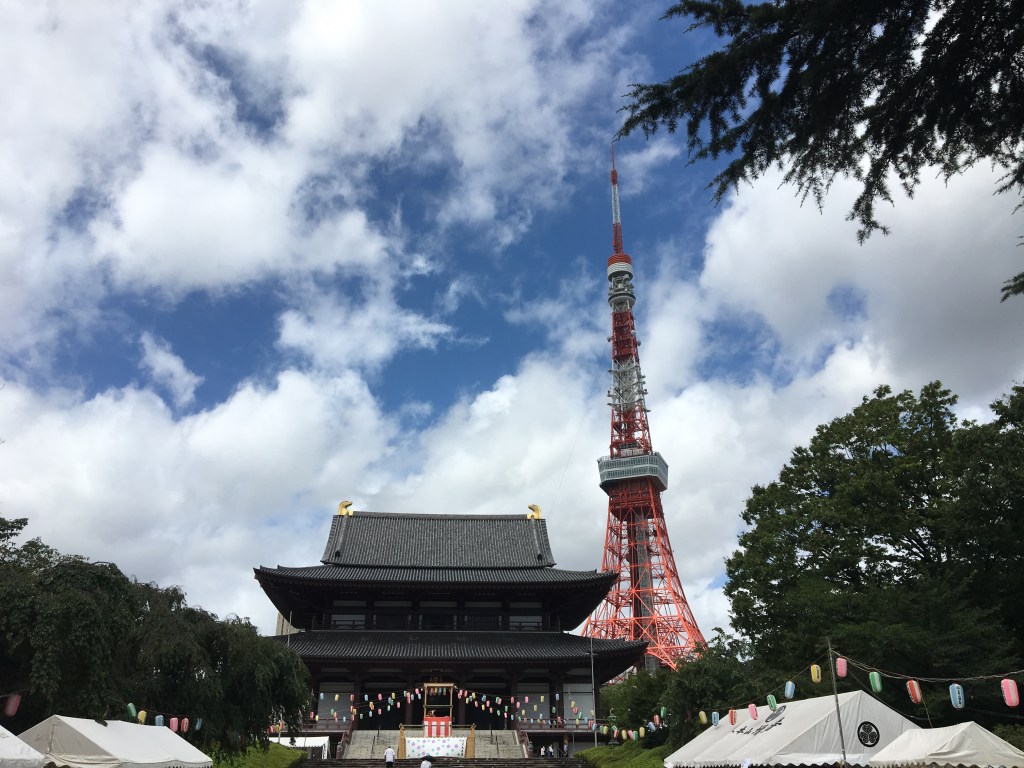
A few years ago, during our last trip to Japan before the Pandemic, we came to the famous Buddhist temple of Zojoji: one of two head temples of the Jodo Shu sect.
My wife and I like Zojoji in particular, and since it is right next to the famous Tokyo Tower, it is always worth a visit.
Taken in 2019, Tower Tower is in the back, about 2-3 blocks away.
Along its famous treasures is a “black Amida [Buddha]” statue which has a separate altar room, in the annex room to the right of the main hall:
Taken in 2019
Anyhow, on that visit, I picked up a neat little portable altar/image of Amida Buddha: it is normally wrapped in a small brocade envelope:
Inside you can see an image of Amida Buddha:
The writing on the left is a verse from the Shiseige (aka Juseige) a devotional set of verses, which is in turn an excerpt from a Buddhist text, the Immeasurable Life Sutra. The verse above reads:
神力演大光 Jin riki en dai ko 普照無際土 Fu sho mu sai do 消除三垢冥 Sho jo san ku myo 広済衆厄難 Ko sai shu yaku nan
With my divine power I [Amida Buddha] will display great light,
Illuminating the worlds without limit,
And dispel the darkness of the three defilements [greed, anger, delusion];
Thus I will deliver all beings from misery.
On the right is a poem by Honen (法然, 1133-1212), founder of Jodo Shu, called “Moonlight”. I talked about the poem here.
This folds out like a mini triptych, though it doesn’t stand up very well on its own.
Because it’s so small, yet very beautiful, it is a nice thing to carry with you sometimes for those moments of inspiration or private devotion.
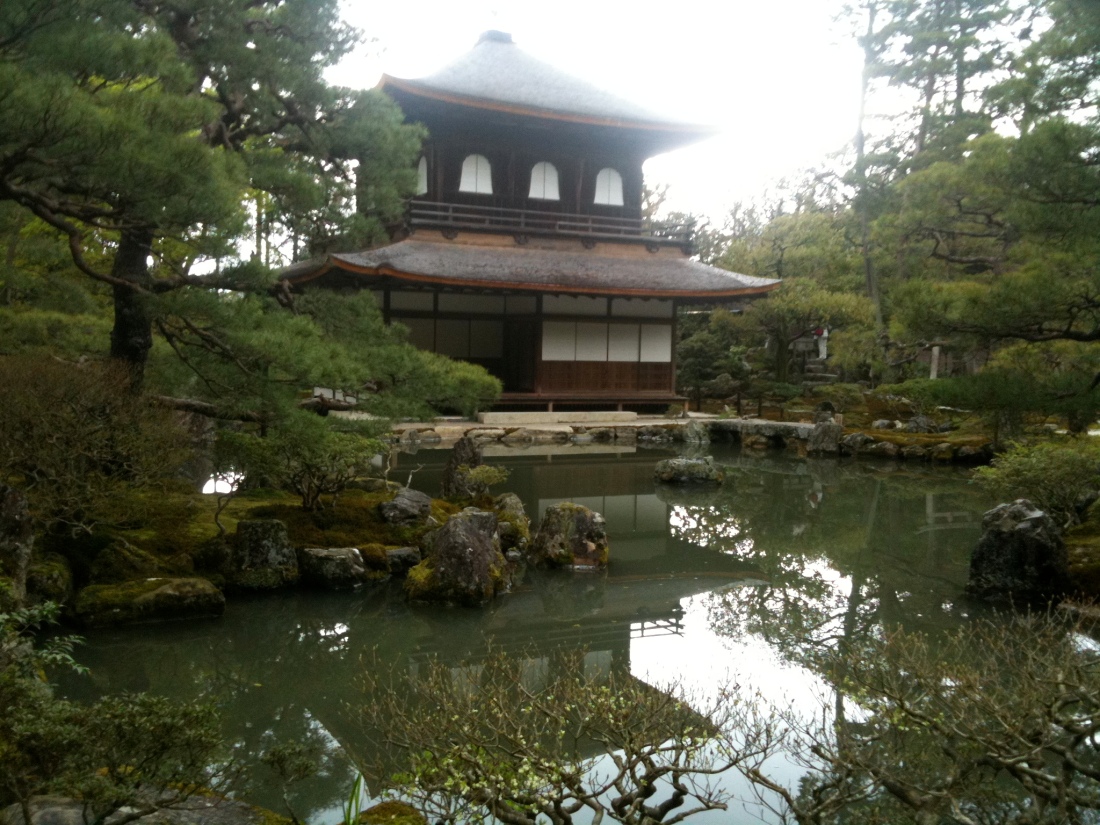
In Professor Donald Keene’s biography about the life of Shogun Ashikaga Yoshimasa (足利 義政, 1436 – 1490), includes a poem composed by Yoshimasa, now retired and living in his villa, the Silver Pavilion, ruminating on his former life as the supreme military commander of Japan:
Ashikaga no Yoshimasa, arguably one of the most influential people in Japanese art and aesthetics, yet ironically one of the worst military leaders in Japanese history, was never a serious student of Buddhism (though he was nominally ordained as a Rinzai Zen monk) but it’s interesting to hear him regret his life of luxury and power. To me, it is a contrast with Miyazawa Kenji’s famous poem Unbeaten By Rain (雨にも負けず).
A life of honesty poverty is probably better than wealthy lifestyle full of discord.
P.S. Photo taken of the Silver Pavilion, by me, in 2010.
Recently, my family and I observed the 100th day memorial for “baba”, my wife’s mother in Japan, and grandmother to our kids. This had me thinking about another poem by Lady Izumi1 from The Ink Dark Moon by Jane Hirshfield and Mariko Aratani:
Original Japanese
Romanization
Translation
跡をみて
Ato wo mite
Even in my dreams
偲ぶもあやし
Shinobu mo ayashi
I never think of you—
ゆめにても
Yume nite mo
how strange now,
何事のまた
Nanigoto no mata
seeing your handwriting,
有りしともなく
Arishi to mo naku
to recall…
Translation by by Jane Hirshfield and Mariko Aratani
I can understand this sentiment. When doing the memorials, it can feel kind of formulaic, but then sometimes I will see something that reminds me of my mother in law, and I can still her presence somehow. While I was in Japan, my father in law, noticing my interest in the Hyakunin Isshu, gave me a book to take home that belonged to his wife (my late mother-in-law).
「新百人一首をおぼえよう」(Let’s Memorize the Hyakunin Isshu, new edition) by 佐佐木幸綱 (Sasaki Yukitsuna)
This is a nice book, published back in 2002 that covers the Hyakunin Isshu anthology with lots of neat photography of famous locations, and tips and mnemonics for memorizing poems for karuta card game. I’ve enjoyed reading through it.
But more importantly, it provides a tangible link to my mother-in-law. Due to language barrier, I wasn’t able to converse with her much in my early years of marriage, and in the later years her health had declined to the point we couldn’t converse anyway. So, I wasn’t able to connect with her as much as I wanted to.
But with this book, I feel connected to her in a way I couldn’t before. My only regret is that we didn’t share this hobby before.
However, as Lady Izumi’s poetry shows, there is another side to grief and losing loved ones:
Original Japanese
Romanization
Translation
としをへて
Toshi wo hete
Through the years
物思ふことは
Mono omou koto wa
I’ve become used to sorrow:
ならひにき
Narai ni ki
there was not one spring
花に別れぬ
Hana ni wakarenu
I didn’t leave behind
春しなければ
Haru shinarakereba
the flowers
Translation by by Jane Hirshfield and Mariko Aratani
and:
Original Japanese
Romanization
Translation
頼むとて
Tanomu tote
Do you now know
頼みけるこそ
Tanomi keru koso
this world
はかなけれ
Hakana kere
is a waking dream?
昼間の夢の
Hiruma no yume no
However much I needed you,
よとは知らずや
Yo towa shirazu ya
that is also a fleeting thing…
Translation by by Jane Hirshfield and Mariko Aratani
As one gets older, one becomes somewhat numb to all the people that we’ve lost. The second poem here has overtly Buddhist undertones, reminding the reader that, as the Diamond Sutra famous says:
All composed things are like a dream, a phantom, a drop of dew, a flash of lightning. That is how to meditate on them. That is how to observe them.
Translation by Ven. Thich Nhat Hanh, in The Diamond That Cuts Through Illusion
For my part, I have lost friends as far back as high school, known relatives who have taken their own lives, lost loved ones due to cancer, dementia, pneumonia, etc.
Chances are, you have too.
As time goes on, this number will continue to grow. If you imagine scattered blossoms in spring, one can easily find parallels to life and the people all around us.
Here is another wonderful poem (previous posts here and here) by the 11th century Japanese poetess, Lady Izumi (izumi shikibu 和泉式部 in Japanese), that I found in The Ink Dark Moon by Jane Hirshfield and Mariko Aratani:
Original Japanese
Romanization
Translation*
ものをのみ
Mono o nomi
Should I leave this burning house
思ひの家を
Omoi no ie o
of ceaseless thoughts
出でてふる
Idete furu
and taste the pure rain’s
一味の雨に
Ichimi no ame ni
single truth
ぬれやしなまし
Nure ya shina mashi
failing upon my skin?
* Translation by by Jane Hirshfield and Mariko Aratani
The headline for this poem reads:
On the night of the sixth, the sound of the night monk’s voice reciting the Sutras mingled with the sound of incessant rain, and truly this seemed to be a world of dreams…
Lady Izumi cleverly makes not one, not two, but THREE separate allusions to the famous Lotus Sutra, in this poem. I’ve talked about the Lotus Sutra before. It’s a very influential Buddhist text in the Mahayana tradition, and contains many parables and dramatic allusions, compared to some of the drier, more textbook style Buddhist sutras. Thus, allusions to the Lotus Sutra are found throughout literature in East Asia. In my opinion, understanding the Lotus Sutra is key to understanding Buddhism in East Asia: Zen, Pure Land, Tiantai, Nichiren and Vajrayana, etc.
The “burning house” here alludes to the Parable of the Burning House of third chapter of the Lotus Sutra. I’ve talked about it here, among otherplaces. This is pretty straightforward to understand in the poem: the Burning House here is symbolic of the world we live in, burning with passions, craving, anger, delusion, old age, disease, and so on. We can step out of the burning house if we choose to, but we are often distracted by things in the house, and thus unaware that the timbers all around us are on fire, putting us in mortal danger.
The second allusion is that of rain. In the fifth chapter of the Lotus Sutra, there is a parable describing rain on plants, the so-called The Parable of the Medicinal Herbs:
What falls from the cloud is water of a single flavor, but the plants and trees, thickets and groves, each accept the moisture that is appropriate to its portion. All the various trees, whether superior, middling or inferior, take that is fitting for large or small and each is enabled to sprout and grow. Root, stem, limb, leaf, the glow and hue of flower and fruit— one rain extends to them and all are able to become fresh and glossy, whether their allotment of substance, form and nature is large or small, the moistening they receive is one, but each grows and flourishes in its own way.
The Buddha is like this when he appears in the world, comparable to a great cloud that covers all things everywhere, Having appeared in the world, for the sake of living beings he makes distinctions in expounding the truth regarding phenomena.
This is, for me, one of my most favorite parts of the Lotus Sutra. As a sutra, it’s very inclusive (cf. the Parable of the Dragon Princess), but it also acknowledges that there is a huge variety of people in the world. Some people are just different than others, but they can all benefit from the Dharma in their own way, just like the various plants in world drinking from the rain.
Finally, the third allusion in Lady Izumi’s poem is that of a single “taste”. Both the Parable of the Burning House and the Parable of the Medicinal Herbs make a single point: the Dharma of the Buddha appears in a variety of ways, or “gates” for one to enter, but in the end the Dharma tastes the same equally, and is but one truth. So, whichever gate one enters, the rain will ultimately taste the same. For the Burning House, when the children come outside, their father offers, in the end, a single magnificent cart (not many) to offer them as an incentive.
Turning back to Lady Izumi, it’s obvious that she was very thoughtful of these things, even if she struggled to practice them amidst her life. Even when she was surrounded by scandal, and lost both her lovers and her daughter to illness, she could see past it and look at the greater picture.
A while back, I talked about a famous poetess from 11th century Japan named Lady Izumi, one of several famous ladies of the court at that time, but for some reason the one I find most fascinating.1 Lady Izumi was a prolific poet, and I have been reading samples of her poetry compiled in The Ink Dark Moon by Jane Hirshfield and Mariko Aratani. I found this poem the other day and wanted to share. The headline of the poem was that Lady Izumi was on retreat while on retreat at a mountain temple in autumn…
Original Japanese
Romanization
English translation*
心には
Kokoro niwa
Although I try
ひとつみのりを
Hitotsu minori wo
to hold the single thought
思へども
Omoe domo
of Buddha’s teaching in my heart,
蟲のこゑこゑ
Mushi wa koegoe
I cannot help but hear
聞ゆなるかな
Kikoyu naru kana
the many crickets’ voices calling as well.
* Translations by Jane Hirshfield and Mariko Aratani
I think this speaks to the classic frustration many Buddhists (among others) have: the willingness to undertake a practice, and the reality of not being able to stay focused. If it were easy, we’d probably all be doing it.
Lately, in an effort to reconnect to the local Buddhist community, and due to recent experiences in Victoria, BC, I decided to join a local Soto Zen group for remote meditation sessions. It’s been great actually: I have something in the week to look forward to besides more work meetings, and it provides a nice spiritual anchor in my life again. However, I noticed that while meditating for 25 minutes at a time, my mind rarely stays focused for long. Sometimes I can discipline myself for a few minutes, counting my breaths, etc. However, most of the time my mind is just wandering around for most of the session.
When I was younger and first encountered the nembutsu, I used to dedicate myself to reciting the nembutsu 1080 times (using my rosary to help count). Usually this takes about 15-20 depending on the speed of recitation. I (surprisingly) continued this practice for months. However, I also noticed a pattern: my mind would quickly grow bored from reciting, then anxious to hurry up and finish, and then relief when I got near the end. My mind would wander, just as it does with meditation.
So, the experience that Lady Izumi has is not unique to her, and even now, a thousand years later, I can empathize with her.
Further, I don’t think there’s an easy solution here: it’s something that every one has to work out for themselves.
Namu Amida Butsu
1 Speaking of fascinating, you might like to read my review of the Diary of Lady Murasaki, her contemporary on my other blog. Lady Murasaki evidentially didn’t think too highly of Lady Izumi.
With all the time I have to kill while in quarantine in the den, I have been cleaning up my old blog on the Hyakunin Isshu poetry anthology. It’s been great rediscovering things, including poem 60 of the anthology, a poem composed by Lady Izumi‘s daughter, Ko-Shikibu no Naishi (小式部内侍, d. 1025).
Lady Izumi by this time had quite a reputation as a master poet, and her daughter probably had to live in her shadow. While her mother was away in the province of Tango, Ko-Shikibu no Naishi was participating in a poetry contest, a major social event among the aristocrats of capitol. These contests were serious business. The host would choose a topic, and pit poets against one another, and the right poem could really make or break one’s reputation.
As part of the contest, Middle Counselor Sadayori started trash-talking Ko-Shikibu no Naishi saying:
What will you do about the poems? Have you sent someone off to Tango [to ask your mother for help]? Hasn’t the messenger come back? My, you must be worried.
So, Ko-Shikibu comes with some poetic freestyling:
The poem doesn’t translate easily into English, but according to Dr Mostow, the poem is a masterpiece because it recites three places in Tango Province in geographic order, has the following puns:
iku in Ikuno also means to go 行く, and
fumi means both a letter 文 and to step 踏み, and
the bridge mentioned, Ama-no-Hashidate, is associated with “stepping” too.
… and she did all this off the cuff.
The comeback was so good, that Sadayori reportedly fled.
Picture this, but it’s 1,100 years ago, in Japan, and Eminem is a lady.
Pretty amazing comeback by Ko-Shikibu no Naishi, and a sign that talent runs in the family. Sadly, her life was snuffed out at a young age due to illness, and Lady Izumi never quite recovered with loss…
In the old Japanese calendar, based on the 24 periods of the ancient Chinese calendar, the third day of the second month is marked as risshun (立春) or the coming of Spring. Granted, it was still cold outside and flowers hadn’t really blossomed yet, but it is considered the start of the Spring season.1 It marks the time when nature is just starting to defrost, and wake up.
Among the first things that traditionally bloom are plum blossoms, such as those featured in the photo above (courtesy of Wikipedia).
One of the poems from the Hyakunin Isshu anthology, poem 35, touches upon this exciting feeling of the first blossoms of the year:
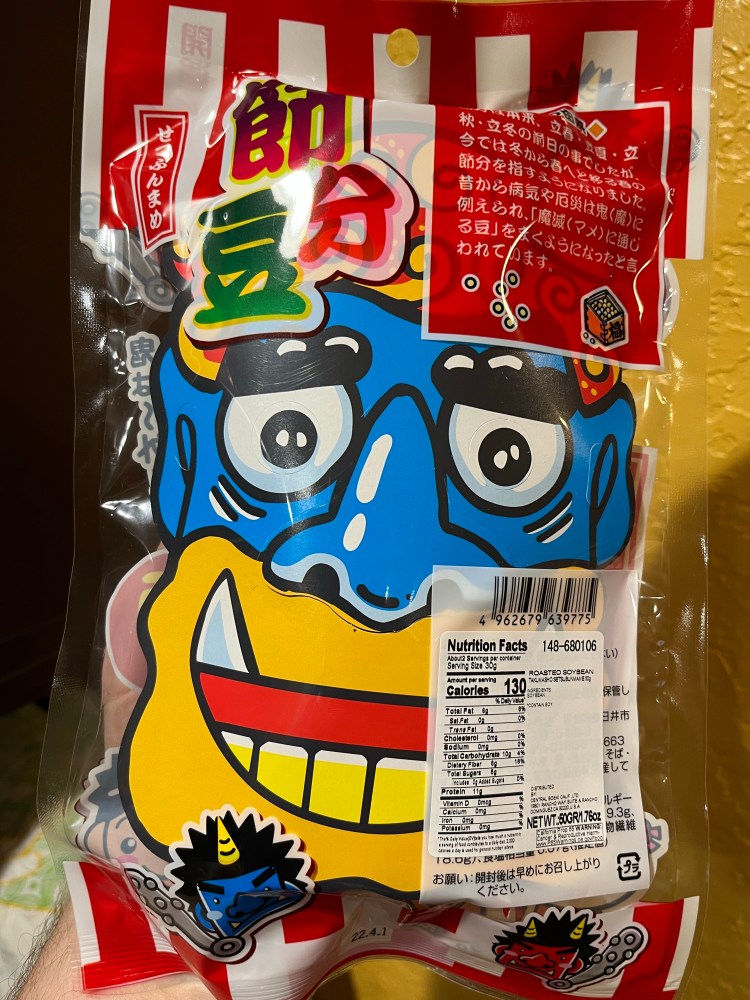
Finally, let’s talk about Setsubun. Every year we celebrate this Japanese holiday with the kids, and over time the Oni mask I use to “scare” the kids has evolved over time, including one my daughter made many years ago and was (unintentionally) a bit terrifying.
This year, we finally got a real mask rather than a homemade one:
This handy Setsubun “kit” provides the cooked soybeans that the kids throw and a nice Oni mask for me to wear. Basically everything you need for mamemaki! As mentioned in past posts, the tradition is for the dad to dress up as an Oni, a kind Japanese ogre, and knock on the door while the kids throw roasted soybeans at him to drive out bad luck and welcome in good luck for the year. Since Lunar New Year used to fall a couple days before Setsubun, this was part of the New Year tradition.
Supply of traditional goods like this from Japan vary quite a bit each year, even before the pandemic, so we were lucky to get a hold of one this year. It’s unclear if the mask will fit my big American face, but we’ll see. If I can, I’ll try to post some photos or a video.
Happy (early) Spring everyone!
1 Here in the PNW, the last day of frost is said to be March 10th, according to my gardening book. Spring comes extra late here.
The twilight years of the Heian Period of Japan (late 12th century) mark the high-point of the refined Imperial Court, its aristocracy and their literary culture. Poetry at this time, epitomized by the Hyakunin Isshu, was a popular past-time and frequent means of corresponding between men and women (often on the sly). A person’s career or reputation could be made or broken by a skillful, or clumsy, poem. Many of the ladies-in-waiting serving the court aristocracy would also go on to become famous writers in Japanese literature:
Lady Murasaki (Japanese: murasaki-shikibu 紫式部) – who wrote the first Japanese novel, the Tales of Genji, and her own diary is a fascinating read. She is part of the social circle around Empress Shōshi. She is also known for poem 57 in the Hyakunin Isshu anthology.
Sei Shonagon – who wrote the Pillow Book, a free-form thought about the minutia of Heian Period society. Sei Shonagon was part of a rival social circle centered around Empress Teishi. She is known for poem 62 in the Hyakunin Isshu.
Akazome Emon – another accomplished poet in the same social circle as Lady Murasaki. She composed poem 59 of the Hyakunin Isshu among her many other accomplishments.
And finally we come to perhaps the most the most controversial, and yet one of the most brilliant ladies among this generation of ladies-in-waiting turned writers: Lady Izumi. In Japanese she is called Izumi Shikibu (和泉式部).
Like all women at the time, her real name is not known. She is named after her husband’s region of administration (Izumi province), and her father’s role in the Imperial court as master of ceremonies (shikibu 式部). Lady Izumi was born into the elite aristocracy in Heian society of the time, but she distinguished herself both with her particular skill in poetry and with her tendency to get involved in scandalous relationships.
While unhappily married to her husband, Tachibana no Michisada, she had an affair with Prince Tametaka, the third son of Emperor Reizei, which caused her to be divorced and shunned by her family. Her ex-husband also took custody of their only child, a daughter named Koshikibu no Naishi (poem 60 in the Hyakunin Isshu). However, before long her lover Prince Tametaka died due to illness.
Later, Prince Tametaka’s brother Prince Atsumichi approached Lady Izumi and a romantic relationship began. Lady Izumi’s “Diary of Lady Izumi” (izumi shikibu nikki 和泉式部日記) covers this period of time, and their correspondences to one another. For example, she composed the following as a reply to Prince Atsumichi:
Japanese
Romanization
English
薫る香に
Kaoru ka ni
Rather than recall
よそふるよりは
yoso uru yori wa
in these [tachibana] flowers
ほととぎす
hototogisu
the fragrance of the past,
聞かばや同じ
kikaba ya onaji
I would like to hear this nightingale’s voice,
声やしたると
koe yashitaru to
to know if his song is as sweet.
Translation by Jane Hirshfield and Mariko Aratani in The Ink Dark Moon: Love Poems by Onono Komachi and Izumi Shikibu, Women of the Ancient Court of Japan
She also left behind many romantic poems such as this one (undated, so it’s unclear who he is), which I was surprised to see quoted in the drama Thirteen Lords of the Shogun:
Since she was divorced anyway, she moved in with the Prince and her relationship with Prince Atsumichi was an open scandal for the Court. They would often be seen riding his carriage through the capitol. Prince Atsumichi’s wife was furious about the affair, and returned to her family, while public criticism of the couple became increasingly harsh and unavoidable.
In the end, Prince Atsumichi, like his brother, died from illness at the age of 27. Lazy Izumi was once again heartbroken.
By this point, Lady Izumi had few options, and no support from her family, so she was taken in as a lady in waiting for Empress Shoshi,1 where she served alongside another notable ladies Akazome Emon and Lady Murasaki. Empress Shoshi’s father, the ambitious Fujiwara no Michinaga, wanted to gather as much talent under his household as he could. However, Lady Murasaki didn’t think too highly of her:
Izumi Shikibu is an amusing letter-writer; but there is something not very satisfactory about her. She has a gift for dashing off informal compositions in a careless running-hand; but in poetry she needs either an interesting subject or some classic model to imitate. Indeed it does not seem to me that in herself she is really a poet at all.
— trans. Waley, “Diary of Lady Murasaki”
Later, Lady Izumi married Fujiwara no Yasumasa and moved to the provinces, and she was reunited with her only daughter (now in her 20’s). Tragedy struck yet again as her daughter died soon after the reunion, leaving behind two children of her own. Lady Izumi was devastated by this loss, but thinking of her grandchildren, she wrote:
Japanese
Romanization
English
留め置きて
todome okite
Left behind [grandmother and grandchildren]
誰をあはれと
tare wo aware to
whose loss do you
思ひけん
omoi ken
think is more pitiful?
子はまさるらん
ko wa masaruran
The children’s loss is worse
子はまさりけり
ko wa masarikeri
Indeed, the children’s loss is worse.
Rough translation by me, please take it with a grain of salt
By this point, she devoted herself to the Buddhist path as a lay nun named Seishin Insei Hōni (誠心院専意法尼). One of her last poems she composed, poem 56 in the Hyakunin Isshu, is:
This poem, based on Japanese commentaries I’ve read, wasn’t meant to be a simple chat, she was likely missing someone she was still intimately involved with, though it’s unclear who.
Lady Izumi is a fascinating figure to me. She was obviously quite attractive. In a very closed, and high-scrutinized society as the Heian-era court aristocracy, multiple men of very high rank risked considerable scandal just to be with her. In layman’s terms, men of the time thought she was really hot.
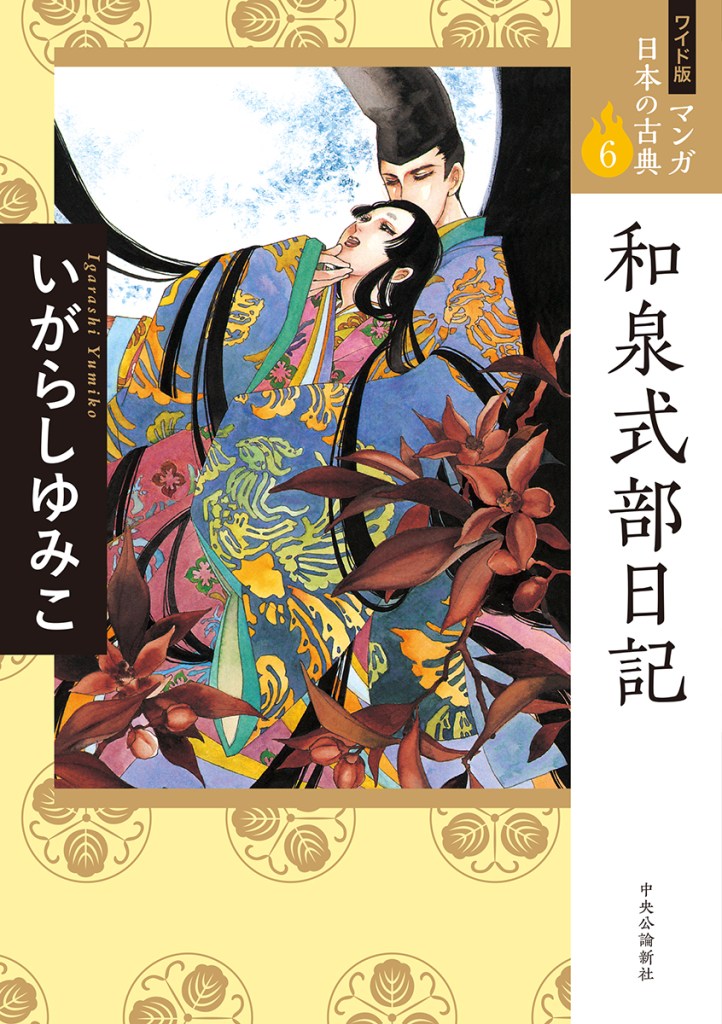
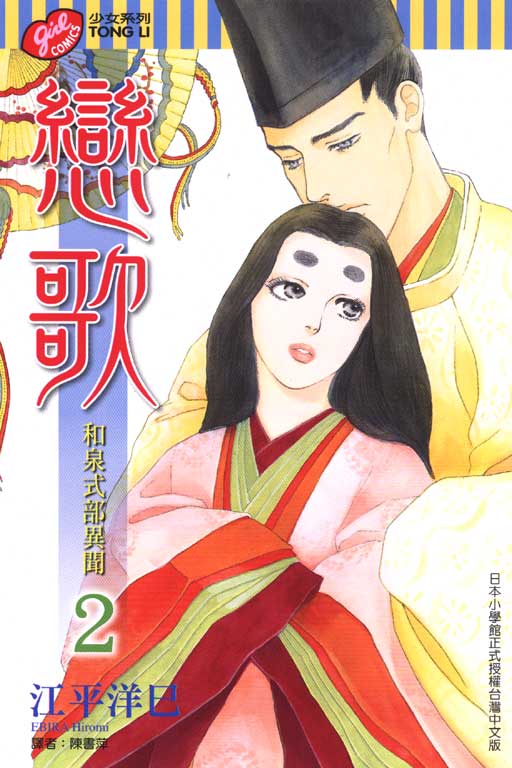
Even today, she is the subject of many romantic manga (Japanese comics) written for young women in Japan:
The comic 恋ひうた (koi uta, “Love song”) by Ebira Hiromi (江平洋巳)
The Diary of Lady Izumi (izumi shikibu nikki 和泉式部日記) by Igarashi Yumiko
A Chinese-language edition of “Love Song” by Ebira Hiromi
As well as stories about her life:
But Lady Izumi was also more than a femme fatale. She was obviously quick-witted, had many poetic talents, plus she was a loving mother (and grandmother), and a devout Buddhist who suffered many losses in her life. To me, she epitomized the bittersweet life of being a woman in Heian Period aristocratic society.
1 As Empress Shoshi was the second wife of Emperor Ichijō and a pawn in the power-struggles between two rival branches of the Fujiwara clan (the other faction tied to Emperor Ichijo’s first wife Empress Teishi), this was not a great position to be in, at least until Empress Shoshi successfully gave birth to a son.









 Gleanings in Buddha-Fields


You must be logged in to post a comment.