SPOCK: On my planet, to rest is to rest — to cease using energy. To me, it is quite illogical to run up and down on green grass, using energy, instead of saving it.
Star Trek, “Shore Leave”, stardate 3025.2
Unlike my 2024 post, I intend to really take time off this time.
The truth is, is that I am deeply burned out. My wife and discussed this recently, and the chaos of preparing our firstborn for college, and our second-born ready for middle school, plus work demands have left us deeply exhausted. When we described it to one another, we quickly concluded that we were not depressed, just burned out. As parents, we had been running at full speed for almost two years, and now that things have quieted down, the fatigue finally caught up to us.
So, for the rest of 2025, I want to just sit around and do nothing: no personal projects, blogging, etc. I do plan to do some light reading (including some new books I picked up), play more soloThe One Ring RPG, watch more Star Trek,1 maybe finally finish painting some figurines that have sat half-completed for a year. I have one more blog post in the works, but otherwise, I’m taking some much needed personal downtime.
Just some of my unfinished painted figurines…
Thank you all for your understanding, and I wish you both a happy holidays and a wonderful new year!
1 I also recently picked up the Star Trek Adventures role-playing game from Modiphius as well, but I haven’t progressed very far in learning the game yet.
This past week, I have been in Dublin, Ireland. The purpose of this trip was (among other things) to help my daughter settle in to your her new life in Trinity College Dublin.
She graduated high school this year, and it’s been a slow-moving, emotional roller coaster as we come face to face to with the fact that our firstborn is leaving the nest. Of course, logically this was always going to happen, but actually facing it is harder than expected. As a father, she has been an important part of our life for the last 18 years, and the thought of letting her go especially in a place where I cannot protect her became increasingly stressful.
Dublin itself, is a great city: very walkable, safe in a way you don’t find in US cities,1 friendly people, and lots of awesome European food you can’t really find here in the West Coast.
A view of Dublin from my daughter’s accomadation
And yet, when my daughter and I arrived in Dublin, we had only five days to get setup with things like:
Apartment (student housing)
Bank account (since it’s a different country)
Mobile phone (same reason)
Figure out food sources
Figure out public transportation
Get some basic home goods since we couldn’t possibly bring it all from the States.
Meet some local friends we know to help my daughter establish a local support network, etc.
Out of those five days, I had to some work in Dublin as well (I couldn’t take five full days off), so it was more like three days.
The good news is that we quickly got many of these things sorted out. We found a good mobile service, found some groceries and good restaurants nearby, and her student accommodation is very close to the Luas tram, and the Luas runs often and is easy to get tickets for. If you visit Dublin, definitely learn to use the Luas.
However, during this time my stress and depression was very intense. As soon as my daughter was out of sight, I was full of fear of something bad happening to her (being a lone, young woman), and also really depressed to let her go. I remember a couple nights alone in the hotel where I hardly slept, partly due to jetlag, and partly due to sheer emotional stress.
But I thought about it, and I realized that beyond practical concerns, I was deeply clinging to my daughter. I like to think I was a pretty involved parent, and that I did my best to be both a good father and a friend, and suddenly 18 years of this was ripped away the moment that we set foot in Ireland, and my mind couldn’t handle the abrupt change. In short, I think part of my panic was grounded in ego as a parent. Once I realized my selfish ego was driving this panic, I paused.
Me having breakfast at a local Cafe Nerro in Temple Bar, while reading about the Heart Sutra.
Thinking about this further, the only way she would prosper was to let her get on her feet, help when she needs help, but otherwise, give her space to grown and learn. In short, I had to trust her.
This was hard at first, but I kept reminding myself “trust her, trust her” and by and by I learned to let go. Instead of constantly trying to protect her, I encouraged her, provided any advice I could, and let her explore the city herself. She got lost a couple times on the Luas (got off at the wrong stop), but soon she started finding shops she liked, and could get to and from Dublin city centre without issue.
So, by the end, things were looking up: my daughter was getting on her feet, and we had met a few friends who all happily wanted to help her, and we enjoyed some pub visits, and good European food.
The point of all this, I guess, is that if you are a parent, and you are dreading your children leaving the nest, ask yourself how much of this is concern for your kids, and how much of this is concern for yourself. My job, as a parent, is to provide a safe, loving environment as they grow, but I don’t own my kids. That’s just ego.
Namu Shakamuni Butsu
Update: After I wrote this post, my daughter texted us to let us know she had made some friends already. 🥰
P.S. Unrelated, but September 9th is the Day of the Chrysanthemum holiday in Japan. If you can, maybe decorate the house with a few chrysanthemums, or enjoy the weather with a friend. Happy Day of the Chrysanthemum to you all.
P.P.S. Happy Star Trek Day (September 8th)! Live long and prosper. 🖖🏼
1 It’s hard to explain: when I am in the US, there’s always a subtle feeling of tension. Not just recently, but even 15 years ago when I first came back to the US. When I am Ireland, everything feels more relaxed. The way people talk to one another, even when they tease each other, etc. Dublin city centre at night has plenty of drunks stumbling about, racial tension toward immigrants, and fist fights, but somehow everything feels less …. contentious. Since many Americans don’t travel, we don’t realize how wound up we are.
True story, I had some spare time one day recently to sit and meditate,1 first time in a while. I set the app to 10 minutes, and sat on the ol’ cushion. About five minutes into this, my youngest child walked in and asked me to unlock the parental control on his tablet.
Concentration broken, oh well.
This is a frequent issue with being a parent and being a Buddhist, but it’s not a new one.
In the Buddha’s time, he distinguished the “householder” followers with the “renunciant” ones. This wasn’t meant to denigrate one versus the other, but it was intended to differentiate those who fully could devote themselves to the Dharma (the “renunciants”), to those who had other, competing obligations (the “householders”). Because the renunciants could, in theory, devote themselves full time to practice, and had cut loose any personal obligations and bonds, they could progress a lot further along the Buddhist path. The lay followers (householders) could still progress, but they would be hampered by their mundane obligations, social “entanglements”, and such.
However, because the Buddhist path was intended to help all, the renunciants would set aside certain days of the lunar month for outreach, helping lay followers through teaching and shared practice. This is known as Uposattha in the earliest Buddhist communities.
In later centuries, especially through the Mahayana tradition, Buddhist thinkers and communities sought to expand Buddhist practice to be more engaging toward lay Buddhist followers. The goal of such practices was not intended to replace the traditional monastic establishment, but (I believe) to help fill in the gaps. By expanding the available gates of Buddhist practice, people from all walks of life could find a place to start, and progress. In other words, an even more inclusive Buddhism.
Which comes back to my situation.
If we think of daily life as a box, there are only so many Lego bricks we can fit in there. Most of those Lego bricks, as a parent, are already spoken for, so that leaves only a bit of space left for “me time”. Within that spare time, self-help can be time-consuming, impractical. Or, one is just too mentally exhausted to do anything else but space out. In some ways, life as a “householder” hasn’t changed all that much since the Buddha’s time. We suffer less from hazards like dysentery and Viking raids, but the distractions and obligations are still there.
In any case, until the kids leave the nest, and especially after retirement, I have to be realistic in my own expectations. Simple practices such as the nembutsu, the odaimoku (a la Nichiren Buddhism), the Mantra of Light, or the Heart Sutra, combined with upholding the Five Precepts amidst daily life, are a helpful way to keep up one’s training while being realistic about time and energy. Even reciting something as simple as the nembutsu deepens the karmic bond with the Buddha and hopefully makes the world a slightly better place.
Also even a bit of forward momentum is better than to squander one’s life staring at a screen. 😉
1 my meditation routine has always been very … inconsistent.
My wife and daughter both tested positive for COVID on Wednesday and had to isolate themselves since then. I took time off from work, bring them food, do the housework, and look after our son, ferry him to various social events and playdates, while also looking after a one year old puppy. Then, the puppy developed conjunctivitis (pink eye) as of yesterday. Further, my old acid reflux problem reared its head recently causing plenty of misery for me.
The week has been a train wreck but we’ve managed. Thankfully my wife and daughter’s both had miles symptoms and will be out of quarantine soon.
Amidst all the chaos, I tried to keep up daily Buddhist practice, with mixed success. This morning I just had only enough time to recite the Three Treasures: namu-ki-e-butsu, namu-ki-e-ho, namu-ki-e-so (praise to the Buddha, Dharma, and Sangha).
If you’re a parent, especially a single parent like my mother was, sometimes that’s all you can realistically do. That’s also true if you’re young and just getting on your feet, working a grueling 9-5 job, or you’re caring for ill or elderly family members.
Such people don’t have the time or energy to contemplate Tibetanyidam or participate in a Zen sesshin. How can someone working a demanding warehouse job at Amazon maintain mindfulness when you barely have time for a lunch break? How can a school teacher afford a retreat to Bhutan when they’re scraping money to get adequate school supplies in the classroom?
For most working-class people dealing with stress, financial woes, or parenting, such Buddhist practices are a privilege they can’t afford, but they shouldn’t be excluded either. This was a problem faced centuries ago and continues in the West today.
Instead, when your world is falling apart, or you’re cleaning poop from a baby’s diaper, or trying to mentally shut out the weirdo on public transit, sometimes it’s just enough to say the nembutsu: na-mu-a-mi-da-butsu. Maybe you can’t maintain a Buddhist altar, but it’s just enough to keep a small image in your wallet that you drew or printed out. If you can’t afford good Buddhist books, make your own.
I am not joking or making light of Buddhist practice either. Consider this verse from the second chapter of the Lotus Sutra:
If someone with a confused and distracted mind should take even one flower and offer it to a painted image, in time he would come to see countless Buddhas.
Or if a person should bow or perform obeisance, or should merely press his palms together, or even should raise a single hand, or give no more than a slight nod of the head, and if this were done in offering to an image, then in time he would come to see countless Buddhas.
And if he himself attains the unsurpassed way and spreads salvation abroad to countless multitudes, he will enter the nirvana of no remainder as a fire dies out when the firewood is exhausted.
If persons with confused and distracted minds should enter a memorial tower and once exclaim, “Hail to the Buddha!”
Then all have attained the Buddha way.
Translation by Burton Watson
Or this quote from the Sutra on the Buddha of Immeasurable Life:
“If, sentient beings encounter his [Amida Buddha’s] light, their three defilements are removed; they feel tenderness, joy and pleasure; and good thoughts arise. If sentient beings in the three realms of suffering see his light, they will all be relieved and freed from affliction. At the end of their lives, they all reach emancipation.
Translation by Rev. Hisao Inagaki
Sometimes it’s OK to just recite the nembutsu, or the Three Treasures above. It may not do much to relieve stress, or fix your situation but be assured that every tiny little bit you do to recite the Buddha’s name, or uphold the Five Precepts (or even one of them), anything you do to live an upright, honest life does count for something.
This isn’t empty platitudes either. This is straight from the Lotus Sutra and the Mahayana Buddhist tradition at large. Like contributing to a savings accounts, every little bit you do, however small, is just one step closer to your goal. Every good, wholesome seed you plant will bear fruit someday. Every time you dedicate that good merit towards the benefit of others, it will multiply even further.
No matter how shitty your life is, believe in yourself, believe in the power of the Buddha-Dharma, and trust that even a moment’s recitation or a a single good act can and does make a difference.
The Japanese-Buddhist phrase samu (作務) is often associated with Zen, and refers to a kind of Buddhist work ethic, especially for monks. While monks in ancient India were expected to beg for alms and focus exclusively on practice, when Buddhism reached China the criticism from native Confucian scholars about “lazy monks” forced a change toward self-sufficiency.
Thus monasteries in China developed a work-ethic that emphasized monastic work, and work as a Buddhist practice, however this was not universally practiced. Buddhist communities that adopted this ethic tended to survive the Buddhist purge of 845, and passed on such monastic rules to future communities in Korea, Japan and Vietnam.
I was surprised to learn that this tradition of samu wasn’t limited to Zen, though. I found an article (Google Translate version) about samu in Tendai Buddhism:
“Thus, even in the world of monks endeavoring on the Buddhist path, as a daily training, it has been said since antiquity that ‘first samu, second practice, and third knowledge.'”
As the article says, it’s tempting to see Buddhism in terms of meditation and such, but these are only part of the story. The work we do each day, whether that be parenting, office work, etc., is just as important, if not more important, than meditation. This is because our day to day activities, done in a Buddhist light, help train us bit by bit.
Once one sees daily work in this way, and makes it a foundation for their Buddhist path, then adding home practice (gongyō) within this is a healthy thing to do.
I mention this, because it’s tempting to see work, parenting and such as getting in the way of Buddhist practice, because we tend to hold an unrealistic view of how Buddhism is practiced. But this is a problem that past generations solved long ago by realigning daily obligations into a more Buddhist context.
The work we do benefits others, even if we are just doing it to pay bills, or out of obligation. Right livelihood is also one facet of the Noble Eightfold Path.
Instead of treating Buddhism as a way to escape our problems, we are encouraged to embrace our life as it is and make it a Buddhist one.
Namu Shakamuni Butsu Namu Amida Butsu
1 Even in the Buddha’s time, the monks were carefully instructed not to beg for alms after early morning, to reduce the burden on the lay community. Further whatever they received was meant to last them the whole day.
Hello readers and happy Hanamatsuri to those who celebrate the birthday of the Buddha, Shakyamuni (a.k.a. Siddhartha Gautama).
This past week has been crazy, mainly because we have a new addition to the family:
Her name is Cherry, and she is a 12-week old pug/beagle mix that we adopted. She was abandoned by her original owner in a garbage bag, and later rescued. Since she was staying with a foster family in our area, the adoption process was very quick. Overnight (literally), we had a new puppy in our life and have been scrambling to adjust since.
She is not the first dog we have adopted, but by far the youngest, and we’ve been in for a shock. She hasn’t been house-broken yet, and still has many of the classic puppy habits: biting, lots of energy, teething. and a small bladder.
She is a very sweet dog, but the past week has been very disruptive. We have little time to sit and relax, and she may suddenly decide to start biting our toes or hands when she’s bored or wanting to play rough. Also, our carpet is a mess as we are still training her to toilet outside, and don’t always get it right.
Needless to say, it has been both a fun and miserable experience. When she is taking another nap on my lap, it is very pleasant, when she is destroying the house, not so much.
Which brings us back to Hanamatsuri.
The Buddha taught the importance of self-reflection over and over again. It’s easy to be at peace and a good Buddhist when life is going your way. But, when life is difficult, you are tried, or stressed, then your true nature will emerge, and it is often ugly to look at.
I see it in myself. Apparently this is known as the “Puppy Blues”, too. There are times I wish someone would just take her off our hands. There are also times when I am frustrated, and just don’t want to deal with her. In this respect, Cherry is a mirror to myself. Through her, just as through raising kids, I see my true nature.
But it’s good to be aware of these things. Not just intellectually, but to experience and see it firsthand. It’s unpleasant to confront, but it’s important to recognize those feelings exist too. I love little Cherry and don’t want her to suffer anymore, so I have no desire to send her back. Further, I know it will get easier with time, just as it was with little kids, and just like little kids, it gets more rewarding over time.
However, it does require constant vigilance toward my own mind. One should not kid oneself and get complacent. Just as training a puppy takes considerable patience and persistence, so does training one’s own mind.
Easier said than done, but there is no alternative if one does not wish to break through to a state of peace, and also benefit those around you.
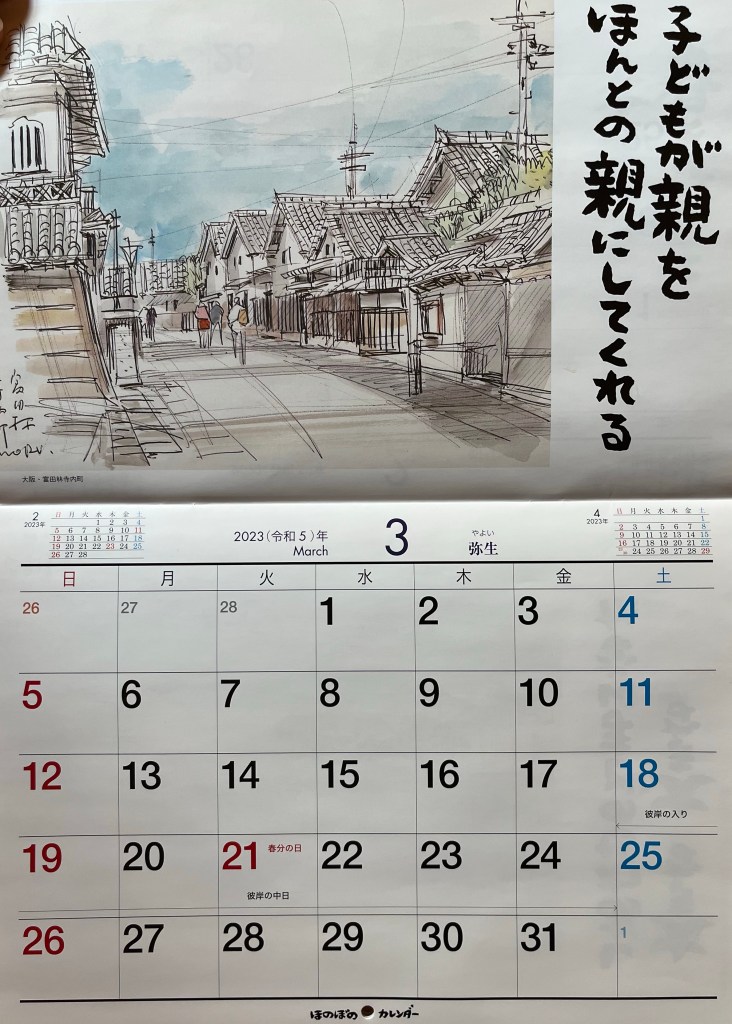
As of writing it is the month of March, or in the traditional calendar of Japan, the month of Yayoi (弥生, “new life”). We frequently get certain Buddhist-themed calendars from Japan every year due to my wife’s family’s connections, in particular the Honobono calendar series.
In addition to the terrific artwork, each month has some bit of Buddhist wisdom on the right hand side. This month’s is the following text:
子どもが親をほんと の親にしてくれる Kodomo ga oya wo honto no oya ni shite kureru.
What this is basically saying is that through their children, parents learn to be parents. In a positive sense, this means that both parent and child grow together.
Parents can learn a lot about themselves from their kids, even when this is not always pleasant. It forces us to confront some petty and selfish aspects of ourselves, but if we reflect on it, we can grow too, just like our kids. I know from personal experience, when my firstborn daughter was 3 months old, I made a resolution to uphold the Buddhist teachings a lot more, especially the Five Precepts, and stop being such an immature, man-child. This process for growth took many twists and turns, but I like to think that I did grow as a person through my own kids.
Compare this to a well-known proverb in Japanese: kodomo wa oya no kagami (子供は親の鏡) meaning that children are a mirror of their parents. The latter though, tends to have a more practical, negative explanation why some kids are just poorly raised: it reflects their parents’ lack of maturity and poor personalities.







 Gleanings in Buddha-Fields
You must be logged in to post a comment.